Ms. M.
Ms. M. is a 40-year-old female who sustained a traumatic brain injury (TBI) and spinal cord injury in a motor vehicle accident. An MRI of the cervical spine showed a comminuted fracture at C4-6 with spinal cord involvement, resulting in complete quadriplegia. An MRI of the head showed left-sided cerebellar infarcts and diffuse axonal injury with multiple scattered bleeds involving the corpus callosum and gray-white junction in the cerebral hemispheres. An EEG completed the same day was suggestive of moderate diffuse encephalopathy. A follow-up EEG showed similar findings but with a rich mixture of wave forms.
A month into recovery, Ms. M. was seen by a neuropsychologist to evaluate her understanding and ability to communicate, and to make recommendations regarding optimizing communication. An initial evaluation revealed limited head movement with inconsistent, single-word verbalization after extensive verbal cueing. Attempts were made to develop a reliable method for communication. It was determined that sticking out her tongue would indicate “no” and closing her eyes would indicate “yes.” Using this system, Ms. M. was able to respond to questions related to personal information. The content of her answers was verified against the report of family members and her medical history. Once reliable communication was determined, Ms. M. was asked simple questions related to symptom management, including, “Are you having pain?” and “Are you feeling short of breath?” Her responses to these questions informed clinical staff and family during medical decision making.
Following the determination that Ms. M. could respond to simple yes/no questions, a speech-language pathologist was consulted to further optimize communication. Extensive training was provided with low-tech augmentative and alternative communication methods, including a communication board. Using this method, Ms. M. was able to communicate basic needs. Ms. M. would respond to questions by sustaining her gaze to one of several answers printed on the board. The speech-language pathologist would then point to the selected answer, and Ms. M. would confirm with her respective gestures for yes or no. This increased the complexity of Ms. M.’s communication despite continued impairments in expressive language. Ms. M.’s medical team wished to determine if she was able to make medical decisions on her own, but it was not clear if Ms. M. retained the cognitive functions required for decision-making capacity, nor how to evaluate this given her communication impairments.
Recent case discussion has raised the possibility of assessing decision-making capacity in patients like Ms. M., Footnote 1 yet no systematic approach for assessment has been outlined in the neurological or neuropsychological literatures. In this article, we explore potential solutions to the challenges raised by Ms. M. and provide a general strategy for assessing decision-making capacity in future cases of profound communication impairment. The strategy involves three steps: (1) determining the reliability of communication, (2) widening the bandwidth of communication, and (3) using compensatory measures of decision-making capacity. We argue that modifications to standard capacity assessment may allow patients like Ms. M. to participate in some medical decisions.
Decision-making Capacity and Communication Impairments
Valid informed consent has three requirements: that a patient is sufficiently informed, that consent is voluntary, and that a patient has decision-making capacity. Footnote 2 Decision-making capacity is decision specific. It is the ability to make a particular medical decision at a given time.
Standard neuropsychological models indicate that decision-making capacity is mediated by four psychological abilities: understanding, appreciation, reasoning, and communication. Footnote 3,Footnote 4 Understanding is the ability to express relevant medical information, such as the nature of the condition, treatment options, and the benefits and risks of treatment, in one’s own words. Appreciation is the ability to apply facts about one’s own personal situation and to anticipate the likely outcome of a medical choice. Reasoning is the ability to describe why a particular medical choice is best according to one’s own values. Finally, communication is the ability to indicate—verbally or otherwise—that a medical choice has been made and what the choice is. Evaluation of these psychological abilities sheds light on the process of a patient’s medical decision. Provided that the process of decision making meets this standard of decision-making capacity, a patient is deemed capable to make a medical decision regardless of what the content of the decision is.
Assessing decision-making capacity in patients with communication impairments raises a number of practical challenges. Standard instruments for assessing decision-making capacity rely heavily on fluid, verbal communication. Patients with communication impairments present a unique challenge, as they may retain decision-making capacity but lack the means to adequately express it. Nevertheless, federal and international policies indicate that reasonable accommodations must be provided to disabled persons to ensure equal protection under the law. Footnote 5,Footnote 6 Standard methods of assessing decision-making capacity may not be accessible to patients with communication impairments. The rules of assessment of decision-making capacity may therefore be reasonably modified in order to accommodate their needs. Footnote 7
To date, there is no general strategy for assessing decision-making capacity in patients with communication impairments. Clinical staff are reliant on standard methods, which contain no written text or pictures, are formulated in complex language, and provide no means for individuals to communicate nonverbally. Footnote 8 Clinical staff using these methods not only find them difficult to administer but also report a lack of confidence in their capacity determinations for patients with communication impairments. Footnote 9 The open-ended question format of standard methods is particularly problematic. Generating verbal responses to a clinician’s questions is challenging—if not impossible—for this patient population. Footnote 10
Respect for patient autonomy is a central ethical principle governing clinical medicine, yet without knowing if a patient has decision-making capacity, clinicians have the duty to protect patients through appointment of a surrogate decision maker. Footnote 11 The inability to exhibit decision-making capacity according to standard assessment methods does not entail that there is a lack of decision-making capacity. It is possible for one to retain decision-making capacity yet lack the means to express it. Identifying how to express decision-making capacity given communication impairments, however, is challenging. Here we formalize a general strategy for evaluating decision-making capacity in patients like Ms. M. This strategy is intended to be provisional and generate further inquiry into how clinical staff can problem-solve in these unique medical situations.
Three Steps for Evaluating Decision-making Capacity in Patients with Communication Impairments
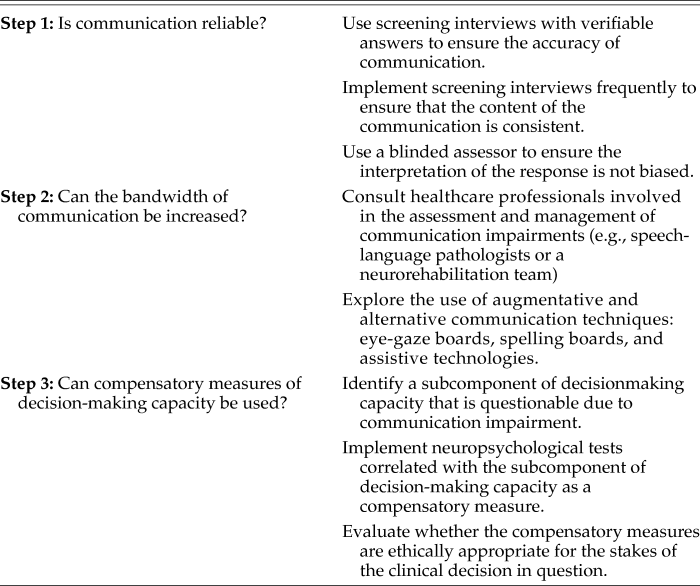
A general strategy for assessing decision-making capacity in patients with communication impairments involves three central questions. First, is communication reliable? Second, can the bandwidth of communication be increased? And third, can compensatory measures of decision-making capacity be used? These questions constitute three steps for evaluating decision-making capacity. These steps, along with potential ways to achieve the goals of each step, are reviewed in detail subsequently (see Table 1).
Three-Step Approach for Evaluating Decision-making Capacity
Step 1: Is Communication Reliable?
A patient’s communication is reliable if it is consistent and accurate within and across testing sessions. Communication is reasonably consistent if a patient responds to a majority of attempts at communication and those responses are reasonably similar across testing sessions. Communication is reasonably accurate if the majority of the content of a patient’s responses is true. For some individuals with communication impairments, the consistency and accuracy of communication is difficult to assess. In cases like that of Ms. M. in which communication impairments are severe, the ability to respond to yes/no questions may be the sole means of communication. Determining if communication is reliable is a first step in assessing more complex cognitive operations, such as decision-making capacity, in these populations.
In cases in which communication is limited to yes/no questions, it is recommended that a patient undergo a series of screening interviews to determine reliability. Screening interviews contain a set of yes/no questions to verifiable information. Coughlan and colleagues advise questions that probe a patient’s knowledge of personal identity (e.g., name, age, date of birth, and names of family members), autobiographical facts (e.g., occupation and personal events that transpired before injury), and orientation in time and place. Footnote 12 Answers to these questions can subsequently be verified by family or medical history. It is recommended that the assessor be blinded to the correct responses to screening interview questions to prevent biased interpretations of patient responses. Likewise, it is also recommended that the correct answers to questions—either “yes” or “no”—be pseudorandomized to rule out patients who display perseveration.
The reliability of communication should be established within and across several interview sessions to increase confidence that responses are not influenced by other variables, such as fatigue. The quantity of interview sessions will depend on the extent of impairment and performance on previous screening interviews. Ideally, a patient should be able to consistently and accurately respond to some reasonable proportion of questions within and across interview sessions. However, if a patient is unable to correctly respond to a majority of questions or shows variable responses during follow-up interviews, then the reliability of communication will be questionable.
Finally, the reliability of the patient’s means of communication must be considered. Some patients, like Ms. M., will be unable to verbalize yes/no responses. Alternate means of responding, such as eye blinks or protrusions of the tongue, are appropriate provided they are reliably produced and interpreted. If the reliability of the patient’s alternative means of communication is questionable—for example, due to dystonia secondary to stroke—clinicians will need to explore methods for controlling confounds. Likewise, if communication does not permit a clearly interpretable distinction between alternative responses, the means of communication must be altered to permit clearly discernable answers.
Step 2: Can the Bandwidth of Communication Be Increased?
Once the reliability of communication has been established, clinicians should seek out ways to increase the bandwidth of communication. Communication bandwidth can be increased in terms of both the duration of communication sessions and the different kinds of answers a patient can provide. Augmentative and alternative communication (AAC) methods are commonly used to increase communication bandwidth. Augmentative communication, such as nonverbal gestures or body language, adds to or enhances verbal communication, such as nonverbal gestures or body language. Alternative communication substitutes for verbal or gestural communication by introducing a new medium, such as a symbol or spelling board. AAC methods are used in consultation with healthcare professionals trained in the assessment and management of communication impairments, such as speech-language pathologists or a neurorehabilitation team.
AAC methods are often used in cases of communication impairments because they minimize or eliminate the need for verbal output. Additionally, they also systematize gestural communication in ways that allow patients to express more than just “yes” or “no” responses. Footnote 13 For example, in Ms. M.’s case, ACC communication was achieved through a communication board and nonverbal gestures. This allowed the patient to select from a larger set of answers to a question and extended the content of responses beyond simple yes/no answers. Additionally, AAC methods may use graphic representations for individuals with aphasia, spelling boards for individuals with preserved higher-order cognitive functions, or mechanical methods of communication, such as computers controlled by eye gaze or small muscular contractions.
Clinicians should seek out consultation with appropriate healthcare professionals to develop a tailored AAC plan for the patient in question. Each technique used should accommodate a patient’s individual impairments and the specified goal of communication. In cases in which communication is needed to establish that the patient retains decision-making capacity, more sophisticated AAC techniques can be used to increase communication bandwidth as much as possible.
Due to the severity of Ms. M.’s injuries and resulting communication impairments, it remained unclear if Ms. M. retained decision-making capacity, despite successful attempts at communication with low-tech AAC techniques. Ms. M. experienced significant medical complications following her injury, and no further assessment of her cognitive abilities was performed. Nevertheless, for some patients with similar communication impairments there will be ample opportunity for further evaluation. In step 3, we propose a final avenue of evaluation that may be explored if decision-making capacity remains in question.
Step 3: Can Compensatory Measures of Decision-making Capacity Be Used?
AAC techniques may be sufficient to accommodate some patients with communication impairments. Yet in some patients, communication impairments may be so severe that compensatory measures are required to further evaluate cognitive functions associated with decision-making capacity. The use of cognitive screening tools and psychometric tests can provide information about cognitive functions associated with the four subcomponents of decision-making capacity. Such information may help to identify patients at risk of diminished capacity, or to identify cognitive predictors of decision-making capacity when standard methods of assessment are not possible. Footnote 14
One promising area of current research is the correlation of performance on validated psychometric tests to one or more preserved subcomponents of decision-making capacity: understanding, appreciation, reasoning, or communication. These psychological abilities, it is reasoned, may be supported by a variety of cognitive functions, including memory and executive processing. Footnote 15 Evaluating the status of these cognitive functions, and how they bear on decision-making capacity, may be a viable strategy for evaluating patients for whom the severity of communication impairment prohibits standard assessment.
Several studies on clinical populations have demonstrated strong correlations between decision-making capacity and particular cognitive functions. Dreer and colleagues found that a variety of cognitive functions were associated with acute impairments and recovery six months post-TBI. Footnote 16 Short-term verbal memory, as assessed by the Wechsler Memory Scale-R Logical Memory I and Semantic Fluency, predicted the performance of understanding treatment in acutely injured patients. However, measures of executive functioning were associated with performance on understanding treatment at the sixth-month follow-up. Reasoning performance in acutely injured patients was associated with short-term verbal memory (Logical Memory I) and auditory verbal attention (WAIS-R Digit Span). At the six-month follow-up, reasoning was associated with auditory working memory (WAIS-III Arithmetic) and verbal learning and memory (RAVLT). Footnote 17 Verbal memory has been shown to be a predictor of decision-making capacity in patients with acute mild and moderate/severe TBI, and thus impaired verbal memory has been suggested as a red flag for impaired capacity. Footnote 18 Finally, several studies have revealed correlations between patient vocabulary level and understanding of medical information. For example, it has been found that patient understanding varied directly with the vocabulary subtest of the Wechsler Adult Intelligence Scale, Footnote 19,Footnote 20 and Gerstenecker and colleagues found that verbal memory and fluency were highly associated with understanding as defined by the Capacity to Consent to Treatment Instrument. Footnote 21
These studies, although promising, still deploy neuropsychological tests that are reliant on expressive language. To apply these findings to patients with communication impairments would require further research on neuropsychological tests that do not involve expressive language. There are several validated neuropsychological measures that may serve this purpose. For example, a patient’s auditory comprehension could be assessed using the Neuropsychological Assessment Battery—Auditory Comprehension (NAB). Footnote 22 Vocabulary could be assessed with the Peabody Picture Vocabulary Test (PPVT-4). Footnote 23 Finally, executive functions could be assessed with the Wisconsin Card Sorting Task (WCST), Footnote 24 NAB Mazes, Footnote 25 or DKEFS Trail Making Test, Footnote 26 taking into account the patient’s motor abilities. Future research is required to determine possible associations between these particular measures and one or more of the subcomponents of capacity. If associations are found, these tests may prove to be fruitful compensatory measures for assessing decision-making capacity in patients with severe communication impairments.
It is important to note that such measures—both those that require expressive language and those that do not—alone cannot demonstrate decision-making capacity. Footnote 27 Decision-making capacity is decision specific and must be assessed in the context of a clinical scenario. In cases of severe communication impairment, such measures may be coupled with a rudimentary interview. This may increase confidence in the patient’s level of decision-making capacity for a particular clinical decision.
Use of compensatory measures will inevitably require flexibility in the standards of decision-making capacity. Footnote 28,Footnote 29 The standard rules of assessment must be flexible enough to accommodate alternative methods for evaluating decision-making capacity. Additionally, the evidentiary standard will also need to be flexible enough to accommodate different forms of evidence. In most cases, this flexibility may lower the threshold of evidence required for the attribution of decision-making capacity. However, the extent to which this threshold can justifiably be lowered will likely depend on the stakes of the medical decision. Low-stakes medical decisions will have a net balance of risks and benefits that is substantially better than alternative decisions, whereas high-stakes decisions will have a net balance of risks and benefits that is substantially worse than alternatives. Footnote 30 Greater flexibility in the standards of decision-making capacity that accommodate compensatory measures may therefore be warranted for low-stakes medical decisions but may be ethically impermissible for high-stakes decisions.
Conclusion
Patients with severe communication impairments, like Ms. M., present difficult ethical and methodological challenges for clinical staff. Clinicians have the duty to respect patient autonomy, yet they must also protect patients that lack decision-making capacity. Patients with communication impairments may bring these duties into conflict, as it may remain unclear if they retain decision-making capacity. This raises several difficult questions: Do clinicians err on the side of protecting the patient or respecting patient autonomy? To what extent should reasonable accommodations be made for patients with communication impairments? And how flexible are the standards of decision-making capacity?
In this article, we have outlined a general strategy for assessing decision-making capacity in patients with communication impairments. This strategy involves three steps: (1) determining the reliability of communication, (2) widening the bandwidth of communication, and (3) using compensatory measures of decision-making capacity. The motivation for this strategy turns on the view that an inability to express decision-making capacity according to standard instruments does not entail that one lacks decision-making capacity.
This strategy is intended to be provisional and to generate further discussion into how decision-making capacity is evaluated in these challenging situations. Until this strategy is honed through further research, a surrogate decision-maker is still required. Future cases like Ms. M.’s may warrant collaborative decision-making. Certain models of collaborative decision-making, such as medical trusteeship, Footnote 31 have been developed to allow individuals with communicative and cognitive impairments to participate in medical decision-making to the degree to which they are capable. This approach may help to facilitate patient autonomy yet also ensure safeguards that prevent incapable patients from making harmful medical decisions.
The attribution of decision-making capacity will ultimately rest on a clinician’s judgment, and whether a patient’s status is commensurate with the stakes of a particular medical decision. Reflection on this issue may bear on future neuropsychological and philosophical research in populations that require highly sophisticated technologies to compensate for communication impairments. Footnote 32,Footnote 33 Seeking out strategies that allow patients like Ms. M. to regain elements of autonomy, despite their disability, is important for patients, families, and the medical staff that care for them.