The Black Death has long been considered one of the landmark events of the late Middle Ages. The outbreak of disease caused by the bacterium Yersinia pestis killed an estimated 40–60 per cent of all people living in Europe, the Middle East and North Africa in the mid-fourteenth century. Unsurprisingly, given this level of mortality, the consequences of the pestilence were enormous and far-reaching, in terms of the devastation of the initial pandemic, the social response to it and subsequent outbreaks of disease that erupted periodically.Footnote 1 An entire subdiscipline of historical scholarship has dedicated itself to charting the impact of the disease on various aspects of medieval (especially western European) society;Footnote 2 while this has shed important light on aspects of artistic culture such as literature and art,Footnote 3 such studies have paid comparatively little attention to cultural contributions made within the field of music.Footnote 4 This may be in part due to the difficulties music poses as a source; as Leonardo da Vinci noted,Footnote 5 unlike paintings which remain in the form their creator gave them for as long as the materials survive, music ‘is consumed in the very act of its birth’ and has a complicated relationship with writing and textuality. Recent musicological studies, however, have recognised the importance of plague as an interpretive framework both for individual pieces and for related families of compositions written in western Europe from the mid-fourteenth century onward.Footnote 6
This article focuses on the chants associated with a votive liturgy apparently celebrated during times of pestilence in the late Middle Ages. Known as the Missa pro mortalitate subitanea evitanda (the Mass to avoid sudden death) from its most common rubric,Footnote 7 or as the ‘Recordare domine’ Mass after the incipit of its introit, the Mass is listed among the votive masses in a large number of liturgical manuscripts and printed books throughout Europe beginning in the fourteenth century,Footnote 8 and occasionally copied in the margins or into added folios inserted into others.Footnote 9 Though this Mass has long been recognised as part of the religious response to disease in the late medieval and early modern periods, I argue that the music of the ‘Recordare domine’ Mass has untapped value as a window onto the processes by which chant composition and performance remained culturally meaningful in times of social stress, even as composers increasingly turned to polyphony as a medium of musical expression. By understanding the ‘Recordare domine’ Mass both as a planned liturgy, ascribed to a central authority, and as a local, personalised musical response to the epidemic, we can gain new appreciation for how musical and ecclesiastical resources were marshalled by communities living in the shadow of the plague, and for the continued value of plainchant as a locus of musical creativity in the late Middle Ages.
The ‘Recordare domine’ Mass
The connection between the ‘Recordare domine’ Mass and the late medieval experience of disease, and possibly even the Black Death itself, has been recognised by scholars for over a century. In 1900 Jules Viard printed the Propers as he found them in two manuscripts in the Bibliothèque de Lille,Footnote 10 labelling the Mass a special creation of the papacy instituted to petition Heaven for deliverance from the scourge of the Black Death. Viard based this both on the texts of the various elements of the mass and on the strength of its heading rubric, which reads that this is a:
Mass for the avoidance of death, which the lord Pope Clement VI made and ordained in consultation with the lord cardinals in the year of our Lord 1348. And he granted to those who heard and said it 260 days of indulgence. And all those hearing the aforementioned Mass should bear a burning candle for the 5 following days; and those shall not be harmed by sudden death. This is proven in Avignon and surrounding regions, and occurred in the year of our Lord 1348.
Missa pro evitanda mortalitate, quam dominus papa Clemens sextus fecit el constitua in collegio, cum dominis cardinalibus, anno Domini millesimo CCCXLVIII. Et concessit omnibus predictam missam audientibus et dicentibus ducentas sexaginta dies indulgentie. Et omnes audientes predictam missam debent portare in manu unam candelam ardentem per quinque dies continue sequentes; et eis mors subit anea nocere non poterit. Hoc est certum et approbatum in Avinione et in partibus Avinionensibus.Footnote 11
Viard also pointed out that though the Mass still exists in the Catholic liturgy and is said in times of epidemics, the version contained in modern missals differed in several respects from that he found in his medieval sources. These consisted primarily of small differences in wording, but also in the addition of a tract and an alternate gradual verse to differentiate performance in Paschal vs non-Paschal time.Footnote 12 The same texts he lists are given with music in several modern sources with a claim to official, normative status, including the 1871 Regensburg gradual, which is largely a reprint of the Medici gradual of 1614 produced in the wake of the drastic chant reforms of the Counter-Reformation, and the Solesmes Graduale Romanum that replaced it in the early decades of the twentieth century.Footnote 13 Following Andrew Tomasello's observation that the Black Death struck Clement's Avignon during the summer of 1348 (and hence after Easter, in a season when alleluias are liturgically appropriate), one might conclude that this Mass was created under the auspices of the papacy as the rubric suggests and propagated across Europe in response to both fear of the plague and the promise of physical and spiritual deliverance contained in the indulgence.Footnote 14 Then, over subsequent centuries as plague epidemics recurred at different times of the year, church authorities broadened the Mass to be liturgically applicable year-round.
It certainly was the case that when faced with the plague, ecclesiastical authorities would respond by instituting large-scale public acts of devotion such as masses and public processions. In a famous letter, William Edenton, Bishop of Winchester, wrote to the clergy of his diocese on 24 October 1348:Footnote 15
every Wednesday and Sunday, assembled in the choir of your monastery, you humbly and devoutly chant [decantentes] the 7 penitential psalms and the 15 gradual psalms [graduali psalmus] on your knees. We also order that every Friday you should go solemnly in procession through the marketplace at Winchester, performing these psalms and in similar fashion the great litany [a vobis simili modo dictis letaniam maiorem] instituted by the fathers of the church for use against the pestilence and fulfilling other exercises of devotion [orationum suffragia], together with the clergy and people of the city, whom we wish to be summoned to attend. They are to accompany the procession with bowed heads and bare feet, fasting, with a pious heart and lamenting their sins (all idle chatter entirely set aside), and as they go they are to chant [psallant] devoutly, as many times as possible, the Lord's Prayer and the Hail Mary. They are to remain in earnest prayer until the end of the Mass which we wish you to celebrate in your church at the end of each procession, trusting that if they persevere in their devotions with faith, rectitude and firm trust in the omnipotence and mercy of the Saviour they will soon receive a remedy and timely help from heaven.
omnibus dominicis et singulis quartis feriis in choro monasterii vestrum insimul congregati septem penitentiales et quindecium graduali psalmus, flexis dicatis genibus humiliter, devote necnon singulis sextis feriis, huius psalmis a vobis simuli modo dictis letaniam maiorem contra huius pestilencias a sanctis patribus institutam per medium mercatus civitatis nostre Wynt una cum clero et populo civitatis eiusdem quos ad hoc per vis volumus evocari solempniter decantantes processiones faciatis solemnes, ac alia devotarum orationum suffragia exerceri, necnon populum, huius processiones insequentem sollicite invitari, ut huius processionibus durantibus demissis capitibus, et nudis pedibus, incedentes, ieiuni, pio corde et piacula sua plangentes, variis fabulis penitus omissis orationem dominicam cum salutatione angelica quotiens poterinit devote psallant, in missis quas dictis processionibus finicis in ecclesia vestra per vos volumus celebrari usque ad finem iugiter orando persistant finam fiduciam optinentes, quod si cum fidei rectitudine et spe solida de omnipotentia et misericordia salvatoris in huius suis devotionibus perseverent, cito de celo sentient remedium et auxilium opportunum.
Elsewhere in fourteenth-century Europe, Konrad von Megenberg's Buch der Natur chronicled that ‘in the first year of the great epidemic [i.e., the Black Death] was the misery so great, that Pope Clement had a new Mass written so that one could petition God to have mercy on the people. This Mass began: Recordare domine testamenti tui.’Footnote 16
The texts of the ‘Recordare domine’ Mass as they appear in Jules Viard's sources are appropriate for the situations described by Konrad von Megenburg and by Bishop Edenton. Indeed, if we examine the readings from the Old and New Testaments and their relationship with the chants of the Proper, we see an elaborate interweaving of concepts of bodily and spiritual health, mediated by a central concern with penance and the amelioration of God's anger. In the first reading, taken from II Kings 24:15–19, God sends an avenging angel with pestilence upon Israel that kills ‘seventy thousand men of the people from Dan to Bersabee’.Footnote 17 The epidemic is ended before it destroys Jerusalem when King David admits that he has sinned, and as a public act of penance he agrees to do as the prophet Gad advises by building a new altar on the site of the threshing floor of Areuna the Jebusite, where the angel's hand was stayed. David's spiritual malaise and its subsequent ‘cure’ through confession, contrition and penance, thus reflects in microcosm the macrocosmic physical malaise of an Israel afflicted and then cured of pestilence. For its part, the gospel reading from Luke 4:38–44 focuses on one of Jesus's medical miracles, in which after first curing Simon's mother-in-law afflicted by a ‘great fever’ (magnis febribus), he healed a multitude who were ‘sick with various diseases’ by laying his hands on them.Footnote 18 The medical rhetoric continues in the chanted Propers, where two of the texts set forms of the verb sanare (to cure or heal). The underlay for the gradual begins, ‘The Lord sent his word and healed them’,Footnote 19 while the communion chant relates how ‘A crowd of the sick and those tormented by unclean spirits came to him [Jesus], because power issued from him and healed them all.’Footnote 20 Two further chants elaborate upon the role played by divine anger in the creation of disease, as after first asking God to remember his covenant with his people,Footnote 21 the introit employs language virtually identical to that of the reading from Samuel as the avenging angel is asked to stay his hand.Footnote 22 In the offertory, the high priest (pontifex) placates the wrath of God with a sacrifice and stops a plague.Footnote 23 The final Proper, the alleluia, appears in Viard's edition to be anomalous in not referencing any aspect of physical or spiritual health, though it does invoke the doctrine of salvation, with the speaker saying ‘I will save the people in the midst of Jerusalem, and I will be to them a God of truth and justice.’Footnote 24 If we view salvation as the apotheosis of spiritual health, we might read the entire Mass as a systematic, multidimensional evocation of health and disease, demonstrating the relationship between humanity and the divine as it plays out simultaneously on the spiritual body, the physical body and even the ‘body public’ of communities of believers.
This interpretation views the ‘Recordare domine’ Mass in essence as a musical ‘work’, the product of a single creative force and subject to the same sorts of biographical and cultural influences used to characterise the compositional process of individual musicians. While there is some merit in this approach given how the rubric indicates that the medieval clergy who wrote the Lille service books ascribed the Mass to Pope Clement, viewing the Mass entirely in this way limits our appreciation for the essential plurality of plainchant. As Katherine Bergeron stated: ‘A Gregorian text will always be a plural phenomenon, a collective that fully embraces its etymological roots of the weaving inherent in the word textus.’Footnote 25 In order to understand the relationship between the singular and plural in a cultural object such as a mass, it is thus desirable to examine it across multiple instantiations, each of which offers a slightly different perspective that contextualises it within a unique time and place.
My study is based on the examination of the ‘Recordare domine’ Mass in fifty-seven late medieval and early modern sources in American, British and French libraries,Footnote 26 as well as in modern ‘standard’ editions such as the Solesmes Graduale Romanum and Missale Romanum and Dickinson's critical edition of the Sarum missal.Footnote 27 Of these, ten manuscripts contained multiple copies of the ‘Recordare domine’ Mass, bringing the number of masses examined up to sixty-seven. Twenty-nine manuscripts (or 43 per cent of the total corpus) follow the usual practice for votive masses and indicate only the collect, secret and post-communion prayers, and are thus limited in their utility.Footnote 28 The remaining thirty-eight exempla contain full texts of either the Proper chants or both the Propers and the celebrants’ prayers, and twenty-six provide a rubric containing some or all of the information in Viard's Lille exempla linking the Mass to Clement VI, Avignon and rituals for the remission of sin or protection from sudden death.Footnote 29
Although a full exposition of the variation seen across the Mass is not appropriate for the present discussion, it is possible to make a few generalisations that speak to the composition and use of the Mass in the late Middle Ages. First, while F-Lm 23 and 28 are representative of the readings given in the majority of the editions of the Mass, the amount of variation is not consistent across the Propers. Instead, the gradual, the gradual verse and the communion appear virtually unchanged across all copies, while the introit, alleluia verse and offertory, while recognisably congruent, display markedly greater variation across the corpus.Footnote 30 This is consistent with the fact that the three unchanging Propers are among the core Gregorian repertory, appearing in the six eighth- and ninth-century service books cross-referenced in the Solesmes Antiphonale Missarum Sextuplex,Footnote 31 and frequently reused elsewhere within the Temporale and Sanctorale cycles of the liturgical year as described in the service books.Footnote 32 The introit, alleluia verse and offertory verse, however, appear to be unique to the ‘Recordare domine’ Mass, suggesting that they may have been composed specifically for this observance. Moreover, several variants in the wording of these Propers are well represented across the population of editions. One of these loci of variation is the opening word of the alleluia verse, which in the Lille reading of the opening verb ‘salvabo’ (I will save) we had previously identified as anomalous in going beyond the invocations of physical and spiritual health found in the other Propers. Though ‘salvabo’ is found in twenty-three other manuscripts, a significant minority of the versions (eleven exempla, or 27.5 per cent), the verb used is ‘sanabo’ (I will cure/heal), bringing the alleluia into agreement with the gradual and communion, while two use the alternate verbs ‘congregabo’ and ‘servabo’.Footnote 33 A significant minority reading of a key word can also be observed in the introit and the offertory,Footnote 34 suggesting that the while the text of the ‘Recordare domine’ Mass likely circulated as a whole under the authority of Pope Clement, differing levels of familiarity with the materials on the part of its recipients affected how the Mass was entered into local liturgy. In other words, in the same way that the construction of the Mass itself is an amalgam of stasis and change in its interweaving of the Ordinary and the Proper, the Propers of the ‘Recordare domine’ Mass reveal the same tension; some chants are being viewed through the lens of repeated experience and familiarity, while others are new and subject to greater variability as a product of the present. The ‘textuality’ of the ‘Recordare domine’ Mass is thus singular and plural, dramatically reflecting the fundamental dynamic tension inherent in performed works that live only through their interpreters and hence draw their identity from both distal and proximal sources of creativity.
Plainchant and the ‘Recordare domine’ Mass
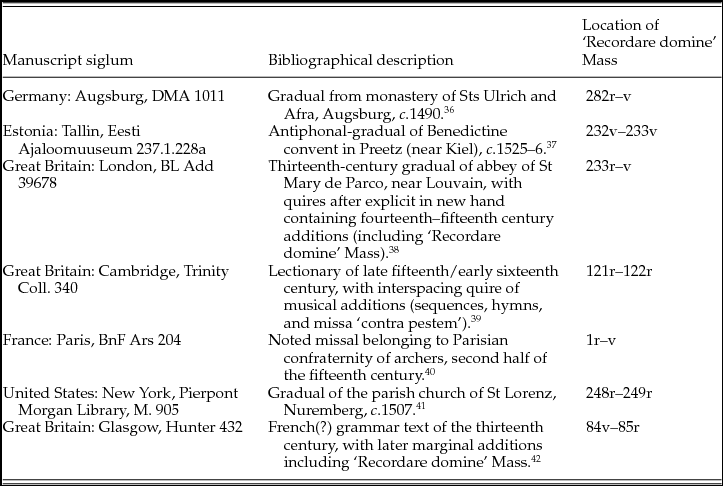
If there were a tension between the familiar and the novel in the texts of the Mass reflecting the agency of its local recipients, we might expect these tendencies to be magnified in musical performance, which is, after all, immediately dependent on performers for expression. Within the sample of ‘Recordare domine’ Mass editions, seven contained musical notation, with the mise en page of an eighth implying that music was intended for copying but never completed.Footnote 35 These seven manuscripts and their suspected provenance are given in Table 1.
Provenance of manuscripts containing musically notated copies of ‘Recordare domine’ Mass.

Whilst it was a common practice for votive masses to be celebrated with limited or non-existent musical elaboration, several elements suggest that the relative paucity of musical exempla may be better read as a lack of concern for the music's preservation than a lack of its existence. First, as Table 1 indicates, the surviving musical exempla come from all over Europe, meaning that performance of the ‘Recordare domine’ Mass with music was more than simply an isolated local practice. Second, in many of these copies the Mass appears to be very much an ad hoc addition to the manuscripts, either in the margins, as in GB-Gu Hunter 432, or as part of an inserted fascicle not originally part of the main manuscript's organisation, as is the case in GB-Lbl Add. 39678 and GB-Ctc 340 as well as US-Cn 45.5. Though this subset of manuscripts are by the very nature of their musical notation ‘outliers’, one might tentatively propose that they reflect a larger tendency to sing the Propers of the Mass that was only occasionally recorded in survivable media, especially if there are patterns in the music that are consistent with the distinction between old and new Propers observed in the texts.
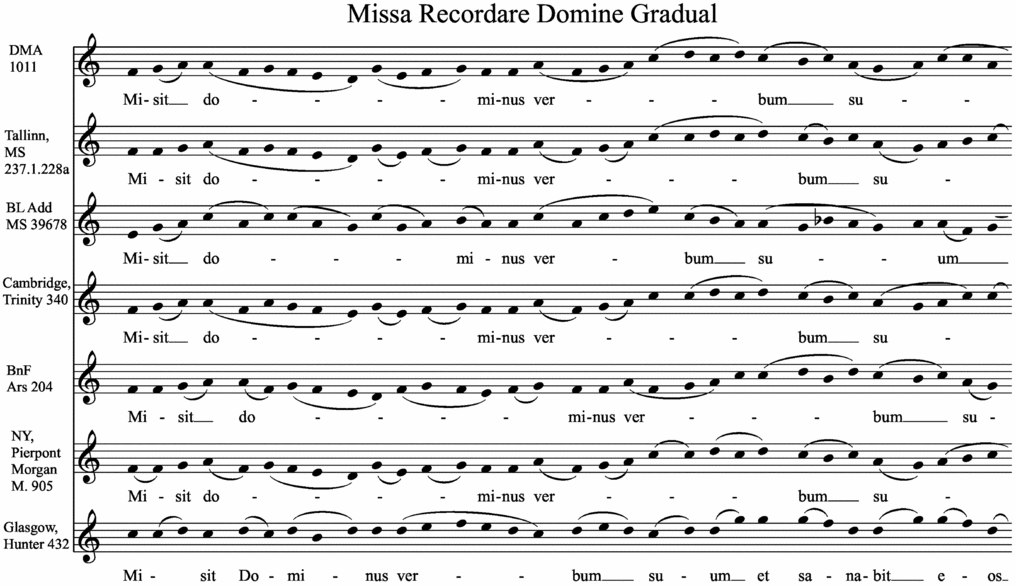
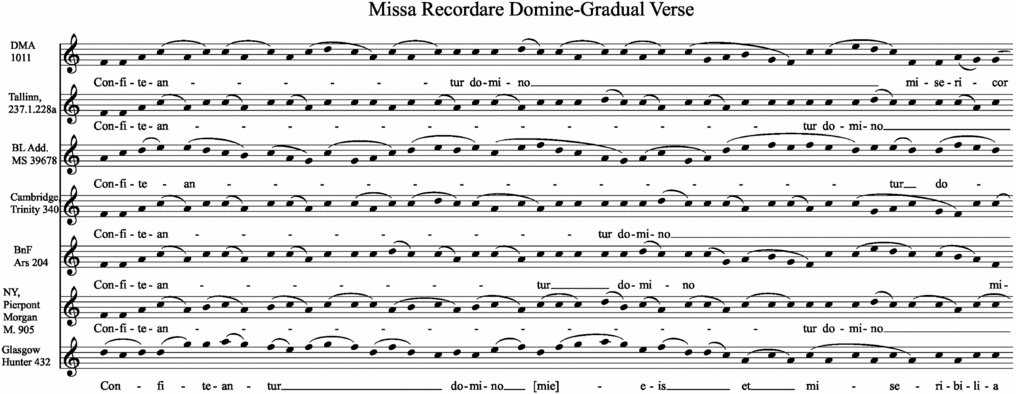
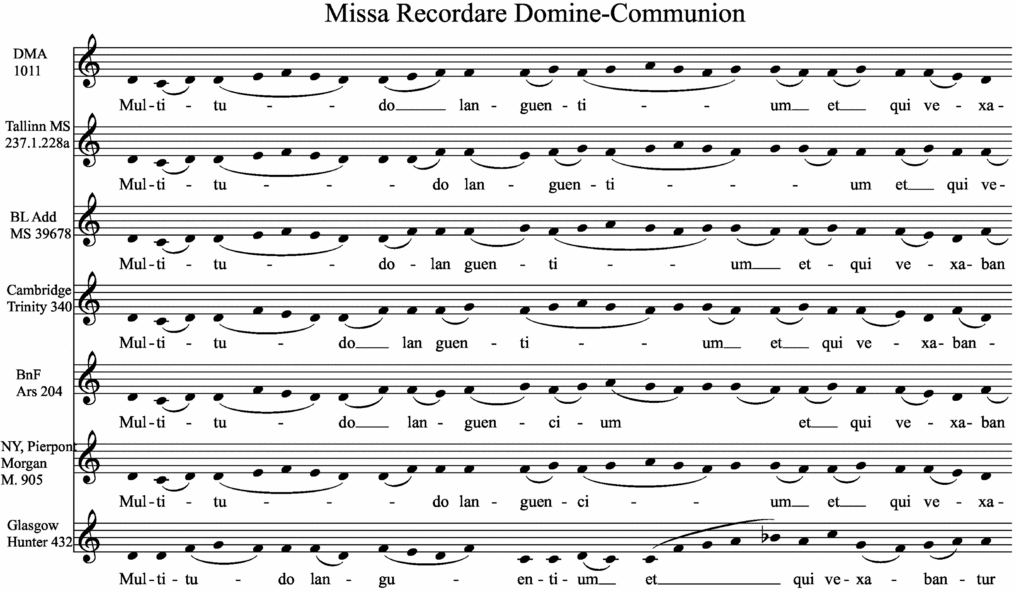
The testimony of the music confirms this hypothesis. As the incipits given in Figures 1–3 suggest, the contours of the melodies for the gradual, gradual verse and especially the communion show great similarity across most of the different settings of the ‘Recordare domine’ Mass,Footnote 43 consistent with their greater age and familiarity.
Comparison of Incipit of Gradual ‘Misit Dominus’ for the ‘Recordare domine’ Mass, across seven exempla.

Comparison of Incipit of Gradual Verse ‘Confiteantur Domino’ for the ‘Recordare domine’ Mass, across seven exempla.

Comparison of Incipit of Communion ‘Multitudo languentium’ for the ‘Recordare domine’ Mass, across seven exempla.

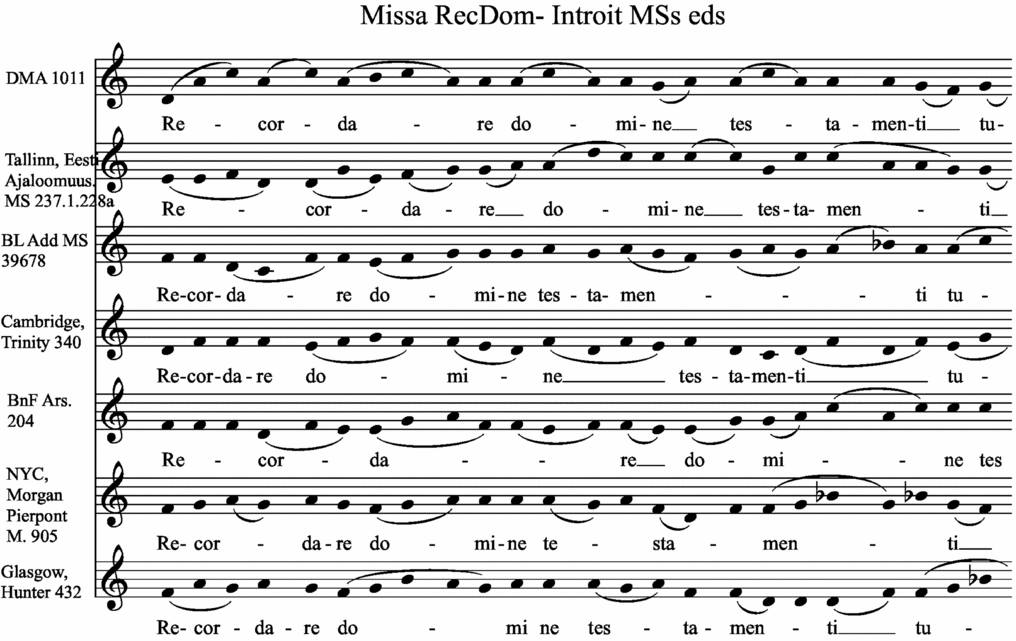
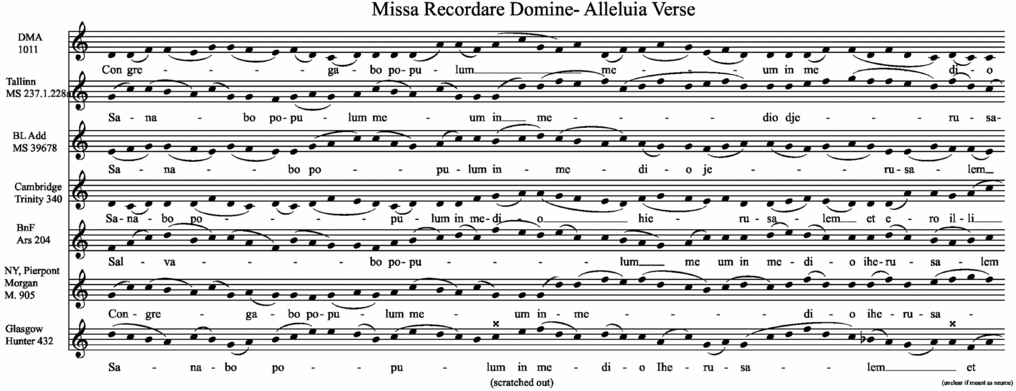
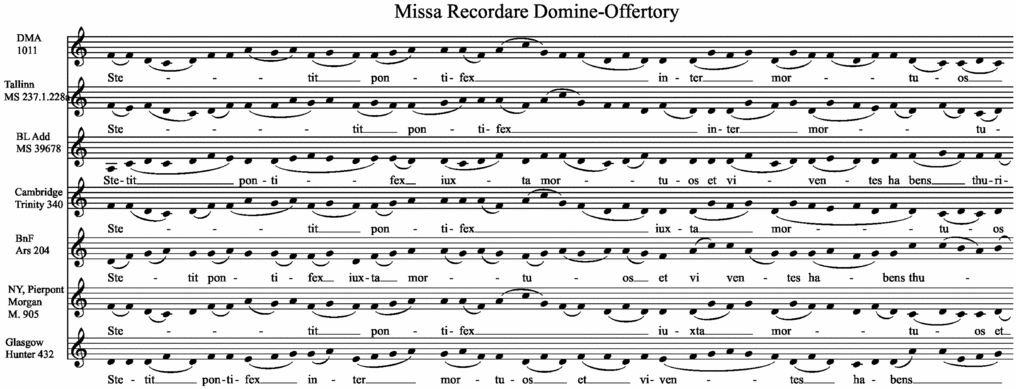
This is not at the expense of soloistic embellishment, as the substantial differences between manuscripts in the number of ornamental oscillations away from the reciting tone makes clear in the gradual verse, but there is a clear preference for a single melody. Correspondingly, many who encountered the ‘Recordare domine’ Mass would have allowed their knowledge of the older chants to ‘correct’ or prescribe their readings of the familiar portions. The same cannot be said of the Propers unique to this mass: introit, alleluia verse and offertory. Instead, as Figures 4–6 illustrate, nearly every melody given is strikingly different, presenting unique profiles of mode, characteristic motifs and melodic contours.
Comparison of Incipit of Introit ‘Recordare Domine’ for the ‘Recordare domine’ Mass, across seven exempla.

Comparison of Incipit of Alleluia Verse ‘Sanabo populum’ for the ‘Recordare domine’ Mass, across seven exempla.

Comparison of Incipit of Offertory ‘Stetit pontifex’ for the ‘Recordare domine’ Mass, across seven exempla.

This pattern of differences between textual and melodic concordance patterns strongly suggests that the texts of the ‘Recordare domine’ Mass travelled independently of the melodies, perhaps in letters from the pope to archbishops advising them how to spiritually prepare for the epidemic. There is evidence that letters of this sort were sent, for example, by the Archbishop of Canterbury to the bishops of London and Exeter during the English plague epidemic of 1382.Footnote 44 Although a search of the published papal registers of Clement VI has not yielded any analogous findings, the records of the Avignon chancery are both voluminous and have been subjected to numerous disturbances, making it, in the words of Charles Burns, ‘difficult to establish precisely to what extent they are deficient, or reconstruct within any near degree of accuracy the total original content’.Footnote 45 It is also possible that the Mass circulated in less formal circles, perhaps in the same way that accounts of miracles did, which would explain the fascination apparent in the rubric's description of the power of observing the Mass while burning a candle for the next five days. Regardless of its transmission, it remains clear that each community engaged with the question of setting the Propers to music on their own. The similarities between settings of the gradual, gradual verse and communion are likely not due to a specific prescription in instructions for the votive mass, but rather a function of how those melodies were already used and familiar to the church community from other services.
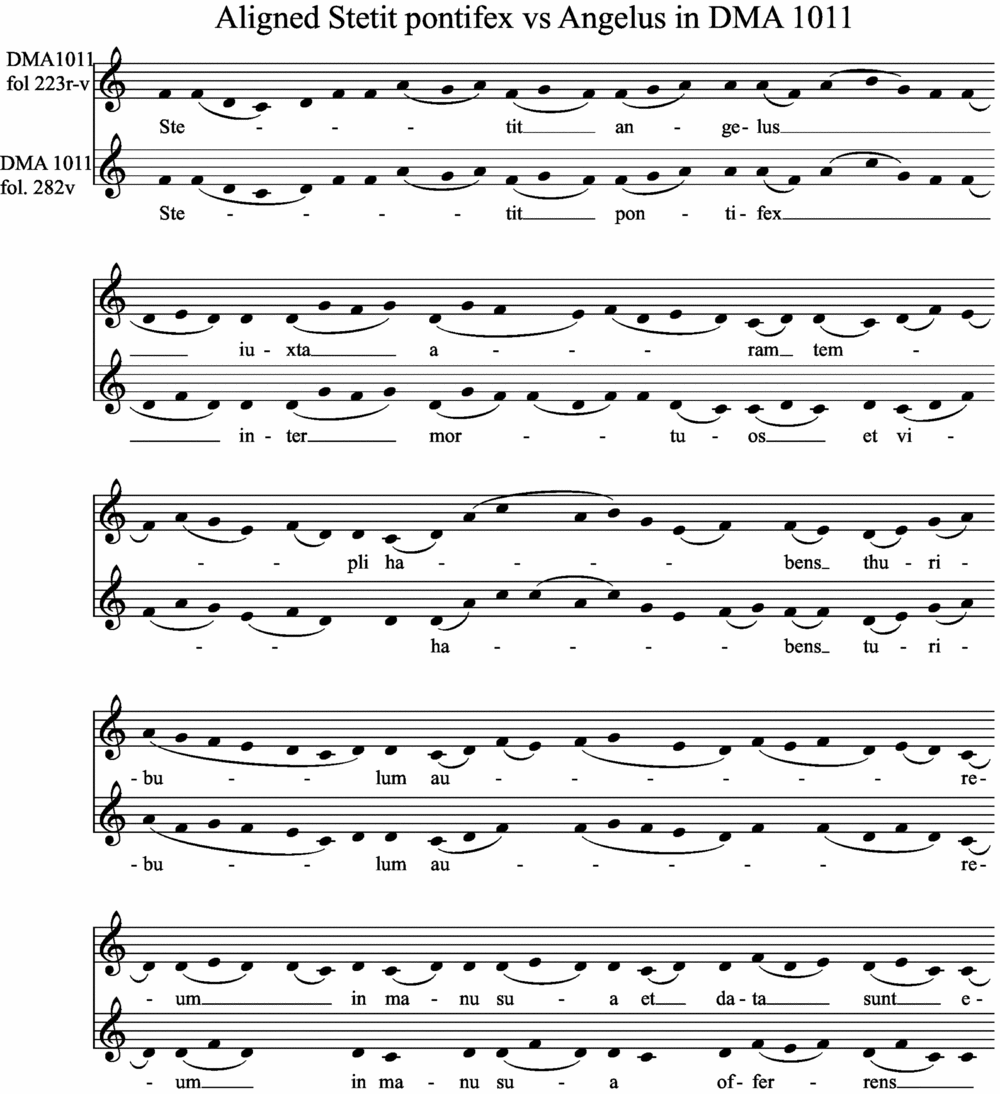
With its set of unique Propers, the ‘Recordare domine’ Mass is also an excellent witness to the diversity of practice across late medieval communities in approaching creating a chant for a new text. When faced with this problem, the easiest solution would have been to base the melody for the new chant on a separate existing and familiar chant with a related text. This was evidently the option taken by the creators of the gradual formerly belonging to the Augsburg monastery of Sts Ulrich and Afra (Diözesanmusem St Afra Augsburg 1011, hereafter abbreviated DMA 1011), whose chant for the offertory chant ‘Stetit pontifex’ in the ‘Recordare domine’ Mass is clearly related to that used at the same monastery for the ‘Stetit angelus’ offertory chant for the feast of St Michael (see Figure 7).Footnote 46 This is not without justification – by the late medieval period there was a tradition of associating St Michael the archangel with remission from plague, as he is named in Jacobus de Voragine's enormously influential thirteenth-century Legenda Aurea (Golden Legend) as the angel who appeared to Pope Gregory the Great in Rome to signal the end of the plague of Justinian by sheathing his sword.Footnote 47 Perhaps as befitting this close association, the texts of the two chants ‘Stetit pontifex’ and ‘Stetit angelus’ are very similar, so similar that in at least two non-noted missals the scribes mistakenly wrote ‘angelus’ rather than ‘pontifex’ in their version of the plague mass.Footnote 48 Thus, it may not be all that surprising that, aside from a slight lengthening of a few phrases, the two chants in DMA 1011 are concordant from beginning to end.
Comparison of the Offertories ‘Stetit pontifex’ and ‘Stetit angelus’ in Augsburg, Diözesanmuseum DMA 1011.

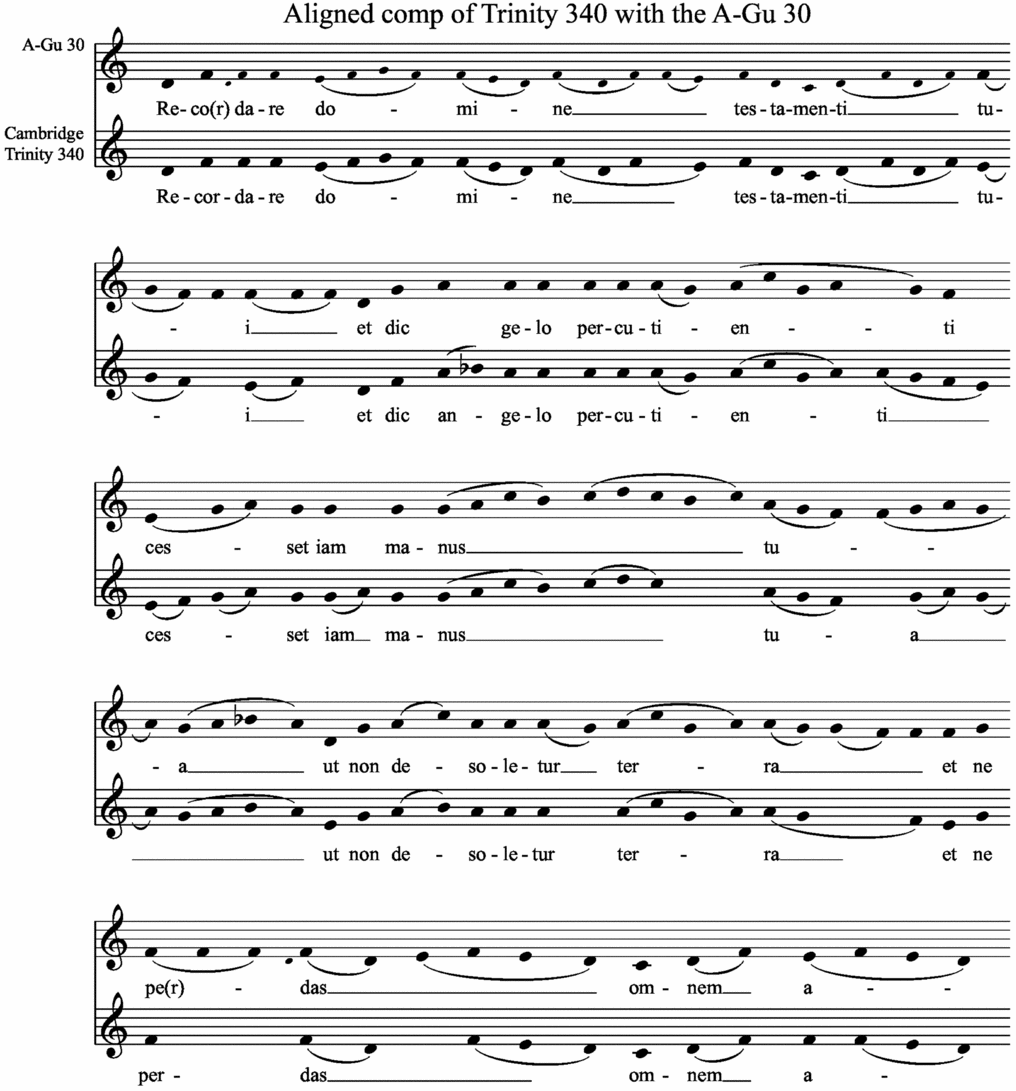
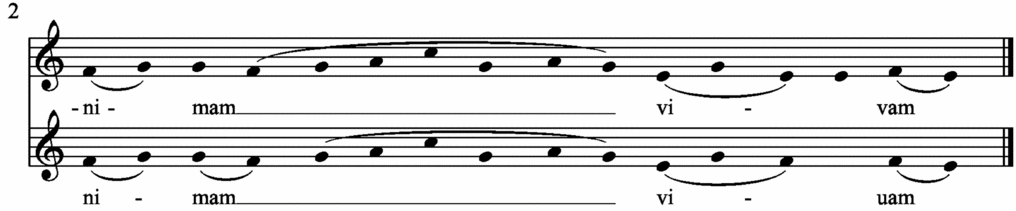
The same melody for ‘Stetit pontifex’ is used in Cambridge Trinity College 340, and though there is no St Michael ‘Stetit angelus’ in that source to compare it to (a lectionary with a single added quire of music in it; see Table 1), the similarity between the ‘Stetit pontifex’ and ‘Stetit angelus’ suggests that the Cambridge source was created by people with extensive familiarity with the chants of the liturgical year. Monastic communities would be one such group, and suspicion of a monastic provenance is heightened by the fact that the introit ‘Recordare domine’ itself in Cambridge Trinity College 340 is a close relative, with only minor variations, of the ‘Recordare domine’ melody used at least since the twelfth century in many monasteries as a Matins responsory during the summer cycle of readings focusing on the Books of Kings, as attested by sixty-two exempla in the CANTUS database (see Figs. 8 and 9).Footnote 49
Comparison of the Introit ‘Recordare domine’ in Cambridge, Trinity College 340 with Matins responsory ‘Recordare Domine’ in A-Gu 30.

Introit ‘Recordare domine’ in Cambridge, Trinity College 340 compared to Matins responsory ‘Recordare Domine’ in A-Gu 30 (concluded).

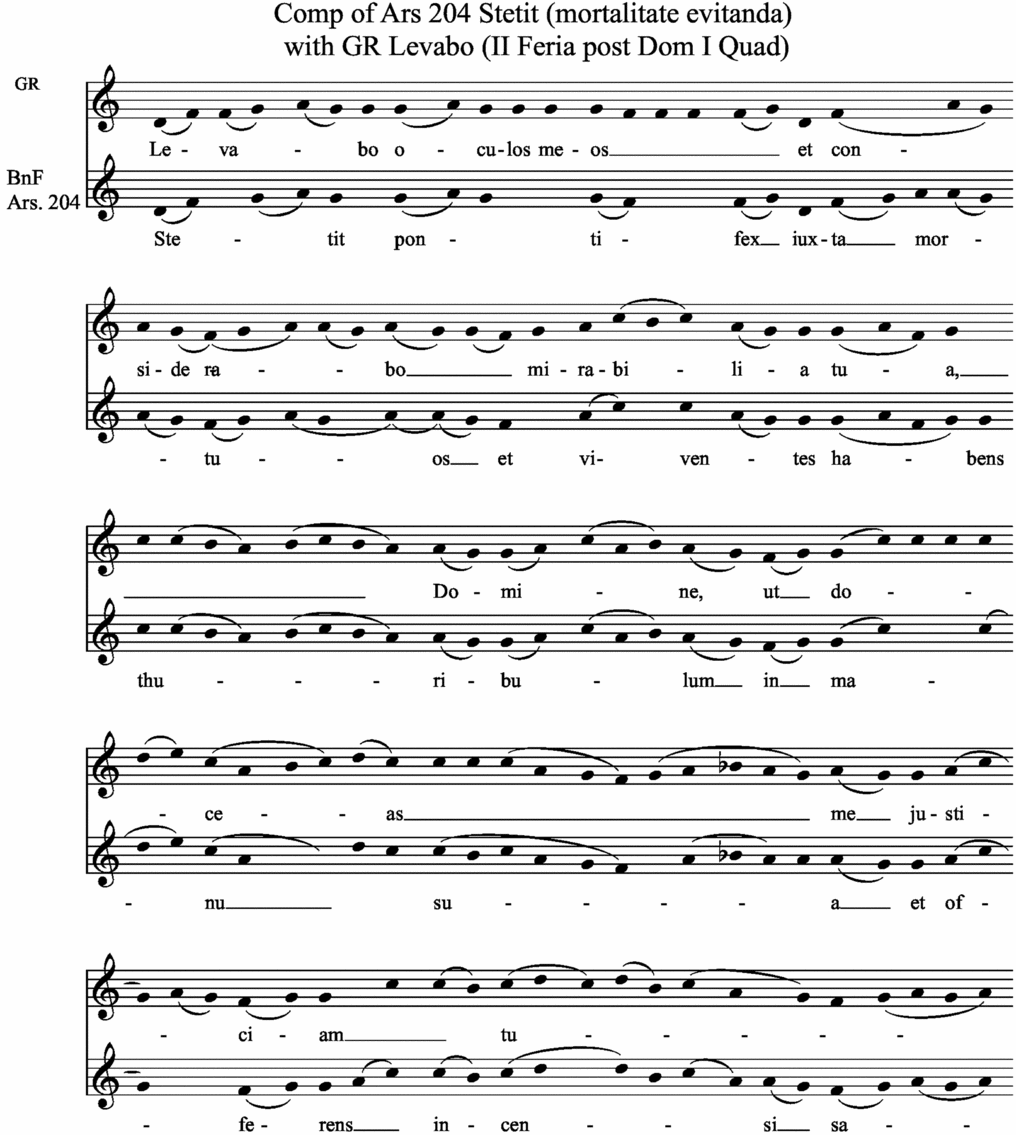
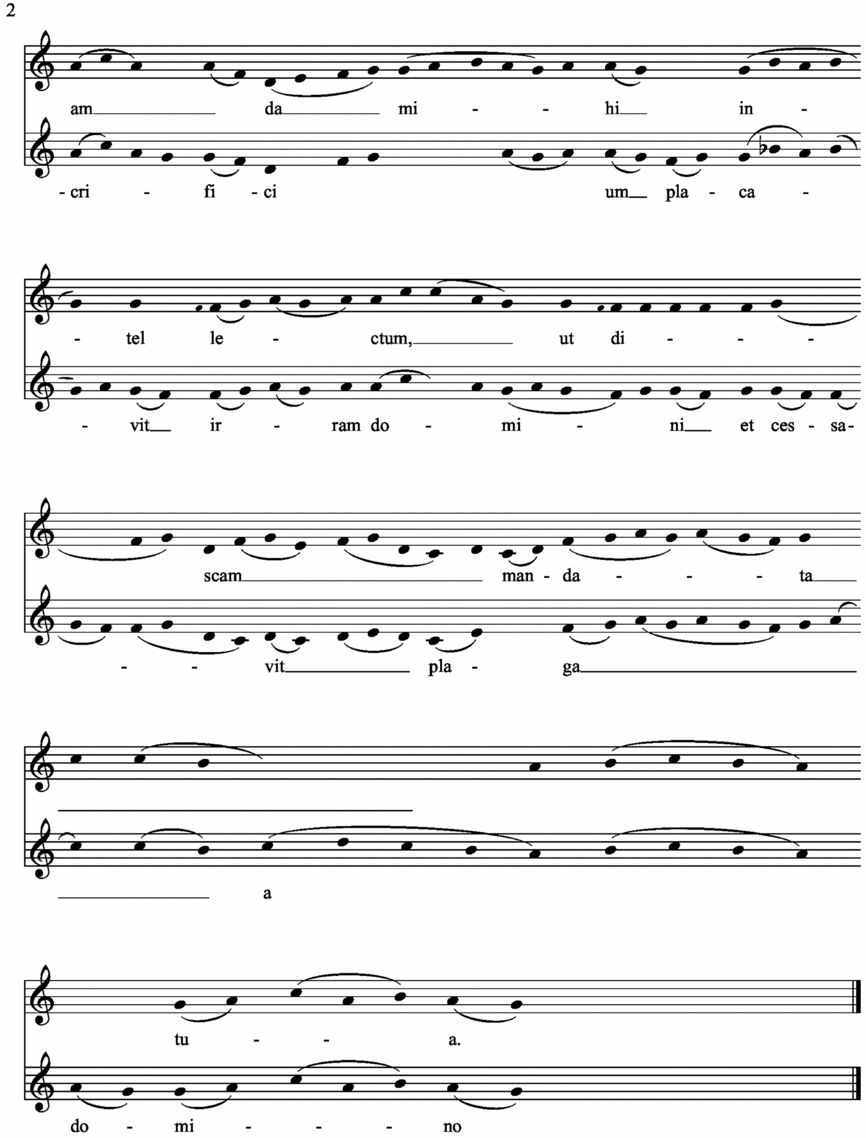
However, creating contrafacta from related chants is only one of the processes of chant ‘composition’ attested within the ‘Recordare domine’ Mass. Another technique may have been to cue on a familiar neighbouring text within the Mass to suggest a melody on which to base the chant for the new text. As seen in Figures 10 and 11, for instance, the melody for ‘Stetit pontifex’ in F-Pa 204 is essentially a slightly pared down version of the offertory ‘Levabo oculos’, often indicated for the Monday after the first Sunday in Lent. Though Ars 204 is a confraternity missal and does not indicate any temporal feasts, in many Parisian missals (as well as the Solesmes Graduale Romanum) this chant immediately follows the tract ‘Domine non secundum’,Footnote 50 and in Ars 204, the ‘Recordare domine’ Mass offertory ‘Stetit pontifex’ immediately follows indications for that same tract.Footnote 51 Thus, in making the version of the ‘Recordare domine’ Mass in Ars 204, it is plausible that the creator, having been prompted through the tract ‘Domine non secundum’ to reminisce its familiar following chant ‘Levabo oculos’, shaped the latter melody to fit the ‘Stetit pontifex’ text for the new votive observance.
Comparison of the Offertories ‘Levabo oculos’ in Paris BnF Ars 204 and in the Solesmes Graduale Romanum.

Offertory ‘Levabo oculos’ in Paris BnF Ars 204 compared with ‘Levabo oculos’ (concluded).

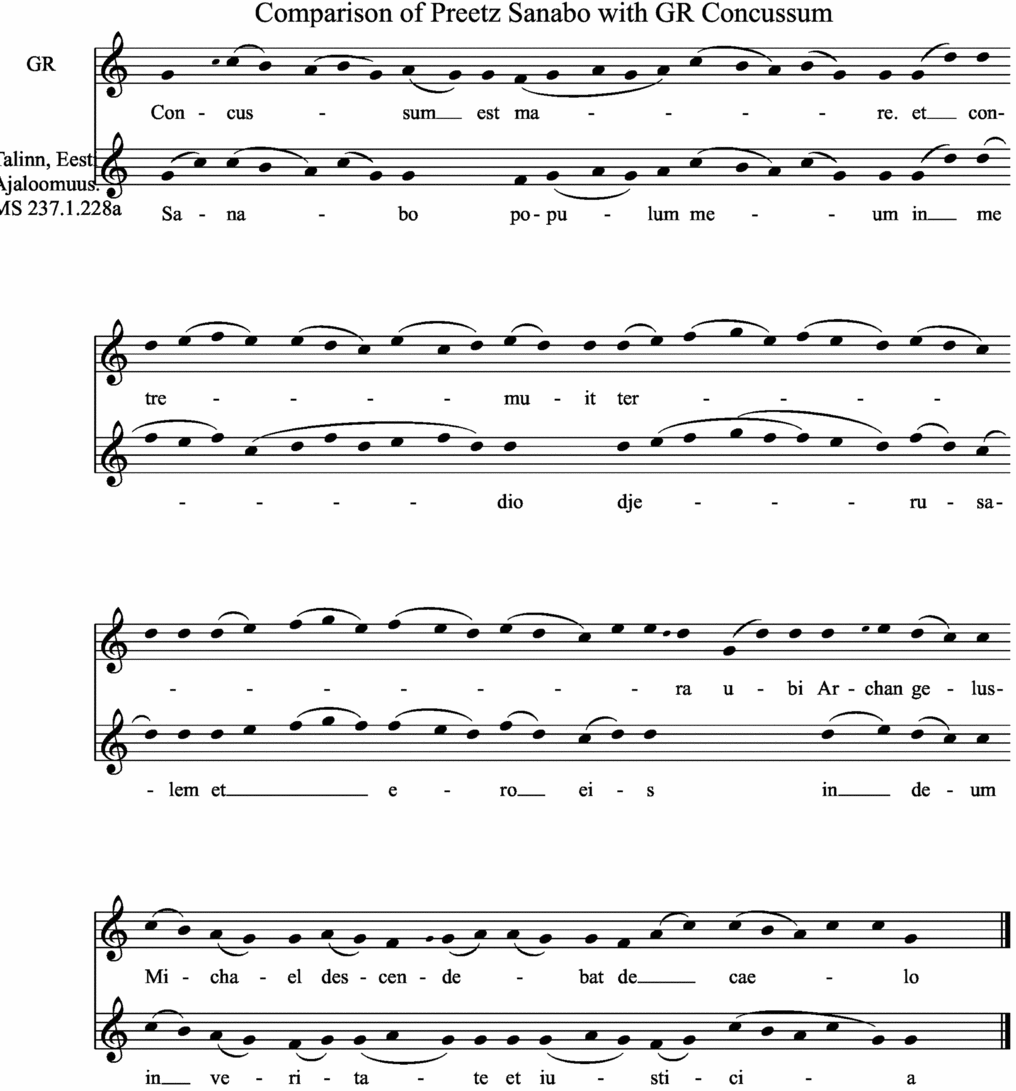
A third process of chant creation attested within the ‘Recordare domine’ Mass repertoire consists in setting the new Proper text to a melody without strong association with any particular text that can be pressed into service for many different situations. The alleluia verse ‘Sanabo populum’ as given in a sixteenth-century gradual from Preetz (Estonia-Tallinn Eesti Ajaloomuuseum (Tallinn Historical Museum) 237.1.228a (XIX.184; 24075); hereafter Estonia- THM 237.1.228a) constitutes an example of this type of adaptation, corresponding in many key respects to a melody used to set at least twenty different alleluia verses, including the ‘Concussum est mare’ found in the Solesmes Graduale Romanum edition of the alleluia for the feast of St Michael (see Figure 12).
Comparison of the alleluia verse ‘Sanabo populum’ in Estonia THM 237.1.228a with the alleluia verse ‘Concussum est mare’ in the Solesmes Graduale Romanum.

Here, however, the relationship between the two versions appears to be less a matter of copying and adaptation, but may instead demonstrate an active re-imagination through performance of the new chant. ‘Concussum est mare’ and the Estonia THM 237.1.228a ‘Sanabo populum’ have many motifs in common, such as the opening melodic arch from G to G on ‘Sanabo’/ ‘Concussum’ and the melisma on ‘populum meum’/ ‘mare’, and much of the second half of the chants. Yet as Figure 10 illustrates, these two chants diverge on extended melismas such as ‘contremuit’/ ‘medio’ and ‘terra ubi’/ ‘ero eis’ and in the melodies set to the final words ‘ei discendebat de caelo’/‘veritate et iusticia’ before re-converging for the last six notes.
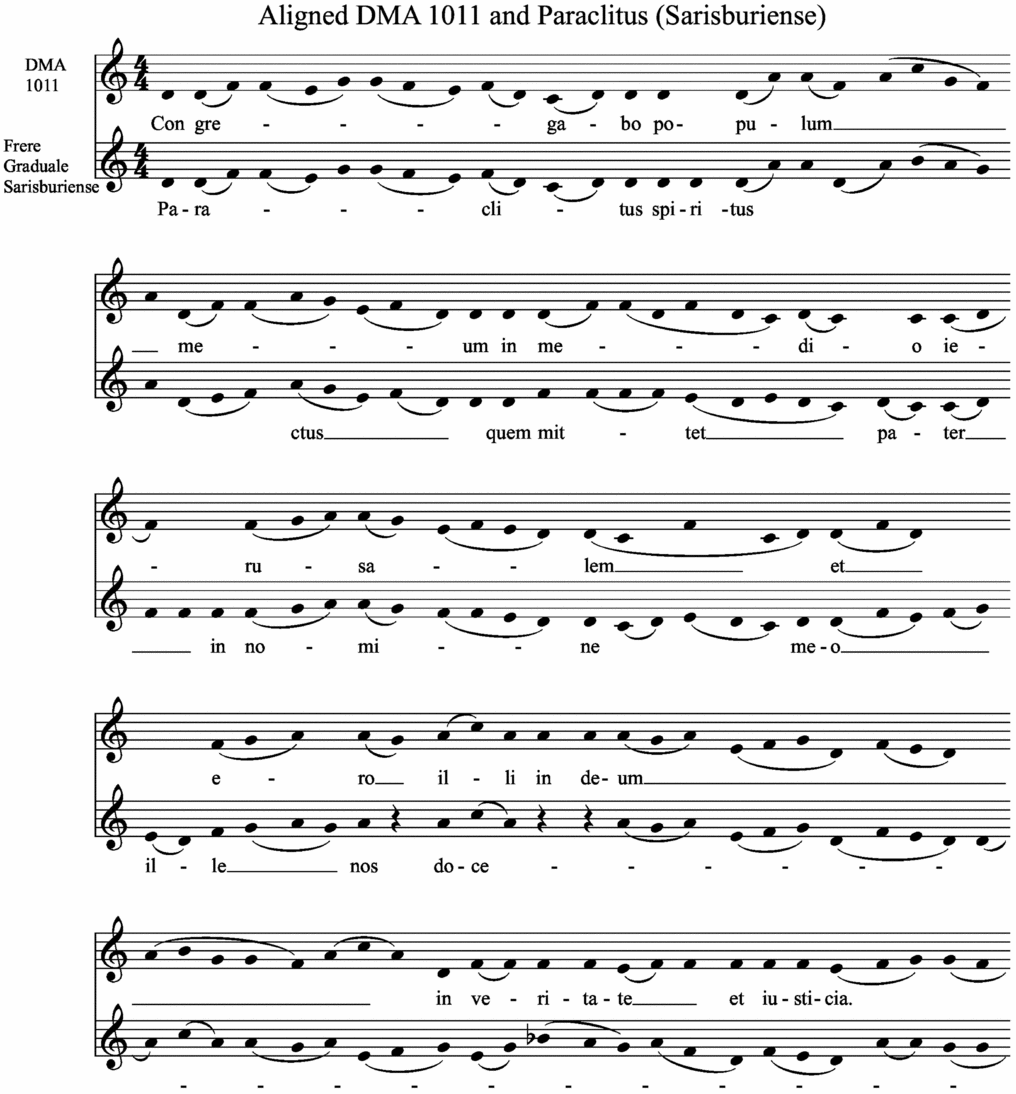
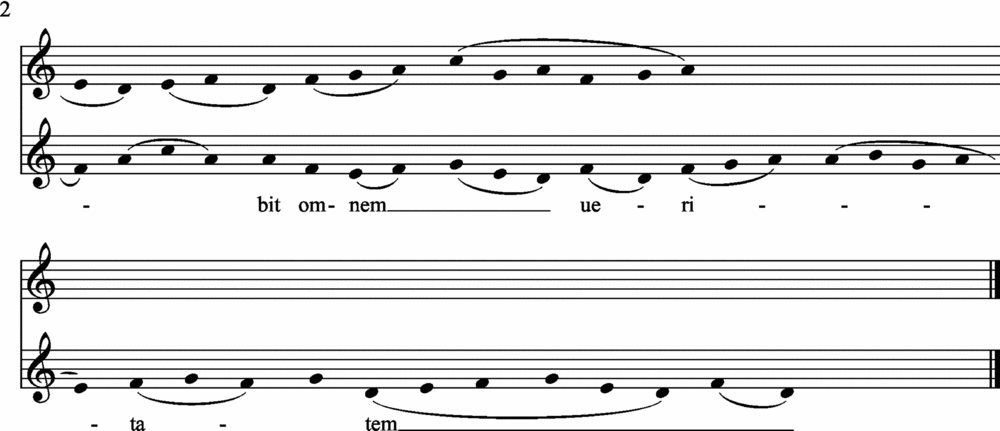
Can anything further be said about the source of the relationship between these two chants? The topic of chant composition has been studied in much greater detail in the early Middle Ages than it has in the later period, and obviously individual creative and compositional processes vary in ways that are both significant and impossible to re-create. Yet, the pattern of concordances and divergences seen between the Preetz/Estonia ‘Sanabo populum’ and the ‘Concussum est mare’ family of alleluia verses are not entirely unpredictable. The greater concordance between the musical phrases at the beginning and end of the piece, as well as the beginning of large melismas, suggests the influence of so-called mnemonic ‘serial-position effects’, in which people display improved accuracy in recalling items from the beginnings (the ‘primacy effect’) and ends of lists (the ‘recency effect’) when in free recall conditions.Footnote 52 Similarly, concordances seen in the alleluia verse of another exemplar of the ‘Recordare domine’ may also suggest reliance on memory, as melody given for the alleluia verse of Augsburg gradual DMA 1011 ‘Congregabo populum’ is partially shared by a different set of alleluia verses, including the ‘Paraclitus spiritus sanctus’ found in the thirteenth-century Sarum gradual GB-Lbl Add. 12194 published in facsimile by Walter Frere (see Figures 13 and 14).Footnote 53 As would be predicted by the primacy effect, the version in DMA 1011 accords quite closely with that in GB-Lbl 12194 at the beginning of the chant, but the exempla diverge as the chants progress. Some small deviations appear at ‘pater’/ ‘medio jerusalem’ as the melodies begin to diverge, but unlike the Preetz/Estonia ‘Sanabo populum’, there is no return to concordance at the end of the chant; from ‘docebit’ / ‘in deum’ onward, the chants are entirely dissimilar.
Comparison of the alleluia verse ‘Congregabo populum’ in DMA 1011 with the alleluia verse ‘Paraclitus spiritus sanctus’ in GB-Lbl Add. 12194.

Comparison of the alleluia verses ‘Congregabo populum’ in DMA 1011 and ‘Paraclitus spiritus sanctus’ of GB-Lbl Add. 12194 (concluded).

By highlighting the potential role of memory in the performance or composition of chants in the ‘Recordare domine’ mass, I do not mean to imply that all variation in these chant melodies are due to imperfect recall of remembered exemplars, or to downplay the importance of other intentional processes of compositional creativity. Rather, I wish to explore the possibility that mnemonic processes, which have been highlighted to a far greater degree in the monophony and polyphony of earlier medieval music,Footnote 54 might still have an important role to play in the late medieval period. Even in an age as fascinated by novelty and the possibilities of written music as the fourteenth century,Footnote 55 textual practices do not change overnight, and occasionally remembering this might serve as an important countermeasure to the tendency to view plainsong in the later Middle Ages as static and bereft of a vital musical impulse that had passed to polyphony.
By studying the ‘Recordare domine’ Mass as a cultural object that is both continuous and potentially variable in its manifestation in multiple exemplars, several patterns emerge. First, not all elements of the Mass are conserved across versions to the same degree, suggesting that the clerics responsible for placing the Mass in the service books did not view all of the parts of the Mass equally. Instead, they likely allowed their familiarity with certain parts of the Mass (namely the gradual, gradual verse and communion) whose texts had long been established in the Gregorian repertory to inform their copying of the ‘Recordare domine’ Mass, leading to fewer variants of these texts than those that were less familiar. Moreover, the text and music for the Propers did evidently not travel together. The novel Propers (namely, introit, alleluia verse and offertory) do not suggest that the scribes copying the Mass were working from a single standardised exemplar. Instead, the large amount of variation in these Propers makes it likely that the clergy, who ultimately put the Mass into practice, made their own decisions about what music the texts should be set to and in several cases it is possible to hypothesise the reasons certain melodies were chosen.
Seeing the chants of the ‘Recordare domine’ Mass as a product of local choice and active decision-making is significant, as it is easy to overlook chant as an important locus of music-making in an age where our own attention has been captured by the polyphonic innovations of the Ars Nova. Even in a musical world that had accepted polyphony, chant remained by far the most common liturgical musical experience of the medieval world. The close examination of the music of the ‘Recordare domine’ Mass can therefore shed light upon a stratum of musical life that remained energetic and important even as certain musicians shifted their attentions to other musical forms. Moreover, the account of Bishop Edenton serves as a useful reminder that the collective musical performance of plainsong was seen as an important countermeasure to the devastation wrought by the Black Death. A comparison of the chant melodies that was used in these observances, gives an idea of how music was employed in response to the cataclysm of pestilence, and more generally of the inter-relationships between musical problem-solving, liturgical practice and psychological resilience in the face of great personal stress. Seen in the proper light, these chants seem far from ‘mortally ill’ and evanescent, as Leonardo da Vinci put it.Footnote 56 Instead, they endure as potent reminders of the power of music to sustain populations through even the most trying of conditions.
Appendix 1: List of manuscripts consulted that contain a ‘Recordare domine’ Mass
-
EV-TALam 237.1.228a
-
D-Diözesanmuseum St. Afra Augsburg 1011 (DMA 1011)
-
F-Pa 156
-
F-Pa 204
-
F-Pa 608
-
F-Pn fr 2001
-
F-Pn lat 835
-
F-Pn lat 850
-
F-Pn lat 863
-
F-Pn lat 870
-
F-Pn lat 871
-
F-Pn lat 878
-
F-Pn lat 861
-
F-Pn lat 1104
-
F-Pn lat 1196
-
F-Pn lat 17315
-
F-Pn lat 17324
-
GB-Cgc 146/196
-
GB-Ctc B.11.3
-
GB-Ctc B.15.3
-
GB-Cu HH.I.1
-
GB-Cu KK.2.6
-
GB-Gu Hunter 432
-
GB-Lbl Add 38723
-
GB-Lbl Add 39678
-
GB-Lbl Add 40146
-
GB-Lbl Add 43380
-
GB-Lbl Arundel 156
-
GB-Lbl Egerton 3036
-
GB-Lbl Harley 1701
-
GB-Llp 213
-
GB-Ob Canon. liturg. 163
-
GB-Ob Canon. liturg. 197
-
GB-Ob Canon. Liturg. 284
-
GB-Ob Canon. liturg. 352
-
GB-Ob Canon. Liturg 368
-
GB-Ob Canon. liturg. 369
-
GB-Ob Canon. liturg. 371
-
GB-Ob Canon. liturg. 374
-
GB-Ob Canon. liturg. 380
-
GB-Ob Canon. liturg. 382
-
GB-Ob Canon liturg. 384
-
GB-Ob Canon. liturg. 385
-
GB-Ob Canon. liturg. 386
-
GB-Ob Canon. liturg. 389
-
GB-Ob Canon. liturg. 364
-
GB-Ob Rawl. Liturg. b.1
-
GB-Ob Rawl. Liturg. c.2
-
GB-Ob Rawl. Liturg. c.3
-
GB-Ob Hatton 1
-
US-Cn Case 45.5
-
US-Cn Case 59.1
-
US-Cn Case 69
-
US-NYpm 905
-
US-SM HM 1042
-
US-SM FI 5096
-
US-SM 19918