Voluntary crimes against life, and in particular the crime of homicide, are always judged by a group of citizens that make up a court of the people, the Jury Court. It is this institution that has the authority to pass all the social verdicts related to these crimes. This Court is composed of people summoned from the civil society, which do not have any connection to state crime control agencies, but who have the extraordinary responsibility of saying what is right and dictating the rules of justice. It is, therefore, par excellence, a public space where important decisions are made that directly intervene in the exercise of the citizenship of these individuals. A space of power and authority, in which a numerically small group of people interact in order to enable the State to formulate responses and / or reparations for offenses committed against society.
Effectively, the criminal justice system is the apparatus in modern societies responsible for making “dangerous decisions”, since it judges the guilt or innocence of people and has the power to convict or acquit. However, this is not an error-free system. Porter and Brinke (Reference Porter and Brinke2009) highlight three main groupings of the sources of error in legal trials: a) there is no way to objectively evaluate the accuracy of the judgments, b) the courts are formed by people, subjectivities, who often judge in a distorted way, and c) in innumerable contexts, human decisions are driven by irrational, unreflective reasoning or even by prejudices.
It is approximately this stage, where a true reconstruction is developed of the dramatic action previously carried out, of the people who took part in this action, and of the legal and social circumstances that are tied to the facts and their versions, which this study is carried out. Our interest is specifically in investigating whether the social judgments of crimes of homicide, handed down by the Court, are influenced by the skin color of those involved, and by their social and economic situations.
The Stage: The jury court
The Jury Court, or people’s court, is the body responsible for the trial of one human being by other “equals”, that is, by those who in theory belong to the same community or the same social group. Through this system, the power to judge is removed from the robed magistracy (judges of law) and delivered to the people (jurors), the legitimate holders of sovereign power.
The Jury Court came to be composed of a court judge, its president, and an additional twenty-one jurors, drawn from among those summoned. Among these, seven would be chosen to compose the sentencing panel in each trial process. These jurors were to be chosen from citizens who offered guarantees of solidity, probity, and intelligence in the performance of the function. This is the current composition of the Court, which must be composed of ordinary citizens who represent civil society in the trial.
In practice, however, the Jury Court, equals do not exactly judge equals. The Jury does not encompass the entire population, being formed generally by civil servants and independent professionals. Indeed, the list of jurors selected for the year 2007 in the city of Aracaju is comprised of 64.7% government employees, 29.3% are workers at public banks, and 5.9% are employees of PETROBRÁS.
It is not only in terms of occupation that jurors are far from representing society. In a survey conducted with a representative sample of the total number of jurors summoned for the year 2007 in the 1st Jury Court of Aracaju, in which 136 jurors were interviewed, it was found that most of them are self-reported as White (43.4%), Darker-skinned (22.8%), or Mixed (15.4%). Only 2.2% define themselves as Black and 0.7% responded as being Mulatto. Almost all live in middle-class neighborhoods, in the B and C Housing Sectors; all have a level of schooling equal to or exceeding the high school level, and 65.4% have a monthly income exceeding U$ 1.000,00 (da Silva, Reference da Silva2009).
The actor and the act: Criminal and crime
Crime invariably assumes a prominent role in modern society, owing to the brutality with which it is carried out, deserving greater attention from the media, or an increase to the discussions on the spread of crime and the reassessment of the effectiveness of public policies in the use of the concerning crime. In concrete terms, both “macro criminality” and “micro criminality” are the social aspects that raise major concerns nowadays, as they jeopardize the public and private safety of the people. This disorder of social relations, in small or large proportions promoted by crime, constitutes a topic of special relevance for the social sciences (Robert, Reference Robert2007).
Young (Reference Young2002) argues that the phenomenon of crime should be examined in the context of social exclusion on three levels: economic and labor-market exclusion, social exclusion, and exclusion from the criminal justice system. Young says that recent modern life causes a state of “ontological insecurity”, due to which repeated attempts to create a secure base arise, reaffirming values as absolute, declaring that other groups do not have values, establishing strict boundaries between what is virtue and what is vice. In the end, being more rigid than flexible, and more punitive and exclusionary than pervious and tolerant in their decisions against other groups.
Exclusion and stigmatization are powerful mechanisms that allow the assertion of superiority between people and between groups. The stigmatized group is seen as different and inferior by the stigmatizing group. The taint of being deviant in relation to laws and rules hangs over its members. The dynamics of stigmatization, generally promoted by groups well-installed in positions of power, can make it possible for an individual to be treated and judged negatively by the mere fact of living in a particular neighborhood. In this case, the image of the group to which he/she belongs becomes a sort of symbolic personal capital that the individual carries (Elias & Scotson, Reference Elias and Scotson2000).
It is in this sense that Misse (Reference Misse and Misse2008) proposes the existence of a “social distance between classes and individuals”, which functions more as a way to maintain, practice, operate, and represent the power relations of a given society than simply as a cultural aspect. Society has a demand for incrimination which makes the mobilization to file the complaint and even to personify and characterize the group as a criminal element publicly justifiable. Identification or indifference in relation to the other will therefore constitute important aspects in social judgments.
The scene: The trial
Social judgment involves a cognitive and social process in dealing with information in a scenario where multiple variables can intervene, often producing results or verdicts that depart from factual reality, to construct a new reality that they validate or legitimize (Kahneman & Tversky, Reference Kahneman and Tversky1982). Social judgments are affected by heuristics or mental shortcuts, and even by other biases, such as beliefs or preconceptions, noteworthy among these are stereotypes and social prejudices. In this sense, false impressions and inaccurate attributions can generate erroneous judgments and result in serious consequences for people’s lives.
Attribution theories try to understand how ordinary people deal with information in order to understand and explain social reality. As Halim and Chew (Reference Halim and Chew2008) observe, it is the attribution of causes or the meaning we give to phenomena, and not the phenomena themselves, that determine our actions at an individual or group level. Attributions are explanations from ordinary citizens for what is happening around them. They are occurring all the time in our daily lives, sometimes consciously, sometimes not, and have a considerable impact on the way we behave and interact with others. In attribution’s theory it is common to commit what Ross (Reference Ross1977) calls “fundamental attribution error”, when judging people’s behavior is confined to dispositional factors, in preference to situational factors.
One of the explanatory principles employed to understanding why, in the processes of explaining reality or attributing causality, so many mistakes and precipitations are committed is called “need for closure”. The need for closure is a motivation to reduce uncertainties in the formation of an attribution. For Kruglanski (Reference Kruglanski and Berkowitz1989), we are motivated in our judgments to seek accuracy and this often leads us to consider as valid only such information that avoids confusions and ambiguities. In this scenario of seeking more concrete elements to form beliefs and judgments, certain “peripheral” cues, such as age, gender, sexual orientation, skin color, education level, socioeconomic status, accent, mode of dress, among others, can have a definitive weight in decision making.
Various studies in social psychology have shown that the jury’s composition and dynamics influences the outcome of its deliberation (Bornstein & Greene, Reference Bornstein and Greene2011; Hastie, Reference Hastie1993; Lieberman, Reference Lieberman2011; Winter & Robicheaux, Reference Winter, Robicheaux, Wiener and Bornstein2011), often lead to a malfunction in jury trials. These factors intervene directly in the three phases of the trial: i) the way jurors use information they obtain before trial; ii) the way they process information during the trial; and iii) how they deliberate, after the evidence has been presented.
In an elitist and racist society, is the case of Brasil, the skin color of those involved in crimes, and their socioeconomic status can be powerful variables in determining what we call a jury malfunction.
Prejudice in social judgments
Researches finds that “dangerous decisions” are often influenced by racism. Several studies show that the decision by police to shoot against a presumably armed suspect is taken more quickly when the suspect is black (e.g., Correll, Park, Judd, & Wittenbrink, Reference Correll, Park, Judd and Wittenbrink2002; Payne, Reference Payne2001). Other studies show that the more pronounced the racism of doctors, the less they diagnose and prescribe treatment suitable for serious illnesses in patients from minority ethnic groups (Green et al., Reference Green, Carney, Pallin, Ngo, Raymond, Iezzoni and Banaji2007). Vala, Pereira, Lima, and Leyens (Reference Vala, Pereira, Lima and Leyens2012) have shown, in a series of studies in Europe, that members of dominant groups spend less time analyzing Black people than Whites in impression formation tasks.
In all these cases, the psychological mechanism underlying the effects of skin color in social and legal judgments is not a simple and direct consequence of individual racism of the people involved. It is something more complex and less controllable.
Several analyses show that our culture associates Blacks with aggressiveness and violence (Guimarães, Reference Guimarães1999; Jahoda, Reference Jahoda1999). This cultural association is reflected in people both consciously and unconsciously, at the so-called “automatic” level (Lima & Vala, Reference Lima, Vala, Lima and Pereira2004a). Studies find that college students, who consider themselves consciously anti-racist, at the level of their private and implicit attitudes (i.e., non-conscious) exhibit negative stereotyping against Blacks (e.g., Lima, Reference Lima2002; Lima, Machado, Ávila, Lima, & Vala, Reference Lima, Machado, Ávila, Lima and Vala2006).
Negative associations against Blacks are culturally widespread, and those. associations which hold influence in every day life because they somehow affect us all become critical when it comes to decisions taken by the court. Systematic investigations demonstrate that the death penalty is assigned more frequently to Black defendants than to White defendants. Eberhardt, Davies, Purdie-Vaughns, and Johnson (Reference Eberhardt, Davies, Purdie-Vaughns and Johnson2006) observe that the more the defendant has traces of the Black phenotype (e.g., darker skin, thicker lips, more curly hair, etc.), the more often they are sentenced to death. There even exists an effect from the victim of the crime, on conviction of the defendants, where this rises from 27% to 41% when the victim is White. So much so that, in cases where the defendant is Black and the victim is White, there is a higher conviction rate in the United States.
It is no wonder, therefore, that in the United States there is a policy of “correctional affirmative action” in reverse. Six in ten inmates in that country are Black or Latino, even though these two groups combined represent no more than 25% of the population. For Wacquant (Reference Wacquant2001), the key trend of the U.S. penitentiary evolution is a continuous ‘darkening’ of the prison population.
In Brazil, racism often appears as a hybrid of color and social class, which includes in its composition, even today, the cult of miscegenation that marked our identity, history and became classic with Freyre (1933/Reference Freyre1983). Another hallmark of our racism has always been, as a function of the non-establishment of a “color line” or of a racialization of color based on descent, the possibility for an individual to change color depending on their socioeconomic status, i.e., the close relationship between color and social class (Degler, Reference Degler1971; Lima, Reference Lima2007; Lima & Vala, Reference Lima and Vala2004b).
Indeed, Fausto (Reference Fausto2001), studying crime in Sao Paulo in the period between 1880 and 1924, finds that criminal prosecutions tended to different outcomes, depending on the color of the accused. Acquittals and dropped cases were the prevalent decisions when they involved a White defendant; the reverse happened when the accused were Black or Mulatto.
Ribeiro (Reference Ribeiro1993) conducted a study on color and criminality in attempted and consummated homicides in Rio de Janeiro in the early decades of the twentieth century. The author found that the absolute majority of criminal cases heard in the Jury Court were Black defendants (60.6%). But this phenomenon did not extend only to the defendants, as Black victims totaled 54.2% of the people injured in a lethal or non-lethal manner, while only 10.8% were Whites.
More recently, Adorno (Reference Adorno, Schwarcz and Queiroz1996) did a study on the color of the defendants in police reports of violent crimes that occurred in 1990 in the city São Paulo (e.g., robberies, rapes, extortion through kidnapping, drug trafficking, etc.). The author notes that there is a tendency toward the “mixed coloring” of the accused and defendant population. As the case progresses, some defendants tend to blacken and others to whiten.
If during prosecution of the case, it is determined that this defendant is a hard-working citizen of a respectable family, a good father and a model husband, who accidentally became involved in the crime, it is possible that in the trial outcome he may come off as slightly dark-skinned; the reverse is also true (Adorno, Reference Adorno, Schwarcz and Queiroz1996, p. 268).
We conducted this study for the purpose of analyzing the impact of skin color and socioeconomic status of the defendants and the victims in the conviction or the acquittal, and in the length of sentence imposed, in the judgments of the Jury Court of a judicial district in a Brazilian capital city, for crimes of homicide. Our working hypothesis states that: black and poor defendants will suffer a higher conviction rate and receive longer sentences than white and rich defendants.
Method
The research
The corpus was established from the universe of actual cases (trials) that were analyzed and judged by the 1st Jury Court of a judicial district in Brazil’s Northeast region, from April 2003 to December 2007. Thus, 127 jury trials were considered, pertaining to the commission of homicides, consummated (resulting in the death of the victim) or attempted (without death of the victim). From these we decided to choose consummated and attempted homicide trials with up to two aggravating circumstances, totaling 114 trials. For statistical analysis we included a single manslaughter case in the category of simple homicides, and all attempted homicides were grouped into a single category.
The defendants in these crimes were mostly men (95%), a large part with no prior criminal records (57.4%), single (59.34%), with up to an elementary level education (73.4%), were aged between 18 and 67 years (M = 28.2, SD = 9.5). Regarding the victims, they were also a majority male (93.4%), almost all with no criminal records (96.7%), single (64.4%), most of those for whom we could obtain information on schooling were literate (83.3%), ranging in age from a number in months to 64 years (Mean = 28.9, SD = 11.7 years). The trials studied had an average duration of 69.8 months (SD = 39.6), ranging from 7 months for the quickest to 194 months for the slowest.
Variables considered
After having made the selection from the “corpus”, we were interested in verifying the information on the skin color and the social stratification of the defendants and the victims. With regard to skin color of the defendants in criminal proceedings, this information is contained in the criminal identification record or is obtained from the information provided by the defendant. With regard to the victims skin color, these data were collected based on researching documents inserted into the records, such as a coroner’s autopsy report, death certificate, and forensic expert report prepared at the crime scene.
Regarding socioeconomic status, as there was no information in the official records about family or personal income of defendants and victims, we decided to adopt the place of residence, stratified into residential housing sectors, as an indicator of this variable. We adopted the classification of neighborhoods by residential housing sectors from the IBGE Census (2000). According to this classification, five housing sectors are configured by the following ranges of mean household income: Sector A (more than 20 times the Minimum Wage Footnote 1 ), Sector B (between 10.1 and 20 x MW), Sector C (between 5.1 and 10 x MW), Sector D (between 2 and 5 x MW), and Sector E (up to 2 x MW). In the classification of the neighborhoods of residence of defendants and victims in these sectors, we had to aggregate the neighborhoods of sectors A and B, since there were only 2 defendants in sector A. It was not possible to allocate all the defendants and victims into the sectors, because some lived in other states or in other cities.
Results and Discussion
First we analyzed the overall outcome of the trials. The study found that the Sentencing Panel predominantly found the defendants guilty. The conviction rate was 75.9% of the cases. The sentences imposed on the convicted ranged from 1 to 37 years, with a mean of 9.45 years (SD = 7.49 years). Our goal, however, is to understand the effective role of skin color and socioeconomic status of the defendant and the victim in the conviction rate of the accused.
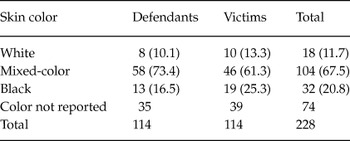
Regarding skin color, we can see that 73.4% of the defendants and 61.3% of the victims are of mixed-color, almost 17% of the defendants and over 25% of the victims are Black. Thus, aggregating mixed-color and black-color into the non-White category, we have 90% of the defendants and 87% of the victims in this social category (see Table 1).
Skin color of defendants and victims of the homicide trials as Frequencies (Percentages in Parentheses)

Contrasting this data with those collected by the IBGE (2007), on the total population and percentage distribution by color or race in our state, we observed that Whites are 29.2% compared with 70.3% of non-Whites (5.7% Black-color and 64.6% Mixed-color). Data of Ministry of Justice Footnote 2 to Sergipe State indicates that, in 2008, there were 407 Whites versus 2209 non-Whites prisoners. That is, 81.6% of the State’s prisoners are non-Whites and only 18.4% are Whites. Which indicates an under representation of Whites in our prisons and an over representation of mestizos and Blacks Footnote 3 .
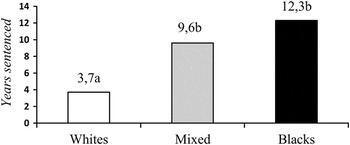
In order to evaluate the hypothesis of the effect of skin color on convictions, we ran a chi-squared test comparing the skin color of the defendant with the decision of the Sentencing Panel. The results indicate that there was no significant effect of the skin color of the defendants on the jury decision, χ2(2) < 1, n.s. Nevertheless, when convicted, black defendants received longer sentences than white defendants. The results of an analysis of variance (ANOVA) indicate a significant effect of the defendant’s skin color on the length of sentence imposed by the Judge, F(2, 75) = 3.11, p = .052. Black defendants receive an average sentence of 12 years for the crime of homicide, nearly four times longer than white defendants receive for committing the same crime (see Figure 1).
The Length of Sentence Imposed by the Judge as a Function of Skin Color of the Defendant.
Means with different letters are significantly different (Least-Significant-Difference, LSD, p < .05).

Taken together, the data on the effects of skin color of the defendants and victims on the Sentencing Panel verdicts and on the final decision of the judge concerning length of sentence confirm our hypothesis that predicts discrimination against non-Whites, mainly Blacks, in the application of criminal justice. More than this, the data also indicate the segregation of homicide, or at least the homicides that come to trial. This crime appears strongly associated with non-White skin color, both for its perpetrators and for its victims. This is confirmed by other researchers and in other contexts, for example Adorno (Reference Adorno, Schwarcz and Queiroz1996) and Fausto (Reference Fausto2001), in São Paulo; Wacquant (Reference Wacquant2001) in the United States; and Ribeiro (Reference Ribeiro1993), in Rio de Janeiro.
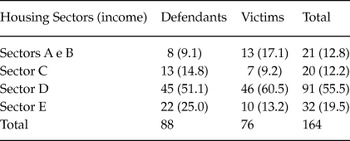
We also analyzed the location of the residences of defendants and victims. The results indicate that the majority of the defendants and victims live in sectors D or E. A slight difference is even observed between the defendants and victims in relation to this indicator, there are more defendants in Sector E, and more victims in Sector A (see Table 2).
Residential housing sector of the defendants and victims of the homicide trials as Frequencies (Percentages in Parentheses)

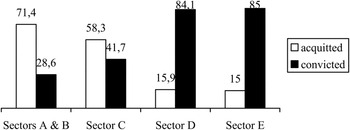
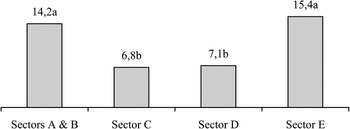
We then tested the effect of the residential housing sector of the defendants and victims (our measure of average income of the head of household) on the Court’s decision, considering the conviction rate and the sentence imposed. Regarding the conviction rate, we found a significant effect of the defendants’ neighborhood of residence χ2(3) = 17.39, p = .001. As we can see in Figure 2, the conviction percentages grow as we move from sectors A and B toward E. Residents of poorer neighborhoods were convicted in more than 85% of the cases, compared with the 28.6% of residents of wealthier neighborhoods. Since all were equally under suspicion, there should not be differences in conviction rates as a function of the neighborhood where one lives or the income that one earns. This data confirm the second part of our hypothesis which stated that defendants from lower social strata would be convicted at a higher rate than those from upper strata.
The Conviction Rates in the Homicide Trials as a Function of Defendants’ Residential Sector (income)

There was no effect from victims’ housing sector on the conviction rate χ2(3) = 1.14, p = .79. Furthermore, there is no significant effect from housing sector on the sentence imposed by the judge, F(3, 76) = 2.15, p = .10, although this result is very close to being significant. Nevertheless, there is a significant effect from the victim’s housing sector on the sentence imposed on the defendant, F(3, 66) = 5.02, p = .003. Longer sentences are handed down to defendants who killed victims from sectors A and B, and also sector E, than for defendants who victimized people from other housing sectors (see Figure 3).
The Length of Sentence Imposed on Defendants as a Function of yours Residential Sector (income)
Note: Means with different letters are significantly different (Least-Significant-Difference, LSD, p < .05).

Just as had occurred for the impact of the victim’s skin color on the conviction rate, we suppose that the judge’s greater severity in imposing sentences can result from passionate motivations involved in crimes against the victims from Sector E. Indeed, 60% of the crimes committed by defendants residing in Sector E had residents of the same sector as victims. However, this is a finding that deserves a more thorough inquiry in other investigations.
Our socioeconomic status indicator confirms a heavy concentration of defendants and victims in the lower strata of the social pyramid. The defendants and victims of the crimes brought to trial are, mostly, the poorest. As Briceño-León, Camardiel, and Avila (Reference Briceño-León, Camardiel and Avila1998) report, a hallmark of the new urban violence is that it involves mainly the poor in the large cities. Even though the middle class feels threatened and seeks protection in various ways against thefts, kidnappings, and robberies, those most often lethally victimized in this “urban warfare” are the poor. This is violence of poor against poor. Our data show that in practically 60% of the cases, defendants and victims of homicide live in neighborhoods of the same housing sector and have the same skin color. In fact, data from the Ministry of Justice (2008) show that 89.8% of the prisoners in Sergipe have at most an elementary education level.
In addition to the crime of murder extending mostly Blacks and poor people as perpetrators and as victims (i.e., being a form of violence segregated by color and social status). Our data show that strong discrimination against defendants in the application of justice also occurs. Non-White defendants are convicted more often and spend more time in prison than White defendants.
In order to obtain a broader view of the impacts of the variables studied and their specific weight in the conviction of defendants and the length of sentence imposed, and especially in order to control the effect of the type of homicide in the conviction rate and the length of sentence imposed, we conducted two regression analyses, one linear and another logistic. This type of analysis is useful when you want to analyze, given a set of variables, which ones best describe or correlate with a phenomenon, and with what explanatory power.
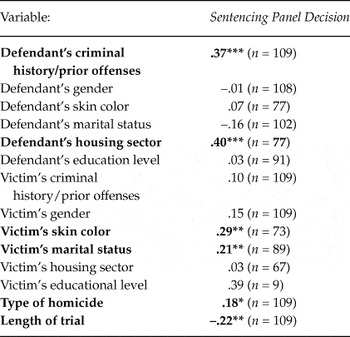
In an initial regression we investigated the impact of the variables analyzed in the trials concerning the conviction rate. To do so, we did a Binary Logistic Regression Footnote 4 , using the Enter method, which is analogous to the Enter method of linear regression models. Before running the regression, we analyzed, through a matrix of bivariate correlations, which variables had some relationship with the sentencing panel’s decision (see Chart 1), then proceeding to the Logistic Regression using only the variables that showed some relationship with the dependent variable.
Correlations between Defendant and Victim Characteristics with the Decision of the Sentencing Panel

Note 1: *p < .10; **p < .05; ***p < .001.
Note 2: Conviction rate: –0.5 = acquitted, 0.5 = convicted; Criminal history: –0.5 = no priors, 0.5 = prior offenses; defendant gender: –0.5 = male, 0.5 = female; skin color: –1 = white, 0 = mixed, 1 = black; Marital status: –0.5 = single, 0.5 = married; Housing Sector: Sectors A and B = 1, Sector C = 2, Sector D = 3, and Sector E = 4; Education level: ranged from 0 = illiterate to 6 = college degree; type of homicide: 1 = attempted, 2 = simple, 3 = aggravated, 4 = doubly aggravated.
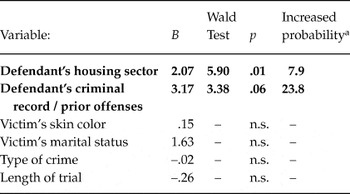
The results indicate a strong effect of the variables considered, Nagelkerke R-Squared Regression Coefficient, R2(39) = .61 and Wald = 8.43, p = .004. There are two variables that have significant impact on the Jury Court’s decision to convict or acquit the defendant in the homicide crimes studied: the economic situation of the defendant (the housing sector where he/she resides) and his/her criminal record. Defendants who live in poorer neighborhoods and have prior criminal records are the most often convicted (see Table 3).
Summary of Logistic Regression Analysis (Enter Method) for Variables Predicting Conviction Rate in the Trials

a Odds Ratio in the original
It is important to note that, when all these variables are placed into a single analysis, an effect from the type of crime on the conviction rate does not show up. This means, in statistical terms, that this effect becomes weaker when collocated simultaneously with the effect of housing sector (monthly income) and prior criminal record, which in this case play a more decisive role than the skin color of the defendant in his/her conviction.
The odds ratio, which for us translates as increased probability, indicates how much the antecedent variable adds to the resulting one when all the others are neutral. This is to say that a change in the housing sector of the defendant, for example from A or B to the C sector, implies a 7.9% greater chance of conviction. A defendant from sector E has a 24% greater chance of being convicted by the Sentencing Panel than a defendant residing in sectors A and B. Furthermore, having a prior criminal record means an almost 24% additional chance of being convicted in relation to defendants who do not have one.
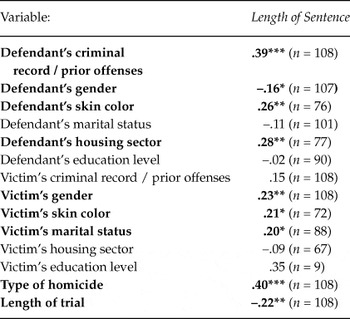
Just as we handled the Sentencing Panel’s decision, we proceed with the Judge’s decision on length of sentence. Correlation analyses indicated nine variables related to sentence length (see Chart 2).
Correlations of Defendant and Victim Characteristics with the Judge’s Decision on Sentence Length

* p < .10; **p < .05; ***p < .001.
These nine variables were entered in the regression equation, a linear regression this time, since the dependent variable was continuous. The results indicate an equally strong effect of the variables considered, Regression Coefficient (R) = .76, adjusted R 2 = .48, F(9, 49) = 5.93, p = .0001. Six variables had a significant effect on the Judge’s decision on the length of sentence to be imposed on the defendant: the type of crime, the defendant’s prior criminal record, the victim’s gender, the defendant’s skin color, the victim’s marital status, and the defendant’s housing sector. A longer sentence is given to defendants with prior criminal offenses, for consummated and aggravated homicides, longer sentences for defendants with darker skin, who live in poorer neighborhoods, and who victimized married women (see Table 4).
Summary of Multiple Regression Analysis (Enter Method) for Variables Predicting Imposed Sentence Length in the Trials

Like the odds ratio in logistic regression, the B in linear regression indicates the increase in the means of the dependent variable (length of sentence) that each level of each variable produces when the others are neutral or controlled. It is striking in this case that the type of crime adds, on average, 2.5 years to the sentence, i.e., moving from a simple homicide to an aggravated one; while the defendant’s skin color adds, on average, over 5 years to the sentence, i.e., a white defendant gets a sentence, on average, 10 years less than a black defendant, even controlling the effect of the type of crime committed.
What also draws attention is that a defendant from a poorer sector, as one descends levels on the social “ladder”, may get an additional 2 years in prison. If you go down 3 steps, from sector A/B to E, for example, you remain in prison almost 7 years longer than another defendant from sector A. It is noteworthy that the effect of color and sector hold steady in the regression, which means that one does not overlap or cancel the other, as the theses from the Class-Over-Race theory could lead one to believe; in addition, there is a predominance of color over class in these results.
It was to be expected, for objective reasons of the Laws, that there were longer sentences for aggravated crimes and that, for the same reasons, there were no effects for the defendant’s skin color and neighborhood of residence, in the verdicts of the Sentencing Panel and in the penalties imposed by the Judges. It so happens, however, that these variables strongly influence the trials studied. The effects seen are consistent across all the analyses carried out, and therefore cannot be disregarded.
Thus, the maxim of blind justice did not apply in most of the trials. Residing in a poor neighborhood greatly increased the defendant’s chances of conviction by the Sentencing Panel (24%) and the sentence from the Judge by up to almost seven years; while having black skin increased the sentence imposed by the Judge by ten years. In other words, the defendant’s economic circumstances and skin color proved to be strong aggravations of homicide in the eyes of the Sentencing Panel and the Judge.
Conclusions
The purpose of this study was to analyze the impact of skin color and socioeconomic level of defendants and victims of homicide in the decision of the Jury Court. Two spheres of judicial decisions were considered in the analyses: the conviction rate and the length of the sentence handed down. The first of these decisions concerns whether or not the defendant is acquitted, and it is the responsibility of the Sentencing Panel, a level of the judiciary, as we saw, coming from civil society and which should be representative of this. The second decision, on sentence length, is the Judge’s. Our working hypothesis stated that there would be discrimination in the trials of black and of poor defendants in these two spheres of decision. The observed results partially confirm the hypothesis raised. Poor defendants were convicted more than richer ones by the Sentencing Panel, and non-White, mainly black defendants, received longer sentences from the Judge than white ones received.
Beyond discrimination in the distribution of justice concerning victims, defendants, non-Whites, and poor people, we observed a segregation or territorialization of homicide. The victims and the perpetrators were almost all black and poor. This fact could lead us to accept a logic that associates color and poverty with extreme violence. However, we must yet consider that there could be considerable differences between blacks/whites and poor/rich on who goes to trial and who does not. Our data concern crimes that were tried and not overall crimes committed.
Another fact that can interfere in this pattern of results is the actual classification of skin color of defendants and victims. As Adorno (Reference Adorno, Schwarcz and Queiroz1996) observes, the defendant’s skin color can vary depending on the course of the trial, darkening for worse outcomes. Lima and Vala (Reference Lima and Vala2004b) demonstrate as well that more successful people are perceived as whiter than socially and economically unsuccessful people. So much so that whitening is an interpretive vector that cannot be ignored.
It is worth highlighting that the under-representation of whites as defendants - we had only eight - leads to a relativization of the data obtained. The differences seen in imposed sentence length and conviction rate denote more an association with the darkening of the skin, rather than with clear splits such as “whites versus blacks.”
But one cannot also ignore the fact, emphasized by other researchers, that modern societies operate with a kind of exclusionary logic that puts the poorest, including non-Whites, up against the wall for the summary firing squad, either by the police themselves, or by others among the excluded (Briceño-León, Reference Briceño-León2002; Briceño-León, Camardiel, & Avila, Reference Briceño-León, Camardiel and Avila1998; Wacquant, Reference Wacquant2001). In addition, as pointed out by Young (Reference Young2002), several studies present a phenomena which shows economic and symbolic frustration, relative deprivation, and the spread of a “culture of honor” can not be neglected in explaining many forms of violence, including homicide.
In the same bent, “social disorganization theory”, highlighted by Robert (Reference Robert2007), seeks to explain crime on the basis of the socio-economic conditions of neighborhoods and the lack of influence from norms of individual behavior, especially among younger individuals. This theory considers in its analyses a territorial logic, according to which the richer withdraw from city centers and take over more prime, high-value areas, while the poorer pile up in outlying areas, poorly maintained, unsafe and lacking any presence by the State. In these areas the conventional standards or the rules that would allow conferring social stability cannot regulate individual behavior satisfactorily. Crime becomes a reflection of the normative disorder from abandonment by the State.
However, what our data claims is that even when White and non-White defendants are tried for homicide, there is discrimination in the application of justice or distortion in the trials. In a way that we can discern the actual operation of a post-welfare-State logic, which replaces the treatment of social misery by criminal or penal treatment. The penal system therefore creates and reinforces social inequalities (Hulsman & Celis, Reference Hulsman and Celis1997).
Our intent in these analyses is not to cast doubt on the correctness of the judgments made in the Jury Court or to blame individuals. The massive presence of Blacks and Mixed as defendants and as victims of crime and their convictions under the law does not owe merely to individual distortions in the trials. We argue that all social judgments, in and out of court, are subject to bias. Thus, the more frequent conviction of one social category than another is a more complex phenomenon that results from differences in social, educational, and economic opportunities for citizens, and that produces and nurtures stigmas and powerful negative stereotypes about the groups. In this social exclusion and stigmatization scenario, it is possible that the civil society members called to judge the crime are also affected by the social stereotypes, as happens with each one of us. The difference is that they make a decision regarding someone else’s life, and these decisions can, as we have seen, increase the chances of conviction and the length of sentences for black and poor defendants.
The question we place is: how could the decisions of the Jury Court be more accurate? We think that the social and legal sciences have a fundamental role in this scenario, for example, discussing elements and consequences of racism and class prejudice in Brazil.
One of the powerful principles for maximizing or neutralizing the use of such peripheral routes is social identification with those involved. As noted by several authors (Elias & Scotson, Reference Elias and Scotson2000; Misse, Reference Misse and Misse2008; Tajfel, Reference Tajfel1981), identification or indifference in relation to the other will constitute an important aspect of social judgments. This becomes of great importance when we consider that there are almost no poor or black jurors, much less judges in these conditions.
Of course we are not assuming here the simplistic logic that the poor should be judged by the poor or that black people should be judged by blacks. But we hold that the Jury Court should be more representative of society as a whole, which would effectively increase the accuracy of their verdicts and their social legitimacy. Another important aspect for minimizing errors in a trial is to produce a broad discussion on racism, elitism, and discrimination in the application of justice in Brazil, both in university spheres for training future judges, and in the most common spheres of every day life.
This study presents some limitations that should be highlighted. The main one concerns the sample. We had access to data from a small number of White defendants and victims. There were 8 White defendants and 10 White victims in the 114 murder trials. With such a small sample, the possibility of generalizing the data decreases in proportion to the increase in probability that the results are due to chance. However, as indicated by various studies presented in this article, including systematic data surveys with representative samples of the Brazilian population, White individuals commit and suffer less murders, when they do commit them they are less likely to go to trial, when they go to trial they have a lower likelihood of being convicted, and when they are convicted they receive less severe sentences than non-White individuals.
Another limitation was not having more objective indicators to measure economic and social status. We considered the neighborhood where those involved in the crimes lived as a variable for analyzing the effect of the socioeconomic situation of the defendant and the victim in the Court’s decisions. This variable has been considered with a certain relativism, because in a country like Brazil, we often find, in “wealthy neighborhoods” with good infrastructure, slums or “islands of absolute poverty”. It should be noted, however, that the housing sectors with higher socioeconomic status, in the logic that we adopted (Sector A and Sector B), accounted for only 8 defendants and 13 victims from the 114 cases of murder trials. This data is consistent with the studies presented on the representativeness of the wealthy in homicide crimes tried in Brazil.
Despite these limitations, this study demonstrates the persistent strength of racism and elitism in Brazilian society. The data presented here indicate that the training of judges and those citizens who compose the sentencing boards needs to be reviewed. Intervention is necessary to allow monitoring and counteracting the effects of prejudice in decisions that directly affect the life and death of individuals. Social psychology and the social sciences, in general, play an important role in this process.