Prostitution, defined as the exchange of sex for money or other valuable items (Menaker & Franklin, Reference Menaker and Franklin2018), produces an asymmetric and risky power relationship against women (Farley, Reference Farley2017) and is an economic activity outside the law that generates a substantial amount of money per year (Jakobsson & Kotsadam, Reference Jakobsson and Kotsadam2013; Meneses, Reference Meneses2010). In addition, prostitution is closely related to human trafficking and contemporary forms of female slavery (see Castellanos Torres & Ranea Truviño, Reference Castellanos Torres and Ranea Triviño2013; Cho et al., Reference Cho, Dreher and Neumayer2013; European Network for HIV/STI Prevention and Health Promotion among Migrant Sex Workers [TAMPEP], 2009; Eurostat, 2018; Rubio Guzmán et al., Reference Rubio Guzmán, Labrador Fernández, Huesca González and Charro Baena2003; Solana, Reference Solana and Checa-Olmos2005; Weitzer, Reference Weitzer2015). Recent studies have considered forced prostitution a global issue that legitimizes social and economic inequality and the exploitation of women (see Benoit et al., Reference Benoit, Smith, Jansson, Healey and Magnuson2018; Moran & Farley, Reference Moran and Farley2019). Moreover, prostitution has psychological consequences for its female targets. Several studies have shown that prostitution is related to a high risk of mental health problems, such as depression, anxiety or substance abuse (Benoit et al., Reference Benoit, Smith, Jansson, Healey and Magnuson2018; Burnette et al., Reference Burnette, Lucas, Ilgen, Frayne, Mayo and Weitlauf2008; Hengartner et al., Reference Hengartner, Islam, Haker and Rössler2015; Palacios Picos et al., Reference Palacios Picos, Pinedo González and de la Iglesia Gutiérrez2018; Rössler et al., 2010; Teixeira & Oliveira, Reference Teixeira and Oliveira2017).
The use of prostitutes is a growing reality in numerous Western countries. For example, the consumption level is estimated at approximately 13% among men in Norway, 11.3% in Denmark (Buttmann et al., Reference Buttmann, Nielsen, Munk, Liaw and Kjaer2011) and 11% in the United Kingdom (Jones et al., Reference Jones, Johnson, Wellings, Sonnenberg, Field, Tanton, Erens, Clifton, Datta, Mitchel, Prah and Mercer2015). In the case of Spain, 32.1% of the entire male population and 25% of men between the ages of 18 and 49 (Belza et al., Reference Belza, De La Fuente, Suárez, Vallejo, García, López, Barrio and Bolea2008; Instituto Nacional de Estadística [INE], 2004) have paid for sexual services at some point in their lives. Moreover, a study conducted by the Mixed Commission of Woman’s Rights and Equal Opportunities of the Congress of Representatives of the Government of Spain in 2007 indicated that 99.7% of prostitutes’ clients are men, more than 300,000 women in the country are engaged in prostitution activities, and the majority of them are underprivileged, immigrants and undocumented. In a recent study, Meneses et al. (Reference Meneses, Rua and Uroz2018) showed that 20.3% of the male population between the ages of 18 and 70 had paid for sexual services during their lifetime, with 15% having done so in the last year. Moreover, the Association for the Prevention, Reintegration and Care of Prostituted Women (Asociación para la Prevención, Reinserción y Atención a la Mujer Prostituida [APRAMP], 2017) asserts that 39% of men have used a prostitute during their lifetime.
Attitudes toward Prostitution
In addition to consumption, research on prostitution includes two models related to beliefs and attitudes toward prostitution. On the one hand, following Sawyer and Metz (Reference Sawyer and Metz2008), three main attitudinal variables related to prostitution should be targeted by advertisement campaigns seeking attitudinal change: Social/legal support of prostitution, beliefs about prostitutes, and family values related to prostitution. Social acceptance of prostitution leads to the view of sex as a commodity while dehumanizing women; men who endorse this belief trivialize sex and depersonalize sex and intimacy (Sawyer & Metz, Reference Sawyer and Metz2008). The second negative belief related to prostitution involves inaccurate stereotypes and myths about prostitutes related to “perceptions of sex workers’ making free choices about employment decisions and whether they like their work” (Sawyer & Metz, Reference Sawyer and Metz2008, p. 9). This belief is especially important because it leads to misguided beliefs about these women that could justify the use of a prostitute. Finally, following Sawyer and Metz (Reference Sawyer and Metz2008), another belief relates to family involvement in prostitution, reflecting attitudes toward a family member being a prostitute. Family values related to prostitution constitute an especially important aspect because they demonstrate real approval of prostitution.
On the other hand, the model developed by Levin and Peled (Reference Levin and Peled2011) distinguished two focuses in the study of attitudes toward prostitution and prostitutes: The degree to which prostitution is considered a personal choice by the prostitute (vs. a victimized perspective) and the extent to which the prostitution patron is considered deviant (vs. normal). The model also clearly distinguishes between attitudes toward the phenomenon of prostitution and toward the women who engage in it (i.e., prostitutes).
Prevention Campaigns and Attitude Changes
Currently, public institutions have exhibited growing interest and investment in the reduction of commercial sexual exploitation. In addition to working against forced prostitution on judicial, political, and legislative fronts, public institutions are investing time and money in communication campaigns, advertising, and persuasive initiatives. Garrido-Lora et al. (Reference Garrido-Lora, Ramos-Serrano and Rodríguez-Centeno2007) assert that public interventions, such as institutional communication and advertising, must play a crucial role in the relationships between official organizations and their citizens. This role is especially relevant for prosocial or public health issues (Hornik, Reference Hornik, Goodman, Jinks and Woods2012) and in campaigns directly related to human rights and their violations (Atkin & Rice, Reference Atkin, Rice, Rice and Atkin2013), such as human trafficking and prostitution. In response to this movement and with the main goal of reducing consumption, some public administrations have periodically launched advertising campaigns to mitigate the use of forced prostitution among certain sectors of the population, namely, men. To change attitudes and behaviors (Bohner & Dickel, Reference Bohner and Dickel2011), these campaigns usually try to increase public awareness about the link between prostitution and organized crime related to the trafficking and enslavement of women.
Despite the considerable investment that public institutions have made in campaigns against prostitution and sexual slavery, no known empirical studies have evaluated the effectiveness of such campaigns on attitudes and behavioral change (Corvi & Bonera, Reference Corvi and Bonera2010; Hornik, Reference Hornik2002; Hornik, Reference Hornik, Goodman, Jinks and Woods2012; Papí-Gálvez & Orbea Mira, Reference Papí-Gálvez and Orbea Mira2011; Wells, Reference Wells1997). This lack of empirical studies may be attributable to the complexity of measuring the impact of governmental campaigns on citizens’ attitudes and behaviors (see Szablewska & Kubacki, Reference Szablewska and Kubacki2018). However, this fact is not an excuse to ignore questions about the suitability of the investment, especially if these institutional campaigns involve public money (Hornik, Reference Hornik2002). Focusing on Spain, among the public institutions that work as advertisers for anti-prostitution campaigns, the City Council of Seville stands out (Ayuntamiento de Sevilla, 2016; Saiz-Echezarreta et al., Reference Saiz-Echezarreta, Alvarado and Gómez-Lorenzini2018). Every year since 2009, this municipal governmental body has developed annual advertising campaigns aimed at changing attitudes about prostitution, among other actions. After more than a decade, these campaigns have yielded an interesting and homogeneous number of advertisements from the same advertiser that can be very useful as stimuli for experimental observations to explore possible effects.
Contributions from the Theory of Planned Behavior
In general terms, advertising effectiveness involves persuading a specific audience to act in a manner desired by the advertiser (López Vázquez, Reference López Vázquez2007; Schiffman & Wisenblit, Reference Schiffman and Wisenblit2015). To provoke the desired behavior (i.e., commercial advertising) or to mitigate or eradicate a behavior (i.e., governmental and social advertising), it is necessary to first focus on gradual changes in attitudes. Bohner and Dickel (Reference Bohner and Dickel2011) and Sawyer and Metz (Reference Sawyer and Metz2008), among others, emphasized the importance of studying attitudes because beliefs and attitudes determine behavior. This concept is in line with the classical theory of planned behavior or reasoned action (TPB; Ajzen, Reference Ajzen, Kull and Beckmann1985; Ajzen, Reference Ajzen1991; Fishbein & Ajzen, Reference Fishbein and Ajzen2010).
This model has been used and validated in the behavioral sciences, public health and social sciences, including studies of prostitution (Cimino, Reference Cimino2012; Jeong et al., Reference Jeong, Jo, Jung and Lee2014). Additionally, it has been used in many social marketing studies (Ayikwa et al., Reference Ayikwa, De Jager and Van Zyl2020; David & Rundle-Thiele, Reference David and Rundle-Thiele2018) and in campaigns against driving violations, such as violating speed limits or other traffic rules (Elliott & Armitage, Reference Elliott and Armitage2009; Parker et al., Reference Parker, Stradling and Manstead1996; Stead et al., Reference Stead, Tagg, MacKintosh and Eadie2005).
From a cognitive perspective, this theoretical framework explains, first, that beliefs and attitudes can be measured not only toward an object but also toward the behavior related to that object, which aligns with our intention of assessing attitudes toward prostitution and the behavioral intention of consuming it. Beliefs about a certain fact, subject or object of social reality as well as about a specific behavior related to it determine resultant attitudes, behavioral intentions and, ultimately, behaviors (see O’Keefe, Reference O’Keefe2002). Therefore, attitude change is the central aim of most advertising campaigns (Fennis & Stroebe, Reference Fennis and Stroebe2020), especially this kind of social campaign.
In regard to advertising campaigns against prostitution consumption, a more in-depth message analysis is needed to categorize the arguments that determine whether different kinds of messaging differ in their persuasive power. From this perspective, Saiz-Echezarreta et al. (Reference Saiz-Echezarreta, Alvarado and Gómez-Lorenzini2018) analyzed persuasive arguments in a series of Spanish anti-prostitution campaigns. They indicated that these campaigns oscillated between two main figures represented as persuasive levers: The man who pays for sex and the woman who is prostituted. Thus, the campaigns were divided according to what these authors call figuretivization. That is, the campaigns were divided based on whether the main figure in the advertising statement was female, portrayed as a victim of sexual exploitation, or male, appearing as a patron of prostitutes.
In addition, in the taxonomy of these authors (Saiz-Echezarreta et al., Reference Saiz-Echezarreta, Alvarado and Gómez-Lorenzini2018), two other key figures appear: The man as a pimp and citizens or society in general. However, these two figures appear much less than the other two, so they are only considered marginally. In this sense, it would be appropriate to determine whether one of the two main figures described above has a larger effect on advertising effectiveness (attitudinal and behavioral change). Furthermore, it would be interesting to reflect on the extent to which changing the main argument and figure in campaigns is effective considering the continued and coherent work required by prosocial advertising to truly change attitudes and behavioral intentions (Brierly, Reference Brierly1995).
Finally, with regard to advertising effectiveness, attitudes toward the advertising should be controlled (Mehta, Reference Mehta2000). The attitude toward a particular advertisement, among other measures of advertising effectiveness, can affect the attitude toward the advertised object (Gelb & Pickett, Reference Gelb and Pickett1983). This phenomenon can occur in commercial advertisements for products or brands (Bigné Alcañiz & Sánchez García, Reference Bigné Alcañiz and Sánchez García2001; Blythe, Reference Blythe2013; Gresham & Shimp, Reference Gresham and Shimp1985; Laczniak & Carlson, Reference Laczniak and Carlson1989; Methaq & Fahad, Reference Methaq and Fahad2016) and in social campaigns. Especially for a delicate subject such as prostitution consumption (Mackenzie et al., Reference Mackenzie, Lutz and Belch1986), campaigns must exhibit controversial and shocking messages, images and words that can affect receptivity and therefore effectiveness.
The Present Study: Aims and Hypotheses
The current research was designed to test the effectiveness of real advertisements against prostitution. As previously indicated, campaigns against prostitution have been primarily categorized based on two main focuses (Saiz-Echezarreta et al., Reference Saiz-Echezarreta, Alvarado and Gómez-Lorenzini2018): The male client or the prostituted woman and her enslavement. Therefore, two complementary aims were examined. First, we examined the effect of these two focuses (client or prostitute) on changing attitudes toward prostitution and prostitutes. Second, based on the theory of planned behavior, attitudes predict behavioral intention (Ajzen, Reference Ajzen1991). Therefore, we aimed to test the mediating role of attitudes in the effect of advertisement campaigns on behavioral intentions. Specifically, we conducted an experimental study that included several real print advertisements against prostitution launched by the City Council of Seville during the last decade. These advertisements—including those within the Plan to Promote the Eradication of Trafficking, Prostitution and Other Forms of Sexual Exploitation—have aimed to raise the awareness of potential consumers and citizens in general in relation to the real exploitation of women that usually motivates prostitution (Jakobsson & Kotsadam, Reference Jakobsson and Kotsadam2013). For numerous years, the advertisements have portrayed either the men who consume prostitution or prostituted women, who are considered victims.
To achieve these aims, we designed an experiment with three conditions (prostitute-focused, client-focused and no-advertisement or control group). To make the experimental conditions among the three groups as equivalent as possible (time, task length, etc.), we supplied similar tasks to the control group (see Hawkins et al., Reference Hawkins, Richards, Granley and Stein2004). Therefore, we created a neutral image condition by showing images of landscape stimuli. This control task has been used in previous studies (e.g., Ashley et al., Reference Ashley, O’Connor and Jones2011; Vendemia et al., Reference Vendemia, DeAndrea and Brathwaite2021), and multiple studies have included landscape images as neutral stimuli (e.g., Ma et al., Reference Ma, Jin, Yu, Zhang, Xu and Ma2018; Wang & Lin, Reference Wang and Lin2021).
The targets of the advertisements included in this study and of other campaigns against prostitution are the general population as the final goal is to change attitudes toward prostitution, which will supposedly reduce prostitution consumption. Therefore, our target sample included men in general, not only men who purchase sex from prostitutes. Because the advertisements included in this study were designed by the Seville City Council and were implemented in the City of Seville, all the participants included in this study were living in Seville at the time of the study.
Finally, it is relevant to consider the attitude that a specific advertisement can evoke toward itself. Therefore, to ensure that the main effect of the campaigns was not due to possible different emotional valences toward advertising pieces themselves but was due to the two advertisement focuses, we assessed attitudes toward the advertisement. We expected to not find differences between them.
The following hypotheses were tested:
Hypothesis 1: The client-focused condition, compared with the no-advertisement control condition, has a significant effect on social support toward prostitution (H 1a), beliefs about prostitutes (H 1b) and family values toward prostitution (H 1c).
Hypothesis 2: The prostitute-focused condition, compared with the no-advertisement control condition, has a significant effect on social support toward prostitution (H 2a), beliefs about prostitutes (H 2b) and family values toward prostitution (H 2c).
Hypothesis 3: Social support toward prostitution, beliefs about prostitutes and family values about prostitution mediate the campaign exposure effect on behavioral intention.
Moreover, we explored the differential effect of both advertisement focuses (prostitute- and client-focused) on social support toward prostitution, beliefs about prostitutes and family values toward prostitution. Additionally, we explored whether significant differences were obtained between the client- and prostitute-focused conditions on behavioral intention compared with the no-advertisement control condition.
Preliminary Pilot Study
First, we conducted a preliminary pilot study to test the advertisements that were clearly identified as employing one of the two main focuses described in the literature: The client- vs. the prostitute-focused condition. Thirty-three university students were invited to participate in the study without any monetary compensation. They were presented with eleven advertisements launched by the Seville Council since 2009. After each advertisement, the participants selected the main character or figure around which the messaging argument was developed: The client (alluding to his manhood) or the prostitute (alluding to empathy toward her). The participants could also select a third option, “It is not clear”.
Based on the results, we selected eight advertisements, four for each condition (prostitute- or client-focused). The selected advertisements obtained higher agreement scores on the relevant focuses (i.e., they were selected by at least two-thirds of the participants). To make the conditions equivalent, the same number of advertisements were selected for each condition.
Method
Participants
The sample consisted of 155 male participants recruited through the Qualtrics Paid Panel, a popular survey service that enables specific demographic groups to be targeted. The inclusion criteria were self-reporting being men from Seville City older than 18 years. The participants were monetarily compensated for participating in the study. The average age was 38.1 years (SD =12.9, range = [18, 77], Q1 = 29, Q3 = 37). The highest educational levels reported in the sample were mostly bachelor’s (30%), college (28%) and technical formative degrees (25%; see online Supplementary Material S1 for detailed tables).
Procedure and Instruments
The study was implemented in the Qualtrics Online Survey SoftwareFootnote 1. Before the study began, the participants completed an online consent form. The participants were guaranteed anonymity, and participation was voluntary. Informed consent was obtained from all the individual participants included in the study. Based on the pilot study, the participants were randomly assigned to one of three conditions: Prostitute-focused, client-focused, and no-advertisement control. Before the participants were presented with the advertisements or the landscape pictures (depending on the condition), they were given the following instructions: “Please pay attention to the following advertisements/pictures”. In the client-focused condition, the participants were presented with four advertisements clearly focused on discrediting the client who used prostitution. In the prostitute-focused condition, the four advertisements clearly showed the prostitute as a victim of exploitation. Finally, for the no-advertisement control condition, we presented four landscape pictures. The presentation order of the four advertisements or pictures was randomized in the three conditions. Moreover, we measured the time that each participant spent viewing each of the advertisements or pictures to test for similarity. After each of the four advertisements, the participants were presented with a 7-item measure taken from Christian et al. (Reference Christian, Zdeněk and Lucie2014): “For me, this advertisement is rather boring (reversed)/irritating (reversed)/disturbing (reversed)/credible/good/interesting” (7-point Likert-type scale with “surely disagree” = 1 and “surely agree” = 7) and “To what extent do you like or dislike this advertisement?” (7-point Likert-type scale with “not like at all” =1 and “like very much” =7). In the no-advertisement control condition, we included the same measure; however, the participants were asked to evaluate the landscape pictures. Moreover, we checked whether the participants in each condition had previously seen the advertisements by asking the participants the following question at the end of each of the four advertisements: “Have you seen this advertisement before?” (“yes” or “no”).
When the participants were presented with the four advertisements or pictures, they completed the following variables, which were included in a larger study. The measures were presented in the following order for all participants independent of their condition.
All procedures performed in the studies involving human participants were in accordance with the ethical standards of the institutional and/or national research committee and with the 1964 Helsinki declaration and its later amendments or comparable ethical standards. Informed consent was obtained from all individual participants included in the study. Ethical approval was given by the Universidad Loyola Andalucía’s Ethics Committee.
Attitudes toward Prostitution
The participants completed the 10-item Attitudes toward Prostitution Scale (ATPS) (Sawyer & Metz, Reference Sawyer and Metz2008), a measure of attitudes and beliefs about prostitution. The scale includes the following factors: Social and legal support for prostitution (e.g., “Prostitution should be legalized”), beliefs about prostitutes (e.g., “Prostitutes enjoy their work”) and family values related to prostitution (e.g., “If I were thinking about getting married, I would not mind marrying a prostitute”). The participants indicated the degree to which they agreed with the statements on a Likert-type response scale ranging from 1 (“strongly disagree”) to 4 (“strongly agree”). Higher scores indicated more stereotyped, distorted, and unrealistic attitudes and beliefs concerning prostitutes and sex work. The scale was administered in Spanish following a back-translation process (Harkness & Schoua-Glusberg, Reference Harkness and Schoua-Glusberg1998). The total score for each dimension was calculated by averaging the item scores. The reliability for the social/legal support of prostitution subscale (three items) was .68; for the beliefs about prostitute’s subscale (five items), it was .70; and for the family values related to prostitution subscale (two items), it was .68. The reliability of the subscales was similar to that obtained in the original study (Sawyer & Metz, Reference Sawyer and Metz2008).
Behavioral Intention
The participants were asked about their intention to consume prostitution services in the subsequent year in an item created ad hoc for the study with a 7-point Likert-type scale response format ranging from 1 (“not at all”) to 7 (“very much”) (see Ajzen & Fishbein, Reference Ajzen, Fishbein, Albarracín, Johnson and Zanna2005; Carrera et al., Reference Carrera, Caballero, Fernández and Muñoz2017).
Prostitution Consumption
The participants were asked to what extent they had consumed prostitution services in the previous year with a 7-point Likert-type scale ranging from 1 (“not at all”) to 7 (“very much”). This item was created ad hoc for the study.
Sociodemographic Information
Finally, the participants supplied their gender, age, and educational level.
Statistical Analysis
We performed a MANOVA to handle the correlation between dependent variables. Additionally, we qualified the differences in the MANOVA’s Pillai’s trace by one-way ANOVAs to model the effects of the different conditions on the continuous dependent variables. Welch’s t test was used when only two levels were compared. Additionally, we used Tukey’s HSD with a p value correction for multiple comparisons as a post hoc test for the ANOVA. To handle the traditional ANOVA assumption violations of behavioral intention and consumption, we performed a permutation of the ANOVA, which relaxes the normality of residuals assumption. The assumptions were checked through visual inspections with the performance R package (Lüdecke et al., Reference Lüdecke, Ben-Shachar, Patil and Makowski2020). We computed the estimated marginal means (emmeans) to test the differences between the conditions with nonparametric bootstraps to estimate 95% confidence intervals. As part of our secondary analysis, we performed equivalence tests (Lakens et al., Reference Lakens, Scheel and Isager2018) to check the differences given a statistical effect size of interest. Additionally, we tested the indirect effects with the lavaan R package and calculated confidence intervals with 10,000 bootstrap resampling and z values with the Wald method for inferential p values among the inspection of the bootstrapped confidence interval. The analyses were conducted using the R statistical package analysis software. Raw data and scripts are available online as Supplementary MaterialFootnote 2 .
Results
Preliminary Analysis
To test whether attitudinal change depends on the condition and whether it is explained by the attitudinal effect toward the advertisement, or the time spent viewing it, we tested the main effect of the conditions on these variables. Specifically, to analyze the attitude toward the advertisements, we calculated an ANOVA model for attitudes toward the advertisements with the different conditions (client-focused, prostitute-focused or no-advertisement control) as the between-subject factor followed by tests on the estimated marginal means with Tukey corrections for the p value. The results showed no difference in attitudes between the client- and prostitute-focused conditions, t(100.91) = –0.56, p =.575. Regarding the time spent looking at the advertisements, no significant differences were found in the time the participants spent when comparing the no-advertisement with the client- and prostitute-focused conditions, F(2, 152) = 1.09, p = .338, η2 = .01. Therefore, the participants in all the conditions spent the same amount of time viewing the advertisements or pictures.
Additionally, we checked whether the participants in each condition previously saw the advertisements. We ran a t test with the proportion of advertisements seen as predicted by the prostitute- and client-focused conditions. The results did not show a significant result, t(97.9) = 0.37, p = .716. The mean proportion of the advertisements seen was 27% and 24% in the client- and prostitute-focused conditions, respectively.
Finally, we assessed the effect of the consumption of prostitution of the participants assigned to each condition. As we found several violations of the normality of residuals, we ran a permutational regression test. The permutational ANOVA results did not yield a significant effect, F(2, 152) = 0.75, p = .50, η2 = .01. The consumption scores showed a strong floor effect giving rise to small means in the client-focused, M = 1.14, SD = 0.85, prostitute-focused, M = 1.13, SD = 0.60, and no-advertisement control conditions, M = 1.31, SD = 0.98.
A visual description of the individual scores is available in the online Supplementary MaterialsFootnote 3.
Attitudes toward Prostitution
We calculated the correlation coefficients between the ATPS scores, which yielded moderate to high positive values (ranging from .33 to .56, see Table 1). Additionally, the means of the ATPS scores indicated that the participants scored in the middle range of the scale (minimum mean = 1.7, maximum mean = 2.5, of a range from 1 to 4). To test Hypotheses 1 and 2, which were intended to test the different focuses (client and prostitute) on social support for prostitution, beliefs about prostitutes and family values about prostitution, we ran a MANOVA followed by several one-way ANOVAs taking the condition as a predictor and the mean scores of the ATPS scale as the predicted values. We ran a sensitivity analysis for the ANOVA, fixing our sample to 50 and calculating the power for different Cohen’s f 2 values with the pwr R package. The results showed that our design permitted the detection of a medium effect size (Cohen’s f 2 = .26, equivalent to η2 = .20) with 80% power (see online Supplementary Material for details).
Descriptive Statistics and Correlations between Variables of Interest

The MANOVA revealed a significant effect of the experimental conditions on dependent variables, Pillai’s trace = .09; F(2, 152) = 2.27, p = .037, η2 = .04. The results showed a statistically significant main effect of social support for prostitution, F(2, 152) = 3.79, p = .027, η2=.05. When compared to the no-advertisement control condition, the client-focused condition showed a statistically significant difference that was not found in the prostitute-focused condition (see Table 1). The statistical tests revealed no differences between the client- and prostitute-focused conditions. The means on the social support scale were lower for the client-focused condition (see Figure 1 for graphical depiction) than they were for the prostitute-focused and the no-advertisement control conditions. These results confirmed H 1a but not H 2a. The results related to beliefs about prostitutes showed a significant effect of the condition, F(2, 152) = 3.2, p =.043, η2=.04. The statistical tests revealed no differences between the client- and prostitute-focused conditions and the no-advertisement control and prostitute-focused conditions. The results revealed a difference score in the control and client-focused conditions. The means on the beliefs about prostitutes scale were lower for the client-focused condition than they were for the prostitute-focused condition and the no-advertisement control condition. These results confirmed H 1b but not H 2b. The family value scores in each condition revealed no significant effect, F(2, 152) = 1.15, p =.321, η2=.02, which did not confirm H 1c and H 2c. The means on the beliefs about prostitutes scale were lower for the client-focused condition than they were for the no-advertisement control and prostitute-focused conditions.
Figure 1.

We conducted equivalence tests to determine the practical equivalence of the client and the prostitute. Equivalence tests qualify the differences accounting for an effect size of interest; that is, they check whether a difference is inside or outside of a specified effect size. When the null hypothesis is rejected (p < .05), the interpretation is that given the specified effect size, the means are practically equivalent. We determined that a 0.5 difference in scores was the smallest effect size of interest, which represented 12.5% of the scale’s range. The results show that regarding the social support scores, the client-focused and no-advertisement control conditions were not equivalent given the effect size, t(151) = 0.38, p =.37, and the client- and prostitute-focused results, t(151) = 1.44, p =.078, but no practical difference was found between the no-advertisement control condition and the prostitute-focused condition, t(151) = 3.99, p < .001. Additionally, no practical difference was found in beliefs about prostitutes in the client-focused vs. the no-advertisement control conditions, t(149) = 1.71, p = .04, the client vs. the prostitute-focused conditions, t(149) = 4.03, p < .0001, or the no-advertisement control vs. the prostitute-focused conditions, t(149) = 2.48, p < .01.
Behavioral Intention
We assessed the direct effect of the different campaigns (client-focused, prostitute-focused or no-advertisement control) on the intention to consume prostitution. Because we found several violations of the normality of residuals, we ran a permutational ANOVA test. The permutational ANOVA results did not yield a significant effect, F(2, 152) = 1.036, p = .35, η2 = .01. The behavioral scores showed small means in the client-focused (M = 1.16, SD = 0.70), prostitute-focused (M = 1.17, SD = 0.68) and no-advertisement control conditions (M = 1.37, SD = 1.03), but the tendency was in the expected direction.
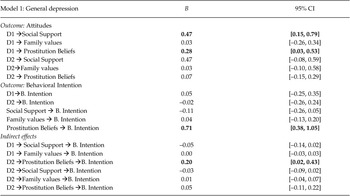
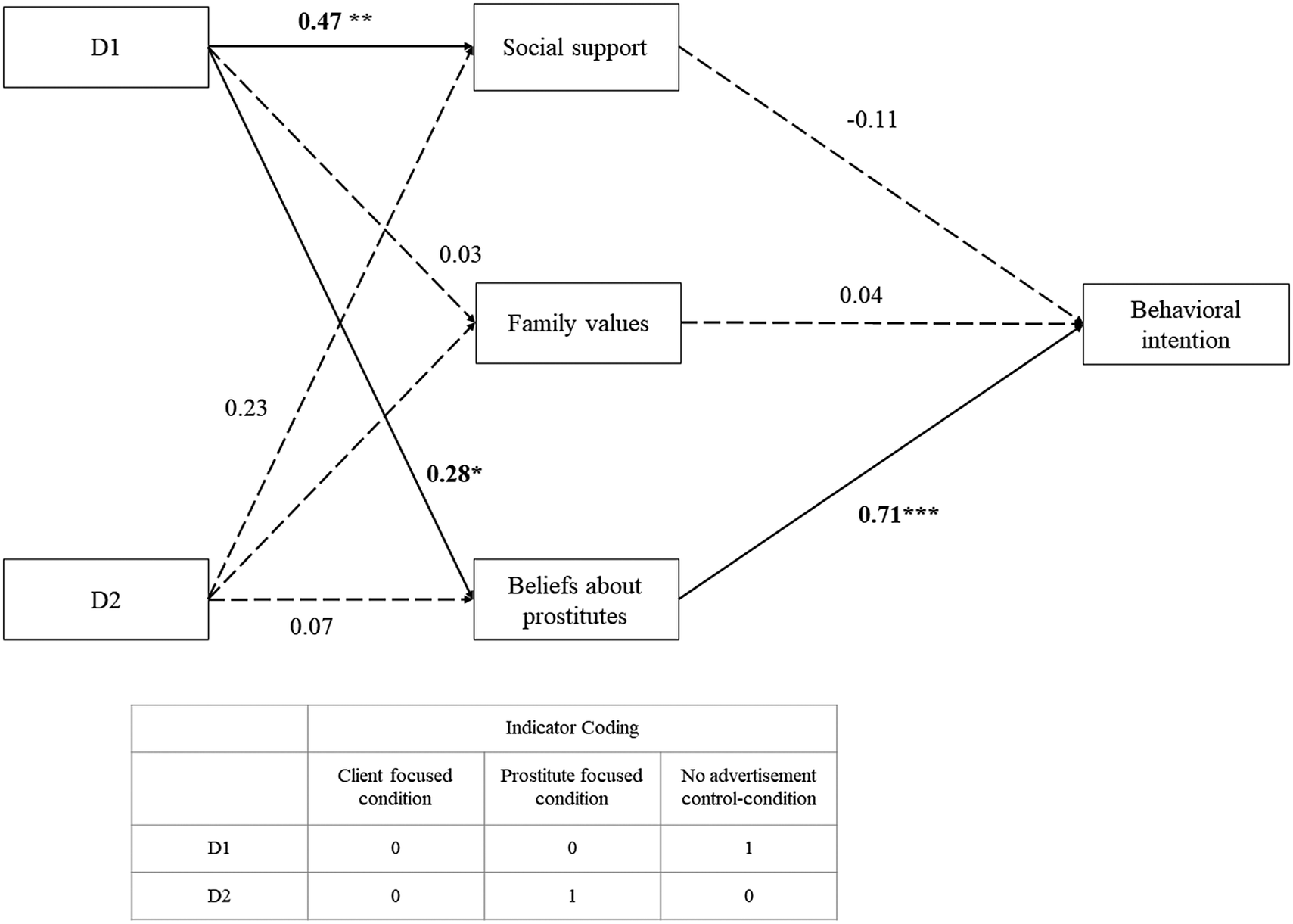
We ran a mediational (Igartua & Hayes, Reference Igartua and Hayes2021) analysis using lavaan with 10,000 bootstrapping samples to verify the mediational role of the attitudes toward prostitution (social support, family values and beliefs about prostitutes) on the relation between the client-focused condition (vs. the prostitute-focused condition vs. the control condition) and the intention to consume prostitution. The experimental manipulation was multicategorical; therefore, following Hayes and Preacher’s (Reference Hayes and Preacher2014) recommendation, we used indicator coding in which the client-focused condition was used as a reference group (Table 2, Figure 2). For an example see Andrighetto et al. (Reference Andrighetto, Baldissarri, Gabbiadini, Sacino, Valtorta and Volpato2018).
Indirect Effects

Note. Significant parameters are bolded. B = unstandardized effect
We created two new dummy-coded variables with the client-focused condition as the reference group (coded as 0) in both variables. One variable took the control condition coded as one (Contrast 1), and the other took the prostitute-focused condition coded as one (Contrast 2, see Figure 2). The results showed a statistically significant increase in Contrast 1 regarding social support, b = 0.47, 95% CI [0.15, 0.79], z = 2.77, p < .001, but not in Contrast 2, b = 0.25, 95% CI [–0.08, 0.59], z = 1.45, p = .147. We found a statistically significant relation between the control condition and beliefs about prostitutes in Contrast 1, b = 0.28, 95% CI [0.03, 0.53], z = 2.21, p =.027, but not in Contrast 2, b = 0.07, 95% CI [–0.15, 0.29], z = 0.65, p = .513. Additionally, we did not find any statistically significant change in family values, Contrast 1, b = 0.03, 95% CI [–0.26, 0.34], z = 0.16, p =.871; Contrast 2, b = 0.23, 95% CI [–0.10, 0.58], z = 1.33, p =.183. In turn, we found a statistically significant relationship between beliefs about prostitutes and behavioral intention, b = 0.71, 95% CI [0.38, 1.05], z = 4.28, p < .001, but not social support, b = –0.11, 95% CI [–0.26, 0.05], z = –1.42, p =.156, or family values, b = 0.04, 95% CI [–0.13, 0.20], z = 0.46, p = .648.
The indirect effects of the experimental condition on the intention to consume prostitution via social support, a*b = –0.05, 95% CI [–0.14, 0.02] for Contrast 1 and a*b= –0.03, 95% CI [–0.09, 0.02] for Contrast 2, and family values, a*b = 0.00, 95% CI [–0.03, 0.03] for Contrast 1 and a*b = 0.00, 95% CI [–0.04, 0.07] for Contrast 2, were not significant. Beliefs about prostitutes, a*b = 0.20, 95% CI [0.02, 0.43], Contrast 1, showed a significant relation, but not in Contrast 2, a*b = 0.05, 95% CI [–0.11, 0.22] (see Table 2 and Figure 2).
Note. Values are unstandardized regression coefficients. Significant correlations are bolded.
*p < .05. **p < .01. ***p < .001.

We can partially confirm hypothesis (Hypothesis 3). Indeed, only one of the regression coefficients, D1, was statistically significant, leading to the conclusion that the corresponding pairs of means (client-focused vs. control condition) were significantly different from each other. However, the results did not confirm that the corresponding pair of means (client-focused vs. prostitute focused condition) differed from each other.
Discussion
This study tested the effect of the advertising campaigns of the City Council of Seville against forced prostitution on social attitude change. Specifically, this study intended to test which of the main approaches used in the advertisements (i.e., the prostitute as a victim vs. the man as a patron of prostitutes) would have a significant effect on attitudinal change.
The present study shows that campaigns in which the central persuasive focus is the prostitution client seem to be more effective than messages focused on the prostitute. These results support our hypothesis that client-focused advertisements, compared with the no-advertisement control condition, had a significant effect on attitudes about prostitution (H 1a) and attitudinal change toward prostitutes (H 1b), but the client-focused advertisements did not show a significant effect on family values (H 1c). Interestingly, and contrary to our hypotheses, we did not find evidence that the prostitute-focused condition had an effect on participants’ attitudinal change (H 2a-c). Moreover, and in accordance with the TPB, we found an indirect effect of experimental manipulation on behavioral intention through beliefs about prostitutes, partially confirming H 3. The TPB indicates that attitudinal change is mandatory for behavioral change, which explains why we found an indirect effect despite the lack of a direct effect between campaign exposure and behavioral intention.
The present results can be explained by the emotions elicited by each campaign focus. First, we suggest that the advertisements included in the client-focused condition could be perceived as questioning the receiver’s manhood or appealing to the shame emotion, whereas the advertisements in the prostitute-focused condition could be perceived as appealing to guilt regarding the damage or oppression that the women suffer. These campaigns can cause their perceived messages to be rejected when the receiver is shielded behind a protective psychological barrier. The lack of effect in the prostitute-focused condition could be explained by a high guilt level, which seems to be ineffective in achieving the desired effects of the campaign, as research suggests in other types of consumption or social marketing (Bennett, Reference Bennett1998; Muralidharan & Sheehan, Reference Muralidharan and Sheehan2018; Singh et al., Reference Singh, Crisafulli and Quamina2020). Therefore, showing the woman as a victim, far from encouraging empathy, might become a pathway to a greater rejection of the message and greater psychological distance. Every persuasive route could be aborted regardless of whether the message carries a more rational or emotional burden or, in Petty and Cacioppo’s (Reference Petty and Cacioppo1981) words, a central persuasive or peripheral process.
In this line, previous studies of emotional impact on the effectiveness of advertising messages (see Brennan & Binney, Reference Brennan and Binney2010; Duhachek et al., Reference Duhachek, Agrawal and Han2012) have shown that guilt promotes not the realization of behavioral change but a simple search for self-protection from the discomfort that this emotion entails. In any case, the use of guilt in advertising is a complex issue, as Chédotal et al. (Reference Chédotal, Berthe, de Peyrelongue and Le Gall-Ely2017) underline. Second, an alternative explanation for the lack of a significant effect of the prostitute-focused condition compared to the no-advertisement control condition is that in the former condition, we included images that could be considered typical in a shocking advertisement. “Shockvertising” uses horror or disgust to gain attention (Machová et al., Reference Machová, Huszárik and Tóth2015; Parry et al., Reference Parry, Jones, Stern and Robinson2013). Although shockvertising can a priori capture more attention and greater notoriety, its persuasive effectiveness does not seem very strong in certain contexts, especially regarding social marketing and advertising in fields such as prevention in health and well-being (Gheorghe et al., Reference Gheorghe, Radu, Gheorghe, Negoiță and Purcărea2017; Urwin & Venter, Reference Urwin and Venter2014). The results obtained in the current experimental study are consistent with this idea.
In contrast, the significant effect of the client-focused condition on attitudinal change compared to the no-advertisement control condition might be explained by the shame promoted by the campaigns whose central focus revolves around the manhood of the receivers, prompting them to perform actions that address the feelings elicited by this impugnment of their masculinity (Brennan & Binney, Reference Brennan and Binney2010). As Hagstedt et al. (Reference Hagstedt, Korsell, Skagerö, Di Nicola, Cauduro, Lombardi and Ruspini2009) underlined, shame is usually an important issue for men who pay for sex, which they try to mitigate through different mechanisms. Another reason for the significant effect of campaigns focused on male clients might be that when the campaigns represent the man as the core target of the advertisements, each message may work as a mirror to which the receiver will inevitably pay attention. Following Pollay’s (Reference Pollay1986) approach, advertising is a mirror in which, distorted or not, society and its values are reflected, as is every consumer or citizen who is exposed to it. As Felton (Reference Felton2013) says, when showing a figure similar to the target in the announcement, the probability increases that the persuasive process will begin. Relatedly, male participants may not identify with the representations in prostitute-focused advertisements, so no emotion is elicited (Hoeken & Sinkeldam, Reference Hoeken and Sinkeldam2014), explaining the lack of effectiveness of these advertisements.
The indirect effect found indicates that exposure to the client-focused condition (vs. the control condition) decreases the behavioral intention to consume prostitution by decreasing negative attitudes toward prostitutes. This is a noteworthy result in support of the theory of planned behavior (O’Keefe, Reference O’Keefe2002). The lack of a direct effect and the existence of an indirect effect mean that modifying the negative attitude toward prostitutes decreases the intention of using them for sex in the exchange of sex for money.
The present study takes a novel perspective through a rigorous design, but it is not without limitations. First, the Attitudes toward Prostitution Scale (ATPS) was created to assess the beliefs of men who purchase sex from prostitutes; however, in the present study, we included a general sample of men. Although the ATPS was focused on clients, in recent studies, it has been used with the general population, including females, with a similar subscale reliability (see Menaker & Franklin, Reference Menaker and Franklin2018; Silver et al., Reference Silver, Karakurt and Boysen2015). In future studies, it would be desirable to include another measure of attitudes toward prostitutes, such as the Attitudes toward Prostitutes and Prostitution Scale (APPS) (Levin & Peled, Reference Levin and Peled2011), which was designed to examine individuals’ (general sample) attitudes toward prostitutes and prostitution. These results should be replicated using different measures.
Second, the use of self-reported measures has limitations. Because of social desirability reasons, the participants might underreport intentional behaviors regarding consuming prostitutes. This problem is especially prominent, for example, when we ask about consumption intention or when the ATPS (Sawyer & Metz, Reference Sawyer and Metz2008) focuses on family values with questions about marrying a prostitute or having a daughter who is a prostitute. These two aspects, marital status and parenthood, were not controlled, which could explain the rejection of H 1c, i.e., the nonsignificant effects of the client focus on family values.
Because implicit measures show an experimental effect that does not emerge from explicit measures (see Gawronski & LeBel, Reference Gawronski and LeBel2008), we encourage future studies to use implicit measures that are not influenced by verbal judgments, such as eye-tracking methodology or an implicit association test (IAT), to assess the impact of advertisements against forced prostitution on attitudinal and behavioral changes. Using implicit measures will allow us to confirm the attitudinal changes obtained in this study and to avoid social desirability and the possible undesirable effects of self-reported measures (Schwarz & Oyserman, Reference Schwarz and Oyserman2001).
Third, the experimental design allowed us to control the unusual variables involved; however, the lab setting might lack ecological validity. An experimental lab setting can never precisely replicate the reality in which the reception of a multichannel advertising campaign is registered. In the current study, we uniquely considered one of the pieces in each campaign, a graphic. We must consider that a campaign is composed of multiple different modalities and channels, such as videos, digital displays, and radio. Future studies should include different campaign modalities (e.g., videos, advertising podcasts) and analyze whether we can replicate these results using different formats.
Fourth, the participants were presented with real advertisements used in real campaigns. This presentation increased the ecological validity of our results although we could not control for other variables, such as the emotional equality of the stimulus of either focus. However, our results show no difference in attitudes toward the advertisements between the two conditions (client- vs. prostitute-focused). Moreover, our sample included only men living in Seville at the time of the study because this population segment was the target of the advertisements included in this study. The use of this sample also increased the external validity of our results; we tested the effectiveness of real advertisements with the real target population. The number of advertisements that the participants saw before the study was similar in both conditions. Future studies should examine whether the results obtained in the current study can be replicated in women to analyze the moderating effect of gender.
Finally, future studies should examine whether the different emotions elicited by both conditions could explain the results presented in this study (sadness vs. shame) and whether these emotions are similar in women and men.
Despite its limitations and modest results, this study is the first to focus on the effects of such advertising on clients who consume prostitution or on female prostitutes in terms of behavioral intentions and attitudinal change. This research makes a small contribution in this regard.
This study shows that campaigns that focus on men who purchase sex, instead of on female prostitutes, have a larger effect on social attitudes toward forced prostitution and more greatly decrease negative attitudes toward female prostitutes. The strongest point of the current study is the use of real advertisements used in real campaigns with the real target population, which increases the validity of the results obtained. This study has several practical implications. The findings support the continuity of public monetary investment by governmental authorities for launching campaigns of this nature. Moreover, the results support the idea that social campaigns must be evaluated. As Hornik (Reference Hornik, Goodman, Jinks and Woods2012) suggested, governments and public institutions, as advertisers, must evaluate their advertisement and communication campaigns.
In conclusion, public money invested in campaigns against forced prostitution that display men (vs. those that display women prostitutes) is much more profitable in terms of social impact and therefore in terms of return on investment. Again, the force of using advertising as a mirror, distorted or not, seems to be succesful. In this occasion, advertising has the strength to impact the potential ‘prostitutor’ (Trotter, Reference Trotter, Dewey and Kelly2011) and, as one of the advertisements states, to cause him to ask himself, “Are you worth so little that you have to pay?”