En 1850, le Louvre inaugurait un nouvel espace d’exposition, la « salle des antiquités américaines », ou « musée américain », rassemblant plus de 800 objets précolombiens en provenance du continent américain : statues de basalte, masques de jade, figurines en argile et instruments de musique du Mexique, poteries zoomorphes, textiles tissés aux motifs colorés et objets en métal filigrané du Pérou ainsi que quelques objets du Chili et des environs de Tiahuanaco, en BolivieFootnote 1 . Commencée dès les années 1830, avec l’achat d’objets mexicains rapportés en France par Maximilien Franck, un artiste originaire de Bohème, cette collection s’enrichit lentement au cours des décennies suivantes avec l’acquisition de pièces du Mexique et des Andes, provenant de collections constituées par des diplomates, des marchands et des voyageurs. C’est en 1849 que le musée acquit l’une des plus grandes collections d’antiquités mexicaines en Europe, à laquelle s’ajouta, en 1851, une petite collection d’objets d’Haïti. Nous ne disposons pas d’images du musée américain, mais le conservateur de l’époque, Adrien Prévost de Longpérier (1816-1882), indique dans le catalogue publié par ses soins avoir organisé les objets en fonction de leur provenance géographique, de leur usage (armes, éléments décoratifs, récipients en céramique), de leur matériau et, pour certaines antiquités mexicaines, de ce qu’ils représentaient (figurines zoomorphes, anthropomorphes ou mythologiques).
Avec cette exposition, le Louvre était le premier grand musée à rassembler ainsi des objets du Pérou, du Chili, du Mexique et d’autres régions du continent américainFootnote 2 . En leur accordant, de manière collective, une salle dédiée, c’est-à-dire un espace à la fois physique et figuratif, à proximité des salles consacrées à l’Égypte ancienne, à l’Antiquité gréco-romaine et à l’Assyrie – à l’aménagement desquelles Longpérier avait également participé –, le musée américain a joué un rôle essentiel dans l’émergence des « antiquités américaines » comme catégorie muséale. La création du musée américain a été rendue possible par le volume sans précédent d’objets précolombiens disponibles et par un contexte intellectuel et institutionnel français dans lequel les « antiquités » rattachées à différentes parties du monde se voyaient érigées en catégories d’étude, de collection et d’exposition.
Toutes les époques ne se valaient cependant pas. Ainsi, bien qu’installées à proximité des autres collections, les antiquités américaines, contrairement aux « monuments de l’Égypte », n’étaient « pas encore classiques » aux yeux de LongpérierFootnote 3 . Si les expressions employées par ce conservateur érudit peuvent paraître étranges à première vue, celle-ci signifiait tout d’abord que les antiquités américaines n’étaient pas « classiques » faute d’être aussi pertinentes pour « nous » d’un point de vue culturel que, par exemple, des objets associés à « notre histoire biblique » ou aux ancêtres intellectuels et culturels de l’Europe en Méditerranée. Les antiquités américaines représentaient un autre type de passé, dont beaucoup en France – parmi lesquels Edme-François Jomard (1777-1862), un collègue de Longpérier – considéraient qu’il avait davantage à voir avec les artefacts ethnographiques des « sauvages » en voie de disparition en Amérique du Nord et partout dans le monde, et qu’à ce titre, ces antiquités justifiaient la création d’un musée ethnographique où elles pourraient constituer un élément de comparaison avec les vestiges matériels du passé classique de l’EuropeFootnote 4 . Par ailleurs, l’autre raison pour laquelle les objets précolombiens n’étaient pas considérés comme « classiques » est qu’ils ne correspondaient pas aux critères esthétiques du style classique. Bien que l’on trouve dans son catalogue de fréquentes comparaisons entre antiquités mexicaines et égyptiennes, d’une part, et antiquités péruviennes et gréco-romaines, d’autre part – un vase péruvien décoré, par exemple, « présentait une telle analogie avec ceux découverts en Étrurie » que même un expert aurait pu s’y tromperFootnote 5 –, Longpérier doutait, comme beaucoup à l’époque, des mérites esthétiques des antiquités américaines, en particulier mexicaines. Chez ces dernières, il relevait des combinaisons « bizarres », une incapacité à adhérer à l’idéal naturaliste et à se mettre à « la recherche du beau qui seule amène le progrès », ce qui, pensait-il, les rapprochait en termes de style des « populations de l’extrême Orient »Footnote 6 . Enfin, comme le suggère une lecture attentive de l’avant-propos du catalogue, Longpérier ne se fondait pas seulement sur des considérations esthétiques pour dénier aux antiquités américaines le label de « classiques », mais invoquait également leur caractère flou et insaisissable d’un point de vue épistémologique : « On manque absolument de guide pour les classer suivant leur signification, leur usage, ou leur date », écrivait-ilFootnote 7 .
Ainsi, pour Longpérier et pour beaucoup au sein de son cercle, le terme « classique » se référait à un objet naturaliste et bien proportionné, appuyé sur un discours esthétique, suscitant un intérêt et possédant une valeur, un statut iconique et une pertinence pour l’identité collective. On est alors en droit de se demander pourquoi, alors qu’elles étaient dénuées d’un intérêt historique, culturel ou esthétique, les antiquités américaines furent collectionnées de la sorte et exposées au côté d’objets « classiques ». La réponse se trouve dans une conviction historiciste ancrée chez Longpérier : c’est précisément parce qu’ils étaient placés dans un musée que des « vestiges existants [devenaient] des objets de savoirFootnote 8 », d’étude, de collection et d’exposition – comme si les objets n’étaient pas « classiques » par essence, mais pouvaient le devenir.
Le musée américain du Louvre n’a été qu’un jalon du processus plus long par lequel des vestiges du continent américain sont devenus des objets d’étude pour les sciences humaines en développement, telles que l’histoire, l’ethnographie et l’archéologie. À partir de la seconde moitié du xix e siècle, des musées de part et d’autre de l’Atlantique ont ouvert des sections consacrées aux antiquités américaines, en particulier du Mexique ancien et des Andes ; désormais, des revues savantes et des colloques internationaux s’emparent de la question, des maisons de ventes organisent des enchères et des États d’Amérique latine édifient certains de leurs monuments les plus emblématiques en faisant écho au « style » de leur passé. L’émergence des antiquités précolombiennes en tant qu’objets scientifiques, esthétiques, politiques et commerciaux a principalement été présentée comme un mouvement téléologique de construction nationale, d’institutionnalisation et de professionnalisation. Cependant, ces récits progressistes, produits des historiographies libérales de la fin du xix e siècle, privilégient une perspective positiviste et linéaire qui, oublieuse des épaisseurs sociales et matérielles, tend à escamoter le caractère désordonné, indéterminé et multisitué des évolutions par lesquelles les antiquités américaines ont acquis de l’importance. Car si le musée américain du Louvre était le fruit d’une configuration particulière d’intérêts contingents et d’historiographies atlantistes, de pratiques intellectuelles itinérantes et d’ambitions politiques, il en allait de même pour le musée national d’anthropologie du Mexique, un cabinet de curiosités de Cuzco ou le musée Peabody d’archéologie et d’ethnologie de Harvard. Les avancées des pratiques et des discours relatifs aux antiquités au cours du xix e siècle, envisagées à l’échelle d’espaces géographiques différents, n’ont donc pas débouché sur une compréhension parfaitement homogénéisée des antiquités américaines. Elles ont cependant fait émerger un objet reconnaissable, une catégorie familière et un ensemble de questions pertinentes s’y rapportant, notamment sur l’origine et la nature de la civilisation américaine, la place de ces antiquités dans les grands récits historiques, leur relation au temps présent et leurs usages contemporains ou encore les formes d’expertise, les régimes de savoir et les infrastructures physiques et matérielles les plus aptes pour leur étude et leur exposition.
Cette étude présente les enjeux spatiaux et temporels de la construction de la catégorie des « antiquités américainesFootnote 9 » à l’échelle de plus d’un siècle et demi ainsi que les nombreux acteurs et sites ayant participé à ce processus. Plutôt que de proposer un récit exhaustif, l’article s’organise en quatre blocs thématiques plus ou moins chronologiques, certaines séquences se chevauchant. Nous commencerons par étudier, dans la première partie, la tradition antiquaire ibérique qui a fait circuler, à partir du milieu du xviii e siècle, des artefacts précolombiens dans un contexte où les vestiges matériels devenaient des objets d’investigation à part entière, en particulier là où les preuves textuelles faisaient défautFootnote 10 . Si elles n’ont pas mis un terme aux pratiques sociales et intellectuelles liées à l’antiquarisme éclairé, les indépendances ont en revanche contribué à reconfigurer les usages des antiquités, sur les plans légal, politique et économique, en faisant notamment émerger de nouveaux acteurs.
Cette évolution est toutefois souvent présentée de façon simpliste par une historiographie centrée sur la naissance de l’État-nation dans l’Amérique hispanique au xix e siècleFootnote 11 ; nous chercherons à montrer que les musées nationaux n’étaient pas les seuls sites concernés par la collecte et l’étude des antiquités et qu’ils devaient rivaliser, rarement à armes égales, avec de nombreux autres acteurs au sein de larges réseaux pour acquérir des objetsFootnote 12 . Dans la deuxième partie, nous nous pencherons sur les contextes de collecte dans les pays nouvellement indépendants, où élites créoles, musées nationaux et diplomates étrangers collectionnaient tous des antiquités, en fonction d’intérêts, de contraintes et d’opportunités variés. Si les collectionneurs, toujours plus nombreux, ne partageaient pas la même vision des antiquités, la présence croissante des antiquités américaines dans les cabinets privés et les musées publics contribua à rendre ces objets plus visibles et familiers. Alors que les antiquités commençaient à voyager davantage, c’est la circulation de leurs reproductions (sous forme d’albums, de gravures, de lithographies, de photographies, de moules et de moulages) qui eut l’influence la plus directe sur la stabilisation des discours et des pratiques les concernant. Dans la troisième partie, nous examinerons comment, à partir du milieu du xix e siècle, les « technologies du papier » ont joué un rôle croissant en tant qu’outils heuristiques pour connaître, organiser et interpréter les artefacts précolombiens, en donnant de l’importance et une densité ontologique à des objets ou à des groupes d’objets particuliers pour aboutir au développement de régimes de savoir et d’institutions spécifiquement dédiés à ces objets. Enfin, nous aborderons les processus d’institutionnalisation du passé précolombien, aux plans national et international, à la fin du xix e siècle et au début du xx e siècle, alors que se développent les musées nationaux et que se consolident l’archéologie ou l’ethnologie en tant que disciplines scientifiques, afin de nous demander quelle a été l’influence de ce mouvement sur la collection, l’exposition et l’étude des antiquités américaines.
Généalogies : l’émergence d’une nouvelle antiquité
Des siècles après la découverte du Nouveau Monde par les conquistadores, les objets de l’Amérique précolombienne, ou associés à cet espace et à cette période, furent investis de significations variées et donnèrent lieu à une multitude d’usages. Dans les premières décennies après la conquête, de nombreux indigènes américains – et pas exclusivement eux – continuaient à investir ces objets d’une autorité divine et à s’en servir comme moyen de communication ou pour confirmer des privilèges et des héritagesFootnote 13 . Quant aux missionnaires, soldats et officiers coloniaux espagnols, ils les voyaient souvent comme des manifestations de l’idolâtrie et de l’« erreur » païenne des Indiens, ou bien comme des témoignages de la richesse des sociétés amérindiennes du passé, révélant ainsi la soumission et la défaite de leurs héritières contemporaines, à l’instar des centaines de « trésors » qu’Hernán Cortés (1485-1547) envoya à partir de 1519 à Charles Quint (1500-1558) et à sa mère, la reine Jeanne de Castille (1479-1555). Dans la série des controverses qui eurent lieu au xvi e et au xvii e siècles, la culture matérielle précolombienne servit également à prouver l’humanité et les capacités intellectuelles des « Indiens » – leur « subtile capacité d’invention » – ainsi que « leur rationalité et leur capacité à être convertis »Footnote 14 . La « magnificence » de villes comme Tenochtitlan, Cuzco ou Quito, la complexité des réseaux routiers andins et la sophistication de la culture matérielle inca ou chimú en vinrent à refléter, avec d’autres considérations environnementales, la civilité « aristotélicienne » de ces peuplesFootnote 15 . Pendant les deux siècles suivants, la culture matérielle associée à l’Amérique précolombienne fut perçue comme contemporaine de celle des conquérants et des colons européensFootnote 16 . Ce n’est qu’à partir de la seconde moitié du xviii e siècle que les objets précolombiens cessèrent progressivement d’être associés au présent pour être collectivement réinterprétés comme des « antiquités », des objets dont la valeur ne réside plus essentiellement dans les liens ancestraux, la puissance ou la richesse qu’ils incarnaient, mais dans la révélation et la représentation qu’ils permettent d’un passé ancien, distantFootnote 17 .
Cette rupture était, en partie, le produit conjoint du projet historiographique des Lumières – de sa quête d’une histoire universelle de l’humanité, et donc de la place qu’y tenait l’Amérique – et de l’importance nouvelle attachée aux vestiges physiques du passéFootnote 18 . La seconde moitié du xviii e siècle fut marquée par la cartographie, la fouille et l’étude de sites en ruine ainsi que par la collecte d’objets dans toutes les colonies espagnoles des Amériques. Charles III (1716-1788) commanda des expéditions et ordonna des campagnes dans les vice-royautés de Nouvelle-Espagne et du Pérou et dans la capitainerie générale du Guatemala, la plus célèbre restant celle de Palenque, en 1787. Les fouilles de Rome, et surtout d’Herculanum et de Pompéi, situés dans le royaume espagnol de Naples, offraient le modèle le plus immédiat pour l’étude des ruines sur le continent américainFootnote 19 . Au début du xix e siècle, Charles IV (1748-1819) lança à son tour d’ambitieuses expéditions antiquaires royales. Entre 1805 et 1808, Guillermo Dupaix (1746-1818) dirigea ainsi plusieurs missions de recherche en Nouvelle-Espagne pour enregistrer, inventorier, collecter et étudier les vestigesFootnote 20 . La couronne n’était pas la seule à s’intéresser aux traces de ce passé : à la fin du xviii e siècle, des officiels espagnols, des hommes d’Église et des érudits créoles rassemblaient des collections d’antiquités, rédigeaient des traités sur le sujet et lançaient leurs propres expéditions, à l’instar de la visite épiscopale du cardinal Baltasar Jaime Martínez Compañón (1737-1797) dans son diocèse de Trujillo qui déboucha sur des relevés de plans de sites anciens et des représentations de tombesFootnote 21 . À Mexico, l’excavation de deux monolithes associés à la civilisation mexica donna lieu à une intense polémique autour de leur interprétation conceptuelle et de leur analyse physique. Néanmoins, par-delà leurs divergences, les participants de ce débat s’accordaient sur le fait que les vestiges matériels étaient cruciaux pour répondre aux questions sur le passé ancien de l’Amérique et sur les structures politiques et culturelles qui avaient rendu de telles cultures possiblesFootnote 22 . Car si des sites comme Pompéi et Herculanum venaient corroborer des informations relatives à un passé classique reconnaissable aux yeux des publics français, prussien ou espagnol, l’« Antiquité » qui émergeait des fouilles de Trujillo, Palenque ou Mexico, bien que découverte grâce à des gestes familiers (fouilles, métrage et collecte), était nouvelle et mal connue.
La recherche sur les antiquités du continent américain ne disposait alors que de quelques conventions et d’aucun régime d’attention, même parmi les créoles hispano-américains. De tels instruments ne commencèrent à être élaborés qu’à partir de la fin du xviii e siècle, dans le contexte d’un vaste programme d’expéditions commandité par les Bourbons afin d’inventorier, d’étudier et de collecter les richesses des colonies, qu’elles fussent naturelles ou d’origine humaine. Il n’était pas rare que les mêmes savants travaillent à la fois sur des histoires naturelles et politiques, si bien que l’étude du passé était guidée par des méthodes, des questions et des formes de représentation et de mesure utilisées pour analyser les mines ou les plantes. Les directives élaborées en 1777 par Antonio de Ulloa (1716-1795), un naturaliste et officier de marine espagnol, eurent une influence particulièrement importante. Ses recommandations, à l’attention des membres des expéditions scientifiques et du grand public, étaient diffusées par les administrations des vice-royautés et dans la presse locale. S’inspirant des conceptions des Lumières sur les indices matériels de la « civilisation » classique – tels que l’architecture civile, la religion et les funérailles, le commerce et les infrastructures –, Ulloa classait parmi les vestiges dignes d’être étudiés « les ruines des bâtiments raffinés », les sites funéraires, la vaisselle en céramique et les récipients de toutes sortes, les outils agricoles, les armes et les « idoles »Footnote 23 . D’autres instructions et circulaires vinrent compléter ultérieurement celles d’Ulloa, en préconisant de s’intéresser aux pièces frappées et aux voies navigables afin d’évaluer la nature et l’importance des activités commerciales, industrielles et manufacturièresFootnote 24 . Non seulement ces directives établissaient une terminologie spécialisée pour les objets précolombiens, qui allait s’ajouter au vocabulaire indigène existant voire le supplanter, mais elles contribuaient également à révéler les objets eux-mêmes en dirigeant le regard de l’observateur vers des choses ou des classes de choses en particulier, et en les rendant visibles dans le discours sur les antiquités. Il ne s’agit pas d’affirmer que la terminologie des antiquités en France ou en Prusse et les conceptions du classique élaborées par les Lumières étaient définitivement établies ni qu’elles ne connurent aucune évolution au cours de la période en questionFootnote 25 , mais de faire le constat que ces conceptions, bien qu’elles-mêmes en cours d’élaboration, contribuèrent à la construction des antiquités américaines précolombiennes en tant que catégorie. Pour les Espagnols, le questionnaire, l’instruction (instrucción) et l’inventaire étaient depuis longtemps des outils permettant d’appréhender la nouveauté du continent américainFootnote 26 ; ils l’étaient aussi pour explorer son passé ancien. Confrontés à l’absence d’inscriptions et au manque de sources écrites pour les périodes ne précédant pas immédiatement la conquête, les antiquaires des colonies espagnoles du continent américain, comme leurs homologues français ou prussiens, s’attelèrent à définir un nouveau « régime de la preuve » pendant cette périodeFootnote 27 .
La réinterprétation des vestiges de la culture matérielle précolombienne en tant qu’« antiquités » était également le produit d’un important changement sociopolitique. En quête d’une légitimité politique, d’une histoire « patriotique » et d’une Antiquité propre, indépendantes de celles du colonisateur, les élites créoles montantes recouraient de plus en plus fréquemment au passé pour situer et légitimer le présent. Les premiers écrits antiquaires hispano-américains de la période s’inscrivent dans le cadre de la fameuse « dispute sur le Nouveau Monde », au cours de laquelle auteurs créoles et clercs répondirent aux critiques européennes contre l’Amérique tropicale en excipant, entre autres choses, de la grandeur des palais, des cités et des forteresses du Mexique et de l’Amérique du Sud andine avant la conquêteFootnote 28 . Si de nombreux auteurs écossais et français abordant cette question avaient dans un premier temps refusé de reconnaître aux habitants du Nouveau Monde une « histoireFootnote 29 », des écrits hispano-américains – notamment la Storia antica del Messico Footnote 30 de Francisco Javier Clavijero (1731-1787) – répondirent en dessinant un « classicisme localFootnote 31 » qui offrait aux lecteurs européens une vision autochtone des antiquités américaines, décrites dans des termes traditionnellement utilisés pour rendre compte de l’Antiquité grecque et romaineFootnote 32 . La réappropriation des lointains passés inca et aztèque commença à devenir un « motif crucial, quoique teinté d’ambivalence, dans le discours créoleFootnote 33 » lorsque les « patriotes » créoles mexicains et péruviens s’emparèrent de ce passé au nom des collectivités imaginées et des traditions politiques et intellectuelles distinctives qu’ils esquissèrent dès la fin du xviii e siècle. La période des guerres d’indépendance marqua à ce titre un tournant : les sociétés précolombiennes devinrent « le patrimoine des révolutionnaires dans toute l’Amérique (espagnole) », et ces derniers, invoquant la « légende noire » de la conquête du Nouveau Monde (le mythe de la brutalité incomparable de l’Espagne à cette occasion), se posèrent en héritiers et vengeurs de ces sociétésFootnote 34 .
Alors que la culture matérielle associée aux sociétés indigènes des Amériques contribuait à unifier les collectivités politiques hispano-américaines naissantes, le processus maintenait dans l’invisibilité les hommes et les femmes qui en étaient issus. En effet, cette appropriation du passé – fondée sur l’analyse des vestiges à l’aide d’outils pratiques et conceptuels utilisés pour étudier l’Antiquité classique – creusa le fossé entre le passé et la réalité vivante du monde indigène, c’est-à-dire entre la lointaine Antiquité « classique » dessinée dans le discours créole sur les antiquités et les « Indiens », cette « majorité absente de la formation de l’État créole, fondé avec l’indépendance »Footnote 35 . Aux yeux des élites hispano-américaines, les « Indiens » contemporains n’avaient aucun lien avec le passé précolombien, soit qu’on niât qu’ils en fussent les descendants, soit qu’ils fussent eux-mêmes, de manière paradoxale, dans le contexte de l’évolutionnisme du xix e siècle, considérés comme des « reliques » du passé ayant échoué à évoluer le long de l’axe du progrès vers la modernitéFootnote 36 . Car l’intérêt pour les antiquités ne se limitait pas à proposer une terminologie et des régimes d’attention pour les « antiquités » : elle consistait surtout à attribuer à ces vestiges du passé précolombien une temporalité lointaine et singulière qui laissait peu ou pas de place aux hommes et aux femmes qui en étaient issusFootnote 37 .
Au début du xix e siècle, les vestiges matériels furent scrutés de façon renouvelée sous l’effet d’une tendance de fond conduisant l’antiquarisme à s’emparer des objets matériels pour poser des questions sur le passé et y apporter des réponses. Les antiquités américaines, comme d’autres ailleurs, prenaient forme dans des contextes spécifiques d’instrumentalisation et d’appropriation. Alors que les auteurs écossais et français cherchaient à donner du sens à ces vestiges en les replaçant dans une histoire de l’humanité au long cours, les élites créoles les utilisaient à des fins politiques, pour s’assurer une légitimité et revendiquer des « antiquités » qui leur étaient propres. Ces tensions autour du passé – sa propriété, ses usages et ses significations – allaient se prolonger, et même s’intensifier, au cours du siècle suivant, pendant lequel la plupart des colonies espagnoles d’Amérique latine obtinrent leur indépendance.
Paysages de la collecte
Avec l’accession à l’indépendance des colonies espagnoles du continent américain, le paysage de l’antiquarisme hispano-américain se diversifie et se complexifie. Pouvoirs publics, voyageurs étrangers et antiquaires créoles se lancent tous dans la collecte et l’étude des antiquités, animés par des objectifs propres et divergents. Selon un principe de centralisation politique et culturelle hérité de la tradition coloniale espagnole, les musées nationaux hispano-américains sont, pour la plupart, établis dans les nouvelles capitales : à Buenos Aires (1812/1823), à Santiago du Chili (1813/1838), à Bogotá (1823), à Mexico (1825), à Lima (1826) et, plus tard, à Montevideo (1837) et à La Paz (1838)Footnote 38 . Beaucoup de ces institutions furent d’abord fondées en tant que cabinets d’histoire naturelle, comme ce fut le cas des collections du Chili jusqu’en 1843 ou du musée national du Pérou sous le mandat de son premier directeur, Mariano Eduardo de Rivero y Ustariz (1798-1857). Guidés par une logique patriotique et chorographique – l’aspiration à représenter tout ce qui avait jailli du sol national –, ces musées exposaient des antiquités précolombiennes ou, selon le langage de l’époque, des « textiles et des trésors [preciosidades] des huacas », au côté de raretés naturelles comme des « minéraux, marbres et roches cristallisés », des coquillages, des « quadrupèdes » et des plantesFootnote 39 . D’autres musées nationaux suivaient une logique différente, plus encyclopédique – aspirant à créer des musées universels et spectaculaires reflétant la diversité du monde avec une palette d’objets la plus étendue possible –, qui n’était pas sans rappeler les cabinets de curiosités des Lumières. Le premier musée national mexicain, son équivalent argentin, de même que le musée national péruvien (après la première éviction de Rivero y Ustariz de sa direction en 1829) exposaient des « poteries des anciens Indiens » de même que du minerai d’argent et des coquillages « du pays » en regard d’herbiers japonais, de momies égyptiennes, d’une « hache de Tahiti » et de portraits de philosophes grecsFootnote 40 . Si tous ces musées « universels » collectionnaient des antiquités précolombiennes, peu d’entre eux marquaient dès le départ une préférence pour les objets domestiques sur ceux d’origine étrangère, et moins encore pour les objets anciens plutôt que modernes. En 1828, par exemple, le premier directeur du musée national mexicain, Isidro Ignacio de Icaza (1783-1834), n’hésita pas à échanger des antiquités mexicaines, d’anciens manuscrits et des dessins des ruines de Palenque contre une collection d’oiseaux empaillés du Sénégal avec l’antiquaire français Jean Henri Baradère (1792-1839 ?), un troc qu’il qualifia de « notoirement avantageuxFootnote 41 ». Ce n’est qu’à partir du milieu du xix e siècle que les musées nationaux du Mexique et du Pérou commencèrent à accorder la priorité aux antiquités précolombiennes, puis à les traiter comme une catégorie à part, en les séparant de manière institutionnelle des spécimens d’histoire naturelle ou d’autres objets culturels. Les antiquités précolombiennes acquirent alors une forme de distinction et de visibilité publique dans ces premiers musées nationaux, situés dans des capitales qui étaient déjà devenues les vitrines culturelles légitimes. Toutefois, au cours des premières décennies du xix e siècle, cela ne tenait pas encore à leur valeur intrinsèque, puisque l’étude et l’exposition de ces antiquités s’inscrivaient dans un discours plus large sur les richesses naturelles des pays et leurs liens avec le monde.
Les musées nationaux des capitales ne représentaient que certains chaînons (et pas forcément les plus importants) dans des réseaux d’échange bien plus vastes et en plein essor, à l’instar du troc entre Icaza et Baradère, et dans le commerce émergent des antiquités précolombiennes. En effet, dans beaucoup de pays hispano-américains, dont le Mexique et le Pérou, les musées nationaux restèrent des institutions éphémères, confrontées à un sous-financement et à un manque de personnel chroniques bien après leur établissement : en tant que lieux d’exposition et d’études des antiquités, ils ne pouvaient rivaliser ni avec des musées étrangers – comme le Louvre, le British Museum ou le musée Peabody de Harvard – ni avec des collections privées dans les capitales ou en provinceFootnote 42 . À partir de la première moitié du xviii e siècle, on trouvait dans des villes comme Lima et Mexico, mais aussi Cuzco, Campeche ou Oaxaca, des collections privées toujours plus riches, rassemblées par une bourgeoisie urbaine variée au sein de laquelle se côtoyaient médecins créoles, hommes d’Église descendant des Incas ou hommes d’affaires étrangers. Les frères Leandro (mort en 1849) et José María Camacho (mort en 1854), des prêtres espagnols de Campeche, Carl Adolf Uhde (1792-1856), un marchand brandebourgeois à Mexico, ou Ana María Centeno de Romainville (1817-1874), une riche salonnière péruvienne de Cuzco constituèrent des « cabinets » opulents où animaux empaillés, chinoiseries et minéraux côtoyaient des pièces d’art précolombien en métal, des pots en terre cuite sculptés, des robes en plumes, des masques de turquoise et des tuniques brodéesFootnote 43 . De magnifiques collections d’antiquités précolombiennes, de plus en plus spécialisées, furent ainsi élaborées au cours de la seconde moitié du xix e siècle, au Mexique et surtout au Pérou, alors que le pays connaissait une période de croissance et de prospérité liée au développement de la production et de l’exportation de guano entre 1841 et 1879. On peut notamment citer les collections de José Mariano Macedo (1823-1894), un médecin de Lima, de Miguel Garcés, un propriétaire terrien de Puno, de Fernando Sologuren (1850-1918), un docteur d’Oaxaca, et de Christian Theodor Wilhelm Gretzer (1847-1926), un marchand de textile originaire de HanovreFootnote 44 . Beaucoup de ces collections faisaient également office de musées semi-publics et de salons dédiés à des discussions entre archéophiles, auxquelles participaient d’autres antiquaires créoles, des diplomates passionnés ou les nombreux voyageurs étrangers qui affluaient vers les pays hispano-américains nouvellement indépendants pour échanger sur une publication archéologique récente ou sur la dernière découverte en date. La valeur, l’intérêt et la signification attribués aux antiquités américaines au cours du xix e siècle évoluèrent en grande partie au gré du dialogue entre des collectionneurs créoles et des voyageurs, que ces derniers soient venus chercher des antiquités ou qu’ils s’y intéressent une fois sur place. Ce dialogue prenait tantôt la forme d’échanges amicaux (par exemple entre Centeno et le diplomate nord-américain Ephraim George Squier [1821-1888]) ou de querelles (par exemple entre Macedo et Charles Wiener [1851-1913], qui dirigea une expédition archéologique et ethnographique au Pérou et en Bolivie en 1875)Footnote 45 .
Si elle constituait un motif récurrent de l’antiquarisme depuis la fin du xviii e siècle, la logique patriotique, et plus tard nationaliste, était loin d’être omniprésente, en particulier jusqu’au milieu du xix e siècle, période à laquelle les antiquaires, les salonniers ou les voyageurs finançaient encore leurs voyages, leurs collectes et leurs publications avec des fonds privés, l’État-nation étant bien souvent marginalisé dans cette quête pour des raisons d’intérêts économiques, de compétences particulières et d’affinités politiques d’ordre personnel. D’ailleurs, les collections de Centeno et des frères Camacho étaient souvent mentionnées dans des projets régionalistes visant à renforcer l’autonomie de Cuzco vis-à-vis de Lima ou pour créer une région autonome au Yucatán – au Mexique, les tenants du fédéralisme et du centralisme s’opposant jusque dans les années 1870Footnote 46 . Cependant, de l’aveu même de Centeno, sa collection n’était pas politique, mais représentait un moyen de faire montre de richesses, d’érudition et, plus encore, d’hospitalité : exposer des antiquités péruviennes visait à contenter « les honnêtes hommes » et les voyageurs, de même que des crayons en aluminium, des pétrifications suisses et de la porcelaine française étaient là pour satisfaire le goût de ses compatriotes « provinciaux » pour les curiosités européennesFootnote 47 . Si l’historiographie a traditionnellement tourné ces « amateurs » en dérision, leurs collections ont contribué à faire connaître les antiquités et à affirmer leur importance. En outre, ce sont justement leurs expériences personnelles en tant que propriétaires fonciers ou femmes de la bonne société qui leur a permis de rassembler les objets qui ont fourni une grande partie de la base de leurs collections. Ils acquièrent des antiquités par hasard ou bien à la suite de fouilles qu’ils décident de mener, par l’intermédiaire « d’achats auprès des Indiens » résidant sur leurs propriétés, au cours de sorties mondaines le week-end, à travers l’appropriation de collections entières à l’occasion d’héritages familiaux – lorsqu’ils connaissaient des familles de l’élite indienne ou qu’ils en descendaient eux-mêmes –, ou bien encore par des échanges avec d’autres collectionneursFootnote 48 . De nombreux antiquaires tiraient également parti de leur formation d’ingénieur, d’avocat ou de marchand de textiles, en mettant à profit leur expérience en matière de fouilles, de réalisation de plans, de prise de mesures, d’exploitation de documents écrits ou de connaissance des textilesFootnote 49 .
L’échange de cadeaux, la vente et le troc sont des pratiques qui ont aussi concerné, dès le début, les musées et les collectionneurs étrangers. Ainsi, tout au long du xix e siècle, voyageurs, diplomates et créoles cosmopolites développèrent un réseau de plus en plus dense à l’échelle du continent américain et du monde atlantique. Des diplomates, des marchands et des voyageurs – comme Gretzer ou Squier, ou encore le diplomate français Léonce Angrand (1808-1886) – ramenèrent des antiquités de leurs voyages et plusieurs d’entre eux organisèrent des expositions ouvertes au public. Dès 1823, William Bullock (1773-1849), l’un des premiers voyageurs européens à se rendre au Mexique après l’indépendance, organisa à son retour à Londres une exposition d’antiquités mexicaines « rassemblées sur place » qui rencontra un immense succèsFootnote 50 . Les antiquaires hispano-américains cédaient, prêtaient ou vendaient également des antiquités à leurs correspondants ainsi qu’à des sociétés d’archéologie et des musées à l’étranger, en particulier aux États-Unis, dans l’Empire allemand et en FranceFootnote 51 . En réaction à ces exportations et à ces ventes – « nous privant du bénéfice de ce qui nous appartientFootnote 52 » –, les gouvernements péruvien et mexicain promulguèrent rapidement une législation, respectivement en 1822 et en 1827, qui interdisait les exportations non autorisées d’antiquités, de métaux et de minerais précieuxFootnote 53 . Ces textes s’inspiraient non seulement des lois coloniales relatives à l’exportation des richesses minières, mais aussi des lois sur la propriété et des restrictions légales portant sur les antiquités adoptées dès 1624 dans les États pontificaux en Italie, puis dans le royaume bourbon de Naples. Ils faisaient également écho aux législations anti-exportations mises en place dans le monde atlantique au début du xix e siècle, des lois similaires ayant été adoptées en Grèce peu après l’indépendance (1834) et en Égypte ottomane (1835)Footnote 54 . Ces législations protectrices ne mirent cependant pas un frein au trafic d’antiquités. Au contraire, par la baisse de l’offre qu’elles impliquaient, ces mesures semblent avoir parfois provoqué l’accroissement de la valeur des antiquités et, partant, l’intérêt qu’elles suscitaient ; de manière générale, elles contribuèrent à les rendre encore plus visibles en en faisant une catégorie à partFootnote 55 . Certaines des collections hispano-américaines les plus réputées furent absorbées au cours de la seconde moitié du xix e siècle par les grands musées du monde, qui connaissaient alors une expansion continue, spécialement après la guerre du Pacifique (1879-1883). Le conflit entraîna une grave instabilité monétaire et politique au Pérou comme en Bolivie et mit les collectionneurs, y compris ceux qui, comme Garcés, « n’avaient pas souhaité vendre des années durant », dans « une position [qui les obligeait] à vendre le plus vite possible »Footnote 56 . Si certains obtinrent des permis ou revendiquèrent le privilège consulaire (comme le représentant des États-Unis Joel R. Poinsett [1779-1851] ou Uhde), d’autres se livrèrent à la contrebande, en mettant au point des méthodes de plus en plus sophistiquées allant de la corruption classique à l’utilisation de valises à double-fondFootnote 57 .
La vente de ces collections à l’étranger, puis leur dispersion, a souvent été présentée comme une perte dramatique. Un tel constat est indiscutable si l’on considère que les œuvres d’art ont un contexte – un « siège ancien », pour reprendre l’expression d’Antoine-Chrysostome Quatremère, dit Quatremère de Quincy (1755-1849) – et que leur place est là où elles ont été créées. Cette idée, née pendant les guerres napoléoniennes, se trouve aujourd’hui au cœur des débats autour de la restitution des œuvresFootnote 58 . Pour autant, ce constat ne doit pas faire oublier que les États hispano-américains indépendants n’étaient pas parvenus à un consensus sur la signification politique et symbolique des antiquités, ni sur leur valeur esthétique et scientifique, et que leur commerce sur le continent américain et de part et d’autre de l’Atlantique, même lorsqu’elles faisaient l’objet d’un trafic, a eu le mérite de les faire circuler davantage, non seulement en élargissant leur espace de diffusion, mais aussi en renforçant leur prise sur l’imaginaire collectif. C’est grâce à l’acquisition de la collection Garcés en 1896 que le musée américain d’histoire naturelle de New York parvint à « occuper une place unique et à surpasser tous les autres musées du monde s’agissant des fameuses îles [de Titicaca] », pour reprendre l’expression d’Adolph F. Bandelier (1840-1914)Footnote 59 . Les collections de Centeno, Macedo et Gretzer, rassemblant 5 000 pièces d’antiquités du Pérou, la collection d’urnes zapotèques de Manuel Martínez Gracida (1847-1923) et la collection d’antiquités mexicaines de Uhde ont constitué la base matérielle des riches fonds précolombiens du musée d’ethnologie de Berlin, quand celle de don Nicolás Saenz, acquise par l’État chilien, a permis aux antiquités péruviennes d’être « bien représentées » au musée national du ChiliFootnote 60 . La marchandisation à grande échelle de ces objets – le fait que les « antiquités » et vestiges aient été commercialisés et monétisés comme pièces de collection et objets muséaux – a donc permis la large circulation transatlantique des antiquités précolombiennes et leur a assuré une reconnaissance et une visibilité plus importantes en tant que catégorie.
Antiquités de papier
Bien que les chercheurs d’antiquités, les explorateurs et les collectionneurs locaux aient mis un nombre considérable d’objets sur le marché, leur faire franchir des chaînes de montagnes ou des océans était tout sauf évident, comme John Lloyd Stephens (1805-1852) en fit l’expérience lorsqu’il essaya de racheter les ruines de Copán pour les transporter à New York pierre par pierreFootnote 61 . Même les petites pièces, plus légères et moins encombrantes, n’étaient pas forcément faciles à déplacer, du fait de leur fragilité ou bien de la résistance politique et des obstacles juridiques grandissants. Par ailleurs, en dépit des balbutiements du tourisme archéologique en Amérique latine au début du xx e siècle, peu de gens avaient les moyens de se rendre sur les sitesFootnote 62 . Les visites des sites et des collections étant réservées à un petit nombre, c’est principalement par le biais de reproductions que la connaissance des antiquités américaines a progressé au cours du xix e siècle : Vues des Cordillères, et monumens des peuples indigènes de l’Amérique d’Alexander von Humboldt (1769-1859)Footnote 63 ; Antiquités mexicaines. Relation des trois expéditions du capitaine Dupaix, ordonnées en 1805, 1806, et 1807 (1832-1834)Footnote 64 ; la collection en neuf volumes, splendide mais hors de prix, des Antiquities of Mexico (1830-1848) de Lord Kingsborough (1795-1837), qui permit la diffusion de descriptions et d’illustrations d’objets et de vestiges mexicains précolombiens comme celles produites par les expéditions archéologiques de DupaixFootnote 65 ; le best-seller de Stephens, Incidents of Travel in Central America, Chiapas, and Yucatán ; et l’atlas lithographique Antigüedades peruanas, élaboré par le savant péruvien Rivero y Ustariz, en collaboration avec Johann Jacob von Tschudi (1818-1889)Footnote 66 .
Si ces premières éditions étaient richement illustrées et donc très chères, la baisse progressive, à partir du milieu du xix e siècle, du coût des techniques de reproduction, en particulier de la lithographie et de la photographie, mais aussi de la gravure et du moulage, rendit les antiquités américaines plus « transportablesFootnote 67 ». Cette « portabilité » nouvelle permit aux chercheurs et aux non-initiés d’accéder aux antiquités et de se familiariser avec elles. Les collections imprimées comme celles des volumes de Humboldt et de Stephens valorisaient les objets représentés tout en les rendant plus visibles. En 1827, lorsque Latour-Allard débarqua en France avec sa collection d’antiquités mexicaines, le Louvre refusa d’en faire l’acquisition, trouvant les pièces grotesques et bizarres. Vingt ans plus tard, en 1849, et après que son propriétaire avait essuyé des refus similaires de la part d’autres grands musées, la collection Latour-Allard fut finalement acquise par le Louvre, où elle allait constituer l’essentiel du musée américainFootnote 68 . Selon Longpérier, c’est la publication de lithographies exécutées d’après certains objets de la collection dans le quatrième volume des Antiquities of Mexico de Kingsborough qui « contribua […] à la réputation des antiquités de M. Latour-Allard, qui sont connues dans toute l’Europe savante », et conduisit le Louvre à les lui acheterFootnote 69 . Par ailleurs, ces collections d’antiquités sur papier, comme les herbiers, ont influé sur les manières d’étudier les antiquités : d’une part, en mettant ces objets « à la disposition » des chercheurs et des collectionneurs ; d’autre part, parce que les débats et les interprétations sur l’antiquité précolombienne se formaient souvent non pas à partir des objets eux-mêmes, mais en observant des dessins, des lithographies, des gravures ou des photographies.
L’usage croissant des images par l’antiquarisme a été comparé à des développements similaires dans les sciences naturelles, observés plus tôt au xviii e siècle, lorsque le « tournant visuel » aboutit à des conventions de standardisation, à une abstraction grandissante et à la propension à privilégier des détails particuliers et pertinents – les organes reproductifs en botanique, par exemple – à des fins de classification et de « traduction » entre aires linguistiques ou culturellesFootnote 70 . Si la notion de « mobile immuable », c’est-à-dire l’hypothèse selon laquelle les espèces végétales et animales peuvent être transcrites dans une langue universelle et reconnue, peut être utile pour penser la circulation des éléments du monde naturel, il n’en va pas de même pour l’antiquarisme américain. On ne trouve en effet pas d’équivalent, comme c’est le cas pour l’organe reproductif d’une plante ou les dents et griffes d’un animal, qui puisse être élevé au rang de « détail pertinent » ou figé comme universel dans l’antiquarisme des xviii e et xix e siècles. Au contraire, les controverses de l’époque portaient précisément sur l’identification des détails à privilégier et des critères les plus pertinents pour décrire, interpréter et classerFootnote 71 .
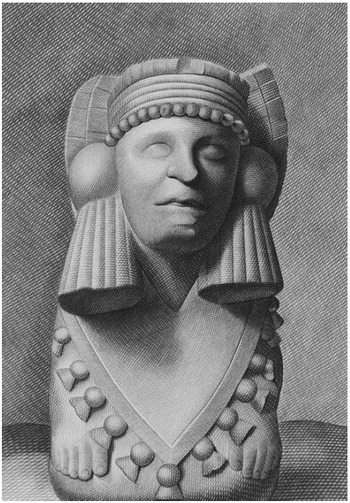
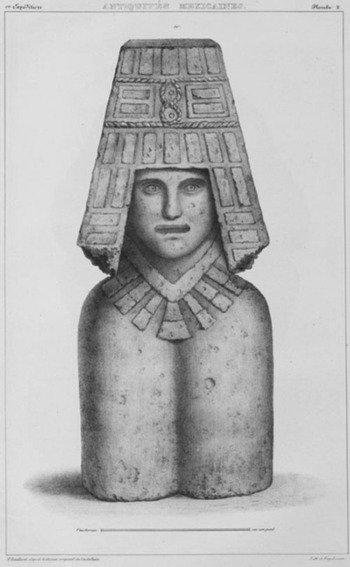
Nombre des premiers observateurs – dont Ulloa, mentionné précédemment – ont essayé d’attirer l’attention sur les caractéristiques des antiquités américaines les plus comparables à l’Antiquité classique. Certains des choix d’Ulloa transparaissent ainsi dans la façon dont Longpérier organisa la collection américaine du Louvre. Cependant, au cours du xix e siècle, ces caractéristiques « classiques » sont progressivement devenues moins pertinentes pour représenter et décrire les antiquités américaines et, de manière plus générale, pour comprendre le passé du continent américain. Cela était particulièrement vrai des antiquités mexicaines, ce dont la statue aztèque d’une femme agenouillée – le « buste d’une prêtresse » qui avait appartenu à Dupaix – figurant sur la première planche de Vues des Cordillères de Humboldt (fig. 1) est un exemple parfait. La ressemblance entre la coiffe du buste et le « voile ou calantica » porté par la déesse Isis, le Sphynx et d’autres statues égyptiennes – ainsi que le calendrier, les hiéroglyphes et les pyramides à degrés aztèques – incitèrent Humboldt à « attribuer le commencement de la civilisation américaine » à un « reflet » des civilisations de l’« ancien continent » et à rechercher les structures politiques, culturelles et environnementales ayant déterminé des expressions matérielles similaires dans l’Ancien et dans le Nouveau MondeFootnote 72 . Les comparaisons stylistiques de Humboldt, comme celles d’Ulloa avant lui, furent à l’origine de catégories lexicales et de différents régimes d’attention applicables aux antiquités américaines ; ceux-ci furent intériorisés non seulement par les chercheurs et les collectionneurs, mais aussi par les artistes, dont les représentations des antiquités américaines étaient singulièrement proches des antiquités égyptiennes (fig. 2). Cependant, vers la fin du xix e siècle, une interprétation radicalement différente de la tenue et des ornements du buste de la prêtresse allait se développer, aboutissant à faire de la statue une représentation de Xilonen (la déesse du jeune maïs) ou de Chalchiuhtlicue (la déesse de l’eau), et à affirmer que l’art mexicain était une expression autochtoneFootnote 73 .
« Buste d’une prêtresse aztèque », Vues des Cordillères d’Alexander von Humboldt
Source : Alexander von Humboldt, Vues des Cordillères, et monumens des peuples indigènes de l’Amérique, Paris, F. Schoell, 1810-1813, planche 1. Reproduit avec l’aimable autorisation de la Nettie Lee Benson Latin American Collection, Austin, The University of Texas.

« Divinité païenne », Antiquités mexicaines. Relations des trois expéditions du capitaine Dupaix
Source : Jean Henri Baradère et Guillermo Dupaix, Antiquités mexicaines. Relation des trois expéditions du capitaine Dupaix, ordonnées en 1805, 1806, et 1807, Paris, Bureau des Antiquités mexicaines, 1832-1834, vol. 2, planche 10. Reproduit avec l’aimable autorisation de la Nettie Lee Benson Latin American Collection, Austin, The University of Texas.

Loin d’être des supports passifs de la circulation des antiquités, les dessins et les recueils d’images constituaient donc également des outils heuristiques permettant de donner un sens aux choses : ils étayaient ou rendaient explicites des opinions et des interprétations scientifiques, satisfaisaient les inclinations d’un certain public – par exemple pour le sublime et le pittoresque – ou prêtaient main-forte à l’imagination, en recréant des structures ou des caractéristiques disparues ou, à l’inverse, en faisant disparaître un détail « superflu ». Les images des antiquités reflétaient ce que l’artiste, le savant ou l’éditeur voyait ou voulait voir dans un objet et, ce faisant, influençaient la réception de l’« original » par la communauté scientifique ou le public non initiéFootnote 74 . Comme le fit remarquer l’un des critiques du recueil de Jean-Frédéric Waldeck (1766-1875), le penchant de l’auteur pour la « restauration » des ruines « s’impose inévitablement à l’esprit de ceux qui étudient de semblables dessins, et devient une sorte d’injonction qui les force, même à leur insu, à suivre la pensée du dessinateur »Footnote 75 . Si les dessins ont joué un rôle de vecteur important, au travers duquel les antiquités américaines ont acquis davantage de poids en tant que catégorie archéologique, il s’agissait ainsi d’un vecteur contingent, forgé par la « pensée », la vision et le talent de l’artiste et du scientifique.
On aurait pu penser que la photographie constituerait une échappatoire à l’imagination, une solution pour éviter l’écueil de la subjectivité et une garantie d’authenticité et d’exactitude. Elle offrait la promesse d’une technique objective permettant d’enregistrer et de transmettre des preuves à même de faire de l’archéologie une science – l’archéologie fournissant en retour à la photographie la justification de sa valeur. Dans ce contexte, les photographes devinrent des membres incontournables de toute expédition archéologique dès les débuts du daguerréotypeFootnote 76 . Dans le domaine de l’archéologie américaine, les photographies complétèrent peu à peu, à partir de la seconde moitié du xix e siècle, les dessins, les gravures et les lithographies d’antiquités, aussi bien dans les publications destinées au grand public, comme les guides de voyage ou les catalogues d’exposition, que dans les projets savants. Parmi les premières photographies de ruines, les plus célèbres remontent aux voyages de Désiré Charnay (1828-1915) au Mexique à la fin des années 1850Footnote 77 . Le diplomate américain Squier aurait été le premier à essayer de photographier la culture matérielle précolombienne au Pérou en 1864 et 1865. À son retour, il possédait une collection personnelle de 50 photographies de « poteries péruviennes anciennes » et 200 clichés de ruinesFootnote 78 . Les appareils et l’équipement devenant moins volumineux et les produits chimiques moins dangereux et plus faciles à utiliser, les photographies prirent place dans le protocole des missions d’exploration et de fouilles, comme en témoigne le nombre impressionnant de clichés réalisés par certains voyageurs : Thomas J. Hutchinson (1820-1885) au Pérou, Charnay, en particulier lors de son expédition au Yucatán au début des années 1880 et Alfred Percival Maudslay (1850-1931) au Mexique et en Amérique centraleFootnote 79 .
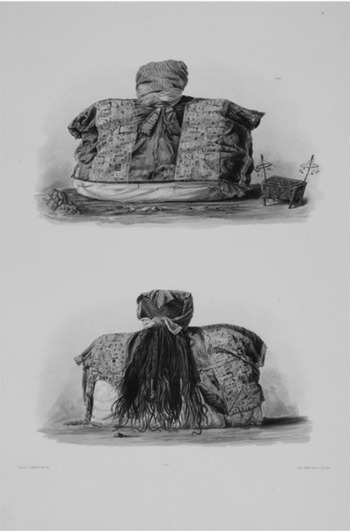
Bien qu’elle fût de plus en plus répandue, la photographie n’offrait cependant pas de réponses évidentes aux problématiques de l’objectivité et de la véracité. Au contraire, comme le soulignaient aussi bien partisans que détracteurs, les photographies avaient hérité de certaines conventions et, partant, des défauts des techniques précédentes – par exemple, une tendance à l’esthétisation ou à l’utilisation subjective du contexte –, tout en introduisant un ensemble de nouvelles difficultés. L’un des principaux écueils des photographies était qu’on y discernait difficilement les détails. Par ailleurs, elles créaient une tension entre exactitude, d’une part, et utilité, d’autre part. Car si la photographie permettait de capter des détails, la lecture de ces derniers n’était pas toujours aisée et il fallait discipliner l’image, aussi bien que le regard, pour que la photographie pût avoir une utilitéFootnote 80 . L’antiquaire péruvien Macedo, notamment, conseillait à Adolf Bastian (1826-1905), directeur du musée d’ethnologie de Berlin, d’examiner les photographies des « mystérieux quipus des Incas » avec une loupe afin d’apprécier les couleurs et l’espacement des nœudsFootnote 81 . Pour rendre leurs travaux plus intelligibles, les savants et les explorateurs associaient la photographie à d’autres techniques. Par exemple, les organisateurs des missions d’exploration conduites en 1866 dans les ruines de Metlaltoyuca, au centre du Mexique, emportèrent un appareil photographique, mais s’adjoignirent également les services du célèbre artiste José María Velasco (1840-1912), affirmant qu’il était difficile de discerner l’ombre d’un bas-relief sur une photographie, alors que l’illustrateur était, lui, capable de la suggérerFootnote 82 . D’autres explorateurs utilisaient la lithographie associée à la photographie. Wilhelm Reiss (1838-1908) et Alphons Stübel (1835-1904), bien qu’ayant utilisé des techniques photomécaniques lors de leurs fouilles du cimetière d’Ancón en 1875, choisirent ainsi d’illustrer leur atlas Das Todtenfeld von Ancon in Perú (La nécropole d’Ancón au Pérou) avec des lithographies en couleurs plutôt qu’avec des photographies en noir et blanc, afin de rendre justice aux teintes vives des textiles d’Ancón (fig. 3)Footnote 83 .
Lithographies en couleurs, Das Todtenfeld von Ancon in Perú de Wilhelm Reiss et Alphons Stübel
Source : Wilhelm Reiss et Alphons Stübel, The Necropolis of Ancón in Peru: A Contribution to our Knowledge of the Culture and Industries of the Empire of the Incas, Being the Results of Excavations Made on the Spot, vol. 1, trad. par A. H. Keane, Berlin, A. Asher & Co., 3 vol., 1880-1887, planche 16 montrant l’avant et l’arrière d’un « somptueux paquet funéraire ». Chromolithograph. © The Getty Research Institute, Los Angeles.

Parfois, la photographie était combinée à la lottinoplastie, une autre technique tout aussi nouvelle consistant à appliquer des couches de feuilles de papier gélatinées sur la surface de l’objet à reproduire, puis, après séchage et application d’huile de lin, à utiliser la structure pour réaliser des moulages utilisant différents matériauxFootnote 84 . Empreinte directe, la lottinoplastie permettait une observation détaillée et offrait aux chercheurs la reproduction la plus proche de l’original qu’ils puissent rencontrer ; en cela, elle contribua grandement à faire de l’écriture maya un objet d’étudeFootnote 85 . À la différence des moules en plâtre, utilisés depuis longtemps, les moules en papier présentaient l’avantage d’être légers et donc aisément transportables. Lorsque Charnay effectua son deuxième séjour au Yucatán et à Palenque, en 1882, il prit des photographies, mais réalisa également des lottinoplasties de reliefs des ruines. Il photographia ensuite les moulages obtenus dans des conditions de studio, où il pouvait recréer une lumière et une exposition impossibles à obtenir sur le terrainFootnote 86 . Ses moulages et ses photographies de moulages furent exposés dans des musées des deux rives de l’Atlantique avec des artefacts authentiques. Ces répliques engendrèrent des modes et, de manière plus importante encore, contribuèrent à la formation d’un corpus d’objets jugés pertinents et dignes d’intérêt pour l’étude du passé du continent américain. Ces reproductions, sans lesquelles aucune collection n’était complète, finirent par s’imposer au côté des originaux, de même que, un siècle plus tôt, toutes les collections d’art classique de l’Ancien Monde qui se respectaient comprenaient une copie en marbre du groupe du LaocoonFootnote 87 . À partir de la fin du xix e siècle, les principales collections d’antiquités américaines incluaient des reproductions de la Pierre du Soleil (Piedra del Sol), d’un relief maya et, parfois même, d’une pyramide ou de la Porte du Soleil de Tiahuanaco.
Au xix e siècle, les techniques de reproduction contribuèrent à la formation de vastes corpus d’archives de répliques d’antiquités. Objets d’échange entre chercheurs et sociétés savantes, présentées dans les musées et les expositions ou utilisées dans les maisons de ventes comme substituts à des objets mis aux enchères, ces archives devinrent des outils heuristiques importants pour l’étude des antiquités, car il s’avérait bien plus simple de comparer, d’assembler et de réassembler des photographies que les objets eux-mêmesFootnote 88 . La large diffusion des répliques eut un effet très important sur la visibilité des antiquités américaines et sur la formation de canons relatifs aux artefacts représentatifs du passé du Nouveau Monde. Les savants et, de manière générale, tous ceux qui utilisaient ces reproductions, étaient conscients du fait qu’elles n’étaient pas fidèles aux objets qu’elles représentaient : chacune des étapes du processus (de la contemplation au dessin, à la lithographie ou à la gravure) impliquait des lectures et des jugements subjectifs de l’original. De même, les photographies et les moulages reflétaient des processus de sélection et déterminaient des régimes d’attention et de reconnaissance de certains objets, tandis qu’ils en condamnaient d’autres aux oubliettes. Avec le temps, la manière d’enregistrer, de dessiner ou de décrire les artefacts, les questions qu’ils suscitaient et les protocoles guidant leur examen matériel et symbolique devinrent des sujets majeurs de préoccupation, que les balbutiantes institutions créées spécifiquement pour l’étude des antiquités américaines se devaient de gérer. À la fin du xix e siècle, l’émergence de l’archéologie et de l’ethnologie comme disciplines scientifiques aboutit à une stabilisation linguistique et graphique des antiquités américaines en tant qu’objets d’étude. Retracer les méandres de ce processus revient à s’interroger sur les enjeux de ces tentatives de stabilisation : quels objets comptaient et pourquoi, comment leur sélection avait été opérée, dans quels récits s’étaient-ils ancrés et qui était responsable de ces récits ?
Les experts, les ancêtres et les autres
Dix ans après son ouverture en 1850, victime du désintérêt progressif de la direction du Louvre, le musée américain dut fermer ses portes au publicFootnote 89 . En 1878, à la suite de l’exposition universelle de Paris, les antiquités américaines du Louvre ainsi que celles conservées au Muséum national d’histoire naturelle et à la Bibliothèque nationale de France se virent transférées au tout nouveau musée d’Ethnographie du Trocadéro, où elles furent exposées avec des artefacts provenant d’Afrique et du Pacifique, deux régions qui représentaient de réels enjeux coloniaux pour la France. C’est ainsi que les antiquités américaines se trouvèrent séparées des antiquités grecques, romaines, égyptiennes et assyriennes, considérées comme participant plus directement au récit du passé européen. Les antiquités nationales françaises – associées à l’histoire des Gaulois et des Francs – furent quant à elles installées au Musée des antiquités nationales de Saint-Germain-en-Laye en 1867. Tournant le dos à la proposition de Longpérier d’exposer les antiquités américaines au Louvre, ces réorganisations reflétaient la division qui se creusait entre art et artefact, entre les ancêtres de l’Europe et ce qui serait autre à l’EuropeFootnote 90 . Près d’un demi-siècle plus tôt, Jomard avait défendu la nécessité d’un musée d’ethnographie pour sauvegarder et rassembler les vestiges matériels des « sauvages » en voie de disparition à travers le monde et – empruntant aux sciences naturelles – avait établi des critères d’organisation pour leur exposition, des objets de « nécessité » à ceux qui reflétaient des avancées dans les domaines de l’art et de la science. Sa vision se matérialisa au Trocadéro, où des objets produits par des peuples non méditerranéens, encore décrits en 1870 comme « parfois grotesques, rarement pourvus de beauté, sortes de produits du hasard ou d’une fantaisie barbareFootnote 91 », seraient la manifestation du devenir moral, sinon esthétique, de l’Homme. Les antiquités exposées au Louvre et à Saint-Germain-en-Laye racontaient l’histoire du passé de l’Europe et de la France, à la différence des antiquités américaines, qui acquirent leur cohérence comme catégorie ethnographique : « pas encore classiques », puisqu’elles ne correspondaient pas à un canon consacré et ne faisaient pas partie d’une identité collective européenne, elles étaient convoquées pour témoigner de l’évolution de l’humanité, « s’insérant dans un schéma global de progrès culturel qui plaçait les peuples et les civilisations le long d’un continuum »Footnote 92 .
La fondation du musée du Trocadéro n’est pas un événement isolé dans l’histoire des antiquités américaines de la seconde moitié du xix e siècle. En Europe et en Amérique du Nord, l’infrastructure épistémique et institutionnelle afférente aux antiquités américaines devint celle de l’ethnographie, de l’anthropologie et même de l’histoire naturelle : la Smithsonian Institution de Washington DC, en 1846, le musée Peabody d’archéologie et d’ethnologie de Harvard, en 1866, le musée américain d’histoire naturelle de New York, en 1869, le Königliches Museum für Völkerkunde de Berlin, en 1873, et le Field Museum de Chicago, en 1894, étaient en effet, comme le Trocadéro, des musées d’ethnographie ou d’histoire naturelle. Leurs fondateurs et premiers conservateurs – Ernest-Théodore Hamy (1842-1908) à Paris, Bastian à Berlin et Franz Boas (1858-1942) à New York et à Chicago – furent associés au développement de l’ethnologie et de l’anthropologie physiqueFootnote 93 . Bien que caractérisées par des configurations spécifiques et contingentes – mêlant ambitions intellectuelles, contraintes matérielles et objectifs urbains ou nationaux –, ces différentes institutions partageaient néanmoins un engagement commun en faveur de l’exposition et de l’étude des antiquités américaines au nom de la sauvegarde, de l’évolution et du progrès de l’humanitéFootnote 94 .
Comme l’ont affirmé des générations d’historiens, ces projets de musée étaient indissociables des relations de pouvoir entre empires de l’époque, qui affectaient non seulement la formation des collections – on pense au musée Peabody d’histoire naturelle de Yale, qui devait nombre de ses antiquités américaines à des fouilles controversées au Machu Picchu, et à celui de Harvard, au centre du pillage du puits sacré (Cenote sagrado) de Chichén ItzáFootnote 95 –, mais aussi les sujets de recherche guidant l’étude des antiquités américaines. Des hypothèses diffusionnistes, par exemple, souvent introduites lors de sessions du Congrès des américanistes après 1875Footnote 96 , trahissaient le préjugé colonialiste selon lequel les Amérindiens ne pouvaient pas avoir construit les impressionnantes structures monumentales du continent. Comme José Fernando Ramírez (1804-1871), directeur du musée national du Mexique, le fit remarquer avec amertume en 1857 : « Ceux qui ne veulent pas accorder la moindre pensée originale aux malheureux fils de l’Amérique attribuent les pyramides à une imitation de l’ÉgypteFootnote 97 . » Certaines théories de la race, comme celle promue par Arthur de Gobineau (1816-1882) et défendue par Eugène Emmanuel Viollet-le-Duc (1814-1879) en relation avec les arts, et particulièrement avec les artefacts mexicains, cherchaient à établir un lien entre l’expression artistique, matérielle et technique et des caractéristiques racialesFootnote 98 . De la même façon, les débats sur la dégénérescence et la décadence raciale cherchaient à expliquer le sort peu enviable des sociétés amérindiennes de l’époque en se servant des antiquités comme preuves. Ce type d’enquêtes, menées par des savants français, espagnols, prussiens ou britanniques, relevaient d’un réseau de discours pouvant être mobilisés à la fois pour légitimer les projets impériaux (à l’étranger) et avaliser le fait que les antiquités appartenaient aux musées européens et nord-américains, dans lesquels elles pouvaient être conservées de manière appropriéeFootnote 99 . Tout au long de ce processus d’intégration dans les collections ethnographiques et dans cette nouvelle « infrastructure » de savoirFootnote 100 , caractérisée par une classe d’experts et des affiliations politiques propres, ces artefacts n’en demeurèrent pas moins polysémiques, car déterminés par des traditions intellectuelles et des structures politiques différentes.
Alors que les musées européens et nord-américains voyaient dans les antiquités des objets à l’aune desquels mesurer le passé d’autres civilisations, les musées hispano-américains détenant des fonds précolombiens étaient également réorganisés ou (re)fondés – au Mexique après 1867, au Pérou en 1905 et au Chili en 1912 – dans un cadre discursif, disciplinaire et politique radicalement différent. Dans ces pays, les antiquités andines et mexicaines, qui avaient progressivement émergé en tant qu’objets de collection et catégories d’étude au cours du xix e siècle, devinrent la métaphore de l’État-nation, de sa grandeur, de son héritage unique et de sa légitimité politique. Animé d’une conviction que partageaient de nombreux intellectuels hispano-américains, Justo Sierra Méndez (1848-1912), le ministre mexicain de l’Instruction publique, s’adressa ainsi en 1909 à ses collègues du ministère des Finances pour leur demander d’allouer davantage de fonds à la gestion des antiquités, en prévision du centenaire de l’indépendance du Mexique : « Pour vous, qui êtes hommes d’affaires et de finance, cette chose que l’on nomme archéologie n’est qu’une question triviale et dérisoire ; mais pour nous il s’agit de la seule chose qui distingue le Mexique aux yeux du monde scientifique ; tout le reste existe partout ailleursFootnote 101 . » Depuis longtemps, on sait que, à la fin du xix e siècle et au début du xx e siècle, les États-nations se sont construits sur une étrange dialectique : processus de convergence vers un même modèle, entretien des particularismes, dans le cadre d’une montée des nationalismes – le droit à l’existence de chaque nation étant lié à la revendication d’une authenticité et d’un héritage uniqueFootnote 102 . Dans de nombreux pays hispano-américains, comme le Mexique, le Pérou ou le Chili, cette authenticité et cette légitimité politique s’incarnèrent, toujours plus fermement, dans le passé précolombien et ses vestiges matériels.
Au Mexique, les antiquités revinrent sur le devant de la scène comme composante d’un discours officiel, sous l’éphémère Second Empire mexicain de 1864 à 1867, avec Maximilien Ier (1832-1867). L’empereur, qui s’était attribué le titre des empereurs mexicains précolombiens, huey tlatoani (« grand/haut tlatoani »), fit enrichir la collection d’antiquités du musée national, qu’il transféra hors de ses locaux exigus vers le palais impérial (aujourd’hui palais national), pour unifier le pays et légitimer son précaire mandat de gouvernementFootnote 103 . À la même époque, l’État péruvien commença lui aussi à faire de la collecte d’antiquités une priorité. Entre 1872 et 1876, pendant la mandature du gouvernement du Parti civil (Partido Civil) de Manuel Pardo (1834-1878), les collections archéologiques du musée national furent transférées au palais des expositions de Lima sous les auspices d’une commission d’experts, la Société des beaux-arts. Le musée du palais des expositions devait accueillir des « objets utilitaires et d’autres objets intéressants, indigènes ou étrangers », mais, « surtout, des antiquités péruviennes grâce à l’achat de collections d’objets historiques indigènes, d’instruments, d’ustensiles, de machines, etc. »Footnote 104 .
Bien que le projet de Maximilien Ier et celui du musée du palais des expositions aient été de courte durée – le premier se terminant par l’exécution de l’empereur, le second par l’occupation chilienne de Lima pendant la guerre du Pacifique –, les gouvernements mexicain et péruvien finirent par faire de nouveau de la collecte et de l’étude des antiquités le cœur de leurs politiques nationales. Au Mexique, dans le sillage de la présidence de Porfirio Díaz (1884-1911) de 1876 à 1880, les antiquités bénéficièrent d’une visibilité accrue au musée national à partir de 1885, tandis que l’archéologie était progressivement placée sous le contrôle de l’État. Imitant probablement des initiatives prises en Irlande, dans la péninsule italienne et dans les territoires germanophones, le gouvernement mexicain fonda l’Inspection générale des monuments archéologiques, avec pour mandat de surveiller les fouilles et les sites en ruineFootnote 105 ; des lois promulguées en 1896 et en 1897 renforcèrent encore le contrôle de l’État sur l’étude et les mouvements des antiquités. L’évolution vers une archéologie étatique fut parachevée en 1910, avec le déménagement des spécimens d’histoire naturelle du palais national de Mexico, pour laisser une place de choix aux collections archéologiques. Au Pérou, il fallut attendre un peu plus tard, vers le début du xx e siècle, pour voir l’État, et le nationalisme en tant qu’idéologie politique, commencer à soutenir de manière systématique des projets archéologiques.
Le musée national d’archéologie, d’anthropologie et d’histoire du Pérou fut (re)fondé en 1905, avec trois sections consacrées à l’archéologie, l’ethnologie (l’étude des « tribus sauvages ») et l’histoire. La section d’archéologie comptait cependant peu d’objets avant la nomination de Max Uhle (1856-1944) au poste de directeur en 1906. Au Pérou, l’alliance entre l’archéologie et l’État fut en grande partie associée aux gouvernements d’Augusto B. Leguía (1863-1932), entre 1908 et 1912, puis entre 1919 et 1930, et à sa politique d’« indigénisme » étatique : sous ce terme, il faut entendre un discours artistique, littéraire et politique prônant la réévaluation de l’indigénisme et visant à répondre au besoin d’une « identité fondée sur une culture nationale authentique et organique » – en l’occurrence, la création et la popularisation d’un symbolisme partagé puisant dans l’imagerie précolombienneFootnote 106 . Au Mexique comme au Pérou, c’est à travers l’alliance de l’État et de quelques archéologues ambitieux et particulièrement influents – Leopoldo Batres (1852-1926) et Manuel Gamio (1883-1960) au Mexique, Julio C. Tello (1880-1947) au Pérou – que la politique et l’idéologie finirent par exercer une influence décisive sur l’étude des antiquités.
Le nationalisme ethnique et, dans le cas péruvien, l’indigénisme contribuèrent à donner davantage de visibilité publique aux antiquités, non seulement à l’échelle nationale, mais aussi à l’étranger. Le Pérou et le Mexique exposaient régulièrement des antiquités précolombiennes dans leurs pavillons nationaux – souvent construits dans un style architectural intégrant, de manière sélective et créative, des éléments de l’imagerie populaire associée au passé précolombien – et dans les sections archéologiques des expositions universelles, notamment à l’exposition universelle de Paris en 1889, à l’Exposición histórico-americana à Madrid en 1892, puis à la World’s Columbian Exposition à Chicago en 1893Footnote 107 . En attirant des foules considérables (28 millions de visiteurs à Paris comme à Chicago), ces expositions universelles permettaient simultanément à ces pays de tirer parti du symbolisme des antiquités et de l’attrait croissant qu’elles exerçaient et d’en étendre la portée, en mettant l’accent, à l’étranger, sur leur association avec le passé précolombien. Jusqu’à la fin du xix e siècle, ces deux pays choisirent des civilisations précolombiennes spécifiques pour ces manifestations. Les Incas étaient de plus en plus réimaginés comme les « ancêtres nationaux » du Pérou, à l’exclusion d’autres pays comme le Chili, l’Argentine, la Bolivie et l’Équateur, qui délaissèrent progressivement cet héritage. S’agissant du Mexique, l’imaginaire national, la culture muséale et le discours archéologique s’organisèrent principalement autour des cultures et des passés du Mexique central, en particulier le passé « aztèque » : les monolithes et les pyramides – comme les pyramides de Teotihuacán, qui venaient d’être reconstruites – se trouvaient ainsi au cœur du projet national mexicain depuis la fin du xix e siècleFootnote 108 . De fait, ce n’est qu’au cours du xx e siècle, avec l’arrivée de méthodes aujourd’hui associées à la discipline archéologique – l’observation des résidus matériels par stratigraphie séquentielle, le séquençage chronologique ou la sériation stylistique –, que le passé précolombien devint progressivement une « antiquité » différenciée, voire plurielle, au sein de laquelle d’autres civilisations figuraient également en bonne place : les Mayas, au Mexique, ainsi que les Nazcas et les Chavíns, au PérouFootnote 109 . Au début du xx e siècle, les « antiquités » avaient donc acquis une importance culturelle et politique pour de nombreuses sociétés ; dans le même temps, la « révolution primitiviste » du début du xx e siècle et la vogue du surréalisme en Occident entraînaient une réévaluation des antiquités américaines, en particulier mexicaines, qui facilitait leur utilisation dans les discours officiels en les rendant « classiques » sur la base de leur pertinence sociale et de l’attrait que leur garantissaient les nouveaux canons de beautéFootnote 110 .
Il faut insister sur le fait que la consolidation des antiquités en tant qu’objets ethnographiques dans les musées des deux rives de l’Atlantique, d’une part, et leur resémantisation en tant que piliers des antiquités nationales, d’autre part, n’étaient pas des processus opposés ou aisément distinguables. En effet, les liens intellectuels et matériels entre institutions et chercheurs hispano-américains et leurs homologues des rives nord de l’Atlantique étaient denses et vibrants à la fin du xix e siècle, comme le montrent les débats organisés lors de congrès ou d’expositions, ou les biographies transatlantiques d’éminents scientifiques, tels Eduard Seler (1849-1922), Boas ou UhleFootnote 111 . Les historiographies nationalistes, promptes à « naturaliser » l’association entre les antiquités et l’État-nation, ont également occulté le fait que cette association, de même que les significations et les usages des antiquités, dépendaient d’un certain nombre d’acteurs, de leurs ambitions professionnelles et de leurs liens au marché, aux disciplines et aux institutions scientifiques ainsi qu’aux identités locales et transnationales.
Les antiquités américaines sont-elles devenues classiques au tournant du xx e siècle, au sens où Longpérier l’avait envisagé un demi-siècle plus tôt ? Les discours et récits dont nous rendons compte dans cet article suggèrent qu’il n’est pas facile de répondre à cette question, surtout de manière tranchée. Au cours du xix e siècle, les artefacts précolombiens associés à d’anciennes civilisations américaines spécifiques – en particulier du centre du Mexique et du Pérou – sont effectivement devenus de plus en plus importants, culturellement et politiquement, pour certains États-nations fondés dans les années 1820 comme le Mexique, le Pérou et le Chili. Ailleurs, notamment dans les musées d’Europe et des États-Unis, les vestiges matériels des Amériques ont été utilisés à d’autres fins, les antiquités américaines se voyant peu à peu dissociées du passé classique de l’Europe pour être intégrées dans des histoires de l’humanité rassemblant des artefacts précolombiens et ethnographiques. En parallèle, les antiquités américaines ont été l’un des terrains où s’est jouée la remise en cause de la notion de « classique », identifiée avec le « beau », voire le « canonique » : tandis que certains conservateurs de musée persistaient à considérer ces objets comme « barbares » ou dénués de beauté, renforçant ainsi la distinction entre art et artefact, des artistes et des hommes politiques s’en emparaient pour forger de nouveaux canons esthétiques. Au-delà d’usages divergents selon les acteurs et des significations très hétérogènes que ceux-ci leur attachaient, la collecte, l’exposition et l’étude des antiquités américaines ont indéniablement fini par former une catégorie propre, au point d’être convoitées par nombre de grands musées mondiaux et de se négocier à des prix toujours plus élevés sur le marché de l’art.
Dans cette étude, nous avons essayé de montrer que l’émergence des antiquités américaines comme catégorie épistémologique, esthétique, politique et commerciale ne correspondait pas à un processus d’exhumation graduelle révélant la vérité profonde des objets, en lien intrinsèque avec la consolidation des identités nationales ou de la science archéologique. Les antiquités américaines sont certes devenues une catégorie identifiable, mais une catégorie mobilisant des interprétations divergentes, dont la pertinence s’est construite par à-coups – et en aucun cas de manière définitive – au travers de transactions entre des individus et des institutions poursuivant des intérêts différents, parfois même contradictoires, à des moments et dans des lieux différents. De manière semblable, en reconstruisant leur émergence sur plus d’un siècle et demi, nous ne prétendons pas qu’au début du xx e siècle, les antiquités américaines étaient « enfin » devenues des entités immuables aux significations figées. En réalité, leur consolidation en tant que catégorie archéologique a suscité de nouveaux usages tout aussi pluriels, qu’il s’agisse de leur utilisation en tant qu’objets scientifiques, de leur appropriation par des acteurs nationaux et des collectivités locales ou, ces dernières années, des débats croissants autour de la restitution et du rapatriement des œuvres.