

In a previous article in this journal I put the case that psychiatrists have much to gain from engaging with the media (Reference BithellBithell 2011). The piece argued that the media offers an opportunity to communicate with a wide audience, including the general public, those with mental health problems, those who know or care for someone with a mental illness, policy makers, potential funders and other medical professionals. A news media interview takes less time than many other forms of public engagement – such as setting up a website or speaking at a public lecture – but often reaches a larger number of people, including those who would not seek information on the issues from other sources. There is much that could be done, as psychiatry is a profession often misunderstood and coverage about mental health problems is often negative in tone (Reference LawrieLawrie 2000; Reference Huang and PriebeHuang 2003; Reference Callard, Thornicroft and RoseCallard 2008). Media coverage of mental health research could provide a more informed narrative by communicating basic information about mental health problems; however, mental health research is currently underrepresented in the media (Reference BithellBithell 2010). Engaging with the media gives psychiatrists the opportunity to explain their role to the public and ensure that the public is given good information about mental health problems.
However, it is not enough simply to put the case for engaging with the media. It is important to demystify the way the media works for those new to the area and to give practical help and advice. In this article I hope to give some insight into the way the media operates, different ways to get involved and some advice for those embarking on media work.
Type of media outlet
‘The media’ is a broad term and there are many outlets that require varying approaches from experts and that have different audiences. An appreciation of these differences will help experts engage with the media in a more effective way.
Daily news media
When most people think of the media, they think of daily news media – newspapers, television and radio news programmes and bulletins. The lead-in times for this type of media are very short – the time between something happening and it appearing in the news is often within an hour. The advent of 24-hour news means that stories do not wait until the next bulletin or even the next day – even daily newspapers now file stories throughout the day for their websites. Journalists may have less than an hour to write a story, and this usually includes reading source material (often a press release and a paper), working out what the top line of the story is, putting the information into plain English and speaking to key experts in the field.
Those experts who are willing to engage with news journalists at short notice can change the way a story is reported. By giving important context and their opinion on the significance of the news within a tight deadline they can ensure that the story is more accurate. The Science Media Centre is an independent press office for science and health stories in the news and it helps promote the voices, views and stories from the scientific community (which includes medical professionals and experts in mental health) in the headlines. The Science Media Centre was set up to deal with news stories in particular because of the short time frames journalists work to, the tendency of the news to focus on the sensational or controversial, and because, traditionally, it has been the type of media that experts have tended to shy away from.
The rest of this article will focus on working with the news media, but it is worth appreciating other types of media that you could engage with – some different types and their key features are given below. Many of the tips for communicating with the news media also apply to communicating using these channels.
Documentaries
Documentaries have much longer lead-in times and deadlines than news media, and can take a year or two to produce. Although documentary makers have more time to examine an issue in-depth (documentaries can be an hour or two in length), there is no guarantee they will be completed and broadcast, and some projects fall through.
Before committing time to a documentary, find out whether it has been commissioned and has full funding. Ask journalists to send examples of work they have done before and the brief they used to make their pitch to give you an idea of what the finished product may look like. Also bear in mind that being involved with a documentary can be extremely time consuming and almost always takes longer than initially planned.
Documentaries can devote much more air-time to a subject than a news story, so can be a very valuable way to communicate if they are well produced.
Features
Features are an in-depth look at a topical issue – typically seen in the middle pages of newspapers or in magazines – for example, newspapers such as The Sun and Daily Mail have a lot of space for information on health problems. If you have an idea and think it would make a good feature you could be proactive and find a journalist who has written something similar and pitch your idea. You could do this directly or ask your press officer for help.
Comment pieces
A comment piece may allow you to challenge a narrative that has been running in the media or add an important perspective that you feel is being missed. If you do want to write a comment piece you will need to work quickly – it will only be relevant if linked to current events. Examples of comment pieces that the Science Media Centre has placed on mental health include a comment examining the way the media has treated Charlie Sheen (Box 1) and a piece in response to a multiple shooting in Cumbria (Reference EastmanEastman 2010).
Expert comment: Charlie Sheen
As the media was running stories on the behaviour of Charlie Sheen, the Science Media Centre approached experts to write a piece for the BBC’s Scrubbing Up column to give important context to the way the story was being reported. Paul Keedwell from the University of Cardiff offered to write a comment piece about the way that this had been reported and the issues it raised. Paul had to write something within 48 h that was short, pithy and made all of his key points in plain English. The article went online a few days after he submitted it and it attracted a lot of comments from members of the public.
If you work in an area that is running in the news and would like to write a comment piece, you could contact your press officer or the Science Media Centre to help you.
New media
New media such as Twitter, blogs and YouTube enable you to speak directly to an audience without going through conventional media outlets/journalists. By communicating directly with your target audience you can avoid the vagaries of dealing with the media and have more control over your message. This can be a very successful way of communicating, but it is always worth considering who your audience is. It might be that the people who seek out your blog or YouTube video are like-minded and that you are ‘preaching to the converted’. Recent surveys suggest that if you want to reach the wider public, traditional media routes remain the most effective.
However, new media offer a good way to communicate with a younger audience as increasingly they use them to access information about science and health.
What makes news?
Understanding what makes news will help you work with the media, for example by avoiding wasting time and effort trying to publicise topics of no interest to journalists, while making sure issues that warrant publicity do not get overlooked. A basic understanding of what makes news will help you flag up the right topics to your press office.
As their name suggests, news journalists are looking for something new that is relevant to their audience. This could be a policy announcement, a new research finding, a group or institution calling for something, new figures or a personal interest story that has implications for others. If the audience is the general public, the news has to pass the ‘so what?’ test, that is whether the story has direct relevance to the public/audience for that media outlet, so answering the question ‘What does this mean for the man or woman on the street?’ Something that passes this test may tell the public about their risk of getting a new disease, something new about the way their body works, the prevalence of an illness or a new treatment. If the new information is relevant only to a very small proportion of the public or only to health professionals, there may be a better way to communicate with them than through the national news media.
There are some stories that do not follow these rules and are covered by the media because journalists know they hold great interest for the public. The latest piece of research on space or dinosaurs may not be of direct relevance to the average person, but if they are likely to be interested in it, journalists are likely to cover the story. This is also the reason why the media covers so many stories on things like chocolate, alcohol, celebrities and cute animals – whether we like it or not, the public are interested. Not having hard and fast rules can make it tricky for researchers to navigate this area, so if you are in doubt, seek advice from the Science Media Centre, your press officer or a journalist.
It is also important to know what does not make a good news story. In general, announcements about new funding, conferences, talks or the start of projects do not make national news. To give examples, a bursary for a new student is not news, but the discovery of a new gene for Alzheimer’s disease is. However, there are some exceptions; for example, if experts at a conference are calling for something relevant to members of the public or new research is presented, this may make the news.
News can also be generated when something goes wrong: if a crime is committed, someone is harmed or dies, or something goes wrong at a hospital or with services. If a project, service or anything else goes wrong that you are involved with, you should contact your institutional press officer immediately. Give them as much information as possible and remember that if journalists get in touch they are only trying to do their job, so be as open, transparent and helpful as you can and encourage your press office to do the same.
Mental health as a field has a specific challenge in working with the news media (Reference BithellBithell 2010). Some journalists I have spoken to, although keen to cover more mental health stories, have also cautioned that their editors were subject to the same preconceptions as the general public and did not perceive that mental health difficulties affect their audience. The perception that not many people experience mental health problems presents a real challenge for those looking to generate news media coverage. Psychiatrists can help address this issue by engaging with the media to allow communication of background information such as the prevalence and impact of mental illness.
How you can work with the media
If you care about the way your area is portrayed in the media, you can engage to make sure that coverage is fair and accurate. The Science Media Centre has found that journalists know fewer clinicians and researchers in mental health than in other fields of medicine, so as a profession it is important that psychiatry reaches out and engages with the media. Simple ways that you can engage include the following.
Find out who your press officer is (you might have more than one)
Let them know your areas of expertise and how much experience of media work you have had. If you have never worked with the media, they might ease you in gently with a friendly journalist who has a straightforward enquiry. Once they know what you work on, they can look for suitable opportunities.
Update your online presence
Press officers and journalists will come to you at the right time if the information on your website is up to date and accurate. If you have old information about your area of expertise you will get irrelevant calls. Make sure you have an up-to-date telephone number online; journalists who spend valuable time lost in institutional switchboards may simply give up trying to get hold of you.
Put your contact details on media databases
Journalists often ring press officers to find an expert, so register with media databases such as the one run by the Royal College of Psychiatrists or by your institution’s press office. If you register on these databases, press officers will be able to put journalists through to you. The bigger the list of experts available to press officers and journalists, the more chance there is of getting the right expert – one with expertise in exactly the right field. The Science Media Centre also has a database of experts – see ‘Work with the Science Media Centre’ opposite.
Look for opportunities
If you have a new research paper coming out, are involved in a new report, are doing something new in your clinical role or hold a strong view on a topical issue, let your press officer know. It is worth noting, however, that press officers often represent hundreds or thousands of academics or clinicians, so help them out by giving them enough information in an email or telephone conversation so that they can make an quick and informed decision about whether they can help you get your views across.
Be willing to give your opinion
When journalists are writing a story, whether it is about a journal paper, a policy announcement or breaking news about the health of someone in the public eye, they will want to know what people working in the field think. It is important that journalists have access to ‘third-party’ experts to help them decide on the importance of a news story, and by speaking to a journalist you are likely to influence the way they cover an issue (you do not need to be drawn into commenting on the mental health of specific individuals; see p. 76). We have seen time and time again experts influence the tone of a story and how high it appears in the news headlines or if it appears at all. But journalists can only respond to these views if they hear them in the first place – so it is essential that experts are willing to engage, as in the example in Box 2. Sometimes the Science Media Centre collects comments from mental health experts and sends these out to journalists (Box 3). If you are on the Science Media Centre’s database, you may be approached to help them in this way.
Expert reaction: speculation about Gadaffi’s mental health
When the media began speculating about the state of Muammar Gaddafi’s state of mind, Kate Kelland, Health and Science Correspondent at Reuters News Agency, decided to write a piece questioning our need as a society to try to predict behaviour and put labels on those we feel are acting outside the boundaries of normal behaviour. Given the article was linked to current news stories coming out of Libya, it was important the piece was written in a timely way. Kate called the Science Media Centre (SMC) as she was looking to speak to a number of experts as quickly as possible. The SMC sent out the request to key press officers in the field of mental health to find out whether any of their academics or clinicians would be willing and available to talk. Experts making themselves available and the resulting piece raised important questions and viewpoints.
Expert reaction: new research on the relationship between cannabis and mental health
The Science Media Centre (SMC) receives press releases from major journals and gathers expert opinion if it thinks that useful context can be given.
The SMC spotted a new piece of research to be published in the BMJ looking at the relationship between cannabis use and psychosis risk. Ahead of publication and embargo lift, it sent the paper and the press release to two experts on their database, who replied with short comments explaining what they thought of the research. The SMC issued these reactive comments to journalists in the form of a press release (Reference Murray and KindermanMurray 2011). The comments were used directly in many of the news articles. The SMC also knows, from past experience, that journalists use these press releases to help judge the significance of findings and how robust they are.
Examples of media coverage that used the comments include:
www.bbc.co.uk/news/uk-12616543
www.telegraph.co.uk/health/healthnews/8354747/Cannabis-doubles-risk-of-psychotic-episodes.html
www.dailymail.co.uk/health/article-1361997/Cannabis-use-doubles-risk-psychosis-teenagers.html
Work with the Science Media Centre
Established in 2002 in the wake of science stories such as those on genetically modified crops and immunisation against MMR (measles, mumps and rubella), the Science Media Centre been a major success story helping scientists to get their voices heard on breaking news stories, running almost 100 press conferences a year and being used routinely by every major news organisation in the UK.
Over the past year the Science Media Centre has committed more resources to working on mental health and are looking for new experts to join their database and ideas for press briefings, comment pieces and features. Although the Science Media Centre has a database of over 2000 experts, psychiatrists are currently underrepresented and the centre needs more who are willing to engage with journalists. If you are interested in finding out more about working with the Science Media Centre, please email them at smc@sciencemediacentre.org with a bit of information about yourself.
Tips for engaging with the news media
For many academics and clinicians, speaking to a journalist about a topical issue is a daunting prospect. But there are many skills and tips that will help make doing media work easier and increase the chances that it will be a pleasant and productive experience. The following advice that might be useful.
Get support
No one would expect you to ‘do media’ without support. Your institution, professional body and, if you are doing research, research funder, will all have press officers who may be able to give you help and advice. They should have good relationships with journalists and you should be able to ask them for advice. Press officers are often very busy with many enquiries from journalists and academics, but do persevere if you do not initially get a response and need support. It is important to build up a good relationship with your press officer, respect their judgement and give them the information they need to do their job.
Practice
The experts that the Science Media Centre finds most skilled at dealing with the media are often the ones that have spent years explaining their area of expertise to a lay audience. This may not necessarily be in a media context, but could involve telling their friends and family about their work. Alternatively, public lectures, talks in schools, writing blogs or lay summaries for grant applications all give valuable experience of communicating in accessible language.
Do not stay in your comfort zone
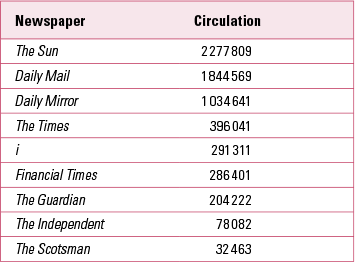
Clinicians and academics are often happy to deal with broadsheet media (especially the outlets they consume – so the BBC, The Guardian and The Times are often high on their preferred list), whereas they have concerns about speaking to tabloid media or newspapers such as the Daily Mail. But psychiatry as a profession ignores tabloid outlets at its peril, as these often reach the widest audience – over 2 million people in the UK read The Sun every day, compared with just over 200 000 reading The Guardian (Ponsford 2013). Bear in mind also that over 1 million read the Daily Mirror every day and just under 2 million read the Daily Mail (for more circulation figures see Table 1). The Science Media Centre works closely with the national science and health reporters from the Daily Mail, Daily Mirror, The Sun and Daily Express and they are excellent journalists who write brilliant copy and strive to get things right.
Decide what you want to say
Media trainers recommend deciding on three key messages before any media interview. This is wise advice as in most interviews you will not get across anything more and it helps to focus your mind on what you want to say. Practice saying these messages out loud in a way that is clear and accessible using language you feel comfortable with. You should also think of evidence that could back up these messages. For example, if your key message is ‘We need more innovative treatments for mental health problems’, you might have statistics or numbers, anonymised examples of cases you have treated or parallels that can be drawn with other fields of medicine.
Circulation figures for major daily UK newspapers
Make sure you get the opportunity to get these messages across
Politicians famously avoid questions that they do not like and bulldoze out their key messages – but this is likely to damage them in the public eye. Instead, most communications experts recommend answering questions as best you can (and it is fine to say you do not know and explain why), then using a linking sentence to move onto a key message. Examples of linking sentences are: ‘What is most important here is …’; ‘What people should know is …’; ‘What we are saying today is …’ – all of which allow you to make sure you get in one of your key messages and use the interview to the best effect. For example:
Reporter: ‘So how many people will die as a result of this illness?’
Interviewee: ‘There is no evidence available at the moment to say how many people will die from this illness; we need to do more work in this field. What we do know is … [insert key message].’
Understand that most journalists do not have an agenda
Of course, there are always exceptions, but the vast majority of journalists are just trying to get a full picture of a situation. They simply want to know the truth and are coming to you as a valued expert for your opinion. Reassure yourself if you have concerns by finding out a bit more about what the journalist is trying to achieve by talking to you. Ask what the story is, why they are calling you now, who else they have spoken to and what they are hoping you can help with. If you have concerns, call your press officer for help.
Understand that journalists have difficult deadlines
Print news journalists have to write anything between four and six stories by about 17.00 h each day. They will also have to decide which stories to write and scan hundreds of press releases they have been sent and pitch their stories to their news editors. For each story they decide to write, they will have to read the paper, read the press release, speak to the author and get external comment from a clinician, academic or charity. A breaking news story can mean dropping everything and starting something new at any point in the day. So when they call an expert they need a prompt response and there is nothing more frustrating for them than an academic who promises to telephone back but never does. This might leave a hole in their story for expert comment and could prevent good analysis of the issue getting into the news.
You do not comment on individual cases to have your say in the media
Psychiatrists are often asked to comment on individual cases and are sometimes asked to ‘diagnose by media’. Guidelines from the Royal College of Psychiatrists strongly warn against giving a professional opinion on a named individual using the media (Special Committee on Unethical Psychiatric Practices 1992). However, that does not mean that you should not engage with the media on these issues (e.g. Box 1). Instead, you can let the journalist know that you cannot comment on the particular case, but you can give background information. So if you receive a telephone call because a high-profile celebrity is diagnosed with bipolar disorder, you can say to journalists that you cannot comment on this case, but you can give background information on bipolar disorder, its prevalence and treatments (for example, see the expert reaction to Catherine Zeta-Jones’s bipolar disorder; Reference Smith and CraddockSmith 2011). Useful phrases you could use in media interviews include:
-
• ‘Although I can’t comment on this case, I can say that ….’
-
• ‘Only a psychiatrist who is treating X can make a diagnosis, it would be unethical for me to do so. What is important ….’
-
• ‘We don’t know whether X has a mental health problem and we should not speculate. What is important is that the public are more aware of …’.
Most journalists will understand that you cannot comment about individual cases and will respect this, but will value any non-specific insight you can give about a particular condition. If you have any concerns about ensuring that you engage in an appropriate way, contact your press officer and talk the situation through before doing an interview.
Be prepared in case a journalist calls you unexpectedly
It is not unusual for a journalist to find an expert’s contact details online and to call them directly. This can be a bit daunting so it is worth giving a bit of thought to what you would do in this situation. My advice would be to get as much information as you can from the journalist (see Box 4 for a list of questions you may want to ask) and if you feel you need some time to think about what you would like to say, ask the journalist if you can call them back in a few minutes. However, if you promise to telephone them back by a certain time, you must do this otherwise they may be left without that all-important context for their article or have to file a story without getting important questions answered.
Information you could ask for if you get a telephone call from a journalist
-
• What is the journalist’s full name, contact number and email address? It is really important that you have this information so that you can get back in touch if you need to.
-
• Which media outlet are they calling from? If possible, get specific information, for example ‘BBC’ could mean the Today programme, Newsnight or a local BBC radio station.
-
• What is the hook/peg for the piece, i.e. why are they calling you now?
-
• Who else have they spoken to? This will give you an idea of what they may know so far.
-
• What is the deadline? If they are a documentary maker it could be a long deadline, but a news journalist might need a comment/information in half an hour.
-
• What will be the main focus of their piece? What angle are they coming from?
-
• What do they need from you? Are they looking for an interview and, if so, will this be in the studio, on the telephone or at your office? Will it be live or recorded in advance?
Complain cleverly – if at all!
The role of specialist journalists in the national media is very challenging. They have to cover a very wide brief, have a broad knowledge of health, medicine and policy, and be able to quickly and accurately break down a complex issue into plain English. A normal afternoon for a news journalist may be having to write a story on NHS reforms, a new genetic variant for Alzheimer’s disease, a Department of Health announcement on public health and a paper on a new type of vaccine – all in one afternoon, while constantly scanning new press releases and news wires. Given the challenges of their role, it is not surprising that sometimes they make small mistakes. So bear this in mind before complaining and remember that journalists get a large number of complaints, often unjustified. If you do feel that you need to complain there are different ways to approach this. A journalist will always appreciate a friendly email offering your help as an expert (to help them get it right next time), rather than an aggressive, accusatory email.
It also helps to have some context on the way stories are written. For example, journalists who write the story do not write the headlines – this is done much later in the day by subeditors. If the headline does not accurately represent the story, it is not the fault of the journalist who wrote the story, and they might have tried to influence the subeditor to add a different headline. They may even be as upset as you by the headline. Also remember that stories are edited after they are submitted, and some mistakes are made at this stage as an editor removes what they perceive to be superfluous information.
That said, if you have been seriously misquoted or there is an inexcusable piece of coverage, writing a letter to the editor or the letters page may be a good approach. If you do this you will need to write a short pithy letter and do this in a timely way (ideally early in the day the coverage appeared). If something goes seriously wrong you could contact the Press Complaints Commission (www.pcc.org.uk). It is worth getting the advice of your press officer or the Science Media Centre if you are in this situation.
Get media training
Media trainers will help you understand the format of a media interview and attain the skills that you need to communicate effectively. Often a media trainer will bring a camera and record you doing television and radio interviews. Although it can be embarrassing to watch yourself, it is the best way to find out whether you have bad habits (e.g. waving your arms around on camera or rocking backwards and forwards) and to improve your technique. Media training needs to be topped up regularly, ideally every year or so. Your institution may provide media training but if not, the Royal College of Psychiatrists, the British Psychological Society or your research funder may be able to help. The Science Media Centre runs introductory courses for those who want to engage with the news media. They are not ‘hands on’ media training, but will give you a better understanding of how journalists work and provide tips for engaging with them.
Conclusions
Psychiatrists have a lot to gain from engaging with the media but need not do it alone or without the right skills. By working with press officers, at your institution or professional body, you can get support when faced with a difficult issue. Practising speaking in plain English and getting media training will help you develop the right skills. By working effectively with the media you will find it easier to get across the messages you think are important and to influence, or even set, the media agenda.
MCQs
Select the single best option for each question stem
-
1 Which of the following would be most likely to make a good news story for a daily national news journalist?
-
a the announcement that a professional body is running its annual conference later in the year
-
b a new grant for research into the causes of depression
-
c a piece of research suggesting that an innovative new treatment for depression is effective
-
d a new research collaboration
-
e a talk by a professor of psychiatry as part of a research institute’s seminar series.
-
-
2 Media training can:
-
a ensure that nothing ever goes wrong when you speak to a journalist
-
b give you the skills to use media interviews to get your messages across
-
c help you write blogs and use Twitter
-
d mean that you do not need to work closely with your press officer
-
e be difficult to sign up to because it is rarely offered to researchers.
-
-
3 The paid-for daily newspaper most widely read by the UK public is:
-
a The Times
-
b Daily Mail
-
c Daily Mirror
-
d The Guardian
-
e The Sun.
-
-
4 For newspaper journalists, copy deadlines:
-
a are usually moveable – news journalists tend to be in control of their own deadlines
-
b are usually fixed – journalists must submit copy to deadline as they are in competition with other news outlets
-
c are usually optional – a journalist can chose whether to feed into a news cycle
-
d can sometimes be extended when a journalist is working on an in-depth piece
-
e are usually not a big issue now blogging and new media are competing with traditional media.
-
-
5 The most important piece of information to get from a journalist if they call you directly is:
-
a whether they have already spoken to your press officer
-
b their name, direct telephone number and who they work for specifically so you or your press officer can contact them again if necessary
-
c whether they have written many articles on psychiatry in the past
-
d the name of their editor in case something goes wrong
-
e detail about the length of the piece or package they are working on.
-
MCQ answers

| 1 | c | 2 | b | 3 | e | 4 | b | 5 | b |




eLetters
No eLetters have been published for this article.