

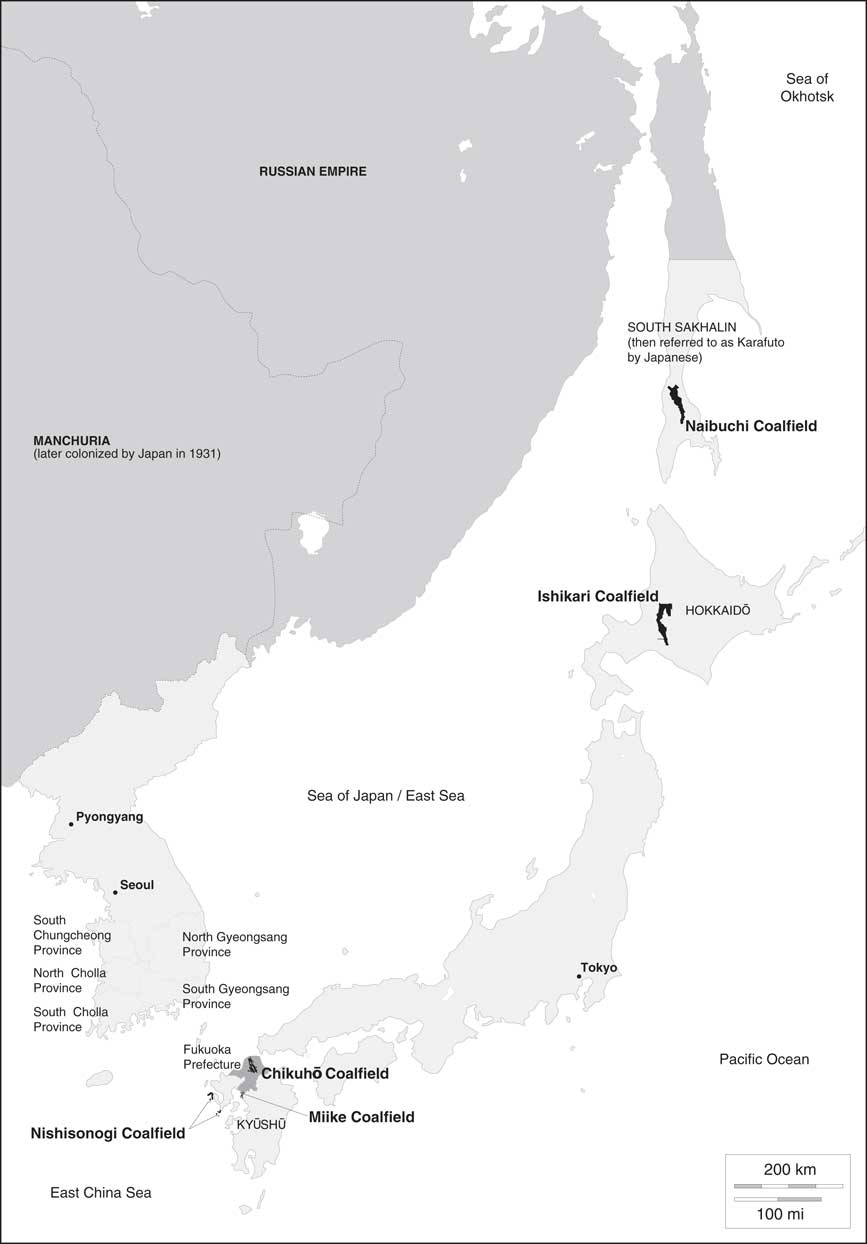
In the first half of the twentieth century, Korean migrants became a vital workforce for coal production in Japan. In the period of Japanese colonization of the Korean peninsula between 1910 and the end of World War II, many Korean peasants lost their lands to a handful of rich landowners. According to Ken Kawashima, a historian of Korean immigration in Japan, they turned into a “colonial surplus population”, i.e. an extensive pool of cheaply available workers created, directly and indirectly, by the Japanese colonization.Footnote 1 These impoverished Korean peasants were recruited as wage labourers to work in different coalmining sites across Japan’s empire, from the Kyūshū and Hokkaidō islands to South Sakhalin, which occupied part of present-day Sakhalin (see Figure 1).
The major coalfields of the Japanese Empire in the 1910s.
While some of the existing scholarship on the history of Japan’s coal production underplays, if not almost completely ignores, the role of Korean workers,Footnote 2 other scholarship emphasizes the ways in which the colonial workforce was mobilized, racially discriminated against, and exploited as a cheap labour force by Japanese mining companies.Footnote 3 While sympathizing with those scholars, the present article will further complicate this narrative by revealing how, since the annexation of the peninsula in 1910, Korean workers were unevenly distributed across different mining companies. The use of Korean workers was thus not a generalized phenomenon.
The varying distribution of Korean workers during the first few decades of colonization is often ignored in existing scholarship.Footnote 4 In the late 1930s, when Japan intensified its war efforts, virtually all major Japanese mining companies began to rely on the colonial workforce as forced labourers to cover wartime labour shortages. Before the late 1930s, however, Korean miners were unevenly distributed across different companies. This article will focus on this earlier period, raising the question of why, if Korean miners were indeed a cheap workforce, not all companies used them to maximize their profits. If, from the perspective of Marxian political economy, capital’s driving force is to “absorb the greatest possible amount of surplus labour”, why did not all companies follow this logic?Footnote 5
In order to explain the problem of uneven distribution, we will focus on two coalmining regions in south-western Japan, the Miike and Chikuhō regions in the Fukuoka prefecture, located on Kyūshū island. Both had been major coalmining regions since the mid-nineteenth century, and stayed so until the last pit at the Miike Mine closed in 1997. The Miike Mine was the largest coalmine in Japan. It was operated by Mitsui Kōzan, which was part of Mitsui Zaibatsu.Footnote 6 In the Chikuhō region, meanwhile, there were several mines of varying size, administrated by different companies. Among them were Mitsui Kōzan as well, next to Mitsubishi Kōgyō, a company owned by Mitsubishi Zaibatsu, and Asō Shōten, a smaller company that had emerged from within Chikuhō itself. In the 1910s and 1920s the mines in this region employed a large pool of Korean miners, alongside Japanese miners, both from within and outside the Fukuoka prefecture. A survey in 1928 indicated that almost 9 per cent of the miners originated from Korea (Table 1). According to this survey, the majority of these Koreans were from the provinces of North and South Cholla and North and South Gyeongsang, where according to Kawashima “peasant immiseration was greatest [during the interwar period]”.Footnote 7
Places of origin of miners in the Chikuhō coalfield in 1928.
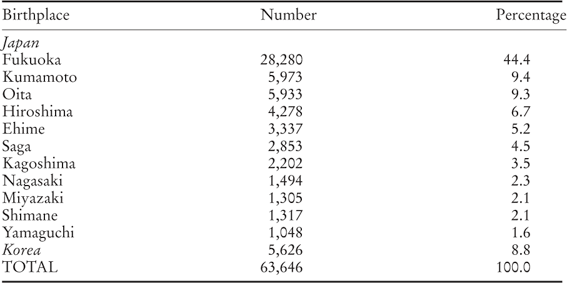
Source: Fukuoka Chihō Shokugyō Shōkai Jimukyoku [Fukuoka Employment Bureau], Chikuhō Tankō Rōdōsha Shusshinchi Shirabe [Survey of Home Prefectures/Country of Chikuhō Miners] (Fukuoka, 1928), p. 6.
While many companies in Chikuhō, such as Mitsubishi Kōgyō and Asō Shōten, employed a large number of Korean workers as early as the late 1910s, during World War I, Mitsui Kōzan did not rely on them at Miike in the 1910s and 1920s, nor at their mines in Chikuhō. This article argues that the uneven recruitment of Korean workers was a consequence of uneven capital accumulation among those companies, and was related to the availability of workforces and the wage level at their mines.
This research first examines what preconditions prevailed at Miike and Chikuhō when the aforementioned companies began developing their respective mines in the late nineteenth century. Varying geographies, production processes, and workforces caused different historical trajectories. In the following section we will show that the labour force employed by Mitsui Kōzan at the Miike Mine consisted of immediately available, cheap, and disposable Japanese miners: convict workers, and later also female pit workers, who were deployed when the use of prisoners had become restricted. We will then demonstrate how profits made at the Miike Mine at the expense of these cheap workers financially fuelled Mitsui’s other mines in the Chikuhō region, offering the company the possibility of paying the employees at those mines relatively high wages. As wages were a decisive factor in recruiting as well as in retaining miners, Mitsui Kōzan was able to keep enough Japanese miners in Chikuhō under the company’s rather discriminatory guiding precept of Seihyō-Shugi (which might be translated as “elite troop-ism”).
Conditions at the Mitsubishi Kōgyō and Asō Shōten mines in Chikuhō around the time of Japan’s annexation of Korea in 1910 differed from those at the Mitsui Kōzan mines. Compared to Mitsui Kōzan, wages at their mines were lower, which also implies that these two companies must have been less successful in securing a stable workforce of Japanese miners. We suppose that, because of the lack of a stable Japanese workforce, the two companies turned to the vast pool of the Korean colonial surplus population, produced by Japan’s colonialism, as an immediately available labour supply. In a peculiar way, the Korean workers conjured up the role that the convict and other, non-convict miners had played for Mitsui Kōzan at Miike a few decades earlier. Productivity and the use of labour differed in these companies and mining sites, depending on their own preconditions and corresponding capital accumulation. This is the history of economic unevenness at work within Japan’s capitalism during the interwar period, seen through the lens of immediately available, cheap, and disposable workforces.
PRECONDITIONS AT MIIKE AND CHIKUHŌ
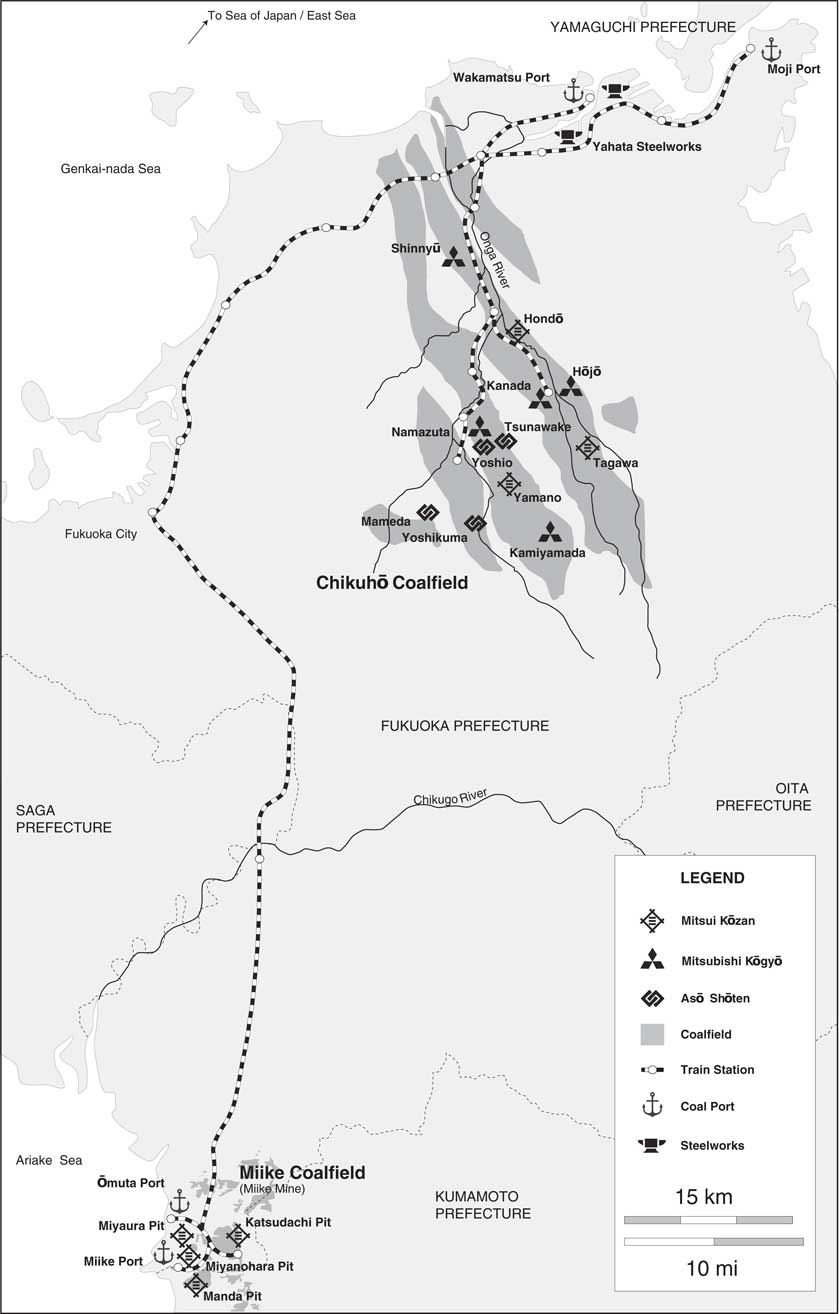
Located relatively close to each other in the Fukuoka prefecture, Miike and Chikuhō were two of Japan’s major coalmining regions (see Figure 2). The history of coal production at both locales predated the Meiji Restoration, which replaced the Tokugawa shōgunate with the imperial state in 1868. Administered by local clans during the Tokugawa era (1603–1868), coal production at that time was still insignificant in both regions, relying on manual labour with insufficient machinery. For Miike and Chikuhō to become prominent for what they are known for in Japan − the production of coal − both regions needed to wait for large capital, machineries, and infrastructures to be introduced.
Mines and pits in the Miike and Chikuhō coalfields administrated by Mitsui Kōzan, Mitsubishi Kōgyō, and Asō Shōten.
At Miike in 1873 the new Meiji state intervened in the mine to extract coal for export. The quality of the bituminous coal from the Miike Mine was high. Also, as the mine was located by the Ariake Sea at the border of the present Fukuoka and Kumamoto prefectures, it was relatively easy to transport coal to the nearby Ōmuta port. Thanks to this location and the high quality of coal, the amount of coal exported from Miike increased from 409 tons in 1877 to 217,302 tons in 1888.Footnote 8 Coal from the mine was sent to foreign trading ports, such as Hong Kong and Shanghai, by the Mitsui Bussan trading company, another key company owned by Mitsui Zaibatsu and which had been in charge of exports since the mid-1870s. As exports grew, the total output of coal further increased. Concomitantly, large amounts of capital were invested to mechanize the mining process, introducing, for instance, the steam-generated water pump. Financed and administrated by the state, the Miike Mine had the most advanced mechanical production process and by the late 1880s it yielded the largest tonnage of coal of all Japan’s mines.
In 1888, with the profits gained through the trading business of Mitsui Bussan, Mitsui Zaibatsu won the bid over Mitsubishi Zaibatsu and purchased the Miike Mine from the state, taking over the operation fully the following year. After the takeover, Mitsui formally established the Mitsui Kōzan mining company in 1892. Since Mitsui Kōzan inherited all the existing infrastructure and workforce from the state, the company was able to jumpstart its operation. Included in the workforce were convict workers, as shown in the following section. The company further invested in new machinery (including the mechanical winch), the opening of new pits, and the construction of the Miike port in 1908. As a result of these investments, the Miike Mine continued to be Japan’s main coal-producing mine in terms of output.
In the Chikuhō region, although located at a relatively short distance from Miike, the state was much less involved in the operation of mines after the Meiji Restoration in 1868. Mines previously owned by local clans during the Edo period became available for local merchants, allowing for the advent of endogenous mining companies. Without sufficient private capital of their own, these companies continued to rely on the primitive means of production carried over from the previous era. Their operations were far less industrialized than those of the state-owned Miike Mine. Devoid of large investments by the state, it took a longer time to develop the Chikuhō mines and to accumulate large capital.
The major obstacles in the region were the small size designated by the state to each mining concession and the large distance to the nearest port. The small concessions did not allow for a greater production of coal, and the transportation of coal to the port through the Onga river and its tributaries took a long time and thus was costly. These spatial and geographical circumstances were not attractive enough for the large companies to consider investing. These impediments began to dissolve only when the Sentei Kōku Sei [Coalmine District Reformation] was enacted by the state in 1888 to enlarge the minimum mining concession, and railway lines were constructed to connect the mines to the Moji port and Wakamatsu port, which were built around 1890.
A few months after the enactment of the Sentei Kōku Sei, Mitsubishi Zaibatsu bought the Shinnyū Mine and Namazuta Mine, followed by the Kamiyamada Mine and Hōjō Mine in 1895. A few years later, Mitsui Kōzan also advanced into the region, purchasing the Yamano Mine in 1896 and the Tagawa Mine in 1900.Footnote 9 Also, a handful of local companies, wealthy enough to increase their coal production, further expanded their operations. Asō Shōten was one of those endogenous companies, whose advent further industrialized the region. By 1895, Chikuhō, together with Miike, was producing almost one-half of all coal extracted in Japan, fuelling the furnaces, for example, of the Yahata Steelworks (inaugurated near Chikuhō in present-day Kitakyūshū city in 1901).
Still, Chikuhō’s growth was uneven. The larger companies, such as Mitsui Kōzan, were able to increase coal production quickly, while other companies with less capital had a different pace as well as size of production. Diverse conditions at the start of the industrialization of the mines allowed for the coexistence of multiple companies, big and small, jostling each other in the region. This economic unevenness among different companies in the region continued throughout the interwar period.
Along with geography and production, another major difference between the Miike and Chikuhō mines was the availability of labour. The mining process in both areas continued to rely heavily on human labour, regardless of the extent of mechanization at each mine. Procuring a guaranteed workforce in Chikuhō continued to trouble all companies, even during the interwar period when labourers seemed most readily available. The proximity of the mines in the region made it easy for the miners to leave one mine for another, and thus the retention of miners was a serious issue for the companies. In contrast, Mitsui Kōzan was able to overcome the difficulty of maintaining a stable workforce, at least at Miike, by employing convict workers, provided by the state. This enabled the company to accumulate more capital earlier and quicker than the other companies in Chikuhō. In addition, Mitsui Kōzan was virtually the only employer in Miike. Surrounded by farmlands with a surplus agrarian population, the mine was able to monopolize the supply of labour.
CHEAP AND DISPOSABLE LABOUR AT MIIKE
When the state began administrating the Miike Mine in 1873, the majority of the workforce consisted of peasants who had been mining coal during the off-season of their farm work. In order to increase coal production further, the state needed a more stable workforce and to that end it turned to prisoners.
As soon as the state began operations in 1873, fifty prisoners were taken to the mine to transport coal to the nearby port. As far as the mining process was concerned, although the state introduced machinery into some of the major pits, the hauling and hewing of coal continued to rely on manual labour. Also, the underground water needed to be pumped out manually from the pits, as the steam-generated water pump was not widely available at that time. These jobs were not attractive, especially with the high temperature and humidity underground, making it even more difficult for the state-owned mine to find enough new miners. Hence, utilizing its juridical and prison apparatus, the state disciplined more prisoners to work in the mines to keep production going under these harsh conditions. Accordingly, the number of convict workers increased further in the following years.
Both the availability and the low cost of convict workers at the Miike Mine were crucial preconditions for Mitsui to continue mining after the takeover from the state. When the company purchased the mine in 1888, it made sure it applied for permission to use convict workers. Although there are no exact figures, the wages for convict workers were roughly half those of non-convict miners.Footnote 10 Based upon the low cost of the convict workers, Mitsui Kōzan was able to increase its profits. At its peak during the 1890s, convict workers constituted almost 70 per cent of the pit workforce. In this period, the company opened more pits and production at the mine drastically increased.
Every time a new pit was opened, and a new workforce was urgently needed, convict workers were relocated from the previous pit to work there for several years, until the company introduced new machinery, opened another pit, or hired non-convict workers. By using immediately available and cheap convict labour, Mitsui Kōzan was able to increase production further as well as to expand its capital. Simultaneously, convict workers were mobilized as a highly disposable workforce.
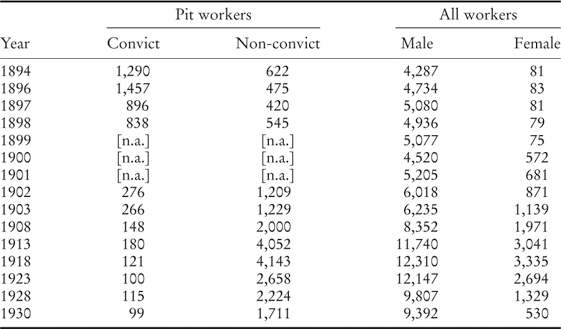
Two factors rendered convict workers no longer the “best option” at the Miike Mine. One was prison reform, the other was mechanization. In 1899 the state enacted the Prison Law (Kangoku Hō). As this law restricted the use of convict workers to a maximum of 400, Mitsui Kōzan needed to discharge many of them. This change of policy also reflected the impact of growing public criticism of the use of prisoners as forced labour.Footnote Footnote 12 Nevertheless, as the company continued to use convict workers until 1930, albeit in smaller numbers (see Table 2), the juridical or ethical motives were not the only explanation for discharging convict workers. The introduction of machinery was equally crucial. The installation of a huge steam-generated water pump in the early 1890s was a decisive moment for the industrialization of the Miike Mine. Clearing the underground water no longer required human labour, making the convict workers partially dispensable.Footnote 13 At the same time, the convict workers were still needed for hewing and hauling, which continued to rely on manual labour. However, they were not considered ideal by the company. This was the occasion when Mitsui turned fully to non-convict workers, first female then male miners.
Number of workers at the Miike Mine, 1894−1930.
Source: Mitsui Kōzan, Gojūnen-shi Kō, 10hen, Rōmu [Draft of 50-Year History of Mitsui Kōzan, X, Labour Management] (Tokyo, 1943).Footnote 11
As shown in Table 2, the number of convict workers drastically decreased from 1898 to 1902, largely due to the Prison Law. In stark contrast, while there were only 75 female workers in 1899 when the law was enforced, the number skyrocketed to 572 in the following year. Those women workers, who likely came from peasant households nearby, were paid less than their male counterparts, and in this respect they shared features with the convict workers. When in 1901 the remaining convict workers at the Katsudachi pit were relocated to the Miyanohara pit, the company soon lifted a ban on using female workers in the Katsudachi pit.Footnote 14 These female workers were obviously brought into the production process to compensate for the dwindling number of convict workers upon the passage of the reform law.
Female workers represented more than the mere replacement of the convict workers, however. Along with the water pump, the mechanical winch was introduced during the mid-1890s. It automated the transportation of coal from the main shaft inside the pit to the surface. As this task had presumably been handled by the convict workers before, the machine replaced some of their labours. On the other hand, the installation further intensified the use of manual labour in the underground pit to keep pace with the machine. In this way, the mechanization of transport created more jobs for the coal haulers, who transported coal from the coalface to the main shaft manually. As this work required less skill and probably less strength compared with the work of the coal hewer, Mitsui Kōzan turned to female workers for the hauling jobs. By assigning these jobs to women, the company was able to optimize the production process.Footnote 15
Furthermore, the company had another motive for incorporating female miners. To increase production and the return on the investment in new machinery, the company needed to hire more male hewers. To secure a stable workforce of male miners, the company strategically hired their wives as haulers. Especially in “room and pillar” mining – still the predominant method around 1900 – pairs of married couples were assigned to respective “rooms”, where a husband worked as a hewer and his wife as a hauler. Together they formed a “family-style employment structure based upon a dual-income household”.Footnote 16 The increase in the number of female workers in 1900 marked Mitsui Kōzan’s initial move toward this structural change – that is, the expansion of its workforce by discharging convict workers.
Table 2 shows that, while there were around 1,457 convict pit workers (hewers and haulers) at the peak of their employment in 1896, their number decreased quickly in the following years. In contrast, although the number of male workers, surface and underground combined, at Miike decreased from 5,077 in 1899 to 4,520 in 1900, perhaps because of the Prison Law, thereafter it increased again to 5,205 in 1901. Notably, the number of non-convict pit workers reached 2,000 by 1908 and continued to increase in the following years. Within a few years of the Prison Law, the non-convict miners, male and female together, exceeded the number of convict miners at the peak of 1896. This trend suggests that, even without the Prison Law, the supply of convict workers alone would not have been enough to increase production at the mine.
For example, had Mitsui Kōzan continued to use convict workers in its newly opened Manda pit in 1903, one of the largest pits at the Miike Mine, the company would have needed to bring more prisoners from elsewhere, which would have cost more since it would have entailed, for example, constructing new corresponding facilities. Therefore, with or without the Prison Law, it is highly probable that the reliance on prisoners became an obstacle to the prospective growth of the mine. Although the wages of the prisoners were lower than those of the non-convict miners, the need for enhanced capital accumulation rendered convict workers “unattractive” in the long run: there were extra costs attached to them and they were considered less productive than non-convict labourers. Sooner or later, the company would have required non-convict workers.
The simultaneous use of convict and non-convict miners must have caused problems too. Their presence in a pit perhaps made it more difficult for the company to secure a stable labour force, for it is not hard to imagine that toiling side by side with prisoners in the same pit was not appealing to others. This explains why, after 1901, all convict workers were relocated to the Miyanohara pit, which was destined to be closed.Footnote 17 As the company had calculated that the Miyaura pit and the Manda pit were more productive, non-convict workers were assigned to these pits. In a way, the Prison Law conveniently shrank the pool of convict workers and made it easier for the company to insulate them from the others. Doing so enabled Mitsui Kōzan to recruit more non-convict hewers, while using the labour of the prisoners at the waning pit until the end (the Miyanohara pit closed in 1931).
At the same time, there is no doubt that Mitsui Kōzan had gained tremendous profits from the forced labour of the convict workers. By the early 1910s, the Miike Mine became the cashbox for the company. It yielded approximately 2,000,000 tons of coal by 1912, the largest volume of any of Japan’s mines. This abundant production and capital accumulation at the Miike Mine greatly helped the subsequent operation of their mines in Chikuhō.Footnote 18 Thanks to the convict workers in Miike, the company became wealthy enough to hire non-convict workers and managed to increase production at its mines. Furthermore, the convict wages functioned as a benchmark for the company, leading it to lower the cap on wages for the subsequent non-convict Japanese miners.Footnote 19 In a way, the convict workers defined the labour conditions of those who followed.
WAGES
Having discharged the majority of the convict workers, since the dawn of the twentieth century Mitsui Kōzan began hiring former peasants from the vicinity of the Miike Mine. “With regard to the employment of miners”, wrote an office manager of the company, “one of the difficult parts is their wage.”Footnote 20 The manager reasoned that the company should not hire “experienced” persons since they “try to leave the mine”. Instead, it had to look for “unsophisticated” peasants, for they tended to stay longer and “the company does not have to raise the wage [to attract them]”.Footnote 21 From these passages, we can surmise how important it was for the company to secure a stable workforce and how the wage was the crucial factor for both the miners and the company.
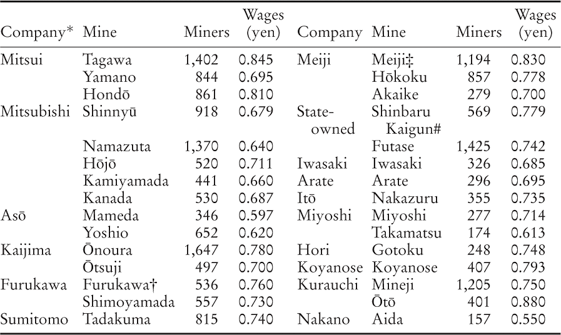
Interestingly, the officer wrote in the same report that, “as persons often come from Chikuhō to steal miners [from the Miike Mine], the company should always tighten security”.Footnote 22 This remark suggests that the mines in Chikuhō (at least those not pertaining to Mitsui Kōzan) had more difficulty in retaining enough miners. As wages were the crucial factor for both the employment and retention of miners, in this section we will briefly look at the wages of miners at the different mines in the Chikuhō region in the early 1910s. As will be shown later, the varying wage scales across the companies reflected their respective employment strategies toward Korean miners later on.
Table 3 presents the average daily wages for male miners at Chikuhō mines in 1912, two years after the annexation of the Korean peninsula. The table makes clear that wages fluctuated from one company to another. The highest wages were paid in the three mines of Mitsui Kōzan, averaging 0.78 yen. Mitsubishi Kōgyō and Asō Shōten (or their predecessors) paid the lowest wages, averaging 0.68 yen and 0.61 yen respectively.Footnote 23
Wages for male pit workers paid at different Chikuhō mines in 1912.
* Regarding the ownership of each mine, we relied on the information for 1913. Hence, some mines might have been owned by different companies in 1912.
† The figures are for three Furukawa-owned mines: Shiogashira, Shakanō, and Katsuno.
‡ The figures include the numbers of and wages for pit timberers and haulers.
# The mine was located in the present-day Kasuya district, west of the Chikuhō region.
Source: Chikuhō Sekitan Kōgyō-shi Nenpyō Hensan Iinkai [Committee for the Compilation of a Historical Chronology of the Chikuhō Coal Industry] (ed.), Chikuhō Sekitan Kōgyō-shi Nenpyō [Historical Chronology of the Chikuhō Coal Industry] (Fukuoka, 1973), p. 255.
As it is not likely that the higher wages paid by Mitsui Kōzan were a consequence of longer working hours, they do suggest that there were differences in productivity between Mitsui Kōzan and other companies. Whatever the reasons for the varying productivity, our contention is that the corresponding higher wages at the Mitsui Kōzan mines in Chikuhō would have been impossible without the profits at the Miike Mine. Without the state-funded start of production and the labour of convict workers at Miike, Mitsui Kōzan would have been unable even to purchase those mines in Chikuhō in the first place. Thanks to the preconditions at and the continual prosperity of the Miike Mine, the mines operated by Mitsui Kōzan in Chikuhō had access to enough capital possibly to invest in better machinery and to spend on the wages of their workers.Footnote 24 Accordingly, as we will demonstrate below, the company was able constantly to increase the number of Japanese miners and production throughout the rest of the 1910s.
Judging from the wages paid in 1912 at the Mitsubishi Kōgyō and Asō Shōten mines in Chikuhō, these were not as economically prosperous as the Mitsui Kōzan mines. This might have been due to the geological conditions of the mines, the scarcity of capital, or all of those factors combined. Without the preconditions of Miike and subsequent capital accumulation, both companies inevitably had to build their respective production lines from what they had available, for which Korean miners became an indispensable workforce.
UNEVEN DISTRIBUTION OF KOREAN MINERS
Table 4 shows the distribution of Korean miners across the larger mines in Miike and Chikuhō in the late 1920s. As becomes clear from the table, Mitsubishi Kōgyō and Asō Shōten relied on heavily colonial labour, while the Miike Mine employed only 7 Koreans, a negligible number considering that there were over 11,000 workers at this mine (surface and underground combined). Although the table does not include the figures for the Mitsui Kōzan mines in Chikuhō (Tagawa and Yamano), it is likely that the percentages of Koreans there were equally negligible.
Korean miners in some major mines in Miike and Chikuhō, March 1928.
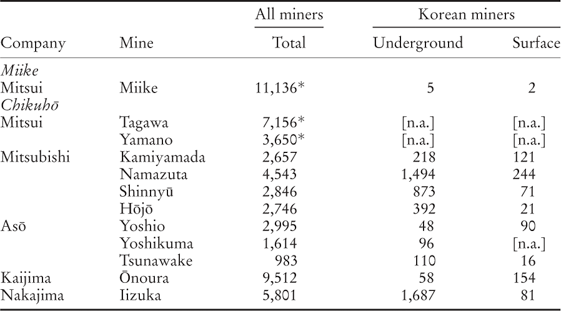
* These figures refer to the number of workers at the respective mines for the whole of 1928, while all other figures indicate the numbers during March of the same year.
Sources: Fukuoka Chihō Shokugyō Shōkai Jimukyoku [Fukuoka Employment Bureau], Kanai Zaijū Chōsenjin Rōdō Jijō [Working Conditions of Korean Workers in Fukuoka] (Fukuoka, 1930), pp. 83−89, available at the Digital Library from the Meiji Era, http://kindai.ndl.go.jp/, last accessed 15 June 2015; Yutaka Nishinarita, “Sekitan Kōgyō no Gijutsu Kakushin to Joshi Rōdō” [Technological Development and Female Labour in the Coal Industry], in Nakamura Masanori (ed.), Gijutsu Kakushin to Joshi Rōdō [Technological Development and Female Labour] (Tokyo, 1985), pp. 71−105; Mitsui Kōzan, Gojūnen-shi Kō.
The virtual absence of Korean miners at the Mitsui Kōzan mines was the consequence of the company’s guiding precept, Seihyō-Shugi. In an overview of its fifty-year history, Mitsui Kōzan itself defined the ideal labourer − Seihyō (elite troop) − as somebody with a “trustworthy personality, sound thought, and strong body”.Footnote 25 Korean miners apparently did not fit this criterion. According to the company’s own historical overview, Mitsui Kōzan first recruited 102 Korean miners in 1917 at its Kawakami Mine in South Sakhalin, then part of Japan’s colonial empire along with the Korean peninsula (see Figure 1). This resulted in a series of conflicts, including a massive brawl with Japanese miners. Adding to the worries of the company were the language barrier and the apparently high illiteracy rate among Koreans, which in its view hampered the Koreans’ “working efficiency”. Following these experiences and the principle of Seihyō-Shugi, Mitsui Kōzan thus decided not to employ colonial workers any more (a policy that, in any case, was altered in the late 1930s when the Japanese war effort intensified).Footnote 26
Obviously, Seihyō-Shugi was a racially ethnically discriminative precept, deeming all Korean miners “unproductive”. Leaving its discriminatory aspect aside, however, what made Seihyō-Shugi possible in the first place? What deserves attention here are both the preconditions and the effects of this policy. Mitsui Kōzan fully understood that the Korean workers could have become an immediately available and cheap workforce, as their recruitment fee was also lower. Moreover, in the company’s view, they adapted more easily to bad working conditions compared with Japanese miners.Footnote 27 Still, the company considered relying on Japanese miners, “unsophisticated peasants”, or skilled coal hewers a better employment strategy, although this was more expensive. It is clear that this policy of ethnic homogenization of the workforce and its benefits were made possible by the company’s preconditions at Miike and resulting capital accumulation, enough to recruit “elite troops”.
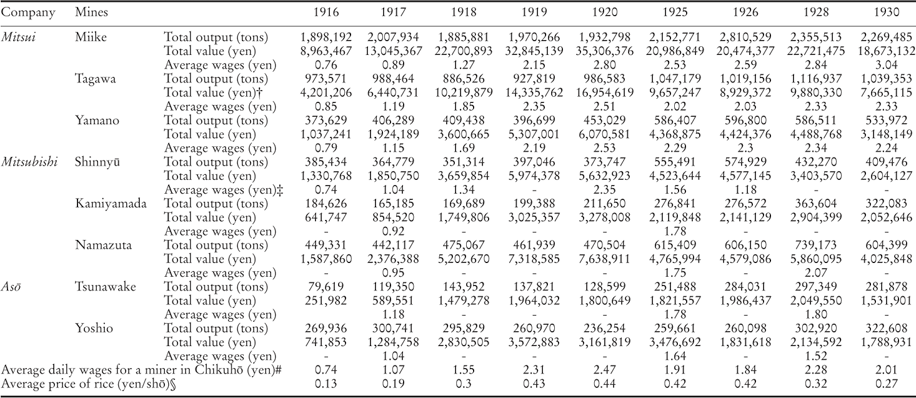
In order to measure the capital accumulation and corresponding productivity, the Mitsui Yamano Mine and some Mitsubishi mines in Chikuhō will provide a useful contrast here. As already indicated in Table 3, the Yamano Mine was the least productive among the Mitsui Kōzan mines in Chikuhō in 1912. Still, Table 5 shows that the Yamano Mine managed to increase its coal output from 373,629 tons in 1916 to 453,029 tons in 1920 in response to the swelling demand for coal due to World War I. During the same period, as evident from the same table, the output from the Namazuta Mine, one of the most mechanized Mitsubishi Kōgyō mines in the late 1910s, increased only from 449,331 tons to 470,504 tons. Therefore, despite the low productivity earlier in the decade, the Yamano Mine was able to catch up quickly with one of Mitsubishi’s most industrialized mines by 1920.
Productions, value, and wages at mines of Mitsui, Mitsubishi, and Asō.Footnote *
* All wages, values, and prices are nominal. Unless otherwise noted, the average wages indicate the daily average wages among both coal hewers/haulers and male/female miners.
† The figure for 1920 is the total sales price for the amount of coal (1,002,366 tons) sold at market.
‡ The average for 1925 was for the whole mine, while the remaining averages were the wages at the mine’s Pit No.1. The figure for 1926 was calculated in the following way: the average monthly wage for male miners (23.62 yen)/the estimated average number of working days in a month (20 days)=1.18 yen.
# The figure for 1926 was taken from Chikuhō Tankō Rōdō Jijō. For the remaining years, we follow the hypothesis put forward by Ogino (1993): Ogino considers the average wages at the Ōnoura Mine’s Sugamuta Pit, which was owned by Kaijima & Co, to be the average wages for a miner in Chikuhō. For the figures for 1925, 1928, and 1930 we took the average wage for the whole Ōnoura Mine. For 1928 we added the highest wage and the lowest wage for male and female miners, and divided the figure by four.
§ Again following Ogino, these figures are the average price of rice at Moji in Fukuoka, taken from Fukuoka-ken Tōkeisho [Statistical Report for Fukuoka]. We calculated the average price of rice (yen/shō) as follows: the average price of rice (yen/koku) /100 (shō/koku). Miners are believed to have consumed up to 1 shō (c.1.6 kg) of rice a day.
Sources: Shōkōshō Kōzankyoku [The Mining Division of the Ministry of Commerce and Industry], Honpō Kōgyō no Sūsei [Current State of the Mining Industry in Japan], available at http://www.meti.go.jp/statistics/tyo/honpouko/tokei.html, last accessed 15 June 2015; Nōshōmushō Kōzankyoku/Shōkōshō Kōzankyoku [The Mining Division of the Ministry of Agriculture and Commerce/Commerce and Industry], Honpō Jūyō Kōzan Gairan [List of Important Mines in Japan], available at the Digital Library from the Meiji Era, http://kindai.ndl.go.jp/, last accessed 24 July 2015; Yoshihiro Ogino, Chikuhō Tankō Rōshi Kankei-shi [The History of Industrial Relations in the Chikuhō Coalmine] (Fukuoka, 1993), ch. 2; Mitsui Kōzan, Gojūnen-shi Kō, and idem, Mitsui Tagawa Kōgyōsho Enkaku-shi [History of the Tagawa Mine] (Tokyo, 1943); Ōsaka Chihō Shokugyō Shōkaijo Jimukyoku [Osaka Employment Bureau], Chikuhō Tankō Rōdō Jijō [Working Conditions in the Chikuhō Coalmine] (Osaka, 1926), available at the Digital Library from the Meiji Era, http://kindai.ndl.go.jp/, last accessed 15 June 2015; Fukuoka-ken Tōkei-sho [Statistical Report for Fukuoka], available at the Fukuoka Data Web, http://www.pref.fukuoka.lg.jp/dataweb/nenkan-pdf.html#M14, last accessed 24 July 2015; Nobuo Ayukawa, “Senkanki no Chikuhō Shotankō niokeru Kōfu Tōkatsu – Nayaseido kara Chokkatsuseido e” [The Management of Coalminers in Chikuhō during the Interwar Period – From the Naya System to Direct Employment System]”, in Chōsa to Kenkyū: Keizaironsō Bessatsu [Survey and Research: Economic Theory Collection Special Issue] (1997), XII, pp. 10−26.
As the Yamano Mine then still heavily relied on manual labour, this growth in production must have involved securing more underground pit workers.Footnote 28 Wage thereby becomes the indicator of how successful their recruitment was. As Table 5 shows, while the price of rice – a metonym for the miners’ standard of living – was rising, the Yamano Mine increased wages for their miners during the period: from 0.79 yen in 1916 to 2.53 yen in 1920, consistently higher than the average wage in Chikuhō. Accordingly, the total number of workers also increased, from 3,410 in 1917, to 4,423 in 1919 and 4,750 in 1920.Footnote 29 This makes a good contrast with the Mitsubishi Kōgyō Shinnyū Mine. Although by the mid-1910s the Shinnyū Mine offered the highest wages among the Mitsubishi mines in Chikuhō, the average wage remained lower than that paid by the Yamano Mine. Moreover, while the difference in wages between the two mines was not large in 1916, it became more pronounced in the period leading up to 1920. These comparisons seem to indicate that the expansion of production as well as the recruitment and retention of an ethnically homogeneous labour force at the Mitsui Kōzan mines was perhaps realized more smoothly through higher wages.
Although we do not have much data on the wages of workers at Mitsubishi Kōgyō, this comparison with Mitsui Kōzan at least allows a glimpse of their productivity and employment conditions. Judging from their wages (Table 5), we can surmise that the company must have been less successful in securing labour throughout the 1910s, especially compared with Mitsui Kōzan. The labour shortage must have been a serious issue, especially when demand for coal began to soar in 1916. It is thus not surprising that the company began recruiting Korean workers on a large scale precisely during this period.
At the end of June 1917 the Mitsubishi Kōgyō Kamiyamada Mine recruited just over 200 Korean miners to supplement the existing workforce. According to a government survey at the time, there were 1,825 miners, underground and surface included, working at the mine in 1917.Footnote 30 In previous years, the mine had apparently been running at an economic loss, which explains why the average wage for a pit worker was one of the lowest among the Mitsubishi mines.Footnote 31 In fact, while the value of total output from the Kamiyamada Mine was increasing, due to rising coal prices, the actual output of coal declined, from 184,626 tons in 1916 to 165,185 tons in 1917 (see Table 5). This indicates that the mine had insufficient capital to offer higher wages, and accordingly that there were not enough miners to sustain production. The Korean workers seem to have come in the midst of this crisis and, notably, the mine’s output began to recover in the following years, rising from 169,689 tons in 1918 to 211,650 tons in 1920. Although the deployment of Koreans was probably not the only reason, their labour, however transitory, must have served in the recovery, as a “colonial gift”.
In fact, in September 1917, the Kamiyamada Mine was indicted by a court for imposing a sanction on twenty-five “abductors”, who had kidnapped [mostly] Korean miners from them.Footnote 32 The incident indirectly reveals how desperately the mine needed these migrant workers and how jealously the company tried to retain them. Subsequently, at the beginning of the following year, Mitsubishi Kōgyō applied for permission to recruit more Korean workers for the Namazuta Mine and Shinnyū Mine from the South Gyeongsang province as well as from the South Chungcheong province in Korea (see Figure 1). The Korean workers were recruited to keep the mine’s production in pace with the increasing demand for coal − quite similar to how convict workers had been mobilized to assist the mechanization process at the Miike Mine a few decades earlier. Table 5 further shows that, even after 1920, wages at the Mitsubishi Kōgyō mines, especially those like the Shinnyū Mine which depended heavily on Korean workers, remained low. In other words, Mitsubishi Kōgyō must have been less successful than Mitsui Kōzan in securing its workforce during this period.
As far as Asō Shōten is concerned, we do not have enough documentation to demonstrate when and under what circumstances Asō Shōten began recruiting Korean labourers to their respective mines.Footnote 33 Although the company was historically notorious for uncompromisingly low wages – it was often referred to as the “despotic mine” (assei no yama) – Table 5 surprisingly shows that the wages in its Yoshio Mine and Tsunawake Mine were not drastically lower than those at the mines owned by Mitsui Kōzan in the late 1910s.Footnote 34 However, neither coal output nor the corresponding value of the coal produced at the two mines increased as much as they did at Mitsui or Mitsubishi. Moreover, as indicated in Table 5, average wages at the Asō mines dropped below the average at Chikuhō, almost the lowest among the three companies by the late 1920s, at which point Asō Shōten was already relying on Korean miners. It is highly probable that the company, much more than Mitsubishi Kōgyō, suffered from labour shortages in those years, and that the availability of Korean labour was a matter of life and death for the survival of their mines.
In sum, the colonial surplus population remained a vital source of labour throughout the 1920s at the lower-wage mines of Asō Shōten and the Mitsubishi Kōgyō. The existing scholarship problematizes the way in which these companies took advantage of the “ethnic difference” and exploited Korean miners as a cheap workforce. Yet, as Donald Smith writes, it is hard to track down exact figures for the wages of Korean miners during the interwar period, largely because of the scarcity of archival sources.Footnote 35 What can be said, based on the information available, is that the labour of the colonial miners enabled Asō Shōten and Mitsubishi Kōgyō to manage their mines without drastically increasing wages and helped these companies to keep wages down even for the Japanese miners. In that sense, the Korean immigrant miners played a role similar to that of the convict workers at Mitsui Kōzan in the late 1890s.
CONCLUSION
As the annexation of Korea in 1910 further reconfigured the economic structure of the then agrarian countryside of the Korean peninsula, many impoverished peasants lost their lands. Those peasants became a colonial surplus population in need of jobs to sustain their lives. Just as, a few decades earlier, the legal system had provided Mitsui Kōzan with an allotment of convict workers, colonialism in effect produced a vast pool of immediately available labour with a low recruitment fee.Footnote 36 For companies such as Mitsubishi Kōgyō and Asō Shōten, the Korean surplus population was a colonial gift they could not resist.
In our view, the uneven distribution of the Korean workforce in Chikuhō during the colonial period was related to the “monopolization” of convict workers at Miike a few decades earlier. The unevenness reveals the ways in which companies capitalized on respective preconditions and their effect on employment strategies. Such an analysis could potentially be expanded to include other companies or coalfields in Japan itself, such as Ishikari (Hokkaidō) and Nishisonogi (Nagasaki), but also in Japan’s former colonies (for example, South Sakhalin or Manchuria).
From the late 1920s the companies initiated, under the banner of a “rationalization policy” (gōrika seisaku), a reduction of the workforce and a mechanization of the mining process by introducing, for example, the coal cutter and the conveyor belt. The chronic economic recession of this period urged the companies to carry out this rationalization process. While replacing the labour of underground workers with machinery, in 1930 Mitsui Kōzan decided to impose a “ban” on the use of female pit miners, along with the remaining convict workers. Senior workers, long-time employees, and high-wage earners were also fired. Instead, the company kept only the core workforce (chūken rōdōsha) − “robust healthy [male] workers in their 20s and 30s” − and thus further solidified the principle of Seihyō-Shugi by homogenizing the workers in relation to age and gender.Footnote 37
At the Mitsubishi Kōgyō mines, too, many Korean workers were discharged, beginning in the late 1920s, due to the recession.Footnote 38 Although we cannot investigate here in depth what was at work in these layoffs, through this policy Mitsubishi Kōgyō established its own version of Seihyō-Shugi; it proved how disposable immigrant labour was in the face of socio-economic troubles. Although their wages were most likely the lowest, the company, by discharging them, could save the jobs for Japanese miners – the “elite troops” who were becoming militant during the recession.
Thus, each company had – though in different ways according to the moment, the circumstances, and its own possibilities – ways to secure a reserve of a particular type of workforce; defining them by criminality, gender, ethnicity, nationality, or age and, depending on the amount of their capital accumulation, these companies sought to construct alterity through those distinctions to establish considerable wage differentials. Although the economic benefits of this constellation were important, over time the companies tended to dispose of these “non-elite” groups of workers and to replace them with a more homogenized workforce (male, young, Japanese) – sometimes accompanied by a rhetoric of miners as vanguard workers. Thus, both the evolving logic of capital accumulation and the circumstances (infrastructure, economic situation, state policy, workers’ resistance) saw companies making, at given moments, different valuations and subsequent adjustments in relation to the workforce composition.



