Policy-making in modern democracies is characterized by a division of labour between different policy domains and by increasingly blurred boundaries between the public, private and voluntary sectors. ‘Policy network’ is one of the terms used to label these entities consisting of public and private actors interested in specific policies and taken into account by other actors as resourceful players. Policy network analysis nowadays comes in two versions (cf. Eising Reference Eising2008), as a political science tool to describe ‘certain forms of state guidance’ or ‘negotiating relations between a plurality of state and private organizational actors that reach a collective decision in a common problem area’ (Heritier et al. Reference Heritier, Knill and Mingers1996; see also Mayntz Reference Mayntz and Heritier1993, 39), and as a quantitative sociological branch stressing the relations between actors which are mapped as graphs or digraphs (Laumann and Knoke Reference Laumann and Knoke1987; Heinz et al. Reference Heinz, Laumann, Nelson and Salisbury1993; Pappi et al. Reference Pappi, König and Knoke1995; Knoke et al. Reference Knoke, Pappi, Broadbent and Tsujinaka1996). Dowding (Reference Dowding1995Reference Dowding2001) has criticized both approaches, his examples for the first, descriptive approach covering British studies of policy communities and issue networks (see e.g. Jordan and Richardson Reference Jordan and Richardson1987, or Marsh and Rhodes Reference Marsh and Rhodes1992). These studies use the network concept more as a metaphor, relying on actor characteristics as interests and influence resources as explanatory variables. However, even as a metaphor the network concept can provide interesting insights into complex governance structures (Klijn and Koppenjan Reference Klijn and Koppenjan2000; Marsh and Smith Reference Marsh and Smith2001, Eising Reference Eising2008, see also Dakowska 2009). Dowding has also argued that the formal sociological approach has the potential to explain policy outcomes with network characteristics but has not delivered, up to now, convincing results. Partially in response to Dowding's criticism a number of high quality works using social network analysis to analyze the policy process have recently appeared (Forrest Reference Forrest2003; Howlett Reference Howlett2002, Christopoulos and Quaglia, this special issue; Beyers et al. Reference Beyers, Eising and Maloney2008).
Finally, Dowding has argued that ‘the descriptive approach, bounded by formalized theory, will prove most useful’ (1995, 150). In this context Pappi and Henning (Reference Pappi and Henning1998) suggested a formal theory of policy networks that not only allows a theoretical derivation of non-trivial policy network relations, but also explains how specific network structures influence policy outcomes. According to their theory political influence of interest groups results from political exchange of influence resources valuable to politicians, like support or expert information, with formal political control, where the latter corresponds to legally authorized rights to decide policy. The exchange of influence resources are hypothesized to form crucial links between actors in policy domains whenever the conditions of a perfect market are not given. Networks are supposed to affect policy outcomes insofar as profitable exchanges cannot be realized due to high transaction costs between various pairs of actors. These transaction costs can be measured in the form of access networks. Thus, at the macro level policy networks are informal institutions facilitating political exchange, i.e. collective decision-making, while at the micro level individual actor's network position can be understood as an additional resource increasing an actor's exchange potential and thus increasing its political influence.
Combining Pappi and Henning's political exchange theory with quantitative network analysis also offers advanced network analysis tools, e.g. the network input-output analysis (Henning Reference Henning, Warntjen and Wonka2004) that is a suitable instrument for the analysis and systematic comparison of complex policy networks including in the multi-level governance system of the European Union (EU). In this article we apply Pappi and Henning's policy network theory and advanced quantitative network tools to compare the policy network structures of the EU agricultural policy of the EU-15 and, after the EU enlargements of 2004 and 2007, EU-27. The Common Agricultural Policy (CAP) is a perfect example for studying political decision-making in the EU system. It accounts for almost half of the EU budget. In contrast to the many studies found in the literature applying a qualitative policy network approach, our approach includes an empirical identification of relevant governmental and non-governmental actors and a quantitative measurement and description of their network relations. Moreover, identified network structures are systematically related to the political influence of relevant actors at the micro level and transformed into policy outcomes at the macro level. In this regard our model nicely relates to most recent developments in interest group theory which also emphasize the importance of theoretically grounded and quantitative studies that measure empirically the political influence of interest groups and their impact on policy outcomes (Beyers, Eising and Malony Reference Beyers, Eising and Maloney2008; see also Dür Reference Dür2008).
The EU multilevel system and possible patterns of interest mediation
Following Pappi and Henning (Reference Pappi and Henning1999), we characterize the EU as a multilevel system, that is as a specific type of federal system. Federal systems are characterized by two levels of government, a higher and a lower level government. For the EU, we treat the Council of Ministers of the national government as the lower level intergovernmental part and the Commission and the Parliament as the higher level supranational part of the governance system. A multilevel system as defined here can also be described as a system of authority fusion, since governments responsible for policy-making at one level of government share responsibility with other governments of the same level at a higher, collective level. Such systems offer more options for the access of interest groups than one single level or cooperative federal systems. In the following, the term ‘intergovernmental system’ (nG) is used for the permanent representatives and the national governments as Council members and the term ‘supranational system’ (sG) for the Commission and the political parties of the European Parliament (EP).
To describe systematically the lobbying strategies of both national and supranational interest groups, it is helpful to distinguish strategies according to the following dimensions (see Pappi and Henning Reference Pappi and Henning1999). Firstly, we distinguish lobbying strategies according to the final target of lobbying, i.e. the intergovernmental or supranational system. Secondly, we distinguish direct and indirect lobbying strategies. The latter corresponds to the use of other interests groups as brokers. Accordingly, we can separate national and supranational broker strategies: for the former an interest group uses another national and for the latter it uses another supranational interest group as broker.
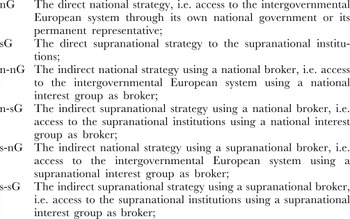
Overall, interest groups can apply six major lobbying strategies in the multilevel system of the EU:
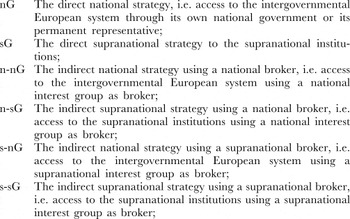
At system level twelve, different lobbying strategies result, as these six strategies can be applied by a national or supranational interest group. Of course, a multilevel system does not make either lobbying strategy superfluous, but the relative weight of the different strategies can be interpreted as indicating the ‘stronger’ authorities for the CAP or the lower transaction costs, as evaluated by relevant interest groups. Priority channels may be different for different resources and from different perspectives, e.g. for national and supranational interest groups. In the political exchange equilibrium, observed resource transfers can be valued by corresponding political power outflows. The higher the valued resource flow in a channel, the higher is the outflow of political power through this channel. Therefore, the complete set of valued resource transfers reflects the network organization of political influence. In this context, we have developed a topology of interest mediation systems based on the structure of policy networks (Henning and Wald Reference Henning and Wald2000).
Based on the classical work of Bentley (Reference Bentley1908), Truman (Reference Truman1951) and Schmitter (Reference Schmitter1974) corporatism and pluralism are defined as two major interest mediation systems based on the number of relevant interest groups.Footnote 1 Of course, for the EU-27 as a multilevel system it is easy to verify that there are many relevant national and supranational interest groups seeking political influence. Due to this multilevel structure, EU lobbying systems generally correspond to pluralistic systems, and corporatism can be excluded (see also Eising Reference Eising2008). However, based on policy network structures Henning and Wald (Reference Henning and Wald2000) defined a more elaborated corporatism/pluralism typology taking two more dimensions into account: (1) segmentation of policy networks and (2) brokerage relations between interest groups.
If policy networks are segmented, i.e. access to the government is biased in favour of a specific type of interest group like farmers, Henning and Wald (Reference Henning and Wald2000) call such a system clientelism or clientelistic pluralism, in contrast to pluralism which is characterized by many interest groups with more or less equal access to the government. Finally, if policy networks include interrelations among different interest groups, one can speak of cooperative rather than competitive lobbying systems. For the CAP, this creates four types of ideal-type lobbying systems: cooperative or competitive pluralism and cooperative or competitive clientelism.
Additionally, for the special case of the EU multilevel system we distinguish a third dimension, the focus of lobbying activities on the lower or higher level of government. Accordingly, if policy network structures are focussed on the intergovernmental or on the supranational system, we define this as a national or supranational lobbying system, e.g. national versus supranational pluralism or national versus supranational clientelism.
A network approach to political exchange and political influence
Following the seminal work of Laumann and Knoke (Reference Laumann and Knoke1987) and Knoke et al. (Reference Knoke, Pappi, Broadbent and Tsujinaka1996) one can understand inter-organizational relations between governmental actors and interest groups as exchange relations of valuable political resources. Following Coleman (Reference Coleman1986), one can model the political exchange of influence resources as a perfect market without transaction costs or a market with transaction costs in which exchange barriers are measured in the form of access networks (Pappi and Henning Reference Pappi and Henning1998). Furthermore, one can describe the political exchange equilibrium applying an economic market equilibrium with transaction costs (Pappi and Henning Reference Pappi and Henning1998) or applying a network approach (Pappi and Henning Reference Pappi and Henning1999). In this article, we apply an extended version of the Pappi-Henning network approach, which explicitly includes broker relations between interest groups.
To simplify the analysis we will compute indices of resource flows, focussing on one influence resource at a time, although the approach applies to a general political exchange equilibrium including multiple influence resources (Pappi und Henning Reference Pappi and Henning1998, Henning Reference Henning2000). We start with the original approach of Pappi and Henning. Designating the original voting power of the political actors i as p v and their relative interest in an influence resource as X i, so that (1-X i) is the relative interest in voting power, Pappi and Henning (Reference Pappi and Henning1999) compute the outcome of the exchange processes as an income of power or control of the actors j as follows:

The original voting power (P v) is given by the consultation procedure, whereas power as income (P j) is the outcome of exchanges on local markets, where information is partly exchanged with voting power. The power outflow from a political actor j depends on its total final power income P j and its interest in an influence resource (X j). Obviously, the final power income pj is then spent for the control of policy decisions, not in total, but only with that share that corresponds to an actor's interest in power, that is (1-X i). Conceptualizing the simultaneous exchanges as a stepwise procedure, t ij tells us which actor i has access to which actor j according to j's report. Notice that [t ij] is the normalized adjacency matrix, so that j's access is measured as relative access, i.e. as a ratio of the number of all js that are mentioned by i as providers of the respective influence resource. Writing the equations 1 in matrix notation results after simple rearrangements:

Thus, total political influence of interest groups without any original voting power results from access to powerful political agents who are highly interested in influence resources, e.g. political expert information. However, only if an interest group ‘i’ has access to a politician ‘j’, i.e. t ij > 0, voting power flows from j to i. Moreover, the lower the number of agents having access to a politician, i.e. the higher the relative access, t ij, the higher is the share of an interest group i in total power outflow of politician j, where the latter is determined by the term t ijX jP j.
In the original conception Pappi and Henning (Reference Pappi and Henning1999) take only direct access among actors into account, where politicians too could provide influence resources to each other. Indirect access of interest groups via brokerage relations has not been taken into account, although empirical transfer networks include a significant proportion of indirect relations among interest groups (Henning Reference Henning, Warntjen and Wonka2004). In particular, a national interest group lacking direct access to a supranational politician, say in the Commission, might use its supranational peak organization or parties of the EP to get access to the supranational level, that is, it is engaged in an indirect exchange relation using its peak organization or the EP groups as broker. If we denote the individual broker share of an actor k by s k the total power flow which runs through a specific actor, as a network node, results from direct and indirect transfer relations:

Thus, total power flow  directed to an actor i results from direct power flows from politicians,
 , and indirect power flows from brokers,
 . Rewriting eq. 3 in matrix form results after rearrangements:

Given total power flow realized by an actor i, the relevant voting power received by this actor i corresponds to his brokerage share, i.e.  . Thus, total political power resulting from original voting power and received direct and indirect power flows from exchange of influence resources:

Substituting eq. (4) into eq. (5) and writing it again in matrix notation results after rearrangements:

Finally, Henning (Reference Henning2000) proved that the broker share of an agent k can be approximately calculated given the transfer network T:

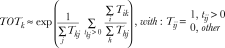

Thus, using eq. (4), eq. (6) and (7) the final power of political actors, that is politicians and interest groups, can be calculated, and one can construct an input-output-table including all direct and indirect power flows among all relevant political actors. Based on this constructed input-output-table we can calculate standard input and output coefficients as the relative share of an input or output transfer among actor i and actor k in total transfers delivered or received by actor i, respectively (for further details see Henning Reference Henning, Warntjen and Wonka2004; Krause Reference Krause2005). In contrast to simple network indices, e.g. density, used in earlier studies like Pappi and Henning (Reference Pappi and Henning1999) which only measure the flow of political influence resources, network input-output tables take into account both the amount of transferred resources and their relative importance (price) measured in political power. Due to broker relations in general equilibrium, resource and power flows result not only between interest groups and politicians (I-P relations), but these also occur between different interest groups (I-I relations) and also between different politicians (P-P relations). For example, power outflows from the groups of the EP can only occur in general political exchange equilibrium when these groups possess political power due to exchange of their own influence resources or the brokerage of other interest groups' resources seeking access to powerful political agents via the EP.
Study design and network data
To apply our network approach empirically we need to specify (1) the complete set of relevant public and private actors, (2) the institutional voting power of governmental actors (p v), (3) the relevant exchange network relation between the complete set of relevant private and public actors (T) and (4) actors' interest in relevant influence resources (X).
This empirical data has been collected for the CAP in the EU-15 and EU-27 in two research projects, the NACAP-project 1994–1997 and the NACAP-East project 2003–2007,Footnote 2 via personal interviews with identified relevant politicians and interest groups, where these organizations are considered as corporate actors (see Lauman and Knoke Reference Laumann and Knoke1987, or Pappi and Henning Reference Pappi and Henning1999). The main research goal of both studies was to model major CAP policy decisions. For the first project this was the MacSharry Reform and for the second this was the Mid-Term Review (MTR) as major changes of agricultural policy in 1992 and 2003, respectively. While the MacSharry reform basically implied a shift from agricultural price policy to coupled transfer payments, the MTR introduced decoupled payments. However, in this article, we focus only on the organization of influence so that we omit substantive discussions and explanations of policies. It suffices it to state that the networks linking interest groups and governmental actors are among the most important determinants of the final outcome in terms of policy decisions. As applied procedures of data collection are in detail described in previous publications (Pappi and Henning Reference Pappi and Henning1999, Henning Reference Henning2000, Henning Reference Henning, Warntjen and Wonka2004 and Krause Reference Krause2005), these will only be briefly described.
Institutional voting power of governmental actors has been calculated applying standard or generalized voting power indices (Schnorpfeil Reference Schnorpfeil1996 or Henning et al. Reference Henning, Struve, Brümmer and Seidel2006),Footnote 3 while actors' interest in relevant influence resources has been asked directly during the interviews (see Pappi and Henning Reference Pappi and Henning1999). More challenging was the identification of the complete set of actors and the collection of transfer network data. According to the consultation procedure relevant governmental actors in the CAP are national members of the Council, i.e. for the CAP these are first of all agricultural ministries as well as the permanent representatives of all EU member states. Moreover, the European Commission is a relevant governmental actor under the consultation procedure. Accordingly, we interviewed seven relevant director generals of the Commission involved in CAP decision-making in the NACAP-East (NACAP) project. Further, we included the relevant groups of the EP in our empirical study as governmental actors. Although the EP has no formal voting power under the consultation procedure, the groups of the EP are informally powerful actors in the CAP, not least because they possess valuable information and access to the Council members and the Commission. Beside governmental actors we interviewed relevant national and supranational interest groups. These included for the EU-15 28 supranational organizations and 29 national organizations of all 15 member states for the NACAP project. For the EU-27 these included 18 supranational organizations and 127 national organizations of all 27 member states for the NACAP-East project. Interest groups have been subdivided into socio-economic categories, i.e. national and supranational farmer organizations (COPA – Comité des organisations professionnelles agricoles, COGECA – Confédération générale de la coopération agricole). Non-farm organizations include national and supranational organizations of agribusiness (agricultural trade and industry) as well as consumer organizations and unions.
To identify all relevant interest groups we applied a two stage procedure. At a first stage we identified in a pre-study a large list of 92 and 281 potentially consequential national and supranational interest groups for the EU-15 and EU-27.Footnote 4 Following our usual procedure, we then asked at a second stage questions about general influence reputation in a policy domain. As a result, we could omit some of the interest groups which were originally on our lists, ending up with 145 and 57 interviews of both national and European interest groups for the NACAP-EAST and NACAP studies respectively. However, the missing organizations are not left out due to a refusal to be interviewed, but as a result of our decision to interview only representatives of organizations that were mentioned as generally influential in the agricultural policy domain.
The network questions were all asked in a form which we have found especially helpful in earlier network studies. The respondents were asked to name organizations with which they have a certain type of relationship. Thus, we created a complete network of relations among all consequential actors in a policy domain. Using the procedure described above we asked the same set of network questions in both studies (for details see Henning Reference Henning2000; Krause Reference Krause2005), making policy network data of both studies perfectly comparable.
The only types of network relation we will discuss in this article are transfer relations for influence resources like expert knowledge, monitoring information, public support and, as a central resource, political power, i.e. control of policy decisions (Pappi and Henning Reference Pappi and Henning1999; Krause Reference Krause2005). The governmental actors are supposed to demand public support and expert information, offering control of policy decisions and monitoring information. The interest groups, on the other hand, are the suppliers of support and expert knowledge which they exchange for control of those policies in which their members are most interested, and for monitoring information.
As an example, we shall study the expert information network, which comprises transfer of expert knowledge among interest groups and governmental institutions. In particular, expert information transfers have been collected from both perspectives, the suppliers, i.e. the interest groups, and on the demand side, governmental institutions. Therefore, we are able to construct confirmed expert knowledge transfers, which from a network theoretic point of view are much more reliable (Pappi et al. Reference Pappi, König and Knoke1995).Footnote 5
Interest mediation in the EU-27: Supranational Pluralism in the West and National Clientelism in the East?
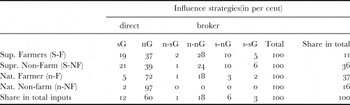
In Table 1 influence strategies applied by national and supranational interest groups in the CAP lobbying system of the EU-27 are presented. Figures have been calculated based on power flows derived from the empirically collected confirmed expert information network of the EU-27 using eqs. (7) and (6). Systematic differences between influence strategies applied by national West and East European interest groups can be identified. While Eastern farmers' organizations only lobby their national government, Western farmers' organizations lobby at both the intergovernmental and supranational levels. For Western farm organizations the direct and indirect supranational strategies account for 21 per cent and 10 per cent of their total output respectively, while for their Eastern counterparts supranational lobbying strategies are practically non-existent with a share of 0.5 per cent (see Table 1). Moreover, Western farm organizations especially use other farm organizations as broker to reach both the supranational system and as other national governments.
Influence strategies in the CAP-lobbying system of the EU-27
Note: Measured as aggregated output coefficients of the confirmed expert information network
Western farm organizations apply a national broker strategy to reach other national governments as well as the EP at the supranational level, with a share of 13.3 and 4.5 per cent for the indirect lobbying strategies n-nG and n-sG respectively. Western farm organizations mainly function for each other as brokers, but to reach new Eastern governments they also use their Eastern counterparts as brokers. Further, Western farm organizations also use supranational brokers, especially their supranational peak organization, COPA, to lobby the supranational system, the Commission. Accordingly, the supranational broker strategy s-sG takes 5.8 per cent of total output of Western farm organizations. Interestingly, the latter also use their supranational peak organization COPA to lobby the intergovernmental system, i.e. other national governments, where this indirect lobbying strategy s-nG accounts for 7 per cent of their total lobbying efforts.
In contrast to Western farm organizations, brokerage plays almost no role for Eastern farm organizations. These organizations only to a limited extent (4.1 per cent of their total output) use their Western counterparts as brokers to lobby Western governments as well as the supranational system. Eastern farm organizations neither use COPA to get access to the supranational system, nor do they use each other as brokers to get access to other East European governments.
The picture seems to be reversed when Western and Eastern non-farm organizations are compared. Here, a clear direct national strategy can be observed for Western non-farm organizations, delivering 100 per cent of their total output to their corresponding national agricultural ministries, while Eastern non-farm organizations deliver 3 per cent of their expert information to the supranational level, using their supranational peak organizations as brokers. Moreover, Eastern European non-farm organizations use each other as well as their corresponding national farm organizations to get access to the intergovernmental system, i.e. Eastern European governments. In relative terms this national broker strategy n-nG accounts for 10.8 per cent of their total lobbying efforts.
Analysing lobbying strategies of supranational interest groups shows that, compared to its Western member organizations, COPA's influence strategies have a quite similar profile. However, in contrast to its Western members COPA applies a national brokerage strategy using its national member organizations as brokers to get access to the intergovernmental system, while other supranational peak organizations are much less used as brokers (see Table 1). In contrast, influence strategies applied by supranational non-farm organizations differ significantly from both national members and COPA. In contrast to the former, supranational non-farm organizations rely much more on brokerage; broker strategies account for roughly 30 per cent of total output, while national non-farm organizations use only 15 (East) or zero (West) per cent of their resources for broker strategies. Supranational non-farm organizations focus their lobbying activities more on the supranational system. COPA and its West European member organizations distribute 70 per cent of their resources to lobby the intergovernmental system, while supranational non-farm organizations use more than half of their resources to lobby the supranational system.
Given that institutional power is roughly distributed by 90 and 10 per cent among the intergovernmental and supranational system (see Schnorpfeil (Reference Schnorpfeil1996) for the EU-15 or Henning et al. (Reference Henning, Struve, Brümmer and Seidel2006) for the EU-25 and EU-27), farm organizations seem to be sufficiently integrated in both systems, while supranational non-farm organizations seem to observe relatively high transaction costs lobbying the intergovernmental system. Moreover, Eastern European interest groups in general as well as Western non-farm interest groups observe high barriers accessing the supranational system in Brussels given for all of these organizations a share of less than 1 per cent directed towards the higher level government.
Analysing overall input structures shows the CAP lobbying system of the EU-27 is clearly biased in favour of farm interests which account for 55 per cent of total expert information output (see last column in Table 1). However, this bias is more attenuated at the supranational level, for national farm and non-farm organizations a market share of 38 per cent and 6 per cent is observed, compared to a total market share of 17 and 38 per cent for supranational farm and non-farm organizations. Comparing the political influence of Western and Eastern interest groups reveals a clear dominance of the West, with a share of 26 per cent in total political influence for the former and a share of only 18 per cent for the latter. However, compared to institutional power distributions in the Council, which is roughly 60 to 40 for the West and East member states, political influence seems in fact to be slightly biased in favour of East European interest groups. Basically, this results from the fact that the political influence of supranational organizations on the intergovernmental system is strongly biased towards Western governments. Thus, at national level Western interest groups face a much stronger competition for political influence vis-à-vis supranational organizations when compared to their Eastern counterparts.
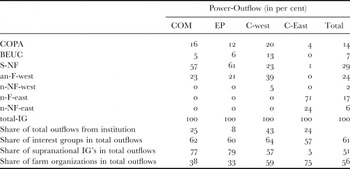
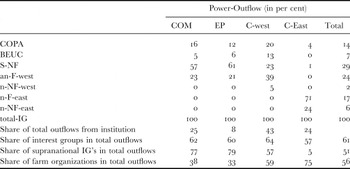
To get a more detailed picture on power outflows from the EU-governmental system, we next analyze the power outflows calculated for different governmental and supranational institutions, i.e. Council Western and Eastern member states, C-West and C-East, respectively, and the Commission and EPFootnote 6. Two thirds of power outflows come from the intergovernmental system, while the power outflow from the Commission and the EP accounts for 25 and 8 per cent respectively. With the intergovernmental system 64 and 36 per cent of total power outflows results from Western and Eastern member states, respectively (Table 2).
Moreover, power outflows differ significantly among both West and East National Council or Minister members as well as among the supranational and the intergovernmental system. Corresponding to national lobbying strategies of Eastern farm organizations, the power outflow of Eastern Council members is concentrated on their national farm organizations, which on average receive 71 per cent of total power outflows of their national governments. The remaining power outflows of East European Council members go to their corresponding national non-farm organizations, while supranational interest organizations have almost no stake in national power outflows from Eastern member states.
In contrast, power outflows of Western Council members are much more balanced. For example, national farm organizations receive only 39 per cent of total power outflows, while a comparable amount goes to supranational non-farm organizations (see Table 2). Note in particular that the supranational consumer organization BEUC (Bureau Européen des Unions de Consommateurs) has significant influence on Western Council members receiving a share of 10 per cent of total power outflow from these institutions. However, the supranational farm organization COPA also receives 20 per cent of total power outflows from Western Council members, while national non-farm organizations receive only the small amount of 5 per cent. Thus, overall for Western Council members a bias of power outflows in favour of farm interests can be observed. Moreover, in contrast to Eastern Council members power outflows of Western Council members are focused on supranational organizations, which receive in total 57 per cent of total power outflows.
Power-Outflow in Policy Networks of the EU-27: Expert information network
Note: Measured as aggregated input coefficients of the confirmed expert information network
Finally, power outflows from the supranational system, i.e. Commission and EP, differ significantly from both Western and Eastern Council members. In particular, power outflows from both the Commission and the EP are focused on supranational organizations with a share of almost four fifths of total power outflows. Although this focus has also been observed for Western Council members, at the supranational level this is significantly higher. The most striking difference to the Western Council members can be seen in the focus on non-farm interests, which, with 62 and 67 per cent, receive the major part of total power outflows of the Commission and the EP respectively, compared to a share of 41 and 25 per cent for Western and for Eastern Council members, respectively. Interestingly, the supranational consumer organization BEUC receives a comparable lower share from the supranational system with 5 and 6 per cent for the Commission and EP, respectively, when compared to its share of 10 per cent for the Western Council members.
A large share of expert information exchange in the EU-27 occurs among politicians, amounting to 39 per cent of total power outflow in the CAP-system. Exchanges within the political sector are a characteristic of multilevel systems that can in general be characterized by a high volume of deal making within the political sector to the detriment of access possibilities of private interest groups (Pappi and Henning Reference Pappi and Henning1999).
If we try to summarize the observed input and output network structures as a lobbying system, we get mixed results, where we have different lobbying structures for the East and the West.
Applying the topology of Henning and Wald (Reference Henning and Wald2000), influence strategies of East European interest organizations clearly correspond to competitive National Clientelism, while given the dominance of supranational organizations as well as the importance of brokerage relations interest mediation in the West the strategy corresponds to a cooperative supranational system. However, depending on how observed political influence structures are interpreted regarding biases in favour of a farm interests, the Western lobbying system could be evaluated as cooperative Supranational Clientelism or Supranational Pluralism. Excluding East European member states total political influence is less focussed on farm interest providing only 45 per cent of total expert information delivered in this system (see Table 1). Moreover, in contrast to Eastern national farm interest groups, Western farm organizations also seek access to national governments of other countries as well as direct access to the supranational system, which also can be interpreted as a form of pluralism as long as different national farm organizations take competing policy positions. Following this line of argumentation the present CAP lobbying system of the West European member states corresponds to Supranational Pluralism. However, if national farm interests are considered as homogenous, observed policy network structures imply that interest mediation in the West corresponds to cooperative supranational Clientelism.
Finally, given the fact that the Eastern enlargement of the EU has just taken place in 2004, the question arises to what extent significantly different policy network structures observed for Eastern and Western interest organizations manifest fundamental differences in applied lobbying strategies or to what extent these differences just result from the fact that new Eastern interest groups are just not fully integrated in the EU multi-level system and will disappear in the medium term, when new members are fully integrated. In this regard it might be helpful to analyze how policy network structures in the West have developed over time.
Comparing policy networks over time: political influence structures in the EU-15 and EU-27
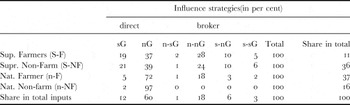
To compare lobbying strategies in the EU-15 and the EU-27 influence strategies applied by national and supranational interest groups in the CAP lobbying system of the EU-15 are presented in Table 3. Analogously to Table 1 reported figures in Table 3 have been calculated based on output coefficients derived from the empirically collected expert information network of the EU-15 (Henning Reference Henning, Warntjen and Wonka2004).
Comparing the importance of single lobbying strategies the dominant strategy in the CAP-lobbying system of the EU-15 is the direct national lobbying strategy (nG) accounting for 60 per cent of total output. Although this strategy remains the most important one also in the EU-27 system, its relative importance drops significantly to only 49 per cent. Correspondingly, the importance of the direct supranational lobbying strategy (sG) increased from 12 per cent in the EU-15 to 24 per cent in the EU-27. Lobbying strategies of national farm organizations have also significantly changed over time. In contrast to the EU-27, in the EU-15 national farm organizations concentrated their political influence activities on their national governments given a share of 72 per cent and 20.6 per cent for corresponding direct and indirect national influence strategies (nG and n-nG, s-nG) for national farm organizations (see Table 3).
Influence strategies in the CAP-lobbying system of the EU-15
Note: Measured as aggregated output coefficients of the confirmed expert information network
However, cooperation among Western farm interest groups was already fully established in the EU-15 and continued in EU-27, where national broker strategies n-nG and n-sG remain of similar importance corresponding to a total output share of roughly 18 per cent for national farm interest groups in both systems (see Tables 1 and 3).
At the micro level the most striking shift of policy network structures can be observed for national non-farm lobby organizations. While deliveries of national non-farm organizations in total account for almost 16 per cent of total system transfers in the EU-15, this is reduced to only 1.5 per cent of total transfers in the EU-27. Interestingly, the shift of political influence away from national non-farm interests seems to contradict the so-called ‘Agrarwende’ implying an increase of relevance of consumer interests in CAP. However, in contrast to the national level an increase of political influence of consumers can be observed at the supranational level. Especially the supranational consumer organization BEUC could extremely enhance its influence on the Western council members (see Tables 2 and 4). Moreover, international environmental interest organization like OXFAM managed to increase their political influence significantly in the EU-27 when compared to EU-15. Nevertheless, in total, i.e. including new Eastern member states, the relative political influence of farm interest increased in the EU-27 when compared to the EU-15 accounting for 48 per cent of total output in the latter and 55 per cent in the former (see Tables 1 and 3). Only in the new Eastern member states non-farm interests exert significant political influence on their national governments accounting for roughly 5 per cent. However, a more detailed analysis reveals that most influential Eastern non-farm groups in fact are organizations of food industry and agricultural trade which at least in East European member states have quite similar political interests to farm organizations.
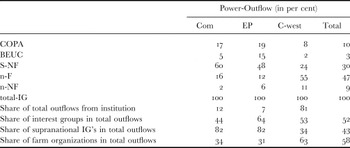
Given the different output structures of the CAP lobbying system in the EU-27 and EU-15, the question arises what are major implications of these differences. At the micro level different output structures first of all imply different political power outflows and hence different political influence of socio-economic groups. In Table 4 the calculated power outflow for the relevant political institutions of the supranational and intergovernmental system in the EU-15 are presented. Comparing Table 4 with Table 3 reveals that power outflows vary significantly for the EU-15 and EU-27.
Firstly, overall the share of power outflows towards interest groups increases from 52 per cent for the EU-15 to 62 per cent for the EU-27. Secondly, a clear shift towards the supranational system can be observed comparing power outflows of the EU-15 and EU-27. While in the EU-15 only 19 per cent of total power outflows came from the supranational systems, more than 33 per cent of total power outflows came from this governmental system in the EU-27. Thirdly, a clear shift of relative political influence from national to supranational interest groups can be observed comparing the CAP-lobbying system of the EU-15 and EU-27.
Power-Outflow in Policy Networks of the EU-15: Expert information network
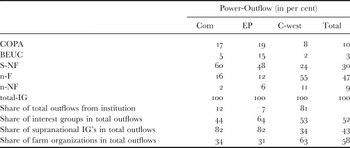
Note: Measured as aggregated input coefficients of the confirmed expert information network
Comparing power outflows of different institutions of the intergovernmental and supranational systems also reveals significant differences between the EU-15 and EU-27. While power outflows of the intergovernmental system in the EU-15 at a first glance seems comparable to that of the Western Council members in the EU-27, a closer look also shows clear differences. For example, for the EU-15 power outflows from national Council members are clearly focused on national farm organizations receiving 55 per cent of total power outflows. In contrast, in the EU-27 system power outflows observed for the Western Council members are focused on supranational organizations with a share of more than 57 per cent of total power outflows, while national farm organization receive only 39 per cent of total power outflows of Western Council members. As we already stated above these developments result from the so-called ‘Agrarwende’, e.g. especially since the BSE-crises CAP policy-making has been reoriented more towards multi-functionality, i.e. consumer interests.
On the other hand, comparing power outflows of the EU-15 Council to the Eastern Council members, some similarities can be observed. For both, for example, power outflows are clearly focussed on national farm organizations, which even receive a share of 71 per cent of total power outflows from the Eastern Council members. However, clear differences also exist between the EU-15 Council and the East European Council members. While for the EU-15 Council a significant share of power outflows is directed towards supranational organizations (34 per cent), supranational organizations exert almost no influence on Eastern Council members with a share of only 5 per cent of total power outflows.
Finally, an interesting shift of power outflows among farm and non-farm interests at the national and supranational level can be observed. While COPA's influence decreases at the supranational level, it significantly increases at the national level comparing the EU-15 with the EU-27.and vice-versa for Western farm organizations. Moreover, BEUC receives increasing power outflows from Western Council members, while outflows from the EP decreases for the EU-27 when compared to the EU-15 (see Tables 2 and 4). Overall, we have three overlapping effects. On the one hand the ‘Agrarwende’ shifting power from farm to non-farm organizations. On the other hand increasing integration shifts power towards supranational peak organization. Thirdly, we have enlargement implying higher conflicts among national farm interests, which imply that the latter increasingly represent their own interest in Brussels relying less on COPA. Interestingly, overall both COPA's and BEUC's total influence increased, while the influence of national (especially Western) farmers decreased (see last column of Table 1 and 2, respectively).
Moreover, comparing power outflows from the supranational system in the EU-15 and EU-27 also reveals some interesting differences. In particular, political influence of supranational non-farm organizations on supranational governmental institutions increased at the expense of political influence of COPA, the supranational farm organization. These developments result from the so-called ‘Agrarwende’. Especially under the Austrian Agriculture Commissioner Franz Fischler, the Commission reoriented its CAP policy-making more towards multi-functionality, i.e. consumer interests.
Applying the topology of Henning and Wald (Reference Henning and Wald2000) we can conclude that the overall lobbying system of the EU-15 corresponds to cooperative National Clientelism given the clear focus on farm interest and on the national level. However, comparing the lobbying system of the EU-15 with EU-27 is not an easy task. For the latter a dual East-West system results corresponding to competitive National Clientelism in the East and Supranational Pluralism in the West.
Comparing CAP lobbying structures of the EU-15 with the Western lobbying system of the EU-27, that is Supranational Pluralism, the observed changes could be explained with the ongoing integration processes. Since the establishment of the CAP in 1962 a continuously increasing integration of the CAP shifted de facto legislative decision-making power from the intergovernmental to the supranational system, first of all to the European Commission. Given the fact that the institutional rules under which CAP are currently decided have never been changed since the foundation of the present-day EU, observed power shifts basically result from EU enlargements. It is now much harder to form a uniform coalition in the Council which overrides the Commission proposal.Footnote 7 Obviously, Western interest groups managed to adapt their lobbying strategies to the observed shifts of institutional power from the intergovernmental to the supranational system.
Comparing the CAP system of the EU-15 with the lobbying system of Eastern member states in the EU-27 corresponding to competitive National Clientelism requires a different explanation, however. Clearly, the most striking characteristic of the lobbying system East European style lies in the lack of cooperation among farm interest groups. Of course, as mentioned earlier, an obvious interpretation of missing links between national interest groups of the new member states and their Western counterparts might reflect that they are new members and first have to integrate into the system. However, a possible rationale behind the emergence of competitive National Clientelism is the re-nationalization of the CAP. This follows from the fact that Eastern enlargement implied a conflict of interest among national farmers, especially between West and East European member states. Due to the common financing of the CAP and the ceiling of the total CAP budget, enlargement required that subsidies paid to East European farmers reduce subsidy payments to Western farmers. This conflict of interest cuts a wedge into the farmers' coalition, which impedes cooperation and coordination of lobbying activities among West and East European farm interest groups. This also became clear in the controversy among so far unified German farmers induced by the so-called Mid-term reform of the CAP imposing for the first time a transparent redistribution of subsidies across farmersFootnote 8.
Lobbying systems, political influence bias and CAP outcomes
Since its establishment the CAP has been heavily criticized as an economically inefficient and ineffective policy (Koester and Tangermann Reference Koester and Tangermann1977). Thus, it would be interesting to analyze how or whether competitive National Clientelism, cooperative Supranational Clientelism and Supranational Pluralism have a systematic impact on the economic efficiency of the CAP.
According to our theory, final policy outcomes result from political exchange processes among governmental and non-governmental actors (Henning Reference Henning2000; Pappi and Henning Reference Pappi and Henning1998). Hence, policy network structures have an impact on political decision-making in as much these structures influence transaction costs of political exchanges and thus the final exchange equilibrium. In the exchange equilibrium, different actors hold a specific amount of political control resources over different policy dimensions, where the final collective policy decision results from the mean voter decision rule as a weighted mean of actors' policy positions. The weight of individual actors for a given policy position corresponds to the political control resources the actors demand in the political exchange equilibrium (Henning Reference Henning2000; Pappi and Henning Reference Pappi and Henning1998).
Therefore, it follows directly that the final policy outcome depends on both the distribution of political control resources in the exchange equilibrium and the distribution of policy positions across actors. Policy networks have an impact on the former, but not on the latter. Accordingly, we concluded in our former work (see Henning and Wald Reference Henning and Wald2000) that in general, a simple matching of a specific lobbying system with a specific policy outcome is impossible. In the lobbying literature it is generally assumed, however, that the more political influence is biased towards particular interests, the more policy outcome is biased in favour of these particular interests at the expense of general public interests (Persson and Tabellini Reference Persson and Tabellini2002). If for the moment we apply this commonly accepted hypothesis, we can systematically relate the identified CAP lobbying systems to the economic efficiency of CAP outcomes. Thus, clientelistic lobbying systems result in less efficient CAP outcomes when compared to pluralistic systems, since the former includes a stronger bias of political influence in favour of farm interest. Moreover, since cooperation among farm interest groups implies more efficient lobbying, political influence should be more biased in cooperative compared to corresponding competitive lobbying systems. Thus, we could conclude that CAP outcomes are less efficient for the CAP lobbying system of the EU-15, i.e. cooperative National Clientelism, while the efficiency of CAP should increase in the EU-27, for both the Western Supranational Pluralism and the Eastern competitive National Clientelism. Finally, even under cooperative Supranational Clientelism, CAP-outcomes should be more efficient, since biased-access structures in favour of farm interest are attenuated at the supranational compared to the intergovernmental level. In fact, the economic efficiency of the CAP did increase significantly in the EU-27 compared to the EU-15 (Henning Reference Henning2005).
However, we cannot take these empirical results as a sufficient proof for our hypothesis. Firstly, although the relation among lobbying bias and efficiency of policy outcomes is a commonly accepted thesis, Henning and Wald (Reference Henning and Wald2000) convincingly demonstrated that this seemingly obvious hypothesis does not always hold true. Secondly, as has been demonstrated by Struve (Reference Struve2006), most recent CAP reforms have been mainly triggered by changed economic framework conditions resulting in a systematic shift of policy preferences of all relevant governmental and non-governmental actors towards more efficient CAP policies. Thirdly, the governance of the CAP is a very complex system of formal institutional decision-making rules and informal policy network structures. Besides expert information other network relations have to be taken into account, e.g. monitoring information. Especially, the latter implies unexpected power redistributions not only among interest groups, but also among formal governmental institutions, which can induce non-obvious policy outcomes (Krause Reference Krause2005). Fourthly, also in the EU-15 national farm organizations often take different policy positions. Thus, although we observe a clear bias of political influence towards farm organizations, this does not necessarily translate into a corresponding policy bias, as due to heterogeneous policy positions, lobbying influence of national farm organizations often offset each other (Henning Reference Henning, Warntjen and Wonka2004).
Conclusion
This article firstly demonstrated that a theoretically founded policy network analysis provides a very powerful tool for comparative politics that not only allows a quantitative analysis of complex governance systems including the quantitative measurement of interest group influence, but also generates interesting hypotheses regarding the interplay of formal constitutional rules and the informal organization of political influence in networks. In contrast to qualitative network studies using policy networks as a metaphor, our network approach is integrated with a theoretical model of legislative decision-making. Furthermore, the classical Corporatism-Pluralism typology of interest mediation systems could be generalized using our quantitative network approach.
Secondly, our case study provides interesting insights into the lobbying system of the CAP of the EU-15 and EU-27. Firstly, the CAP lobbying system of the EU-27 corresponds to a dual system comprising two different interest mediation systems, Supranational Pluralism for the West and competitive National Clientelism for the East member states, while interest mediation in the EU-15 corresponds to cooperative National Clientelism. Accordingly, it is (like the Eastern CAP lobbying system of the EU-27) extremely focused on national farm interests. However, in contrast to their Eastern counterparts, farm interest groups in the EU-15 clearly coordinate their lobbying activities.
Secondly, explaining the observed developments of the CAP-lobbying system we identified three major factors. The ongoing integration processes of the CAP implies a continuous shift of institutional decision-making power from the Council to the supranational level, i.e. the Commission and the EP. The CAP has become reoriented towards consumer interests resulting from the so-called ‘Agrarwende’. Both factors induced a shift of lobbying structures from National Clientelism towards Supranational Pluralism. However, there has been a re-nationalization of the CAP induced by the most recent Eastern enlargement of the EU fostering competitive National Clientelism as observed for new Eastern member states.
Finally, we discussed how the CAP lobbying structures can be systematically related to an increased efficiency of the CAP observed since the last CAP reform in 2003. On the one hand, the efficiency of the CAP should increase following the transition from cooperative National Clientelism of the EU-15 to the mixed lobbying system of the EU-27. On the other hand, we indicated that at least for the special case of the CAP, the relationship between lobbying structures and efficiency of policy outcomes is far more complex and thus, one should not jump to conclusions too fast.
We only use the CAP system as one example to demonstrate the usefulness of our network approach as a tool in comparative politics, however. In our view, it can also be applied to other policy domains in the EU multi-level governance system or, for that matter, to compare the CAP-system with other EU policy domains or to compare the EU system internationally with others as multilevel governmental systems, e.g. the US system or other national policy domains.