INTRODUCTION
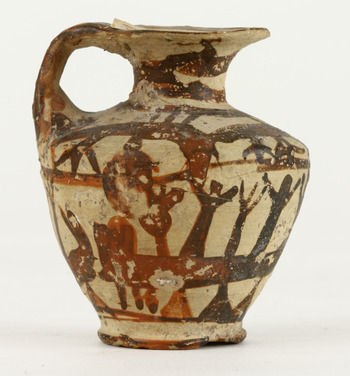
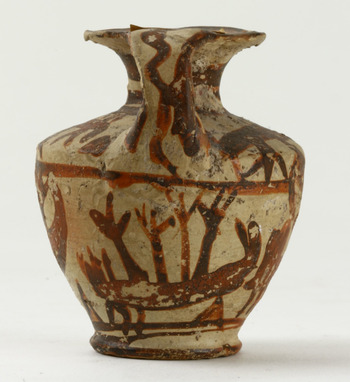
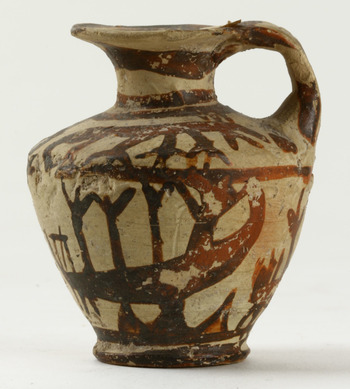
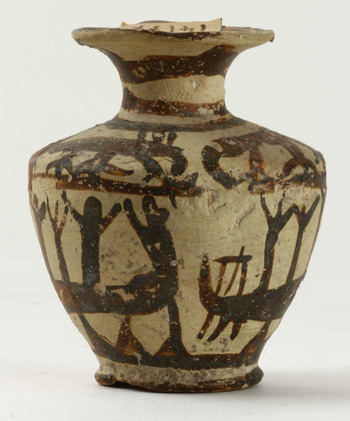
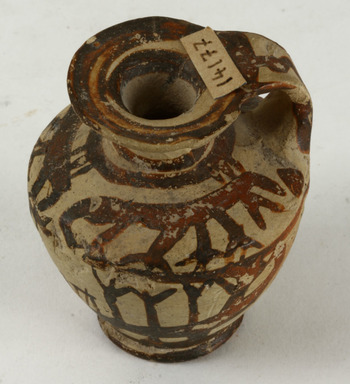
Inside the storerooms of the National Archaeological Museum in Athens one may find the vase inventoried as NAM 14177 (Figs. 1, 2, 3, 4, 5) from the south-east area of the Second Temple at the Argive Heraeum (Hoppin Reference Hoppin and Waldstein1905, 91, fig. 20 and pl. LXVI).Footnote 1 Measuring 5.5 cm high, with a rim diameter of 3.0 cm, a base diameter of 2.5 cm, and a maximum diameter of 4.7 cm, NAM 14177 may be described as intact with some chipping all around its surface. The clay of NAM 14177 is pale yellow (Munsell 2.5Y 8/4), and the paint black to light brown due to uneven firing. The body of the vase is depressed and rests on a ring-foot decorated with external paint and a central dot underneath the vessel. The short neck ends in a mouth-plate with a flat top decorated with multiple lines of varying widths, the outermost of which may be considered the thickest. Encircling the neck are an additional three unevenly-spaced horizontal lines of variable thickness, which give the impression of having been drawn in a hasty or careless manner. The decoration on the vertical strap handle adds to this impression, with one wavy line drawn irregularly between two straight vertical lines.
Aryballos NAM 14177, side view. National Archaeological Museum (photographer: Irini Miari). Copyright © Hellenic Ministry of Culture and Sports / Archaeological Receipts Fund.

Aryballos NAM 14177, rear view. National Archaeological Museum (photographer: Irini Miari). Copyright © Hellenic Ministry of Culture and Sports / Archaeological Receipts Fund.

Aryballos NAM 14177, view of other side. National Archaeological Museum (photographer: Irini Miari). Copyright © Hellenic Ministry of Culture and Sports / Archaeological Receipts Fund.

Aryballos NAM 14177, front view. National Archaeological Museum (photographer: Irini Miari). Copyright © Hellenic Ministry of Culture and Sports / Archaeological Receipts Fund.

Photograph of the shoulder decoration on aryballos NAM 14177. National Archaeological Museum (photographer: Irini Miari). Copyright © Hellenic Ministry of Culture and Sports / Archaeological Receipts Fund.

J.C. Hoppin (Reference Hoppin and Waldstein1905, 91) dated NAM 14177 to the transition between the Mycenaean and Argive (Geometric) styles, since he considered the clay and technique to be purely Mycenaean, but the decoration more characteristic of the Argive style. The decoration on the shoulder of the vessel was interpreted as a depiction of three animals, but the sloppiness of the execution made determining the specific animals difficult. The animals were described as having large open mouths, with three projections above, possibly representing ears and horns, and a tail. The decoration on the vessel body was also interpreted as a depiction of three animals, although it was noted that there was a peculiar effect produced by the design, since the animals looked like ships with their sailors, and the ray pattern like waves. Hoppin (Reference Hoppin and Waldstein1905, 91), however, considered this effect to be purely accidental. Unfortunately, Mycenaean parallels to NAM 14177 were (and still are) lacking, since the shape is unknown in Mycenaean pottery and the inverted painting technique would be extremely unusual.
NAM 14177 REVISITED
Careful typological examination of NAM 14177 reveals that it is an early type of aryballos datable to the Middle Protocorinthian I period (690–670 bc).Footnote 2 Unfortunately, NAM 14177 exhibits a total absence of incised decoration, which is considered an identifying feature of the Middle Protocorinthian Ι period (Coulié Reference Coulié2013, 113). Stylistic parallels, however, may be identified by comparing it with other known vessels. Dunbabin (Reference Dunbabin1962, 246 no. 2370, pl. 94) drew decorative parallels between NAM 14177 and a fragmentary kotyle (2462) from Perachora, which he characterised as a painted vessel decorated in the most childish manner. From Tomb B20 of the Lechaion Cemetery, Protocorinthian aryballos CP-2096 may yet provide another parallel to NAM 14177, bearing on its body a scene of a battle between archers and hoplites and, on the back of the handle, another man (Boardman Reference Boardman1998, 92, fig. 171:1–2; Vanderpool Reference Vanderpool1955, 225, pl. 68:10; Eliot and Eliot Reference Eliot and Eliot1968, 348–50, pl. 102).
Amyx (Reference Amyx1988 vol. I, 25, pl. 6) has attributed the Lechaion aryballos (CP-2096) to ‘Near the Huntsmen Painter,’ who was one of the first aryballos painters to depict primarily hunting scenes. Benson (Reference Benson1989, 50, 82), however, has argued that the Lechaion aryballos should be associated with, but not formally belong to, the ‘Nola Complex’. Additionally, Neeft (Reference Neeft1991, 13) has listed the Lechaion aryballos under the group ‘Early Masters of Narrative’, which dates to the Middle Protocorinthian Ι–ΙΙ periods (690–670 and 670–650 bc, respectively).Footnote 3 Aryballos CP-2096 may therefore be comfortably dated to the Middle Protocorinthian Ι–ΙΙ period, thus offering a chronologically contemporary parallel for NAM 14177. The difficulty in finding additional parallels for NAM 14177, however, is indicative of the rapid evolution of aryballos shapes in Protocorinthian pottery.
Considering the shape of the vessel, as well as the colour of the clay, the decoration and the way of rendering, it is not easy to determine whether NAM 14177 should be assigned to a Corinthian or an Argive workshop. Corinthian and Argive pottery are clearly related in regard to clay, shapes and decoration, and multiple parallels may be drawn between the local Argive and Corinthian wares. Argive potters produced large quantities of miniature vases in order to compete with imported Protocorinthian and Corinthian pottery and attract more buyers (Marer-Banasik Reference Marer-Banasik1997, 167–8). Interestingly, in the Archaic stratum of the small area at the Heraeum at Argos, only five per cent of the pottery was imported while the rest was of local Argive manufacture (Caskey and Amandry Reference Caskey and Amandry1952, 187).
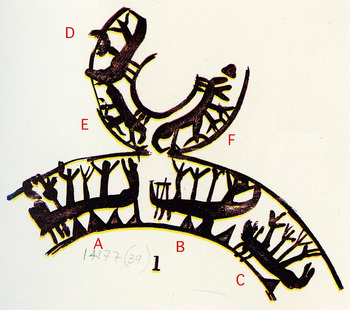
The choice of decorative theme for the NAM 14177 aryballos is interesting and unique. Decorations on both the body and the shoulder of the vessel are particularly enigmatic, since they appear to represent the same scene executed in two different manners (Figs. 1, 2, 3, 4, 5). On the body, the scene is rendered from a normal upright perspective, whereas on the shoulder it is inverted (Fig. 6). If looked at closely, however, the scene clearly depicts shipsFootnote 4 rendered as silhouettes in a schematic and abstract way, rather than animals as previously hypothesised. On the body of the vase, three ships rest upon a black, burnished ray pattern between two horizontal lines that may thus be suggestive of waves on the sea.
Drawing of the decoration on the body and the shoulder of aryballos.

On the body of the vessel, ship A (Fig. 6) offers the best overall depiction and is therefore a good starting point for the description of the scene. The hull of the ship is low but swings upwards vertically before ending in a very slight bifurcation on the right side of the image. The little knob on the outer edge of this bifurcation likely represents the aphlaston of the ship. The line that runs down from the stern and into one of the triangles along the base may therefore be interpreted as a steering oar, unlike the three vertical lines below the left extremity of the ship. Located on either side of the stern to ensure at least one blade is always immersed and functional when the hull heels over under the pressure of the wind against the sail, steering oars on Greek ships never number more than two (Mark Reference Mark2005, 122). More than two steering oars are known from Pharaonic Egypt, however, where there may be up to three per side (i.e. a total of six). This is a particular feature of navigating on a large river with a strong current, since the additional steering oars provide a better grip on the water when turning the vessel. Extending left along the hull towards the bow of the galley is a square forecastle, which would have served as living quarters for the sailors. This type of bow first appears in the Late Helladic III Amphiareion model (Wedde Reference Wedde and Tzalas2002, 853 Group 5 B4), and continues through to the Geometric period, as evidenced by the Protogeometric Fortetsa krater (Wedde Reference Wedde and Tzalas2002, 853 Group 5 E1–E2). Ship C roughly reproduces the shape of ship A, although the bow to the left is not as carefully drawn and the steering oar does not extend into the water represented by the triangles.
Ship B is not a ship of the same type as A and C, however, since it lacks the massive bow (stem-post plus forecastle) visible on the other two images. At its left edge is a rectangular post-and-lintel-shaped structure that may be understood either as the sterncastle (a protective structure for the helmsman), or as the bow and forecastle. If the rectangular feature does indeed represent a sterncastle, then the long oblique line running across it may consequently be interpreted as the steering oar. However, as the vase painter works largely with the repetition of patterns, it seems reasonable to assume that the bows of all ships A, B, and C are to the left of each image. Upon every ship are four standing figures of indeterminate gender with upraised arms.
On the shoulder of the aryballos are an additional three ships painted with the keels facing the top of the vessel, thus giving the appearance of being upside-down. The ships are depicted in roughly the same manner as those on the body, although the images appear to lack clearly identifiable architectural features. However, three lines below each hull may help locate the bows of each vessel, which would suggest that the ships are oriented in a counterclockwise direction around the shoulder. Ship F, in particular, provides fairly secure clues that help confirm this orientation, since the left extremity of the ship may plausibly be interpreted as the stern. Reminiscent of an architectural feature found on ships throughout the Mediterranean, the depiction of the forward bend at the post's extremity may represent a sternpost terminal in the shape of a duck's head looking over the hull, which is typical of Greek and Cypriot ships (Wachsmann Reference Wachsmann1998, 177–97; Wedde Reference Wedde and Tzalas2001, 612–13 nos. 1–3, figs. 1–3). The Y-shaped ornament would therefore depict the thole-pinsFootnote 5 where the oars rested. Four standing figures with upraised arms are depicted on ship F, while only two are visible on ships E and D.
From an architectural point of view, all of the ships conceivably represent small galleys,Footnote 6 with a short bow projection similar to those of ships constructed from the Late Helladic IIIB period on, despite being superseded by more advanced designs. It is therefore possible that these images represent the kind of galley smaller coastal communities or members of the economic elite could afford to build and maintain. In the absence of a substantial bow projection, however, it could also be argued that these vessels might portray merchant galleys used for trading voyages, which were just aggressive and well armed enough to deter pirates.
Iconographic information for Aegean seafaring begins in the third millennium bc. From this information, two types of ships may be distinguished – the seagoing longboat and a small vessel with a cutwater bow and stern (Wachsmann Reference Wachsmann1998, 69). In the Late Bronze Age, oared galleys were common. These ships had a straight keel with an upward-curving stern and a bow that extended beyond the vertical stem-post like a ram (Höckmann Reference Höckmann and Koehl2013, 358). This type of oared galley, a development of Minoan ships and Cycladic longboats, constitutes a break in Greek shipbuilding at the beginning of the Late Helladic IIIB period, or perhaps somewhat earlier (Wedde Reference Wedde and Laffineur1999, 465). For the subsequent two centuries, a rich corpus and considerable variety of Mycenaean ship representations are available.Footnote 7
Contrasts between the variety and abundance of Mycenaean ship images and the uniformity of galleys depicted primarily by the Dipylon workshop in Athens (760–750 bc) are considerable (Wachsmann Reference Wachsmann1998, 130 and 155).Footnote 8 By Late Geometric II, the ship motif had acquired powerful emotional connections with warfare and death at sea (Langdon Reference Langdon2008, 223), and during the seventh and sixth centuries bc Greek maritime activity was strongly related to colonial expansion. Maritime-related architectural achievements, such as the building of triaconters, penteconters, and especially biremes and triremes, thus contributed towards the overall financial and political development of Greek society.
Representations of ships on pottery from the Submycenaean to Middle Geometric II periods (1100–800 bc), as well as from Late Geometric II to the later sixth century bc, are rare (Νakas Reference Nakas and Mazarakis Ainian2011, 1004).Footnote 9 This extends to representations on both Late Geometric Corinthian pottery (Boardman Reference Boardman1998, 49) and Geometric Argive pottery (Courbin Reference Courbin1966, 419 and 445), thereby making it difficult to situate NAM 14177 within its proper chronological or regional contexts. A few examples of Corinthian vases depicting ships are, however, known (Höckmann Reference Höckmann and Koehl2013, 358; Tzahou-Alexandri Reference Tzahou-Alexandri and Tzalas1990, 337), including NAM 281, a Late Corinthian I (570–550 bc) aryballos with a particularly distinctive example of an oared ship on one side (Amyx Reference Amyx1988 vol. I, 242).
In the Argive Heraeum, only one sherd (NAM 25248) with a fragmentary ship representation has so far been found dated to the mid-eighth century bc (Hoppin Reference Hoppin and Waldstein1905, 113, pl. LVII:13; Tzahou-Alexandri Reference Tzahou-Alexandri and Tzalas1990, 340). Both the bow and the forepart of the ship are preserved on the potsherd, along with the back of a man seated inside the vessel and a helmeted archer aiming towards the ship. From the neighbouring city of Argos comes a single example of a clay ship model dating to the Mycenaean period (Palaiologou Reference Palaiologou and Tzalas1989, 217–28). Additionally, an oinochoe shoulder fragment with a representation of a ship has been excavated at Argos, from Danaou 4 in the Katsaros plot (Tzahou-Alexandri Reference Tzahou-Alexandri and Tzalas1990, 339–40, fig. 25). Dating either to the end of the third quarter or the beginning of the fourth quarter of the eighth century bc, the Argos oinochoe fragment may be assigned to a local Argive workshop on the basis of clay analyses. Two more contemporary fragments, one from a pithos and the other from an open vessel, have also been found in the city of Argos (Tzahou-Alexandri Reference Tzahou-Alexandri and Tzalas1990, 340). Recent Late Geometric I (750–730 bc) examples of a globular jar depicting two ships, birds and fish alongside a man controlling two horses, and of a giant pyxis with two ships and their crews under the handles, surrounded by birds and fish, help expand the examples of narrative scenes featuring ships in Argive Geometric pottery (Coldstream Reference Coldstream2008, 462).
An impressive characteristic in respect to the iconography of NAM 14177 is the density of painting on a vase of such small dimensions. Although the images appear to be carelessly drawn, a strong and dramatic style of execution is conveyed by the painting. The figures of indeterminate gender standing upon the ships with upraised arms also help to reinforce this feeling. Although such figural representations go back to images of Minoan goddesses from Late Minoan IIIB, they survive into the Geometric period, when there are several examples known from pottery and terracotta figurines (Κanta Reference Kanta, Kanta and Davaras2011, 31). One local-style Middle Geometric II (800–750 bc) oinochoe from Argos even bears the earliest known representation of two commanding figures raising their arms with fingers spread (Coldstream Reference Coldstream2008, 462). However, while it is tempting to interpret the inverted scene on the shoulder of the NAM 14177 aryballos as a shipwreck, it should be remembered that such scenes generally have human corpses depicted floating in the water in danger of being eaten by fish, as seen on the famous shipwreck krater from Pithekoussai (c.725 bc) (Buchner and Ridgway Reference Buchner and Ridgway1993, pl. 231). The standing figures, well attested in other iconographic representations, therefore indicate that other explanations for the application of the inverted technique should be sought.Footnote 10
Other comparable examples to the NAM 14177 aryballos are the Early Iron Age clay ship models with human figures from the cave of Eileithyia at Tsoutsouros on Crete (Kanta Reference Kanta, Kanta and Davaras2011). The figures are partially preserved and seated in pairs, and at least one may be identified as female, given the possible depiction of breasts. In the centre of one ship is either a seated human figure or a foetus rising into the world (Kanta Reference Kanta, Kanta and Davaras2011, 35). The interpretation of this clay ship model is therefore quite difficult. Considering that the model has been found in a place associated with the cult of Eileithyia (associated with childbirth), it is possible to hypothesise that a baby is coming into the world on a ship which also transported Eileithyia.
In Argos in particular, the goddess Hera was the protectress of pregnancy and childbirth, eventually developing into a separate divinity known as ‘Hera Eileithyia’ (Baumbach Reference Baumbach2004, 79–82).Footnote 11 Evidence exists for several clay figurines of pregnant women dedicated to her, such as terracotta figurine NAM 25961 (Waldstein and Chase Reference Waldstein, Chase and Waldstein1905, 30 no. 124, fig. 52). The cult of Hera as Eileithyia thus provides a plausible foundation for the suggestion that the anthropomorphic figures on the aryballos NAM 14177 from the Argive Heraeum illustrate the long journey a foetus makes as it is brought into the world.Footnote 12
In addition, four clay ship models, one imported from Corinth, have been found in the ‘Stipe dei Cavalli’ in Pithekoussai, and date to either the end of the seventh or the beginning of the sixth century bc (D'Agostino Reference D'Agostino1994–5). Although it is possible that finds from this deposit may be associated with a hero cult, the clay models of chariots and ships have mainly been attributed to the cult of Hera (C. Gialanella in Stampolidis [ed.] Reference Stampolidis2003, 397, no. 620). Ships may reflect the cult of Hera as protectress of fishing, since she was concerned with many aspects of nature (Baumbach Reference Baumbach2004, 97, 163).
Ship themes, while not very common on Corinthian pottery, may be associated with colonisation and its associated adventures and dangers. This may perhaps be why the figures are asking for divine assistance on their journey, and why the aryballos NAM 14177 was dedicated as an offeringFootnote 13 in the Temple of Hera. Although the Argive Heraeum is not situated by the sea, like the Heraea in Crotone, Gravisca, Malta and Samos, it is worth noting that the cult of Hera developed greatly during the years of westward colonisation, possibly as a result of her abilities to control the winds and maritime routes, which would have allowed navigators to arrive safely at their destinations (Fenet Reference Fenet, Hermary and Jaeger2011, 412–13). The upraised arms may also express happiness and comfort, or perhaps represent a feast or other celebration for the successful end of a trip. Such a gesture can be seen on side B of the François Crater, where a man raises his arms as an expression of such feelings once the ship arrives in Athens (Hedreen Reference Hedreen2011, 497).
Either a sacred journey or an unidentified myth may also be represented on the aryballos NAM 14177.Footnote 14 In the Argive Heraeum, two locally produced seated terracotta figurines dated to the second half of the sixth or the early fifth century bc have been interpreted as depicting women holding ships decorated with floral motifs (cf. Barfoed Reference Barfoed, Thomasen, Rathje and Bøggild Johannsen2013, 92, fig. 8). These images recall the importance of ships and the sea in the cult of Isis (e.g. Pausanias 2.4.6; Roeder Reference Roeder1916, 2116–17), and may represent the strong relationship established between the Heraeum and Egypt by the myth of Hera's priestess, Io (Herodotus 2.41; Diodorus Siculus 1.24.8; Baumbach Reference Baumbach2004, 96–7).
At sanctuaries, true votive deposits are rare since pots were probably valued first and foremost for their contents (e.g. the oil in the aryballos). Nevertheless, interpretations of votive offerings should take into account the possibility that certain images or scenes were selected for their relevance as dedications to honour particular deities (Stissi Reference Stissi, Nørskov, Hannestad, Isler-Kerényi and Lewis2009, 30).
THE GROUP OF ‘UPSIDE-DOWN’ PAINTED VASES
By examining the images on NAM 14177, an obvious dialogue, or reciprocity, between the painting on the body and that on the shoulder should be noted. The inverted painting technique applied to the aryballos is an issue of specific interest that raises many questions, since a group of pottery with water birds rendered upside-down is already known and has been well studied. This group of pottery has been assigned to the Attic workshop of the ‘Swan Group’,Footnote 15 dated to the second half of the sixth century bc.
This article examines a group of earlier, mainly Corinthian, pottery, which consists of vessels decorated with several themes rendered in the inverted technique (see catalogue in the Appendix to this article). The majority of these vessels have been found in sanctuaries (i.e. Argive Heraeum, Perachora, Isthmia and Corinth) and do not appear to have specific meanings or messages related directly to the recipient god (Stissi Reference Stissi, Nørskov, Hannestad, Isler-Kerényi and Lewis2009, 29). A great number of these vessels come from wells,Footnote 16 implying they were for everyday use. It may therefore be assumed that, in the sanctuaries, vessels were also used for various activities (e.g. rituals, offering ceremonies, ritual communal meals or drinking ceremonies) rather than being merely votive in character (Stissi Reference Stissi, Nørskov, Hannestad, Isler-Kerényi and Lewis2009, 25–6). According to the material collected so far, the chronology of the ‘upside-down’ painted vessels fits into the span between the Early Protocorinthian and Middle Corinthian periods, with the majority dated to the Protocorinthian period (720–630 bc), and one unique example (catalogue no. 4) dated to the middle of the eighth century bc.
The preference for inverted decoration on the vessels is striking, and the decorative themes display remarkable standardisation and homogeneity. Most of these images consist of birds painted between rays, springing straight up from the bases of vessels, predominantly kotylai. Rows of larger, but not easily recognisable, animals are depicted more rarely. These animals could be either dogs or horses, since a row of dogs is depicted on kotyle F32 (P22701) from the Athenian Agora (catalogue no. 30; Brann Reference Brann1961, 337, pl. 89). Narrative scenes depicted in the inverted technique however, are far fewer and have so far been found only on NAM 14177 and two other small skyphoi (catalogue nos. 1–2) from the Argive Heraeum, one of which bears decoration of a hunting scene and the other of running animals (Hoppin Reference Hoppin and Waldstein1905, 151–2, figs. 90–91). As already noted (see note 10), the miniature black-glazed single-handled Phaleron cup from Athens (catalogue no. 3) has a depiction of ships.
The earliest known example of the use of this inverted technique of decoration on Greek pottery is a protokotyle with decoration arranged in two panels with reversed orientations, which was excavated in the Peribolos of Apollo at Corinth in 1966 (catalogue no. 4). In this mixed way of rendering, the panel below the rim is oriented towards the rim while the other panel is oriented towards the foot. Particularly visible are the metopal panels decorated with inverted conjoined (Siamese) twins (Coldstream Reference Coldstream2008, 461; DeVries Reference DeVries, Williams and Bookidis2003, 142–4). The choice of the theme is unique in the Corinthian Geometric pottery as well as the combination in the rendering of the scene, upside-down in the one half and in the regular way in the other. With the protokotyle from the Peribolos of Apollo, we thus have the earliest known application of the upside-down technique, suggesting that this technique may first have developed within a Corinthian workshop.
The repeated association of the inverted technique with a specific shape – namely the kotyle – is also worth noting. The apparent standardisation of both shape and design would suggest either the existence of a specific workshop or a clear decorative fashion. Nevertheless, the style of decoration may also indicate a purely practical modification, related to the standard use of the vessel. If kotylai functioned as lids for other pots (Brann Reference Brann1961, 337), when in use in this way their upside-down illustrations would have been oriented correctly towards the perspective of the viewer. The same could be said to apply if the cups were hung on a wall or perhaps laid upside-down on a table (DeVries Reference DeVries, Williams and Bookidis2003, 144). Furthermore, it is also possible that inverting the vase while applying the decoration provided more space for executing the painting than leaving it in its usual orientation (E. Baziotopoulou-Valavani in Parlama and Stampolidis Reference Parlama and Stampolidis2003, 286 no. 267). However, even if one accepts this argument for the Phaleron cup (catalogue no. 3), it should not be assumed that the same applies to the remaining examples, including kotylai, aryballos NAM 14177, or the small skyphoi or kotylai from the Argive Heraeum.
Interestingly, inverted images could perhaps be interpreted as the work of novice painters perfecting their craft. Most of the images, however, are of good quality, suggesting that such is not the case. The use of added white and purple, as well as the precise depiction of birds between rays, indicates not only experience, but ample knowledge of the techniques necessary to execute the decoration. Considering the widespread mass-production of kotylai throughout the Mediterranean, it seems inevitable that both experienced artists and their apprentices would have tried their hands at kotylai decoration to meet customer demands. Relatively competent artists may have been compelled to work hastily alongside incompetent artists who were also pressed into service (Benson Reference Benson1983, 312, 318). It is also possible that there was a distinct division of labour among individual painters, which allowed someone to introduce inverted vase-painting into the decorative repertoire. Unfortunately, sufficient proof for this hypothesis is currently lacking.Footnote 17
Perhaps this decorative trend of ‘upside-down’ painted vessels should therefore be integrated into wider theories regarding change and experimentation, in which new ideas, combinations and variations of already well-known themes were created, in order to appeal to and attract prospective customers. Finally, the idea of inversion may have had an apotropaic function for the pottery workshops, a work environment filled with dangers and unsuccessful batches (Kalpaxis Reference Kalpaxis1986, 10, 12).
EPILOGUE
The originality of the decoration and uniqueness of the shape of NAM 14177 has prompted a re-examination and analysis, which has proved very worthwhile. An attempt to explain the decorative scene has provided an opportunity to review the ship theme in Corinthian and Argive pottery during the Protocorinthian and Geometric periods and to tie in this vase with its general context in the Argive Heraeum.
The curious rendering of the decoration of NAM 14177 has drawn attention to a group of ‘upside-down’ painted vases, the majority of which, so far, can be dated in the Protocorinthian period. A protokotyle dated in the mid-eighth century bc (catalogue no. 4) offers the earliest example of a combination of the regular manner of vase-painting and the inverted technique. Since most of the vases listed in the catalogue of ‘upside-down’ painted examples which follows, as well as the protokotyle, come from the area of Corinth, the attribution of this technique to Corinthian workshops seems secure. It is so far difficult to find any convincing explanation for the use of this ‘upside-down’ technique of painting, but this article is an attempt to stimulate debate and encourage further research into this curious and very interesting phenomenon.
CATALOGUE OF OBJECTS
Narrative scenes
Argive Heraeum (Hoppin Reference Hoppin and Waldstein1905, 151, figs. 90–1)
-
1. Skyphos (height 0.047 m, diameter 0.066 m). A frieze around the base with a panther and three other animals, perhaps a deer (Hoppin Reference Hoppin and Waldstein1905, 151, fig. 90).
-
2. Skyphos, Inventory Number NAM 14192 (height 0.057 m, diameter 0.061 m). A hunting scene with a man shooting an arrow at a deer to left, behind him a lion with open mouth. From Old Temple Terrace (Hoppin Reference Hoppin and Waldstein1905, 151, fig. 91).
Athens
-
3. A miniature black-glazed single-handled Phaleron cup, Inventory Number Α 15341 (height 0.05 m, rim diameter 0.067 m). Representation of two boats. 680–660 bc. From Tomb 152 in the Kerameikos Station cemetery (E. Baziotopoulou-Valavani in Parlama and Stampolidis Reference Parlama and Stampolidis2003, 286 no. 267).
Corinth
-
4. A protokotyle with the decoration arranged in two tiers of panels, the orientations of which are reversed. Metopal panels with inverted conjoined twins are visible (DeVries Reference DeVries, Williams and Bookidis2003, 142–4 and Coldstream Reference Coldstream2008, 461). Middle of the 8th century bc. From the 1966 excavations of the Peribolos of Apollo.
Animals
Perachora, Sanctuary of Hera Limenia
-
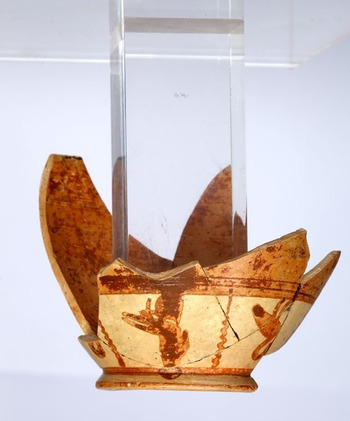
5. Kotyle (height 0.086 m). Five birds rendered upside-down between worms, with a sixth bird imposed over a blob or ray. Protocorinthian period (725–640 bc)Footnote 18 (Dunbabin Reference Dunbabin1962, pl. 19, no. 389) (Figs. 7, 8).
-
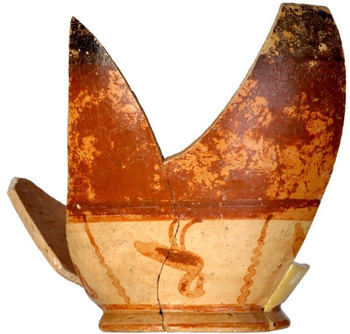
6. Part of a kotyle. Birds rendered upside-down between worms (Dunbabin Reference Dunbabin1962, pl. 27 no. 615) (Fig. 9).
This item and nos. 7–14 below are primarily the bases and lower bodies of kotylai bearing depictions of upside-down birds located between ray patterns or worms. All these kotylai come from the same workshop and date to the Protocorinthian period (725–640 bc).
-
7. Part of a kotyle (preserved height 0.043 m). Birds rendered upside-down between worms (Dunbabin Reference Dunbabin1962, pl. 27 no. 616).
-
8. Part of a kotyle. Birds rendered upside-down between rays (Dunbabin Reference Dunbabin1962, pl. 27 no. 617).
-
9. Part of a kotyle. Birds rendered upside-down between worms which replace the ray pattern (Dunbabin Reference Dunbabin1962, pl. 27 no. 618).
-
10. Part of a kotyle. Birds rendered upside-down between rays (Dunbabin Reference Dunbabin1962, pl. 27 no. 619).
-
11. Part of a kotyle. Birds rendered upside-down between rays (Dunbabin Reference Dunbabin1962, pl. 27 no. 620).
-
12. Part of a kotyle. Birds rendered upside-down between rays (Dunbabin Reference Dunbabin1962, pl. 27 no. 621).
-
13. Part of a kotyle. Birds rendered upside-down between rays (Dunbabin Reference Dunbabin1962, pl. 27 no. 622) (Fig. 10).
-
14. Part of a kotyle. Birds rendered upside-down between rays (Dunbabin Reference Dunbabin1962, pl. 27 no. 623). (Fig. 11).
-
15. Part of a kotyle. A row of animals painted upside-down, perhaps dogs. Early Corinthian (625–600 bc) (Dunbabin Reference Dunbabin1962, pl. 94 no. 2366).
-
16. Part of a kotyle. Two rows of animals, not easily recognisable. An example of very clumsy painting. Transitional period (640–625 bc) (Dunbabin Reference Dunbabin1962, pl. 94 no. 2370).
-
17. Kalathos. Two rows of animals, perhaps horses and dogs. Protocorinthian (725–640 bc) (Dunbabin Reference Dunbabin1962, pl. 35 no. 771) (Fig. 12).
-
18. Pyxis lid. Animals. Perhaps Protocorinthian (725–640 bc) (Dunbabin Reference Dunbabin1962, pl. 85 no. 1864).
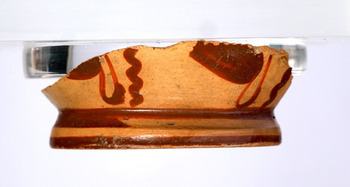
Part of kotyle no. 389 from Perachora (catalogue no. 5) with decoration of ‘upside-down’ birds. National Archaeological Museum (photographer: Irini Miari). Copyright © Hellenic Ministry of Culture and Sports / Archaeological Receipts Fund.

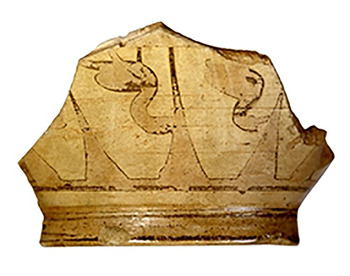
Part of kotyle no. 389 from Perachora (catalogue no. 5) with decoration of ‘upside-down’ birds, viewed from other side. National Archaeological Museum (photographer: Irini Miari). Copyright © Hellenic Ministry of Culture and Sports / Archaeological Receipts Fund.

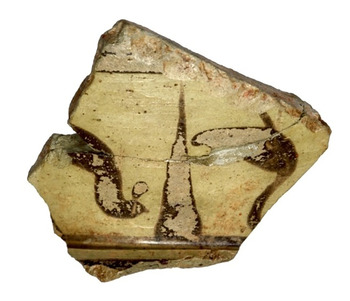
Part of kotyle no. 615 from Perachora (catalogue no. 6). National Archaeological Museum (photographer: Irini Miari). Copyright © Hellenic Ministry of Culture and Sports / Archaeological Receipts Fund.

Part of kotyle no. 622 from Perachora (catalogue no. 13). National Archaeological Museum (photographer: Irini Miari). Copyright © Hellenic Ministry of Culture and Sports / Archaeological Receipts Fund.

Part of kotyle no. 623 from Perachora (catalogue no. 14). National Archaeological Museum (photographer: Irini Miari). Copyright © Hellenic Ministry of Culture and Sports / Archaeological Receipts Fund.

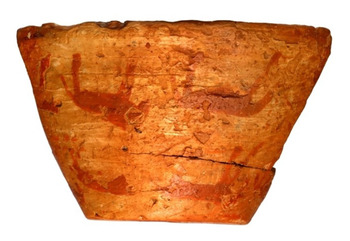
Kalathos no. 771 from Perachora bearing decoration of ‘upside-down’ animals (catalogue no. 17). National Archaeological Museum (photographer: Irini Miari). Copyright © Hellenic Ministry of Culture and Sports / Archaeological Receipts Fund.

Corinth
A. Anaploga Well (fragmentary pottery found in this important deposit of the Archaic period)
-
19. Part of a miniature kotyle. An 119 (preserved height 0.047 m). In the preserved part of the frieze a coursing hound (?). Below this frieze, two bands and a zone of rays with small birds in silhouette painted upside-down. Late Early Corinthian (620/615–595/590 bc) (Amyx and Lawrence Reference Amyx and Lawrence1975, pl. 63).
-
20. Bottom of a small kotyle. An 166 (height 0.016 m). A frieze of long-beaked birds in silhouette rendered upside-down and alternating with vertical squiggles. Around 600 bc. Later than central Early Corinthian (620/615–595/590 bc) (Amyx and Lawrence Reference Amyx and Lawrence1975, 130, pl. 63).
-
21. Fragment of a black-glazed kotyle with added red and white. An 228 (height 0.071 m). A long-beaked bird drawn upside-down in silhouette between rays. Late Protocorinthian (650–630 bc) (Amyx and Lawrence Reference Amyx and Lawrence1975, pl. 71).
-
22. Fragment of a black-glazed kotyle. An 229 (preserved height 0.084 m). A small bird in silhouette drawn upside-down between rays. Late Protocorinthian (650–630 bc) (Amyx and Lawrence Reference Amyx and Lawrence1975, pl. 63).
B. The Potters' Quarter
-
23. Part of the neck of an oinochoe. 195 (width 0.045 m). Early Protocorinthian (720–690 bc) (Stillwell and Benson Reference Stillwell and Benson1984, pl. 81).
-
24. Part of the lower body and base of a kotyle. 1264 (preserved height 0.035 m). A band with two ducks in silhouette drawn upside-down and separated by wavy lines. Use of added white and purple. From Well I; Early Corinthian (620/615–595/590 bc) (Stillwell and Benson Reference Stillwell and Benson1984, pl. 52).
This item and nos. 25 (1265), 26 (1269), 27 (1270) and 28 (1277) belong to the same ‘Silhouette Style’ workshop, a traditional workshop that makes use of an outline technique characteristic of the Geometric period, rather than incision, which is considered an invention of the succeeding period.
-
25. 11 non-joining body fragments of a kotyle. 1265. A zone with two birds in silhouette drawn upside-down and separated by long rays. One of the birds has three legs and is drawn in a very peculiar manner; it may be a cock. Use of added white and purple. From Well I; Early Corinthian (620/615–595/590 bc). (Stillwell and Benson Reference Stillwell and Benson1984, pl. 52).
-
26. Fragment of the lower part of a kotyle. 1269 (preserved height 0.04 m). A zone with a large duck in silhouette drawn upside-down between two rays. Use of added purple and perhaps white. Early Corinthian (620/615–595/590 bc) (Stillwell and Benson Reference Stillwell and Benson1984, pl. 53).
-
27. Fragment of the body of a kotyle. 1270 (preserved height 0.022 m). A zone with an animal in silhouette drawn upside-down and two thin rays. The animal depicted is uncertain. It has the hooves of a horse, although these could also belong to a goat, and a long thin neck. Use of added purple. Uncertain dating, although it could be later than Early Corinthian (620/615–595/590 bc) (Stillwell and Benson Reference Stillwell and Benson1984, pl. 53).
-
28. Fragment of the body of a kotyle. 1277 (preserved height 0.067 m). A zone with a long-legged bird between two very widely-spaced rays. Use of added white and purple. It can hardly be earlier than Middle Corinthian (595/590–570 bc) (Stillwell and Benson Reference Stillwell and Benson1984, pl. 53).
-
29. Uncertain example. 1412. The clay and the decoration appear to be Geometric, but it is not clear whether the upside-down incised bird was done in the Geometric period or later (Stillwell and Benson Reference Stillwell and Benson1984, pl. 59).
Athens
-
30. Kotyle. P22701 (estimated diameter 0.11 m). Upside-down frieze of running dogs. From a well in the Athenian Agora. 650–625 bc (Brann Reference Brann1961, 337, pl. 89).
Isthmia, from the Sanctuary of Poseidon
-
31. Part of a kotyle with birds. IP 2051. Late Protocorinthian – Early Corinthian (unpublished).
Ithaca
-
32. Base of a kotyle with a row of upside-down birds (height 0.03 m). From Aetos (Heurtley and Robertson Reference Heurtley and Robertson1948, 12, no. 36). Late Protocorinthian – Early Corinthian on the basis of its context (Dunbabin Reference Dunbabin1962, 71).
Cumae
-
33. Kotyle 205 (2292). Upside-down, carefully drawn ducks. (Adolf Furtwängler's Collection now in the Staatliche Antikensammlungen und Glyptotek in Munich; Sieveking and Hackl Reference Sieveking and Hackl1912, 8 no. 205, fig. 10). Probably Early Corinthian (Stillwell and Benson Reference Stillwell and Benson1984, 230–1).