Carbapenemase-producing Enterobacteriaceae (CPE) have spread rapidly and globally in the past 20 years. CPE are not yet widespread in Canada; although individual casesReference Pillai, Melano and Rawte 1 , Reference Kus, Tadros and Simor 2 and outbreaksReference Borgia, Lastovetska and Richardson 3 – Reference Goldfarb, Harvey, Jessamine, Jessamine, Toye and Desjardins 6 have been reported, the incidence of CPE colonization or infection at sentinel Canadian hospitals has remained relatively low at 0.07 to 0.08 cases per 10,000 patient days. 7
In contrast to the relatively stable incidence of CPE at a national level, the incidence of identified CPE colonization or infection in metropolitan Toronto and the regional municipality of Peel in Southern Ontario, Canada, doubled approximately every 2 years from 2007 to 2017, with an incidence of 1.3 clinical isolates per 100,000 population in 2017.Reference Zhong, Faheem and Farooqi 8 Notably, one-third of all patients with CPE in Southern Ontario between 2007 and 2015 did not have a history of travel or healthcare abroad in the year prior to their CPE detection but had a history of exposure to Canadian healthcare.Reference Kohler, Melano and Patel 9 Among patients whose CPE was a Klebsiella pneumoniae carbapenemase (KPC)-producer or a Verona integron-encoded metallo-β-lactamase (VIM)-producer, these proportions were 55% and 67%, respectively.Reference Kohler, Melano and Patel 9 These findings suggest acquisition of CPE in Ontario hospitals and highlight the importance of local infection prevention and control (IPAC) practices for CPE.
Although guidelines for the control of CPE have been issued by numerous agencies, 10 – 12 and evidence suggests that coordinated approaches to implementation are more effective than individual hospital action,Reference Carmeli, Akova and Cornaglia 13 – Reference Schwaber, Lev and Israeli 15 relatively little is known about IPAC guideline implementation in North America. Key recommendations in Ontario guidelines for CPE include admission screening for patients with risk factors (receipt of health care abroad or in any hospital with known CPE transmission), private room and contact precautions, and regular room cleaning and disinfection (with particular attention to sinks). 10 We conducted a survey to determine IPAC practices for CPE at acute-care hospitals in Ontario, Canada, hypothesizing that there would be substantial variability in IPAC practices between hospitals and delays in implementation of evidence-based practice.
Methods
This survey was designed to gather information on IPAC practices for CPE in acute-care hospitals in Ontario, Canada, including admission screening, other patient screening, environmental testing, use of precautions to prevent transmission, and outbreak management (see Supplementary Material online for complete survey). Questions pertained only to CPE; Ontario guidelines do not include recommendations specific to non-CP carbapenem-resistant Enterobacteriaceae.
The survey was developed based on annual Ontario IPAC practice surveys administered by the Ontario Institute for Quality Management in Healthcare as well as a 2017 survey sent to a subset of hospitals,Reference Jamal, Armstrong and Burgundvaag 16 and it was pilot tested by infection control practitioners at 3 hospitals. The survey was e-mailed to the IPAC directors or managers of all acute-care hospitals in Ontario in August 2018. Nonresponders were sent 3 reminders (2 e-mails and a telephone call) at 1-week intervals.
Data were collected using SimpleSurvey, and analyses were performed using SAS version 9.4 M6 University Edition software (SAS Institute, Cary NC). Differences in proportions were assessed using χ2 tests and differences in continuous variables using Wilcoxon rank-sum tests. P values <.05 were considered significant.
Results
IPAC staff at 105 of 116 (91%) acute-care hospitals in Ontario, Canada, completed the survey, including 16 of 16 academic hospitals (100%) and 89 of 100 community hospitals (89%). The median number of beds per responding hospital was 79 (interquartile range [IQR], 30–266), and the median number of annual admissions was 3,941 (IQR, 1,051–16,698). The 11 nonresponding hospitals were all community based and were smaller than responding hospitals (median, 35 beds; IQR, 15–55; P = .03; median 991 admissions; IQR, 275–2,164; P = .02).
Patient screening to detect CPE colonization
Of the 105 responding hospitals, 68 (65%) performed some form of targeted CPE admission screening. Hospitals most commonly screened patients known to have been colonized or infected with CPE in the past (n = 64, 61%) as well as patients directly transferred from or previously hospitalized in the Indian subcontinent (n = 62, 59%) or other countries (n = 56, 53%) (Table 1). One hospital (1%) screened all medical admissions only. Among the 62 hospitals that screened patients with hospitalizations or travel abroad, patients were identified by admitting department staff in 30 hospitals (48%), by a nurse on initial assessment in 16 hospitals (26%), by both admitting and nursing in 14 hospitals (23%), and by IPAC in 1 hospital (2%). One hospital did not specify how patients were identified.
Ontario Acute-Care Hospitals Screening Different Patient Populations on Admission to Detect CPE Colonization, 2018

Note. CPE, carbapenemase-producing Enterobacteriaceae.
a Among 14 hospitals screening patients with a history of hospitalization in the Indian subcontinent but not all other countries, the definition for the Indian subcontinent was not predetermined (n = 5, 36%) or India, Pakistan, Bangladesh, and Sri Lanka (n = 9, 64%).
b Among 54 hospitals screening patients hospitalized outside of Canada and the Indian subcontinent, the other countries included: all (n = 46, 85%), the United States only (n = 2, 4%), Greece, Israel, and the US eastern seaboard (n = 4, 8%), countries in the Middle East, Asia, and United States (n = 1, 2%), and countries where CPE are endemic in hospitals (n = 1, 2%).
c Among 58 hospitals screening patients with a history of hospitalization abroad and/or in Canada, time periods included: 14 days (n = 1, 2%), 6 months (n = 1, 2%), 1 year (n = 47, 81%), 2 years (n = 2, 2%), 5 years (n = 1, 2%), and undefined (n = 6, 10%).
Fewer than one-quarter of hospitals screened patients with a history of hospitalization in Ontario (n = 18, 17%) or elsewhere in Canada (n = 22, 21%) (Table 1). Of these 22 hospitals, 15 (75%) screened all patients with a history of hospitalization in Canada, 3 (15%) screened only patients with previous exposure to Canadian hospitals that have had CPE outbreaks, 3 (15%) screened patients with previous exposure only to hospitals outside of Ontario, and 1 (5%) screened only patients directly transferred from another Canadian hospital.
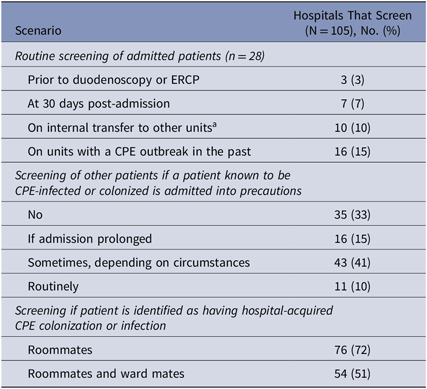
In total, 28 (27%) hospitals screened some patients routinely during hospital admission; a minority (n = 3, 3%) screened patients before duodenoscopy or endoscopic retrograde cholangiopancreatography (Table 2). If a patient was known to be CPE colonized at admission, 11 hospitals (11%) routinely screened patient contacts to determine whether transmission had occurred despite precautions, and an additional 59 hospitals (56%) screened patient contacts in some circumstances (Table 2). If a patient with hospital-acquired CPE was identified, 76 hospitals (72%) screened roommates and 54 (51%) screened ward mates (Table 2).
Screening of Patients Potentially Exposed to Patients With CPE Colonization or Infection at Acute-Care Hospitals in Ontario, 2018

Note. CPE, carbapenemase-producing Enterobacteriaceae; ERCP, endoscopic retrograde cholangiopancreatography.
a Units included intensive care (n = 6, 60%), transplant (n = 1, 10%), long-term care (n=3, 30%), and all (n = 3, 30%).
Precautions to prevent transmission
Almost all (n = 101, 96%) hospitals used specific precautions to prevent transmission from patients colonized or infected with CPE, which included contact precautions, accommodation in a private room, dedicated mobile equipment, restrictions to patient movement, and/or changes in bathing practices, room cleaning, or sink management (Table 3). Two hospitals (2%) did not recommend any such precautions, and 2 hospitals (2%) did not yet have a policy.
Number (%) of Hospitals That Used Specific Precautions for All Patients With CPE Colonization or Infection at Acute-Care Hospitals in Ontario, 2018

Note. CPE, carbapenemase-producing Enterobacteriaceae.
a Exceptions most commonly cited included receipt of physiotherapy (n = 18, 38%) or a necessary medical test or procedure (n = 19, 40%).
b Visitors were required to use precautions if performing direct patient care (n = 7, 78%), spending a significant amount of time in the patient room (n = 1, 11%), or visiting other areas of the hospital (n = 1, 11%).
Of the 101 hospitals that used precautions for patients with CPE colonization or infection, 54 (53%) never discontinued them (they were continued for the index and all subsequent admissions). Fourteen hospitals (14%) discontinued precautions at discharge (readmitted patients would require precautions only if screening at readmission yielded CPE); 3 hospitals (2%) discontinued precautions when the clinical site originally CPE positive became negative; and 26 hospitals (26%) discontinued precautions after CPE could not be identified from 3 consecutive rectal swabs. The remaining hospitals discontinued precautions on a case-by-case basis (n = 5, 5%) or had not yet determined when precautions could be discontinued (n = 4, 4%).
Environmental cultures for CPE
A minority of hospitals (n = 19, 18%) performed environmental cultures to identify CPE contamination. All of these hospitals tested sink drains for CPE contamination, and some tested shower drains (n = 16, 84%), sink surfaces (n = 7, 37%), toilets (n = 4, 21%), and surfaces in the patient environment (n = 3, 16%; eg, bedside tables, other high touch surfaces). Reasons for performing environmental cultures were to identify a reservoir for CPE (n = 7, 37%) or a source in a CPE outbreak (n = 6, 32%), and for research (n = 1, 5%); 5 hospitals (26%) did not specify a reason for these cultures. In addition, 6 hospitals (6%) reported having identified transmission of CPE from an environmental reservoir to a patient; at 5 of these hospitals, the reservoir was a sink and/or sink drain and at 1 hospital it was a shower drain.
CPE outbreaks
Eighty-nine hospitals (85%) reported having a predetermined definition for a CPE outbreak. These definitions included 1 possibly nosocomial case (n = 22, 26%), 1 definitely nosocomial case (n = 25, 24%), 2 nosocomial cases (n = 39, 37%), and 3 nosocomial cases (n = 3, 4%). Half of hospitals (51, 49%) reported that they would screen patients for colonization if they identified an outbreak.
Eight hospitals (8%) had declared a CPE outbreak at least once. The numbers of patients with CPE colonization or infection in the largest outbreak reported at each these 8 hospitals were as follows: 1 patient (n = 2, 25%), 2 patients (n = 2, 25%), 3 patients (n = 1, 13%), 4 patients (n = 1, 13%), and 6 patients (n = 2, 25%).
Differences in screening and management of patients by hospital characteristics
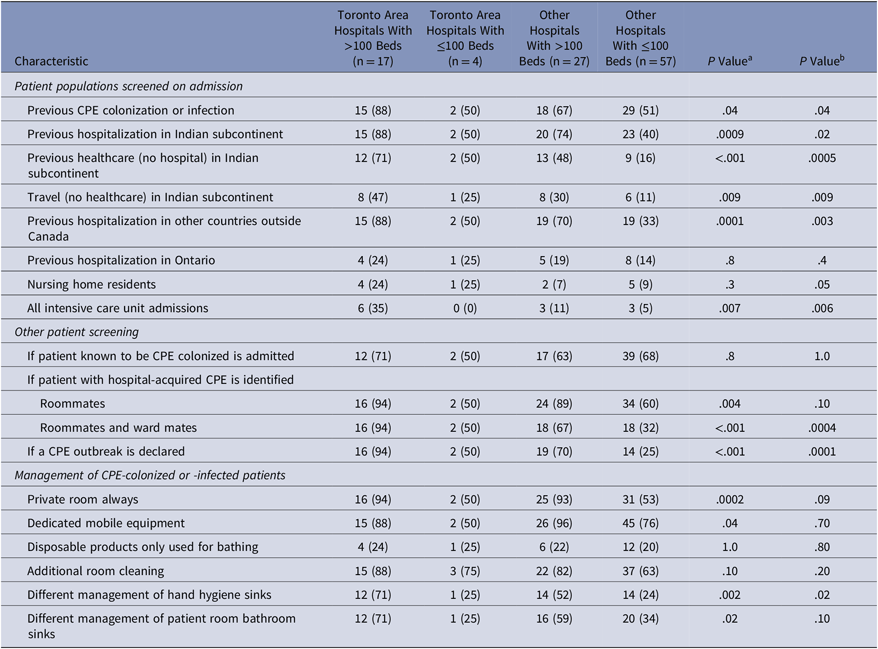
Larger hospitals (especially those located in the Toronto area) were significantly more likely to screen at-risk patients on admission, with the exception of those recently hospitalized in Ontario and nursing home residents. Larger hospitals were also significantly more likely to screen roommates and ward mates of a patient with hospital-acquired CPE (Table 4), and significantly more likely to require that patients colonized or infected with CPE be accommodated in a private room with dedicated mobile equipment and that hand hygiene and bathroom sinks in their rooms be managed differently (Table 4).
Hospital Characteristics Associated With Policies Related to Screening and Management of Patients With CPE Colonization or Infection at Acute-Care Hospitals in Ontario, Canada, 2018.

Note. CPE, carbapenemase-producing Enterobacteriaceae.
a Comparing all 4 groups.
b Comparing hospitals with >100 beds versus hospitals with ≤100 beds.
All 8 hospitals that had declared an outbreak at least once had >100 beds, and 6 of these hospitals (75%) were in the Toronto area. These hospitals were significantly more likely than other hospitals to screen at-risk patients on admission, to screen ward mates of a patient with hospital-acquired CPE, and to manage hand hygiene and bathroom sinks differently in rooms of patients with CPE (data not shown).
Cost and resource constraints
The admission screening program was reported to be limited by cost at 36 hospitals (34%); this proportion did not differ in hospitals of different size or geographic location or in hospitals that had or had not declared an outbreak (data not shown). If cost was not a limitation, patient populations that these hospitals would screen on admission included patients previously CPE colonized or infected (n = 23, 22%), patients exposed to hospitals in the Indian subcontinent (n = 23, 22%) and other countries (n = 16, 22%), patients exposed to Canadian hospitals (n = 13, 12%), Ontario nursing home residents (n = 9, 9%), all medical and surgical admissions (n = 19, 18%), all hospital admissions (n = 17, 16%), and all intensive care unit admissions (n = 10, 10%).
The investigation of potential CPE transmission was reported to be limited by cost at 24 hospitals (23%). If cost was not a limitation, these sites would include periodic point prevalence of some high-risk patients (eg, patients in the intensive care unit) (n = 10, 42%), screening of patients at some transfer points (eg, to or from the intensive care unit) (n = 12, 50%), more frequent screening of roommates (n = 17, 71%) and ward mates (n = 17, 71%) of exposed patients, and testing of sinks in rooms of patients with CPE colonization or infection (n = 17, 71%).
Discussion
This survey was administered to IPAC programs at all acute-care hospitals in Ontario to determine their practices for CPE. As hypothesized, the survey revealed variability in IPAC practices for CPE between hospitals. Most hospitals screened only patients who received healthcare abroad on admission, one-third of hospitals felt that their admission screening and investigation of CPE transmission were limited by cost, almost all hospitals used precautions for patients with CPE colonization or infection, and few hospitals performed environmental cultures.
CPE are emerging rapidly in Canada. Recent studies in 2 provinces showed that 40% of patients in Ontario and 44% of patients in British Columbia identified as CPE colonized or infected had no history of hospitalization outside of Canada or of high-risk travel.Reference Zhong, Faheem and Farooqi 8 , Reference Kohler, Melano and Patel 9 , Reference Sekirov, Croxen and Ng 17 In Ontario, most of these patients (including 55% and 67% of all patients with KPC- and VIM-producers, respectively) had been hospitalized in Canada.Reference Kohler, Melano and Patel 9 Despite these data suggesting acquisition and transmission of CPE in local hospitals, and recent studies reporting that transmission control programs which include screening patients with a history of local healthcare only is cost-effective in low-prevalence settings,Reference Lapointe-Shaw, Voruganti, Kohler, Thein, Sander and McGeer 18 , Reference Ho, Ng, Ip and You 19 only 17% and 21% of the hospitals surveyed screened patients if they had a history of hospitalization in Ontario and in Canada outside of Ontario, respectively. Existing Canadian and Ontario guidelines recommend screening patients with exposure to health care abroad but not those with exposure to Canadian healthcare, 10 , 11 which may explain these practices. This finding highlights the challenges of updating guidelines sufficiently frequently in the presence of emerging antimicrobial resistance. Screening and control programs for antimicrobial-resistant organisms are more likely to be successful if implemented when prevalence is low, 20 highlighting the urgent need to intensify IPAC measures to slow the spread of CPE in our local area.
Cost was not reported to be a major barrier in the implementation of admission screening programs, suggesting that most of our hospitals do not perceive CPE as a local threat, potentially because CPE are relatively rare in Canada. This perception may be misguided, given data showing that local issues with antimicrobial resistance often pose a larger absolute threat than antimicrobial resistance issues in other regions, even if the prevalence in those regions is significantly higher.Reference Donker, Henderson and Hopkins 21 It is possible that it would be more effective to focus on screening patients for CPE who have had exposure to Ontario hospitals than screening patients who have had exposure to countries where CPE are endemic. Given that our screening programs may be systematically failing to identify patients who have acquired CPE in Canadian hospitals, methods should be explored to ensure that these patients are identified when they are readmitted to or transferred between Canadian facilities.
Only half of hospitals reported that they would screen patients if an outbreak were declared, despite Canadian guidelines recommending periodic prevalence screening until 3 negative prevalence screens are obtained after the last new case. 10 Although this finding may be because most hospitals have yet to experience a CPE outbreak, it is concerning given the importance of screening and precautions in controlling CPE outbreaks.
Almost all hospitals reported using precautions to prevent transmission from patients with CPE colonization or infection, which is in accordance with guidelines. 10 – 12 Most sites never discontinued precautions, possibly because there is insufficient evidence for guidelines to make a recommendation. 10 Prolonged precautions are likely to increase stigma and decrease quality of care for patients,Reference Tran, Bell and Stall 22 – Reference Dashiell-Earp, Bell, Ang and Uslan 25 emphasizing the need to better understand the natural history of colonization with CPE.
Published literature suggests that the hospital water environment (eg, sinks and shower drains) may be a reservoir for CPE and other resistant gram-negative pathogens.Reference Lowe, Kus and Salt 26 – Reference Johnson, Deming and Conlan 29 In keeping with this, 6 hospitals in our survey reported identifying transmission of CPE from sinks and/or sink drains to patients. However, only 18% of the hospitals surveyed performed cultures of the water environment to detect CPE contamination. Furthermore, only one-third of sites managed sinks differently in rooms of patients with CPE colonization or infection, despite provincial guidelines 10 , 30 suggesting that consideration should be given to performing mechanical, chemical, and/or heat cleaning regularly during the patient’s stay and at discharge. These guidelines also suggest testing exposed drains at discharge. Given that the hospital water environment remains largely unmonitored in Ontario hospitals, it may eventually become a persistent reservoir for CPE.
Hospitals that had reported outbreaks, larger hospitals, and hospitals located in the Toronto area were significantly more likely than smaller hospitals (≤100 beds) to perform admission screening or screening of at-risk patient populations. Nonetheless, 60% of smaller hospitals, and one-fifth of larger hospitals in Ontario reported not screening patients with a recent history of hospitalization in the Indian subcontinent. Cost was not reported to be a major barrier, and additional data are needed to understand why hospitals have elected not to follow recommendations.
This study has several limitations. It includes data from a single Canadian province at a single point in time and does not reflect practices in other jurisdictions or at other times. We asked only about policies; we did not attempt to assess how well they were implemented. Among the 39% of sites that did not perform admission screening on patients previously known to be colonized or infected with CPE, we did not ask whether these patients were automatically placed on contact precautions. Most hospitals have not yet identified outbreaks, and when transmission is detected, actual practice may differ from the planned practice reported by the survey. Outbreaks were self-reported, definitions were variable, and many hospitals were not actively screening to detect transmission of CPE; thus, we were unable to reliably capture the frequency of transmission of CPE. However, as of May 1, 2018, CPE became reportable in Ontario, and definitions for CPE outbreaks are now in place so that reporting will be standardized moving forward. 31 This survey was cross sectional, and we were unable to determine whether hospitals identified outbreaks because they were more actively screening or whether the identification of an outbreak resulted in more patient screening subsequently. We did not ask for details of reported sink and/or drain transmission to patients, so we were unable to assess the quality of evidence that such transmission occurred. Finally, some IPAC programs had not made decisions about particular issues or reported making decisions on a case-by-case basis, which limited our understanding of actual management of patients.
In summary, results from this survey revealed variability in IPAC practices for CPE in acute-care hospitals in Ontario, Canada. This variability is at least in part driven by the lack of evidence for best practices for CPE, which emphasizes the urgent need for research in this area. Despite evidence of cost-effectiveness for control programs implemented early in CPE emergence, most hospitals in Ontario have not implemented such programs and may not appreciate the need for them locally. A province- or country-wide, coordinated approach to CPE prevention and control may be necessary to prevent CPE from becoming endemic in our hospitals.
Supplementary material
To view supplementary material for this article, please visit https://doi.org/10.1017/ice.2019.173.
Acknowledgments
We would like to thank the infection prevention and control professionals and physicians who responded to this survey.
Financial support
Alainna J. Jamal is supported by the Government of Canada Vanier Canada Graduate Scholarship. No external funding was received for this study.
Conflicts of interest
All authors report no conflicts of interest related to this article.