Introduction
Psychosis is characterized by problems in interpersonal functioning and distrust towards others (Couture et al. Reference Couture, Penn and Roberts2006; Fett et al. Reference Fett, Shergill, Joyce, Riedl, Strobel, Gromann and Krabbendam2012). Trust is an essential component of successful social interactions and until recently has been difficult to probe experimentally. With the adaption of interactive paradigms from game theory into psychiatric research it became possible to experimentally study trust as a mechanism of social dysfunction in psychopathology (Sharp et al. Reference Sharp, Ha and Fonagy2011, Reference Sharp, Monterosso and Montague2012; Fett et al. Reference Fett, Shergill and Krabbendam2014b ). In the trust game the first player (investor) receives an endowment from the experimenter and can then decide whether to share part of that amount with the second player (trustee; Berg et al. Reference Berg, Dickhaut and McCabe1995). The shared amount is tripled and sent to the trustee, who then decides whether to honour the investor's trust (i.e. send part of the money back) or not (i.e. keep all or most of it). For the trustee, the highest earnings are obtained by keeping the money. Thus, sharing money in the first place requires the investor's trust in the benevolence of the trustee. Recent trust game research showed lower levels of trust in adult patients with non-affective psychosis and healthy first-degree relatives with an increased genetic risk of the disorder, compared to controls. Furthermore, lower trust was associated with higher levels of positive psychotic symptoms. Relatives and controls increased their trust when they learned that their counterpart behaved in a trustworthy manner. Suggestive of a reduced sensitivity to positive social information there was no effect on patients’ trust (Fett et al. Reference Fett, Shergill, Joyce, Riedl, Strobel, Gromann and Krabbendam2012; Gromann et al. Reference Gromann, Heslenfeld, Fett, Joyce, Shergill and Krabbendam2013, Reference Gromann, Shergill, de Haan, Meewis, Fett, Korver-Nieberg and Krabbendam2014).
Anomalous trust and social dysfunction might be rooted in insecure attachment (Fonagy et al. Reference Fonagy, Gergely and Target2007). Attachment styles reflect individual differences in beliefs about relationships. They are thought to emerge from early experiences with primary caregivers, which lead to the formation of internal working models of others and the social world and function as guidance for social behaviour in interpersonal situations later in life (Sroufe et al. Reference Sroufe, Carlson, Levy and Egeland1999). Attachment is typically classified as secure or insecure. Secure attachment comprises a positive view of the self and others. Insecure attachment comprises two underlying dimensions: (1) attachment anxiety, which is characterized by a rather positive view of others and a negative view of the self, and (2) attachment avoidance, which refers to a negative view of others and a positive view of the self (Berry et al. Reference Berry, Barrowclough and Wearden2007, Reference Berry, Barrowclough and Wearden2008; Korver-Nieberg et al. Reference Korver-Nieberg, Berry, Meijer and Haan2013). Attachment avoidance is thought to reduce social approach behaviour and attachment anxiety has been connected to profound worries about being liked by others (Shaver & Mikulincer, Reference Shaver and Mikulincer2002).
To date there is surprisingly little research on the link between trust and attachment. In the general population higher levels of trust towards partners have been found in securely attached individuals and secure attachment has been associated with superior coping with trust violations, higher levels of trust in work settings and more prosocial behaviour. In addition, secure attachment has been linked to higher trust and cooperation in interactions with strangers in experimental settings (Van Lange et al. Reference Van Lange, De Bruin, Otten and Joireman1997; Mikulincer, Reference Mikulincer1998; Simmons et al. Reference Simmons, Gooty, Nelson and Little2009; De Dreu, Reference De Dreu2012; McClure et al. Reference McClure, Bartz and Lydon2013). Other research has confirmed that trust related characteristics, such as honesty and openness are promoted by attachment security (Gillath et al. Reference Gillath, Sesko, Shaver and Chun2010) and that a secure attachment style is associated with a greater reliance of children in their mothers, which might reflect greater trust (Corriveau et al. Reference Corriveau, Harris, Meins, Fernyhough, Arnott, Elliott, Liddle, Hearn, Vittorini and de Rosnay2009). More evidence for the putative link between attachment and trust comes from research showing that in relationships between patient and physicians lower levels of trust were attachment dependent and associated with greater emotional distress and more physical limitations (Holwerda et al. Reference Holwerda, Sanderman, Pool, Hinnen, Langendijk, Bemelman, Hagedoorn and Sprangers2013; Hinnen et al. Reference Hinnen, Pool, Holwerda, Sprangers, Sanderman and Hagedoorn2014).
These findings suggest that securely attached individuals hold more positive beliefs about others and that this could account for stronger affiliative behaviour in a variety of social settings, including close but also more distant social relationships.
The rates of insecure attachment are higher in individuals with psychosis than in the healthy population and individuals with other psychiatric conditions (Berry et al. Reference Berry, Barrowclough and Wearden2007). As such, attachment theory may offer a useful explanatory framework for understanding deficits in trust and social functioning in psychosis. Previous research in patients with psychosis has linked attachment insecurity to interpersonal dysfunction, poorer engagement with services (Gumley et al. Reference Gumley, Taylor, Schwannauer and MacBeth2013), poorer social and individual living skills and higher levels of inappropriate community behaviour (Couture et al. Reference Couture, Lecomte and Leclerc2007). Insecure attachment has also been associated with (subclinical) symptoms of psychosis, in both studies with patients and healthy individuals with high levels of schizotypy (Berry et al. Reference Berry, Wearden, Barrowclough and Liversidge2006; Liotti & Gumley, Reference Liotti and Gumley2008; Read & Gumley, Reference Read and Gumley2008). Cognitive models of psychosis propose that negative beliefs about others, which are characteristic of attachment insecurity, could play a role in their instantiation and maintenance (Garety et al. Reference Garety, Kuipers, Fowler, Freeman and Bebbington2001; Freeman et al. Reference Freeman, Garety, Kuipers, Fowler and Bebbington2002). Accordingly, specifically attachment avoidance may drive social withdrawal and paranoia. Attachment anxiety is characterized by a heightened sensitivity to interpersonal threat, which may increase psychotic symptoms. Associations between insecure attachment and higher levels of positive symptoms (Berry et al. Reference Berry, Wearden, Barrowclough and Liversidge2006, Reference Berry, Barrowclough and Wearden2008; MacBeth et al. Reference MacBeth, Schwannauer and Gumley2008; Meins et al. Reference Meins, Jones, Fernyhough, Hurndall and Koronis2008; Pickering et al. Reference Pickering, Simpson and Bentall2008; Kvrgic et al. Reference Kvrgic, Beck, Cavelti, Kossowsky, Stieglitz and Vauth2012) and negative symptoms have been established (Gumley et al. Reference Gumley, Taylor, Schwannauer and MacBeth2013; Korver-Nieberg et al. Reference Korver-Nieberg, Berry, Meijer and Haan2013).
Attachment styles are formed early in life and have a long lasting impact. Accordingly, early negative experiences and adverse events during childhood might explain subsequent social cognitive, emotional and behavioural problems that could increase the risk for psychotic symptoms (Read & Gumley, Reference Read and Gumley2008; Gumley et al. Reference Gumley, Schwannauer, Macbeth, Fisher, Clark, Rattrie, Fraser, McCabe, Blair, Davidson and Birchwood2014). However, attachment also fluctuates in response to negative life events (Weinfield et al. Reference Weinfield, Whaley and Egeland2004; Zhang & Labouvie-Vief, Reference Zhang and Labouvie-Vief2004). Hence, it is possible that repeated negative social experiences, such as stigma or being in care increase attachment insecurity during the course of psychosis. The early stages of psychosis are therefore particularly interesting to investigate the association between attachment, symptoms and social dysfunction; yet, to date there has been little research. Higher levels of attachment avoidance and anxiety have been found in first-episode psychosis patients (FEP) compared to healthy controls and it has been shown that attachment anxiety contributes to social dysfunction (Couture et al. Reference Couture, Lecomte and Leclerc2007; MacBeth et al. Reference MacBeth, Gumley, Schwannauer and Fisher2011). MacBeth et al. (Reference MacBeth, Gumley, Schwannauer and Fisher2011) found that patients’ attachment styles were unrelated to psychotic symptoms and a recent longitudinal study in FEP showed that attachment insecurity predicts the recovery from negative symptoms (Gumley et al. Reference Gumley, Schwannauer, Macbeth, Fisher, Clark, Rattrie, Fraser, McCabe, Blair, Davidson and Birchwood2014). In sum, some evidence associates attachment style with social dysfunction, but the evidence on the relationship between attachment and symptoms in FEP is mixed.
The aims of this study were twofold: (1) to investigate whether basic trust and the ability to adapt trust during social interactions is reduced in individuals with early psychosis compared to controls; and (2) to investigate whether potential differences are explained by attachment avoidance and attachment anxiety. Thirty-nine adolescents with early psychosis and 100 controls played two multi-round trust games. Psychosis has been associated with a differential sensitivity (i.e. learning responses) after the provision of positive and negative feedback (Strauss et al. Reference Strauss, Waltz and Gold2013). We therefore investigated interactions with a cooperative and an unfair game partner. Specifically, we investigated basic trust towards others (initial investments), the changes of trust (increase/decrease of investments) over repeated interactions and the associations of both with attachment style. In the trust games higher trust (i.e. investments) signals the desire to affiliate, whereas lower trust indicates self-protective behaviour. We hypothesized that patients would show lower basic trust than controls. Research suggests that cognitive biases are more flexible during the early stages of the disorder (Dudley et al. Reference Dudley, Daley, Nicholson, Shaftoe, Spencer, Cavanagh and Freeston2013). We therefore expected that the patients would increase their trust during interactions with a cooperative counterpart. Due to an elevated sensitivity to negative feedback, we expected lower trust in patients than in controls in interactions with the unfair partner. We hypothesized that group differences in trust would partly be accounted for by higher levels of attachment avoidance or attachment anxiety in patients. Finally, we explored the association between trust, symptoms and attachment style in patients. Based on previous research findings and cognitive models of psychosis we expected that lower levels of trust and higher levels of attachment avoidance and anxiety would be associated with higher levels of positive psychotic symptoms.
Method
Participants
The sample included 100 healthy adolescents and 39 adolescents with early psychosis. Informed consent was obtained from all adolescents and their parents/guardians if they were under 16 years. The study was approved by the South West London REC. Inclusion criteria for patients consisted of (1) age between 13 and 19 years, (2) having experienced a psychotic episode according to ICD-10 criteria (WHO, 1992), as diagnosed by their clinician (for diagnoses see Supplementary material, section 1), (3) good command of the English language and (4) being able and willing to give written informed consent. Additional inclusion criteria for the control group were (5) no psychiatric diagnosis, including a personal or family history of a psychosis. Patients were recruited via consultant psychiatrists and the Mental Health Research Network in the SLAM, Oxleas, NELFT and SEPT NHS Foundation Trusts. Control participants were recruited from local schools, the Institute of Psychiatry volunteer database ‘Mindsearch’, via colleagues and previous participants. For the controls, a telephone screening was completed to ensure that there were no psychiatric diagnoses within this group.
Instruments
The trust game
All participants played two trust games, each consisting of 20 game rounds. They were told that they were playing with two anonymous human counterparts. However, in reality two probabilistic computer algorithms were used to model the counterparts, one reflecting a cooperative and one reflecting an unfair decision-making style. Participants took the investor role throughout both games. In each game round they had to transfer an (integer) amount between £0 and £10 to the trustee. The transferred amount was tripled and the subsequent trustee repayment depended on the previous investments and the computer algorithm (see Supplementary material, section 2).
Attachment
Attachment style was assessed with the ‘Psychosis Attachment Measure’ (PAM; Berry et al. Reference Berry, Wearden, Barrowclough and Liversidge2006), a 16-item questionnaire that is rated on 4-point scales ranging from 0 ‘not at all’ to 4 ‘very much’. The PAM has a good reliability and validity (Berry et al. Reference Berry, Wearden, Barrowclough and Liversidge2006, Reference Berry, Barrowclough and Wearden2008; Wearden et al. Reference Wearden, Peters, Berry, Barrowclough and Liversidge2008). Cronbach alphas in the current sample reflect a good to acceptable internal consistency (anxiety subscale α = 0.79; avoidance subscale α = 0.67).
Symptom assessment
Positive and Negative Syndrome Scale (PANSS; Kay et al. Reference Kay, Fiszbein and Opler1987)
The PANSS was used to assess symptoms during 2 weeks prior to testing on a scale ranging from 1 (absent) to 7 (extreme), which represents increasing levels of psychopathology. It consists of a positive, negative and general symptoms scale. The PANSS was only completed for the adolescents with early psychosis and not for the healthy controls.
Green Paranoid Thoughts Scale (GPTS; Green et al. Reference Green, Freeman, Kuipers, Bebbington, Fowler, Dunn and Garety2008)
The GPTS measures ‘social reference’ and ‘persecution’ paranoia with 16 items each that are answered on scales ranging from 1 (‘not at all’) to 5 (‘totally’). The GPTS has a high internal consistency and test–retest reliability and the indices in the current sample reflect a good internal consistency (social reference paranoia α = 0.87, persecution paranoia α = 0.88).
Neuropsychological assessment
The vocabulary subtest of the Wechsler Abbreviated Scale of Intelligence (WASI; Wechsler, Reference Wechsler1999) was used as indicator of general estimated cognitive ability.
Procedure
Participants were tested individually. They were assessed on the WASI vocabulary subtest, the PANSS (patients only), GPTS and PAM and took part in the trust games subsequently. Before the trust game participants were given detailed written information about the procedure and two game rounds were illustrated by means of examples. The experimenter explained the game and asked comprehension questions to ensure that all participants fully understood how it works. Participants were told that their game partners were in a different location and that they would interact via the internet. Fifty controls and 22 patients completed the trust games in an MRI scanner and 50 controls and 17 patients completed them outside the scanner. Only some of the participants completed the trust games in the MRI scanner, as this was part of a larger study investigating underlying neural processes. Being in a scanner or not had no impact on the participants’ behaviour during the trust games. Participants completed a questionnaire about their perception of the game partner at the end of the testing session. Thirty-three percent of the participants did not doubt that they were playing with real people, 53% said they had occasional doubts, and 14% indicated that they had strong doubts about whether they were interacting with real people. Finally, the earnings from one randomly selected round of the trust game were paid out to the participants in addition to the participation fee.
Data analysis
The analysis was conducted in Stata v. 13 (StataCorp., USA). First, differences between the patient and the control group in social demographics, estimated cognitive ability, attachment style and social reference, and persecutory paranoia were analysed with χ2 tests or regression analyses.
Second, we analysed group differences in the first investments across the two trust game conditions (basic trust) and the development of investments (changes in trust) across repeated interactions with each game partner. We used multilevel random regression analyses (XTREG), to account for multiple observations [investments (level 1); within participants (level 2)]. To simplify the investigation of changes in trust across the repeated game rounds we divided each game into four blocks of five game rounds. Attachment style was added to the regression model to assess its impact on group differences in trust. Age, gender, estimated cognitive ability and the degree of belief in the experimental manipulation were controlled in all between-group analyses.
Finally, associations between attachment and symptom levels were investigated within patients by means of simple regression analyses. Associations between attachment and trust were analysed with multilevel random regression analyses.
Results
Sample characteristics
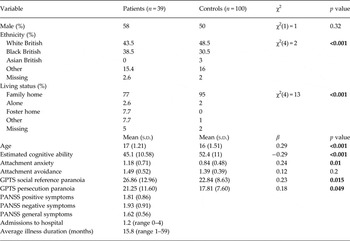
Patients were older and had a lower estimated cognitive ability than controls. The groups differed significantly in ethnicity and living status. Patients had significantly higher levels of attachment anxiety than controls, but there were no group differences in attachment avoidance. Social reference and persecution paranoia were higher in patients than controls (see Table 1).
Sample characteristics

GPTS, Green Paranoid Thought Scale; PANSS, Positive and Negative Syndrome Scale.
Significant values are given in bold.
Group differences in trust and the effect of attachment avoidance and anxiety
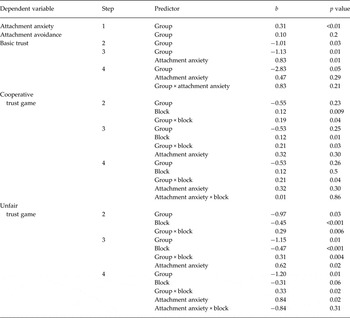
The groups did not differ in attachment avoidance and only attachment anxiety was included as potential explanatory factor of group differences in trust. For the analysis results see Table 2.
Regression analyses

All analyses were controlled for age, gender, estimated cognitive ability and degree of belief in the experimental manipulation.
Basic trust
Patients made significantly lower initial investments than controls (mean = 4.92, s.d. = 3.0 v. mean = 5.85, s.d. = 2.86). The effect became stronger when attachment anxiety was added to the model. Attachment anxiety was significantly and positively associated with initial investments. There was no significant attachment anxiety by group interaction.
Cooperative interactions
Changes in trust
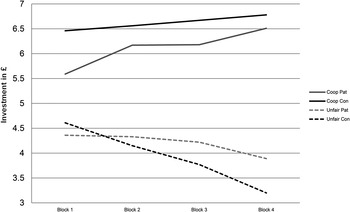
Main effects of group and block were qualified by a significant interaction, which remained significant when attachment anxiety was added to the model. The attachment anxiety by block interaction was not significant, i.e. attachment anxiety did not explain change in investments. Analyses by group showed a stronger association between block and investments in patients than controls (patients: b = 0.29, p < 0.001; controls: b = 0.11, p < 0.01, see Fig. 1).
The development of trust (in £) across interactions by group and condition. Coop, cooperative partner; Unfair, unfair partner; Pat, patient; Con, control. Each block represents average investments of five game rounds.

Unfair interactions
Changes in trust
Main effects of group and block were qualified by a significant interaction, which became stronger and remained significant when attachment anxiety was added to the model. The attachment anxiety by block interaction was not significant, i.e. attachment anxiety did not explain change in investments. Analyses by group showed a weaker, negative association between block and investments in patients than controls (patients: b = −0.19, p < 0.05; controls: b = −0.46, p < 0.00, see Fig 1).
Within patient analyses
Symptoms and trust
There were no significant associations between initial or average investments and PANSS positive symptoms (b = −0.67), social reference (b = 0.03), or persecution paranoia (b = 0.001, all p > 0.14). Higher negative symptoms were significantly associated with lower initial investments (b = −1.03, p = 0.009) and lower average investments towards the cooperative (b = −0.81, p = 0.01) and the unfair game partner (b = −0.64, p = 0.03). Interactions between block, positive and negative symptoms, social reference and persecution paranoia were non-significant during interactions with both game partners (all p > 0.18), i.e. symptoms were unrelated to change in investments.
Symptoms and attachment
Associations between attachment anxiety and PANSS positive and negative symptoms were non-significant (β = 0.17 and −0.19, both p > 0.26). Attachment anxiety was significantly associated with social reference (β = 0.70, p < 0.001) and persecution paranoia (β = 0.49, p < 0.001). Attachment avoidance was marginally significantly associated with PANSS positive symptoms (β = 0.29, p = 0.08), and significantly associated with higher social reference (β = 0.52, p < 0.001) and persecution paranoia (β = 0.43, p < 0.001), but not with negative symptoms (β = 0.07, p = 0.64).
Discussion
The current study is the first to use the trust game to examine interpersonal trust and the explanatory role of attachment style in early psychosis. Our results showed reduced basic trust towards others in adolescent patients compared to healthy controls. As expected, patients had higher levels of attachment anxiety than controls; however the groups did not differ in attachment avoidance. Therefore, only attachment anxiety was considered as explanatory factor of group differences in trust. Against our expectations, attachment anxiety was associated with higher basic trust and did not account for group differences in trust. Patients and controls increased their trust during repeated interactions with the cooperative game partner and patients reached levels of trust similar in magnitude to those of controls. During interactions with the unfair partner in contrast patients decreased their levels of trust less than controls. Again, attachment anxiety did not account for these group differences.
Trust and the explanatory value of attachment style
The finding of reduced basic trust in early psychosis is in line with research in adults with chronic psychosis and healthy first-degree relatives of patients, who have an increased genetic risk for the disorder (Fett et al. Reference Fett, Shergill, Joyce, Riedl, Strobel, Gromann and Krabbendam2012; Gromann et al. Reference Gromann, Heslenfeld, Fett, Joyce, Shergill and Krabbendam2013). This suggests that reduced trust is related to the risk for psychosis. However, the young patients were sensitive to positive social signals and learned to trust, as indicated by increasing investments during cooperative interactions. Previous research in non-social settings showed that patients have a normal sensitivity to negative feedback and a reduced sensitivity to positive feedback (Strauss et al. Reference Strauss, Waltz and Gold2013), and that adults with chronic psychosis are also less sensitive to positive social cues (Fett et al. Reference Fett, Shergill, Joyce, Riedl, Strobel, Gromann and Krabbendam2012). In sum, this might suggest that the sensitivity to positive social signals is still intact in the early stages of psychosis.
Patients were less reactive to trust violations by the unfair partner than controls. Previous research showed that patients also had a higher acceptance of unfair offers in the ultimatum game than controls (Csukly et al. Reference Csukly, Polgár, Tombor, Réthelyi and Kéri2011; Wischniewski & Brüne, Reference Wischniewski and Brüne2011). Reduced basic trust and a lower propensity to adapt to malevolent behaviour have been associated with lower perspective-taking (Fett et al. Reference Fett, Shergill, Gromann, Dumontheil, Blakemore, Yakub and Krabbendam2014a ), which is also prevalent in psychosis (Sprong et al. Reference Sprong, Schothorst, Vos, Hox and van Engeland2007). Accordingly, this finding might reflect a reduced understanding of others’ intentions. However, another possible explanation might be that patients have a reduced inclination for altruistic punishment, i.e. the retribution of unfair treatment by others (Boyd et al. Reference Boyd, Gintis, Bowles and Richerson2003; Csukly et al. Reference Csukly, Polgár, Tombor, Réthelyi and Kéri2011).
We expected to see higher attachment avoidance and attachment anxiety in patients than in controls and that this would partly account for patients’ reduced basic trust and a reduced ability to learn to trust in response to trustworthy others. Against our expectations the groups did not differ in attachment avoidance. Attachment avoidance reflects the aim to minimize the need for others and is measured by items such as ‘I try to cope with stressful situations on my own’. Attachment avoidance scores in healthy adolescents in the current sample were substantially higher than attachment anxiety scores and attachment avoidance ratings of healthy adults (Pos et al. Reference Pos, Bartels-Velthuis, Simons, Korver-Nieberg, Meijer, de Haan, Bruggeman, Cahn, Kahn and Myin-Germeys2014). Adolescence is a period of major relationship changes with parents and peers that is characterized by increasing independence. A possible explanation for high attachment avoidance in controls might be that it reflects a normal developmental push for autonomy (Harrop, Reference Harrop2002; McElhaney et al. Reference McElhaney, Allen, Stephenson, Hare, Lerner and Steinberg2009). In controls, the need to express independence from others may decrease with increasing age when they successfully attained a sense of agency and ownership over their own lives. Due to the disrupting effect of their disorder, those affected by psychosis may show a disturbed development, characterized by continued struggle for autonomy and higher attachment avoidance in adulthood (Harrop & Trower, Reference Harrop and Trower2001).
Attachment anxiety was substantially higher in patients than controls. It reflects concerns such as ‘If other people disapprove of something I do, I get very upset’ or ‘I worry that if I displease other people, they won't want to know me anymore’. Adolescents with high attachment anxiety often have poor self-concepts (Cooper et al. Reference Cooper, Shaver and Collins1998). Also, psychosis in adolescence is frequently accompanied by decreased self-esteem (Guillon et al. Reference Guillon, Crocq and Bailey2003) and anxiety about discord with others (Harrop & Trower, Reference Harrop and Trower2001). Thus, being affected by a severe mental disorder may further increase concerns about being accepted. We found that higher attachment anxiety was associated with higher basic trust and higher trust during interactions with the unfair partner. Individuals with high attachment anxiety are thought to have a strong desire for closeness and acceptance, combined with a fear of rejection (Berry et al. Reference Berry, Barrowclough and Wearden2007). Thus, our findings might reflect the wish to affiliate and to be liked, as opposed to self-protection. Importantly, our findings showed that attachment anxiety did not account for the group differences in trust between patients and controls, i.e. it explained trusting behaviour independent of illness status.
Associations between attachment, trust and symptoms
Unlike expected, basic trust and positive symptoms, persecution or social reference paranoia were unrelated. Only higher levels of negative symptoms were significantly associated with reduced (basic) trust. In the light of this, reduced trust in the early stages of psychosis could be explained by lack of social motivation, rather than paranoia and suspiciousness. Kéri et al. (Reference Kéri, Kiss and Kelemen2009) suggested that negative symptoms in schizophrenia may reflect the inability to accept risk in social interactions in a trust-related task that involved sharing of secrets. Their research also presented initial evidence suggesting that lower oxytocin levels in patients might be an underlying mechanism linking negative symptoms to lower levels of trust (Kéri et al. Reference Kéri, Kiss and Kelemen2009).
These findings are particularly interesting because other studies have shown that oxytocin increases trust in social interactions in healthy individuals (Kosfeld et al. Reference Kosfeld, Heinrichs, Zak, Fischbacher and Fehr2005). Yet, the effect of oxytocin seems to be dependent on attachment style. For example, negative effects of administered oxytocin on trust and cooperation in the trust game have been reported in borderline patients with insecure attachment styles and experiences of childhood trauma (Bartz et al. Reference Bartz, Simeon, Hamilton, Kim, Crystal, Braun, Vicens and Hollander2011; Ebert et al. Reference Ebert, Kolb, Heller, Edel, Roser and Brune2013). Other studies showed that participants who experienced childhood trauma, which is often linked to insecure attachment, have increased plasma oxytocin in response to social stress (Pierrehumbert et al. Reference Pierrehumbert, Torrisi, Laufer, Halfon, Ansermet and Beck Popovic2010; Seltzer et al. Reference Seltzer, Ziegler, Connolly, Prososki and Pollak2014). Kiss and colleagues further reported that oxytocin secretion was particularly increased during trust related interactions in individuals with anxious attachment (Keri & Kiss, Reference Keri and Kiss2011; Kiss et al. Reference Kiss, Levy-Gigi and Kéri2011). These findings point towards complex association between attachment anxiety, trust and symptoms, which may partly be explained by oxytocin function and which would be of great interest for future investigations.
We found no significant associations between symptoms and the ability to adapt trust during repeated interactions. It could be argued that this might be due to the low symptom levels in our sample. Yet, slightly higher symptoms in the present adolescent sample compared to the adult sample in our previous research suggests otherwise (Fett et al. Reference Fett, Shergill, Joyce, Riedl, Strobel, Gromann and Krabbendam2012). Alternatively, rigid belief systems and the inability to modify trust might be specifically associated with residual symptoms in the more chronic stages of the disorder. The current sample was heterogeneous and included individuals with affective and non-affective psychosis. An alternative explanation for the absent association between symptoms and the ability to adapt to others could be that this association is only present in the schizophrenia spectrum.
Positive symptoms were marginally significantly associated with higher attachment avoidance, with a medium effect size, similar to those reported in adult samples (Berry et al. Reference Berry, Barrowclough and Wearden2008). In line with other studies in FEP there were no significant associations between PANSS positive symptoms and attachment anxiety and negative symptoms and both, anxious and avoidant attachment (MacBeth et al. Reference MacBeth, Gumley, Schwannauer and Fisher2011). The robust associations between attachment anxiety and the specific measures of social reference and persecution paranoia could suggest that the absence of the relationship with the PANSS positive scale is due to the nature of the measure, which also includes other features such as hostility, that appear to be closer to attachment avoidance. Persecution paranoia was relatively strongly associated with both dimensions of attachment avoidance and anxiety. Not surprisingly, social reference paranoia, which refers to concerns about affiliation and being judged (e.g. ‘I have been upset by friends and colleagues judging me critically’ or ‘I spend time thinking about friends gossiping about me’) was more strongly associated with attachment anxiety (0.70) than attachment avoidance (0.52).
The current findings have to be interpreted in the light of some limitations. First, the patient sample had heterogeneous diagnoses. This could have led to issues in detecting associations between trust, attachment style and symptoms that are specific to affective or non-affective psychoses. Future research should include larger samples of each group to investigate differential effects. Second, the PAM was developed for adults and has not been validated for the use in adolescents. However, the questionnaire was designed to be easy to administer; including simple answer scales with exclusively positively worded items and it seems unlikely that the adolescents did not understand the questions. Third, it is possible that the social interaction in the cooperative trust game may not have activated the attachment system sufficiently and that attachment therefore had no effect in this condition. Research by Balliet & Van Lange (Reference Balliet and Van Lange2013) found that trust matters most when there is a large conflict of interest. It is unlikely that cooperation elicits feelings of conflict. However for future studies, it would be important to investigate the emotional responses to the respective experimental tasks to ensure that these sufficiently activate the attachment system. Fourth, it is important to consider that the trust game may not elicit the same social processes as face-to-face contacts, which are influenced by a range of factors such as gender, age or looks; or experimental paradigms that probe intimate social interactions (Kéri et al. Reference Kéri, Kiss and Kelemen2009, Reference Keri and Kiss2011). However, to date few studies investigated the role of attachment during anonymous social interactions (Van Lange et al. Reference Van Lange, De Bruin, Otten and Joireman1997; McClure et al. Reference McClure, Bartz and Lydon2013). With regard to the anonymous nature of the trust game it is important to consider that attachment has mostly been viewed as important for relationship phenomena that involve significant others. Yet, this and previous investigations on attachment in the context of relationship formation have shown that it is not only important for close relationships, but that it also impacts upon behaviour towards unknown others in minimally defined situations (Van Lange et al. Reference Van Lange, De Bruin, Otten and Joireman1997; Roisman, Reference Roisman2006; McClure et al. Reference McClure, Bartz and Lydon2013).
Conclusion
Patients with early psychosis have reduced basic trust but adapt their trust in response to others’ positive social signals. This suggests that the early stages of the disorder could present a window of opportunity for interventions that aim to keep the behavioural flexibility towards others and social functioning intact. While attachment anxiety seems to be important for trusting behaviour, it does not account for differences in trust between patients and controls. The fact that patients’ symptoms were associated with higher attachment anxiety, but not with lower levels of trust suggests a complex relationship that may be explained by other factors. Oxytocin function (Insel & Young, Reference Insel and Young2001; Kapur et al. Reference Kapur, Mizrahi and Li2005; Kéri et al. Reference Kéri, Kiss and Kelemen2009; Bakermans-Kranenburg & van Ijzendoorn, Reference Bakermans-Kranenburg and van Ijzendoorn2011; De Dreu, Reference De Dreu2012), for example has been linked to attachment, trust and psychosis and can interact with the (social) environment, for instance through experiences of early trauma (Strathearn et al. Reference Strathearn, Fonagy, Amico and Montague2009).
Supplementary material
For supplementary material accompanying this paper visit http://dx.doi.org/10.1017/S0033291716000015.
Acknowledgements
The authors thank the MHR support team, the clinical studies officers at NELFT, SEPT, SLAM and OXLEAS; the consultant psychiatrists Partha Banerjea, Uttom Chowdhury, Philip Collins, Sophia Frangou, Giovanni Giaroli, Daniel Hayes, Kah Mirza, Viviana Porcari, Kurinji Semmanpalayam, Derek Tracy and the local schools for their help with the recruitment of the participants.
Anne-Kathrin Fett: supported by a Netherlands Organization for Scientific Research (NWO) VENI grant 451-13-03 and a NARSAD Young Investigator Grant from the Brain & Behaviour research Foundation (24138); Lydia Krabbendam: supported by a NWO VICI grant 453-11-005. Sukhi Shergill: supported by a Medical Research Council New Investigator Award Project grant 93641 and an ERC Consolidator Award.
Declaration of Interest
None.