1 Introduction
On the basis of English data, this article explores the nature of the relationship between the possibility of preposition stranding under wh-movement and the availability of ellipsis alternation. Merchant (Reference Merchant2001: 107) was the first to notice this relationship, and he formulates it as the Preposition Stranding Generalization (PSG) in (1):
-
(1) A Language L will allow preposition-stranding under sluicing iff L allows preposition stranding under regular WH-movement.
The PSG refers to the elliptical construction sluicing, where a wh-phrase is left stranded and has an overt correlate in the antecedent clause (Ross Reference Ross, Binnick, Davison, Green and Morgan1969), as shown in (2)–(3). The stranded wh-phrases (remnants) and their correlates are marked in bold. Note that in the type of sluicing the PSG captures, the correlate is always a prepositional phrase (PP). This allows an alternation between two realizations of the remnant: either as a PP hosting the preposition present in the correlate, or as an NP lacking this preposition. Let us term this alternation ellipsis alternation.
-
(2) Katie is staying in Paris with someone, but I don't know with who/who.
-
(3)
-
A: I'm counting on my other friends.
-
B: On which other friends? /Which other friends?
-
The PSG intends to capture an apparently categorical split between languages allowing preposition stranding in interrogative clauses and those not allowing it. The availability of ellipsis alternation follows from movement and deletion operations possible only in the former kind of language. Both (4) and (5) can be derived in English through movement of the wh-phrase, with or without the preposition, to clause-initial position and subsequent deletion of the rest of the material (the deleted material is indicated by strikethrough). Example (5) illustrates preposition stranding, such that the preposition with remains at the end of the interrogative clause.
-
(4) Katie is staying in Paris with someone, but I don't know with who Katie is staying in Paris.
-
(5) Katie is staying in Paris with someone, but I don't know who Katie is staying in Paris with.
The PSG as stated in (1) predicts that languages that disallow preposition stranding also disallow ellipsis alternation, allowing only PP remnants.
The PSG was later extended to another elliptical construction, fragment answers, shown in (6) (Merchant Reference Merchant2004). The PP correlate and alternating remnants are marked in bold. As in sluicing, the remnant may be realized as a PP or an NP, but is here argued to derive from an underlying declarative clause through fronting and deletion, as in (7) and (8).
-
(6)
-
A: What meds are you on?
-
B: On none/None.
-
-
(7) None I am on.
-
(8) On none I am.
A question that has not been asked is why there should be any relationship at all between preposition stranding and ellipsis alternation. This question is far from trivial, given existing cross-linguistic work on elliptical constructions. One finding is that ellipsis alternation is found above and beyond languages allowing preposition stranding under wh-movement (Almeida & Yoshida Reference Almeida and Yoshida2007; Fortin Reference Fortin2007; Stjepanović Reference Stjepanović2008; Szczegielniak Reference Szczegielniak, Abner and Bishop2008; Vicente Reference Vicente2008; Rodrigues, Nevins & Vicente Reference Rodrigues, Nevins, Vicente, Torck and Wetzels2009; Nykiel Reference Nykiel2013; Leung Reference Leung2014; Philippova Reference Philippova, Kohlberger, Bellamy and Dutton2014). Another finding is that even preposition-stranding languages, such as English, tolerate ellipsis alternation in contexts where their full sentential counterparts can't strand prepositions (Chung, Ladusaw & McCloskey Reference Chung, Ladusaw and McCloskey1995). Finally, contexts in which prepositionless remnants appear are more restricted than those in which remnants with prepositions appear in some languages without preposition stranding (Rodrigues et al. Reference Rodrigues, Nevins, Vicente, Torck and Wetzels2009; Caha Reference Caha2011; Nykiel Reference Nykiel2013; Philippova Reference Philippova, Kohlberger, Bellamy and Dutton2014). This research shows that preposition stranding is not a necessary condition for ellipsis alternation to be available, and yet this alternation is available in all preposition-stranding languages, as argued by Merchant (Reference Merchant2001). In sum, the part of the PSG that argues that non-preposition-stranding languages don't tolerate ellipsis alternation has been counter-exemplified, but the part that argues that preposition-stranding languages tolerate it has not.
I propose that remnants with prepositions are the cross-linguistically default option, and that ellipsis alternation is subject to a processing constraint in English that overrides the default more than it does in languages without preposition stranding. I offer two kinds of corpus evidence from English in support of this proposal. The significance of the evidence presented here is that we should expect to see ellipsis alternation in all languages, and we should expect remnants without prepositions to be more frequent than remnants with prepositions in preposition-stranding languages. More generally, I propose that actual use of remnants with and without prepositions reveals general performance-based preferences operating on these remnants across languages, explaining their availability and distribution.
The rest of the article proceeds as follows. The next section turns to one factor known to affect ellipsis alternation cross-linguistically – the semantic and syntactic content of the wh-phrase used in the remnant and of its correlate. Section 3 addresses the nature of the correspondence between ellipsis alternation and preposition stranding, proposing that it is not syntactic, but based on structural persistence. Section 4 presents two corpus studies of ellipsis alternation in US English. In section 5, I discuss the implications of the findings for our understating of the mechanisms underlying ellipsis alternation and for theories of ellipsis. Section 6 concludes.
2 Semantic and syntactic content of the remnant and correlate
One factor that affects the availability of ellipsis alternation in languages without preposition stranding is the semantic and syntactic content of the wh-phrase serving as a remnant. Examples (9) and (10) from Spanish illustrate a contrast between a bare wh-phrase and a which-NP phrase, such that (10) is preferred over (9) if the remnant is prepositionless (Rodrigues et al. Reference Rodrigues, Nevins, Vicente, Torck and Wetzels2009: 2).
-
(9)

-
(10)


Rodrigues et al. (Reference Rodrigues, Nevins, Vicente, Torck and Wetzels2009) stress that the status of examples like (9) ranges from marginal to acceptable, while examples like (10) are fully acceptable. These judgments are inconsistent with the PSG. However, Rodrigues et al. (Reference Rodrigues, Nevins, Vicente, Torck and Wetzels2009) argue that these examples don't derive from the usual interrogative clause sources, but from cleft sources that don't involve illicit preposition stranding, as shown in (11). On this analysis, Spanish sluicing uses two underlying structures, and this leads Rodrigues et al. (Reference Rodrigues, Nevins, Vicente, Torck and Wetzels2009) to propose a relaxed version of the PSG that states that languages without preposition stranding may allow ellipsis alternation in environments that don't involve illicit wh-movement.
-
(11)

The cleft-based analysis provides a way of deriving remnants without prepositions in Spanish, but it doesn't explain why Spanish would employ additional devices so that it can derive such remnants. Of interest to us here is the acceptability contrast between examples (9) and (10). Beyond noting that (9) is less acceptable than (10), Rodrigues et al. (Reference Rodrigues, Nevins, Vicente, Torck and Wetzels2009) do not explicitly address its status with respect to unacceptable instances of preposition stranding in nonelliptical clauses. Let us note first that the contrast does not reduce to the content of the wh-phrases alone, but to both the wh-phrases and their counterparts in the correlates. In example (9), an indefinite pronoun is paired with a bare wh-phrase, and in example (10), a lexical NP is paired with a corresponding which-NP phrase, matching in terms of their syntactic and semantic content. There is evidence that mismatch in such content degrades the acceptability of sluicing, whether or not ellipsis alternation is involved, as in (12)–(13) (Dayal & Schwarzschild Reference Dayal, Schwarzschild, Staroverov, Altshuler, Braver, Fasola and Murray2010; Nykiel Reference Nykiel, Hofmeister and Norcliffe2013b).Footnote 2
-
(12) *Kim saw someone on the beach, but I don't know which actor.
-
(13) *Kim saw a restaurant on the beach, but I don't know what (Intended: I don't know what she saw).
Further, independent evidence shows that matching contentful correlates and remnants (lexical NPs and which-NP phrases) are found more acceptable than matching noncontentful ones (indefinite pronouns and bare wh-phrases) in English sluicing with appositive antecedents, as in (14)–(15) from Collins, Popova, Sag & Wasow (Reference Collins, Popova, Sag, Wasow, Kluck, Ott and de Vries2015: Appendix).
-
(14) My brother Steve, who says he read something last week, can't remember what.
-
(15) My brother Steve, who says he read an interesting book last week, can't remember which book.
If the acceptability contrast between contentful and noncontentful correlates and remnants is a general characteristic of sluicing, it is not surprising to find it in ellipsis alternation. In fact, this contrast has been reported in ellipsis alternation beyond Spanish: French, Serbo-Croatian, Polish, Czech, Russian, and Early and Late Modern English (Stjepanović Reference Stjepanović2008; Szczegielniak Reference Szczegielniak, Abner and Bishop2008; Rodrigues et al. Reference Rodrigues, Nevins, Vicente, Torck and Wetzels2009; Caha Reference Caha2011; Sag & Nykiel Reference Sag, Nykiel and Mueller2011; Nykiel Reference Nykiel2013a, Reference Nykiel2015; Tatiana Philippova p.c.).Footnote 3 This list suggests that a larger generalization can be made about why ellipsis alternation is not merely a characteristic of preposition-stranding languages.
Let us consider in more detail the possibility that examples like (9) are not unacceptable in languages without preposition stranding, but merely more degraded than examples like (10).Footnote 4 This possibility has already been tested and supported for Polish in Nykiel (Reference Nykiel2013a), suggesting that it is cross-linguistically viable. A pattern we would expect to see is that remnants with prepositions are overall more frequent than remnants without prepositions, and that the latter appear primarily if their correlates contain contentful phrases. Empirical support for this expectation comes from Early Modern English (1500–1700) and Late Modern English (1700–1900): the frequency of remnants with prepositions is 67 and 55 per cent in these periods (Nykiel Reference Nykiel2015).Footnote 5 A corpus sample I collected from Polish also shows the expected frequencies of remnants with and without prepositions: there are 57 (18.3 per cent) remnants without prepositions and 254 (81.7 per cent) remnants with prepositions.Footnote 6 These patterns strongly suggest that remnants with prepositions are the default option in ellipsis alternation across languages. We in fact know of no language where remnants without prepositions are found, while remnants with prepositions are not. However, note that the frequency of remnants with prepositions is higher in Polish than in both Early and Late Modern English. I will return to these data in section 3.
A possible explanation for the defaultness of remnants with prepositions comes from the principle of Minimize Forms (MiF) of Hawkins (Reference Hawkins2004, Reference Hawkins2014). MiF is a principle of efficient language processing that assumes that linguistic forms undergo reductions in contexts that make their semantic and syntactic properties straightforward to assign to them. Hawkins (Reference Hawkins2004) argues that when form reduction results from ellipsis, structural parallelism between the material that contains the ellipsis site and its antecedent facilitates the process of assigning appropriate properties to the former. Structural parallelism is indeed mandatory in English sluicing, such that the remnant must match the antecedent in terms of voice (Merchant Reference Merchant2005, Reference Merchant2013), as seen in the ill-formedness of the passive antecedent–active remnant mismatch in (16). Voice-matched remnants and antecedents are also preferred, though not mandatory, in English Verb Phrase ellipsis (Frazier & Clifton Reference Frazier and Clifton2006); an acceptable example of voice mismatch is shown in (17), from Kertz (Reference Kertz2013: 390). These patterns support Hawkins’ (Reference Hawkins2004) prediction that there is an efficiency-based hierarchy of linguistic forms such that partial structural parallelism shouldn't be found in a language unless full parallelism is found.Footnote 7
-
(16) *Joe was murdered, but we don't know who. <murdered Joe> (Merchant Reference Merchant2005: 16)
-
(17) The incident was reported by the driver, although he didn't really need to. <report the incident>
For ellipsis alternation, remnants with prepositions fully match the structure of their correlates (both are PPs), while remnants without prepositions do so only partially (a PP correlate vs an NP remnant). MiF thus predicts a preference for remnants with prepositions over remnants without prepositions. It further predicts that languages that have remnants with prepositions but not remnants without prepositions are more likely to exist than the reverse.
Hawkins (Reference Hawkins2004) lists another context that supports form minimization that is relevant for us here. Linguistic forms whose referents are accessible in the current discourse undergo reduction since, again, their properties can be easily assigned to them. This is apparent in nominal anaphora, as discussed by Ariel (Reference Ariel1990): reduced anaphors (pronouns) have antecedents providing explicit information about their referents, and non-reduced anaphors (lexical NPs) have antecedents providing less explicit information about their referents. On the assumption that accessibility is determined by the amount of information provided about the referent, reduced anaphors refer to more accessible entities than non-reduced ones. To return to ellipsis alternation, the tendency we are seeing to use remnants without prepositions with correlates containing lexical NPs can be argued to follow from the higher accessibility of such correlates as compared to correlates containing indefinite pronouns. This tendency overrides the benefits of structural parallelism.
I hypothesize here that contentful remnants and correlates raise the frequency of remnants without prepositions in ellipsis alternation also in languages allowing preposition stranding. I test this hypothesis in English corpus data in section 4 and find clear support for it. This finding raises the obvious question of why remnants without prepositions should still have a higher frequency in English than in languages without preposition stranding. I turn to this question next.
3 Structural persistence
The availability of preposition stranding in nonelliptical clauses affects ellipsis alternation in ways other than syntactic. To see this, consider the examples of sluicing and fragment answers in (18)–(21) (the correlates are marked in bold).Footnote 8
-
(18)
-
A: When you think of a wedding cake, what do you think of?
-
B: Marriage. (SB)
-
-
(19)
-
A: What area do you live in?
-
B: North Carolina. (SB)
-
-
(20)
-
A: He's in the army.
-
B: Which one?
-
A: Ours. (S)
-
-
(21)
-
A: Tell them about the refrigerator.
-
B: Which refrigerator? (SB)
-
In (18) and (19), the remnants have correlates in interrogative clauses with preposition stranding, with the result that the correlates are discontinuous PPs. The likelihood that remnants are realized as NPs is higher for such examples than for examples like (20) and (21), in which the correlates are continuous PPs. A remnant also has a high chance of being realized as an NP if its correlate has also been realized as an NP. This is the case in (20): the phrase Which one, itself a sluicing remnant realized as an NP, serves as the correlate for Ours. These patterns reflect structural persistence – reuse of syntactic structure encountered in the surrounding discourse. That is, speakers reuse the structure of the correlate in the remnant by either realizing the remnant as a PP, which repeats the structure of a PP correlate whose constituents are adjacent, or by realizing it as an NP, which repeats the structure of a PP correlate where the preposition is separated from the complement or altogether missing.
Structural persistence occurs at different levels of linguistic description: semantics, syntax, morphology, lexis and phonetic form (Meyer & Schvaneveldt Reference Meyer and Schvaneveldt1971; Tanenhaus, Flanigan & Seidenberg Reference Tanenhaus, Flanigan and Seidenberg1980; Kempley & Morton Reference Kempley and Morton1982; Levelt & Kelter Reference Levelt and Kelter1982; Weiner & Labov Reference Weiner and Labov1983; Bock Reference Bock1986; Hartsuiker & Westenberg Reference Hartsuiker and Westenberg2000; Branigan, Pickering & Cleland Reference Branigan, Pickering and Cleland2000; Szmrecsanyi Reference Szmrecsanyi2005). Structural persistence effects are observed at the level of syntax when speakers repeat syntactic structure as their discourse evolves. These effects persist both within individual speakers (self-priming) and in dialogue. Such a reuse of syntactic structure is argued to facilitate language production by allowing speakers to use structures that they have implicitly learned from exposure to other speakers’ output, as well as their own (MacDonald Reference MacDonald2013). It has been suggested that patterns of preference found in syntactic variation can at least in part be explained by speakers’ exposure to similar structures appearing in prior discourse (Branigan et al. Reference Branigan, Pickering and Cleland2000; Szmrecsanyi Reference Szmrecsanyi2005, Reference Szmrecsanyi2006; Bresnan Reference Bresnan, Featherston and Sternefeld2007; Bresnan, Cueni, Nikitina & Baayen Reference Bresnan, Cueni, Nikitina, Baayen, Bouma, Krämer and Zwarts2007; Ford & Bresnan Reference Ford, Bresnan, Krug and Schlüter2013; Nykiel Reference Nykiel2015).
Of relevance to the argument developed here is Levelt & Kelter's (Reference Levelt and Kelter1982: 80) study of Dutch fragment answers. They demonstrate experimentally that Dutch speakers reuse the syntax of questions like (22) and (23), which optionally contain prepositions, in their elliptical responses. The response to (22) usually corresponds to the structure of the question by also containing the preposition, as in (24), and the response to (23) corresponds to it by containing no preposition, as in (25). These correspondences are statistically significant. But Levelt & Kelter (Reference Levelt and Kelter1982) demonstrate that reuse effects disappear when additional linguistic material intervenes between the question and the answer, as in (26).
-
(22)
-
(23)
-
(24)
-
(25)
-
(26)


In the data to be presented here, the correlate always appears in the immediately preceding sentence, and hence we may expect to see clear structural persistence effects. Of the two constructions we have discussed, fragment answers are directly affected by preposition stranding if the correlate appears in an interrogative clause as a discontinuous PP (see (18) and (19)). There is only one example in the current data where sluicing is so affected, shown in (27). As predicted, the remnant is realized as an NP following its discontinuous correlate.
-
(27)
-
A: What area are you in?
-
B: What area of the country? I'm in southwest Houston. (SB)
-
In the next section, I explore how strong exactly structural persistence effects are across both sluicing and fragment answers. These effects can, by hypothesis, account for some of the variation seen in the realization of remnants in languages with and without preposition stranding. Recall from the previous section that remnants realized as PPs are more frequent than remnants realized as NPs in Polish and in Early and Late Modern English. This is not the case in the data from present-day English to be discussed: the ratio of remnants without prepositions to remnants with prepositions is 276 (67.2 per cent) to 135 (32.8 per cent). However, even in the Early and Late Modern English data 72 per cent of the 54 discontinuous correlates are coupled with remnants without prepositions (Nykiel Reference Nykiel2015). This evidence suggests that the environments that support remnants without prepositions in non-preposition-stranding languages are a subset of the environments that support such remnants in preposition-stranding languages. If the frequency of remnants without prepositions with respect to remnants with prepositions is lower in non-preposition-stranding languages than in preposition-stranding languages, then it is unsurprising that their acceptability with respect to remnants with prepositions is also lower in non-preposition-stranding languages. Exactly this acceptability difference has been shown experimentally for German and Polish (Merchant, Frazier, Clifton & Weskott Reference Merchant, Frazier, Clifton, Weskott and Goldstein2013; Nykiel Reference Nykiel2013). It is well known that frequency correlates with acceptability ratings. For example, Keller (Reference Keller2000) compares corpus frequencies and acceptability ratings and finds that the most frequent structures receive the highest ratings, with a decrease in frequency corresponding to a decrease in acceptability ratings. This correspondence is often not perfect: structures that are actually not found in corpora can be rated as acceptable to various degrees (Konieczny Reference Konieczny2000; Featherston Reference Featherston, Kepser and Reis2005; Kempen & Harbusch Reference Kempen, Harbusch, Kepser and Reis2005). However, for structures that are found in corpora, their corpus frequency closely tracks their acceptability. I now turn to the evidence for structural persistence effects in English.
4 Corpus studies
The data collected for these studies come from three corpora of spoken American English: the Switchboard corpus (henceforth S), Santa Barbara (henceforth SB) and the Corpus of Contemporary American English (henceforth COCA). I first extracted all wh-phrases from the first two corpora and then identified those that were instances of sluicing with PP correlates. Next, I identified those wh-phrases which were embedded in interrogative clauses as prepositional objects and selected those that had elliptical responses. Following these procedures, I extracted remnants that instantiated either sluicing or fragment answers. These data constitute 60 per cent of the entire dataset. As for COCA, I extracted an equal sample of bare wh-phrases and which/what/whose-NP phrases from the spoken part of the corpus to avoid a potential bias toward a particular kind of wh-phrase. In extracting relevant remnants, I followed the same procedures as before. I extracted the total of 411 ellipsis remnants, of which 276 (67.2 per cent) were NP remnants, and coded them for the factors discussed in sections 2 and 3, as described in detail below.
For statistical analysis, this dataset was reduced to a smaller sample of 310 items. This step was necessary because two types of items showed a pattern of behaviour distinct from the rest. These two types are illustrated in (28) and (29) (the correlates and remnants are shown in bold). Example (28) resembles fragment answers except that both the question and answer occur within a single speaker's turn; such examples are termed split questions in the literature (Camacho Reference Camacho2002; Arregi Reference Arregi2010). Example (29) resembles sluicing except that the remnant here has a clarificational function: note that the proper noun Aguilar has not been heard correctly, and hence its referent has not been identified at the point that the remnant occurs. Such examples are referred to as reprise questions (Ginzburg & Sag Reference Ginzburg and Sag2000). These items were removed from the data because split questions have an independent preference for remnants realized as NPs over remnants realized as PPs (46 to 10), and reprise questions show the reverse preference (30 remnants with prepositions to 15 remnants without prepositions), which is unusual for English.Footnote 9 After removing these two types of items from the data, only canonical sluicing and fragment answers remained.
-
(28) This cake is filled with what, whipped cream? (S)
-
(29) But he couldn't get along with Aguilar.
-
B: With who?
-
A: I mean Aguirre.
-
B: Oh, Aguirre. (S)
-
4.1 Corpus study 1
The data were annotated in terms of the content of the correlate. As discussed in section 2, correlates and remnants normally match in content under sluicing, such that, for example, a correlate hosting a lexical NP is coupled with a remnant hosting a which/what/whose-NP phrase. However, the acceptability of fragment answers is not affected by a distinction between matching and non-matching correlates and remnants. In example (30), the correlates host a contentful phrase (the NP what college) and a noncontentful one (the interrogative pronoun what), while the remnants are both contentful phrases – lexical NPs. By coding the data for the content of the phrase hosted by the correlate, we capture the pattern relevant for fragment answers and at the same time ensure that a match between the correlate and remnant is also captured for sluicing. The coding scheme simply captures the binary distinction between lexical NPs and (indefinite or interrogative) pronouns, that is, between contentful and noncontentful correlates. The hypothesis tested here is that remnants are more frequently realized as NPs if their correlates are contentful than if they are noncontentful.
-
(30)
-
A: So you went to what college?
-
B: Northern State University in Aberdeen, South Dakota.
-
A: And what did you graduate in?
-
B: International business. (S)
-
4.1.1 Results
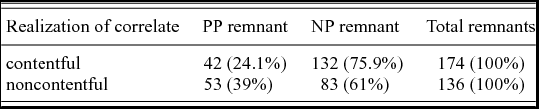
The results are given in table 1. Consistent with our hypothesis, the percentage of remnants without prepositions is higher for contenful correlates than for noncontentful ones. Statistical significance of this pattern was tested by fitting a mixed-effects logistic regression model to the data (Baayen Reference Baayen2008). The model predicted the realization of remnants based on the content of their correlates.Footnote 10 Compared to contentful correlates, noncontentful correlates lowered the likelihood that remnants would appear as NPs (β=−0.97,SE=.42,zvalue=−2.3,p<.05).
Realization of remnants by correlate content

4.2 Corpus study 2
To control for the effect of structural persistence, I annotated each antecedent for whether it contained a continuous PP correlate or a discontinuous one (with the preposition either separated from its object or missing altogether). If preposition stranding has applied in an antecedent clause, the correlate consists of a preposition separated from, and following, its object, as in (18) repeated here as (31). It might seem that for antecedent clauses with preposition stranding, the correlate does not contain the preposition but only its object. As can be seen from table 2, however, remnants with prepositions appear with discontinuous correlates, suggesting that the correlate is the entire PP, not only its object. For convenience, I used the label discontinuous to also code correlates appearing as NPs rather than PPs, as in (20) repeated here as (32). The separation of the preposition from its object or its absence could prime speakers to realize remnants as NPs. In contrast, a continuous correlate hosts a preposition preceding its object and is embedded in one of three environments: a declarative clause (21) (repeated here as (33)), an in-situ interrogative (34) or an elliptical PP (35). I hypothesized that, all else being equal, discontinuous correlates are more likely than continuous correlates to yield remnants without prepositions.
-
(31)
-
A: When you think of a wedding cake, what do you think of?
-
B: Marriage. (SB)
-
-
(32)
-
A: He's in the army.
-
B: Which one?
-
A: Ours. (S)
-
-
(33)
-
A: Tell them about the refrigerator.
-
B: Which refrigerator? (SB)
-
-
(34)
-
A: We're products of what?
-
B: A cultural process. (SB)
-
-
(35)
-
A: Learn the rules of the game, play the game.
-
B: For what?
-
A: For whatever you want. (S)
-
Realization of remnants by realization of correlates (all correlates)

4.2.1 Results
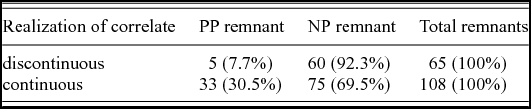
Table 2 gives the statistics for the realization of remnants with respect to the realization of all correlates. Table 3 gives a subset of the data in table 2: discontinuous correlates hosted by clauses with preposition stranding vs. all continuous correlates.
Realization of remnants by realization of correlates (continuous correlates and discontinuous correlates hosted by clauses with preposition stranding)

Although both types of correlate prefer remnants without prepositions across both the data in tables 2 and 3, an increase can be seen in the number of remnants without prepositions where the correlates are discontinuous. To verify whether these patterns were statistically significant, I fitted a mixed-effects logistic regression model to these data predicting the realization of remnants as NPs or PPs, based on the form of the correlate.Footnote 11 Remnants were found to be significantly less likely to be realized as NPs for continuous correlates than for discontinuous ones (β=−2.37,SE=.45,zvalue=−5.2,p<.001). This pattern persisted when continuous correlates were compared only with discontinuous correlates hosted by interrogative clauses with preposition stranding (β=−1.85,SE=.61,zvalue=−3,p<.01). These results confirm that the availability of preposition stranding in English nonelliptical clauses is relevant to the realization of remnants in terms of structural persistence. Note also that discontinuous correlates have a strong presence in the data, since they constitute about one third of all correlates.
An anonymous reviewer suggests comparing these results with cases where the antecedent has no overt structure to induce structural persistence effects. For instance, in (36) the B-questions are referring to a covert phrase in the antecedent John fixed the car (with something). Given that either of these questions can be asked, we could explore their ratios in a context that neutralizes structural persistence effects. However, such data could be hard to find in corpora, and we should expect an independent bias toward the question with preposition stranding in English that confounds the data.
-
(36) A: John fixed the car. B: Really? What did he fix it with? /Really? With what did he fix it?
One way around this problem is to consider similar examples that are readily available in the current data. There are 140 antecedents without overt correlates for remnants that follow them, as in (37)–(38). The construction that features such remnants is termed sprouting. Prepositions may not be omitted here (Chung Reference Chung, Cover and Yuni2006), but they may strand.
-
(37)
-
A: I'd like to say a few words.
-
B: About what? /What about?
-
-
(38)
-
A: It's an artistic expression.
-
B: Of what? /What of?
-
This kind of preposition stranding under ellipsis is one of the ‘syntactic nuts’ reported in Culicover (Reference Culicover1999). That is, some prepositions strand more easily than others. The six most frequent prepositions in the data of interest are for, from, with, by, about, and of, accounting for 104 instances. All of these prepositions are fully strandable under ellipsis, according to Culicover (Reference Culicover1999), except for by, which has trouble stranding with what (but not with who). The preposition by appears 14 times in the data and only 4 times with what. Given this set of prepositions, stranded variants should be available for most of the data. The actual ratio of stranded variants to non-stranded ones is 1 to 139, a pattern that resembles neither that found with continuous correlates nor that found with discontinuous correlates. We can thus be certain that the counts given in tables 2 and 3 reflect the effects of the structure of overt correlates.
5 Discussion
The results discussed in the previous section provide clear answers to the two questions this article asks. First, is there a preference for remnants realized as NPs to occur with contentful correlates that generalizes to preposition-stranding and non-preposition-stranding languages alike? Second, is there a reason why remnants realized as NPs are overall more frequent and more acceptable in preposition-stranding languages than in non-preposition-stranding ones? Both questions relate to the relationship between ellipsis alternation and the availability of preposition stranding in nonelliptical clauses.
As for the first question, it is clear that contentful correlates are more frequently coupled with remnants without prepositions than noncontentful correlates are in English. This pattern parallels that observed in several non-preposition-stranding languages listed in section 2. The English data strengthen the possibility (which needs further empirical investigation) that remnants without prepositions appearing with noncontentful correlates are not unacceptable in any language but merely degraded with respect to remnants without prepositions appearing with contentful correlates. The direction of the correlate content effects in English provides solid evidence that ellipsis alternation is generally sensitive to the accessibility of the correlate, exactly as predicted by MiF.
The second question addresses the difference in the overall frequency of remnants realized as NPs compared to remnants realized as PPs between preposition-stranding languages and non-preposition-stranding ones. The current data provide evidence that this difference is partially due to structural persistence effects. We have seen that the availability of preposition stranding in English has a measurable effect on ellipsis alternation by promoting remnants without prepositions. This contributes to an overall higher frequency of remnants without prepositions than remnants with prepositions, and other preposition-stranding languages may be expected to behave like English. On the assumption that high-frequency structures receive high acceptability ratings, all remnants without prepositions should receive high acceptability ratings in English, possibly higher than remnants with prepositions. For non-preposition-stranding languages, the set of discontinuous correlates is reduced to remnants that have themselves been realized as NPs and serve as correlates for subsequent remnants, with the result that remnants with prepositions outnumber remnants without prepositions. If the overall frequency of remnants without prepositions is lower than the frequency of remnants with prepositions in such languages, their overall acceptability should also be lower than the acceptability of remnants with prepositions (see Merchant et al. Reference Merchant, Frazier, Clifton, Weskott and Goldstein2013 and Nykiel Reference Nykiel2013a for empirical evidence). Hence, an explanation for acceptability differences between remnants without prepositions and remnants with prepositions in various languages may be found in the distributional frequencies of these remnants.
Both the observed structural persistence effects and the effects associated with the content of the remnant and its correlate are performance-based. The content of the correlate and remnant affects ellipsis alternation as part of the general principle of efficient language processing, MiF, which in this case prefers minimization of the remnant's form (from PP to NP) if its correlate is accessible in the current discourse. This explains why languages use remnants without prepositions whether or not they allow preposition stranding, as well as why remnants like those shown in (39) and (40) appear in English. As noted by Chung, Ladusaw & McCloskey (Reference Chung, Ladusaw and McCloskey1995: 273), these remnants without prepositions can't be derived through preposition stranding, posing an English-internal problem for the deletion-based approach (see (41) and (42)). However, the remnants’ correlates are contentful phrases, supporting minimization of the remnants’ form, which is fully consistent with MiF.
-
(39) We will use force under certain circumstances, but we can't say what.
-
(40) This theory is right in some sense, but I'm not sure what.
-
(41) *What circumstance will we use force under?
-
(42) *What sense is this theory right in?
The structural persistence effects follow directly from the architecture of language production and are commonly found in studies of syntactic variation in the sense that the choice of syntactic alternatives is constrained by structures appearing in previous discourse, as discussed in section 3. Structural persistence effects arise in ellipsis alternation because PP correlates are hosted by clauses with different possibilities for preposition placement, and these possibilities are then repeated in the structure of remnants. These effects reveal that there is a nonsyntactic relationship between ellipsis alternation and preposition stranding, which sets English (and possibly the rest of the preposition-stranding languages) apart from non-preposition-stranding languages. This is not to say that structural persistence effects are solely responsible for the distinctive behaviour of English, or that structural persistence and correlate content effects are the only factors visible in ellipsis alternation. A full account of ellipsis alternation would have to consider the strength of semantic dependencies between prepositions and verbs, where higher frequencies of prepositionless remnants are associated with items showing a dependency (Nykiel Reference Nykiel2014, Reference Nykiel2015). This factor also contributes to the unique behaviour of English with respect to ellipsis alternation.
More generally, the current results help us make sense of the growing evidence that ellipsis alternation is not limited to languages with preposition stranding. No language has yet been documented in the existing cross-linguistic literature that disallows ellipsis alternation, but cross-linguistic differences in the acceptability or frequency of remnants without prepositions with respect to remnants with prepositions have been reported (Rodrigues et al. Reference Rodrigues, Nevins, Vicente, Torck and Wetzels2009; Merchant et al. Reference Merchant, Frazier, Clifton, Weskott and Goldstein2013; Nykiel Reference Nykiel2013). This article is the first step towards understanding better why such differences emerge and how the availability of preposition stranding contributes to them. The proposal I defend here, based on the English data, is that performance preferences shape the availability of ellipsis alternation and the distribution of remnants across languages. From the theoretical perspective, we would expect all languages to have syntactic devices that allow generation of remnants with and without prepositions. The deletion-based approaches to ellipsis assume that all remnants derive from sentential sources, and that alternative sources are available in case prepositionless remnants can't be derived through preposition stranding (Merchant Reference Merchant2001, Reference Merchant2004; Rodrigues et al. Reference Rodrigues, Nevins, Vicente, Torck and Wetzels2009). However, alternative sources such as cleft structures are not always available. While some languages (Brazilian Portuguese, Spanish) have been argued to have them, others have been shown to have none (Indonesian, Amis, Polish, Russian, Emirati Arabic), although ellipsis alternation is available in all of them, as seen in (43) from Russian (Fortin Reference Fortin2007; Vicente Reference Vicente2008; Rodrigues et al. Reference Rodrigues, Nevins, Vicente, Torck and Wetzels2009; van Craenenbroeck Reference Craenenbroeck2010a, Reference Craenenbroeckb; Sag & Nykiel Reference Sag, Nykiel and Mueller2011; Sato Reference Sato2011; Wei Reference Wei2011; Nykiel Reference Nykiel2013a, pace Szczegielniak Reference Szczegielniak, Abner and Bishop2008; Leung Reference Leung2014; Philippova Reference Philippova, Kohlberger, Bellamy and Dutton2014).
-
(43)

And if there are no alternatives, ellipsis alternation challenges the deletion-based approaches. If we instead allow the grammar to generate remnants with and without prepositions regardless of whether preposition stranding is available, leaving room for performance preferences to explain differences across languages, the cross-linguistic data are easily accommodated on the direct interpretation approaches to ellipsis, which generate ellipsis remnants without any underlying structure and rely on the surrounding context in assigning an interpretation to them (Ginzburg & Sag Reference Ginzburg and Sag2000; Culicover & Jackendoff Reference Culicover and Jackendoff2005; Sag & Nykiel Reference Sag, Nykiel and Mueller2011; Kim Reference Kim2015). It is interesting to note here that even languages with postpositions, such as Korean, allow omission of these postpositions under sluicing if they are part of the correlates (Kim Reference Kim2015). Kim argues, based on this and other evidence, for a direct interpretation account of Korean sluicing.
6 Conclusion
This article has argued for two performance-based constraints on ellipsis alternation. One of these constraints involves the linguistic content of the remnant and its correlate and follows from the principle of Minimize Forms of Hawkins (Reference Hawkins2004, Reference Hawkins2014). MiF can arguably explain two cross-linguistic patterns: (1) ellipsis alternation is found in a wide range of languages rather than being a characteristic of languages with preposition stranding under wh-movement, and (2) remnants with prepositions are overall more frequent and/or more acceptable than remnants without prepositions. The second constraint involves the availability of preposition stranding in English nonelliptical clauses such that it supports the use of remnants without prepositions via structural persistence. Structural persistence effects contribute to the preference for remnants without prepositions over remnants with prepositions that is visible in the English corpus data presented here, but not in the available cross-linguistic data. These constraints help explain both the cross-linguistic availability of ellipsis alternation and differences between English and languages without preposition stranding.