Cheese yield (CY) is an important indicator of profit for the dairy industry, as it reflects the amount of cheese obtained from a given amount of milk (Marziali & Ng-Kwai-Hang, Reference Marziali and Ng-Kwai-Hang1986; Lucey & Kelly, Reference Lucey and Kelly1994; De Marchi et al. 2008). Improving CY is a main objective in countries where milk is predominantly processed into cheese. This is the case of Italy that uses 70% of available milk to manufacture typical cheeses, in particular Protected designation of origin (PDO) products (European Commission, 2006). The most popular PDO cheese in Italy, with 158 326 tons produced and 16% of total milk processed, is Grana Padano (Pieri, Reference Pieri2010). It is a hard-textured, cooked, and long ripened cheese (at least 9 and even beyond 20 months of ripening, depending on product category) obtained from partially skimmed raw milk, and produced in North Italy (Battistotti & Corradini, Reference Battistotti, Corradini and Fox1993; European Commission, 2009).
Besides the cheese-making conditions such as the type of coagulant, cheese vat, and milk treatments, CY is determined by the protein (or casein) and fat content of milk (Lucey & Kelly, Reference Lucey and Kelly1994), and the importance of these constituents is demonstrated by their use to predict CY as reviewed by Emmons et al. (Reference Emmons, Ernstrom, Lacroix and Verret1990). Other milk quality parameters such as pH and titratable acidity (TA), somatic cell count, and milk coagulation properties (MCP) may have a quantitatively marginal but significant effect on CY (Verdier-Metz et al. Reference Verdier-Metz, Coulon and Pradel2001).
Milk coagulation properties have been widely studied in recent years and their potential role as technological traits to improve the efficiency of dairy industry has been discussed (Ikonen et al. Reference Ikonen, Morri, Tyrisevä, Ruottinen and Ojala2004; Cassandro et al. Reference Cassandro, Comin, Ojala, Dal Zotto, De Marchi, Gallo, Carnier and Bittante2008; Jõudu, Reference Jõudu2008; De Marchi et al. Reference De Marchi, Fagan, O'Donnell, Cecchinato, Dal Zotto, Cassandro, Penasa and Bittante2009). Milk that coagulates rapidly and has high firmness of the curd is expected to result in more cheese with more desirable composition and to lose less milk components in the whey compared with milk that coagulates late and has low firmness of the curd (Aleandri et al. Reference Aleandri, Schneider and Buttazzoni1989; Ng-Kwai-Hang et al. Reference Ng-Kwai-Hang, Politis, Cue and Marziali1989; Lucey & Kelly, Reference Lucey and Kelly1994; Martin et al. Reference Martin, Chamba, Coulon and Perreard1997; Wedholm et al. Reference Wedholm, Larsen, Lindmark-Månsson, Karlsson and Andrén2006). The technological characteristics of milk play a determinant role in defining the quality of milk destined for hard cheese production such as Grana Padano and Parmigiano–Reggiano. In Parmigiano–Reggiano cheese production, which cheese-making technology is very similar to that of Grana Padano, MCP have been considered in milk quality payment system for several years (www.parmigiano-reggiano.it).
To date, most trials have been conducted in laboratory or pilot-scale plants using milk from individual cows (Ng-Kwai-Hang et al. Reference Ng-Kwai-Hang, Politis, Cue and Marziali1989; Wedholm et al. Reference Wedholm, Larsen, Lindmark-Månsson, Karlsson and Andrén2006) or little amount of bulk milk (Grandison & Ford, Reference Grandison and Ford1986; Martin et al. Reference Martin, Chamba, Coulon and Perreard1997; Verdier-Metz et al. Reference Verdier-Metz, Coulon and Pradel2001). Only few studies dealt with milk collected in several herds and processed in commercial dairy plants (Aleandri et al. Reference Aleandri, Schneider and Buttazzoni1989; Ikonen et al. Reference Ikonen, Ruottinen, Syväoja, Saarinen, Pahkala and Ojala1999), and none was conducted on Grana Padano cheese. Carrying out a trial in field conditions may better reflect the true variation of MCP of bulk milk supplied to commercial dairy factories. Therefore, the aim of this study was to assess the influence of chemical and technological quality of vat milk on CY in a commercial Grana Padano dairy plant.
Materials and Methods
Cheese-making
Twelve cheese-making days (8 vats for each day) were carried out in 2009 in one dairy cooperative of North Italy producing Grana Padano cheese; 4 sessions took place in February, 4 in July, and 4 in December. The production of Grana Padano cheese followed the official protocol approved by the Consortium (European Commission, 2009; Grana Padano Consortium, 2011). The day before cheese-making the milk from morning and evening milkings was collected from farms and delivered to the dairy factory. Milk was stored at 8 °C in shallow settling tanks for 12 h so that the fat could naturally rise to the surface (natural creaming). Following fat separation, the partially skimmed raw milk was drained from the bottom of the settling tanks and transferred to the copper bell-shaped vats that contain 1000 kg milk.
Cheese-making started with the addition of the natural whey starter (32 litres per vat) obtained from the spontaneous acidification of cooked whey from previous day's cheese-making. Milk was heated to 33 °C and 56 g powder calf rennet (strength, defined as the number of volumes of milk clotted by 1 volume of rennet in 40 min at 35 °C, was 1:100 000; 95% chymosin and 5% pepsin) per vat were added. The coagulation process was manually checked and the curd was broken up into small granules after 10 min from the rennet addition. The curd was then cooked by increasing the temperature from 33 to 53·5 °C in 10 min and it was agitated continuously. The broken-up curds aggregated and blended together during the so-called resting period, and deposited at the bottom of the vat. During this step the temperature was maintained at 53·5 °C and the process lasted 45 min.
The cheese mass was cut in two wheels with a specific tool, removed from the vat and placed in Grana Padano cheese moulds. The wheels were weighted (precision: ±0·01 kg) after 2 d of drainage and placed into brine. Cheese yield was expressed as kilograms of product per 100 kg milk processed. A total of 192 wheels were produced and 96 records for CY were available.
Laboratory analyses
Before the beginning of cheese-making, a sample of raw milk was collected directly from each vat, stored in portable refrigerator (4 °C), transferred to the milk quality laboratory of Veneto Agricoltura (Thiene, Italy), and analysed within 6 h for fat, protein, and casein contents (Combi Foss 6000 FC, Foss Electric A/S, Hillerød, Denmark), pH, TA expressed in Soxhlet–Henkel degrees [°SH 50 = ml NaOH (0·25 mol/1000 ml)/50 ml milk; Crison Compact D, Crison Instruments SA, Alella, Spain], and somatic cell count (Cell Fossomatic 250, Foss Electric A/S, Hillerød, Denmark). Casein number was calculated as the ratio of casein to protein content. Somatic cell count (mean value of 71 000 cells/ml) was not considered in subsequent statistical analyses because the entire milk destined to produce Grana Padano cheese undergoes the natural creaming process which dramatically reduces the somatic cell content of milk. In fact, most of the cells are entrapped in the rising fat and thus remain within the upper cream layer. The quantity of cells removed with the fat is not related to the content of cells present in the milk prior to creaming and it depends on many factors such as temperature, creaming device, and quality of milk. Thus, the somatic cell content of vat milk is not representative of the somatic cell content of the full cream milk.
Measures of MCP of vat milk samples were obtained from the same laboratory by using a computerised renneting meter (CRM, Polo Trade, Monselice, Italy) following Dal Zotto et al. (Reference Dal Zotto, De Marchi, Cecchinato, Penasa, Cassandro, Carnier, Gallo and Bittante2008) and Penasa et al. (Reference Penasa, Cassandro, Pretto, De Marchi, Comin, Chessa, Dal Zotto and Bittante2010). The principle of the CRM is based on the swing of a pendulum immersed in the milk container and driven by an electromagnetic field. After the addition of the clotting enzyme, coagulation takes place and the swing of the pendulum becomes smaller because of the enhanced firmness of the curd. A survey system measures differences in the electromagnetic field caused by milk coagulation: the greater the extent of coagulation, the smaller the pendulum swing. This analysis provides measurements of rennet coagulation time (RCT), defined as the interval, in minutes, from the addition of the clotting enzyme to the beginning of coagulation; curd-firming time (k 20), defined as the interval, in minutes, from the beginning of coagulation to the moment the width of the graph attains 20 mm; and curd firmness (a 30), defined as the width, in millimeters, of the diagram 30 min after the addition of rennet.
Statistical analysis
Sources of variation of CY were investigated using the GLM procedure of SAS (SAS Inst. Inc., Cary, NC). Several fixed effects models were tested and the final model was chosen on the basis of the significance of the factors included and the amount of variability explained by each of them:
 $$y_{ijklmn} = \mu + {\rm CMD}_i + {\rm FAT}_j + {\rm PROT}_k + {\rm TA}_l + {\rm CF}_m + e_{ijklmn}, $$
where y ijklmn is CY; μ is the overall intercept of the model; CMDi is the fixed effect of the ith cheese-making day (i = 1–12); FATj is the fixed effect of the jth class of milk fat content (j = 1–3); PROTk is the fixed effect of the kth class of milk protein content (k = 1–3); TAl is the fixed effect of the lth class of milk titratable acidity (l = 1–3); CFm is the fixed effect of the mth class of curd firmness at 30 min from coagulant addition (m = 1–3); and e ijklmn is the random residual N ∼ (0, σe2). Except for cheese-making day, classes of explanatory variables were defined according to mean ± 0·5 sd so that class 1: ⩽ − 0·5 sd, class 2: from −0·5 sd to 0·5 sd, and class 3: ⩾0·5 sd.
A multiple comparison of means was performed for the class effects of fat and protein content, TA, and a 30 using Bonferroni's test (P < 0·05).
Results and Discussion
Protein and casein contents of vat milk averaged 3·49 and 2·67 g/100 g, respectively (Table 1), in agreement with findings from De Marchi et al. (2008) on vat milk destined to Grana Trentino cheese production. Fat content (2·55 g/100 g) after the process of natural creaming was optimal to produce Grana Padano cheese, as the fat to casein ratio should be comprised between 0·80 and 1·05 (Battistotti & Corradini, Reference Battistotti, Corradini and Fox1993; European Commission, 2009). Rennet coagulation time and a 30 averaged 19·27 min and 25·73 mm, respectively (Table 1); overall, these values are worse than those previously suggested as optimal for cheese-making (Zannoni & Annibaldi, Reference Zannoni and Annibaldi1981; De Marchi et al. Reference De Marchi, Dal Zotto, Cassandro and Bittante2007; Cassandro et al. Reference Cassandro, Comin, Ojala, Dal Zotto, De Marchi, Gallo, Carnier and Bittante2008), and confirm the worsening of technological properties of milk in the last years (Formaggioni et al. Reference Formaggioni, Sandri, Franceschi, Malacarne and Mariani2005). The coefficient of variation of quality traits were much lower than those reported earlier (Wedholm et al. Reference Wedholm, Larsen, Lindmark-Månsson, Karlsson and Andrén2006; Cassandro et al. Reference Cassandro, Comin, Ojala, Dal Zotto, De Marchi, Gallo, Carnier and Bittante2008), mainly because we used vat samples whereas in the previous studies samples were from individual cows.
Descriptive statistics of vat milk quality traits and cheese yield (CY), and Pearson's correlations between vat milk quality traits and CY
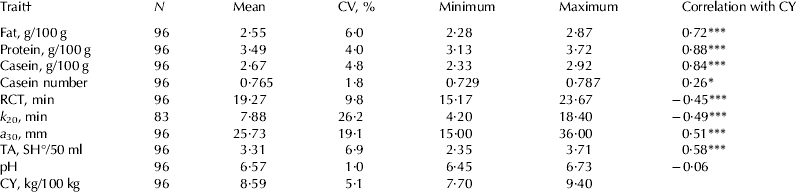
† RCT = rennet coagulation time; k 20 = curd-firming time; a 30 = curd firmness 30 min after coagulant addition; TA = titratable acidity; CY = cheese yield after 2 d of drainage
*P < 0·05; ***P < 0·001
Cheese yield after 2 d drainage averaged 8·59 kg/100 kg and showed relatively low variation (CV = 5·1%; Table 1). The mean value from our work is consistent with those reported for Grana Padano, Grana Trentino, and Parmigiano–Reggiano cheeses (Malacarne et al. Reference Malacarne, Summer, Fossa, Formaggioni, Franceschi, Pecorari and Mariani2006; Mordenti et al. Reference Mordenti, Merendi, Fustini and Formigoni2007; De Marchi et al. Reference De Marchi, Bittante, Dal Zotto, Dalvit and Cassandro2008), but the variability is wider.
As expected, fat, protein, and casein contents were positively and strongly correlated with CY (r = 0·72, 0·88, and 0·84, respectively; P < 0·001; Table 1). Rennet coagulation time and k 20 were negatively associated with CY (r = − 0·45 and −0·49, respectively; P < 0·001), whereas a 30 was positively correlated (r = 0·51; P < 0·001). These estimates are in agreement with previous studies; milk with shorter RCT, faster k 20, and higher a 30 results in higher CY (Aleandri et al. Reference Aleandri, Schneider and Buttazzoni1989; Ng-Kwai-Hang et al. Reference Ng-Kwai-Hang, Politis, Cue and Marziali1989; Martin et al. Reference Martin, Chamba, Coulon and Perreard1997). In the present work, all samples coagulated within 30 min and exhibited a value of a 30, but approximately 14% of samples did not have information on k 20. The positive and moderate relationship between a 30 and CY should be carefully evaluated as high a 30 may not be beneficial for cheese quality. As reported by Annibaldi et al. (Reference Annibaldi, Ferri and Mora1977) for Parmigiano–Reggiano cheese production, milk samples characterised by excessive values of a 30 are classified as ‘mediocre’ as they are difficult to handle during cheese-making, and give rise to curd and cheese mass with a lower rate of syneresis (Lenoir & Schneid, Reference Lenoir, Schneid and Eck1984). Consequently, the higher CY associated with higher values of a 30 may be the result of an excessive retention of whey in the cheese matrix. This could lead to defects in cheese throughout ripening due to anomalous fermentations or excessive demineralisation of the paste. In the current study, we did not investigate the relationship between a 30 and cheese quality during ripening as this was not the aim, but it will be the matter of future research. Titratable acidity was positively correlated with CY (r = 0·58; P < 0·001), whereas no association was found between pH and CY, probably due to the low variability of pH (CV = 1·0%).
Most milk components and quality traits are related to each other; for example, high correlations are often reported between protein (or casein) and fat contents, or between MCP and pH (Ikonen et al. Reference Ikonen, Morri, Tyrisevä, Ruottinen and Ojala2004; Cassandro et al. Reference Cassandro, Comin, Ojala, Dal Zotto, De Marchi, Gallo, Carnier and Bittante2008) or TA (Cassandro et al. Reference Cassandro, Comin, Ojala, Dal Zotto, De Marchi, Gallo, Carnier and Bittante2008). Hence, in some cases it is not possible to determine whether a correlation is causal or arises by association with other traits.
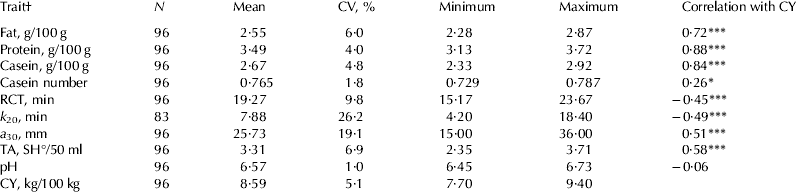
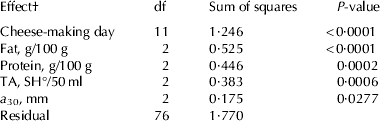
Results from ANOVA of CY are reported in Table 2. All effects included in the model were significant in explaining the variability of the trait (P < 0·05). Cheese-making day accounted for the largest proportion of variation followed by fat and protein contents; this was expected as seasonal variation of milk composition exists. Also, the Grana Padano production is not totally standardised and some steps of the process are still artisanal. Although MCP traits are highly correlated to each other (Ikonen et al. Reference Ikonen, Morri, Tyrisevä, Ruottinen and Ojala2004; Cassandro et al. Reference Cassandro, Comin, Ojala, Dal Zotto, De Marchi, Gallo, Carnier and Bittante2008; Pretto et al. Reference Pretto, Kaart, Vallas, Jõudu, Henno, Ancilotto, Cassandro and Pärna2011), only a 30 resulted significant in explaining the variability of CY. Least squares means of CY across classes of fat and protein contents, TA, and a 30 are depicted in Fig. 1. Class 1 was always significantly lower than class 3. This is true for fat and protein contents, and TA, and it is particularly interesting in the case of a 30: results showed that the class of a 30 averaging 31·88 mm resulted in 20·12 kg/100 kg higher CY than the class averaging 20·52 mm.
Least squares means (with SE) of cheese yield after 2 d drainage across classes of (a) milk fat content, (b) milk protein content, (c) titratable acidity, and (d) curd firmness 30 min after coagulant addition. For each class the raw mean and sd are given. Levels with different letters are significantly different according to Bonferroni's test (P < 0·05)

Results from ANOVA for cheese yield (R 2 = 0·905, RMSE = 0·153)
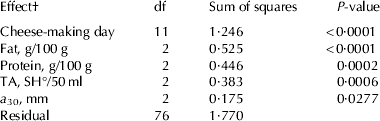
† TA = titratable acidity; a 30 = curd firmness 30 min after coagulant addition
Conclusions
Findings from the present study demonstrated that a 30 is associated to CY in the Grana Padano dairy industry. As expected, fat, and protein contents are the key drivers of CY, followed by TA. Milk coagulation properties have a positive impact on CY and could be used as indicators of cheese-making efficiency in the dairy industry. Future research is needed to investigate the relationships between MCP and quality of cheese, as high values of a 30 may lead to defects during ripening, and to evaluate the feasibility of including technological properties in multiple component milk pricing system for Grana Padano cheese production.
The authors thank the Latterie Vicentine (Bressanvido, Vicenza, Italy) for performing the cheese-making trial and Veneto Cheese – Distretto Lattiero Caseario del Veneto: FILATVE project, DGR 2111 (10/07/07), Mis. 2A – Regione Veneto for financial support.