


1. Introduction
Observe, comply, and pursue: three verbs that structure legal reasoning. Observe engages both the facts at hand and the legally recognised principles identified as applicable to those facts (Sein); comply invokes the binding force of rule-imposed duties (Sollen); and pursue directs attention towards collective ends articulated by policies (Wollen).Footnote 1 This tripartite mapping frames the logical-teleological recasting advanced in this article.
Dworkin argued that legal positivism, with its focus on rules, omits important normative dimensions (principles and policies) whose significance cannot be reduced to the all-or-nothing application of legal rules.Footnote 2 Despite this foundational insight, Dworkin’s account leaves a gap in what we term ‘Dworkin’s conjecture’—that is, the claim that the distinction between rules and principles is logical in nature, a point for which he provides no systematic demonstration.Footnote 3 Inspired by this challenge, this article proposes a logical-teleological framework centred on Sein, Sollen, and Wollen, demonstrating how principles, rules, and policies possess ‘irreducible logical forms’.Footnote 4
Relating each norm-type to its corresponding logical form reveals that principles take the form of value-based categorical judgments, rules connect operative facts to deontic or constitutive consequences, and policies coordinate heterogeneous norms towards collective objectives. To understand how these norms operate in practice, this article develops a theoretical framework that takes Dworkin’s conjecture as its starting point. It does so by (1) mapping principles, rules, and policies to distinct logical forms; (2) exploring the teleological foundations that underpin this tripartite structure; and (3) demonstrating its practical implications. This approach, at times, will lead to conclusions that diverge from Dworkin’s own.
The logical-teleological account of norm-types does not presuppose any interpretivist thesis about the nature of law (including ‘law as integrity’), nor any metaethical claim that legal principles are moral truths.Footnote 5 Operating at the level of logical form—structure abstracted from content—permits this neutrality.
The demonstration that rules, principles, and policies are logically distinct is not merely an exegetical exercise. On the contrary, it provides conceptual clarity, with direct practical implications for adjudication, legislation, and legal pedagogy, equipping legal actors with precise diagnostic tools.
This article adds to existing jurisprudential tools in three ways—by supplying a structural account of norm-types; showing when teleology is constitutive (not merely interpretive); and offering a diagnostic method for selecting the appropriate mode of legal reasoning. The limits of existing tools are developed in Section 6.1, before the comparative illustrations.Footnote 6
The need for such conceptual clarity is particularly acute in the contemporary legal landscape. The rise of the ‘regulatory state’ has significantly increased the prevalence of complex normative schemes that coordinate multiple rules, principles, and objectives towards collective goals.Footnote 7 Traditional rule-focussed analysis struggles to capture the internal architecture of regulatory regimes governing financial markets, environmental protection, data privacy, and public health. At the same time, emerging technologies are transforming how legal norms are created, interpreted, and enforced. ‘Smart contracts’ automate the execution of conditional prescriptions,Footnote 8 while ‘artificial intelligence (AI) systems’ increasingly assist in legal analysis and decision-making.Footnote 9 These developments demand greater precision in identifying what kind of norm is at issue: a rule that can be automated through algorithmic execution, a principle that requires evaluative judgment, or a policy that necessitates coordinated interpretation across multiple provisions.
The article proceeds as follows. Section 2 revisits Dworkin’s classification and his conjecture regarding logical distinctions. Section 3 establishes the core framework by mapping the norms to their respective logical forms, while Section 4 examines the mediating role of collective will (Wollen). Section 5 provides an extended analysis of these structures, followed by Section 6, which demonstrates the framework’s practical utility through comparative case studies. Section 7 addresses theoretical objections and limitations, and Section 8 concludes.
2. Dworkin’s Conjecture and the Distinction Among Legal Norms
Dworkin’s tripartite typology formed part of his broader critique of rule-focussed positivism.Footnote 10 Dworkin also hinted—without providing a systematic proof—that the distinction among these norm-types is logical: It concerns the form of the propositions used in legal justification, not merely their pedigree or institutional source.Footnote 11 His typology can be summarised as follows:
-
1. Rules, which apply conclusively when the facts match their prescribed conditions. They operate in an ‘all-or-nothing’ manner, meaning that, once triggered, they leave no room for balancing or partial application.
-
2. Principles, which are standards based on dimensions such as justice or fairness that guide decisions in one direction without prescribing a single, rigid outcome. Their weight or importance comes into play when they conflict with other principles or when they inform how rules should be interpreted.
-
3. Policies, which articulate collective goals that aim to improve or preserve certain conditions in society. While policies commonly look forward by seeking a better future state, Dworkin notes that some goals are negative, designed to protect existing features from undesirable change.Footnote 12
This tripartite distinction, first articulated in “The Model of Rules,” ignited immediate debate, prompting Dworkin to defend and deepen his argument in “Social Rules and Legal Theory.”Footnote 13 There, he confronts the core challenge, exemplified by Joseph Raz, that rules can also conflict and must be weighed, seemingly collapsing the distinction.Footnote 14 Dworkin’s defence argues that what critics label a “conflict” between rules (such as assault and self-defence) is actually a relationship of exception.Footnote 15 The rules, when read together, determine a single, non-discretionary outcome. A genuine conflict between principles, by contrast, requires a judge to assess their respective “weight” to resolve the issue.Footnote 16
In “New Values,” Dworkin traces how courts uncover values that crystallise into principles and shows how those principles differ categorically from other kinds of legal standards.Footnote 17 Dworkin observes that many standards courts retrospectively identify as principles only emerge after judges have ‘decoded’ past decisions and uncovered the fundamental ‘value’ that best fits them—‘privacy’ is his example.Footnote 18 By contrast, what he calls the “‘design’ mode of thought” is prospective: It constructs normative frameworks intended to achieve goals that have not yet been realised.Footnote 19 Applying Dworkin’s own distinctions, we can now draw a four-fold map of value (see Table 1).Footnote 20
Descriptive × Normative vs. Instrumental × Final

Table 1 Long description
A table categorizing values into four types based on descriptive and normative distinctions, as well as instrumental and final distinctions. The table has two rows and two columns. Row labels are Descriptive and Normative. Column headers are Instrumental and Final. Row 1: Descriptive, Instrumental: people in fact want X because it leads to Y; Descriptive, Final: people in fact want X for its own sake. Row 2: Normative, Instrumental: people ought to want X because it promotes Y; Normative, Final: people ought to value X for itself.
On this axis, principles function as final values in legal justification—treated as worth affirming in their own right—whereas policies operate instrumentally by coordinating norms as means to collective ends.Footnote 21
Recognising the two axes thus clarifies why ‘privacy’, once decoded as an intrinsic political good, migrates from the normative-instrumental register (earlier cases protected it only as a useful means in isolated disputes) to the normative-final register (it is now affirmed as an end in itself);Footnote 22 the subsequent creation of data-protection regimes (e.g., the GDPR) exemplifies a design-oriented policy that translates that newly recognised principle into a dense architecture of duties, rights, and enforcement mechanisms directed towards the systemic goal of trustworthy data flows.Footnote 23
Dworkin’s initial distinction between rules, principles, and policies in “The Model of Rules” continues to shape discussions, leading to numerous refinements, critiques, and alternative frameworks.Footnote 24
Scholars have put forward various refinements. Robert Alexy, for example, considers only two categories of legal norms: rules and principles.Footnote 25 He asserts that while his criterion for distinguishing legal norms resembles that of Dworkin, “it differs … at one significant point, namely in the characterization of principles as optimization requirements.”Footnote 26 According to Alexy, this ‘optimization requirement’ is “the decisive point in distinguishing rules from principles.”Footnote 27
Criticisms of Alexy’s theory underscore the complexities of applying principles and rules when dealing with ‘hard cases’, leading him to develop various reformulations that attempt to resolve these difficulties.Footnote 28 Even so, it remains an open question whether these reformulations have provided a fully satisfactory solution, as Poscher’s examples show.Footnote 29
Recent scholarship has addressed the objections raised by Ralf Poscher against Alexy’s concept of principles as optimisation requirements. Poscher’s contention that Alexy’s principles are essentially disguised rules, thus lacking distinct ontological status, has garnered support from Giovanni Ratti, who identifies an internal contradiction in Alexy’s balancing model, further challenging the rules-principles distinction.Footnote 30 Responding to these critiques, Alexy refined his theory by explicating principles as representing an “ideal ‘ought’”—a directive to optimise constitutional goals—contrasted with the “real ought” that characterises rules.Footnote 31 In short, Alexy’s refusal to carve out a separate class of policies obliges his ‘principles’ to shoulder a dual burden: They carry not only axiological weight (values) but also teleological direction (goals).
Pedro Lopes identifies the critical gap in Dworkin’s account, noting: “Unfortunately, Dworkin never thoroughly demonstrated why the distinction [between principles and rules] was logical.”Footnote 32 Lopes attributes the difference between principles and rules to genericity—namely, the generic formulation (“a, any”) of the hypothetical action in the antecedent of principles, which can be analysed as an inclusive disjunction of “autonomous specific actions.”Footnote 33 In this article, we take a different route: Instead of distinguishing rules and principles within a shared hypothetical schema by the genericity of their antecedents, we argue that principles, rules, and policies exhibit irreducible logical forms.
Relatedly, Josef Esser argued that the distinction between rules and principles turns not on the degree of abstraction or generality, but on the extent to which cases of application can be specified—something characteristic of rules (precepts) rather than principles.Footnote 34 While we agree with this notion, it falls short of establishing logical forms.
Dietmar von der Pfordten raises another objection by asking, “What is the main form of expression in law?”Footnote 35 He argues against reducing legal expression to a single or narrowly-limited set of forms.Footnote 36 Our approach diverges from von der Pfordten’s insofar as we propose that specifying the logical forms of legal norms is not only possible, but also beneficial.
Since 2010, the discussion on rule-principle dualism has taken several new turns. John Gardner’s Law as a Leap of Faith defends a legal-positivist account that nonetheless treats principles as ‘favoured reasons’, thereby partially converging with Alexy while rejecting optimisation.Footnote 37 Mark Greenberg and Scott Shapiro have reframed the issue in terms of the ‘moral impact’ and ‘planning’ theories, respectively.Footnote 38
Both Shapiro’s planning theory and Greenberg’s moral impact theory, despite their differences, presuppose a mediating layer between social facts and binding norms.Footnote 39 Taken together, these accounts illustrate two different ways of theorising the transition from social facts to normativity; the present framework remains neutral between them and focusses on the logical grammar of norm-types.
Nevertheless, the debate persists on how best to account for these differences in strictly logical terms.
3. The Logical Framework for Principles, Rules, and Policies
Before analysing the philosophical foundations and various implications of our research, this section maps principles, rules, and policies to categorical, hypothetical, and relational judgments, respectively. The following subsections spell out each form and its inferential role.
Legal principles are categorical judgments asserting a value-based predicate, expressed as “X is (or is not) <value>,” such as “[Equality of persons before the law] is good.”Footnote 40 In other words, a principle states a value judgment—affirming or denying that something is valuable, fair, or desirable within the legal system.Footnote 41
In cases where legal rules are inadequate or non-existent for a given situation, principles can provide broad guidelines to inform decision-making and assess conduct. Thus, principles are starting points for legal reasoning and lawmaking. When a new rule is required, the legal decision-maker identifies and prioritises applicable principles. However, although these principles argue in one direction, they do not dictate a specific decision.Footnote 42
The structure of categorical judgment is also evident in various legal expressions beyond legal principles. These include the categorisation of factual elements in a legal case, legislative definitions expressed in statutes, and individual categorical judgments embodied in guilty verdicts, among others.
Having established principles as categorical judgments, the framework next delineates the structure of rules.
Legal rules are hypothetical judgments expressed as “if A is a fact, then B.” Two distinct types can be identified:Footnote 43
-
1. Regulative Rules: In these, the consequent is characterised by a deontic modal. They are expressed as “if A is a regulated fact, then B_AGENT is {obligatory | permitted | forbidden}.” The hypothetical form of regulative rules explicitly specifies the agent, a specific individual or role (e.g., a driver, an employer, or a government official). In regulative rules, once the condition A occurs, the designated agent must observe or enforce the prescribed consequence.Footnote 44
-
2. Constitutive Rules: In these, the consequent declares the existence (or non-existence) of a legal entity or status. Because the antecedent in this case specifies a constitutive fact arising from an act performed by an authorised agent, they are formulated as “if A_AGENT is a constitutive fact, then [the legal entity] is (or is not) existent.” Here, “A_AGENT” emphasises that the constitutive fact arises from the performance of an act by the designated agent, which in turn triggers the creation or dissolution of the legal entity.Footnote 45
These structures can serve as major premises in a hypothetical syllogism, either by dictating behaviour through deontic modalities or by establishing the legal existence or non-existence of an entity or status. In both cases, the hypothetical structure connects an antecedent fact to a legal consequence.
Additionally, constitutive rules serve multiple purposes. They may establish, amend, or abolish legal institutes, such as contracts, marriage, or legal persons. They may also govern specific legal institutions,Footnote 46 such as particular contracts or companies, or determine specific actions within those institutions, like monthly mortgage payments and their consequences.Footnote 47
Legal rules are designed to govern the interactions between legal subjects and establish the consequences of breaching these rules. Indeed, rights and duties—the intersubjective counterpart of deontic values—do not arise ex nihilo but are assigned at the moment the institution to which they are linked is established. Legal rules also regulate individual conduct. For example, a penal code might prescribe twenty years in prison for murder, barring instances of self-defence, with the goal of maintaining specific standards of conduct.
Finally, our framework recognises a third structural layer that coordinates collective objectives.
Legal policies are relational judgments expressed as “R_AUTHORITY (S1, S2, …, Sn) ⟹ G,” where ‘AUTHORITY’ denotes the entityFootnote 48 establishing the policy and each Si represents a constituent judgment (categorical, hypothetical, or nested relational). The relational judgment can be used as a major premise in a relational syllogism.Footnote 49 The connective ‘⟹’ denotes a teleological relation of policy design and coherence, not logical consequence in the ordinary truth-functional sense. It indicates that the authority treats S1,…,Sn as coordinated components (means/constraints) directed at G, without implying that their satisfaction is sufficient to secure G in fact. Because this kind of relational judgment presupposes the coordination of multiple norms, it provides a unifying structure for achieving a particular outcome.
On this account, legal institutes and institutions can be analysed as ‘policies’, insofar as they coordinate heterogeneous norms towards an end. For instance, the legal institution of a specific contract prescribes rules (hypothetical judgments to be complied with), principles (value-based categorical judgments to be observed), and objectives (to be pursued), and also describes roles, competencies, and definitions, clarifying the nature and scope of the agreement.
To synthesise the tripartite framework, the synoptic Table 2 provides a structured overview of the logical forms, their corresponding formulae, and illustrative examples.Footnote 50
Logical Forms of Legal Norms

Table 2 Long description
A table categorizing legal norms by type, logical form, and example. The table has four rows and three columns. The columns are labeled Norm Type, Logical Form (formula), and Example. Row 1: Norm Type, Principle; Logical Form (formula), X is <value>; Example, [Equality of persons before the law] is good. Row 2: Norm Type, Regulative Rule; Logical Form (formula), if A is a regulated fact, then B_AGENT is {obligatory/forbidden/permitted}; Example, If [the traffic light’s being red] is a regulated fact, then [going forward]_DRIVER is forbidden. Row 3: Norm Type, Constitutive Rule; Logical Form (formula), if A_AGENT is a constitutive fact, then [legal entity] is existent; Example, If [signing a contract]_PARTIES is a constitutive fact, then [the contract] is existent. Row 4: Norm Type, Policy; Logical Form (formula), R_AUTHORITY (S, S, S, S) G; Example, The contract institution R_BUYER, SELLER coordinates rules/principles/sub-policies towards achieving the goal (G).
A question arises from the analytical philosophy of law concerning the individuation of norms. If rules are individuated by the conditional prescription they establish, and principles by the value-based predicate they assert, how are policies individuated? The answer lies in the concept of legal institutes and institutions, and individuation operates at two distinct levels. At the abstract level, a legal institute (e.g., the contract as a normative type) constitutes one policy: It defines the general architecture through which parties may coordinate rules, principles, and objectives towards certain permissible ends. At the concrete level, a legal institution—an instance of the institute, such as the sales contract executed between A and B on a specific date—constitutes one policy as well: It particularises the abstract framework into a determinate set of obligations, rights, and purposes binding upon identified parties. Hence, what individuates the policy is not its internal complexity but its teleological and institutional closure: the point at which a discrete set of norms is unified under a single coordinating purpose established by an identifiable authority.
3.1. The Necessity of Distinct Logical Forms
The question analysed in this section is not whether principles, rules, and policies can be expressed in categorical, hypothetical, and relational forms. Drafting practice can always paraphrase. The question is whether these norm-types could be expressed otherwise without loss of normative content.Footnote 51
A minimally functional legal system must perform three operations. It must (1) evaluate axiologically; (2) prescribe conditionally; and (3) coordinate teleologically. ‘Evaluation’ distinguishes what is worthy of protection, condemnation, or endorsement; ‘conditional prescription’ attaches determinate legal consequences to specified facts; ‘teleological coordination’ organises heterogeneous normative elements into schemes directed at collective ends. These operations correspond to distinct logical forms: Evaluation is expressed through categorical judgments, conditional prescription through hypothetical judgments, and teleological coordination through relational judgments.
The argument proceeds in three steps. It first clarifies what each form contributes to legal reasoning; it then applies a distortion test, showing what goes wrong when one norm-type is forced into another’s form; it finally links each form to a distinct inferential pattern (categorical, hypothetical, and relational syllogisms), showing that the forms are not interchangeable.
The thesis is that these operations require distinct logical forms and cannot be adequately performed through a single form. But why is each form necessary?
Principles require categorical form.
A categorical judgment predicates a value of a subject without antecedent conditions: “S is (or is not) P.” The function of principles is to affirm that something counts as valuable, fair, or unjust as such within the system’s evaluative horizon. Their work is not to trigger consequences upon the satisfaction of a fact-pattern, but to supply evaluative premises that guide interpretation, justify departures from mechanical application where law permits, and shape the construction of new rules and policies.
Rendering a principle as a hypothetical judgment either introduces an artificial contingency (“if A, then equality is good”) or relies on an all-encompassing antecedent (“if a legal situation exists, …”). In both cases the hypothetical structure ceases to discriminate between situations in the way rules must. A principle does not operate through antecedent-triggering in the manner of a rule; it operates as an evaluative reason that bears on legal characterisation across cases. The categorical form captures this mode of operation without importing conditional architecture that belongs elsewhere.
Rules require hypothetical form.
A hypothetical judgment connects an antecedent to a consequent: “If A, then B.” The function of rules is to bind legal consequences—regulative (obligatory/forbidden/permitted) or constitutive (existence/non-existence of a legal entity)—to the occurrence of specified facts. This conditional structure is what enables subsumption: The law-applier determines whether the facts satisfy the antecedent and, if they do, applies the consequent in an all-or-nothing manner (subject to recognised exceptions and meta-rules).
Expressing a rule categorically (“[Stopping at a red light] is obligatory”) removes the antecedent that makes the prescription situation-sensitive and legally tractable. The resulting statement resembles a value-assertion or an unconditioned command, but it no longer represents the logical operation characteristic of rules: connecting a fact-pattern to a determinate legal response. Expressing a rule as a relational scheme oriented towards a goal equally distorts its function. Rules do not coordinate elements towards ends; they trigger consequences when conditions are met.
Policies require relational form.
A relational judgment coordinates multiple elements into a unified scheme directed at an end: “R_AUTHORITY(S1, S2, …, Sn) ⟹ G.” Each Si may itself be categorical, hypothetical, or a nested relational judgment; G represents the collective objective; and ‘⟹’ marks teleological design and coherence rather than truth-functional entailment. The function of policies is to organise rules, principles, definitions, competencies, procedures, and sub-policies into a purposive architecture. This structure is characteristic of modern regulatory regimes and institutional frameworks: Their normative force does not reside in any single conditional prescription, but in the way their components must be interpreted together to realise (or preserve) a collective end.
Reducing a policy to a categorical judgment yields only a value-affirmation (“[Data protection] is good”) without institutional specification of how that value is to be pursued. Reducing it to a single hypothetical judgment yields, at most, one rule within the scheme (“If [personal data are processed] is a regulated fact, then [ensuring that at least one lawful basis for processing applies]_CONTROLLER is obligatory”), leaving the coordinating structure unexpressed. The GDPR, for instance, is neither one rule nor merely a heap of rules; it is an integrated architecture combining definitions, principles, duties, rights, enforcement mechanisms, and exceptions directed at systemic objectives. The relational form captures this multi-element coordination.
The necessity of distinct forms becomes especially clear through a ‘distortion test’: Attempts at reduction generate predictable losses of function.
Principle as rule.
Reformulating “[Equality] is good” as “If [a legal situation exists], then [treating equally]_AUTHORITY is obligatory” makes the antecedent universal and empties the rule-form of its discriminatory capacity. A genuine rule distinguishes between cases in which it applies and cases in which it does not. When the antecedent covers all cases, the hypothetical structure collapses into a disguised categorical judgment: The ‘rule’ no longer operates through subsumption but through evaluation.
Rule as principle.
Reformulating “If [the traffic light is red], then [stopping]_DRIVER is obligatory” as “[Stopping at red] is good” converts a determinative prescription into a value-claim. The all-or-nothing operation of the rule is lost, and the statement now invites balancing in a way that rules, as such, do not. The result is not simply a change of wording but a change of inferential role: What was previously applied through subsumption is now treated as a defeasible evaluative consideration.
Policy as conjunction of rules.
Representing a policy as R1 ∧ R2 ∧ … ∧ Rn preserves multiplicity but loses unity. A conjunction is satisfied when each conjunct is satisfied independently. A policy adds a further requirement: that the elements be read as components of a coherent scheme directed at G. An interpretation may comply with each isolated rule and still defeat the scheme’s objective. Conjunctive form cannot express the demand for systemic coherence that policies impose on interpretation and application.
Policy as principle.
Reducing a regime to “[Protection of personal data] is good” preserves evaluative pedigree but erases institutional architecture. A law-applier armed only with the principle does not thereby know the scheme’s definitional boundaries, lawful bases for processing, procedural obligations, rights of data subjects, enforcement mechanisms, and sanctions. The categorical form can ground a policy, but it cannot replace the policy’s coordinating structure.
The final step appeals to each form’s function as a major premise within a distinct pattern of inference (‘syllogistic correspondence’).
A ‘categorical syllogism’ operates through predication. When a principle supplies the major evaluative premise, the conclusion is an evaluation of the case: All conduct that violates human dignity is wrongful; torture violates human dignity; therefore, torture is wrongful. A further legal step may connect wrongfulness to prohibition, but that connection is supplied by rules or institutional doctrines, not by the evaluative form itself.
A ‘hypothetical syllogism’ operates through subsumption: If A, then B; A obtains; therefore, B. When a rule supplies the major premise—If [one kills another unlawfully] is a regulated fact, then [punishment X]_STATE is obligatory; John killed another unlawfully; therefore, [imposing punishment X on John]_STATE is obligatory—the reasoning determines the applicable legal consequence.
A ‘relational syllogism’ operates through purposive coordination characteristic of scheme-based interpretation: R_AUTHORITY(S1, …, Sn) ⟹ G; S1, …, Sn must be interpreted and applied so as to cohere with G; therefore, among admissible readings, the correct interpretation is the one that best fits the scheme’s objective and internal structure. This mode of reasoning does not attach one consequence to one antecedent.
These forms of inference are not interchangeable. Categorical predication cannot determine conditional legal consequences; hypothetical subsumption cannot coordinate heterogeneous elements into a coherent scheme; relational coordination cannot replace the evaluative function of value-affirmations. The irreducibility of these inferential patterns entails the irreducibility of the normative forms that serve as their premises.
The distinction among principles, rules, and policies is therefore not a conventional taxonomy imposed on legal materials. It reflects logical structures required for law to evaluate, prescribe, and coordinate.
4. Teleology and the Role of Collective Will (Wollen) in Legal Theory
The previous section argued that modern law cannot be described adequately through a binary opposition between facts and prescriptions alone. Policies, understood as relational judgments, organise heterogeneous normative elements towards collective ends. This section supplies the conceptual ground of that claim. It introduces a third category—Wollen—to capture the purposive orientation that connects facticity to prescriptivity in the architecture of legal schemes.
Dworkin’s own vocabulary is suggestive here. Whereas “decoding” uncovers the values latent in yesterday’s structures, ‘design’ deliberately architects policies that will shape tomorrow’s institutions.Footnote 52 The structural analysis of teleological reasoning has long occupied legal and philosophical thought. As Ota Weinberger has observed, jurisprudence has long studied the logic of purposive action and its implications for law.Footnote 53 Despite these contributions, legal theory is still dominated by the dualism between Sein (the world of facts) and Sollen (the world of norms). This binary framework, however, is insufficient to explain the purposive dimension of modern law. Legal systems do more than affirm values through categorical judgments and attach legal consequences to factual conditions through hypothetical prescriptions; they also establish goals and design complex policies to achieve future states of affairs. This forward-looking nature of law—whether preserving social stability, advancing economic equity, or safeguarding individual rights—cannot be fully captured by the categories of ‘is’ and ‘ought’ alone, creating an explanatory gap in our understanding of legal norms.
The category of Wollen addresses that explanatory gap. Thinkers such as Georg Simmel and Karel Engliš treated ‘willing’ not as an incidental psychological episode but as an order of thought concerned with ends. As Simmel framed it, the transition from an abstract idea to a concrete reality is guided by intermediate states like hoping (Hoffen), being-able (Können), willing (Wollen), and commanding (Sollen).Footnote 54 For instance, a legislature’s will to reduce income inequality begins as an aspiration (Hoffen), crystallises into a policy objective (Wollen), and finally manifests as binding norms (Sollen). Similarly, Karel Engliš proposed that reality is understood through three fundamental orders: the ontological (Sein), the teleological (Wollen), and the normological (Sollen).Footnote 55 On the present account, policies are the logical manifestation of this teleological order. Because this collective will implies a movement from a current state to a desired end, it logically necessitates a relational structure to coordinate the means. Their very structure is teleological, making sense only in light of the purpose they are intended to achieve.
Wollen, however, should not be confused with psychological accounts of collective intention. Michael Bratman’s and John Searle’s notions of collective intentions, which remain psychological in nature, and Raz’s social goals, likewise, are contingent objects of political choice.Footnote 56 The concept proposed here is different. Wollen designates an institutionally encoded goal-orientation that structures legal coordination, whether the relevant goal is stated expressly or reconstructed from the scheme’s architecture. It is neither a mental episode nor a metaphysical entity. It functions as a practical premise of legal reasoning: Given certain social conditions and an institutionally adopted end G, the legal order must coordinate a set of rules, principles, definitions, and sub-policies R1…Rn that are apt to realise G, and it must interpret those elements as components of a unified scheme rather than as independent propositions. Construing Wollen in this way, the argument avoids both voluntarism (mere preferences) and strict positivism (source-based validity without purpose).Footnote 57
The most significant objection to incorporating Wollen as a fundamental category comes from Hans Kelsen’s The Pure Theory of Law.Footnote 58 Influenced by Kant, Kelsen upheld an “insuperable abyss” between Sein and Sollen in order to preserve the scientific purity of jurisprudence, purged of all ‘impure’ elements like psychology, sociology, or politics.Footnote 59 From this perspective, ‘will’ belongs to Sein as a factual event—an intention of a lawmaker—and cannot operate as a third normative category. Validity, on this view, derives from a higher norm, not from a purpose.Footnote 60 However, Kelsen’s methodological purity comes at an explanatory cost. Refusing to grant teleology a structural role, his theory can explain that a law is valid but struggles to explain the internal logic of why the law has the specific, goal-oriented content it does.Footnote 61 In contemporary regulatory governance, this limitation becomes especially salient.
Wollen does not confer legal validity—a point that separates the present framework from Dworkinian interpretivism. Whether a norm is valid depends on criteria established by the rule of recognition (for positivists) or on its fit with political morality (for interpretivists). Wollen addresses a different question: Given that a norm is valid, what is its logical form and how does it relate to other norms within a coordinated scheme? This separation of validity from logical structure preserves the framework’s neutrality between competing theories of law.
A natural question arises: Where can Wollen be found within a legal system? It manifests itself in institutional expressions of collective purpose. Most explicitly, it appears in statutory purpose clauses—provisions that declare the objectives a legislative scheme is designed to achieve; preambles often perform a similar function by setting out aspirations that animate what follows. Executive policy documents, regulatory impact assessments, and official explanatory memoranda provide further evidence of the collective will underlying legal enactments. Judicial decisions also participate in this reconstruction when they identify the ‘purpose’ or ‘object’ of a statute and treat that purpose as a constraint on the interpretation of its components.Footnote 62
Wollen is also given institutional form through categorical specifications embedded within policies and legal institutions. These clauses—which state objectives, delineate institutional structures, allocate competencies, or define the conceptual vocabulary of a normative scheme—do not merely describe pre-existing realities. Rather, they constitute the architecture through which collective purposes are to be pursued. When a statute defines ‘personal data’ or ‘environmental harm’, when a contract specifies the composition of a dispute-resolution committee, or when a regulatory framework allocates powers to designated agents, these categorical definitions give concrete shape to the collective will. They translate abstract teleological orientation into the institutional scaffolding necessary for goal achievement.
The next section turns from these foundations to diagnostics. It shows how logical form is often masked by doctrinal labels and drafting techniques, and it develops criteria for identifying whether a provision functions, in legal reasoning, as a categorical principle, a hypothetical rule, or a relational policy.
5. Extended Analysis and Illustrations
The logical forms identified in the preceding sections are not always transparent in legal texts. Statutes, judicial decisions, and contractual provisions frequently employ linguistic formulations that obscure the underlying normative structure. A norm labelled ‘principle’ may function as a rule or policy; a provision drafted in categorical terms may operate hypothetically. The task of this section is to develop criteria for identifying logical form beneath the doctrinal surface, illustrating through a range of legal materials how the framework illuminates distinctions that conventional analysis tends to overlook.
5.1. Principles: Logical Form Beyond Linguistic Label
A specific legal system that recognises principles typically labels certain norms explicitly as principles (e.g., the ‘principle of equality’), often expressed substantively as “All persons are equal before the law.” This norm can be reformulated in categorical form as “[Equality of persons before the law] is good.”
However, not all norms labelled as ‘principles’ conform to this categorical structure. For instance, consider the so-called ‘principle of lex posterior’ (according to which, in case of conflict, the later enacted statute prevails over the earlier one). Despite its traditional designation, this norm functions as a regulative rule that directs law-appliers on how to resolve temporal conflicts between norms. It can be formulated as follows: “If [two valid norms conflict and one norm was enacted later than the other] is a regulated fact, then [setting aside the earlier norm and applying the later one]_INTERPRETER is obligatory.”
This formulation addresses two important distinctions. First, the lex posterior rule must be distinguished from the constitutive acts of enactment and repeal themselves. As Kelsen clarified in his correspondence with Klug, the derogating power of ‘lex posterior derogat priori’ does not reside in the new conflicting norm but rather in the conflict-solving rule itself.Footnote 63 The lex posterior rule thus operates at a meta-level: It does not create or extinguish norms but rather prescribes which norm the law-applier must follow when a conflict is identified. Second, framing lex posterior as a regulative rule accounts for the possibility of exceptions—such as the maxim lex specialis derogat generali—which can defeat its application in specific cases.
Even in the absence of explicit statutory mandates, legal systems often identify and apply principles in specific cases. Although these principles may not be codified in law from the outset, they draw normative authority from the legal system’s foundational values. During the period when a principle is emerging in jurisprudence, it may guide judicial reasoning informally, reflecting broader evaluative, institutional, or conceptual commitments. Over time, as courts repeatedly invoke and affirm it in their rulings, the principle’s normative force solidifies, eventually attaining recognition as a binding element of the legal order.
It is not the grammatical form that determines whether a statement is a principle or a rule; rather, it is the structure required by the propositional content and the presence of deontic modals (obligation, prohibition, or permission) for regulative rules or existential predicates (existence or non-existence of a legal entity) for constitutive rules. As Mumford and Anjum demonstrate, the statements “All iron bars expand if heated” and “If an iron bar is heated, it will expand” are cases of hypothetical judgments, while “All men are mortal” and “If x is a man, then x is mortal” are cases of categorical judgments—despite sharing superficially similar grammatical structures.Footnote 64 This logical aspect is vital for correctly identifying legal norms, where linguistic phrasing often masks a norm’s underlying structural role. For example, consider the principle of good faith in private law, which is regularly invoked in contractual contexts. Sometimes it appears in a ‘false’ hypothetical form—“If [a party enters into a contract] is a regulated fact, then [that party acts in good faith]”—but this statement contains no deontic modal, so it functions not as a prescriptive rule but as a guide for evaluating conduct. In its purely value-based formulation, the principle asserts a fundamental value: “[That parties to a contract act in good faith] is good (or fair).” Because it does not impose a direct rule of conduct, this principle instead serves as a general guide for interpreting contracts and assessing fairness.
However, the principle of good faith can also be framed in a hypothetical structure containing a deontic modal: “If [a contract exists] is a regulated fact, then [adherence to the principle of good faith]_PARTIES is obligatory.” It should be noted that this formulation does not define the principle of good faith; rather, it refers to a principle that exists independently—whether in general legal doctrine, constitutional provisions, or prior legislation—and incorporates it as a normative constraint within a regulative rule. Consequently, depending on how they are formulated, principles may either serve as non-prescriptive guidelines, or be incorporated by reference into regulative rules that prescribe specific duties, or—less commonly—be defined locally within a policy’s own normative architecture.
Although some norms might appear categorical in their force (e.g., “to murder is forbidden”), their logical structure remains hypothetical within the legal framework. This apparent categoricity is often reinforced by the compact drafting technique characteristic of criminal legislation, which typically states the prohibited conduct alongside its sanction without explicitly articulating the conditional structure (e.g., “Homicide: to kill another person. Penalty: imprisonment for X years”). Yet the underlying logical form is that of a regulative rule: “If [a person kills another person unlawfully] is a regulated fact, then [imposing punishment X]_STATE is obligatory.” The antecedent specifies the operative facts (the killing, its unlawfulness), and the consequent prescribes the deontic response incumbent upon the state. What distinguishes such rules from principles is not their gravity but their conditional structure: They connect factual predicates to deontic consequences.
Against this backdrop, it becomes clear that regulative and constitutive rules often arise from constitutive acts, such as the enactment of a statute or the signing of a contract. For instance, by voluntarily signing a contract, parties explicitly establish specific obligations and embed underlying principles like good faith and fairness.
5.2. From Principles to Rules: The Practical Syllogism
A concrete illustration of the logical transition from principles (categorical judgments) to rules (hypothetical judgments) emerges when we treat principles as major premises in a practical syllogism. For example, consider the categorical principle “[Equality of persons before the law] is good.” By introducing a minor premise that connects this value-based claim to a specific scenario—“Discriminatory hiring practices undermine equality”—the lawmaker may then adopt a norm in hypothetical form: “If [a hiring process is in progress] is a regulated fact, then [discriminatory hiring]_EMPLOYER is forbidden.” Here, the minor premise serves as the bridge that embeds the principle’s categorical force into a conditional framework, thereby generating an actionable rule. This mechanism aligns with von Wright’s notion of “practical inference,” in which an overarching value (the principle) and a concrete factual context coalesce into a prescriptive outcome (the rule).Footnote 65 In this way, the legal system transforms principles into context-sensitive directives.
The same principle of equality serves to illustrate a further distinction—that between the principle proper and the policy through which it is operationalised. The practical syllogism above generated a single rule; yet legal systems typically require an entire normative architecture to give effect to a principle. In its strict form, the principle remains genuinely categorical: “[Equality of persons before the law] is good.” This judgment contains no antecedent factual condition and no deontic consequent; it merely affirms that equality is valuable within the legal order. The layered relationship between principle and policy becomes particularly salient when we consider how the principle of equality is commonly articulated in legal discourse. The familiar formulation “treat equals equally and unequals unequally” is not the principle itself but the goal (G) of a policy that gives it effect. As von Wright demonstrated, any norm requiring an action (such as ‘treating’) presupposes an opportunity for that action, which in turn requires antecedent conditions.Footnote 66 These conditions render the formulation hypothetical in structure, not categorical. The policy that pursues this goal constitutes a relational judgment coordinating: (1) regulative rules prescribing conduct, such as “if [persons are in comparable situations] is a regulated fact, then [differential treatment]_AUTHORITY is forbidden” and “if [persons are in relevantly different situations] is a regulated fact, then [identical treatment disregarding such difference]_AUTHORITY is forbidden”; (2) categorical definitions establishing the criteria for comparability; and (3) the teleological objective expressed in the formulation above. The principle supplies the axiological foundation; the policy translates that foundation into binding prescriptions. Recognising this layered architecture forestalls the error of attributing to principles a hypothetical complexity that belongs properly to the policies implementing them.
5.3. Policies as Institutional Frameworks
To illustrate the hierarchical and relational nature of legal policies, consider the contractual institution. A contract operates as the relational policy (“R_{BUYER,SELLER}(S1, S2, …, Sn) ⟹ G”) coordinating:
-
a) Rules to be complied with (hypothetical judgments): “If [failure to deliver the goods by the agreed date] is a regulated fact, then [paying the stipulated penalty]_SELLER is obligatory.”
-
b) Principles to be observed (categorical judgments): “[Acting in good faith during contractual performance] is good.”
-
c) Sub-policies to be pursued (nested relational judgments): The sub-policy on late payments integrates:
-
a. A rule: “If [payment is delayed] is a regulated fact, then [paying the overdue amount with interest at 1% per month]_BUYER is obligatory.”
-
b. A principle: “[Fairness in penalty clauses] is good.”
-
-
d) Categorical specifications (categorical judgments): Judgments that define terms or specify the policy’s objectives, institutional structure, competencies, or procedural framework.Footnote 67
This structure reveals that contracts are not monolithic norms but teleological frameworks that bind heterogeneous elements (rules, principles, and sub-policies) to achieve mutually agreed-upon ends. Such nested relational judgments exemplify how legal institutions, as policies, recursively integrate norms across levels of specificity, ensuring coherence between overarching goals and granular obligations.Footnote 68
This institutional architecture operationalises the triad of imperatives identified at the outset: The policy coordinates the duty to comply with rules and the necessity to observe principles, unifying them under the collective will to pursue specific ends.
A clarification is warranted regarding how principles relate to policies. When a policy integrates principles, this integration may take two distinct forms. In the first and more common case, the policy incorporates principles by reference: A statutory provision requires those carrying out a given activity “to observe the principles of good faith, proportionality, and transparency” without itself defining these principles as categorical value judgments. Here, the provision itself functions as a regulative rule: The regulated fact is the performance of the activity, and the consequent makes observance of the referenced principles obligatory for the agent. The principles themselves remain independently defined—whether in constitutional texts, general legal doctrine, or prior legislation—and are made applicable within the policy through this rule of reference. In the second and rarer case, the policy defines a principle locally: The normative text itself asserts a categorical value judgment (e.g., “[The protection of the weaker party in consumer relations] is good”) that operates within the policy’s framework. The distinction matters for the logical structure of policies. In the first case, the internal component (Si) is the regulative rule requiring observance of an externally defined principle; in the second case, the categorical judgment itself is an internal component of the policy’s architecture. Both forms are compatible with the relational structure of policies; what differs is whether the principle is integrated indirectly through a rule of reference or directly as a categorical judgment.
A legal institution, viewed as a policy, can set forth positive goals (which specify the state of affairs to be achieved) and negative goals (which protect certain existing features or values from undesirable change), thereby aligning with Dworkin’s notion of safeguarding or advancing particular features of the status quo. Footnote 69 Within the relational framework, negative goals operate by relationally coordinating conditions, legal principles, and concrete facts to ensure that particular institutional or societal elements remain intact.
Traditional purposive interpretation, focussed on achieving future states of affairs, struggles to account for negative goals. The tripartite framework accommodates them naturally: A policy’s relational structure can coordinate norms towards the goal of preservation just as readily as towards the goal of transformation. This capacity is particularly important in constitutional law, where many provisions function as policies designed to prevent the concentration of power or the erosion of fundamental rights.
Each legal institute and legal institution inherently possesses a teleological dimension as a mandatory and defining feature. From a practical standpoint, policies can be formulated with different degrees of concreteness, depending on their purposes and contexts.Footnote 70 They may appear in a high-level form, mentioning only overarching objectives and principles to be observed; in a more detailed form that allocates specific competencies or powers to designated agents; or in a very granular form that assigns concrete duties, rights, and liberties to each party involved. This graduated approach ensures that the policy’s core goals remain clear while granting legal actors the authority and guidance necessary to fulfil them.
When creating or applying a legal institution understood as a policy, the officials must consider the community or context in which this goal is to be pursued. One can observe this teleological characteristic on a large scale (e.g., in public-law institutions targeting economic development) or on a smaller scale (e.g., in the private contract that tailors the pursuit of specific ends to the mutual benefit of the contracting parties).
5.4. Reclassifying Traditional Principles as Policies
The proposed tripartite framework clarifies why certain normative statements labelled as ‘principles’ in legal discourse may in fact be policies that guide the achievement of specific ends. Consider, for example, references to the “principle of economic efficiency” or the “principle of legal certainty.” Although these are often called principles, they function more accurately as policies when they direct legal or administrative actors to pursue a particular outcome—such as maximising efficiency or ensuring predictability. The same can be said of constitutional provisions that, rather than merely stating a broad normative value, set out explicit objectives, requiring public authorities to protect or promote certain rights and collective interests.
Expanding on this perspective, it becomes evident that many norms traditionally referred to as principles in legal doctrine are in fact policies. Three prominent examples—the principle of hierarchy of norms, the principle of separation of powers, and the principle of due process—illustrate this and merit closer examination.
Traditionally referred to as the principle of hierarchy of norms, this framework establishes which legal norms prevail over others (e.g., constitutional provisions over statutes, statutes over administrative regulations, and so on). Far from simply stating a value (i.e., “hierarchy is good”), it coordinates various rules to preserve coherence and unity in the legal system. Hence, it operates as a policy that orders and harmonises potentially conflicting norms to achieve legal certainty and systemic coherence.
Often called the principle of separation of powers, this provision delineates the competences and checks among different branches of government (legislative, executive, and judicial). Rather than merely affirming a single value, it arranges multiple rules and sub-principles (e.g., procedures for appointing officials, limitations on judicial or executive authority, and legislative oversight mechanisms). In so doing, it pursues the overarching goal of preventing power concentration and ensuring balanced governance—functions that characterise a policy rather than a bare, value-based statement.Footnote 71
Conventionally labelled as the ‘principle of due process’, this concept comprises a complex set of procedural safeguards (the right to be heard, the right to a fair hearing, impartiality of the judge, publicity of proceedings, and so on). Instead of a single categorical value claim, it integrates numerous rules to secure a fair outcome and protect against arbitrary decision-making. Its inherently teleological and relational nature—drawing together diverse procedural mandates—marks due process as a policy that structures and guides the entire adjudicative process towards fairness and legitimacy.
Although common legal parlance labels due process a ‘principle’, we reserve that term for value-based categorical judgments only. By contrast, due process operates structurally as a policy because it coordinates a suite of procedural rules (notice, hearing, impartial tribunal) and sub-policies (legal aid, evidentiary disclosure) in view of the compound telos of accuracy and efficiency. Nothing in this reclassification dilutes its evaluative pedigree; it merely clarifies the logical architecture that enables courts to apply it in a principled fashion.
Furthermore, the relational structure of policies allows for recursivity: A policy can incorporate other policies as components of its teleological framework. For instance, the policy of due process may integrate sub-policies such as the policy of fair hearing—which itself coordinates rules (e.g., deadlines for evidence submission), principles (e.g., “[Impartiality] is good”), and even other sub-policies (e.g., the ‘policy of access to legal aid’). This layered architecture enables legal institutions to pursue collective ends at varying levels of abstraction, from broad constitutional objectives to granular procedural mandates. Unlike linear hypothetical rules or atomic categorical principles, policies derive their functional richness precisely from this capacity to nest and interconnect normative elements, including other policies, within a unified relational syllogism.
Classifying due process as a ‘policy’ marks a significant departure from Dworkin’s conventional terminology, yet it is a conclusion compelled by the logical framework proposed here.
A closer look at Law’s Empire reveals a nuanced, and even ambivalent, status for due process that opens the door for this reclassification based on logical form. Dworkin himself distinguishes due process from the more abstract virtues of justice and fairness, noting that he will “mainly ignore procedural due process” to focus on the others.Footnote 72 More revealingly, he defines the integrity of due process not as an absolute value, but as a pragmatic “balance between accuracy and efficiency” in enforcing the law, an expression that already presupposes a teleological trade-off among multiple variables—the hallmark of a ‘policy’.Footnote 73
The characterisation of due process as structured coordination of competing ends—accuracy versus efficiency—is precisely aligned with our conceptualisation of a policy as a relational judgment. In our framework, a policy is understood as an organisational structure harmonising diverse rules and values to achieve a particular, complex outcome. Although Dworkin grounds due process in a deontological justification—the imperative to treat individuals with equal respect and concern—our framework remains agnostic on this foundational question. What matters for the present analysis is that the practical structure of due process is teleological: It coordinates multiple procedural elements towards the goal of accurate and efficient adjudication. This structural characterisation is compatible with various foundational justifications, whether moral, institutional, or pragmatic.
A parallel illustration emerges from the U.S. Supreme Court’s Mathews v. Eldridge test, where procedural due process is operationalised through a triadic inquiry—private interest, risk of erroneous deprivation, and governmental burden.Footnote 74 While each prong identifies a specific factor, the composite test functions as a policy. In this light, the coordination of these factors is not an arithmetic calculation of weight, but a teleological calibration of accuracy against efficiency, mandated by the collective will to ensure fair procedure.
6. From Theory to Practice
The mapping of legal norms into judgments is inspired by Immanuel Kant’s Critique of Pure Reason, where Kant outlines different forms of judgment. Yet, while Kant’s theory employs the disjunctive judgment (“A is either B or C or D”),Footnote 75 our framework replaces it with the relational judgment—a form particularly suited for structuring legal policies due to its inherent capacity to coordinate multiple conditions and goals.Footnote 76
Contemporary pluralist legal systems can be seen as complex networks of relational judgments, where principles, rules, and policies intertwine.Footnote 77 However, a network of policies is not itself a macro-policy. While each policy coordinates norms towards a specific goal (G), such contemporary pluralist systems as a whole lack a singular telos. Their systematicity is syntactic, not teleological—they provide the second-order rules (hierarchy, validity, conflict-resolution) that enable heterogeneous policies to operate without requiring that they converge towards a unified end. The fragmented and often conflicting character of legal production reflects a contingent limitation of human institutions, not a deficiency in the logical structure here proposed.
6.1. The Limits of Existing Tools
Before demonstrating the framework’s applications, it is necessary to identify the specific gaps in existing jurisprudential tools that the tripartite distinction addresses. Three limitations merit attention.
First, the binary rule-principle distinction explains that norms differ in their mode of application—rules apply in an all-or-nothing fashion, while principles carry weight and can be balanced. However, this distinction does not explain why these norms behave differently. When a court encounters a norm that resists both subsumption and balancing, the binary framework offers no guidance. The present framework fills this gap: Such norms are likely policies—relational judgments that coordinate multiple elements towards a goal—and require a distinct reasoning method: coordination rather than subsumption or balancing.
Second, purposive or teleological interpretation has long been part of the legal method, allowing interpreters to construe ambiguous provisions in light of their underlying purposes. Traditional teleological interpretation treats purpose as external; our framework reveals it as constitutive. This distinction matters practically: While any norm can be interpreted purposively, only policies require coordination as their primary mode of application.
Third, conflict-solving maxims provide meta-rules for resolving normative conflicts, such as lex posterior and lex specialis, but they presuppose that the conflicting norms have been correctly identified and classified. When a legislature drafts a regulatory scheme as an undifferentiated series of provisions—mixing principles, rules, and policy directives without explicit markers—courts struggle to determine which maxim applies. The tripartite framework offers a prior diagnostic step: By identifying the logical form of the norm expressed by each provision or group of provisions, interpreters can determine whether they face a conflict between rules (requiring exception-based resolution), a tension between principles (requiring balancing), a coordination failure within a policy (requiring systemic interpretation), or a conflict between competing policies (requiring teleological reconciliation or hierarchical prioritisation of objectives).
The binary model is not merely incomplete; it is structurally insufficient. Incompleteness would imply that adding a third category simply fills a gap while leaving the existing framework intact. Insufficiency, by contrast, denotes a deeper defect: The binary model systematically misclassifies norms whose logical form is relational, forcing interpreters to apply reasoning methods that contradict the norm’s internal structure. These are not marginal errors but categorical mistakes—failures to match the method of reasoning to the logical form of the norm. The tripartite framework does not supplement the binary distinction; it corrects a structural flaw that produces predictable distortions in legal reasoning.
6.2. Comparative Illustrations
This section analyses five legal problems and shows what the framework adds to their reasoning in each case.
First, the case of Riggs v. Palmer is routinely cited to illustrate how principles can prevail over rules.Footnote 78 Dworkin’s analysis emphasises that the principle that no one should profit from their own wrongdoing outweighed the statutory rule of inheritance.Footnote 79 This account is correct but incomplete.
Under the binary framework, the court’s reasoning appears as a straightforward conflict between a rule (the inheritance statute) and a principle (the equitable standard against profiting from one’s own wrongdoing), resolved by according greater weight to the principle. But this description obscures a crucial step: On the present reconstruction, the court may be understood as having identified the policy underlying inheritance law—preserving family wealth and ensuring intergenerational support—and determined that allowing a murderer to inherit would frustrate this policy’s objectives.
The tripartite framework makes this reasoning explicit. The inheritance statute is a hypothetical judgment (rule): “If [the testator dies and the will designates X as heir] is a constitutive fact, then [X’s right to the estate] is existent.” The evaluative standard invoked by the court is a categorical judgment (principle): “[That persons profit from their own wrongdoing] is unjust.” And the institutional purpose of inheritance law is a relational judgment (policy) that coordinates rules, principles, and definitions towards the goal of orderly and just wealth transmission.
Identifying all three logical forms renders the court’s reasoning transparent: The principle provides the evaluative criterion for determining that applying the rule in this particular case would undermine the policy that justified the rule’s existence in the first place. The principle did not simply ‘outweigh’ the rule in some abstract calculus; rather, it revealed that mechanical application of the rule would contradict the very policy the rule was designed to serve.
Second, in Chevron U.S.A. Inc. v. Natural Resources Defense Council, the U.S. Supreme Court established a two-step framework for reviewing agency interpretations of statutes.Footnote 80 At step one, under the traditional Chevron framework, courts ask whether Congress has ‘directly spoken to the precise question at issue’; if the statute is ambiguous, step two asks whether the agency’s interpretation is ‘permissible’. The tripartite framework clarifies what is at stake in each step. Step one is essentially a question of rule-identification: Has Congress enacted a hypothetical judgment that conclusively determines the outcome? If so, the court applies the rule through subsumption, and the agency has no interpretative discretion. Step two, by contrast, involves policy-identification: When a statute is ambiguous, the court must determine whether the agency’s interpretation coheres with the relational judgment (policy) that the statute as a whole is designed to achieve.
This analysis explains a persistent difficulty in Chevron jurisprudence: Courts often struggle to distinguish ‘ambiguity’ (triggering deference) from ‘clear meaning’ (precluding deference). The tripartite framework suggests that this difficulty arises from conflating rules and policies. A provision may appear ambiguous when read as a stand-alone rule (because its conditions are vague) but entirely clear when read as a component of a broader policy (because its function within the coordinated scheme is evident).
Third, the framework illuminates how identical legal texts may yield divergent outcomes across jurisdictions without logical inconsistency. Consider a constitutional principle affirming the right to health, coupled with a statutory rule obliging the state to provide essential medicines. In two states within the same federal system, identical legal texts may yield divergent outcomes regarding the subsidy of an expensive medication for a rare disease. Under a binary rule-principle model, one might conclude either that the principle ‘weighs’ differently in each state or that the rule is being applied inconsistently—both unsatisfying explanations that suggest either arbitrariness or error.
The tripartite framework reveals a more precise account: Each state enacts a distinct healthcare policy—a relational judgment that coordinates the principle (right to health), the rule (duty to provide), budgetary appropriation rules, empirical data on disease prevalence, and fiscal constraints towards the attainable goal (G) of equitable care within available means. The policy is the locus where collective will (Wollen) interacts with factual possibilities (Sein) to produce a context-sensitive prescription (Sollen). Hence, what varies is not the weight of the principle per se, but the teleological architecture that translates that principle into concrete obligations under contingent circumstances.
This example also demonstrates that hard cases demand the identification of all three norm-types: The principle supplies the evaluative anchor (“[The protection of health] is good”), the rule sets a conditional standard (“If [a patient requires essential medicine] is a regulated fact, then [providing the medicine]_STATE is obligatory”), and the policy performs the necessary coordination that adapts the normative system to empirical and institutional reality. Without identifying the policy layer, interpreters are left with an impoverished choice between mechanical rule-application (which ignores the divergent budgetary realities of each state) and unconstrained principle-balancing (which obscures the institutional design through which abstract values are translated into concrete allocations under conditions of scarcity).
Fourth, the preceding illustrations address conflicts between norms of different logical types, but modern regulatory systems frequently generate a distinct challenge: conflicts between policies themselves. A coordination failure between policies arises when two or more relational judgments—each rationally designed to achieve its own objective—pull the legal system in contradictory directions, generating normative dissonance, regulatory gaps, or compliance dilemmas. Traditional conflict-resolution maxims (lex superior, lex specialis, lex posterior) are ill-equipped to resolve such failures because they presuppose conflicts between discrete, conditionally structured norms (rules) or even between values (principles). Policies, however, conflict not as contradictory prescriptions but as competing teleological architectures—each integrating a distinct configuration of rules, principles, and sub-policies towards a different systemic end.
Consider a legal system that simultaneously pursues two policies: Policy_A, “Affordable Housing” (a relational judgment coordinating zoning rules, subsidies, and tenant-protection principles towards the goal of increasing housing supply and accessibility), and Policy_B, “Environmental Sustainability” (a relational judgment coordinating emissions standards, green-space preservation rules, and precautionary principles towards the goal of reducing urban ecological impact). A proposed high-density residential development in a sensitive wetland area triggers a conflict between these policies: Policy_A supports it (more housing, lower costs); Policy_B opposes it (habitat destruction, increased carbon footprint).
A rule-based approach might attempt to apply lex specialis—for example, invoking a specific wetland-protection statute against a general housing law—but this misses the systemic nature of the conflict. Each policy represents a complex, goal-oriented scheme that cannot be reduced to a single rule. A principle-balancing approach might weigh “housing justice” against “environmental stewardship,” but this too proves insufficient: It fails to engage the institutional design question of how the legal system should organise its resources and regulations to advance both ends over time.
The tripartite framework recasts the conflict as one between relational judgments and thus demands a relational solution. A court or legislature might craft a meta-rule—a hypothetical judgment that establishes precedence between competing policies under specified conditions (e.g., “If [a housing development is proposed in a protected wetland and no housing-shortage emergency has been declared or alternative sites remain available] is a regulated fact, then [applying Policy_B over Policy_A]_AUTHORITY is obligatory”). Alternatively, the legislature might create a new coordinated policy—“Green Affordable Housing”—that integrates selected components of both original policies into a unified framework with adjusted objectives.
The framework does not mechanically prescribe which policy should prevail; rather, it structures the inquiry by requiring explicit consideration of (a) the teleological stakes of each policy, (b) the factual and institutional constraints (Sein) that affect their realisability, and (c) the possibilities for synthesising or sequencing them in light of overarching constitutional or statutory purposes.
Fifth, awareness of normative typologies is instrumental in legislative drafting. To illustrate, consider the enactment of a legal instrument and the subsequent analysis of its content. When carried out through the legally prescribed procedure, the enactment is a constitutive fact governed by existing legal norms. From the perspective of John Searle’s speech act theory, this act qualifies as doubly performative: It is declarative in bringing the normative act into legal reality as an institutional fact to be observed, and directive in mandating compliance with its provisions.Footnote 81
The enacted legal instrument is an instance of a recognised instrument type (statute, decree, resolution, etc.), while its authentic text is the normative artefact that records and communicates its content. Linguistically, the text constitutes a concatenation of propositions conveying norms, although not in a one-to-one correspondence between provisions and norms. At the level of logical form, the normative scheme embodied in the authentic text may be represented as R_LEGISLATURE(S1, S2, …, Sn) ⟹ G. Here, the subscript LEGISLATURE identifies the authority establishing the policy, while S1, S2, …, Sn denote its constituent judgments—categorical, hypothetical, or relational—which need not correspond one-to-one with individual provisions.
Legislative texts often interweave principles, definitions, rules, and policies, challenging drafters and interpreters alike. When the distinct logical forms of these elements are not precisely distinguished, their conflation risks ambiguous interpretation and application.
6.3. Meta-Rules and the Logic of Conflict Resolution
Conflict-resolution maxims traditionally labelled ‘principles’ function as hypothetical meta-rules.Footnote 82 While regulative meta-rules direct officials on precedence and interpretive moves, constitutive meta-rules determine the existence or validity of legal norms. Some of them are illustrated in Tables 3 and 4.
Regulative Meta-Rules in Legal Systems

Table 3 Long description
A table with two columns: Meta-Rule and Logical Form. The table has six rows, each describing a different meta-rule and its logical form. Row 1: Meta-Rule: Lex Superior, Logical Form: If a conflict exists between norms of different hierarchical rank is a regulated fact, then applying the hierarchically superior norm interpreter is obligatory. Row 2: Meta-Rule: Stare Decisis, Logical Form: If a materially identical case has been decided by a higher court is a regulated fact, then following the precedent court is obligatory. Row 3: Meta-Rule: Harmonious Interpretation 83, Logical Form: If two norms admit an interpretation that avoids conflict is a regulated fact, then adopting the harmonising interpretation interpreter is obligatory. Row 4: Meta-Rule: Nullum Crimen Sine Lege, Logical Form: If conduct C was not defined as criminal before its commission is a regulated fact, then imposing criminal liability for C court is forbidden. Row 5: Meta-Rule: Exhaustion of Remedies, Logical Form: If administrative remedies remain available is a regulated fact, then adjudicating the dispute court is forbidden.
Constitutive Meta-Rules in Legal Systems

Table 4 Long description
A table with two columns and two rows. The first column is labeled ‘Meta-Rule’ and the second column is labeled ‘Logical Form’. The first row under ‘Meta-Rule’ is ‘Rule of Recognition’ and under ‘Logical Form’ it reads ‘If [recognizing a normative statement as satisfying the system’s criteria of legal validity] _OFFICIALS is a constitutive fact, then [the norm as valid law] is existent.’ The second row under ‘Meta-Rule’ is ‘Unconstitutionality ex tunc’ and under ‘Logical Form’ it reads ‘If [declaring norm N unconstitutional with retroactive effect] _CONSTITUTIONAL_ COURT is a constitutive fact, then [the norm N as valid law] is non-existent.’
Hart’s rule of recognition is the paradigmatic constitutive meta-rule: It establishes the criteria by which a normative statement is recognised as valid law.Footnote 84 In the tripartite framework, however, the rule of recognition must be understood as capable of identifying not only rules but also principles and policies. For principles, recognition may occur through the hermeneutic activity of decoding past decisions (as illustrated by the emergence of privacy protection) or through the explicit incorporation of categorical value judgments in authoritative texts (Section 5.1), while policies are typically identified through the constitutive acts and purpose clauses that establish their teleological scope.
6.4. The Framework as Diagnostic Tool
The foregoing illustrations demonstrate that the tripartite framework functions as a diagnostic tool—a method for identifying the logical form of a norm before reasoning with it. This diagnostic step is absent from existing jurisprudential tools, which typically proceed directly to application without first classifying the norm-type.
The diagnostic process involves three questions:
-
1. Does the norm assert a value-based predicate about a state of affairs without prescribing specific conduct? If so, it is likely a principle (categorical judgment), and the appropriate reasoning method is balancing when it conflicts with other principles.
-
2. Does the norm connect an antecedent fact to a deontic consequence (obligation, prohibition, permission) or to the creation/extinction of a legal entity? If so, it is likely a rule (hypothetical judgment), which operates through subsumption. Specifically:
-
2.1. If it connects a fact to a deontic mode (obligation, prohibition, permission), it is a regulative rule.
-
2.2. If it connects a fact to the creation or extinction of a legal entity, it is a constitutive rule.
-
-
3. Does the norm coordinate multiple elements—rules, principles, definitions, sub-policies—towards a collective goal? If so, it is likely a policy (relational judgment), and the appropriate reasoning method is coordination: ensuring that each component is interpreted and applied in a manner that advances the policy’s objective.
This diagnostic approach does not guarantee correct outcomes, but it reduces categorical mistakes—errors that arise from applying the wrong reasoning method to a given norm-type. A judge who treats a policy as a rule will apply it too rigidly, ignoring its coordinating function. A legislature that drafts a policy as a series of independent rules will produce a statute that lacks internal coherence. By identifying logical form before application, legal actors can select the method appropriate to the norm at hand.
6.5. The Musical Analogy: From Score to Performance
Given the structural complexity of legal systems, a musical analogy offers a useful heuristic for understanding how these abstract forms translate into concrete legal practice.Footnote 85
One may liken the existing legal reality (Sein) to a piano, where each key represents a basic element—a categorical judgment that asserts a fundamental value or fact. Just as an individual key produces a distinct tone, each categorical judgment offers a stand-alone assertion within the legal framework. When multiple keys are played together to form a chord, they yield a composite sound analogous to a hypothetical judgment, integrating individual elements into a unit that produces a specific legal consequence. The musical score, in turn, symbolises the relational judgment, serving as a formal document that outlines how individual notes and chords should be coordinated to achieve the intended performance. The score corresponds to the normative artefact produced by the constitutive act and encodes the relational judgment, while its live performance represents the institutional realisation of that judgment through interpretation and execution. Furthermore, the composer in this analogy symbolises the authority—comparable to a legislator—who drafts and creates the musical score. Central to the analogy is the role of the conductor, who interprets and brings the musical score to life by guiding the overall performance. Equally important is the role of the pianist, who, by executing the actual performance, translates the interpreted score into a concrete outcome. In the legal arena, while the judge functions much like the conductor—‘performing’ relational syllogisms through interpretation—the executing agent or institution acts as the pianist, actualising the decision and ensuring that the legal norms resonate in practice. This illustrates how a constitutive act produces a normative artefact (the score) that encodes norm-statements, while the corresponding legal norms are realised in institutional practice (the performed music) through both the interpretative and integrative role of the judge (the conductor) and the executing role of the practitioner (the pianist).
This musical metaphor makes the framework’s added value explicit: Because a score must both respect what is already written (retrospective coherence) and guide the performers towards the intended sound (prospective orientation), it captures in a single image the dual task that legal reasoning faces—honouring settled doctrine while steering future conduct. By showing how categorical principles (single notes), hypothetical rules (chords), and relational policies (the full orchestration) are synchronised under a purposive ‘conductor’, the analogy depicts law as a dynamic, goal-directed performance rather than the essentially backward-looking storytelling of Dworkin’s chain-novel. While this emphasis on teleological realisation differs from Dworkin’s narrative metaphor of the chain-novel—which stresses retrospective coherence—the two perspectives need not be incompatible.Footnote 86 The present framework simply highlights a dimension (prospective coordination) that the chain-novel metaphor underemphasises.
6.6. Contemporary Applications: The Regulatory State, Smart Contracts, and Artificial Intelligence
The tripartite framework acquires particular significance in light of three contemporary developments that are reshaping legal practice: the complexity of the modern regulatory state, the emergence of smart contracts, and the application of artificial intelligence to legal reasoning.
Contemporary legal systems are characterised by complex regulatory schemes. Financial regulation, environmental law, data protection, healthcare governance, and competition policy all exhibit a common structural feature: They are not collections of independent rules but integrated normative architectures designed to achieve complex, often competing, objectives. As the GDPR example discussed in Section 3 illustrates, the Regulation coordinates definitional provisions, substantive rights and obligations, enforcement mechanisms, and exception clauses to protect personal data while enabling lawful processing.
Traditional legal analysis, focussed on individual rules, struggles to capture how these regulatory components interact. A provision interpreted in isolation may yield a result that frustrates the regulation’s systemic objectives.Footnote 87
Smart contracts—self-executing agreements encoded in software—represent an innovation in legal technology.Footnote 88 Their core mechanism is the automated execution of conditional prescriptions: If specified conditions are met, predetermined consequences follow without human intervention. In the terminology of our framework, smart contracts operationalise hypothetical judgments (rules) in computational form.
However, the framework reveals inherent limits to what smart contracts can achieve. Categorical judgments (principles) resist automation because they require evaluative assessment that cannot be reduced to conditional logic. A smart contract cannot determine whether a party acted in ‘good faith’ or whether a contractual term is ‘unconscionable’—such determinations require the kind of value-based reasoning that principles demand. Similarly, relational judgments (policies) resist full automation because their coordinating function presupposes interpretation of how multiple norms interact towards a shared goal.
This analysis suggests a division of labour between automated and human legal reasoning. Smart contracts are well-suited for executing clearly defined rules—payment upon delivery, automatic penalties for delay, transfer of title upon condition. But the integration of these rules into broader contractual policies, and their interpretation in light of governing principles, remain the province of human judgment. The tripartite framework thus provides criteria for determining which aspects of legal practice can be automated and which resist full automation and therefore require human evaluative judgment.Footnote 89
Artificial intelligence (AI) systems are increasingly deployed to assist legal research, predict case outcomes, review documents, and even draft legal texts.
The tripartite framework offers a conceptual architecture that can inform the design and deployment of legal AI. An AI system tasked with analysing a regulatory scheme must be able to distinguish among: (1) definitional provisions that establish the scheme’s conceptual vocabulary; (2) rules that prescribe specific conduct or constitute legal entities; (3) principles that provide evaluative standards; and (4) the policy structure that coordinates these elements towards regulatory objectives. Without this differentiation, the system may treat all provisions uniformly, missing the functional distinctions that determine how each should be interpreted and applied. Moreover, mapping norms to distinct logical forms favours neuro-symbolic approaches to legal AI, supplying the structured grammar that symbolic engines require to complement neural language models.Footnote 90
These contemporary applications underscore that the tripartite framework is not merely a refinement of jurisprudential theory but a practical tool for navigating the evolving landscape of legal practice. As law becomes increasingly complex, technologically mediated, and globally interconnected, the need for conceptual clarity about the types of norms that constitute legal systems becomes ever more pressing.
7. Potential Critiques and Theoretical Boundaries
This section examines potential objections and conceptual boundaries of our proposed logical framework, focussing on how it handles conflicts between principles, the interplay of moral imperatives with legal prescriptions, and the challenge of fitting diverse linguistic expressions into rigorously defined logical categories. The discussion also clarifies the scope and limitations of the framework, laying out questions that remain open for further jurisprudential debate.
7.1. Objection: Dworkin’s Later Evolution
An objection might be raised against our project, arguing that it focusses on Dworkin’s early distinction between principles and policies—a distinction that Dworkin himself later transcended. On this reading (associated with Shapiro’s reconstruction of Dworkin’s pre-Law’s Empire work), Dworkin’s later writings repudiate the taxonomic concept of law—the idea that law consists of a discrete stock of standards that we can isolate and classify. Dworkin does, indeed, reject that picture in Justice in Robes: “The idea of law as a set of discrete standards, which we might in principle individuate and count, seems to me a scholastic fiction.”Footnote 91 Yet that passage does not amount to a retreat from the distinction as such. Later in the same book, in responding to Shapiro’s reconstruction, he denies any break between his earlier and later arguments on this point: “But I do not believe that my later arguments are different from my earlier ones in any important respect.”Footnote 92 He explains that his target was “doctrinal, not taxonomic, positivism.”Footnote 93 The point, in other words, is not to deny that different kinds of propositions operate differently in legal justification, but to reject the inference that everything relevant to the truth of propositions of law must therefore be counted as belonging to a fixed inventory of ‘legal standards’. Our project, accordingly, does not engage in inventory-style taxonomy. It preserves the distinction at the level that Dworkin’s later clarification itself supports: as a differentiation of logical forms required to make sense of the phenomenology of legal reasoning and justification.
Whether or not one accepts Dworkin’s constructive interpretation of law, the logical distinction between principles, rules, and policies remains independently defensible. For Dworkin, the very possibility of integrity rests on a strict institutional division of labour. This is especially clear in common-law adjudication, where the justification of novel rights and duties must proceed on grounds of principle rather than on legislative-style policy choice. A different, although related, challenge emerges, however, when courts are tasked not with creating law, but with interpreting statutes enacted by legislatures. These statutes are themselves often replete with policies. Our project, therefore, does not challenge Dworkin’s foundational separation. Rather, it confronts the subsequent question that he leaves open: How can a judge apply a legislated policy in a way that remains consistent with the judicial role of upholding principle?
Another dimension of these debates emerges from Dworkin’s distinction that “[a]rguments of principle are arguments intended to establish an individual right; arguments of policy are arguments intended to establish a collective goal.”Footnote 94 As Donald Regan correctly emphasises, Dworkin maintains that when a case hinges on individual rights, policy-based justifications can be reconceived effectively as principle-based arguments.Footnote 95 Additionally, the posthumously-published Hart manuscript shows that courts do, in practice, openly invoke policy considerations as such, frequently appealing to the public interest or collective welfare without necessarily recasting these concerns as individual rights.Footnote 96 The teleological framework proposed here resolves this apparent dichotomy by providing a structural explanation for these judicial practices. It accommodates Hart’s observation that courts openly use policies by demonstrating that they do so through a distinct mode of reasoning. This reasoning, in turn, aligns with Regan’s insight, as it effectively recasts the application of a collective goal (a policy) in a manner consistent with the overarching demands of principle and the individual rights they protect.
7.2. Objection: The Categorical Nature of Legal Principles
A distinct objection targets the framework’s classification of principles as categorical judgments. Philippa Foot rejected the notion that moral ought is intrinsically categorical. Footnote 97 In her account, moral prescriptions resemble hypothetical imperatives, such as: “If one wants to be a respectable philosopher one should get up in the mornings and do some work.”Footnote 98 Foot’s view thus undercuts the idea of moral or legal principles as unconditional. If moral norms function like Foot’s interpretation of Kant’s “hypothetical imperatives,” someone who lacks the relevant motivation could ignore them without irrationality.Footnote 99 However, legal systems generally do not allow individuals to opt out of fundamental principles: A person’s indifference to equality, for example, is no legal justification for discrimination.
Although moral imperatives, as described by Philippa Foot, share a superficial resemblance to the “if… then…” structure of legal rules, they differ in an essential respect. Foot’s moral “ought” rests on the individual’s personal endorsement of particular ends.Footnote 100 By contrast, on the present account, the hypothetical imperatives of law derive from the collective will and compel compliance irrespective of personal inclination. Thus, when the legally stipulated antecedent occurs (e.g., encountering a red traffic light), an obligation follows regardless of whether the agent personally endorses the rationale behind that rule.
A helpful perspective on Foot’s position emerges if we consider Georg von Wright’s broader taxonomy of norms. Georg von Wright distinguishes between several types of norms, including rules, prescriptions, directives or “technical norms,” customs, moral principles, and what he terms “ideal rules.”Footnote 101 These distinctions highlight a key divergence between moral and legal normativity. Foot’s insistence that moral ‘ought’ operate like ends-based imperatives tied to desires or goals rather than being categorically binding arguably aligns more closely with what Georg von Wright identifies as either “directives” (i.e., conditional norms advising certain means to achieve given ends) or with “ideal rules,” which specify characteristics that a “good” person, professional, or artefact ought to possess.Footnote 102 Such norms differ from regulative rules in the strict sense and from principles in that they allow for departure if the relevant end or ideal is no longer pursued. Hence, when Foot posits that an agent can opt out of moral prescriptions by withdrawing the relevant motivation, she highlights a form of normativity that does not resemble the binding force of principles, nor the all-or-nothing application of rules.
Specifically, if legal principles are categorical judgments that assert values, how can this be reconciled with Dworkin’s claim that principles carry “weight” and must be balanced in hard cases? In the present framework, weight is a relational attribute that emerges in two steps without altering a principle’s categorical form. First, the legal order itself fixes axiological tiers through higher-order categorical meta-principles—such as constitutional clauses that declare human dignity to outrank purely economic interests—thereby assigning an ex-ante degree of precedence. Second, when principles collide in concreto—say, freedom of expression (“Free speech is good”) versus protection of honour (“Respect for personal dignity is good”)—the adjudicator employs a regulative meta-rule: If [applying P1 would frustrate the legally endorsed goal more gravely than applying P2] is a regulated fact, then [applying P2]_INTERPRETER is obligatory. This comparison modulates the conclusiveness of each principle in the particular case while leaving its logical status (“X is good”) intact. Balancing, therefore, is not an ‘external optimisation calculus’ but a structured comparison of precedence already authorised by the legal system; it preserves the categorical nature of principles even as it equips courts and legislatures with an internal method for reconciling competing values.Footnote 103
7.3. Objection: Terminological Convention
An objection arises from standard legal terminology: Many foundational norms explicitly designated as ‘principles’ in constitutional or statutory texts—such as the principle of due process or the principle of separation of powers presented in Section 5.4—appear to contradict their classification as policies within this framework. Critics may argue that if authoritative legal sources label these constructs as principles, they cannot logically align with the relational structure of policies. This critique hinges on a terminological tension between conventional legal discourse and our proposed framework. However, the objection conflates linguistic convention with logical form.
As Juan Etcheverry observes, debates about legal principles risk becoming “dialogues of the deaf” precisely because the term admits multiple meanings—including what he identifies, following Genaro Carrió’s enumeration, as “[p]rinciples as policies:” political mandatory guidelines directed primarily at state authorities that only in particular circumstances generate individual rights.Footnote 104 Legal texts frequently employ ‘principle’ as a broad, non-technical label for norms perceived as foundational, irrespective of their structural characteristics.
The framework does not deny the historical or doctrinal usage of ‘principle’ but clarifies that such norms, when analysed for their operative logic, function as teleological policies. The terminological mismatch is doctrinal, not logical. This reinforces the need to prioritise structural analysis over colloquial labelling in jurisprudential theory.Footnote 105
7.4. Objection: Parsimony and the Need for a Tripartite Distinction
A related objection invokes Occam’s razor: If principles can prescribe ends to be attained, why introduce policies as a separate category? Proponents of a binary framework argue that principles, understood as norms governing generic actions, already perform the coordinating function attributed here to policies.Footnote 106 On this view, the tripartite distinction multiplies entities beyond necessity.
The response to this objection lies in the logical foundations established in Section 3.1. The tripartite distinction derives from three irreducible forms of syllogistic reasoning—categorical, hypothetical, and relational—each possessing distinct expressive capacities. As demonstrated there, a categorical syllogism predicates something of a single subject, a hypothetical syllogism connects an antecedent to a consequent within a single state of affairs, and a relational syllogism coordinates multiple elements across different dimensions towards a shared objective. These are not three labels for the same logical operation; they represent fundamentally different inferential structures with correspondingly different normative applications.
The distortion test in Section 3.1 confirms this irreducibility: Attempts to express a policy as a principle (losing institutional architecture) or as a conjunction of rules (losing teleological unity) produce identifiable deficiencies. The parsimony objection thus rests on an equivocation, assuming that ‘prescribing ends’ is a single operation performable through one normative category. Law relates to ends in two fundamentally different ways: affirming that an end is valuable (the work of principles as categorical judgments), and designing the normative architecture through which that end is to be pursued (the work of policies as relational judgments).
One consequence of collapsing policies into principles is a drift towards what might be termed ‘pan-principlism’—a tendency observable in certain applications of Alexy’s optimisation model.Footnote 107 When principles are made to perform the coordinating work that properly belongs to policies, they become susceptible to ad hoc optimisation at the adjudicator’s discretion. The result is a familiar pattern: Rules favouring the desired outcome are applied; rules that do not are displaced through invoking a ‘principle’ of sufficient weight. Without the structural constraint that policies provide—the requirement that norms be interpreted in light of an institutionally-defined collective goal—principled reasoning degenerates into selective invocation, increasing decisional variability and undermining legal certainty.
Another objection contends that rules can coordinate other rules instrumentally—appropriation rules, for instance, create budgetary authorisations that enable allocation rules, all under the evaluative ‘umbrella’ of equitable allocation of public resources. If so, the coordinating function attributed to policies would be redundant.
This objection, however, misidentifies the locus of coordination. Consider the structure it describes. A constitutive rule provides: “If [validly enacting a healthcare appropriation]_LEGISLATURE is a constitutive fact, then [the healthcare appropriation] is existent.” A regulative rule provides: “If [the healthcare appropriation exists] is a regulated fact, then [allocating the authorised funds to healthcare]_STATE is obligatory.” The second rule presupposes the outcome of the first. Yet the relation of coordination between them—the proposition that both rules must operate jointly towards the goal of equitable allocation of public resources—is expressed by neither. Each rule is a self-contained hypothetical judgment connecting its own antecedent to its own consequent. Neither rule states: “These norms shall be interpreted as components of a unified scheme directed at G.” That proposition is the policy. It is the relational judgment R_LEGISLATURE(S1, S2, …, Sn) ⟹ G that integrates the constitutive rule, the regulative rule, the categorical principle (“[Equitable allocation of public resources] is good”), and the relevant definitions into a coherent normative architecture. Rules do not coordinate other rules; rules are coordinated by the policy.
Further support comes from the ‘Law and Economics’ movement. The entire discipline presupposes that legal decision-making can and should be guided by policy objectives—efficiency, welfare maximisation, optimal deterrence. Such objectives are not categorical value assertions (‘Efficiency is good’) but coordinating frameworks that direct how rules should be designed, interpreted, and applied to achieve systemic outcomes. The success of economic analysis in illuminating legal doctrine tacitly vindicates the tripartite structure: It demonstrates that legal systems already operate with policies that cannot be reduced to either rules or principles without explanatory loss. In logical terms, ‘Economic Analysis of Law’ operates primarily within the domain of Wollen, designing hypothetical rules as means to maximise relational ends.
A related objection questions whether ‘balancing principles’—central to the binary model—already subsumes the teleological function assigned to policies. After all, when principles collide, courts often invoke proportionality, reasonableness, or public purpose—which appear attuned to collective ends. This objection conflates the criterion of decision with the logical structure of the norm that grounds it. Balancing is a decision-making method applied to normative collisions; a policy is a normative organisational form that coordinates multiple elements towards an end.
Consider allocating public resources for a high-cost medication: Two states under the same constitutional order—with identical principles affirming the right to health and general financing rules—may reach different outcomes through their concrete budgetary and healthcare policies. These policies, expressed in multi-year plans, appropriation acts, and administrative guidelines, are not ‘principles in action’ but relational schemes integrating principles (the value of life, equity), rules (financial appropriations, eligibility criteria), definitions (what constitutes an ‘essential medicine’), and sub-policies (for regional or disease-specific allocation) in light of an attainable goal given factual constraints. Judicial reasoning here does not reduce to weighing ‘health’ against ‘fiscal sustainability’ in the abstract; it consists of interpreting and applying the policy institutionally designed to realise these values under conditions of scarcity.
Reducing such a policy to a principle (or a set thereof) would erase precisely the relational architecture enabling the law to respond systematically—and in a teleologically informed manner—to contingent realities. Without the category of policies, we would be compelled to force the analysis of such cases into pure balancing of principles, losing the institutional structure explaining why the legal response can and must vary according to context without betraying the normative order. The policy captures precisely this institutional mediation between abstract values and contingent circumstances.
A final observation reinforces this conclusion. Occam’s razor applies most forcefully when the phenomena to be explained follow strictly from logical premises. Yet, as Oliver Wendell Holmes famously observed, “the life of the law has not been logic: it has been experience.”Footnote 108 Legal reasoning cannot be reduced to purely deductive operations; it necessarily involves evaluative judgments about what is good or just (axiology) and purposive reasoning about what ends ought to be pursued (teleology). The well-documented limitations of deontic logic further underscore that formal logic alone cannot capture the full architecture of legal normativity.Footnote 109 The tripartite framework honours parsimony not through reductive economy but through explanatory adequacy: It employs exactly as many categories as law’s multi-dimensional nature requires.
7.5. Scope and Limitations
While our framework clarifies the logical distinctions between legal norms, certain questions remain outside the scope of this article. First, the structural analysis proposed here does not prescribe methods for reconciling ambiguously phrased norms that resist straightforward classification into categorical, hypothetical, or relational forms. Second, the framework focusses on logical form rather than on empirical effectiveness; it does not assess whether a legal system’s policies achieve their stated goals, as this demands sociolegal inquiry into implementation and outcomes.Footnote 110 Third, the framework opens theoretical avenues concerning meta-normativity that exceed the present scope. These include the systematic analysis of principles as justificatory grounds for meta-rules and the characterisation of the conflict-resolution architecture as a constitutional policy coordinating meta-rules towards systemic coherence.
8. Conclusion
Reassessing legal normativity through the lens of the Sein-Sollen-Wollen triad reveals how each major type of norm carries a distinct logical form, positioning collective will as the hinge between facticity and prescriptivity. By mapping principles to categorical judgments, rules to hypothetical judgments, and policies to relational judgments, this framework addresses Dworkin’s conjecture that the distinction among legal norms is fundamentally logical, a claim he advanced but never systematically demonstrated.Footnote 111
This tripartite framework clarifies how principles provide a broad evaluative backdrop for guiding legal reasoning, how rules attach either deontic or constitutive consequences to specified antecedent facts, and how policies set forth teleological pathways that integrate various norms to achieve collectively desired outcomes. A key insight is that policies should not be viewed as mere ‘third options’ existing somewhere between rules and principles. Instead, they function as teleological structures whose relational form is irreducible to the categorical or hypothetical forms of the other norm-types.
The central contribution of this article lies in demonstrating that principles, rules, and policies correspond to categorical, hypothetical, and relational forms of judgment—each requiring a distinct mode of syllogistic reasoning. This demonstration supplies the systematic logical structure that Dworkin’s account lacked. The three inferential operations are irreducible: None can perform the function of the others without identifiable distortion. This irreducibility is not a taxonomic preference but a logical necessity, grounded in the distinct expressive capacities of each judgmental form. The resulting diagnostic tool—identifying logical form before selecting reasoning method—becomes indispensable in an era of mounting regulatory complexity and technological mediation of law, where the cost of categorical mistakes is measured in systemic incoherence and unpredictable outcomes.
Purposive interpretation is familiar to legal method; the Sein-Sollen-Wollen triad reframes teleology as intrinsic to law’s normative architecture. Wollen is not merely a hermeneutic lens; it is the institutionally encoded orientation that explains how legal systems transform collective purposes into binding prescriptions. This reframing has a concrete payoff: It clarifies why certain norms traditionally labelled ‘principles’—such as ‘due process’ or ‘separation of powers’—resist categorical treatment and function instead as policies that coordinate multiple normative elements towards systemic goals.
The framework’s value, therefore, is not to replace existing tools but to deepen them. Judges who understand that due process operates as a relational policy can apply the Mathews v. Eldridge three-factor test with greater theoretical self-awareness. Legislators who recognise that a regulatory scheme constitutes a policy—not a collection of independent rules—can draft with explicit attention to how its components must be coordinated. Similarly, legal technologists can utilise this diagnostic precision to delineate the boundaries of automation, distinguishing rules that can be executed algorithmically from principles and policies that demand human evaluation. Legal educators can structure doctrinal instruction around the tripartite distinction, helping students grasp not only what norms say but how their logical form shapes their application.
Ultimately, demonstrating that the distinction among norms is logical does more than resolve a jurisprudential conjecture. In placing each norm within its proper logical category, the framework enhances the coherence and predictability of legal reasoning and legal application.
Acknowledgments
My thanks to Luiz Gustavo Kaercher Loureiro, João Paulo A. Almeida, Lauro César Araujo, Marcio Iorio Aranha, Giancarlo Guizzardi, Leonardo Rigotti de Ávila e Silva, Clay Souza e Teles, Victor Marcel Pinheiro, Marco Mazzoni, Jill Haring, and Alexandre Costa-Leite for their comments on an early version of this article. I also thank the anonymous reviewers and editors for their insightful comments and suggestions.
Competing interests
The author declares none.
Statement of Originality
This article has not been published elsewhere nor is it under review with any other publication.
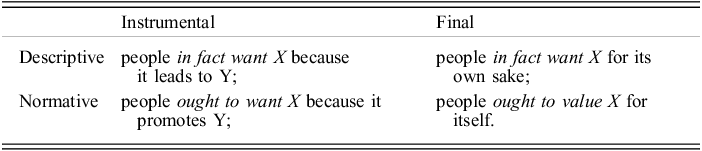
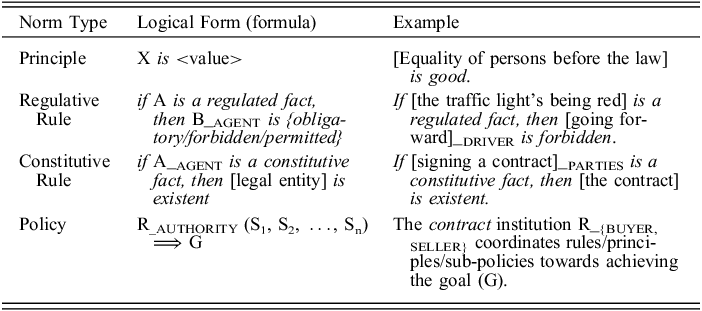
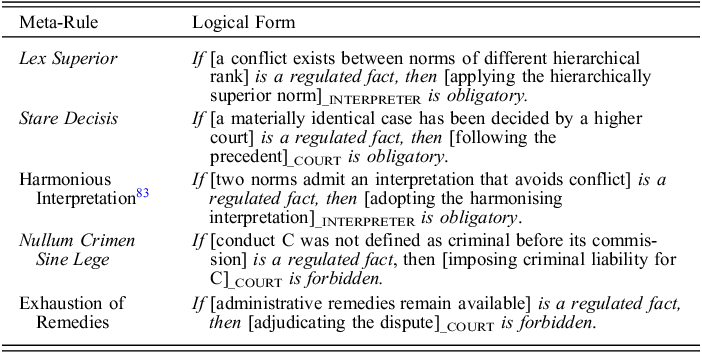
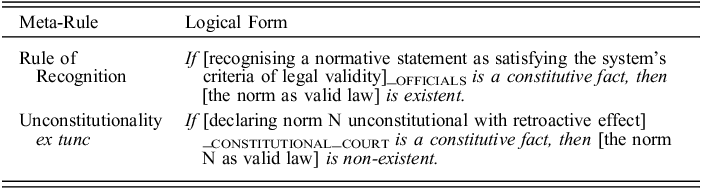

 Open access

