Surgical aortic valve replacement has been a gold standard treatment in patients with symptomatic severe aortic valve stenosis. Patients with multiple comorbidities are usually not fit for surgery and are therefore managed conservativelyReference Varadarajan, Kapoor, Bansal and Pai 1 or with aortic valvuloplasty as a palliative measureReference Otto, Mickel and Kennedy 2 or as a bridge to definitive management.Reference Hamid, Eichhöfer, Clarke and Mahadevan 3 Cribier et alReference Cribier, Eltchaninoff and Bash 4 described the first successful human transcatheter aortic valve implantation. Transcatheter aortic valve implantation has been successfully performed for high-risk surgical cases but has been associated with procedural risks.
Case presentation
A 78-year-old patient with a history of ischaemic heart disease and severe aortic stenosis was referred for consideration of surgical aortic valve replacement. His past medical history included coronary artery bypass graft surgery, repeat coronary artery bypass graft surgery, significant left ventricular systolic dysfunction (ejection fraction 30%, Simpson method), previous percutaneous coronary intervention with a coronary artery stent, paroxysmal atrial fibrillation, and dual-coil single-chamber implantable cardio-defibrillator for ventricular arrhythmia, severe chronic obstructive airway disease, hypertension, and chronic renal impairment. He had previous aortic balloon valvuloplasty but remained symptomatic breathlessness with New York Heart Association class III–IV.
After review by the cardiac surgeons, he was declined for surgical aortic valve replacement because of associated comorbidities and high surgical risk. His Euro-score was 21.7%, while his risk of mortality on Society of Thoracic Society risk calculator was 14.5%.
Procedure
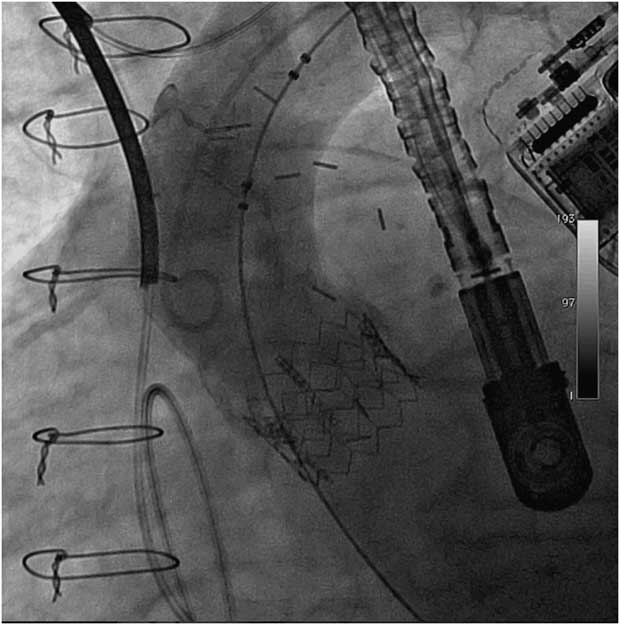
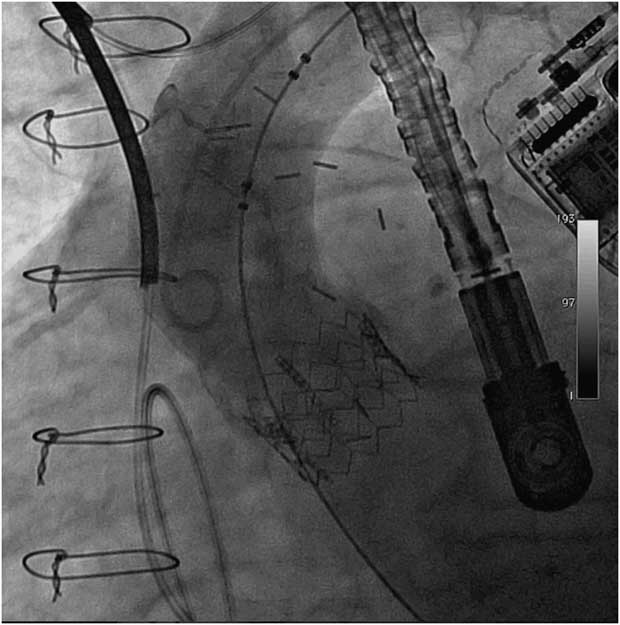
The procedure was performed under general anaesthesia. A temporary pacing wire was inserted in the right ventricular apex via the right femoral vein and the transcatheter aortic valve implantation implant was carried out through the right femoral artery following the usual assessments. A 26-millimetre Edwards valve® was positioned at the aortic valve position and then deployed under rapid ventricular pacing. The valve position looked very satisfactory post deployment, but the patient became very hypotensive despite the discontinuation of rapid ventricular pacing. Trans-oesophageal echocardiography revealed very severe aortic regurgitation with no valve leaflet motion, poor left ventricular function with evidence of electromechanical dissociation, and no pericardial effusion. Check aortography revealed significant aortic regurgitation (Fig 1, Supplementary movie 1) probably caused by stuck valve leaflets that persisted despite removal of the wire from the left ventricle, causing very poor ventricular function and loss of pressure differential across the new prosthetic valve. Cardiopulmonary resuscitation was commenced and inotropes were given. After 2 minutes of cardiopulmonary resuscitation, the patient spontaneously recovered with an improvement of ventricular contractility and blood pressure. Repeat angiography revealed no evidence of any significant aortic regurgitation (Supplementary movie 2) and trans-oesophageal echocardiography confirmed good valve function with mild aortic regurgitation. The post-transcatheter aortic valve implantation gradient dropped from 60 to 11 millimetres of mercury. The procedure was completed with the insertion of an intra-aortic balloon pump for 24 hours. Blood pressure remained stable and all the inotropic support along with intra-aortic balloon pump was withdrawn within 12 hours. His repeated transthoracic echocardiography showed improvement of left ventricular function to 35%. He was discharged home after 5 days.
Angiography shows guide wire through aortic valve with acute severe aortic regurgitation.
Discussion
Transcatheter aortic valve implantation has recently emerged with incremental successReference Cribier, Eltchaninoff and Tron 5 – Reference Grube, Buellesfeld and Mueller 7 as a newer technology for percutaneous interventional treatment of severe symptomatic aortic valve stenosis in surgical high-risk patients. Transcatheter aortic valve implantation procedural complications include vessel trauma, peripheral athero-embolism, peri-procedural stroke,Reference Grube, Buellesfeld and Mueller 7 transient visual deficit,Reference Webb, Chandavimol and Thompson 6 cardiac tamponade,Reference Webb, Chandavimol and Thompson 6 severe mitral regurgitation (trans-venous),Reference Hanzel, Harrity, Schreiber and O'Neill 9 arrhythmias, and obstruction of the coronary ostia.Reference Dağdelen, Karabulut and Alhan 8 Device-related complications include severe life-threatening, severe trans-valvular aortic regurgitation, and valve embolisation.Reference Clavel, Dumont and Pibarot 10
Severe central aortic regurgitation immediately after valve deployment can occur as a result of perforation or tearing of a valve leaflet, deformation of stent by severe aortic valve calcification, or entrapment of the bio-prosthetic valve leaflet by protrusion of a portion of the native valve leaflet within or above the stent.
In our patient, the cause of severe haemodynamic compromise immediately after the valve was implanted appears to be due to the leaflets of the new valve being entrapped by calcium from the native aorta leading to acute severe aortic regurgitation. Moreover, the myocardium was probably stunned as a result of the rapid right ventricular pacing at 200 beats per minute, in the setting of pre-existing severe left ventricular systolic dysfunction. Both these factors led to the rapid cardiac decompensation and subsequently pulseless cardiac arrest. The prompt cardiopulmonary resuscitation presumably resulted in the restoration of leaflet mobility of the implanted valve, leading to restoration of function. In our case, the other potential causes of cardiac arrest such as ventricular perforation, pericardial effusion, and coronary embolisation were excluded by repeat angiography and trans-oesophageal echocardiography. The patient had significant improvement in symptoms and remains well on 1-year follow-up.
Conclusion
Cardiac arrest during the deployment of percutaneous aortic valve replacement is a rare but known complication. Transient severe aortic regurgitation secondary to the mechanical failure of the deployed valve can lead to dangerous consequences in the setting of significant left ventricular impairment.
Supplementary material
For supplementary material referred to in this article, please visit http://dx.doi.org/doi:10.1017/S1047951112000273