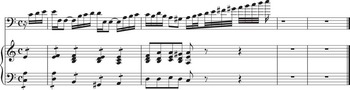
From the mid-nineteenth century onwards, performing editions of canonic works for stringed instruments have proliferated. Even within the period covered by this paper, Beethoven's violin sonatas were edited by Auer, Brodsky, David, Dont, Flesch, Halir, Hermann, Joachim, Singer, and Kreisler, and his Violin Concerto by Auer, David, Dessauer, Dont, Flesch, Hubay, Joachim, Kreisler, Sauret, Vieuxtemps and Wilhelmj. The cello repertoire is much less liberally provided with editions of this sort. Over the same period, Beethoven's cello sonatas were edited only by Friedrich Grützmacher, Carl Hüllweck, and Percy Such, and only four editions of Mendelssohn's cello sonatas appeared (by Friedrich and Leopold Grützmacher, Bernhard Cossmann and David Popper).Footnote 1
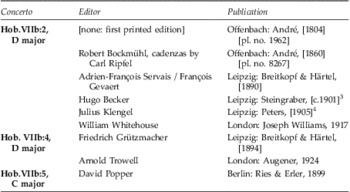
However, Haydn's cello concertos present a very different picture. In the period under discussion, there were three cello concertos associated with Haydn's name, appearing in a total of eight performing editions (Table 1). The ‘great’ D major concerto Hob.VIIb:2 was frequently attributed to Anton Kraft until the rediscovery of Haydn's autograph manuscript. The ‘little’ D major concerto Hob.VIIb:4 was then thought to be by Haydn, but that attribution is untenable; it is to all intents and purposes an anonymous work. The concerto in C Hob.VIIb:5, edited by David Popper ‘from sketches’, was generally accepted as at least incorporating music by Haydn. Never popular, performances of the ‘little’ D major disappear in the 1920s. The ‘C major concerto’ never achieved any currency after Popper's death in 1913, and it exists in Popper's version only.Footnote 2
concertos by or attributed to Haydn

This paper will discuss aspects of all these texts alongside the reception of the concertos (as compositions) and of individual performances. The prevalence of cuts and other alterations is shown to be a feature of almost all the editions and therefore central to their performance history. Performing editions of both D major concertos vary considerably, not only in the performance indications, but in the very notes played. It is hard to think of any work this central to any instrumental repertoire whose performing editions have embraced such a wide range of approaches. This article surveys the period of the greatest diversity of editions, a period whose later limit is determined by the eventual entry of this work into the cello canon.Footnote 5 It will be argued that this diversity is a consequence of non-canonicity.
Hob.VIIb:2 – EDITIONS
Bockmühl, Servais and Gevaert
These editions and editors are closely connected, and will therefore be discussed together. The first performing edition of this work is that by Robert Bockmühl (1820–1881). Bockmühl rarely performed in public, as he had independent means. He was a prolific composer and arranger; notably, he arranged Beethoven's Violin Concerto for the cello.Footnote 6 His Etudes classiques include numerous examples of difficult cello passages from chamber music (one of the first collections of its kind), and he advised Schumann on technical aspects of his Cello Concerto.Footnote 7 Bockmühl makes numerous changes to André's version, but, unlike many later editors, he does not make cuts to the first movement (like all editors considered in this paper, he shortens the final section of the third movement). However, he rewrites some sections, adds dynamic markings, makes numerous small changes to André's phrasing and articulation marks, and provides fingerings.
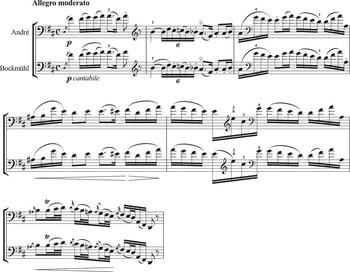
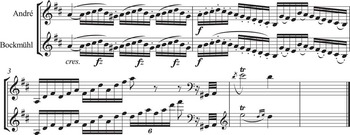
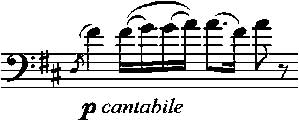
Hob.VIIb:2, Bockmühl and André first movement, bars 29–34.

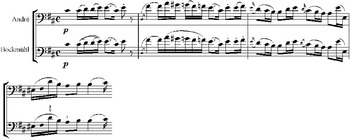
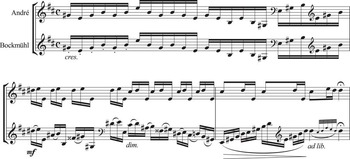
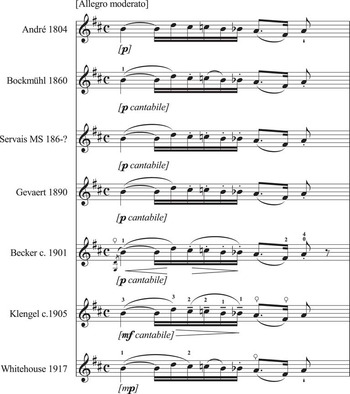
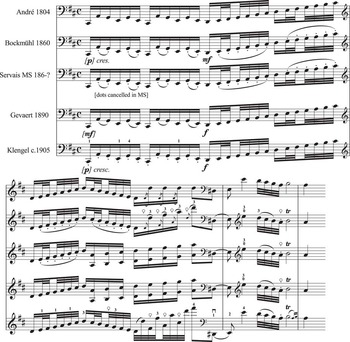
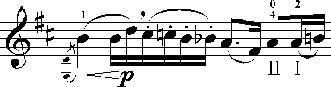
Alterations like the additional slurs or hairpin crescendi in example 1 are characteristic. Bockmühl's cantabile marking is one of several additional expressive indications, along with energico (bar 100) and doloroso (bar 104). His fingerings are mostly simply for clarification rather than serving any expressive purpose. However, one fingering (ex. 2, bar 4) clearly implies a portamento effect to a d′ harmonic, a favourite effect of Julius Dotzauer and Bernhard Romberg, described in their cello methods and used in several exercises.Footnote 8 Bockmühl is, however, generally quite restrained in his use of portamento here, compared with some of his other publications.Footnote 9 Where he rewrites passage-work, Bockmühl inclines towards a more lyrical approach, with added chromatic embellishment derived from Haydn's original motif (ex. 3). Bockmühl does not significantly increase the concerto's virtuosic demands overall. However, at the end of the first movement he adds dramatic off-beat forzandi and up-bow staccato, extends the sextuplet arpeggio through a further octave, and moves the cadential trill up an octave; he also frequently adds up-bow articulation markings to scales, and adds staccato dots to some of André's slurs (ex. 4 – see also ex. 6). The 1890 edition ‘bearbeitet und neu instrumentiert’ by François-Auguste Gevaert (1828–1908), was the most widely circulated. Indeed, notwithstanding its evident shortcomings, it is still in use, though mostly for orchestral auditions, where the substantial cuts are unimportant. It has three principal features: Haydn's wind orchestration is considerably enlarged; the first movement is severely cut; and the first movement cadenzas are clearly cellistic, even though Gevaert was not a cellist but a professor of orchestration at the Brussels Conservatoire. The importance of Gevaert's contribution was tacitly acknowledged when the piece was attributed to ‘Haydn-Gevaert’ as early as 1892 in the Musikalisches Wochenblatt. Footnote 10 Gevaert's orchestration was criticized quite early in the work's performance history. A public lecture in Manchester on the cello's repertoire included the comment: ‘The modernized accompaniments by Gevaert […] took away something of the softness of Haydn's scoring, which was really more suitable.’Footnote 11 When Suggia played it in 1915 one critic suggested that ‘[t]he name of the ‘cellist who edited this work ought to be hyphened with that of Haydn. It would be interesting to hear what the latter actually wrote.’Footnote 12 Piatigorsky is said have advised his pupils to give Gevaert's edition as a present to their worst enemy.Footnote 13 The cuts, which were retained in the editions by Becker and Whitehouse, include the entire recapitulation of the first subject, radically altering the form of the first movement.Footnote 14
Bockmühl and André, 1st movement development, bars 92–95.

Bockmühl and André, 1st movement, bars 62–64

Bockmühl and André, 1st movement, bars 176–179.

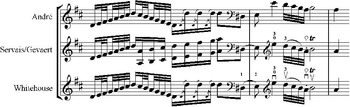
Hob.VIIb:2, 1st movement, bar 30.

However, Gevaert was not responsible for all these shortcomings. The orchestration is his, but unpublished research by Jerome Carrington has shown that the cuts, revisions and cadenzas originate in a version prepared by the Belgian virtuoso and teacher Adrien-François Servais (1807–1866).Footnote 15 Servais's manuscript copy of the solo part is now held in a private archive in Belgium belonging to his great-grandson. Carrington surmised that Servais was working from another manuscript version, ‘which in turn was constructed from the individual parts of the 1804 André edition’.Footnote 16 This is a reasonable assumption, but in fact Servais's edition was based on Bockmühl's, also published by André. Servais could well have known of Bockmühl, as the latter's Etudes pour le développement du mécanisme du violoncelle (1847) had been adopted by the Brussels Conservatoire, where Servais was professor of cello from 1848 until his death.Footnote 17
Bockmühl's bowings, articulations and rewritten passage-work appear in Servais's manuscript in the latter's ‘neat’ hand; some of these are then further altered in his more ‘careless’ hand, and these changes reappear in Gevaert. Examples 5-7 are typical. In bar 30 of the first movement (ex. 5) Bockmühl adds slurs to the sextuplet scale (the corresponding passage in the development is played in one slur). Servais copies these slurs but then deletes the second one, adding staccato dots to the c’’ and b’. Gevaert reproduces Servais's version. It should be particularly noted that, pace Robbins Landon, this sextuplet scale is only marked to be played with an articulated up-bow in twentieth-century editions, beginning with Becker, and that this is not indicated in any nineteenth-century edition.Footnote 18 Klengel's notation strongly implies a bow-stroke closer to portato (he clearly indicates up-bow staccato in bar 41 – see ex. 13). Even though Becker marks a slur with staccato dots, he explains in a later commentary that this only means that ‘the four sextuplets following the d′ are to be taken in one bow, gently staccato!’.Footnote 19 No doubt an off-the-string up-bow staccato (Landon's ‘springbogen’) could have been used in the nineteenth century, but there is no specific evidence to substantiate its use here. This is all the more striking in view of Servais's own clear personal predilection for virtuosic up-bow staccato in his own compositions, which would make him, prima facie, the most likely cellist to use that technique here.
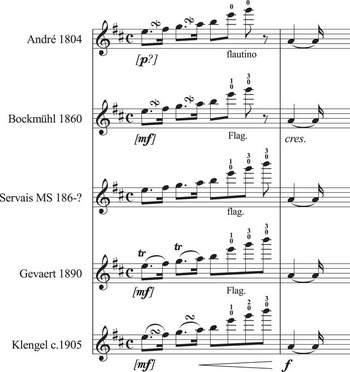
In bars 44–47 (ex. 6), the same process applies: Bockmühl adds up-bow staccato markings in bars 44–45 and rewrites the semiquavers in bar 45, Servais copies these, but deletes all the staccato markings and substitutes a different passage in bar 45, and Gevaert follows Servais's version. The high e″ in bar 46 added by Bockmühl is retained by Servais and Gevaert. The well-known flautino passage in harmonics (ex. 7) is copied by Servais from Bockmühl, but Servais then clearly adds an extra separate, unbeamed, quaver b′′′ where Bockmühl (and the first André edition) give a rest. This additional note appears in Gevaert, Klengel, Becker, Whitehouse and many later editions. With only a few very small exceptions, this pattern of transmission can be observed throughout.Footnote 20
Hob.VIIb:2, 1st movement, bars 44–47.

Hob. VIIb:2, harmonics, bar 175 of complete text.

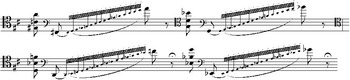
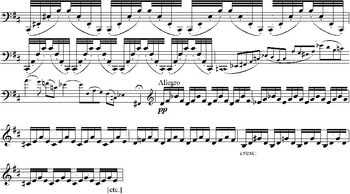
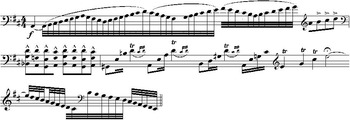
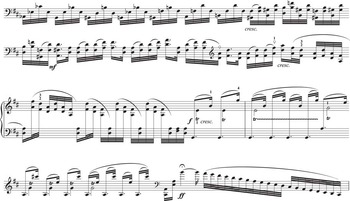
The Servais manuscript therefore dates from between 1860, when Bockmühl's edition appeared, and 1866, when Servais died. He appears to have begun with a piano score, indicating cuts by pasting white paper over these passages, before writing in the solo part.Footnote 21 The separate solo part was written from the outset with the cuts already established. Servais's cadenzas exhibit his fondness for extreme up-bow staccato effects, repeated pp arpeggio figurations and successive triple-stopped chords, though they are less virtuosic than his own compositions tended to be (exx. 8–10).
Servais's son Joseph (1850–1885), who taught at the Brussels Conservatoire from 1872, performed this version in Brussels and Paris, with Gevaert conducting. This association is acknowledged in Gevaert's dedication of his edition, ‘dem Andenken des hochbegabten Virtuosen Joseph Servais’.
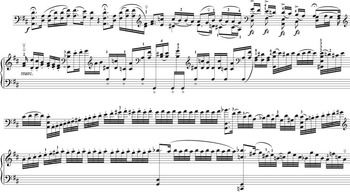
By composing his own cadenzas, Servais was rejecting those included in Bockmühl's edition. These were not by Bockmühl himself, but the obscure cellist Carl Ripfel (1799–1876). Ripfel's cadenzas are separately paginated, but are otherwise integral to the Bockmühl edition, bearing André's imprint and the same plate number, with the endings of each cadenza cued into the piano score. Ripfel is identified here only by his initials ‘C. R.’, and this near-anonymity is consistent with what little is known of him. According to Wasielewski, he was a virtuoso player, but too nervous to perform as a soloist once he reached adulthood. Instead, he spent 45 years as principal cello in the Frankfurt opera house (a post held later by Hugo Becker). Ripfel also composed, but ‘roughly refused’ to let Jean Becker see one of his compositions.Footnote 22 In length and technical difficulty his Haydn cadenzas are among most extravagant written for this concerto by any cellist. His first movement cadenza takes up four densely printed pages, or more than a third of the movement in all; some extracts are given in examples 11–12.
Klengel
Julius Klengel's (1859–1933) edition cuts far less than Servais/Gevaert. However, Klengel's 1887 performance of the work in England probably used Gevaert's orchestration, and therefore might have still incorporated Servais's cuts at that time. According to the Athenaeum,
[T]he work is not even published, and the manuscript. score and parts (including accompaniments for woodwind, and cadenzas certainly not written by Haydn) were borrowed from the Brussels Conservatoire.Footnote 23
It is quite possible that Gevaert's manuscript score and parts had remained at the Brussels Conservatoire after Joseph Servais's death in 1885. Shedlock, reviewing the same concert for Academy, was therefore probably wrong to presume (plausibly enough) that Klengel ‘used the violoncello part revised by Bockmühl and the “C.R.” cadences’, as Bockmühl follows the André version without cuts.Footnote 24 However, Shedlock would have been correct when he suggested that
the concerto was not performed exactly as the master wrote it. Haydn's accompaniments to his concertos were for strings and in one instance for strings and two horns; but the accompaniments on Wednesday were played by strings and woodwind. Cadences, too, were added and written quite in the modern style, and the solo part was very probably touched up in places.Footnote 25
In 1902 the Times thought that Klengel had ‘done for it what Liszt so frequently did for Bach and others’.Footnote 26
In fact, Klengel's version is relatively restrained. He cuts seven bars of orchestral tutti from the first movement and two snippets of four bars from the concluding section of the finale; adds one bar to the first movement to extend a sequence of sextuplets in a similar way to Bockmühl (see ex. 4); keeps the solo cello playing at the start of the third movement's minore section; extends some sections slightly; and adds double-stopped thirds in one section. He makes no cuts in the recapitulation section of the first movement.
Hob. VIIb:2, Servais, cadenza, 1st movement

Hob. VIIb:2, Servais, 1st movement cadenza, arpeggios.

Hob. VIIb:2, Servais, 1st movement cadenza, conclusion.

Hob.VIIb:2, Carl Ripfel's 1st movement cadenza, opening bars.

Hob.VIIb:2, Carl Ripfel's 1st movement cadenza, conclusion.

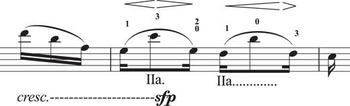
The most notable features of Klengel's edition occur in the first movement. In bars 63–64 Klengel, uniquely, goes back to André (as in ex. 3); the parallel passage in the development is however altered, but still less than in other editions. Overall, his editorial stance is somewhat closer to the original, with fewer additions or alterations. However, he creates a unique bowing pattern for the sextuplet scales in bar 41 (ex. 13).
Hob.VIIb:2, 1st movement, Klengel, bar 41.

Klengel's substantial first-movement cadenza mostly uses standard arpeggio figures and elaborate flourishes, and is chiefly notable for its final arpeggio rising to a d′′′′. This cadenza even temporarily halted one performance when the Hanover audience could not restrain its applause.Footnote 27
Whitehouse
William Whitehouse's (1859–1935) edition is based primarily on Servais/Gevaert, including cuts. He does not supply a first movement cadenza, suggesting instead a short additional cut if no cadenza is played. However, cadenzas are provided for the other movements. He sometimes changes the notes of Servais/Gevaert, but he restores an original André reading only once (ex. 14).
Hob.VIIb:2, 1st movement bars 45–46, Whitehouse.

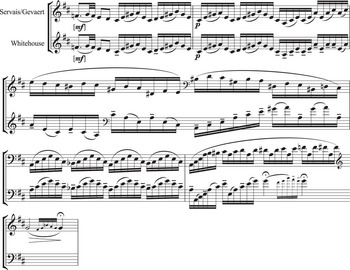
In bars 126–130 he finds a less difficult, and slightly shorter, alternative to Servais's chromatically enhanced sextuplets (ex. 15).
Hob.VIIb:2, 1st movement, Whitehouse and Servais/Gevaert, bars 126–130.

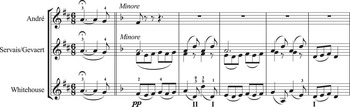
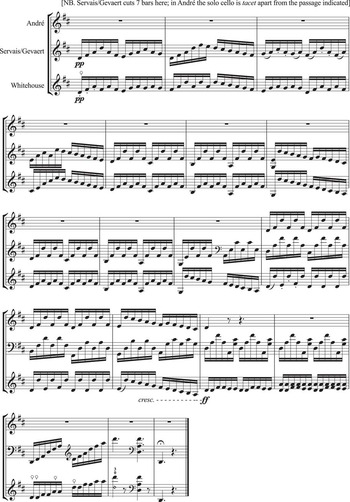
In the minore section of the third movement he alters the second and fourth bars, removing Servais's double stops, and he rewrites the final play-out replacing Servais's quite awkward chords with much easier repeated notes (exx. 16–17; note that in example 17 Servais/Gevaert cuts seven bars, while in André the solo cello is tacet apart from the passage indicated).
Hob.VIIb:2, 3rd movt, minore, Whitehouse.

Hob.VIIb:2, 3rd movt, conclusion, Whitehouse.

Hob.VIIb:2, 1st movement, Whitehouse, bars 31–32.

Whitehouse rarely uses fingerings that imply portamento; example 18 is exceptional.
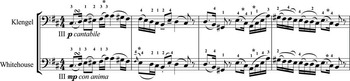
The first movement's second theme affords several such opportunities, fewer of which are taken by Whitehouse than Klengel (ex. 19; portamentos marked with asterisk).
Hob.VIIb:2, 1st movement, Whitehouse and Klengel portamentos bars 50–53.

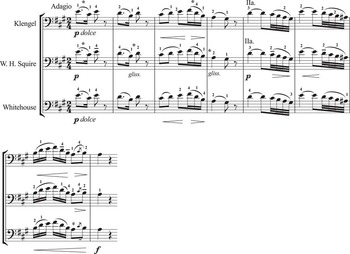
Similarly in the second movement, where we can additionally compare him with W.H. Squire's arrangement (ex. 20 – portamentos are indicated by asterisks) Whitehouse avoids the portamentos used by Squire and Klengel in bars 1, 3 and 4.Footnote 28 He also remains on the A string in bar 5 and uses an open A in bar 7, perhaps rejecting the easier sentimentality of the higher reaches of the D string.
Hob.VIIb:2, 2nd movement, Whitehouse, Klengel and Squire portamentos (indicated by asterisks) bars 1–8.

In the third movement, a fingering which might tempt the player to use portamento is clarified to indicate that no audible shift is implied (ex. 21):
Hob.VIIb:2, 3rd movement, ‘extend’ markings (fingerings in brackets added for clarification).

Whitehouse is particularly fond of harmonics, such as the unusual artificial octave harmonic used in the penultimate bar of the third movement and in the first movement (ex. 22). This is only possible in higher positions, with the thumb holding the lower note and the third finger touching the same string an octave higher. There are many examples of this technique in the works of nineteenth-century cellists such as Servais, Grützmacher or Romberg, but it had become quite rare by the twentieth century.
Hob.VIIb:2, 1st movement, Whitehouse, artificial octave harmonic.

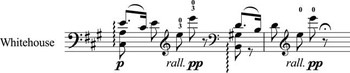
The final flourish of the first movement features an arpeggio of harmonics with a rallentando to give the player more time to find the notes and a bowing that encourages a pp ending with the last note on an up-bow, towards the tip (ex. 23).
Hob.VIIb:2, 1st movement Whitehouse harmonics, bars 141–142.

He also toys with some delicate high harmonics in his second movement cadenza, once more making sure that there is time to dwell upon them, and playing the highest ones with an up-bow (ex. 24).
Whitehouse's edition generally avoids virtuosity. He prefers to keep the bow close to the string, indicated by his repeated use of lines as opposed to staccato dots, and simplifies some of the passage-work. In his use of high harmonics, played pp and generally with a slowing of the tempo, he has more in common with earlier types of nineteenth-century virtuosity than with Klengel or Becker.
Becker
Hugo Becker (1864–1941) was the first cellist to provide both a performing edition and a written commentary on Hob.VIIb:2, albeit separated by some three decades.Footnote 29 His own performances used Haydn's orchestration, as several reviews make clear.Footnote 30 His commentary includes metronome marks for each movement:  $$\[-->$<>\raster="fx3"$$$ = 104–108,
 $$\[-->$<>\raster="fx3"$$$ 66–69 and
 $$\[-->$<>\raster="fx4"$$$ 84 respectively. The markings for the first and second movements are significantly slower than Suggia's recorded tempi, respectively
 $$\[-->$<>\raster="fx3"$$$ 114 and
 $$\[-->$<>\raster="fx3"$$$ 77; in the third movement Suggia is much slower than Becker at
 $$\[-->$<>\raster="fx4"$$$ 78. Becker is the first cellist, and possibly the first musician, to make serious written claims for the stature and significance of this concerto. Suggia recorded some of Casals’ observations on the work in 1921, but these are few and deal with general stylistic considerations – the work is of a ‘style léger; difficile de donner des règles; simple, sans glissando’.Footnote 31 For Becker, on the other hand, while the first movement is ‘characterized by gladness and life-affirming expression’, it also embraces opposing qualities ‘which in the first movement intensify from the lyric to the dramatic’.Footnote 32 This means that ‘the player himself will have to contain any sentimentality of expression!’.Footnote 33
Hob.VIIb:2, Whitehouse, 2nd movement cadenza.

In two places Becker, like Casals, specifically rejects the use of portamento. In bar 33 (ex. 25), he suggests an agogic stress on the lower e′, and then, ‘with the avoidance of any noticeable portamentos, play simply across this passage!’.Footnote 34
Hob.VIIb:2, bar 33, avoiding portamento: Becker and Dynar, Mechanik.

At bar 64, approaching the pause on the fourth crotchet beat (ex. 26), the sextuplets are ‘to be played in such a way that portamentos are not to be heard, despite the change of position’.Footnote 35
Hob.VIIb:2, 1st movement, bars 63-64, Becker.

His fundamental point is entirely consistent with his approach to performance in general – elsewhere in the Mechanik he rails against Kaffeehaus sentimentality.Footnote 36 However, since Becker fingers this passage entirely in thumb position it is not clear where he thinks the shifts might occur, as with the thumb on b′ in bar 63 there is no shift needed for the crotchet d′′. It could be that Becker is thinking of his striking use of a D string harmonic on the fermata, which requires a shift to a higher position; this is the type of place where Grützmacher was quite capable of introducing a portamento (see ex. 31 below for an example from Hob.VIIb:4).
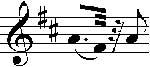
In the soloist's first bar (ex. 27) Becker specifically warns against what he sees as a faulty rhythm: ‘the last semiquaver f# is often incorrectly shortened so that it gives the impression of a demisemiquaver’.Footnote 37 It is not clear whether Becker is warning against over-dotting, that is, prolonging the a′ and shortening the f#′, or shortening the f#′ to a demisemiquaver followed by an implied demisemiquaver rest, that is, over-articulating the bow change (ex. 28).
Hob.VIIb:2, soloist's entry.
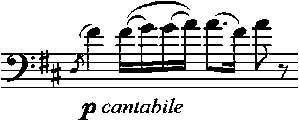
Hob.VIIb:2, Becker, possible faulty rhythm.
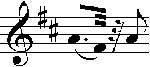
Given that over-dotting was widespread in the earlier twentieth century, and that this rhythmic ‘error’ is inherently more likely than the over-articulated alternative, it seems more likely that Becker objected to over-dotting here.Footnote 38 However, Becker also asks for agogic accents on the first and third semiquavers of this bar, which implies that he may have approved of the equally well-established practice of rhythmic inequality.Footnote 39
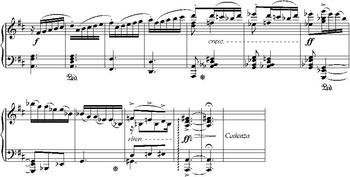
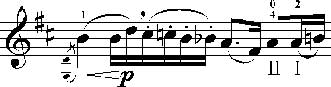
In the next bar (ex. 29) he goes to great lengths to clarify his intentions, both in notation and verbally.
The crescendo through the b′ is followed by a subito piano on d′′, a ‘kleine Luftpause’ before the c#′′, and a slight accelerando through the sextuplets to the third crotchet of the bar where only the first a′ is stressed (the harmonic on the second a′ clearly implies that it is much quieter).Footnote 40 He follows this with the remark about ‘gentle staccato’ for the sextuplets already quoted (see note 19). None of this is apparent from his performing edition (see ex. 5 above).
Hob.VIIb:2, soloist's second bar, Becker's markings (Mechanik).
Becker characterises the second theme as ‘cheerful’ and ‘joyful’, confirming the theme's con anima marking in his edition.Footnote 41 This theme is normally indicated to be played entirely on the G string (following André; Haydn's manuscript agrees), but Becker, uniquely, changes to the D string after half a bar, and then remains there as long as possible (ex. 30).
Hob.VIIb:2, 1st movement, 2nd theme, Becker's fingering; fingerings in brackets are implied.

There are many small examples of rubato in Becker's account, particularly in the first movement, nearly all of which require an agogic stress. Indeed, combining his edition with his commentary it would seem that Becker uses a line over a note to mean agogic rubato at least as often as an articulation, unlike Klengel's more conventional use of a line to indicate an articulation. Becker's line is the equivalent of Hugo Riemann's inverted V, which also indicates an agogic accent.Footnote 42 Sometimes Becker is not so specific, as with the demisemiquaver scales in the fifth and sixth bars of the slow movement, which are simply to be played ‘with rubato’.Footnote 43 However, in the light of his remarks elsewhere, he probably intends an agogic accent on the first of each group, with a slight compensating accelerando.
In his general remarks about the character of the first movement, Becker draws attention to the fact that it embraces opposing expressive qualities. His detailed commentary and the dynamic markings in his edition bear this out. The commentary shows that these opposing emotions are not simply in balance, but that there is a struggle between them, particularly in the B minor development.
The three bars before H [bars 93–95] appear as an exacerbated struggle utilising all available energies, which reaches its high point in the last bar. The orchestra's eight semiquavers at H [bar 96] lead away from this exciting struggle to a more prudent peace. A more conciliatory theme gains ground, which is however still occasionally disturbed by dramatic incidents, so that the earlier interplay remains until the orchestra entry at I [bar107].Footnote 44
Becker ends his discussion with some general remarks about editions:
The work went through various transformations and was published in different versions. The available version by Gevaert can be called successful. Since it is the basis for our analysis, the modifications suggested here cannot be seen as deviations from the composer's original version, in the sense of an injury to the principle of faithfulness to the notes [Notentreue].Footnote 45
Presumably, Becker means that modifying Gevaert's ‘glückliche’ edition is legitimate because it is not the same thing as altering Haydn's own version. This offers an interesting insight into attitudes to a text widely known to be altered from its original and yet still preferred to that original, a few years before Altmann's edition returned to the André version.
Hob.VIIb:2—RECEPTION
Reception evidence for this concerto, and indeed for the two others considered here, is somewhat patchy. While there are a number of English reviews of performances, there are significantly fewer in Germany or France. This may reflect Haydn's somewhat greater popularity in England, but it also reflects that fact that the Popper ‘Haydn’ concerto had its première in England (receiving very few performances anywhere else), and that Arnold Trowell's edition of Hob.VIIb:2 was only ever performed there (and on only a few occasions).
Until the early twentieth century, performances of the ‘great’ D major were often received with serious reservations about the quality of the work itself. Haydn himself was widely seen as irredeemably passé, and the concerto was not thought to show him at his best. Piatti's 1856 performance at the Philharmonic Concerts in London – the London première and the earliest documented performance found anywhere to date – was severely criticized on the following grounds:
Sig. Piatti's incomparable talent was ill-displayed in the meagre and old-fashioned concerto of Haydn, which we strongly recommend him to restore to that ancient book-stall where he is said (we are unaware with what truth) to have discovered it. As music it is rococo, and as a specimen of the master, of no value whatever. […] It should be buried…Footnote 46
The Examiner was just as unimpressed:
The revival of a Concerto for the Violoncello by so great a master, was interesting as a curiosity, and as such would have pleased, but for its most unreasonable length. It abounds in that gaiety which characterizes so many of Haydn's compositions, but exhibits no trait of his genius. […] to the last movement we certainly should have applied a strong epithet, had not our respect for so truly great a name operated as a restraint on our language. […] [T]his was one of many dozens of compositions produced, as a duty, in his official capacity; and, it may be traced to […] a desire to gratify the unrefined taste of the court of some petty German prince. Signor Piatti, however, made the most of the resuscitated piece, and all would have enjoyed the pleasure that antiquaries feel at an exhumation, had not the process of disinterment been protracted till, at the end of about ten minutes, such excitement had ceased to act, and weariness had in most instances supervened.Footnote 47
The Musical Gazette simply dismissed the piece as ‘a very old-fashioned article’.Footnote 48 Piatti never played it again in public, presumably because of its bad reception.Footnote 49 When the amateur Stanley Rigby recalled his teenage years in Manchester in the 1870s and 1880s, he said that:
Piatti was a regular visitor. A young cellist once asked me what Piatti played with the orchestra. I remember that in the second half he would play a Locatelli or Sammartini sonata with Hallé, but what he played in the first I couldn't for my life recall. There was not much for him. The Haydn had not been unearthed…Footnote 50
Parisian performances fared little better than Piatti's in London. Although the Paris première had taken place at the Conservatoire in 1855 (played by Emile Norblin, 1821–1884, son and pupil of Louis Norblin),Footnote 51 a performance two years later was reviewed as a première:
The concerto for cello by Haydn, which was also having its first hearing in Paris, appeared to be in a somewhat aged style, although very well executed; and Corelli, in his trio for two violins and cello, although older, appeared newer.Footnote 52
Although Norblin was to play it again at the Conservatoire in 1860,Footnote 53 Joseph Servais's 1879 Paris performance was still mistakenly described by the Revue et gazette musicale as ‘the first time, to our knowledge, that such a work was performed in Paris’. It attracted qualified praise:
A little old-fashioned in form, as one would have expected, nonetheless the concerto has some interest; the andante, notably, is a lovely page. A large, difficult cadenza, of M. Gevaert's composition, was added to the first allegro; M. Servais performed it with the greatest security and much brio.Footnote 54
An 1867 performance by Grützmacher in Meiningen formed part of the first part of a ‘historische Abonnement-Concert’ alongside a concerto grosso and an opera aria by Handel, and aroused no comment.Footnote 55 The following year it was to have been performed in Leipzig by Emil Hegar (1843-1921), but he was persuaded to play Goltermann instead, for reasons unknown:
Herr Hagar has met with much, well-deserved approval. Sad to say, this has had much to do with the choice of that all too often-heard composition of Goltermann's [the concerto in A minor], which, with its incessant fatiguing of the A string, was hardly to the taste of any friend of the beautiful and interesting. It is well worth asking whether this was his choice, since what we have heard suggests that Herr Hagar had intended to play a seldom (if ever) performed Violoncello Concerto by J. Haydn (known to us as a very interesting piece), but was advised against it by someone important.Footnote 56
Ernest de Munck (1840–1915), one of Servais's most prominent pupils, almost certainly used the Servais/Gevaert edition at the Leipzig Gewandhaus in 1871, when he played the second and third movements, with only limited success:
The cellist Herr Demunck from Weimar was not able to warm us in the slightest with his playing. The performance of the concerto attributed to Haydn (which, a celebrated connoisseur of Haydn's works assures us, was never composed by Haydn) completely failed. It keeps to Haydn's style, but without Haydn's familiar original freshness and charm.Footnote 57
Not for the last time in connection with this work, the reviewer regretted that the soloist ‘did not apply his good technique to works with more content’.Footnote 58
Criticism of Hob.VIIb:2 recurred into the twentieth century. The Manchester Guardian was particularly provoked. In 1905 it stated that ‘it cannot be contended that it is a great work, however delightful to listen to’.Footnote 59 Two years later, Casals's performance was seen as a wasted opportunity: ‘In the concerto neither Casals nor Haydn can be heard at his best’.Footnote 60 However, the newspaper was saving its most ingenious and sustained invective for the 1909 Haydn centenary performance by Carl Fuchs. While it appreciated Fuchs's grace, subtlety and technical mastery, the performance was seen as a weak tribute to an irrelevant composer.
The worst of centenaries is that they so often come just when a man is turning himself in his grave that he may go off to sleep more soundly. There comes such a time for even the best and greatest of men – a time when […] they are of no further use to anybody […] There is no use now in turning part of a concert audience away so that Haydn may be brought out of his grave to speak for himself by the hour. We have Mozart, Beethoven, Brahms, his followers; let us hear them. Haydn is heard at his best in their works. […] No healing plant for our modern ills shoots from out the dust of Haydn. It is true he built the Palace Symphonic for the soul of the musician to dwell in; Mozart lived and flourished there, Beethoven extended it and put up with it to the end. […] The lack of sincerity about the Haydn centenary performance was shown in the choice of pieces. What composer ought to have his centenary celebrated by a ‘cello concerto? Goltermann. And can Haydn only be represented by a modernized work? If so, why bother at all?Footnote 61
Even in 1921 the Musical Times curtly dismissed it as ‘tedious’.Footnote 62
However, sometimes it did attract praise. Shedlock, reviewing Klengel's 1887 London performance, found it ‘important’ and ‘interesting’, and the slow movement was ‘especially charming’.Footnote 63 The Musical Times even found it hard to account for the work's neglect:
It seems of little use to go for reasons to the music itself, Haydn being always melodious and masterly, and, may be, the right conclusion is that the concertos […] have been crowded out, and that what we do not know or remember is for practical purposes, non-existent.Footnote 64
The Musikalisches Wochenblatt echoed the review of Piatti's 1856 London performance when describing Becker's in 1895:
[…] first, he brought out an interesting excavation, a cello concerto with orchestra by Haydn (probably an arrangement of a gamba concerto – Haydn wrote numerous gamba compositions for his prince, who played this nowadays outdated five-stringed instrument).Footnote 65
Here, however, the reviewer does not imply that the excavation was a waste of time, praising Becker's tone quality and total lack of ‘virtuoso rubbish’ (Virtuosen-schmarrn). Becker's London performance in 1894 led the Musical News to call the piece ‘delightful’, with ‘plenty of display passages’, and ‘well worth playing’.Footnote 66 Shedlock described this performance as ‘quaint and pleasing, and showy for the solo instrument’.Footnote 67 Other reviewers called it ‘cheerful’ or ‘fascinating’, and in 1902 the Times called it ‘naïve’.Footnote 68A 1919 Bradford performance, in a programme including works by Sibelius, Tchaikovsky and Glazunov, was praised as much for its lack of ambition as for any more positive qualities:
One could not help feeling […] that in spite of its antiquated form Haydn's Violoncello Concerto in D gave more profound satisfaction, in that it attains its comparatively modest aim more completely.Footnote 69
When performances themselves were praised, it was nearly always in terms commensurate with the implied limitations of the work. The most frequently used adjective is ‘delightful’, also applied to the ‘small’ D major concerto and to Popper's concerto in C. This recurs in reviews from around 1900 into the 1920s, describing cellists such as Jean Gerardy (1877-1929), Suggia and Casals. Similarly, Maurice Dambois's 1915 performance in Bournemouth was ‘artistic, delicate and refined’.Footnote 70 ‘Brilliance’ is another frequently used term, applied to Klengel (1887), Ernst de Munck (1893), Arnold Foldesy (1903) and Ferdinand Pollain (1908).Footnote 71 A more unusual quality was perceived in the ‘great’ D major concerto performed by amateurs at the Queen's Hall, London in 1912, when
Beethoven's second Symphony and Haydn's violoncello concerto in D (soloist, Miss Vera Poppe) gave an air of rectitude to the programme of the Strolling Players’ concert…Footnote 72
From around the turn of the century, performances by women cellists (amateur and professional) become more frequent. Among the earliest was the Swiss cellist Elsa Rüegger's 1896 performance in Bruges at the age of fifteen.Footnote 73 Suggia's were the most widely reported, and she was to make its first recording in 1928 with Barbirolli, using Casals's cadenzas. Beatrice Harrison almost certainly studied it with Hugo Becker during the period 1908–12 when she was his student in Berlin; she played it in Vienna in 1914 shortly before the war curtailed her appearances on the continent, and also quite frequently in the 1920s.Footnote 74 It was associated with promising younger players as well, such as the Dutch cellist Lucie van Hulst (described variously as ‘promising’ and ‘clever’);Footnote 75 Jean Marcel, a ‘neat and finished’ pupil of Becker and Casals;Footnote 76 Kathleen Moorhouse (pupil and friend of Carl Fuchs, who played regularly as second cellist with him in the Brodsky Quartet) and Joan Willis, who had a modest career as a chamber musician in the inter-war years. Raya Garbousova chose it for her USA début in Detroit in 1927.Footnote 77
In this context, a review of Piatigorsky's 1930 performance is particularly interesting. The Times noted that
Haydn's violoncello concerto in D was the other important work, and M. Grigor Piatigorsky […] brought out its genial charm. He gave to the finale a rather more marked lilt than women violoncellists usually employ, but though female subtlety may be preferred in this particular concerto this masculine reading was all of a piece and bore the stamp of authority.Footnote 78
This review invokes several of the gender tropes associated with the cello throughout the nineteenth century. Masculine ‘authority’ and ‘geniality’ are qualities associated with cellists from the earlier nineteenth century such as Romberg or Merk, at a time when the cello was seen as essentially masculine. A wide range of literary and other sources suggest that this gendered identity became less well-defined later in the nineteenth century, to the extent that by the 1920s the cello was seen by some as either ambiguously, or not at all, gendered. This Piatigorsky review is one of very few openly to suggest that any major cello repertoire (as opposed to small salon pieces) is more suitable for a woman to play. It is also the only review of any cello performance from the period to imply that the soloist plays the piece quite well for a man.Footnote 79
Hob.VIIb:4 – EDITIONS AND RECEPTION
Grützmacher
The difference in styles could not more extreme between Hob.VIIb:2 and the ‘little’ D major concerto Hob.VIIb:4, first published in 1894 in a performing edition by Friedrich Grützmacher. Easier to play, shorter, and avoiding high registers, it has more in common with Viennese composers like Matthias Monn than with Haydn.Footnote 80
Hob.VIIb:4, ed. Grützmacher, 1st movement

Hob.VIIb:4, ed. Grützmacher, 1st movement

Grützmacher, as in his editions of Bach or Boccherini, makes many alterations and cuts. The longer orchestral passages are severely cut, sequential repetitions in the original are altered, and there are numerous small changes to individual notes. In this way the first movement is reduced by about a fifth and the second by a quarter. The third movement is the most changed. Overall, it is reduced from 268 to 225 bars, but Grutzmacher also composes an entirely new episode in B minor nearly a hundred bars long, possibly added by analogy with the minore section of the third movement of Hob.VIIb:2. He provides a cadenza for each movement, even though in the original there is no place for one in the third movement (see ex. 33).
Hob.VIIb:4, 3rd movement, bars 200–211, Grützmacher.

Grützmacher uses most of his characteristic markings in this edition (exx. 31–32). The soloist begins ‘fma nobile’, similar to his favourite ‘con grandezza’.Footnote 81 There are frequent small hairpin swells, which in many cases almost certainly also imply the use of vibrato.Footnote 82 There are also many explicit portamento markings and even more fingerings that clearly imply it; in this, Grützmacher makes no distinction between Haydn and Mendelssohn.Footnote 83 Some of these portamentos precede the beginning of a phrase, particularly when the note is played as a harmonic.
His cadenzas demonstrate Grützmacher's tendency towards ill-advised modulation. In the first movement cadenza he wanders into B-flat major, only rescuing himself with a dramatic diminished seventh and a long portamento to a dominant chord. The second movement's cadenza is similarly contrived, and that for the third, while itself staying closer to the tonic, is introduced by a last-minute Neapolitan sidestep to E-flat (ex. 33).Footnote 84
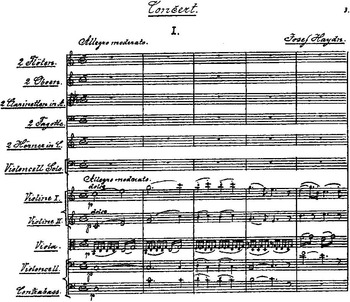
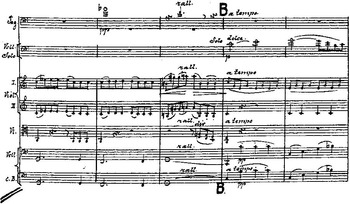
Hob.VIIb:5, Popper, opening bars of full score.

Hob.VIIb:5, Popper, 1st movement, first solo entry.

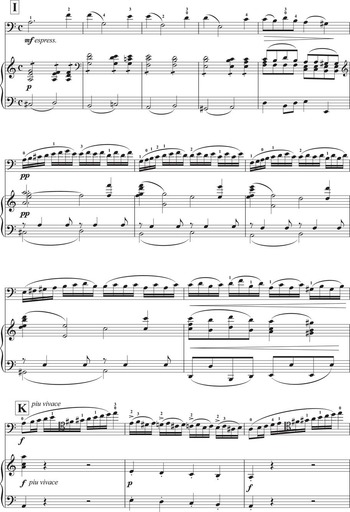
Hob.VIIb:5, Popper, 1st movement, letter I.

Hob.VIIb:1, bars 86–87.

Trowell
Arnold Trowell's (1887–1966) performing edition of the ‘little’ D major concerto amounts to an even more thorough recomposition of the work. He doubles the note values, changing the time signature from  $$\[-->$<>\raster="fx1"$$$ to
 $$\[-->$<>\raster="fx2"$$$, and rewrites the solo part so extensively that only the two principal themes remain identifiable. Almost all the demisemiquaver passage-work is replaced with quite new and very different material in triplets. Orchestral passages are entirely cut, apart from that leading to the recapitulation. In the slow movement, dotted rhythms are replaced with even semiquavers, other thematic material is completely replaced, and the orchestral play-out ends pianissimo, pizzicato.Footnote 85 In the finale, not only does Trowell retain Grützmacher's interpolated minore section – he adds another one of his own. He stops short of adding a cadenza to this movement.
Whereas Grützmacher's version is at least recognisably based on an eighteenth-century concerto, Trowell's is as far removed from that model as David Popper's C major ‘Haydn’ concerto, Hob.VIIb:5, discussed below. This does not appear to have concerned English audiences. Trowell performed this concerto several times from 1919 onwards, twice at the Promenade Concerts. A 1919 Liverpool performance only prompted the Musical Times to speculate as to the origins of his cadenzas, ‘which […] appeared to be of much more recent date’.Footnote 86 At the Proms in 1923 he was particularly successful:
Mr. Trowell seems to have made this work peculiarly his own; he has re-scored it and provided the cadenzas, and his performance is that of a lover. In the beautiful slow movement he produced a suave, rich tone which was always well balanced with the orchestral accompaniment; and the faster movements were played with a rhythmic certainty and a freedom from any of the unpleasant scratchiness which many violoncellists are unable to avoid.Footnote 87
The Musical Times thought this performance ‘both artistic and technically brilliant’.Footnote 88 At the 1926 Proms the work whetted the critic's appetite for the later symphonies of Haydn, with Trowell's ‘tactful editing of the orchestral score’ singled out for special praise.Footnote 89 Trowell's version remained strictly for local consumption, however, and no other cellist took it up. Altmann in his 1935 edition of the ‘great’ D major concerto even used Hob.VIIb:4 as an example of genuine Haydn to cast doubt on the attribution of Hob.VIIb:2:
If one compares our concerto with the only other hitherto published violoncello concerto of Haydn's, which is also in D major [Hob.VIIb:4], it is striking that the latter is far easier and, above all, does not utilize the highest positions as ostentatiously as [Hob.VIIb:2].Footnote 90
Given that the ‘little’ D major was only available at that time in two highly edited and substantially recomposed versions, one by a prolific editor notorious for heavy-handed editing when not actually recomposing the works he edited, one would have thought that Altmann would have been reluctant to take the Haydn attribution at face value.
Hob.VIIb:5—POPPER
For early twentieth-century audiences, much could be taken as being by Haydn that seems obviously spurious to modern ears. David Popper's ‘Haydn’ concerto in C is a good example. This concerto, ‘nach einer Skizze ausgeführt’, claimed to be based on manuscript sketches of the solo part, given to Popper in mysterious circumstances, as described by his pupil Steven Deák (18971975).
In the early 1890s, during the intermission of one of Popper's Vienna recitals, Popper received an interesting windfall. A man who appeared at the artists’ room handed Popper a few sheets of wrinkled manuscript papers, saying that they were some sketches for a cello concerto, by Haydn, that perhaps Popper would find the material interesting, and that he was welcome to have it. […] A few years later […] Popper took time to study the almost forgotten sketches, and judged that the themes were genuinely by Haydn. Thereupon, he set out to work them into a concert form of three movements, for which an outline had already been provided. […] no-one knows the whereabouts of the original sketches today.Footnote 91
The première took place on 1st December 1894 at the Crystal Palace, London, five years before its publication. In reviews, its provenance was not openly contested, but simply stated, with a suggestion that Popper was in fact given the manuscript sketches sometime in the early 1870s, much earlier than in Deák's version. ‘Amphion’, writing in Bow Bells, sat on the fence:
The solo part was presented to [Popper] by a rich amateur while he was a ‘cellist in the Vienna Opera Orchestra twenty-five years ago, but neither the score nor parts could be discovered. Haydn is known to have written six ‘cello concertos between 1760–1790, but this is altogether a new one.Footnote 92
The Musical Times enjoyed it, while not endorsing its authorship:
The Concerto in C […] is attributed by [Popper] to Haydn. Unfortunately, the evidence adduced is inconclusive. The score was given to him by an old amateur in Vienna some twenty years ago, but it has not transpired whether the manuscript affords any clue to the identity of the author. As no traces of the accompaniment could be discovered at Esterhaz or elsewhere, Herr Popper has himself scored the work for an orchestra of the usual dimensions of Haydn's Concertos, and acquitted himself of the task with conspicuous skill and discretion. The Concerto […] is of a decidedly pleasing character, and, if not written by Haydn, is certainly thoroughly Haydnesque both in form and spirit.Footnote 93
The Musical News thought it at least sounded ‘Haydnish’ and thought that ‘it is pretty safe to accept it as a production of the master; it is in his graceful manner, and forms quite a delightful piece for the instrument […]’.Footnote 94 Shedlock, typically, went further than any other critic in his assessment of the work's provenance, describing it as specifically resembling late Haydn because ‘it reminds one, at times, of early Beethoven. […] Haydn's original accompaniments may turn up one day; no one, certainly, would be more interested to see them than Herr Popper’.Footnote 95 A German performance by Popper in 1900 was claimed to ‘show the good old Haydn at his best’.Footnote 96 The reviewer of a performance in Stuttgart in 1903 was clear that the work was Haydn's C major concerto, ‘in Popper's Einrichtung’.Footnote 97 Public performances were few, although Popper's pupils appear to have learned it as part of a natural progression, seeing it, quite simply, as ‘the’ Haydn cello concerto in C:
His [Zsámboki, Popper's assistant] advice was that I should speak to the master and ask him to permit me to stop working on the Romberg [concerto no. 2] and learn instead Haydn's C major Concerto […] we returned to the studio, and [Popper] asked me to play some of the Haydn C major Concerto…Footnote 98
Popper's own limitations as a composer of anything more than short salon pieces were well known – his own concertos were not well reviewed as compositions. It is hard now to see how this concerto could have been taken for Haydn, with its full double wind scoring, highly chromatic decoration, and chromatic sequences (examples 34–35 show the opening bars and the first solo entry).Footnote 99
However, he does hit upon a passage which closely resembles one in the genuine Haydn C major concerto (Hob.VIIb:1) discovered in 1961 (exx. 36–37). Popper's version of this passage has all the elements of Haydn's – the relative minor key, the descending sequence using downward sevenths, and the rapid ascending A minor scale over one and a half octaves with a longer first note. But it is also much expanded, allowing the orchestra to repeat the sequence beneath the soloist's semiquaver embroidery. In Haydn, example 37 marks the end of the development section, with a concise orchestral tutti leading to the recapitulation. Popper extends the same idea for another 21 bars of semiquaver figuration, followed by a tutti based on the ascending scale, leading to a recapitulation which omits the first subject, as in the recapitulation of the Servais/Gevaert edition of Hob.VIIb:2. The possibility exists, therefore, that in spite of the vague basis for this composition, Popper might have been working from a source which, at least in part, was connected in some way with Haydn's genuine C major concerto.
Conclusions
These editions document a process of transition from a marginal, non-canonic status to a position at the centre of the cello canon. While non-canonic, Hob.VIIb:2 can be rewritten more freely than any other cello concerto, but with canonic status the partial recomposition of the work more or less stops, and the more marginal ‘little’ D major and Popper's C major concertos fall out of favour. Seen as far too old-fashioned, Hob.VIIb:2 failed to impress in its rare mid-nineteenth-century appearances, even when the concerto literature of the cello was small. By the 1850s, even the cello concertos of more recently active virtuosos such as Max Bohrer or Josef Merk were virtually unplayed. Over a decade after his unsuccessful Haydn performance, Piatti tried to resurrect a concerto by another dead composer:
Signor Piatti repeated at his concert the adagio frondo from Bernard Romberg's ‘Swiss Concerto’, lately resuscitated by him at one of the meetings of the Philharmonic Society. Music so weakly elegant would not be worth calling from its grave, were it not clothed with fresh beauty by the silvery tones of the Italian violoncellist.Footnote 100
Shifting perceptions of the ‘essential’ qualities of the cello in the later nineteenth century and a greater interest in eighteenth-century cello repertoires (to which Alfredo Piatti, Friedrich Grützmacher and Carl Schroeder contributed much) contributed to the later success of the ‘great’ D major. Almost unperformed before the 1870s, it had become one of the most frequently performed cello concertos by the 1930s. Altmann claimed that it was nearly as often played as those by Dvořák and Eugen d'Albert.Footnote 101 Substituting Elgar for the latter, this still applies today, though the genuine concerto in C is equally popular. By the time that the ‘little’ D major and the Popper C major concertos appeared, the ‘great’ D major was becoming more frequently played, to the extent that there was less need for these more modest, or more weakly composed, pieces.
Whereas towards the end of the nineteenth century there was a fairly well-defined canon of essential violin and piano works, this was by no means the case with the cello. Only in 1897, for example, is there a clear statement that to be considered a true cellist one must know a particular work, such as Beethoven's A major sonata.Footnote 102 (Even after that date, there were those who preferred Mendelssohn's cello sonatas to Beethoven's).Footnote 103 Indeed, it is only in the late 1890s that students are to be found playing Hob.VIIb:2 for conservatoire examinations.Footnote 104 Nonetheless, although Grützmacher substantially altered the ‘little’ D major concerto, his edition of Beethoven's cello sonatas, and his second edition of the Bach Suites (his earlier one amounts to a wholesale recomposition) are among his more conservative; Grützmacher takes a slightly more circumspect approach to the works of unquestionably ‘great’ composers.Footnote 105
A Haydn cello concerto was not always sufficient by itself. Carl Fuchs combined Hob.VIIb:2 with Tchaikovsky's ‘Rococo’ Variations, Josef Hollmann with Boëllmann's Variations symphoniques, Beatrice Harrison with the Delius concerto, and Casals once went even further, playing the Brahms Double Concerto with Kreisler (who also played the Elgar Violin Concerto in the same programme).Footnote 106 On the other hand, once widely available in Gevaert's edition it was apparently suitable for the new generation of women cellists, and it was seen by some as essentially feminine in character. If qualities such as grace, charm, or elegance carried with them slightly condescending connotations earlier in the twentieth century, the solo part could still be – and nearly always was – adapted for greater virtuosic display, and enhanced with any one of the many available elaborate cadenzas.
Cellists have consistently altered the ‘great’ D major concerto, whether to highlight their own virtuosity, remedy perceived defects in the work, or both. This has some interesting consequences. For instance, the concluding 34-bar section of the last movement (from the D major key change, bar 172) was nearly always shortened to 26 bars (22 in Bockmühl's case), with the addition of some decorative material for the soloist. The consensus view, therefore, was that this passage was too long, and that there was not enough for the soloist to do. Nowadays, cutting Haydn's music is frowned upon, and with the advent of generally faster tempos, especially in the first movement, the problem of excessive length is significantly mitigated (performances of the first movement with a plodding quaver pulse are much rarer than once they were).Footnote 107 However, the available evidence is that this concerto was always cut to some degree throughout most of its performing history. Paradoxically, Hob.VIIb:2 may owe its twentieth-century canonic status to Gevaert's edition, the one that alters it the most.
From a reception standpoint, a modern performer who adds decorative figurations to the final section of the finale of Hob.VIIb:2 could be seen as historically aware, in the sense that such improvisatory embellishment is generally perceived to be consonant with an eighteenth-century Zeitgeist. The editions considered here show that such creative recomposition was an essential part of this work's reception history from the start. Earlier players appear simply to have wanted to improve on what was perceived as a weak original in line with prevailing notions of cello virtuosity. Modern performers may execute similar virtuosic embellishment in the spirit of HIP, or at least be received by audiences and critics as doing so. The difference on the performer's side is fundamentally one of motivation. From the audience's perspective, it may be that some of the editorial practices documented here might be acceptable if presented in a HIP package but otherwise would be deplored as ‘romantic’ excess.
A further consideration arises from the relation between these editions and the actual performances given by the editors. There is, for example, no record of a performance by Servais père, or by Bockmühl. Klengel appears to have used the Servais/Gevaert version before making his own edition; Becker's edition and his later commentary show that his teaching would have amplified and clarified several details in the musical text. It is not surprising that the latter two editors may have performed this concerto differently from their own published editions, especially over more than decade.Footnote 108 Crucially, such performing editions record a moment in the editor's relationship with the work, a relationship which may well have altered over time, and, given the lack of early recordings, to a largely unquantifiable degree. These moments are, however, illuminating, because works like these, edited with considerable freedom while not yet bearing the burden of canonicity, offer a revealing glimpse of uninhibited attitudes to the text which are much less evident in authoritatively edited works by more revered composers, and which show the player's underlying instincts more clearly as a result.