Introduction
Plant height is an important component of crop architecture and closely connects with crop yield. Dwarf or semi-dwarf wheat and rice breeding results in substantially increase of yield termed as ‘Green Revolution’ in the 1960s due to the improvement of lodging resistance and harvest index (Hedden, Reference Hedden2003). The introduction of dwarfing genes into crops has made a significant contribution to ensure food security worldwide (Sakamoto and Matsuoka, Reference Sakamoto and Matsuoka2004).
The dwarfing genes practiced in ‘Green Revolution’ are mostly involved in the biosynthesis or signalling pathway of gibberellins (GAs) (Claeys et al., Reference Claeys, De Bodt and Inzé2014). Semi-dwarf (sd-1) Green Revolution allele is a loss function of GA biosynthetic genes (GA20ox2) in rice (Sasaki et al., Reference Sasaki, Ashikari, Ueguchi-Tanaka, Itoh, Nishimura, Swapan, Ishiyama, Saito, Kobayashi, Khush, Kitano and Matsuoka2002). The wheat loci associated with decreased plant height are termed as Reduced height (Rht). According to their response to exogenous GAs, Rht genes are classified into two subgroups, GA-sensitive and GA-insensitive genes (Botwright et al., Reference Botwright, Rebetzke, Condon and Richards2005; Zhang et al., Reference Zhang, Yang, Zhou, He and Xia2006; Lou et al., Reference Lou, Li, Li, Pu, Shoaib, Liu, Sun, Zhang and Yang2016). The wheat Green Revolution genes, Rht-B1b and Rht-D1b, are insensitive to GA and contain a stop codon in the DELLA proteins of GA responsive region (Peng et al., Reference Peng, Richards, Hartley, Murphy, Devos, Flintham, Beales, Fish, Worland, Pelica, Sudhakar, Christou, Snape, Gale and Harberd1999). A single nucleotide substitution in the DELLA region of Rht-B1d, Rht-B1e (Pearce et al., Reference Pearce, Saville, Vaughan, Chandler, Wilhelm, Sparks, Al-Kaff, Korolev, Boulton, Phillips, Hedden, Nicholson and Thomas2011; Li et al., Reference Li, Yang, Guo, Liu, Sun and Zhang2012) and Rht-B1p (Bazhenov et al., Reference Bazhenov, Divashuk, Amagai, Watanabe and Karlov2015) also leaded to severe dwarfism. Besides the above GA-insensitive dwarfing genes, other dwarfing genes have been reported to show sensitivity to GAs in wheat (Botwright et al., Reference Botwright, Rebetzke, Condon and Richards2005), such as Rht4, Rht5, Rht9, Rht12, Rht13 and Rht8 (Korzun et al., Reference Korzun, Röder, Ganal, Worland and Law1998; Ellis et al., Reference Ellis, Rebetzke, Azanza, Richards and Spielmeyer2005; Tang et al., Reference Tang, Jiang, He and Hu2009; Gasperini et al., Reference Gasperini, Greenland, Hedden, Dreos, Harwood and Griffiths2012).
Despite several Rht dwarfing genes have been identified in wheat, the available genes practiced in agronomy are still very limited. Rht-D1b and Rht-B1b were widely utilized in agricultural practice (Flintham et al., Reference Flintham, Borner, Worland and Gale1997; Zhang et al., Reference Zhang, Yang, Zhou, He and Xia2006; Zanke et al., Reference Zanke, Ling, Plieske, Kollers, Ebmeyer, Korzun, Argillier, Stiewe, Hinze, Neumann, Ganal and Roder2014). However, the utilization of these genes with some negative aspects also accompanied. Rht-D1b and Rht-B1b decreased seedling vigour and coleoptile length, and possibly reduced water-use efficiency (Richards, Reference Richards1992; Rebetzke et al., Reference Rebetzke, Richards, Sirault and Morrison2004; Botwright et al., Reference Botwright, Rebetzke, Condon and Richards2005; Chen et al., Reference Chen, Hao, Condon and Hu2014) and did not seem to perform well in some unfavourable growing conditions (Rebetzke et al., Reference Rebetzke, Richards, Fischer and Mickelson1999; Butler et al., Reference Butler, Byrne, Mohammadi, Chapman and Haley2005; Li et al., Reference Li, Lan, Liu, Gale and Worland2006; Chapman et al., Reference Chapman, Mathews, Trethowan and Singh2007). In addition, the GA-sensitive Rht8 is another widely used dwarfing gene and it has been practiced in different environments due to no effects on coleoptile length or seedling vigour (Rebetzke et al., Reference Rebetzke, Richards, Fischer and Mickelson1999, Reference Rebetzke, Ellis, Bonnett, Mickelson, Condon and Richards2012; Richards, Reference Richards1992). However, owing to the limited molecular characterization and/or some negative effects on yield, the other GA-responsive Rht genes are usually not employed in agriculture. Therefore, the identification and employment of novel GA-responsive dwarfing genes with less negative effects on yield components are of great significance.
In this study, by screening a large number of induced dwarfing mutants, combining with comparison of agronomic traits and expression profile of GA biosynthetic genes, the elite GA-responsive mutants were identified. These mutants will be promising novel materials for dwarfing wheat breeding.
Materials and methods
Plant material
The Chinese winter wheat cultivar Jing411 (J411) was used as wild-type (WT). J411 was mutated by EMS or γ-rays. For EMS mutation, after immersion in water for about 16 h, J411 wheat seeds were soaked in 1–1.5% EMS (Sigma, St. Louis, MO, USA) for 4–8 h with mixing several times. After treatment, the seeds were washed with running water and then planted to the field. For γ-rays irradiation, 250 Gy dose γ-rays with 9–10 Gy/min dose rate were applied to dried seeds. The 366 dwarfing mutants of M6 generation were used for further genotype screening of Rht-D1b and Rht-B1b genes. The yield components of the mutants from M5 and M6 generations were measured. 220 mutants of M6 generation were randomly selected for GA treatment analyses.
Screening of Rht-D1b and Rht-B1b genes by kompetitive allele-specific PCR (KASP) assays
The primers for KASP of Rht-D1b and Rht-B1b genes were according to Rasheed et al. (Reference Rasheed, Wen, Gao, Zhai, Jin, Liu, Guo, Zhang, Dreisigacker, Xia and He2016). These primers were designed carrying the standard FAM and HEX at the 5′ end and with the targeted single-nucleotide polymorphism (SNP) at the 3′ end. The primer mixtures for PCR contained 12 µl of each tailed primer (100 µm), 30 µl common primer (100 µm) and 46 µl ddH2O. The following 10 µl reaction system was used for PCR: 5 µl KASP master mixture, 0.12 µl primer mixtures, 0.08 µl 50 mM Mg2+, 2 µl 100 ng/μl DNA and 2.8 µl ddH2O. PCR was conducted by CFX 96 Real-Time System (Bio-Rad, Hercules, CA, USA) with the following procedure: 95°C for 15 min, followed by 10 cycles of touchdown (95°C for 20 s; touchdown at 65°C initially and decreasing by −1°C per cycle for 30 s), then followed by 30 additional cycles of annealing (95°C for 10 s; 57°C for 60 s). Finally, the SNP discrimination was achieved by distinguish different fluorescence dyes with competitive binding of two allele-specific forward primers.
Exogenous GA3 treatment
After germination for 1–2 days, 220 dwarfing mutants and WTs were grown with the half-concentration of the recommended nutrient solution and treated with or without 1 mg/l GA3 (Sigma, St. Louis, MO, USA). The composition of nutrient solution was according to Guo et al. (Reference Guo, Kong, Xu, Zhao, Liang, Wang, An and Li2012). When treated with 8 d, the seedling length with eight replications was measured. The increased percentage of seedling length in GA3-treated plants comparing with no treated ones was calculated. The mutant with the percentage, more than 10%, is GA-sensitive, while the others are GA-insensitive. This experiment was repeated twice for confirmation and conducted in the growth chamber with 200–300 µm m−2 s−1 light at 21°C.
Field experiment and agronomic trait
The field experiment was performed in the experimental stations (Zhongpuchang and Changping stations) of the Institute of Crop Science, Chinese Academy of Agricultural Sciences (Beijing, China). The dwarfing mutants and WT were grown on October, 2014 or 2015 and harvested on the next June. Each mutant was planted with at least two rows and 20 plants per row with 2 m. The plant height, spike length, number of spikelets per spike, effective spike number and 1000-grain weight were evaluated from five replications.
Quantitative real-time PCR
The top 18 mutants of high sensitivity to GA were used for investigation of gene expression profiles of GA biosynthetic genes. The young stems of these mutants from eight plants cultured about 10 d were sampled. Total RNA was extracted by using Trizol reagent (Invitrogen, Carlsbad, CA, USA). First-strand cDNA was synthesized with 5 × golden RT MasterMix Kit (With gDNase, HaiGene, Beijing, China) according to the manufacturer's instructions. Quantitative real-time PCR was performed on CFX 96 Real-Time System (Bio-Rad, Hercules, CA, USA) with the SsoFast EvaGreen Supermix Kit (Bio-Rad, Hercules, CA, USA). The primers of GA biosynthetic genes for quantitative real-time PCR were according to Pearce et al. (Reference Pearce, Huttly, Prosser, Li, Vaughan, Gallova, Patil, Coghill, Dubcovsky, Hedden and Phillips2015) and the actin gene was used as an internal control.
Statistical analysis
The data of yield components between different types of mutants was statistically compared using one-way ANOVA analysis at a 0.05 level of probability followed by Duncan test of SPSS 16.0 (Hou et al., Reference Hou, Gao, Xie, Li, Meng, Kirkby, Römheld, Müller, Zhang, Cui and Chen2012). The statistical analysis of agronomic traits between the WT and 18 selected mutants was determined by Student's t-test.
Results
Combined screening of dwarfing mutants by KASP assays and GA treatment
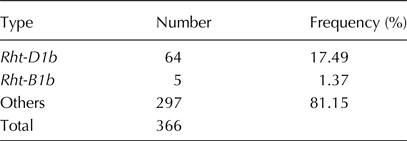
It has been confirmed that the WT J411 is Rht-D1a and Rht-B1a genotype by sequence. Therefore, it does not contain both Rht-D1b and Rht-B1b dwarfing genes. 366 dwarfing mutants induced by EMS or γ-rays from J411 were screened by KASP assays of Rht-D1b and Rht-B1b (Table 1). Among them, 64 mutants contained Rht-D1b dwarfing gene, accounting for 17.49%. However, the proportion of mutation to Rht-B1b gene was very low and it was only present in five mutants with 1.37 percentages. The other 297 dwarfing mutants neither contain Rht-D1b nor Rht-B1b.
The number and frequency of Rht-D1b and Rht-B1b genes in the dwarfing mutants

The number of Rht-D1b and Rht-B1b genes in the dwarfing mutants was according to KASP assays of Rht-D1b and Rht-B1b genes. ‘Others’ mean the mutants without Rht-D1b and Rht-B1b genes. The frequency of both genes was calculated as the number of mutants containing the gene divided by the total number of dwarfing mutants.
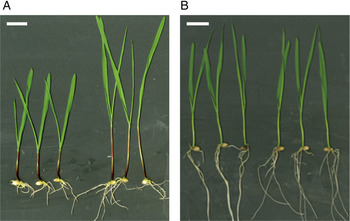
The changes of Rht-D1a and Rht-B1a in dwarfing varieties resulted in the insensitivity to GA. To exclude the mutation of other Rht-D1 and Rht-B1 genes, 220 mutants in response to GA were investigated (Supplementary Table S1, available online). Mutants obviously increasing coleoptile length under GA treatment were sensitive to GA (Figure 1A). On the contrary, the GA insensitive one was without difference in coleoptile length after GA treatment (Figure 1B). Among 57 mutants of Rht-D1b, 56 mutants were insensitive to GA and one was sensitive to GA. Moreover, five selected mutants with Rht-B1b genotype were insensitive to GA. Additionally, 157 in 158 other mutants were sensitive to GA and one mutant was insensitive to GA.
The phenotype of GA-sensitive or -insensitive dwarfing mutants. In each figure, the left three plants were grown in the normal condition, while the right plants were treated with 1 mg/l GA3. (A) GA-sensitive dwarfing mutants; (B) GA-insensitive dwarfing mutants. Bars = 2 cm.

Effects of Rht-D1 and Rht-B1 on agronomic characteristics
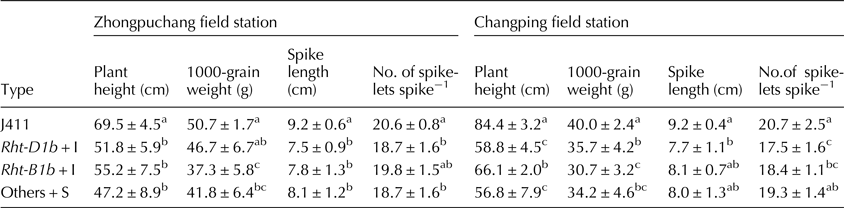
The agronomic traits of the above haplotypes of Rht-D1 and Rht-B1 in two locations were compared (Table 2, Supplementary Table S2, available online). Notably, plant height of GA-insensitive Rht-D1b mutants was significantly lower than that in GA-insensitive Rht-B1b mutants in Changping station of 2015 and Zhongpuchang station of 2016 (Table 2, Supplementary Table S2, available online). Generally, the 1000-grain weight in GA-insensitive Rht-D1b mutants was the highest among three types of mutations and it was significantly higher than that of Rht-B1b mutants in 2 years experiments. In addition, GA-sensitive mutants without Rht-D1b and Rht-B1b genes have generally higher 1000-grain weight comparing with that of GA-insensitive Rht-B1b mutants, although without significant difference. However, Rht-D1b mutants showed the lowest the spike length among three types of mutants and it was also remarkably lower than that of WT in two locations and 2 years experiments (Table 2, Supplementary Table S2, available online). Moreover, the number of spikelets per spike in Rht-D1b mutants was also significantly less than that of WT in the two locations experiments (Table 2).
Agronomic traits of distinct types of dwarfing mutants in Zhongpuchang and Changping field stations in 2015

J411 was the WT. Rht-D1b + I or Rht-B1b + I, means the mutants with Rht-D1b or Rht-B1b genotypes, and being insensitive to GA. Others + S, means without Rht-D1b and Rht-B1b genotypes, and being sensitive to GA. Totally, 56 of Rht-D1b + I, 5 of Rht-B1b + I and 157 of Others + S mutants were compared. The data were from five replicates of each mutant. Values are means ± SD and different letters in the same row indicate the significant difference between each group at P < 0.05.
Expression profile of GA biosynthetic genes in GA-sensitive mutants
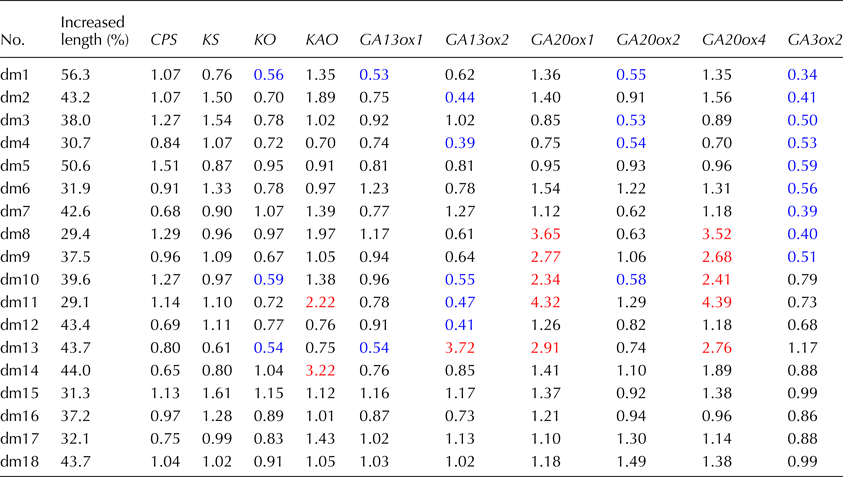
Eighteen dwarfing mutants, which are more sensitive to GA and without Rht-D1b and Rht-B1b genes, were selected for GA biosynthetic gene expression analyses. As shown in Table 3, GA biosynthetic gene expression was up (≥2 fold) or down (≤0.6 fold) regulated in 14 mutants comparing with WT. Among them, nine mutants showed decreased expression of GA3ox2, a key gene for catalysing the final bioactive products of GA biosynthetic pathway. Interestingly, dm1 showed the highest sensitive to GA, which increased shoot length by 56.3% under GA treatment, and four genes of GA biosynthesis were down-regulated in this mutant. Moreover, the expression of GA3ox2 was only 0.34 times of WT in dm1. In four or five mutants, the transcript levels of GA13ox2 or GA20ox2 were down-regulated. However, expression amount of GA20ox1 or GA20ox4 were increased in some mutants.
Expression profiles of GA biosynthetic genes in GA-sensitive mutants

Eighteen mutants, showing relatively more sensitive to GA, were selected for expression analyses and named from dm1 (dwarfing mutant 1) to dm18. The values are the means of relative expression ratio to WT from at least two replications. The relative expression ratio ≥2 fold for up-regulated genes was marked as red character, while relative expression ratio ≤0.6 for down-regulated genes was indicated as blue one.
Comparison of yield components in GA-sensitive mutants
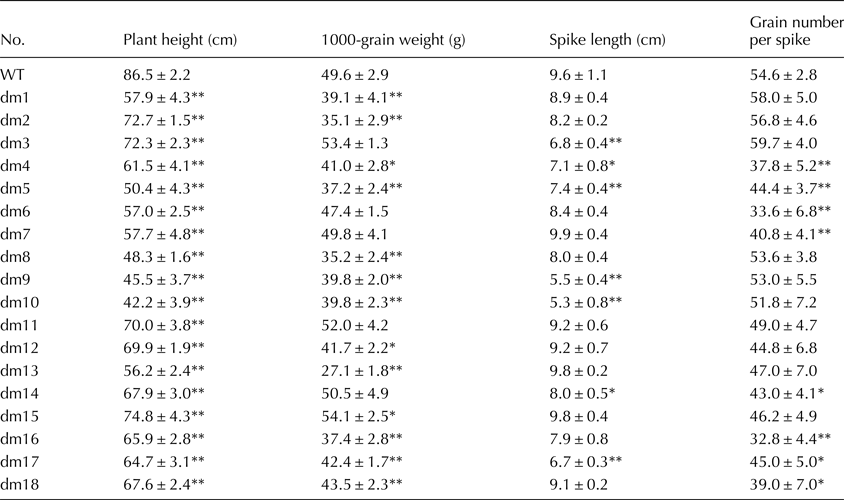
The yield components of the above GA-sensitive mutants were compared (Table 4). Among 18 mutants, ranging from 42.2 to 74.8 cm of plant height, 12 mutants significantly decreased 1000-grain weight. Meanwhile, seven mutants significantly decreased spike length and eight mutants remarkably reduced grain number per spike (Table 4). In contrast, comparing with WT, dm15 obviously increased 1000-grain weight without change of spike length and grain number per spike in two locations of field experiments (Table 4 and Supplementary Table S3, available online). Moreover, only dm11 showed no difference of 1000-grain weight, spike length and grain number per spike from WT in both experiments (Table 4 and Supplementary Table S3, available online).
Yield components of WT and GA-sensitive mutants

The plant height, 1000-grain weight, spike length and grain number per spike of WT and mutant (dm1 to dm18) from Changping experimental station in 2016 were shown in this table. Data are means ± SD from five biological replicates. Significant differences from WT were determined by Student's t-test, *P < 0.05, **P < 0.01.
Discussion
Induced mutations have been widely utilized for crops breeding (Ahloowalia and Maluszynski, Reference Ahloowalia and Maluszynski2001; Ahloowalia et al., Reference Ahloowalia, Maluszynski and Nichterlein2004). In this study, by EMS and γ-rays a large number of dwarfing mutants were created and comprehensively classified by screening with KASP and GA treatment. The comparison of Rht-D1b and Rht-B1b mutants, yield components and expression profiles of GA biosynthetic genes of some novel dwarfing mutants were discussed below.
Among 366 dwarfing mutants, 17.49% mutants contained Rht-D1b gene and only 1.37% contained Rht-B1b gene (Table 1), suggesting that the efficiency of mutation to Rht-D1b gene is much higher than that of Rht-B1b gene by induced mutagenesis. Interestingly, this phenomenon is also observed in the natural variations as the frequency of Rht-D1b was much higher than that of Rht-B1b in both European (Knopf et al., Reference Knopf, Becker, Ebmeyer and Korzun2008; Zanke et al., Reference Zanke, Ling, Plieske, Kollers, Ebmeyer, Korzun, Argillier, Stiewe, Hinze, Neumann, Ganal and Roder2014) and Chinese (Zhang et al., Reference Zhang, Yang, Zhou, He and Xia2006) wheat varieties. This indicates that the natural variations maybe achieved by induced mutagenesis with largely shorten the duration. In 57 Rht-D1b mutants, one mutant showed sensitive to GAs (Supplementary Table S1, available online). We further sequenced Rht-D1b and confirmed the mutation to Rht-D1b in this mutant (Supplemental Fig. S1, available online). These results indicate that independently with DELLA protein, there is another possible gene for regulation of GA signalling pathway. An intensive study for this mutant is needed to identify the key gene and the mechanism of being sensitive to GAs in the Rht-D1b mutant. Moreover, one mutant induced by EMS without Rht-D1b and Rht-B1b genes is insensitive to GAs, indicating that the mutation of other bases of the DELLA proteins, such as Rht-B1d, Rht-B1e (Pearce et al., Reference Pearce, Saville, Vaughan, Chandler, Wilhelm, Sparks, Al-Kaff, Korolev, Boulton, Phillips, Hedden, Nicholson and Thomas2011; Li et al., Reference Li, Yang, Guo, Liu, Sun and Zhang2012) and Rht-B1p (Bazhenov et al., Reference Bazhenov, Divashuk, Amagai, Watanabe and Karlov2015), are present in this mutant. Further sequence of Rht-D1 and Rht-B1 is needed for identification the key mutation responsible for dwarfism in this mutant.
In this study, the plant height and yield components of mutation to Rht-D1b and Rht-B1b were compared. Previous study has reported that Rht-D1b mutation has a larger effect on reduction height comparing with that of Rht-B1b (Ellis et al., Reference Ellis, Spielmeyer, Gale, Rebetzke and Richards2002; Tang et al., Reference Tang, Jiang, He and Hu2009; Rasheed et al., Reference Rasheed, Wen, Gao, Zhai, Jin, Liu, Guo, Zhang, Dreisigacker, Xia and He2016). Our study also showed that the dwarfing mutants with Rht-D1b gene were significantly shorter than Rht-B1b dwarfing mutants in 2 years experiments (Table 2, Supplementary Table S2, available online). Furthermore, it suggested that the 1000-grain weight in GA-insensitive Rht-D1b mutants was obviously higher than that of Rht-B1b mutants (Table 2, Supplementary Table S2, available online), which is in consistent with the higher yield of Rht-D1b in previous results (Knopf et al., Reference Knopf, Becker, Ebmeyer and Korzun2008).
Due to some unfavourable factors of GA-insensitive dwarfing genes in restricted environments (Rebetzke et al., Reference Rebetzke, Richards, Fischer and Mickelson1999; Butler et al., Reference Butler, Byrne, Mohammadi, Chapman and Haley2005; Chapman et al., Reference Chapman, Mathews, Trethowan and Singh2007), GA-sensitive dwarfing mutants were focused in this study. GA3ox2, catalysing the final bioactive GA (Pearce et al., Reference Pearce, Huttly, Prosser, Li, Vaughan, Gallova, Patil, Coghill, Dubcovsky, Hedden and Phillips2015), was down-regulated in nine GA-sensitive dwarfing mutants, suggesting the endogenous GA levels were probably changed in these mutants. It has been reported that higher expression of ZmGA3ox2 was associated with higher GA1 accumulation and ZmGA3ox2 was responsible for the dwarf phenotype in the mutant (Teng et al., Reference Teng, Zhai, Liu, Bai, Wang, Huo, Tao, Zheng and Zhang2013). Therefore, it is possible that the resultant change of endogenous GA from low GA3ox2 expression leads to reduction height in these mutants. GA20-oxidase is another key regulatory enzyme for syntheses of bioactive GAs. The loss function of GA20ox2 in rice leads to semi-dwarfs and drives Green Revolution (Sasaki et al., Reference Sasaki, Ashikari, Ueguchi-Tanaka, Itoh, Nishimura, Swapan, Ishiyama, Saito, Kobayashi, Khush, Kitano and Matsuoka2002; Hedden, Reference Hedden2003). In this report, four mutants showed about half of the expression of GA20ox2 compared with WT. The dwarfism in these mutants may result from the change of GA20ox2. Additionally, GA3ox2, GA20ox2 and GA13ox2 were decreased expression in several mutants while GA20ox1 and GA20ox4 were up-regulated in some mutants comparing with WT (Table 3). In Arabidopsis, five GA20ox genes have different expression patterns and it has showed the feedback regulation of GA20ox and other GA biosynthetic gene expression in ga20ox1 and ga20ox2 mutants (Rieu et al., Reference Rieu, Ruiz-Rivero, Fernandez-Garcia, Griffiths, Powers, Gong, Linhartova, Eriksson, Nilsson, Thomas, Phillips and Hedden2008). So the different expression pattern of GA biosynthetic genes in this report may result from the feedback regulation of the corresponding genes in one mutant.
Combing with comparison of yield components and expression profile of GA biosynthetic genes in the dwarfing mutants, the elite GA responsive dwarfing mutants were identified. It has been indicated that the GA responsive dwarfing genes, Rht5 (Daoura et al., Reference Daoura, Chen, Du and Hu2014), Rht12 (Chen et al., Reference Chen, Phillips, Condon, Parry and Hu2013), Rht13 (Wang et al., Reference Wang, Chen, Du, Yang, Condon and Hu2014) and Rht18 (Yang et al., Reference Yang, Zheng, Liu, Wang, Condon, Chen and Hu2015) have negative effects on yield components, such as decrease of number of grains per spike or 1000-kernel weight. Accordingly, most of GA-sensitive dwarfing mutants decreased 1000-grain weight or other yield components in this study (Table 4, Supplementary Table S3, available online). Interestingly, the γ-rays-induced dm15, with 13% reduction of plant height, significantly increasing 1000-grain weight but without change of grain number per spike, showed similar expression of GA biosynthetic genes from WT. Meanwhile, this mutant showed similar GA sensitivity with WT (increased percentage of shoot length by GA3: WT, 31.7%; dm15, 31.3%, Table 3). These results indicate GA biosynthesis or signalling is not directly responsible for the dwarfing phenotype in this mutant. As Rht8 is a brassinosteroids-responsive mutant (Gasperini et al., Reference Gasperini, Greenland, Hedden, Dreos, Harwood and Griffiths2012), it cannot be excluded out that the mutation to Rht8 (WT do not contain Rht8 by molecular marker analysis) leads to dwarfing phenotype in dm15. In addition, dm11 with 19% reduction of plant height is another elite mutant with no change of yield components from WT (Table 4). However, this mutant altered the expression of GA biosynthetic genes (Table 3), indicating GA metabolism may be involved in the dwarfing process in dm11. Since the replacement of Rht-D1b and Rht-B1b dwarfing genes is of great importance (Chen et al., Reference Chen, Hao, Condon and Hu2014), the elite GA-responsive dwarfing mutants dm11 and dm15 will be a promising material for dwarfing wheat breeding.
Supplementary Material
The supplementary material for this article can be found at https://doi.org/10.1017/S1479262116000459
Acknowledgements
This work was financially supported by the National Key Research and Development Program of the Ministry of Science and Technology of China (Grant numbers 2016YFD0102101 and 2016YFD0102106) and National Natural Science Foundation of China (Grant no. 31100610).