Introduction
Entomopathogenic nematodes (EPNs) in the families Steinernematidae and Heterorhabditidae are known worldwide to be lethal and obligate pathogens of a wide range of insects, due to the unique nematode–bacterium complex. Each EPN species has its own set of such unique characteristics, with some performing better under certain conditions than do others (Campbell et al., Reference Campbell, Lewis, Yoder and Gaugler1995; Lacey & Unruh, Reference Lacey and Unruh1998; Unruh & Lacey, Reference Unruh and Lacey2001). Any one EPN species is not effective at controlling all insect pests, with some species being more effective against certain insect groups (Lacey et al., Reference Lacey, Frutos, Kaya and Vail2001). To ensure successful control, it is important to match the appropriate EPN species against a particular insect pest (Lacey et al., Reference Lacey, Frutos, Kaya and Vail2001; Shapiro-Ilan et al., Reference Shapiro-Ilan, Byron and Gaugler2004). Since 1955, when the existence of EPNs was first reported (Dutky & Hough, Reference Dutky and Hough1955; Weiser, Reference Weiser1955), many studies have been done on EPN pathogenicity in relation to numerous insect pests around the world (Ehlers, Reference Ehlers1996; Koppenhöfer, Reference Koppenhöfer, Lacey and Kaya2000; Lacey & Georgis, Reference Lacey and Georgis2012).
The first report of EPNs in South Africa was by Harington (Reference Harington1953), who discovered an EPN in Grahamstown, Eastern Cape province, infecting all life stages of the maize beetle Heteronychus arator (Fabricius). Since this first discovery, EPNs have been recovered in eight of the nine provinces of South Africa (Spaull, Reference Spaull1988, Reference Spaull1990, Reference Spaull1991; Grenier et al., Reference Grenier, Bonifassi, Abad and Laumond1996; Malan et al., Reference Malan, Nguyen and Addison2006, Reference Malan, Knoetze and Moore2011, Reference Malan, Knoetze and Tiedt2014; Molotsane et al., Reference Molotsane, Ngoma and Gray2007; Hatting et al., Reference Hatting, Stock and Hazir2009). A current review of the control of codling moth in South Africa, with special emphasis on the use of EPNs, was undertaken by Odendaal et al. (Reference Odendaal, Addison and Malan2015).
The codling moth, Cydia pomonella L. (Lepidoptera: Tortricidae), was first reported from South Africa around 1885, and by 1918 it had gained established pest status within the country (Giliomee & Riedl, Reference Giliomee and Riedl1998). Originating in Eurasia, this moth has become the key pest of apples and pears around the world, due to its successful dispersal and adaptation strategies (Audemard, Reference Audemard, Van der Geest and Evenhuis1991; Barnes, Reference Barnes, Van der Geest and Evenhuis1991). South Africa is the third largest deciduous fruit producer in the southern hemisphere, with apples and pears making up the bulk of production (Hortgro, 2013). With relatively strict quality control measures in place concerning the chemicals used for codling moth control, and with reduced minimum residues, the management of codling moth populations in orchards has become problematic. The withdrawal of primary chemicals that were once used for codling moth control, and the increased demand for more sustainable production than in the past, has led to the search for biological alternatives (Odendaal et al., Reference Odendaal, Addison and Malan2015, Reference Odendaal, Addison and Malan2016).
Most research into EPNs has been pursued under optimal laboratory conditions required for the control of the codling moth. In the laboratory, studies have been conducted on: the efficacy of codling moth control using different species (Lacey & Unruh, Reference Lacey and Unruh1998; Lacey & Chauvin, Reference Lacey and Chauvin1999; Unruh & Lacey, Reference Unruh and Lacey2001; Cossentine et al., Reference Cossentine, Jensen and Moyls2002; Lacey et al., Reference Lacey, Neven, Headrick and Fritts2005, Reference Lacey, Arthurs, Unruh, Headrick and Fritts2006a; De Waal et al., Reference De Waal, Malan, Levings and Addison2010, Reference De Waal, Malan and Addison2011a, Reference De Waal, Malan and Addisonb, Reference De Waal, Addison and Malan2013; Odendaal et al., Reference Odendaal, Addison and Malan2016); the concentrations required to provide optimal control (Lacey & Unruh, Reference Lacey and Unruh1998; De Waal, Reference De Waal2008); the optimum temperature that should be maintained (Kung et al., Reference Kung, Gaugler and Kaya1991; Wright, Reference Wright1992; Grewal et al., Reference Grewal, Selvan and Gaugler1994; Lacey & Unruh, Reference Lacey and Unruh1998); the requisite humidity (Kung et al., Reference Kung, Gaugler and Kaya1991; Lacey & Unruh, Reference Lacey and Unruh1998; De Waal et al., Reference De Waal, Malan, Levings and Addison2010; Navaneethan et al., Reference Navaneethan, Strauch, Besse, Bonhomme and Ehlers2010); and the prevalent water activity levels (Navaneethan et al., Reference Navaneethan, Strauch, Besse, Bonhomme and Ehlers2010; De Waal et al., Reference De Waal, Malan and Addison2011a, Reference De Waal, Addison and Malan2013). Such techniques as the addition of adjuvants (Lacey et al., Reference Lacey, Neven, Headrick and Fritts2005; Navaneethan et al., Reference Navaneethan, Strauch, Besse, Bonhomme and Ehlers2010; De Waal et al., Reference De Waal, Addison and Malan2013) and mulches (De Waal et al., Reference De Waal, Malan and Addison2011b) to improve EPN efficacy have also been studied. The results obtained under laboratory conditions, as well as from the field, have often displayed significant differences (Lacey & Unruh, Reference Lacey and Unruh1998; Cross et al., Reference Cross, Solomon, Chandler, Jarrett, Richardson, Winstanley, Bathon, Huber, Keller, Langenbruch and Zimmerman1999). These inconsistencies have been attributed to the variety of behavioural, ecological and environmental challenges encountered by the nematodes in the field, including their deactivation by environmental extremes, indefinite host contact and limited movement (Cross et al., Reference Cross, Solomon, Chandler, Jarrett, Richardson, Winstanley, Bathon, Huber, Keller, Langenbruch and Zimmerman1999; Grewal et al., Reference Grewal, De Nardo and Aguillera2001).
The variability between the results obtained from laboratory and field trials has led to a move towards favouring the use of laboratory conditions that more realistically reflect and represent the local climate. Overall, relatively few studies have focused on the control of the codling moth with EPNs under field conditions, in comparison with the plethora of laboratory studies that have been undertaken in this respect. Previous field studies include those that have been done on the effect of environmental conditions, on the application technique and on the post-application conditions that are required for successful codling moth control (Lacey & Unruh, Reference Lacey and Unruh1998; Unruh & Lacey, Reference Unruh and Lacey2001; Lacey et al., Reference Lacey, Arthurs, Unruh, Headrick and Fritts2006a, Reference Lacey, Granatstein, Arthurs, Headrick and Frittsb, Reference Lacey, Shapiro-Ilan and Glenn2010; De Waal, Reference De Waal2008; De Waal et al., Reference De Waal, Malan and Addison2011a, Reference De Waal, Malan and Addisonb, Reference De Waal, Addison and Malan2013; Odendaal et al., Reference Odendaal, Addison and Malan2015, Reference Odendaal, Addison and Malan2016).
EPNs qualify as an environmentally friendly control measure, as they have a narrow, and thus selective, host range, with limited to no effect on non-target organisms, low mobility and no detrimental effects on the surrounding environment (Ehlers & Hokkanen, Reference Ehlers and Hokkanen1996; Lacey & Unruh, Reference Lacey and Unruh1998; Cross et al., Reference Cross, Solomon, Chandler, Jarrett, Richardson, Winstanley, Bathon, Huber, Keller, Langenbruch and Zimmerman1999; Grewal et al., Reference Grewal, De Nardo and Aguillera2001; Unruh & Lacey, Reference Unruh and Lacey2001). A major advantage of using EPNs to control the codling moth is that they are capable of locating insect pests in cryptic habitats, and with above-ground pests having no opportunity to develop co-evolutionary barriers toward EPNs, they can provide effective supplementary control as part of an integrated pest management (IPM) strategy (Lacey et al., Reference Lacey, Frutos, Kaya and Vail2001; Koppenhöfer, Reference Koppenhöfer, Nguyen and Hunt2007). No evidence has yet been found with regard to a naturally acquired resistance to the symbiotic bacteria that are associated with these nematodes (Divya & Sankar, Reference Divya and Sankar2009).
The objectives of this study were to assess the efficacy of different EPN strains on the mortality of diapausing codling moth larvae under local field conditions, using spray application. Field spray trial results were compared to those obtained under simulated field conditions in the laboratory. Additionally, temperature, as a main factor in the outdoor effectiveness of nematodes, was evaluated under laboratory conditions, so as to ascertain nematode efficacy at relatively low temperatures.
Materials and methods
Source of insects and nematodes
Codling moth eggs, and the artificial diet on which they were to be reared under laboratory conditions, were obtained from Entomon Technologies (Pty) Ltd, situated on Welgevallen Experimental Farm in Stellenbosch, Western Cape province, South Africa. Diapausing larvae were reared in a growth chamber under diapausing conditions (photoperiod 10:14 (light:dark), 25°C, 60% relative humidity (RH)) (Singh & Ashby, Reference Singh and Ashby1986). Once they had developed into late-instar larvae, they were stored in the diet, covered in brown bags and kept at 4°C, until they were needed for trials.
Infective juveniles (IJs) of the different nematode isolates, Steinernema jeffreyense Malan, Knoetze & Tiedt, Reference Malan, Knoetze and Tiedt2015 (Malan et al., Reference Malan, Knoetze and Tiedt2015), Steinernema yirgalemense Mráček, Sturhan & Reid, 2003 (GenBank accession number: EU625295), Steinernema feltiae (Filipjev, 1934) Wouts, Mráček, Gerdin & Bedding, 1982, and two isolates of Heterorhabditis bacteriophora Poinar, 1976 (Hb1 and Hb2) were produced in codling moth larvae in a growth chamber maintained at 25°C in the dark. After 7 days, the infected codling moth cadavers were placed on a modified White trap (Kaya & Stock, Reference Kaya, Stock, Lacey and Kaya1997). During the first week post-emergence, the IJs were harvested and stored at 4°C in 150 ml of filtered water, in 500-ml horizontally positioned, vented culture flasks. The flasks were shaken weekly for aeration, with the nematode suspensions being used within 4 weeks of harvesting. Following the procedure described by Navon & Ascher (Reference Navon and Ascher2000), the nematode concentrations were quantified an hour before each trial.
Experimental field trials
The semi-field trials were conducted at the Welgevallen Experimental Farm in Stellenbosch. Trials were run in a 16-year-old, 0.416-ha block, comprised of Granny Smith, Royal Gala and Pink Lady apple trees. The trial block consisted of 11 rows, with an average of 44 trees per row, with 1.5 m spacing between the trees, and 4 m between the rows.
The experimental design consisted of four treatment rows, with eight treatment trees per row (n= 32 treatment trees). There were two buffer rows on the edges of the block, as well as one buffer row between treatment rows, and four buffer trees between treatment trees. A complete randomized design was used for the experimental layout.
The temperature and humidity for each row was monitored by iButton® dataloggers (Maxim Integrated iButton®temperature/humidity logger (DS1923), Fairbridge Technologies (Pty) Ltd, Johannesburg, South Africa), mounted on a scaffold branch of the tree located in the middle of each of the four treatment rows. These dataloggers recorded the conditions experienced by the EPNs during the 24-h exposure period.
Cages, 7 × 3 cm, were constructed by means of rolling wire mesh (40 mesh/425-μm aperture size) around a glass cylinder, and sticking the edges together using a glue gun. Both sides of the cylinder were fitted with plastic caps, of which one was glued shut, while the other was left unglued, so as to allow access to the cage (De Waal et al., Reference De Waal, Malan and Addison2011a, Reference De Waal, Malan and Addisonb).
Each cage was filled with apple-tree bark and 20 late-instar codling moth larvae 24 h before each trial. The cages were placed separately in 1-litre plastic containers, with the larvae being provided with sufficient time in which to spin themselves into a cocoon. The cages were secured, so that no larva could escape. One cage was hung per treatment tree (n= 32), with a total of 640 larvae being used for each trial.
Before treatment applications, the cages were pre-wet by being completely submerged into a beaker filled with filtered water. EPN suspensions of a predetermined concentration were then dispensed into a handheld sprayer. Each cage was sprayed, at a distance of around 10 cm, until drip. The handheld sprayer was shaken before every spray, so as to avoid the sedimentation of nematodes. The cages were post-wet by spraying with filtered water every 2 h for the first 6 h of the trial.
After a 24-h exposure period in the orchard, the cages were recovered, and their contents (apple-tree bark and codling moth larvae) removed. After being rinsed with filtered water to remove any remaining surface nematodes, the codling moth larvae were placed in a 9-cm-diameter Petri dish, which was placed on moist filter paper. The Petri dishes from each treatment (n= 8) were placed in separate plastic containers, lined with moist paper towelling, which were then closed and inserted in a growth chamber at 25°C for another 72 h (3 days). On day 4 (96 h), mortality by infection was assessed and confirmed by dissection.
After the cages were prepared for the trial, as described in the containment protocol, they were each tied to a separate scaffold branch close to the main stem of a treatment tree. The treatments consisted of H. bacteriophora (Hb1), S. yirgalemense and S. jeffreyense, with water only being used as the control treatment. Heterorhabditis bacteriophora (Hb2) was not used because of previously noted low infection in field trials (Odendaal et al., Reference Odendaal, Addison and Malan2016). The cages were treated, as described in the EPN application protocol, between 11.00 and 13.00 hours. After the 24-h exposure period, the cages were retrieved from the field, and handled as stipulated in the evaluation protocol. The trial was repeated on a different test date, with fresh batches of nematodes.
Laboratory bioassays with sprayed cages
The containment method and the loading of the cages, which remained unchanged in the laboratory study, were carried out as indicated in the containment protocol. In order to determine a delimiting concentration, pilot trials were conducted, and a concentration of 25 IJs/ml was selected for this study. The nematode species used were H. bacteriophora (Hb1 and Hb2), S. feltiae and S. yirgalemense, with water only being used as the control treatment.
The cages were pre-wet, and the nematode isolates were applied, according to the application protocol used for the field trials, after which the cages for each treatment (n= 8) were placed in separate 1-litre plastic containers, lined with moist paper towelling, and closed. The treated cages were then incubated in a growth chamber for 24 h, at a temperature regime of 22°C for 4 h, 14°C for 12 h, and 22°C (simulating field temperatures) for 8 h in the dark. After 24 h in the growth chamber, the cages were removed from the containers, and they were then handled as described in the evaluation protocol. Laboratory trials were done on separate dates, with fresh batches of recycled nematodes.
Laboratory bioassays at different temperatures using multiwell plates
A comparison of the infection and penetration rate of two isolates of H. bacteriophora (Hb1, Hb2), S. feltiae and S. yirgalemense was carried out at 14°C and 25°C, in multiwell plates (24 wells, volume 3.8 cm2/well, flat bottom, NuncTM, cat. no. 144530, Thermo Fisher Scientific (Pty) Ltd, Johannesburg, South Africa). Filter paper (13 mm in diameter) was placed in ten wells per plate. One well was left open between treatment wells, so as to avoid the movement of nematodes from one well to another. Five multiwell plates were used per treatment (n= 50). The nematode concentration used was 50 IJs/50 μl of filtered water per codling moth larva, with water only being used as the control treatment.
The nematode suspensions and bioassay plates were placed at the required temperatures 1 h before commencement of the trial, to allow the inoculum to reach the specific temperature in question. The nematode suspension was then applied on to the filter-paper discs, and one last-instar codling moth larva was added to each of the ten wells. The bioassay plate lids were fitted with a 3-mm glass pane, so as to ensure that the larvae did not escape from their wells. Bioassay plates of each treatment (n= 5) were enclosed in separate 2-litre plastic containers, lined with moist paper towelling, to ensure the maintenance of a high humidity. The containers were left at the required temperatures for 48 h, after which the larvae were removed from the bioassay plates, rinsed and placed in Petri dishes lined with moist filter paper. The Petri dishes were then placed in a growth chamber at 25°C for two more days, with the larval mortality being assessed on day 4 (96 h after inoculation).
The cadavers were checked on a daily basis to allow the first-generation nematodes to develop. Once the nematodes were fully developed, the Petri dishes from all the treatments were placed in the freezer, to curtail any further nematode development. The cadavers were then dissected, and the number of first-generation nematodes was counted.
Data analysis
The data were evaluated using STATISTICA 12 software (StatSoft Inc., Tulsa, Oklahoma, USA). In the absence of any significant test date versus treatment differences, the data from the different test dates were pooled and analysed, using a one-way analysis of variance (ANOVA), with post hoc comparison of means. If the residuals were found not to be normally distributed, bootstrap multiple comparisons were performed (Efron & Tibshirani, Reference Efron and Tibshirani1993).
Results
Experimental field spray trials
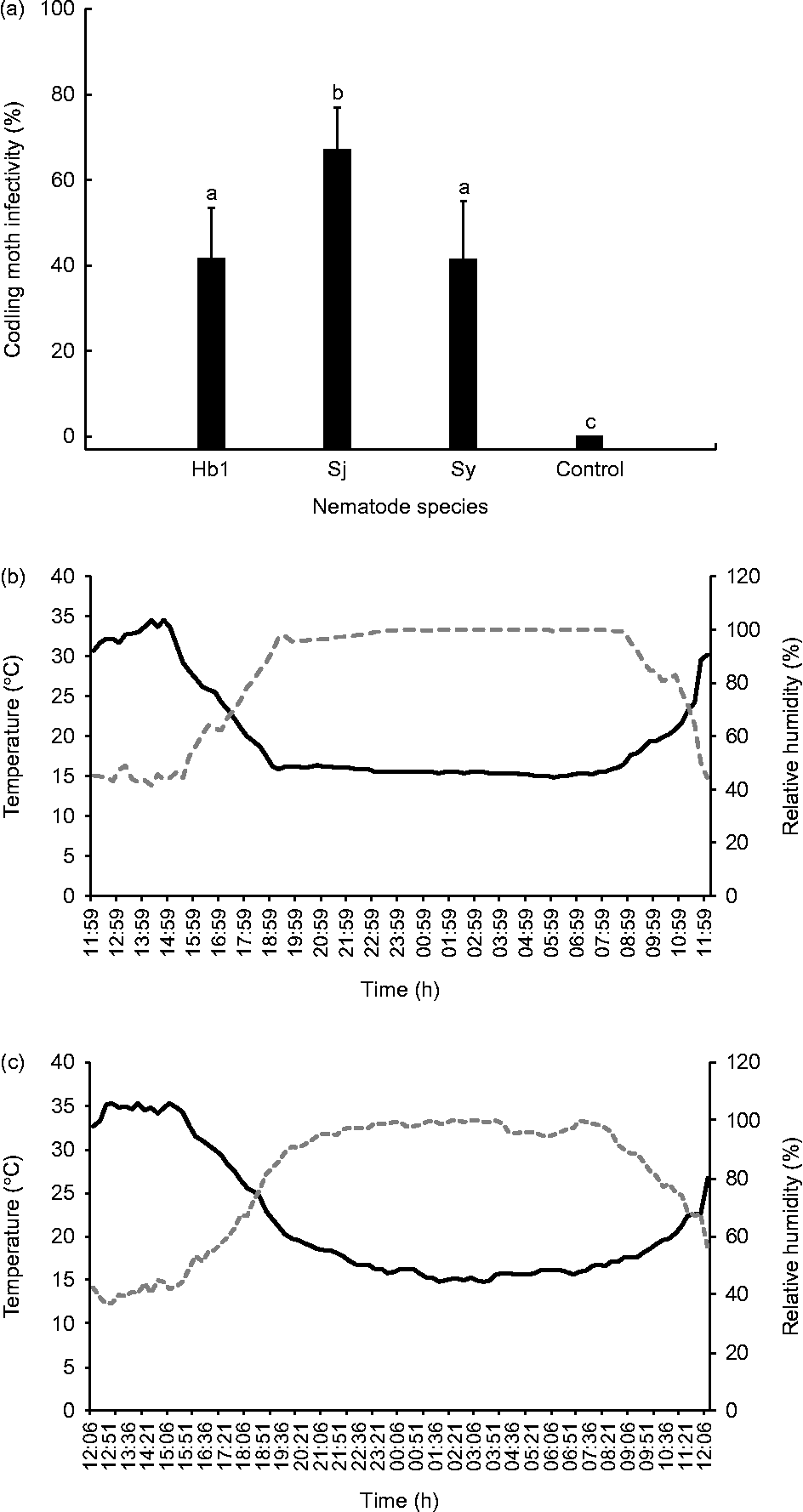
The analysis of the results of the two field spray trials using a two-way ANOVA showed no difference between the main effects of the test dates and the treatments (F (3,56)= 0.964, P= 0.461) and data from the two trials were pooled. The analysis of the combined data, using a one-way ANOVA, showed a significant effect of the treatments on codling moth infection (F (3,60)= 23.648, P < 0.005). Steinernema jeffreyense caused the highest level of mortality of codling moth larvae (66.81 ± 5.46%), followed by H. bacteriophora (Hb1) (41.81 ± 6.40%) and S. yirgalemense (41.18 ± 7.67%). A significant difference was found between S. jeffreyense and H. bacteriophora (Hb1) (P= 0.027) and S. yirgalemense (P= 0.045), whereas none was found between the S. yirgalemense and H. bacteriophora (Hb1) (P= 1) (fig. 1a).
(a) Mean percentage mortality (95% confidence limits) recorded for codling moth larvae after spraying with three nematode isolates, Heterorhabditis bacteriophora (Hb1), Steinernema jeffreyense (Sj) and S. yirgalemense (Sy), and water only (control), at a concentration of 1000 IJs/ml, during a field trial. Different letters above the bars indicate significant differences (one-way ANOVA; F (3,60)= 23.648, P < 0.005). (b) Temperature (-) and relative humidity data (-) recorded during the 24-h trial period of the first spray trial. (c) Temperature and relative humidity of the second spray trial.
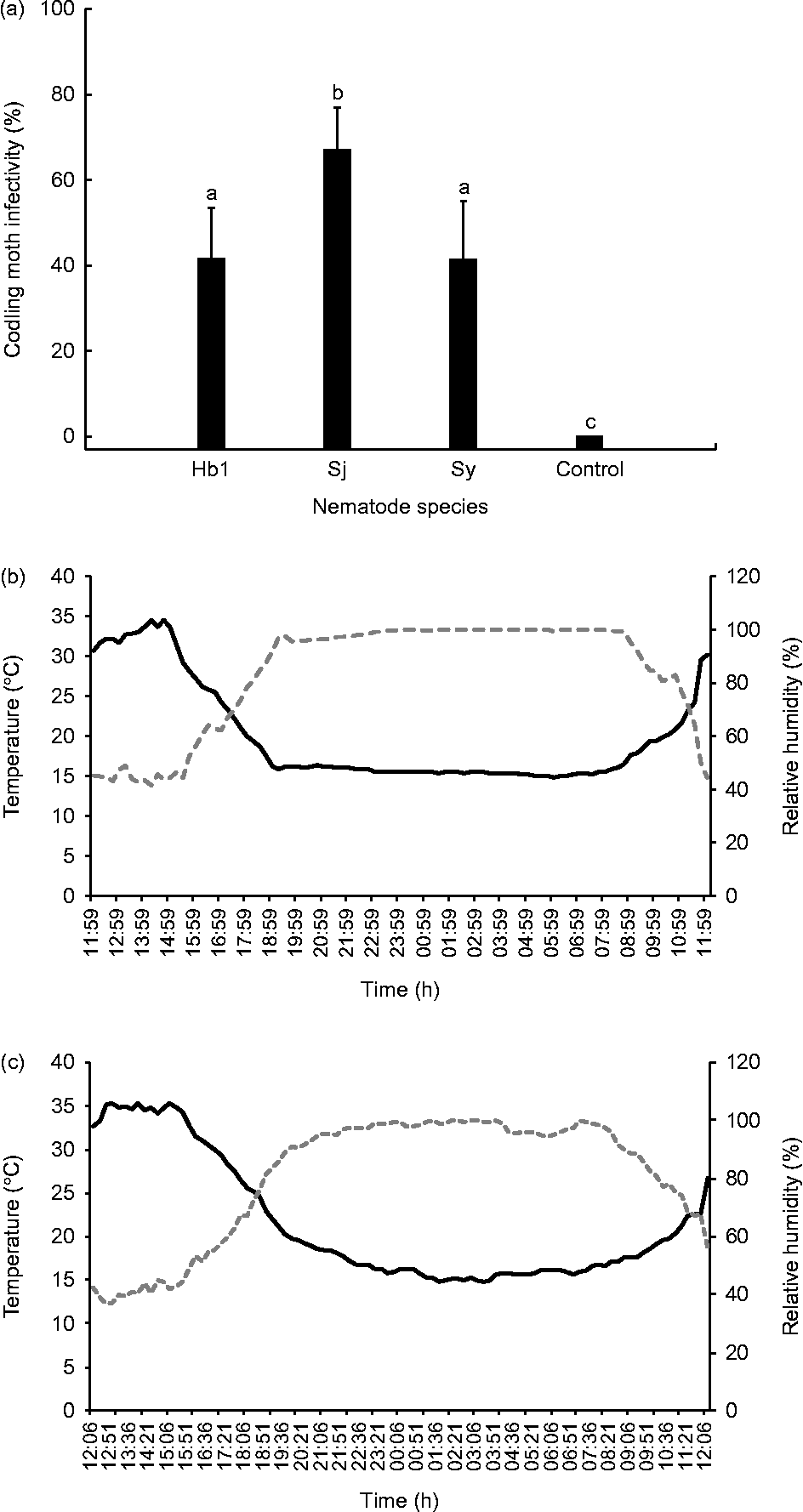
During the 24-h exposure time of the first spray trial, the temperature decreased to 15°C, while the RH increased to 100% during the night. On the following day, up until midday, the temperature increased to 35°C and the RH decreased to 44%. The average temperature during the exposure period was 20°C and the RH 84%. The temperature and RH fluctuations experienced during the 24-h trial period are indicated in fig. 1b. No rainfall was experienced during the period concerned.
The conditions during the second trial were comparable to those that prevailed during the first trial, with only minor deviations. During the 24-h exposure the temperature decreased to 15°C, while the RH increased to 99% during the night. On the following day, up until midday, the temperature increased to 27°C, and the RH decreased to 56%. The average temperature during the exposure period was 22°C and the RH 81%. This trial was commenced in temperatures fluctuating around 35°C for the first 3 h. The temperature and RH fluctuations that were experienced during the 24-h trial period are indicated in fig. 1c. No rainfall was experienced during the period concerned.
Laboratory bioassays with sprayed cages
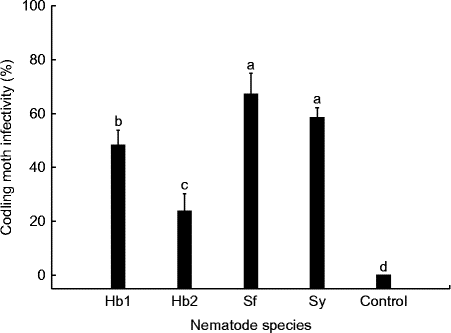
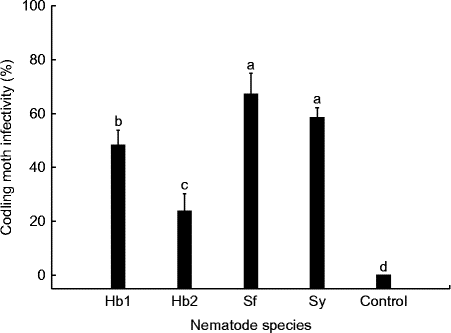
The analysis of the results of the two laboratory trials using a two-way ANOVA showed no difference between the main effects of the test dates and the treatments (F (4,70)= 1.8321, P= 0.134), and data from the two trials were pooled. A significant effect (F (4,75)= 90.946, P < 0.005) of the treatments on codling moth larval infectivity was obtained when the data were analysed using a one-way ANOVA. However, no significant differences were found between S. feltiae and S. yirgalemense (P= 0.369). The S. feltiae differed significantly from both isolates of H. bacteriophora, Hb1 (P < 0.005) and Hb2 (P < 0.005). A significant difference was also found between the S. yirgalemense and the Hb1 and Hb2 isolates of H. bacteriophora (P < 0.005). Overall, S. feltiae gave the highest mortality of codling moth larvae by infection (67.06 ± 4.18%), followed by S. yirgalemense (58.44 ± 2.02%), and then by the two H. bacteriophora strains, Hb1 (48.25 ± 2.98%) and Hb2 (23.88 ± 3.29%), respectively (fig. 2).
Mean percentage mortality (95% confidence limits) recorded for codling moth larvae confined in cages filled with apple bark, after treatment by spraying cages with four nematode species, Heterorhabditis bacteriophora (Hb1), H. bacteriophora (Hb2), Steinernema feltiae (Sf) and S. yirgalemense (Sy), and water only (control), at a concentration of 25 IJs/ml during a laboratory trial. Different letters above the bars indicate significant differences (one-way ANOVA; F (4,75)= 90.946, P < 0.001).
Laboratory bioassays at different temperatures using multiwell plates
At 25°C, after an exposure period of 48 h in 24-well bioassay plates, all four nematode isolates caused high mortalities of between 98 ± 2.15% and 100%, with no significant differences being found to occur between nematode treatments (data not shown). No mortality of codling moth larvae was found using only water as a treatment.
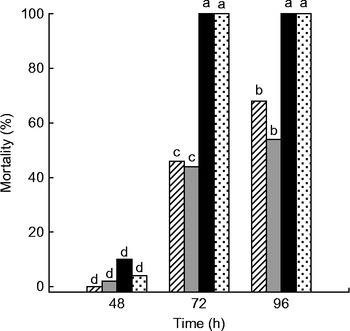
After exposure to the four nematode isolates for 48 h, at a temperature of 14°C, the codling moth larval mortality was < 15% for all isolates (fig. 3). However, when the codling moth larvae were freed from the surface nematodes by washing (after 48 h) and left for another 24 h (72 h after inoculation) in a growth chamber at 25°C, both S. feltiae and S. yirgalemense caused 100% codling moth mortality, followed by H. bacteriophora (Hb1), with mortality of 45%, and H. bacteriophora (Hb2), with 42% mortality, indicating latent infection (fig. 3). After 96 h, H. bacteriophora (Hb1) resulted in a mortality of 68% and H. bacteriophora (Hb2) resulted in a mortality of 54%. No mortality was found using only water as a treatment.
Percentage mortality of diapausing codling moth larvae after inoculation with Heterorhabditis
bacteriophora (Hb1) ( ), H.
bacteriophora (Hb2) (
 ), Steinernema feltiae (
 ), S.
yirgalemense (
 ) and water only (control), at a concentration of 50 IJs/insect, using 24-well bioassay plates at 14°C. Different letters above the bars indicate significant differences (one-way ANOVA; F
(6,32)= 14.615, P < 0.001).

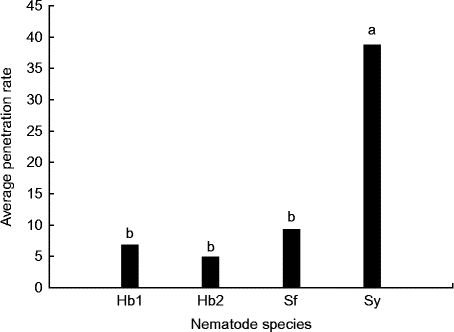
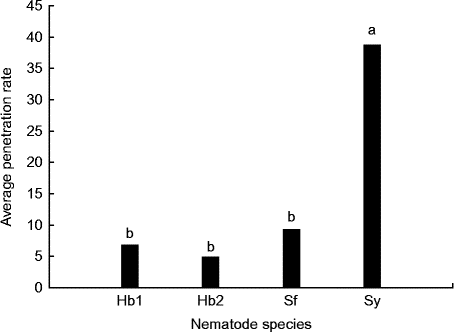
At 25°C, S. yirgalemense had the highest average penetration rate of 39 IJs per larva (fig. 4). All three of the other nematode isolates had a very low average penetration rate, with that of S. feltiae being 9 IJs, that of H. bacteriophora isolate Hb1 being 7 IJs, and that of isolate Hb2 being the lowest penetration rate of all, namely only 5 IJs per larva.
Average penetration rate of infective juveniles (IJs) of Heterorhabditis bacteriophora (Hb1), H. bacteriophora (Hb2), Steinernema feltiae (Sf) and S. yirgalemense (Sy) per codling moth larva, 48 h after inoculation with a concentration of 50 IJs/ml using 24-well bioassay plates at 25°C. Different letters above the bars indicate significant differences (one-way ANOVA; F (3,16)= 139.41, P < 0.001).
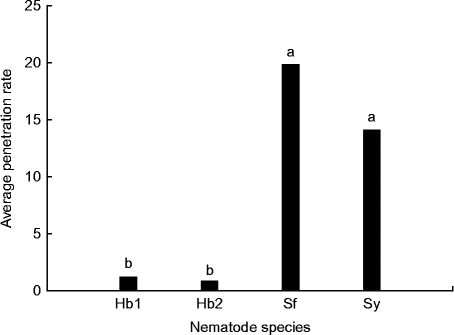
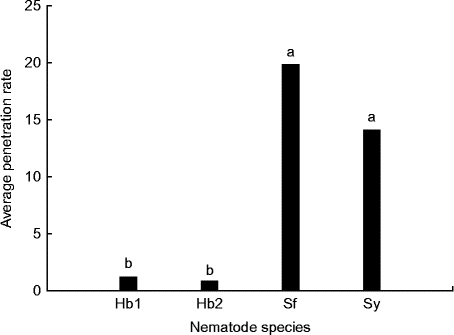
Codling moth larvae, treated with the three different nematode species, at a temperature of 14°C, were dissected to determine the average IJ penetration rate (fig. 5). Steinernema feltiae had the highest average penetration rate of 20 IJs per codling moth larva, followed by that of S. yirgalemense, with an average penetration rate of 14 IJs. The two H. bacteriophora isolates had the lowest penetration rate, of only one IJ per larva.
Average penetration rate of infective juveniles (IJs) of Heterorhabditis bacteriophora (Hb1), H. bacteriophora (Hb2), Steinernema feltiae (Sf) and S. yirgalemense (Sy) per codling moth larva, 48 h after exposure to a concentration of 50 IJs/ml using 24-well bioassay plates at 14°C. Different letters above the bars indicate significant differences (one-way ANOVA; F (3,16)= 32.943, P < 0.001).
Discussion
Soil, which is the natural habitat of EPNs, protects them from such environmental extremes as high temperatures and low moisture levels (Kung et al., Reference Kung, Gaugler and Kaya1991; Grewal et al., Reference Grewal, De Nardo and Aguillera2001). The above-ground application of EPNs removes them from the protection of such a safe environment, exposing them to relatively harsh conditions, from which they need to be protected. The failure to do so results in desiccation, and, thus, ineffective control. The prime time for application is the evening, early in the morning or on cloudy days (Unruh & Lacey, Reference Unruh and Lacey2001; De Waal, Reference De Waal2008), so as to minimize the EPN exposure to ultraviolet (UV) radiation and high temperatures. Pre- and post-wetting is highly recommended, as the process increases the amount of moisture that is available for EPN survival and movement (Lacey & Unruh, Reference Lacey and Unruh1998; Unruh & Lacey, Reference Unruh and Lacey2001; Lacey et al., Reference Lacey, Arthurs, Unruh, Headrick and Fritts2006a; De Waal, Reference De Waal2008).
In a previous study (Odendaal et al., Reference Odendaal, Addison and Malan2016), the choice of application was to dip the container with codling moth in a nematode suspension, so as to enable a comparison of the efficacy of S. feltiae under local field conditions in an apple orchard, without biological pollution. However, this method is not suitable for the field application of above-ground pests, which should be similar to that which is used for applying chemicals in orchards (Gaugler, Reference Gaugler1988; Mason et al., Reference Mason, Matthews and Wright1998; Fife, Reference Fife2003; Shapiro-Ilan et al., Reference Shapiro-Ilan, Gouge, Piggott and Fife2006).
Steinernema feltiae was replaced with a promising new isolate, S. jeffreyense, in the field spray trials conducted in this study. In general, it was found that, by spaying the nematodes on to the cages in the field, the ensuing mortality was much less than that which occurred when using the technique of dipping the cage into a nematode suspension. Steinernema jeffreyense was found to cause the highest codling moth larval mortality (67%), whereas both H. bacteriophora (Hb1) and S. yirgalemense resulted in relatively poor ( ± 40%) control, with no significant difference being found between the two. The cause of the low mortality resulting from the actions of the latter two species is uncertain, as the average temperature for both spray trials during the 24-h exposure time was above 20°C, with the average humidity being above 80%. Such conditions have been reported by other researchers (Unruh & Lacey, Reference Unruh and Lacey2001; De Waal et al., Reference De Waal, Malan, Levings and Addison2010; Odendaal et al., Reference Odendaal, Addison and Malan2016) as being optimal for effective EPN application.
In order to clarify the results obtained with the field trials, bioassays simulating the field trials with regard to the temperature and the method of containment were conducted at a constant humidity of 100%. The same method, of applying the nematodes by means of spraying, was used as had been used in the field trial. As the trial was conducted under controlled conditions, S. jeffreyense was replaced by S. feltiae. In general, it was found that, by means of the application of nematodes using the spray technique, relatively low control of the codling moth was obtained. Steinernema feltiae caused a relatively high percentage (67%) of codling moth control, followed by S. yirgalemense (58%), with no significant difference between the two species. The level of control by H. bacteriophora isolate Hb1 (48%) differed significantly from that found for S. feltiae. The H. bacteriophora isolate Hb2 was least effective of all species concerned, resulting in < 25% control.
In the laboratory, the performance of S. yirgalemense improved compared to that which was found to occur in the field. The improvement in performance might be due to the more constant, and higher, humidity to which the nematode in question was exposed in the laboratory, as it might have been more sensitive to the relatively low humidity, and thus, to the relatively low water activity levels (aw), than were the EPN isolates that proved to be more effective. Steinernema feltiae resulted in the same efficacy that S. jeffreyense achieved under field conditions. Consequently, future studies should compare the efficacy of S. feltiae and S. jeffreyense in laboratory bioassays.
In the field trials, because of practical considerations, including issues of logistics, nematodes were applied at midday, a time when the temperatures were generally at a maximum, and humidity at a minimum. The prevailing conditions were ameliorated by wetting the cages every 2 h for a period of 6 h. With the dipping of the cages into the nematode suspension, more nematodes and moisture could have been retained within the cages, in comparison to when the cages were sprayed with the EPN suspensions. With spray applications, the likelihood of fewer nematodes being applied, as well as the initial high temperature, and the possible drying out of the cage contents between wettings during the first 6 h post EPN application, could have led to the general decrease in EPN efficacy encountered. Improvement of the efficacy of the sprayed nematodes could be obtained by applying them in the late afternoon, so as to avoid conditions of high temperature and low humidity. In future studies, the addition of adjuvants should be used as standard practice, as this has been shown, in previous studies, to slow down the rate of desiccation and, thus, to increase the levels of EPN efficacy (Lacey et al., Reference Lacey, Neven, Headrick and Fritts2005; Navaneethan et al., Reference Navaneethan, Strauch, Besse, Bonhomme and Ehlers2010; De Waal et al., Reference De Waal, Addison and Malan2013; Van Niekerk & Malan, Reference Van Niekerk and Malan2015).
Four EPN isolates were exposed to a constant temperature of 14°C and 25°C, to determine the effect of temperature on EPN efficacy and activity. At a concentration of 50 IJs/larva and a temperature of 14°C, < 15% codling moth larval mortality was recorded for all EPN species after an exposure period of 48 h. After removing the surface nematodes and incubating the cool-treated larvae at 25°C in a growth chamber for 24 h, both the S. feltiae and the S. yirgalemense resulted in 100% mortality. Of the two H. bacteriophora isolates, Hb1 resulted in more efficacious codling moth control (68%) than did the Hb2 isolate (54%).
An important difference with this temperature study, in comparison to the previous studies conducted in this respect (De Waal et al., Reference De Waal, Malan and Addison2011a), is that EPN suspensions were acclimatized to a temperature of 14°C prior to inoculation. Van Niekerk & Malan (Reference Van Niekerk and Malan2014) have shown that IJs are able to penetrate mealybugs within half an hour of exposure to the nematodes. If the experiment had been done at room temperature (25°C), and if the bioassay plates had only then been transferred to an environment with the lower temperature of 14°C, higher infection rates might have been recorded after 48 h. Although S. feltiae is known as a low-temperature nematode (Wright, Reference Wright1992; Grewal et al., Reference Grewal, Selvan and Gaugler1994), in this study, when mortality was recorded after 48 h, all species, including S. feltiae, were found to have performed poorly. When the precooled nematodes, including their controls, were washed to remove the surface nematodes and kept under optimum conditions for another 24 h, 100% codling moth larval mortality was recorded. Thus, even though the codling moth larvae still remained alive after 48 h at 14°C, they were all infected with nematodes, and they were all destined to be killed over time.
After 48 h, during which they were exposed to a temperature of 25°C, with the same concentration of nematodes, 98–100% codling moth mortality was recorded for all the EPN strains involved. This trial has revealed the drastic effect that temperature has on EPN activity, and their efficacy. All four EPN species caused faster codling moth larval mortality at the higher temperature, resulting in 100% mortality within 48 h, excluding the two H. bacteriophora isolates.
Steinernema feltiae had a much higher average IJ penetration rate at 14°C (20 IJs/larva) than at 25°C (9 IJs/larva), providing even more evidence that S. feltiae is a cold-active nematode. At 14°C, this EPN had the highest average penetration rate, followed by S. yirgalemense, with 14 IJs/larva, and then by the two H. bacteriophora strains (Hb1, Hb2), each with only one IJ/larva. At 25°C, S. yirgalemense had the highest average penetration rate of 39 IJs/larva, followed by S. feltiae (9 IJs/larva), H. bacteriophora isolate Hb1 (7 IJs/larva) and then by H. bacteriophora isolate Hb2 (5 IJs/larva). Steinernema yirgalemense and the two H. bacteriophora isolates tend to be more active, and thus more efficient, at relatively warm temperatures.
Steinernema feltiae has, thus far, proved to be the better candidate for the control of diapausing codling moth larvae in the Western Cape. However, S. jeffreyense is a promising future biocontrol agent for diapausing codling moth larval populations in apple and pear orchards. It is recommended that more studies be done on this species, so as to determine an effective application protocol, as well as its temperature range, its efficacy when it is combined with an adjuvant, and its sensitivity to agrochemicals. Different application techniques require studying so as to determine the efficacy of each technique for the application of each species, as well as for the addition of adjuvants.
Acknowledgements
The authors would like to thank D. Nel from the Centre for Statistical Consultation, Stellenbosch University, for assistance with the statistical analyses, as well as Entomon Technologies (Pty) Ltd for the codling moth eggs, larvae and diet.
Financial support
The authors would like to thank the South African Apple and Pear Producers' Association (SAAPPA) and the National Research Foundation of South Africa (NRF-THRIP TP2011060100026) for funding the project.
Conflict of interest
None.