One of the great promises of democracy is that elections serve as a mechanism for inducing public officials to represent the public interest. The relationship between voters and their elected representatives is only indirect, however, and in practice it is mediated by political parties, which define the group of politicians from among whom voters may select their representatives. The power to select these politicians may become concentrated in the party leadership, a problem identified by Michels as the ‘iron law of oligarchy’ as early as 1915.Footnote 1 Indeed, in contemporary new democracies, this power is often consolidated in the hands of a select few within political parties,Footnote 2 who can benefit greatly from their candidates’ incentives to serve the interests of party leaders ahead of those of the public. Yet in some new democracies, party leaders have democratized and decentralized the candidate selection process, allowing nominees to be selected through primary elections.Footnote 3 Why do party elites relinquish this power? What determines whether a party's candidates for legislative offices are selected through contested primary elections?
Most existing scholarship on this question in comparative politics has focused on party leaders’ pursuit of what Carey and Polga-Hecimovich call the ‘primary bonus’ – an improvement in electoral performance that results from using primaries.Footnote 4 For example, by mirroring general election conditions, primaries can select for high quality candidates with the skills and resources needed to win the general election. Primaries may also contribute to a reputation for transparency or unify a divided party.Footnote 5 But by adopting primary elections, party leaders essentially give up control over the policy position of the party's nominee. Since weaker parties are less likely to win the election and have the opportunity to implement their preferred policies ex ante, leaders of these parties should be more likely to adopt primary elections.Footnote 6
But this trade-off between valence and policy rests on a number of assumptions that may not hold for legislative nominations in many new democracies. First, party leaders may not be concerned with the policy preferences of their individual legislators where the legislature has little independent influence on the formation or implementation of policy. Second, where electoral irregularities are a serious concern and clientelistic politics is common, primaries may be decided through significant vote buying, and disagreements within the party over the validity of the outcome may prevent the selection of a higher valence candidate. Third, in many new democracies party leaders depend heavily upon local party activists to engage with voters and mobilize supporters in elections. Such party leaders will have to take local party members’ interests into account when deciding whether to democratize candidate selection. Extant theories are unsatisfactory explanations for the use of primary elections under these conditions.
This article addresses the question of why primaries are used for parliamentary nominations in a new democracy, Ghana, where the legislature is not a significant constraint on the president. While both major parties in Ghana have formal policies in their party constitutions stating that primaries are to be held for every legislative seat, primaries are held irregularly and party leaders intervene to prevent contested primaries in some constituencies.
We construct an original dataset on candidate selection and political interference in primaries for the two major parties in the 2004 and 2008 elections and find no support for the relationship between electoral competitiveness and the adoption of primaries proposed in the existing literature. Primaries in Ghana are not more likely in the weaker party or in more competitive seats where the electoral benefit of selecting a higher valence candidate would be greatest. Rather, primaries in Ghana are more likely in the stronger party and for the safest seats, where any potential primary bonus would be inconsequential for determining the winner of the election.
To explain this finding, we present a new theory of primary elections focusing on distributional conflicts within the party between the leadership and local party members. We propose that party leaders allow for primaries in order to avoid the negative reaction of local party members, which results from being denied the opportunity to collect rents from the aspirants (sometimes called pre-candidates) competing for the nomination. Nominations in safe constituencies that are more likely to translate into a parliamentary seat attract more aspirants and greater spending to win the nomination than those in constituencies that are competitive or strongholds of the opposing party. This competition among the aspirants generates rent opportunities for the local party members who comprise the small electorate in the primary.
Although party leaders could maintain control over the nomination and extract these rents for themselves, local party members unhappy about a pre-empted primary can impose significant costs on party leaders by withholding support for their parliamentary and presidential candidates, as well as for the leaders themselves. Where the potential rents to local party members are greatest, the cost to party leaders from angering local members by preventing a primary is also greatest. In anticipation of this reaction, party leaders allow for primaries more often where many aspirants compete for a valuable nomination.
The value of the potential rents that would flow to the local party members if a primary were held should also affect the manner in which party leaders interfere with candidate selection. Party leaders can make quiet side payments to induce aspirants to withdraw in favour of a preferred nominee, use administrative procedures to disqualify aspirants competing against a preferred nominee, or simply cancel a primary outright. Where the nomination does not attract many aspirants, party leaders can cancel the primary without great loss of rents to the local party members or alternatively offer a side payment to induce an aspirant to withdraw from a nomination contest. But these options become prohibitively expensive for valuable nominations that attract many aspirants. In these circumstances, party leaders may prefer to use vetting to influence candidate selection.
We show that the probability of having a contested primary election is increasing in the value of a nomination and the number of aspirants, consistent with the argument that greater competition drives up potential rents to local party members. We also show that party leaders are most likely to interfere in or prevent primary elections where fewer aspirants seek the nomination, and do not do so systematically to protect ministers with key policy positions. Although we cannot directly measure all forms of interference, we find that side payments to induce aspirants to withdraw are also more likely for less valuable nominations, while disqualifying aspirants through vetting is more common for more valuable nominations.
Our focus on one country has both advantages and disadvantages. The restriction means that we cannot investigate the effect of a country-level institution, such as an electoral threshold for run-off elections.Footnote 7 But our narrower geographical focus offers units that are more comparable than in a cross-national study. Moreover, the parliament is dominated by the president and a seat in parliament in Ghana brings access to substantial resources, as is typical of many new democracies. The Ghanaian parties also fall in the middle range of African cases in the extent of democratization of the candidate selection process.Footnote 8
This research contributes to the existing literature in four ways. First, we demonstrate that existing theories on the adoption of primary elections are inconsistent with the pattern of candidate selection in Ghana. Second, we show that democratization within a party is not only a result of top-down, supply-side electoral calculation by elites but also a consequence of bottom-up, demand-side pressure from local party members. Third, we generate a theory for why party leaders choose among different options for interfering in primaries to produce desired outcomes, moving the analysis beyond the dichotomous choice over whether or not to hold a primary at all.
Finally, although the conditions for our theory extend beyond Ghana and sub-Saharan Africa, to our knowledge this is the first quantitative study of legislative primaries in an African country. Our research brings African data to bear on a theoretical question that has thus far been generally limited to empirical study in the Americas. By setting aside the assumption that control over the candidate's policy position is a key consideration in the decision to use primaries – central to much of the primaries' literature from at least as early as KeyFootnote 9 – we propose an explanation that diverges from the standard North and Latin American models.
This article proceeds as follows: we summarize the recent literature in the next section and then develop a theory of primary elections for legislative seats in new democracies where the executive dominates the legislature. We give an overview of electoral politics and the primary process in Ghana, followed by our empirical analysis. In the final section we consider and find little empirical support for two alternative explanations for the use of primaries in Ghana.
Policy, Valence and Primary Elections
A substantial empirical literature finds that political parties with a weaker past or expected electoral performance are more likely to use primary elections to select their candidates. For example, De Luca et al. find that primaries are used more often by opposition parties to select candidates for the lower house of the Argentinian legislature, while ruling parties are more likely to avoid primaries and allow party leaders to select candidates.Footnote 10 Langston argues that the leadership of Mexico's Partido Revolucionario Institucional (PRI) decentralized candidate selection for the Senate in order to find more electable candidates as a response to increasing political competition.Footnote 11 Similar associations between electoral challenges and the adoption of primaries are found in studies on Israel,Footnote 12 Latin AmericaFootnote 13 and more established democracies.Footnote 14
Meinke et al. focus on the different costs rather than the different benefits faced by party leaders in the United States.Footnote 15 They argue that because party leaders give up control over the policy position of the eventual candidate when they allow party members to select the nominee in a primary, party leaders face greater costs when those party members are more ideologically distant from the leaders. They find that in states with greater ideological congruence between state-level party elites and members, the Democratic party is more likely to use a more democratic nominating procedure in its presidential primaries.
Serra examines these relationships formally, with a party leader whose decision to adopt a primary election weighs allowing party members to control the nominee's policy position against improving the likelihood of selecting a nominee with high valence, or greater ‘skills, assets and resources . . . for campaigning.’Footnote 16 As in Meinke et al., primaries are more likely when party members and the party leadership are ideologically closer and the primary is less likely to produce a nominee with very different policy preferences from the party leader.Footnote 17 Leaders of weaker and opposition parties are also more likely to adopt primaries, since their preferred policies are less likely to be implemented ex ante and they have more to gain from selecting a high valence nominee. Adams and Merrill similarly propose that primaries carry greater benefits for weaker and opposition parties.Footnote 18
Others propose that primary elections are adopted by party leaders in response to intra-party conflicts. Poiré argues that the PRI adopted primary elections for some offices in order to prevent politicians from leaving the party and challenging the PRI as candidates from a different party.Footnote 19 Similarly, in their study of presidential nominations in Latin America, Kemahlioglu et al. propose that primaries are more likely to be used when there is greater disagreement within the party. They argue that these conflicts are better resolved through a public nomination process rather than making ‘backroom’ deals, since the outcome of a formal primary contest is harder to challenge and provides common information about the relative strengths of competing factions. They find a much lower likelihood of primaries for traditional parties than for coalitions, which by composition have multiple well-organized factions, and to a lesser extent for non-centrist coalitions than for centrist coalitions, which ‘are more likely to attract politicians with heterogeneous interests.’Footnote 20
However, theories of primary elections built on considerations of candidate ideology and the electoral benefit of higher valence may not generally apply to new democracies where the institutional environment and the nature of political parties usually differ from more established democracies in two key ways. First, legislatures are often weak relative to the executive in new democraciesFootnote 21 and the policy positions of legislative nominees may not be a major concern of party leaders when deciding whether to hold primary elections. Executives can often manage the bureaucracy without oversight or easily corral the legislative approval necessary for government action. Ruling party leaders may still need to secure an overall majority to control the legislature, but they have the resources to enforce party discipline and are unlikely to be concerned about the policy preferences of individual legislators who have little influence on national policy. These are unlike presidential primaries, studied by Carey and Polga-Hecimovich and Kemahlioglu et al., in which the policy positions of the nominee are consequential regardless of the strength of the legislature.Footnote 22
Second, parties in many new democracies lack the capacity to conduct primaries that select for higher valence nominees. Rules governing primary elections may be only irregularly enforced, allowing aspirants to secure support from a small electorate through vote buying.Footnote 23 Such strategies may be useful for winning over a small group of primary voters, but they cannot necessarily be successfully scaled up,Footnote 24 and the nominee who emerges from a primary contest may, therefore, possess a different set of skills and resources than those needed to win a general election. The poor conduct of primaries may spur disputes about the validity of the primary election outcome and conflicts within the party, not necessarily settling the question of which aspirant has the greatest support. These conflicts may discourage local party members’ efforts in the general election and diminish the party's appeal with potential voters, offsetting the electoral benefits of using a primary election to select the nominee.
Contested Primaries and Aspirants
If not the policy-valence tradeoff, what determines party leaders’ decisions to adopt primary elections? We propose an alternative theory for the use of primary elections in new democracies, which builds on the observation that party leaders and candidates usually must depend upon local party organizations and members to turn out supporters in the general election. In new democracies, the linkage between parties and voters is often not primarily ideological but instead is substantially clientelistic, even where political parties can be programmatically distinguished from one another.Footnote 25 Party leaders and candidates need to funnel resources to voters in order to succeed at the polls and require local agents to establish or maintain a credible connection with these voters because party leaders cannot easily establish effective programmatic linkages with voters as an alternative to clientelism.Footnote 26 Where local party members are crucial intermediaries between party leaders and voters, party leaders must consider these local members’ interests.
We argue that in new democracies where party leaders are not concerned about the policy positions of individual legislators but are dependent upon local party members for electoral mobilization, party leaders consider the effects of not having a primary on discontent among local party members when deciding whether to allow for primary elections. If preventing a competitive primary were costless, a party leader would prefer to maintain control over candidate selection. Although the party leader may not be concerned with the policy position of any individual nominee, control over the nomination would allow him to advance the careers of personal allies or other specific politicians. Preventing a primary may be costly to a party leader, however, because local party members would be denied substantial rents from the aspirants seeking their votes in a primary.
The potential rents to local party members, and thus the cost to the party leader of forestalling a primary, can be large where the nomination is valuable and aspirants bid up the price of the votes of a small electorate. This value is greater where the party's nominee is likely to win the general electionFootnote 27 and when the party's presidential nominee is likely to be elected, since a Member of Parliament (MP) from the president's party may be considered for a senior government appointment or receive other favourable treatment in addition to the standard benefits of office. But a nomination in a constituency that a party is likely to lose in the general election will not encourage aspirants to invest considerable personal resources. Competition for nomination for these seats is unlikely, and the expected rents to primary voters, were primaries to be held, are small.
Considering these potential costs of not holding a primary, a party leader chooses among four options for candidate selection. First, he may simply allow a contested primary election to take place if multiple aspirants seek the nomination. This is the best outcome from the perspective of local party members, who would then have the opportunity to extract rents from aspirants competing for their support. Even if a losing aspirant were to challenge the result of the primary and cause a dispute, a party leader is unlikely to face a backlash since the local party members have benefited from having the primary election. This is often the least costly option for the party leader, but the party leader's preferred aspirant may not emerge as the nominee.
Second, the party leader can cancel the primary outright and impose a nominee. While the party leader gets his preferred aspirant, such a move may spark a negative response from local party members by explicitly denying them the ability to select their own nominee and collect rents from the primary process.
Third, a party leader can influence who becomes the nominee by using his authority to ‘vet’ or disqualify aspirants for a violation of party rules, even if violations have not actually occurred. Local party members cannot determine with certainty whether the party leader had valid reasons to exclude aspirants from the contest or whether he reduced the number of aspirants in order to get his preferred outcome. The backlash to such intervention from local party members in this case will be less severe than if the party leader had cancelled the primary outright.
Finally, the party leader can quietly offer side payments to all but one of the aspirants to quietly push them out of the contest as a ‘back door’ means of preventing a primary.Footnote 28 Because aspirants may also withdraw from a contest of their own volition, local party members are less likely to blame the party leader for the resulting loss in rents than if the party leader excludes an aspirant from the contest through vetting.
The value of the party's nomination affects the relative costs of these options to the party leader. Simply allowing a primary election to take place is least likely to create a problem in the local party, and the party leader selects this option if he does not have a preferred aspirant. However, if the party leader does prefer a particular aspirant, he may consider the other three options. For nominations that are unlikely to turn into a parliamentary seat and attract very few aspirants, a party leader can secure the nomination of his preferred aspirant at little cost by offering a side payment to a competing aspirant to drop out of the nomination contest. In these cases, the aspirants are not likely to have invested heavily in the contest to begin with, and potential rents to local party members would have been low. Local party members are less likely to object to an aspirant dropping out of a contest by choice than an aspirant being publicly disqualified in vetting.
But where the nomination is highly valued and likely to turn into a parliamentary seat, the side payments needed to induce aspirants to withdraw in favour of a preferred candidate may be prohibitively expensive. Such nominations attract a greater number of aspirants, who must all be convinced to withdraw, and each of these aspirants can hold out for higher payments from the party leader. The party leader may still support his favoured aspirant by vetting out his competitors, but this requires the party leader to find more rule violations or official explanations for their disqualification and risks substantial backlash from local party members. For highly valued seats, neither disqualifying aspirants nor inducing them to drop out with side payments are attractive options to the party leader, but the former is less costly than the latter.
Three sets of hypotheses follow: first, contested primaries should be more likely for more valuable nominations. This means primaries should be more common in strongholds for each party and for the president's party when the incumbent president is on the ballot, in direct contrast with the hypotheses from the policy-valence trade-off approach. Second, nominations sought by more aspirants should be more likely to have primaries, since the increased competition drives up the rents for local party members.
Third, both the official disqualification of aspirants through vetting and the withdrawal of declared aspirants should be more likely for nominations sought by fewer aspirants. Vetting should be more likely for more valuable nominations and the quiet withdrawal or dropout of aspirants should be more likely for less valuable nominations. Moreover, the premise that individual nominees’ policy preferences are not important to a party leader implies that political interference in candidate selection should not systematically protect government ministers with important policy roles from primary challengers.
Our theory is most similar to Kemahlioglu et al., who also focus on intra-party conflicts to explain the adoption of primary elections for presidential nominations in Latin America.Footnote 29 Our argument differs in that we focus on primaries at a different institutional level and the vertical distributional conflict over rents between party leaders and local party members, not on the need to settle policy or other horizontal disagreements such as cabinet post allocations within coalitions, which are more pertinent to presidential nominations. While both theories expect the probability of primaries to be increasing in the previous vote share, our theory generates additional hypotheses for the pattern of interference by the party leader in the nomination process.
Existing studies of legislative primaries in Latin America are situated in countries where the key assumptions underlying our theory of primary elections are less likely to hold. Legislatures in Latin America, though often still weak, have some power to influence policy outcomes, and policy may be at stake in legislative primaries. Moreover, media penetration in Mexico and Argentina, where primaries have been studied by Poiré, Langston and De Luca et al.,Footnote 30 is greater than in other less developed countries, particularly in Africa, giving party leaders greater ability to connect directly with voters. To the extent that local party members can be bypassed in these countries, party leaders will not need to consider their interests in the decision to hold primaries.
Competitive Politics in Ghana
Before proceeding to the empirical analysis, we describe the competitive nature of Ghanaian elections, show that MPs gain control over valuable resources to distribute in their constituencies but have little influence on national policy, and describe how the leaders of Ghana's major political parties are dependent upon their local members. Finally, we lay out the format of the primary election system used by the two major political parties.
Elections and Political Parties
Ghana has held competitive, concurrent presidential and parliamentary elections every four years since its democratic transition in 1992, and two political parties, the National Democratic Congress (NDC) and the New Patriotic Party (NPP), dominate Ghanaian politics. Currently, 230 MPs are elected from single-member districts by plurality rule,Footnote 31 and nearly 40 per cent of parliamentary constituencies are competitive and could be won by either the NPP and NDC in each election. The remaining constituencies are strongholds of one of these two parties, and elections for these seats are uncompetitive. To date, the president's party has always also held the majority in parliament. The NPP was in the majority from 2001 to 2009 under President John Kufuor, who faced a two-term limit and did not run for re-election in 2008. With its competitive elections and alternation of power between the major parties, Ghana is widely considered a successful African democracy.
Election to parliament brings access to substantial patronage resources for a politician. In Ghana, as in an increasing number of developing countries, the government sets aside a pool of money for each parliamentarian to distribute in his constituency as he wishes.Footnote 32 In recent years this has come to approximately US$43,000, along with an official salary of approximately US$24,000, which is roughly thirty-four times the gross domestic product (GDP) per capita.Footnote 33 Legislators who belong to the party of the president potentially have access to additional resources, since a president is constitutionally mandated to fill a majority of the government's ministerial posts with MPs.Footnote 34
However, individual legislators have little influence on the president's policy agenda, as Van de Walle observes across much of sub-Saharan Africa,Footnote 35 and as long as the party wins a majority of seats in parliament a party leader can be confident his legislation will pass with a party-line vote. Ghanaian MPs do not introduce legislation independently from the party leadership, and voting against the party brings little or no benefit to the MP for re-election. Ghanaian MPs face great demands for ‘personal assistance’ and development projects from their constituents, but little voter pressure to support particular legislation.Footnote 36 Voting against the party's agenda is also risky for the MP, since party leaders can expel a defecting MP from his party, triggering a by-election for a new MP to serve out the remainder of the defecting MP's term.Footnote 37
Party leaders have influence over legislators once in office through control over resources valued by the legislators, but, in turn, party leaders for both the NPP and NDC are dependent upon their local party leaders and organizations in two ways. First, contests for national party leadership can be competitive, and national leaders who have lost the confidence of constituency-level party executives may be replaced at each party's approximately quadrennial national conventions.Footnote 38 These constituency-level executives are in turn ultimately responsible to local party members,Footnote 39 who in each polling station area elect a local executive committee, which then selects delegates to vote for the party's constituency-level executives. Second, these constituency-level and polling station-level party organizations are the main vehicles for mobilizing support for the party's candidates for both the presidential and parliamentary elections in their areas. Party organizations in constituencies where the parliamentary race is competitive are not necessarily more valuable to party leaders, since the presidential election treats the whole country as one electoral district. This means that a vote in a stronghold area counts as much as one in a competitive area.
Parliamentary Primaries
The NPP and NDC adopted their primary election system for 2004 and 2008 in response to their experiences in the first elections (1992, 1996, 2000) following the end of military rule in 1992. Initially, the parties employed different procedures for selecting parliamentary candidates. In the NPP, parliamentary candidates were officially selected at constituency-level primaries by local party activists,Footnote 40 although the NPP leadership intervened in several cases, and some constituencies did not hold competitive primaries. By contrast, candidate selection in the NDC remained ‘informal’ until after the 2000 election and NDC national executives intervened openly in the process.Footnote 41 After losing to the NPP in 2000, national executives of the NDC decided to abandon their approach to candidate selection – because they believed the direct imposition of candidates in many constituencies created internal discontent that weakened the party – and moved to a system that more closely mirrored that of the NPP.Footnote 42 By 2004, each party had a formal policy stating that every parliamentary candidate would be elected by delegates selected by the local executive committee elected in each polling station area.Footnote 43 Party leaders continued to interfere and prevent contested primaries in some cases, however.
Nominations generally proceeded according to the following steps. First, interested aspirants filed paperwork with the constituency executives to seek the nomination. Aspirants can only seek the nomination in constituencies where they already live or from which their family originated, so they could not select favourable areas in which to run. In addition, aspirants must be members of the party in the constituency in which they contest for at least two years before the primary, so they cannot easily switch parties or constituencies in pursuit of better political opportunities.Footnote 44 Because primaries were usually held first in constituencies where the party did not hold the seat, politicians also had to decide whether to seek the nomination before learning whether the incumbent MP would be renominated. Party leaders at the constituency-level and then a committee of regional-level and national-level party executives vetted the pool of aspirants to filter out those who did not meet basic administrative requirements.
Occasionally, only one aspirant officially declared for the nomination or all but one aspirant dropped out of the contest before the primary. In these cases, the lone aspirant was unanimously endorsed by the delegates. Where there were multiple aspirants and voting did take place, the size of the primary electorate was small enough that it was easy for aspirants to buy the support of individual voters. Lindberg writes that the delegates had ‘enormous leverage to extract personalised goods from the candidates.’Footnote 45 The former National Chairman of the NPP agreed that money played a major role in the primaries: ‘Hitherto there were only small numbers – the candidate can pay and bribe his way through! It was unacceptable.’Footnote 46
Party leaders could also thwart contested primaries without suspending the formal procedures for these elections. The vetting procedure gave party leaders effective veto power over whether a primary would be held, and disqualified aspirants frequently complained that vetting committees had invented excuses to push them out of the race.Footnote 47 Other instances involved aspirants who had campaigned for the nomination suddenly withdrawing at the last minute, creating suspicion of behind-the-scenes manipulation, which may have included side payments to aspirants to allow a nominee to emerge unopposed.Footnote 48 As one primary aspirant described it, the party leaders ‘don't bring it out for anybody to see that they prefer this particular candidate from the other. But behind the scenes they could be doing anything.’Footnote 49 Such interventions from party leaders often triggered angry responses from local party members. Newspaper accounts of the primaries spell out many instances in which local members petitioned party leaders to reopen nominations after interference and threatened to desert the party in the general election.Footnote 50
Only in rare cases did party leaders formally cancel the primary process altogether. This intervention was a last ditch effort to resolve nominations bogged down in disputes,Footnote 51 a result of a publicly announced decision by the NPP leadership in the 2008 election to not hold primaries for seats that had just been filled through by-elections (where the incumbent MP may have been in office for only a few months),Footnote 52 or a decision not to nominate anyone because the seat was held by a third party or independent MP who was in alliance with the party.Footnote 53 There were very few of these alliances overall. The NPP did not nominate its own parliamentary candidate in one of 200 constituencies in 2000, seven of 230 constituencies in 2004, and one of 230 constituencies in 2008, while the NDC did not have a nominee in one constituency in 2004 and two constituencies in 2008. Such decisions not to nominate anyone cannot account for the absence of primaries in the numerous other cases.
Empirical Analysis
A sequence of analyses on the use of legislative primaries in Ghana supports our explanation over alternative theories. After describing our data, we show first that the probability of having a contested primary election increases in the safety of the seat. This probability also increases in ethnic diversity and is greater when the party is more likely to win the presidential election. Second, we show that the probability of having a contested primary election increases in the number of aspirants. Finally, we show that political interference from party leaders in the primary process is most likely when few aspirants come forward to contest and that the particular strategy used for this interference changes with the value of the nomination.
Data
We constructed an original dataset on primaries in Ghana for the 2004 and 2008 elections. Because neither the parties themselves nor the Electoral Commission kept systematic records on parliamentary primaries, we assembled our dataset using newspaper sources.Footnote 54 From these sources we have data on 620 of the possible 920 nomination contests in this period but can only identify the nomination process in 461.
Our key outcome, following Ansolabehere et al., is whether or not voting took place in a primary election between multiple aspirants.Footnote 55 We emphasize this contestation requirement for classifying a nomination procedure as a primary because competition indicates that party leaders have given up some control over candidate selection and is the crucial mechanism for the primary bonus proposed in existing theories.Footnote 56 Approximately two-thirds of the nomination processes in the NPP and half of the nomination processes in the NDC, or a combined 60 per cent of nomination processes for which we have data, were contested primary elections.Footnote 57
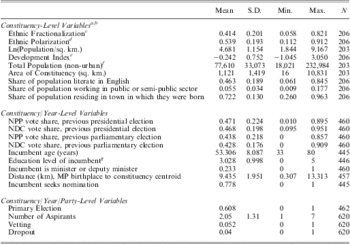
We combine our data on primary elections with enumeration area-level census records from the 2000 Ghana Population and Housing Census, aggregated to the constituency level by overlaying our geo-referenced constituency boundaries map. Because the constituency boundary map lumps together the small constituencies that make up three of the large urban areas in Ghana, we were able to construct variables only for 206 areas, 203 of which correspond to individual constituencies and three of which cover the remaining twenty-seven urban constituencies in Accra, Kumasi and Takoradi. Table 1 summarizes our data.
Summary Statistics for Ghanaian Primaries Election Dataset

aThe Electoral Commission map does not show boundaries for small constituencies in major urban areas; 13 constituencies in Greater Accra, 4 around Takoradi, and 10 in Kumasi are each lumped together, so we generate these variables for 206 areas to cover 230 constituencies.
bCalculated from 2000 Population and Housing Census, Ghana Statistical Service.
cThe fractionalization index is  $ 1{\rm{ - }}\mathop{\sum}\sidelimits_{i = 1}^N \pi _{i}^{2} $, where πi is the proportion of people in each ethnic group and N is the total number of groups (Montalvo and Reynal-Querol, ‘Ethnic Polarization, Potential Conflict, and Civil Wars’).
dThe polarization index is  $4\mathop{\sum}\sidelimits_{i = 1}^N \pi _{i}^{2} (1{\rm{ - }}{{\pi }_i})$, where πi is the proportion of people in each ethnic group and N is the total number of groups (Montalvo and Reynal-Querol, ‘Ethnic Polarization, Potential Conflict, and Civil Wars’).
eThe development factor is constructed through a factor analysis of three correlated measures of living conditions: the percentage of homes with electricity, modern sanitation and running water.
fPopulation totals are aggregated for the three urban areas and cannot be separated out to list by constituency. The total population in the urban constituencies is: 1,660,657 for Accra (13 constituencies); 1,170,270 for Kumasi (10); and 326,386 for Takoradi (3).
g0 less than secondary, 1 secondary, 2 certificate/post-secondary, 3 bachelors, 4 masters/postgrad, 5 PhD/doctor.
Primary Elections
To examine the relationship between electoral competitiveness and the use of primaries, we estimate variations of the following model:
 $${ Pr(P{{E}_{ict}} = 1) = logi{{t}^{-1}} ({{\beta }_0} + {{\beta }_1}{{S}_{ict-1}} + {{\beta }_2}S_{{ict-1}}^{2} + {{\beta }_3}Et{{h}_c} + {{\beta }_4}{{P}_i} + {{\beta }_5}Yr{{08}_t} + {{\beta }_6}{{P}_i}*Yr{{08}_t}) $$
where  $ {{S}_{ict{\rm{ - }}1}} $ is the vote share for the presidential candidate of party i in constituency c for the election held at time t−1, Ethc is ethnic fractionalization in constituency c in the year 2000, Pi is an indicator variable for NPP, and
 $ Yr{{08}_t} $ is an indicator variable for the year 2008. Each observation is a party-constituency-election year (ict). We use the party's vote share in the previous presidential election as our measure of expected electoral performance, since it is very highly correlated with the party's vote share in the previous parliamentary election but is a better measure of underlying support for the party in the few constituencies where the parliamentary seat was held by a third-party candidate in alliance with one of the major parties.Footnote 58
We also include the squared previous vote share, since existing theories predict that the probability of a primary should be first increasing and then decreasing in the competitiveness for a seat. We do not include a separate variable for whether the party currently holds the seat, since that is only a coarser version of the previous vote share and there are no theoretical expectations for an additional effect of this variable on whether there is a primary.
Because nominations in constituencies that are more ethnically diverse will also be likely to attract additional aspirants, and the added competition may increase potential rents for local party members, we also include ethnic fractionalization in the constituency in our model. An additional ethnic group in a constituency does not necessarily imply an additional aspirant, since a large group could support multiple aspirants, sometimes in different parties, or multiple groups could form coalitions that support a single aspirant. Nevertheless, voters generally believe that they would benefit from a co-ethnic in office and tend to support co-ethnic candidates in elections,Footnote 59 so that more ethnically diverse areas are likely to sustain more aspirants.Footnote 60
We include an indicator variable for the year 2008, since term limits precluded the incumbent NPP president from seeking re-election, and, consequently, uncertainty about the outcome of the presidential election was greater in that year than in 2004. This is interacted with the party indicator to allow for different effects of this uncertainty on the two parties. In a final specification, we restrict the sample to those constituencies where the party currently holds the seat and include indicators for whether the incumbent MP is seeking re-election and for whether the incumbent MP was a minister or deputy minister in the government. Standard errors are clustered at the area level to which the census data were aggregated (206 areas over 230 constituencies).
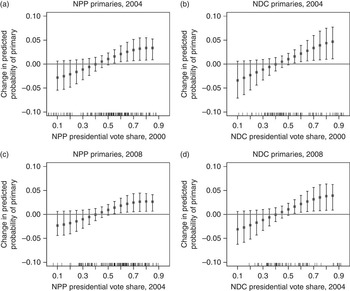
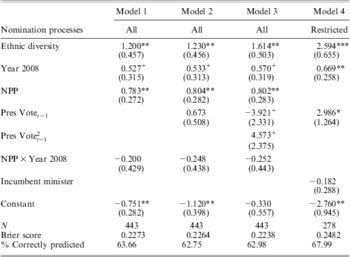
Our results, presented graphically in Figure 1 using estimates from Model 3 in Table 2, do not support existing theories based upon the policy-valence trade-off but are consistent with our explanation for contested primary elections.Footnote 61 Each panel plots the estimated change in the probability of a contested primary for a 5 percentage point increase in the party's vote share in the previous presidential election at different levels of previous vote share, along with their 95 per cent confidence intervals. These effects are calculated with ethnic fractionalization fixed at its mean value for the full sample. The rug plots at the bottom of these panels show the distribution of constituencies by previous vote share.Footnote 62
Change in the predicted probability of a primary election for a 5 percentage point change in the previous vote share Note: Based upon estimates from Model 3 in Table 2.

Primary Election, Logit Model

Notes: Robust standard errors in parentheses, clustered at area level. +p < 0.1, *p < 0.05, **p < 0.01, ***p < 0.001.
The four panels of Figure 1 show a consistent pattern: the probability of a contested primary election is increasing in the party's electoral performance in the previous presidential election, rather than increasing and decreasing, as would be expected if primaries were adopted by party elites in the most competitive seats.Footnote 63 Changes in the predicted probability of a primary are statistically indistinguishable from zero in constituencies where the party is likely to lose, but the first difference effect is positive and increasing for safer seats.
In column 4 of Table 2, we report estimates from restricting the sample to nomination processes in the incumbent MP's party, and find that ministers – the MPs with the most important policy roles in the government – are no less likely to face primary elections for re-nomination than are other incumbents. In this model, we exclude the quadratic term because the previous vote share for the incumbent party generally falls in the range in which our theory expects the probability of primaries to be generally increasing and extant theories do not predict a change in the slope.Footnote 64 If policy and legislative expertise played a role in party leaders’ decisions about whether to allow for primaries in each constituency, government ministers should have been more likely to be protected from primary challengers.
We also find that the predicted probability of a contested primary election is increasing in other factors that increase the number of aspirants for a nomination. More diverse constituencies are more likely to have a contested primary election than are less diverse constituencies. A party in a constituency at the median in ethnic diversity and the mean vote share in the previous presidential election is approximately 12 percentage points less likely to have a contested primary election than a party in a similar constituency at the 95th percentile in ethnic diversity (not shown).
Moreover, in contrast with the majority of findings from the existing literature, primaries are more likely in the ruling NPP, whose members have the opportunity for lucrative ministerial appointments, than in the weaker opposition NDC. The difference between the two parties was greater in 2004, when the NPP's presidential candidate was the incumbent and likely to win re-election, than in 2008, when the incumbent president faced term limits and the presidential election was closely contested between the parties (not shown).
This finding that the probability of a contested primary election is increasing in vote share in the previous presidential election and in ethnic diversity is robust. Excluding observations where the party previously won less than 10 per cent or more than 90 per cent of votes cast in the previous presidential election does not substantively change our findings. We also find no effect of the distinction between urban and rural constituencies or the development level of the constituency on the probability of having a contested primary (not shown).Footnote 65
Number of Aspirants
In line with the mechanism we proposed earlier, primaries are also more likely when more aspirants contest for the nomination. As additional aspirants enter, we expect increased competition to drive up the rents available to primary voters and make not having a primary election more costly for party leaders. Figure 2 plots the proportion of observations (party-constituency-year) that have contested primary elections by the number of aspirants who seek the nomination, along with the 95 per cent confidence intervals on these proportions. The difference between observations with two aspirants and three aspirants in the proportion of nominations that are contested primary elections is statistically significant at the 99 per cent confidence level.Footnote 66 The figure also shows the distribution of observations by the number of aspirants, with relative frequency as the height and the total number of observations listed at the top of each bar.
Proportion of contested primary elections by number of aspirants Note: 95 per cent confidence intervals are shown. The height of the bars are the relative frequency of the observations, with the number of observations noted at the top of each bar.

This association between the number of aspirants and contested primary elections is also confirmed in linear probability and logistic regressions of contested primary election on the number of aspirants, which may be treated as a categorical or continuous variable (not shown). Adding previous vote share, ethnic diversity, year, or party to the model individually or in combination barely changes the coefficients on the number of aspirants. The coefficients on these additional variables except party are also statistically indistinguishable from 0. Overall, there is a strong relationship between the number of aspirants who attempt to contest for a nomination and the likelihood that party leaders will allow primaries to proceed.
Political Interference
We find that political interference in candidate selection is more likely for nominations sought by fewer aspirants, which provides additional support for our argument. For more valuable nominations, the use of vetting to disqualify aspirants and prevent a primary is more common than the quiet withdrawal of aspirants. Moreover, consistent with our premise that party leaders do not value the policy preferences or expertise of their MPs, party leaders do not interfere more often to protect ministers or deputy ministers.
We code political interference by a party leader in two ways: the official disqualification of aspirants through a vetting procedure (as described earlier) and the last minute withdrawal of approved aspirants to allow the nominee to emerge unopposed. First, we recorded that vetting took place if at least one aspirant was officially disqualified for any reason, administrative or otherwise. We coded vetting broadly in this way because, while some portion of these disqualifications is presumably legitimate, others are political interference disguised as rule enforcement.Footnote 67 We have thirty-one cases of vetting, of which twenty-three take place for nominations for seats currently held by the party and eight are for seats held by the opposing party.
Our second measure of interference, dropout, registers any cases where only one aspirant was left on the day the nomination was decided by primary voters, even though more than one aspirant filed to contest and none of the aspirants were officially disqualified by vetting. While some of the aspirants undoubtedly withdrew from the contest because they expected to lose the primary or ran low on campaign resources, in several cases all aspirants but one withdrew unexpectedly and at the last moment.Footnote 68 Because we usually cannot know whether an aspirant's withdrawal was encouraged by a side payment, we code dropout broadly as we did with vetting. We have twenty-three cases of contests with dropout, of which eight are for nominations where the incumbent MP for that seat belongs to the party and fifteen occur where the incumbent MP belongs to another party.
By these measures, political interference is most likely where there are only two declared aspirants and pushing aside one aspirant can guarantee the nomination of a favoured choice. Approximately 48 per cent of cases of vetting and 83 per cent of cases of dropout occur in cases with only two aspirants, although they make up just 27 per cent of the cases in our data. In addition, ninety-six MPs who were ministers or deputy ministers were not more likely than the other 244 MPs to be protected from challenges within the party by the party leader. Thirteen per cent of nominations with ministers or deputy ministers involved political interference, while 9 per cent of nominations without ministers or deputy ministers had political interference. These proportions are not statistically significantly different from one another at conventional levels and are consistent with the views expressed by one party leader in an interview that the party was not worried about getting any specific MP elected to serve in the cabinet because it could still choose ministers from outside parliament for the essential posts.Footnote 69 Moreover, consistent with our theory, vetting is relatively more likely and dropouts are less likely in constituencies that a party is more likely to win.
We must be cautious in our interpretation, since vetting and dropout measure interference by the party leadership, as well as regular actions by aspirants weighing their own electoral prospects. Nevertheless, if vetting were a primarily administrative action, it should be more likely where the number of aspirants is greater, as there would be more potential rule breakers to disqualify. We do not find this, and our evidence is consistent with the interpretation that these variables are indicators of political interference.
Alternative Explanations
The strong positive relationship between the safety of the seat, the number of aspirants and likelihood of a contested primary election in Figures 1 and 2 could also result from a party leader encouraging aspirants to enter in safer constituencies, rather than a party leader anticipating the responses of local party members to his actions. In safer seats, the party may have a deeper pool of potential aspirants and a high-quality candidate may emerge from a primary. At the same time, the large expected vote margin over the other party mitigates concerns that the party may lose the seat if the primary triggers a dispute.
One theoretical objection to this alternative is that a party that already regularly wins a constituency by large margins is unlikely to improve its electoral performance considerably by replacing its incumbent, who has already demonstrated that he can win by a wide margin. The incentives for the party leader to find a better candidate are therefore fairly weak. If party leaders used primaries in order to select candidates who will improve the party's performance at the general election, primaries should be more likely in competitive seats where the improvement in electoral performance would be more likely to affect who wins the election, as in Serra and in Adams and Merrill.Footnote 70 However, in the previous section we found that primaries were more likely in safe seats than in competitive seats.
Furthermore, if party leaders were encouraging challengers where they sought to replace the incumbent, incumbents should be less likely to seek re-nomination in safe constituencies where they anticipate many strong challengers encouraged by the party leader. We investigate this implication of the alternative explanation by estimating a logit model with the incumbent's decision to seek re-election as the outcome, and party, year, age of the incumbent, the incumbent's vote share in the previous election, ethnic fractionalization in the incumbent's constituency and the interaction between the last two terms as predictors (not shown). Figure 3 plots the predicted probability of an NPP incumbent seeking re-election in 2004 at different levels of an incumbent's previous vote share, fixing incumbent age at 52 (median) and ethnic fractionalization at either 0.4 (median) or 0.712 (75th percentile); the plot for NDC is similar (not shown). It shows, first, that this predicted probability changes very little over the range of the safety of the seat. The figure also shows that the predicted probability that an incumbent will seek re-election is higher where ethnic fractionalization is greater and the incumbent may anticipate additional aspirants. Neither pattern is consistent with the proposed alternative explanation.Footnote 71
Predicted probability that NPP incumbent will seek re-nomination, 2004 Note: The upper solid line is the predicted probability that an NPP incumbent will seek re-nomination, with ethnic fractionalization fixed at its 75th percentile, and the lower solid line is the predicted probability with ethnic fractionalization fixed at its median. Incumbent age is fixed at 52 (median) for both graphs. The dotted lines are their 95 per cent confidence intervals.

A second alternative explanation for the positive relationship between the number of aspirants and the likelihood of a primary election is that primaries could be most likely to be perceived as manipulated and cause disputes when the party is polarized and party members are organized around two aspirants. This would be consistent with the greater frequency of intervention by party leaders in primaries with fewer aspirants and the higher probability of a contested primary for cases with more aspirants. In Ghana, however, apart from ethnicity there are no issues over which party members could become so deeply divided and polarized that they cannot be reconciled through compromises and side payments. If there are polarized camps within the parties, they are likely to be defined by ethnicity. To investigate this alternative, therefore, we re-estimate our models for primary elections, using an index of ethnic polarization proposed by Montalvo and Reynal-Querol in place of the ethnic fractionalization index.Footnote 72 We find that greater ethnic polarization is not associated with a lower probability of contested primary elections and instead appears to have no relationship (not shown), casting doubt on this second alternative argument. Although we cannot directly test and definitively rule out this or the first alternative argument, we find no evidence supporting them in these indirect explorations.
Conclusion
In this article we argue that party leaders democratize the nomination process selectively in response to demands for rents from their local party members, acting in anticipation of a costly reaction to denying them these rents, rather than in pursuit of electoral benefits.Footnote 73 Nominations that are likely to turn into elected office attract numerous aspirants who compete for the votes of these local party members, and pre-empting a primary election denies local party members potentially substantial rents from these aspirants. Wary of alienating local party members on whom party leaders rely for electoral success, the leaders forestall or interfere more in primaries when these potential rents are lower, and in less transparent ways when possible.
Our proposed theory for the use of primaries should stand, and current theories are unlikely to apply, under three conditions that are likely to be quite common in new democracies. First, where legislators do not play a significant role in national policy making, the policy position of a nominee may not be contested in the primary election and leaders do not face a trade-off between selecting a nominee with their policy preferences and allowing primary voters to choose the nominee's location in the policy space. Second, where clientelistic politics are prevalent, vote buying and disputes over the legitimacy of the primary outcome may prevent the selection of a higher valence candidate in a primary. Third, where national party leaders depend on local members to maintain crucial relationships with voters, vertical distributional conflicts within the party hierarchy can have an impact on the choice of candidate selection mechanism and alter the incentives of party leaders.
With an original dataset on parliamentary nominations for the two major parties in Ghana in 2004 and 2008, we demonstrated that contested primaries were more likely in safer constituencies rather than in competitive constituencies, in the incumbent party rather than in the weaker party, and in more ethnically diverse rather than in less ethnically diverse constituencies. We also documented a strong positive relationship between the number of aspirants and the probability of a contested primary election. Finally, we showed a pattern of political interference in nomination contests consistent with our predictions about the relative costs of different forms of intervention by party leaders.
Our study systematically documents how formal rules and the actual practice of a democratic process diverge in the developing world, augmenting the research agenda on informal institutions proposed by Levitsky and Helmke.Footnote 74 We show that the incentives of a party leader when viewed as an actor within the party, rather than as a representative of the party as a whole, help explain this divergence. Research on the historical formation and development of political parties in what is now the developed world has generally focused on electoral concerns and the representation of specific policy interests,Footnote 75 but our study suggests that the evolution and institutionalization of political parties in new democracies today might be better understood with greater emphasis on internal conflicts over rents than on promotion of particular ideological positions.