




No CrossRef data available.
Article contents
Readmission rate as an indicator of hospital performance: The case of Spain
Published online by Cambridge University Press: 01 August 2004
Abstract
Objectives: Hospital readmission rate is currently used as a quality of care indicator, although its validity has not been established. Our aims were to identify the frequency and characteristics of potential avoidable readmissions and to compare the assessment of quality of care derived from readmission rate with other measure of quality (judgment of experts).
Methods: Design: cross-sectional observational study; Setting: acute care hospital located in Marbella, South of Spain; Study participants: random sample of patients readmitted at the hospital within six months from discharge (n=363); Interventions: review of clinical records by a pair of observers to assess the causes of readmissions and their potential avoidability; Main measures: logistic regression analysis to identify the variables from the databases of hospital discharges which are related to avoidability of readmissions. Determination of sensitivity and specificity of different definitions of readmission rate to detect avoidable situations.
Results: Nineteen percent of readmissions were considered potentially avoidable. Variables related to readmission avoidability were (i) time elapsed between index admission and readmission and (ii) difference in diagnoses of both episodes. None of the definitions of readmission rate used in this study provided adequate values of sensitivity and specificity in the identification of potentially avoidable readmissions.
Conclusions: Most readmissions in our hospital were unavoidable. Thus, readmission rate might not be considered a valid indicator of quality of care.
Information
- Type
- RESEARCH REPORTS
- Information
- International Journal of Technology Assessment in Health Care , Volume 20 , Issue 3 , August 2004 , pp. 385 - 391
- Copyright
- © 2004 Cambridge University Press
The evaluation of the results of medical care is one of the cornerstones in health management, but it may be difficult to perform it because frequently the outcomes cannot unambiguously be attributed to medical interventions (24). However, rates of “adverse outcomes,” such as deaths, complications, nosocomial infections, or readmissions, have been extensively used to monitor health-care quality.
Readmission rate has been proposed as a quality of care indicator because (i) its relation to the quality of care is plausible, (ii) it is easily obtained from hospital databases, and (iii) readmissions appear more frequently than other adverse outcomes, such as mortality, and in all specialties. A difficulty for using readmissions as a measure of quality is the absence of a unified definition of the indicator. There is not consensus in the time from the previous (or “index”) episode, in the inclusion of urgent or planned readmissions, or in the need of a relationship between the diagnosis of the index admission and readmission.
The conclusions of different studies about readmissions have been controversial: some authors have found that readmissions are mainly related to problems of quality of care (2;5;23;25;30;32); others did not find associations between readmissions and the quality of care during the index episode (11;18;28); and finally, there are studies that did not find a clear conclusion (14;19;20;27;29).
We have studied readmissions in a randomly selected sample of patients in Costa del Sol Hospital, in the South of Spain. Our first aim was to identify the frequency and characteristics of potential avoidable readmissions, exploring which variables within the minimum basic data set (MBDS) were related to the potential avoidability of readmissions; therefore, they should be taken into account in the formulation of more adequate definitions of readmission rate for the hospital as a whole and for groups of specialties. Second, we studied the validity of readmission rate by comparing this indicator, with the gold standard estimate of quality of care, that is, the judgment of experts after review of clinical charts.
METHODS
We have performed an observational and cross-sectional study in Costa del Sol Hospital, a state company that belongs to the Autonomy of Andalucía in the South of Spain. It is a general hospital-care facility for 280,000 inhabitants of the Marbella area and, during 2002, attended 112,000 emergencies and more than 16,000 admissions.
The study population was patients discharged from the hospital during the first semester of 1997 who were readmitted within six months after discharge (n=784, 14.2 percent of all discharges). Random sampling by episodes was performed to allow the study of more than one readmission for each patient. The sample size (n=365) was calculated for estimating the proportion of readmissions potentially avoidable in the population previously mentioned, which was expected to be around 0.25. The precision was fixed at ±0.033, alpha error in 0.05, and the expected losses at 3 percent. Finally, there were only two losses corresponding to incomplete charts, thus, the valid sample size was 363.
Readmissions were classified according to the criteria shown in Table 1, into one of two possible groups: potentially avoidable or unavoidable, after analysis of the diagnostic-therapeutic process in the previous admission and its possible modification in each case. We applied a new classification of causes of readmissions, based on twenty categories, eleven of which directly defined the readmission as potentially avoidable and the other nine as unavoidable. In the case that two or more causes coexisted for one readmission, the reviewers were asked to give priority to the one considered as principal, if both were from the same group of avoidability; if they were from different groups, the readmission was considered to be potentially avoidable. For the statistical analysis, only one cause was considered for each readmission. The reason “instability at discharge” was evaluated using explicit criteria adapted from Ludke et al. (20) and Kosecoff et al. (17). Results were displayed in three groups according to the specialty that was responsible for the index episode discharge: medical (internal medicine, cardiology, pneumology, gastroenterology, hematology, and pediatrics), surgical (general surgery, orthopedics and traumatology, gynecology, urology, ophthalmology and otorhinolaringology) and obstetrics.

Data collection was performed using the following phases: (i) opening a database with dates, specialties, main diagnosis, and surgical procedures of each index episode and readmission; (ii) examination of the database by two physicians experts in clinical documentation and review of the chart when necessary (in this phase the causes for 45 percent of the readmissions were defined); (iii) 18 percent of the charts were reviewed by a surgical specialist, a gynecologist or a pediatrician, according to the specialty of the index episode, together with an expert in clinical documentation. In case of discharges from medical specialties, which were more in number (37 percent of the sample) and complexity, 42 charts were initially reviewed independently by two internal medicine specialists. We obtained a moderate agreement for this first review with respect to the potential avoidability of readmissions (kappa=0.55). Thus, the rest of the charts of medical specialties were reviewed by two internal medicine specialists who had to agree on the readmission cause. In summary, the assignment of the cause of each readmission was made in all cases with the agreement of two professionals.
Logistic regression (LR) was applied with the aim of identifying the variables of the MBDS associated with the potential avoidability of readmissions. The dependent variable was the potential avoidability of readmissions (1, yes; 0, no; according to the experts as described above). The independent variables were (i) type of admission in the readmission episode (scheduled, urgent as reference category); (ii) type of discharge from the index episode (transferred to another hospital, discharge against medical advice, normal discharge to home) included as a dummy variable with the last category as reference; (iii) time in days elapsed between discharge from the index episode and readmission; (iv) relationship between the specialty responsible for discharge of the index episode and the one where the patient was readmitted (compatible specialties were those that frequently treat the same diseases, for example, intensive care unit with the rest, internal medicine with gastroenterology, hematology, cardiology, and pneumology; gastroenterology with general surgery); (v) relationship between principal diagnoses in both episodes according to the first three digits of the International Classification of Diseases, 9th Revision or according to the 12th version of the Diagnosis Related Groups classification or to the Major Diagnostic Category (MDC) of this same classification.
Initially, all variables were included in the LR model. Then, the variables with less statistical significance were eliminated one at a time until a model with global statistical significance was obtained. Ninety-five percent confidence intervals (CI) were calculated for the adjusted odd ratios (OR) that were statistically significant. Goodness of fit of the selected models was evaluated through Hosmer-Lemeshow's test.
We calculated sensitivity and specificity for different definitions of readmission rates with the same procedure used for the assessment of a diagnostic test in clinical practice: the concept of “potential avoidability” stands for “disease” in the diagnostic tests evaluation and the “consideration of the case as a readmission,” according to the definition applied, stands for “diagnostic test with a positive result.” Consequently, “sensitivity” is the proportion of readmissions potentially avoidable that the indicator identifies as readmissions and “specificity” is the proportion of unavoidable readmissions that the indicator does not identify as readmissions. We used Dbase IV for creating the database, SPSS version 9 for Windows and Epi Info version 6 for the statistical analysis.
RESULTS
We analyzed 363 hospital readmissions within six months after the index episode, corresponding to 295 different patients. Patients' mean age (±SD) was 53.9±20.5 years, and 58.4 percent were male patients. On average, readmissions occurred 45.6±45.0 days after the previous admission and 21.8 percent of readmissions occurred during the first week, 50.7 percent the first month, and 80.2 percent the first three months.
Table 1 shows the distribution of readmission causes. The most frequent causes were recurrence or clinically unavoidable progression (26.7 percent), process not related to previous episodes (18.7 percent), and planned readmission (18.2 percent). As it is shown, main potentially avoidable causes were complication of surgical procedure (4.4 percent), readmission for a procedure that could have been done during the index episode (3.9 percent), and failure to achieve the expected result from a surgical procedure (3.3 percent).
Potentially avoidable causes included 19 percent of all readmissions, 13.1 percent of those after discharge from a medical service, 37.4 percent from a surgical service, and 11.8 percent from obstetrics. When we considered only the readmissions within one month from previous discharge, these percentages were somewhat higher: 23.9 percent for the entire hospital and 15.4 percent, 55 percent, and 15 percent, respectively, for the three groups of specialties. The maximum percentage of potentially avoidable readmissions was during the first week from discharge in surgical services (56.3 percent) and the minimum was six months after discharge from the obstetrics unit (11.8 percent).
LR model, for all the specialties, detected that, the shorter the time between discharge and readmission, the higher the probability of the latter to be potentially avoidable (OR=0.993; 95 percent CI, 0.987-0.999). In addition, coincidence in diagnosis during admission and readmission reduced the probability of the readmission to be potentially avoidable (OR=0.63; 95 percent CI, 0.35–1.12).
In the medical specialties, probability of readmission to be potentially avoidable was higher when the MDC matched between both episodes (OR=3.93; 95 percent CI, 1.31–11.82) and lower when the principal diagnoses were different between episodes (OR=0.43; 95 percent CI, 0.18–1.05). For surgical specialties, the probability of the readmission to be potentially avoidable was lower when the time between both admissions was longer (OR=0.99; 95 percent CI, 0.98–0.99) and higher when the readmission unit was “compatible” with the index admission unit (OR=3.79; 95 percent CI, 0.97–14.76). Among obstetric patients, no combination of variables produced a satisfactory LR model. Hosmer-Lemeshow chi squared test did not detect differences between observed and predicted values in any of the three selected models.
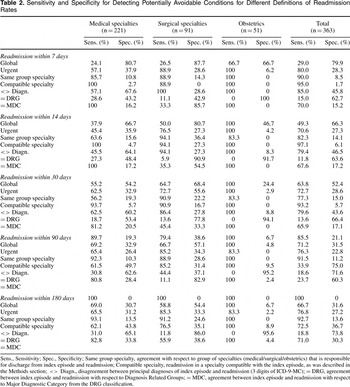
Table 2 shows sensitivity and specificity for detecting avoidability of readmissions using different definitions, according to days from index episode and characteristics of both admissions. The design of the study shows an increase in sensitivity and a decrease in specificity as the period becomes longer. The addition of sensitivity and specificity was the highest for the following definitions of the indicator: for medical specialties, readmissions within seven days and different principal diagnosis (sensitivity 57.1 percent and specificity 67.6 percent); for surgical specialties, readmissions within thirty days (64.7 percent and 68.4 percent, respectively); for obstetrics, readmissions within fourteen days (63.8 percent and 52.4 percent, respectively), and for all specialties together, readmissions within thirty days (sensitivity 63.8 percent and specificity 52.4 percent).

DISCUSSION
Our results show that only 19 percent of hospital readmissions within six months after discharge were caused by situations potentially avoidable if the attention received had been modified during the index episode. When studied by specialties, the percentage was 37.4 percent in surgical services, 13.1 percent in medical units, and 11.8 percent in obstetrics.
None of the definitions for the readmission rate yielded adequate values for sensitivity and specificity. In the definitions with better balance between both indexes, these were around 60 percent. The design of the study, in which readmission within six months has a sensitivity of 100 percent and a specificity of 0 percent, allows only a relative comparison with the rest of the definitions. The actual estimation of these indexes would have needed a review of a representative sample of hospital discharges, which also included patients that were not readmitted. However, given the low relative frequency of readmissions and of situations of low quality of care, the size of the sample would have needed to be very high.
In the evaluation of health-care results using rates of negative events, it has been described that a high sensitivity would correspond to a low specificity and that there are few indicators that identify high percentages of adverse effects (6). The specificity of many outcome indicators of quality of care tends to be low, because there are many factors not related to the attention received, which can interfere with the relation between medical attention and clinical results. Bates et al. (6) described a sensitivity of 28 percent and a specificity of 80 percent in readmission rate within two months for the identification of preventable adverse effects in a medical ward. Heggestad and Lilleeng (13) found that, for the time interval of one month, 72 percent of the readmissions in a general hospital were related to the earlier episode.
The common problem of hospital readmissions and other indicators of clinical outcomes is in brief that, despite that the frequency of quality problems appears to be higher in readmitted patients, the causes of readmissions of most patients are not the quality of care problems. A review of the literature (7) described that most authors attribute the majority of the hospital readmissions to the weakness of the patient or to the progression of a chronic disease. Other reviews have estimated that substandard health care during the index episode increases the risk of readmission between 24 percent and 55 percent in specific diseases (3;4) and that shorter length of stays increase the risk of early readmissions (12).
Our results indicate that the validity of readmissions as an indicator of quality of care may be higher in surgical specialties where the percentages of potentially avoidable readmissions were 55 percent in one month and 37.4 percent in six months. A higher validity of the readmission rate as an indicator of quality of care in surgical specialties compared with the medical ones has also been found in other studies (26). It would be clearly wrong to interpret that this difference is due to a worse quality of care in surgical specialties. The low validity of readmission rates in obstetrics has also been described by other authors (9).
A difficulty for the use of readmissions as a measure of quality is the absence of a unified definition of the indicator. There are studies that establish the time between the previous (or “index”) episode and the readmission as a few days and others that consider several months. According to our results, a term of thirty days appears as the most adequate for the total of the hospital discharges. This period is in agreement with what most authors have defined as the time frame for “early readmissions” (4;7). Proposed definitions of readmissions in general hospital services include emergency (9) and the coincidence of diagnosis in both episodes (8). However, our results show that the urgent nature of the readmission is not related to its potential avoidability. Moreover, the coincidence of diagnosis in both episodes results in a decrease in the probability of the readmission to be potentially avoidable.
We used information about causes of readmission retrospectively collected. This method has been widely applied in studies on readmission causes (2;5;6;11;17;20;21;25;28;29) even when it does not guarantee that all the necessary information is obtained. Knowing this, we stressed the in-depth review of charts.
The main objective of our study was to determine the causes and potential avoidability of readmissions. Possibly, some patients might have been readmitted in other hospitals; but it is unlikely that this reason could substantially affect the cause distribution of readmissions, because our center is the only public hospital in this geographical area and patients scarcely use private services because the payment is not covered by the state.
The main limitation might be the difficulty for judging the quality of care, which has been raised by different authors (10). The bibliography suggests that, to improve reliability, chart reviews should be done by several experts, according to explicit or structured implicit review criteria and with a pilot study before the generalization of the measuring system (1;10;22). These recommendations were fully complied with in our study.
Differential classification between medical and surgical specialties could have been raised. Given the impossibility of demonstrating the quality of a surgical procedure through the review of clinical charts, it was agreed that those surgical techniques that did not achieve the expected result were included in the group of potentially avoidable readmissions. However, if in a particular readmission, the pharmacological treatment used was considered correct, it was assigned to the unavoidable group even when the treatment did not achieve the expected result.
The assignment of the readmission causes to one of the two groups of avoidability was done through a new classification proposed by us, given the absence of a unified one (4;15;21;22;30). Among the advantages of the new proposed classification are its exhaustivity and the direct determination of the avoidability of the readmission according to the assigned cause.
Undoubtedly, the analysis of readmission causes from the hospital point of view gives a partial idea of reality. The analysis of the circumstances of each patient after the discharge could have resulted in a distribution of causes different from that obtained. However, it must be taken into account that the quantity and quality of the information about the hospital process, in each case, is much broader than the information about the incidences after the discharge.
Even though the main strategy for the development of quality control systems based on clinical outcomes goes through an adequate risk adjustment (16), our study, as others also performed (13;28;30-32), is in the line of searching for indicator definitions that show the closest possible relation to the quality of care received.
In the debate between researchers who have concluded that hospital readmissions can be considered valid as quality of care indicators (2;5;23;25;30;32) and those who have concluded that the causes of readmissions depend mainly on the patients' clinical condition and not on the quality of the medical care received (11;18;28), our results seem to support the opinion of the second group.
In conclusion, most of the readmissions in our hospital were not avoidable with the modification of medical care during the index episode. These results suggest that, in a general hospital with a similar level of quality of care, readmission rate might not be advisable as a valid quality of health-care indicator.
POLICY IMPLICATIONS
Whereas in the United States, reports in the literature about validity of hospital readmissions as a measure of quality of care are quite extensive, in Western Europe, articles dealing with the subject are still scarce. Nevertheless, hospitals and health administrations of both continents include the readmission rate among the indicators regularly monitored.
According to our results, most of the hospital readmissions are not avoidable with the modification of medical care during the index episode. Thus, readmission rates cannot be considered valid quality of care indicators for the set of specialties in a general hospital. In agreement with other authors, we propose to continue evaluating whether, on the contrary, they can be valid quality of care indicators within specific diagnoses.
To the colleagues at Costa del Sol Hospital who collaborated in the review of charts of their specialties: Norberto Gándara, Enrique Guerado, Miguel Padilla, Beatriz Picazo, and Alejandro Rohde. To Antonio García and Rosa Jiménez for their methodological suggestions. To Marion Winter, Paco Martos, and Mariano Rodríguez for their help with translation.
The study was supported by a grant for research projects of the Andalucian Health Service (exp. 197/97). Costa del Sol Hospital is part of the IRYSS Network for Health Care Outcomes Research.
References
Ashton CM,
Kuykendall DH,
Johnson ML, et al.
1994
A method of developing and weighting explicit process of care criteria for quality assessment.
Med Care.
32:
755–
770.Google Scholar
Ashton CM,
Kuykendall DH,
Johnson ML.
1995
The association between the quality of inpatient care and early readmission.
Ann Intern Med.
122:
415–
421.Google Scholar
Ashton CM,
Wray NP.
1996
A conceptual framework for the study of early readmission as an indicator of quality of care.
Soc Sci Med.
43:
1533–
1541.Google Scholar
Ashton CM,
Del Junco DJ,
Souchek J,
Wray NP,
Mansyur CL.
1997
The association between the quality of inpatient care and early readmission: A meta-analysis of the evidence.
Med Care.
35:
1044–
1059.Google Scholar
Ashton CM,
Kuykendall DH,
Johnson ML,
Wray NP.
1999
An empirical assessment of the validity of explicit and implicit process-of-care criteria for quality assessment.
Med Care.
37:
798–
808.Google Scholar
Bates DW,
O'Neil AC,
Petersen LA,
Lee TH,
Brennan TA.
1995
Evaluation of screening criteria for adverse events in medical patients.
Med Care.
33:
452–
462.Google Scholar
Benbassat J,
Taragin M.
2000
Hospital readmissions as a measure of quality of health care: Advantages and limitations.
Arch Intern Med.
160:
1074–
1081.Google Scholar
Epstein AM,
Bogen J,
Dreyer P,
Thorpe KE.
1991
Trends in length of stay and rates of readmission in Massachusetts: Implications for monitoring quality of care.
Inquiry.
28:
19–
28.Google Scholar
Franklin PD,
Noetscher CM,
Murphy ME,
Lagoe RJ.
1999
Using data to reduce hospital readmissions.
J Nurs Care Qual.
(Special Issue):
67–
85.Google Scholar
Goldman RL.
1992
The reliability of peer assessments of quality of care.
JAMA.
267:
958–
960.Google Scholar
Hayward RA,
Bernard AM,
Rosevear JS,
Anderson JE,
McMahon LF.
1993
An evaluation of generic screens for poor quality of hospital care on a general medicine service.
Med Care.
31:
394–
402.Google Scholar
Heggestad T.
2002
Do hospital length of stay and staffing ratio affect elderly patients' risk of readmission? A Nation-wide study of Norwegian hospitals.
Health Serv Res.
37:
647–
665.Google Scholar
Heggestad T,
Lilleeng S.
2003
Measuring readmissions: Focus on the time factor.
Int J Qual Health Care.
15:
147–
154.Google Scholar
Hofer TP,
Hayward RA.
1995
Can early readmission rates accurately detect poor-quality hospitals?
Med Care.
33:
234–
245.Google Scholar
Hughes MR,
Johnson NJ,
Nemeth LS.
2000
Classifying reasons for hospital readmissions.
Top Health Inf Manage.
20:
65–
74.Google Scholar
Iezzoni LI, editor.
1997.
Risk adjustment for measuring healthcare outcomes.
Chicago:
Health Administration Press
Kosecoff J,
Kahn KL,
Rogers WH, et al.
1990
Prospective payment system and impairment at discharge.
JAMA.
264:
1980–
1983.Google Scholar
Kossovsky MP,
Sarasin FP,
Perneger TV, et al.
2000
Unplanned readmissions of patients with congestive heart failure: Do they reflect in-hospital quality of care or patient characteristics?
Am J Med.
109:
386–
390.Google Scholar
Krumholz HM,
Parent EM,
Tu N, et al.
1997
Readmissions after hospitalization for congestive heart failure among Medicare beneficiaries.
Arch Intern Med.
157:
99–
104.Google Scholar
Ludke RL,
Booth BM,
Lewis-Beck JA.
1993
Relationship between early readmission and hospital quality of care indications.
Inquiry.
30:
95–
103.Google Scholar
Marcantonio ER,
McKelan S,
Goldfinger M, et al.
1999
Factors associated with unplanned hospital readmission among patients 65 years of age and older in a Medicare managed care plan.
Am J Med.
107:
13–
17.Google Scholar
Oddone EZ,
Weinberger M,
Horner M, et al.
1996
Classifying general medicine readmissions: Are they preventable?
J Gen Intern Med.
11:
597–
607.Google Scholar
Osman LM,
Godden DJ,
Friend JA,
Legge JS,
Douglas JG.
1997
Quality of life and hospital readmission in patients with chronic obstructive pulmonary disease.
Thorax.
52:
67–
71.Google Scholar
Övretveit J,
Gustafson D.
2003
Using research to inform quality programmes.
BMJ.
326:
759–
761.Google Scholar
Slack R,
Bucknall CE.
1997
Readmission rates are associated with differences in the process of care in acute asthma.
Qual Health Care.
6:
194–
198.Google Scholar
Taroni F,
Louis DZ,
Yuen EJ.
1993
Outcomes management: The Italian case-mix project.
In: Casas M,
Wiley MM, editors.
Diagnosis related groups in Europe.
Berlin:
Springer-Verlag:
97–
108.
Thomas JW,
Holloway JJ.
1991
Investigating early readmission as an indicator for quality of care studies.
Med Care.
29:
377–
394.Google Scholar
Thomas JW.
1996
Does risk-adjusted readmission rate provide valid information on hospital quality?
Inquiry.
28:
258–
270.Google Scholar
Wei F,
Mark D,
Hartz A,
Campbell C.
1995
Are PRO discharge screens associated with postdischarge adverse outcomes?
Health Serv Res.
30:
489–
506.Google Scholar
Weissman JS,
Ayanian JZ,
Chasan-Taber S, et al.
1999
Hospital readmissions and quality of care.
Med Care.
37:
490–
501.Google Scholar
Wray NP,
Ashton CM,
Kuykendall DH, et al.
1995
Selecting disease-outcome pairs for monitoring the quality of hospital care.
Med Care.
33:
75–
89.Google Scholar
Wray NP,
Peterson NJ,
Souchek J,
Ashton CM,
Hollingsworth JC.
1997
Application of an analytic model to early readmission rates within the department of veterans affairs.
Med Care.
35:
768–
781.Google Scholar

Causes of Readmissions in 180 Days According to Their Potential Avoidability through the Modification of Care during the Index episode and Type of Specialty Responsible for the Discharge from the Index Episode
Sensitivity and Specificity for Detecting Potentially Avoidable Conditions for Different Definitions of Readmission Rates
 You have
Access
- 24
- Cited by