Introduction
Infertility affects approximately 15% of couples with 50% of cases being attributed to a male factor (Chandra et al., Reference Chandra, Martinez, Mosher, Abma and Jones2005). The main causes of altered male factor fertility are many: oligozoospermia, asthenozoospermia, teratozoospermia, cryptozoospermia and azoospermia. In the ICSI procedure the physiological mechanisms of natural sperm selection are bypassed and the sperm injected into the oocyte is selected directly by the biologist, combining attention to choose with motility and normal gross morphology. This procedure does not ensure the genetic integrity of the chosen sperm and, consequently, of the derived embryo. Moreover, to date, the consequences of using low quality spermatozoa are still unclear. Some studies have disclosed that offspring conceived by ICSI have been shown to be at increased risk for aneuploidies, with a higher incidence on sex chromosomes (Hansen et al., Reference Hansen, Bower, Milne, de Klerk and Kurinczuk2005; Ludwig, Reference Ludwig2005). To date, the consequences of using low quality sperm is still under discussion. Some authors report a direct correlation between extensive teratozoospermia and impaired implantation and ongoing pregnancy rates (Taşdemir et al., Reference Taşdemir, Taşdemir, Tavukçuoglu, Kahraman and Biberoģlu1997); this might be related to higher rates of DNA fragmentation, mitochondrial dysfunction and chromosomal aneuploidy in sperm of oligozoospermic and/or asthenozoospermic and/or teratozoospermic men compared with unaffected controls (Jiang et al., Reference Jiang, Yang, Tong, Zhu, Xue, Xu, Yang and Zhang2015). Sperm DNA testing has been increasingly used as an additional parameter of sperm evaluation (Bungum et al., Reference Bungum, Humaidan, Spano, Jepson, Bungum and Giwercman2004; Virro et al., Reference Virro, Larson-Cook and Evenson2004; Check et al., Reference Check, Graziano, Cohen, Krotec and Check2005; Benchaib et al., Reference Benchaib, Lornage, Mazoyer, Lejeune, Salle and François Guerin2007; Bungum et al., Reference Bungum, Humaidan, Axmon, Spano, Bungum, Erenpreiss and Giwercman2007; Frydman et al., Reference Frydman, Prisant, Hesters, Frydman, Tachdjian, Cohen-Bacrie and Fanchin2008; Ozmen et al., Reference Ozmen, Caglar, Koster, Schopper, Diedrich and Al-Hasani2007; Lin et al., Reference Lin, Kuo-Kuang Lee, Li, Lu, Sun and Hwu2008). Sperm DNA quality might be one of the important determinants of normal fertilization and embryo development. For this reason, many studies have investigated the relationship between outcome of assisted reproductive technology (ART) and high DNA damage in sperm (Aitken et al., Reference Aitken, Gordon, Harkiss, Twigg, Milne, Jennings and Irvine1998; Lopes et al., Reference Lopes, Sun, Jurisicova, Meriano and Casper1998; Henkel et al., Reference Henkel, Kierspel, Hajimohammad, Stalf, Hoogendijk, Mehnert, Menkveld, Schill and Kruger2003; Larson-Cook et al., Reference Larson-Cook, Brannian, Hansen, Kasperson, Aamold and Evenson2003; Gandini et al., Reference Gandini, Lombardo, Paoli, Caruso, Eleuteri, Leter, Ciriminna, Culasso, Dondero, Lenzi and Spanò2004; Dar et al., Reference Dar, Grover, Moskovtsev, Swanson, Baratz and Librach2013; Simon et al., Reference Simon, Proutski, Stevenson, Jennings, McManus, Lutton and Lewis2013). However, most studies have found that sperm with DNA damage were capable of fertilizing an oocyte (Zini et al., Reference Zini, Meriano, Kader, Jarvi, Laskin and Cadesky2005; Borini et al., Reference Borini, Tarozzi, Bizzaro, Bonu, Fava, Flamigni and Coticchio2006), showing only a modest effect on conception rates with conventional IVF and almost no effect with ICSI (Aitken et al., Reference Aitken, Gordon, Harkiss, Twigg, Milne, Jennings and Irvine1998; Zini et al., Reference Zini, Meriano, Kader, Jarvi, Laskin and Cadesky2005; Borini et al., Reference Borini, Tarozzi, Bizzaro, Bonu, Fava, Flamigni and Coticchio2006; Bungum et al., Reference Bungum, Humaidan, Axmon, Spano, Bungum, Erenpreiss and Giwercman2007; Kobayashi et al., Reference Kobayashi, Sato, Otsu, Hiura, Tomatsu, Utsunomiya, Sasaki, Yaegashi and Arima2007; Ozmen et al., Reference Ozmen, Caglar, Koster, Schopper, Diedrich and Al-Hasani2007; Collins et al., Reference Collins, Barnhart and Schlegel2008; Frydman et al., Reference Frydman, Prisant, Hesters, Frydman, Tachdjian, Cohen-Bacrie and Fanchin2008; Lin et al., Reference Lin, Kuo-Kuang Lee, Li, Lu, Sun and Hwu2008; Zini et al., Reference Zini, Boman, Belzile and Ciampi2008; Dar et al., Reference Dar, Grover, Moskovtsev, Swanson, Baratz and Librach2013; Simon et al., Reference Simon, Proutski, Stevenson, Jennings, McManus, Lutton and Lewis2013). Conversely, Zini et al. (Reference Zini, Boman, Belzile and Ciampi2008) reviewed these observations concluding that sperm DNA damage was associated with a significantly higher risk of pregnancy loss after IVF and ICSI. Furthermore, aberrant DNA methylation of imprinted loci in sperm from oligospermic patients has been reported (Kobayashi et al., Reference Kobayashi, Sato, Otsu, Hiura, Tomatsu, Utsunomiya, Sasaki, Yaegashi and Arima2007). This result might be related to a low degree of maturity and a high malformation rate in testicular sperm (Lu et al., Reference Lu, Gao, Li, Zheng, Ye, Qian, Xu, Huang and Jin2012). A recent study outlined that the use of suboptimal sperm increases the risk of aneuploidy of sex chromosomes in preimplantation blastocyst embryos (Coates et al., Reference Coates, Hesla, Hurliman, Coate, Holmes, Matthews, Mounts, Turner, Thornhill and Griffin2015). Many studies have focused on the risk of using frozen sperm as ICSI allows the use of thawed sperm even if cryopreservation impairs semen motility; some studies have shown that using thawed sperm could be not as safe as it seems, as the accumulated evidence shows that the process of freezing and thawing could cause damage to the sperm (Giraud et al., Reference Giraud, Motta, Boucher and Grizard2000; Chatterjee and Gagnon, Reference Chatterjee and Gagnon2001).
Probably the most addressed issue is the use of testicular or epididymal sperm that is considered to have a low degree of maturity and therefore leading to a high malformation rate (Takahashi, Reference Takahashi2012). Tsai et al. (Reference Tsai, Huang, Lin, Kung, Lin and Lan2015) compared clinical outcome of obstructive azoospermia (OA) and non-obstructive azoospermia (NOA) couples after testicular sperm extraction (TESE) and ICSI, and found that the two groups had similar clinical pregnancy, chemical pregnancy, implantation, live birth and abortion rates per transfer. They also compared perinatal outcomes and the subsequent development of the children over a median of 10 years following TESE–ICSI, detecting no statistical significant difference in live births rates. Moreover, the health of the children conceived using ICSI was satisfactory, without any major retardation in psychomotor or intellectual development (Ludwig et al., Reference Ludwig, Katalinic, Thyen, Sutcliffe, Diedrich and Ludwig2009). The development of children conceived by ICSI with extracted testicular sperm or with ejaculated sperm from men with extreme severe OAT was found to be comparable (Tsai et al., Reference Tsai, Huang, Wang, Lin, Kung, Hsieh and Lan2011, Reference Tsai, Huang, Lin, Kung, Lin and Lan2015). In light of the above-mentioned findings, it is mandatory to understand if the use of sperm retrieved from different sources or the use of sperm that is clearly abnormal may influence not only the fertilization rate but also embryo development or embryo ploidy, increasing the risk of contracting a genetic disease. The aim of our study was to analyze possible relationships between sperm quality and chromosomal defect through blastocyst preimplantation genetic testing (PGT) analysis.
Materials and methods
Subjects
Our study is a retrospective analysis of 201 ICSI-PGT cycles performed from January 2012 to December 2015 to evaluate the incidence of chromosomal aneuploidy in patients who submitted to the following selection criteria: maternal age ≤38 years old, no intracytoplasmic morphologically selected sperm injection (IMSI), no genetic diseases. Couples with female infertility factors such as endometriosis, low ovarian reserve, polycystic ovary syndrome (PCOS) and genetic indications were excluded from the study. Only male patients with a normal karyotype were enrolled in the study. We chose a maternal age ≤38 years old to decrease the female factor. Mean female age, anti-Müllerian hormone (AMH) values, body mass index (BMI) and E2 values highlighted no statistical significant difference between the four groups; the same stand true for male mean age.
Group 1 was composed of 95 cycles with normal semen parameters based on WHO (2010) guidelines (total sperm number, calculated by sperm concentration × sperm volume, ≥39 × 106 sperm/ml, progressive motility ≥32%, and morphology ≥4% normal forms). Group 2 was composed of 58 cycles with oligoasthenoteratozoospermia (OAT) (total sperm number <39 × 106, progressive motility <32% morphology <4%). Group 3 was composed of 29 cycles including extremely severe OAT, i.e. cryptospermic men (sperm concentration from 0.0003 to 1 × 10⁶/ml). Group 4 was composed of 19 cycles including NOA.
Sperm preparation
Fresh ejaculated semen was collected on the day of oocyte retrieval and left to liquefy for ∼20–30 min prior to semen analysis. Afterwards, the semen specimens were processed using the swim up procedure; in this kind of selection the sperm was washed using 5 ml of sperm washing medium and centrifuged for 10 min at 600 g; therefore, the supernatant was carefully removed leaving only the pellet that was suspended by slowing agitating the tube. Finally, 500 μl of cleavage medium with HEPES, 5% human serum albumin (Quinn Sage, CooperSurgical, Pasadena, USA) was stratified leaving the tubes for 30 min at 37°C in 6% CO2 and then 200 μl were taken and transferred into a new tube and put in the incubator. The surgical procedure was performed under general anaesthesia, as described elsewhere (Franco et al., Reference Franco, Scarselli, Casciani, De Nunzio, Dente, Leonardo, Greco, Greco, Minasi and Greco2016). Briefly, after disinfection the scrotum was incised along the scrotal raphe and the testis was then delivered through the incision. Sperm extraction was always performed using multiple biopsies (4–8 samples). Tissue samples were placed in a Petri dish (containing 6–8 ml of buffered medium with HSA) in which the seminiferous tubules were opened by mechanically dissection with glass coverslides (wet preparation). The sperm search on the wet preparation was performed at ×400 magnification under an inverted microscope. After ∼10–15 min, whether or not sperm are found in the wet preparation, the TESE sample was centrifuged (600 g for 10 min) in 0.5 ml of a buffered medium (Quinn’s Advantages Medium with HEPES, 5% human serum albumin; Sage, CooperSurgical, Pasadena, USA). Part of the cell suspension was smeared and covered with mineral oil in order that sperm search could continue on a more concentrated sample.
Ovarian stimulation, oocyte denudation and insemination
Controlled ovarian stimulation was performed using recombinant follicle stimulating hormone (FSH) (Gonal F, Merck Serono, Geneva, Switzerland) and gonadotropin-releasing hormone (GnRH)-antagonist flexible protocol. Evaluation of the patient’s age, BMI, antral follicle count. (AFC) and AMH were taken into account in the recombinant FSH starting dose calculation. The number and the mean diameter of the growing follicles were assessed by means of periodic transvaginal ultrasound scans. Together with serum estradiol levels, these data were used to adjust the recombinant FSH dose. When at least three follicles reached 19 mm in diameter, human chorionic gonadotrophin (hCG) (Gonasi, 10,000 IU, IBSA, Lodi, Italy) was administered by intramuscular injection. Oocyte pick-ups were performed 36–38 h later by ultrasound-guided transvaginal follicular puncture. The ovarian stimulation method leading to supernumerary oocyte retrieval has been described in detail elsewhere (Litwicka et al., Reference Litwicka, Mencacci, Arrivi, Varricchio, Caragia, Minasi and Greco2018). Briefly, controlled ovarian stimulation was performed using recombinant FSH (Gonal F, Merck Serono, London, UK) and gonadotropin-releasing hormone agonist in a long suppression protocol or GnRH-antagonist protocol according to ovarian reserve and AMH values. When at least three follicles reached 18 mm in diameter, hCG (Gonasi, 10,000 IU, IBSA, Lodi, Italy) was administered by intramuscular injection. Oocytes were retrieved 36–38 h later by ultrasound-guided transvaginal follicular puncture.
The oocytes were stripped of the surrounding cumulus cells (38 h after hCG administration) by brief exposure to 20 IU/ml hyaluronidase (Quinn, Sage hyaluronidase, CooperSurgical, Pasadena, USA) in buffered medium (Quinn’s Advantages Medium with HEPES, 5% human serum albumin, Sage, CooperSurgical, Pasadena, USA) under oil. Subsequently, oocytes were gently aspirated in and out of a plastic pipette (Flexipet, 170 and 140 μm i.d.; Cook, Australia) to allow the complete removal of cumulus and corona cells. The denuded oocytes were then observed and evaluated. Mature oocytes were therefore moved into an ICSI dish ready for the procedure.
The ICSI procedure was performed 38–42 h post-hCG injection. The microinjection procedure was performed on a heated stage at 37°C under an inverted microscope at ×400 magnification. Sperm were selected at the periphery of the polyvinylpyrrolidone (PVP; Sage, CooperSurgical, Pasadena, USA) microdroplet. A selected spermatozoon was immobilized by repeatedly touching the tail and was then aspirated, tail first, into the injecting pipette. The oocyte was held by a holding pipette with the polar body at the 6 o’clock position. The injecting pipette containing the spermatozoan was introduced at the 3 o’clock position through the zona pellucida and oolemma, deep into the cytoplasm. A small part of the cytoplasm was aspirated. The spermatozoon and the cytoplasm were injected, and the injecting pipette was withdrawn gently. After injection, the oocytes were rinsed and incubated in cleavage medium with HEPES, 5% human serum albumin (Quinn, Sage, CooperSurgical, Pasadena, USA) at 37°C, in 6% CO2, 5% O2.
Embryo culture
Fertilization was confirmed 16–20 h post-ICSI procedure by the presence of two pronuclei. Embryo culture was realized using Sanyo incubators (model MCO-5M) at 37°C in 6% CO2 5% O2. Embryos were grown in cleavage medium supplemented with HEPES, 5% human serum albumin (Quinn, Sage, CooperSurgical, Pasadena, USA) until day 3 when they were switched to blastocyst medium supplemented with HEPES, 5% human serum albumin (Quinn, Sage, CooperSurgical, Pasadena, USA) and laser assisted hatching was performed. When the blastocyst stage was reached, from day 5 to day 7 of culture, the trophectoderm (TE) biopsy was carried out.
Trophectoderm biopsy and genetic analysis
Trophectoderm biopsy was performed at the blastocyst stage, as described elsewhere (Minasi et al., Reference Minasi, Colasante, Riccio, Ruberti, Casciani, Scarselli, Spinella, Fiorentino, Varricchio and Greco2016). Briefly, on the day of biopsy, 5–10 TE cells were aspirated using a biopsy pipette, washed in sterile phosphate-buffered saline solution (PBS) and finally placed into microcentrifuge tubes containing 2 μl PBS and sent to the Genoma Laboratory for genetic analysis. For whole-genome amplification (WGA), TE cells were first lysed and genomic DNA was randomly fragmented and amplified using the SurePlex DNA Amplification System (BlueGnome, Cambridge, UK). Briefly, WGA products were fluorescently labelled and competitively hybridized to 24sure V3 arrays (BlueGnome) to a matched control in an aCGH experiment format. Therefore, a laser scanner InnoScanw 710 AL (INNOPSYS, Carbonne, France) was used to excite the hybridized fluorophores and read and store the resulting images of the hybridization. The images were analyzed and quantified by algorithm fixed settings in BlueFuse Multi Software (BlueGnome) (Gutiérrez-Mateo et al., Reference Gutiérrez-Mateo, Colls, Sánchez-García, Escudero, Prates, Ketterson, Wells and Munné2011).
Blastocyst vitrification and warming
All blastocysts were cryopreserved after biopsy. Vitrification and warming were carried out with the use of the Kuwayama protocol with a Cryotop as support (Kuwayama Reference Kuwayama2007). During vitrification, two solutions (Kitazato Vitrification Kit, BioPharma, Shizuoka, Japan) were used: equilibration (7.5% ethylene glycol and 7.5% dimethyl sulfoxide) and vitrification (15% ethylene glycol, 15% dimethyl sulfoxide, and 0.5 mol/l sucrose) solutions. Blastocysts were incubated at room temperature for 15 min in the first one and moved for another 30–60 s to the second one. Finally, blastocysts were individually loaded onto a Cryotop and quickly plunged into liquid nitrogen. During warming, three solutions (Kitazato Warming Kit, BioPharma, Shizuoka, Japan) were used: thawing (1 mol/l sucrose), dilution (0.5 mol/l sucrose) and washing (without sucrose) solutions. Blastocysts were incubated at 37°C for 1 min in the first solution and then moved at room temperature to the other two solutions for 3 and 5 min, respectively. Blastocysts were finally incubated at 37°C, in 6% CO2, 5% O2 for 2 h before transfer.
Blastocyst transfer
Single frozen–thawed embryo transfer (FET) was performed in patients prepared by combining gonadotropin-releasing hormone agonist and oestrogen pills (Progynova, Bayer, New Zealand Limited, Auckland). All transfer procedures were carried out with the use of a catheter (Wallace, Smits-Medical, Dublin, Ireland) under direct ultrasound guidance as previously described (Greco et al., Reference Greco, Litwicka, Arrivi, Varricchio, Caragia, Greco, Minasi and Fiorentino2016). No blastocyst transfer was done with an endometrium thickness of <7 mm. Intramuscular administration of progesterone in oil (Prontogest, IBSA, Lodi, Italy) was initiated 6–7 days before embryo transfer and continued until the first serum β-hCG determination.
Ethical approval
All the procedures reported in this study are routinely applied in our infertility centre. For this reason, the Institutional Ethics Committee of the European Hospital approved the present study proposal in accordance with the Helsinki Declaration. Informed consent forms were signed from all the patients enrolled in this study.
Statistical analysis
Quantitative data are shown as mean ± standard deviation (SD). Categorical data are presented as numbers and percentages. Chi-squared test, or Fisher’s exact test when necessary, was used to compare categorical data. Analysis was performed using STATA 14.2 (Stata; Data Analysis and Statistical Software, TX, USA); a P-value < 0.05 was considered statistically significant.
Results
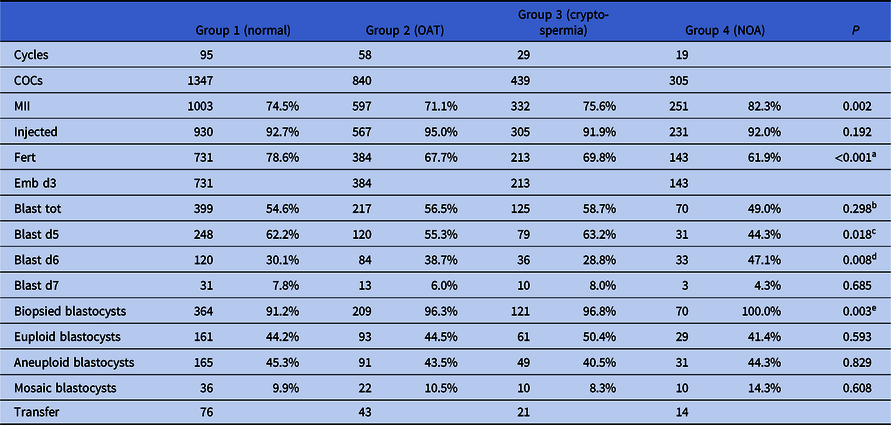
In total, 201 ICSI cycles were taken into account. Group 1 included 95 cycles: 930 mature eggs were injected forming 731 embryos (78.6% fertilization rate); 399 embryos reached the blastocyst stage (54.6% blastocyst formation rate) of which 364 underwent trophectoderm biopsy: 161 blastocysts were euploid (44.2%), 165 were aneuploid (45.3%) and 36 were genetic mosaic (9.9%).
Group 2 included 58 cycles: 567 mature eggs were injected forming 384 embryos (67.7% fertilization rate); 217 embryos reached blastocyst stage (56.5% blastocyst formation rate) of which 209 underwent to trophectoderm biopsy: 93 blastocyst were euploid (43.7%), 91 were aneuploid (43.5%) and 22 were genetic mosaic (10.5%).
Group 3 included 29 cycles: 305 mature eggs were injected forming 213 embryos (69.8% fertilization rate); 125 embryos reached blastocyst stage (58.7% blastocyst formation rate) of which 122 underwent trophectoderm biopsy: 61 blastocyst were euploid (50.4%), 49 were aneuploid (40.5%) and 10 were genetic mosaic (8.3%).
Group 4 included 19 cycles: 231 mature eggs were injected forming 143 embryos (61.9% fertilization rate); 70 embryos reached blastocyst stage (49.0% blastocyst formation rate); all blastocysts underwent trophectoderm biopsy: 29 blastocyst were euploid (41.4%), 31 were aneuploid (44.3%) and 10 were genetic mosaic (14.3%) (Table 1).
Comparison of general parameters obtained in the four groups

a Group 1 shows a strongly significant difference vs all the other groups while group 4 show a weekly statistical significant lower fertilization rates.
b Groups 3 and 4 show a weekly significant difference (P = 0.0823).
c Group 4 shows a statistical significant lower rate of blastulation in day 5 compared with all the other groups.
d Group 4 shows a statistical significant higher rate of blastulation in day 5 compared with all the other groups.
e Groups 1 and 4 show a strongly significant difference (P = 0.0051).
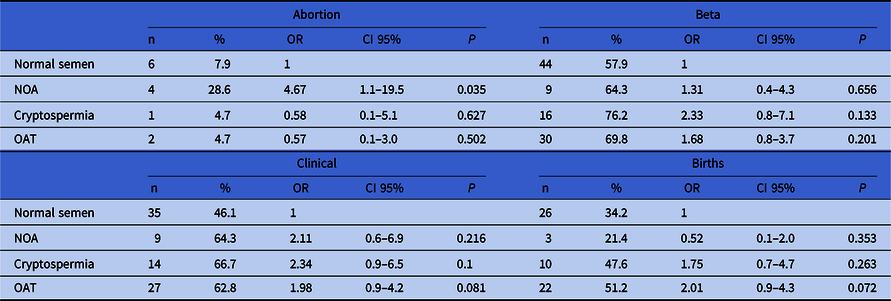
A comparison between blastocyst formation, euploidy, aneuploidy and mosaicism in the four groups showed no statistically significant difference while, as expected, an extremely statistically significant difference was found comparing fertilization rates among groups, showing a statistically lower fertilization rate in NOA patients compared with the others (Table 1). Interestingly, we found a statistically higher abortion rate when comparing NOA to normal semen with an odds ratio = 4.67 (Table 2). We did not find statistical differences in all other analyzed parameters, as shown in Tables 1 and 2.
Statistical analysis with OR of pregnancy rates and abortion rates

On the basis of the Coates et al. (Reference Coates, Hesla, Hurliman, Coate, Holmes, Matthews, Mounts, Turner, Thornhill and Griffin2015) work, we analyzed each chromosomal incidence in monosomy, complex aneuploidy and mosaicism without finding any statistical significant pattern (Tables S1–S4).
Discussion
Embryo aneuploidy is the most common cause of embryo implantation failure and early pregnancy loss (Simon et al., Reference Simon, Murphy, Shamsi, Liu, Emery, Aston, Hotaling and Carrell2014), it is mainly attributed to oocyte chromosomal abnormalities that can cause modifications in the assembly of meiotic spindle, leading to errors in both chromosome alignment and microtubule matrix, increasing frequency of chromosomal degeneration into unassociated chromatids or increasing rates of chromosomal nondisjunction (Holubcová et al., Reference Holubcová, Blayney, Elder and Schuh2015). These abnormalities increase with maternal age, causing an increased risk of chromosomal abnormality in the produced embryos. At this time, embryo genetic screening by different molecular techniques (qPCR, aCGH, NGS) at blastocyst stage is currently used to detect chromosome aneuploidies and to select the embryo for transfer. This technique can be particularly indicative to disclose the effect of the different sperm pathologies on blastocyst aneuploidies when it is adopted in young women, who should have a reduced effect of aneuploidies related to aged oocytes. In our study, we analyzed the relationship between semen quality, embryo development and ploidy. According to our data, there was no evidence of a different embryo development after ICSI based on sperm quality. By enrolling in the study patients without any known female factors and with a maternal age ≤38 years old, we conceivably selected only male factor cycles. Probably limiting female age is one of the reasons that led to these results. Simon et al. (Reference Simon, Proutski, Stevenson, Jennings, McManus, Lutton and Lewis2013) showed that implantation rates are significantly higher if the female age is ≤35 years old compared with older women in ICSI cycles performed with a highly fragmented sperm DNA (Coates et al., Reference Coates, Hesla, Hurliman, Coate, Holmes, Matthews, Mounts, Turner, Thornhill and Griffin2015).
In our study, we found a difference among the fertilization rates in the four groups, which is, as expected, significantly lower in the TESE group. Numerous studies, including the present work, supported the conclusion that poor sperm morphology on pre-IVF semen analysis using Kruger’s strict criteria does not correlate to either poor fertilization and/or pregnancy rates in ICSI cycles (Küpker et al., Reference Küpker, al-Hasani, Schulze, Kühnel, Schill, Felberbaum and Diedrich1995; Nagy et al., Reference Nagy, Liu, Joris, Verheyen, Tournaye, Camus, Derde, Devroey and Van Steirteghem1995; Svalander et al., Reference Svalander, Jakobsson, Forsberg, Bengtsson and Wikland1996; Lundin et al., Reference Lundin, Söderlund and Hamberger1997; McKenzie et al., Reference McKenzie, Kovanci, Amato, Cisneros, Lamb and Carson2004; Keegan et al., Reference Keegan, Barton, Sanchez, Berkeley, Krey and Grifo2007; MacLennan et al., Reference MacLennan, Crichton, Playfoot and Adams2015).
An unexpected finding was the absence of variation in the blastulation rates among the study groups, although blastocysts derived from sperm obtained from TESE seemed to have a slower development (there was a higher ratio of day-6 blastocysts in Group 4 compared with the others). Subfertile patient populations are known to possess in their spermatozoa significantly elevated levels of 8-hydroxy-2′-deoxyguanosine (8-OHdG), which is particularly mutagenic (De Iuliis et al., Reference De Iuliis, Thomson, Mitchell, Finnie, Koppers, Hedges, Nixon and Aitken2009; Aitken et al., Reference Aitken, De Iuliis, Finnie, Hedges and McLachlan2010; Lord and Aitkin, Reference Lord and Aitken2015). ICSI has been reported to increase the probability of spermatozoon harbouring mutagenic lesions that will achieve fertilization (Chabory et al., Reference Chabory, Damon, Lenoir, Kauselmann, Kern, Zevnik, Garrel, Saez, Cadet, Henry-Berger, Schoor, Gottwald, Habenicht, Drevet and Vernet2009). Conversely, zygotes can partially fix DNA damage (Lu et al., Reference Lu, Gao, Li, Zheng, Ye, Qian, Xu, Huang and Jin2012; Lane et al., Reference Lane, McPherson, Fullston, Spillane, Sandeman, Kang and Zander-Fox2014). This might explain why in younger women treated in our study there was no statistically significant difference in euploidy rate of the blastocysts obtained using spermatozoa from the four different sources. Our data correlated with those published by Lu et al. (Reference Lu, Gao, Li, Zheng, Ye, Qian, Xu, Huang and Jin2012), who did not find any difference in pregnancy rates analyzing 1925 ICSI cycles independently from the semen origin. Anyway, they found a difference in the embryo morphology that was partially correlated with the slower development found in our study in the testicular group. They divided the patients in seven groups based on the sperm quality or sperm source, finding a lower fertilization rate in extreme OAT or obstructive azoospermia patients, although without detecting differences in pregnancy rates, even if the average number of embryo transferred in the groups with a lower quality semen was statistically lower. It is interesting to underline that the mean female age in each group was lower than 32 years old, confirming that these outcomes could be related to the capacity of zygotes from young women to partially fix DNA damage, as previously hypothesized.
In contrast, Rodrigo et al. (Reference Rodrigo, Rubio, Peinado, Villamón, Al-Asmar, Remohí, Pellicer, Simón and Gil-Salom2011) reported a difference in pregnancy rates comparing embryo obtained using sperm from NOA or from OA patients and also noticed a higher rate of aneuploidy in the NOA group detected using the fluorescence in situ hybridization (FISH) technique on sperm. However, the sample size analyzed was low: 16, 19 and 10 patients were enrolled in OA, NOA and control groups, respectively. Coates et al. (Reference Coates, Hesla, Hurliman, Coate, Holmes, Matthews, Mounts, Turner, Thornhill and Griffin2015) analyzed 3835 embryos deriving from 629 couples, noticing a higher aneuploidy rate in embryos derived from ICSI oligozoospermia cycles compared with standard insemination or normal semen cycles. This difference however was not found in ICSI oligozoospermia cycles using donor eggs, probably because younger eggs have a higher repairing potential bypassing the semen problems. Tsai et al. (Reference Tsai, Huang, Lin, Kung, Lin and Lan2015) also found no difference when comparing pregnancy rates from NOA or OA patients and, interestingly, the patients enrolled in the study had a female mean age <33 years old.
In one of the few studies analyzing aneuploidy rates of ICSI versus standard insemination-derived embryos, Munné et al. (Reference Munné, Márquez, Reing, Garrisi and Alikani1998) found that ICSI embryos did not show an increase in aneuploidy rates compared with embryos created using standard insemination, unless the parents had a balanced chromosomal abnormality. However, in that report, embryos were biopsied on day 3 and analyzed using FISH for chromosomes X, Y, 13, 16, 18, and 21. Only a subset of the karyotype was therefore analyzed, and the use of FISH for determining aneuploidy in human embryos has come under considerable scrutiny due to its limitations for chromosomal screening of preimplantation embryos. Our results have been confirmed by Mazzilli et al. (Reference Mazzilli, Cimadomo, Vaiarelli, Capalbo, Dovere, Alviggi, Dusi, Foresta, Lombardo, Lenzi, Tournaye, Alviggi, Rienzi and Ubaldi2017) in both fertilization and aneuploidy rates. In their work the genetic health of 1219 blastocysts was analyzed divided in four groups by semen quality. Analogous to our study, they found no differences among the groups in gestational age, birth weight and congenital malformations. However, Mazzilli and collaborators did not define any inclusion criteria, consequently even for couples with female factors that had been enrolled in the study. Despite such differences, our data correlated with their results. Coates et al. (Reference Coates, Hesla, Hurliman, Coate, Holmes, Matthews, Mounts, Turner, Thornhill and Griffin2015) analyzed the incidence of chromosomal aneuploidy, finding that chromosomes 1, 2 and 11 were statistically significantly more involved in embryo aneuploidies in homologous ICSI cycles, whereas chromosome 18 was more frequently involved in heterologous ICSI cycles, probably because chromosome 18 alterations are borne by the egg whereas the others are borne by the sperm. They also speculated that chromosomal 18 alterations may be caused by an impaired segregation caused by sperm suboptimal quality.
We performed the same analysis, screening all the aneuploidies divided on the basis of the type of alteration (monosomies, trisomies and complex aneuploidies) without finding any statistical difference in the chromosome involved. This outcome could be once more related to the age of the woman. Anyway, we did not find any particular incidence on chromosome 18 other than that alteration is usually borne by women.
Despite the heterogeneity of available data in the literature, the large pool of patients analyzed by our centre were give strong hope of fathering for men who have an extremely low semen quality or even to those who will undergo a testicular biopsy. Nevertheless, it is important to clarify that this outcome could be strictly linked to the female partner age, as oocyte quality seems to be the discriminating factor between success and failure. An interesting result is the higher abortion rate in NOA patients compared with other groups, considering that all the transfers in this study were made only by euploid blastocyst replacements. For this reason, the increased risk of miscarriage could be linked to a late paternal effect of which we are not yet aware.
Our present study is subject to a few limitations. This study had a retrospective approach therefore cannot be used to predict in any way the result of a cycle. Also, chromosomal analysis showed no statistically significant result, probably due to the low number of cycles observed; in fact to effectively analyze the aneuploidy rate on each chromosome a much bigger number of cycles is needed.
Supplementary material
To view supplementary material for this article, please visit https://doi.org/10.1017/S0967199422000119
Author contributions
RP played a central role in the embryologic laboratory procedures, and was involved in the study conception and design, data analysis and drafting the manuscript. MGM is the director of the laboratory, coordinated all the embryological laboratory procedures and was involved in the study conception and design, critical revision of the manuscript and final approval. FS played a central role in the embryologic laboratory procedures, especially in the treatment of testicular samples, data analysis and final approval. BD was involved in the study final review and data analysis. EG was involved in the study conception and design, in the critical revision of the manuscript, in stimulation protocols and final approval.
Funding
None.
Conflict of interest
The authors declare that they have no conflict of interest.