Nowadays, many dairy products are enriched with calcium (Ca), and such products are commonly consumed by people of all ages, irrespective of their health status. Nevertheless, Ca supplementation may have an adverse effect on the metabolism of other micronutrients; for example, it has been shown to inhibit iron (Fe) and zinc (Zn) absorption (Barton et al. Reference Barton, Conrad and Parmley1983; Wood & Zheng, Reference Wood and Zheng1997).
One of the first foods to be supplemented with Ca was cows' milk. Milk and other dairy products derived from cows are rich in Ca and interfere with the absorption of Fe from the diet (Jackson & Lee, Reference Jackson and Lee1992). However, recent studies have found that when goats' milk is incorporated into the diet of rats, it produces a greater nutritive use of Fe (Barrionuevo et al. Reference Barrionuevo, Alférez, López-Aliaga, Sanz Sampelayo and Campos2002) and minimizes the possible interactions of Fe with other minerals such as Ca, P and Mg, in comparison with animals fed with cows' milk (López Aliaga et al. Reference López Aliaga, Alférez, Barrionuevo, Lisbona and Campos2000).
Fe deficiency anaemia is particularly prevalent in developing countries (Viteri, Reference Viteri1993) and is considered one of the major public health problems in the world and the most common nutritional deficiency. In a previous paper (Alférez et al. Reference Alférez, López-Aliaga, Nestares, Díaz-Castro, Barrionuevo, Ros and Campos2006) we investigated, in rats with induced Fe-deficiency anaemia (NFA), the effects of the diets used in present study (standard and cows' or goats' milk based diets) but with normal Ca content, on nutritive utilization of Fe. We demonstrated that goats' milk diet improves Fe bioavailability in both the control and anaemic rats, increasing Fe deposits in target organs and favouring the recovery of haematological parameters after NFA.
The experimental groups from above paper (control or anaemic rats fed normal Ca-diets; Alférez et al. Reference Alférez, López-Aliaga, Nestares, Díaz-Castro, Barrionuevo, Ros and Campos2006) are the appropriate controls for the groups of the present manuscript (control or anaemic rats fed Ca-enriched diets). At present no information is available on the influence of goat or cow milks enriched in Ca on the metabolism of Fe in a state of NFA, and it is the aim of the present paper.
To assess Fe status, the digestive and metabolic use of Fe was determined, together with its distribution in the spleen, liver, sternum and femur. Additionally, we measured different haematological parameters related to Fe metabolism.
Materials and Methods
Animals
Male Wistar albino breed rats (n=60) recently weaned, aged about 3 weeks, purchased from the University of Granada Laboratory Animal Service, were used for this study. Animal care procedures and experimental protocols were approved by the Ethics Committee of the University of Granada in accordance with the international guidelines.
Model of nutritional ferropenic anaemia
Dietary Fe deficiency was induced by a technique developed previously by us (Pallarés et al. Reference Pallarés, Lisbona, López-Aliaga, Barrionuevo, Alférez and Campos1993). After receiving the low-Fe diet for 40 d, the rats were anaemic and their haematological parameters were consistent with Fe-deficiency-induced anaemia in rats (Table 4).
Diets
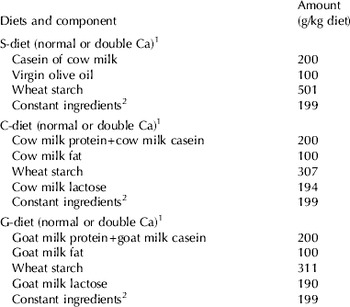
Table 1 summarizes the different diets assayed. The diets and mineral and vitamin supplements provided during experimental period (EP) were prepared according to the AIN93-G recommendations (Reeves et al. Reference Reeves, Nielsen and Fahey1993), except for the source (olive oil instead of soybean oil) and level of fat (100 g/kg rather than 70 g/kg). The milk-based diets were made with cows' or goats' milk lyophilisate (C- and G-diets, respectively). The necessary quantities of lyophilisate were taken to obtain diets with a 10% fat content. To obtain a protein content of 20% the diets were supplemented with casein, 124 g bovine casein/kg of C-diet and 145 g caprine casein/kg of G-diet, as the protein provided by the lyophilisate used for the milk-based diets was insufficient.
Composition of the experimental diets

1 The Fe and Ca content (mg/kg) in the diets after analysis was as follows: normal-Ca diet: Fe: 46·09 (S), 44·71 (C), 44·14 (G); Ca: 5400 (S), 5650 (C), 5200 (G) (Alférez et al. Reference Alférez, López-Aliaga, Nestares, Díaz-Castro, Barrionuevo, Ros and Campos2006) and double-Ca diet: Fe: 44·00 (S), 44·70 (C), 46·00 (G); Ca: 9720 (S), 10958 (C), 10436 (G). All diets were made isocaloric (17226 kJ/kg diet)
2 The constant ingredients consisted of (g/kg diet): fibre (micronized cellulose) 50, sucrose 100, choline chloride 2·5, L-cystine 1·8, mineral premix 35, vitamin premix 10. The vitamin premix were prepared according to the recommendations of the AIN (1993), but the differences in the vitamin content of the milk-based diets are given by the vitamin supplied for the lyophilized milks. The mineral premix were prepared according to the recommendations of the AIN (1993) for standard diet and mineral specific supplements for C- and G-diets were formulated taking into account the mineral content of the lyophilized milks supplied in order to meet these recommendations
Experimental design
The control (non-anaemic rats, fed with normal-Fe content diet; 45 mg/kg diet) and anaemic groups (rats fed with low-Fe content diet; 5 mg/kg diet for 40 d to induce NFA) were further divided into six sub-groups, which were fed for 14 d with three different types of diet (S-, C- and G-diets; Table 1), containing either normal Fe content (45 mg/kg diet) and double the requirements for Ca content (10 000 mg/kg diet), or containing normal Fe and Ca content. The latter are the appropriate controls for the present investigation and the data was reported previously by us in a parallel study focussed on normal Ca content diets (Alférez et al. Reference Alférez, López-Aliaga, Nestares, Díaz-Castro, Barrionuevo, Ros and Campos2006). From the start of the study, the animals were housed in individual, ventilated, thermoregulated cages (22±2°C) with a 12 h light-dark period, and diet and mineral-free water was available ad libitum to all rats. During the EP food intake was measured and urine and faeces were collected daily. Body weight was recorded at the beginning and end of EP. On d 14 EP, the rats were fasted overnight and then anaesthetized by intraperitoneal injection of 5 mg sodium pentobarbital/100 g body weight (Sigma Chemical Co, St Louis, MI, USA). After median laparotomy, the rats were totally bled by cannulation of the abdominal aorta and aliquots were analysed to measure RBC, MCV, haematocrit, platelets and Hb concentration. The remaining blood was centrifuged at 1500 g for 15 min at 4°C to separate the cells from the serum and for subsequent analysis of serum Fe, serum ferritin, transferrin saturation and TIBC. The spleen, liver, sternum and both femurs were removed, frozen immediately in liquid nitrogen and then stored at −20°C for later Fe analysis.
Biological indices
The following indices were calculated from the data on Fe intake and fecal and urinary Fe excretion: apparent digestibility coefficient (ADC)=(intake−fecal excretion)×100/intake; balance=(intake−fecal excretion)−urinary excretion; R/I (%)=balance×100/intake.
Analytical methods
Water contents of diet, faeces, liver, sternum, femur and spleen were determined by drying the materials at 105±2°C until constant weight. The concentration of Fe in the diets, faeces, urine and organs were determined by atomic absorption spectrophotometry (Perkin-Elmer 1100B, Norwalk, CT, USA). The samples had been previously mineralized by a sand bath wet method (JR Selecta, Barcelona, Spain). The nitrogen content in the lyophilisates and diets was determined by the Kjeldahl method, using a protein conversion factor of 6·25 for casein and 6·38 for lyophilisates. The fat content in the lyophilisates and diets was determined by Sanderson's technique (Sanderson, Reference Sanderson, Haresing and Cole1986). RBC, haematocrit, platelets and Hb, in heparinized blood samples, were measured using an automated haematology analyzer (Sysmex KX-21, Tokyo, Japan). Serum ferritin concentration was determined using the Chiron Diagnostics ACS:180® Automated Chemiluminescence System (Chiron Diagnostics Corporation, Norwood, MA, USA). To calculate the rate of transferrin saturation, TIBC and serum Fe levels were determined colorimetrically and enzymatically, using Sigma Diagnostics Iron and Total Iron-Binding Capacity reagents (Sigma Diagnostics, St. Louis, MI, USA). The rate of transferrin saturation was subsequently calculated using the following equation: transferrin saturation (%)=serum Fe concentration [μg/l]/TIBC [μg/l]×100.
Quality control
This consisted of analysing a lyophilized bovine liver (certified reference material BCR 185; Community Bureau of References, Brussels, Belgium), which yielded a Fe value of 210±6 mg/kg (mean±sem values of five determinations) (certified value: Fe, 214±5 mg/kg).
Statistical analysis
Data are reported as means±sem. Differences between groups (control vs. anaemic and normal-Ca vs. double-Ca) were tested for statistical significance with the Student's t test. One-way analysis of the variance was used to compare the different diets supplied to the two groups of animals (control and anaemic) during EP. Individual means were tested by pair-wise comparison using Tukey's multiple comparison test when main effects and interactions were significant. Differences were considered significant at P<0·05. All statistical analyses were carried out using the SPSS computer program (SPSS, version 14.0, 2006; SPSS Inc., Chicago, IL, USA).
Results and Discussion
Digestive and metabolic utilization of Fe
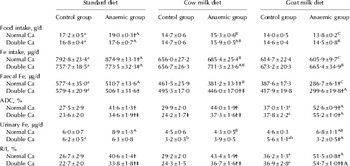
In general, Fe intake was not affected by dietary Ca supplementation under the different experimental conditions. The ADC of Fe was higher in anaemic rats than in their controls, regardless of the type of diet consumed (Table 2). This reveals that there is a greater avidity for Fe among anaemic rats, which might be because ferropenic anaemia increases the intestinal divalent metal transporter (DMT1) (Yeh et al. Reference Yeh, Yeh, Watkins, Rodríguez-Paris and Glass2000) and ferroportin expression (Morgan & Oates, Reference Morgan and Oates2002). These receptors are affected by non-heme Fe absorption and thus they increase Fe absorption (Forellat et al. Reference Forellat, Gautier and Fernandez2000).
Digestive and metabolic utilization of Fe in control and anaemic rats fed different diets either normal (normal-Ca diet results are from Alférez et al. (Reference Alférez, López-Aliaga, Nestares, Díaz-Castro, Barrionuevo, Ros and Campos2006) ) or double-Ca content
Values are means±sem for n=10

† Mean values were significantly different from the corresponding group of control animals by Student's t test
‡ Mean values were significantly different from the corresponding group of animals fed normal-Ca diet by Student's t test
a,b,c Mean values among groups of control animals in a row with superscript without a common letter differ (P<0·05) by one-way ANOVA (Tukey's test)
A,B,C Mean values among groups of anaemic animals in a row with superscript without a common letter differ (P<0·05) by one-way ANOVA (Tukey's test)
Several short-term studies have shown that the concurrent ingestion of Ca and Fe from the same meal inhibits Fe absorption (Wienk et al. Reference Wienk, Marx, Lemmens, Brink, Van der Meer and Beynen1996). However, long-term studies of Ca supplementation have not reported a consequent decrease in Fe status (Molgaard et al. Reference Molgaard, Koestel and Michaelsen2005). Our results show that the consumption of diets containing high levels of Ca for 14 d has no adverse effects on non-heme Fe absorption in control rats (Table 2), these results being in agreement with those reported by other authors (Grinder-Pedersen et al. Reference Grinder-Pedersen, Bukhave, Jensen, Hejgaard and Hansen2004) except in the case of the double-Ca C-diet, in which there was a significant fall in Fe ADC in comparison with a normal-Ca C-diet, as was also found by Minihane & Fairweather-Tait (Reference Minihane and Fairweather-Tait1998). Moreover, in rats with NFA fed the double-Ca S- or C-diets, the ADC of Fe decreased in comparison with normal-Ca S- or C-diets (Table 2). Wienk et al. (Reference Wienk, Marx and Beynen1999) described the mechanism of an inhibitory effect of high CaCO3 intake on Fe bioavailability in anaemic rats. The CaCO3 induced decrease in Fe transfer through the mucosal cytoplasm and/or basolateral membrane may have been responsible for the concurrent decrease in Fe bioavailability.
However, in NFA rats, double-Ca supplementation had no influence on ADC Fe when the G-diet was provided (Table 2). This could be due to the exceptional characteristics of this kind of milk (López Aliaga et al. Reference López Aliaga, Alférez, Barrionuevo, Lisbona and Campos2000; Alférez et al. Reference Alférez, López-Aliaga, Nestares, Díaz-Castro, Barrionuevo, Ros and Campos2006), which minimizes Ca-Fe interactions even when the amount of Ca in the diet is double the daily requirements of the rat. In addition, in the control and anaemic rats fed the double-Ca G-diet, the Fe ADC was higher than in those fed the S- or C-diets, both normal-Ca or double-Ca.
The Fe balance, expressed as the R/I ratio, was also greater in the anaemic rats than in their controls, for the three Ca-enriched diets studied (Table 2) and for normal-Ca diets (Alférez et al. Reference Alférez, López-Aliaga, Nestares, Díaz-Castro, Barrionuevo, Ros and Campos2006; Table 2). The type of diet supplied influenced Fe retention; both control and anaemic rats given G-diet, had a higher level of Fe retention, especially in the Fe-deficient rats compared with those consuming S- or C-diets. Moreover, the increase of Ca in the diet (in comparison with a normal-Ca diet) did not affect Fe retention in the control rats. Although in anaemic rats, fed the S- and C-diets, Fe retention decreased. However, in anaemic rats fed the G-diet, Ca supplementation actually caused a significant increase in R/I (Table 2).
The greater nutritive utilization of Fe found with G-diet, could be due to various nutritional factors; for example, the fat quality is different in the three diets; goats' milk fat is richer in medium chain triglycerides (MCT) than the fat obtained from cows' milk, 36 vs. 21%, (Alférez et al. Reference Alférez, Barrionuevo, López-Aliaga, Sanz-Sampelayo, Lisbona and Campos2001) the olive oil used in standard diet contains 0%. The MCT in the diet are rapidly absorbed and metabolized to obtain energy (García-Unciti, Reference García Unciti1996) and so could contribute to increase the synthesis of carrier proteins and thus the Fe absorption.
Numerous dietary components, present in greater quantities in G-diet than in C-diet (Alférez et al. Reference Alférez, López-Aliaga, Nestares, Díaz-Castro, Barrionuevo, Ros and Campos2006), are capable of reducing Fe (III) to Fe (II), including ascorbic acid (Wienk et al. Reference Wienk, Marx and Beynen1999), and amino acids such as lysine (Van Campen, Reference Van Campen1973) and cysteine (Glahn & Van Campen, Reference Glahn and Van Campen1997).
In addition, goat milk has almost twice the vitamin A content than cow milk (Alférez et al. Reference Alférez, López-Aliaga, Nestares, Díaz-Castro, Barrionuevo, Ros and Campos2006), vitamin that may mobilize available Fe stores and use them to form haemoglobin (Bloem, Reference Bloem1995). On the other hand, the β-carotene improves Fe uptake and overcomes the inhibition by potent inhibitors of Fe absorption (García-Casal et al. Reference García-Casal, Leets and Layrisse2000).
Goats' milk also has higher vitamin D content than cows' milk (Alférez et al. Reference Alférez, López-Aliaga, Nestares, Díaz-Castro, Barrionuevo, Ros and Campos2006), promoter of the active component in the absorptive process of Fe which has been reported previously by us (Gómez-Ayala et al. Reference Gomez-Ayala, Lisbona, López-Aliaga, Pallarés, Barrionuevo, Hartiti, Rodríguez-Matas and Campos1998).
Fe concentrations in organs
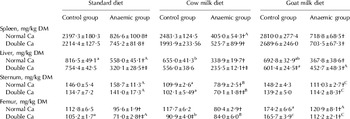
In general, in all the organs studied (spleen, liver, sternum and femur), Fe concentrations were lower in the anaemic rats than in their controls for the three Ca-enriched diets assayed (Table 3) in spite of the higher Fe R/I ratio observed in anaemic rats in all the experiments carried out. If the EP had been longer than 14 d, more deposition at the level of organs would probably have been found. Liver and, to a lesser extent, spleen Fe concentrations are routinely used as indicators of body Fe status in rats (Whittaker et al. Reference Whittaker, Hines, Robl and Dunkel1996). The marked decreases in Fe concentration in the liver and the spleen, as reported in this paper, are suggestive of the depletion of Fe storage in anaemic rats. Under our experimental conditions in control and anaemic rats, the highest Fe content was found in the spleen and liver, followed by other organs such as the sternum and the femur. Dietary Ca supplementation had no significant effect on Fe content in the different organs studied, in either control or anaemic rats, for the animals given the G-diet whereas for the S- and C-diets, in general Fe deposits were lower. This is in agreement with the better Fe R/I ratio achieved with the G diet in the current study.
Fe concentrations in several organs in control and anaemic rats fed different diets either normal (normal-Ca diet results are from Alférez et al. (Reference Alférez, López-Aliaga, Nestares, Díaz-Castro, Barrionuevo, Ros and Campos2006) or double-Ca content
Values are means±SEM for n=10

† Mean values were significantly different from the corresponding group of control animals by Student's t test
‡ Mean values were significantly different from the corresponding group of animals fed normal-Ca diet by Student's t test
a,b,c Mean values among groups of control animals in a row with superscript without a common letter differ (P<0·05) by one-way ANOVA (Tukey's test)
A,B,C Mean values among groups of anaemic animals in a row with superscript without a common letter differ (P<0·05) by one-way ANOVA (Tukey's test)
Haematological parameters
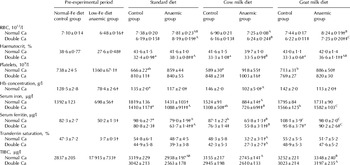
Comparing the Ca-enriched diets with normal-Ca diets, the rats fed C-diet Hb concentration was lower, whereas this effect was not observed for the G- and S-diets. This shows that in a situation of NFA, goat milk supplemented with Ca does not interfere with the recovery of the Fe status.
Fe-deficient rats with respect top their controls, both fed with double-Ca, showed higher values of RBC and haematocrit, for S- and G-diets, but this fact was not observed with the C-diet. Haematocrit was lower in the anaemic rats given double-Ca diet, compared with the normal-Ca diet for S-, G- and C-diets and in anaemic rats, platelet count was similar to those of the control rats for S- and G-diets, but in the rats given C-diet, platelet levels were higher than in their controls (Table 4). These results might mean there is a lesser recovery from anaemia, among the rats given C-diet, because previous studies reported by us (Campos et al. Reference Campos, Barrionuevo, Alférez, Gómez-Ayala, Rodriguez-Matas, López-Aliaga and Lisbona1998) showed that platelet levels reflects the Fe status. In control rats Ca supplementation increased platelet levels for S- and C-diets, whereas this difference was not observed in rats fed with G-diet. This latter result it is noteworthy, because it reflects what takes place in the nutritive utilization of Fe and confirms the interaction between Ca and Fe, which is minimized when G-diet is supplied. However, in anaemic rats platelet levels were not affected by the Ca supplementation in the diet, probably as a consequence of the Fe metabolism being unbalanced (Pallarés et al. Reference Pallarés, Lisbona, López-Aliaga, Barrionuevo, Alférez and Campos1993; Viteri, Reference Viteri1993).
Haematological parameters in control and anaemic rats fed different diets either normal (normal-Ca diet results are from Alférez et al (Reference Alférez, López-Aliaga, Nestares, Díaz-Castro, Barrionuevo, Ros and Campos2006) or double-Ca contentFootnote 1
Values are means±SEM for n=10

† Mean values were significantly different from the corresponding group of control animals by Student's t test
‡ Mean values were significantly different from the corresponding group of animals fed normal-Ca diet by Student's t test
a,b,c Mean values among groups of control animals in a row with superscript without a common letter differ (P<0·05) by one-way ANOVA (Tukey's test)
A,B,C Mean values among groups of anaemic animals in a row with superscript without a common letter differ (P<0·05) by one-way ANOVA (Tukey's test)
In anaemic rats, Ca supplementation did not affect serum Fe values when G-diet was supplied, whereas with S- and C-diets serum Fe values decreased (Table 4). It could be due to the fact that dietary goats' milk improves the nutritive utilization of Fe and minimizes interference with Ca (Barrionuevo et al. Reference Barrionuevo, Alférez, López-Aliaga, Sanz Sampelayo and Campos2002).
Ca supplementation decreased serum ferritin levels in both the control and the anaemic rats fed S-diet and C-diet, and to a lesser extent for G-diet (Table 4). This fact reveals that the goat milk in the diet not only improves body Fe stores in anaemic rats but even did so when the amount of Ca was double the daily requirements for this species.
After consumption of the normal or Ca-enriched diets, serum transferrin remained low in anaemic rats fed C-diet, while no differences were observed between the anaemic rats and their controls with S- and G-diets (Table 4). This shows that dietary cow milk does not aid recovery from anaemia, as levels of this haematological parameter remain low.
TIBC was lower in the control than in the anaemic rats (Table 3). After consuming normal or Ca-enriched diets, in anaemic rats TIBC approached the values presented by the control animals for the three diets assayed. Ca enrichment in the diet did not affect the TIBC in the different experimental groups (Table 4).
We would like to thank to President-Lactalis Industry, Lugo, Spain, for providing the dairy products. This study was supported by CICYT Project No. AGL-2000-1501 and University of Granada and Ministry of Education research grants to T.N. and J.D.C. We are thankful to International Dairy Journal (Elsevier Publishers) for allowing reproduction of previous data from Alférez et al. (Reference Alférez, López-Aliaga, Nestares, Díaz-Castro, Barrionuevo, Ros and Campos2006).