Most people in the world today use more than one language in the course of daily life, and the acquisition and dynamic interaction of multiple languages are being intensely studied within the domain of psycholinguistics (Kroll and De Groot, Reference Kroll and De Groot2005). Alongside this work, there is growing interest in the possibility that bilingualism might exert its influence beyond the language system, and have implications for cognition more generally (for a recent review, see Bialystok, Reference Bialystok2009). Evidence for extralinguistic differences in the cognitive function of monolinguals and bilinguals can illuminate the degree to which language production and comprehension rely on domain-general cognitive skills (O'Grady, Reference O'Grady2005). Specifically, the current paper focuses on the possibility that lifelong bilingualism can produce basic changes in executive control.
Recent studies of young children have provided evidence for robust bilingual advantages in the development of executive control (Bialystok and Martin, Reference Bialystok and Martin2004; Bialystok and Shapero, Reference Bialystok and Shapero2005; Carlson and Meltzoff, Reference Carlson and Meltzoff2008; Martin-Rhee and Bialystok, Reference Martin-Rhee and Bialystok2008). There is also evidence that bilingualism can protect against the age-related decline of executive function in older adults (Bialystok, Craik, Klein and Viswanathan, Reference Bialystok, Craik, Klein and Viswanathan2004; Bialystok, Craik and Ryan, Reference Bialystok, Craik and Ryan2006; Bialystok, Craik and Luk, Reference Bialystok, Craik and Luk2008). However, the findings regarding young college-age populations have been mixed, with some studies showing bilingual advantages and others documenting comparable performance for bilinguals and monolinguals (Bialystok et al., Reference Bialystok, Craik and Luk2008; Bialystok, Martin and Viswanathan, Reference Bialystok, Martin and Viswanathan2005; Costa, Hernández and Sebastián-Gallés, Reference Costa, Hernández and Sebastián-Galles2008; Colzato et al., Reference Colzato, Bajo, Wildenberg, Paolieri, Nieuwenhuis, La Heij and Hommel2008). One explanation offered is that this age group is at peak performance in terms of its ability to exercise executive control, and therefore ceiling effects might impede the detection of group differences (Bialystok, Reference Bialystok2006; Costa et al., Reference Costa, Hernández and Sebastián-Galles2008).
The bilingual advantage in executive control is assumed to stem from bilinguals’ constant need to manage and monitor their two languages. There is abundant evidence that, perhaps counter-intuitively, both languages of bilingual speakers are constantly active (van Heuven, Schriefers, Dijkstra and Hagoort, Reference van Heuven, Schriefers, Dijkstra and Hagoort2008). Thus, it seems that the intention to speak in one language is not sufficient to suppress all activation of the other language (for a recent review see Costa, Reference Costa, Kroll and Groot2005; and for a different perspective see La Heij, Reference La Heij, Kroll and Groot2005). This might be especially true in non-balanced bilinguals speaking in the second language (L2; Kroll, Bobb and Wodniecka, Reference Kroll, Bobb and Wodniecka2006), but is not limited to this population. Similarly, lexical candidates become activated in both languages, even in a monolingual setting, for both auditory (Spivey and Marian, Reference Spivey and Marian1999) and visual word recognition (for a recent review see Dijkstra, Reference Dijkstra, Kroll and Groot2005). The need for executive control is arguably greater in the case of language production, as it calls for managing active competition.
Recent research has demonstrated, however, that executive control is not a unitary construct, and can be decomposed into several functions. Miyake et al. (Reference Miyake, Friedman, Emerson, Witzki, Howerter and Wager2000) identify three separate, but correlated, executive functions: updating of working memory, inhibition of distractors or responses, and shifting between mental sets (see also Friedman, Miyake, Corley, Young, DeFries and Hewitt, Reference Friedman, Miyake, Corley, Young, DeFries and Hewitt2006). The tasks used to date to explore the impact of bilingualism on executive functions – including the Simon, anti-saccade, stop-signal and flanker tasks – fall mostly into the category of inhibition (for further distinctions regarding types of inhibition, see Friedman and Miyake, Reference Friedman and Miyake2004), rather than controlled shifting of mental sets. However, during language production, bilingualism places particularly high demands on shifting abilities, as speakers have to decide, at least in certain circumstances, when and how to switch back and forth between their two languages. Thus, it is important to measure the possible effects of bilingualism on experimental paradigms that require executive shifting. The current study set out to investigate the possibility that lifelong bilingualism could lead to advantages in the ability to shift efficiently between mental sets.
Two studies conducted with children provide supporting evidence for bilingual advantages in the ability to shift mental set. Bialystok and Martin (Reference Bialystok and Martin2004; see also Martin-Rhee and Bialystok, Reference Martin-Rhee and Bialystok2008) found that bilingual preschoolers successfully performed the dimensional change card sort task (DCCS; Zelazo, Resnick and Pinon, Reference Zelazo, Resnick and Pinon1995) at an earlier age than their monolingual peers. This task requires children to shift from sorting based on one dimension (color) to sorting based on a second dimension (shape), through activation of the new criterion and inhibition of the previous sorting principle. Along the same lines, Bialystok and Shapero (Reference Bialystok and Shapero2005) demonstrated an advantage in bilingual children's ability to identify alternative images in reversible figures when compared with monolinguals. Further, performance on the reversible figure task was correlated with performance on the DCCS task, suggesting that both rely on similar control mechanisms. Both of these experimental tasks rely, to some extent, on the inhibition of perceptual interference. However, both tasks also require subjects to shift between mental sets or tasks.
One highly relevant study (Bialystok, Craik and Ruocco, Reference Bialystok, Craik and Ruocco2006) examined a similar issue with older and younger adults, using a dual-task paradigm. The results showed a bilingual advantage in performing the classification of visual images during concurrent classification of auditory information. There were two possible classification schemes – stimuli were classified as letters or numbers in one scheme and as animals or instruments in the other. The concurrent visual and auditory tasks relied on the same classification scheme in some experimental conditions, and in other cases a different classification scheme was assigned to each modality. The results demonstrate a bilingual advantage only in the visual classification of numbers and letters, which was the easier of the two tasks. Further, for this task, the advantage was stable both when the auditory task used the same classification scheme and when it required classifying stimuli as animals or instruments. The authors concluded that the bilingual advantage stemmed from enhanced bilingual inhibitory control, and not from the ability to switch between tasks. The dual-task paradigm used in this study emphasized a comparison between dual-task and single-task performance, but did not measure the actual cost of switching between tasks, as opposed to the overall cost of monitoring two incoming streams of information and coordinating the simultaneous performance.
In the current study, we revisit this issue by examining college-aged bilinguals’ ability to switch between tasks, using a measure that allows a direct comparison of local switching costs with general mixing, or monitoring, costs. To this end, the stimuli used in the current task-switching paradigm are “bivalent”, in the sense that they afford two competing responses. Although the task to be executed is cued on every trial, efficient performance requires voluntary internal switching of task-set configurations. This situation is reminiscent of the conditions faced by bilinguals when they are required to name a picture or an object. In such cases there are typically two competing articulatory responses, which need to be resolved by control mechanisms for selecting the appropriate language (Green, Reference Green1998). In the task-switching paradigm, the task schema can be compared to the language selection, and competition needs to be resolved before an accurate response can be produced. The demands of language switching in bilingual speakers have many parallels with task switching, and both paradigms rely on the executive function of mental shifting (Miyake, Friedman, Emerson, Witzki, Howerter and Wager, Reference Miyake, Friedman, Emerson, Witzki, Howerter and Wager2000).
Language-switching costs are cited as evidence for the continuous activation of both languages in bilingual speakers, and the need to inhibit one language in order to allow output in the other (Meuter and Allport, Reference Meuter and Allport1999). Meuter and colleagues have demonstrated that, on a given trial, changing the language of response from the previous trial results in a slowed reaction, when compared with reaction times for trials in which there is no language change (Jackson, Swainson, Cunnington and Jackson, Reference Jackson, Swainson, Cunnington and Jackson2001; see Meuter, Reference Meuter, Kroll and De Groot2005, for a review). The interpretation given to these results is that switching between languages necessitates establishing the new language set and overcoming the language set inertia of the language used on the previous trial. These processes are very similar to the ones described in the general task-switching literature (Meiran, Chorev and Sapir, Reference Meiran, Chorev and Sapir2000; though see, e.g., Bryck and Mayr, Reference Bryck and Mayr2008, for an alternative account of switching costs).
Another similarity that can be drawn between the task-switching and language-switching domains involves the phenomenon of switching cost asymmetries. Specifically, switching from an easier (or dominant) to a more difficult task often results in smaller switching costs than switching from a difficult task to an easier one (Allport, Styles and Hsieh, Reference Allport, Styles, Hsieh, Umilta and Moscovitch1994; Allport and Wylie, Reference Allport, Wylie, Humphreys, Duncan and Treisman1999, Reference Allport, Wylie, Monsell and Driver2000; Rubinstein, Meyer and Evans, Reference Rubinstein, Meyer and Evans2001; see Yeung and Monsell, Reference Yeung and Monsell2003; and Monsell, Yeung and Azuma, Reference Monsell, Yeung and Azuma2000, for specific conditions that lead to switching asymmetries). In bilingual language-switching experiments, switching into the stronger, more proficient first language (L1) incurs a greater switching cost, a finding that might seem paradoxical at first glance, since overall performance in L1 is generally faster and more efficient (Meuter and Allport, Reference Meuter and Allport1999). According to the Inhibitory Control model of bilingual performance (Green, Reference Green1998), language task schemas control the linguistic output of bilinguals. These schemas are similar to the action schemas described by Norman and Shallice (Reference Norman, Shallice, Davidson, Schwartz and Shapiro1986; Shallice and Burgess, Reference Shallice, Burgess, Roberts, Robbins and Weiskrantz1996) for controlling behavior in general. The language task schemas either inhibit or activate the lemma nodes in the lexicon, which are tagged for language, in order to allow production in the desired language. Thus, naming a picture in L2 requires inhibiting the competing response in L1, as well as the task goal of speaking in L1, and unbalanced bilinguals must rely on strong inhibition of L1 in order to allow for production in the L2. When switching from a trial in which the L2 is used, and the L1 is inhibited, to a trial in which the L1 language schema is called upon, a large degree of inhibition must be overcome. Conversely, when producing in a highly dominant L1, unbalanced bilinguals need to inhibit L2 to a lesser degree, and therefore switching into producing in L2 on a consequent trial has a lower cost. Further support for this analysis comes from the fact that balanced bilinguals do not show the language-switching cost asymmetry between L1 and L2 (Costa and Santesteban, Reference Costa and Santesteban2004; but see Costa, Santesteban and Ivanova, Reference Costa, Santesteban and Ivanova2006, for an interpretation of these findings that does not rely on inhibitory control mechanisms).
Finally, there is also evidence that similar brain regions may support language switching and task switching. Several studies (Hernandez, Martinez and Kohnert, Reference Hernández, Martinez and Kohnert2000; Hernandez, Dapretto, Mazziotta and Bookheimer, Reference Hernández, Dapretto, Mazziotta and Bookheimer2001; Wang, Xue, Chen, Xue and Dong, Reference Wang, Xue, Chen, Xue and Dong2007) have found increased activation in dorsolateral prefrontal cortex, when comparing mixed-language with single-language blocks of naming. The involvement of prefrontal areas has also been identified in imaging studies of task switching, though activation correlating with different components of control during shifting attention has spanned lateral as well as medial prefrontal areas, with recent research focusing on the specific role of anterior cingulate areas in monitoring conflict and guiding control (Botvinick, Braver, Yeung, Ullsperger, Carter and Cohen, Reference Botvinick, Braver, Yeung, Ullsperger, Carter, Cohen and Posner2004; Dove, Pollmann, Schubert, Wiggins and von Cramon, Reference Dove, Pollmann, Schubert, Wiggins and Cramon2000; Wager, Jonides, Smith and Nichols, Reference Wager, Jonides, Smith and Nichols2005; Wager, Jonides and Smith, Reference Wager, Jonides and Smith2006). Further, a direct comparison of between-language switching and within-language register switching in a bilingual population demonstrated significant similarity in the spatio-temporal ERP signatures of the two processes, suggesting that they rely on partially shared neural substrates (Khateb, Abutalebi, Michel, Pegna, Lee-Jahnke and Annoni, Reference Khateb, Abutalebi, Michel, Pegna, Lee-Jahnke and Annoni2007). Along similar lines, Rodriguez-Fornells, van der Lugt, Rotte, Britti, Heinze and Munte (Reference Rodriguez-Fornells, Van Der Lugt, Rotte, Britti, Heinze and Munte2005) found evidence that bilinguals recruit brain areas not identified as language specific, i.e., the middle prefrontal cortex, for the purpose of controlling interference from the non-intended language. Finally, in a review of the literature, Abutalebi and Green (Reference Abutalebi and Green2007) argue convincingly for shared neural representations for the two languages of bilinguals, and more importantly in the present context, for the recruitment of general cognitive control mechanisms for the selection, inhibition and production of one language by bilinguals.
In light of these parallels, higher efficiency of bilinguals in task switching, when compared with monolinguals, would lend support to the idea that bilingual advantages in executive control extend beyond inhibitory control, as demonstrated in previous research. Further, because task-switching paradigms are notoriously difficult and incur large costs even for young high-performing participants (for a review, see Monsell, Reference Monsell2003), there is a reduced risk of encountering ceiling effects and a better chance of demonstrating group differences in performance.
Task-switching paradigms normally include two types of experimental blocks – single-task blocks, and mixed-task blocks. From this basic setup, two measures of executive control can be computed. Switching costs (also called specific or local switching costs) are defined as the difference in response time between switch and non-switch trials in the mixed-task blocks, and are thought to reflect the difficulty in switching from one task set to another. Mixing costs (also called general or global switching costs) are defined as the difference in performance between single-task blocks and non-switch trials in the mixed-task blocks. Mixing costs may reflect the activation of global sustained control mechanisms necessary for maintaining two competing task/response sets, for monitoring the task cued or for a process of task decision on each trial (Braver, Reynolds and Donaldson, Reference Braver, Reynolds and Donaldson2003; Koch, Prinz and Allport, Reference Koch, Prinz and Allport2005; Rubin and Meiran, Reference Rubin and Meiran2005). Conversely, switching costs have been described as arising from more transient control processes necessary for selecting the appropriate task, such as goal updating, or linking task cues with the appropriate response mappings, retrieved from long-term memory (Braver et al., Reference Braver, Reynolds and Donaldson2003; Mayr and Kliegl, Reference Mayr and Kliegl2000, Reference Mayr and Kliegl2003). It has also been suggested (Philipp, Kalinich, Koch and Schubotz, Reference Philipp, Kalinich, Koch and Schubotz2008) that while mixing costs reflect the need to resolve interference caused by the target on each and every trial, switching costs are additionally driven by proactive interference caused by the previous trial.
Task-switching paradigms can be implemented in a variety of ways: switches can be predictable or unpredictable, the time interval for preparing the task switch (cue–target SOA) can vary, the type of stimuli used can be bivalent or univalent, and the response mappings can also be bivalent or univalent. The specific implementation we chose is modeled on that described by Rubin and Meiran (Reference Rubin and Meiran2005). Specifically, from the various configurations described in that paper, we chose the conditions that would allow for both mixing costs and switching costs to emerge. We did not, however, include conditions that are aimed at investigating the influences of working memory load on task mixing and switching, for two reasons. First, the current study included a separate measure of working memory performance, to ensure that the two participant groups would be matched in this capacity. Second, the effect of bilingualism on executive function has not been ascribed to working memory advantages, and we did not wish to complicate the present design with additional factors.
The two tasks used in the current study were shape decision and color decision. To maximize mixing cost we used bivalent stimuli (red and green circles and triangles) that have dual affordances and thus lead to the bottom-up activation of both task sets on each trial in the mixed-task blocks (Rubin and Meiran, Reference Rubin and Meiran2005). Our decision to use cued task switching, rather than an alternating runs paradigm, was motivated both by findings that increased task uncertainty, which is 50% in our case, leads to increased mixing costs (Meiran, Hommel, Bibi and Lev, Reference Meiran, Hommel, Bibi and Lev2002), and by our desire to keep working memory load to a minimum. For the same reason, we chose to use non-overlapping response mappings, such that each task was mapped to one hand. A cued task-switching paradigm also allows the experimenter to easily control the duration of task preparation. Because long preparation times have been shown to dramatically reduce switching costs (Meiran, Reference Meiran1996; Meiran et al., Reference Meiran, Chorev and Sapir2000; Rogers and Monsell, Reference Rogers and Monsell1995) we chose a short cue–target interval of 250 ms to allow for robust switching costs.
Our predictions regarding the outcomes of the task-switching paradigm were as follows. We expected to find significant mixing costs and switching costs for both participant groups, and no difference was expected in the basic reaction times of the two groups in the single-task blocks. A bilingual advantage could take several forms, each one hinting at different underlying mechanisms. A reduced mixing cost for bilinguals as compared to monolinguals would link the bilingual advantage to more global control processes and the ability to resist distractor interference. Alternatively, a reduced switching cost for bilinguals would point towards the locus of the bilingual advantage as lying in more transient executive control mechanisms (Miyake et al., Reference Miyake, Friedman, Emerson, Witzki, Howerter and Wager2000), such as time-sensitive goal updating or resistance to proactive interference.
Finally, the monolingual and bilingual participants also completed several additional tasks, including a test of receptive vocabulary in English, a measure of working memory and a language history questionnaire, including information on SAT scores. These additional data were collected to ensure that the two groups were matched on various cognitive domains, so that any differences found could be attributed to the different language experience.
Method
Participants
Forty-five monolingual (32 female) and 47 bilingual (27 female) students enrolled in introductory psychology courses at Carnegie Mellon University participated in the study, for course credit or payment. One self-described monolingual was excluded because of early exposure to another language in the home. Two bilingual participants were eliminated because they had ceased using one of their languages completely. Data from one additional bilingual participant was discarded due to equipment failures, resulting in 44 participants in each experimental group.
Bilingual participants had learned English and another language before the age of six, and used both languages continuously ever since. Besides English, the bilingual participants spoke a variety of other languages, including Mandarin (13), Korean (11), Spanish (4), Russian (3), Cantonese (3) and one speaker each of Japanese, Hebrew, Italian, Bengali, Malay, Bosnian, Marathi, Hindi, French and Greek. Monolingual participants were native English speakers, and had not studied or been exposed to any other language before the age of twelve, though some had limited proficiency in a second language at the time of testing.
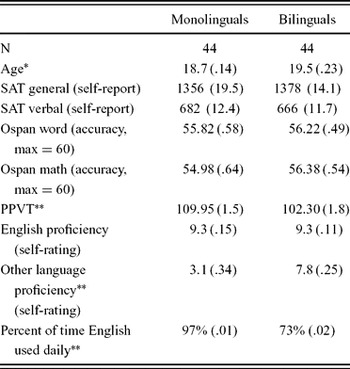
The background variables of both groups are detailed in Table 1. The mean ages for the two language groups were 18.7 years (SD = .9) for the monolinguals and 19.5 years (SD = 1.5) for the bilinguals. Overall self-reported SAT scores were taken as a measure of general cognitive ability, and there was no significant difference between monolinguals and bilinguals. We further administered the operation-span task, a measure of working memory capacity. There was no difference between the groups in their performance on either the verbal or the mathematical components of the task.
Monolingual and bilingual participant characteristics, mean (SEM).

Self-ratings are on a scale from 1 (not at all) to 10 (perfect command) and are averaged across oral and written comprehension and expression.
*Groups significantly different, p < .05.
**Groups significantly different, p < .001.
Two variables were used to tap the verbal ability of the participants: the verbal component of the SAT and the Peabody Picture Vocabulary Test (PPVT-IIIL; Dunn and Dunn, Reference Dunn and Dunn1997, a test of receptive vocabulary in English). Although there was no significant difference between the groups in the verbal portion of the SAT, the monolinguals did outperform the bilinguals on the PPVT-III [t(86) = 3.23, p < .001)]. Because previous findings have demonstrated relative deficiencies for bilinguals, when compared with monolinguals, on language tasks (e.g., Bialystok et al., Reference Bialystok, Craik and Luk2008), this finding is not surprising. Indeed, an attempt to create groups matched on vocabulary performance might have resulted in selective inclusion of bilinguals of higher ability, relative to the distribution of bilinguals, than monolinguals. Further, the task-switching paradigm performed in this experiment did not rely on verbal skills and indeed any finding of bilingual advantages would be operating in the face of their somewhat lower verbal performance in English.
Design and procedure
All participants completed the following tasks in a single experimental session that lasted approximately 90 minutes.Footnote 1 The tasks were presented in the same order to all participants.
Language history questionnaire. Participants completed questions regarding their language skills, proficiency, age of acquisition, immersion experience, daily use patterns and SAT scores (see Table 1 for participant characteristics).
Peabody Picture Vocabulary Test, PPVT-III. A receptive vocabulary test, in which the experimenter names a word in English, and the participant has to select the appropriate picture among an array of four possibilities. The test was administered to each participant individually by the experimenter. Raw scores were then standardized according to the participants’ age.
All computerized tasks were presented on a Sony Vaio desktop computer, with a 15-inch screen. Experimental scripts and data collection were managed by E-prime using a Serial Response Box (both by Psychological Software Tools Inc, Pittsburgh, PA), to assure accurate reaction time measurement. Participants were seated approximately 60 cm from the monitor.
Task switching paradigm. The procedure was adapted from Rubin and Meiran (Reference Rubin and Meiran2005). Each trial started with a fixation cross presented for 350 ms, followed by a 150 ms blank screen. The task cue then appeared on the screen for 250 ms, 2.8° above the fixation cross. To avoid using linguistic information, which might interact with the participants’ language experience, we decided to use graphic task cues. Thus, the cue for the color task was a color gradient and the cue for the shape task was a row of small black shapes (4.5° × 0.8°). The cue remained on the screen, and the target appeared in the center of the screen. Targets were red or green circles (2.8° × 2.8°) and triangles (2.3° × 2.3°). The cue and target remained on the screen until the participant responded, or for a maximum duration of 4 seconds. Incorrect responses were followed by a 100 ms beep. An 850 ms inter-trial blank screen interval was presented before the onset of the following trial.
Participants were instructed to perform one task (either shape or color, counterbalanced across participants) using the right hand, and the other task using the left hand. In each case, the “red” response was assigned to the index finger, and the “green” response was assigned to the middle finger. Similarly, the “circle” response was assigned to the index finger and the “triangle” response was assigned to the middle finger. This mapping of task to hand was preserved throughout the single-task and mixed-task blocks. The response keys for the color task were labeled with the appropriate colors, and the response keys for the shape task were labeled with the appropriate shape, in black.
Participants completed three parts of the experiment, comprising a sandwich design. In the first part, they performed two single-task blocks (color and shape, order counterbalanced across participants), each including 8 practice trials followed by 36 experimental trials. In the second part, participants performed 16 mixed-task practice trials, followed by 3 mixed-task blocks. Each mixed-task block included 48 trials, half of which were switch trials and half of which were non-switch trials, of both the color and shape tasks, randomly ordered with a maximum of 4 consecutive trials of the same type. Two additional dummy trials were added at the beginning of each block and were not included in the analysis. Finally, in the third part of the experiment, participants again performed two single-task blocks, presented in the opposite order from that used in the first part. The sandwich design enables a comparison of 72 switch trials, 72 non-switch trials, and 144 single-task trials (72 color and 72 shape).
Operation span task: This working memory task allowed us to compare monolingual and bilingual participants’ performance. The procedure was adapted from the Turner and Engle (Reference Turner and Engle1989) operations–word task. Participants solved mathematical expressions, while maintaining sets of English words in memory. In each trial, a fixation cross appeared in the middle of the screen for 1000 ms, followed by a single mathematical expression, which remained on the screen for 2500 ms, and was replaced by a question mark appearing for 1250 ms. While the question mark remained on the screen, participants had to push a button indicating whether the mathematical expression was correct or incorrect. Upon response, or time-out, the question mark was replaced with a word appearing for 1250 ms. Participants had to retain the words in memory until the end of the set, when a recall prompt appeared on the screen. At that point, participants wrote down in a booklet as many words as they recalled from that set, and pressed a button to initiate the following set. Sets ranged in size from two to six operation–word pairs per set, and were presented in ascending order, with three sets of each size, for a total of fifteen sets. Each set included approximately equal numbers of correct and incorrect mathematical expressions. Before completing the experimental sets, participants performed two practice sets (one with four items and one with six items).
Participants were encouraged to solve the math problems as quickly and accurately as possible, while remembering all the words from a given set. Participants received two scores for their performance on this task: a verbal score, namely the number of correctly recalled words (see Conway, Kane, Bunting, Hambrick, Wilhelm and Engle, Reference Conway, Kane, Bunting, Hambrick, Wilhelm and Engle2005, for considerations of scoring working memory span), and a mathematical score, namely the number of correctly classified mathematical expressions.
Results
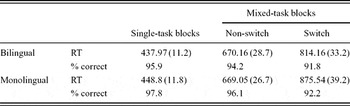
The results for both groups in the task switching paradigm are presented in Table 2.
Mean reaction time in milliseconds (SEM) and % correct for single task, non-switch and switch trials, by language group.

Switching costs
Switching costs are defined as the difference in performance on Switch trials as opposed to Non-Switch trials, within the mixed-task blocks. Switching costs in accuracy and RT were analyzed using a two-way repeated measures ANOVA, with language group as a between-participant factor (monolingual, bilingual) and trial type as a within-participant factor (switch trials, non-switch trials). The main effect of trial type was highly significant for both accuracy and RT [F(1,86) = 34.9, MSE = .11, p <.001; F(1,86) = 189.2, MSE = 1,356,263, p <.001, respectively], because non-switch trials received faster and more accurate responses than switch trials. The main effect of language group was not significant in either analysis [F(1,86) = 1.1, MSE = .03, p = .29; F < 1; for accuracy and RT, respectively). However, the interaction between trial type and language group was significant in the RT [F(1,86) = 6.0, MSE = 42,950, p <.05] but not the accuracy [F(1,86) = 1.1, MSE = .003, p = .33] analysis. As can be seen in Table 2, this interaction is driven by the fact that both language groups performed identically on non-switch trials, but bilinguals were much faster than monolinguals on the switch trials. Thus, bilinguals incurred a much lower switching cost than monolinguals. An additional analysis was carried out in which the switching cost was calculated individually for each participant, by subtracting their mean RT for non-switch trials from the mean RT for switch trails. When switching cost was compared across the two groups, the bilinguals again incurred smaller switching costs (M = 144 ms, SE = 16) than the monolinguals (M = 206 ms, SE = 20), [t(86) = 2.45, p <.05].
Finally, the bilinguals in the current sample used their non-English language on average only 27% of the time. Thus, they were less balanced in their patterns of daily language use than bilingual participants in previous studies, who approximated 50% usage of each language (Bialystok et al., Reference Bialystok, Craik and Luk2008; Costa et al., Reference Costa, Hernández and Sebastián-Galles2008). Further, participants who used English for a larger percentage of the time also tended to have higher scores on the PPVT-III score, the English vocabulary measure, though the correlation was only marginally significant (r = 0.25, p = .09). To explore whether the percentage of use might be related to the magnitude of the switching cost, we examined whether the two variables were correlated within the sample of our bilingual participants. However, we found no reliable relation between the percentage of the time the non-English language was used and the magnitude of the switching cost (r = .01, p >.9). Therefore, it seems that our findings hold across the range of proficiency and the degree of balance in language use that was represented in our sample (from 50% to 90%).
Mixing costs
Mixing costs were defined as the difference between the performance in the single-task blocks and the performance on non-switch trials of each task in the mixed-task blocks. As there was no significant difference between the color and shape tasks (F < 1), results are collapsed across the two tasks. Thus, mixing effects, for RT and accuracy, were analyzed using a two-way repeated measures ANOVA, with language group as a between-participant factor (monolingual, bilingual) and trial type as a within-participant factor (Single task trials, Non-Switch trials). The main effect of trial type was significant for both RT and Accuracy [F(1,86) = 251.5, MSE = 2251273, p <.001; F(1,86) = 8.4, MSE = .013, p<.01, respectively), because trials in the single-task blocks were performed more quickly and accurately than non-switch trials in the mixed-task blocks. However, there was no significant difference between the groups, and no interaction (all Fs < 1). In addition, we calculated a mixing cost for each participant, by subtracting performance on single-task trials from that on non-switch trials in mixed-task blocks. Again, we found no significant differences in the mixing costs of the two groups [bilinguals M = 304 ms, SE = 23; monolinguals M = 323 ms, SE = 23, t(86) = .57, p >.5].
This pattern demonstrates that both groups exhibited significant mixing costs, but there was no difference in the magnitude of the mixing costs between the groups. Thus, despite bilinguals having reduced switching costs, both groups were equally susceptible to the cognitive load imposed by the mixed-block trials.
Discussion
The present study investigated possible bilingual advantages in shifting between mental sets, by using a non-linguistic task-switching paradigm, and found a pronounced bilingual reduction in switching costs. Specifically, both participant groups performed similarly in single-task blocks and on the non-switch trials within mixed-task blocks, but bilinguals were significantly faster to correctly perform the new task on switch trials. Thus, bilinguals displayed greater facility at activating a task set in response to a cue, and took less time to overcome any residual interference or activation from the task performed on the previous trial (Meiran et al., Reference Meiran, Chorev and Sapir2000; Philipp et al., Reference Philipp, Kalinich, Koch and Schubotz2008).
Enhanced bilingual executive function has been ascribed to the constant need to select the appropriate language, a process which involves achieving a coordinated and resonant activation of the interrelated features of the chosen language (MacWhinney, Reference MacWhinney, Kroll and De Groot2005). Secondarily, it also involves the rejection of competition and interference from the other language. The present study demonstrated that lifelong practice with language switching can lead to specific bilingual advantages, by using a task-switching paradigm that measures switching per se, and directly targets the executive function of shifting (Miyake et al., Reference Miyake, Friedman, Emerson, Witzki, Howerter and Wager2000). The reduced bilingual switching cost lends support to accounts assigning the bilingual advantage to the successful navigation of two active language systems (Bialystok et al., Reference Bialystok, Craik, Klein and Viswanathan2004; Costa et al., Reference Costa, Hernández and Sebastián-Galles2008; Green, Reference Green1998).
The specific pattern of results found in the task-switching paradigm can contribute to a detailed understanding of bilingual executive advantage. Specifically, the bilingual advantage was limited to reduced switching costs, which arise from transient control processes for selecting between competing tasks, such as activating current task goals and reconfiguring stimulus–response mappings. Conversely, no group difference was found in mixing costs that have been related to more sustained control mechanisms, and the ability to resolve concurrent distractor interference (Braver et al., Reference Braver, Reynolds and Donaldson2003; Philipp et al., Reference Philipp, Kalinich, Koch and Schubotz2008).
Switching costs have also been described as reflecting proactive interference (Philipp et al., Reference Philipp, Kalinich, Koch and Schubotz2008), and thus the present results support enhanced bilingual efficiency in resistance to proactive interference, a subtype of inhibitory function (Miyake et al., Reference Miyake, Friedman, Emerson, Witzki, Howerter and Wager2000). This aligns with previous claims in the literature (Bialystok, Craik and Ryan, Reference Bialystok, Craik and Ryan2006; Costa et al., Reference Costa, Hernández and Sebastián-Galles2008), regarding a bilingual advantage in inhibitory control. Further, there is a moderate correlation between the shifting and inhibition executive functions (Miyake et al., Reference Miyake, Friedman, Emerson, Witzki, Howerter and Wager2000), raising the possibility that both might rely on a shared mechanism such as controlled attention.
The results of the current study are clear and can be interpreted directly by contrasting transient control processes, time-sensitive shifting of mental sets and resistance to proactive interference on the one hand, with more sustained control processes and resistance to distractor interference on the other hand (Friedman and Miyake, Reference Friedman and Miyake2004). Specifically, bilinguals in the current study showed advantages in the former, but not the latter, set of abilities. However, integrating the current findings with the wider literature on bilingual advantages is more difficult, largely because of the inconsistency with which these component processes have been measured. In particular, several studies (Bialystok, Craik and Ryan, Reference Bialystok, Craik and Ryan2006; Bialystok et al. Reference Bialystok, Craik, Klein and Viswanathan2004; Bialystok, Reference Bialystok2006; Bialystok and Viswanathan, Reference Bialystok and Viswanathan2004; Costa et al., Reference Costa, Hernández and Sebastián-Galles2008) have pointed to enhanced bilingual performance in experimental blocks with changing stimulus characteristics, findings that have been interpreted as reflecting a bilingual advantage in ongoing monitoring, which would be expected to parallel mixing costs in the present study. However, in all these studies, the performance in experimental blocks, conceptualized as similar to mixed blocks in the task-switching paradigm, was not compared to an appropriately controlled single-task block. Some experiments did not include such blocks (Bialystok, Reference Bialystok2006; Costa et al., Reference Costa, Hernández and Sebastián-Galles2008) and others included control blocks that presented different stimuli than those used in the experimental blocks, specifically limited to non-conflict displays (e.g. Bialystok, Craik and Ryan, Reference Bialystok, Craik and Ryan2006; Bialystok et al., Reference Bialystok, Craik, Klein and Viswanathan2004). Bialystok and Viswanathan (Reference Bialystok and Viswanathan2004) do report reduced mixing costs for bilinguals, by comparing mixed blocks with single-task blocks, but failed to find switching costs for all participant groups, leading to a difficulty in interpreting the results. Therefore, an account that ascribes bilingual advantages in the experimental blocks to reduced mixing costs cannot be preferred over accounts relying on reduced switching costs, or perhaps still other mechanisms.
Finally, Bialystok and colleagues (Bialystok et al., Reference Bialystok, Craik, Klein and Viswanathan2004; Bialystok, Craik and Ruocco, Reference Bialystok, Craik and Ruocco2006; Bialystok, Craik and Ryan, Reference Bialystok, Craik and Ryan2006; Bialystok et al., Reference Bialystok, Craik and Luk2008) have described aspects of cognitive executive function that deteriorate with aging, but are enhanced by bilingualism. Thus, it is interesting to compare the current study with the impact of aging on task-switching performance.Footnote 2 Several studies report increased mixing cost with aging, but no significant changes in switching cost (Kray and Lindenberger, Reference Kray and Lindenberger2000; Mayr, Reference Mayr2001; Reimers and Maylor, Reference Reimers and Maylor2005). Further, Viswanathan and Bialystok (Reference Viswanathan and Bialystok2007) examined younger and older monolinguals and bilinguals, and found reduced mixing costs for younger participants and for bilinguals. These findings seem incommensurate with the present patterns, which showed reduced bilingual switching costs, but comparable mixing costs across groups. However, age effects in mixing costs seem to emerge only with alternating runs task-switching paradigms (Kray and Lindenberger, Reference Kray and Lindenberger2000; Reimers and Maylor, Reference Reimers and Maylor2005), or when there is complete overlap in the response sets of the two tasks (Mayr, Reference Mayr2001; Viswanathan and Bialystok, Reference Viswanathan and Bialystok2007). Interestingly, a study by Kray, Li and Lindenberger (Reference Kray, Li and Lindenberger2002) implemented a task-switching paradigm that included a high percentage of unpredictable cued switches, similar to the current experiment. Under these conditions, older individuals incurred larger switching costs, but no age differences were found in mixing costs. Thus, if the effects of bilingualism on executive function are conceptualized as mirroring those of ageing, only in the opposite direction, the present results agree with previous findings using comparable designs.
In conclusion, the present study compared the performance of monolingual and lifelong bilingual young adults in a task-switching paradigm. We demonstrated a robust bilingual advantage in performance, suggesting that lifelong bilingualism may lead to enhanced efficiency in the executive function of shifting between mental sets. Specifically, the reduced switching costs found for bilinguals can be linked to the process of language switching that calls on general mechanisms of shifting, and utilizes overlapping neural resources. Further, we suggest that the increased bilingual efficiency in shifting might have contributed to some extent to previous findings of bilingual advantages linked to inhibitory function, especially in light of the correlation between these two executive functions. Future work on this important topic should investigate how the cognitive consequences of lifelong bilingualism are expressed through variations in executive function.