1. Introduction
The lack of antenatal care is commonly associated with premature delivery, infant and maternal mortality and postnatal complications (Magadi et al., Reference Magadi, Madise and Rodrigues2000; Rani et al., 2008; Say and Raine, Reference Say and Raine2007; Simkhada et al., 2008; Sepehri et al., 2008). However, there are very few studies that explore antenatal care in the countries of Caucasus and Central Asia (McKee et al., Reference McKee, Healy and Falkingham2002; Center for Disease Control and Prevention (CDC), 2003; Falkingham, Reference Falkingham2003, Reference Falkingham2004; Habibov and Fan, Reference Habibov and Fan2008; Fan and Habibov, Reference Fan and Habibov2009).
Against this background, we focus on Azerbaijan, a low-income transitional country.Footnote 1 There are several reasons why the determinants of antenatal care in this country should be in the focus of the urgent research efforts. First, Azerbaijan has the worst indicators of maternity care in the entire region. The comparative report by the US Center of Disease Control found that among countries of Eastern Europe, Caucasus and Central Asia, Azerbaijan has the highest infant mortality rates, the highest percentage of women who received no antenatal care during their recent pregnancies and the highest percentage of women of reproductive age with anemia (CDC, 2003). The report also found that the country has the lowest percentage in the region of women who have ever had a routine gynecologic exam or had any discussion of the topics related to sex.
Second, since the commencement of transitional processes between 1990 and 2002, life expectancy in Azerbaijan has decreased by 6 years, which is the most significant downturn in the world, except for the countries of sub-Saharan Africa that experience steeper downtrends as a result of the HIV/AIDS pandemic (World Bank, 2005a). In addition, the country is undergoing demographic transition caused by the declining population growth rate, the net emigration in the 1990s and a drop in fertility rates. Consequently, the population is aging and the dependency ratio (the proportion of the number of people aged 0–14 and 65 years and older to the number of people aged 15–64) is projected to increase.
Third, the previous studies on antenatal care in Azerbaijan are based on fairly outdated data (CDC, 2003). In comparison, this study uses the most recently available micro-data source – the high-quality Azerbaijan Demographic and Health Survey (AZDHS) of 2006. Using newly available data permits us to receive up-to-date results reflecting the current reality of the country. Another limitation of the previous studies is that they are based exclusively on bivariate cross-tabulation (CDC, 2003; State Statistical Committee of Azerbaijan (SSC), 2008). The limitation of a bivariate method is that it cannot control for the effect of other relevant variables and covariates, since this may cause a misleading interpretation of the results (Trivedi, Reference Trivedi2002). In comparison, this study employs a multivariate econometric framework by estimating several regression techniques that respect the discrete nature of the outcome variables related to antenatal care utilization.
Finally, the commitment to improve accessibility, affordability and quality is one of the key measures of healthcare sector reforms which the Azerbaijan government has identified as a priority in the State Program on Poverty Reduction and Economic Development and the State Programme of Economic Development of Regions (Government of Azerbaijan, 2003, 2004). Thus, the findings of this study are to contribute to the current government efforts to reform the healthcare sector by estimating the determinants of antenatal care utilization and providing specific suggestions to improve utilization in Azerbaijan.
The remainder of this paper is organized as follows. Section 2 provides a brief review of the healthcare system in Azerbaijan in transition. Section 3 discusses the data set, research questions, selection of dependent and independent variables and analytical strategy. Section 4 presents the findings and discusses them using the perspectives of the available literature on the topic. The last section concludes with policy and research implications.
2. Background
Antenatal health care in Azerbaijan is officially provided free through an extensive network of ambulatory polyclinic and maternity hospitals. The network is reported to the Ministry of Health, and is organized around geographical regions. The network is adequately staffed from a purely input perspective (World Bank, 2005a). For every 900 children below age 5 and for every 2200 women of the childbearing ages 15–44 years, the network has one maternal and child health clinic. Likewise, the network employs 3.6 physicians and 7.5 nurses per 1000 of population. The level is directly comparable with enumeration unit (EU-15) averages of 3.9 doctors and 7.0 of nurses per 1000 of population. However, the scope and quality of services provided is rather limited due to the lack of medical equipment and supplies caused by the plummeting public spending for health care during transition.
At independence, Azerbaijan inherited from the former Soviet Union the ‘Semashko’ model of universal, free at point of delivery healthcare system fully financed by the state. This tradition continued after independence. The rights to health and health care are stipulated by the 1995 constitution and the law on public health care. Following transition, however, this system collapsed due to the economic crisis and the war with Armenia, which significantly limited the ability of the state to adequately finance health care. During the period of 1990–2004, the share of public health care expenditures in total government expenditures dropped from 9% to 3.5%, while the share of health expenditures as a percentage of gross domestic product dropped during the same period from 3% to 0.9% (World Bank, 2005b). This level is greatly below the average among the countries of the Commonwealth of Independent States, which is 2.9%.
The collapse of government financing dramatically increased the role of private out-of-pocket payments for formally ‘free’ health care. The out-of-pocket spending in Azerbaijan accounts for 78% of total healthcare expenditures, the highest among the countries of the Commonwealth of Independent States (WHO, 2005). Consequently, the country has experienced an increase in the inequalities in healthcare utilization and health outcomes. For instance, one in three poor households has been in situations when they could not use the health services when needed, while the incidence of infant mortality rates in the poorer household is three times higher than in wealthier households (UNICEF, 2000; World Bank, 2003).
The lack of financial resources undermined the ability of the Ministry of Health to design and implement an effective health policy. Nevertheless, even these limited resources are often distributed by geographical regions under the tight control of the Ministry of Finance with little input from the Ministry of Health (World Bank, 2005b). As a result, there are considerable differences in the amount of healthcare findings the regions received per capita, with some regions receiving 2–3 times the resources of other regions (World Bank, 2003).
In the light of this, the government tried to give a fresh start for health policy reform in the framework of two broader initiatives, namely, the state program on poverty reduction and economic development and the state program of economic development of regions, which aimed at improving healthcare accessibility, affordability and quality (GoA, 2003, 2004).
3. Data set and method
3.1 Data set
The data in this study come from the AZDHS. The AZDHS is a part of the long-standing worldwide demographic and health surveys program, which is developed to assist developing countries in collecting data on fertility, reproductive health, maternal and child health, nutrition and HIV/AIDS. The AZDHS is conducted by the State Statistical Committee of Azerbaijan, the national statistical authority, with the technical assistance of Macro International Inc., USA (SSC and Macro International Inc., 2008). Funding was provided by the USAID (United States Agency for International Development) and the UNICEF (United Nations Children’s Fund). The AZDHS is a nationally representative survey of 8444 women aged 15–49 years. It was implemented from July to November 2006 with a household gross response rate of more than 90%.
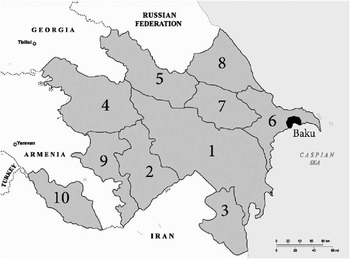
The AZDHS employs a multistage stratified clustered sampling design based on a sampling frame that is from the Population Census of the Azerbaijan Republic conducted in 1999, as provided by the State Statistical Committee of Azerbaijan. In this sampling frame, stratification was achieved in two stages. In the first stage, the country was stratified by economic regions and in the second stage the regions were divided into rural and urban strata. In this way, the 10 regions of Azerbaijan were stratified into 20 sampling strata and the capital city of Baku, which has only urban areas (see Figure 1).
Azerbaijan and its socio-economic regions. Notes: 1 = Aran, 2 = Yuxarı Qarabağ, 3 = Lankaran-Astara, 4 = Ganca-Qazax, 5 = Şəki-Zaqatala, 6 = Absheron, 7 = Dağlıq Şirvan, 8 = Quba-Xaçmaz, 9 = Kalbacar-Laçın, 10 = the Autonomous Republic of Naxçıvan.

Although officially there are 10 economic regions in Azerbaijan, 2 regions were not covered by the AZDHS. First, the Kalbacar-Laçın region is currently occupied by Armenian forces and was excluded from the sampling frame as well as the survey, with a loss of approximately 5% of the Azerbaijan total population (SSC and Macro International Inc, 2008). Second, the Autonomous Republic of Naxçıvan did not participate in the survey due to the blockade with a loss of approximately 4.5% of the Azerbaijan total population. This leaves the AZHDS with 17 strata including 16 rural/urban strata for the remaining eight economic regions of Azerbaijan and one urban stratum for the capital Baku.
For clustering purposes, samples were selected independently in each of 17 strata using a two-stage procedure. In the first stage, 350 census EUs were selected with a probability proportional to the EU size, where the EU size denotes the number of households in the EU. In each selected EU, a household listing operation was conducted to develop a full list of all households living in the EU. The developed lists of households served as the sampling frame for the second-stage selection of households.
Some of the selected EUs were large in size and to minimize the task of household listing, EUs with more than 300 households were further segmented. Only one segment in each of these large EUs was selected for the survey with a probability proportional to the segment size. The household listing for that EU was conducted only in the selected segment. Consequently, all clusters in the survey are either an EU or a segment of a large EU. In the second stage of selection procedure, 24 households were selected in each cluster, using equal probability systematic sampling.
As a result, a total of 318 clusters (178 urban and 140 rural) in Baku and eight economic regions were selected for the AZDHS implementation, resulting in a final sample of 7619 households. After the spreadsheet indicating the selected households for each cluster was developed, only the preselected households were interviewed. No replacements or changes to the preselected households list were allowed in order to avoid possible selection bias.
The AZDHS collects a wide range of detailed information on demographics, education, household wealth, maternal and child health and antenatal healthcare utilization. In particular, the pregnancy and postnatal section of the survey contains comprehensive information on the antenatal healthcare utilization of women who gave birth in 2001 or later. The questions about antenatal healthcare utilization concern only the most recent births delivered during this period. In addition to asking women whether they see anyone for antenatal care for pregnancy during the last birth, the AZDHS records information about the frequency and timeliness of antenatal care utilization as well as about the quality of utilized services.
3.2 Research questions and selection of dependent variables
The discussion in the previous sections of this paper has motivated us to examine the socio-economic determinants of antenatal healthcare utilization in Azerbaijan. To shed light on antenatal healthcare utilization in the country, the following four research questions are investigated in this study:
1. What are the determinants of antenatal healthcare utilization?
2. What are the determinants of frequency of the utilization?
3. What are the determinants of timing of the first utilization?
4. What are the determinants of the quality of the utilized care?
Inasmuch as this study seeks to answer the four specific research questions posted above, we studied four distinctive dependent variables. To answer the first posted question, we examined the answers to the following question asked by the AZDHS: “Did you see anyone for antenatal care for this pregnancy?” The respondent had the opportunity to answer by selecting between ‘someone’ and ‘no one.’ The definition of ‘someone’ in this question encompasses a wide range of possible antenatal care providers such as: doctor, nurse/midwife, feldsher, community/village health worker and others. Therefore, this question clearly identifies those women who did not receive any antenatal health care during their last pregnancy.
For the women who did receive care, the AZDHS asked the follow-up question: “How many times did you receive antenatal care for this pregnancy?” The responses to this question varied from 1 visit to 20 visits. These responses serve as a measure of the frequency of antenatal care utilization. Another follow-up question asked by the AZDHS was: “How many months pregnant were you when you first received antenatal care for this pregnancy?” Since it is common to measure the timing of the pregnancy by trimesters, the responses are grouped into three categories: visits during the first trimester, visits during the second trimester and visits during the third trimester. Consequently, the responses to this question varied from one to three. These responses serve as a measure of timing of antenatal care utilization.
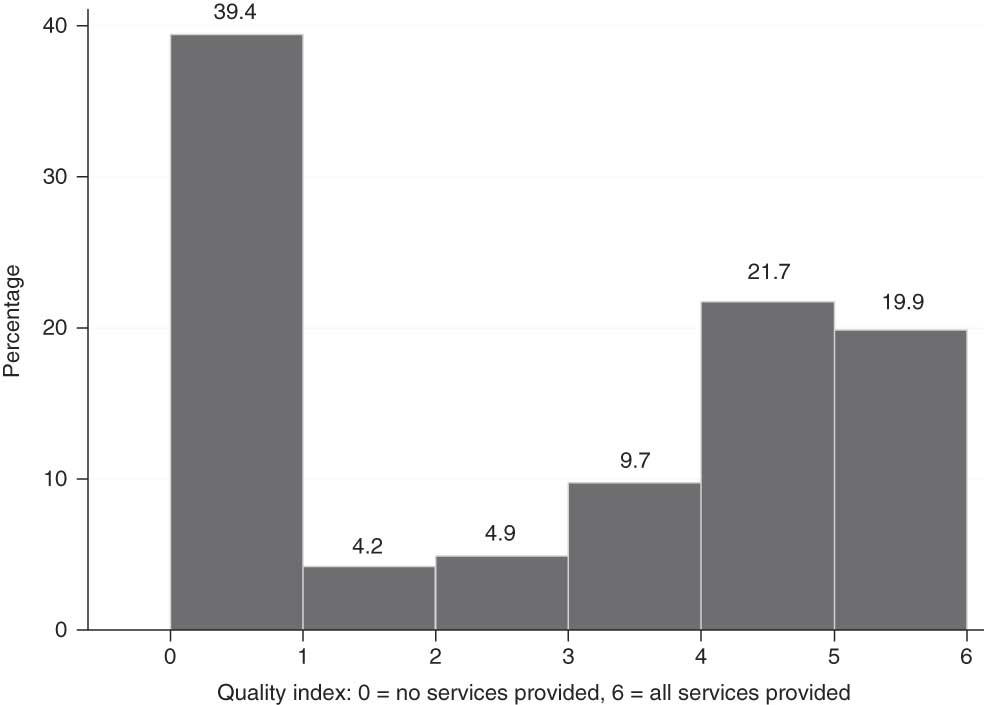
Lastly, the series of follow-up questions were aimed at assessing the quality of delivered antenatal care. Specifically, the AZDHS asked whether each of the following was carried out at least once during antenatal care during the last pregnancy: (1) the woman was weighed; (2) her blood pressure was measured; (3) her blood sample was taken; (4) her urine sample was taken; (5) she was told about the signs of pregnancy complications; (6) she was told where to go if she had any of the pregnancy complications. The response for each question was coded ‘1’ if the specific service was provided and ‘0’ if otherwise. These responses were employed to compute the additive index for the quality of services (Kohler and Kreuter, Reference Kohler and Kreuter2008). The index varied from 0 to 6. If women received no service, then the index took a value of 0. If women received only one type of service, for instance, their blood pressure was measured, then the index took the value of one, while the index took value of six if women received all the aforementioned services.
3.3 The conceptual framework and selection of antenatal healthcare utilization determinants
The rapid increase in scholarship on determinants of antenatal healthcare utilization in developing and transitional countries prompts us to base the conceptual framework of this paper on the two most recent systematic literature reviews on the topic. These reviews were conducted by Simkhada et al. (Reference Simkhada, van Teijingen, Porter and Simkhada2008) and Say and Raine (Reference Say and Raine2007). The former examined 28 peer-reviewed studies published since 1990, while the latter examined 30 studies for approximately the same period. Both reviews converged in the main findings. The major determinants of antenatal healthcare utilization in developing countries are: (1) women’s socio-demographic characteristics (e.g. current age, educational attainment and age at first birth); (2) current pregnancy characteristics (e.g. birth order, gender of child, multiple births and wanting the last child or the current pregnancy); (3) affordability (e.g. socio-economic status and insurance coverage); and (4) accessibility of services (e.g. place of residence such as rural/urban and region, travel time to health facilities and state/private facilities). Several other factors, such as ethnicity, religion and culture, were also found to be important determinants of antenatal care utilization.
As suggested by the conceptual framework, women with higher education have a higher likelihood of utilizing antenatal care since they may have better knowledge of the benefits associated with antenatal healthcare utilization. Women with higher educational attainment may also be better informed about how the healthcare system functions and hence can get better access to it. In contrast, older women, women who experienced early pregnancies in their life, and women who have a higher birth order have a lower likelihood of antenatal care utilization due to the experience and confidence gained from previous pregnancies. Therefore, several independent variables were selected in this study to test the relationship between the abovementioned characteristics and antenatal care utilization. Women’s educational attainment is denoted by a continuous variable indicating the years of schooling. Likewise, women’s current age and age at first birth are also denoted by continuous variables.
Among the current pregnancy characteristics, the literature suggests that having been pregnant with a male child or multiple births, as well as wanting the last child or current pregnancy, may strongly and positively be associated with the probability of antenatal healthcare utilization. Hence, our study includes dummies for being pregnant with a male child or multiple births as well as a dummy indicating the desire for the last child or the current pregnancy to test these relationships.
The literature indicates that the ability of women to participate in decision-making about their own healthcare utilization is positively associated with the likelihood of antenatal care utilization. To capture this effect, we include a dummy variable indicating if women alone or women together with their husband or partner have the final say on their own health care.
To capture the effect of affordability, we use the wealth index quintiles provided in the AZDHS data set.Footnote 2 There are six wealth quintiles in the data set ranging from the first, the poorest, to the sixth, the richest. We select for use the bottom two quintiles, which represent the poorest and the poorer households, and the top two quintiles, which represent the richest and the richer households. The middle, the third quintile, is omitted as a benchmark category for the purpose of regression estimation.Footnote 3 Given the inequalities in healthcare utilization discussed in the background section, we expect that living in the poorest and poorer households will have a negative effect on the likelihood of antenatal care, while living in the richest and the richer households will have a positive effect.
Two variables were employed to capture the accessibility perspective. First, we use a categorical variable, rural, that denotes women living in rural areas, while the urban category is omitted as a benchmark for the purpose of regression estimation. We hypothesize that living in rural areas will have a negative effect on the likelihood of antenatal healthcare utilization as compared with living in urban areas. Second, we use dummies for the eight regions of the country, whereas the capital Baku is omitted as a benchmark for the purpose of regression estimation (see Figure 1 for details). Among the regions, Aran is the centrally located part of Azerbaijan. It is mostly an agricultural region with mainly industrial conglomerates in the southwest and northwest. Yuxarı Qarabağ is mainly an agricultural region that borders Aran on the east, Iran on the south and the occupied territories on the west. Aran and Yuxarı Qarabağ are the two regions that suffered the most from the war with Armenia. On the south of Aran, there is the Lankaran-Astara region surrounded by Iran and the Caspian Sea. This region is specialized in the agriculture, fishing and forestry sectors and in the processing of products from these sectors. On the west of Aran, there is the Ganca-Qazax region that borders Georgia and Armenia. The region is the second largest economically developed part of the country after Baku. On the northwest of Aran, there is the Şəki-Zaqatala region that borders Russia and Georgia. The key sectors of the economy are agriculture, the ‘light’ industry and food processing sectors. On the northeast of Aran, there is the Absheron economic region, which, together with Baku, is the largest contributor to the country’s domestic production. It is the second most densely populated region of Azerbaijan that is situated very favorably on the territory surrounding Baku, the most developed part of the country. Another region, Dağlıq Şirvan, is surrounded by Absheron, Aran and Şəki-Zaqatala. It is the least densely populated region in the country, which specializes in viticulture, winemaking, cattle-breeding and traditional handcrafting. Finally, the Quba-Xaçmaz region is located in the northeast of the country and borders Russia in the north and the Caspian Sea in the east. The major sectors of the region’s economy are agriculture, manufacturing and tourism. Although there are some differences between the regions in terms of socio-economic development, these differences are not significant as compared with differences between the regions and Baku (Government of Azerbaijan, 2003, 2004; World Bank, 2003). Therefore, we expect that living in the regions will have a negative impact on prenatal care utilization as compared with Baku. Variation between the regions is also expected.
It must be highlighted that at the preliminary stage of analysis, we investigated a large number of independent variables widely known to affect antenatal healthcare utilization, as suggested by the conceptual framework. However, some of these variables, for instance, perception of service quality or travel time to health facilities, were not available in the AZDHS. Other variables turned out to have a low level of variation in distribution, for example, religion (99% are Muslim) and ethnicity (95% are Azeri). However, a number of other variables were not relevant for the current conditions of the country. Thus, the share of maternity care received in private facilities is <1%, while the share of women and men covered by health insurance is about 1% and 5%, respectively, since the system of health insurance and private healthcare facilities is not well developed in Azerbaijan.
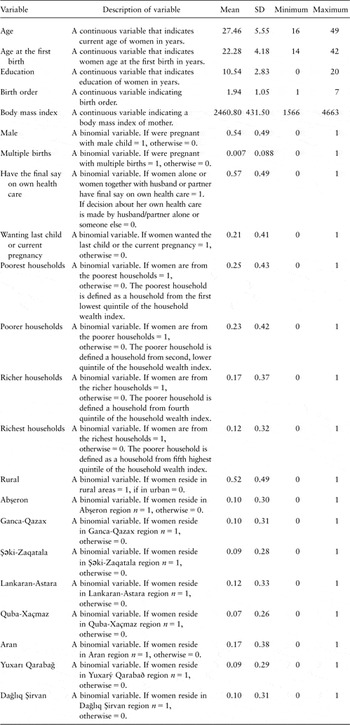
In addition, some other variables are found to be highly multi-collinear with each other. We identified the severe multi-collinearity between women’s age at the last birth, birth interval, the current age of the women, birth order, women’s education, wealth status of the household and residency. We found that a younger age for women at their last birth and shorter birth intervals were strongly multi-collinear with a younger current age for women, a larger birth order, lower educational attainments and wealth status as well as with living in a rural area. The effect of multi-collinearity was so strong that it changed the sign of regression coefficients to the opposite direction. These results are not surprising since severe multi-collinearity between these variables was also reported in the previous studies of the determinants of antenatal health care (Habibov and Fan, Reference Habibov and Fan2008). Under these circumstances, we followed the approach suggested by Fan and Habibov (Reference Fan and Habibov2008). We ran a separate regression between each predictor and outcome variable and recorded the sign of the regression coefficient. Then, we ran a full model with all predictors and compared the sign of the estimated regression coefficients. Only those predictors, whose sign did not change in the full model as compared with separate regression, remained in the final model reported in this paper and hence variables for birth intervals and age of women at last birth have been excluded. It must be noted that the same approach to detecting and avoiding multi-collinearity has already been used in several previous studies (Fan and Habibov, Reference Fan and Habibov2008; Habibov and Fan, Reference Habibov and Fan2008; Habibov, in press). The descriptive statistics for the remaining independent variables (after exclusion of multi-collinear variables) are provided in Table 1.
Descriptive statistics for independent variables

Notes: Data are rounded up.
Data are for unweighted sample of women with the last births in the 5 year preceding the time of the Azerbaijan Demographic and Health Survey (AZDHS) in 2006.
Omitted categories are excluded. For instance, four wealth quintiles are included in the regressions and described in this table, while the fifth quintile is omitted from the regressions and hence not described. Likewise, eight regional dummies are included in the regressions and described in the table, while Baku is omitted and hence not described.
Source: AZDHS (2006).
3.4 Analytical strategy
For each of the four research questions, we developed a separate model. In each model, we commence with the examination of the descriptive distribution of the dependent variable under investigation and discuss the implications of this distribution. Multivariate analysis is followed. The same set of independent variables is used in all multivariate models. Such a multistage sequential modeling is based on the hypothesis that utilization of antenatal care is a multistage process in which decisions are sequential. The decision of using or not using antenatal care is made in the first stage. The binomial logit regression model is used due to the binomial nature of the outcome variable, namely, utilized prenatal care or not. During the subsequent stages, other series of decisions are made regarding the frequency, timing and quality of the usage. Negative binomial regression (NBREG) is employed to estimate determinants of frequency of the utilization. Ordered logit regression is employed to estimate the determinants of the timing of the first utilization and determinants of the quality of the received care. The computation in the three abovementioned regression models was restricted to those women who actually utilized prenatal health care.
Although at all of the stages the decision is affected by the set of factors described in the conceptual framework, we hypothesize that the effect of these factors can be different at different stages. Hence, for instance, some variables can be significant predictors of antenatal care utilization, but at the same time be insignificant predictors of the frequency of utilization or its timing. In fact, recent studies in transitional countries have confirmed the sequential nature of decision-making in maternal care utilization (Habibov and Fan, Reference Habibov and Fan2008; Sepehri et al., Reference Sepehri, Sarma, Simpson and Moshiri2008; Habibov, Reference Habibov2009).
3.4.1 Model for antenatal healthcare utilization
We commence with estimation of the likelihood of antenatal care utilization. As the dependent variable is binomial (utilized antenatal care or not), a binomial logit regression model was fitted to assess the determinants of antenatal healthcare utilization. The model computes the observed probability of utilizing antenatal health care as a vector of the set of independent variables.
3.4.2 Model for frequency of utilization
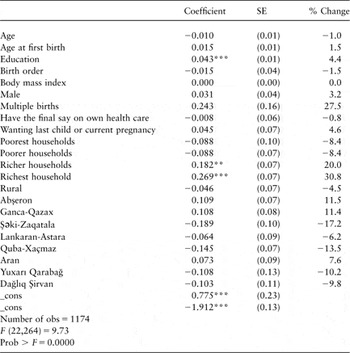
For those women who used antenatal care, the frequency of utilization is estimated. The dependent variable is the number of times, or counts, when utilization of antenatal health care occurred. Count variables required estimation of a count regression model, since application of the ordinary least square produces biased results (Long and Freese, Reference Long and Freese2006). However, Poisson regression, the classic model for count variables, often suffers from over-dispersion, a situation when the variance of the dependent variable is larger than the mean. We also expect over-dispersion in the model since the variance of the number of antenatal utilization is larger than the mean (n = 1174, mean = 4.77, variance = 11.03). Therefore, we estimate the NBREG model, which can handle over-dispersion. The model computes the observed probability of each count of utilizing antenatal health care as a vector of the set of independent variables. Indeed, the estimated measure of dispersion is positive and rather large (α = 0.161) and the likelihood ratio test suggests that NBREG should be used instead of Poisson regression (chibar2(01) = 280.61; Prob≥chibar2 = 0.000). This result demonstrates that estimation of NBREG for the determinants of antenatal care utilization should be preferred over estimation of Poisson regression.
3.4.3 Model for timing of the first utilization
In addition, for those women who used antenatal care, the timing of the first utilization is estimated. As the dependent variable, trimester, is ordinal and rank-ordered, ordered logit regression is fitted. The model estimates the observed probability of having the first antenatal visit during the first, second or third trimester of pregnancy as a vector of the set of independent variables.
3.4.4 Model of quality of delivered care
Finally, the quality of antenatal care is estimated for those women who used antenatal care. As the dependent variable, quality index, is ordinal and rank-ordered, the ordered logit regression model is fitted to estimate the probability of receiving a higher quality of antenatal services as a vector of the set of independent variables.
3.4.5 General consideration for all models
Two general considerations regarding the estimation of all models need to be made. First, AZDHS used a complex survey design based on the unequal probability of respondents’ selection, stratification and clustering. Multivariate analysis of the surveys with such a complex sample design will render the result of regressions seriously biased unless estimations are adjusted for all the three components, namely stratum, clusters and weights (Levy and Lemeshow, Reference Levy and Lemeshow2008). Therefore, all regression estimations are conducted in the STATA statistical program by taking into account the stratum, clusters and nationally representative weights that are supplied in the AZDHS data set. Consequently, the results of our estimations are more conservative in terms of the regression coefficient’s significance than the results from estimations, which ignore a complex design feature (Fuller, Reference Fuller2009).
Second, as discussed above, all models estimated in this study are non-linear since the outcome variables are categorical or count variables. The interpretation of non-linear regression models requires transformation of the usually estimated parameters in order to make them more understandable for a reader and easily comparable across all the estimated models. To achieve these objectives, we use a software suite of programs, Stata Postestimation Commands (SPost), that is designed by Long and Freese (Reference Long and Freese2006) to postestimate the interpretation of regression results for the models with categorical and count variables in STATA. After estimation of the logit regression models such as binomial and ordered logits in our study, SPost reports a percentage change in the odds for unit change in the independent variable. After estimation of the count models such as NBREG in our study, SPost reports a percentage change in the expected counts for unit change in the independent variable. The advantages of using SPost are twofold. On the one hand, the results of models become more understandable for a reader inasmuch as they become closer to interpretation of the ordinary least square results. On the other, since the same results occur, namely, percentage change is reported for all models, the results of regression become easily comparable across all the estimated models.
4. Findings and discussion
4.1 Results of the model for antenatal healthcare utilization
The result of answering the question in regard to the usage of antenatal healthcare utilization shows that a significant number of women, about 22%, did not receive any antenatal care during their last pregnancy, while about 77% of women received some care. This figure is extremely high even in comparison with other countries with a similar level of economic development or similar socio-cultural background. To provide reliable comparison, we can use the data from the recently conducted comparable DHS surveys. For instance, in Moldova, another low-income transitional country, the share of women who did not receive any antenatal care is only 1.8% (National Scientific and Applied Center for Preventive Medicine (NCPM), 2006). Turkey, which borders Azerbaijan, has similar religious and cultural traditions; however, this figure is no higher than 18% (Hacettepe University Institute of Population Studies (HUIPS), 2004). In another neighboring country, Kazakhstan, the share of women who did not receive antenatal care is also only 6% (Academy of Preventive Medicine (APM), 2000).
The results of the binomial logit-regression model estimation on the probability of antenatal healthcare utilization are reported in Table 2. In total, the effect of 8 variables out of the 22 presented in the model is found to be significant. Among current pregnancy characteristics, two factors, birth order and wanting last child or current pregnancy, are found to be the significant predictors of antenatal care utilization. For a one-unit increase in the birth order, the odds of utilizing antenatal care decreased by 28.2%. Likewise, the odds of utilizing antenatal care are 39.8% lower for women who did not want the last child or current pregnancy. Affordability of service also plays an important role in determining prenatal utilization. The odds for utilizing prenatal care are 54.4% lower for women from the poorest households. Several variables are significant accessibility of service variables. Living in rural areas decreases the odds of prenatal care utilization by 35.1%. Similarly, living in the Lankaran-Astara, Quba-Xaçmaz, Aran and Dağlıq Şirvan regions significantly decreases the odds of antenatal care utilization. In fact, with the decrease in the odds of prenatal utilization between 73.5% and 59.4%, the regional residencies are the most powerful predictors of antenatal care utilization in Azerbaijan. Living in other regions also reduces the odds of utilization, but the variables are not significant in a strictly statistical sense. With respect to other explanatory variables in the estimated model, all of them have the expected direction, although the effect is not statistically significant.
Multivariate analysis of determinants of antenatal care utilization (binomial logit)

Notes: % change denotes percentage change in odds for unit increase in an independent variable. *10% significance level; **5% significance level; ***1% significance level.
Data are rounded up.
The results of estimations are adjusted to a complex survey design though Taylor’s linearization series and are nationally representative.
Source: Azerbaijan Demographic and Health Survey (2006).
4.2 Results of the model for frequency of utilization
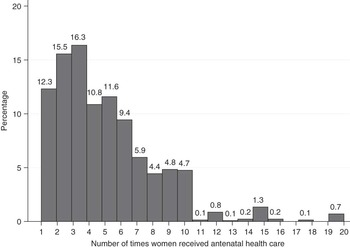
The result of answering the question about the frequency of antenatal healthcare utilization is graphically illustrated by Figure 2. As shown, the number of utilization events increased from one time during pregnancy – for about 12% of women, to three times – for about 16% of women and then steadily declined to 20 visits – for <1% of women. The distribution in Figure 2 can be assessed from the perspective of the national and international normative standards in antenatal health utilization. For a normal pregnancy, a pregnancy without high risk for antenatal complications, the Ministry of Health of Azerbaijan recommends monthly visits until the third trimester and twice monthly visits in the third trimester. However, <1% of the pregnant women received the required antenatal care. WHO uses less stringent guidelines by recommending at least four antenatal care visits for a normal pregnancy. Nevertheless, only approximately 10–11% of all women in Azerbaijan received the required volume of antenatal care.
Distribution of the number of times women utilized antenatal health care. Notes: Data are rounded up. Missing responses are excluded. n = 1259. Source: Azerbaijan Demographic and Health Survey (2006).

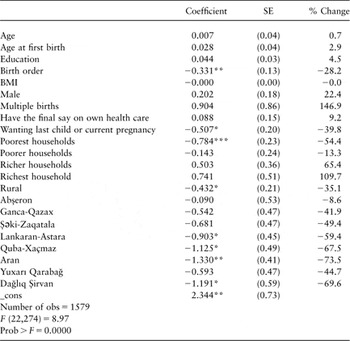
The results of the NBREG estimation on the frequency of prenatal care utilization are reported in Table 3. In the reported results, the effect of 3s variables out of the 22 presented in the model is found to be significant. Women’s socio-demographic and affordability perspectives are important predictors of utilization frequency. In terms of women’s socio-demographic perspective, for every additional year of schooling, the expected number of prenatal utilization visits increase by 4.4%. In terms of affordability, living in a richer household increases the expected number of visits by 20%, while living in the richest household increases the expected number of visits even more – by 30%. It can be concluded, therefore, that affordability of services is the most important factor explaining the frequency of antenatal care utilization in Azerbaijan. Other determinants presented in the estimated model are not statistically significant, although they have the expected direction.
Multivariate analysis of determinants of frequency of utilization (NBREG)

Notes: % change denotes percentage change in expected count for unit increase in an independent variable. *10% significance level; **5% significance level; ***1% significance level.
Data are rounded up.
The results of estimations are adjusted to a complex survey design by Taylor’s linearization series and are nationally representative.
Source: Azerbaijan Demographic and Health Survey (2006).
4.3 Results of the model for timing of the first utilization
The result of answering the question about the timing of the first antenatal healthcare utilization shows that most women in Azerbaijan, more than 67%, utilize antenatal care during the first trimester. Nevertheless, a considerable share of women utilizes antenatal care later – approximately 25% during the second trimester and approximately 7% during the last trimester only. This finding shows that the timing of the first antenatal care utilization in Azerbaijan is roughly comparable with that of Moldova and Turkey – 72% and 66%, respectively (HUIPS, 2004; NCPM, 2006). However, the timing indicator in Azerbaijan is still worse than that in neighboring Kazakhstan where most women, 84%, have already utilized antenatal care by the beginning of the third month of pregnancy (APM, 2000).
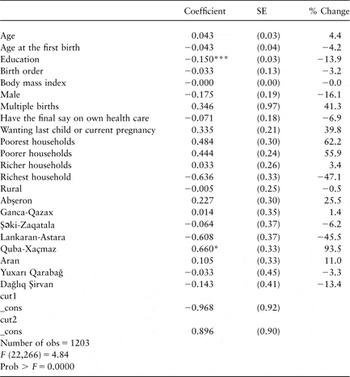
The results of ordered logit estimation on the likelihood of timing of the first utilization are reported in Table 4. In total, two variables, women’s socio-economic characteristics and accessibility, are found to be significant predictors of the timing of the first prenatal visit. The increase in women’s educational attainments is negatively associated with the likelihood of the late prenatal visit. More specifically, for each additional year of women’s education, the odds of having the first antenatal visit in the third trimester are almost 14% smaller than in the first semester. In contrast, living in the Quba-Xaçmaz region is positively associated with the likelihood of late antenatal care utilization. The odds of having the first prenatal visit in the third trimester are approximately 93% higher for the women living in this region. Hence, the regional variables are most important in understanding the timing of prenatal care utilization in Azerbaijan. Other variables in the estimated model are not statistically significant, although they have the expected direction.
Multivariate analysis of timing of utilization (ordered logit)

Notes: % change denotes percentage change in odds for unit increase in an independent variable. *10% significance level; **5% significance level; ***1% significance level.
Data are rounded up.
The results of estimations are adjusted to a complex survey design though Taylor’s linearization series and are nationally representative.
Source: Azerbaijan Demographic and Health Survey (2006).
4.4 Results of the model of quality of delivered care
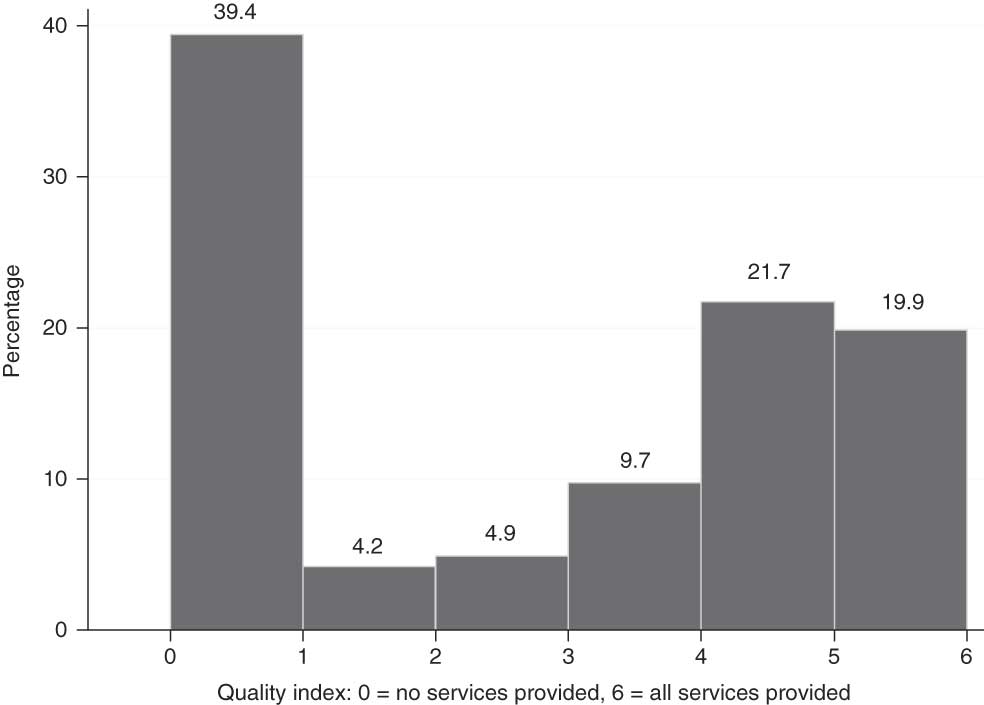
The result of the quality index distribution is illustrated in Figure 3. The figure demonstrates the high polarization in the quality of delivered care in Azerbaijan. Approximately 40% of all women do not receive any quality care during their antenatal visits – the quality index is 0. By sharp contrast, around 20% of women received the highest quality of care – the quality index is 6 and approximately 22% received a high quality of care – the quality index is 5. In contradistinction, a much smaller number of women received mediocre or average quality of care with the quality of indexes varying from 2 to 4.
Quality of received antenatal health care for the last pregnancy. Notes: Data are rounded up. Missing responses are excluded. n = 1259. Source: Azerbaijan Demographic and Health Survey (2006).
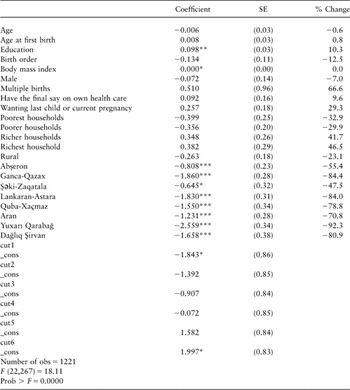
Since the dependent variable, quality index, is ordinal and rank-ordered, the ordered logit regression model is fitted to estimate the probability of receiving a higher quality of antenatal services. The results are reported in Table 5. In the reported results, 10 variables out of the 22 presented in the model are found to be significant predictors. Among women’s socio-economic variables, the increase in women’s educational attainments is strongly associated with the rising likelihood of receiving a higher quality of care. For a 1-year increase in women’s educational attainment, the odds of receiving a higher quality of antenatal care increased by more than 10%. Likewise, having a higher body mass index is also associated with the improved likelihood of receiving better care, but the effect is negligible. In contrast, the accessibility perspective is most important in shaping the determinants of the quality of antenatal services received. All regional dummies in the model are significant, signaling that the quality of antenatal care in the region is much lower than in Baku. For example, the odds of getting all six types of prenatal care are 92% smaller for those who live in the Yuxarı Qarabağ region and 84% smaller for those who live in the Ganca-Qazax region.
Multivariate analysis of quality of received antenatal care (ordered logit)

Notes: % change denotes percentage change in odds for unit increase in an independent variable. *10% significance level; **5% significance level, ***1% significance level.
Data are rounded up.
The results of estimations are adjusted to a complex survey design though Taylor’s linearization series and are nationally representative.
Source: Azerbaijan Demographic and Health Survey (2006).
4.5 Discussion
Despite some progress made by Azerbaijan in regard to improving maternal and child care during the past 5 years, including the decrease in child mortality rates, the situation with providing antenatal health care is still far from satisfactory. As demonstrated by descriptive analysis, in terms of antenatal care utilization, its frequency, timing and quality, Azerbaijan continues to lag behind other countries with the same level of socio-economic development as well as national and international standards.
Against this background, the findings of this study help to identify a number of specific determinants of antenatal care utilization and its frequency, timing and quality. As shown in the previous sections, the wide and unacceptable disparities in the utilization are based on the residence, education, income/wealth and birth order.
Residency, as reflected by dummies for rural and regional place of living, is perhaps the most important determinant of antenatal healthcare utilization in Azerbaijan. It determines the likelihood of utilization, and the timing and quality of care received, whereas it is not significant in the model predicting the frequency of antenatal utilization. Thus, living in rural areas or regions has a negative effect on the likelihood of the utilization. Women living in rural areas and regions have lower chances to utilize prenatal care. Even if they utilized antenatal care, the first prenatal visit tends to occur later, during the second or the third trimester of pregnancy rather than the first one. They also obtain lower quality of care by receiving fewer components of prenatal care. The effect of place of living is also found significantly in previous studies. The probability of the usage and timing and quality of the usage increases if women live in urban areas or in relatively more developed regions of the country (Celik and Hotchkiss, Reference Celik and Hotchkiss2000; Magadi et al., Reference Magadi, Madise and Rodrigues2000; Sharma, Reference Sharma2004; Paredes et al., Reference Paredes, Hidalgo, Chedraui, Palma and Eugenio2005).
Similar to the place of living, women’s education is also significant in three models out of four. Education is important in explaining the frequency and timing of utilization as well as the quality of services received, but it is not significant in predicting the likelihood of antenatal utilization. Thus, women with better education are more likely to receive the recommended number of antenatal checkups, commence these checkups earlier and receive better quality of care. The same results are observed in other developing countries (Miles-Doan and Brewster, Reference Miles-Doan and Brewster1998; Matthews et al., Reference Matthews, Mahendra, Kilaru and Ganapathy2001; Nielsen et al., Reference Nielsen, Hedegaard, Liljestrand, Thilsted and Joseph2001; Erci, Reference Erci2003). The lack of a significant positive effect of women’s education on the likelihood of antenatal care utilization in Azerbaijan is an interesting finding, although in fairness it must be noted that the absence of association between these two factors was also highlighted in previous studies (Nisar and White, Reference Nisar and White2003).
Poverty or wealth gradient, as reflected by quintiles of household wealth index, is another important determinant of antenatal care utilization in Azerbaijan. It is significant in explaining the likelihood of prenatal care utilization and frequency of utilization. Women from poor and poorer households have fewer chances of utilizing antenatal care. Even if they utilized antenatal care, they did it less frequently than women from the richer and richest households. This finding of importance of wealth gradient confirms the findings from previous studies. Thus, the recent study by Houweling et al. (Reference Houweling, Ronsmans, Camplbell and Kunst2007) analyzing DHS data from 45 developing countries found that the share of women from the wealthiest households who utilized antenatal care reaches or exceeds 80% in most countries and the level of utilization steadily decreases for poorer households.Footnote 4 Similarly, there is a strong positive effect of wealth gradient on the frequency and timing of utilization and on the likelihood of receiving higher quality care (Magadi et al., Reference Magadi, Madise and Rodrigues2000; Matsumura and Gubhaju, Reference Matsumura and Gubhaju2001; Sharma, Reference Sharma2004).
In addition, two variables, birth order and desirability of last child or current pregnancy, are significant only in one model. These two factors are strong predictors of utilization of prenatal services but not of its frequency, timing or quality of care received. Having a higher birth order and not wanting the last child or current pregnancy significantly reduces the likelihood of utilization. A possible explanation is that during their first pregnancy women are more cautious and therefore seek antenatal care, while the experience and confidence gained from previous pregnancies negatively affects the probability of seeking care for subsequent pregnancies (Celik and Hotchkiss, Reference Celik and Hotchkiss2000; Sepehri et al., Reference Sepehri, Sarma, Simpson and Moshiri2008). Not wanting the last child or current pregnancy is also found to be a physiological factor associated with a lower probability of prenatal health care in other countries (Simkhada et al., Reference Simkhada, van Teijingen, Porter and Simkhada2008).
5. Conclusion and policy implications for healthcare reform
The empirical evidence presented in this study has several important implications for health policy in Azerbaijan. First, the presented results demonstrate an inequality in utilization between rural/urban areas and regions. This inequality can be explained by the lack of mechanisms of linkage between regional priorities and the government healthcare expenditures by regions. Government administration in Azerbaijan, as in many other transitional countries, lacks the procedures to reconcile the needs and distribute funds from the budget (Betley, Reference Betley2004). There is no elaborate mechanism to match the needs of the regions to the allocation of scarce budgetary resources for health care. Budget allocations are made based on the norms and inputs or per capita of the population. The needs of the regions are not studied or identified before the funds are allocated, and nor specific health policy targets developed. Since regional health priorities are not taken into account, public expenditures on health care cannot be effectively used to reduce rural/urban and regional inequality in usage of antenatal care. In contrast, allocation of public healthcare expenditures under these circumstances may simply reinforce the existing regional inequalities.
In this context, the changes in the mechanism of the allocation of scarce budgetary resources for health care should be a priority. Budgetary allocation for antenatal care should take into account the differences in the utilization of antenatal care and its quality. In the short term, the efficient allocation should target the regions lagging behind so as to bring them at least up to scale with the others. In the long term, the efficient allocation should pursue the purposes of steady and equal increase in utilization and its quality.
Second, another key obstacle for healthcare utilization is lack of education. There is no substantial gender gap in schooling in Azerbaijan (SSC, 2008). Therefore, the pertinent solution could be the increase in amount and improvement in quality of non-academic educational activities aimed at promoting antenatal care. As an illustration, Habibov and Fan (Reference Habibov and Fan2008) reported that limited knowledge on matters related to sex significantly reduces the likelihood of antenatal utilization and the frequency of utilization. In this context, having health and family education activities implemented in the population point, having active women’s community groups, especially in the rural areas, as well as the effective usage of mass media to promote maternal health, are strongly associated with increase in antenatal care utilization (Sunil et al., Reference Sunil, Rajaram and Zottarelli2006). Receiving better education in maternal care and being empowered by new knowledge, women demand and receive a higher quality of antenatal care (Rani et al., Reference Rani, Bonu and Harvey2008).
Against this background, the Ministry of Health should take the initiative to create a special unit that will be responsible for the design and implementation of health education and health promotion programs. The programs developed should address the issues of antenatal care in a comprehensive way that encompasses improved information and education of women on the benefits of the usage, its timing and frequency as well as the quality of care. One of the examples of such an approach is Tajikistan, another low-income country in transition. Like Azerbaijan, Tajikistan suffers from high child mortality and a low level of antenatal care utilization. In response, the government of Tajikistan adopted a 10-year strategic plan for reproductive health and commenced its implementation. In the framework of this plan, the Ministry of Health of Tajikistan conducted a series of information events on the topic, actively involving educational institutions and the mass media (Government of Tajikistan (GoT, 2005)). Transitional China is another example. The Safe Motherhood Program in China has used education and social mobilization for the promotion of hospital delivery since 2000. The recent evaluation of the program (Guo et al., Reference Guo, Feng, Shi, Wang, Xu, Luo, Shen and Yin2009) compared counties where the program was implemented with the control group of counties without the program. The evaluation demonstrated that 7-year treatment of the program improved the hospital delivery rate by 3.9 per 100 live births.
Third, poverty emerges as one of the major obstacles to antenatal care utilization in Azerbaijan. Poverty reduction in the country is a long-term strategic goal that is being pursued by the government in the framework of the broader State Program on Poverty Reduction and Economic Development. At the same time, more immediate short-term solutions are needed to mitigate the negative effect of poverty on antenatal care utilization. The international experience demonstrates that one of the ways to target the limited resources to the poorest women is through cash conditional social assistance programs. Programs such as Oportunidades in Mexico and programme for advancement through health and education in Jamaica are examples of programming that uses various types of targeting techniques to identify the most neediest households and provide them the social transfer, conditional on school attendance and healthcare checkups (Handa and Davis, Reference Handa and Davis2006). For instance, in a study by Barber and Gertler (Reference Barber and Gertler2008), the sample of women was randomly assigned to Oportunidades and a control group. The subsequent evaluation demonstrated that the program participant received 12.2% more antenatal procedures as compared with the control group.
Azerbaijan has also implemented a targeted social assistance program that delivers benefits to the poorest families with children. Despite being implemented for several years and undergoing numerous changes in benefits coverage, the program, as of today, covers only already born children and lacks a healthcare component. In the meantime, there is promising evidence in other transitional countries with regard to linking health benefits with social assistance programs. Such programs in Georgia and Armenia have already increased healthcare utilization among the poor (Gotsadze et al., Reference Gotsadze, Bennett, Ranson and Gzirishvili2005; Angel-Urdinola and Jain, Reference Angel-Urdinola and Jain2006). Hence, the existing social assistance program in Azerbaijan could be extended to cover eligible pregnant women and the amount of benefits might be linked to the frequency and timing of antenatal care utilization. The improved program would have two advantages. On the one hand, program benefits will offset out-of-pocket expenditures for the utilization, thus increasing the usage of antenatal care. On the other, program benefits will increase incentives to improve timing and increase the frequency of antenatal care utilization to the recommended levels.
Fourth, from methodological perspectives, this study confirms previous findings by Habibov and Fan (Reference Habibov and Fan2008) and Sepehri et al. (Reference Sepehri, Sarma, Simpson and Moshiri2008) that the utilization of maternal care is a multistage process in which decisions are sequential. Although the same set of factors may affect decision-making at all stages, the effect of these factors is different at different stages. In our particular case, the determinants of utilization are different from the determinants of frequency and the timing of utilization, which in turn are different from the determinants of quality. Furthermore, we did not find a steady set of determinants that were simultaneously significant for predicting all components of utilization. This renders multistage modeling relevant in predicting factors affecting antenatal care utilization.
In addition, multistage modeling provides rich information for making informed decisions on the course of healthcare reforms. Should policy makers and health administrators consider the frequency of utilization as a priority, then one set of determinants, such as women’s education and wealth disparity, should be the main concern. By contrast, should the quality of services be considered the priority, then another set of determinants, such as regional disparity and women’s education, should be the main concern.
Finally, we would be remiss if we do not speak about the limitations of this study. This study does not control for the history of the current or previous pregnancies and does not specifically focus on unobserved community-specific characteristics, which may influence the decision to utilize care. Nevertheless, the findings of our study still provide an impetus and create a baseline in regard to assessing the determinants of the utilization of antenatal care, its frequency, timing and the quality of care in Azerbaijan. Another limitation is that we do not have data on the costs and effectiveness of prenatal care components. If we had these data, it would be possible to conduct a formal cost benefit analysis to identify where each component of the prenatal health money could be best spent.