Most couples desire egalitarian relationships, but many have difficulty achieving them (Gerson, Reference Gerson2010; Yavorsky et al., Reference Yavorsky, Kamp Dush and Schoppe-Sullivan2015). In addition to being viewed as fairer to both partners, more egalitarian arrangements are associated with greater sexual intimacy, relationship quality, and relationship stability than conventional (e.g. male breadwinner – female homemaker) or counter-conventional (e.g. female breadwinner – male homemaker) arrangements (Carlson et al., Reference Carlson, Miller, Sassler and Hanson2016a; Carlson et al., Reference Carlson, Hanson and Fitzroy2016b; Carlson et al., Reference Carlson, Miller and Sassler2018; Frisco & Williams, Reference Frisco and Williams2003; Schwartz & Gonalons-Pons, Reference Schwartz and Gonalons-Pons2016).
When couples cannot achieve egalitarianism, the fallback is often conventional gender roles, especially for domestic work (Pedulla & Thebáud, Reference Pedulla and Thébaud2015; Yavorsky et al., Reference Yavorsky, Kamp Dush and Schoppe-Sullivan2015). This is particularly likely after having a child. Motherhood is associated with a reduction in women’s labor force participation and an increase in domestic labor that coincides with shouldering the majority of childcare duties (Cohany & Sok, Reference Cohany and Sok2007; Yavorsky et al., Reference Yavorsky, Kamp Dush and Schoppe-Sullivan2015), whereas fatherhood has been shown to increase men’s labor force participation (Kaufman & Uhlenberg, Reference Kaufman and Uhlenberg2000). Although egalitarian attitudes moderate the movement toward conventional roles following childbirth (Kaufman & Uhlenberg, Reference Kaufman and Uhlenberg2000; Sanchez & Thomson, Reference Sanchez and Thomson1997), attitudes themselves are shaped by structural constraints that limit couples’ agency in shaping their division of labor (Carlson & Lynch, Reference Carlson and Lynch2013; Pedulla & Thebáud, Reference Pedulla and Thébaud2015).
Because conventional divisions of labor may threaten relationship stability and are strongly linked to parenting, practices and policies that encourage and enable more egalitarian parenting may be especially important for maintaining relationship quality and stability. One such policy and practice is paternity leave, which may help to reduce the likelihood of relationship dissolution by alleviating family-work conflict and increasing relationship satisfaction, especially for mothers (Newkirk et al., Reference Newkirk, Perry-Jenkins and Sayer2017; Schober, Reference Schober2012).
Emerging research suggests that fathers’ leave-taking is associated with increases in father involvement and relationship quality among both European and U.S. couples (Almqvist & Duvander, Reference Almqvist and Duvander2014; Bünning, Reference Bünning2015; Kotsadam & Finseraas, Reference Kotsadam and Finseraas2011; Petts & Knoester, Reference Petts and Knoester2018; Pragg & Knoester, Reference Pragg and Knoester2017). Furthermore, because more egalitarian divisions of labor are increasingly associated with higher quality, stable relationships (Carlson et al., Reference Carlson, Miller, Sassler and Hanson2016a; Carlson et al., Reference Carlson, Miller and Sassler2018; Schwartz & Gonalons-Pons, Reference Schwartz and Gonalons-Pons2016), it may be that paternity leave-taking is positively associated with relationship stability. Indeed, there is some evidence linking fathers’ leave-taking with relationship stability in the Nordic countries (Lappegård et al., Reference Lappegård, Duvander, Neyer, Viklund and Anderson2019; Olah, Reference Olah2001; Viklund, Reference Viklund2018). However, research has yet to examine this relationship in the United States.
In this study, we estimate associations between paternity leave-taking and relationship stability using data from a U.S. sample of parents. Understanding the potential benefits of paternity leave for families is particularly important within the United States, as the lack of a statutory paid parental leave policy leaves most Americans without access to paid leave (Kaiser Family Foundation, 2017; World Bank Group, 2018). In contrast to Nordic countries where there are clearly defined policies that establish cultural norms for leave-taking (Lappegård et al., Reference Lappegård, Duvander, Neyer, Viklund and Anderson2019; Viklund, Reference Viklund2018), the norms regarding American fathers’ leave-taking are less clear. Thus, focusing on the U.S. context allows for an exploration of whether paternity leave-taking is associated with union stability even without clear norms guiding leave-taking practices. Such knowledge may help policymakers to develop family policies that may benefit U.S. society.
Background
The vast majority of countries throughout the world, and all OECD countries, provide paid parental leave to mothers (either as a parental or maternity leave policy), and a sizeable percentage of countries (94% of OECD countries) also allow fathers to take paid leave through a national paternity leave or shared parental leave policy (Blum et al., Reference Blum, Koslowski, Macht and Moss2018; International Labour Organization, 2014; World Bank Group, 2018). In contrast, the only national leave policy in the U.S. is the Family and Medical Leave Act (FMLA). FMLA provides up to 12 weeks of unpaid leave to parents after childbirth for U.S. employees who meet eligibility requirements, which excludes approximately 40% of the workforce (Blum et al., Reference Blum, Koslowski, Macht and Moss2018). Furthermore, many eligible workers do not take parental leave under FMLA because it is unpaid (Klerman et al., Reference Klerman, Daley and Pozniak2012). Paid family leave policies do exist in a handful of U.S. states (California, Rhode Island, New Jersey, and New York, with policies being implemented in Washington, Washington, D.C., and Massachusetts in the next 1-2 years), but only workers in these states are eligible. In addition, estimates suggest that approximately 33% to 50% of companies offer at least partially-paid maternity leave whereas only 15-17% of employers offer paid paternity leave (Kaiser Family Foundation, 2017; Matos, Galinsky, & Bond, Reference Matos, Galinsky and Bond2017). As such, most American fathers currently lack access to paid paternity leave.
Despite a lack of access to paid leave in the U.S., fathers are expected to be present for their child’s birth and most fathers take some time off when their child is born (Petts & Knoester, Reference Petts and Knoester2018; Pragg & Knoester, Reference Pragg and Knoester2017). Periods of leave are relatively short, with fathers taking one week of leave or less, on average (Petts et al., Reference Petts, Knoester and Li2018; Pragg & Knoester, Reference Pragg and Knoester2017). Given the uneven access to paternity leave in the U.S., there are disparities in leave-taking patterns; fathers who are more socioeconomically advantaged are more likely to have access to leave, and take longer leaves, on average, than fathers who are less socioeconomically advantaged (Klerman et al., Reference Klerman, Daley and Pozniak2012; Petts et al., Reference Petts, Knoester and Li2018; Winston, Reference Winston2014). However, similar disparities exist in countries with national paid parental leave policies due to variations in eligibility requirements (McKay et al., Reference McKay, Mathieu and Doucet2016; O’Brien, Reference O’Brien2009; Twamley & Schober, Reference Twamley and Schober2019).
Overall, given that most American workers lack access to paid parental leave, it is important to understand the consequences of paternity leave-taking within the U.S. context because evidence of benefits associated with leave-taking may help to support future policies on paid parental leave. The current study focuses on the potential implications of paternity leave for relationship stability, which has not yet been examined in the U.S.
Conceptual framework
Our conceptual framework utilizes role theory to focus on the challenges of fulfilling domestic and breadwinning roles after the arrival of a child, and the implications of paternity leave-taking for relationship stability. Childbearing places great stress on relationships, especially in the era of the dual-earner couple, as infants primarily rely on parents for emotional, social, and physical care (Cowan et al., Reference Cowan, Cowan, Heming, Garrett, Coysh, Curtis-Boles and Boles1985; Waldfogel, Reference Waldfogel2006). Not only must couples find time and energy for the work associated with parenting, but they must also make decisions about paid work and domestic divisions of labor. Consequently, parenting responsibilities may conflict with parents’ other responsibilities as workers and partners (Stone, Reference Stone2007; Yavorsky et al., Reference Yavorsky, Kamp Dush and Schoppe-Sullivan2015).
From a role theory perspective (Goode, Reference Goode1960; Hecht, Reference Hecht2001), family and work strains that accompany the arrival of a new child may result in role conflict (i.e. stress from competing roles), role overload (i.e. stress from inability to complete role responsibilities), and role spillover (i.e. stress when one role transfers to another). These strains may lead to decreases in relationship quality (Hecht Reference Hecht2001; Twenge et al., Reference Twenge, Campbell and Foster2003), which may threaten relationship stability (Gager & Sanchez, Reference Gager and Sanchez2003). Declines in relationship quality are most common among mothers, as they are more likely to experience role strain given the expectation that they act as primary caretakers of children (Cowan et al., Reference Cowan, Cowan, Heming, Garrett, Coysh, Curtis-Boles and Boles1985; Dew & Wilcox, Reference Dew and Wilcox2011; Hays, Reference Hays1996; Twenge et al., Reference Twenge, Campbell and Foster2003).
Difficulties balancing work and family responsibilities, gendered dynamics of childcare, and high daycare costs often result in conventional divisions of domestic labor among both breadwinner-homemaker and dual-earner couples in the U.S. (Kimmel, Reference Kimmel1998; Yavorsky et al., Reference Yavorsky, Kamp Dush and Schoppe-Sullivan2015). In particular, intensive mothering expectations encourage women to reduce their time in paid employment following a birth (Cohany & Sok, Reference Cohany and Sok2007; Hays, Reference Hays1996; Stone, Reference Stone2007). Wage penalties may also pressure women to reduce work hours due to diminishing returns on their employment (England et al., Reference England, Bearak, Budig and Hodges2016). Even when women remain employed after a birth, they still experience an increase in unpaid labor at home that is not matched by men, increasing the gender gap in domestic responsibilities (Hays, Reference Hays1996; Yavorsky et al., Reference Yavorsky, Kamp Dush and Schoppe-Sullivan2015).
In contrast to conventional arrangements, more egalitarian contributions to breadwinning, housework, and childcare are associated with greater sexual intimacy, relationship satisfaction, and relationship stability (Carlson et al., Reference Carlson, Miller, Sassler and Hanson2016a; Carlson et al., Reference Carlson, Hanson and Fitzroy2016b; Schwartz & Gonalons-Pons, Reference Schwartz and Gonalons-Pons2016). Although couples may engage in conventional divisions of labor to offset parenting strains, such arrangements may undermine relationship quality and stability. Conversely, more equally sharing labor may help partners balance competing responsibilities, helping to promote relationship quality and stability because both men and women may be likely to view such arrangements as more equitable. In fact, couples increasingly view conventional arrangements as less fair (Carlson et al., Reference Carlson, Miller, Sassler and Hanson2016a). This trend may have consequences for relationship stability; couples who view their division of labor as more equitable are less likely to dissolve their relationships than those in which one or both partners find their division of labor to be especially unfair (Frisco & Williams, Reference Frisco and Williams2003).
Although most Americans desire egalitarian relationships and view them as the fairest way to divide labor, many struggle to achieve them due to cultural frames, public policies, and institutional arrangements that reinforce conventionally gendered behaviors (Gerson, Reference Gerson2010; Risman, Reference Risman1998; Ridgeway, Reference Ridgeway2009). Therefore, policies and practices that can encourage more equal sharing of domestic labor and breadwinning responsibilities, and reduce the strains associated with these roles, may have significant ramifications for relationship stability among couples, as well as gender equality more generally.
Paternity leave and relationship stability
Paternity leave is a policy that may aid couples in achieving a more egalitarian balance and stabilize relationships. Although cultural conceptions of intensive mothering continue to emphasize mothers’ essential roles in child development, emerging fatherhood ideals also encourage men to be more actively engaged parents (Brady et al., Reference Brady, Stevens, Coles, Zadoroznyj and Martin2017; Marsiglio & Roy, Reference Marsiglio and Roy2012). American fathers desire to spend more time at home, and spend three times more time on childcare compared to fathers in previous generations—although they still spend far less time in childcare compared to mothers (Bianchi et al., Reference Bianchi, Sayer, Milkie and Robinson2012; McGill, Reference McGill2014; Milkie et al., Reference Milkie, Bianchi, Mattingly and Robinson2002). Moreover, fathers are often judged on their capacity to provide financially for their families (Albiston & O’Connor, Reference Albiston and O’Connor2016). By providing time off work to focus on family life, paternity leave may help fathers to better manage this role conflict and focus more on meeting family needs.
Paternity leave-taking may encourage, and represent commitments to, more egalitarian arrangements by allowing men to be engaged fathers. Leave, especially extended periods of leave, provides men with time to participate in childcare and housework tasks that are traditionally performed by mothers, helps partners learn how to share tasks, and establishes expectations for a more equitable division of labor (Johansson, Reference Johansson2010; Nomaguchi et al., Reference Nomaguchi, Brown and Leyman2017; Rehel, Reference Rehel2014). Taking leave also enhances the probability that fathers will continue to participate more fully in childcare and housework after leave ends (Cabrera et al., Reference Cabrera, Fagan and Farrie2008; Petts & Knoester, Reference Petts and Knoester2018). Yet, paternity leave also allows men to maintain their paid careers. Indeed, fathers’ leave-taking and longer periods of leave are positively associated with father involvement and greater sharing in housework (Almqvist & Duvander, Reference Almqvist and Duvander2014; Bünning, Reference Bünning2015; Hosking et al., Reference Hosking, Whitehouse and Baxter2010; Huerta et al., Reference Huerta, Adema, Baxter, Han, Lausten, Lee and Waldfogel2014; Kotsadam & Finseraas, Reference Kotsadam and Finseraas2011; Petts & Knoester, Reference Petts and Knoester2018; Pragg & Knoester, Reference Pragg and Knoester2017; Schober, Reference Schober2014; Tanaka & Waldfogel, Reference Tanaka and Waldfogel2007). Although most studies on the effects of fathers’ leave-taking are correlational, research utilizing techniques to reduce endogeneity problems and better address causation (e.g. quasi-experimental studies focusing on policy reforms) also demonstrate that fathers who take leave are more invested in their families (Bünning, Reference Bünning2015; Kotsadam & Finseraas, Reference Kotsadam and Finseraas2011; Schober, Reference Schober2014). Although mothers may still perform a greater share of domestic labor regardless of whether fathers take leave, evidence suggests that fathers’ leave-taking (and longer periods of leave) may help to encourage greater father involvement in these tasks.
Increased participation by fathers in childcare and other domestic work likely increases (especially mothers’) satisfaction with the division of labor and decreases (especially mothers’) parenting stress (Knoester & Petts, Reference Knoester and Petts2017; McClain & Brown, Reference McClain and Brown2017; Nomaguchi et al., Reference Nomaguchi, Brown and Leyman2017). Indeed, couples that share childcare and housework report greater satisfaction with the division of labor, greater feelings of equity, and greater relationship satisfaction than couples in less egalitarian relationships (Carlson et al., Reference Carlson, Miller, Sassler and Hanson2016a). As such, fathers’ leave-taking may also increase couples’ relationship satisfaction (Petts & Knoester, Reference Petts and Knoester2019; Kotsadam & Finseraas, Reference Kotsadam and Finseraas2011).
By reducing strain on mothers and promoting greater father involvement and parents’ relationship satisfaction, paternity leave-taking may also help to stabilize parents’ relationships. There have been a few studies that have considered this question in Nordic countries, with results largely showing that the risk of union dissolution is lower when fathers take leave (Lappegård et al., Reference Lappegård, Duvander, Neyer, Viklund and Anderson2019; Olah, Reference Olah2001; Viklund, Reference Viklund2018). However, the effect of fathers’ leave-taking on relationship stability does not seem to be linear – i.e. more leave is not always better. Instead, the risk of union dissolution is lowest when fathers take the normative amount of leave within a cultural context (e.g. the amount of leave reserved for fathers in a national parental leave policy), as this likely encourages sharing between mothers and fathers which promotes greater parental satisfaction and stronger family ties (Lappegård et al., Reference Lappegård, Duvander, Neyer, Viklund and Anderson2019; Viklund, Reference Viklund2018). These studies also suggest that the association between fathers’ leave-taking and relationship stability may be less clear when paternity leave norms are not well established. For example, Avdic and Karimi (Reference Avdic and Karimi2018) found that fathers’ leave-taking was actually associated with an increase in union dissolution after the introduction of a parental leave reform in Sweden; it seems that this new reform had not yet been accompanied by clear norms, and may have pushed more traditional couples into uncomfortable leave-taking behaviors that may have increased relationship conflict.
Given the lack of a national paid parental leave policy in the U.S. and the continued prevalence of traditional gender norms, it is possible that paternity leave-taking is associated with a higher risk of union dissolution for American parents. However, given that most Americans view egalitarian relationships as ideal (Gerson, Reference Gerson2010; Shu & Meagher, Reference Shu and Meagher2018), and most fathers want to be engaged parents and coparents (Marsiglio & Roy, Reference Marsiglio and Roy2012; McGill, Reference McGill2014), taking paternity leave may signal a commitment to these ideals and promote greater relationship stability. Moreover, despite a lack of access to paid paternity leave, American fathers indicate strong support for paternity leave and most fathers take a short period of time off work when their child is born (Petts et al., Reference Petts, Knoester and Li2018; Pragg & Knoester, Reference Pragg and Knoester2017). Even a short period of leave may demonstrate that fathers are committed and invested in family life; in fact, there is evidence that short periods of leave influence fathers’ family behaviors in other cultural contexts where periods of leave are short (Pailhé et al., Reference Pailhé, Solaz and Tô2018). Thus, we expect that paternity leave-taking, including taking short periods of leave, will be positively associated with relationship stability given the current informal norms of leave-taking in the U.S.
Other factors
Previous studies on the association between fathers’ leave-taking and union stability largely include a similar set of control variables: education, income, age, union type, work characteristics, child sex, and nativity (Avdic & Karimi, Reference Avdic and Karimi2018; Lappegård et al., Reference Lappegård, Duvander, Neyer, Viklund and Anderson2019; Olah, Reference Olah2001; Viklund, Reference Viklund2018). We take a similar approach in the current study to minimize the likelihood that any observed association between paternity leave and union stability is due to confounding factors, with a few variations. First, we incorporate measures of race/ethnicity instead of nativity as rates of paternity leave-taking and union dissolution vary by race/ethnicity in the U.S. (Osborne et al., Reference Osborne, Manning and Smock2007; Petts et al., Reference Petts, Knoester and Li2018). Second, we consider two additional factors that may impact fathers’ investments in their families and union stability – length of relationship prior to childbirth and whether either parent was previously married (Berger et al., Reference Berger, Carlson, Bzostek and Osborne2008; Lyngstad & Jalovaara, Reference Lyngstad and Jalovaara2010). Finally, we account for cohort effects through the use of a birth cohort study.
Data and methods
Data
Data are taken from the Early Childhood Longitudinal Study, Birth Cohort (ECLS-B). The ECLS-B contains a nationally representative sample of approximately 14,000 children born in the U.S. in 2001. For this study, data come from all available waves: information was collected from parents when children were approximately 9 months old (W1), two years old (W2), four years old (W3), and five or six years old (W4 and W5).Footnote 1
The sample is restricted to resident two-parent families in which fathers were employed both at the time of their child’s birth and following the child’s birth to accurately assess information about paternity leave. The sample was further restricted so that there was only one valid case for each family (one randomly chosen focal child from the subsample of twins was used as the focal child). These restrictions result in a sample size of 6,000 couples (20,550 couple-years).
Paternity leave
For this study, paternity leave is defined as taking time off work for the birth of a child. In W1, mothers were asked whether fathers took any time off for the birth of the focal child, and if so, how many weeks of leave (either paid or unpaid) fathers took. Unfortunately, there is no information in the data indicating whether fathers utilized a paternity leave policy (either FMLA or a company policy) or some other means (e.g. sick or vacation time) to take leave. Regardless, these questions do focus on taking time off specifically for the birth of a child, which is how paternity leave is generally defined in the U.S.
We focus on two indicators of paternity leave. Paternity leave-taking indicates whether fathers took leave (1 = yes). Length of paternity leave is a categorical variable indicating whether fathers took no leave (used as reference category), one week or less, 2 weeks, 3 weeks, 4 weeks, or 5 or more weeks of leave. Given the relatively short periods of leave taken within the U.S., measuring length of leave in weeks (instead of months) is appropriate.Footnote 2 This approach is also consistent with studies on paternity leave within the U.S. which all focus on weeks of leave (Huerta et al., Reference Huerta, Adema, Baxter, Han, Lausten, Lee and Waldfogel2014; Petts et al., Reference Petts, Knoester and Li2018; Petts & Knoester, Reference Petts and Knoester2018; Pragg & Knoester, Reference Pragg and Knoester2017).
Relationship dissolution
The primary dependent variable is relationship dissolution. Relationships are considered dissolved if mothers report no longer being married to, or cohabiting with, the focal child’s father. Couples are at risk for dissolution starting at W1 until either the relationship ended or the couple was censored. Relationship dissolution is treated as a discrete event (relationships are treated as dissolved in the wave that the mother reports no longer being married to or cohabiting with the father), and couples are right-censored if they dropped out of the survey or mothers were still married to and/or residing with fathers at W5.
Control variables
We include a number of control variables. Union type is indicated by whether parents are married (reference category) or unmarried cohabiters at W1.Footnote 3 Mothers’ and fathers’ income are measured in logged dollars and included as time-varying indicators. Race/ethnicity is coded as (a) both parents are white (reference category), (b) both parents are black, (c) both parents are Latino, (d) both parents report other race/ethnicity, and (e) each parent reports a different race/ethnicity. Time-varying indicators of parents’ work hours are categorized as (a) does not work (this is included for fathers to allow this possibility in later waves), (b) part-time (less than 35 hours a week), (c) full-time (35-44 hours a week; reference category), and (d) more than full-time (45 hours a week or more).Footnote 4 Time-varying indicators of fathers’ occupation type are categorized as (a) professional (reference category), (b) labor, (c) service, (d) sales, or (e) other occupational type. We also include time-varying indicators of each parent’s age and number of other children. Controls for each parent’s educational attainment (1 = did not complete high school to 4 = college degree), whether either parent was previously married, how long the couple had been together prior to W1 (in years), and length of maternity leave (in months) are also included. Finally, to account for initial variations in relationship quality, we include a baseline measure of relationship conflict taken from W1, which is taken from mothers’ responses on how often (1 = never to 4 = often) they argue with their spouse about ten items such as chores, children, and leisure time (α = .79). The mean response is used.
Analytic strategy
Life-table estimates and discrete-time event history models are used in this study. Life tables indicate the cumulative proportion of couples who dissolved their relationship by the fifth year after their child’s birth. Chi-square tests are used to assess whether rates of relationship dissolution significantly differ by paternity leave.
Discrete-time logistic event history models are then used to assess whether paternity leave-taking and length of paternity leave are associated with union dissolution, accounting for potential confounders. Relationships are treated as dissolved if the couple ends their relationship between survey waves. Discrete-time models are appropriate because mothers in the ECLS-B only reported dates of relationship dissolution in W1 and W2. Dissolution dates were utilized in supplementary Cox proportional hazards models (January of the interview year was used when a dissolution date was not provided), and results were consistent with those presented. Indicators of each survey wave were included to estimate the baseline hazard (with the last wave used as the reference category). All continuous control variables are mean centered to allow for easier interpretation. To account for missing data, multiple imputation from ten imputed models is used.
Selection
Given the unequal access to paternity leave in the U.S., selection is an important concern. Particularly, there may be factors that influence the likelihood that fathers take paternity leave and relationship stability. Unfortunately, given our use of observational survey data, we are unable to account for selection effects that may be due to unobservable factors (e.g. availability of a paternity leave program, motivation to be a good father, etc.). However, we attempt to minimize selection problems due to observed factors as best we can by using inverse probability of treatment weighting (IPTW). IPTW is a method that utilizes weights based on propensity scores to deal with selection by accounting for variations between the treatment (i.e. took paternity leave) and control (i.e. did not take leave) groups such that these groups differ in whether they received the treatment but are similar on all other baseline characteristics (Austin, Reference Austin2016). These weights are equal to the inverse of the probability of receiving the treatment (Austin, Reference Austin2016). To calculate these weights, we first estimated propensity scores using logistic regression to predict ever experiencing dissolution based on the W1 control variables, generating propensity scores, and matching respondents in the treatment and control groups with the closest propensity scores. We then ran diagnostic analyses to assess the propensity score model, insuring that the assumption for common support (i.e. propensity scores overlap between the treatment and control groups) was met and insuring balance was achieved. The calculated weights are included in the event history models to assess the likelihood of relationship dissolution accounting for the propensity to take leave based on observed characteristics at W1.
Results
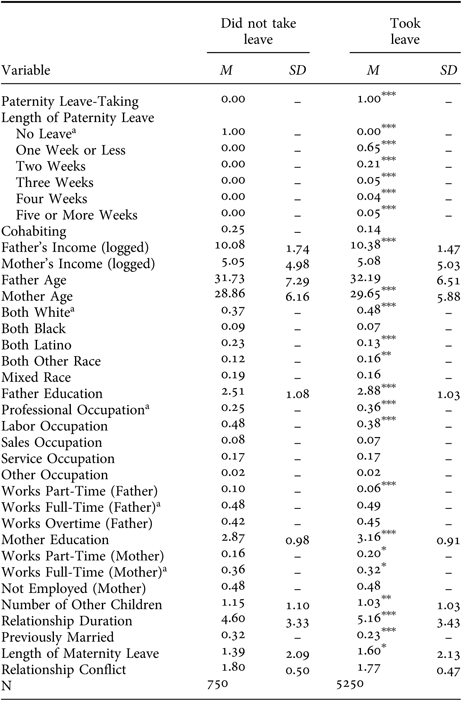
Mean values for all variables are presented separately by paternity leave-taking in Table 1. Overall, 89% of fathers took time off work after the birth of a child in these data. Of the fathers who took leave, most took one week or less (65%) and only 14% of fathers who took leave took more than two weeks. Results in Table 1 also suggest that fathers who took leave are more socioeconomically advantaged (e.g. higher income, higher education, more likely to have a professional occupation) than fathers who did not take leave.
Summary statistics (W1)

a Used as reference category. Significant differences determined by two-tailed t-tests (*p < .05. **p < .01. ***p < .001),
Life-table estimates
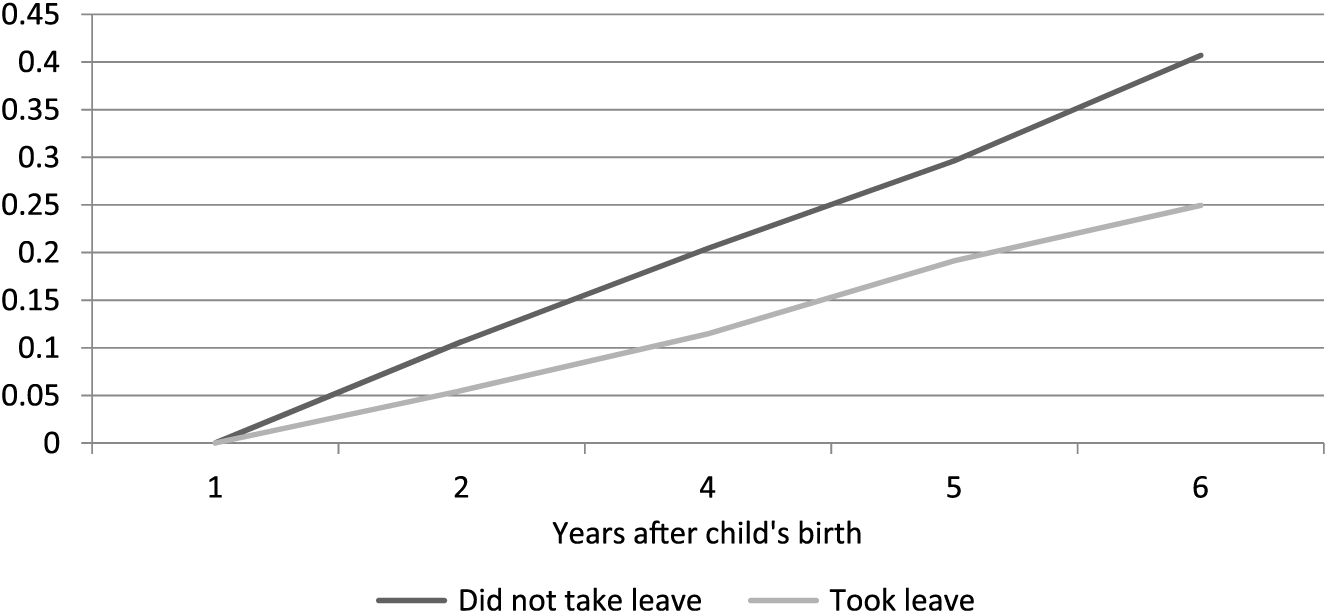
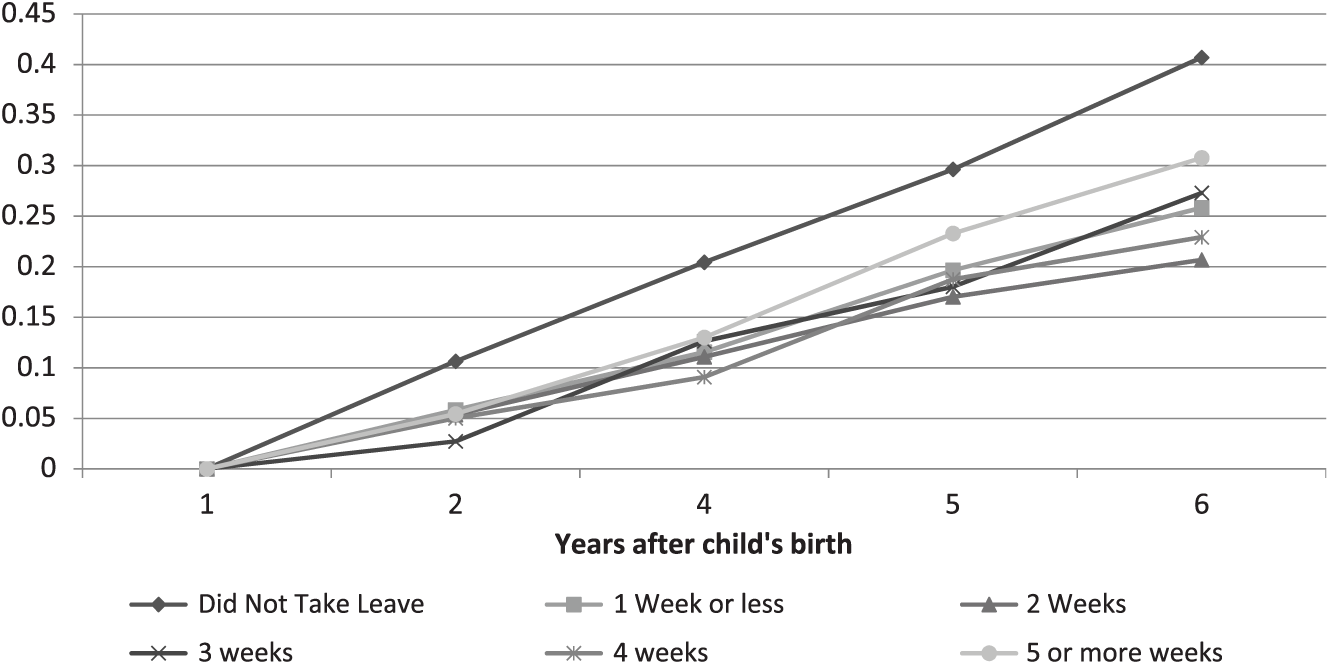
As shown in Figure 1, unadjusted life-table results provide support for our hypothesis in showing that unions in which fathers took paternity leave are less likely to dissolve than unions in which fathers did not take leave. Specifically, 25% of relationships dissolved after fathers took leave compared to 41% of relationships when fathers did not take leave (p < .001). However, as shown in Figure 2, the risk of relationship dissolution does not appear to vary by length of paternity leave. Specifically, relationships in which fathers do not take leave have the highest risk of dissolution, but there were no significant variations in the risk of dissolution by length of leave. Overall, results from life-table estimates suggest that paternity leave-taking, but not length of leave, is associated with relationship dissolution.
Cumulative Dissolution Rate of Unions by Paternity Leave-Taking

Cumulative Dissolution Rate of Unions by Length of Paternity Leave

Discrete-time event history results
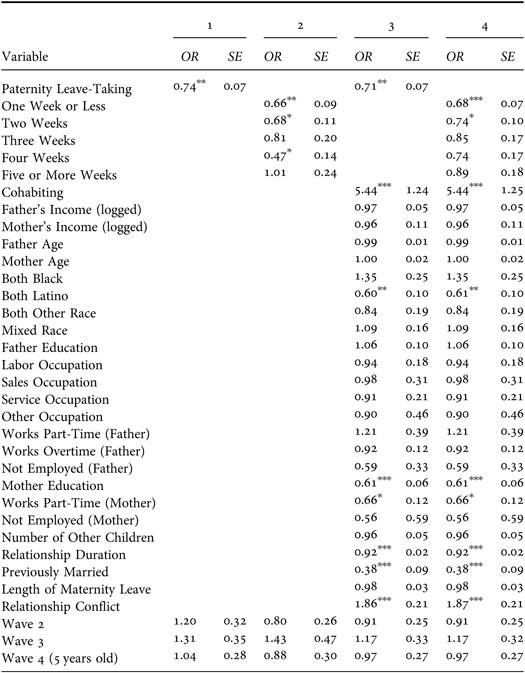
Results from discrete-time logistic event history models are presented in Table 2. Zero-order effects are presented in Models 1 and 2. Results in Model 1 suggest that couples in which fathers take leave have 26% lower odds of dissolving their relationship compared to couples in which fathers do not take leave. Moreover, results in Model 2 suggest that relationship dissolution is less likely to occur when fathers take one week or less, two weeks, or four weeks of leave compared to when fathers do not take leave. Supplementary analyses suggest that the associations between paternity leave and union stability do not vary over time (i.e. interactions between paternity leave and survey wave were not statistically significant). Thus, there is additional evidence supporting our expectation that paternity leave-taking is positively associated with relationship stability.
Results from discrete-time logistic event history models predicting relationship dissolution

N = 6000 (20,550 person-years); Models are weighted using IPTW; *p < .05. **p < .01. ***p < .001.
Results from full models that include control variables are presented in Models 3 and 4 of Table 2. Results in these models are largely consistent with the zero-order models; paternity leave-taking is associated with a lower risk of relationship dissolution. In terms of length of leave, taking one week or less or two weeks of leave is associated with a lower risk of dissolution compared to couples in which fathers do not take leave. We used marginal effects to better understand effect sizes. These results show that taking paternity leave reduces the probability of dissolution in any given wave by 25% compared to not taking leave (predicted probability of .056 for taking leave vs. .075 for not taking leave; p < .01). In addition, taking one week of leave reduces the probability of dissolution by 29% compared to not taking leave (predicted probability of .054 for taking one week vs. .075 for not taking leave; p < .01), and taking two weeks of leave reduces the probability of dissolution in any given wave by 25% (predicted probability of .058 for taking two weeks vs. .075 for not taking leave; p < .05). Overall, results provide evidence that taking paternity leave, and relatively short leaves in particular (two weeks or less), is associated with greater relationship stability.
Sensitivity analyses
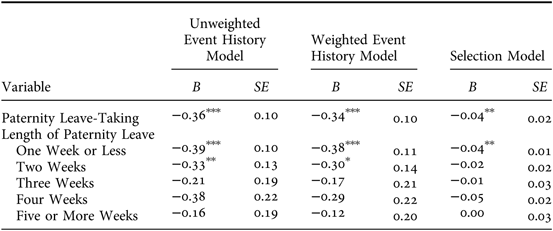
Given that selection is a major concern, we conducted additional analyses to assess the robustness of our findings. Specifically, we compared our results using IPTW to models not including weights as well as to models using propensity score matching (to assess selection on paternity leave-taking) and augmented inverse propensity weighted estimators, which is a variation of propensity score matching in which multiple treatments can be used (to assess selection on length of paternity leave). Although the selection model coefficients differ across models (as the selection model estimates come from models using a dummy variable indicating ever experiencing dissolution), the trends in the estimates are fairly consistent, increasing confidence in our results (estimates are presented in Table A1).
In supplementary analyses, we attempted to identify the pathways through which paternity leave may have led to increased relationship stability. Our framework focused on paternity leave-taking reducing the risk of union dissolution by enabling fathers to become more invested in their families and by improving parents’ relationship satisfaction. We incorporated an indicator of parents’ relationship quality in our analyses (relationship conflict) and this did not explain away the effect of paternity leave-taking. In other analyses, we included an indicator of father involvement, but this was unrelated to union stability and did not affect the results (these results are not presented because they were only asked of a subset of fathers; N = 4700). Additionally, given that one previous study accounted for parents’ gender ideologies (Olah, Reference Olah2001), we incorporated baseline indicators of fathering attitudes and fathers’ gender ideologies (mothers’ gender ideologies are not included in W1 of the ECLS-B) in supplementary models (N = 4700) but these factors were unrelated to union dissolution and did not alter the associations between paternity leave-taking and relationship stability. We also considered whether paternity leave-taking was more likely to reduce the risk of dissolution among dual-income families, as mothers in these families may have been particularly likely to experience family and work role strains (Stone, Reference Stone2007; Yavorsky et al., Reference Yavorsky, Kamp Dush and Schoppe-Sullivan2015). We found no evidence that mothers’ work statuses moderated the relationship between paternity leave and relationship stability. Overall, these analyses suggest that the available measures in these data are insufficient in explaining the associations between paternity leave and relationship stability. Nevertheless, similar to previous studies, the reported findings on the association between paternity leave and relationship stability are robust to the inclusion of the measures available.
Discussion
The goal of this study was to assess whether paternity leave-taking and length of paternity leave are associated with relationship stability within the United States. Although researchers have begun to look at the association between fathers taking parental leave and relationship stability in Europe (Avdic & Karimi, Reference Avdic and Karimi2018; Lappegård et al., Reference Lappegård, Duvander, Neyer, Viklund and Anderson2019; Olah, Reference Olah2001; Viklund, Reference Viklund2018), research has yet to examine this association in the U.S. The U.S. context is important to consider given the high rates of relationship dissolution and lack of a national paid parental leave policy (Amato & James, Reference Amato and James2010; Osborne et al., Reference Osborne, Manning and Smock2007; World Bank Group, 2018). Overall, findings suggest that paternity leave is associated with greater relationship stability among American parents.
First, life-table estimates indicated that couples were more likely to stay together if fathers took paternity leave, and this association persisted after accounting for potential confounders and observable selection factors in the event history models. Caring for infants is a time-intensive activity that can leave parents, especially mothers, sleep-deprived, fatigued, and distressed (Dennis & Ross, Reference Dennis and Ross2005; Martin et al., Reference Martin, Hiscock, Hardy, Davey and Wake2007; Waldfogel, Reference Waldfogel2006). Add to this the demands of employers, and parents may suffer from role strain, role overload, and role spillover (Goode, Reference Goode1960; Stone, Reference Stone2007; Yavorsky et al., Reference Yavorsky, Kamp Dush and Schoppe-Sullivan2015). These stressors may wear on parents’ health and undermine their relationships. Although mothers may still continue to perform more of the domestic labor than fathers, paternity leave may help to work towards reducing this gap and alleviate role stress for parents by providing men the opportunity to be engaged fathers, which may help to reduce the burden placed on mothers (Albiston & O’Connor, Reference Albiston and O’Connor2016; Pragg & Knoester, Reference Pragg and Knoester2017; Rehel, Reference Rehel2014). Alleviating stress for mothers is especially important since women are most likely to initiate breakups, especially when they feel their relationships are unfair (Birditt et al., Reference Birditt, Wan, Orbuch and Antonucci2017; Frisco & Williams, Reference Frisco and Williams2003). Taking leave may be particularly important within the U.S. given the stigma surrounding paternity leave (Albiston & O’Connor, Reference Albiston and O’Connor2016; Rudman & Mescher, Reference Rudman and Mescher2013). Demonstrating a commitment to be involved may increase feelings of equity and consequently reduce the risk of relationship dissolution (Frisco & Williams, Reference Frisco and Williams2003; Milkie et al., Reference Milkie, Bianchi, Mattingly and Robinson2002; Rehel, Reference Rehel2014).
We also found evidence suggesting that length of paternity leave was associated with relationship stability. However, the evidence does not identify a linear relationship such that longer periods of leave are associated with lower risks of relationship dissolution. Instead, taking a short period of leave (i.e. two weeks or less) appeared to be most beneficial in promoting relationship stability. Taking only a few days off likely provides at least some time for fathers to learn how to become engaged parents and partners, to help out more with childcare responsibilities, and to support their partners, while remaining fully entrenched in breadwinning roles (Albiston & O’Connor, Reference Albiston and O’Connor2016; Pragg & Knoester, Reference Pragg and Knoester2017; Rehel, Reference Rehel2014). As such, short periods of leave may enable fathers to meet the cultural expectations of being both an engaged parent and a provider (Marsiglio & Roy, Reference Marsiglio and Roy2012; Petts & Knoester, Reference Petts and Knoester2019). Short periods of leave may also shield fathers from the negative career consequences associated with taking longer leaves in the U.S. (Coltrane et al., Reference Coltrane, Miller, DeHaan and Steward2013; Rege & Solli, Reference Rege and Solli2013; Rudman & Mescher, Reference Rudman and Mescher2013; Twamley & Schober, Reference Twamley and Schober2019; Williams, Reference Williams2010). Previous research suggests that fathers’ leave-taking is most likely to promote union stability when fathers abide by the cultural expectations surrounding leave, such as using a period of parental leave reserved for fathers (Lappegård et al., Reference Lappegård, Duvander, Neyer, Viklund and Anderson2019; Viklund, Reference Viklund2018). Although there is not a national policy guiding formal norms in the U.S., there may be a set of informal norms as most American fathers take a short period of time off when their child is born (Petts & Knoester, Reference Petts and Knoester2018; Pragg & Knoester, Reference Pragg and Knoester2017). As such, not taking leave may increase the risk of union dissolution as fathers are not committing themselves to be more engaged caregivers, and taking long periods of leave may be violating traditional norms of fatherhood and carry economic consequences. Taking a short period of time off may enable fathers to abide by each set of cultural norms, demonstrate support to their families, and improve relationship stability.
Overall, although cultural norms and practices continue to promote a gendered division of labor in which mothers are primarily responsible for childcare and housework (Hays, Reference Hays1996; Risman, Reference Risman1998; Yavorsky et al., Reference Yavorsky, Kamp Dush and Schoppe-Sullivan2015), paternity leave may help parents work toward better balancing work and family life and may enable fathers to fulfill new fatherhood expectations that promote more active father engagement. As such, increasing access to paternity leave in the U.S. may provide families with structural supports that foster family stability.
Nonetheless, this study has limitations. First, there is a lack of information about whether fathers are using family leave, paternity leave, or other leave programs (e.g. Family and Medical Leave Act, vacation or sick days, etc.). More precise information about length of leave (e.g. number of days) would also be helpful, given the relatively short leaves that U.S. fathers take.
Second, this study does not fully account for selection effects, particularly in regard to unobserved factors that may influence the association between paternity leave and relationship stability (e.g. access to paternity leave, workplace support, fathers’ personality characteristics, etc.). Moreover, the first wave of data was collected approximately nine months after the birth of a child and we are not able to assess the risk of dissolution starting at the time of relationship formation or birth of the child. Thus, we are limited to focusing on the risk of dissolution starting shortly after the birth of a child. Although we attempted to address selection effects due to observed characteristics to the extent we were able, future studies should continue to examine the associations between paternity leave and relationship outcomes utilizing data collected both pre- and post-birth, and more fully accounting for issues of selection.
Third, although results provide evidence that parents may be more likely to stay together if fathers take paternity leave, we were unable to isolate the specific mechanisms that explain this association. Future research should incorporate additional mechanisms (e.g. how childcare is divided within families, whether the division of labor is seen as equitable, how committed one’s partner is to family relationships) that may help to explain the relationship between paternity leave and relationship stability.
In conclusion, this study informs our understanding of parental leave within the U.S. context by focusing on whether leave-taking is associated with relationship stability. Results provide evidence that paternity leave-taking, and short leaves in particular (two weeks or less), is associated with a lower risk of relationship dissolution. Given that the U.S. does not currently have a national paid parental leave policy, these findings may be especially useful to policymakers who aim to strengthen and stabilize parental relationships.
Acknowledgements
Research was supported by the Eunice Kennedy Shriver National Institute of Child Health & Human Development of the National Institutes of Health under Award Number R03HD087875. The content is solely the responsibility of the authors and does not necessarily represent the official views of the National Institutes of Health.
Appendix
Results comparing estimates from models using various techniques to account for selection

Unweighted event history model estimates are taken from discrete time event history models that do not account for selection. Weighted event history model estimates are replicated from Table 2 (but regression coefficients are displayed instead of odds ratios to allow for more direct comparisons). Selection model estimates are taken from selection models predicting whether couples ever experienced dissolution. Propensity score models are used to estimate the influence of paternity leave-taking and augmented inverse propensity weighted estimates are used to estimate the influence of length of paternity leave.
*p < .05. **p < .01. ***p < .001.