INTRODUCTION
More than 80% of advanced cancer patients experience pain and require opioids (Bruera & Kim, Reference Bruera and Kim2003). However, widespread opioid abuse, addiction, and overdose deaths have raised several safety concerns. More than 16,000 people die from prescription opioid overdoses every year in the United States alone (Dart et al., Reference Dart, Surratt and Cicero2015; Jones et al., Reference Jones, Mack and Paulozzi2013). Reportedly, more than 75% of prescription opioid abusers obtain their medications from friends and relatives (Centers for Disease Control and Prevention, 2010; Manchikanti et al., Reference Manchikanti, Helm and Fellows2012). While the U.S. population only comprises 5% of the world's population, Americans consume approximately 80% of the world's opioids (Manchikanti et al., Reference Manchikanti, Helm and Fellows2012).
This opioid abuse epidemic impacts emergency department (ED) physicians, as they are often the prescribers (Choo et al., Reference Choo, Douriez and Green2014; Poon & Greenwood-Ericksen, Reference Poon and Greenwood-Ericksen2014; Volkow et al., Reference Volkow, McLellan and Cotto2011), and they also care for the ever-increasing flow of patients with opioid overdoses (Volkow & McLellan, Reference Volkow and McLellan2011; Wisniewski et al., Reference Wisniewski, Purdy and Blondell2008; Yokell et al., Reference Yokell, Delgado and Zaller2014). Cancer patients frequently visit the ED owing to uncontrolled pain (Fortner et al., Reference Fortner, Okon and Portenoy2002). In a previous ED-based survey report, none of the interviewed patients safely stored or disposed their opioids (Tanabe et al, Reference Tanabe, Paice and Stancati2012). Moreover, a recent study (Reddy et al., Reference Reddy, de la Cruz and Rodriguez2014a ) concluded that 25% of outpatient cancer patients either lost their opioids or shared them with others. Improper practices of storage, use, and disposal of opioids may lead to increased availability for others to abuse patients' opioids (Choo et al., Reference Choo, Douriez and Green2014). Our aim was to determine the patterns of opioid storage, use, and disposal among cancer patients presenting to the ED of a comprehensive cancer center.
METHODS
This was an IRB-approved cross-sectional survey of cancer patients at the time of their admission to an ED. Patients were eligible to participate if they were at least 18 years of age, were fluent in written and spoken English, had no evidence of altered mentation, and had been receiving opioids for at least 2 months. The survey consisted of 26 questions pertaining to patients' home situations and practices of opioid storage, use, and disposal. The survey was developed based on previous studies (Center for Disease Control and Prevention, 2010; Reddy et al., Reference Reddy, de la Cruz and Rodriguez2014a ; Tanabe et al., Reference Tanabe, Paice and Stancati2012) and substantiated with input from experts in the field (Hall et al., Reference Hall, Logan and Toblin2008; Jones et al., Reference Jones, Mack and Paulozzi2013; Tanabe et al., Reference Tanabe, Paice and Stancati2012) but was not validated. The survey was assessed for readability for a high-school education level and was pilot tested on volunteers to ensure that it took less than 15 minutes to complete. The average time to complete the survey was five minutes. Information was collected regarding demographics, history of tobacco and illicit drug use, opioid prescription history, and scores on the “cut-down, annoyed, guilty, and eye-opener” (CAGE) questionnaire. All patients were enrolled by one of our authors (JS) and were educated regarding safe practices of opioid use based on the recommendations of the U.S. Food and Drug Administration (FDA) (2014) after completing the survey.
Our objective was to determine the patterns of storage, use, and disposal of opioids in patients presenting to the ED. Unsafe storage was defined as storing medications where they were visible and/or accessible to people aside from the patient and his/her designated caregiver. Unsafe use was defined as losing or sharing opioids. Our secondary objective was to determine the predictors of unsafe opioid storage and use.
Statistical Methods
The clinical endpoint was to determine the frequency of unsafe storage and unsafe use of opioids. Data were summarized using standard descriptive statistics for each variable of interest. Association between categorical variables was assessed using a chi-square test or Fisher's exact test when appropriate. A Wilcoxon–Mann–Whitney test was employed to examine the difference for age between groups. All computations were carried out in SAS 9.3 (SAS Institute Inc., Cary, NC).
RESULTS
A total of 203 patients were screened, and 44 were ineligible (i.e., receiving opioids for less than 2 months, experiencing delirium, and/or did not speak English). Of the remaining 159 patients, only 113 (71%) completed the survey and were eligible; 43 patients refused because they had symptom distress, were not interested, had a procedure or radiological testing, or were scheduled for discharge from the ED. Three surveys were incomplete and excluded.
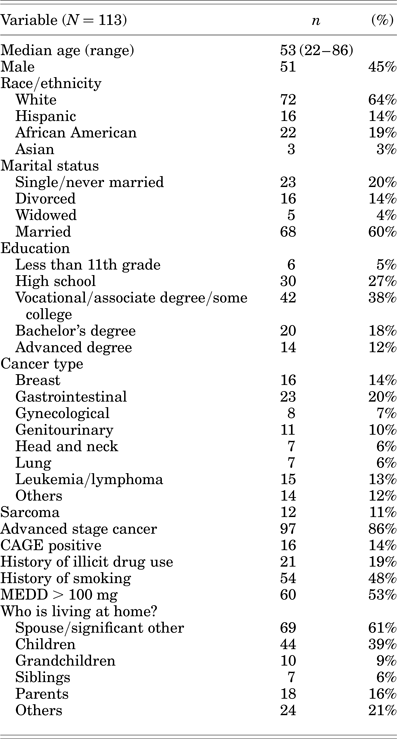
The median age was 53 years (see Table 1). Most of the patients (61%) lived with a spouse, and 39% lived with children. Almost a third (32%) had only a high school education or less, 38% had some college or an associate's degree, 18% had a bachelor's degree, and 12% had an advanced degree. Gastrointestinal (20%) was the most common cancer type, followed by breast cancer (14%). CAGE screening was positive in 14% of patients, and 19% had a history of illicit drug use. More than half (53%) had a morphine equivalent daily dose (MEDD) above 100 mg.
Patient characteristics

CAGE = cut down, annoyed, guilty, eye-opener questionnaire; MEDD = morphine equivalent daily dose.
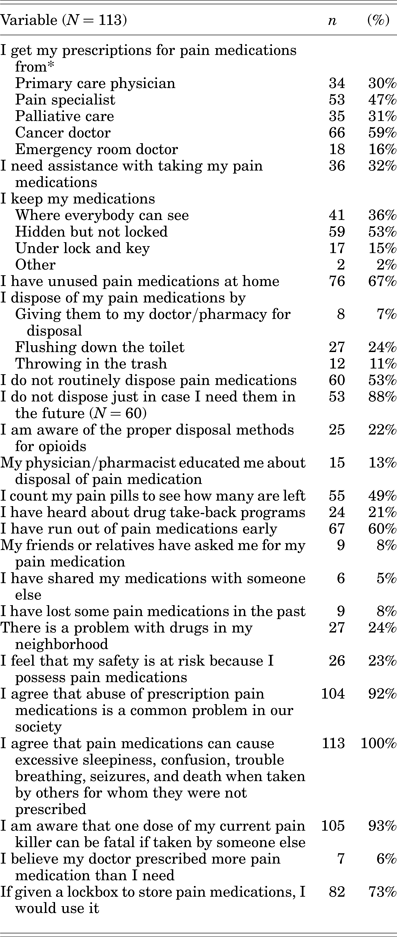
Overall, 77% reported unsafe opioid-related practices, such as storing opioids in plain sight (36%); sharing (5%) or losing (8%) their opioids; or possessing unused opioids at home (67%) (see Table 2). Most of the patients had prescriptions from their oncologists and pain-management physicians. ED physicians prescribed 16% of opioids during the previous year. Only 13% of patients received some kind of education regarding opioid disposal.
Patients' knowledge, practices, and attitudes regarding opioid storage, disposal, and use

*Can choose more than one correct answer.
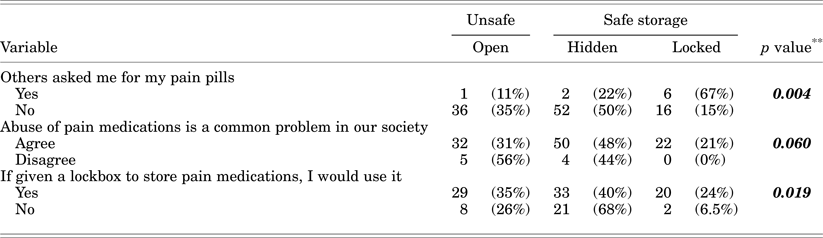
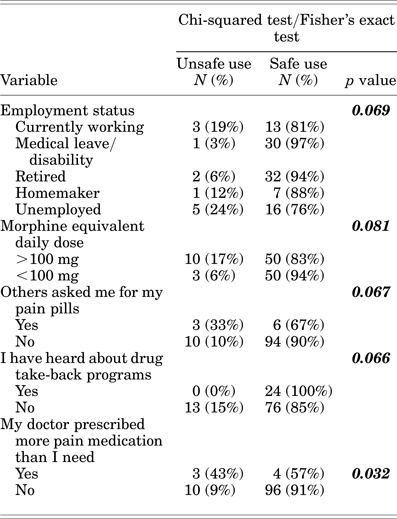
Patients who reported that others had asked them for their opioids (p = 0.004) (see Table 3) and those who said they would use a lockbox if given one (p = 0.02) were more likely to keep them locked. Table 4 shows that patients who reported being prescribed more opioids than required (p = 0.032), being asked by others for their opioids (p = 0.067), being unemployed (p = 0.69), and being unaware of drug take-back programs (p = 0.066) were more likely to practice unsafe use.
Predictors of unsafe opioid storage*

* Defined as storing opioids openly in plain sight.
**Chi-squared test or Fisher's exact test.

Patterns of unsafe storage and use were not significantly different according to other variables such as age, cancer type, race/ethnicity, sex, CAGE score, history of illicit drug use, MEDD, level of education, and marital status.
DISCUSSION
Most cancer patients presenting to the ED reported unsafe opioid-related practices that could increase the availability of their opioids for abuse by others. Cancer patients frequently undergo opioid dose adjustments, rotate from one opioid to another, and require a high MEDD to adequately control their pain (Reddy et al., Reference Reddy, Yennurajalingam and de la Cruz2014b ). Consequently, cancer patients may possess opioids that are currently being used or that are unused and expired (Reddy et al., Reference Reddy, Yennurajalingam and Pulivarthi2013). To our knowledge, this is the first comprehensive study to evaluate practices of opioid storage, use, and disposal in cancer patients presenting to an ED.
Previous reports (Lewis et al., Reference Lewis, Cucciare and Trafton2014) found that opioid sharing is common (34%) when patients possess unused opioids. However, only 5% of the patients in our sample reported sharing opioids, which is consistent with another survey in cancer outpatients (Reddy et al., Reference Reddy, de la Cruz and Rodriguez2014a ). This could be explained by the fact that all the patients in our study (100%) acknowledged the risk of seizures and death when opioids are taken by others for whom they were not prescribed. Patients who reported being prescribed more opioids than they required were more likely to practice unsafe use, and those who reported being asked by others for their opioids locked their medications. The majority of patients reported feeling safe while having opioids at home, yet most were willing to use a lockbox to store their medications if given one. Avoiding excessive amounts of opioids prescribed to patients (Bates et al., Reference Bates, Laciak and Southwick2011; Maher et al, Reference Maher, Kissen and Danovitch2014; Welham et al., Reference Welham, Mount and Gilson2015) and providing them lockboxes (Volkow & McLellan, Reference Volkow and McLellan2011) may be simple solutions to help curb the rising opioid epidemic. However, there is controversy regarding the effectiveness of using a lockbox (Marcus, Reference Marcus2011). Unlike previous studies, having small children at home (Williams et al., Reference Williams, Robertson and McGorm2009) or a personal history of CAGE positivity or illicit drug use (Reddy et al., Reference Reddy, de la Cruz and Rodriguez2014a ) were not associated with unsafe opioid storage and use, which may be due to the relatively small sample size of our study.
A large majority of patients did not dispose unused opioids and were unaware of the proper disposal recommendations, and less than a quarter of them were aware of drug take-back programs. Flushing opioids down the toilet was reported in 24% of our sample. In previous reports, medications in general were flushed in 35 to 53% of cases (Tong et al., Reference Tong, Peake and Braund2011). Regarding opioid disposal protocols, there are conflicting differences among agencies (e.g., the Environmental Protection Agency [EPA] (2014) and the FDA). The FDA suggests that some medications can be safely flushed since no perceived harm was observed; while the EPA declares that flushing is unsafe, suggesting to make use of take-back programs or mixing them with absorbent material (Tarling et al., Reference Tarling, van den Berg and Strunin1996) (e.g., coffee grounds or kitty litter). These differences cause confusion for the general public and even to healthcare practitioners. Flushing unused opioid causes unintended harm, since opioid traces have been found in subterranean waters, potentially contaminating drinking water (Boleda et al., Reference Boleda, Galceran and Ventura2009). Increasing avenues and education for safe disposal of opioids to patients and healthcare providers is vital for preventing the availability of these drugs and, consequently, for preventing accidental poisoning or the abuse of opioids by others.
Our study had several limitations. The sample size was small, and all the patients were English-speaking cancer patients presenting to the ED of a single institution. Our survey was administered by a physician; therefore, unsafe storage, use, or disposal could have been underreported. More research is needed to confirm our findings. We conclude that the high frequency of unsafe opioid storage, use, and disposal practices warrant improved opioid monitoring, patient education, and better accessibility to drug take-back programs.
CONFLICT OF INTEREST
The authors hereby confirm that they have no conflicts of interest to declare.
FUNDING/SUPPORT
This study was supported in part by MD Anderson Cancer Center support grant #CA016672. The funding organization had no role in the design and conduct of the study; in the collection, management, analysis, and interpretation of the data; or in the preparation, review, or approval of the manuscript.
DISCLOSURES
This study was presented at the American Society of Clinical Oncology's Annual Meeting in May of 2015 and at the Multinational Association of Supportive Care in Cancer's International Symposium in June of 2015. Additionally, the study was submitted to the Palliative Care in Oncology Symposium (October 2015).