Introduction
One of the main principles and goals of representative democracy is that policy ought to – at least roughly – reflect citizens’ preferences. Policy representation, or ‘substantive representation’ (Pitkin, Reference Pitkin1967), is certainly not the only criterion for judging the quality of democracy. In cases where it is in tension with government responsibilities or fundamental human rights, a closer link between the majority opinion and policy may even be undesirable. Yet, it is an important indicator of whether ‘government by the people’ is functioning, and one that has received growing attention from political scientists (e.g. Monroe, Reference Monroe1998; Soroka and Wlezien, Reference Soroka and Wlezien2010; Lax and Phillips, Reference Lax and Phillips2012; Rasmussen et al., Reference Rasmussen, Reher and Toshkov2018b). Citizens also seem to care, as their evaluations of the democratic system are influenced by how well they are represented (e.g. Ezrow and Xezonakis, Reference Ezrow and Xezonakis2011; Reher, Reference Reher2015).
However, modern democracies have a problem not only if policy is out of step with the preferences of the people but also if grave inequalities exist in the representation of the views of different social groups. As Sidney Verba states ‘one of the bedrock principles in a democracy is the equal consideration of the preferences and interests of all citizens’ (Reference Verba2003: 663). Consequently, a growing number of studies investigate whether disparities exist in the representation of different social groups, the majority of them comparing the rich and the poor (e.g. Bartels, Reference Bartels2008; Soroka and Wlezien, Reference Soroka and Wlezien2008; Gilens, Reference Gilens2012; Brunner et al., Reference Brunner, Ross and Washington2013; Bernauer et al., Reference Bernauer, Giger and Rosset2015; Peters and Ensink, Reference Peters and Ensink2015).
This study focuses on another important group in society that is numerically, or ‘descriptively’ (Pitkin, Reference Pitkin1967), underrepresented in politics up to this day: women. They hold fewer seats in parliaments and positions in governments across the world, including in the most advanced democracies. Given that it is often argued that women may be better at representing women (Phillips, Reference Phillips1995; Mansbridge, Reference Mansbridge1999), this descriptive underrepresentation might have consequences for the degree to which policy reflects the views of women. Yet, although several studies suggest that women’s descriptive and substantive representations are indeed linked (e.g. Bratton and Ray, Reference Bratton and Ray2002; Schwindt-Bayer and Mishler, Reference Schwindt-Bayer and Mishler2005; Kittilson, Reference Kittilson2008), we know very little about how well the policies in place actually align with the views of women as compared to those of men.
The first aim of this study is thus to extend our knowledge about the existence of gender inequality in substantive representation in Europe by assessing how well the preferences of women and men are reflected in public policy across a wide range of policy domains. The study draws on public opinion data from major cross-national surveys on a diverse set of 20 specific issues in 31 European countries, which is matched with information on policy collected from a range of governmental, academic, interest group, and media sources. These data show that the majorities of women and men prefer the same policy in most cases. However, when women and men disagree, policy is more likely to reflect the preferences of men. There is thus evidence for a gender gap in policy representation in Europe.
The second aim is to investigate what might explain whether policy is congruent with women’s or men’s preferences when they disagree. Interestingly, neither the proportion of women in parliament nor the left–right position of the government appears to have an effect, despite large literatures showing that women tend to be more left-wing (e.g. Gidengil et al., Reference Gidengil, Blais, Nadeau and Nevitte2003; Campbell, Reference Campbell2004; Bergh, Reference Bergh2007; Bernauer et al., Reference Bernauer, Giger and Rosset2015) and that female legislators are more likely to promote women’s rights and interests (e.g. Thomas, Reference Thomas1991; Vega and Firestone, Reference Vega and Firestone1995; Swers, Reference Swers1998; Bratton and Haynie, Reference Bratton and Haynie1999; Taylor-Robinson and Heath, Reference Taylor-Robinson and Heath2003; Celis, Reference Celis2006; Campbell et al., Reference Campbell, Childs and Lovenduski2010). In contrast, a higher effective number of parliamentary parties (ENPP) improves women’s representation. This holds when controlling both for the proportionality of the electoral system and for women’s descriptive representation, which has been shown to be strongly affected by electoral rules (e.g. Matland and Studlar, Reference Matland and Studlar1996).
Whereas women and men tend to agree on the direction of policy on issues typically regarded as ‘women’s issues’, disagreement is the most frequent for ‘new politics’ issues. This suggests that the positive effect of the number of parties on women’s representation might be explained by small parties placing issues on the agenda that divide men and women but have received less attention from the mainstream parties. However, this possibility is not empirically supported, since neither the government position on the libertarian–authoritarian dimension nor the presence of Green parties explains women’s policy congruence. It might thus be other institutions and practices that are more likely to be introduced in contexts with more parliamentary parties that benefit the representation of women’s opinions. In addition to providing important new evidence on the state of gender equality in policy representation in Europe, the article thus outlines an agenda for further research into the explanations of women’s representation.
Gender and representation
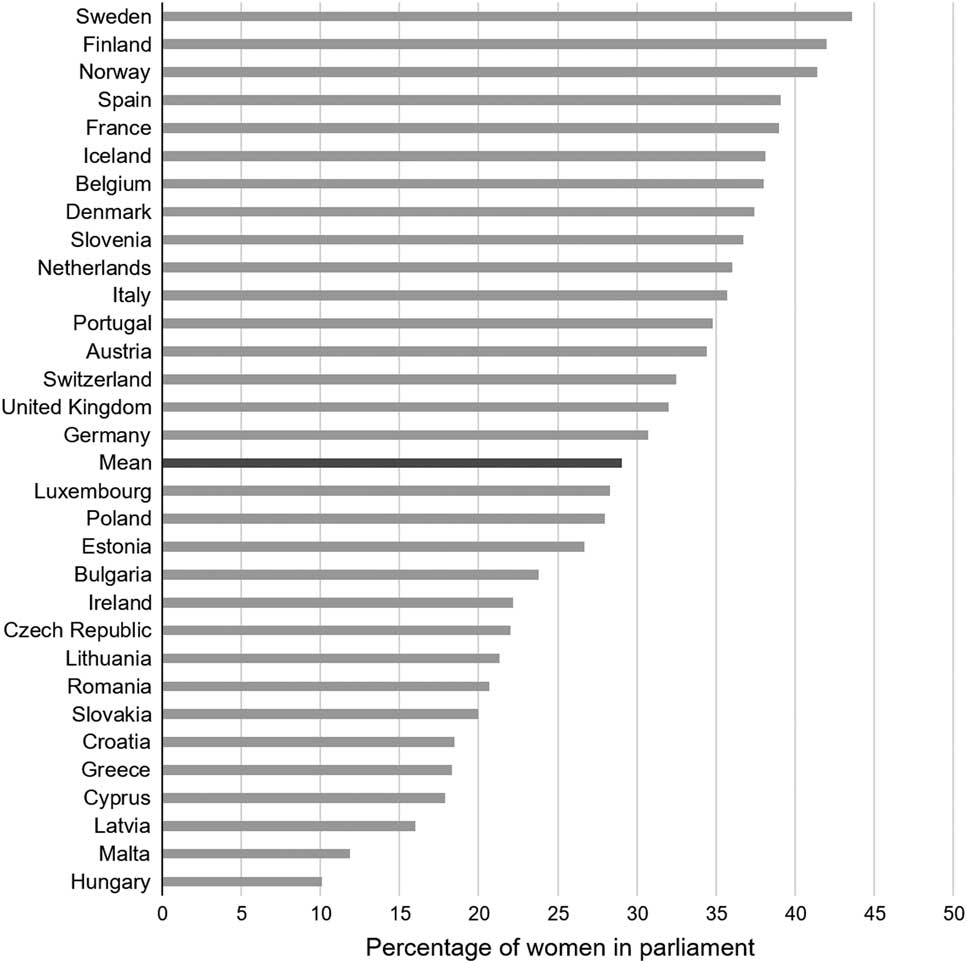
Although the number of women in politics has increased over the last decades, they are still in the minority in parliaments across Europe (Figure 1). While women hold 44% of the seats in the Swedish parliament, the European average is much lower with 29%, and in Hungary only 10% of parliamentarians are women. This raises the question whether women’s views are also underrepresented in the output of the political process, meaning the laws that govern European societies. Surprisingly, this question has not yet been answered, although a few studies have assessed different aspects of women’s policy representation in Europe. Homola (Reference Homola2017) shows that although the manifestos of parties respond to shifts in the left–right positions of both genders, they seem to be more responsive to men. Yet, this does not necessarily result in unequal representation in parliament: as Bernauer et al. (Reference Bernauer, Giger and Rosset2015) show, women tend to be more left-leaning but not consistently further away from the most proximate parliamentary party.
Proportion of seats held by women in national parliaments (single chamber or lower house) in Europe as of 1 April 2018 (IPU, 2018).

Although the representation of citizens’ ideological views is undoubtedly important, neither parties’ nor citizens’ positions on specific policy issues always neatly align with the left–right dimension or even several ideological dimensions (e.g. Converse, Reference Converse1964; Dolezal et al., Reference Dolezal, Eder, Kritzinger and Zeglovits2013). We should, therefore, also examine how well the public is represented on more narrowly defined issues and in concrete policy outcomes (Thomassen, Reference Thomassen2012). This strategy has been employed in studies of the representation of income groups (e.g. Soroka and Wlezien, Reference Soroka and Wlezien2008; Gilens, Reference Gilens2012; Brunner et al., Reference Brunner, Ross and Washington2013) and of the overall public (e.g. Page and Shapiro, Reference Page and Shapiro1983; Monroe, Reference Monroe1998; Lax and Phillips, Reference Lax and Phillips2012; Rasmussen et al., Reference Rasmussen, Mäder and Reher2018a, b). In the context of gender, Dingler et al. (Reference Dingler, Kroeber and Fortin-Rittberger2018) investigate whether inequalities exist in the congruence between public opinion and the positions of parliaments around Europe, measured by expert placements of parties on seven policy dimensions. Interestingly, they find that women’s views are overall better represented than men’s. Outside of Europe, Griffin et al.’s (Reference Griffin, Newman and Wolbrecht2012) analysis of roll-call votes in the US House of Representatives reveals that the underrepresentation of women’s views in districts represented by Republicans is counterbalanced by their better representation in Democratic districts.
Yet, while these studies look beyond left–right ideology, their results still do not tell us how well women’s preferences are reflected in actual policy. First, governments rather than parliaments as a whole primarily determine which policies are put into place. But even analyzing government positions is not sufficient, since they cannot always implement them: they need to prioritize among issues, bargain with coalition partners, overcome institutional hurdles, and react to events, changing economic conditions, etc. Such ‘frictions’ (e.g. Baumgartner et al., 2009) might introduce biases in the policy-making process that result in policies that are less reflective of women’s views than men’s even if no gender inequalities exist in the policy preferences of governments or parliaments. By analyzing women’s and men’s support of the policies in place, this study thus expands our knowledge of women’s representation in Europe to a further stage of the representation process.
Hypothesis 1 Public policy is less congruent with the preferences of women than the preferences of men across Europe.
Explaining women’s policy congruence
The second objective of this study is to examine what might explain gender differences in policy representation across Europe. While there are a range of potentially important variables, the study focuses on three political factors: women’s descriptive representation, the ideology of the government, and electoral and party systems.
Descriptive representation
As Anne Phillips (Reference Phillips1995) famously contended, women’s presence in politics will, in certain contexts, strengthen their substantive policy representation because they have some (largely though not universally) shared interests and experiences that are not shared by men. These interests and experiences give rise to policy preferences which women will be more likely to promote due to their higher awareness and commitment (cf. also Mansbridge, Reference Mansbridge1999). A vast number of studies have empirically examined this argument from different angles. They show that women legislators tend to place stronger emphasis on issues related to women, children, and family (Thomas, Reference Thomas1991, Reference Thomas1994), support social welfare (Wängnerud, Reference Wängnerud2000; Poggione, Reference Poggione2004), and promote women’s rights and gender equality (Thomas, Reference Thomas1991; Vega and Firestone, Reference Vega and Firestone1995; Swers, Reference Swers1998; Bratton and Haynie, Reference Bratton and Haynie1999; Taylor-Robinson and Heath, Reference Taylor-Robinson and Heath2003; Celis, Reference Celis2006; Campbell et al., Reference Campbell, Childs and Lovenduski2010). These differences are to a large degree mirrored in the public (Thomas, Reference Thomas1994; Wängnerud, Reference Wängnerud2000; Campbell et al., Reference Campbell, Childs and Lovenduski2010). Parties with more women MPs also address greater sets of issues and become more left-leaning (Greene and O’Brien, Reference Greene and O’Brien2016).
On the other hand, parliaments with high numbers of women are neither necessarily nor exclusively ‘gender-sensitive parliaments’ (Wängnerud, Reference Wängnerud2015). Political parties play a crucial role by conditioning how gender shapes legislators’ attitudes and actions (e.g. Poggione, Reference Poggione2004; Osborn, Reference Osborn2012) and even overshadowing its role (e.g. Esaiasson and Holmberg, Reference Esaiasson and Holmberg1996; Swers, Reference Swers1998). Qualitative studies by Sawer (Reference Sawer2012) and Childs and Withey (Reference Childs and Withey2006) elucidate the importance of individual or small groups of women who become ‘critical actors’ (cf. Childs and Krook, Reference Childs and Krook2009) as well as of specific networks and institutions. Others emphasize the importance of cabinets (e.g. Atchison, Reference Atchison2015) or women’s movements and policy agencies (e.g. Stetson and Mazur, Reference Stetson and Mazur1995; Weldon, Reference Weldon2002; Htun and Weldon, Reference Htun and Weldon2012) as key arenas beyond parliaments in which women promote their interests.
Reflecting this disagreement about the impact of women’s ‘mere’ presence in parliaments on policy outcomes, the studies that have tested this relationship arrive at varying conclusions. In the United States, Thomas (Reference Thomas1991) shows that the proportion of women in state legislatures is unrelated to the passage of bills linked to women, children, or families. Griffin et al. (Reference Griffin, Newman and Wolbrecht2012) find that women are not better represented by female representatives. In contrast, Schwindt-Bayer and Mishler (Reference Schwindt-Bayer and Mishler2005) observe effects of women’s descriptive representation on maternity leave, marriage equality laws, and political and social gender equality. Kittilson (Reference Kittilson2008) finds effects on parental leave across post-industrial democracies and Bratton and Ray (Reference Bratton and Ray2002) on municipal childcare in Norway. Meanwhile, mixed effects have been found in Swedish local councils (Wängnerud and Sundell, Reference Wängnerud and Sundell2012) and in the Argentine Congress (Htun et al., Reference Htun, Lacalle and Micozzi2013).
While these studies provide important insights, most of them focus on a specific set of policies or on measures of gender equality and do not empirically assess women’s and men’s preferences. Usually, this approach reflects a deliberate decision to study the representation of women’s interests through the promotion of ‘feminist policy’ (Mazur, Reference Mazur2002). These interests are derived not from expressed preferences but from women’s distinct experiences and the goals of women’s rights and equal status (Phillips, Reference Phillips1995; Waylen, Reference Waylen2007). The study presented here pursues a different objective, namely to assess the degree to which the preferences that women and men express are reflected in policy. This calls for an empirical examination of the views of both women and men across a wide variety of policy issues beyond ‘women’s issues’, for at least two reasons.
First, women’s preferences are heterogeneous–for instance, many women are opposed to abortion (cf. Shapiro and Mahajan, Reference Shapiro and Mahajan1986)–and might in fact often be very similar to men’s, as people have a range of identities beyond their gender (cf. Childs and Withey, Reference Childs and Withey2006; Campbell et al., Reference Campbell, Childs and Lovenduski2010: 11). Moreover, gender patterns in preferences are likely to vary across contexts. Second, women and men might disagree substantially on policy issues that are not usually considered ‘women’s issues’, meaning that some inequalities in representation might have gone unnoticed. This study addresses both issues by measuring women’s and men’s preferences on a diverse set of policy issues. Using a similar framework, Dingler et al. (Reference Dingler, Kroeber and Fortin-Rittberger2018) found no effect of women’s descriptive representation on their relative congruence with parliaments’ issue positions. Yet, as discussed above, comparing women’s and men’s views with the concrete policies in place might yield different conclusions.
Hypothesis 2 Larger proportions of women in national parliaments are associated with higher levels of opinion–policy congruence of women relative to men.
Government ideology
While women had traditionally been more conservative in their views and voting behavior in most Western democracies, these patterns reversed in the last two decades of the 20th century through a ‘realignment’ that led to the ‘modern gender gap’ (Inglehart and Norris, Reference Inglehart and Norris2000). Several explanations have been proposed for why women now tend to hold more left-wing attitudes (Gidengil et al., Reference Gidengil, Blais, Nadeau and Nevitte2003; Campbell, Reference Campbell2004; Bernauer et al., Reference Bernauer, Giger and Rosset2015) and show stronger support for left-wing parties (see also Bergh, Reference Bergh2007). First, their lower salary and higher poverty levels, their greater reliance public services such as childcare and social care services as well as their higher degree of public sector employment might make them more supportive of the welfare state and public spending (Inglehart and Norris, Reference Inglehart and Norris2000; Knutsen, Reference Knutsen2001; Gidengil et al., Reference Gidengil, Blais, Nadeau and Nevitte2003; but see Bergh, Reference Bergh2007).
Second, the greater support of left-wing parties for feminist ideas, and equality more generally, might attract more voters with a ‘feminist consciousness’ (Hayes, Reference Hayes1997). Finally, some studies suggest that differences in policy preferences have socio-psychological origins. Men’s higher support for military programs may be rooted in a social dominance orientation, implying a stronger preference for inequality among social groups (Pratto et al., Reference Pratto, Stallworth and Sidanius1997). Differences in economic attitudes, with women being less individualistic and displaying lower trust in the free market, might be partially explained by moral reasoning (Gidengil et al., Reference Gidengil, Blais, Nadeau and Nevitte2003).
Regardless of their roots, the observed patterns lead us to expect policy to better reflect women’s views under more left-wing governments. Yet, the existing evidence on this relationship is mixed. Griffin et al. (Reference Griffin, Newman and Wolbrecht2012) demonstrate that women’s preferences are better represented in US Congress roll-call votes when the Democrats are in the majority. Wängnerud and Sundell (Reference Wängnerud and Sundell2012) find that some but not all outcomes for women are better in Swedish municipalities with left-green coalitions. Meanwhile, Kittilson (Reference Kittilson2008) finds no effect of left party power in government on family leave policy. These discrepancies are likely due to the different contexts and measures of women’s interests. Testing the relationship in a cross-national and multi-issue framework will thus shed further light on this question.
Hypothesis 3 More left-wing governments are associated with higher levels of opinion–policy congruence of women relative to men.
Electoral rules and party systems
Electoral systems are known to play an important role in women’s representation: more proportional electoral rules – particularly higher district magnitudes and numbers of parliamentary parties as well as lower electoral thresholds – are linked to higher numbers of women in parliament (Matland and Studlar, Reference Matland and Studlar1996; Matland and Taylor, Reference Matland and Taylor1997; McAllister and Studlar, Reference McAllister and Studlar2002). Thus, if descriptive representation affects substantive representation, we would expect women’s preferences to be better represented in more proportional systems. However, electoral rules might also influence women’s policy representation through other channels which have received much less attention (cf. Schwindt-Bayer and Mishler, Reference Schwindt-Bayer and Mishler2005: 412; Krook and Schwindt-Bayer, Reference Krook and Schwindt-Bayer2013: 569).
Two mechanisms have been proposed in this context. The first involves differences in the tendency of female politicians to represent the views of women. Politicians elected via party lists in proportional representation (PR) systems have more leeway to see themselves, and be considered by voters, as representatives of a particular social group, such as women. In contrast, in single-member district systems, candidates depend on winning the support of a plurality of voters in their district. Hence, representation in these systems is more closely tied to geographic constituencies than to social groups that are not concentrated in the district (Tremblay, Reference Tremblay2003; Höhmann, Reference Höhmann2017). As a result, we might expect women’s preferences to be better represented in PR systems, even when holding the number of women in parliament constant.
Hypothesis 4a More proportional electoral systems are associated with higher levels of opinion–policy congruence of women relative to men.
The second potential effect of electoral rules works via the number of parties. More proportional rules make it easier for smaller, and hence more, parties to enter parliament (Cox, Reference Cox1997). As new parties are incentivized to adopt positions which are held by significant numbers of voters but not by any party, a higher number of parties expands the coverage of the political spectrum (Blais and Bodet, Reference Blais and Bodet2006; Golder and Stramski, Reference Golder and Stramski2010). As Bernauer et al. (Reference Bernauer, Giger and Rosset2015) argue, this should lead to better representation of different groups of voters, including women, by the parties in parliament. Through the more frequent occurrence of coalition governments in multi-party systems, this could then translate into better representation in policy output.
Although Bernauer et al. (Reference Bernauer, Giger and Rosset2015) do not find support for such an effect on women’s congruence with party ideology, we might find it in a multi-dimensional policy space. Women often hold different policy priorities from men; importantly, they tend to focus less on economic issues that are traditionally associated with the left–right dimension (Wängnerud, Reference Wängnerud2000; Campbell, Reference Campbell2004). This implies that women might more often desire particular policies on issues to which mainstream parties pay less attention. A higher number of parties in parliament might make it more likely that at least one party focuses on these issues. This could be women’s parties, which are rare but present in some contexts in Europe, but also other ‘niche parties’ which ‘politicize sets of issues which were previously outside the dimensions of party competition’ (Meguid, Reference Meguid2005: 347; see also Wagner, Reference Wagner2012). Even if not in government, these parties may influence the policy agenda and incentivize other parties to pass (or maintain) policy in line with women’s policy preferences on otherwise neglected issues (cf. de Vries and Hobolt, Reference de Vries and Hobolt2012; Abou-Chadi, Reference Abou-Chadi2016; Cowell-Meyers, Reference Cowell-Meyers2017).
Another potential mechanism through which higher numbers of parties might improve women’s representation involves contagion effects. As Matland and Studlar (Reference Matland and Studlar1996) argue, if one party starts nominating more women, others are likely to follow suit [see also Caul (Reference Caul2001) on gender quotas]. The higher the number of parties, the higher the probability that a party promoting women’s descriptive representation exists. Similar contagion effects might be at work with respect to other practices and institutions that might improve women’s substantive representation in policy. For instance, multi-party systems may be more likely to include parties that give more powerful positions to women, have women’s sections, or require gender equity in speaking time. The other parties may then be motivated or pressured to pick up similar practices and institutions. In sum, there are several reasons why we might expect systems with higher numbers of parties to generate stronger congruence between women’s preferences and policy.
Hypothesis 4b Higher numbers of parliamentary parties are associated with higher levels of opinion–policy congruence of women relative to men.
Data and method
I analyze women’s and men’s policy representation using a data set compiled by the GovLis project that includes measures of public opinion and policy status for 20 policy issues in 31 European countries (Rasmussen et al., Reference Rasmussen, Reher and Toshkov2018b). The public opinion data come from 18 cross-national opinion surveys conducted between 1998 and 2013, which cover at least 15 European countries (Eurobarometer, International Social Survey Programme, European Election Study, European Values Study, and European Social Survey). Among all items that ask about a specific policy and fulfill several additional criteria (they must ask about agreement with policies rather than desired changes in policy and be within the competence of the national government), 20 policy items were selected which cover a large range of different policy areas (see Table S1 in the Supporting Information A). Overall, the sample contains 491 issue-country observations.
Since the issues were selected independently of whether they had been on the political or public agenda, they vary in salience (Figure S1). This is important for avoiding overestimating representation levels because representation has been found to be higher on more salient issues (e.g. Page and Shapiro, Reference Page and Shapiro1983; Monroe, Reference Monroe1998). Salience is measured by the relative number of articles that address the issue in the Financial Times coverage of Europe over a period of 3 years, starting 2 years before the survey was conducted. The most salient issue is nuclear power, the least salient one concerns warnings for pregnant women and drivers on alcohol bottles.
Public support for a policy is measured as the percentage of respondents who indicated support among all those who were either in favor or against the policy, excluding respondents who replied with ‘don’t know’ or ‘neither in favor nor against’ (see Table S2 for descriptive statistics). After compiling the set of policy issues from the public opinion surveys, it was determined whether or not a policy was in place in a country at the time when the survey was conducted. This was determined on the basis of relevant legal documents, publications by national governmental and EU bodies, academic publications, newspaper articles, publications by interest groups and non-governmental organizations, and expert interviews (cf. Monroe, Reference Monroe1998; Lax and Phillips, Reference Lax and Phillips2012 for similar procedures).Footnote 1 The binary indicator of whether a policy was in place was then used to construct a binary measure of congruence between the preferences of the majority (of women, men or the entire public, respectively) and the policy in place. The congruence variable takes the value 1 if the majority supported it and the policy was in place or if the majority opposed it and it was not in place. Value 0 indicates that public opinion and policy were not aligned.
By measuring public opinion and policy status at the same point in time, this study analyzes the representation of public opinion in policy rather than (dynamic) policy responsiveness (cf. e.g. Page and Shapiro, Reference Page and Shapiro1983; Stimson et al., Reference Stimson, Mackuen and Erikson1995; Soroka and Wlezien, Reference Soroka and Wlezien2010; Peters and Ensink, Reference Peters and Ensink2015). A similar approach has been taken by studies of congruence of public opinion with policy (Rasmussen et al., Reference Rasmussen, Reher and Toshkov2018b) or with party positions (e.g. Blais and Bodet, Reference Blais and Bodet2006; Golder and Stramski, Reference Golder and Stramski2010; Bernauer et al., Reference Bernauer, Giger and Rosset2015; Dingler et al., Reference Dingler, Kroeber and Fortin-Rittberger2018). It reflects the idea that policy representation may come about in a variety of ways: not only through policy-makers responding to public opinion but also through concurrent reactions of policy-makers and citizens to events or developments, or through public opinion formation ‘from above’ where the public adjusts its preferences to policy (cf. Kuklinski and Segura, Reference Kuklinski and Segura1995; Esaiasson and Holmberg, Reference Esaiasson and Holmberg1996). The latter is legitimate as one of the main tasks of political representatives is to provide the public with information about policy issues and explain their reasons for (not) taking certain actions. This means that gender disparities in congruence might not only be a result of unequal policy responsiveness to women’s and men’s preferences but also of imbalances in political elites’ efforts to justify their decisions and persuade citizens.
Independent variables
The descriptive representation of women is measured by the mean proportion of women in the national parliament (single or lower chamber) over four years (t−3 to t) based on data from the Inter-Parliamentary Union (IPU, 2018). Government ideology is the average of the mean positions of the cabinet parties (weighted by seat share) on the left–right dimension provided by the Chapel Hill Expert Survey (Bakker et al., Reference Bakker, Edwards, Hooghe and Jolly2015) over the previous four years. The scale ranges from 0 to 10, with higher values indicating more right-wing positions. To test the hypotheses about electoral systems, I use a dummy variable indicating whether the majority of lower house seats is allocated through PR or plurality rules (Keefer, Reference Keefer2015). The robustness of the results is tested with the Gallagher Index of the degree of vote-seat disproportionality (Gallagher, Reference Gallagher2014) and with the average district magnitude at the first tier (Bormann and Golder, Reference Bormann and Golder2013) at the last legislative election. Lastly, I use Golder’s (Reference Golder2010) and Bormann and Golder’s (Reference Bormann and Golder2013) measure of the effective number of parliamentary parties (ENPP) from the last legislative election prior to the year when the policy data were collected.
Control variables
The analysis controls for the degree to which women express their opinions on a policy issue relative to men, as we might expect political elites to be more attentive to the section of the public that voices their views more strongly. It is the ratio of the percentage of female to that of male respondents who expressed positions in favor or against a policy, as opposed to ‘neither nor’, ‘don’t know’, or no answer (Table S4). Furthermore, lower turnout rates among a group might result in lower representation of the group’s views – it partly explained the lower congruence of men found by Dingler et al. (Reference Dingler, Kroeber and Fortin-Rittberger2018). I follow Peters and Ensink (Reference Peters and Ensink2015), who argue that turnout should be particularly unequal at low overall turnout rates and gradually equalize, by including a squared term of turnout at the last election before the previous year (IDEA, 2017). I also control for democratic experience through the number of years for which a country has maintained a Polity IV score of at least +7 (Marshall et al., 2016). Lastly, I include a year trend to account both for other factors that might have led to a gradual increase in representation equality and for the fact that later years include more data from Central and Eastern Europe.
Results
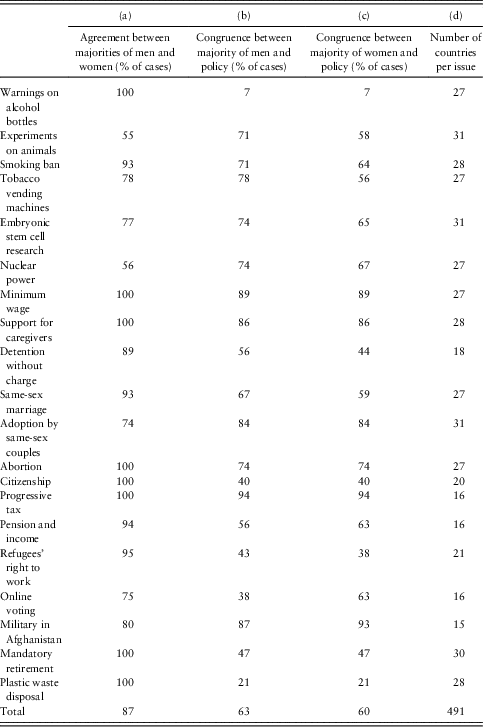
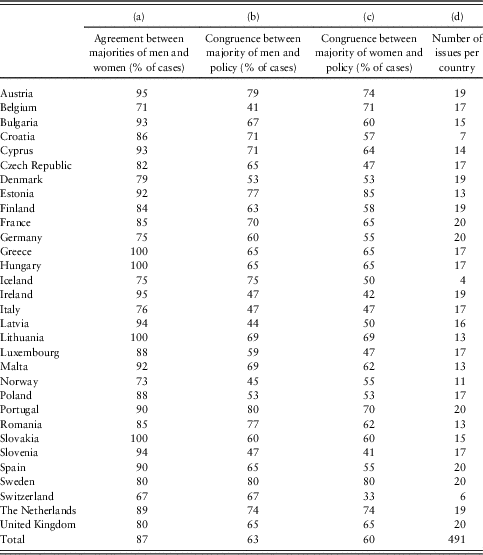
I start by exploring how women and men differ in their support for the 20 policies. Column (a) in Tables 1 and 2 shows the percentages of cases per issue and country, respectively, in which the majorities of women and men hold the same policy preference. The agreement levels are remarkably high: on almost half of the issues, the majorities of men and women agree on the desired direction of policy in all countries. Interestingly, they include the ‘women’s issues’ of abortion rights and financial support for caregivers. Agreement is also very high on economic issues, while we observe most disagreement on ‘new politics’ and ‘cultural’ issues including nuclear power, animal rights, and adoption rights of same-sex couples. Preference agreement is remarkably high in all countries (Table 2), with the lowest levels of around 70% in Switzerland, Belgium, and Norway. Across issues and countries, the majorities of men and women desire the same policy 87% of the time (Figures S2 and S3 provide more detailed illustrations of the patterns).
Preference agreement and policy congruence by issue

Preference agreement and policy congruence by country

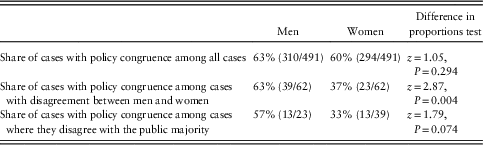
As we would expect based on these observations, women and men have fairly similar levels of policy congruence, as columns (b) and (c) in Tables 1 and 2 show. On average, policy reflects men’s preferences 63% and women’s preferences 60% of the time (Table 3). While evaluating these levels of congruence is somewhat difficult given the lack of clear normative expectations, they are higher than the 50% which Lax and Phillips (Reference Lax and Phillips2012) find across the US states and could be interpreted as good news for democracy in Europe. However, the picture of equality in representation changes when we focus only on the 62 cases where the majorities of women and men disagree with each other (second row in Table 3). Here, we see clear and statistically significant disparities, with men’s preferences being congruent with policy 63% of the time and women’s in only 37% of cases.
Opinion–policy congruence among men and women

However, we might also want to take the preferences of the overall majority into account (cf. Brunner et al., Reference Brunner, Ross and Washington2013). If we consider representation to be fair if policy reflects the views of the majority of citizens, then a social group can be considered ‘overrepresented’ if policy is congruent with its preference while being incongruent with the overall public. The bottom line of Table 3 shows that when the majority position among men does not align with the position of the public majority, they get their preference 57% of the time. For women, it is only 33%. The P-value of the difference is 0.07, but the number of cases included in the sample is quite low. Thus, the findings suggest that although women and men in Europe often hold the same policy preferences, when their views diverge women tend to be represented less often, lending support to Hypothesis 1.Footnote 2
Explaining the gender gap in policy congruence
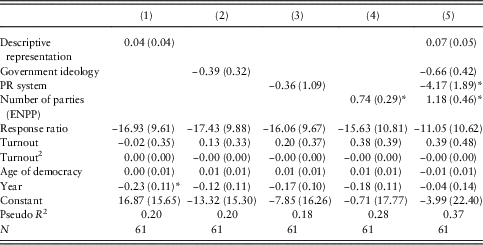
What explains why women or men are represented in the instances where their majorities have different policy positions? To answer this question, I regress the binary indicator of women’s policy congruence on the predictors and controls. I only include the cases with majority disagreement in the analysis, which means that 1 indicates congruence with the majority of women and 0 congruence with the majority of men. Table 4 displays the results of five logistic regression models: the first four test the effect of each independent variable separately along with the controls; the fifth model includes all variables.Footnote 3 Among the control variables, the only significant coefficient is that of the year in Model 1.
Logistic regression models explaining women’s policy congruence

ENPP=effective number of parliamentary parties.
*P<0.05, **P<0.01, ***P<0.001.
The proportion of women in parliament is not associated with subsequent women’s policy congruence in any of the model specifications (Models 1 and 5). This also holds when it is the only variable included and when a squared term is added to test whether a ‘critical mass’ of women in parliament is necessary for the effect to take hold (results not shown) (Dahlerup, Reference Dahlerup1988; Bratton and Ray, Reference Bratton and Ray2002). While this runs counter to the widely held belief that women are more likely to be represented by women, it is in line with the conclusions of several other studies (e.g. Thomas, Reference Thomas1991; Griffin et al., Reference Griffin, Newman and Wolbrecht2012; Bernauer et al., Reference Bernauer, Giger and Rosset2015; Dingler et al., Reference Dingler, Kroeber and Fortin-Rittberger2018). Similarly, we find no significant effect on the ideological position of the government (Models 2 and 5). This might not be very surprising given that women and men largely agreed on the economic issues that tend to be most closely associated with left and right, which are thus largely absent from the sample analyzed here.
Moving on to the electoral system indicators (Models 3 and 4), we find that PR and majoritarian systems do not differ in their propensity to represent women’s or men’s views in policy. In contrast, the higher the effective number of parties in parliament, the higher women’s congruence as compared with men’s. This statistically significant effect persists when including the other predictors (Model 5), suggesting that it does not mask an effect of electoral system proportionality and is not mediated by the proportion of women in parliament. Surprisingly, the coefficient of PR systems becomes statistically significant when controlling for the other variables in Model 5, suggesting that policy is more congruent with women’s preferences in majoritarian systems. Yet, since neither the average district magnitude nor the Gallagher Index has similar effects (Table S5), this finding is not very robust.
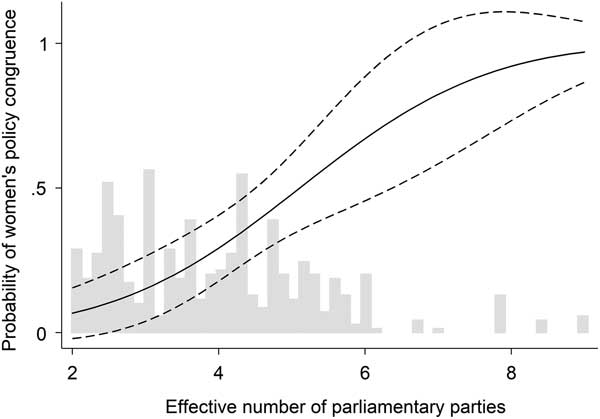
The substantive meaning of the positive coefficient of the number of parliamentary parties is illustrated in Figure 2. The average predicted probability of policy being congruent with women rather than men is at only 7% in systems with an ENPP of around two, like Malta in 2010 and the United Kingdom in 2002. Women and men are equally likely to be represented in systems with around five parliamentary parties. At higher numbers of parties, policy is more likely to be congruent with women than with men. However, only few countries have such high numbers of parties, as the histogram shows – the average parliament in the sample has an ENPP of 4.3, where the probability of congruence is 34% for women and 66% for men.Footnote 4
Predicted probabilities of women’s policy congruence based on effective number of parliamentary parties. Predicted probabilities are calculated from average marginal effects (all other variables at their observed values) based on Model 5 (Table 4).

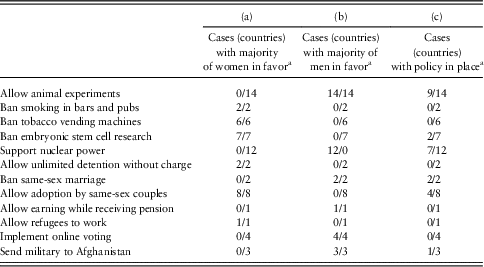
This finding lends support to the proposition that parliaments with more parties are more likely to include a party that promotes policies supported by women. To explore this further, I take a closer look at the issues on which women and men disagree. As discussed earlier, these are mostly ‘new politics’ and ‘cultural’ issues that are less strongly associated with traditional left–right politics. Table 5 shows astonishing cross-national coherence in the gendered preference patterns on these issues: on all of them, women take the same position in every country, as do men. Women show a strong tendency to favor policies championed by Green and left-libertarian parties, such as bans on nuclear energy and adoption rights for same-sex couples. Does this mean that women’s higher congruence in contexts with more parties is due to the stronger presence and power of these types of parties?
Women’s and men’s preferences and policy on issues with majority disagreement

a The samples only include the cases with disagreement between the majorities of women and men.
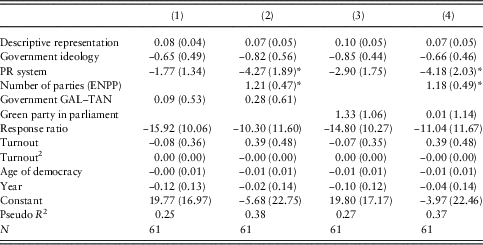
I test this proposition in two ways. First, I include a measure of the government position on the GAL–TAN dimension based on the Chapel Hill Expert Survey, where lower values indicate more libertarian/post-materialist positions and higher values more traditional/authoritarian views (Bakker et al., Reference Bakker, Edwards, Hooghe and Jolly2015). In addition, I measure whether a Green party was represented in parliament in the previous year based on ParlGov data (Döring and Manow, Reference Döring and Manow2016). As Table 6 shows, neither of the two measures affect women’s policy congruence when substituted for the ENPP variable. This suggests that a higher likelihood of some parliamentary party being present which represents women’s preferences particularly well, rather than necessarily a Green or left-libertarian party, may explain women’s better policy representation in multi-party systems.
Logistic regression of women’s policy congruence on GAL–TAN position of the government and Green party presence

ENPP=effective number of parliamentary parties.
*P<0.05, **P<0.01, ***P<0.001
Conclusion
Women are still in the minority in most parliaments and positions of political power across Europe and the world. But are the policies that govern societies also less reflective of the preferences of women than those of men? This study is the first to investigate this question by looking a diverse set of concrete policies across Europe. It revealed that the majorities of women and men have remarkably similar preferences on many policy issues. In these cases, policy is naturally representative of the views of both genders, although the representation of one group could certainly be ‘coincidental’ (cf. Enns, Reference Enns2015). Importantly, however, when women and men have divergent policy positions, men are more likely to see their demands fulfilled. This insight corresponds with Homola’s (Reference Homola2017) finding of a bias in party responsiveness towards men’s views, while diverging from recent conclusions that parliaments in Europe present women’s ideological views as well as men’s (Bernauer et al., Reference Bernauer, Giger and Rosset2015) and their positions on more specific policy dimensions even better than men’s (Dingler et al., Reference Dingler, Kroeber and Fortin-Rittberger2018). These contrasting results highlight the value of examining policy representation on various policy dimensions as well as at different stages of the policy-making process, from the drafting of election manifestos to concrete policy outcomes, at which biases might be introduced and corrected (cf. Htun et al., Reference Htun, Lacalle and Micozzi2013).
Despite prominent theoretical accounts (Phillips, Reference Phillips1995; Mansbridge, Reference Mansbridge1999) and a range of studies (e.g. Bratton and Ray, Reference Bratton and Ray2002; Kittilson, Reference Kittilson2008; Campbell et al., Reference Campbell, Childs and Lovenduski2010) suggesting that women are better at representing women, no effect of the proportion of women in parliament on their substantive representation in policy was found. This result, which echoes findings by Dingler et al. (Reference Dingler, Kroeber and Fortin-Rittberger2018), could be seen as a further encouragement to shift our attention away from mere numbers and towards the actions of ‘critical actors’ and the specific institutions and structures in which they operate (cf. Childs and Withey, Reference Childs and Withey2006; Childs and Krook, Reference Childs and Krook2009; Sawer, Reference Sawer2012). At the same time, the role of descriptive representation might be restricted to certain issues, for instance those with particular relevance to women (e.g. Bratton and Ray, Reference Bratton and Ray2002; Schwindt-Bayer and Mishler, Reference Schwindt-Bayer and Mishler2005; Kittilson, Reference Kittilson2008; Wängnerud and Sundell, Reference Wängnerud and Sundell2012). Since women and men largely agreed on issues like abortion and support for caregivers, this study would not have picked up such effects. Other policy-related factors might also condition the relationship: Bratton and Ray (Reference Bratton and Ray2002), for instance, highlight the importance of women’s presence in the phase of policy innovation.
Similarly, the finding that women’s relative policy congruence is not enhanced by more left-wing governments might be due to the study’s focus on issues with gender disagreement, which was low on economic issues closely related to left–right ideology. Instead, women tended to be more supportive of libertarian and pro-environmental policies (cf. Dingler et al., Reference Dingler, Kroeber and Fortin-Rittberger2018). However, neither governments’ positions on the authoritarian–libertarian dimension nor the presence of Green parties could explain women’s representation on these issues. Thus, the observed effect of women’s higher congruence in contexts with more parliamentary parties does not seem to be explained by Green parties promoting libertarian and environment policies. This could be because the success of Green parties might actually incentivize mainstream parties to not emphasize environmental issues in order to prevent boosting the challenger’s popularity (Abou-Chadi, Reference Abou-Chadi2016).
However, contagion mechanisms might nevertheless play an important role. The presence of a party with internal institutions and practices that promote the substantive representation of women’s preferences, which can then ‘spread’ to other parties, might be more likely in parliaments with higher numbers of parties. Since the analysis controlled for the number of women in parliament, these need to be practices that go beyond increasing the number of women (Matland and Studlar, Reference Matland and Studlar1996; Caul, Reference Caul2001) – for instance, the promotion of women into leadership roles, women’s sections within parties, or rules for alternation between male and female speakers at party meetings, like those of the German Greens.
Further research into the topic should also incorporate policy priorities. On the one hand, this might improve our evaluations of the policy representation of women and men, which is arguably better when they are well represented on the issues they care most about and when their respective policy priorities are high on the agendas of policy-makers. On the other hand, it might help us determine what explains gender disparities in representation. The issues on which women desire policy change might be particularly salient to them, which means that finding out which factors increase policy-makers’ attention to women’s priorities might ultimately help us understand what explains the representation of their positions in policy.
Finally, like much of the research on women’s representation, this study compared all women with all men, not least because of data restrictions imposed by the cross-national, multi-issue, policy-centered approach. Yet, further research should take individuals’ diversity in backgrounds and views into account, as inequality in representation is likely to exist not only between but also among women and men. Intersectional approaches thus have the potential to uncover additional patterns and gaps in representation and enrichen our knowledge about their causes.
Acknowledgments
The research received support from Sapere Aude Grant 0602-02642B from the Danish Council for Independent Research. The author would like to thank Anne Rasmussen, Lars Mäder, and the other members of the GovLis project as well as Paul Burstein, Jonathan Chapman, Marta Fraile, and Martin Vinæs Larsen for their helpful comments on earlier versions of this article, as well as the editors and three anonymous reviewers. The article also benefited from comments received at the 2016 and 2017 GovLis workshops, the 2016 EPSA and 2017 MPSA and EPOP Conferences, and the ‘Diversity and Unity’ group at the European University Institute. Cæcilie Venzel Nielsen provided valuable research assistance.
Supplementary material
To view supplementary material for this article, please visit https://doi.org/10.1017/S1755773918000140