INTRODUCTION
In the first census of marine and estuarine alien species on the Basque coast, twenty-eight alien mollusc species originally from the tropical, subtropical and temperate areas, were listed (Martínez & Adarraga, Reference Martínez and Adarraga2005, Reference Martínez and Adarraga2006). Since then, three more species have been added to the Basque malacofauna: the gastropod Potamopyrgus antipodarum Gray, 1843, small snail native to New Zealand collected in three estuaries of Bizkaia since 2008–2009 (Artibai, Barbadum and Oka, unpublished data); the Asian mussel Musculista senhousia (Benson in Cantor, 1842), mytilid recorded in the Bidasoa Estuary (Bachelet et al., Reference Bachelet, Blanchet, Cottet, Dang, de Montaudouin, de Moura Queirós, Gouillieux and Lavesque2008) and recently collected in 2010 in the Nervión Estuary (unpublished data); and Limnoperna securis (Lamarck, 1819), another mytilid native to the south-west Pacific (Australia and New Zealand) (Wilson, Reference Wilson1967) identified in 2010 in the Nervión Estuary (Adarraga & Martínez, in press). According to our research, Theora lubrica is the last alien species detected on the Basque coast.
Theora lubrica is a member of the Semelidae, a familiy that includes eight genera of marine and brackish-water bivalve molluscs of the order Veneroida (Powell, Reference Powell1979), widely distributed in tropical seas. Theora is the sixth genus recorded in the Atlantic Ocean after Abra, Cumingia, Ervilia, Scrobicularia and Semele. Among these, only Abra and Scrobicularia have been found on the Basque coast.
This small bivalve is a selective deposit feeder that normally inhabits in bays, basins, ports and harbours. In these ambient conditions, it lives on the surface of subtidal soft-bottoms, preferably on muddy sediments with high organic matter percentages (Morley, Reference Morley1995; Hayward et al., Reference Hayward, Morley, Hayward, Stephenson, Blom, Hayward and Grenfell1999; Yokoyama & Ishihi, Reference Yokoyama and Ishihi2003). Bathymetrically, it can appear from low tide mark to 50 m, and exceptionally it has been found at 100 m (Inglis et al., Reference Inglis, Gust, Fitridge, Floerl, Woods, Hayden and Fenwick2006).
Native to the east coast of Asia, from Japan south to Singapore and Indonesia, T. lubrica has shown a wide capacity to colonize other geographical regions. The first record outside its natural range was from Port Philip Bay, Australia in 1958 as Theora fragilis (Macpherson, Reference Macpherson1966). Since then, the geographical range of T. lubrica has has become and it has established viable populations worldwide. In Australia it has been introduced from New South Wales to eastern South Australia and Tasmania (Wells et al., Reference Wells, McDonald and Huisman2009). Some records include: Portland Harbour (Parry et al., Reference Parry, Currie and Crookes1997); Devenport, Westernport, Botany Bay (Cohen et al., Reference Cohen, McArthur and Parry2001); and Sydney Harbour (Berents & Hutchins, Reference Berents and Hutchins2002). In Western Australia, it was collected in Swan River, Rockingham and Bunbury (Wells et al., Reference Wells, McDonald and Huisman2009). In New Zealand it was found in estuaries of the north-east coast of the North Island (Inglis et al., Reference Inglis, Gust, Fitridge, Floerl, Woods, Hayden and Fenwick2006), Auckland Harbour (Climo, Reference Climo1976), Golden Bay, Marlborough (Foster & Willan, Reference Foster and Willan1979) and other numerous ports (Hayward et al., Reference Hayward, Stephenson, Morley, Riley and Grenfell1997, Reference Hayward, Morley, Hayward, Stephenson, Blom, Hayward and Grenfell1999; Inglis et al., Reference Inglis, Gust, Fitridge, Floerl, Woods, Hayden and Fenwick2006). In western North America, there are records in Los Angeles Port (Seapy, Reference Seapy1974), San Francisco Port (Carlton, Reference Carlton1979) and California (Ranasinghe et al., Reference Ranasinghe, Mikel, Velarde, Weisberg, Montagne, Cadien and Dalkey2005). More recently, it was found in Europe and south-west Asia. In 2001 it was collected inside Livorno Harbour, Italy (Belena et al., 2002); whereas in 2006 it was taken in Haifa Bay, Israel (Bogi & Galil, Reference Bogi and Galil2007).
In two studies carried out in 2010 about the macrofaunal soft bottom communities in Nervión Estuary and Pasajes Port (Basque country, south-eastern Bay of Biscay), numerous individuals of the Asian clam T. lubrica have been identified. Originally identified as Semelidae (authors, unpublished data), a recent re-examination of these specimens has revealed its real status. A post-hoc survey into Pasajes Port where new material was collected (see additional material), has confirmed the successful establishment of this semelid. This discovery represents the first record of T. lubrica in the Atlantic Ocean.
MATERIALS AND METHODS
Study area
Theora lubrica was found in four sites located in the Nervión Estuary and Pasajes Port as part of two bio-monitoring programmes carried out by AZTI-TECNALIA (Basque Technological Centre Specialized in Marine Research) on behalf of Consorcio de Aguas de Bilbao and the Autoridad Portuaria de Pasajes, respectively.
The Nervión River that runs through the city of Bilbao is located in the north-east of the Iberian Peninsula into the Cantabrian Sea (Bay of Biscay). The final tract, the zone of marine influence constitutes the Nervión Estuary. This estuary is 22 km long and communicates with the sea through the port of Bilbao.
The natural features of the estuary have been modified dramatically by urban, industrial and port settlements, which have occupied practically the whole valley during the last 150 years (Cearreta et al., Reference Cearreta, Irabien, Pascual, Borja and Collins2004).
Samples where T. lubrica was found were collected in the small basins of Udondo and Axpe. Both are located in the middle reaches of the estuary at 5.8 m depth, near to Bilbao Port (Stations 1 and 2; Figure 1).
Map showing the study area and the locations of the four stations where Theora lubrica has been collected.

Moreover, the port of Pasajes is also located in the north-east of the Iberian Peninsula, on the eastern end of Gipuzkoa province. This natural port provides a bay for total shelter oft ships.
In Pasajes Port, T. lubrica was collected in the central channel at 12.2 and 11.4 m depth (Stations 3 and 4; Figure 1).
Methodology
Samples were taken by AZTI-TECNALIA on 6 October 2010 in Bilbao Estuary and 21 May 2010 in Pasajes Port. In the first case, two benthic replicates were collected at each station using a Van Veen dredge (0.1 m2); whereas in the second one, three replicates were collected using a Shipeck dredge (0.04 m2). The sediments were washed through a 1 mm mesh sieve and fixed with a 4% formalin solution. In the laboratory the samples were sorted and transferred to 70% ethanol. Afterwards, we identified all specimens to species or lowest possible taxon under an Olympus stereomicroscope and a Zeiss microscope. Theora lubrica individuals were measured using a digital calibre and an ocular micrometer in the case of the smaller ones. Photographs were taken with a Nikon D50 digital camera adapted to an Olympus stereomicroscope.
The ecological descriptors used for the macrobenthic community characterization were: richness (number of identified taxa), density (ind./m2), specific diversity (H′) (Shannon & Weaver, Reference Shannon and Weaver1963) and the trophic structure.
At each station, a supplementary grab was taken for sediment analysis. The granulometric analyses were carried out using a column of 8 sieves (4 mm to 31 um). The percentages of gravel, sand and mud were calculated as >2 mm fraction, 63 um to 2 mm and <63 um, respectively (Holme & McIntyre, Reference Holme and McIntyre1971 in Borja et al., Reference Borja, Muxika and Franco2006). The organic matter content was calculated using the ‘loss on ignition’ method (Kristensen & Anderson, Reference Kristensen and Andersen1993 in Borja et al., Reference Borja, Muxika and Franco2006).
RESULTS
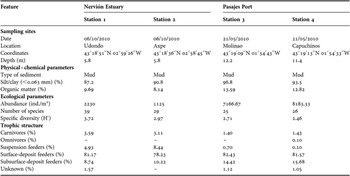
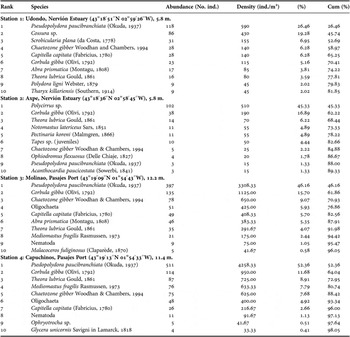
One hundred and fifty-two specimens of T. lubrica were identified in 2010 in two localities of Basque country (south-eastern Bay of Biscay) as part of two monitoring programmes carried out by AZTI-TECNALIA for the Consorcio de Aguas de Bilbao and the Auroridad Portuaria de Pasajes (Figure 1). The individuals were found in the middle reaches of Nervión Estuary (Stations 1 and 2), and in the central channel of Pasajes Port (Stations 3 and 4). All individuals were also taken on muddy sediments (87.2–96.8% mud) with elevated organic content (8.14–15.59%) at 5.8–12.2 m depth. A total of 2513 organisms were identified from these four sampling stations, belonging to 62 species or higher taxa. The annelids were numerically dominant with 73.6% of the total abundance. The molluscs comprised 25.1% and the other taxa accounted for only 1% of the total individuals. The trophic structure shows a dominance of surface-deposit feeders (80.85%), subsurface-deposit feeders (12.27%) and filter feeders (3.54%). To specific level, the more abundant species were the annelids: Pseudopolydora paucibranchiata (Okuda, 1937); Capitella capitata (Fabricius, 1780); Mediomastus fragilis Rasmussen, 1973 and Chaetozone gibber Woodham & Chambers, 1994; and the bivalves Corbula gibba (Olivi, 1792) and T. lubrica. The abundance of T. lubrica ranged between 80 and 725 ind./m2. The composition of the sediment and ecological parameters at each station are summarized in Table 1; while the top-ten species (ranked by abundance) for the four stations are detailed in Table 2.
Résumé of principal features for the four stations where Theora lubrica was collected.

Top-ten ranked taxa for the four stations where Theora lubrica was collected.

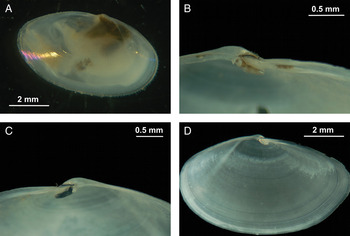
Theora lubrica (from Pasajes Port, Spain): (A) live specimen from the port of Pasajes collected 7 April 2011; (B) the hinge line of the right valve; (C) the hinge line of the left valve; (D) view of the inside of the right valve (photographed by Julián Martínez).

MATERIAL EXAMINED
Sixteen individuals, Udondo Basin, Station 1 (43°18′51″N 02°59′26″W), mud sediment, 5.8 m depth, 6 October 2010; 14 individuals, Axpe Basin, Station 2 (43°18′36″N 02°58′45″W), mud sediment, 5.8 m depth, 6 October 2010; 35 individuals, Molinao, Station 3 (43°19′09″N 01°54′43″W), mud sediment, 12.2 m depth, 21 May 2010; 87 individuals, Capuchinos, station 4 (43°19′13″N 01°54′33″W), mud sediment, 11.4 m depth, 21 May 2010.
ADDITIONAL COMPARATIVE MATERIAL
Twenty-four individuals, Molinao, station 3 (43°19′09″N 01°54′43″W), mud sediment, 10.9 m depth, 7 April 2011; 99 individuals, Capuchinos, station 4 (43°19′13″N 01°54′33″W), mud sediment 10.0 m depth, 7 April 2011.
SHORT DESCRIPTION
Small semi-transparent bivalve, weak, brittle, equivalve; quasi-equilateral, beaks practically in the midline; elongate and elliptic in outline (Figure 2A). Periostracum smooth and shining; the large specimens measure up to 15–16 mm in length. External ligament a small brown arched band. Sculpture of fine concentric lines. Growth stages often not clear. Right valve with two small projecting cardinal teeth and single anterior and posterior laterals (Figure 2B); left valve with one cardinal tooth and single anterior and posterior laterals (Figure 2C). Anterior abductor thinner and longer than the posterior. Pallial sinus deep with its lower border partly confluent with the pallial line. Margin smooth.
REMARKS
Externally, T. lubrica is similar to Abra nitida (Müller 1776) and A. prismatica (Montagu, 1808) in having a semi-transparent and elongated shell with fine concentric growth lines. The three species can be distinguished because T. lubrica has a fine elongate rib extending obliquely across the internal surface of the shell, also visible by transparency (Figure 2A, D), absent in the others. In addition, T. lubrica has the beaks more or less in the midline, A. nitida slightly behind the midline and A. prismatica in the posterior half.
DISCUSSION
The geographical extension of T. lubrica constitutes an example of how a species can colonize new environments once outside its native habitat. Since the second half of the 20th Century, this Asian semelid has established viable populations in Oceania, North America and Europe. In these continents it has been recorded in the western and eastern Pacific Ocean, Mediterranean Sea and Atlantic Ocean.
A quick analysis of different records of T. lubrica shows that the majority of specimens have been found in the vicinity of areas with heavy shipping. Over many centuries, the naval transport has accidentally contributed to the spread of marine organisms. Actually, many researchers point to commercial shipping as the main cause of introduction of alien marine species worldwide (e.g. Eno et al., Reference Eno, Clark and Sanderson1997; Forrest et al., Reference Forrest, Taylor and Hay1997; Hayward et al., Reference Hayward, Stephenson, Morley, Riley and Grenfell1997; Wilson et al., Reference Wilson, Heislers and Poore1998; Gollasch, Reference Gollasch1999; Steneck & Carlton, Reference Steneck, Carlton, Bertness, Gaines and Hay2001; Blanchard et al., Reference Blanchard, Feder and Shaw2002; Leppakoski et al., Reference Leppakoski, Gollasch, Gruszka, Ojaveer and Olenin2002; Fofonoff et al., Reference Fofonoff, Ruiz, Steves, Carlton, Ruiz and Carlton2003; Hewitt & Pilditch, Reference Hewitt and Pilditch2004; Je et al., Reference Je, Belan, Levings and Koo2004; Otani, Reference Otani2004; Hirsch, Reference Hirsch2005).
The ports of Bilbao and Pasajes are part of the 28 Port Authorities of State ownership in Spain, 5th and 16th respectively in the ranking of total port traffic. For this reason, ship activity is the most likely mechanism of introduction of T. lubrica to the Basque coast, either via ballast water or sediments. Among these, the larval transport in ballast tanks is the widely proposed mechanism for the introduction and spread of T. lubrica (Climo, Reference Climo1976; Balena et al., Reference Balena, Campani, Coppini and Margelli2002, in Bogi & Galil, Reference Bogi and Galil2007). Larvae of this semelid have been collected in the ballast water of Japanese ships arriving in Oregon, USA by Carlton et al. (Reference Carlton, Thompson, Schemel and Nichols1990). Hull fouling is not considered a potential vector for transport, because these species do not colonize hard substrates (Aquenal, 2001). Theora lubrica would therefore be one of 15,000 species that are moved around the world every week in ballast water (Steneck & Carlton, Reference Steneck, Carlton, Bertness, Gaines and Hay2001).
In its natural range, T. lubrica can reach abundant populations, of which adult individuals appear to migrate gradually to offshore soft-muddy areas (Imabayashi & Tsukuda, Reference Imabayashi and Tsukuda1984). Patterns of its biology include: a regular univoltine cycle, seasonal changes in the abundance, short life span (several months), rapid growth and maturation (1 to 3 months at first reproduction), continuous recruitment (more than seven cohorts released throughout the year), extended breeding season and capacity of spawning all the year round (Kikuchi & Tanaka, Reference Kikuchi and Tanaka1976; Imabayashi & Tsukuda, Reference Imabayashi and Tsukuda1984; Imabayashi, Reference Imabayashi1986; Imabayashi & Wakabayashi, Reference Imabayashi and Wakabayashi1992). All these traits are typical characteristics of a successful invader (Ehrlich, Reference Ehrlich, Drake, Money, Castri, Groves, Kruger, Rejmanek and Williamson1989; Fletcher & Farrell, Reference Fletcher and Farrell1999; Kerckhof et al., Reference Kerckhof, Vink, Nieweg and Post2006).
As discussed above, a common feature of all references to T. lubrica in their new settlements is the type of habitat. Ports, basins, bays and estuaries adjacent to shipping activity areas are environments where this species normally has been recorded. In most cases, these areas are degraded (low dissolved oxygen levels, elevated organic matter percentages, contaminated sediments, low specific richness and low diversity). The potential impact of T. lubrica introduction can be variable, both positive and negative. The positive effects include: increased specific diversity, processing contaminated sediments by filtering (bioturbation) and provision of a supplementary food source (Ruth, Reference Ruth2005). On the contrary, the negative impacts are the possible alteration of habitats and biogeochemical cycles by liberating nitrogenous compounds from bottom sediments (Yamada & Kayama, Reference Yamada and Kayama1987). Bivalves such as T. lubrica are vulnerable to bioaccumulation. These organisms can accumulate discharged contaminants and pathogens to harmful levels, which can affect species population levels, and in turn, impact on community and ecosystem structures. These toxic substances can also adversely affect the health of any organism feeding on them, because they bio-accumulate up the food chain (Chen & Chend, Reference Chen and Chend1999; Champ, Reference Champ2000; Morrison et al., Reference Morrison, Whittle and Haffner2000; Baudrimont et al., Reference Baudrimont, Schafer, Marie, Maury-Brachet, Bossy, Boudou and Blanc2005).
The effects of T. lubrica in the Nervión Estuary and Pasajes Port are still uncertain. The first collection belongs to the year 2010. Only in Pasajes, can we repeat the same sampling stations after T. lubrica introduction. According to preliminary results, we have not observed adverse impacts to macrofauna communities. Number of species and specific diversity remain more or less the same. Further monitoring will be necessary in order to analyse the evolution of this exotic mollusc in the area.
Finally, according to our last survey (Adarraga & Martínez, in press), we must insist on greater control of the naval transport. Theora lubrica is, after the mytilid L. securis, the second alien species detected in 2010 on the Basque coast. Both are considered actually as two of the worst invasive alien species in Europe (Balena et al., Reference Balena, Campani, Coppini and Margelli2002; SEBI, 2010).
ACKNOWLEDGEMENTS
We thank AZTI-TECNALIA, Consorcio de Aguas de Bilbao-Bizkaia and Autoridad Portuaria de Pasajes for providing the samples. We also thank Enrike Crespo captain of the ship ‘Ana María’; Olatz Adarraga for correcting the English of the text; and the anonymous referees for their constructive comments on the manuscript.