Introduction
In early 1904 the leading circus entrepreneurs of the Australasian region, the FitzGerald Brothers’ Circus, presented a team of Japanese sumo wrestlers to Australian audiences. The circus asserted this was the first troupe of professional sumo wrestlers ever to leave Japan and there is no evidence to contradict this claim.Footnote 1 Early reviews of the wrestlers’ performances reveal that initial audience response to the ceremonial rituals, costumes, and wrestling action of the troupe included polite mystification.Footnote 2 Notwithstanding the tone of early reviews, however, the sumo wrestlers became the star attraction at this high-profile circus for the term of their sixteen-month contract, during which they toured throughout Australia and New Zealand, to the Dutch East Indies and Singapore.
Circus scholar Peta Tait has acutely observed that the circus ‘remains opportunistically responsive to social fashions, political events and shifts in cultural moods’,Footnote 3 and this article acknowledges the circusian opportunism exerted by the FitzGeralds, who mobilized contemporary world politics as the lever to promote the Japanese wrestlers’ act. Whilst there is no evidence that the sumo wrestling action influenced social behaviour in ways that contemporary icons of the international physical culture movement did – and here I am referring particularly to Eugen Sandow and the international physical culture industry he inspired – it seems very likely that the sumo wrestlers transmitted the first performances of ju-jitsu to Australasian audiences in 1905.Footnote 4 Recent research by Diana Looser has revealed that ju-jitsu classes for women began ‘around 1905’ in New Zealand, approximately the same time that New Zealand newspapers began reporting women's martial arts classes in Britain and the United States.Footnote 5 This timing coincides with the Japanese wrestlers’ extensive tour of New Zealand, therefore providing evidence for the circus's role in the transnational circulation of the martial arts on popular stages.
Thomas Postlewait has reminded all performance historians to ‘describe and interpret the relations between events and their possible context’, acknowledging that the problem inherent in this process is to mark ‘the defining traits of any context’ as well as ‘the causal features that contribute to the making of the event’.Footnote 6 Heeding Postlewait's advice, this article draws upon primary sources concerning the contractual engagement, conditions and features of performance, and the reception of the sumo wrestlers during the sixteen months of their contract with the Australian circus. Further, the sociopolitical environment of Australia's international relations is also examined alongside relevant media reviews, and the circus's promotional tactics concerning the Japanese wrestlers.
By examining the tour of the Japanese sumo wrestlers within the context of Australia's international political relations (the duration of the wrestlers’ sixteen-month contract coincided with the Russo-Japanese War), this article also contributes to our understanding of the circus more generally as a politically dynamic site where performative transnational encounters were nurtured. Paying close attention to the educational, political and dramaturgical strategies mobilized on account of the sumo wrestlers, this article reveals that the circus staged a cosmopolitanism that arose ‘from the commercialization and politicization of cultural difference’.Footnote 7 While this quote from Helen Gilbert and Jacqueline Lo's Performance and Cosmopolitics refers to our contemporary globalized performing-arts market, this article's focus on the years 1904–5 reveals the case of a high-profile circus of the early twentieth century that also staged cosmopolitanism through its presentation of performers from many different cultures.Footnote 8 The case of the sumo wrestlers reveals, furthermore, that the circus worked to undermine negative racial stereotypes prevalent in Australia's homeland culture.
Sumo wrestlers at the Australian circus
The FitzGerald Brothers were the pre-eminent circus entrepreneurs of the Australasian region during the years 1892–1906. Dan (1859–1906) and Tom FitzGerald (1865–1906) managed the company and produced the circus shows while John FitzGerald (1862–1922), a barrister and career politician, took some responsibility for the company's finances, occasionally adopting a managerial role when required. In keeping with entrepreneurial patterns set by other Australia-based theatrical producers of the later decades of the nineteenth century, the FitzGerald Brothers shopped internationally for acts in entertainment centres of the northern hemisphere such as London and Paris. Their lavish annual travelling productions attracted large and enthusiastic audiences of all classes in the metropolitan centres and rural towns their two circuses visited throughout Australia and New Zealand.
Throughout the early years of the twentieth century the FitzGeralds’ circus programmes reflected the broad changes occurring gradually on circus programmes internationally: the traditional dominance of equestrian performance was declining in favour of elite aerial acts and other routines that were equally at home on the variety stage or in the circus arena.Footnote 9 There was, as well, throughout this period, an increasing slippage between the sporting arena and the circus ring. The production of equestrian steeplechase action in and around the circus tent, and competitive high jumping acts in the circus ring, were theatrically framed sporting events that echoed the nineteenth-century circus's dependence upon the horse. Bicycle acts, performed by comic trick cyclists, or by teams of riders ‘competing’ against one another in a teacup-shaped velodrome within the circus ring, are further examples of some of the new, sport-inspired performances that displaced the traditional primacy of equestrian acts throughout the early years of the twentieth century.Footnote 10 During 1904, theatricalized wrestling competition emerged as the latest performance trend on Australia's popular variety and circus stages,Footnote 11 attributed by reviewers of the Australian theatre press as the result of yet another ‘wrestling boom’ on variety stages in England.Footnote 12 The FitzGeralds’ engagement of sumo wrestlers at this time chimed with two trends emerging in contemporary popular culture: the appearance of the wrestlers extended the burgeoning relationship between the circus and competitive sport, whilst at the same time it dovetailed with the contemporary fascination for physical culture.Footnote 13
Sumo is deeply rooted in agricultural and feudal culture and retains religious symbolism associated with Asian cosmology and the traditional Japanese religions of Shinto and Buddhism.Footnote 14 The straw in the rope that marks the performance ring of sumo, and comprises the rope belt awarded to the champion, is an important ritual material in Shinto, as is rice, apparent in the rice bags that mark the rectangular space outside the wrestling ring. Salt, sprinkled in the ring before wrestling contests begin, is a purifying symbol widely used in Shinto, whilst the ritual of washing out the mouth with water before a fight reflects ‘a purification ritual performed in Shinto by those about to pray to the gods’.Footnote 15 Yamaguchi Masao has described the very short wrestling contests that are prefaced by lengthy ritualized and theatrical preparation as ‘a mythical battle fought between the positive and negative elements of the cosmos in which the former is always the winner and the latter the loser’.Footnote 16 Masao has claimed the theatrical nature of sumo through an alignment of its key performance features with those of kabuki theatre. The performance similarities Masao cites are stylized gestures, the delineation of ceremonial space in which both sumo and kabuki occur, and aesthetic trappings such as costume, all of which produce and mark ‘a festive space which is separate from everyday life’.Footnote 17 By extension, then, the circular festive space of sumo, and its ritualized theatricality, stylized physical action, symbolic costumes, and production of physical supremacy as popular entertainment, could also be said to align with prominent characteristics of circus performance.Footnote 18 Mapping correlative elements of circus and sumo in this way suggests, moreover, that far from being difficult to read as entertainment, the performance signifiers of sumo were sufficiently recognizable to a popular Australian audience. This seems likely when we take into consideration the fact that Australian audiences of this era were extremely literate in circus performance, and accustomed to being entertained by the extraordinary bodies, skills, sights and sensations that the circus produced. (Popular Australian audiences were also keen followers of sport and knowledgeable about Western wrestling codes. Approbation of the sumo wrestlers’ physical prowess is addressed later in this article.) My point here concerning the performance parallels between circus and sumo is further strengthened by Masao's suggestion that sumo might be regarded ‘as a kind of freak show’,Footnote 19 in which near-naked men perform battles to determine physical and tactical supremacy. Whilst freaks of nature or, more correctly, ‘prodigies’ were not a feature of the early twentieth-century circus in Australia, the circus was nevertheless a performance arena for the entertaining display of extraordinary feats of physical skill.
Other questions to ask about this innovative and seemingly anomalous coupling of circus and sumo are those that interrogate the ‘why’ and ‘how’ of the contractual engagement. Archival sources provide basic information about the circumstances of the Japanese wrestlers’ contractual agreement with the circus, but only speculation can address the question of why the wrestlers sought to leave Japan and the rigidly structured social, ritual and competitive system that has governed sumo since feudal times.Footnote 20 The strict traditions of sumo stipulate that a wrestler's ranking within the code's pyramidic structure is determined by ongoing participation in the annual cycle of competition. A contract with an Australian circus would have effectively removed the wrestlers from the social and competitive structure that defined their position within sumo society, and Japanese society more generally. In one sense they were fulfilling the outward-looking imperatives that characterized Japan during the Meiji era (1868–1912) when Japan actively promoted her national profile overseas through the export of her cultural products, but this is not a particularly strong argument. A small clue, however, recorded in a newspaper review during a tour of New Zealand, suggests that the wrestlers were able both to perform overseas and to maintain a position within the code's ranking system. In an address to the audience in which he described the rules and customs of sumo, Dr Gordon (the circus's strongman), explained that in order to maintain their prestige within sumo society, every one of the wrestling contests performed with the circus ‘was recorded and duly registered in Japan’.Footnote 21
John FitzGerald engaged the wrestlers in 1903 whilst visiting Japan, where he attended an infrequent tournament in Noji between an estimated seven hundred traditional wrestlers.Footnote 22 Letters sent home to his brothers in Australia convey an excitement about being caught up in the moment of the Noji tournament, but they also reveal that he responded to the performances as a theatricalized show, embedded with qualities essential to the circus such as comedy, practised dexterity and a high level of physical skill. Animated audience responses and the proxemics of the circular sumo ring, which, although smaller, matched the single circus ring used by the FitzGeralds, were elements of the sumo performances that may also have persuaded John to engage the Japanese wrestlers.Footnote 23 He wrote to his brothers,
The trick men are for throwing all the time and in doing this they get into the most extraordinary complications and twists and make such marvellous [word unclear] that the audience shouts and screams with laughter and cheers, while they are calm and unemotional while the men wrestling proceed. I cannot describe the effect of this extraordinary circus act. It took the crowd by storm. Then they were so humorous and had such funny tricks. They were so adroit at falling, too, that each fall brought about a frank dispute with the umpire and the thing had to be fought out again. The audience screamed and donated presents.Footnote 24
John's insistence that these were ‘trick’ wrestlers, and that their bouts were comical, suggests that they may not have been performing the style of sumo wrestling with which Western audiences are now familiar; a similar point was made by the entertainment press of the time:
The wrestling they give is not the wrestling they do in the great contests in Japan. That has little throwing in it, the great effort being concentrated to push the adversary over the straw ropes. What we are given is a system of ‘fancy wrestling,’ still distinctively Japanese, but more suited than the orthodox to the understanding of the foreigner.Footnote 25
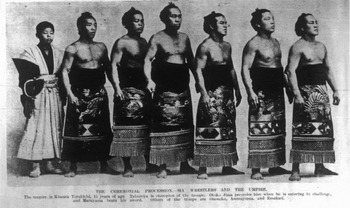
The wrestlers Tokanoya, Onenoko, Aremayuma (or Arumyama), Emakari (or Miyicardi), Maruyama and Otoko Jima, with their fifteen-year-old umpire Torakichi, and an interpreter, disembarked in Sydney in April 1904, nearly five months after meeting John FitzGerald at the tournament in Noji (Fig. 1).Footnote 26 The terms of engagement for the wrestlers and umpire were one pound per week each, or £50 per year (500 yen), with half a year's salary payable in advance, while their interpreter was to be paid £1 16s per week.Footnote 27Arriving ten days after the opening of the FitzGeralds’ traditional Easter season in Sydney, the belated appearance of the Japanese wrestlers was attributed to delays caused inevitably by the outbreak of the Russo-Japanese War.Footnote 28 From their first performance in Australia in Sydney on Easter Monday, 4 April, until their final performances with the circus in Singapore in early August 1905,Footnote 29 the circus billed the Japanese wrestlers as their headline act.Footnote 30
‘The Ceremonial Procession – six wrestlers and the umpire. The umpire is Kimura Torakichi, 15 years of age. Tokanoya is champion of the troupe. Otoko Jima precedes him when he is entering to challenge, and Maruyama bears his sword. Others of the troupe are Onenoko, Aremayuma, and Emakari.’ Sydney Mail, 13 April 1904. Courtesy of the National Library of Australia.

Newspaper reviews and incidental notes by print journalists constitute the principal archival traces of the wrestlers’ tour, and in seeking to understand how the performances occurred we must rely upon these eyewitness accounts. A writer for the Sydney Mail working under the pseudonym ‘Te Whero’ published a systematic description of the ceremonial rituals, processes and action of the performance in which the wrestlers fought each other earnestly to determine the champion amongst them. Te Whero's essay explained the history and cultural significance of the Japanese wrestling guilds, likening the wrestlers’ hero status in Japan to the English cricketer or footballer, to the American baseballer or prizefighter, and ‘in Australia to the racehorse, the champion cyclist, the great cricketer, or the prominent footballer’.Footnote 31 The wrestlers’ appeal to popular Australian audiences was regularly analysed by journalists as satisfying the national appreciation and interest in sport. What follows is Te Whero's description of the performance in which he captures the haptic quality of the wrestlers’ traditional costumes, describes the precise ordering of the action, and explains the ceremonial significance of the performance protocols:
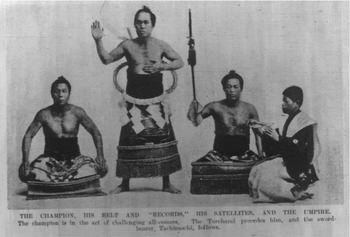
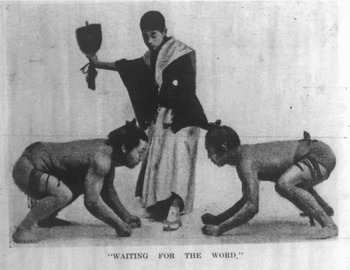
The umpire is, in accordance with custom, a boy of about 15, whose family have been umpires for 1000 years. His costume and his every act are directed by tradition. Thus also with the wrestlers. For them a small circle is marked out with straw ropes, laid on the ground in the centre of the ring. They first march into the arena in procession, the umpire in his picturesque robes, the wrestlers bare-skinned but for a loin cloth and the heavy, magnificently gold-brocaded and embroidered silk aprons. The champion of the team wears in addition a great white rope bound round his waist, and fastened behind in a sort of butterfly knot, and from the rope are pendant tablets bearing his records. This is the champion ‘belt.’ (Fig. 2) After various ceremonies and invocations have been gone through, the party stalk solemnly out and return, the wrestlers, clad only in the loin cloth and cord-fringed belt, their tawny skins glowing with health and strength, and their big but good-natured looking faces set for the struggle. Salt is sprinkled in the ring for luck, to ensure that there may be no fatal injuries (as the interpreter put it – ‘In Japan if you kill a man in a wrestling match – no matter! No one do anything to you. It is in the game.’) The contestant also goes to the water jug, which is set handy, and rinses his mouth with water, the idea being both to refresh himself and suggest to the opponent that he is in extremis, as water is given to dying men, and so to lull him into the belief that the struggle will be brief and easy. Also, there is much opening and closing of hands at the ringside, an indication that there are no weapons concealed . . . To indicate that they are fixtures in the ring, each wrestler lifts his thigh with his hands and plants his foot down heavily, and finally they sink on hands and toes, and prepare to spring at each other like a couple of game fowls. While it lasts the contest is very fierce. It is permitted to strike the opponent on the head or face with the open hand or the side of the hand and to do various things foreign to Cornish [wrestling] or Westmoreland [wrestling] ethical ideas. There are some 18 falls – 12 throws, 12 lifts, 12 twists, and 12 throws over the back – permitted by the code, and in one performance these men will illustrate more than half of them. Over all the youthful umpire presides, using his lettered fan just in the prescribed way, directing, admonishing, censuring, loudly and volubly, as the occasion requires, and implicitly obeyed . . . (Fig. 3) The wrestling must not be confounded with the Jujutsu, the aristocratic Japanese art of self defence and system of physical culture and moral conduct . . . They are two different things.Footnote 32
‘The Champion, His Belt and “Records,” His Satellites and the Umpire’, Sydney Mail, 13 April 1904. Courtesy of the National Library of Australia.

‘Waiting for the Word’, Sydney Mail, 13 April 1904. Courtesy of the National Library of Australia.

At the conclusion of each performance, which lasted for approximately twenty minutes,Footnote 33 the champion for the evening was ceremonially installed with apron, sword and rice straw belt.Footnote 34 Early in the wrestlers’ engagement the dramaturgy of the performance was altered when fan rituals preceding the wrestling bouts were omitted, a concession perhaps to audience attention span and the tempo expected of circus acts.Footnote 35 For the duration of the sixteen-month tour this was, however, the only change to the act recorded in the press.Footnote 36
Mediating traditions
At this historical moment the circus was a performance institution that was in flux, not yet ossified by tradition. Certainly, the circus had well-established traditions that set it apart from other forms of performance, yet whilst it restaged elements of its past, it was nevertheless a performance form constantly seeking new aesthetic and materialist trajectories.Footnote 37 Striving to collect and display encyclopedic aggregations of racial types, creatures and human skills was an established characteristic of successful international circuses of this era and the largest Australian circuses of the late nineteenth and early twentieth centuries, the FitzGeralds and the Wirths, were influenced by trends established by the principal circuses in the US, Europe and the UK. Throughout the nineteenth century, the circus had established a pattern of affiliative cultural engagement, reflecting Bhabha's assertion that cultural engagement, whether antagonistic or affiliative, is produced performatively.Footnote 38 In Australia, the circus institution had also sedimented social expectations that its performances could, and frequently did, embrace racial difference. So in addition to the parallels between circus and sumo that have been discussed earlier in this article (the circular festive space, ritualized theatricality, stylized physical action, symbolic costumes, the foregrounding of physical supremacy as popular entertainment), the racial difference of the sumo wrestlers also aligned their performance with some of the established traditions of the circus.
The wrestlers were also elite athletes and the moment of their contract with the FitzGeralds dovetailed with an increased international focus on sports,Footnote 39 the incursion of theatricalized sporting spectacle on Australia's circus and variety stages,Footnote 40 and the sedimentation of competitive sport as a significant carrier of Australian cultural and national identity.Footnote 41 In their daily newspaper advertisements the FitzGeralds mobilized notions of ‘rational recreation’ to promote the act whilst underlining the wrestlers as sporting envoys from Japan:
The introduction to Australia of a Team of Professional Wrestlers from Japan marks a new and sensational departure in amusement enterprise. The Wrestlers are a special class in Japan, and are privileged as no other class of athletes are in the world, the nearest approach being the professional Bullfighters of Spain. It is on record in Japanese history . . . that the claim of two rival Princes to the Imperial Throne was once submitted to the test of a wrestling match, and the victor was acclaimed Emperor. In feudal days a wrestler could sit by the side of the Daimio, and even to-day they retain special privileges, and the guilds are held in high esteem, the Mikado often attending their contests.Footnote 42
It is impossible to ascertain what impact this sort of advertising may have had on audience attendance. The FitzGeralds were effectively Australia's national circus, with a very large audience base; it is likely therefore that people would have attended their new show anyway. Newspaper reviews consistently reported popular reception of the sumo performance and journalists expressed their admiration of the wrestlers’ elite athleticism: ‘There is no mistaking the strength and adroitness of these men’, observed one journalist; their ‘muscles are of the soft, silky kind, which according to Sandow is the perfection of muscle’.Footnote 43 Yet another noted, ‘The physical perfection of the men became apparent at a glance. Fairly tall, with limbs well developed, they have the appearance of highly trained and well-proportioned athletes’.Footnote 44 Several weeks after their arrival, the Sydney Morning Herald observed, ‘The interest caused by the Imperial Japanese wrestlers continues unabated . . . That Japanese wrestling is full of clever points is obvious to anyone who follows these lightning quick contests with a sportsman's eye’.Footnote 45 Reviews surveyed from throughout the tour indicate that audiences received the wrestlers on much the same terms and with similar approbation wherever they appeared.
Opportunistic strategies
The FitzGerald Brothers were shrewd showmen whose instincts had enabled them to retain their position as the principal circus producers in the region for over a decade. They understood the attraction of performances that transmitted the popular trends and sociopolitical ideologies that were exerting influence upon Australian society.Footnote 46 Their contemporary society was, however, valorizing the racial and moral superiority of Anglo-European culture. Press articles sampled from leading newspapers in the weeks immediately preceding the arrival of the Japanese wrestlers reveal competing tensions within Australia's position towards Japan; Japan was simultaneously a fertile market for Australian agricultural products,Footnote 47 and a ‘Yellow Peril’ waiting to inundate Australian shores with aliens ‘whom no legislation could keep out’.Footnote 48 The new conflict between Russia and Japan posed an ethical dilemma to Australians; if Japan triumphed over Russia this might mean ‘the freeing of that “Yellow Peril”’, whereupon Japan would ‘assume the control of 450 millions of Chinese, give them a directing and controlling agency, and make the white race secondary in the Far East and in adjacent territories’.Footnote 49 Reflecting on Japan as an imperial power and a swiftly modernizing society, the same unidentified journalist advised Australian readers, ‘we have been invited therefore to sympathise with Russia in the present struggle’.Footnote 50 Formally, however, Australia was a political ally of Japan. As the tour of the Japanese wrestlers progressed and events in the Russo-Japanese War unfolded, the circus opportunistically promoted the sumo wrestlers as a convergent point in popular Australian culture for jingoistic expressions of allegiance and supremacy.
The Anglo-European world's awareness of Japan's growing militaristic prestige and escalating significance in world politics certainly prompted a measure of the public interest aroused by the Japanese wrestlers. Between their engagement in late 1903 and their arrival in Sydney in April 1904, the Russo-Japanese War of 1904–5 had commenced, initiated on 8 February 1904 by a Japanese torpedo attack on Russian ships anchored at Port Arthur. The duration of the wrestlers’ sixteen-month contract was contemporaneous with the Russo-Japanese War, which concluded with a Japanese victory in September 1905. Australians’ fascination with the sumo wrestlers stemmed, in part at least, from contemporary anxieties about their own nation's place in world politics. Since the Japanese defeat of the Chinese in the Sino-Japanese War of 1894–5, Britain had increasingly regarded alliance with Japan as a means of maintaining a balance of power in the north Pacific. Assisting Japan to develop her military capabilities was seen as a path to checking the expansionist aims of Russia in that region. As a result of her natural allegiance to Britain, Australia had committed troops to fight with Japan in the Boxer Uprising of 1900, and when Britain brokered the Anglo-Japanese Alliance in 1902 the newly federated nation of Australia formally became an ally of Japan. Cultural-interest articles and photo essays in newspapers and journals from around this time also attest to the extent of contemporary interest in the culture and society of Australia's recent, but relatively unknown, ally. The extent of this print-media coverage about Japan furthermore suggests that the appearance of the wrestlers in April 1904 tapped into a new vein of curiosity on the part of Australians about the customs and lifestyles of the Japanese people.
Throughout the preceding four decades, Australian audiences had also been exposed to competing images of Japan and her people within various theatrical frames. Since 1867 Australians had seen native Japanese performers appearing with Australian circuses, on variety stages and with the Japanese Village exhibition of the mid-1880s. Troupes of Japanese acrobats, rope walkers, conjurors, contortionists, gymnasts, jugglers, musicians, tumblers and dancers first arrived in Australia in 1867 just one year after Japan signed the Convention of Edo, a treaty which, for the first time, allowed Japanese subjects to leave their country.Footnote 51 Following the popular success of the Japanese Village exhibition in London in 1885, a Japanese Village was installed along similar lines in Melbourne in 1886, organized under the auspices of the Japanese government ‘as a national advertisement’.Footnote 52 Sixty Japanese people were shown living and working in separate dwellings under one roof and the precinct included a replica Buddhist temple where religious ceremonies were conducted daily, a tea house where the public could observe the traditional tea ceremony, a waxworks, artisans manufacturing artefacts by traditional methods, and ten thousand lanterns that illuminated the ‘village’ in the evening. Circus-style acts by Japanese performers included juggling, acrobatics, conjuring and sword walking,Footnote 53 and eight months later the enterprise was re-established with Fryer's Circus at Melbourne's Exhibition Building.Footnote 54 There are many instances from 1867 onwards that substantiate art historian Darryl Collins's claim that Japanese circus performers played ‘an important part in the picturesque image Australians would cultivate of Japan and the Japanese’ throughout the later decades of the nineteenth century.Footnote 55
Australian audiences were also familiar with fictive, romanticized (mis)representations of Japan and her people from elaborate popular stage productions such as Gilbert and Sullivan's The Mikado, which received its first Australian performance in 1885,Footnote 56 and The Geisha, first performed in Australia in late 1898.Footnote 57 Since the mid-1880s, these ‘yellow face’ comic operas, nominally set in Japan, placed before Australian audiences a parade of characters that established a range of Japanese stereotypes.Footnote 58 Nurturing the late Victorian appetite for japonisme, these productions clothed their actors in gorgeous theatrical versions of traditional Japanese attire and positioned their burlesque samurais, coolies, rickshaw drivers and maids in front of intricately painted scenery which reinforced fairy-tale images of the country.Footnote 59 Josephine Lee has argued that the racial disguise initiated by The Mikado created ‘particular fantasies’ about ‘what “Japanese” meant’, producing in Western society the dominant ways in which ‘oriental’ was imagined and performed.Footnote 60 These forms of stage orientalism were reiterated in an Australian pantomime, Djin Djin, produced by the firm of J. C. Williamson in 1895 for popular and lengthy seasons in Sydney and Melbourne. Set in a theatrically imagined Japan, the hero, Prince Eucalyptus, sets out to free an Asian people from the demon Djin Djin (a representation of all Asian threats). The plot set Occident against Orient, championing the natural superiority of the West, and its racist text vilified Japanese people as brutal, mercenary and in need of saving.Footnote 61 Of course, all of the performances in these productions were by Anglo actors with little knowledge of Japan and even less regard for the authenticity of their characterizations.
In contrast to the stereotyped images of Japan and Japanese people that had been promulgated on Australian stages throughout the preceding four decades, the guttural and physically furious performances by the muscular and highly trained wrestlers were authentic – neither fictionalized nor Europeanized. There is no getting away from the fact that they were appearing within the circus frame but this was a far cry from the ethnographic people show promulgated by the Japanese Village exhibitions of several decades earlier, where Japanese nationals were asked to behave under the gaze of the public ‘as if’ they were going about their traditional way of life at home in Japan. The sumo wrestlers acquitted their sixteen-month contract with very little disturbance to the integrity of their act and, judging from the absence of media articles about the wrestlers outside the circus ring, their lives remained private.
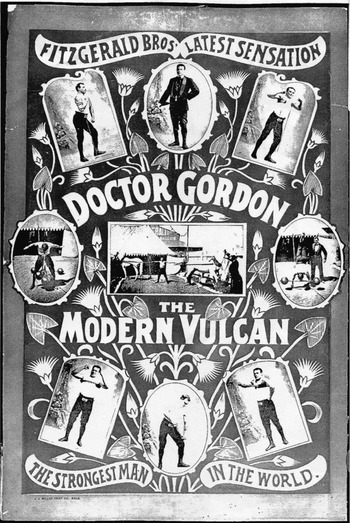
The FitzGeralds opportunistically promoted the sumo wrestlers using intersecting discourses of education, authenticity, and patriotism, deftly using Australia's extensive print-media network as a forum for mobilizing loyal support of the nation's new Japanese allies. From the commencement of the wrestlers’ performances in Australia, the FitzGeralds’ advertisements in daily newspapers positioned them as cultural envoys from a friendly, if unknown, land. According to the promotional rhetoric of the circus, the wrestlers’ Asian bodies were symbolic representations of all Japanese; they were ‘Britain's allies from the Far East’, and therefore they were ‘our allies’.Footnote 62 When the circus returned to Sydney more than a year after the wrestlers first disembarked, they had added ju-jitsu to their performance repertoire. Advertisements urged the public to see the sumo and ju-jitsu bouts, arguing that they made it possible ‘to understand the Japanese successes in the Manchurian campaign’.Footnote 63 Dr Gordon had become a recent pupil of ju-jitsu under the tutelage of one of the wrestlers, Otoko Jima, and Gordon took part in public displays that, as a new student, he could never win.Footnote 64 Despite Gordon's elite muscular development and proven strength, he was no match for the Japanese at one of their native sports which enabled a much smaller person to overcome a much larger opponent. By European standards Gordon was the epitome of alpha-male physical culture, but for a few months in 1905 he was a second-class combatant against the scientific precision of the Japanese wrestlers (Fig. 4). The FitzGeralds managed these competing images of racial superiority with a light hand, bringing narratives of patriotism and national allegiance into play. The Japanese Imperial Army won the majority of the military engagements of the war with Russia and the FitzGeralds astutely argued that their sumo wrestlers provided an embodied lesson as to why Australia's ally, the numerically inferior Imperial Japanese Army, was winning the war against the superior might of the tsar.
Handbill for Doctor Gordon, the Modern Vulcan, the Strongest Man in the World, depicting various strength routines, c.1904. Michael Kenna Collection, Alexander Turnbull Library, National Library of New Zealand.

Conclusion
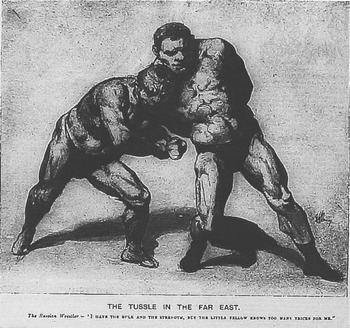
The introduction of the Japanese wrestlers to Australian audiences at the historical moment of the outbreak of the Russo-Japanese War constitutes an episode wherein we can see popular performance operating in the interstices between competing attitudes to Japan and her people. The performances of the Japanese wrestlers playfully mediated contested attitudes towards their race and homeland; these attitudes were expressed alternately as fears of invasion by hordes from Asia, and as the imperatives of market capitalism. The wrestlers’ theatrically framed contests of physical supremacy played, quite literally, between popular discourses that embodied claims of European racial superiority, curiosity about the exotic performances of sumo, and appreciation on the part of popular audiences for elite athletic skills (Fig. 5).
Resonances in popular culture. During 1904–5 popular interest in the Russo-Japanese War was reflected in the output of Australia's cartoonists, whose work spoke to the simple proposal that Russia was the enemy and Japan was ‘our’ ally. Between January and March 1905 the Melbourne weekly newspaper Punch published a series of drawings that depicted the tsar as a coward and parodied the mutinous state of his vodka-drinking army. One of the Punch cartoons appropriated the currency of wrestling bouts on popular Australian stages as the basis of its satire. This cartoon depicts two wrestlers in a hold, one is George Hackenschmidt, ‘The Russian Lion’ who was appearing as the headline act on the Tivoli variety circuit, the other was a Japanese wrestler from the FitzGerald Brothers’ Circus. Titled ‘The Tussle in the Far East’, the cartoon gives the Russian wrestler the line ‘I have the bulk and the strength, but the little fellow knows too many tricks for me’. Punch (Melbourne), 26 January 1905, p. 99.

This study also reveals an episode in which the circus embraced a form of cosmopolitanism through its staging of cross-cultural and transnational encounters. Whilst the performances discussed in this article might not be regarded by today's standards as being devoid of ethical challenges, we can nevertheless discern the early twentieth-century circus working to undermine the racial stereotyping of Japanese people that was dominant in contemporary Australian society. The circus has always been a locus for unexpected and new forms of cultural production and through this episode it is possible to discern, in some small measure, performance contributing to the dynamics and dialectics of national attitudes.