Implications
This study has identified that culling rate of primiparous heifers during first lactation varies greatly between farms and that the age at first calving (AFC) has a significant association with this. This study highlights the importance of maintaining an AFC of 23 to 24 months of age because prolonged AFC leads to a greater wastage of primiparous heifers with associated financial losses.
Introduction
Heifer rearing is a key financial component of most dairy farms, with the rearing of replacements accounting for 15% to 20% of total dairy production costs (Heinrichs, Reference Heinrichs1993). The importance of replacement rate and the target number of replacements for each individual farm is dependent upon the culling rate of that particular farm. The annual culling rate within UK dairy herds has previously been reported to be between 22% and 25% (Esslemont and Kossaibati, Reference Esslemont and Kossaibati1997; Whitaker et al., Reference Whitaker, Kelly and Smith2000; Bell et al., Reference Bell, Wall, Russell, Roberts and Simm2010). Culls have traditionally been classified as voluntary or involuntary; however, another classification is ‘forced culls’ and ‘economic culls’. Forced culls are those cows for which no possible productive future exists and economic culls are those cows for which a decision has been made that replacing them with another cow is a sensible economic option (Fetrow et al., Reference Fetrow, Nordlund and Norman2006). As the majority of the culls on farm are economic (Orpin and Esslemont, Reference Orpin and Esslemont2010), this indicates that the incoming replacement animal needs to be a better financial option for the farm. Previous research highlights that the costs of rearing a replacement are not recovered until the second lactation (Archer et al., Reference Archer, Mc Coy, Wapenaar and Green2013), therefore it is imperative that replacement heifers survive to their second lactation.
A variety of studies have recently investigated the survival rates of primiparous heifers. A study in Spain reported that 8.4% of 7768 Holstein heifers born alive did not finish the first lactation, with 31.5% (n=206) of the non-surviving heifers exiting within the first 50 days in milk (DIM) (Bach, Reference Bach2011). These heifers were all reared externally from the main dairies at one heifer rearing unit, under the same management system. In a study in the United Kingdom on 18 farms, which followed a cohort of 468 Holstein-Friesian heifers (Brickell and Wathes, Reference Brickell and Wathes2011), 19% (n=79) of heifers that calved for the first time (n=415) did not survive to the end of first lactation, equivalent to 28.2% (n=132 heifers) of all heifers born (n=468 heifers). In terms of between-herd variation, there was a range of 7% to 33% heifer loss during first lactation between farms. These findings were similar to those in 26 English herds in 1999, with a loss of 14% in the first lactation (Esslemont and Kossaibati, Reference Esslemont and Kossaibati1997). Therefore, survival of heifers through their first lactation is important, but there have only been a few large-scale studies in the United Kingdom and worldwide to evaluate this.
Research has highlighted the impact of AFC on production and health indices (Hoffman et al., Reference Hoffman, Brehm, Price and Prill-Adams1996; Nilforooshan and Edriss, Reference Nilforooshan and Edriss2004; Berry and Cromie, Reference Berry and Cromie2009). Impact of AFC on survival has been extensively studied, with a number of trials finding that lower AFC was associated with increased survival (Lin et al., Reference Lin, McAllister, Batra, Lee, Roy, Vesely, Wauthy and Winter1988; Bach, Reference Bach2011; Brickell and Wathes, Reference Brickell and Wathes2011; Archer et al., Reference Archer, Mc Coy, Wapenaar and Green2013), whilst a large number of other workers failed to demonstrate such a link (Ducrocq, Reference Ducrocq1994; Ojango et al., Reference Ojango, Ducrocq and Pollott2005). These studies were all either based on small numbers of farms or were conducted in farming systems very different to those typical in the United Kingdom, making it difficult to put these findings into context of the performance of UK first lactation heifers. Therefore, the objective of this study was to evaluate the survival rate of first lactation animals in a large sample of UK dairy herds and to evaluate the impact that AFC had on survival.
Material and methods
Data collection and organisation
Herd management data were collected as part of a larger project (Hudson et al., Reference Hudson, Bradley, Breen and Green2012), with anonymised herd databases being requested from 20 veterinary surgeons across England and Wales, with an acknowledged interest in dairy herd health management and data analysis. Data came from a variety of sources, including on-farm recording software, veterinary practice bureau recording services and records of national milk recording organisations. Although not a probabilistic sampling method, this convenience sample was used because high-quality data were essential for the analyses.
The data was extracted for all animals calving between 1 January 2008 and 31 December 2008, from 468 dairy herds across the United Kingdom. Data quality was assessed at both an individual cow and herd level, with removal of animals lacking a date of birth (n=25 749) and those without a calving date (n=15). Herds which contained no first lactation animals (n=25 herds) and herds without any 305-day yield information (n=5 herds) were removed. The resulting data set was from 437 herds with a total of 73 227 animals, of which 18 406 were first lactation heifers. A binary indicator representing culling during first lactation was calculated for each cow, along with DIM at the time of culling, calving interval and AFC. At herd level, mean 305-day yield, herd size, calving index and culling rate was calculated for each herd. Data re-structuring was carried out in Microsoft Excel 2010 and Microsoft Access 2010 (Microsoft Corporation, Redmond, WA, USA).
Descriptive analysis
Initial analysis was carried out to evaluate general herd features and performance of primiparous heifers within individual herds. To evaluate the patterns of times of removal of first lactation animals, conventional survival analysis was performed, using Kaplan–Meier curves (Kaplan and Meier, Reference Kaplan and Meier1958). The adult herd culling rate was defined as the number of cows equal to or above two lactations that exited the herd before their next calving. The primiparous heifer herd culling rate was defined as the number of animals that calved for the first time during 2008 and exited the herd before their next calving. The definition of exiting the herd before their next calving was either the animal exiting the herd before the next calving (n=17404) or the animal having not re-calved for a minimum of 760 days at the end of the study period (n=139). The overall herd culling rate was defined as the number of animals, of all parities, that calved in 2008 and did not calve again. Descriptive statistics were calculated using Minitab 17 (2013) Statistical Software (Minitab Inc., State College, Pennsylvania, USA).
Statistical modelling
A multilevel logistic regression model was used to evaluate the association between the probability of a first lactation heifer exiting the herd before the second lactation (i.e. failing to calve for a second time) and a variety of potential explanatory variables. These included AFC, calving season, adult herd culling rate, herd size, herd mean 305-day yield and herd mean calving interval. A two-level hierarchical model was used to account for correlations between primiparous heifers within herds.
The model specification took the form:
 $$\eqalignno{ & {\rm Exit}\,{\rm herd}_{{ij}} \,\sim\,{\rm Bernoulli}\,{\rm (}\pi _{{ij}} {\rm )} \cr & ({\rm logit}\,{\equals}\,\pi _{{ij}} )\,{\equals}\,\alpha {\plus}\beta _{1} X_{{ij}} {\plus}\beta _{{\rm 2}} X_{j} {\plus}u_{j} \cr & [u_{j} ]\,\sim\,N{\rm (}0,\,\Omega _{u} {\rm )} $$
where subscripts i and j denoted the ith primiparous heifer of the jth herd, respectively. π
ij
was the probability of a heifer exiting before the start of her second lactation for the ith heifer of the jth herd, α the intercept value and X
ij
and X
j
explanatory covariates at heifer and herd levels, respectively, with β
1 and β
2 being the corresponding coefficients for covariates X
ij
and X
j
, respectively. u
j
was the random effect to account for residual variation between herds (assumed to be normally distributed with mean=0 and variance=
 $${\sigma _{v}}^{2} $$
).
Model building was carried out in MLwiN version 2.31 (Rabash et al., 2012). Initial model building was performed by forward selection and explanatory variables were retained in the model if deemed significant (P<0.05).
Results
Descriptive statistics
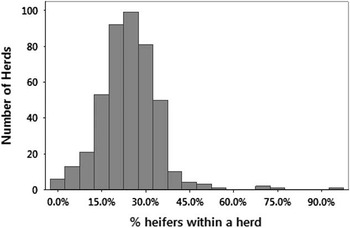
The number of animals that calved during 2008 in each herd varied between 25 and 848, with the mean number per herd being 168 (median: 144). The mean percentage of first lactation heifers calving in the herd was 24.3% (median: 23.9%), with an interquartile range of 18.5% to 30%. The distribution of the percentage of primiparous heifers by herd is illustrated in Figure 1. The mean herd mean calving interval was 412 days (median: 410 days) and the mean herd 305-day milk yield was 7204 kg (median: 7400 kg).
Histogram of the percentage of primiparous dairy heifers within the 437 herds.

Primiparous heifer performance
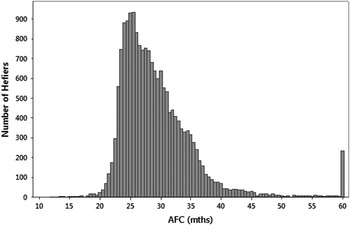
Of the18 406 first lactation heifers within 437 herds, 15 296 animals calved for a second time (83.1%). The mean AFC was 29.6 months, with a median of 28.0 months, indicating that 50.1% of heifers calved for the first time at ⩾28 months of age, 35.9% calved for the first time at >30 months of age and 9.8% at >36 months of age; the distribution of AFC is shown in Figure 2.
Distribution of the age at first calving (AFC) for primiparous dairy heifers (n=18 406).

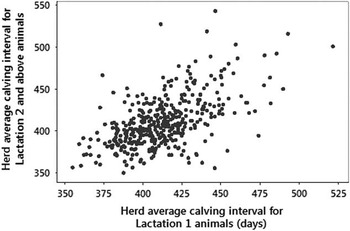
The mean calving interval of the 15 296 heifers that re-calved was 409 days (median: 385 days), which was similar to a mean calving interval of 410 days (median: 389 days) for animals in Lactation 2 and above, shown in Figure 3. In all, 10% of the primiparous heifers had calving intervals <330 days and 53% of the heifers had calving intervals >380 days. A third of primiparous heifers had a calving interval >420 days. Of the heifers calving in for the first time, the largest proportion (33.6%) calved in autumn (September to November) and the smallest proportion (18.0%) calved in spring (March to May); 22% calved in winter (December to February) and 26.5% in summer (June to August).
Herd average calving intervals for Lactation 1 animals v. Lactation 2 and above animals.

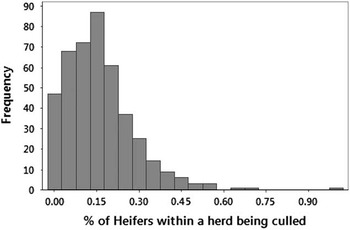
A total of 16.9% of all of the primiparous heifers were culled before second lactation, which was lower than the 26.0% of adult cows (Lactation 2 and above) that were culled. The overall herd cull rate across all of the herds was 23.9%, with 17 534 animals being culled before their next lactation. The primiparous heifer herd culling rate was 15.7% on average (median: 14.3%); the distribution is shown in Figure 4.
Histogram of the percentage of primiparous dairy heifers culled per herd.

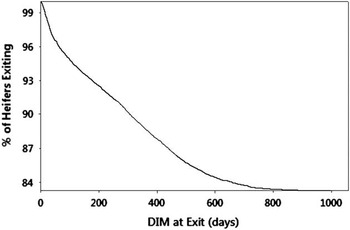
Survival analysis indicated that of those primiparous heifers culled, 31% were culled before 100 DIM (n=955), which was 5% of all primiparous heifers. This cull rate slowed to 14% (2% of all heifers) between 100 and 400 days after calving as shown in Figure 5.
Kaplan–Meier survival plot for overall survival of primiparous dairy heifers. DIM=days in milk.

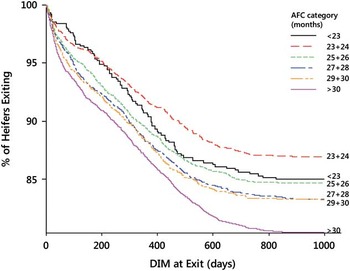
When stratified by AFC, primiparous heifer survival times were reduced as AFC increased (Figure 6). Heifers that calved between 23 and 24 months of age were most likely to calve for a second time and those that calved >30 months were least likely to calve again. Also of note, there appeared to be a more rapid culling rate between 50 and 150 days after calving for heifers with an AFC >30 months.
Kaplan–Meier survival plot of primiparous dairy heifers exiting the herd in terms of age at first calving (AFC). AFC<23 months (n=626), AFC 23+24 months (n=2812), AFC 25+26 months (n=3558), AFC 27+28 months (n=2883), AFC 29+30 months (n=2506) and AFC>30 months (n=6021). DIM=days in milk.

Statistical model
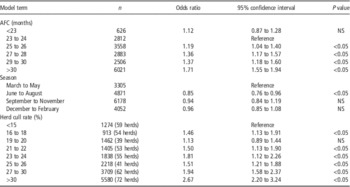
The results of the final model are shown in Table 1. The odds of a heifer calving for a second time was significantly associated with AFC, season of calving and adult herd culling rate as follows. The optimal AFC was 23 to 24 months of age and the risk of culling increased with increased AFC; the odds of being culled were 1.71 times greater for heifers calving >30 months of age compared with those calving at 23 to 24 months (P<0.05). The risk of a primiparous heifer being culled increased with the adult herd culling rate, but decreased in summer, when compared with the other seasons (Table 1).
Parameter estimates from the final multilevel logistic regression model with the binary outcome variable being a primiparous dairy heifer culled (yes or no) during their first lactation

AFC=age at first calving; season=season of the first calving date for the heifers; herd cull rate=the estimated overall herd cull rate.
Discussion
Although the mean culling rate for first lactation heifers was 16.9%, there was large variation between the 437 herds. For individual heifers, the likelihood of calving for a second time was associated with AFC, overall herd cull rate and calving season.
Increased AFC over 24 months of age was found to be significantly associated with an increased risk of being culled during the first lactation. The impact of AFC on survival of animals has been debated in the literature with significant associations being found in some studies, but not in others (Ducrocq, Reference Ducrocq1994; Lin et al., Reference Lin, McAllister, Batra, Lee, Roy, Vesely, Wauthy and Winter1988; Vukasinovic et al., Reference Vukasinovic, Moll and Künzi1997 and Reference Vukasinovic, Moll and Casanova2001; Ojango et al., Reference Ojango, Ducrocq and Pollott2005). Studies that have shown an impact of AFC on survival have reported that the relative risk of culling heifers is higher in animals older at first calving (Pirlo et al., Reference Pirlo, Miglior and Speroni2000; Berry and Cromie, Reference Berry and Cromie2009; Chirinos et al., Reference Chirinos, Carabaño and Hernández2015). A decrease in AFC from 27 to 24 months of age was associated with a 10% reduction in the odds of removal from the herd (Archer et al., Reference Archer, Mc Coy, Wapenaar and Green2013). This is echoed in a recent study, where heifers with an AFC of 23 to 25 months of age outperform later calving compatriots in terms of fertility, milk production and survival for first 5 years of life (Cooke et al., Reference Cooke, Cheng, Bourne and Wathes2013). The main reason discussed for removal of first lactation heifers from a herd is due to poor fertility performance (Evans et al., Reference Evans, Wallace, Shalloo, Garrick and Dillon2006; Brickell and Wathes, Reference Brickell and Wathes2011), with a high AFC being connected with worse fertility performance in the first lactation (Zavadilová and Zink, Reference Zavadilová and Zink2013). The present study indicates that AFC does have an impact on the odds of being culled during the first lactation.
The average AFC was slightly higher in this study (29.6 months) than previously reported 27 months for the United Kingdom in 2011 (Brickell and Wathes, Reference Brickell and Wathes2011). This previously reported AFC of 27 months was taken from a relatively small sample of 18 farms in the south east of England, which had a target herd AFC of 24 months. A study in Ireland reported a lower mean AFC of 25.8 months; this was taken from 14 spring-calving herds (Evans et al., Reference Evans, Wallace, Shalloo, Garrick and Dillon2006). An Italian study identified a mean AFC at 28.1 months of age (Pirlo et al., Reference Pirlo, Miglior and Speroni2000) taken from a large heifer data set, but this data set excluded all heifers calving <20 and >36 months of age and therefore excluded older heifers. Other studies have also reported different average AFCs across the world (Ettema and Santos, Reference Ettema and Santos2004; Bach, Reference Bach2011; Wu et al., Reference Wu, Wathes, Brickell, Yang, Cheng, Zhao, Xu and Zhang2012) and these studies have been based on either single or a few farms, limiting the exposure to different management systems and geographical regions. The present study represents one of the largest study to date, but it remains uncertain as to whether this truly reflects the UK situation, because a convenience sample was used to ensure data of sufficient quality. However, these findings are in agreement with a review article, which described larger data sets reporting a wide range in AFC within UK herds (Wathes et al., Reference Wathes, Pollott, Johnson, Richardson and Cooke2014).
The culling rate of first lactation heifers was 16.9% in this study, with the distribution of within-herd culling having a right-sided skew and showing a large variation between herds. This variation in culling rate between herds had an interquartile range of 7.1% to 21.7%; this was similar to the Brickell study, which reported a range of 7.1% to 33.3%. Large between-herd variation was also reported by Archer et al. (Reference Archer, Mc Coy, Wapenaar and Green2013) in a large data set of Irish heifers. The mean culling rate in this study was 2.1% lower than that reported by a previous UK study in 2011 (Brickell and Wathes, Reference Brickell and Wathes2011) and 0.7% lower than a study in California (Ettema and Santos, Reference Ettema and Santos2004). It would be extremely beneficial to better understand the reasons for the large between-herd variation in culling rates of first lactation heifers; such variation is likely to result in major differences in financial performance and welfare outcomes between herds. This remains an important area for future research.
The overall estimated herd culling rate was associated with the risk of a heifer being culled during the first lactation, with the risk increasing as the herd’s overall culling rate increased. This association suggests that there may be reasons within an individual farm’s system for a generally increased culling rate across all lactations and that this affects primiparous heifers as well as older cows. Further studies to examine these reasons and relationships are warranted.
Another significant finding in this study was the association between season of calving and survival, with heifers calving in summer having higher odds (0.82) of re-calving. This differs to other studies (Bach, Reference Bach2011; Archer et al., Reference Archer, Mc Coy, Wapenaar and Green2013) that reported improved survival in different calving seasons. The reasons why calving season influences heifer survival differently in different studies are unclear and may warrant further investigation; however, a possible reason could be related to differences in climate.
This study has highlighted the variation in culling rate of first lactation heifers across 437 herds in the United Kingdom. There was an association between decreasing survival of first lactation heifers and both an increasing AFC and an increasing culling rate of animals which were parity two and above. The results suggest that closer monitoring of heifer rearing practices is important, as well as the potential need to address reasons for high culling rates across all parities within UK herds.
Acknowledgement
V.E.S. was funded by a Barham Benevolent Foundation Scholarship.