Emotion regulation, broadly conceptualized as the ability to manage states of arousal in order to facilitate adaptive functioning or goal-directed activity, is an essential component of healthy psychological development. Although developmental advances in the ability to regulate emotional responding may continue to into adulthood (Charles & Carstensen, Reference Charles, Carstensen and Gross2007), the most dramatic gains in emotion regulation capacities occur in the first few years of life. Thus, young infants are almost wholly reliant on their caregiver to regulate their emotional arousal, by 4 or 5 years of age children are already relatively skilled self-regulators, employing multiple strategies to manage their own emotional states (Kopp, Reference Kopp1989; Rothbart, Reference Rothbart, Kohnstamm, Bates and Rothbart1989). Normative increases in emotion regulatory capacities appear to contribute to several other developmental progressions, including decreases in aggression and increases in compliance, and to facilitate effective cognitive and social engagement (Campbell, Reference Campbell2002; Eisenberg et al., Reference Eisenberg, Fabes, Murphy, Maszk, Smith and Karbon1995; Kim & Cicchetti, Reference Kim and Cicchetti2010; Kochanska & Knaack, Reference Kochanska and Knaack2003; Marshall, Fox, & Henderson, Reference Marshall, Fox and Henderson2002; Rothbart & Derryberry, Reference Rothbart, Derryberry, Lamb and Brown1981).
Emotion Regulation and Externalizing Problems
Given the contribution of emergent emotion regulation capacities to normal developmental achievements, research attention has turned to the potential role of deficits in the ability to regulate emotions in the etiology of childhood psychopathology (Cicchetti, Ackerman, & Izard, Reference Cicchetti, Ackerman and Izard1995; Cole, Michel, & Teti, Reference Cole, Michel and Teti1994). Externalizing problems in particular are defined by emotional and behavioral lability, and the underregulation of negative affect is hypothesized to be a causal factor in the etiology of oppositional defiant disorder and attention-deficit/hyperactivity disorder (Barkley, Reference Barkley1997; Calkins, Reference Calkins1994; Eisenberg, Smith, Sadovsky, & Spinrad, Reference Eisenberg, Smith, Sadovsky, Spinrad, Baumeister and Vohs2004; Hinshaw, Reference Hinshaw2003; Kochanska & Knaack, Reference Kochanska and Knaack2003). Empirical research broadly supports this position. Thus, Cole and colleagues demonstrated concurrent associations between the degree of expression of negative emotion and behavioral problems in preschool and early school-aged children (Cole, Zahn-Waxler, Fox, Usher, & Welsh, Reference Cole, Zahn-Waxler, Fox, Usher and Welsh1996; Cole, Zahn-Waxler, & Smith, Reference Cole, Zahn-Waxler and Smith1994). Boys with attention-deficit/hyperactivity disorder have been found to show deficits in emotion regulation, as well as more generalized impairments in regulatory control (Melnick & Hinshaw, Reference Melnick and Hinshaw2000; Walcott & Landau, Reference Walcott and Landau2004). Research has also demonstrated that childhood aggression, particularly reactive aggression, is concurrently associated with impaired regulation of emotional states (Marsee & Frick, Reference Marsee and Frick2007; Melnick & Hinshaw, Reference Melnick and Hinshaw2000; Shields & Cicchetti, Reference Shields and Cicchetti1998).
Observations of cross-sectional associations between emotional regulation capacities and externalizing psychopathology are significant; however, questions arise regarding the direction of effects. Although emotion regulatory capacities are assumed to represent basic processes that contribute to adjustment, it is also the case that externalizing disorders are themselves characterized by dysregulated affect, and observed emotion regulatory impairments might therefore be symptomatic rather than causal. Longitudinal studies of high-risk populations may speak to this issue, by demonstrating that emotion regulatory deficits precede the emergence of externalizing psychopathology or predict later psychopathology over and above concurrent symptomatology. However, direct, longitudinal evidence on this point is limited. In a study of disadvantaged boys, the use of particular emotion regulation strategies (distraction, passive waiting, or low focus on provocation) at 3.5 years was associated with lower externalizing symptoms at 6 years (Gilliom, Shaw, Beck, Schonberg, & Lukon, Reference Gilliom, Shaw, Beck, Schonberg and Lukon2002). Kochanska and Knaack (Reference Kochanska and Knaack2003) studied the development of effortful control, a temperament dimension that incorporates the ability to regulate attention, behavioral and also affective states, and reported that better effortful control at 2–3 years predicted lower externalizing symptoms at 6 years child age. Similarly, Eisenberg and colleagues (2005) demonstrated that higher levels of effortful control at 9 years of age predicted lower levels of externalizing symptoms 2 years later, even when initial levels of externalizing symptoms were included in the model. Although suggestive, effortful control indexes behavioral as well as emotional regulation, meaning that these studies cannot confirm a specific effect of the latter. Research has also examined the predictive value of physiological indices of regulatory capacities. Longitudinal data from the RIGHT Track Research Project demonstrated that poor vagal regulation of heart rate activity at 2 years of age characterized children with stable behavioral problems through to 4 years (Calkins & Dedmon, Reference Calkins and Dedmon2000; Calkins & Keane, Reference Calkins and Keane2004, Reference Calkins and Keane2009). Again, these findings are suggestive, since vagal regulation is an assumed physiological concomitant of emotion regulation (Porges, Doussard-Roosevelt, & Maiti, Reference Porges, Doussard-Roosevelt and Maiti1994). However, the urgent need for further longitudinal investigations, and particularly studies that directly examine developing emotion regulation capacities in high-risk populations, has been highlighted in the literature (John & Gross, Reference John, Gross and Gross2007). Moreover, studies that encompass the first 2 years of life, assumed to be a key developmental period for emotion regulation capacities (Kopp, Reference Kopp1982), are desirable.
Developmental Influences on Emotion Regulation Capacities
Research has also considered the processes that influence the development of good or poor regulatory capacities. Some aspects of regulatory functioning are likely to be determined prior to birth; for example, individual differences in fetal heart rate and movement parameters have been observed that predict relevant aspects of temperament in young infants following birth (DiPietro, Hodgson, Costigan, & Johnson, Reference DiPietro, Hodgson, Costigan and Johnson1996; Huffman et al., Reference Huffman, Bryan, del Carmen, Pedersen, Doussard-Roosevelt and Porges1998). Modest genetic influences appear to be present (Deater-Deckard, Petrill, & Thompson, Reference Deater-Deckard, Petrill and Thompson2007; Goldsmith, Buss, & Lemery, Reference Goldsmith, Buss and Lemery1997), and in utero factors may also be influential. Smoking during pregnancy has been linked to both emotional and physiological lability in young infants (Fried & Makin, Reference Fried and Makin1987; Schuetze, Lopez, Granger, & Eiden, Reference Schuetze, Lopez, Granger and Eiden2008), as well as to externalizing symptomatology (Fergusson, Horwood, & Lynskey, Reference Fergusson, Horwood and Lynskey1993; Weitzman, Gortmaker, & Sobol, Reference Weitzman, Gortmaker and Sobol1992). Similarly, maternal symptoms of depression and anxiety that occur antenatally, as well as those experienced following birth, have been linked to a profile of disturbances in child development that includes indicators of impaired emotion regulation capacities (Blandon, Calkins, Keane, & O'Brien, Reference Blandon, Calkins, Keane and O'Brien2008; Feng et al., Reference Feng, Shaw, Kovacs, Lane, O'Rourke and Alarcon2008; Field, Diego, & Hernandez-Reif, Reference Field, Diego and Hernandez-Reif2006; Maughan, Cicchetti, Toth, & Rogosch, Reference Maughan, Cicchetti, Toth and Rogosch2007; Talge, Neal, & Glover, Reference Talge, Neal and Glover2007). However, the focus of research to date has been on the role of postnatal and later environmental factors, particularly parenting behaviors.
In early development, the regulation of emotional states is conceptualized as being highly dependent on the provision of responsive caregiving behaviors, which assist in the maintenance of an appropriate level of infant arousal (Calkins & Hill, Reference Calkins, Hill and Gross2007; Kopp, Reference Kopp1982; Thompson & Meyer, Reference Thompson, Meyer and Gross2007; Tronick & Gianino, Reference Tronick and Gianino1986). Consistent with this position, research has demonstrated that perturbations in maternal responding have an immediate effect on infant arousal, as indicated by changes in behavioral, emotional, and physiological state when maternal input is withdrawn during the still face paradigm (Mesman, van IJzendoorn, & Bakermans-Kranenburg, Reference Mesman, van IJzendoorn and Bakermans-Kranenburg2009), and that sensitive parenting post still face may facilitate a quicker return to a preperturbation state in the infant (Conradt & Ablow, Reference Conradt and Ablow2010). More generally, maternal sensitivity appears to facilitate the development of secure attachments, and attachment insecurity is characterized by disturbances in the regulation of emotional responding (Ainsworth, Blehar, Waters, & Wall, Reference Ainsworth, Blehar, Waters and Wall1978; Cassidy, Reference Cassidy1994; Gilliom et al., Reference Gilliom, Shaw, Beck, Schonberg and Lukon2002).
The role of parents also appears to persist beyond early development. Parents may continue to provide input that is concurrently related to child emotional responding through the preschool and early school years, even as children are becoming more adept self-regulators (Cole, Teti, & Zahn-Waxler, Reference Cole, Teti and Zahn-Waxler2003). Moreover, parents are assumed to shape the development of child regulatory capacities such that a persistent influence has been hypothesized (Calkins & Hill, Reference Calkins, Hill and Gross2007; Cassidy, Reference Cassidy1994; Cole, Michel, & Teti, Reference Cole, Michel and Teti1994; Thompson, Reference Thompson1994). Broad support for the latter position has been provided. Thus, Calkins and colleagues found that a poorer quality mother–child relationship at 2 years of age predicted poorer vagal regulation in children at aged 5, even when child behavioral problems and age 2 vagal regulation were controlled for (Calkins, Graziano, Berdan, Keane, & Degnan, Reference Calkins, Graziano, Berdan, Keane and Degnan2008). Eisenberg and colleagues demonstrated that positive parenting at 9 years of age predicted adolescent effortful control 2 years later (Eisenberg et al., Reference Eisenberg, Zhou, Spinrad, Valiente, Fabes and Liew2005), even controlling for stability in each of these dimensions and in externalizing symptoms. However, again, although these studies are suggestive of persistent parental influences on child emotion regulation, this question was not specifically addressed. Although a link between maternal sensitivity and child emotion regulation is widely referred to in the literature, direct, longitudinal evidence on this point is remarkably limited.
Longitudinal data become particularly important when it is considered that parent–child relationships are not exclusively determined by the parent; they also depend, to a degree, on the characteristics that the child brings to dyadic interactions (Cole et al., Reference Cole, Teti and Zahn-Waxler2003; O'Connor, Deater-Deckard, Fulker, Rutter, & Plomin, Reference O'Connor, Deater-Deckard, Fulker, Rutter and Plomin1998; Patterson, Reference Patterson, Pepler and Rubin1995; Raiha, Lehtonen, Huhtala, Saleva, & Korvenranta, Reference Raiha, Lehtonen, Huhtala, Saleva and Korvenranta2002). Infants who show highly dysregulated emotional responding may have reduced capacity for high-quality interactions with their parent. Thus, early indicators of poor regulatory capacity (irritability/negative affect) have been found to predict less optimal maternal behavior in the context of mother–infant interactions (Morrell & Murray, Reference Morrell and Murray2003; van den Boom & Hoeksma, Reference van den Boom and Hoeksma1994). However, not all studies have identified equivalent effects (Eisenberg et al., Reference Eisenberg, Zhou, Spinrad, Valiente, Fabes and Liew2005).
The Current Study
In sum, existing research highlights a possible role for deficient emotion regulation capacities in contributing to the development of externalizing problems in children; in addition, it identifies insensitive parenting behavior, as well as preexisting infant characteristics, as potential contributors to regulatory impairments in children. However, to date, longitudinal research examining these putative pathways to child disorder is limited, an omission that raises questions as to the causal direction of observed cross-sectional associations. Moreover, although the first 2 years of life appear to be critical to the development of emotion regulation capacities, most research has focused on older children. Studies that consider the relevance of very early regulatory abilities and parenting behavior to emotion regulation and externalizing problems later in development are particularly lacking. The primary aim of the current study was to examine deficits in early emotion regulation as a potential vulnerability factor for externalizing psychopathology, via a prospective longitudinal study of child emotion regulation capacities that included parent and child observations from the neonatal period. To this end, we studied a sample of 121 mothers and their children, who were recruited to the study during pregnancy and repeatedly assessed from the neonatal period through to childhood (5 years). Approximately half of study families were experiencing high levels of psychosocial adversity (Cronin, Halligan, & Murray, Reference Cronin, Halligan and Murray2008), defined by the presence of several established risk factors for externalizing disorder, including indicators of socioeconomic deprivation, young maternal age, single parenthood, limited educational qualifications, smoking during pregnancy, and symptoms of depression and anxiety (Rutter, Giller, & Hagell, Reference Rutter, Giller and Hagell1998; Shaw, Winslow, Owens, & Hood, Reference Shaw, Winslow, Owens and Hood1998). In addition to these families at elevated risk for externalizing problems, a low-risk comparison group was also studied. The resultant groups provided a context in which to test the hypothesis that poor emotion regulation capacities distinguish high-risk children from an early age, and precede and predict the emergence of externalizing symptoms.
Another major aim was to test the hypothesis that parenting behavior, particularly maternal insensitivity, is longitudinally associated with poorer emotion regulation capacities in children and thereby contributes to the development of externalizing behaviors. We also tested for the converse association, that is, infant behaviors preceding and predicting the development of insensitive maternal behavior. In order to avoid the problems associated with basing multiple assessments on maternal report or the confound of examining both maternal and child characteristics in the same assessments, indices of child emotion regulation and maternal behavior were derived from independent observational assessments.
Our high- versus low-psychosocial adversity groups were recruited as a context for studying risk for externalizing problems (Shaw, Gilliom, Ingoldsby, & Nagin, Reference Shaw, Gilliom, Ingoldsby and Nagin2003; Shaw et al., Reference Shaw, Winslow, Owens and Hood1998). Recruitment ensured that multiple difficulties co-occurred in our high-psychosocial adversity sample, and the sample overall was relatively small. Consequently, our study was not suitable for a comprehensive analysis of the relevance of specific adversities. Nonetheless, in secondary analyses, we examined the possibility of specific contributions to child emotion regulation for a subset of theoretically indicated dimensions. We obtained robust assessments of maternal smoking and affective symptoms in the current study and were therefore able to conduct exploratory analyses examining possible direct influences on the development of emotion regulation. Maternal age was also subject to similar, exploratory investigation. Although observed associations between maternal age and child behavior problems appear to be largely explained by less optimal parenting practices and home environments (Fergusson & Lynskey, Reference Fergusson and Lynskey1993; Fergusson & Woodward, Reference Fergusson and Woodward1999), there may also be specific relevant characteristics of mothers who become pregnant at a relatively young age that have effects that are independent of parenting (e.g., poor self-care during pregnancy; Woodward, Horwood, & Fergusson, Reference Woodward, Horwood and Fergusson2001). Finally, maternal and child cognitive abilities distinguished our high- versus low-risk groups. In this case, the interpretation of a possible link to developing emotion regulation capacities is complex, because theoretical accounts have tended to assume that cognitive and emotional control are underpinned by similar systems or exert mutual developmental influences on each other (e.g., Kochanska & Knaack, Reference Kochanska and Knaack2003; Rothbart & Derryberry, Reference Rothbart, Derryberry, Lamb and Brown1981). Nonetheless, a preliminary examination of whether risk group differences in emotion regulation were related to cognitive abilities was conducted.
Methods
Sample
Primiparous mothers attending their routine 20-week antenatal scan appointment at the Royal Berkshire Maternity Hospital in Reading, United Kingdom, were screened via a 20-item questionnaire indexing multiple indicators of psychosocial adversity, including young maternal age, single parenthood/relationship instability, limited qualifications, unemployment, low income/resources, unstable/unsatisfactory living conditions, smoking during pregnancy, and feelings of depression and anxiety. Questionnaire completion was rate 72.5% (see Cronin et al., Reference Cronin, Halligan and Murray2008). Of 198 women initially contacted based on their questionnaire scores, 67 mothers scoring above a cutoff defining the 20% highest scores (high-risk group) were recruited to the study, along with 68 mothers with scores in the 40% lowest scoring range (low-risk group). High- versus low-risk women did not differ in terms of recruitment percentages (high risk 64%, low risk 60%: χ2 = 0.56, df = 1, ns). After excluding those delivering prematurely or withdrawing from the study prior to delivery, numbers in high- and low-risk groups were 58 and 63, respectively.
On the questionnaire's principal demographic indices of adversity, compared to the low-risk group, high-risk women were younger: high risk M = 19.7, SD = 3.3; low risk M = 30.6, SD = 3.3 years; t (120) = 18.3, p < .001; more often single: high risk 53.4%, low risk 0%; χ2 (1) = 45.9, p < .001; unemployed: high risk 63.2%, low risk 3.1%; χ2 (1) = 50.4, p < .001; and fewer were educated beyond 16 years: high risk 14.8%, low risk 96.8%; χ2 (1) = 80.8, p < .001. The sample was 86% Caucasian, with ethnic minorities being better represented in the high-risk group (high risk 21%, low risk 8%; χ2 = 4.23, df = 1, p = .04). Groups were similar in terms of infant characteristics, including gender (both groups 52% female), gestational age (high risk M = 280.2 days, SD = 10.0; low risk M = 279.6, SD = 10.4), and 1 minute Apgar scores (for both groups, median = 9, range = 7); but the high-risk group had lower birth weights, high risk M = 3.30 kg, SD = 0.57; low risk M = 3.51 kg, SD = 0.50; t (120) = 2.09, p < .05. Of the original 121 families who completed the first stage of assessments (28 weeks gestation through to 12 weeks postpartum), 105 completed the second stage of assessments (12 and/or 18 months), and 98 completed the final 5-year assessments.
Assessments
Measures used in the current study derived from assessments completed at 28 and 34 weeks gestation, in the neonatal period (10 days, 4 weeks, and 12 weeks infant age), at 12 and 18 months, and in childhood (5 years). Child emotion regulation was measured at 10 days and 4 weeks, at 12 and 18 months, and at 5 years; and maternal sensitivity was measured at 12 weeks, at 12 and 18 months, and at 5 years. Where identical assessments were completed across proximal time points, average scores were used for analyses. This applied to the assessment of emotion regulation utilized at 10 days and 4 weeks, and to both infant and maternal assessments completed at 12 and 18 months.Footnote 1 This approach was adopted in order to limit the number of analyses run in our relatively small sample, to provide robust indices of the dimensions measured, and also to minimize the impact of missing data points. Neonatal and 12- and 18-month data refer to these combined scores hereafter.
Background information
Initial demographic information was collected via the screening questionnaire (Cronin et al., Reference Cronin, Halligan and Murray2008). Smoking during pregnancy was reported by mothers and validated via salivary Cotinine tests. Infant birth weight was ascertained via hospital delivery records.
Maternal affective symptoms
Mothers completed the Hospital Anxiety and Depression Scale (HADS; Zigmond & Snaith, Reference Zigmond and Snaith1983) at 28 weeks and 34 weeks gestation (averaged as an “antenatal” score for analyses), at 12 and 18 months, and at 5 years child age. The HADS is a brief instrument that yields reliable and valid measures of the symptoms of depression and anxiety (in the current student Cronbach α range = 0.82–0.86). Mothers also completed the Edinburgh Postnatal Depression Scale (Cox, Holden, & Sagovsky, Reference Cox, Holden and Sagovsky1987) at 4 weeks postpartum, a self-report scale that has been specifically developed to measure depressive symptoms as they occur in the postnatal context (α = 0.82).
Child emotion regulation
Emotion regulation was assessed neonatally, at 12 and 18 months and at 5 years child age using age-appropriate observational measures.
Neonatal assessments
The Neonatal Behavior Assessment Scale (Brazelton & Nugent, Reference Brazelton and Nugent1995) is a well-established observational assessment of a range of neonatal behaviors and reflexes that are clustered into meaningful dimensions; it was administered by trained researchers in the infants' own homes at 10 days and 4 weeks postpartum. The state regulation cluster (comprising the dimensions of cuddliness, consolability, self-quieting, and hand-to-mouth) predominantly refers to regulation of emotional state and is referred to, for simplicity, as a measure of neonatal emotion regulation in the present study. Scores in the current study showed acceptable reliability (Cronbach α = 0.66) and were combined across 10-day and 4-week assessments.
12- and 18-Month assessments
Emotion regulation capacities were indexed via two assessments. First, the Bayley Scales of Infant Development, Second Edition (BSID-II; Bayley, Reference Bayley1993) were administered in the laboratory by a trained researcher. The BSID-II is a standardized assessment of infant abilities that is widely used as a research tool. The BSID-II includes the Emotion Regulation Scale (ERS), an observer rating scale that is based on infant behavior throughout the administration of the test battery. Infant behavior is rated on multiple dimensions, which index the occurrence of dysregulated behaviors, response to changing demands, proneness to negative affect, sensitivity to test materials, and task persistence. The ERS has established reliability and validity (in the current study α = 0.87).
Second, two of the four anger episodes from the Locomotor Laboratory Temperament Assessment Battery (Goldsmith & Rothbart, Reference Goldsmith and Rothbart1999) were administered. Infants completed three trials where an attractive toy was taken from them and placed behind a clear Perspex barrier for 30 s, immediately followed by two trials in which the mother gently restrained the infant's arms for 30 s to prevent them him or her reaching a toy. Episodes were filmed and subsequently coded by two raters blind to status, using the Observer 4.1 (Noldus software). The elapsed time until the first expression of frustration on each trial was coded (as indexed by back arching, struggling, and crying) and average latency to frustration across trials was computed (α = 0.77).
A single index of emotion regulation capacities was computed based on the above two measures, which were positively correlated with each other (r = .42, p < .001). In combination, these two scales capture both behavioral aspects of emotion regulation (i.e., the extent to which regulatory versus dysregulatory behaviors occur) and the extent to which negative emotion is effectively contained (as evidenced by the latency to frustration across increasingly provocative episodes). Due to the different measurement scales, the ERS and Laboratory Temperament Assessment Battery latency to frustration scores were both transformed into standardized scores to ensure that they contributed equal weight; the composite comprised the mean of the standardized scores. Average scores across 12-month and 18-month assessments were utilized.
5-Year assessment
At 5 years we developed a novel “buzz wire” assessment, whereby children attempted to move a hoop along a wire without touching the wire, which caused the apparatus to buzz. Task difficulty was such that all children touched the wire. Children were instructed that if they buzzed too many times, then a red light would come on, requiring them to restart the task. Children were given three 1-min attempts to complete the task and win a prize. The task was rigged such that the red light was controlled by the experimenter and was activated four times per trial regardless of child performance. As such, all children were unable to complete the task within the prespecified three trials. Pilot work established that this task routinely elicited transient expressions of negative affect in children.
Assessments were video recorded and subsequently coded. Scores for the task were derived from latency to the expression of negative affect in each trial and the frequency of emotion regulation strategies. Negative affect was indicated by affective verbalizations and behaviors, crying, or disengaging from the task. Self-regulatory behaviors were coded based on procedures specified by Cole and colleagues (Cole, Wiggins, Radzioch, & Pearl, Reference Cole, Wiggins, Radzioch and Pearl2007), including child-initiated bids to engage the experimenter (excluding negative emotional expressions), self-soothing behaviors, self-directed verbalization, attempts to modify behavior to “fix” the situation (e.g., testing a new strategy), and focusing attention on the demand. Children showed a significant reduction in the latency to negative affect from trial to trial, with means of 47.4 s in Trial 1, 30.5 s in Trial 2, and 22.7 s in Trial 3, and also significant increases in the use of emotion regulation strategies from Trial 1 (M = 4.0) to Trials 2 and 3 (M = 5.1 and M = 4.7). An index of emotion regulation was derived for the task based on the combined, standardized scores for mean latency to negative emotion and total regulatory strategies utilized (α = 0.68).Footnote 2
Maternal parenting behavior
Mothers completed interactions with their child at 12 weeks, 12 months, 18 months, and 5 years postpartum. All interactions were video recorded and subsequently coded for maternal sensitivity. At 12 weeks, mothers played face-to-face with their infants in their homes for a 5-min period. Maternal sensitivity (warm, responsive, accepting behavior that takes appropriate account of infant cues) was scored on a series of standard 5-point rating scales (Murray, Fiori-Cowley, Hooper, & Cooper, Reference Murray, Fiori-Cowley, Hooper and Cooper1996). The rating scheme has previously been used to distinguish a number of different maternal and infant conditions (Gunning et al., Reference Gunning, Conroy, Valoriani, Figueiredo, Kammerer and Muzik2004), including the effects of psychosocial adversity (Murray et al., Reference Murray, Fiori-Cowley, Hooper and Cooper1996). At 12 and 18 months mothers and infants were recorded in the course of face-to-face play based on three 2.5-min consecutive sessions with a series of toys (Wolke, Skuse, & Mathisen, Reference Wolke, Skuse and Mathisen1990). Maternal sensitivity to the infant was again rated on 5-point scales for each of the three segments, and an average score for the interaction was computed. At 5 years, mothers and children completed an interaction comprising 10 min of free play with a desirable set of toys (PlayDoh), followed by 5 min of play with an age-inappropriate toy (shape sorter) and a tidy-up of all toys (Dadds, Mullins, McAllister, & Atkinson, Reference Dadds, Mullins, McAllister and Atkinson2003; Gardner, Sonuga-Barke, & Sayal, Reference Gardner, Sonuga-Barke and Sayal1999). Maternal sensitivity was scored for each segment of the interaction, on 5-point rating scales equivalent to those employed at previous assessments, adapted to be age-appropriate. Average scores for the interaction were computed.
Child behavioral problems
At 12 and 18 months mothers completed an age-adapted version of the Behavior Screening Questionnaire (BSQ; Richman & Graham, Reference Richman and Graham1971), in semistructured interview format. The BSQ was originally developed as a screen to identify a range of clinical problems in 3-year-old children. Items address a range of common childhood problems. The version used in the current study comprised a reduced set of 8 items that has previously been found to be appropriate for the study age range (Ghodsian, Zajicek, & Wolkind, Reference Ghodsian, Zajicek and Wolkind1984; Murray, Reference Murray1992). We analyzed scores for items specifically addressing externalizing-type difficulties (temper tantrums and hard to manage behaviors). The scale has previously been shown to have good external validity and acceptable reliability (Ghodsian et al., Reference Ghodsian, Zajicek and Wolkind1984; Richman & Graham, Reference Richman and Graham1971). The internal consistency for the externalizing scale used in the current study was acceptable (α = 0.78).
At 5 years both mothers and teachers completed the Strengths and Difficulties Questionnaire (SDQ; Goodman, Reference Goodman1997; Goodman, Ford, Simmons, Gatward, & Meltzer, Reference Goodman, Ford, Simmons, Gatward and Meltzer2000), a broad measure of child functioning with subscales covering attention/hyperactivity problems, conduct problems, emotional problems, peer problems, and prosocial behavior. Externalizing subscales (conduct/hyperactivity) were the primary outcome in the current study. The SDQ is a standardized, widely used assessment that has excellent reliability and validity. Maternal- and teacher-report scores were significantly correlated (r = .53) and were combined for analytic purposes (overall reliability α = 0.88; in all cases, maternal and teacher scores showed the same pattern of results).
Cognitive abilities
At 12 and 18 months, infants completed the BSID-II, as already described. In addition to the use of the ERS, the Mental Development Index was utilized as an index of cognitive abilities. At 5 years, subscales of the Wechsler Preschool and Primary Scale of Intelligence–Revised (WPPSI-R; Wechsler, Reference Wechsler1989) were administered. The Wechsler Preschool and Primary Scale of Intelligence–Revised is a reliable and valid assessment of intelligence in children aged from 3 years to 7 years and yields indices of performance and verbal IQ, which in combination provide a full IQ score (in the current study α = 0.83). In addition, the National Adult Reading Test (NART; Nelson & Willison, Reference Nelson and Willison1991) was administered to mothers at the 5-year assessment. The NART is based on reading irregular English words and yields scores that are highly correlated with standard IQ tests (Bright, Jaldow, & Kopelman, Reference Bright, Jaldow and Kopelman2002).
Coding and reliability
Coding was completed by trained raters who were blind to maternal group status. Coding reliability was established in two ways. For assessments where coding occurred online (Neonatal Behavioral Assessment Scale and Bayley Scales), researchers were pretrained to an acceptable level of reliability in the course of the standard training procedures. For ratings made on videorecordings, a minimum 10% of the sample was double scored. Intraclass correlations ranged from r = .76 (maternal sensitivity at 5 years) to r = .94 (regulatory behaviors on the 5-year buzz wire task).
Statistical analyses
Since infant birth weight and ethnicity differentiated the adversity groups, they were screened as potential covariates in relation to the key outcomes of child emotion regulation capacities and externalizing symptoms; neither was related to these outcomes, and therefore they were not considered further. Several other demographic characteristics differentiated the groups, as already described, but these were part of the selection process for high- versus low-adversity groups and therefore could not logically be considered as confounds in relation to group status. Psychosocial adversity group comparisons of child characteristics and maternal parenting behavior were carried out using multivariate analysis of variance (MANOVA) for parametric variables and Mann–Whitney U tests for nonparametric variables (12- and 18-month BSQ scores). Child gender was taken into account throughout. Associations between child emotion regulation scores and behavioral problem scores were first examined using bivariate correlations; for 5-year outcomes, regression analyses further investigated whether emotion regulation scores could predict externalizing symptoms once adversity status, child gender, and previous behavioral problem scores were taken account of. Bivariate correlations also tested for concurrent and prospective associations between maternal behavior and child emotion regulation. Longitudinal pathways from adversity status to child outcomes, via intervening child emotion regulation capacities and maternal behavior, were then examined using path analysis, conducted using maximum likelihood estimation with the Mplus 4.2 software (Muthén & Muthén, Reference Muthén and Muthén2007). The Satorra–Bentler scaled difference chi-square significance was used for model comparisons (Satorra & Bentler, Reference Satorra and Bentler2001). Finally, exploratory correlations tested whether child emotion regulation scores were specifically predicted by maternal age, antenatal smoking, antenatal and subsequent maternal affective symptoms, or maternal/child cognitive abilities (see group differences in Table 1); follow up regression analyses examined whether identified associations still held once overall risk group status was taken into account.
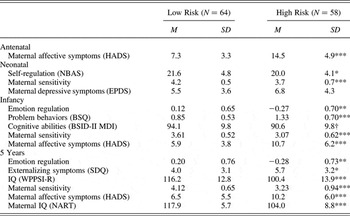
Descriptive statistics reported for high- and low-risk groups

Note: HADS, Hospital Anxiety and Depression Scale; NBAS, Neonatal Behavioral Assessment Scales; EPDS, Edinburgh Postnatal Depression Scale; BSQ, Behavior Screening Questionnaire; BSID-II MDI, Bayley Scales of Infant Development II, Mental Development Index; SDQ, Strengths and Difficulties Questionnaire; WPPSI-R, Wechsler Preschool and Primary Scale of Intelligence—Revised.
†p < .10. *p < .05. **p < .01. ***p < .001.
Missing data
As noted, the sample reduced from 121 at recruitment to 98 at 5-year follow-up (81% retention rate). There was more attrition from the high- versus the low-risk group (17/58 vs. 6/63 at 5 years; χ2 = 7.68, df = 1, p = .006).Footnote 3 Therefore, we further examined whether those who dropped out were comparable to those in their group on the screening questionnaire and all available study outcomes. Analyses of variance comparing scores by retention status while controlling for risk group indicated no significant differences by retention status on any measure, and effect sizes for comparisons on relevant variables were all small (partial η2 range = <0.001 to 0.02). Within-group comparisons by retention status yielded similar results. Thus, participants who were retained in the study appeared representative of those originally recruited to their group. Moreover, path analyses were based on the entire recruitment sample (i.e., n = 121) with missing data modelled using full information maximum likelihood estimation, the recommended approach for minimizing the introduction of bias owing to missing data (Allison, Reference Allison2003; Schafer & Graham, Reference Schafer and Graham2002).
Results
Child adjustment
An initial set of group comparisons examined child adjustment in relation to adversity status (see Table 1 for descriptive statistics). With respect to BSQ scores at 12/18 months, nonparametric analyses indicated that high-risk children showed more behavioral problems than their low-risk counterparts (Z = –3.43, p = .001). Scores were similar for boys and girls (Z = –0.09, ns). When an analysis of variance was used to examine 5-year externalizing symptoms (SDQ) in relation to risk status and gender, the results indicated a significant effect of risk status, F (1, 94) = 8.23, p = .005, partial η2 = 0.08, reflecting higher scores for the high- versus low-risk group (Table 1), a trend for an effect of gender, boys M = 6.8, SD = 3.6; girls M = 5.2, SD = 4.4; F (1, 94) = 5.2, p = .054, partial η2 = 0.04, but no risk by gender interaction, F (1, 94) = 0.06, ns.
Emotion regulation capacities and the emergence of externalizing behaviors
In order to test the hypothesis that risk status would be associated with impaired child emotion regulation capacities, MANOVA was used to examine child emotion regulation scores in the neonatal period, at 12/18 months and at 5 years in relation to the independent variables of risk status and child gender. Multivariate tests indicated a main effect of risk status on emotion regulation scores, Pillai trace F (3, 89) = 6.86, p < .001, partial η2 = 0.19. Follow-up univariate tests indicated that this was due to significantly lower scores in the high- versus low-risk groups at 12/18 months, F (1, 91) = 8.26, p = .005, partial η2 = 0.08, and at 5 years, F (1, 91) = 10.66, p = .002, partial η2 = 0.11, with a trend for the same effect in the neonatal period, F (1, 91) = 3.75, p = .056, partial η2 = 0.04 (see Table 1 for descriptive statistics). Note that the trend for a group difference neonatally was significant when all 121 cases available for this assessment point were analyzed, t (121) = 2.06. p = .042. Multivariate tests also indicated a significant gender effect, Pillai trace F (3, 89) = 6.55, p < .001, partial η2 = 0.18, which univariate tests revealed was due to boys having lower regulatory scores than girls at 5 years, boys M = –0.31, SD = 0.67; girls M = 0.32, SD = 0.76; F (1, 91) = 19.0, p < .001, partial η2 = 0.17, but not at 12/18 months or at the neonatal assessment. There was no risk by gender interaction, Pillai trace F (3, 89) = 0.79, ns.
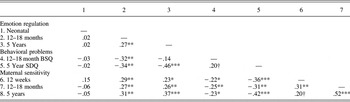
We next tested the hypothesis that poorer emotion regulation capacities would be associated with the emergence of child problem behaviors. Correlations are presented in Table 2. Neonatal emotion regulation scores showed no associations with later behavioral problems, and there was also no stability from neonatal to subsequent emotion regulation. However, 12/18-month emotion regulation scores were significantly negatively correlated with concurrent behavioral problem scores and with 5-year externalizing symptoms; 5-year emotion regulation scores were also negatively correlated with concurrent externalizing difficulties. Furthermore, emotion regulation capacities showed moderate stability over the same period (12 to 18 months r = .41, p < .001; 18 months to 5 years r = .35, p = .001).
Intercorrelations among child emotion regulation scores, behavioral problems, and maternal sensitivity

Note: BSQ, Behavior Screening Questionnaire; SDQ, Strengths and Difficulties Questionnaire.
†p<.10. *p < .05. **p < .01. ***p < .001.
Positive associations observed between emotion regulation capacities and externalizing symptoms were examined further. Linear regression investigated the extent to which emotion regulation variables could predict child externalizing difficulties at 5 years once earlier behavioral problems (12- and 18-month BSQ scores), child gender, and risk group status were taken into account. Child gender, BSQ scores, and risk status were entered into the model in the first step, R 2 = 0.12, F (3, 91) = 4.14, p = .008. The addition of 12- and 18-month emotion regulation scores in the second step significantly improved model fit, ΔR 2 = 0.06, ΔF (1, 90) = 6.24, p = .014, as did 5-year emotion regulation scores in a third step, ΔR 2 = 0.09, ΔF (1, 89) = 10.5, p = .002. The final model was highly significant, F (5, 89) = 6.38, p < .001, accounting for 26% of the variance in child externalizing symptoms; emotion regulation as measured at 12 and 18 months (B = –1.01, SE = 0.46, β = –0.22, p = .031) and at 5 years (B = –1.44, SE = 0.45, β = –0.35, p = .002) were the only independently significant predictors of externalizing symptoms in the final model.
Finally, we examined the specificity of associations between emotion regulation capacities and child externalizing versus internalizing difficulties. Basic correlations examined associations between emotion regulation capacities and child internalizing problems, as indexed by 5-year emotional problem scores on the SDQ. In contrast to the moderate to large effects reported for child externalizing symptoms, results indicated that emotional problem scores were not significantly related to either 12/18-month or 5-year emotion regulation scores (12/18-month r = –.14, ns; 5-year r = –.18, p = .075); at 5 years the difference in magnitude of correlations for externalizing versus internalizing symptoms with emotion regulation capacities was significant, 12/18-month t (95) = 1.55, ns; 5-year t (95) = 2.29, p = .02.
The role of maternal parenting behavior
We investigated the role of maternal sensitivity in (a) differentiating high- and low-risk groups, (b) predicting the development of child emotion regulation capacities, and (c) thereby contributing to the emergence of externalizing symptoms. First, MANOVA was used to examine the prediction of maternal sensitivity at 12 weeks, 12/18 months, and 5 years by risk status and child gender (descriptive statistics in Table 1). The results indicated an overall effect of risk status, Pillai trace F (3, 84) = 16.0, p < .001, partial η2 = 0.36, which reflected lower sensitivity in the high- versus low-risk group at every assessment point: neonatal F (1, 86) = 15.9, p < .001, partial η2 = 0.16; 12- and 18-month F (1, 86) = 21.5, p < .001, partial η2 = 0.20; 5-year F (1, 86) = 28.0, p < .001, partial η2 = 0.25. There was also a multivariate effect of child gender, Pillai trace F (3, 84) = 2.95, p = .037, partial η2 = 0.10, which reflected lower sensitivity in relation to boys (M = 3.2, SD = 0.66) versus girls (M = 3.5, SD = 0.54) at 12/18 months only. There was no gender by risk interaction, Pillai trace F (3, 84) = 0.06, ns.
Second, concurrent and prospective associations between maternal sensitivity and child emotion regulation capacities were examined. We investigated whether maternal sensitivity was associated with concurrent child regulation and could predict child emotion regulation capacities at the next assessment point. As can be seen from the full intercorrelation presented matrix in Table 2, higher maternal sensitivity was associated with higher concurrent and subsequent child emotion regulation at each assessment from 12 weeks through to 5 years. Conversely, we also tested whether child emotion regulation could predict maternal sensitivity at the next time point. Neonatal emotion regulation (at 10 days and 4 weeks) was not found to be a significant predictor of subsequent maternal sensitivity at 12 weeks. However, better regulated 12/18-month-olds had mothers who were more sensitive at 5 years (see Table 2).
Third, indirect pathways from earlier maternal sensitivity to 5-year externalizing symptoms via emotion regulation were examined (Preacher & Hayes, Reference Preacher and Hayes2008). For 12-week sensitivity, results indicated a significant indirect pathway to 5-year SDQ scores via emotion regulation in infancy and at 5 years (bootstrapped total indirect effect = –0.73, 95% confidence interval [CI] = –1.33 to –0.34, p = .010; infancy indirect effect = –0.30, CI = –0.76 to –0.10; 5-year = –0.43, CI = –0.96 to –0.13). For infancy maternal sensitivity, results indicated a significant indirect pathway to 5-year SDQ scores via emotion regulation in infancy and at 5 years (bootstrapped total indirect effect = –0.75, 95% CI = –1.42 to –0.32, p = .007; infancy indirect effect = –0.26, CI = –0.64 to –0.06; 5-year = –0.49, CI = –1.06 to –0.15).
Multivariate analyses
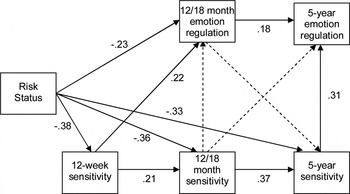
Based on the outcomes of the above analyses, we examined longitudinal pathways to child outcomes via path analysis. Two related models were constructed: the first focused on child emotion regulation as the primary outcome, and the second also considered pathways to child externalizing symptoms. A preliminary analysis in relation to child emotion regulation capacities, based on positive findings established in the preceding sets of analyses, examined sequential paths from risk status to 5-year emotion regulation via both intervening emotion regulation (excluding the neonatal index, which was unrelated to subsequent outcomes) and maternal behavior. The model fit was poorFootnote 4 (χ2 = 27.1, df = 5, p < .001; comparative fit index [CFI] = 0.79, Tucker–Lewis index [TLI] = 0.38; root mean square error of approximation [RMSEA] = 0.19, 90% CI =0.13–0.27), and the covariance matrix indicated strong associations between risk status and maternal behavior at every stage of assessment. These additional direct risk-parenting pathways were included, and three pathways with p > .10 (dashed lines in Figure 1) were dropped. The resultant model (Figure 1) showed a good fit (χ2 = 6.87, df = 6, p = .33; CFI = 0.99, TLI = 0.98, RMSEA = 0.04, 90% CI = 0.0–0.13). As can be seen from the figure, risk status influenced 5-year emotion regulation via both intervening emotion regulation and maternal parenting behavior. Parenting behavior showed a degree of stability over time, it but was also strongly influenced by psychosocial risk at every time point. The addition of a further direct pathway from risk status to 5-year emotion regulation did not result in a better fitting model (Satorra–Bentler scaled chi-square difference test, χ2 = 1.69, df = 1, ns), and this pathway was not significant (standardized coefficient = –0.14, Z = –1.30). In sum, path analysis supported the conclusion that maternal sensitivity was a significant influence on developing child emotion regulation capacities and contributed to the association between risk status and poorer emotion regulation. Reverse effects, from child emotion regulation to later maternal sensitivity (demonstrated in basic correlations from 12/18 months to 5 years) were not significant.
The relationships among risk status, maternal sensitivity, and child emotion regulation. Dashed lines represent nonsignificant pathways dropped from the original model.

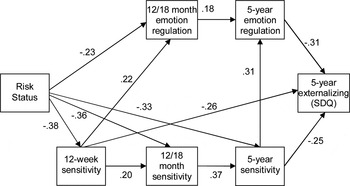
A second set of models examined prediction of child externalizing scores on the SDQ. A preliminary analysis included a full set of possible concurrent and prospective associations from parenting and emotion regulation variables to SDQ scores. Two of these direct pathways, from 12/18-month emotion regulation and 12/18-month maternal sensitivity, had p values >.10 and were dropped from the model. The resultant model showed a good fit (χ2 = 10.73, df = 9, p = .29; CFI = 0.99, TLI = 0.97, RMSEA = 0.04, 90% CI = 0.0–0.12). As can be seen from Figure 2, 5-year externalizing symptoms on the SDQ were independently predicted by maternal parenting behavior (both concurrently and longitudinally) and by child emotion regulation capacities.
Longitudinal pathways from risk status to child externalizing symptoms, via maternal sensitivity and child emotion regulation capacities. SDQ, Strengths and Difficulties Questionnaire.

Building on this model, we examined the impact of including earlier child difficulties (i.e., BSQ scores at 12/18 months) on existing pathways to 5-year externalizing problems; we also tested whether earlier problem behaviors predicted later emotion regulation and maternal sensitivity. A preliminary model included a full set of possible concurrent and prospective associations from parenting and emotion regulation variables to BSQ scores, as well as a pathway from BSQ to SDQ scores. Only two significant pathways were identified, to 12/18-month BSQ scores from both risk status (β = 0.29) and 12/18-month emotion regulation (β = –0.27). Although the pathway from BSQ scores to SDQ scores was nonsignificant (β = 0.04), it was retained as we particularly wanted to take account of longitudinal stability in behavioral problems. All other pathways were dropped. The resultant model showed a good fit (χ2 = 11.60, df = 13, p = .56; CFI = 1.00, TLI = 1.02, RMSEA = 0.01, 90% CI = 0.0–0.08), but the existing pathways identified in Figure 2 were essentially unchanged (model not depicted). Further analysis examined the impact of adding a direct pathway from risk status to 5-year externalizing symptoms and forward pathways from BSQ scores to 5-year emotion regulation and maternal sensitivity. All of these additional pathways were nonsignificant (standardized coefficients range = –.03 to –.09, maximum Z = –0.82), and there was also no significant change in model fit (Satorra–Bentler scaled chi-square difference test, χ2 = 0.96, df = 3, ns). Thus, links among emotion regulation, parenting, and SDQ scores did not appear to be accounted for by earlier behavioral problems, and the association between risk status and levels of externalizing symptoms was explained, at least in part, by disturbances in emotion regulation capacities and maternal insensitivity.
Proximal components of risk
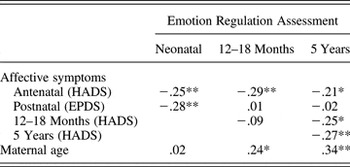
We conducted exploratory analyses of key proximal influences on fetal and child development: maternal age, affective symptoms (measured at each assessment point), and Cotinine validated smoking during pregnancy. Smoking during pregnancy essentially occurred exclusively in the high-risk (35/58) versus the low-risk (1/63) group. Thus, although antenatal smoking was associated with poorer emotion regulation at 12/18 months (p = .019), when the presence/absence of smoking was considered just within the high-risk group there was no evidence for an effect (p > .4), and no effect of smoking emerged at other time points (ps > .19). Bivariate correlations for maternal age and affective symptoms are reported in Table 3. Higher maternal affective symptoms relatively consistently predicted poorer child emotion regulation capacities, including prospective associations from antenatal HADS scores. Younger maternal age also predicted poorer emotion regulation capacities at 12/18 months and at 5 years.
Correlations among maternal age and affective symptoms and child emotion regulation scores

Note: HADS, Hospital Anxiety and Depression Scale; EPDS, Edinburgh Postnatal Depression Scale.
*p < .05. **p < .01.
Regression analyses examined whether any of the significant effects of maternal age and affective symptoms could predict child emotion regulation outcomes independently, over and above overall risk effects. For the prediction of neonatal emotion regulation, antenatal and postnatal maternal affective symptoms were tested and significantly improved model fit, ΔR 2 = 0.07, ΔF (2, 117) = 4.40, p = .014, over and above risk status alone, R 2 = 0.03, F (1, 118) = 3.98, p = .048. Postnatal Edinburgh Postnatal Depression Scale scores were the only significant, independent predictor in the resultant model (β = –0.22, t = –2.32, p = .022). For the prediction of 12/18-month emotion regulation and 5-year emotion regulation, maternal age and mental health variables did not contribute additional variance over and above risk status alone, and the resultant models contained no independently significant predictors.
Finally, given assumed interplay between cognitive and emotional development, and the existence of IQ differences between our two groups (see Table 1), we examined child IQ as a covariate for analyses. Preliminary analyses revealed significant correlations between emotion regulation at 12/18 months and the Mental Development Index of the BSID-II, completed at the same time points (r = .50, n = 109, p < .001),Footnote 5 and between IQ as measured by the WPSSI-R at 5 years and 5-year emotion regulation (r = .24, n = 97, p = .016). Maternal IQ at 5 years, as indexed by the NART, was unrelated to child emotion regulation (r = .15, ns). Further linear regression analyses showed that associations between risk status and emotion regulation were maintained once cognitive abilities were also included in the model at both 12/18 months (risk, β = –0.20, t = –2.40, p = .018; mental index, β = –0.46, t = 5.55, p < .001) and 5 years (risk, β = –0.25, t = –2.18, p = .032; IQ, β = –0.11, t = 1.04, ns).
Discussion
The key findings from the current study were as follows. First, risk for externalizing psychopathology, conferred by virtue of maternal psychosocial adversity, was associated with poorer emotion regulation capacities from the neonatal period through to 5 years child age. Moreover, child emotion regulation capacities showed a degree of stability from the start of the second year of life through to 5 years and were associated with emergent child externalizing difficulties over the same period (neonatal regulation was neither stable nor associated with later behavioral problems). A degree of specificity in the emotion regulation/externalizing symptoms association was tentatively indicated, since equivalent effects were not apparent in relation to internalizing symptoms. Second, psychosocial adversity was also associated with less sensitive maternal parenting behavior from the neonatal period through to 5 years. This association was pervasive; thus, adversity continued to be linked to less optimal parenting at later assessments, even once associations with earlier parenting were taken into account. Third, there were interrelationships between maternal parenting and child outcomes throughout development, which contributed to associations between psychosocial adversity and both poorer emotion regulation and higher levels of externalizing symptoms.
The current findings highlight the presence of impairments in the ability to regulate negative emotional states that characterize at-risk children, even from relatively early in development, and that are longitudinally associated with externalizing symptomatology. Consistent with our observations, previous research has reported longitudinal associations between effortful control and externalizing symptoms, in studies spanning both early to middle childhood (Kochanska & Knaack, Reference Kochanska and Knaack2003) and early adolescence (Eisenberg et al., Reference Eisenberg, Zhou, Spinrad, Valiente, Fabes and Liew2005). However, whereas effortful control incorporates multiple aspects of self-regulation, our study indicates that emotion regulation capacities in particular may be a significant factor in predicting child externalizing difficulties. Moreover, emotion regulation capacities measured as early as 1 year child age had the capacity to predict subsequent externalizing symptoms through to 5 years in the current study, even once concurrent behavioral problems were controlled for. Overall, our longitudinal findings provide important support for the proposal that emotion regulation deficits contribute to the development of externalizing disorders and are not merely symptomatic of preexisting externalizing problems. Nonetheless, our data are correlational, precluding strong conclusions regarding causality. Thus, in path analyses the association between early emotion regulation capacities and 5-year externalizing behaviors was largely explained by stability in emotion regulation through to 5 years. Although this observation of stability in emotion regulation coupled with associations with externalizing symptoms is significant, since it suggests that emotion regulation processes may be a potential target for early intervention, it also underscores other possible interpretations of our findings. Shared underlying third processes and/or different manifestations of the same problem across development could have yielded similar patterns of results.
Our study is unique in having measured emotion regulation capacities from the neonatal period through to middle childhood. The inclusion of these early observations was informative. Although there was a trend for poorer regulatory capacities to be evident in high-risk versus control group neonates in the first month of life, neonatal regulation did not show longitudinal stability even through to 1-year infant age and did not predict subsequent behavioral problems.Footnote 6 The rudimentary capacities to modulate arousal that are observable in the first 3 months appear to be largely a function of innate, reflexive mechanisms and individual differences in the physiological parameters underpinning emotional responding (Kopp, Reference Kopp1982; Porges, Reference Porges1996). More diverse regulatory capacities begin to emerge from around 3 months of age; infants increasingly begin to use social interactions to manage their affective state, a wider repertoire of physical self-soothing behaviors emerges, and the ability to actively utilize cognitive and behavioral engagement/disengagement to regulate arousal develops (Buss & Goldsmith, Reference Buss and Goldsmith1998; Kopp, Reference Kopp1989; Rothbart, Ziaie, & O'Boyle, Reference Rothbart, Ziaie, O'Boyle, Eisenberg and Fabes1992; Stifter & Braungart, Reference Stifter and Braungart1995). Further cognitive advances during the second year of life mean that infants begin to understand the sources of emotional distress and the actions required to correct it (Cicchetti & Pogge-Hesse, Reference Cicchetti, Pogge-Hesse, Lamb and Sherrod1981; Kopp, Reference Kopp1989), and the ability to label emotional states also begins to emerge (Dunn, Bretherton, & Munn, Reference Dunn, Bretherton and Munn1987). Thus, the first years of life bring marked changes in both infants' capacity to regulate emotional states and the mechanisms by which they achieve this. Although we cannot rule out a possible contribution of the inevitable changes in the way that emotion regulation was measured through development, our failure to observe associations between neonatal and subsequent emotion regulation in the current study should be considered in the light of the developmental context outlined; the occurrence of significant transitions in social, cognitive, and behavioral capacities, and their application to the management of emotional state, means that discontinuity in regulatory capacities is perhaps to be expected. Moreover, our observations are consistent with previous research that found no stability in the regulation of responses to frustration between 5 and 10 months infant age but a degree of consistency in regulatory behavior between 10 and 18 months (Stifter & Jain, Reference Stifter and Jain1996). Building on this existing work, we were able to demonstrate modest positive associations between emotion regulation capacities measured at 12/18 months and 5-year regulatory capacities, indicating that persistent individual differences in the ability to contain negative emotions may be established by the second year of life.
Consistent with the view that caregivers are a key source of regulatory input for the developing child (Calkins & Hill, Reference Calkins, Hill and Gross2007; Kopp, Reference Kopp1982; Thompson & Meyer, Reference Thompson, Meyer and Gross2007; Tronick & Gianino, Reference Tronick and Gianino1986), we observed positive associations between maternal sensitivity and child emotion regulation at every stage of assessment. Moreover, prospective associations were also observed, with maternal sensitivity measured as early as 12 weeks postpartum predicting subsequent emotion regulation. Assessments of child emotion regulation were independent of assessments of parenting in the current study, and therefore associations reflect more than just immediate child responding to maternal input. Although previous research has suggested reciprocal relations between maternal behavior and child characteristics (Cole et al., Reference Cole, Teti and Zahn-Waxler2003; Patterson, Reference Patterson, Pepler and Rubin1995; van den Boom & Hoeksma, Reference van den Boom and Hoeksma1994), our data were consistent with the primacy of the maternal role; thus, although we observed a modest correlation between infancy regulation and subsequent maternal sensitivity, this effect was not upheld in path analyses when the full set of longitudinal pathways was examined.
In principle, maternal behavior may influence child regulation of negative emotional states through several mechanisms. In early development, by responding sensitively to their child's emotional state, mothers may provide the child with an appropriate platform from which to learn to regulate their own negative emotions (Cassidy, Reference Cassidy1994; Thompson & Meyer, Reference Thompson, Meyer and Gross2007; Tronick & Gianino, Reference Tronick and Gianino1986). Conversely, maternal overinvolvement or control may restrict opportunities for the child to learn how to self-regulate, and harsh or insensitive parenting may have a direct adverse impact on child attempts to contain their negative emotions (Calkins & Johnson, Reference Calkins and Johnson1998). In later development, mothers may directly teach or model appropriate regulatory behaviors, or they may explicitly require or reward effective containment of negative emotions, providing a drive for the child to self-regulate. In addition, responsive maternal behavior may influence the development of underlying child neurophysiological systems key to the expression and containment of emotional responses (Calkins & Hill, Reference Calkins, Hill and Gross2007; Moore et al., Reference Moore, Hill-Soderlund, Propper, Calkins, Mills-Koonce and Cox2009); tentatively, maternal responses appear to serve as input to the development of the child hypothalamic–pituitary–adrenal axis (Blair et al., Reference Blair, Granger, Kivlighan, Mills-Koonce, Willoughby and Greenberg2008; Blair, Granger, Willoughby, & Kivlighan, Reference Blair, Granger, Willoughby and Kivlighan2006; Gunnar, Reference Gunnar1998; Murray, Halligan, Goodyer, & Herbert, Reference Murray, Halligan, Goodyer and Herbert2010) and autonomic nervous system functioning (Calkins et al., Reference Calkins, Graziano, Berdan, Keane and Degnan2008). Again, we note that our longitudinal correlations cannot unequivocally establish a causal role for maternal behavior in the development of child emotion regulation; both maternal responding and child emotion regulation may be underpinned by a third variable, such as an unmeasured component of child temperament. Nonetheless, our observations represent an important advance on cross-sectional studies, because they demonstrated an association between early parenting and later child emotion regulation that was maintained even once stability in both these dimensions was taken into account. Future work aimed at manipulating aspects of maternal behavior in order to enhance developing child emotion regulation capacities is indicated.
It is striking that poorer emotion regulation distinguished high- versus low-risk children at each stage of the study. Moreover, we also observed a strong and persistent association between psychosocial adversity and less sensitive maternal behavior at every stage of assessment, even when longitudinal stability in maternal sensitivity was taken into account in path analyses. In combination, interrelated disturbances in emotion regulation capacities and maternal sensitivity contributed to the association between adversity and child externalizing problems seen at 5 years. Although our analyses utilized groups based on measures of psychosocial adversity taken during the antenatal period, our high-adversity group continued to experience multifaceted social difficulties. Thus, at 5 years, compared to their low-risk counterparts, high-adversity mothers reported experiencing more socioeconomic deprivation, higher levels of affective symptoms, less satisfactory intimate relationships, poorer housing, higher levels of community disorder, and greater levels of adverse life events (data not presented). Given this high-stress context and the elevated levels of maternal affective symptoms, associations between ongoing environmental adversity effects and maternal behavior are perhaps unsurprising (Goodman & Gotlib, Reference Goodman and Gotlib1999; Murray et al., Reference Murray, Fiori-Cowley, Hooper and Cooper1996; Weissman et al., Reference Weissman, Pilowsky, Wickramaratne, Talati, Wisniewski and Fava2006). Nonetheless, other explanations are also possible. In principle, the ongoing association between adversity and maternal behavior may reflect stable underlying maternal characteristics that manifest differently at different stages of child development, as adjustment to changing demands is required (Cronin et al., Reference Cronin, Halligan and Murray2008). In this case, the apparently persistent influence of psychosocial adversity on parenting behavior would actually be explained by expression of those characteristics, operating over and above measured stability in parenting. However, the weight of research suggests that parenting is influenced by both such individual characteristics and the quality of the external environment (Kendler & Baker, Reference Kendler and Baker2007).
Psychosocial adversity was utilized as a means of recruiting children at high risk of externalizing problems in the current study; a comprehensive examination of the components of this multifaceted construct was beyond the scope of this paper. Nonetheless, we conducted exploratory analyses examining whether specific components of adversity might be particularly important. Although there was little evidence that maternal antenatal smoking was a significant influence on developing child emotion regulation capacities, maternal age and affective symptomatology did emerge as relatively consistent predictors of emotion regulation outcomes. With respect to the latter component of risk, antenatal symptoms showed the most persistent associations, with higher levels predicting poorer child emotion regulation at every stage of assessment. These observations are consistent with a broader literature linking antenatal maternal stress and depression with multiple adverse child outcomes, including externalizing psychopathology (Van den Bergh, Mulder, Mennes, & Glover, Reference Van den Bergh, Mulder, Mennes and Glover2005) and disturbances in the development of emotion regulation capacities (Blandon et al., Reference Blandon, Calkins, Keane and O'Brien2008; Maughan et al., Reference Maughan, Cicchetti, Toth and Rogosch2007). At the same time, our analyses highlight the difficulties of trying to isolate single contributors to adverse outcomes in high-risk populations; as already noted, recruitment for the current study ensured the selection of individuals in whom multiple difficulties tended to co-occur, and observed influences of maternal affective symptoms typically were no longer significant when the broader set of risk factors was considered. Moreover, as with other studies in this area, we would note that although our assessments of psychosocial adversity were relatively comprehensive, there likely remain other factors that distinguished our groups but were not assessed by us (including possible genetic vulnerabilities). Overall, our analyses of the significance of specific components of risk should be interpreted cautiously.
There were important strengths of our study, particularly the high-risk, prospective longitudinal design and the independent assessment of maternal and child characteristics via observational measures. The inclusion of assessments from relatively early in development is a second strength, since the first 2 years of life have been highlighted as a period during which key developments in infant regulatory capacities occur (Kopp, Reference Kopp1989; Rothbart, Reference Rothbart, Kohnstamm, Bates and Rothbart1989). The robustness of our study was also improved by observational assessments that were completed at every stage. Nonetheless, there are also some limitations. First, we included novel assessments to index child regulation of negative emotional responding, albeit with coding schemes based on existing research. The need to standardize measures of child regulation has been noted (Cole, Martin, & Dennis, Reference Cole, Martin and Dennis2004), but there is currently no established standard for the measurement of emotion regulation across development. There is also debate in the literature regarding what should be encompassed by the construct of emotion regulation (Cole et al., Reference Cole, Martin and Dennis2004; Gross & Thompson, Reference Gross, Thompson and Gross2007; Thompson, Reference Thompson1994); nevertheless, current definitions consistently emphasize the effectiveness with which affective states are managed and the strategies that are used to achieve this, components which we endeavored to reflect in our assessments. Second, our sample was modest in size, meaning that there was not sufficient power to correct for multiple correlations; and attrition over the 6 years of study occurred particularly in the high-risk group. Although we had no evidence to suggest that families who dropped out of the research were different from those in their group who were retained, that the attrition was largely due to families being lost to contact may mean that those families experiencing the highest levels of environmental disorder were not included. Third, although we used a longitudinal approach, ours was still essentially a correlational design. As such, it may be that associations observed among parenting, child regulatory indices, and child behavior are underpinned by shared genetic or other environmental factors. However, processes that are explained by genes are not necessarily immutable, and an insight into interrelationships among different aspects of child disturbance offers potential targets for intervention.
To conclude, our study demonstrated impairments in emotion regulation capacities in children at risk for externalizing disorder that were apparent from an early stage of development. Moreover, poorer emotion regulation capacities were longitudinally associated with externalizing difficulties, consistent with a causal role. Persistent maternal insensitivity also characterized high-risk dyads and was longitudinally linked to the development of child emotion regulation problems. In principle, poor emotion regulation capacities may represent a target for (early) intervention, via either directly working to enhance child emotion regulatory skills or through providing parents with skills to better support their child's emotional development. More broadly, our findings add to a significant literature highlighting links between psychosocial adversity and poorer parental and child functioning, and reaffirm the urgent need to improve outcomes in this context.