Introduction
Thyroid nodules are common in the general population. The detection rate is 19–68 per cent in individuals undergoing a neck ultrasound scan (USS) and 8–65 per cent in autopsy specimens.Reference Mazzaferri1 The diagnosis of a thyroid nodule has also increased significantly over the past 2 decades as a result of the increasing use and the increased sensitivity of USS and computed tomography (CT).Reference Mehanna, Jain, Morton, Watkinson and Shaha2 The financial burden is significant for the National Health Service (NHS), with annual costs exceeding £272 million.Reference Rad, Zakavi, Layegh, Khooei and Bahadori3
Fine-needle aspiration biopsy (FNAB) under USS guidance is the gold standard modality to evaluate the nature of a thyroid nodule. This minimally invasive, cost-effective technique offers higher adequacy rates compared to traditional palpation-guided FNA.Reference Cross, Chandra, Giles, Johnson and Poller4
In 2009, the Royal College of Pathologists introduced modifications to the Thy classification system, updating the previous British Thyroid Association (BTA) and Royal College of Physicians (RCP) nomenclature.Reference Cross, Chandra, Giles, Johnson and Poller4 The Bethesda System serves as the equivalent classification in the United States.Reference Baloch, LiVolsi, Asa, Rosai, Merino and Randolph5 Thy3, Thy4 and Thy5 nodules require multidisciplinary team (MDT) management to determine the next steps. According to current National Institute for Health and Care Excellence (NICE) guidelines, Thy3a nodules are typically managed with repeat sampling, including repeat FNAB and consideration of core needle biopsy, whereas Thy3f lesions typically require diagnostic thyroid surgery (lobectomy).6, Reference Homer, Winter, Abbey, Aga, Agrawal and Dafydd7
The Thy3a category includes cases of atypia with follicular patterns, making clinical decision-making challenging and often leading to uncertainty in patient counselling. The subdivision of Thy3 into Thy3a and Thy3f was introduced to identify which patients (Thy3a) could potentially avoid diagnostic surgery without compromising oncological outcomes.
Study objective
The aim of this systematic review is to analyse published data from UK hospitals, assess the observed malignancy rate in surgically managed Thy3a and Thy3f patients and provide a more evidence-based approach to their management.
Materials and methods
Our systematic review protocol was registered with PROSPERO and the registration number was CRD42025645486. A comprehensive electronic search of PubMed (via MEDLINE), ScienceDirect and Google Scholar databases was conducted from 30/12/2024 to 07/02/2025 to identify articles relevant to our research question. A time restriction was applied, and only studies published after 2008 were included, as the Thy3a and Thy3f classifications were introduced in 2008. Consequently, studies published before this date were considered irrelevant. To enhance the sensitivity of our review, we also manually screened the references lists of relevant original articles discussing the Thy classification. Ethical approval and patient consent were not required due to the nature of this study. The review was conducted using manual screening methods without the use of automated screening software.
Two researchers (A.P. and S.S.) independently conducted the literature search using the following free-text search terms across all databases: Thy3, Thy3f, Thy3a, Thy classification and Thyroid preoperative FNA. The inclusion of each article was determined independently by both researchers, with any disagreements resolved through consensus. Inclusion and exclusion criteria were predefined before the literature review.
Eligibility criteria
Inclusion criteria are as follows: (1) studies reporting patients with pre-operative FNAB who subsequently underwent diagnostic thyroid surgery; (2) studies using the Thy classification system as defined by the BTA; and (3) studies that subclassified Thy3 cases into Thy3a and/or Thy3f subcategories.
Exclusion criteria are as follows: (1) animal studies; (2) non-UK studies; (3) studies published before 2008; and (4) case reports.
Data extraction and quality assessment
All identified studies were independently evaluated by A.P. and S.S. based on the inclusion and exclusion criteria. Eligible studies were retrieved, and relevant data were extracted into a structured spreadsheet. Extracted data included: first author’s name, year of publication, study design, population, number of surgically managed patients with pre-operative Thy3a FNAB, number of surgically managed patients with pre-operative Thy3f FNAB and number of patients with post-operative malignancy in each category.
The primary outcome of this study was the observed malignancy rate in surgically treated Thy3a and Thy3f categories. The Quality Assessment of Diagnostic Accuracy Studies 2 (QUADAS-2) tool was used to evaluate the risk of bias and applicability concerns in each study.Reference Whiting, Rutjes, Westwood, Mallett, Deeks and Reitsma8 Each of the seven QUADAS-2 domains was assessed independently by A.P. and S.S. as high risk, low risk or unclear risk. Discrepancies were resolved through discussion until consensus was reached.
Statistical analysis
Statistical significance was evaluated using the chi-square test with a significance threshold of p less than 0.05.
Results
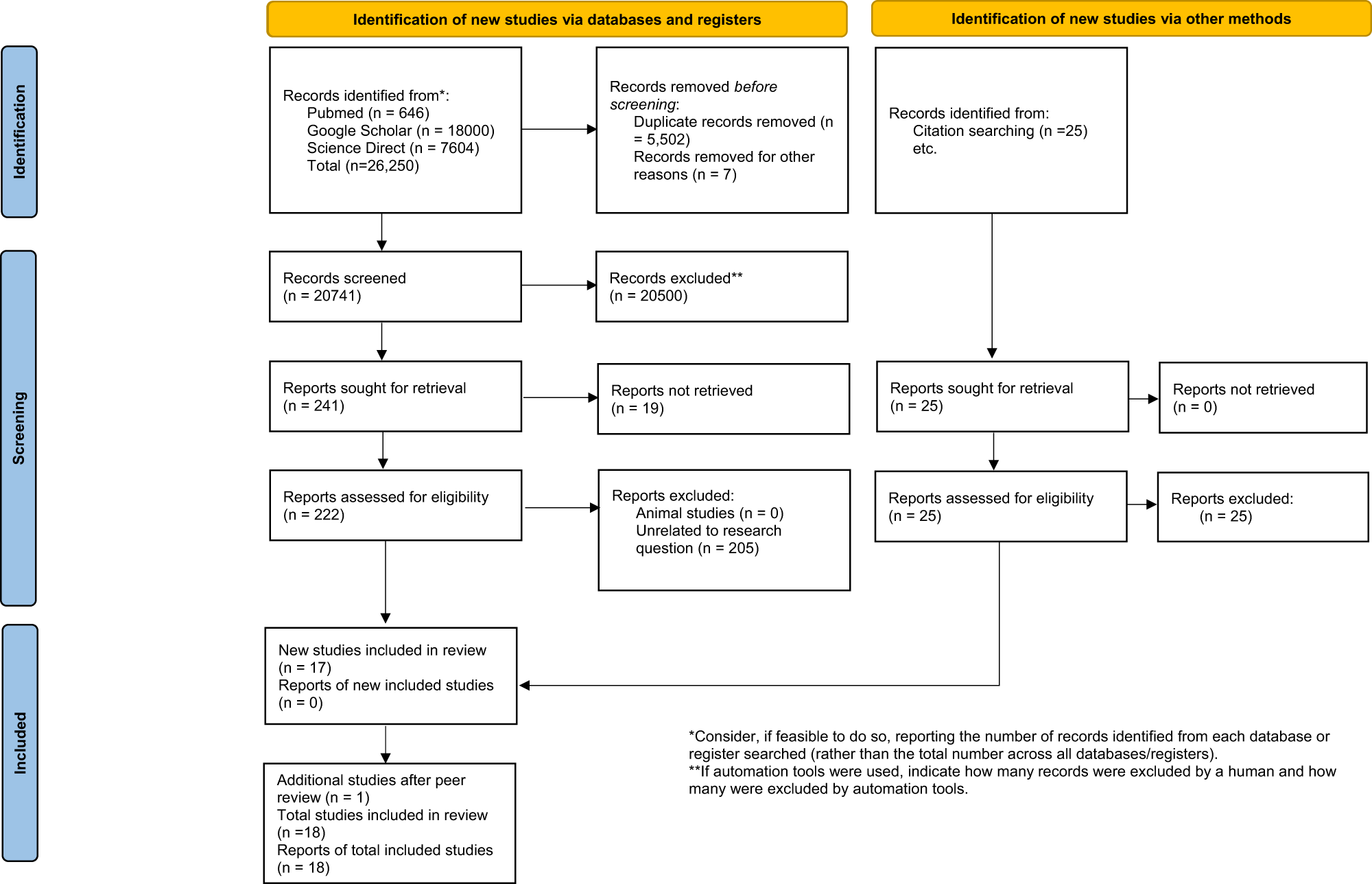
Our systematic literature search initially identified 26,250 studies. After excluding 5,502 duplicate studies, additional seven studies were removed as they were not published in English. The remaining 20,741 records were screened based on their titles and abstracts, leading to the exclusion of 20,500 studies that did not meet our inclusion criteria. Following this, 241 studies were selected for full-text evaluation; however, following the full-text screening, 19 studies could not be fully accessed for eligibility assessment. After assessing the 222-remaining full-text articles, 17 studies met the eligibility criteria and were included in our systematic review.Reference Lobo, McQueen, Beale and Kocjan9–Reference Mehanna, Nankivell, Boelaert, Woolley, Sharma and Sidhu25 Additionally, 25 studies were identified through references list screening, but none met the inclusion criteria. An additional eligible study was recommended during the peer review process and was included in the revision analysis.Reference Rezkallah, Hanna and Elsaify26 Eventually our systematic review consisted of 18 studies (Fig. 1).
The flow chart of our systematic review.

Figure 1 Long description
The flowchart outlines the systematic review process, starting with identification of new studies via databases and registers and other methods. Records identified from databases include Pubmed, Google Scholar and Science Direct, totaling 26,250. Records removed before screening include 5,502 duplicates and 7 for other reasons. Records identified via other methods include citation searching, totaling 25. Screening involves 20,741 records, with 20,500 excluded. Reports sought for retrieval number 241, with 19 not retrieved. Reports assessed for eligibility include 222, with 205 excluded for being unrelated to research. New studies included in the review total 17, with no new reports. Additional studies after peer review add 1, making the total included studies 18. Notes mention considerations for reporting numbers from each database and the use of automation tools for exclusion.
The included studies were performed in UK NHS hospitals and were published between 2011 and 2024. The population of Thy3 patients undergoing diagnostic lobectomy was variable among studies ranging from 23 to 699 cases. In 2020, Van der Horst et al.Reference van der Horst C, Wright, Young, Tailor and Clark17 conducted the largest study, published in 2021 (Table 1).
Demographic characteristics of the included studies

Table 1 Long description
Columns list Authors, Year, Trust, N, and Type of study for 18 studies. Years range from 2011 to 2024, with one study in 2011 and multiple studies from 2021 to 2024. Trust entries include named NHS foundation trusts and multi site groups listed as 2 Hospitals, 4 Hospitals, 6 Hospitals, and 18 Hospitals. Sample sizes range from N 14 for Liu et al. 2017 at London North West University Healthcare NHS Trust to N 699 for van der Horst et al. 2021 at NHS Greater Glasgow and Clyde. Other larger samples include Parkinson et al. 2017 at Newcastle upon Tyne Hospitals NHS Foundation Trust with N 316 and Alexander et al. 2018 at 4 Hospitals with N 288. Types of study are mostly Retrospective, with Wong et al. 2014 listed as Prospective and Mehanna et al. 2024 listed as Clinical trial. Retrospective studies include Lobo et al. 2011 N 82, Gill et al. 2016 N 155, Khalil et al. 2018 N 30, and Reskallah et al. 2024 N 101, among others.
Malignancy rates in Thy3a and Thy3f groups
The overall Thy3a cases were 1117 and the overall Thy3f cases were 2078. The malignancy rate for surgically managed Thy3a cases ranged from 13.8 per cent to 50 per cent apart from one study reported only three Thy3a cases with zero malignancies (very small sample). In the Thy3f group, the malignancy rate in surgically managed cases ranged from 18.2 per cent to 43.8 per cent. The overall malignancy rate was 25.16 per cent for Thy3a cases and 26.27 per cent for Thy3f cases (Table 2).
Malignancy rate in Thy3a and Thy3f nodules

Table 2 Long description
Authors are listed with columns for Thy3a total cases and Thy3a malignancy rates in percent, Thy3f total cases and Thy3f malignancy rate in percent, plus Overall cases and Overall malignancy rate in percent. Lobo et al. reports Thy3a 10 with 4 malignant at 40.0 percent, Thy3f 72 with 20 malignant at 27.8 percent, overall 82 with 24 malignant at 29.2 percent. Wong et al. reports Thy3a 38 with 19 malignant at 50.0 percent, Thy3f 100 with 36 malignant at 36.0 percent, overall 138 with 55 malignant at 39.9 percent. Gill et al. reports Thy3a 67 with 15 malignant at 22.0 percent, Thy3f 88 with 37 malignant at 42.0 percent, overall 155 with 52 malignant at 33.5 percent. Liu et al. reports Thy3a 3 with 0 malignant at 0.0 percent, Thy3f 11 with 2 malignant at 18.2 percent, overall 14 with 2 malignant at 14.3 percent. Khalil et al. reports Thy3a 12 with 2 malignant at 16.7 percent, Thy3f 18 with 4 malignant at 22.2 percent, overall 30 with 6 malignant at 20.0 percent. Parkinson et al. reports Thy3a 152 with 38 malignant at 25.0 percent, Thy3f 164 with 52 malignant at 31.7 percent, overall 316 with 90 malignant at 28.5 percent. Alexander et al. reports Thy3a 79 with 24 malignant at 30.3 percent, Thy3f 209 with 61 malignant at 29.2 percent, overall 288 with 85 malignant at 29.5 percent. Halliday et al. reports Thy3a 20 with 4 malignant at 20.0 percent, Thy3f 62 with 9 malignant at 14.5 percent, overall 82 with 13 malignant at 15.9 percent. van der Horst et al. reports Thy3a 336 with 53 malignant at 15.8 percent, Thy3f 363 with 86 malignant at 23.7 percent, overall 699 with 139 malignant at 19.9 percent. Nair et al. reports Thy3a 34 with 14 malignant at 41.2 percent, Thy3f 56 with 22 malignant at 39.3 percent, overall 90 with 36 malignant at 40.0 percent. Puttergill et al. reports Thy3a 57 with 26 malignant at 45.6 percent, Thy3f 154 with 36 malignant at 23.4 percent, overall 211 with 62 malignant at 29.4 percent. Chandrasekar et al. reports Thy3a 49 with 16 malignant at 32.7 percent, Thy3f 97 with 11 malignant at 11.3 percent, overall 146 with 27 malignant at 18.5 percent. De Jong et al. reports Thy3a 29 with 4 malignant at 13.8 percent, Thy3f 152 with 31 malignant at 20.4 percent, overall 181 with 35 malignant at 19.3 percent. Pereira reports Thy3a 59 with 13 malignant at 22.0 percent, Thy3f 143 with 32 malignant at 22.4 percent, overall 202 with 45 malignant at 22.3 percent. Gaunt et al. reports Thy3a 0 with 0 malignant at 0 percent, Thy3f 134 with 26 malignant at 19.4 percent, overall 134 with 26 malignant at 19.4 percent. Dimitriadis et al. reports Thy3a 70 with 19 malignant at 27.1 percent, Thy3f 48 with 21 malignant at 43.8 percent, overall 118 with 40 malignant at 31.3 percent. Mehanna et al. reports Thy3a 95 with 27 malignant at 28.4 percent, Thy3f 113 with 42 malignant at 37.2 percent, overall 208 with 69 malignant at 33.2 percent. Rezkallah et al. reports Thy3a 7 with 3 malignant at 42.8 percent, Thy3f 94 with 18 malignant at 19.1 percent, overall 101 with 21 malignant at 20.8 percent. Total row reports Thy3a 1,117 with 281 malignant at 25.16 percent, Thy3f 2,078 with 546 malignant at 26.27 percent, overall 3,195 with 827 malignant at 25.88 percent.
Note: Only cases that underwent diagnostic surgery are included
Statistical analysis
A chi-square test was conducted to evaluate whether the difference in cancer rates between Thy3a and Thy3f groups was statistically significant. On average the cancer rate was 25.16 per cent for Thy3a cases and 26.27 per cent for Thy3f cases. The chi-square test with Yates correction was 0.417 and the p-value of 0.518 (p > 0.05). Therefore, the malignancy rate between Thy3a and Thy3f categories is not considered significant.
The QUADAS-2 assessment tool was used to assess the risk of bias of the included studies. The two studies performed by Van der Horst et al.Reference van der Horst C, Wright, Young, Tailor and Clark17 and Chandrasherak et al.Reference Chandrasekar, Jayaram and de Carpentier20 did not show any definite high risk in any domain of the QUADAS-2 tool (Tables 3 and 4).
Risk of bias assessment of included studies using QUADAS-2 tool

Table 3 Long description
Columns list Authors, Year, Trust, N, and Type of study for 18 studies. Years span 2011 to 2024. Trust entries include single named NHS trusts and multi site groupings listed as 2 Hospitals, 4 Hospitals, 6 Hospitals, and 18 Hospitals. N values by row are 82, 138, 155, 14, 30, 316, 288, 82, 699, 90, 211, 146, 181, 202, 134, 118, 208, and 101. Type of study is Retrospective for 16 entries, Prospective for Wong et al. 2014, and Clinical trial for Mehanna et al. 2024. The smallest N is 14 for Liu et al. 2017 at London North West University Healthcare NHS Trust, and the largest N is 699 for van der Horst et al. 2021 at NHS Greater Glasgow and Clyde. Two entries have N of 82, Lobo et al. 2011 at University College London Hospitals NHS Foundation Trust and Halliday et al. 2020 at Shrewsbury and Telford Hospital NHS Trust.
 Low Risk
 High Risk
 Unclear Risk
Summary of QUADAS-2 risk of bias and applicability assessments

Table 4 Long description
Table content is available to describe. Column headers, row labels, and cell values for the risk of bias and applicability assessments are not provided. Without the table entries, counts or ratings for any domains cannot be read out. No comparisons, patterns, or totals can be reported because the data cells are missing.
Discussion
Diagnostic surgery risks and considerations
Although diagnostic thyroid surgery is a well-established procedure, it is not without risks and complications. Even with advancements such as intermittent or continuous nerve monitoring, the risk of permanent recurrent laryngeal nerve palsy is not insignificant (0.5–1.0 per cent).Reference Cleere, Davey, Young, Lowery and Kerin27, Reference Patel, Ally, Venkatachalam, Hearn and Mochloulis28 Additionally, post-operative hematoma, if not promptly managed, can be life-threatening.Reference Fan, Zhou, Su, Zhou, Su and Luo29 A visible scar is another unavoidable consequence of traditional transcervical thyroidectomy. While remote-access thyroidectomy has been proven equally safe and effective, the transcervical approach remains the standard of care in most cases.Reference Vanermen, Vander Poorten and Meulemans30
On the other hand, thyroid cancer is generally an indolent disease with an excellent prognosis.Reference Chou, Dana, Haymart, Leung, Tufano and Sosa31 Given the non-aggressive nature of the disease, the risks and benefits of diagnostic surgery must be carefully weighed before making management decisions.
Summary of key findings
This systematic review analysed 18 published studies to evaluate the malignancy risk in patients with pre-operative Thy3 thyroid nodules. The malignancy risk was 26.27 per cent for Thy3f nodules and 25.16 per cent for Thy3a nodules for surgically managed cases. Statistical analysis (p = 0.518) confirmed that the difference between the two groups was not statistically significant.
It should be highlighted that a wide variation in cancer rates was observed among NHS hospitals, showing inter institutional differences in cytopathological interpretation and MDT decisions.
Comparison with existing literature
In 2020, Poller et al. performed a systematic review and meta-analysis. The malignancy rate was 25 per cent for Thy3a nodules and 31 per cent for Thy3f nodules.Reference Poller, Bongiovanni and Trimboli32 Our results demonstrate even smaller differences between Thy3 subcategories, raising questions about the completely different clinical management between these two subcategories. While our results are mostly consistent with those of the systematic review and meta-analysis by Poller et al.,Reference Poller, Bongiovanni and Trimboli32 the present systematic review includes new UK data and specifically focuses on the comparison between the indeterminate (Thy3a and Thy3f) subcategories.
On the other hand, the Bethesda classification indicates that category III is associated with a 10–30 per cent malignancy risk and category IV with a 25–40 per cent risk.Reference Yaprak Bayrak and Eruyar33 In a meta-analysis Crescenzi et al. reported a malignancy risk of 27.4 per cent among 4241 Bethesda III nodules.Reference Crescenzi, Palermo and Trimboli34 These results are comparable to our Thy3a results.
Clinical and practical implications
Current clinical decision making can be challenged by our results. Current guidelines suggest that Thy3a thyroid nodules have a repeat FNA, while Thy3f nodules undergo diagnostic hemithyroidectomy.6 The lack of a statistically significant difference in cancer rates between both indeterminate (Thy3a and Thy3f) categories, suggest that the current different approaches may warrant further evaluation. However, if repeat FNA in Thy3a indeterminate nodules results in clinically significant delays in diagnosis and treatment or adversely affects the oncological outcomes is not clear. A large portion of patients ultimately proceed to diagnostic lobectomy following a second repeated indeterminate cytology; therefore, further prospective studies are needed to determine the real clinical impact of delayed hemithyroidectomy in this subgroup.
Pre-operative risk stratification could also incorporate the ‘U’ classification system. Studies have shown that when U grading is combined with Thy cytology, the overall prediction of malignancy can be more accurate. Therefore, Busby et al. demonstrated that the integration of these two systems can enhance decision-making in the pre-operative setting.Reference Busby, McArthur, Wright and Hilmi35 Another important aspect is the role of molecular testing, family history and prior radiation exposure. All these have predictive value and can be used in addition to the pre-operative FNAB for risk stratification.
Genetic markers play a significant role in evaluating cancer risk in thyroid nodules, especially Thy3a and Thy3f categories. The BRAF V600E mutation is the most well-studied and is strongly correlated with papillary thyroid carcinoma (PTC).Reference Xing36, Reference Pusztaszeri, Krane and Faquin37 The predictive value of BRAF V600E can be elaborated to upgrade (if positive) or to downgrade (if negative) the malignancy risk Thy3a or a Thy3f nodule. Therefore, mutation-positive nodule surgery could guide an MDT towards diagnostic surgery, whereas mutation-negative nodules have a repeat FNA in due time. Of course, these are just logical assumptions that should be validated through randomised prospective studies.
RAS mutations and TERT promoter mutations have been also associated with thyroid malignancies, and further investigation to determine their predictive value should be conducted.Reference Nikiforov, Ohori, Hodak, Carty, LeBeau and Ferris38
In 2024, Forozidou et al. conducted a literature review on the role of c-MYC, Cyclin D1 and Ki-67/MIB-1 immunohistochemical expression in a broad spectrum of thyroid neoplasms.Reference Forozidou, Syrnioti, Laskou, Poutoglidis, Sapalidis and Koletsa39 They found that nuclear c-MYC positivity is correlated with malignant thyroid lesions, while cytoplasmic c-MYC positivity was more often associated with benign nodules.Reference Forozidou, Syrnioti, Laskou, Poutoglidis, Sapalidis and Koletsa39 Therefore, c-MYC expression patterns can be employed as potential biomarkers in thyroid cancer diagnosis or at least in risk assessment.
Strengths and limitations
The main strength of this study is its relative homogeneity, as only UK NHS hospital data using the Thy classification system were included. This approach aimed to limit the variability related to differences in other international classification systems and clinical/surgical management pathways, although interobserver variability even among NHS Trusts remains a well-recognised issue. Furthermore, the sample was large, increasing the robustness and generalisability of the results. The methodological rigor is based on statistical analysis, and the QUADAS-2 assessment makes the results even stronger.
However, this systematic review is in the light of certain limitations. The most important limitation is the significant selection bias inherent in the included retrospective studies, especially for Thy3a nodules. In most of the studies, only a minority of Thy3a nodules underwent surgery, typically those are the cases with the most suspicious clinical, radiological or cytological characteristics. Therefore, the reported cancer rates likely overestimate the overall cancer risk among all Thy3a nodules in everyday practice. In addition, the main variation in cancer rates across NHS hospital trusts shows ongoing inter-observer variability in cytological interpretation and differences in endocrine MDT decision-making.
Future research directions
The objective of future research should focus on how to overcome these limitations by performing prospective studies with diagnostic and reporting criteria to increase the consistency and reliability of cancer risk evaluation in indeterminate thyroid cytology cases. The role of genetics in pre-operative FNA should be further explored and can be part of the classification system if there is predictive value.
• According to current guidelines, Thy3a nodules are managed with repeat FNAB, whereas Thy3f lesions typically require diagnostic thyroid surgery (lobectomy)
• Our review pinpointed a lack of a statistically significant difference in cancer rates between both indeterminate (Thy3a and Thy3f) categories treated surgically
• Established clinical decision making can be challenged by our results.
• Future randomised prospective studies are needed to validate our results
Conclusion
Our results show that surgically managed Thy3a and Thy3f nodules have similar malignancy risk rates, making the recommendation for different clinical and surgical approaches controversial. These findings demonstrate that the current conservative management of the indeterminate Thy3a nodules may need reconsideration. However, because of the variability in rates of cancer among current studies, the retrospective nature of the included data of our systematic review and its main limitation of selection bias in Thy3a subcategory, future prospective multicenter studies are necessary before considering changes to national guidelines. Finally, Individualisation of care in thyroid nodules by integrating molecular genetic tests and by considering other risk factors might further improve patient management.
Data availability statement
This is a systematic review. No new data were created.
Competing interests and funding
Authors declare no conflict of interest. No funding received for this study.
Ethics approval statement
This is a systematic review, and no ethics approval is needed due to the nature of the study.
Patient consent statement
This is a systematic review using data from the literature; therefore, no patient consent is needed.
Permission to reproduce material from other sources
We do not reproduce materials from other sources.
Clinical trial registration
We did not conduct a clinical trial.
Authors contribution
All authors contributed to the study conception and design. The first draft of the manuscript was written by Alexandros Poutoglidis and all authors commented on previous versions of the manuscript. All authors read and approved the final manuscript.