INTRODUCTIONFootnote 1
Middle Minoan (MM) III is a period that is key to the transition between the first and second palaces on Crete. Recently, there has been a resurgence of interest in this time frame thanks to new finds, but also reanalyses of old material. The current study falls into the latter category; it involves the reassessment of the pottery excavated by Arthur Evans and Duncan Mackenzie from the House of the Fallen Blocks and the House of the Sacrificed Oxen at Knossos. This pottery was assigned by Evans to the MM IIIB period and was crucial in the argumentation for a major seismic event at Knossos. Today, we have more comparative material from MM III and can return to this deposit in order to clarify issues concerning pottery typology and dating, and to place the deposit in sequence within the history of Knossos, taking into consideration that the MM IIIA period has been accepted as a separate phase, supported both stratigraphically and typologically (Macdonald and Knappett Reference Macdonald and Knappett2013). Accordingly, this study has the potential to contribute to our knowledge of the MM III period at Knossos, adding greatly to a better definition of ceramic terms, i.e. the repertoire of shapes and forms, of the MM IIIA phase, especially its earlier part.
The House of the Fallen Blocks (HFB) and the House of the Sacrificed Oxen (HSO) are just outside the south-eastern corner of the palace. The area of the two houses represents part of the town of Knossos and shows, in Evans’ words ‘how the humble dwellings of the artisans clustered round the very borders of the Palace’ (Evans Reference Evans1928 = PM II.1, 300). The deposit presented here has been interpreted in the past as having been dumped into the space occupied by the HFB and HSO and the passages excavated to the north and between them. The deposit is here dated to the earliest part of the MM III period, i.e. early MM IIIA, a conclusion arrived at mainly by comparison with contemporary material from inside the palace.Footnote 2 The bulk of the pottery appears to have been made over a short period and probably deposited in one event in MM IIIA.
A DEPOSIT OF UNCERTAIN CHARACTER: A CONSIDERATION OF DIFFERENT DEPOSITIONAL NARRATIVES
Mackenzie's excavation notes are relatively brief, and, while very good for their time, do not provide sufficient information to understand fully the context and coherence of the ceramic deposit. The excavation of the houses did not reveal proper floor deposits and this was in accordance too with the character of the fill of the passages: ‘it all looked as if thrown in’ (Mackenzie Reference Mackenzie1922, 58). Previous examinations of the pottery have considered it as a whole, since it gave the impression of not being stratified in the proper sense of the term (Mackenzie Reference Mackenzie1922, 44; PM II.1, 303; MacGillivray Reference MacGillivray1998, 46).
Since the time of Evans, it has been assumed that the large ashlar blocks fallen into the HFB document a major earthquake destruction of the palace and probably of parts of the town. This assumption, though, has not been systematically reconsidered. Four blocks sit on the floor of the HFB, but Mackenzie did not note others in the higher fill. It is assumed they are contemporary with the sherd fill around and above them, though this had been dumped into the HFB after the blocks fell into position, unless the fill was actually the contents of a room at the south-eastern corner of the palace and the blocks fell first, followed by some of the contents of the room. If one claims that an earthquake was the reason for both the destruction of the houses and the formation of the deposit, it may seem odd that there is not a substantial fill under the blocks, representing the contents of the house and the collapsed upper floor and roofing debris. In this case, the physical juxtaposition of the fill alongside and above the blocks does not indicate clearly that the dumped ceramics are contemporary with the collapse. So an earthquake may or may not have been responsible for the destruction of the houses. A second point to consider is whether the ceramic material derives from a single destroyed context or from multiple contexts. If the latter, it may include material from different chronological episodes, through several potential processes. It seems we cannot rule out a scenario in which there was a significant destruction of the houses, which would include their own contents, with the main fill added later, from the same or a subsequent destruction event.
The whole issue becomes more complicated when taking into consideration Evans’ assumption that the cattle horns and offering tables at floor level in two corners of the HSO show that ‘this methodical filling in had only been carried out after a solemn expiatory sacrifice to the Powers below’ (PM II.1, 297). In this case, the deposit under study is characterised as ‘methodical filling’ without further explanation concerning its origins. It is assumed that after the earthquake the inhabitants dug through and partly redeposited the debris, to retrieve valuables or bodies, and placed the offerings of a ‘closing’ ceremony, involving the sacrifice of cattle, before filling the ruins with the pottery deposit, potentially mixing debris from the different original house contents (Macdonald Reference Macdonald, Driessen, Schoep and Laffineur2002, 37). It is reasonable to assume that if a destruction as major as an earthquake had occurred, this would spread debris from neighbouring structures into this area and this would be expected to have been incorporated in the fill.
This article attempts to present all available data and consider them in relation to alternative depositional histories. It will assess the different mixing or depositional problems that need to be solved, based on patterns evident through study of the pottery and past suggestions about possible contaminants. Before proceeding to interpretations and the presentation of possible scenarios, there are several factors to consider regarding the formation processes of the deposit: (a) Evans’ evaluation of the deposit and Mackenzie's observations on possible sources of contamination and (b) join-patterns, fragmentation and the homogeneity of the ceramic material.
Evans’ evaluation of the deposit and Mackenzie's notes on possible contamination
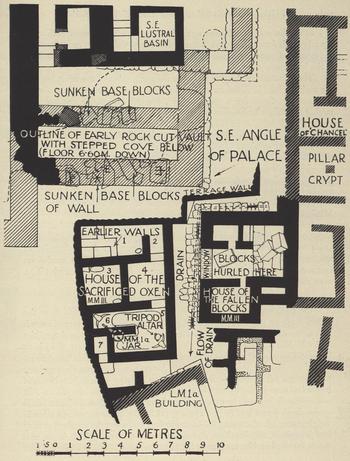
The HFB and HSO were excavated by Evans and Mackenzie from March until June of 1922 (Mackenzie Reference Mackenzie1922, 35 and passim). Both houses were discovered due to excavations occurring in the South-South-East House, as part of the supplementary excavations of the site undertaken on an extensive scale in 1922. Only the basement rooms of the houses remain (Fig. 1). The HFB was found not more than a metre and a half from the palace's south-eastern corner. It was ruined by huge blocks ‘hurled from the Palace wall by what could not have been less than a violent earthquake shock’ (PM II.1, 296), which were left where they fell inside the house. The house was never rebuilt but was filled with material, mainly pottery from the contemporary destruction or from another act or event that took place in the area at a slightly later point. Material from the same destruction or act was also used to fill the ruins of the adjacent HSO and the passages north of the HFB and between the two houses.
Plan of the south-eastern corner of the palace and the adjacent HFB and HSO (PM II.1, fig. 172).

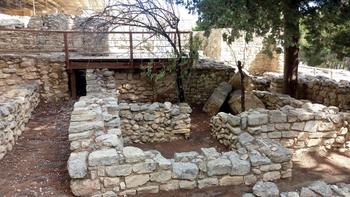
Τhe HFB (c.32 m2) has the more solid structure and stronger walls (Fig. 2); it presumably supported a substantial upper structure. There is no trace of entrances on the ground floor, so these rooms must have been the basement of the house. In most cases, the walls go down on the inside to a red earth fill which is covered with clay plaster in a thin coating, but there are also floors of plain soil. The HFB may have been occupied by a craftsman who made stone lamps; their remains were found on the floor level of the main room (PM II.1, fig. 174) (the lamps were not identified in the material studied here). In the same space were also found fragments of four large pithoi (not identified in the material studied here).
The House of the Fallen Blocks from the south.

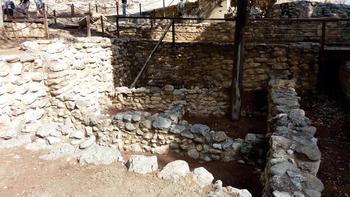
The HSO (c.40 m2) is a multispaced architectural unit (Fig. 3). In one of its rooms (5–6 on Fig. 1) were found the bull's skull and the tripod offering tables shown in Evans’ well-known photograph (PM II.1, fig. 175). In the south-eastern corner of room 5 were found fragments of other horns, while another pair was found at the western end of room 7 (Mackenzie Reference Mackenzie1922, 49). In the northern room of the house, the lower courses of earlier walls were found, associated with a deposit of remarkable polychrome vases of MM IIA date (PM II.1, pl. IX), which afterwards gave the name to the deposit and, inadvertently, to the whole (mostly stratigraphically later) assemblage (i.e. the South Polychrome deposit: PM II.1, 300; MacGillivray Reference MacGillivray1998, 46). Between the two houses runs a passage (c.1.5 m in maximum width) with a stone-built drain and a pavement of stone slabs of the kalderim type about 30 cm above the drain.
The House of the Sacrificed Oxen from the south.

The houses are described by Evans in a chapter of PM II.1 focused on catastrophic seismic effects on the island (PM II.1, chapter 45). During the excavation, it seemed clear that the pottery from both houses was similar in character, not stratified and represented a fill thrown in at the time the houses had been ruined and abandoned (Mackenzie Reference Mackenzie1922, 44); it has been treated as a unit ever since. According to Mackenzie (Reference Mackenzie1922, 71), the different types of vessels reflect different phases within the MM III period, i.e. covering its whole time span. He regularly calls the material ‘MM IIIa’, though occasionally says the deposit spans the entire MM III period and considers its final date in MM III (Mackenzie Reference Mackenzie1922, 54, 58, 63–4, 71). The surface deposits contained many Late Minoan (LM) III sherds, but, below, the pottery was exclusively MM III without any contamination (Mackenzie Reference Mackenzie1922, 54) apart from some MM II pottery fragments related to earlier walls, which also provide the terminus post quem for the layout of the houses. In Mackenzie's words (Reference Mackenzie1922, 64) ‘there was no stratification in the deposit except what occurred at the time the Houses were built and the earlier pottery belonged to previous habitation on the spot’.
Since the time of Evans, many have stressed the magnitude of the earthquake demonstrated by the large fallen blocks that labelled one of the houses. Because of this event and his personal experience of a massive earthquake in 1926, Evans conceived the idea of the decisive role of earthquakes in the history of the palace and more broadly in Minoan history. He devoted a long chapter of his synthetic work to this issue (PM II.1, chapter 46). Earthquakes became a good reason to support divisions in site sequences, particularly since rebuilding afterwards allowed for major changes in architecture. In this sense, Evans spoke of a different era, and a massive rebuilding, after the ‘Great Earthquake’ (PM II.1, passim). Evans’ method for developing his chronology was based on these deposits. The ‘Great Earthquake’ was dated by Evans to the end of the third Middle Minoan period (i.e. the terminal phase of MM III), defining the end of the archaeological horizon of the contents of the great MM III pottery stores of the palace (i.e. the North-east Magazines and the Magazines of Medallion Pithoi), the western area of the palace, where much debris was swept into kaselles (i.e. the cists below the Central Stairs), a basement space within the south-western corner of the palace (with the famous tall inscribed jar now exhibited in the Herakleion Museum) and the Temple Repositories (PM II.1, 292; cf. Macdonald Reference Macdonald, Jusseret and Sintubin2017). Evans and Mackenzie noted the resemblance of the ‘pitchers of purplish brown glaze’ of the last context with those frequently found in the deposits presented here. Nevertheless, Evans separated this major catastrophe from a ‘lesser but still well-marked disturbance due to the stratification of earlier remains of this period, well illustrated by a series of MM IIIa deposits, including those of the Northern Lustral Basin’ (PM II.1, 320). In this way, he had already raised the problem: that of the presence of more than one disturbance producing deposits of the third Middle Minoan period. Seismic events might have occurred several times within a limited time span; therefore, sealed MM III deposits might not all be consequences of the same event.
In an attempt to assess the degree of contamination and clarify the nature of the deposit, specific comments in Mackenzie's notebook should be considered, taking into account also observations on different pottery groups which come from separate spaces within the houses. Mackenzie notes several rooms where earlier walls were exposed and attributes MM II-style vessels to these deposits, which likely formed part of the contents of the HSO represented by these earlier walls. He does not discuss these contexts in detail, though. The presence of pottery in relation to earlier walls provides opportunities for contamination of the deposit, particularly in rooms not sealed by clear floors. The material has been retained and stored by spatial area and not stratigraphically; in this way, any retained earlier material is mixed with the main fill deposit. The following section presents Mackenzie's notes on earlier deposits combined with the author's notes on these deposits in order to assess possible contamination. It is evident that not much is preserved from which to extract this kind of data.
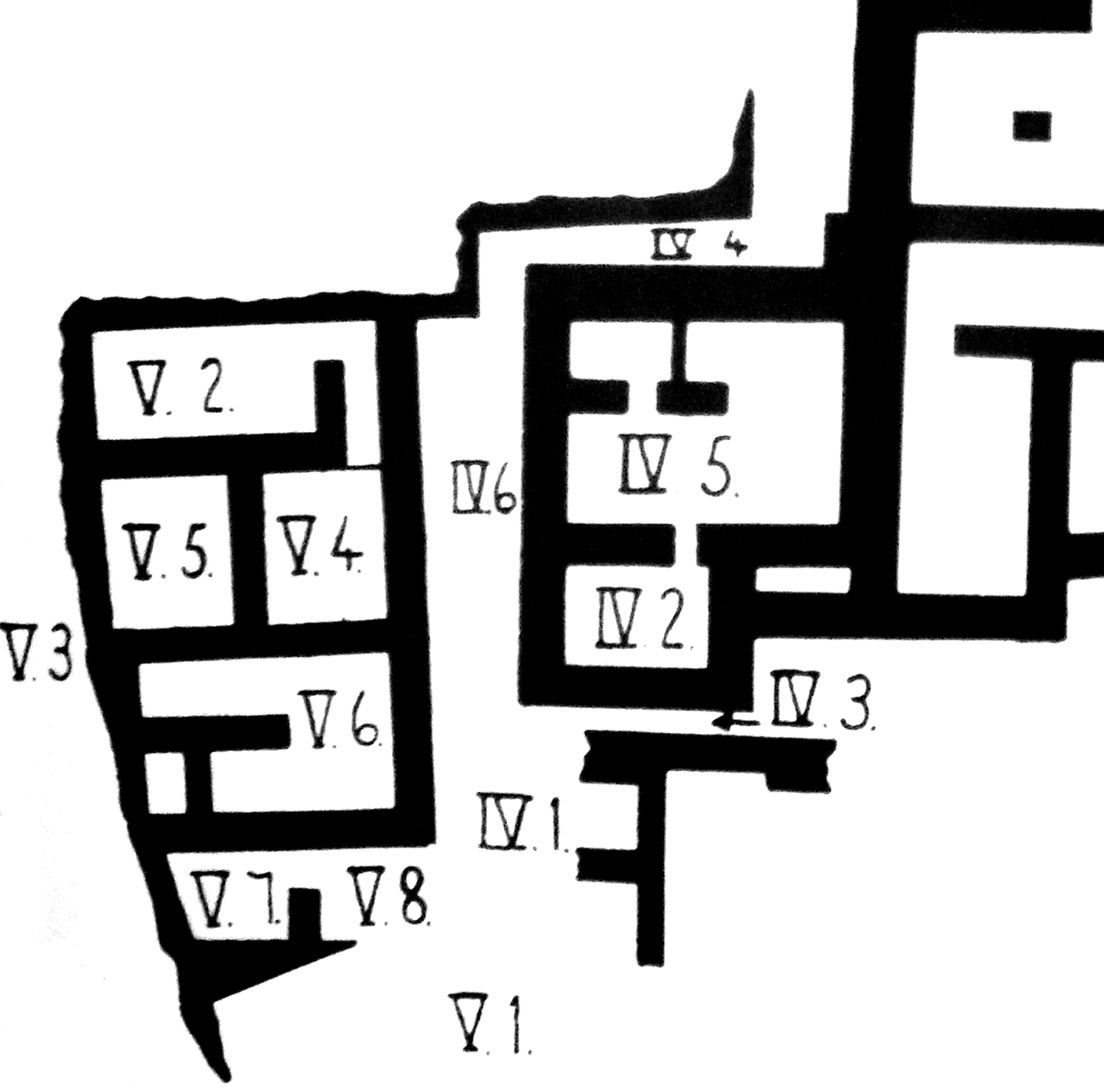
Mackenzie (Reference Mackenzie1922, 45) notes ‘an earlier system of walls in room 1 of the HSO at a depth varying from 2.00 to 2.40 m. from the surface, with which was associated pottery that was not thrown in like the rest of the deposit’ (Figs 1, 4:V.2). Examination of the pottery of this unit has revealed that there is only a small amount of earlier pottery that might represent contamination. Among the 450 sherds kept in the relevant boxes, 28 belong stylistically to an earlier phase and could have originated from the earlier context described by Mackenzie (i.e. MM IA and MM II). With these are included fragments of egg-cups and carinated cups together with bridge-spouted jars with angular profiles. Most were identified in group no. 1558 (R.V.2) with the original label ‘NW Room’.
Plan of the houses, with Pendlebury's numbers (after Pendlebury Reference Pendlebury1933, fig. 31).

Another earlier context is noted by Mackenzie in room 3 of the HSO (Figs 1, 4:V.5). During its excavation ‘down to 1.00 from its top it was seen that its N wall towards the W end began to have an earlier wall projecting from its face, which possibly belongs to the same earlier system as that adjoining on the N side’ (Mackenzie Reference Mackenzie1922, 47). This context contained even fewer stylistically earlier sherds, 21 out of 1,102 and of the same types mentioned above, and thus not much contamination is observed in the stored material. Groups 1572–9 (R.V.5) include many parts of medium- to large-sized vessels (jugs/jars) of the main period (early MM IIIA), commonly decorated with groups of thin and broad bands or trickles, which were found especially fragmented, possibly due to depositional reasons. This characteristic is not attested in other contexts and is noted here because it might represent a distinct post-depositional process (i.e. the redumping or mixing of material).
Mackenzie (Reference Mackenzie1922, 48) notes an earlier system of walls in connection with room 5 of the HSO (Figs 1, 4:V.6), the lower part of the partition wall which separates spaces 6 and 7 (Fig. 1). The floor of the room has a ledge projecting from the walls and it looks as if the room had been dug out to floor level after the addition of the partition wall (Mackenzie Reference Mackenzie1922, 48). The pottery of the fill deposit of MM III date went down to this sunken floor level, revealing considerable disturbance, as noted by Mackenzie. Again, the contamination observed in the unit is not high, but it is worth noting that stylistically earlier (24 out of 900) as well as LM III (21 out of 900) sherds were kept, and this indicates a certain degree of post-depositional mixing. Whether this represents post-depositional disturbance in the past or simply mixing of the excavated and retained material cannot be demonstrated, though Mackenzie's description indicates LM III material was found above the deposit.
At a later point, Mackenzie (Reference Mackenzie1922, 60) records that ‘there are many fragments which approach the lower limit of MM IIB and any fragments markedly MM II in character were found invariably at the very bottom next to the passage floor’. It is impossible to confirm this observation due to the way the material was finally stored – without relevant information. Some ‘egg-shell’-ware sherds were found in the cutting made for the drain running east to west in the passage, but, as Mackenzie notes, these fine fragments were probably deposited with the fill above the drain (Mackenzie Reference Mackenzie1922, 60). In the same cutting just under the passage surface were found the fragments of a cup with a ‘white design consisting of curving lines and other designs on a ruddy glaze surface’ (Mackenzie Reference Mackenzie1922, 61 [i.e. Printed ware]; cf. MacGillivray Reference MacGillivray1998, 235, 136), and their presence suggests that the house was built after the cup had been discarded (Mackenzie Reference Mackenzie1922, 61). However, Mackenzie does not give enough information to confirm this suggestion, since the presence of these sherds could be the outcome of an earlier or later surfacing of the passage; thus the relation of the disturbance to the foundations of the house wall is not clear.
As a result of assessing this data, it must be concluded that it is not possible to estimate the degree of contamination due to the way the material was initially recovered and stored. Some earlier pottery was incorporated in the boxes of material studied, but the quantity of stylistically diagnostic pottery is not sufficient to represent any significant contamination within the major fill deposits. The earlier material referred to above is dated to the MM IA–IB (i.e. egg-cups) and the MM IIA–IIB periods (i.e. ‘egg-shell’, Stamped or Printed ware). The vast bulk of the deposit is dated to the early MM IIIA period.
Join-rate, fragmentation and depositional homogeneity
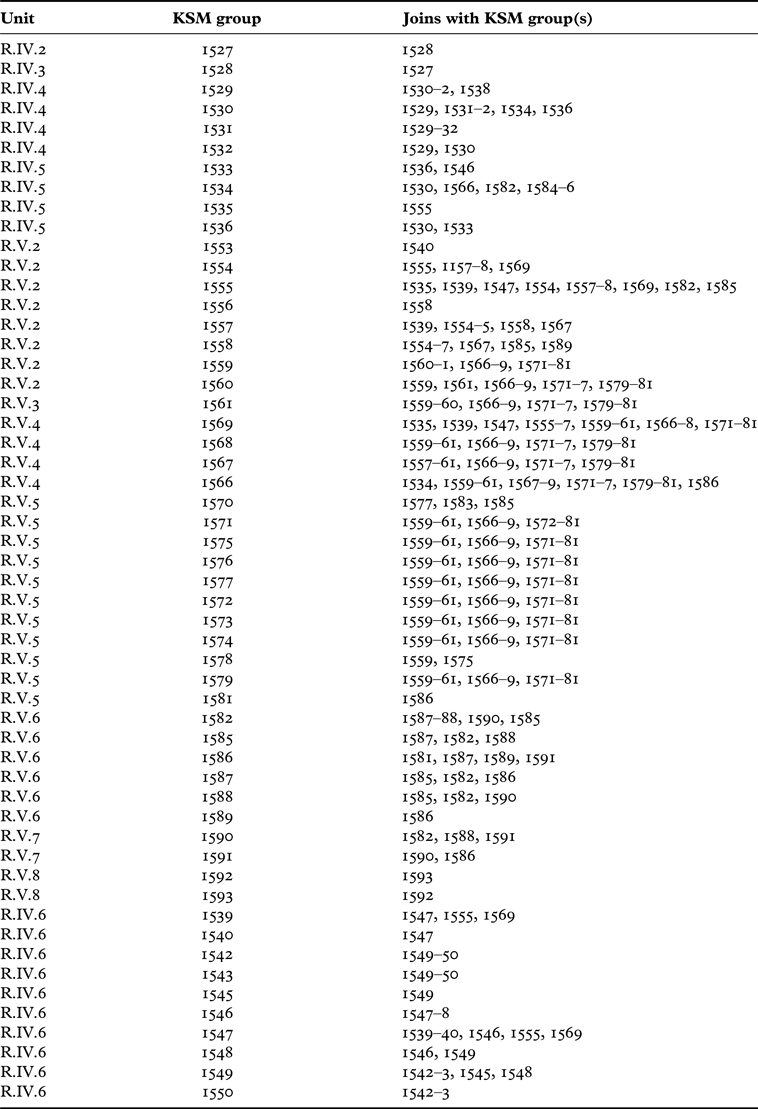
Mackenzie's original observation that the material has joins throughout is confirmed by the present study. This indicates that the material was not completely confined in its recycling to each individual building. The join rate, though, is not as high as one would expect, especially to support the earthquake scenario, i.e. from a deposit resulting from clearance activities after the event and the redeposition of the same material in the same place afterwards; parts of several distinctive vessels, some quite large, that we kept searching for as the study of the pottery groups proceeded, were not found. There are sherd joins that link the deposits recovered from different areas or rooms of the houses (Table 1), but most joins are found within a major context, i.e. a single house or the passage. Relatively few vessels document joins between these groups. Most joins were found among the rooms of the HSO and then follow the groups from the passage and those from the HFB. Between major contexts, most of the joins were found between the HSO and the passage, while only a few joins were found between the contexts of the HFB and the passage. The limited number of joins does not really support the assumption that the deposit as a whole was pooled from one or more original sources, presumably outside the houses, and then dumped in. This observation on the join rate does not itself suggest breakage elsewhere and any significant movement and mixing before deposition, but it does not justify the original assumption that this is all one uniform fill from a common origin.
Joins between the different areas of the assemblage.

Joins between different groups per unit.

In order to explore the possibility that some of the pots originated from the context of the houses, as opposed to one or more original deposits elsewhere, some observations on the preservation of complete vessels is necessary. There is a large percentage of complete vessels: 21 per cent of the catalogued vessels; while 33.7 per cent are half-preserved or represent a full profile; 45 per cent are more fragmentary sherds. Thus, over half of the material is preserved in good condition, sufficient to identify the original pottery forms. The HSO and HFB show more or less the same breakage rate, but the passage unit (R.IV.6) had the largest amount of complete vessels (38 per cent), almost twice as much as the other areas. This might be attributed to pure chance, but may also indicate that the passage was treated as a different unit after the destruction, during the refill of the debris in the ruins.
Another matter to be addressed in order to explore the formation of the deposit as a whole is whether the types are equally spread across contexts. Are there any differences by depositional context which suggest different points of origin? Are there any distinct sub-assemblages which might have been stored independently? Are these the inventories of the house or are they more specialised, such as a palace storeroom which collapsed into these spaces? Material from different original contexts might preferentially be dumped in different houses, spaces or rooms. The equal spread across the assemblage of different pottery categories might speak in favour of a common origin and justify treating this material as a coherent whole.
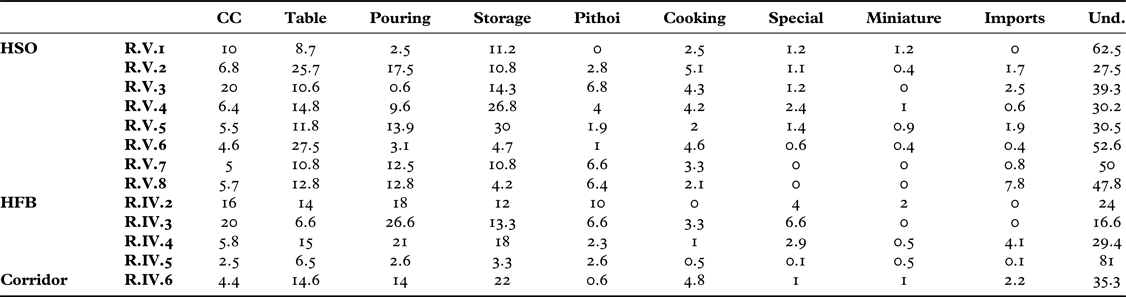
In order to answer these questions and assess the nature of the deposit, the composition of the samples from each major depositional area (the two houses and passage) should be considered. All the units include the same types of pottery in terms of function. There are, though, some patterns in the distribution of the material which might be of importance and offer some clues to the deposit's accumulation process. The material from the different areas is all broadly comparable by functional types and, in this respect, it may arguably have derived from a single source (Table 2). R.V.3 and R.IV.3, two areas outside the main house units, have the largest concentration of conical cups. Could this mean that their presence was related to post-depositional functions, i.e. ceremonies? Unfortunately, we cannot develop this theory further since no information on the depth of their discovery was kept. Across the other units, the percentage of conical cups is more or less the same. Cooking pots or pots for food preparation do not produce a differential pattern, but, rather, form a comparable proportion of vessels in every unit. The same applies to the special vessels and miniatures.Footnote 3 The imports have their highest concentration in R.V.8 (outside the HSO), possibly by chance; there is no clear explanation for this. Since this unit is not related to the corner of the palace, it cannot be presumed that the imported material fell from there; it is actually the most distant unit from it. R.V.4 and R.V.5 (HSO) have a lot of storage or transport vessels, while R.V.6 (the room of the ‘sacrifice’ in the HSO) contained a lot of tableware but also many undiagnostic sherds (i.e. small body fragments), a fact that points to a higher degree of fragmentation in comparison to that observed in other units. R.V.1, R.V.7 and R.V.8 (HSO) also contained a lot of fragmented material (i.e. large amounts of undiagnostic body fragments), which presumably indicates that these units were treated separately during the deposition process, being possibly open spaces or areas of waste disposal. The evidence of fragmentation in these areas (the room of ‘sacrifice’ and the open spaces outside the HSO) argues for their reuse at least for the event which presumably took place there or for their use as working areas during possible clearance activities.
Percentages of functional types per unit (CC = conical cups; Und. = unidentified pottery fragments).

R.IV.4, the northern part of the passage (north of the HFB), contained a lot of transport or storage vessels together with large amounts of undiagnostic sherd material, which points to a high degree of fragmentation. R.IV.5 (the room with the fallen blocks) has the highest percentage of fragmented pottery material (81 per cent), mostly belonging to tableware. This might relate to the fact that the large blocks, and possibly other debris that was later removed, fell into this room, pulverising the contents of the house. The passage between the houses (R.IV.6) also contained a lot of undiagnostic material as well as many fragments belonging to transport or storage vessels. This unit also revealed the largest number of large fragments of jugs. The presence of a lot of transport or storage vessels in the passages (main and northern) might indicate their presence there at the moment of the destruction or, more probably, be indicative of the salvage operation that took place afterwards in the area, since larger and thicker-walled vessels had a better chance of surviving the destruction and were gathered outside in the passage, where salvage operations were organised. In this case, the use of the passage as a working area for salvage would be consistent with the extra fragmentation of vessels in the accumulated fill in the passage. One might also presume that material from different original contexts was dumped in these units or that at the moment of the deposition the passages continued to be recognised as passages.
The patterns that are most obvious from this ‘reading’ of the material are: (a) the deliberate use of the passages for storage material or their different depositional role as spaces which were accessible at some point after the destruction and (b) the impact of the actions that took place in the room of the ‘sacrifice’ and its close vicinity (i.e. R.V.6, R.V.7 and R.V.8). The most important aspect here is the possibility that the passages were used as passages even at this late stage, when the whole area had suffered greatly from damage. The passages might have had a different depositional story and this is the only area where the deposit is significantly differentiated according to the spaces in which it was deposited.
Examination of different scenarios for the formation of the deposit
Before proceeding with an examination of the different possible scenarios for the deposition of the material, some of the observations noted above will be summarised. First, the consideration of contamination speaks in favour of a fairly short period of time in which the deposit was accumulated. The recognisable contamination is a very small component of the assemblage and cannot account for the early features of some of the pots. Second, the types are equally spread across contexts. There are some differences in a few contexts, which might suggest different accumulation processes, like the more fragmented material in some units or the higher number of storage or transport vessels in others, but, generally, the same types are observed in every unit in the same, more or less, proportions. No concentrations of groups of specialised or imported vessels – that might suggest a possible palatial origin – were observed in specific units. The comparable spread across the assemblage of different pottery categories might speak in favour of a common, certainly comparable, origin.
There are potentially three different sets of data: (a) the houses (founded in later MM II or early MM IIIA), (b) the pottery fill (dated in early MM IIIA) and (c) the blocks at the bottom of the fill, fallen from the south-eastern corner of the palace due to an earthquake. In the following section, the relationship of these three different elements will be considered, drawing on previous observations, in an attempt to define the most likely scenario for the accumulation process. Two alternative scenarios encapsulate most of the options.
In the first potential scenario, the deposit post-dates the fallen blocks, which fell on a house which might or might not have been in use at the time. In this case, the deposit could represent a gradual accumulation of material used between the final MM IIB and into the early MM IIIA periods. This scenario is based on the following observations.
Mackenzie makes no comments on other ashlar blocks within the fill. There is also an absence of any recognised substantial fill – i.e. contents of the house and debris from the upper floor and roof – which raises the possibility that the HFB had been abandoned or even collapsed at the time the blocks fell into it. Nevertheless, Mackenzie may not have recognised such collapse material. With the pottery debris around and above the blocks, the major sherd fill could have been introduced at any time after the blocks fell into position. In this case, the fill might incorporate some material from the houses and material from elsewhere, brought from one or multiple locations and dumped into these ruins (i.e. secondary or tertiary deposition).
Mackenzie (Reference Mackenzie1922, 60) observes that the earlier material in the passage was closer to the ground level and lower in the deposit, which suggests two episodes of deposition: a floor deposit or build-up and a later fill. Following this, one might argue that the houses had already been abandoned, before or because of the earthquake destruction, and were subsequently used as dumps for material resulting from clearing after the same earthquake destruction or some other kind of destruction. Mackenzie (Reference Mackenzie1922, 78) also notes that other vessels in the HFB were found at a somewhat higher level than a polychrome jar from the earlier subfloor deposits and were separated from the jar by a layer of deposit in which sherds were scarce.Footnote 4 This might have been a floor build-up inside the house or represent a period of abandonment before the massive dump of the main body of material.
The deposit contains large quantities of pottery, which means, of course, that the space contained a very large assemblage of pots. The HSO is c.40 m2 and the HFB c.32 m2 in plan, while the catalogued pots amount to 750 vessels and more than half of these are medium to large in size. Many more are represented by the more fragmentary material. This is exceptional for two small houses. With so many vessels and many only partially represented, this might be a segment only of a much larger assemblage, only part of which was dumped in the excavated area. If this is the case, the only realistic supra-household context of origin would be a palace storeroom in the south-eastern area of the palace, cleared out and dumped downhill into the ruins of these houses. A smaller component, perhaps originally stratigraphically distinct, but now impossible to isolate due to the way it was excavated and stored, might represent the original contents of the houses.
In the second potential scenario, the destruction of the houses, the fallen blocks and the formation of the deposit were caused by the same earthquake and are related to each other. The deposit is of secondary nature, i.e. disturbed destruction debris used to backfill the same area afterwards. This scenario is based on the following observations.
The dumped material is related to the deposition of the cow skulls and horns sitting on the floor in the HSO, being contemporary with the latter, and thus it may extend all the way to the floor of the houses.
There is no significant differentiation of the pottery between units, in terms of both typology and function. It seems that the deposit, being homogeneous, largely represents the original contents of the houses that were in use at the time of the earthquake. Taking into consideration that the fallen blocks came from the external wall of the south-eastern corner of the palace, the domestic material may be mixed with contemporary material from the palace; the deposit displays a conjunction of types that are common in other palace deposits and material which could be characterised as domestic (pots for cooking and food preparation, among others), not otherwise identified in any quantity in the studied palace deposits.
The bulk of the pottery is dated in early MM IIIA according to typological traits. No great amount of contamination was observed. Through the pottery examination, it is evident that the deposit has chronological integrity, so is at least contemporary within a matter of decades (see the section on the pottery assemblage, below).
The presence of many complete or half-preserved vessels makes it possible that some of these could have belonged to the original contents of the houses. More fragmentary material would be expected if the deposition was tertiary.
Unfortunately, neither of these scenarios can be established conclusively. Nevertheless, overall it seems that the material is likely to represent a single-episode dump deposit, with probably fairly limited amounts of earlier contamination. The bulk of the material probably derives from a single destruction event. The analyses of the context and the integrity of the material support a common derivation, but study of the pottery per se can also contribute to the exploration of this issue. Having considered what is known of the context of the material and what can be reconstructed of the formation processes of these deposits, unresolvable uncertainties remain. On the one hand, it seems likely that the vast bulk of the material represents a single destruction deposit, from these two houses and/or their close vicinity, representing an assemblage of pottery in use or stored together. On the other, it could be a collection from, at most, a small number of comparable and spatially localised deposits, accumulated over a relatively short period of time. In either case, the documentation of this material as representing a ceramic phase not yet well represented in published assemblages from Knossos is justified.
THE POTTERY ASSEMBLAGE
According to Evans, the density and variety of ceramic relics in this assemblage were perhaps unrivalled in any other area of the site and, taken together, the pots ‘supply a unique repertory of the ceramic forms in vogue during that period, including some remarkable new types’ (PM II.1, 303). Most of the studied material derives from the HSO, i.e. Pendlebury's R.V.1–6 (Pendlebury Reference Pendlebury1933, 26–7); a large amount of pottery comes from its south-western and south-eastern rooms, R.V.5 and R.V.6 respectively. The deposit presented here is known as the ‘South Polychrome deposit’ and has been defined together with the ‘West Polychrome deposit’ as the representative pottery group for the MM IIIA period in the Knossos Pottery Handbook (MacGillivray Reference MacGillivray and Momigliano2007, 144; also Reference MacGillivray1998, 46). In Alexander MacGillivray's study it is presented as Group N and is compared to the West Polychrome deposit (i.e. the West Court Kouloures deposit).Footnote 5 A selection of the MM IIIA pots was illustrated in The Palace of Minos (PM II.1, 304 fig. 176); the pots depicted are today stored or exhibited in the Archaeological Museum of Herakleion (AMH).Footnote 6 The published data and, especially, information from closed stratified deposits, like those of the South-West Houses (Macdonald Reference Macdonald, Macdonald and Knappett2013), as well as typological analysis of crucial palace deposits (i.e. the PMM3 Project), have allowed us to date the material as reliably as possible by detecting morphological nuances attributed to chronological differences. In terms of our present understanding of the date ranges of individual characteristics, most of it could actually be exactly contemporary.
Methodology
The retained material from the deposit comprises 6,025 sherds, belonging mainly to medium and small vessels. The preserved material relates closely to what was originally excavated, judging by the representation of types in MM III palace deposits identified in the course of the PMM3 Project. The nature of the sherds and the combination of complete, full-profile and small sherds indicate that this is probably most of the material that was excavated. It is often the case, also judging by the palace deposits studied as part of the PMM3 Project, that the material preserved from Evans’ excavations is usually heavily selective, but sometimes, depending on the interest of the deposit, a more representative selection was retained and little was discarded (as is the case here). Τhe catalogued vessels amount to 750 pieces, but only 164 are presented here. The diagrams and tables, the ware and shape descriptions, as well as references to fabrics and forming techniques, take into account the complete assemblage. The vessels that are catalogued and presented here are mostly represented in large quantities and define typologically the deposit (i.e. handleless conical cups, other cup and bowl types, jugs, bridge-spouted jars and oval-mouthed amphorae). But several are also catalogued as useful additions to the corpus of the period, since they are not commonly attested in other published assemblages (i.e. jar/jug fragments, cooking vessels, special vessels). In each case, the percentage of the type in the whole assemblage, i.e. catalogued vessels and all the sherd material, is reported in order to show the representativeness of the type within the whole. Generally, the pots selected are quite representative of the entire assemblage and most of them are very characteristic for the period. As a second criterion for the selection for cataloguing, the representativeness of each type in other (mainly Knossian) published deposits was also taken into consideration. For example, not many handleless conical cups are included, since the type is well known from other publications; tall handleless conical cups are better represented as the least-known conical cup type, and so forth. A third criterion was the preservation of the vessel, since complete or full-profile examples are preferred to sherd material.
The catalogue is arranged according to functional categories and shape, and, within each shape category, according to ware (plain, monochrome, other). Imported pieces are presented at the end of each pottery category and not separately. All the catalogued sherds are stored in boxes as detailed in each catalogue entry. Data on catalogued vessels are given in the following order: Knossos Stratigraphic Museum (KSM) box number, state of preservation, shape and relevant details, macroscopic fabric observations, manufacture, decoration, measurements in centimetres and publication reference or comparanda. A paragraph concerning the generic shape characteristics, its date and relevant references in published material precedes the catalogued pots in each case. This section also contains some quantitative information on different types of the period.
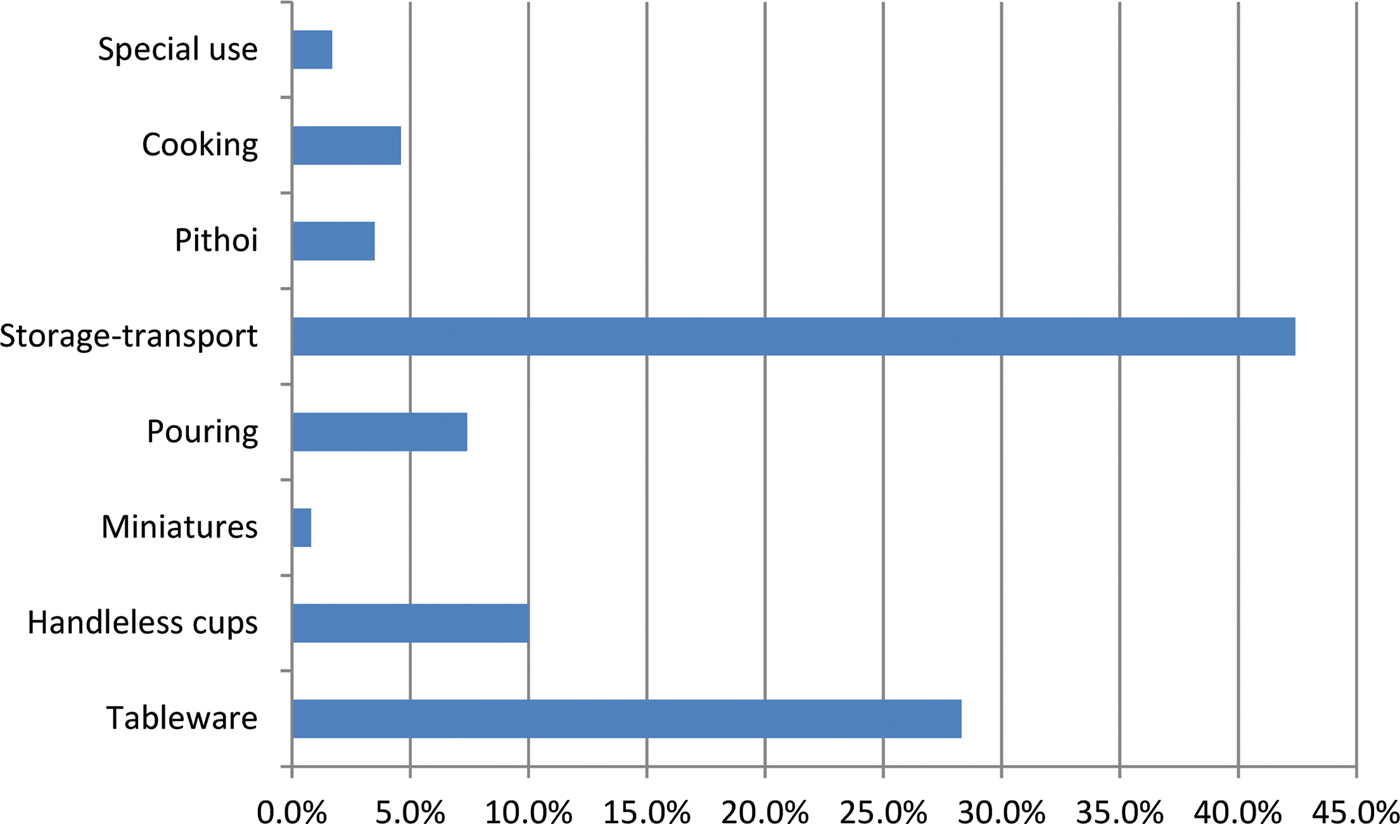
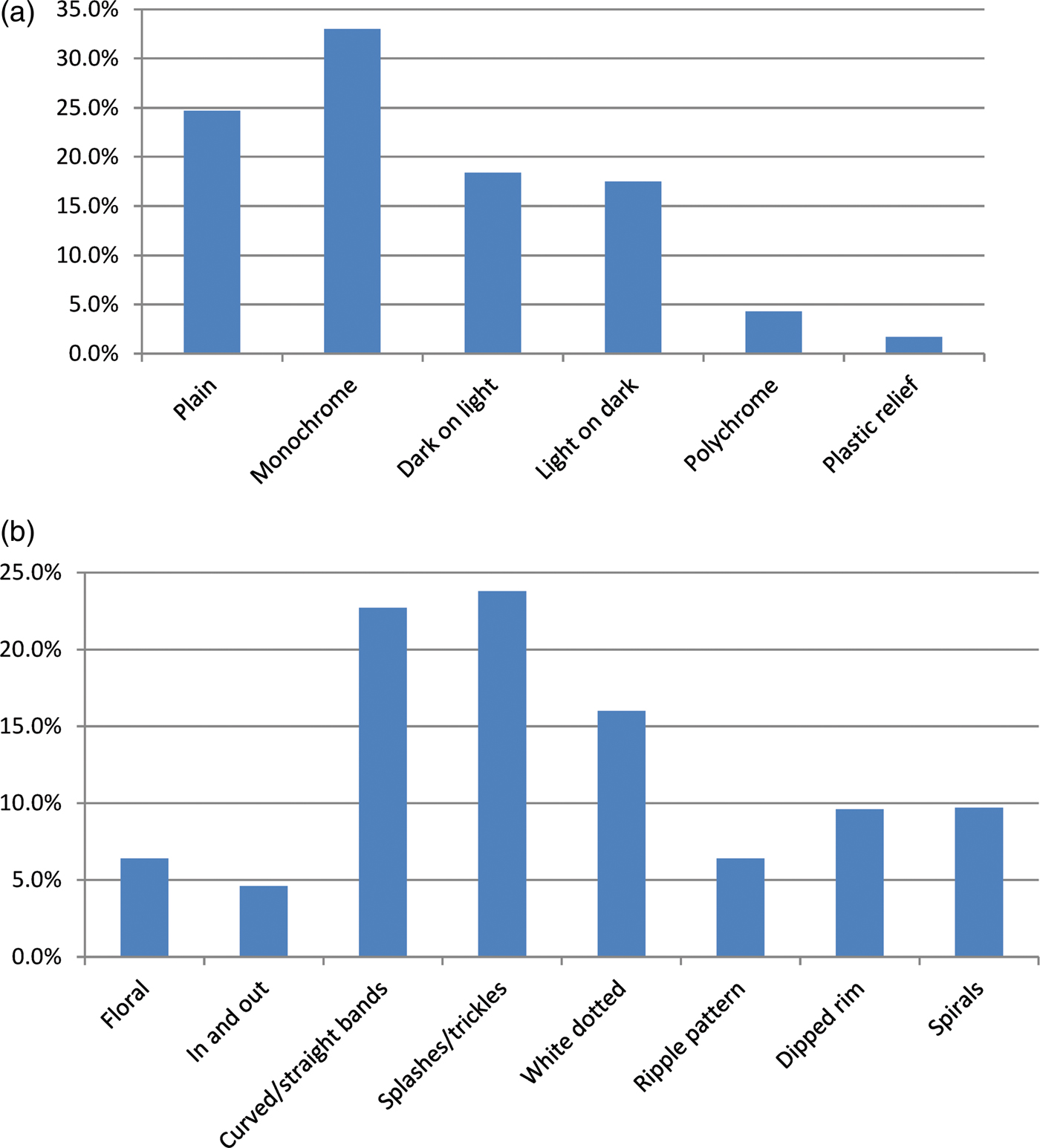
For the distribution of sherds in different rooms and spaces see Tables 3 and 4. A large amount of the material belongs to storage or transport vessels, mainly jars and jugs. Together with other storage and transport vessels these form more than 42 per cent of the total (Fig. 5). The second commonest category is that of tableware, which broadly comprises another 40 per cent of the total, with handleless cups included. The handleless cups alone make up more than ten per cent of the total; both broad and tall varieties appear in large numbers, the broad variety being twice as common as the tall. The presence of several other cup types gives us the opportunity to study these in detail and to confirm typological aspects of the period. Pouring vessels are fewer, but still appear in substantial quantities. There follow in quantity cooking pots (i.e. tripod cooking pots, large or smaller trays) and jars. There are also several vessels of special use, like those depicted by Evans (i.e. the so-called ‘Ariadne's clew-box’ and ‘bird's nest’: PM II.1, fig. 176), as well as lamps, both large pedestalled and small, chalices and trays with holes to seat other smaller vessels.
Functional categories.

Numbers of pots/sherds according to area.

Numbers of sherds according to unit.

Tableware
Broad handleless cups
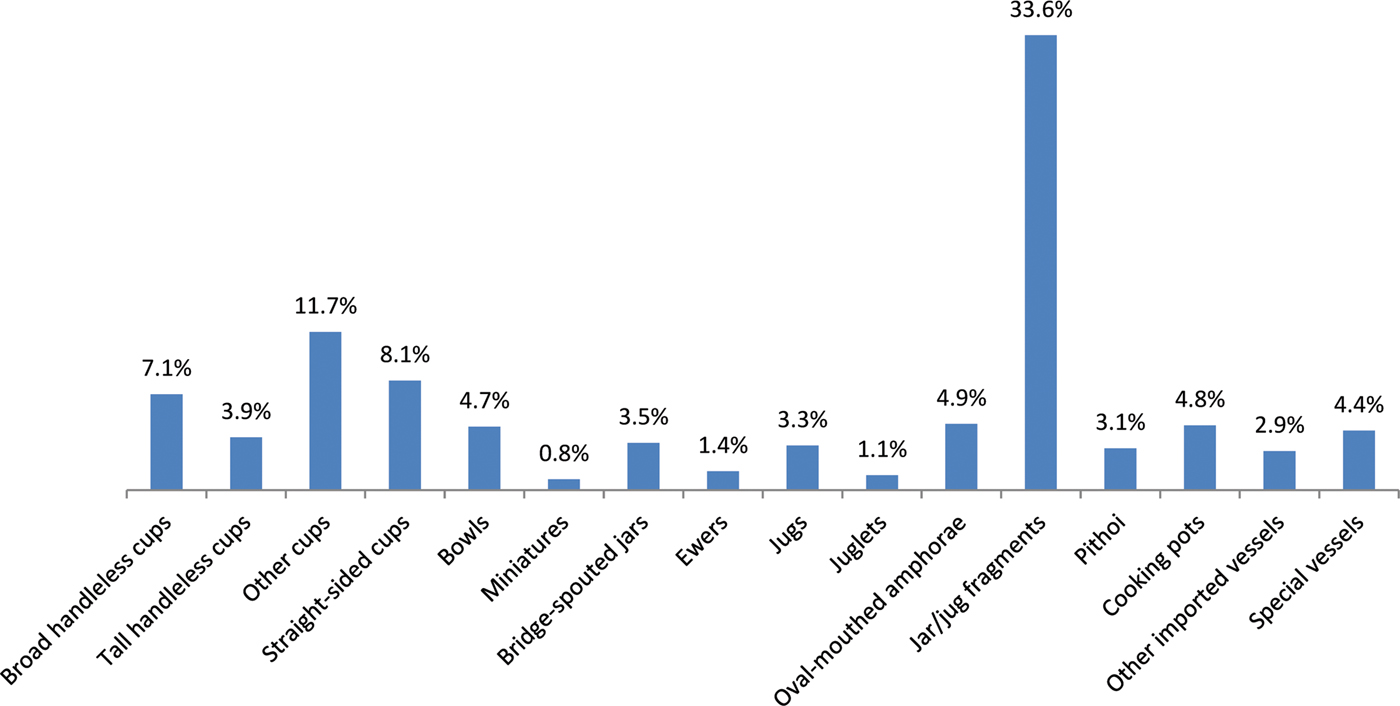
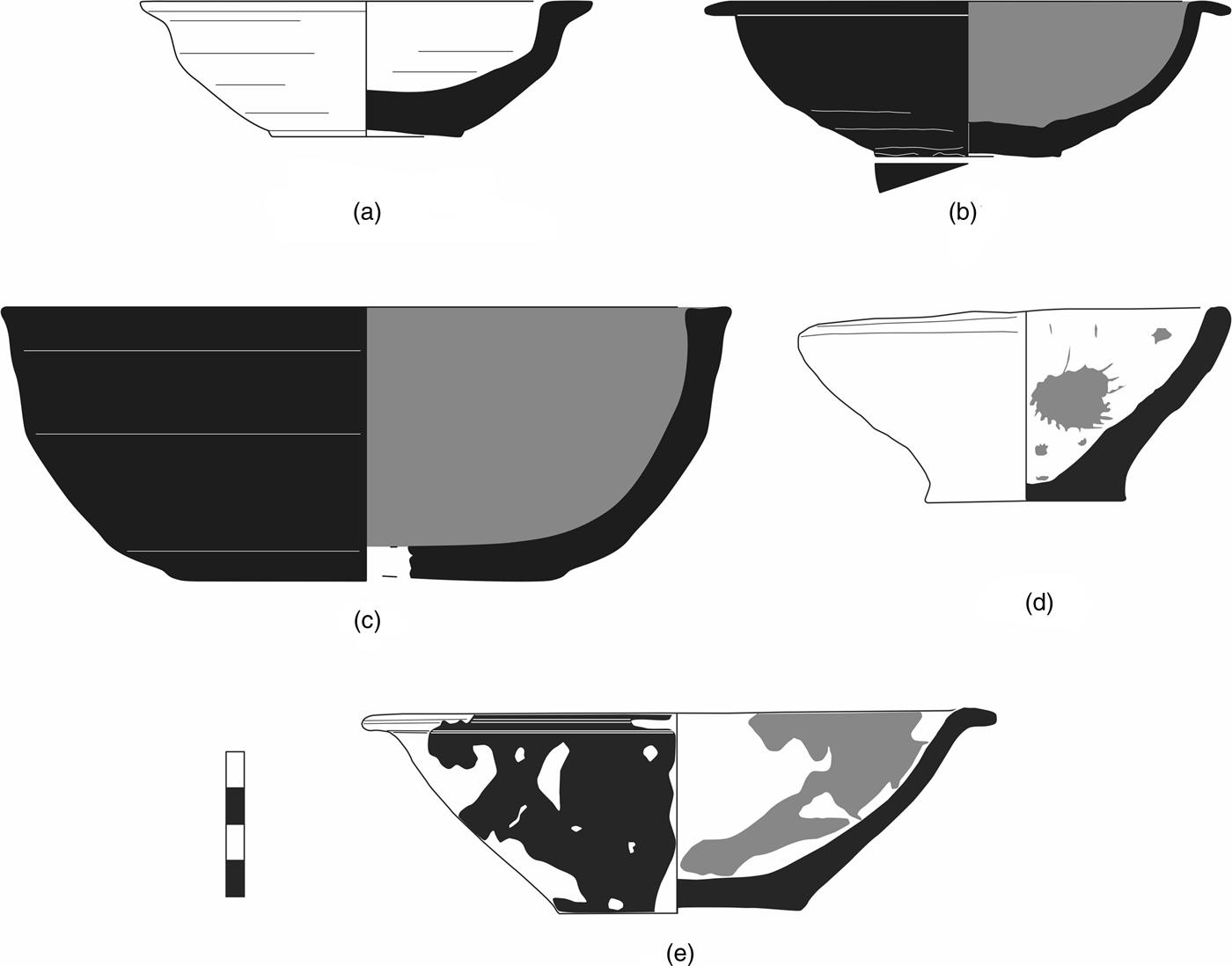
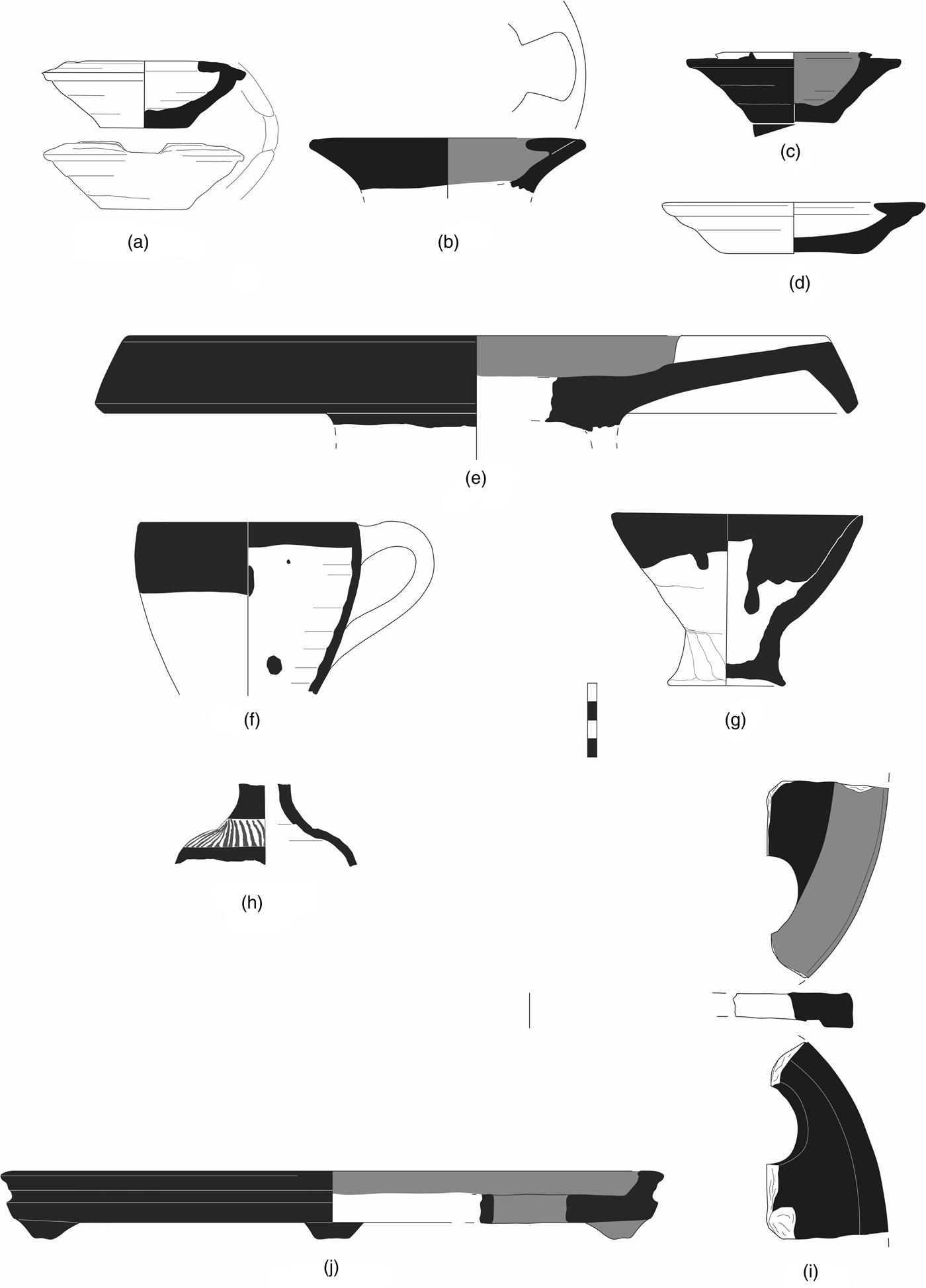
The category of handleless cups, the precursor of the later conical cups, is here divided into two distinct subtypes: broad and tall (cf. Hood Reference Hood, Evely, Lemos and Sherratt1996; Knappett, Mathioudaki and Macdonald Reference Knappett, Mathioudaki, Macdonald, Macdonald and Knappett2013, 14).Footnote 7 The handleless cups found in the deposit are characteristic of the early MM IIIA phase. The broad variety comprises around seven per cent of the total (289 examples; Fig. 6), almost twice as much as the tall subtype. Spiral rilling on the interior of the vessel, which Evans saw as characteristic of MM III, is very common for this type and constitutes a diagnostic trait for identifying MM IIIA handleless cups. In most cases, the rim is plain, while in several examples it is either everted and/or flattened. Because of the presence of everted rims, some of the broad handleless cups could also be called ‘ledge-rim bowls’. The base is flat or slightly pronounced. Most are of a fine fabric, but 15 examples are of a soft-sandy fabric (cf. Fig. 7c), and in this they resemble closely examples from the Trial KV deposit (Popham Reference Popham1974, 189, fig. 8:2–3). Most are wheel-fashioned, though in some cases it is difficult to distinguish between wheel-thrown and wheel-fashioned, and these pieces need to be studied by a technology specialist. More than half are plain (51 per cent), 38 per cent are monochrome and 11 per cent are decorated with splashes or spatter decoration on the interior and/or exterior. The deposits treated in the PMM3 Project support an early date within the MM IIIA period for the broad handleless cups with splash decoration, since they occur commonly in the Olive Press Room, the type-deposit for early MM IIIA, but are not attested in the Trial KV deposit (Knappett, Macdonald and Mathioudaki Reference Knappett, Macdonald and Mathioudakiin preparation). Broad handleless cups are medium to large in size, with an average rim diameter of between 9.5 cm and 11 cm, an average height of 3.5 cm to 4.5 cm and an average base diameter of between 4.5 cm and 5.5 cm. Generally, MM IIIA handleless cups have larger dimensions than those attested in the following period. Examples of the type are illustrated in published material from the Palace of Knossos (Hood Reference Hood, Evely, Lemos and Sherratt1996, 12, fig. 1:8), the South-West Houses (lower level of S.V 4.2: Macdonald Reference Macdonald, Macdonald and Knappett2013, fig. 2.2:187–8, 1221) and other deposits at Knossos (Popham Reference Popham1974, figs 6:16, 8:3; Catling et al. Reference Catling, Catling, Smyth, Jones and Jones1979, fig. 17:27, 32–3; Rethemiotakis and Warren Reference Rethemiotakis and Warren2014, figs 3.6:86, 3.10:201). The broad handleless cup is also common at Alonaki, Juktas (Karetsou and Mathioudaki Reference Karetsou and Mathioudaki2012, fig. 14), Galatas (Rethemiotakis and Christakis Reference Rethemiotakis, Christakis, Macdonald and Knappett2013, fig. 8.2, referred to as ‘ledge-rim bowls’) and Phaistos (Girella Reference Girella2010a, pls XXVI:19/1, 20 A/6; Reference Girella2010b, fig. 66:3–5).
Shape categories.

Catalogued vessels (Fig. 7)
1. (Fig. 7a) KSM box 1554; full profile. Soft-sandy light orange. Wheelmade. Ht 4; D rim 11.5; D base 4.7. Cf. Popham 1974, fig. 8:3.
2. (Fig. 7b) KSM box 1544; half. Ledge rim. Fine buff. Coil-built, wheel-finished. Monochrome. Ht 4.8; D rim 13; D base 5. Cf. Popham Reference Popham1974, fig. 6:16.
3. (Fig. 7c) KSM box 1560; full profile. Flattened rim, thick walls. Soft-sandy orange. Wheelmade. Monochrome. Ht 7.6; D rim 17; D base 9.5.
4. (Fig. 7d) KSM 1536; three-quarters. Rounded rim. Coil-built, wheel-finished. Splashes on interior. Ht. 5; D rim 11.8; D base 5. Macdonald Reference Macdonald, Macdonald and Knappett2013, fig. 2.2:188; Knappett, Macdonald and Mathioudaki Reference Knappett, Macdonald and Mathioudakiin preparation (Olive Press Room: 1140.11).
5. (Fig. 7e) KSM box 1576; half. Fine buff. Wheelmade. Splashes on interior/exterior. Ht 5.5; D rim 16.8; D base 6.8. Cf. Macdonald Reference Macdonald, Macdonald and Knappett2013, fig. 2.2:1221; Knappett, Macdonald and Mathioudaki Reference Knappett, Macdonald and Mathioudakiin preparation (Olive Press Room: 1140.24, 1164.8).
Broad handleless cups: (a) cat. no. 1; (b) cat. no. 2; (c) cat. no. 3; (d) cat. no. 4; (e) cat. no. 5.

Tall handleless cups
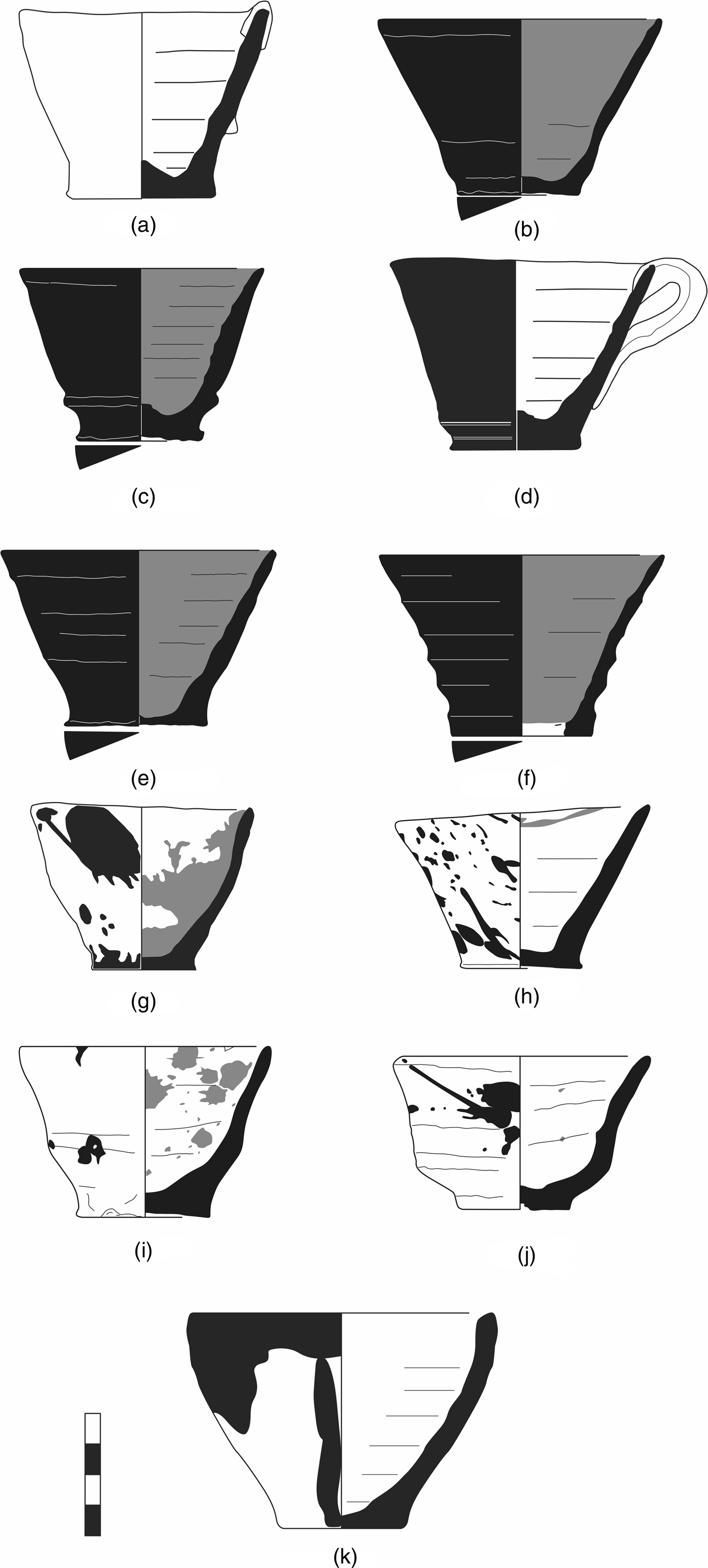
This subtype is a hallmark of the MM IIIA period, especially its earlier part (Knappett, Mathioudaki and Macdonald Reference Knappett, Mathioudaki, Macdonald, Macdonald and Knappett2013, 15–16). It is not actually that common and nor is it characterised as a handleless cup beyond Knossos. Tall handlelessFootnote 8 cups form around four per cent of the total (162 examples), which is a high proportion for this type of cup in comparison with palace deposits. Interior rilling is also very common, as for the broad handleless cup. The rim is always plain and the base flat or slightly pronounced. In a few cases there is a ‘relic’ handle attached to the rim. Some examples are especially thin-walled and refined (Fig. 8b, f), while one has curved walls and a convex profile (Fig. 8k). It is not uncommon for examples of this type to be slightly deformed, probably as a consequence of their rapid production. The fabric is usually fine, very rarely soft-sandy orange or buff. Almost half are coil-built and wheel-fashioned. Half are plain, 33 per cent are monochrome and 16 per cent are decorated in the dark-on-light style with splashes or stains or dipped rims that trickle down. This last category is relatively common here. The average height of the cups is 6 cm to 6.5 cm, the average of the rim diameter around 8 cm and that of the base diameter around 4 cm. Tall handleless cups are not attested in the MM IIIB period. The type is represented in large quantities in the Olive Press Room, which supports its date in earlier MM IIIA (Hood Reference Hood, Evely, Lemos and Sherratt1996, fig. 1:1–3; Knappett, Macdonald and Mathioudaki Reference Knappett, Macdonald and Mathioudakiin preparation). It is also found in the nearby South-West Houses (lower level of S.V 4.2: Macdonald Reference Macdonald, Macdonald and Knappett2013, fig. 2.2:1192, 1205, 1209), the Acropolis Houses (Catling et al. Reference Catling, Catling, Smyth, Jones and Jones1979, fig. 17:13–18, ‘deep cups’) and the Vlachakis plot (Rethemiotakis and Warren Reference Rethemiotakis and Warren2014, figs 3.6:100–1, 3.7:123). This type is also attested at Galatas (Rethemiotakis and Christakis Reference Rethemiotakis, Christakis, Macdonald and Knappett2013, fig. 8.3 upper three rows, identified as ‘bell-shaped’ cups) and Phaistos (Girella Reference Girella2010a, pl. XXVI:20 A/3).
Catalogued vessels (Fig. 8)
6. (Fig. 8a) KSM box 1558; complete. Relic handle. Fine buff. Coil-built, wheel-finished. Ht 6.2; D rim 8; D base 5. Knappett, Macdonald and Mathioudaki Reference Knappett, Macdonald and Mathioudakiin preparation (Magazine of the Medallion Pithoi: 1111.18).
7. (Fig. 8b) KSM box 1558; three-quarters. Fine buff. Wheelmade. Monochrome. Ht 6; D rim 9; D base 4. Cf. Popham Reference Popham1974, fig. 6:10.
8. (Fig. 8c) KSM box 1559; three-quarters. Fine buff. Coil-built, wheel-finished. Monochrome. Ht 5.7; D rim 8; D base 4. Cf. Popham Reference Popham1974, fig. 6:17.
9. (Fig. 8d) KSM box 1554; three-quarters. Vertical strap handle. Semi-fine buff. Wheelmade. Monochrome. Ht 6.3; D rim 8.5; D base 4.3. Cf. Popham Reference Popham1974, fig. 6:14.
10. (Fig. 8e) KSM box 1569; complete. Fine buff. Coil-built, wheel-finished. Monochrome. Ht 5.9; D rim 9.3; D base 4.6.
11. (Fig. 8f) KSM box 1538; one-third. Ridged body. Fine buff. Wheelmade. Monochrome. Ht 6.2; D rim 8.5; D base 4. Cf. Popham Reference Popham1974, fig. 6:10.
12. (Fig. 8g) KSM box 1533; complete. Fine buff. Wheelmade. Splashes. Ht 5.3; D rim 7; D base 3.4. Cf. Macdonald Reference Macdonald, Macdonald and Knappett2013, fig. 2.2:1192; Knappett, Macdonald and Mathioudaki Reference Knappett, Macdonald and Mathioudakiin preparation (Olive Press Room: 1171.4).
13. (Fig. 8h) KSM box 1528; half. Fine buff. Wheelmade. Splashes. Ht 5.3; D rim 8.2; D base 3.8. Cf. Knappett, Macdonald and Mathioudaki Reference Knappett, Macdonald and Mathioudakiin preparation (Olive Press Room: 1171.4).
14. (Fig. 8i) KSM box 1574; half. Fine buff. Wheelmade. Splashes. Ht 5.7; D rim 8; D base 4.4. Cf. Popham Reference Popham1974, fig. 6:22.
15. (Fig. 8j) KSM box 1533; half. Fine buff. Coil-built, wheel-finished. Splashes. Ht 5.2; D rim 8.3; D base 3.6. Cf. Popham Reference Popham1974, fig. 6:20, 22.
16. (Fig. 8k) KSM box 1592; three-quarters. Fine buff. Wheelmade. Dipped rim/trickles. Ht 6.9; D rim 10; D base 4.1.
Tall handleless cups: (a) cat. no. 6; (b) cat. no. 7; (c) cat. no. 8; (d) cat. no. 9; (e) cat. no. 10; (f) cat. no. 11; (g) cat. no. 12; (h) cat. no. 13; (i) cat. no. 14; (j) cat. no. 15; (k) cat. no. 16.

Saucers
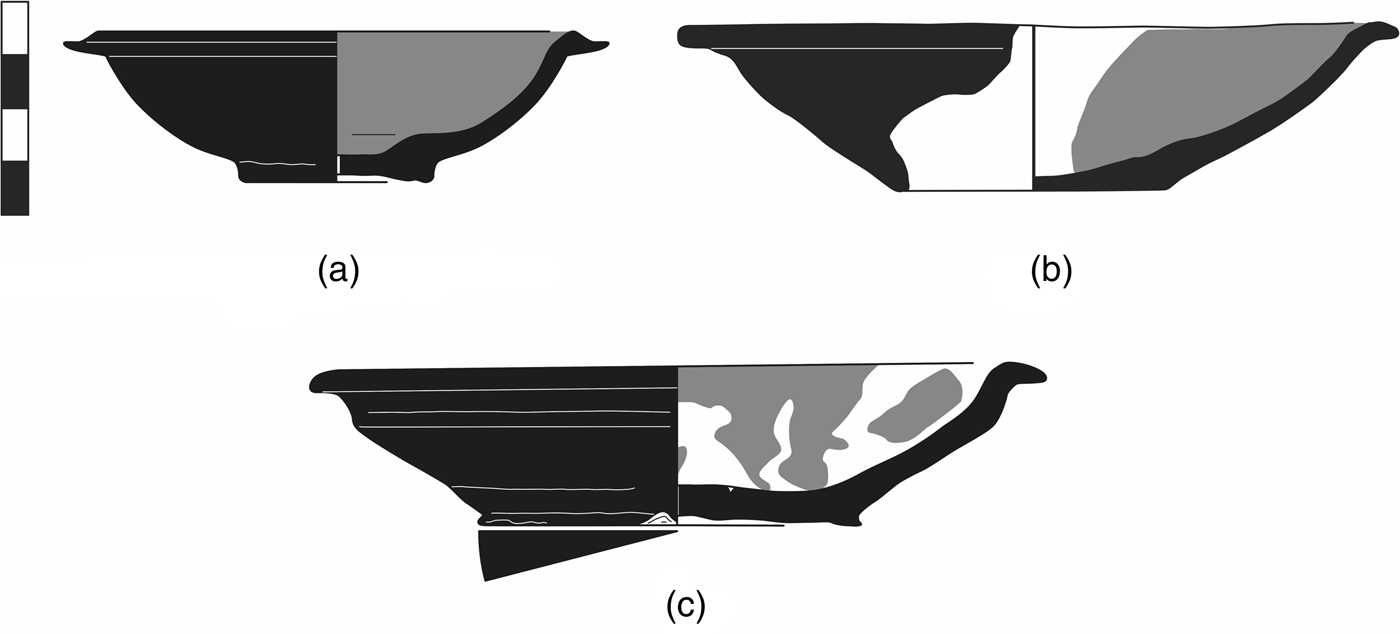
Saucers are not particularly common in MM IIIA, in contrast to the previous period (MacGillivray Reference MacGillivray and Momigliano2007, Trial KV deposit). In the sample under study, 30 examples were identified with ledge and/or flattened rims. Sometimes saucers are called ‘ledge-rim bowls’, which makes comparisons based only on descriptions complicated. In the Greek literature they are commonly designated λοπάδια (lopadia), though in several cases this description is used for conical cups in general (see Sakellarakis and Sakellaraki Reference Sakellarakis and Sakellaraki1979). Most of them are monochrome, though there are a few plain; some are half-dipped or decorated with splashes. In this period, saucers seem to have been replaced by handleless cups as functional equivalents.
Catalogued vessels (Fig. 9)
17. (Fig. 9a) KSM box 1531; half. Fine buff. Wheelmade. Monochrome. Ht 3.2; D rim 9.5; D base 3.4. Cf. Popham Reference Popham1974, fig. 6:16.
18. (Fig. 9b) KSM box 1534; half. Fine buff. Coil-built, wheel-fashioned. Half-dipped. Ht 3.3; D rim 13; D base 5.3. Cf. Rethemiotakis and Christakis Reference Rethemiotakis, Christakis, Macdonald and Knappett2013, fig. 8.2 (middle row); Knappett, Macdonald and Mathioudaki Reference Knappett, Macdonald and Mathioudakiin preparation (Olive Press Room: 1171.9).
19. (Fig. 9c) KSM box 1560; half. Fine buff. Coil-built, wheel-fashioned. Monochrome exterior, splashes on interior. Ht 3.4; D rim 11.8; D base 5.9. Cf. Rethemiotakis and Christakis Reference Rethemiotakis, Christakis, Macdonald and Knappett2013, fig. 8.2 (upper row, centre).
Saucers: (a) cat. no. 17; (b) cat. no. 18; (c) cat. no. 19.

Weakly carinated cups
Weakly carinated cups are also encountered in the assemblage, but not in great numbers. This type of cup is a survivor of its MM IB to MM IIB forerunner (cf. Macdonald and Knappett Reference Macdonald and Knappett2007, 63 fig. 3.3; MacGillivray Reference MacGillivray and Momigliano2007, 136 fig. 4.23:1 – note that pots 1–2 of fig. 4.26 belong to the assemblage presented here). This cup is strongly associated with early MM IIIA, as its presence in the Olive Press Room of the palace suggests (Knappett, Macdonald and Mathioudaki Reference Knappett, Macdonald and Mathioudakiin preparation), but it does not continue later. These cups were found in a fragmentary state in the palace material and no full profile could be retrieved. In the deposit under study here, some vessels could be restored. The rim is plain with a weak carination slightly below it, while the base is either splayed, forming a chalice-like foot, or simply plain, like that of the straight-sided cups. The cup is usually monochrome, i.e. pale red to light purple or grey. Weakly carinated cups are not common beyond Knossos, not even in adjacent areas (see, though, its presence at Akrotiri Phase C: Knappett and Nikolakopoulou Reference Knappett and Nikolakopoulou2008, fig. 10:21); they have so far been attested in the South-West Houses (lower level of S.V 4.2: Macdonald Reference Macdonald, Macdonald and Knappett2013, fig. 2.2:182, 1293) and the Olive Press Room. This cup type is not attested in the contemporary levels of Phaistos (Luca Girella, personal communication).
Catalogued vessels (Fig. 10)
20. (Fig. 10a) KSM box 1533; half. Disc base. Fine buff. Wheelmade. Monochrome. Ht 7.8; D rim 11.3; D base 4.5. Cf. MacGillivray Reference MacGillivray1998, pl. 156:1038; Knappett, Macdonald and Mathioudaki Reference Knappett, Macdonald and Mathioudakiin preparation (Olive Press Room: 1139.9, 1153.15).
21. (Fig. 10b) KSM box 1536; one-third. Fine buff. Wheelmade. Monochrome. Ht 9.3; D rim 11.4; D base 4.8. Cf. Knappett and Nikolakopoulou Reference Knappett and Nikolakopoulou2008, fig. 10:21; Macdonald Reference Macdonald, Macdonald and Knappett2013, fig. 2.2:1293, 182; Knappett, Macdonald and Mathioudaki Reference Knappett, Macdonald and Mathioudakiin preparation (Olive Press Room: 1153.15).
22. (Fig. 10c) KSM box 1539; three-quarters. Fine buff. Wheelmade. White-dotted interior. Ht 9; D rim 10.2; D base 4.4. Published by MacGillivray Reference MacGillivray1998, pls 17:411–12, 30:992; Reference MacGillivray and Momigliano2007, fig. 4.26:1–3.
Weakly carinated cups: (a) cat. no. 20; (b) cat. no. 21; (c) cat. no. 22.

Hemispherical cups
Hemispherical cups are present in the assemblage at more than three per cent of the total. They are either medium or large with an everted rim and usually thin walls. In nearly one-third of the pieces the upper part is ridged, a quite common trait for MM IIIA. The ridged shoulder is mainly attested in the largest examples. The cup type is well known from the Akrotiri Phase C assemblage, equivalent in terms of dating to the MM IIIA period (Knappett and Nikolakopoulou Reference Knappett and Nikolakopoulou2008, 12 fig. 4); in the latter assemblage, the ridged shoulder is combined with polychromy and the White-dotted style. In the assemblage presented here, polychromy on hemispherical cups is rare. There are, though, a few examples of the Wavy-line style more characteristic of the MM IIB period and not that common in late MM IIIA (Fig. 11d) (cf. Sakellarakis and Sakellaraki Reference Sakellarakis and Sakellaraki1997, 418 fig. 384; MacGillivray Reference MacGillivray and Momigliano2007, 137 fig. 4.24:2; Girella Reference Girella2010a, 60, pl. XXVI:20 A/32; Rethemiotakis and Christakis Reference Rethemiotakis, Christakis, Macdonald and Knappett2013, 98 fig. 8.5). Most examples are simply red or reddish-brown monochrome with matt surfaces. Usually this type of vessel goes together stylistically with the straight-sided cups, with both shapes decorated in the same styles (cf. Knappett and Nikolakopoulou Reference Knappett and Nikolakopoulou2008, figs 4, 6, 10:19–20). This situation is also witnessed here; it could thus be assumed that hemispherical cups had the same function as straight-sided ones and that for some unknown reason the former were soon replaced by the latter in terms of function. Also interesting, and surely of chronological relevance, is the absence from the assemblage of hemispherical cups decorated with disc spirals, which are present in palace deposits (i.e. the pit east of the School Room) and the Acropolis Houses (Catling et al. Reference Catling, Catling, Smyth, Jones and Jones1979, fig. 18:91–2), and fairly common in the late MM IIIA period.
Catalogued vessels (Fig. 11)
Hemispherical cups: (a) cat. no. 23; (b) no. 24; (c) cat. no. 25; (d) cat. no. 26.

23. (Fig. 11a) KSM box 1531; one-third. Fine buff. Coil-built, wheel-finished. Monochrome. Ht 5; D rim 7.7; D base 3.4. Cf. MacGillivray Reference MacGillivray1998, pl. 18:414–15; Reference MacGillivray and Momigliano2007, fig. 4.26:6.
24. (Fig. 11b) KSM box 1539; full profile. Fine buff. Coil-built, wheel-finished. Monochrome. Ht 6.2; D rim 10.3; D base 3.8.
25. (Fig. 11c) KSM box 1558; half. Ridged shoulder. Fine buff. Coil-built, wheel-finished. Monochrome. Ht 7.5; D rim 13; D base 4.7. Published by MacGillivray Reference MacGillivray1998, pl. 147:987; cf. MacGillivray Reference MacGillivray1998, pl. 156:1045.
26. (Fig. 11d) KSM box 1533; full profile. Fine buff. Wheelmade. Polychrome. Wavy-line style. Ht 5.8; D rim 10.9; D base 4.3. Cf. Rethemiotakis and Christakis Reference Rethemiotakis, Christakis, Macdonald and Knappett2013, fig. 8.5; Rethemiotakis and Warren Reference Rethemiotakis and Warren2014, fig. 3.6:92; Knappett, Macdonald and Mathioudaki Reference Knappett, Macdonald and Mathioudakiin preparation (Magazine of the Medallion Pithoi: 1111.16).
Straight-sided cups
Straight-sided cups are well represented in the MM IIIA period and continue on directly from their MM IIB predecessors (MacGillivray Reference MacGillivray and Momigliano2007, fig. 4:25). They constitute eight per cent of the assemblage and are more common than both the broad and tall handleless cup types, when each is taken individually. This is the commonest cup type of the period. Some examples have slightly bevelled bases, but not like those encountered in later periods, when bases become narrower (Hatzaki Reference Hatzaki and Momigliano2007a, fig. 5.6:6). Their walls are in some cases ridged (Fig. 12e), a trait not encountered in earlier versions, but one that definitely continues to the next phase. All straight-sided cups are fine and made mostly with the wheel-fashioned technique. More than half are decorated in the light-on-dark style, i.e. White-dotted style or with white splashes or stains, a hallmark of the MM IIIA period, presumably (Fig. 12c, g) (cf. MacGillivray Reference MacGillivray and Momigliano2007, fig. 4.33; Rethemiotakis and Warren Reference Rethemiotakis and Warren2014, fig. 3.6:112, 114). There are also several examples preserving parts of white spiralling motifs, curved lines and crescents on a dark ground. A large proportion is red or brown monochrome. Their average height is 7 cm to 7.5 cm, the average rim diameter is 8.5 cm to 10 cm and the average base diameter is 6.5 cm to 7 cm. Rare too are polychrome examples among those catalogued (Fig. 12h, k). In the contemporary palace material, cups decorated in the monochrome style are the commonest, while very few are decorated in the White-dotted style (Knappett, Macdonald and Mathioudaki Reference Knappett, Macdonald and Mathioudakiin preparation). The presence of pots decorated in the White-dotted style speaks, again, in favour of an earlier date within the MM IIIA period, also supported by the presence of the style at Anemospilia and the MM IIIA imports of Phase C at Akrotiri on Thera (Sakellarakis and Sakellaraki Reference Sakellarakis and Sakellaraki1997, fig. 383; Knappett and Nikolakopoulou Reference Knappett and Nikolakopoulou2008, figs 6:10–11, 10:20). Cups decorated in this style are particularly common in the Acropolis Houses (Catling et al. Reference Catling, Catling, Smyth, Jones and Jones1979, fig. 18), the South-West Houses (Macdonald Reference Macdonald, Macdonald and Knappett2013, fig. 2.6:1985, 2045) and the Vlachakis plot at Knossos (Rethemiotakis and Warren Reference Rethemiotakis and Warren2014, figs 3.6:112, 114, 3.7:134–35, 3.10:217–20). They are also commonly attested at Galatas (Rethemiotakis and Christakis Reference Rethemiotakis, Christakis, Macdonald and Knappett2013, fig. 8.4) and Phaistos (Levi and Carinci Reference Levi and Carinci1988, 204; Girella Reference Girella, Felten, Gauss and Smetana2007, 242; Reference Girella2010a, pl. XXVII:20 C/22–6).
Straight-sided cups: (a) cat. no. 27; (b) cat. no. 28; (c) cat. no. 29; (d) cat. no. 30; (e) cat. no. 31; (f) cat. no. 32; (g) cat. no. 33; (h) cat. no. 34; (i) cat. no. 35; (j) cat. no. 36; (k) cat. no. 37.

Catalogued vessels (Fig. 12)
27. (Fig. 12a) KSM box 1533; half. Bevelled base. Fine buff. Wheel-fashioned. Monochrome. Ht 7; D rim 11.2; D base 5.5. Cf. Rethemiotakis and Christakis Reference Rethemiotakis, Christakis, Macdonald and Knappett2013, fig. 8.4.
28. (Fig. 12b) KSM box 1538; complete. Fine buff. Wheel-fashioned. Monochrome. Ht 8; D rim 10.4; D base 7.
29. (Fig. 12c) KSM box 1535; rim-body. Ridged body. Fine buff. Wheelmade. White-dotted on exterior of rim. D rim 11.3. Cf. Rethemiotakis and Warren Reference Rethemiotakis and Warren2014, fig. 3.6:114.
30. (Fig. 12d) KSM box 1585; two body fragments. Fine buff. Wheelmade. White-dotted. Cf. Rethemiotakis and Christakis Reference Rethemiotakis, Christakis, Macdonald and Knappett2013, fig. 8.4 (lower row); Rethemiotakis and Warren Reference Rethemiotakis and Warren2014, fig. 3.6:112.
31. (Fig. 12e) KSM box 1584; base-body. Ridged body; pronounced base. Coil-built, wheel-finished. White-dotted interior. D rim 11.5; D base 6.2. Cf. MacGillivray Reference MacGillivray1998, pl. 79:406–7.
32. (Fig. 12f) KSM box 1538, SMP 9732; complete. Bevelled base. Fine buff. Coil-built, wheel-finished. White-dotted. Ht 6.5; D rim 9.2; D base 6.8. Published by MacGillivray Reference MacGillivray1998, pl. 147, no. 990.
33. (Fig. 12g) KSM box 1537; three-quarters. Intra-island import; semi-fine buff. Coil-built, wheel-finished. White-dotted. Ht 7.5; D rim 9; D base 5.4. Cf. Rethemiotakis and Christakis Reference Rethemiotakis, Christakis, Macdonald and Knappett2013, fig. 8.4.
34. (Fig. 12h) KSM box 1580; rim-body. Bevelled base. Coil-built, wheel-finished. Polychrome. Half rosettes. D rim 9; D base 6.8. Published by MacGillivray Reference MacGillivray1998, pl. 30, no. 994.
35. (Fig. 12i) KSM box 1582; base-body. Fine buff. Coil-built, wheel-finished. Thin parallel lines. D base 5.7.
36. (Fig. 12j) KSM box 1537; half. Soft-sandy buff. Coil-built, wheel-finished. Splashes on interior; monochrome exterior. Ht 6; D rim 9; D base 8.3. Cf. MacGillivray Reference MacGillivray and Momigliano2007, fig. 4.25:1.
37. (Fig. 12k) KSM box 1570; one-third. Soft-sandy orange. Coil-built, wheel-finished. Polychrome; foliate band. D base 5.7. Published by MacGillivray Reference MacGillivray1998, pl. 30:1007.
Bell-shaped cups
Bell-shaped cups are not as common as in previous periods; relatively few have been identified in the assemblage. Most are red or brown monochrome, but there are several decorated in the dark-on-light style with dipped rims, trickles or splashes. Most are fine, though some with a soft-sandy fabric seem to continue earlier technological traditions. There are also a few uncatalogued pieces that could be characterised as old-fashioned carinated cups.
Catalogued vessels (Fig. 13)
38. (Fig. 13a) KSM box 1537; complete. Fine buff. Coil-built, wheel-finished. Monochrome. Ht 5.6; D rim 7.5; D base 4.2.
39. (Fig. 13b) KSM box 1560; complete. Fine buff. Coil-built, wheel-finished. Splashes. Ht 4.9; D rim 7.9; D base 4.5.
40. (Fig. 13c) KSM box 1538; three-quarters. Intra-island import; semi-fine reddish-brown with dark grits. Coil-built, wheel-finished. Ht 6.8; D rim 10; D base 5.2.
Bell-shaped cups: (a) cat. no. 38; (b) cat. no. 39; (c) cat. no. 40.

Bowls
In this category are ‘in and out’ bowls and flaring bowls. ‘Ledge-rim bowl’ is not used in our terminology, since the profile is incorporated either in the broad handleless cup or saucer category (if especially shallow). The ‘ledge-rim bowl’ label defines better some cups of later periods, i.e. late MM IIIA or MM IIIB onwards. If these are ruled out, we are left with both ‘in and out’ and flaring bowls, which form quite stylistically homogeneous categories.
The deposit includes at least 16 examples of the ‘in and out’ bowl with abstract dark-on-light decoration on both the interior and exterior surfaces (Fig. 14a, e). This decorative style is considered a hallmark of the MM IIIB period, with most examples bearing ripple decoration (Warren Reference Warren1991, fig. 7d–j; Hatzaki Reference Hatzaki and Momigliano2007a, 163–4; Reference Hatzaki, Macdonald, Hatzaki and Andreou2015). The paint here is not lustrous, as it is on the best MM IIIB examples (Hatzaki Reference Hatzaki and Momigliano2007a, fig. 5.4:6–8). The ‘in and out’ bowl starts in MM IIIA, and some of the largest examples, with rim diameters around 25 cm, clearly belong to this period. Two of the catalogued examples are decorated with a ripple pattern resembling examples of later periods; one also has the well-known double lugs. Others are decorated with rows of festoons, stars or rosettes and the common broad parallel bands on the exterior. It is interesting to note that not many ‘in and out’ bowls derive from the palace proper, and those that do belong to deposits dated generally to MM IIIA (Knappett, Macdonald and Mathioudaki Reference Knappett, Macdonald and Mathioudakiin preparation). This type of bowl has also been identified in the South-West Houses (Macdonald Reference Macdonald, Macdonald and Knappett2013, fig. 2.6:2002d) and the Acropolis Houses (Catling et al. Reference Catling, Catling, Smyth, Jones and Jones1979, fig. 16:10).
Bowls: (a) cat. no. 41; (b) cat. no. 42; (c) cat. no. 43; (d) cat. no. 44; (e) cat. no. 45; (f) cat. no. 46; (g) cat. no. 47.

The flaring bowl is less common than the ‘in and out’ bowl, though there are some examples in the material presented here (Fig. 14d, g). Its most characteristic trait is its straight and flaring rim, which gives to the vessel the form of the modern-day plate. In some cases there is a low ridge at the exterior body-rim transition. Flaring bowls are usually large, with rim diameters of more than 25 cm. They often appear in a soft-sandy fabric or are imported like cat. no. 47 (Fig. 14g). They also seem to be handmade more often than not. In most cases, flaring bowls are given a red or brown monochrome finish. Cat. no. 44 (Fig. 14d) is one of the rare cases in which the pot is decorated with dark-on-light bands on the internal and external surfaces. Similar vessels have been recovered from the South-West Houses (Macdonald Reference Macdonald, Macdonald and Knappett2013, fig. 2.3:1172) and appear quite commonly in Knossian deposits. Tall flaring bowls become more common in later periods, when they are also called ‘kalathoi’.
The total absence of the ‘lipless hemispherical bowl’ (the ‘ogival bowl’ of Hatzaki Reference Hatzaki and Momigliano2007a, 166) speaks for an early point within the MM IIIA period for the assemblage. Not once has this bowl type been identified here; this is definitely of chronological significance. This type is present, though, in palace material attributed to the late MM IIIA and MM IIIB periods (Knappett, Macdonald and Mathioudaki Reference Knappett, Macdonald and Mathioudakiin preparation). This bowl is particularly common in Peter Warren's SEX Pit VI deposit dated to the MM IIIB/LM IA period (Warren Reference Warren1991, 323).
Catalogued vessels (Fig. 14)
41. (Fig. 14a) KSM box 1566; half. Double lugs. Fine buff. Wheelmade. Thick ripple on interior; bands on exterior. Ht 6.2; D rim 13.5; D base 4.8. Published by MacGillivray Reference MacGillivray1998, pl. 30, no. 985.
42. (Fig. 14b) KSM box 1578; body. Fine buff. Wheelmade. Thin ripple on interior; bands on exterior. Cf. Macdonald Reference Macdonald, Macdonald and Knappett2013, fig. 2.6:2002d.
43. (Fig. 14c) KSM box 1573; full profile. Rounded rim. Semi-fine buff. Wheelmade. Bands on interior and exterior; star on interior. Ht 9.5; D rim 32.
44. (Fig. 14d) AMH 7744; flaring bowl; three-quarters. Fine buff. Wheelmade. Bands on interior and exterior. Ht 5.2–5.9; D rim 29; D base 11.
45. (Fig. 14e) KSM box 1578; full profile. Rounded rim. Fine buff. Wheelmade. Crescent semicircles on interior; bands on exterior. Ht 14; D rim 30; D base 22. Cf. Catling et al. Reference Catling, Catling, Smyth, Jones and Jones1979, Deposit A:10.
46. (Fig. 14f) KSM box 1527; full profile. Fine buff. Wheelmade. Rosette(?). Ht 5; D rim 15.8; D base 8. Cf. Rethemiotakis and Warren Reference Rethemiotakis and Warren2014, fig. 3.7:125.
47. (Fig. 14g) KSM box 1591; half. Flaring bowl. Slightly footed. Intra-island import; semi-coarse red with schist and quartz. Handmade. Ht 9; D rim 25; D base 8.8. Cf. Catling et al. Reference Catling, Catling, Smyth, Jones and Jones1979, Deposit D:191.
Miniature cups/tripod cups
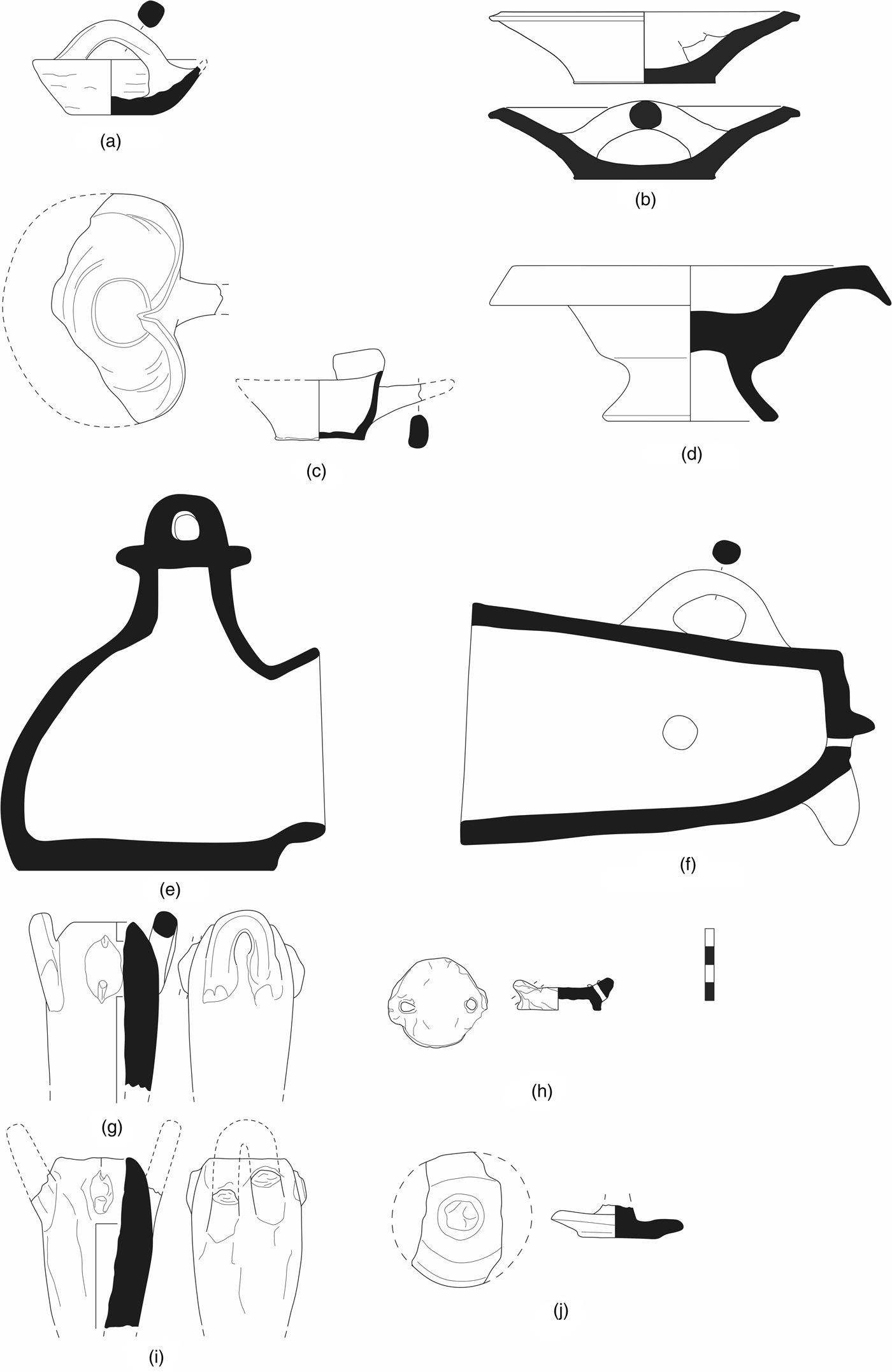
Miniatures are not that common, but are present in the assemblage (around 20 pieces). In this category are included both miniatures of handleless cups and very small, miniature, tripod cups, also known from the contemporary palace material (i.e. Room of the Knobbed Pithos: cf. Knappett, Macdonald and Mathioudaki Reference Knappett, Macdonald and Mathioudakiin preparation). The tripod examples were presumably for special use, made hastily with a substandard spout at the side and three small feet.
Catalogued vessels (Fig. 15)
48. (Fig. 15a) KSM box 1573; half. Tripod; vertical handle. Soft-sandy orange. Wheelmade. Monochrome. Ht 4.7; D rim 6.2; D base 2.8. Cf. Mackenzie Reference Mackenzie1922, 72.
49. (Fig. 15b) KSM box 1569; complete. Fine buff. Wheelmade. Half-dipped. Ht 5; D rim 9.4; D base 3.8.
50. (Fig. 15c) KSM box 1554; complete. Fine buff. Coil-built. Ht 2.2; D rim 4.3; D base 3.4.
51. (Fig. 15d) KSM box 1535; complete. Tripod; relic handle; spouted. Fine buff. Coil-built. Ht 4; D rim 4.5.
52. (Fig. 15e) KSM box 1535; three-quarters. Tripod; spouted. Fine buff. Coil-built. Ht 5; D rim 6.8.
53. (Fig. 15f) KSM box 1552; complete. Tripod; spouted; relic handle. Coil-built. Ht 3.4; D rim 5.
54. (Fig. 15g) KSM box 1535; complete. Fine buff. Coil-built. Trickles. Ht 3.9; D rim 3.8; D base 2.2.
Miniature cups and tripod cups: (a) cat. no. 48; (b) cat. no. 49; (c) cat. no. 50; (d) cat. no. 51; (e) cat. no. 52; (f) cat. no. 53; (g) cat. no. 54.

Pouring vessels
Bridge-spouted jars
Bridge-spouted jars are present at more than three per cent of the total. They might be more prevalent, but in a fragmentary state it is hard to tell them apart from other vessels of similar size, like jugs and oval-mouthed amphorae, especially when no part of the spout, but only lower body fragments, are preserved. Bridge-spouted jars continue from earlier periods with slight shape differences, especially in the spout and handles (MacGillivray Reference MacGillivray1998, 79 fig. 2.16). In the period treated here, jars of this kind are mainly small or medium (with a rim diameter of between 12 cm and 14 cm); they are wheelmade with intense wheelmarks in the interior. Twenty-five out of 40 pattern-painted examples are decorated in the light-on-dark style, with linear or floral motifs (i.e. rosettes, lilies and large foliate patterns), spirals and splashes, or decorated in the White-dotted style. There are several plain examples, usually small in size. Bridge-spouted jars decorated in the dark-on-light style are rare, with decoration generally confined to simple splashes or stains on light surfaces. There is, though, an imported vase decorated with zones of ripple pattern (cat. no. 62; Fig. 16h), which is more common in later periods. The large spout and other morphological and technological characteristics support a date that fits with the majority of the pots from the deposit. This pot was, in all probability, imported from Malia, based on macroscopic assessment of its fabric. Bridge-spouted jars are rare among the palace deposits with the exception of some examples from the Olive Press Room, mostly body fragments (Knappett, Macdonald and Mathioudaki Reference Knappett, Macdonald and Mathioudakiin preparation). The White-dotted style is particularly common and seems to have been the style in which these vessels were usually decorated (see also Rethemiotakis and Christakis Reference Rethemiotakis, Christakis, Macdonald and Knappett2013, fig. 8.7).
Bridge-spouted jars: (a) cat. no. 55; (b) cat. no. 56; (c) cat. no. 57 (reproduced from MacGillivray Reference MacGillivray1998, pl. 30:1002; (d) cat. no. 58; (e) cat. no. 59; (f) cat. no. 60; (g) cat. no. 61; (h) cat. no. 62.

Catalogued vessels (Fig. 16)
55. (Fig. 16a) KSM box 1543; rim-body. Pointy rim; globular body. Fine buff. Coil-built. White-dotted. D rim 11.2. Cf. Girella Reference Girella2010a, pl. XXVIII:20 C/167; Rethemiotakis and Christakis Reference Rethemiotakis, Christakis, Macdonald and Knappett2013, fig. 8.7 (left); Rethemiotakis and Warren Reference Rethemiotakis and Warren2014, fig. 3.10:214.
56. (Fig. 16b) KSM box 1538; body. Fine buff. Wheelmade. Spiralling motif (light-on-dark).
57. (Fig. 16c) KSM box 1534; three-quarters, partly restored. Fine buff. Wheelmade. Lily with spiralling ends (light-on-dark). Ht 15; D rim 9.6; D base 6.7. Published by MacGillivray Reference MacGillivray1998, pl. 30, no. 1002.
58. (Fig. 16d) KSM box 1530; rim-globular body. Semi-fine buff. Handmade. Large foliate pattern (light-on-dark). D rim 14.
59. (Fig. 16e) KSM box 1558; rim-body. Fine buff. Wheelmade. Polychrome. Sunflower. D rim 10.
60. (Fig. 16f) KSM box 1589; half; no spout preserved. Fine buff. Horizontal loop handle. Wheelmade. Monochrome. Ht 13.6; D rim 16.8; D base 6.8. Cf. Macdonald and Knappett Reference Macdonald and Knappett2007, fig. 3.38:653. Possibly MM IIA hangover.
61. (Fig. 16g) KSM box 1547; base-body. Semi-fine buff. Wheelmade. Vertically arranged decorative zones; rows of black drops. D base 4.8. Published by MacGillivray Reference MacGillivray1998, pl. 149, no. 1004; cf. MacGillivray Reference MacGillivray1998, pl. 25:874; Panagiotaki Reference Panagiotaki1999, no. 330 (for decorative syntax); Macdonald Reference Macdonald, Macdonald and Knappett2013, fig. 2.3:1175 (for decorative syntax).
62. (Fig. 16h) KSM box 1592; rim-body. Piriform shape; large spout. Intra-island import, probably from the Malia region based on macroscopic observations; semi-fine reddish-orange. Zones of ripple pattern; black rim. D rim 13. Cf. Sakellarakis and Sakellaraki Reference Sakellarakis and Sakellaraki1997, fig. 389.
Ewers
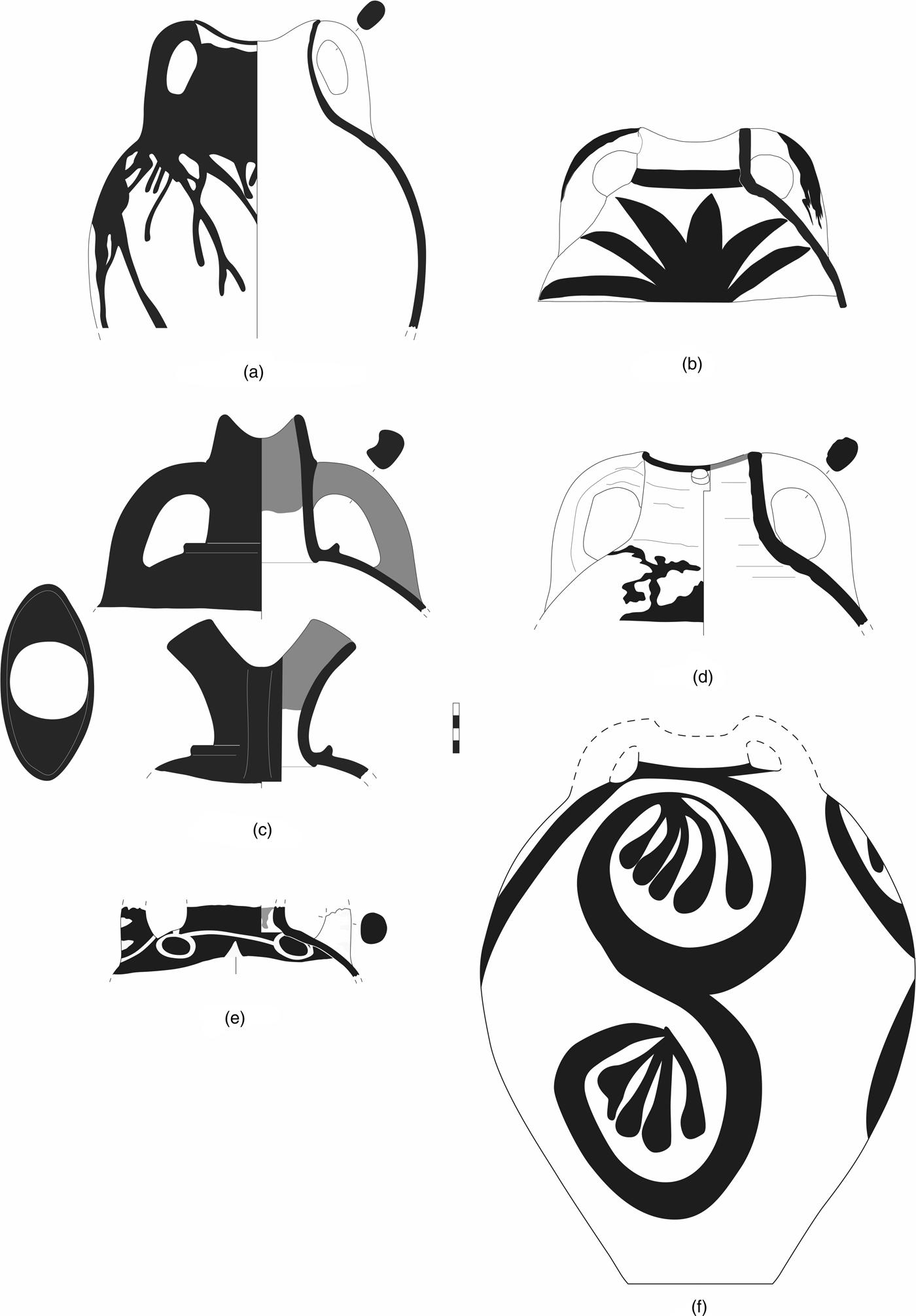
Ewers are not that common in the assemblage. They are mostly small in size; their main characteristic is the ridge or collar at the neck base, which often distinguishes them from jugs. This appears to be a new shape in the MM III period, and afterwards becomes quite common. Their presence here attests their early appearance from the beginning of MM IIIA. Ewers are identified by their shoulder zone with preserved collar; fragments of the lower body or rim are hard to recognise, since they coincide stylistically with those of other shapes (i.e. jugs). The catalogued ewers belong mainly to small-sized vessels, though one, cat. no. 65 (Fig. 17c), is a very good, neatly executed example of a larger ewer, which resembles examples from the Anemospilia deposit (Sakellarakis and Sakellaraki Reference Sakellarakis and Sakellaraki1997, figs 388–9). Ewers are decorated in a variety of styles and are also, in several cases, polychrome; the ridge is painted red and the rest of the body black with white patterns, bands or splashes.
Ewers: (a) cat. no. 63; (b) cat. no. 64; (c) cat. no. 65; (d) cat. no. 66.

Catalogued vessels (Fig. 17)
63. (Fig. 17a) KSM box 1585; ridged neck with collar. Fine buff. Coil-built. Monochrome.
64. (Fig. 17b) KSM box 1567; body. Ridged neck. Fine pinkish-buff. Handmade. Banded (light-on-dark).
65. (Fig. 17c) KSM box 1593; rim-body. Sharp profile; ridged neck. Coarse buff. Handmade. Sphashes/bands. D rim 17. Cf. Sakellarakis and Sakellaraki Reference Sakellarakis and Sakellaraki1997, figs 388–9.
66. (Fig. 17d) KSM box 1535; rim-body. Ridged neck. Intra-island import; coarse red with angular white grits. Wheelmade. Banded (light-on-dark).
Jugs
Jugs account for a little more than three per cent of the assemblage, but, as for other shapes, they might actually have been more common in the deposit; the fragmentary state of much of the material does not allow easy identification of body parts. Nevertheless, parts of jugs, especially medium- to large-sized body fragments, are included here. According to the form of their spout, they are divided into types with a cut-away neck (in some cases slightly beaked), for the main part, and funnel-mouthed jugs. An interesting shape, which makes its appearance in different deposits in this period, is the three-handled jug; indeed, it could be characterised as a hallmark of MM IIIA (Fig. 18c–f) (Mackenzie Reference Mackenzie1922, 62; Karetsou and Mathioudaki Reference Karetsou and Mathioudaki2012, 89 fig. 8; Knappett, Macdonald and Mathioudaki Reference Knappett, Macdonald and Mathioudakiin preparation). These pots are very elegant and decorated either in the light-on-dark or dark-on-light style. Cat. no. 71 (Fig. 18e) is an interesting large-sized vessel with an elaborate decoration of thin plastic rope bands and painted patterns. They are equally decorated in the light-on-dark (i.e. White-dotted, parallel lines/bands) and dark-on-light styles (i.e. ripple pattern, bands, trickles or splashes). Some good examples of jugs belonging to this period come from Anemospilia (Sakellarakis and Sakellaraki Reference Sakellarakis and Sakellaraki1997, fig. 387) and Galatas (Rethemiotakis and Christakis Reference Rethemiotakis, Christakis, Macdonald and Knappett2013, fig. 8.14). The palace material includes several examples of different jug types, but in a fragmentary state; their largest concentration is, again, in the Olive Press Room (Knappett, Macdonald and Mathioudaki Reference Knappett, Macdonald and Mathioudakiin preparation).
Jugs: (a) cat. no. 67; (b) cat. no. 68; (c) cat. no. 69; (d) cat. no. 70; (e) cat. no. 71; (f) cat. no. 72.

Catalogued vessels (Figs 18, 19)
67. (Fig. 18a) KSM box 1543; almost complete. Fine buff. Coil-built, wheel-finished. Ht 11; D base 4.
68. (Fig. 18b) KSM box 1533; half. Ridged neck. Fine buff. Coil-built, wheel-finished. Monochrome. Ht 13.4; D base 4. Published by MacGillivray Reference MacGillivray1998, pl. 147:986.
69. (Fig. 18c) AMH 7743; three-quarters; three-handled jug (small). Fine buff. Wheelmade. Monochrome. Ht 13.2; D rim 4.5; D base 5.5.
70. (Fig. 18d) KSM box 1555; three-quarters; three-handled jug. Fine buff. Coil-built, wheel-finished. Banded (light-on-dark); straps on handle. Ht 17.8. Published by MacGillivray Reference MacGillivray1998, pl. 147:988.
71. (Fig. 18e) KSM box 1539; rim-body; three-handled jug. Semi-fine buff. Coil-built. Two plastic rope bands on neck/body; horizontal bands on body; bands around handles (dark-on-light).
72. (Fig. 18f) KSM box 1537; rim-body; three-handled jug. Coarse buff with dark grits. Handmade. Linear decoration (dark-on-light); bands around neck/handles. Cf. Karetsou Reference Karetsou, Macdonald and Knappett2013, fig. 7.32:859; Rethemiotakis and Warren Reference Rethemiotakis and Warren2014, fig. 3.5.
73. (Fig. 19a) KSM box 1540; rim-body; funnel-mouthed jug. Fine buff. Coil-built, wheel-finished. White-dotted. D rim 5.
74. (Fig. 19b) KSM box 1589; half; funnel-mouthed jug. Fine buff. Coil-built, wheel-finished. White-dotted rim. D rim 5.4.
75. (Fig. 19c) KSM box 1581; spout; cut-away necked jug. Semi-fine buff. Coil-built. Dipped rim/trickles. Cf. Knappett, Macdonald and Mathioudaki Reference Knappett, Macdonald and Mathioudakiin preparation (Olive Press Room: 1140.33).
76. (Fig. 19d) KSM box 1554; half. Fine buff. Coil-built, wheel-finished. White-dotted. Ht 12.2; D base 3.4. Published by MacGillivray Reference MacGillivray1998, pl. 147:993.
77. (Fig. 19e) KSM box 1533; base-body. Fine buff. Coil-built, wheel-finished. Parallel lines (light-on-dark). D base 5.4.
78. (Fig. 19f) KSM box 1554; rim-body; cut-away necked jar. Fine buff. Coil-built. Half-dipped.
79. (Fig. 19g) KSM box 1578; body. Semi-fine buff. Handmade. Floral pattern (dark-on-light).
80. (Fig. 19h) KSM box 1536; body. Semi-fine buff with black grits. Handmade. Polychrome. Spirals.
81. (Fig. 19i) KSM box 1564; rounded rim-neck. Vertical handle on neck. South-east Aegean import; semi-coarse red with gold mica. Handmade. D rim 11.
82. (Fig. 19j) KSM box 1560; rim-body; cut-away necked jar. Intra-island import; semi-fine brown with black grits. Handmade. Monochrome.
83. (Fig. 19k) KSM box 1537; rim-body. Funnel mouth/narrow neck; vertical handle on neck. Intra-island import; coarse with dark grits. Coil-built. Circles on body; banded neck (light-on-dark). D rim 7.8.
Jugs: (a) cat. no. 73; (b) cat. no. 74; (c) cat. no. 75; (d) cat. no. 76; (e) cat. no. 77; (f) cat. no. 78; (g) cat. no. 79; (h) cat. no. 80; (i) cat. no. 81; (j) cat. no. 82; (k) cat. no. 83.

Juglets
Juglets are typical for the period, usually having a rounded body with a slightly distinct base and a flaring rim and neck. One important observation is that the more angular type of juglet usually attributed to the MM IIB period is absent (Popham Reference Popham1974, fig. 6:25).
Catalogued vessels (Fig. 20)
84. (Fig. 20a) KSM box 1589; complete. Fine buff. Coil-built, wheel-finished. Ht 5.5; D rim 4; D base 4.7.
85. (Fig. 20b) KSM box 1544; three-quarters. Lugs on shoulder. Fine buff. Coil-built, wheel-finished. Splashes. Ht 6.2; D rim 3.8; D base 4.2.
86. (Fig. 20c) KSM box 1551; almost complete. Fine buff. Coil-built, wheel-finished. Splashes. Ht 8.2; D rim 4.7; D base 4.6.
87. (Fig. 20d) KSM box 1546; complete. Fine buff. Coil-built, wheel-finished. Splashes. Ht 7.3; D rim 3.9; D base 4.
88. (Fig. 20e) KSM box 1546; complete. Fine buff. Coil-built, wheel-finished. Splashes. Ht 7.5; D rim 4.2; D base 4.2.
89. (Fig. 20f) KSM box 1536; three-quarters. Fine buff. Coil-built, wheel-finished. Splashes. Ht 6.8; D base 4.6.
90. (Fig. 20g) KSM box 1535; almost complete. Thick walled. Intra-island import; coarse reddish-brown, gritty. Coil-built, wheel-finished. Ht 8.5; D base 5.3.
Juglets: (a) cat. no. 84; (b) cat. no. 85; (c) cat. no. 86; (d) cat. no. 87; (e) cat. no. 88; (f) cat. no. 89; (g) cat. no. 90.

Storage/transport vessels
Oval-mouthed amphorae
The oval-mouthed amphora exceeds numerically both jugs and bridge-spouted jars, forming around five per cent of the total; again, identification issues mean its percentage could have been higher. It is very characteristic of the MM IIIA period, especially its earlier part. Light-on-dark and dark-on-light examples are generally equally present, showing for the first time a feature that characterises later periods. It is interesting to note that the dark-on-light patterns (i.e. open spirals, linear decoration, stars) slightly exceed light-on-dark examples (i.e. splashes/stains, floral motifs, bands). The amphorae are usually semi-coarse or coarse and handmade. In the palace material, oval-mouthed amphorae are detected almost exclusively in MM IIIB deposits (i.e. the cists below the Central Stairs), but the material presented here challenges the conclusions arising from this, demonstrating their strong presence in the previous period. The shape obviously continues later, according to finds from several deposits (Warren Reference Warren1991, fig. 5a, b; Hatzaki Reference Hatzaki and Momigliano2007a, fig. 5.8:3). Oval-mouthed amphorae are reported from the Acropolis Houses (Catling et al. Reference Catling, Catling, Smyth, Jones and Jones1979, fig. 20:58) and the South-West Houses (Macdonald Reference Macdonald, Macdonald and Knappett2013, fig. 2.3:1175). Cat. nos 93 and 100 (Figs 21c, 22e) are both decorated with open spirals on the shoulder and white bars on the handles, despite the fact that they are products of different workshops, i.e. Knossian and probably southern Cretan (see Girella Reference Girella2010a, pl. XXVII:20 A/39). This indicates that there were very specific and broadly accepted ways in which pots of this period were decorated and that there was also a relationship between decorative pattern, syntax and shape. Cat. no. 92 (Fig. 21b) has an exact parallel in the material from Akrotiri Phase C, though in this case the pot derives from Naxos (Reference Mathioudaki and NikolakopoulouMathioudaki forthcoming). It is obvious that the decorative patterns on this kind of transport vase circulated and became more or less fashionable over wide areas. Cat. no. 96 (Fig. 22a) bears a commonly attested pattern of the early MM IIIA period: the ‘diagonal trickles’ known from Knossian deposits (cf. MacGillivray Reference MacGillivray1998, pl. 92:558; Knappett, Macdonald and Mathioudaki Reference Knappett, Macdonald and Mathioudakiin preparation) and recently attested also at Akrotiri Phase C (Nikolakopoulou Reference Nikolakopoulouforthcoming, cat. no. 1386).
Oval-mouthed amphorae: (a) cat. no. 91; (b) cat. no. 92; (c) cat. no. 93; (d) cat. no. 94; (e) cat. no. 95.

Oval-mouthed amphorae: (a) cat. no. 96; (b) cat. no. 97; (c) cat. no. 98; (d) cat. no. 99; (e) cat. no. 100; (f) cat. no. 101.

Catalogued vessels (Figs 21 and 22)
91. (Fig. 21a) KSM box 1567; rim-body, small. Coarse buff. Coil-built. Bands and circles; bars on handle (light-on-dark). D rim 5.4.
92. (Fig. 21b) KSM box 1542; rim-body. Coarse buff with angular brown grits. Handmade. Thin-lined star (light-on-dark). Cf. Reference Mathioudaki and NikolakopoulouMathioudaki forthcoming, no. 1427.
93. (Fig. 21c) KSM box 1573; rim-body. Semi-fine buff. Handmade. Open spirals; bars on handle (light-on-dark). D rim 6.8–13.
94. (Fig. 21d) KSM box 1585; rim-body. Semi-coarse buff. Coil-built. Bands around neck/handle; interior rim band (dark-on-light).
95. (Fig. 21e) AMH 7746; three-quarters (restored). Pot marked on handle (plain incision). Coarse buff. Handmade. Large curved bands forming original motif (dark-on-light). Fingermarks on interior. Ht 39.8; D rim 8–10; D base 12. Cf. Sakellarakis and Sakellaraki Reference Sakellarakis and Sakellaraki1997, fig. 392; Rethemiotakis and Warren Reference Rethemiotakis and Warren2014, fig. 3.5.
96. (Fig. 22a) KSM box 1529; rim-body. Semi-fine pinkish-buff. Handmade. Diagonal trickles; white band on rim. Cf. Knappett, Macdonald and Mathioudaki Reference Knappett, Macdonald and Mathioudakiin preparation (Olive Press Room: 1144.25).
97. (Fig. 22b) KSM box 1547; rim-body (two non-joining fragments). Semi-fine buff with red/brown grits. Handmade; creamy slip. Large foliate pattern (dark-on-light); band around neck/rim; splashed handles. Cf. Rethemiotakis and Christakis Reference Rethemiotakis, Christakis, Macdonald and Knappett2013, fig. 8.13.
98. (Fig. 22c) KSM box 1533; rim-body. Sharp profile; collared neck; ridged handle. Intra-island import; coarse red with dark grits. Handmade. Monochrome.
99. (Fig. 22d) KSM box 1585; rim-body. Two plastic knobs on spout edges; lipless; tall neck. Dodecanesian(?) import; coarse brown with dark angular grits. Handmade. Monochrome.
100. (Fig. 22e) KSM box 1560; two body fragments. Intra-island import; coarse reddish-brown with black grits. Handmade. Open spirals (light-on-dark).
101. (Fig. 22f) AMH 7739; half (restored). Intra-island import, probably from the Mesara area according to macroscopic observation; coarse whitish-buff with dark-grey grits. Handmade. Spiralling rosettes (dark-on-light). Ht (restored) 43; D base 11.6. Published by MacGillivray Reference MacGillivray1998, pl. 150:1010.
Jars
Fragments of jars and/or jugs are the most represented category in the assemblage, i.e. 33.6 per cent of the total. The composite term jar/jug is employed in Fig. 6 since it is hard to differentiate between the two shapes when only fragments of the lower body are preserved. Thus, many body fragments have been categorised as jars/jugs; all belong to large- or medium-sized closed vessels that probably served as containers for goods. In most cases, the term ‘jar’ is more apt, since the walls of the vessels are particularly thick. In several examples, the rim, base or lower body fragments hint at the original shape of the vessel; most of these have been added to the database as catalogued vessels.
The category of jars is generic and not as homogeneous as one would like. The vessels could not be categorised in a more comprehensive way, since comparanda are missing from published deposits. It is possible to single out typologically examples with an incurving upper body and rim, i.e. kados-like pots, with a hole-mouth or pulled-out rim (Figs 23c, 24d, i), which are also present in other deposits of the period (Catling et al. Reference Catling, Catling, Smyth, Jones and Jones1979, figs 22:140, 25:164; Rethemiotakis and Warren Reference Rethemiotakis and Warren2014, fig. 3.11:228), and some medium-sized examples which have a neck with a plain rim and horizontal handles on the shoulder (Figs 23a, 24e). The others, more or less, seem to be sui generis, and in many instances it is hard to restore the original shape of the vessel. Most jars are handmade or partly coil-built, with coil seams visible at sections; they often bear vertical fingermarks on the internal surfaces from the formation technique (Fig. 23g). Several are plain or monochrome, while nearly half the material is decorated in the dark-on-light style, i.e. bands, trickles, floral motifs, rim bands, solid circles, splashes or spirals; a few have patterns in added white paint and could be considered forerunners of popular later styles (Figs 23i, 24a). Very few are decorated in the light-on-dark style (see cat. no. 113; Fig. 24b), a fact that speaks for a gradual fading out of the style, at least so far as large-sized vessels are concerned. No polychrome pieces are preserved, in contrast to the palace deposits which contained several pots belonging to Evans’ ‘subdued polychrome tradition’ (Knappett, Macdonald and Mathioudaki Reference Knappett, Macdonald and Mathioudakiin preparation). A quarter of the jars were imported; cat. no. 118 (Fig. 24g) is reminiscent of similar vessels from the Olive Press Room (Knappett, Macdonald and Mathioudaki Reference Knappett, Macdonald and Mathioudakiin preparation). Most of the imported pieces derive from other intra-island areas, mostly from sites of northern or south-central Crete.
Jars: (a) cat. no. 102; (b) cat. no. 103; (c) cat. no. 104; (d) cat. no. 105; (e) cat. no. 106; (f) cat. no. 107; (g) cat. no. 108; (h) cat. no. 109; (i) cat. no. 110; (j) cat. no. 111.

Jars: (a) cat. no. 112; (b) cat. no. 113; (c) cat. no. 114; (d) cat. no. 115; (e) cat. no. 116; (f) cat. no. 117; (g) cat. no. 118; (h) cat. no. 119; (i) cat. no. 120; (j) cat. no. 121.

Catalogued vessels (Figs 23, 24)
102. (Fig. 23a) KSM box 1537; almost complete, medium-sized. Two horizontal loop handles. Semi-fine buff. Handmade. Monochrome. Ht 23.5; D rim 7; D base 6.8.
103. (Fig. 23b) KSM box 1529; half, large. Semi-fine buff. Handmade. Splashes on interior. D rim c.12; D base 12.
104. (Fig. 23c) KSM box 1580; rim-body; hole-mouthed jar. Incurving rim. Semi-fine buff. Handmade. Splashes on interior. D rim 22. Cf. Mackenzie Reference Mackenzie1922, 56.
105. (Fig. 23d) KSM box 1531; rim-neck. Two knobs under rim. Semi-fine buff. Coil-built, wheel-finished. Broad bands on rim/neck (dark-on-light). D rim 13.2.
106. (Fig. 23e) KSM box 1562; rim-neck. Flaring rim. Coarse buff with angular red/brown grits. Coil-built. Broad band at neck (dark-on-light). Ht 8.5; D rim 13.6.
107. (Fig. 23f) KSM box 1577; rim-body. Semi-fine buff. Handmade. Solid black circles on shoulder; bands around neck/handles (dark-on-light); rows of impressions on neck. Ht 9.5; D rim 6.
108. (Fig. 23g) KSM box 1536; base-body. Semi-fine buff. Handmade. Trickles. Vertical hand impressions on interior. Ht preserved 22.5; D base 8.5.
109. (Fig. 23h) KSM box 1588; body-base (several non-joining fragments). Semi-fine buff. Handmade. Trickles, plastic rope. D base 13.6. Cf. Knappett, Macdonald and Mathioudaki Reference Knappett, Macdonald and Mathioudakiin preparation (Olive Press Room: 1144.25).
110. (Fig. 23i) KSM box 1586; body. Semi-fine buff. Coil-built. Large dark motif with added white lines (dark-on-light). Cf. Knappett, Macdonald and Mathioudaki Reference Knappett, Macdonald and Mathioudakiin preparation (Olive Press Room: 1163.14–15).
111. (Fig. 23j) KSM box 1542; body. Semi-coarse buff. Handmade; white slipped. Part of large white star(?) surrounded by black pattern (dark-on-light).
112. (Fig. 24a) KSM box 1546; body (three non-joining fragments). Semi-coarse buff. Handmade. Floral pattern with added white lines.
113. (Fig. 24b) KSM box 1554; base-body. Coarse buff with large grits. Handmade. Large foliate pattern (light-on-dark); splashes on interior. Ht preserved 14.5; D base 13.8.
114. (Fig. 24c) KSM box 1556; base-body. Intra-island import; coarse brown with angular grey grits. Handmade. Spirals(?). D base 12.4.
115. (Fig. 24d) KSM box 1532; rim-body, base (nine non-joining fragments). Incurving rim; horizontal handle. Intra-island import; semi-fine orange with dark grits; creamy slip. Diagonal trickles on exterior; fingermarks on interior. Ht preserved 28; D rim 16.3; D base 15.
116. (Fig. 24e) AMH 4494; complete. Tall neck; two horizontal handles. Intra-island import; coarse dark red/grey with limestone. Handmade. Monochrome. Ht 31.3; D rim 9.3; D base 9.5.
117. (Fig. 24f) KSM box 1554; rim-body. Flaring rim; vertical handle. Intra-island import; semi-fine orange with red grits and schist. Handmade. Monochrome. D rim 17.3.
118. (Fig. 24g) KSM box 1561; rim-neck. Squared rim. South-east Aegean import; semi-coarse red/grey with gold mica. Coil-built, wheel-finished; creamy slip.
119. (Fig. 24h) KSM box 1571; rim-body; kados. Thickened rim; horizontal handle. Semi-fine buff with angular red grits. Coil-built. Band on exterior; vertical fingermarks on interior. Ht 18.5; D rim 34.
120. (Fig. 24i) KSM box 1535; rim-body; wide-mouthed jar (two non-joining fragments). Horizontal loop handle. Semi-fine buff. Trickles. D rim 15.
121. (Fig. 24j) KSM box 1592; body-handle; pitharaki(?). Fine buff. Handmade. Monochrome on exterior with plastic ornament of an insect (i.e. Rhinoceros beetle).
Vessels for cooking or food preparation
Cooking vessels or vessels for food preparation are relatively common in the assemblage (4.8 per cent), in contrast to their almost complete absence from the palace deposits. One half of the cooking-pot fragments belong to tripod cooking pots and the other to medium- or large-sized cooking trays (Figs 25, 26). There is a variety of handles for the cooking trays, and these could be used for further subcategorisations. Not many cooking pots from the period have been published, and this prevents further analysis of shapes and styles (cf. Catling et al. Reference Catling, Catling, Smyth, Jones and Jones1979, figs 26:165, 28:182; Karetsou and Mathioudaki Reference Karetsou and Mathioudaki2012, fig. 23; Warren and Rethemiotakis Reference Rethemiotakis and Warren2014, fig. 3.9:198). The majority of the pots are coarse and handmade; in one case only could coil-seams be identified. Very few are imported, possibly from other Minoan sites (cat. nos 133–134; Figs 26f–g). Tripod cooking pots usually have deep bodies; one of the catalogued examples is carefully executed and has decoration of parallel ridges under the rim, white slip and a broad painted rim band on the interior (Fig. 26b). Some other examples have impressed decoration like rope bands close to their feet (Fig. 25e). Cat. nos 132–133 (Fig. 26e–f), described as cooking jars, are not that common and parallels are hard to find; there seems, though, to have been a class of closed or wide-mouthed vessels with a decoration of ridges under the rim (see Macdonald Reference Macdonald, Macdonald and Knappett2013, fig. 2.6:2002, 2024; Rethemiotakis and Christakis Reference Rethemiotakis, Christakis, Macdonald and Knappett2013, fig. 8.8 top). These might also belong to the class of small tripod cooking pots.
Vessels for cooking or food preparation: (a) cat. no. 122; (b) cat. no. 123; (c) cat. no. 124; (d) cat. no. 125; (e) cat. no. 126; (f) cat. no. 127.

Vessels for cooking or food preparation: (a) cat. no. 128; (b) cat. no. 129; (c) cat. no. 130; (d) cat. no. 131; (e) cat. no. 132; (f) cat. no. 133; (g) cat. no. 134.

Catalogued vessels ( Figs 25, 26)
122. (Fig. 25a) KSM box 1573; basin. Flaring, downturned rim; horizontal handle below rim. Coarse buff. Handmade. Trickles. Ht preserved 9.8; D rim 50.
123. (Fig. 25b) KSM box 1534; half; tray. Coarse buff with angular grits (schist?). Coil-built, wheel-finished. Ht 5.7; D rim 24.3; D base 24.
124. (Fig. 25c) KSM box 1536; rim-body; tray or basin. Pair of vertical handles of different type. Semi-fine buff with grey grits and schist(?). Handmade. Ht preserved 10.4; D rim 26.
125. (Fig. 25d) KSM box 1568; full profile; tray. Crescent lug. Coarse buff. Handmade. Ht 5.3; D rim 30. Cf. Girella Reference Girella2010a, pl. 80:15.
126. (Fig. 25e) KSM box 1535; base-foot; tripod cooking pot. Coarse reddish-brown. Handmade. Plastic rope decoration at lower body.
127. (Fig. 25f) KSM box 1579; full profile; tripod cooking pot. Coarse buff, porous. Handmade. Ht 13; D rim 22.
128. (Fig. 26a) KSM box 1582; one-third; tripod cooking pot. Spouted; horizontal handles. Coarse light brown. Wheelmade. D rim 21. Cf. Catling et al. Reference Catling, Catling, Smyth, Jones and Jones1979, Deposit C:165.
129. (Fig. 26b) KSM box 1582; three-quarters; tripod cooking pot. Spouted; horizontal handles. Coarse reddish-brown; white slipped interior. Wheelmade. Three horizontal ridges below rim. Rim band on interior. D rim 25; D base 19. Cf. Sakellarakis and Sakellaraki Reference Sakellarakis and Sakellaraki1997, fig. 219.
130. (Fig. 26c) KSM box 1587; full profile; cooking pot. Flaring and downturned rim. Soft-sandy orange. Wheelmade. Ht 6.5; D rim 24.3; D base 10.
131. (Fig. 26d) KSM box 1541; half; cooking pot for stew. Flat everted rim; horizontal handles. Semi-fine buff. Handmade. Ht 8.5; D rim 17; D base 19.
132. (Fig. 26e) KSM box 1554; rim; cooking jar. Flange for lid on rim; knob. Semi-fine red. Handmade. Ridges below rim. D rim 18.9.
133. (Fig. 26f) KSM box 1565; rim-body; cooking jar (possibly tripod). Flange for lid on rim; horizontal loop handle. Intra-island import; coarse red with mica. Handmade. Ridges below rim. D rim 10.5.
134. (Fig. 26g) KSM box 1560; full profile; cooking pot for stew. Flat everted rim; horizontal handle. Intra-island import; coarse red with dark grits. Handmade. Ht 6.3; D rim 23; D base 17.3.
Vessels of special function
Around four per cent of the total assemblage comprises pots of special function, such as chalices, pedestalled vessels, discs, lamps and offering tables. Chalices (13 examples in total) appear in all styles of the period (Fig. 27a–f; cf. Catling et al. Reference Catling, Catling, Smyth, Jones and Jones1979, fig. 16:6; Karetsou Reference Karetsou, Macdonald and Knappett2013, fig. 7.30:643) and there are a few complete examples, such as cat. nos 135 and 139 (Fig. 27a, e), the latter decorated in the popular White-dotted style. Six discs (i.e. very shallow trays) are also included in this category of vessels, since there are not many of them and they obviously served some special function. Cat. no. 144 (Fig. 27j) is decorated with splashes, like many contemporary handleless cups. Plain discs and discs decorated with splashes have been retrieved from the Olive Press Room and other deposits (Girella Reference Girella2010a, pl. XXVIII:20 C/160–1; Karetsou Reference Karetsou, Macdonald and Knappett2013, fig. 7.28 middle; Rethemiotakis and Christakis Reference Rethemiotakis, Christakis, Macdonald and Knappett2013, fig. 8.15; Knappett, Macdonald and Mathioudaki Reference Knappett, Macdonald and Mathioudakiin preparation). There are also several examples of lamps, usually in a soft-sandy fabric (Figs 28a–d, 29d; cf. Catling et al. Reference Catling, Catling, Smyth, Jones and Jones1979, fig. 22:138). Cat. no. 149 (Fig. 28e) is a very large example that resembles those made of stone from the same period. There is also one ‘pinched goblet’ with a dipped rim and trickles (cat. no. 151; Fig. 28g), a rare MM IIIA type that looks like a hangover from the MM IIA footed goblets (Macdonald Reference Macdonald and Krzyszkowska2010, 208 fig. 20:5). Trays possibly made to take handleless cups are not uncommon in the assemblage. There are several examples in a fragmentary state (Fig. 28i–j) with holes to receive other smaller vessels, like that depicted in Evans’ photo and called by him an ‘egg-stand’ (PM II.1, fig. 178). Fragments of five imported cylindrical flasks (cat. nos 161–163; Fig. 29g–i) are also noteworthy, and similar to examples recovered from the northern and south-eastern Lustral Basins that derive most probably from the Dodecanese (PM II.1, 411 fig. 295; Knappett, Macdonald and Mathioudaki Reference Knappett, Macdonald and Mathioudakiin preparation). The flasks have a cylindrical form, four handles and resemble small amphorae. Their main characteristics are their incredibly thick walls and pared surfaces. Last, there are some utterly unique vessels in the assemblage, already noted by Evans, such as cat. nos 159 and 160 (Fig. 29e–f), called conventionally a ‘bird's nest’ and ‘Ariadne's clew-box’, respectively; these remain unparalleled.
Vessels of special function: (a) cat. no. 135; (b) cat. no. 136; (c) cat. no. 137; (d) cat. no. 138; (e) cat. no. 139; (f) cat. no. 140; (g) cat. no. 141; (h) cat. no. 142; (i) cat. no. 143; (j) cat. no. 144.

Vessels of special function: (a) cat. no. 145; (b) cat. no. 146; (c) cat. no. 147; (d) cat. no. 148; (e) cat. no. 149; (f) cat. no. 150; (g) cat. no. 151; (h) cat. no. 152; (i) cat. no. 153; (j) cat. no. 154.

Vessels of special function: (a) cat. no. 155; (b) cat. no. 156; (c) cat. no. 157; (d) cat. no. 158; (e) cat. no. 159; (f) cat. no. 160; (g) cat. no. 161; (h) cat. no. 162; (i) cat. no. 163; (j) cat. no. 164.

Catalogued vessels ( Figs 27, 28, 29)
135. (Fig. 27a) KSM box 1534; half; chalice. Soft-sandy orange. Coil-built, wheel-finished. Monochrome. Ht 14; D rim 9; D base 5. Published by MacGillivray Reference MacGillivray1998, pl. 147:262.
136. (Fig. 27b) KSM box 1561; ridged base and body; chalice. Fine buff. Coil-built, wheel-finished. Monochrome. Plastic decoration. D base 3.8.
137. (Fig. 27c) KSM box 1536; ridged base; chalice. Fine buff. Coil-built, wheel-finished. Monochrome. D base 2.7. Cf. Karetsou Reference Karetsou, Macdonald and Knappett2013, fig. 7.30:643.
138. (Fig. 27d) KSM box 1574; base; chalice. Ridge above base. Fine buff. Wheelmade. Monochrome. Ht 3.4; D base 6.6.
139. (Fig. 27e) KSM box 1589; three-quarters; chalice. Fine buff. Coil-built, wheel-finished. White-dotted. Ht 11.3; D rim 11.8; D base 4. Published by MacGillivray Reference MacGillivray1998, pl. 147:989.
140. (Fig. 27f) KSM box 1567; base; chalice. Fine buff. Coil-built. Parallel lines (light-on-dark). D base 3.
141. (Fig. 27g) KSM box 1555; base; pedestalled vessel. Coarse light brown with angular grits. Handmade. Monochrome. D base 22. Cf. Karetsou Reference Karetsou, Macdonald and Knappett2013, fig. 7.30:23.
142. (Fig. 27h) KSM box 1540; body; pedestalled vessel. Flaring walls. Semi-fine buff. Handmade. Ripple pattern on exterior; parallel bands on interior. Cf. Mackenzie Reference Mackenzie1922, 65.
143. (Fig. 27i) KSM box 1541; body; pedestalled vessel. Flaring walls. Soft-sandy orange. Wheelmade. Monochrome.
144. (Fig. 27j) KSM box 1529; half; disc. Fine buff. Wheelmade. Splashes. D rim 22.4. Cf. Knappett, Macdonald and Mathioudaki Reference Knappett, Macdonald and Mathioudakiin preparation (Olive Press Room: 1143.23).
145. (Fig. 28a) KSM box 1529; one-third; lamp. Soft-sandy orange. Wheelmade. Ht 4.5; D rim 11; D base 5.2. Cf. Catling et al. Reference Catling, Catling, Smyth, Jones and Jones1979, Deposit B:138.
146. (Fig. 28b) KSM box 1545; one-third; lamp. Soft-sandy orange. Wheelmade. Monochrome. D rim 14.
147. (Fig. 28c) KSM box 1578; three-quarters; lamp. Soft-sandy orange. Wheelmade. Monochrome. Ht 4; D rim 11.3; D base 4.8.
148. (Fig. 28d) KSM box 1534; full profile; lamp. Soft-sandy orange. Wheelmade. Ht 3; D rim 11.8; D base 5.8.
149. (Fig. 28e) KSM box 1585; rim-body; large lamp. Coarse light red/grey. Handmade. Slipped and burnished. D rim 35.
150. (Fig. 28f) KSM box 1532; rim-body; large cup with vertical handle. Fine buff. Wheelmade. Banded rim/splashes. D rim 11; D base 9.5. Cf. Catling et al. Reference Catling, Catling, Smyth, Jones and Jones1979, Deposit A:11, Deposit B:110; Rethemiotakis and Warren Reference Rethemiotakis and Warren2014, fig. 3.7:136.
151. (Fig. 28g) KSM box 1552; three-quarters; pinched goblet. Fine buff. Wheelmade. Dipped rim. Fingermarks at base. Ht 7.5; D rim 9; D base 4.6. Cf. Macdonald Reference Macdonald and Krzyszkowska2010, fig. 20.5; Knappett, Macdonald and Mathioudaki Reference Knappett, Macdonald and Mathioudakiin preparation (Room of the Knobbed Pithos: 689.1).
152. (Fig. 28h) KSM box 1536; neck-body; rhyton(?). Soft-sandy buff. Handmade. Thin ripple. Published by MacGillivray Reference MacGillivray1998, pl. 149:1005.
153. (Fig. 28i) KSM box 1572; rim-body; tray for cups. Semi-fine buff. Handmade. Monochrome. Ht 1.8; D rim 30. Cf. Mackenzie Reference Mackenzie1922, 57, 71; PM II.1, 307, fig. 178; MacGillivray Reference MacGillivray1998, pl. 95:573.
154. (Fig. 28j) KSM box 1569; rim-body; tray for cups. Soft-sandy buff. Wheelmade. Monochrome. D rim 28. Cf. Mackenzie Reference Mackenzie1922, 57, 71; PM II.1, 307, fig. 178; MacGillivray Reference MacGillivray1998, pl. 95:573.
155. (Fig. 29a) KSM box 1578; three-quarters; lid. Horizontal handle on interior. Coarse buff with dark grits. Handmade. Ht 5.5; D rim 9.
156. (Fig. 29b) KSM box 1531; ‘spinning bowl’ or lid. Conical shape; ledged rim. Semi-fine buff. Wheelmade. Ht 3.5; D rim 11.5; D base 6. Cf. Mackenzie Reference Mackenzie1922, 75.
157. (Fig. 29c) KSM box 1582; three-quarters; brazier. Coarse buff; partly burnt. D base 4.9. Cf. Girella Reference Girella2010a, pl. XXXV:28A/41; Knappett, Macdonald and Mathioudaki Reference Knappett, Macdonald and Mathioudakiin preparation (Olive Press Room: 1138.16).
158. (Fig. 29d) AMH 7745; almost complete; footed lamp(?). Downturned rim; low foot. Semi-fine buff. Wheelmade. Monochrome. Ht 8.8; D rim 19.7; D base 9.5. Cf. Catling et al. Reference Catling, Catling, Smyth, Jones and Jones1979, Deposit C:160; Rethemiotakis and Warren Reference Rethemiotakis and Warren2014, fig. 3.14:262.
159. (Fig. 29e) AMH 7741; restored handle (loop for suspension); ‘bird's nest’. Fine buff. Wheelmade. Monochrome. Ht 22; D rim 10.8; D base 14.8. Cf. PM II.1, 306, fig. 177.
160. (Fig. 29f) AMH 7742; three-quarters; hollow cylindrical unknown object with loop handle; ‘Ariadne's clew-box’. Fine buff. Wheelmade. Monochrome. Ht 22.5; D rim 13; D base 8.5. Cf. PM II.1, 308, fig. 176.
161. (Fig. 29g) KSM box 1532; rim-body; cylindrical flask. Two loop handles and vertically pierced lugs. South-eastern Aegean import; semi-fine buff with red grits. Handmade. White-dotted. D rim 3.5. Published by MacGillivray Reference MacGillivray1998, pl. 150:1009; cf. Mackenzie Reference Mackenzie1922, 75; see also northern and south-eastern Lustral Basins: Evans Reference Evans1935, 938, fig. 909.
162. (Fig. 29h) KSM box 1558; complete; lid of cylindrical flask. South-eastern Aegean import; semi-fine buff with red grits. Handmade. D rim 4.8. Published by MacGillivray Reference MacGillivray1998, pl. 150:1008; cf. Mackenzie Reference Mackenzie1922, 75.
163. (Fig. 29i) KSM box 1559; three-quarters; cylindrical flask. Loop handle. South-eastern Aegean import; coarse buff with angular red grits. Handmade. Pared surface. D rim 3. Cf. Mackenzie Reference Mackenzie1922, 75; see also northern and south-eastern Lustral Basins: Evans Reference Evans1935, 938, fig. 909.
164. (Fig. 29j) KSM box 1529; three-quarters; lid. Intra-island import; semi-coarse red with silver mica. Wheelmade. D rim 7.3
Pottery synopsis
There are numerous features which indicate a close connection between this deposit and the previous MM IIB phase, while also setting it apart from later MM IIIA deposits. Several types and styles occur already in the MM IIB period, and their presence in early MM IIIA should be considered as a continuation from the previous period. However, there are clear differences from definite MM IIB contexts, like those at Phaistos and the Quartier Mu at Malia (Levi and Carinci Reference Levi and Carinci1988; Poursat and Knappett Reference Poursat and Knappett2006).
The majority of the pots from the deposit are either plain or monochrome, and many of the monochrome examples are red. Next in terms of popularity are the dark-on-light and light-on-dark styles, which are almost equally represented (Fig. 30a). Polychromy is not very common, but polychrome decorated vessels appear to be more frequent in late MM IIIA. Fig. 30b shows the percentages of different patterns amongst the decorated pottery. The most frequent are splashes or trickles motifs; these are commonly applied on cups, but are also present on larger vessels. There is a preference for abstract motifs that could be applied quickly to the vessel's surface; perhaps this indicates the intention to produce more in less time. The trickles motif is also very frequent amongst the pottery of the North-East Magazines (Mackenzie Reference Mackenzie1922, 57). This style is found in great quantities already in MM IIB at Quartier Mu at Malia (Poursat and Knappett Reference Poursat and Knappett2006).
Percentages of (a) wares and (b) decorative styles and patterns.

The next most popular are vessels decorated with bands (i.e. simple horizontal or vertical, straight or curved examples in most cases) and the White-dotted style. The former show ‘the dark purplish lack-lustre glaze so typical for this epoch’, according to Evans (PM II.1, 305). Spirals are few and belong mainly to the retorted type or the open spiral. It should be noted that no examples of the ‘Heavy Spiral’ style and the spiky foliate band are present – a fact that might have chronological connotations (cf. MacGillivray Reference MacGillivray1998, pls 10–11; Reference MacGillivray and Momigliano2007, fig. 4.33:6). ‘In and out’ bowls are already present at this early stage; some resemble pots from the Acropolis Houses, especially Deposit A (cf. Catling et al. Reference Catling, Catling, Smyth, Jones and Jones1979, fig. 16:2, 10). The paint is not as lustrous as the best MM IIIB examples of KS 178 and Stratigraphical Museum Pit VI (cf. Warren Reference Warren1991, fig. 7; Hatzaki Reference Hatzaki and Momigliano2007a, fig. 5.4:6–8). Most of the wares and styles presented here are also found in the Olive Press Room, the type-deposit for the early MM IIIA period; in particular, the splashes and trickles motif appears in large quantities and is the commonest motif in the dark-on-light style, as is the case in the deposit being considered here (Knappett, Macdonald and Mathioudaki Reference Knappett, Macdonald and Mathioudakiin preparation).
The fabrics encountered in the assemblage are not varied, with the exception, of course, of the imported pieces. The majority belongs to the well-known Knossian fine-buff category, usually well-fired from light brown to orange-brown. A soft-sandy orange fabric is also present, but in much smaller quantities (less than seven per cent) (cf. MacGillivray Reference MacGillivray1998, 86; Macdonald and Knappett Reference Macdonald and Knappett2007, 38).
Imported vessels are encountered in almost every shape category; they make up around three per cent of the assemblage.Footnote 9 According to macroscopic observation, such pieces derive mainly from other Cretan sites (cat. nos 100 and 101; Fig. 22e–f). Several examples, especially handleless cups and cooking pots or trays, might derive from the Pediada region (cat. nos 40 and 47; Figs 13c, 14g). There are also some Cycladic pieces (less than 50) (MacGillivray Reference MacGillivray, Hägg and Marinatos1984, 156; Reference MacGillivray1998, 88–9, pls 146, 150). Most of these belong to the Cycladic Red variety, both micaceous and non-micaceous, as opposed to the Cycladic White, coarse or semi-coarse (for the characterisation of Cycladic fabrics, see Hilditch Reference Hilditch2008; Nikolakopoulou Reference Nikolakopoulouforthcoming).
Several pots are of possible south-eastern Aegean origin, such as some vessels with a cylindrical lower body and particularly thick walls which have been characterised from the outset as ‘frequent’ in the deposit (Mackenzie Reference Mackenzie1922, 57). This type is also found in the cists below the Central Stairs and has been identified already as a south-eastern Aegean import (Knappett Reference Knappett2006, 111–12). An almost complete example is depicted on Evans’ figure of pots deriving from the houses treated here (PM II.1, fig. 176 lower row, middle). The same type of vessel with a Linear A inscription was found in the South-West Basement deposit and is now exhibited at the Herakleion Museum. Interestingly, there is also a Cycladic version of it with the rare decoration of a large crocus from Akrotiri Phase C (Nikolakopoulou Reference Nikolakopoulou and Krzyszkowska2010, 215), which demonstrates that this type of vessel circulated in the Aegean. It is very heavy, thick-walled and was ideal for transporting over long distances.
Of interest too are the amphorae with square-section rims, such as cat. no. 118 (Fig. 24g), which appear as a common import and are also found inside the palace, especially in the Olive Press Room and the cists below the Central Stairs (Knappett, Macdonald and Mathioudaki Reference Knappett, Macdonald and Mathioudakiin preparation). Most of them obviously served as containers of imported goods. The handle at the mid-neck (see cat. no. 81; Fig. 19i) is characteristic of pots coming from the Dodecanese and Kos in particular (Vitale Reference Vitale2006, fig. 3). The imported cylindrical flasks (cat. nos 161–163; Fig. 29g–i) should also be noted; this type of vessel is also found at the northern and south-eastern Lustral Basin of the palace. It is a vessel of possibly special use, imported presumably for its contents. Present also are fragments of jars with broad strokes of streaky paint (less than 40), recalling those identified as Dodecanesian imports amongst the pottery of the palace (Knappett, Macdonald and Mathioudaki Reference Knappett, Macdonald and Mathioudakiin preparation). Good parallels for these come from the Magazines of the Medallion Pithoi. Imports with a possible Dodecanesian origin are also found at Akrotiri at the same period and resemble closely our examples.
This is a period when foreign trade took off, as significant contact with Thera and the Dodecanese and the south-eastern Aegean demonstrates. This might represent the involvement of Knossos in establishing and maintaining networks of contact with other areas of the Aegean. This suggestion is also supported by the quantity of jars and jugs in the deposit, which were probably traded for their contents. Knossian styles became popular and were imitated. This is evident from the study of the contemporary material from Akrotiri, where Minoan styles are encountered as imports, as locally made products and, interestingly enough, as imports from other Cycladic and Dodecanesian sites (Nikolakopoulou Reference Nikolakopoulouforthcoming). Knossian styles and patterns, in particular (such as the White-dotted and the ripple pattern), as well as the shapes (i.e. morphological characteristics) of the bridge-spouted jar and ewer, to name but a few examples, were obviously admired and imitated.
Further information on the date and function of the deposit by comparisons
Comparison with other deposits facilitates chronological attributions, and also clarification of the deposit's nature per se. How does it compare with several MM III assemblages? Would we expect this combination of material, judging from what we know of better-preserved contexts? What does a direct comparison with contemporary palace material show?
There are several other Minoan deposits that could be compared with this deposit, based on a particular shape or pattern which appears in great quantities. But here, comparison will be confined to Knossian deposits, since one of the purposes of this paper is to clarify Knossian questions and add to the picture of the stylistic development of local ceramics. Also, since the paper deals with specific segments of time, trying to put them in a continuum, there is no point in referring to sites which preserve only a broad MM III horizon, without further or definite subdivisions.
The pottery assemblage has close parallels with those of the Olive Press Room (or Room of the Drain Heads) and the Magazines of the Medallion Pithoi, two of the deposits of the eastern slope terraces of the palace which have been studied intensively as part of the PMM3 Project and attributed to the early part of MM IIIA (Knappett, Macdonald and Mathioudaki Reference Knappett, Macdonald and Mathioudakiin preparation). The material of the Olive Press Room comes from two large test pits, the upper metres of which contained substantial fills of MM III pottery, while that of the Magazines of the Medallion Pithoi comes from a test pit beneath the gypsum paving. The majority of the pottery found is tableware, especially handleless conical cups with deep rilling on the interior in both tall and broad varieties. A decoration of splashes or trickles is the most common, as in the deposit treated here. ‘In and out’ bowls and weakly carinated cups are also common.
Nevertheless, the functional aspects of the assemblages reveal a difference between the character of these two deposits and that treated here. Pots of medium to large size are much more abundant in our deposit. Also the two houses contained a more varied repertoire of pots. As emphasised by Sinclair Hood (Reference Hood, Evely, Lemos and Sherratt1996, 10), the pottery from the palace deposits is ‘unbelievably squalid in character’; fine decorated wares are rare and the majority consists of handleless conical cups. No cooking pots, basins or lamps were found in the palace deposits, which possibly indicates their non-domestic character, unless relevant material was thrown away during excavation. In more detail, the handleless conical cups in the deposit presented here form about ten per cent of the assemblage, while those of the Olive Press Room comprise c.73 per cent. Other types of tableware are twice as frequent in the house deposits, while storage or transport vessels are four times more abundant than in the Olive Press Room. Straight-sided and hemispherical cups, bowls and bridge-spouted jars are conspicuous in the houses. In terms of ware proportions, the plain pottery forms here c.24 per cent of the total assemblage, while for the Olive Press Room it forms more than 66 per cent. This definitely speaks for a difference in the nature of the deposits, with the latter basically comprising plain handleless conical cups.
Colin Macdonald found stratified deposits that represent two phases of MM IIIA in the north-south passage between areas S.V and S.VII of the South-West Houses (Macdonald Reference Macdonald, Macdonald and Knappett2013, fig. 2.1). One deposit, described as a ‘dump of destruction debris’ from the lower level of S.V 4.2, is dated to early MM IIIA (Macdonald Reference Macdonald, Macdonald and Knappett2013, fig. 2.2). This deposit has close parallels with that examined here, including the conical-cup types, and their common decoration with splashes or trickles motifs, and the weakly carinated cups.
The West Polychrome deposit, i.e. the West Court Kouloures deposit, is considered to have been created by the clearance of destruction debris (MacGillivray Reference MacGillivray1998). This was linked by Evans (PM II.1, 219) to the deposit presented here, but only through the MM IIB polychrome vases from the level underlying the main deposit under study. The character and date of this large deposit is not clearly established, since the material has not been the subject of a detailed study.
In contrast, the excavation of the Acropolis Houses provided well-stratified MM III pottery from Knossos town that was extensively published in 1979 (Catling et al. Reference Catling, Catling, Smyth, Jones and Jones1979). A great number of handleless conical cups and coarse wares, decorated and plain, are presented in figures, allowing proper comparison of their profiles with those of other deposits. Nevertheless, the dating of the different excavated strata has been the subject of great, still unresolved, debate (cf. Hatzaki Reference Hatzaki, Felten, Gauss and Smetana2007b, 275, table 1). The deposit presented here has parallels in all the different strata from A to D, but the greatest similarities are with Deposit A. The Acropolis Houses material is generally treated as a domestic deposit and, in this respect, is particularly indicative of types which characterise such an assemblage. The variety of types and the presence of storage or transport vessels and cooking pots resembles closely the deposit of the HSO and HFB; thus, the latter deposit compares well with another domestic deposit of MM IIIA date at Knossos (cf. Catling et al. Reference Catling, Catling, Smyth, Jones and Jones1979, figs 22:140, 25:164, 26:165, 28:181–2).
The deposit of Baulk II: Level 4 of the Vlachakis plot is presented as ‘MM IIIA late’ in Rethemiotakis and Warren Reference Rethemiotakis and Warren2014. The typological differences between the pottery presented here and the material belonging to Baulk II: Levels 5–7 (Rethemiotakis and Warren Reference Rethemiotakis and Warren2014, figs 3.8–3.10) should be noted. The characteristics of Level 4 which relate to our deposit, i.e. no carinated cups, fewer straight-sided cups and bowls with an everted rim, differ considerably from those of Levels 5–7. Concerning Levels 5–7, which should be relevant to our deposit, a lot of emphasis is given to the spiky horizontal foliate band, i.e. the white-painted herringbone foliate band, as a characteristic of Knossian and Phaistian deposits mainly of the MM IIB period, but also characteristic of the ‘MM IIIA early’ period at Knossos (Rethemiotakis and Warren Reference Rethemiotakis and Warren2014, 79). We should note though that this decorative style is not attested in the deposit treated here and, accordingly, the proposed synchronism seems problematic. However, the presence or absence of types encountered in the houses might be explained by the different formation processes of these deposits (i.e. of the HSO/HFB and Vlachakis plot Levels 5–7).
Beyond Knossos, the deposits with the closest affinities are those of Anemospilia on the northern spur of Mount Juktas (Sakellarakis and Sakellaraki Reference Sakellarakis and Sakellaraki1979; Reference Sakellarakis and Sakellaraki1997) and several others, contemporary with the Anemospilia deposits, from Rooms 17, 18 and 19 at Tourkogeitonia (Sakellarakis and Sakellaraki Reference Sakellarakis and Sakellaraki1997, 417). The cup types, especially, are very similar and seem to belong to the same chronological horizon. Nevertheless, in order to be able to compare the Anemospilia deposit with the deposit from the two houses in detail, a quantitative analysis is required, especially of the cup types and chronologically sensitive features. Also the Anemospilia deposit is exceptional in its ritual character and so direct comparisons between the assemblages are not readily achievable.
Though Phaistos is some distance away and represents a different part of Crete, its rich MM III assemblages enable fruitful comparisons. Some Phaistian deposits, like those of the Casa a Sud della Rampa (Rooms LXXXVI–LXXXVII) are characteristic of the period treated here and thus particularly suitable for synchronising pottery types (Levi Reference Levi1976, 490–1; Levi and Carinci Reference Levi and Carinci1988, 367). This context enables a stratigraphical division of the early and late MM IIIA period (Girella Reference Girella, Felten, Gauss and Smetana2007, 237), demonstrating continuity between the first and the second palace periods at Phaistos. The key feature of the early phase within the MM IIIA period, as represented at the Casa a Sud della Rampa, is the persistence of light-on-dark patterns of MM IIB tradition, such as rows of dots, interlocking S-spirals, crescents etc. (Girella Reference Girella, Felten, Gauss and Smetana2007, 241); this is also true for Knossos. Nevertheless, as pointed out by Girella (Reference Girella2010b, 82–7), there are some novelties, like running spirals and vegetal motifs, as well as different syntactical arrangements on tableware (i.e. the Wavy-line style), multiple-registered decoration and, generally, simplification of the motif repertoire.
EPILOGUE
In dealing with this deposit and questions concerning its formation processes and dating, we are confronted with the history of the excavation of the Knossian palace and the comprehensive use of its deposits for developing the Minoan ceramic periodisation scheme and dating other deposits. Building on previous examination of palace deposits, this contribution further explores typological issues concerning the earlier part of the MM III period, i.e. the transitional stage from the old to the new palace. Regardless of when Evans’ ‘Great Earthquake’ should be placed, it was the HSO and HFB deposit that made him consider the role of seismic events in architectural phases and divide the palace history into two major parts, with the ‘new’ part being placed immediately after this event. The main purpose of the present study is the chronological placement of the pottery deposit of the HSO and HFB within the history of the palace and Knossos, taking into consideration the difficulties inherent in the analysis of the deposit.
ACKNOWLEDGEMENTS
I would like to thank the Institute for Aegean Prehistory and the Knossos Donated Fund of the British School at Athens for supporting and making this research possible, as well as the Council of the British School at Athens and its Crete Sub-committee for giving me permission to study the material. I would also like to thank the Herakleion Museum for permission to study pots belonging to the deposit. I am grateful to Todd Whitelaw for his review, which was crucial for the direction that the present contribution finally took, and also for his guidance at the beginning of the project. I would also like to thank warmly Carl Knappett for his review, which added greatly to the picture due to his knowledge of contemporary pottery deposits and beyond. I would also like to thank Colin Macdonald, Luca Girella, Don Evely, Yannis Nakas and Ioannis Rogdakis. Of course, I alone am responsible for the views presented here.