


Introduction
Ireland has the fourth highest rate of youth suicide in the European Union, with one in every 38 male deaths by suicide across the lifespan (NOSP, 2011). There is a desire amongst healthcare professionals to engage in best practice for suicide prevention but there are limited resources being ring-fenced for mental health, approximately 6% of the overall health budget in Ireland (NSRF, 2016).
There are several cognitive factors that contribute to suicidal thinking and behaviours. These include Beck’s cognitive triad explaining distortions in the view of the self, others and the world. Beck et al. (Reference Beck, Rush, Shaw and Emery1979) coined the term ‘cognitive triad’ to explain this perceptual view and went on to develop and categorize these beliefs as having durability and rigidity over time. Beck et al. also refer to hopelessness, psychological, physical pain and cognitive information processing deficits such as dichotomous thinking. There is an attentional bias to suicide-related information, an over-generalized memory and attentional fixation on suicide as being the only option in problem-solving. Over-generalized memory interferes with effective problem-solving capacity. This is critical as the depressed person appears unable to recall details of past problem-solving ability (Matthews, Reference Matthews2013).
Holmes et al. (Reference Holmes, Arntz and Smucker2007a,b) suggest that few effective treatments exist for those with recurrent depression who display suicidal features, and those with suicidal ideation are known to be at risk of eventual suicide completion. Ng et al. (Reference Ng, Di Simplicio, McManus, Kennerley and Holmes2016) consider perceived entrapment as a precursor to suicidal imagery. As entrapment increases and no solutions are achieved, then the notion of suicide as an escape strategy intensifies (O’Connor, Reference O’Connor2011).
In clinical practice, the following case report conceptualizes suicidal ideation and its planning as being an intentional mental effort to problem-solve – just in a non-therapeutic or fatal direction. It is the clinician’s role to guide the client in problem-solving towards life rather than death. Suicidal imagery with intentional ‘flash-forward’ imagery destabilization is the primary intervention which will be used. The flash-forwards concept is research into violent daydreaming (Joiner, Reference Joiner2005). Holmes et al. (Reference Holmes, Arntz and Smucker2007a,b) describe suicidal flash-forward images as involuntary snapshots of one’s own death by suicide. It is future focused, detailing images of the person’s suicide event and sometimes coupled with relief or comfort factors within such images. These overlay with suicidal daydreaming, which is considered more voluntary, that which is often non-violent. Ng et al. (Reference Ng, Di Simplicio, McManus, Kennerley and Holmes2016) found that those with suicidal ideation with suicide flash-forward images of the completed event have more intensified suicidal ideation and this may predicate increased motivation towards suicide completion. Such images are critically important as mental imagery is believed to drive behaviour because of ‘seeing in the mind’s eye’ (Holmes and Mathews, Reference Holmes and Mathews2010). Jobes (Reference Jobes2006) encourages collaborative sharing of care with the client so that they also have an active role in remaining safe from suicide. Jobes also highlights three essential truisms about suicidal people:
Most suicidal people do not want to end their biological existence; rather they want to end their psychache or suffering.
Most tell others that they are thinking about suicide as they see it as a compelling option in coping with their pain (including telling mental health workers).
Most suicidal people have psychological and social problems and generally have poor coping methods for pain (Jobes, Reference Jobes2006).
Jobes’ collaborative assessment and management of suicidality (CAMS) suicide status form will be used in addition to routine CBT assessment to rate psychological pain, stress, agitation, hopelessness and self-hate. This was chosen as the preferred suicide-specific evidence-based assessment tool to increase collaboration and engagement within the first meeting.
Joiner (Reference Joiner2005) suggests that to engage in lethal suicidal acts, an individual must first habituate to fear of pain and death. Repeatedly experiencing suicidal related imagery may provide one such form of habituation. It is worth highlighting that this is not just a cognitive process but very much a behavioural process also in terms of suicidal ruminatory behaviour. Picturing, in the mind’s eye, the act of suicide appears to be associated with suicidal ideation, and thus may represent a target area in suicidal risk assessment and prevention. At present, the presence of suicidal imagery is not routinely assessed by health services in the mental health assessment of suicidal patients.
A Christine Padesky workshop on Best Practice in Depression and Suicide (Reference Padesky2014) was the catalyst to the design of the interventions outlined in this cognitive brief therapy case. This workshop strongly cited Jobes’ CAMS approach for use in clinical practice. The CBT service is provided by a HSE (Health Service Executive) secondary care Adult Mental Health clinician in a rural Irish setting.
Method
The case presented here outlines a brief course of cognitive therapy to destabilize a violent flash-forward image to offset a suicidal act. This involves the grading of violent images and de-glamourization of such images to purposefully interrupt daydreaming or fantasizing of suicide as a problem-solving method. In this case, the client (Rob) had a diagnosis of depression and was fantasizing about suicide for up to seven hours per day. Due to the sheer amount of time being stuck in this image-laden ruminatory trap, this key symptom was collaboratively chosen as the central focus of therapy by the client and therapist. This was assessed as a priority for treatment from engaging in a CBT assessment of needs in conjunction with the Collaborative Suicide Status Form (Jobes, 2006). This client had been to a number of healthcare professionals over the course of his adolescent life with similar presentations, but suicidal images and rumination were not prioritized in treatment interventions. Rob experienced both relief and comfort from this ruminatory pattern with some associated distress with increased intensity and duration when self-isolating. Data in empirically supported cognitive behavioural case conceptualization models or treatment protocols for suicidal imagery interventions are limited thus an individual formulation was collaboratively developed with the client using functional analysis and assessment. The formulation and therapeutic interventions draw on established cognitive behavioural models and interventions for depression (Beck et al., Reference Beck, Rush, Shaw and Emery1979; Kuyken et al., Reference Kuyken, Padesky and Dudley2009; Padesky, Reference Padesky2014).
Patient profile and presenting problem
Rob (not his real name) was a 19-year-old young man in his final year at school at the commencement of therapy. He took one year out of school previously due to unresolved depression associated with two significant triggers: loss of functioning (significant ankle injury whilst playing sport) and loss of his best friend through suicide that same year.
The main reason for referral relates to repeated suicide attempts and unresolved suicidal ideation since the age of 16 years. This young man was also independently assessed by the Consultant Psychiatrist and engaged in previous psychology assessments for bipolar affective disorder and emotionally unstable personality disorder, both of which were ruled out. Because of his love for sport and the gym, Rob did not engage in regular problem alcohol or substance misuse behaviour. He was diagnosed with depression and was referred to the CBT clinician for specific suicide treatment as an urgent priority referral case.
Precipitating factors
Rob suffered depressive symptoms with pervasive co-morbid anger issues. The antecedent would involve a thought about the death of his friend and perceived culpability factors; the behaviour included a desire to punish self by hitting a wall or self-punitive behaviour during gym training and the consequence of self-injury, increased hopelessness and self-isolation. Therapy was not engaging in the aspect of culpability and grief as a starting point in treatment. Therapeutically, it was chosen to prioritize a suicide intervention plan initially as suicide risk was judged to be so high. Lifesaving was the main therapeutic goal in the early stage of treatment. Cognitive restructuring of negative thoughts around self-blame for the death of his friend were deliberately scheduled for later in the treatment given his high score on the Beck Depression Inventory (BDI) and his suicidal risk. His capacity to engage in cognitive restructuring fully at this stage was postponed until he was ready for it to have a more lasting effect. Practising clinicians will be aware that when distress or severity of mental health conditions are rated as more moderate to severe, the ability to cognitively restructure thoughts can be a challenging process for the client at this point of therapy. Therefore, focusing on rapport, safety planning and client-perceived symptoms (in this case all-consuming suicidal ideation) were assessed as a critical focal point in the early stage of treatment. Treating the suicidal plan as a perceived client problem-solving mechanism was the major reason for referral to CBT and client safety the main priority in initial CBT sessions.
Rob displayed a poor attendance over the course of his out-patient clinic appointments and was eventually discharged. His referral by the GP was triggered by the death of his friend. He attended a private psychologist, with limited therapeutic response at the time and began attending a private counsellor, disengaging from the mental health services once more. Rob engaged in deliberate self-harm behaviour, through abdominal mutilation, for a brief period only. This was soon replaced by self-harm through punishing gym regimes to purposefully expose his existing sporting injury to further strain. There were no self-mutilating behaviours present on CBT assessment of needs.
He began actively planning suicide at age 17, which resulted in an attempted hanging episode. Despite not routinely misusing alcohol or illicit drugs, this referral episode was impulsive and precipitated by binge alcohol use. All GP referrals were on an urgent basis, each following intense suicidal thoughts and suicidal planning. Many of the ‘revolving door’ community referrals from primary to secondary care appeared to be because of engagement factors post-crisis. High levels of non-engagement are considered normal behaviour patterns within this clinical cohort (Stanley and Brown, Reference Stanley and Brown2012). Rob was re-referred once again by his GP after trying to jump into a machine on a building site where a co-worker intervened.
Prior to targeted cognitive therapy intervention for suicide or CBT-SP (CBT-Suicide Prevention), Rob was trialled on a variety of anti-depressant medications, with the consequence of a limited pharmacotherapy response due to maintenance issues relating to poor adherence.
Predisposing factors
Rob’s family culture and beliefs about mental health or illness is a ‘man up’ attitude with limited expression for feelings of sadness being tolerated within the family home. Sadness is easily expressed through his ankle pain, thus more tolerated within the family. Rob’s view of his mother is that ‘she is so strong and never ever down’. He admires his mother’s strength of character but often feels alienated by her sense of how others ‘should be’ – particularly men. These inherent family assumptions of how men should behave emotionally maintains an allegiance to the core family beliefs of manliness. His father is uneasy in relation to Rob’s mental distress and opts out of any emotional role associated with his care. He is the eldest of his siblings and views himself as a poor role model for his younger siblings. Rob also believes adherence to ‘keeping the bright side out’ is required in all social situations, thus masking of symptoms is a major maintenance factor. To Rob, it is important that he puts his mother’s long-held views of mental health or illness above his own needs. He assumes that ‘if I can “man up”, then I will be accepted’. Chronic conformance to these views both precipitated and maintained the crisis nature of GP referrals by his family.
Measures
Rob completed a Beck Depression Inventory (BDI) which rated 46/63. The BDI was used at the beginning of each session.
In the context of item 9 and safety of self, Rob was not able to commit fully to guaranteeing his safety whilst attending the planned five weekly CBT-SP sessions, after the initial CBT assessment. Both the therapist and Rob collaborated on an out-patient safety plan until the next scheduled CBT session. This safety plan was supported by the team Consultant Psychiatrist in conjunction with Rob’s mother. The safety plan included an explicit document pertaining to warning signs, triggers, distraction techniques, Rob’s ‘social system’/family, professionals/agencies to call during a crisis and eradication of means to keep his environment safe during therapy. Stanley and Brown’s (Reference Stanley and Brown2012) safety planning intervention (SPI) was used to structure the design of this safety plan. It particularly addressed the importance of noose and rope removal from his father’s work shed.
As part of the initial CBT assessment, a Collaborative Suicide Status Form (Jobes, 2006) was also initiated and results were documented (Table 1).
Pre-treatment findings utilizing Jobes’ (Reference Jobes2006) Suicide Status Form on assessment

Procedure and intervention
Suicidal imagery assessment and violent image destabilization was the priority intervention used in the initial stage of treatment. Establishment of rapport was essential from the initial CBT assessment of needs and akin to a truly collaborative process in the choosing of suicidal imagery as the most distressing symptoms for treatment by the client.
Imagery assessment and intervention was also chosen as the predominant treatment intervention due to the amount of time-consuming ruminating on suicidal ideation that included violent vivid imagery or flash-forward suicide, for up to seven hours per day.
A functional analysis of rumination, describing function and context, was developed to help Rob create more adaptive responses for coping with distress.
Functional analysis focuses on the variability of: (a) rumination (e.g. differences between helpful and unhelpful thinking about problems); (b) associated behaviours (e.g. procrastination); and (c) counter-rumination behaviours such as effective engagement in tasks. This detailed analysis of context and function is then used to help patients: (a) recognize warning signs for rumination; (b) develop alternative strategies and contingency plans (e.g. relaxation, assertiveness); and (c) alter environmental and behavioural contingencies maintaining rumination (e.g. shifting the balance from routine chores and obligations towards self-fulfilling activities) (Watkins et al., Reference Watkins, Scott, Wingrove, Rimes, Bathurst, Steiner, Kennell-Webb, Moulds and Malliaris2007).
It is worth noting when suicidal ideation is rated extremely high and is of chronic persistence that this can require up to 17 sessions in total (Padesky, 2014). Each session was facilitated one-to-one on a weekly basis in an out-patient mental health facility. Rob was provided with extended service access to include full access to the acute services 24/7, whilst engaging in therapy of this nature. From the outset, poor prior engagement with services was gently addressed and the tendency to disengage quite quickly normalized in the context of general research findings consistent with the suicidal population (Stanley and Brown, Reference Stanley and Brown2012). Also, simply put, the client was advised gently that this was a collaborative piece of work and that the therapist would not be able to help if he (the client) was not alive to help. Jobes (Reference Jobes2006) encourages clinicians to be explicit about the client’s role in their own safety. The process and procedure of treatment was formulated clearly with the client to increase ‘buy-in’ and illustrate a clear rationale. This included an explanation of brain processes and neural pathways in the maintenance cycle of suicidal rumination, daydreaming and flash-forward impact on behaviour. This rationale and psychoeducation piece was designed to help Rob understand that a major intervention piece was the de-glamourization of his suicide flash-forward image and plan, the latter being an essential collaborative working process requiring significant therapeutic rapport skills being employed including kindness, gentleness and compassion. The friendliness and open communication style of the therapist is essential throughout. Using anecdotal stories, analogy and metaphor to describe how others have been helped to overcome suicidality helps to normalize the human experience of this phenomenon in mental healthcare practice, and was used with Rob.
Despite disengagement being a common phenomenon in mental health crisis work, clients need to be assertively followed up through the appropriate channels and services.
Weekly CBT sessions
Session 1
Treatment rationale and psycho-education to socialize client to CBT approach being used in the treatment of suicidal imagery.
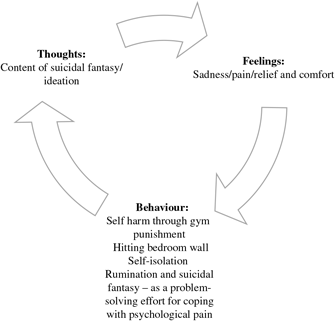
Introduction of a maintenance cycle – firstly, a basic generic CBT maintenance cycle model was introduced before developing a more suicide-specific maintenance cycle (Fig. 1).
Imagery exploration and investigation: to grade the images and identify which image(s) required immediate focus and attention. The hierarchy approach was utilized. Five images were identified (with two given equal subjective units of distress ratings). Hanging was graded highest and thus prioritized in this instance.
Homework: simple thought record to engage Rob as a partner in his treatment and to help him to absorb and own the CBT model, socialize Rob to identify and express writing thoughts, feelings and images to paper.
Combating the behaviour of self-isolation. For example, when going to gym to arrange going with a ‘buddy’. This was advised in an attempt to enhance the secondary gain of limiting self-punitive behaviour at the gym as there would be more opportunities to stop/distract self from maladaptive behaviour, with a friend present.
Make list of adaptive behaviours.
Case conceptualization (Fig. 2) process commenced and recorded by therapist in draft only with the intention of developing/adding/refining throughout therapy. The main objective was to develop a collaborative case conceptualization and be able to give to Rob as therapy progresses.
Suicide-specific maintenance cycle.

Case conceptualization.

Session 2
What is ‘my go-to image’? re: fathers shed
Explored these images as presenting as with:
(a) disturbance/distress and/or
(b) comfort/soothing.
Rob’s father had a work shed adjacent to their home. This old shed was a large concrete structure with a high galvanized ceiling and wooden rafters. Rob had a clear flash-forward image of himself hanging from a rafter directly in from the door. The shed was dusty with wood shavings and had a smell of decay like that of a dead mouse. Rob could hear every sound, bang and creak, imagining himself hanging like a dead weight from the rope. This was Rob’s ‘go-to image’ and rated highest in terms of comfort and sometimes distress. He also imagined hanging from a tree, head hung low. Rob would fantasize and daydream about crashing his car into a wall, drowning or using his grandfather’s shotgun – the latter needing further acute and collaborative safety planning to minimize suicide risk in relation to access to lethal means. The SPI safety plan documented prompt removal of any means such as a gun. This was facilitated by his parent.
Adaptive behaviours were chosen/reviewed and self-monitoring used a weekly activity schedule.
Suicidal images were a chronic ruminative process for Rob at this stage. He would often find himself ‘daydreaming’ about suicide, even when not acutely symptomatic of depression. This pattern was conceptualized as being like that of a ‘trip switch’ brain activity or therapist coined term – the ‘go-to image’ when not coping. It was explained that such images can give a person instant comfort as they are utilizing the brain in a problem-solving capacity therefore hypothesized as providing relief. Simultaneous to the current research base in other areas of imagery rescripting, akin to work in post-traumatic stress disorder and borderline personality disorder (Arntz and Weertman, Reference Arntz and Weertman1999; Giesen-Bloo et al., Reference Giesen-Bloo, van Dyck, Spinhoven, van Tilburg, Dirksen and van Asselt2006), imagery rescripting might be used to produce an alternative flash-forward outcome, e.g. flash-forward to a loved one being part of the image. For example, taking rope down from the shed and imagining what their face looks like looking at you, the suicidal person.
In session 2, the clinician began creatively discussing image reconstruction by requesting to add another person to the image – a bystander (someone of significance or a loved one).
Rationale: CBT, in this instance, is focused on ‘tipping the scales’ towards life and loosening the ‘go-to image’ to make it less soothing – a critical point in therapy. This client used suicidal images to self-soothe as a method of problem-solving psychological pain. He was the only person in the image. It was hypothesized with the client that by bringing a loved one into the image, it aims to make the image more uncomfortable and disturbing, therefore critically less likely to soothe. The complete hypothesis being offered was to offset the suicidal behaviour using a purposeful suicidal imagery intervention, as described, as the key predominant focus in tandem with an explicit documented collaborative suicide intervention plan. At this point, further socialization, acceptance and commitment to the rationale was required and for Rob to buy into the image by adding a loved one. He chose to include his grandmother.
Homework: Write out the image, like a story, from beginning to end (with the person of significance now in it)
– who are they?
– what does their face look like?
– are they upset?
– are they saying anything to you (and so on)?
This exercise was tested in session to prepare for any challenges that may arise from self-loathing statements or assumptions that could surface at home such as ‘they (loved one) would be relieved (if I died)’. In this case, this did not arise.
Session 3
The Jobes (Reference Jobes2006) suicide status form was completed together (Table 2) with a marked reduction in scores.
Session 3 findings utilizing Jobes’ (Reference Jobes2006) Suicide Status Form

Suicidal intent was measured with a change in BDI Q.9 from 3 to 1 (‘I have thoughts of killing myself, but I would not carry them out’).
Homework (from session 2) was completed and explored in depth. Client discomfort was evident in this exploration.
The clinician displayed empathy throughout and slowed the pace of the session to help Rob compete the image. Rob was tearful describing how upset his grandmother would be to find him following suicide. Rob was encouraged for his strength in this task and the lifesaving importance of rescripting of these new images.
Rationale: to reduce comfort associated with problem-solving endorphin release and the de-glamourization of suicide as a problem-solving method to end pain or ‘psychache’.
In collaboration with Rob, the case conceptualization was introduced and refined. A hard copy was also given to him.
Rob was introduced to relaxation and self-soothing techniques to help build adaptive exercises. For example, when going to the gym to notice the function, i.e. relaxation function (adaptive) rather than punishment function (maladaptive), as previous. This helped to gently challenge Rob’s beliefs about self-harm within the maintenance cycle of depression reflecting on the maladaptive behaviours employed when perception of self, others and the world is negatively skewed during relapse. Rob was also helped to develop calm breathing exercises to utilize as needed with psycho-education relating to brain function and ‘amygdala hijack’ theory.
To understand amygdala hijack, a person must have a fundamental understanding of the brain’s neurocircuitry (Goleman, Reference Goleman1995). It was explained to Rob that there are major neural connections between the amygdala and the prefrontal cortex that play important roles in emotional regulation. The basic function of the amygdala is to recognize a potential threat and communicate the potential threat to the prefrontal cortex. The prefrontal cortex evaluates the potential threat and then signals to the amygdala if a fight or flight response is necessary. Therefore, these two important brain structures systematically work together to determine whether a potential threat is really a true threat, and to respond appropriately. However, when the amygdala ‘hijacks’ the system, the prefrontal cortex is incapable of regaining control (Goleman, Reference Goleman1995). It is hypothesized that the consequence of a highly potential suicide act and the imbalanced system that then exists perceives suicide as being the ‘right’ thing to do. Client time to reflect is also provided at this point.
This purposeful matching of exercises to brain function and process particularly appealed to this young man. It appeared to shed new light on mental health management as being more tangible, mechanistic and ‘manly’ in his opinion. This rationale fused easily into his belief system.
Homework: Track suicidal ideation, frequency, intensity and mood rating associated by self-monitoring using an activity schedule for behavioural tasks. Include the planning of chosen adaptive strategies.
Sessions 4 and 5
Rob did not attend CBT once before session 4 and did not attend once between sessions 4 and 5. Homework was completed. He rated his mood 6/10 on subsequent attendance and the BDI measurement scores remained stable, i.e. Q.9 rated at 1 on both session recordings. Stabilization was consistent with findings of reduced frequency and intensity of suicidal ideation. There was clear evidence, even at this early stage, of the ‘go-to image’ destabilizing. The patient did suggest that it made him feel uneasy, at times, when the reconstructed image came to the fore. For Rob, it ultimately deterred risk in completion of suicide or wish to actively engage in suicidal ‘daydreaming’ or fantasy about the violent flash-forward suicide image. The appeal was becoming less and less as the deglamourized image was interrupting his thought pattern. Both sessions focused on the theory and neuropsychological effects of suicidal ideation and potential fatal completion – if images associated are not specifically treated and managed. The suicide status form was also repeated in session 4.
The clinician continued to bring theory back to the problem-solving message/image conceptualization/model and of the impact that suicidal images can have on the habituation process by:
tricking or falsifying a sense of safety to the brain;
misjudging suicide as the right thing to do to problem-solve pain;
creating a feeling of comfort and ‘rightness’ when of chronic persistence.
Using imagery to future plan
Both the therapist and Rob used guided imagery methods to capitalize on earlier occupational desires in pursuing a maritime career post-schooling. He was actively encouraged in treatment to begin applications for training in this area as part of his ‘Life Goals’. Homework involved scribing what it would look like or feel like to be a sailor and visualizing the opportunities it would present in 6 months, 12 months and even 5 years.
Rob did not attend during the period of his final school exams (10-day period) and the therapist requested permission to liaise with his mother at this time; she reported continued stability. Rob did not return to treatment after his exams were completed. He also did not attend routine out-patient appointments with his Consultant Psychiatrist. When assessing and treating suicidal persons, Stanley and Brown (Reference Stanley and Brown2012) state that drop-out of out-patient therapy, as high as 60%, is extremely common and thus appears unrelated to therapist engagement factors. Clinicians are recognizing Emergency Department environments as prime locations for more brief interventions in suicidality to account for significantly high drop-out within this cohort in community settings.
The clinician requested of the mental health team clinical lead, in this case the Consultant Psychiatrist, that Rob be given a grace period to return to CBT during the summer months should his GP or family request this. He had engaged well, although briefly. To date, Rob has not been re-referred to the Adult Mental Health Services since CBT-SP Imagery Intervention was commenced. At the time of writing, this young man’s status is ‘life’.
Reflections and implications for practice
It is important that the clinician validates the client’s trust and courage in engaging in this kind of work as they become a willing participant in imagery destabilization and rescripting. By ultimately making the concept of suicide less soothing and more disturbing, the clinician is aiming to reduce frequency and duration of time spent in this ‘soothing trap’ to offset suicidal behaviour. Largely, trust, rapport and collaboration development are required in the very first session. There were significant engagement issues identified from past engagement efforts where the client left services quite quickly where the focus of treatment was not on suicidal thoughts, the main presenting issue. The client needs to feel that the therapist is willing to treat this as a priority symptom. Principles of empathy, warmth, genuineness, collaboration and being ‘life’ goal focused need to be implicit in all client–therapist interactions from the outset. Also, as Rob had such capacity for imagery, it was a wonderful therapeutic opportunity to use this resource, his imagination, in a more positive way through life planning, not death planning.
Within a trusting therapeutic alliance, it is clear where the client needs require focus – in this case suicidal ideation. Alliance building is achieved through targeted treatment focus and stating this as the purpose of CBT, encouraging the client for their bravery in sharing these private images, reminding the client of therapist/acute services availability at the end of each session, telephone call support post-initial assessment/early in treatment, offering to engage with client’s social system (family, friends, teacher) and normalizing the experience of suicidal images in the context of psychological pain. The client needs to know that the therapist is comfortable with suicidality as a symptom and shows a readiness to candidly talk about it in a way that demonstrates to the client that the therapist is not afraid. Such clients are trusting you with their deepest psychache and plans for death by their own hands. It must also be assumed that the clinician becomes a point of hope when working in this clinically targeted way and even, at times, a mechanistic way. Targeted treatment interventions can require a real depth of professional knowledge, confidence and self-reflection/self-practice, thus professional supervision is required throughout.
This is an under-researched area and requires further development comparing sample populations, e.g. TAU versus CBT-SP Imagery Intervention to further validate theory and model development. There may be an opportunity for a manual led approach <5 sessions, to demonstrate exactly what the sessions would entail, structure of sessions and homework type as illustrated in this single case report. The structure and timing of the treatment is important as fear of intervention specificity may limit clinicians engaging adequately for fear of upsetting the client further or increasing their risk. It is this precise reason that further research is required. All therapy interventions need to be applied in line with an explicit specific SPI (safety plan intervention). It is also important to promote continued engagement in treatment. Future training and research on imagery assessment interventions could also more explicitly address clinician factors that can inhibit or facilitate the use of evidence-based imagery interventions. In applying CBT imagery intervention from flash-forwards theory, further research of this kind may offer new insights into stabilizing the suicidal person to safety.
Limitations
This is one case study report. All suicidal clients need to be individually assessed in order to prioritize what treatment focus is required. Rob was discharged prior to the treatment of a depressive diagnosis due to early drop-out from therapy, once acute suicidality had resolved. The reason for referral was stabilization in suicidality through CBT and this was achieved. However, it would have been wholly therapeutic to engage Rob in Negative Automatic Thoughts, Rules for Living, Assumptions and Core Beliefs which are activated in depression thus in the development of more robust problem-solving and mood management for the future.
As the treatment was specifically focused on acute CBT-SP Imagery Intervention and stabilizing risk to self, there was limited longitudinal formulation exploration due to the nature and purpose of the referral objectives. Early life experience was not prioritized in assessment due to the nature of referral needs. In terms of observable change, the BDI had reduced (mild to sub-moderate rating) with residual thoughts of self-harm with no intent or plan. The therapist had recommended further treatment of depression to include relapse prevention planning, a further scaffolding intervention to protect the client into the future. This client chose to disengage soon after suicidality had resolved, albeit this being the main purpose of treatment referral and intervention. Considering the chronic 3-year history of suicidal ideation and nature of depressive episode, it is likely that this young man may experience a relapse in symptoms of depression. Rob was invited to engage in a follow-up assessment but did not respond to these invitations. Follow-up data collection therefore was not possible. In further case reports of this kind, it would be suitable to include transcripts of the sample voicemail messages enquiring about Rob’s condition/whereabouts and inviting him to return to treatment. These are absent from this report.
Discussion
It is important to acknowledge that this report is of a single case study with no follow-up data achieved. Further research is required using larger samples of depressed adult individuals who have been assessed for the presence of suicidal imagery to empirically establish the range of effect that suicidal imagery has on the cognitive, behavioural, emotional and physiological model. This intervention was structured to get to the heart of the suicidal imagery quite quickly, to intervene and offset the suicidal behaviour.
Imagery intervention, particularly if being employed in a community setting, requires replication within robust adult mental health services having access to 24-hour acute services, when required. Many rural or under-developed services may not have such access to CBT or acute service provision. It is also worth noting the notion of ‘positive risk’ taking, as a phenomenon, needs to be inherent within a suitable service and having access to the available multi-disciplinary and out-of-hours support services. Clinicians need to feel competent in the management of the suicidal person when engaging in imagery intervention. It is envisaged that training and workshop attendance would be required. Anecdotal experience using this imagery intervention, when working on a home-based treatment team, has also yielded very positive findings in risk stabilization using more brief imagery intervention in line with the safety plan intervention schedule. Emergency departments and adult mental health home-based treatment services may be the most suitable positive risk-based service (as an alternative to hospital admission) to train staff in suicidal imagery assessment and interventions, as described in this case report – particularly as engagement with out-patient services is poor for this client group. A manual based approach, utilizing prompt questions/case illustrations, may be of benefit in maintaining integrity to the CBT-SP Imagery Intervention structure outlined in this case report and by increasing confidence in assessment and treatment of suicidal images. This case study illustrates a basic model for future work and development.
Summary
From a treatment perspective, suicide prevention requires the exploration of targeting suicidal images by modifying their meaning (Arntz, Reference Arntz2012). It is exactly this and subsequent behaviour change that the practising clinician/suicide researcher is most interested in. If we understand that goals in life can be image laden and are ever powerful in terms of subsequent behaviour, it is paramount that we understand the clinical significance of this when we intervene with the patient who has a goal towards death or suicide. It is hypothesized that ‘daydreaming’ about goals, whether goals for life or death, considers the same brain activity processes and correlative behaviour and outcomes. Conway et al. (Reference Conway, Meares and Standart2004) supports this view further, stating that imagery is associated with enhanced memory and is important in driving personal goals. From a clinical perspective, the treating clinician is aware that suicidal goals/planning/images are both distressing but often comforting for the client, comforting in that they perceive it as an exercise in problem-solving pain. The clinician suggests this as being the same for an adaptive life goal – some distress or unease about how they will achieve a goal but also great comfort in planning and imagining the intended outcome. Assessment and treatment of suicidal images is essential to the management of the suicidal patient, particularly if there is chronic presentation of depression including a suicidal ruminatory cycle functioning as a method for problem-solving for pain.
This case report has aimed to increase clinician awareness of the presence of ‘flash-forward’ imagery and violent daydreaming in suicidal patients. It has also brought an awareness to practising clinicians that suicidal images can be both soothing and comforting for the patient. It is all too often assumed that the presence of suicidal images are of a distressing nature only. Using suicide-specific assessment, to include imagery as described in this case report, it encourages clinicians to choose more suicide-specific interventions and treatment planning. By engaging front-line clinicians to routinely ask about suicidal images, as part of mental health assessment, it has been shown to be a prime opportunity to assess, treat and support the suicidal patient in a more clinically targeted way and prioritizing imagery intervention as a novel way to offset suicidal behaviour.
Recommendations for clinicians
It is suggested that imagery exploration is essential in clinical assessment and subsequent interventions. Since CBT inception, the earliest work of Aaron Beck recalls imagery as being a fundamental cognitive process that needs attention in assessment and treatment of the depressed patient. If suicide is psychiatry’s medical emergency, focus and attention need to be applied to cognition and brain science research around imagery. Hales (Reference Hales, Deeprose, Goodwin and Holmes2011) highlights the importance of practical identification of images in routine clinical practice and assessment when suicidal clients present to services. Di Simplicio et al. (Reference Di Simplicio, McInerney, Goodwin, Attenburrow and Holmes2012) also suggest that the clinician could ask ‘what images run through your mind when you feel like life is not worth living anymore?’. This specific question may open a vast and clinically significant world of treatment opportunities to the clinician and client. Frontline clinicians, including medical personnel, need to ask about the presence of suicidal imagery to help inform specific timely interventions. The importance of not being afraid to ask this question for fear of what one may hear and by thus asking, shows the suicidal person that one really does understand and can empathize with psychache. By engaging the person in this way, the clinician is showing that they are willing to walk within the suicidal images the person experiences daily in the mind’s eye and plan towards life.
Acknowledgements
The authors wish to acknowledge the local Adult Mental Health Services multidisciplinary team for referring clients to CBT-SP Imagery Intervention and supporting clinical research in suicide prevention.
Financial support
The authors received no financial assistance to assist in the research process/publication of this case report. The HSE and NMPDU (Nursing Midwifery Planning and Development Unit) part-funded CBT training and BABCP workshop attendance to facilitate increased training and expertise in the clinical area of CBT for suicide prevention.
Conflicts of interest
The authors have no conflicts of interest with respect to this publication.
Ethical standards
The authors have abided by the Code of Conduct as set out by the APA. Ethical approval and GDPR advice was sought through the HSE communications division. There was no requirement for ethical approval providing full anonymization of the service and case study personal identification descriptors. The Core Practices, as outlined by COPE, were followed to maintain full integrity to publication ethics.
Key practice points
(1) Increase clinician awareness of the presence of ‘flash forward’ imagery and violent day dreaming in suicidal patients
(2) Educate clinicians that suicidal images can be both soothing/comforting or distressing to the patient
(3) By using suicide specific assessment, to include imagery, it aims to inform suicide specific interventions and treatment planning
(4) Engage front line clinicians to routinely ask about suicidal imagery as part of mental health assessment. Asking about the presence of suicidal images can be a way of showing the suicidal client that you are engaged in treating suicidal behaviour in a clinically specific and targeted way.
(5) Identification of the prioritization of suicidal imagery as the central task in therapy is a novel way to engage the client towards stabilization of risk and life planning.






Comments
No Comments have been published for this article.