1. INTRODUCTION
This article presents both a qualitative and quantitative study investigating the way women and men are depicted in constructed examples from French syntax articles from the 1960s to the present. As our starting point, we take Macaulay and Brice (Reference Macaulay and Brice1997)’s ground breaking study of gender in syntax examples in English, and investigate whether their synchronic and diachronic results can be replicated in a corpus of French linguistics articles. Given that both the linguistic gender systems and the academic cultures differ between France and the US (Sabatier, Reference Sabatier2012), a replication of Macaulay and Brice (Reference Macaulay and Brice1997) on French data would allow us to see to what extent American and French linguistic traditions display similar or different patterns. In France, feminist movements came to the foreground in the 1970s (e.g. Le Mouvement de Libération des Femmes) and the public debate on ‘parité’ (gender quotas in politics and other professional environments) started in the early 1990s (Gaspard, Servan-Screiber, Le Gall, Reference Gaspard, Servan-Schreiber and Le Gall1992) and was codified in 2000. As such, and since we believe that this debate has possibly affected academia, we contrast texts issued before the debate (i.e., the first issues between 1969 to 1971) to texts issued clearly after (i.e., most recent issues, until 2017).
Macaulay and Brice (Reference Macaulay and Brice1997) has been enormously influential, being replicated in many subsequent studies of textbooks and articles in varieties of English (Lee and Collins, Reference Lee and Collins2010; Lewandowski, Reference Lewandowski2014; Lee, Reference Lee2014; Tarrayo, Reference Tarrayo2014; Pabst et al., Reference Pabst2018), and featuring in many discussions of the representation of gender in English (Bergvall, Reference Bergvall1996; Bucholtz, Reference Bucholtz, Finegan and Rickford2004; Eckert and McConnell-Ginet, Reference Eckert and McConnell-Ginet2013; McConnell-Ginet, Reference McConnell-Ginet, Ehrlich, Meyerhoff and Holmes2014; Barrett, Reference Barrett, Zimman, Davis and Raclaw2014, among others); however, although there is research on the representation of gender in French textbooks/language manuals (Rignault and Richert Reference Rignault and Richert1997, Tisserant and Wagner Reference Tisserant and Wagner2008, Sinigaglia-Amadio Reference Sinigaglia-Amadio2010, Baider and Papaioannu Reference Baider and Papaioannou2014, among others), anthropology and sociology articles (Michard and Ribery, Reference Michard and Ribery1982), and grammars (Michard, Reference Michard2001; Abbou, Reference Abbou2018), whether/how gender asymmetries appear in research in French linguistics has not yet been investigated quantitatively. Furthermore, we argue that replicating Macaulay and Brice (Reference Macaulay and Brice1997) on a French corpus of examples is far from trivial given differences in the morphological properties of English and French. In particular, since French is a grammatical gender language (Hockett, Reference Hockett1958; Corbett, Reference Corbett1991), and French grammatical gender does not track social gender as closely as English’s notional gender (McConnell-Ginet, Reference McConnell-Ginet and Corbett2013),Footnote 1 the design of our study has to be slightly different. Consequently, however, our approach will yield new results on the use of masculines as gender neutral or gender mixed and make a new contribution to the debate concerning their use and interpretation in French.
The article is laid out as follows: in section 2, we review the previous work on social gender in constructed examples in English, detailing the classic quantitative and qualitative results of Macaulay and Brice (Reference Macaulay and Brice1997) and more recently Pabst et al. (Reference Pabst2018). In section 3, we present our quantitative studies and show that many of the patterns found by Macaulay and Brice (Reference Macaulay and Brice1997) and Pabst et al. (Reference Pabst2018) for English are also found in our French corpus. Nevertheless, there exist some significant differences between the two languages: in our study, both female and male authors display gender bias, whereas in English, examples from female authors were less biased. We also present quantitative results concerning the use of ‘gender neutral’ masculines and argue that the observed patterns complicate the picture painted by recent results from the psycholinguistic literature on these puzzling linguistic expressions. In section 4, we present a study of the lexical choices in our corpus and compare our results to the lexical components of Macaulay and Brice (Reference Macaulay and Brice1997) and Pabst et al. (Reference Pabst2018). Finally, section 5 concludes with the implications of our research for gender fair guidelines in French linguistics and areas for future work.
2. SOCIAL GENDER IN ENGLISH SYNTAX EXAMPLES
In 1997, Macaulay and Brice published two studies focused on the distribution of s-genderFootnote 2 in constructed examples in English syntactic articles and textbooks. For their first study, they looked at the distribution of female and male gendered noun phrases depending on their grammatical functionsFootnote 3 and thematic rolesFootnote 4 associated with these noun phrases in 1,032 constructed examples in a 1991 syntax textbook.Footnote 5 They also looked at the repartition of gender-specific pronouns – he and she – and the “most commonly used female and male proper names occurred”. They found that references to men were far more frequent than references to women in this corpus (967 male referents (74%) compared to 336 female referents (26%)), and that there exist important asymmetries in s-gender according to grammatical function and thematic roles. For example, they observed that women were much less often subjects than men (8% compared to 49%), i.e. examples like (1a) were much more frequent than examples like (1b) in their corpus. Likewise, they found that examples with male agents (2a) were much more frequent (56%) than examples with female agents (2b) (10%). Women were also more likely to be indirect objects, particularly recipients than men (3) (48% vs 32%). In their second study, they examined ten commonly used syntax textbooks from 1969 to 1994. Two hundred examples have been randomly chosen and analysed according to grammatical functions and thematic roles, although in this study they only looked at subjects and agents, which were the two most significant roles in terms of asymmetry. In eight of the ten books, the same tendency was observed: men were far more often subjects and/or agents than women.
(1)

(2)
(3)


Macaulay and Brice (Reference Macaulay and Brice1997) observed a further asymmetry regarding the thematic role of experiencer: although both women and men were experiencers, they did not experience the same things. Women tended to be related to feelings such as ‘annoy’ or ‘please’, which are usually passive constructions, e.g. (4a), whereas men had cognitive experiences such as ‘consider’, ‘think’, or ‘see’, which are agentive-like constructions, e.g. (4b). Furthermore, men were both more often referred to via proper nouns and pronouns, while noun phrases related to women often referred to their ‘wife’ or ‘motherhood’ status (5ab).
(4)
(5)


In addition to quantitative observations about grammatical functions and theta roles, Macaulay and Brice (Reference Macaulay and Brice1997) gave a qualitative analysis of the lexical choices made by the authors in these examples, particularly how types of verbs, kinship and employment terms relate to gendered discourses (see Cameron, Reference Cameron and Wodak1997; Sunderland, Reference Sunderland2004; Eckert and McConnell-Ginet, Reference Eckert and McConnell-Ginet2013, among others). On one hand, they found that men were more likely to be associated with cleverness and intellectual activities – such as book-reading, ‘being a genius’ – or more prestigious positions than women – doctors, chairmen or detectives. On the other hand, women were very often described in terms of their appearance, for instance how they dress or how they please men. These patterns reproduce discourses supporting gendered stereotypes, for example, stereotypes related to hegemonic masculinity (Connell, Reference Connell1998; Kiesling, Reference Kiesling, Coupland and Jaworski2009), where men are heterosexual, powerful, smart, sometimes violent, strong, drive or fix cars, and stereotypes where women are passive mothers or housewives.
Macaulay and Brice (Reference Macaulay and Brice1997) also found that author gender significantly conditioned their references to women and men: female authors made generally more references to women in their example sentences than male authors, and the content of their examples fed less into gender stereotypes than their male colleagues’ examples.
Twenty-one years later, Pabst et al. (Reference Pabst2018) replicated Macaulay and Brice’s (Reference Macaulay and Brice1997) studies, looking at 200 examples randomly chosen from six syntactic textbooks published in between 2005 and 2017. They showed that the patterns discussed above were still active: men were still more likely to be in a subject position and have agentive roles than women, they were still more often associated with intellectual activities, prestigious positions and violence than women, and still more referred to via names and pronouns than women. Pabst et al. (Reference Pabst2018) also found that author gender had an effect on their lexical choices: female authors used “more ambiguous and inanimate arguments” than male authors (Pabst et al., Reference Pabst2018: 26).
Nevertheless, Pabst et al. (Reference Pabst2018) found some differences. In contrast to the 1997 study, they observed that men were more likely to be in an object position than women, and that women and men were equally likely to experience positive emotions. This being said, women still experienced negative emotions more often than men. Finally, Pabst et al. (Reference Pabst2018) noted a slight change regarding the presence of gender stereotypes: even though men were still violent or related to cars and women still described according to their appearance in 2018, these tendencies seemed to decrease compared to the previous findings.
The following section presents our methodology for coding s-gender in a grammatical language like French and discuss the results of the statistical analyses.
3. QUANTITATIVE STUDY
Inspired by Macaulay and Brice (Reference Macaulay and Brice1997), we undertook a quantitative study of the distribution of references to women and men in the articles from a major French linguistics journal, Langue Française. In order to investigate whether there has been any evolution in this area, we compared articles from two time periods: the earliest articles available (issues from 1969–1971) and the most recent articles (2008–2017). Due to the change in the methodology of the field, where data used in linguistics has become more based on corpora, the number of constructed examples in articles in Langue Française has declined sharply from the 1970s till the present day. Only three issues from 2008–2017 actually had constructed examples, in contrast to all of the issues from 1969–1971. Note that Pabst et al. (Reference Pabst2018)’s study only investigated constructed examples too. Of course, it would also be interesting to study whether the corpus examples selected in more recent papers show the same patterns as we find with constructed examples, but we leave this investigation to future work (Table 1).
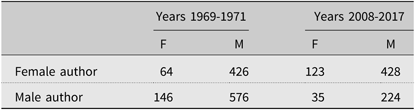
Breakdown of corpus by time period and author gender

We extracted all the constructed examples from these articles and the first author coded each noun phrase for s-gender (if relevant) and a variety of linguistic and social factors. Coded samples of the full dataset were validated by the second author. The whole dataset consisted of 5,564 noun phrases across 2,598 example sentences.
3.1 Coding for social gender in French
Unlike English, French is a grammatical gender language, meaning that both animate and inanimate nouns are sorted according to two g-genders: masculine or feminine. G-gender is observable on dependents of the noun, for example, an adjective that qualifies it or a determiner that precedes it. For example, in (6) the g-gender of nageurs/nageuses can be observed from the adjective forts/fortes, and in (7) the g-gender of different occurrences of journaliste can be observed from the determiner la/le.
(6)
(7)


The exact meaning of the nouns in (6b) and (7b) is the subject of controversy in the literature on French grammatical gender. Many prescriptivist grammars claim that masculine g-gender may have a gender neutral value (Grevisse and Goose, Reference Grevisse and Goose2008; Académie Française, 1984, 2014Footnote 6), meaning that le journaliste or les nageurs may actually refer both to men or/and women.
Le masculin, étant le genre indifférencié, s’emploie aussi sans s’opposer au féminin pour désigner des personnes, ou une personne, en faisant abstraction de leur sexe ou de son sexe ; cela arrive aussi, mais plus rarement pour le féminin.Footnote 7 (Grevisse and Goose, Reference Grevisse and Goose2008: 619)
Furthermore, examples where masculine gender marked noun phrases are used to refer to either specific women (8) or people of both genders (‘gender mixed reference’) (9) are easy to find in current spoken and written discourse. Note that the context of utterance in (9) makes it clear that le coiffeur and l’artisan refer to all hairdressers and craftspersons, as the minister is discussing tax reductions.
(8)
(9)


On the other hand, research in psycholinguistics (such as Chatard et al., Reference Chatard, Guimont and Martinot2005; Brauer and Landry, Reference Brauer and Landry2008; Gygax et al., Reference Gygax, Gabriel, Sarrasin, Oakhill and Garnham2008, Reference Gygax, Gabriel, Lévy, Pool, Grivel and Pedrazzini2012; Garnham et al., Reference Garnham, Gabriel, Sarrasin, Gygax and Oakhill2012; Gabriel and Gygax, Reference Gabriel, Gygax, Giles and Maass2016, among others) has shown that these particular uses of masculine create a socially masculine bias in interpretation; that is, le journaliste and les nageurs are most likely to be interpreted as referring to men. In addition, one could argue that specific uses of masculine singulars (7b) are even more biased towards male references since the specific meaning of the masculine is activated before the generic one. Consequently, when the referent is singular, listeners are even more likely to infer a male s-gender interpretation than when there is more than one referent (6b), where a mixed group inference is possible (Gygax et al., Reference Gygax, Sato, Öttl and Gabriel2019). Nevertheless, examples such as (8) and (9) remain widespread in discourses of different types, and in forthcoming work (Burnett and Richy, Reference Burnett and Richy2019), we show the results of a psycholinguistic experiment which suggests that listeners do interpret masculine marked noun phrases as referring to women under certain conditions. So we cannot exclude that, even with singular masculines in contexts favoring a specific reading, authors had gender neutral or even female reference in mind. Since there is no way to establish the gender of the referent for many masculine marked noun phrases in our corpus, we distinguish between noun phrases that have ambiguous or possibly gender neutral reference and those where g-gender correlates with lexical gender, e.g. le père ‘the father’, in the coding.
Non-human arguments as well as the majority of personal pronouns received a ‘neutral’ code O – ‘other’ – since only third person pronouns correlate with social gender (excluding on ‘we.3SG’). We sometimes coded other personal pronouns as F or M when an adjective – agreeing in gender and number – was qualifying these pronouns like in (10), where the adjective belle ‘pretty’ is a feminine – the masculine being beau –, gives the social gender of this 1SG pronoun. Noun phrases with clearly female referents (like the subjects in (6a) and (7a)) were coded F, and noun phrases with clearly male referents (11) were coded M. Ambiguous masculine noun phrases (such as (6b, 7b, 8, 9), were kept separate and coded AM.
(10)
(11)


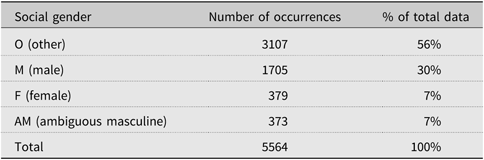
Table 2 gives the distribution of the s-gender of noun phrases in our corpus (percentages have been rounded up). As a first trend, we already see that male noun phrases stand out from female and undifferentiated gender noun phrases, since they embody 30 per cent of the total of NPs used throughout our corpus.
Total of occurrences in our general corpus

3.2 Linguistic and social factors coded
We coded by hand each noun phrase for its syntactic position, its thematic role and whether or not it is a full noun phrase (like a description or a name) or a pronoun. For syntactic position, we coded for three positions: subject, object and oblique, which grouped together indirect objects, noun phrases in adverbial phrases, attributive and vocative uses. For thematic role, we distinguished three categories: agent, experiencer and other, which grouped together roles with few occurrences such as patient, theme, recipient, benefactive, source etc.
For social factors, we also coded for time period (older (1969–1971) vs newer (2008–2017)) and the gender of the article’s authors (male, femaleFootnote 8).
3.3 Study 1: Male/female referents
In our first study, we consider the patterns of s-gender variation looking only at clear cases of socially male (12a) and socially female referents (12b).
(12)

In (12a), l’homme clearly has male referent, since it refers directly to the noun phrase ‘the man’, which specifies male social gender as part of its semantics. On the other hand, un de mes amis could refer to either a male and a female friend, and hence was not counted in our first analysis as being part of clear male referents. We incorporate ambiguous masculines into our results in a second study.
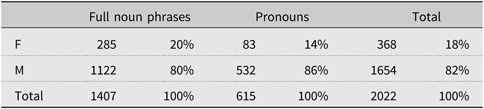
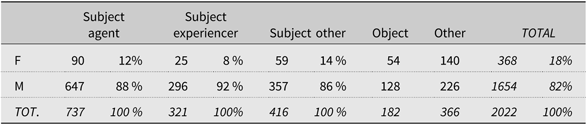
We start by looking at the distribution of clear references to men vs references to women. References to men outnumber references to women across the board: in our sub-corpus, in total 82 per cent of the noun phrases refer to men, and 18 per cent refer to women. Therefore, we expect that they will outnumber women in every syntactic and semantic subcategory. However, we find interesting percentage variations across categories: full noun phrases vs pronouns; subjects vs objects vs obliques; agents vs non-agents vs experiencers. We investigate the statistical significance of these differences in the inferential analysis section (3.3.1). First, we see that, as in the American studies, pronouns were more used to refer to men than to women: as shown in Table 3, only 14 per cent of pronominal referents were female; whereas, 20 per cent of full noun phrases referred to women.
Distribution of full noun phrases vs pronouns according to s-gender

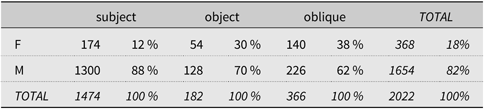
We also find differences in the proportion of references to women and men according to syntactic position and thematic role. As shown in Table 4, references to men are much more likely in subject position than in object or oblique positions; whereas, references to women are more frequent in non-subject positions.
Distribution of syntactic positions according to s-gender

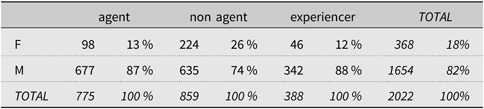
We find similar results for thematic role: as shown in Table 5, male reference is much more likely for agents and experiencers (both 88%); whereas, 26 per cent of noun phrases in other thematic roles refer to women. These asymmetries in terms of uses of male and female referents (overall number of occurrences, syntactic positions, thematic roles) suggest a strong bias towards men. A gender-unbiased pattern would involve an equal distribution of female and male noun phrases across the articles and across the various syntactic and semantic categories discussed in this article (see Malsburg, Poppels and Levy, Reference Malsburg, Poppels and Levy2018 for further discussion on the definition of gender bias).
Distribution of thematic roles according to s-gender

This asymmetry is even more striking if we look at the distribution of these categories for each social gender. For instance, women appear in subject positions 47 per cent of the time while 78 per cent of the overall male references are subject positions. In the same way, men are more often agents and experiencers than women (41% and 21% vs 27% and 12% respectively).
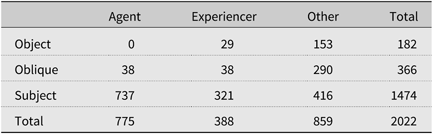
Of course, syntactic position and thematic role are not completely independent in French, with agents being highly likely to appear in subject position. Indeed, if we cross syntactic position and thematic role in our data, we do not find a single agentive object (Table 6).
Total occurrences across grammatical functions and thematic roles

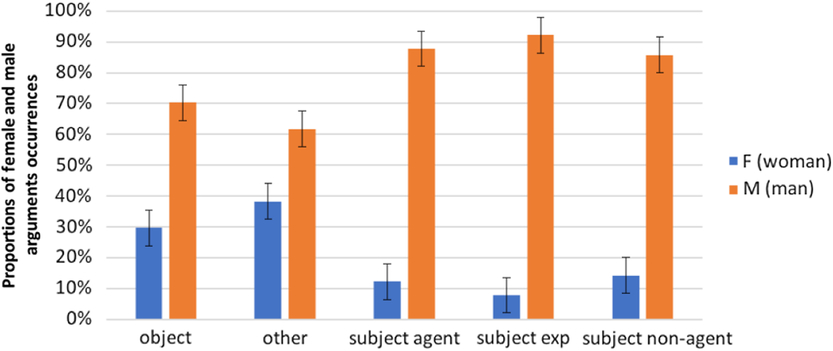
Because of the close relationship between these two factors, in the statistical analysis we combined the two into a single factor, which distinguishes between agentive subjects (13a), experiencer subjects (13b), non-agentive subjects (13c), objects and obliques. The distribution of social gender across these new syntactico-semantic categories is shown in Table 7, Figure 1.
(13)

Distribution of social gender across syntactic and semantic roles

Distribution of syntactico-thematic relations across gender. Recall that the overall percentage is 82% men and 18% women.

Finally, for the social factors: Table 8 shows the distribution of references to men vs women according to the gender and time period of the authors. Unlike in the American studies, we do not find a very big difference according to either author gender or to publication date. Since there are very few occurrences in mixed author papers, we do not include this factor in the statistical analysis.
Distribution of gendered noun phrases according to social factors

With the aim of properly assessing the importance of the different linguistic and social factors, we turn to statistical analysis.
3.3.1 Inferential statistics analysis
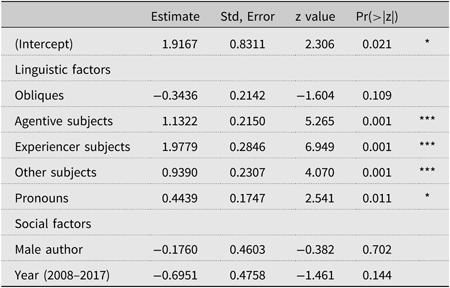
To investigate whether the uses of female and male referents can be predicted by linguistic factors (syntactic positions and thematic roles) and the potential effects of years as well as authors’ gender, we built generalized linear mixed effects models in R using the glmer function in the lme4 package (Bates et al., Reference Bates, Maechler, Bolker and Walker2014) with author (N = 39) as a random effect, the s-gender references as a binary (M vs F) dependent variable and author gender (M vs F), publication date (old vs new), syntactico-thematic role (agentive subject, experiencer subject, non-agentive subject, object and oblique), and noun phrase (full noun phrase vs pronoun) as fixed effects. “Mixed effects modeling, based on maximum likelihood, are now in common use in many areas of science, medicine, and engineering” (Baayen et al., Reference Baayen, Davidson and Bates2008: 391), and they are “a flexible and powerful tool for the analysis of grouped data… includ[ing] longitudinal data, repeated measures, blocked designs and multilevel data” (Johnson, Reference Johnson2009: 364). Since our 5,564 observations are not independent (they come from 46 speakers), author must be included as a random effect in order to avoid overestimating the importance of social factors related to individuals (see Johnson, Reference Johnson2009 for a more detailed discussion of the use of mixed effects models in R in sociolinguistic work). Since we are interested in measuring the effects of all the linguistic and social factors we coded for on the use of s-gender references, we did not add any random slopes.
The results of the statistical analysis are shown in Table 9, where the intercept corresponds to an object full noun phrase written by an older female author.
Fixed effects of the generalized linear mixed model. Intercept: older female author, object positions, full noun phrases

As shown in Table 9, the social factors are not significant: contrary to the American studies, we find no effect of time period or author gender. The linguistic factors, on the other hand, were significant, with all subjects and pronouns significantly favoring male reference. Likewise, all subject positions favored male reference more than objects and obliques, and, although there were no differences between non-subject positions. Furthermore, we conducted a posthoc analysis using agentive subjects in the intercept – we relied on the same methodology as described above – that showed a distinction between subject positions based on thematic role: experiencer subjects are significantly more likely to be male referents than both agentive and other subjects (p < 0.001); whereas, there is no significant difference between agentive and other subjects (p > 0.01).
3.3.2 Discussion
Our results show that women are more likely to be referred to via full noun phrases than pronouns and are less likely to appear in subject position than as non-subjects. These results are in line with the studies on American syntax articles and work in psycholinguistics, such as Formanowicz Roessel, Suitner, and Maass (Reference Formanowicz, Roessel, Suitner and Maass2017), who examined co-occurrences of verbs and different social targets in corpora from various written and spoken genres in Polish and German, and found that men were more likely than women to co-occur with agentic verbs in both languages. Now we must ask: why do we find this pattern?
Unfortunately, there is very little research on the discourse status of constructed syntax examples. One of the key assumptions underlying work in theoretical syntax is that constructed examples exist and are evaluated outside of a particular context and do not commit their author to the endorsement of their content. In his article On policing linguistic content, Postal (Reference Postal2003:182) argues that authors need to create examples that are “short enough to be grasped” since they are only used to “illustrate and/or support certain claims”. For this reason, the content of such examples must not be taken into account. This being said, the pattern observed recalled the one discussed in theories in actual discourse such as Centering Theory (Grosz, Joshi, and Weinstein, Reference Grosz, Joshi and Weinstein1983). Proponents of Centering theory (Brennan, Reference Brennan1995; Marslen-Wilson, Levy, and Tyler, Reference Marslen-Wilson, Levy, Tyler, Jarvella and Klein1982; Gordon, Grosz and Gilliom, Reference Gordon, Grosz and Gilliom1993, among others) have shown that distinctions between categories (pronouns vs noun phrases) and syntactic positions (subject vs non-subject) are significant. The use of different kinds of expressions or syntactic positions to refer to an individual or object can make a difference involving different centers. Subject positions and pronominal expressions are more salient elements within a sentence, and so may be preferred by a speaker to center an expression. Although our corpus is not a genuine discourse, similar patterns seem to emerge: uses of pronouns and subject positions favor men.
In this way, the hypothesis in which only men are usually discourse topics in syntactic examples – both in French and in American English – could offer some hints to explain why subject positions and pronoun uses display a significant male bias. If this is on the right track, it would suggest, contra Postal (Reference Postal2003), that syntactic examples are actually kinds of discourses. However, the full exploration of this counter-intuitive idea is out of the scope of this article.
In summary, our corpus study has shown similarities as well as differences with Macaulay and Brice (Reference Macaulay and Brice1997) and Pabst et al. (Reference Pabst2018)’s findings. Overall, references to women are far less frequent than men across the board, and embody more peripheral grammatical functions that men: more often obliques, less often subjects and less likely to be in an object position. They are also less likely to display an agentive role and to be discourse topics – more often referred to via full noun phrases and being optional arguments. However, we found that in French examples only men were significantly likely to be experiencers. Furthermore, French authors displayed the same socially masculine gender bias regardless of gender, this does not appear to change over the years. It is possible that this difference in terms of patterns of use could be attributable to differences between French and American gender ideologies (see Varikas, Reference Varikas2004; Fassin, Reference Fassin2006; Abbou, Reference Abbou2011, among others). However, we leave this question open to future work.
3.4 Study 2: Ambiguous masculines
The first part of our article gave a direct comparison between gender in English linguistics articles and gender in French linguistics articles. However, since French is a grammatical gender language, it does not encode social gender in the same way. For example, it is easy to use expressions in English that do not make any reference to social gender, such as chairperson (rather than chairman/woman) or police officer (rather than policeman/woman). As discussed above, many French speakers use masculine g-gender (e.g. les policiers) when they intend gender-neutral reference, or even sometimes females (see (8)); however, psycholinguistic research has revealed that this particular masculine g-gender is not as unmarked as prescriptivists claim it is. For example, Brauer and Landry (Reference Brauer and Landry2008) showed in five different experimental studies with both adults and children that the use of ambiguous masculine (14) instead of a gender inclusive expression (15) was more likely to create a socially masculine interpretation.
(14)
(15)


Gygax et al. (Reference Gygax, Gabriel, Sarrasin, Oakhill and Garnham2008) compared the influence of stereotypes and inflection on the representation of s-gender in English, German and French, using role names and explicit gender references. They showed that stereotypes led English speakers to interpret a role name as feminine or masculine – for instance, ‘engineers’ was highly biased towards a masculine interpretation, whereas ‘beauticians’ was highly biased towards a feminine interpretation –, but g-gender affected German and French speakers’ interpretation (i.e., participants always saw male referents when role nouns were presented in the masculine form). In addition, many feminist works (Houdebine-Gravaud, Reference Houdebine-Gravaud1995; Khaznadar, Reference Khaznadar2007; Baider, Khaznadar and Moreau, Reference Baider, Khaznadar and Moreau2007, among others) argue that the use of ambiguous masculines highly contributes to the under-representation of women within our society, because of the bias of this g-gender for a socially masculine interpretation.
Given the well-documented socially masculine bias of grammatically masculine expressions, how should we interpret the social gender of noun phrases in syntactic examples in our corpus such as (16)?
(16)

Since these examples do not have a specific context, we cannot rely on external hints to try and identify the s-gender intended as one may do in natural discourse contexts. However, the psycholinguistic literature on this topic does give us a number of ways to investigate how these masculines should be interpreted. Firstly, as discussed above, noun phrases describing certain role names are associated with male or female stereotypes which influence their s-gender interpretation. In order to measure to what extent our AM noun phrases are likely to be interpreted as socially masculine, we used Misersky et al. (Reference Misersky2014)’s stereotypicity scores. This study aimed to collect norms on s-gender stereotypicality, investigating in a number of languages including French to what extent native speakers would consider specific role nouns as being held by women and/or men. Overall, the gender stereotypicality of our corpus in terms of role nouns, and based on Misersky et al. (Reference Misersky2014), was strongly leaning towards male. More specifically, there was a perceived 68 per cent (MAX = 99%, MIN = 42%) of men in the occupations presented in our corpus. However, this only covers 49 per cent of the total of AM noun phrases (N = 142, total = 290) as they did not all match perfectly with Misersky et al. (Reference Misersky2014)’s tokens.
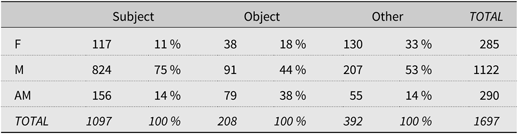
Secondly, if, as psycholinguistic work would suggest, these particular noun phrases truly refer to men, they should follow the same syntactic distributional pattern as male referring noun phrases observed above. In other words, they should be more likely than female referring noun phrases to be in a subject position. Since we only kept ambiguous masculines noun phrases referring to human beings, we limit our second study to masculine, feminine and ambiguous masculine full noun phrases.
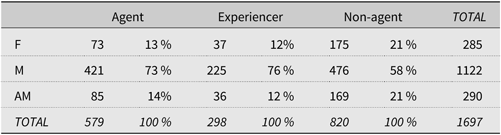
Tables 10 and 11 show the distribution of male, female and AM references in terms of syntactic position and thematic roles.
Distribution of grammatical functions according to social and ambiguous gender

Distribution of thematic roles according to social and ambiguous gender

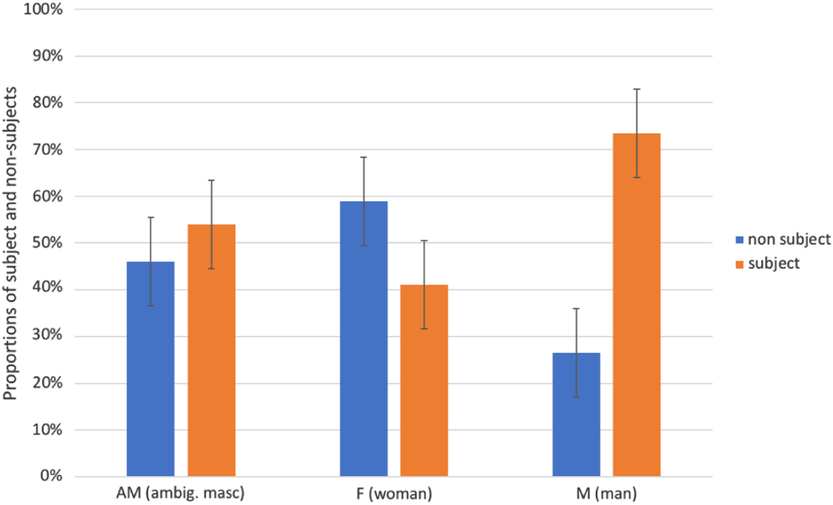
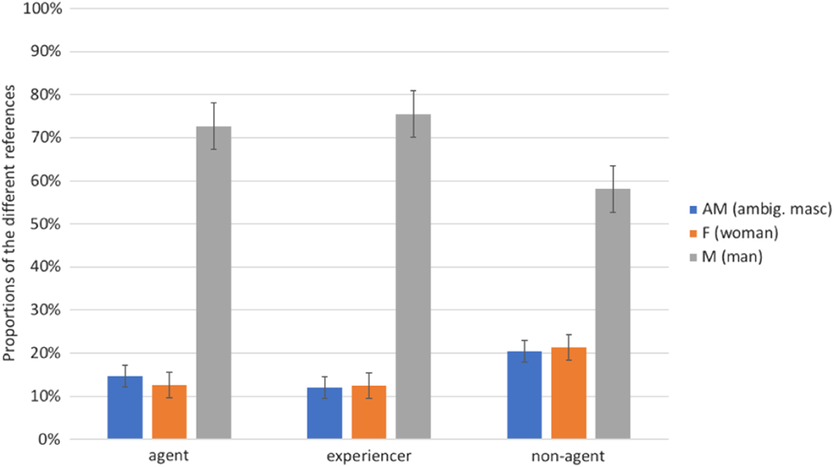
If we look at the distribution of syntactic positions and thematic roles within each gender category, we see that AM are more often subject and agent than women but less often than men (54% and 29% for AM; 41% and 29% for women; 73% and 38% for men, respectively). Furthermore, women are more often non-agent and obliques than AM (61% and 46% for women vs 58% and 19% for AM). Thus, in terms of core positions and roles, ambiguous masculines seem to be favoured compared to women, but not compared to men.
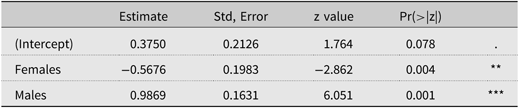
To further probe the grammatical relationship between ambiguous and ‘true’ masculines, we built generalized linear mixed effects models in R (glmer function, lme4 package) with author (N = 41) as random effect, grammatical function (subject vs non-subject) as dependent variable and gender (F, M, AM) as a fixed effect. If AMs show the same reference patterns as Ms, they should be significantly different from Fs in terms of grammatical function, but not necessarily different from Ms. The results of the statistical analysis are shown in Table 12.
Fixed effects of the generalized linear mixed model. Intercept :AM, non-subjects

These results show that, in terms of grammatical functions production, these ambiguous noun phrases are significantly different from male referring ones, while they are significantly less likely to be non-subjects than female referring noun phrases. Figures 2 and 3 also show that AMs are actually not similar to true male referring noun phrases in terms of their syntactic and thematic distribution; therefore, in our corpus, they most likely do not have a male bias intended. However, replicating the study on a bigger corpus (i.e. increasing the statistical power) could then show a male bias, especially since the stereotypes used – and analysed here – for these AM count toward men. With a bigger corpus and more stereotypes matching with Misersky et al. (Reference Misersky2014) study, we could analyse AM separately and investigate whether stereotypes affect syntactic positions used.
Grammatical functions within gendered noun phrases.

Thematic roles across gendered noun phrases.

3.4.1 Discussion
It is striking that, in our corpus, male referring noun phrases actually stand out. Both AM and female arguments are used almost in the same way: even though AMs are more frequently used as subjects than non-subjects, these categories overlap. We see the same pattern regarding thematic roles: only male arguments embody more frequently agentive and experiencer roles than non-agentive ones; that is to say, AMs are not more likely to be experiencers or agents than non-agents. In light of previous research on the interpretation of AMs, these patterns are surprising: in production, AM and socially masculine noun phrases are not alike.
We would like to suggest two (non-exclusive) hypotheses relying on three different approaches to explain this puzzling production/interpretation asymmetry. The first possibility is that this dichotomy between the production and the interpretation of AMs in French is similar to asymmetry to that Kehler and Rhode (Reference Kehler and Rohde2015) found for pronoun interpretation/production depending on implicit causality verbs. Implicit causality (IC) verbs are transitive predicates that create a bias for attributing causality to one of its arguments. Following Stevenson et al. (Reference Stevenson, Crawley and Kleinman1994), Kehler and Rhode (Reference Kehler and Rohde2015) observed that when participants were asked to complete continuations containing a pronoun after a verb like detested (17a), they predominantly interpreted the pronoun as referring to the object, thus, showing that detested is an object-biased IC verb in interpretation (Kehler Rhode, Reference Kehler and Rohde2015: 1064).
(17)

However, when participants were asked to provide their own continuation (17b), they predominantly used pronouns that referred to the subject. In other words, in the same way that les nageurs has a masculine bias in interpretation that disappears in production, a sentence like Amanda detested Brittany shows an object causality bias in interpretation that is not found in production. However, future experimental studies are necessarily to see how close the parallel between IC verbs and grammatical gender should be drawn. A similar pattern with gender in English is found by Boyce et al. (Reference Boyce, von der Malsburg, Poppels, Levy, Pancheva and Iskarous2019) in the asymmetry between noun phrase interpretation and pronoun production. These authors measured on the one hand how likely speakers were to believe that noun phrases refer to women and men depending on the stereotypes (e.g. a manicurist vs a priest), and on the other hand given these gender beliefs, how likely speakers were to use a masculine, feminine or neutral pronoun (‘he/she/they’) in a continuation. They found that ‘he’ was often used, even when participants strongly believed the noun phrase was very likely to refer to a woman, suggesting another case where production and interpretation are not mirror images.
A second hypothesis to explain the observed production/interpretation asymmetry could be related to the specific register that syntactic articles are written in. Gygax et al. (Reference Gygax, Gabriel, Lévy, Pool, Grivel and Pedrazzini2012) studied to what extent French speakers allowed a clearly female denoting noun phrase, like une soeur ‘a sister’, could be a member of a group denoted by an ambiguous masculine, such as les musiciens ‘the musicians’. In the first part of the experiment, no special guidelines were given and participants were much less likely to agree that the referent of a female denoting noun phrase could be a part of the denotation of an ambiguous masculine than the referent of a male denoting noun phrase and, when they did agree, they took much longer to do so with female referents. In the second part of the experiment, Gygax et al. (Reference Gygax, Gabriel, Lévy, Pool, Grivel and Pedrazzini2012) ‘reminded’ participants of the prescriptive grammatical rule that masculines can have a gender neutral interpretation. After these normative instructions, participants had less trouble including women in groups denoted by ambiguous masculines and response times were shorter. Since our corpus is not made up of spontaneous speech, and in fact is constituted of highly formal academic writing, we hypothesize that authors are relying on this prescriptive rule (masculine noun phrases have gender neutral reference) when they construct example sentences like (16).
In addition to analysing syntactic positions and thematic roles, Macaulay and Brice (Reference Macaulay and Brice1997) explored to what extent lexical choices relied on stereotypes. For instance, on the one hand they found that women were often described in terms of appearance or according to the traditional roles of wives and mothers. On the other hand, men were associated to prestigious positions and intellectual activities. The rest of the article briefly examines how gendered discourse is displayed in French constructed examples.
4. A STUDY ON LEXICAL CHOICES
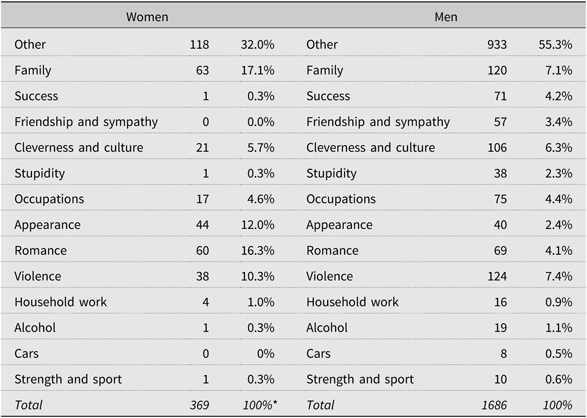
Now that we have observed the male bias in terms of grammatical position and form, we briefly investigate the content of these examples with gendered noun phrases.Footnote 9 Just like in the American articles, female and male referring noun phrases are not related to the same actions or interests and do not have the same jobs. The breakdown of lexical choices in our corpus is shown in Table 13. In what follows, we will comment on a few themes that were also discussed in Macaulay Brice (Reference Macaulay and Brice1997) and Michard and Ribery (Reference Michard and Ribery1982); however see Richy (Reference Richy2018) for a more complete discussion.
Category of predicate

* In rounding up the percentages, the exact total is 100.2, but we chose to keep these rounded up results for a more convenient reading.
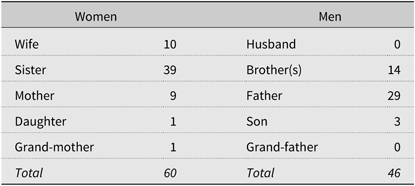
Family.Table 14 shows the role repartition for each social gender, when family roles were explicit. Despite there being far fewer references to women in our corpus, they appear much more frequently in family-oriented examples.
Explicit noun phrases referring to family roles

Success and Occupations. When men are related to family topics, examples also carry another meaning, not fully directed to the family. Instead, fathers, sons and brothers are often related to success, culture or sympathy.
(18)

This type of lexical choice is probably the most significant in terms of asymmetry between women and men. We gathered under this label every example referring to wealth, talent, or when réussir/réussite ‘to succeed/success’ were overtly used. Overall, 71 examples refer to men, whereas only one example refers to a woman (19).
(19)

On top of ungrammaticality, this sentence does not even make Marie the topic. Jean occurs in first position, while Marie is embedded in a sub-clause that gives the reason of Jean’s dissatisfaction.
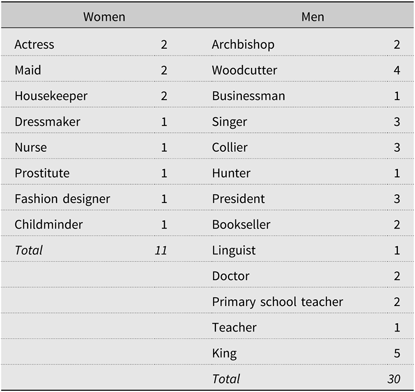
Table 15 gives the details of the occupations described in our corpus, as well as their occurrences. Just like in the American studies, job names are fairly divided according to stereotypical gendered positions. Women do not have powerful positions such as president, doctor or king, and if men are related to manual labour, then it is highly led by ‘manly’ stereotypes of manual labour: woodcutting, hunting, collier.
Occupations and their number of occurrences

Note that singer and collier co-occurred in the same example, ranged in three ways displayed in (20). This means that in total, there are 27 examples using job names for men, not 30.
(20)

Romance. There are 50 examples involving women and 63 involving men in terms of ‘romance’. Most of our examples involve female and male arguments, displaying heterosexual relationships. Furthermore, when we looked at coordination structures gathering female and male noun phrases, we found two occurrences, which displayed heterosexual relationships and values. For both examples (21), the female noun phrase appears in second position, echoing Michard Ribery (Reference Michard and Ribery1982) and Hegarty et al. (Reference Hegarty, Mollin, Foels, Giles and Maass2016) remarks: higher positions in the social hierarchy come first in coordination structures (e.g. doctors and nurses, parents and children, Adam and Eve) and so do men. Eleven examples also might suggest male homosexual relationships, like (22c); however, lesbian relationships are nonexistent in the examined articles.Footnote 10 In other words, women do not exist – in term of relationships – without men, whereas men do exist on their own.
(21)
(22)


Regarding marriage, Marie is either ‘old enough to get married’ (six times) and Léa is getting married with Max twice. There is also an example in which Pierre is against a woman’s marriage.
(23)

On the other hand, men give their consent or disagree with a marriage more often than they actually get married (five occurrences vs one).
(24)

Overall, we have seen that many examples relied on stereotypical gender roles, and these stereotypes are not challenged. Women are often related to family topics and described as wives, sisters or mother while men are successful in their career, wealthy or cultured. In addition, when romance is involved, heterosexual relationships and values prevail, and other sexualities almost never exist.
5. CONCLUSION
In this article, we have presented with a quantitative and a qualitative study on the distribution of women and men in constructed examples in syntax articles in French. Drawing our inspiration from Macaulay and Brice (Reference Macaulay and Brice1997) and Pabst et al. (Reference Pabst2018), we have shown that French linguistics, just like its American counterpart, may display gender biases. Men are far more frequent than female reference across the board – 1,654 occurrences vs 368 –, there is a subject/non-subject asymmetry – men are more likely to be in a subject position – and a significant effect of thematic roles – men are more likely to be agents and experiencers than women –, but there is no effect of author gender nor publication date. We suggested that one way to explain this pattern was to view constructed syntax examples as embedded in discourses in which discourse topics are predominantly males. Men cover 30 per cent of the whole corpus – while women appear only 7 per cent of the time –, and 82 per cent of the female-male corpus. Inasmuch as we also found a significant effect on whether arguments were referred to as a pronoun or a noun phrase – male referents being significantly more likely to be pronouns than females –, we suggested that the pattern would be expected under our hypothesis, since subjects are more likely to be referred to via a pronoun and pronouns are more likely to be discourse topics than full noun phrases. This being said, on the one hand, our analysis raises questions about what kind of discourses we are dealing with. In future work it would be interesting to study syntax examples within discourse analysis and investigate the relations between such register, gender, power and academy. On the other hand, we took all the examples from one linguistic journal, hence investigating others would give us better insights of the patterns described.
Additionally, since French is a grammatical gender language where masculine g-gender is not always interpreted as referring to men, we looked at the behaviour of these particular noun phrases. We compared them to female and clear male arguments in terms of grammatical functions and thematic roles, we found that in production, they were different than true masculines: more likely to be non-subject and less likely to be experiencers. Consequently, in our corpus, men stand out according to any measure: number of occurrences, grammatical functions, thematic roles, discourse topics and even from their own grammatical gender since ambiguous masculines (still referring to human beings) did not display the same patterns as them. Since psycholinguistic research showed that in terms of interpretation, these masculines trigger a socially masculine interpretation, we also hypothesized that there is an asymmetry between what is intended as ‘neutral’ in production and in interpretation. Further investigations on that specific asymmetry seem necessary to understand processes involved in the uses of these particular masculines.
Finally, we qualitatively analysed the content of our corpus according to different categories and stereotypes – especially family, success, employment and romance. We showed that women and men are not related to the same topics, and even when they are – family or romance for instance – authors did not rely on the same lexical choices to refer to women and men, hence reinforcing the male/female dichotomy built by the society we live in. As with Macaulay and Brice (Reference Macaulay and Brice1997), we hope this study will contribute to help readers realize how important stereotypes are within our society, and that, even though they are challenged more and more often nowadays, they strongly remain. Changing the way we construct examples may be a start in changing social gender roles in general. We suggest that following the “Guide pratique pour une communication publique sans stéréotype de sexe” published by le Haut Conseil à l’Égalité entre les femmes et les hommes in 2015Footnote 11 is a good start to break the vicious circle.