Introduction
Since its discovery, Antarctica has become of extensive interest to nations across the world, becoming entrenched in the public imagination as a desolate land of ice, exploration and science (see Leane, Reference Leane2012). Since the establishment of the first Antarctic expedition hut at Cape Adare in 1899 (Borchgrevink, Reference Borchgrevink1900) and the signing of the Antarctic Treaty for scientific cooperation in 1959 (Dudeney & Walton, Reference Dudeney and Walton2012a), nations have continually constructed scientific research bases (stations) on Antarctica to assert their role in Antarctic affairs. As the only significant form of human settlement in the Antarctic, these research bases reflect the cultural values of settler nations through placemaking efforts (see Salazar, Reference Salazar2013), becoming critical sites of cultural display for asserting a territorial, legal and geopolitical claim to the Antarctic space. Antarctica is not just a territorial contest, but a representational struggle – what Dodds (Reference Dodds, Dodds, Hemmings and Roberts2017) calls “a battle of rival geopolitical imaginations” (p. 201) – between nations asserting cultural and symbolic power over the supposedly apolitical Antarctic landscape.
While Antarctic research bases are primarily regarded as ostensibly neutral settlements for geopolitically impartial science, recent sociocultural literature on Antarctic research bases has recognised the symbolic cultural contest surrounding the use of research bases (see Dodds & Hemmings, Reference Dodds and Hemmings2013; Naylor et al., Reference Naylor, Siegert, Dean and Turchetti2008). Antarctic research bases are far from neutral spaces, but are actively implicated in establishing or promoting territorial ownership claims over Antarctica. These research bases are inherently colonial spaces, through which it transforms the Antarctic into a “[cultural] home for its occupants, not only in the sense of domestic settlement, but also, and more powerfully, in the legal and geopolitical sense of territorial possession” (Collis & Stevens, Reference Collis and Stevens2007, p. 249). Antarctica is a colonised space, which is subject to cultural and symbolic influences from elsewhere.
Within colonial landscapes, place names are potent examples of the cultural and symbolic elements given by settler nations to assert a domineering role over particular environments (see Berg & Vuolteenaho, 2009). Place names are emblematic elements of landscapes that reflect the goals of individuals, groups or nations (see Berg & Kearns, Reference Berg and Kearns1996; Cohen & Kliot, Reference Cohen and Kliot1992), functioning as critical geographic tools, which normalise the role of particular settler groups as cultural hegemons (Nash, Reference Nash1999; Wanjiru & Matsubara, Reference Wanjiru and Matsubara2017). Place names act to reinforce ideologies and thereby influence the shaping of social, political and cultural landscapes, being “sensitive indicators of the general link between political process and landscape…, [that are] intrinsically linked with nation building and state formation” (Cohen & Kliot, Reference Cohen and Kliot1992, p. 653).
Place names are inherently value-laden and reflect normative power relations. In postcolonial scholarship, critical toponymic studies have proliferated as subjects of analysis to reveal the inherent power structures involved in labelling colonial places with particular cultural symbols, messages and ideas that recognise the discursive power of particular groups (e.g. Alderman & Inwood, Reference Alderman and Inwood2013; Herman, Reference Herman1999; Kearns & Berg, Reference Kearns and Berg2002). As Antarctica is inherently a colonial space subject to contesting groups, ideas and geopolitical claims (see Berg, Reference Berg2011; Collis & Stevens, Reference Collis and Stevens2007), notions of cultural, and symbolic power are inherent in settling, controlling and altering the Antarctic landscape. As place names act to reproduce these hegemonic and colonial understandings of control (Cohen & Kliot, Reference Cohen and Kliot1992; Kearney & Bradley, Reference Kearney and Bradley2009), Antarctic toponymy, and how it is employed, is part of an ongoing cultural and geopolitical struggle over Antarctic space.
While several papers, manuscripts and books have examined the geological, geographical and geopolitical toponyms of Antarctica (e.g. Debenham, Reference Debenham1942; Dodds, Reference Dodds and Yusoff2005; Hattersley-Smith, Reference Hattersley-Smith1991), no studies have yet examined the particular naming politics, conventions, trends associated with Antarctic research bases. As place names play an influential role in shaping the cultural and colonial values associated with Antarctic research bases, we argue this neglect is problematic. Antarctic research bases are a cultural locus of the Antarctic geopolitical contest, and its toponymic elements deserve further examination for studying polar colonialism and Antarctic’s cultural landscapes at large. Furthermore, while postcolonial scholarship has undergone extensive toponymic analysis on most colonial regions globally, Antarctic research bases have seen no particular examination from this literature. As Antarctic colonisation differs from other sites of colonial settlement due to (1) its lack of indigenous population, (2) its recent and explicitly ongoing approach and (3) its ostensibly neutral scientific nature (Collis & Stevens, Reference Collis and Stevens2007), we argue that Antarctica provides a novel vantage point for which to engage in postcolonial toponymic scholarship.
This paper aims to examine the place names of Antarctic research bases from a cultural-geographic perspective, which reflects on the impositions of cultural, social and political ideologies on ostensibly natural and neutral landscapes. To do this, we employ a critical toponymic and postcolonial lens, which highlights the role of place naming as a form of discursive power within colonial processes of settlement (Rose-Redwood et al., Reference Rose-Redwood, Alderman and Azaryahu2010; Wideman & Masuda, Reference Wideman and Masuda2018). The paper proceeds in five sections. First, we provide a brief overview of the literature on sociocultural Antarctic studies, Antarctic research base names and place names in the Antarctic context. In this overview, we pay particular attention to the work of postcolonial and geopolitical scholars interested in the role of Antarctic bases in promoting and reflecting specific ideas and values. Second, we outline key stages in Antarctic history to contextualise the naming of Antarctic research bases. Third, we outline broad naming trends associated with Antarctic research bases, with particular reference given to the trends associated with different settler countries. These names are indicated on tables that list Antarctic research base names and categorises them by toponymic origin. Fourth, we provide three particular arguments associated with this analysis of Antarctic research base names: (1) Antarctic research base names are often nationalistic and reflect the implicit geopolitical goals of settler nations, (2) Antarctic research base names inherently reflect and reproduce ongoing polar colonialism and (3) contestation over the naming of Antarctic research bases exemplifies wider iconographical and cultural conflict in Antarctic geopolitics. Lastly, we provide brief concluding thoughts on Antarctic research base toponymy and steps future investigations may take.
We note that neither of the authors has travelled to Antarctica, which represents a limitation of our analysis. We, therefore, only aim to provide a cross-cultural interpretation of Antarctica as a cultural environment from our particular positionality as researchers in New Zealand. We do not claim to provide an objective analysis of these naming trends, but aim to be interpretive and generalisable. This paper provides the first scholarly examination of Antarctic research base names and aims to support postcolonial and critical toponymic scholarship and Antarctic sociocultural studies in general.
Naming in the Antarctic
The last few decades have seen increasing interest in Antarctica from those within social sciences and humanities, what Leane (Reference Leane2011) refers to as “the cultural turn within Antarctic studies” (p. 149). Scholarship associated with the sociocultural aspects of the Antarctic has arisen from diverse fields like gender studies (Glasberg, Reference Glasberg2012), cultural history (Heidbrink, Reference Heidbrink2016) and sound art (Philpott & Samartzis, Reference Philpott and Samartzis2017), investigating the discourses, representations, imaginaries and constructions that constitute how humanity makes sense of the polar south. One group of scholars involved in this Antarctic cultural turn are those within cultural geography, several of whom have engaged in investigations into how Antarctica is represented and imagined (see Irving, Reference Irving2011; Kirby et al., Reference Kirby, Stewart and Steel2001; Salazar, Reference Salazar2013). Much of this scholarship is interdisciplinary, examining the imaginaries and representations associated with the Antarctic through artistic, political, sociological and environmental lenses. While postcolonial and geopolitical examinations lead much of this scholarship (see Collis & Stevens, Reference Collis and Stevens2007; Dodds, Reference Dodds2006), a small but significant literature has focused on the construction of Antarctic social and cultural landscapes as the primary unit of analysis (e.g. O’Reilly & Salazar, Reference O’Reilly and Salazar2017; Yussoff, 2007). Despite this foothold, studies of social and cultural landscapes remain limited in an Antarctic context and fall far below the research output of physical scientists working in the region (Leane, Reference Leane2011).
Studies into Antarctic research bases constitute a significant proportion of the sociocultural literature on Antarctica. Within this literature, the majority of these studies have examined Antarctic research bases via a geopolitical lens (e.g. Abdenur & Marcondes Neto, Reference Abdenur and Marcondes Neto2014; Sanchez & Tielemans Jr, Reference Sanchez and Tielemans2015; Turchetti et al., Reference Turchetti, Naylor, Dean and Siegert2008). A small number of studies have examined the sociocultural aspects of Antarctic research bases via the meanings, representations or imaginaries they produce and reflect. Collis and Stevens (Reference Collis and Stevens2007) provide perhaps the most prominent postcolonial examination within this literature, investigating the colonial spatialities associated with Mawson and McMurdo Stations. Collis and Stevens (Reference Collis and Stevens2007) note that polar colonialism is unique and distinct in being purposed through ostensibly apolitical scientific means, creating a contested and complex spatial arrangement of symbolic cultural spaces and geopolitical territorialities. Similarly, Salazar (Reference Salazar2013) provides a valuable examination of Antarctic placemaking, arguing that youth science initiatives at Julio Escudero Station act as powerful displays of soft power and ‘banal geopolitics’ while culturally mediating the relationship between science and the public. These studies are significant as they indicate that Antarctic research bases are cultural landscapes that play influential iconographical and symbolic roles beyond their ostensibly scientific purpose. Antarctic research bases are, inherently, a locus of geopolitical and cultural control in which Antarctic meanings, ideas, values and discourses are produced, altered and displayed.
While the general literature examining critical toponymies is significant and numerous (e.g. Berg & Kearns, Reference Berg and Kearns1996; Berg & Vuolteenaho, 2009; Cohen & Kliot, Reference Cohen and Kliot1992; Rose-Redwood, Reference Rose-Redwood2008), only a small literature has examined place names in an Antarctic context (e.g. Dodds, Reference Dodds2000; Fox & Roberts, Reference Fox and Roberts1996; Hattersley-Smith & Thomson, Reference Hattersley-Smith and Thomson1988). A particular focus of these studies has been on the names of geographical landforms and contestation over mapping and surveying land. Hattersley-Smith and Thomson (Reference Hattersley-Smith and Thomson1988), for example, note that confusion over place names in Antarctica can arise from misidentification, renaming and mistranslation, often arising between Spanish and English-speaking surveying expeditions. Studies of place names in Antarctica have also explored the politics of naming. Dodds & Yussoff (2005), for example, note the challenges in naming features using indigenous Māori naming practices in New Zealand’s Ross Dependency, arguing that adopting Māori names in Antarctica involves a complex arrangement of postcolonial relations and influences.
To date, no studies have explicitly examined the naming of Antarctic research bases, representing a gap in current understandings of the cultural landscapes of Antarctic research bases and Antarctica more generally. If, as Berg and Kearns (Reference Berg and Kearns1996) describe, “naming is to norm” (p. 99), investigating the toponymic origins of these research base names is beneficial to understanding the production of cultural practices, representations and discourses within and by Antarctic research bases.
Key phases of Antarctic settlement
Lasting theorisations of a “Terra Australis” – South Land – by classical and antiquity scholars had been well established before the Age of Discovery (Eisler & Eisler, Reference Eisler and Eisler1995; Simpson-Housley, Reference Simpson-Housley2002). While the discovery of Antarctica had been actively sought out by various exploration parties during the 18th and 19th centuries (see Basberg, Reference Basberg2017), it was only in 1820 that the first confirmed sighting of mainland Antarctica was made by Fabian Gottlieb von Bellingshausen and Mikhail Lazarev of the First Russian Antarctic Expedition (Bulkeley, Reference Bulkeley2016).
While the mid-to-late 1800s saw several explorative expeditions to Antarctica, it was not until the start of the Heroic Age of Antarctic Exploration in the late 19th century where intensive international effort was made to survey, chart and explore the Antarctic continent (see Larsen, 2011). During this period lasting until 1921, 17 major Antarctic expeditions took place to “resolve the outstanding geographical questions still posed in the south” (Murray, 1893, as cited in Crane, Reference Crane2005, p. 75) – to chart and explore the area for economic, political and scientific gain (Basberg, 2006). In 1899, the first Antarctic settlement was developed by the British Antarctic (Southern Cross) Expedition on Ridley Beach at Cape Adare (Borchgrevink, Reference Borchgrevink1900). In 1903, the Scottish National Expedition established Omond House, a meteorological observatory that became the first permanent base in Antarctica and later became the Argentine Orcadas Base. Despite several high-profile expeditions in the 1900s and 1910s, the construction of commercial whaling stations on sub-Antarctic islands, and the use of several temporary bases by exploration parties, no permanent bases were established on Antarctica until the launch of Operation Tabarin by the United Kingdom in 1943, in order to establish claims to parts of Antarctica, in part prompted by conflicting Argentinian claims and a desire to “paint Antarctica pink” (Dudeney & Walton, Reference Dudeney and Walton2012, p. 342). Three British bases on Deception Island, Port Lockroy and Hope Bay were constructed in 1944 and 1945, the latter the first permanent base on mainland Antarctica. Following the end of WWII, Operation Tabarin prompted a mass expansion in base construction by several nations – what Dudeney & Walton (Reference Dudeney and Walton2012) calls a “base race” (p. 356) – with the establishment of Signy (1947), Mawson (1954), Dumont d’Urville (1956), McMurdo (1956), Admunsen-Scott (1956) and Mirny (1956). At this time, base construction was an “integral part of political ambitions to obtain access to such natural resources as might be discovered within Antarctica and its waters” (Dudeney & Walton, Reference Dudeney and Walton2012, p. 356).
Alongside the establishment of research bases were the claiming of Antarctic territory, made by Argentina, Australia, Chile, France, New Zealand, Norway and the United Kingdom on the basis of prior discovery and evidence of effective occupation, “usually in the form of living resource regulation, mapping, surveying, and the construction of bases and camps in national sectors” (Dodds, Reference Dodds2010, p. 108). Political disputes around conflicting territorial claims, the increasing production of scientific bases and international tension surrounding the Cold War saw the signing of the Antarctic Treaty in 1959 by 12 nations with significant political interests in Antarctica at the time: Argentina, Australia, Belgium, Chile, France, Japan, New Zealand, Norway, South Africa, the Soviet Union, the United Kingdom and the USA. The Antarctic Treaty sets aside Antarctica as exclusive to science and promotes international scientific cooperation, but also maintains the original seven territorial claims to Antarctica while not allowing for any additional claims to be made (Dodds, Reference Dodds2010). Entering into force in 1961, the treaty currently has 54 parties.
As the Antarctic Treaty does not give any recognition to place names, individual nations are responsible for naming geographic features through their official naming authorities. The Scientific Committee on Antarctic Research (SCAR) collates these names through the Composite Gazetteer of Antarctica (CGA), a collection of all Antarctic place names submitted by national naming authorities. As of March 2021, the CGA currently consists of 38,885 names, but informally used names may otherwise not appear on this database. Internationally, the United Nations Group of Experts on Geographical Names (UNGEGN) meets to standardise and disseminate the use of particular geographical names in Antarctica. Of particular note is its goal to “adopt single romanisation systems for the conversion of each non-Roman writing system to the Roman alphabet” (UNSD, n.d), which may reflect a Euro-centric view to toponymy.
Antarctic base names
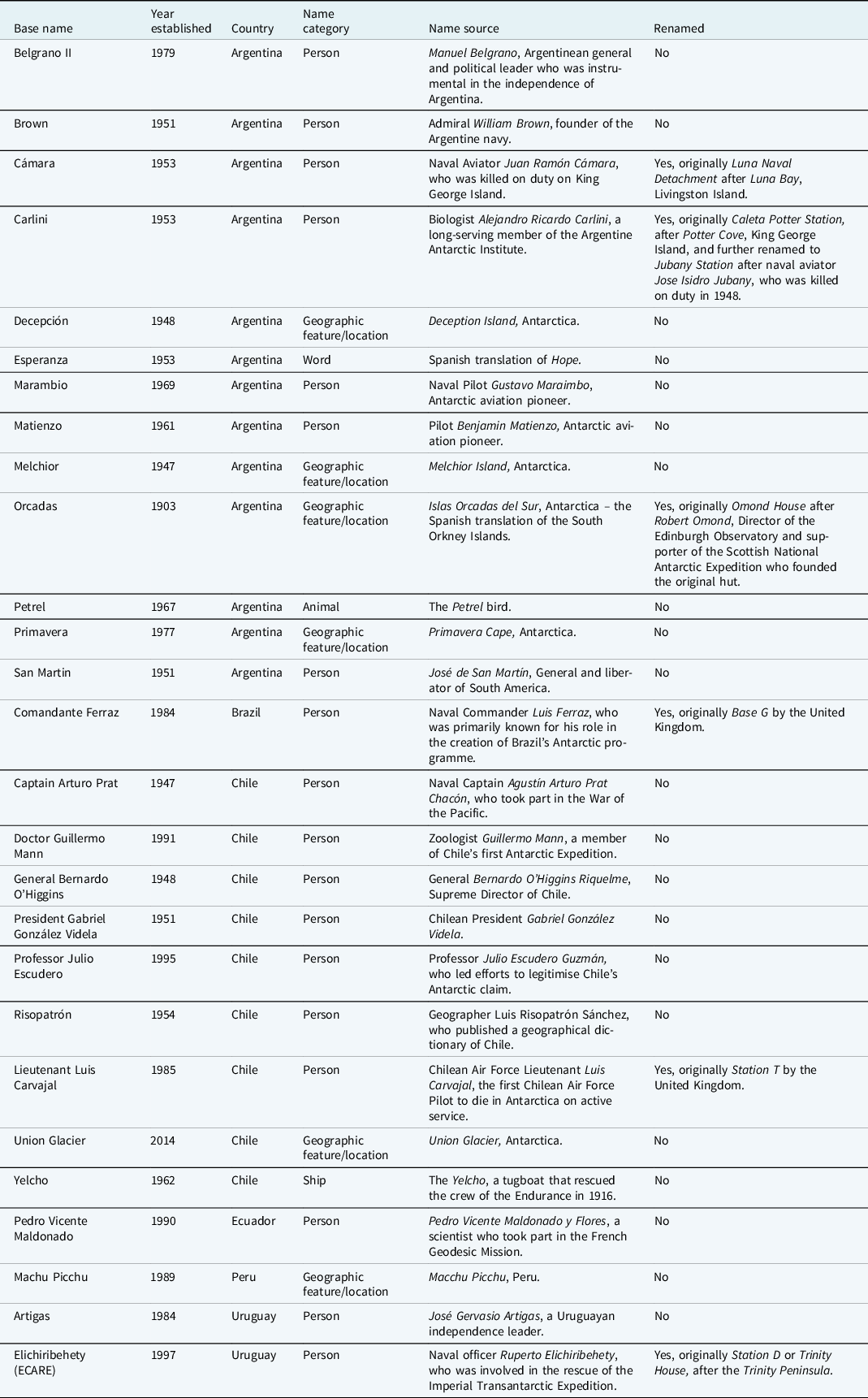
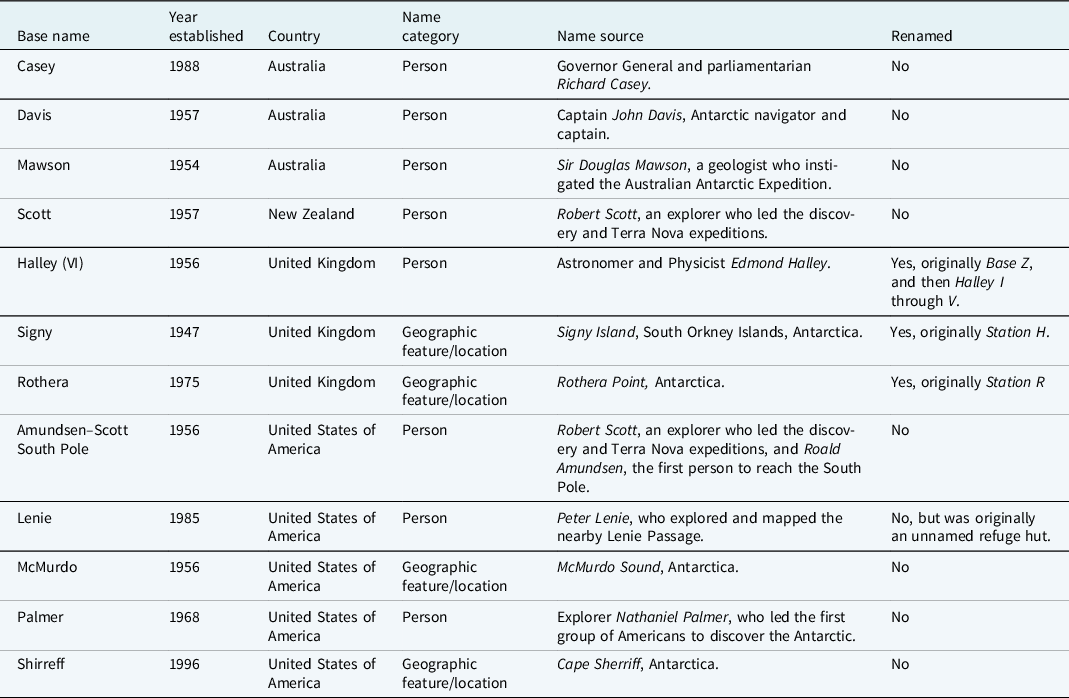
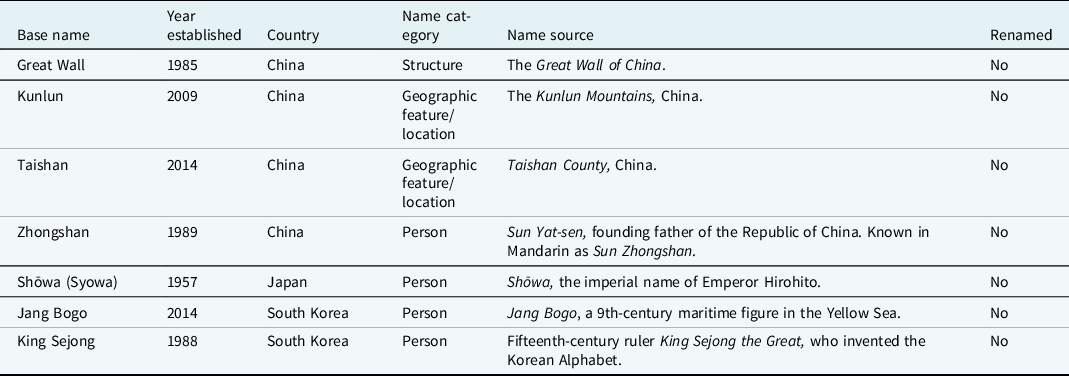
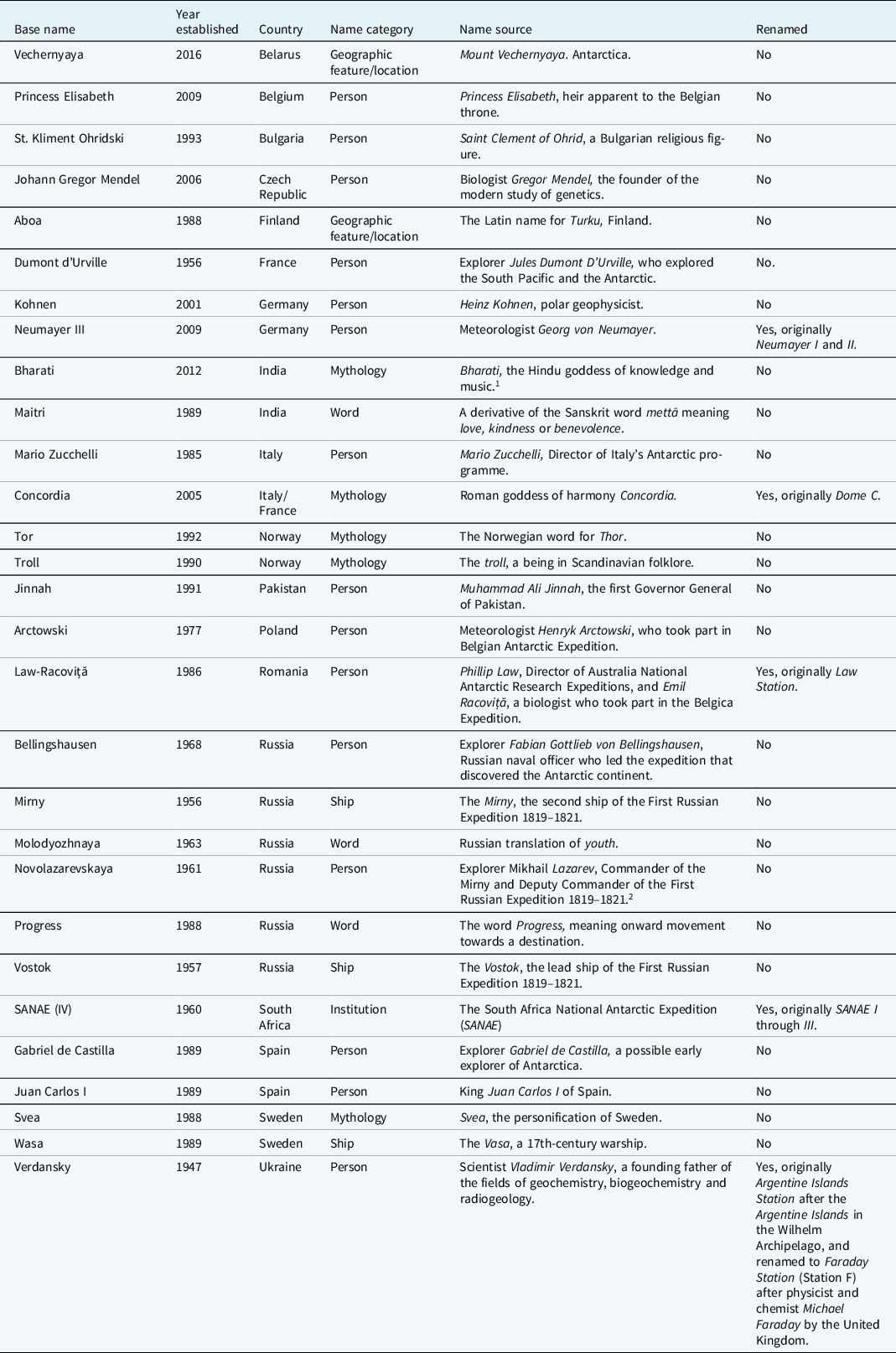
Tables 1, 2, 3 and 4 categorise Antarctic research base names by origin. Tables 1, 2 and 3 categorises the Antarctic research base names of three broad geographical and cultural groups of settler nations – (1) Latin America (2) the Core Anglosphere and (3) East Asia. Table 4 contains Antarctic research base names that are not categorised within these broad geographical groupings.
Names of Antarctic research bases – Latin American nations

Names of Antarctic research bases – Core Anglosphere nations

Names of Antarctic research bases – East Asian nations

Names of Antarctic research bases – uncategorised nations

1 Unclear etymology – researched estimate.
2 Unclear etymology – researched estimate.
These names are categorised by geographic grouping to provide a more in-depth examination of particular geographical and cultural naming conventions associated with different settler nations, examined later in this analysis. We choose these three regions due to the authors’ cultural familiarity, but note that our positionality means our interpretation is one of many possible approaches and other groupings should be examined in greater detail in future studies. While we acknowledge the problems with grouping together broad cultural regions and the heterogeneousness within and between these settler nations, we argue that the relative similarities between particular nations in these cultural groups are beneficial for our analysis. Accordingly, we do not intend on providing a universal examination of Antarctic research base name trends, but to provide a generalisable and interpretive analysis, using these groups as examples of how a toponymic approach may be applied. It is critical to note that an Anglo-centric toponymic orientation is not the only possible form of examination. Any toponymic interpretation employs cultural bias, and we acknowledge our interpretation arises from a western lens using anglicised naming sources. Antarctic toponymy research would benefit from interpretations that acknowledge and critique the Anglo-centric nature of Antarctic toponymy and the role of English in shaping the nature of Antarctica as a colonised space – not just in a cultural sense, but in a linguistic sense as well.
There is no official definition of an Antarctic research base with different sources categorising them differently. We thus begin by defining Antarctic research bases for the purposes of our investigation. We define Antarctic research as “active, permanent, and standalone settlements on the Antarctic continent and nearby islands (within 500 miles) that are claimed to be primarily used for scientific research purposes and are not designated as refuges”. This definition, therefore, excludes research bases on the Subantarctic islands that are not near the Antarctic continent itself. This definition also excludes small research shelters generally associated with larger bases. We recognise the complexities of defining Antarctic research bases and acknowledge the related issues that may arise from defining them as such. However, for this investigation, we argue that this provides a working definition for analysing the names of significant research settlements in the Antarctic. The etymology of two research base names, Novolazarevskaya and Bharati, could not be officially confirmed and as such we have made researched estimates. These sources are labelled with footnotes. Primary sources used to compile this data were collated from the websites of national naming agencies (where possible) and the Science Committee on Antarctic Research (SCAR) Composite Gazetteer.
Analysis of Antarctic base names: key themes and trends
The following section examines Antarctic research base naming conventions, before providing an overview of toponymic trends within the tables associated with this paper. First, the section examines two major categorical trends associated with Antarctic research base names – (1) naming after people and (2) naming after geographic feature/location, before providing an overview of minor naming trends. For this analysis, it is important to note that Antarctic research base names may have been adopted for a number of both implicit and explicit reasons and maybe differently interpreted depending on temporal or spatial context or researcher positionality. Second, the analysis focuses on three broad geographic regions – (1) Latin America, (2) the Core Anglosphere and (3) East Asia as indicative examples of these trends, noting that differences in naming conventions may be geographic in origin. Lastly, this section explores a brief overview of renaming in the Antarctic research base context.
Categorical trends
People
The most prominent naming convention associated with Antarctic research bases is naming after significant individuals associated with settler countries. 45 of the 75 Antarctic bases are named after individuals; an unsurprising find considering this is a trend associated with colonial naming practises of settler nations (see Berg & Vuolteenaho, 2009; Bigon, Reference Bigon2008; Wanjiru & Matsubara, Reference Wanjiru and Matsubara2017). The sources of these research base names are highly varied in terms of their occupation, role or status as a nationalistic figure. Significant national leaders, politicians, national heroes, military figures and scientists and explorers of polar regions are significant toponymic sources for these names, comprising both individuals who were never involved in Antarctica (e.g. Mendel), and individuals who contributed significantly to Antarctic exploration, science or geopolitics (e.g. Mawson).
Naming research bases after people is a nationalistic and symbolic act, working to normalise the role of settlers on the landscape and symbolise the cultural and social power of those able to name (see Berg & Kearns, Reference Berg and Kearns1996; Cohen & Kliot, Reference Cohen and Kliot1992; Herman, Reference Herman1999). Names do not just represent a single person, but a group, community or idea – they are social elements entangled within colonial notions of hegemonic power and cultural control (Nash, Reference Nash1999). In effect, naming bases after significant individuals takes on the symbolic qualities of names on behalf of the settler nation at large and becomes nationalistic through continued use and social inscription on Antarctica’s cultural landscape.
The names of individuals are, in this sense, used as an iconographical tool to which settler values are attached and imprinted on the landscape. As iconographical elements, place names help produce particular cultural readings of the landscapes and cement the role of particular individuals, groups or nations in claiming space (Yoon, Reference Yoon2020). We contend that naming Antarctic research bases after prominent individuals from settler nations is a critical process to which nations position themselves within Antarctic science and geopolitics at large. Not only do research base names highlight particular individuals to celebrate their work, but to claim cultural and symbolic capital that supports their claim to Antarctic space.
Geographic feature/location
The second primary naming source of Antarctic research bases is geographic features and locations, with 14 of the 75 Antarctic research bases being named after these geographic elements. Common naming sources within this category include the names of individual mountains, mountain ranges, sounds, glaciers and islands. While this is again an unsurprising trend, we note that within this category lies a division between bases named after a nearby geographic feature (e.g. McMurdo Station) and bases named after geographic features from the settler country (e.g. Kunlun Station).
While bases named after nearby geographic features may seem toponymically mundane at first glance, we note that these geographic features often have colonial and nationalistic sources themselves. For example, McMurdo Sound, the source for McMurdo Station, is named after Lieutenant McMurdo of the HMS Terror, who took part in the Ross expedition from 1839 to 1943 (Davis, Reference Davis2017). It is, therefore, essential to note that while research bases may often not be explicitly named after nationalistic figures, these names often originate from nationalist sources through intermediary geographic features or locations. While our analysis does not account for these second-order naming sources, it is vital to recognise that these sources are not removed from toponymically nationalistic origin. Even mundane naming sources, like Black Island in the Ross Sea, are nationalistic in their adoption of the English language as a naming source. In the case of Antarctic research bases named after nearby geographic features, we note that these names are still inherently nationalistic, being implicitly or explicitly used to promote particular ideas, languages or concepts taken from the geographical feature’s initial naming source.
A more explicitly nationalistic source of names comes from the adoption of names associated with geographic features in settler countries. China’s Kunlun Station, for example, is named after the Kunlun Mountain Range bordering Tibet, Qinghai and Xinjiang, which in Chinese cosmology is considered to be the backbone and central locus of the world (see Yoon, Reference Yoon2006), while Taishan (meaning The Great Mountain), is one of China’s five sacred mountains. Zhongshan Base (meaning The Central Mountain), is the penname of Sun Yat-sen, who is credited as the founding father of modern China (Republic of China). The Chinese city Zhongshan, also named after Sun Yat-sen, is toponymically significant as traditionally place names are not named after people in China.
Naming after other geographic locations is a common practice within colonial patterns of settlement. To Herman (Reference Herman1999), names transform indigenous geographical discourses to encode western approaches to knowledge, commodification and hegemonic control over territory. Place names “elucidate [changes] in geographic meaning” (p. 76). As Antarctica has no indigenous population, place names do not transform indigenous geographical discourses like traditional forms of colonialism. However, naming after other geographic contexts does act to encode ideas of controlled territory, fusing cultural notions of symbolic power with ostensibly neutral scientific practises and geopolitical land claims. Nations adopt cultural capital from elsewhere to inscribe particular cultural values and discourses on the Antarctic landscapes.
Minor trends
The names of Antarctic research bases also consist of several minor naming trends. First, four Antarctic research bases are named after ships, often ships involved in Antarctic Exploration. The Russian Vostok and Mirny bases, for example, are both named after ships associated with the first Russian Antarctic Expedition (Bulkeley, Reference Bulkeley2016). These names are explicitly nationalistic, and in that they symbolise a significant role in Antarctic exploration and discovery and cements Russia’s role in Antarctic geopolitics. Second, five Antarctic research bases are named after mythological figures. These names are often the personification of the settler country, like Sweden’s Svea base, or are associated with country-specific mythology, like Norway’s Tor or Italy’s Concordia. Third, four research bases are simply named after words. The Russian base Molodyozhnaya, for example, is the Russian word for youth. While the naming source for these bases is not nationalistic, the use of country-specific language is itself nationalistic and helps to ascribe the settler nation’s values and culture on the landscape. The UNGEGN’s aim to “adopt single romanisation systems for the conversion of each non-Roman writing system to the Roman alphabet” (UNSD, n.d) may, however, disrupt the attempts of settler nations whose language is not traditionally or officially in the roman alphabet in asserting linguistic-cultural norms. Lastly, one base is named after institutions, South Africa’s SANAE. While these naming sources are not major categorical trends within Antarctic toponymy, they still represent the inherent nationalism in naming Antarctic research bases.
Examples from geographic regions
Latin America
In Antarctica, Latin American countries (Chile, Argentina, Brazil, Uruguay, Peru and Ecuador) play a significant geopolitical and scientific role (Howkins & Lorenzo, Reference Howkins and Lorenzo2019). Argentina and Chile are the only Latin American nations to maintain territorial claims and between them, 22 of the 27 Latin American host research bases. The Chilean and Argentinian claims consist of much of the Antarctic Peninsula, considerably overlapping with each other and the British Antarctic claim due to conflicting geographical, legal, historical and diplomatic criteria upon their creation (see Naidu Jr., 2008). This overlap has created considerable geopolitical tension between Chile, Argentina and the UK over who controls Antarctic space (see Dodds, Reference Dodds, Dodds, Hemmings and Roberts2017; Dodds & Hemmings, Reference Dodds and Hemmings2013; Salazar, Reference Salazar2013).
Latin American research bases are predominantly named after political leaders, national figures or military officials. This trend includes both figures involved in Antarctica (e.g. Professor Julio Escudero), and figures not involved in Antarctica (e.g. Bernardo O’Higgins). In comparison with other geographical regions, Latin American nations have tended to emphasise naming research bases after independence heroes or military figures. The use of nationalistic names by Chilean and Argentina research bases – naming after political and military figures – serves as a particular political purpose. These nationalistic names symbolically link the settler nation, and its associated values, to Antarctica. In this sense, the names of research bases play an important role in establishing these colonial spaces and strengthen their claim to Antarctic land.
Core Anglosphere
Another major group with Antarctic geopolitics is the USA, UK, Australia and New Zealand, otherwise known as the Core Anglosphere countries (Legrand, Reference Legrand2015). These countries have significant historical roles in Antarctic affairs, have extensive territorial claims, have powerful influence within Antarctic geopolitics and operate some of the largest research bases on the continent (Hemmings, Dodds, & Roberts, 2017). While these nations collectively only operate 11 bases, their influence in Antarctic affairs far outweighs this numerical minority.
Compared with the highly nationalistic political and military names associated with Latin American bases, the names associated with Core Anglosphere bases often use less publicly known scientific figures. Of note is the use of nationalistic figures from other countries in the naming of New Zealand’s Scott Base and the US’ Amundsen–Scott South Pole Station. While these names are not nationalistic in relating to their settler nations, Scott and Amundsen’s names hold significant symbolic and historical qualities that create a powerful claim to Antarctic space. The naming of the US’ Amundsen–Scott Base, for example, is interesting in that neither Robert Scott nor Roald Amundsen was from the USA. In this case, naming after these figures performs a symbolic role that may show cultural and political confidence that US’ claim over the Antarctic place has been asserted without the need for outwardly nationalistic place names.
East Asia
East Asia names in Antarctica are characterised by inward-looking nationalistic terms and do not reflect any connections to Antarctic scientific research or cultural influences from outside East Asia. China’s Antarctic bases are named after two mountain ranges (Kunlun and Taishan), the Great Wall of China (the symbolic “icon” of China), and Sun Yat-sen, whose names literally mean “the central mountain”. The Japanese Antarctic Base Shōwa is named after the imperial name of Emperor Hirohito, who reigned over Japan between 1926 and 1989. Korea’s two bases are named after King Sejong, a revered Korean hero who invented the Korean Alphabet in 1443, and Jang Bogo (797–846), a sailor known to have controlled trade routes between China, Japan and Korea. All three countries have nationalistic names promoting the image of their national heritages or their countries’ images. Unlike other Antarctic base names, the names of East Asia’s research bases do not show association with Antarctic geography or history, and entirely adopt names from other geographic locales.
Renaming
Antarctic research stations have often been renamed, arising from often temporary patterns of Antarctic settlement and the transfer of station control from nation to nation. Most of these processes of renaming have occurred through the transfer of United Kingdom bases to other nations and reflect the considerable presence of Britain in early Antarctic settlement (see Dodds, Reference Dodds2008). Critical toponymy studies have made considerable attention to processes of renaming (e.g. Alderman, Reference Alderman2002; Berg & Vuolteenaho, 2009; Cohen & Kliot, Reference Cohen and Kliot1992; Gnatiuk, Reference Gnatiuk2018; Marin, Reference Marin2012), and in how renaming “discursively demarcates borders between a selected past and a desired future, thereby producing – or destroying – meaningful referentials for self-identification in the present” (Gnatiuk, Reference Gnatiuk2018, pg. 192). While the renaming of Antarctic research bases probably arises from a desire to remove the systematic naming pattern of former British settlements to employ the official language of the settler nation, or to engage in processes of Antarctic placemaking to achieve political legitimation (Yeoh, Reference Yeoh1996), the renaming of these bases speaks to a temporal demarcation of Antarctic control and the probable and implicit desire of nations to remove reminders of previous activity. While this study cannot speak to explicit reasons for renaming, we acknowledge that a focus on the processes of place renaming, as Giraut & Houssay-Holzschuch (Reference Giraut and Houssay-Holzschuch2016) have called for, would be of considerable benefit to studies investigating the symbolic, iconographical and power-laden components of Antarctic toponymy more generally.
Discussion
The following section examines three arguments that we believe capture the implicit symbolic work that Antarctic research bases names perform. Names are not neutral, but perform an iconographical role that promotes particular cultural values (see Cohen & Kliot, Reference Cohen and Kliot1992). Antarctic research base names are cultural symbols that define colonial space, normalise the role of nations in Antarctica and make place (Berg & Vuolteenaho, 2009; Salazar, Reference Salazar2013) – they are part of the rich tapestry of sociocultural elements that construct, alter and reproduce normative ideas of humanity’s role in the polar south. While Antarctica is an ostensibly neutral scientific landscape, it is in fact a deeply contested cultural arena, where names act to signify and cement particular ideas over who should play a part in Antarctic affairs.
We begin by arguing that Antarctic research base names perform a nationalistic role in which symbolically promotes the values of settler nations. Second, we argue that Antarctic research base names help produce and define colonial spaces through supposedly apolitical scientific means. Lastly, we argue that Antarctic research base names are representative of broader iconographical and cultural conflict amongst Antarctic nations.
Antarctic research base names perform a nationalistic and symbolic role
Place names are often sites of nationalism where the symbolic values of settler nations are imposed on a landscape (see Berg & Kearns, Reference Berg and Kearns1996; Herman, Reference Herman1999). To Barrington (Reference Barrington1997), nationalism is defined as “the pursuit – through argument or other activity – of a set of rights for the self-defined members of the nation, including at a minimum, territorial autonomy and sovereignty” (p. 714). While nationalism is highly variable and can manifest along with civic, ethnic, linguistic or religious ties (amongst others), we pay particular attention to civic nationalism and the related influence of nation states on Antarctica (Ignatieff, Reference Ignatieff1993, pg. 5–9). To this definition, place names are inherently nationalistic elements – they delineate formal and informal spaces of civic control. In their study of Israeli place names, Cohen & Kliot (Reference Cohen and Kliot1992) note that the selection of place names in occupied Palestinian territories acts as a powerful tool in reinforcing Zionist ideology. The selection of place names which reflect Zionist settlement values, military heroes, or the interaction of Jewish people with land, Cohen & Kliot (Reference Cohen and Kliot1992) argue, highlights Zionist hegemony over contested geographic space. Antarctic research base names, while not implicated in an explicit conflict between particular groups, nevertheless act using this same process. Antarctic research base names are actively nationalistic in that they adopt the names of famous people, mythological beings, ships or geographic features associated with the settler country. These names are active representations of a cultural group, which in postcolonial scholarship, act as pioneering tools that promote the illusion of a nation deeply rooted in a land (Cohen & Kliot, Reference Cohen and Kliot1992; Gat, Reference Gat2012). While Antarctic settler nations are not deeply rooted in the Antarctic landscapes when temporally compared to other colonial landscapes, the use of particular names acts to symbolise the role of nations in Antarctic affairs by linking the cultural values of other landscapes to Antarctic space.
The establishment of nationalistic values in a space with no indigenous inhabitants acts not to recontextualise space from another cultural group, but to influence territorial, symbolic and cultural ideas of what nations control what spaces. Nationalistic place names act as iconographical constructs that fuse values associated with the settler nation with Antarctic space and symbolically claim a new environment (Wanjiru & Matsubara, Reference Wanjiru and Matsubara2017; Worby, Reference Worby1994). The use of nationalistic place names strengthens and quickens this process by making it abundantly clear who owns the space, the importance of said space and what values are attached to it (Cohen & Kliot, Reference Cohen and Kliot1992). In effect, nationalistic names act as a cognitive shorthand that quickly identifies a settler nation’s role within the landscape. While the toponymic origins of these names often differ, they are nearly always nationalistic in scope. Antarctic research base names act as iconographical displays of cultural power, promoting specific cultural values, relations and imaginaries that settler nations want to display.
Take, for example, Russia’s Bellingshausen Station. Bellingshausen Station is named after Fabian Gottlieb von Bellingshausen, a Russian explorer and naval officer who led the First Russian Antarctic Expedition that discovered Antarctica in 1820 (Armstrong, Reference Armstrong1971). The use of Bellingshausen’s name symbolises Russia’s historical role as a central nation in Antarctic affairs through its attachment to the early exploration of the continent. While Russia does not have an explicitly proximal role in Antarctica, this historic and nationalistic name supports Russia’s position as a critical nation in modern Antarctic affairs through symbolism. The name Bellingshausen acts as an iconographical element that links different times and spaces and creates, alters and reproduces normative ideas over Russia’s major role in Antarctica. The name acts to promote an image of a nation rooted in the Antarctic landscape. While place names are only minor constructs in broader patterns of the cultural, symbolic and iconographical contest over Antarctica, they nevertheless play a role in which cultural power between Antarctic nations is asserted, displayed, constructed.
Antarctic research base names produce and reflect polar colonialism
Antarctic research base names play an influential role in the polar colonialism. To Collis & Stevens (Reference Collis and Stevens2007), Antarctic research bases act as colonial settlements through (1) articulating the aspirations of settler nations, (2) rendering the Antarctic land as familiar and (3) transforming land into a legal and geopolitically claimed space. Collins & Stevens (2007) offer an extensive analysis of how Antarctic colonialism involves a contingent combination of the built environment, symbolic spaces and territorial claims. Polar colonialism is not just a complex geopolitical arrangement of settled spaces, but a deeply cultural and contested idea in which Antarctica has, and continues to be, transformed into a landscape for, and by, humanity. Cultural values, symbols, iconography and placemaking efforts all play powerful and extensive roles in remaking Antarctica into a landscape befitting of human occupation. Nevertheless, this cultural remaking is a deeply uneven process, influenced by differences in cultural and symbolic power between particular nations. This paper supports the ideas of polar colonialism represented by Collis & Stevens (Reference Collis and Stevens2007) and argues that place names represent this ongoing cultural and symbolic moulding of Antarctica through placemaking efforts. While the Antarctic Treaty asserts that no territorial claims may be placed beyond the original claimants, we argue that toponymy has soft informal power that implies a sense of cultural hegemony, regardless of the legal and geopolitically formal agency implied by the Antarctic Treaty.
Colonialism does not only occur purely through material changes to a landscape but through the broad contextualisation of cultural environments to support the narratives of settler groups (see Dirks, Reference Dirks1992; Veracini, Reference Veracini2010). The naming of Antarctic research bases is one of the ways through which this recontextualisation of space as a colonial landscape occurs. Throughout colonial periods, settler names become normalised and indigenous names marginalised through the ongoing use of said names by settlers and outside groups (Berg & Kearns, 1992; Cohen & Kliot, Reference Cohen and Kliot1992). While Antarctica lacks an indigenous population, the use of research base names by other nations is particularly crucial to establishing these colonial spaces. When nations use the names of research bases, they restate and recontextualise cultural power over space. Ongoing use of these names cements the hegemonic control of particular nations over particular landscapes within Antarctica through strengthening normative ideas of what has been, and always been, in the Antarctic landscape.
Take, for example, New Zealand’s Scott Base. While Robert Falcon Scott is not of New Zealand nationality, ongoing use of the Scott name in the naming of Scott Base further strengthens the links between New Zealand, the Antarctic landscape and Scott himself. Use of the Scott Base name, over time, strengthens the bond between a landscape and human settlement, becoming almost as if the base has always been there. In this sense, names are one component of how cultural constructs and processes can aid colonial projects. In polar colonialism, cultural elements have a particularly prominent role in asserting the control of nations over Antarctic land.
Antarctic research base names reflect broader iconographical conflict in Antarctica
Place names are subject to contestation and politicisation. Within geopolitically contentious spaces, place names can produce conflict between groups seeking to symbolically claim particular landscapes (see Helander, Reference Helander, Puzey and Kostanski2016; Puzey, Reference Puzey, Puzey and Kostanski2016). Yoon (Reference Yoon2020) employs the term “iconographical landscape warfare” to describe this symbolic conflict, arguing that conflict between groups can result from different understandings or “readings” of an iconographical site. These readings are inherently liked to particular power structures, and in colonial spaces, iconographical landscape warfare often sees normative settler ideas, values and readings of a landscape challenged by (often indigenous) textual communities. Yoon (Reference Yoon2020), for example, argues that multiple contesting readings surround New Zealand’s One Tree Hill, with an indigenous textual community (arguing an introduced Pine tree symbolises the colonisation of indigenous people) contesting the normative ideas of the Pine as an Auckland icon.
In an Antarctic context, iconographical landscape warfare is a valuable idea for examining the cultural contestation surrounding Antarctica as a sociocultural landscape. Antarctic research base names perform a central iconographical role. Compared with smaller sites of iconographical landscape warfare, such as a hill site, a statue or a building (Yoon, Reference Yoon2020), we note that Antarctica is itself a landscape of which iconographical conflict occurs on a much larger scale. Conflict over particular iconographical understandings of large-scale colonial regions between indigenous peoples and settler peoples, for example, is commonplace and has proliferated particularly in postcolonial and indigenous scholarship (e.g. Ashcroft, Reference Ashcroft and O’Reilly2010; Landau & Kaspin, 2002). Antarctic research base names are inherently placemaking tools (Salazar, Reference Salazar2013), which produce contestable ideas over who the major players are in Antarctica and produce different iconographical readings over Antarctic space. The use of the Amundsen–Scott named by the USA, for example, symbolically claims the historical ties of their original British and Norwegian origin and remakes its iconographical qualities to support the US’ role as a significant Antarctic nation.
While Antarctica is a cultural arena primarily characterised by geopolitical and territorial contestation, this paper argues that contestation often arises through cultural, symbolic and iconographical means. Cultural influences, discourses, perceptions and values underscore the representation of a nation in Antarctic affairs and are thus essential constructs to overall Antarctic geopolitics and conflict over territory. As past history has played a significant role in claiming Antarctic space during the initial claims of the 1950s (Dudeney & Walton, Reference Dudeney and Walton2012), place names may become incorporated into these cultural ties and therefore become integral to an explicit territorial claim. As names act as iconographical sites in which culture contestation occurs, Antarctic research base names represent a complex array of settlements each asserting to influence and contest Antarctica cultural space. Names act as linguistic “flags” that highlight the cultural power of particular nations over Antarctic space, which is differentially employed depending on the name and how it is used. We note not that individual base names are contested, but that the Antarctic is itself a contested landscape in which research base names promote the role of particular nations within Antarctic affairs.
Conclusion
This paper has examined the names of Antarctic research bases by categorising and interpreting their naming sources through a critical toponymic lens. We indicate that Antarctic research bases are primarily named after prominent individuals from settler countries or geographic features/locations. These place names are highly nationalistic, and act to promote the role of settler nations in Antarctic affairs by reproducing the cultural values associated with particular names within the Antarctic context. We provide three arguments that we believe captures the implicit work that Antarctic research bases perform: (1) Antarctic research base names perform a nationalistic and symbolic role, (2) Antarctic research base names inherently reflect and reproduce ongoing polar colonialism and (3) contestation over the naming of Antarctic research bases exemplifies broader iconographical and cultural conflict between Antarctic nations.
Our analysis indicates that Antarctic place names are an important yet underexamined element of Antarctic iconography, symbolism and political contestation. As Antarctica is emblematic of cultural power, contestation and placemaking efforts, investigating the toponymic elements of Antarctica and how they construct, alter and reproduce these cultural relations is a valuable way of understanding Antarctica as a cultural landscape. While Antarctic research base names have variable origins, they share symbolic and nationalistic qualities that help to construct normative ideas of who should, and does, play a role in Antarctic affairs. Moreover, Antarctic research base names are cultural elements that produce and reflect the cultural aspects of ongoing human settlement in the Antarctic, thereby representing and reproducing polar colonialism in iconographical form. These ideas underlie the valuableness of toponymy studies in postcolonial scholarship and the “cultural turn” within Antarctic studies more generally (Leane, Reference Leane2011). Place names have transformative cultural power – they act to normalise the role of individuals, groups or nations in particular environmental spaces. In Antarctica, place names have acted to inscribe particular symbolic and iconographical values through settlement, thereby constructing and reproducing the continent as a cultural landscape. Place names act to make the Antarctic a human landscape. To what cultural values this landscape takes, however, is a point contested between Antarctic nations seeking to shape the cultural imaginary of Antarctic through ostensibly neutral scientific means.
While research base names play a role in recontextualising Antarctic cultural space, this contextualisation is not geographically even. Toponyms have variable iconographical and symbolic power and are differentially employed by settler nations depending on their influence in Antarctic geopolitics and the Antarctic cultural psyche at large. It is essential to note that the use of toponyms may be more important or useful to some nations over others. The naming patterns of these research bases, therefore, reflect territorial claims and the desire of particular nations to “claim” a landscape. Place names are symbolic and constitutive of geopolitical contestation, being intrinsically tied with producing different cultural readings of Antarctic space. Contestation between where these research bases are located, their size, their infrastructural capabilities and the research they complete are all aspects of building Antarctic influence and establishing a role in the region. Future studies into how Antarctica is culturally contested may provide a greater understanding of Antarctica as a cultural environment.
Critical toponymic scholarship allows for a more significant examination of how polar colonialism operates through cultural, symbolic and iconographical means. Throughout history, names have been used to reinterpret cultural spaces to promote the ideals of settler groups and to marginalise indigenous communities (see Berg & Kearns, 2002; Herman, Reference Herman1999). Within Antarctic studies, the cultural and iconographical aspects of polar colonialism have been underexamined and compared with geopolitical contestation between settler nations. This paper points out that cultural influences, meanings, discourses and ideas have a significant role in establishing influence and control over Antarctic space. How Antarctica is read as a cultural landscape is effectively a geopolitical argument, intrinsically tied within territorial, historical and scientific understandings. Non-material processes have an important role in contextualising the production of colonial and geopolitically contestable spaces. Further examinations into the cultural aspects of polar colonialism may allow for a greater understanding of the multifaceted ways through which polar colonialism operates.
We argue that Antarctic scholarship provides a novel vantage point in which to engage in postcolonial and critical toponymic scholarship. Antarctic is a vastly different cultural landscape than other colonial sites, and we believe that further examinations of Antarctica as a contested sociopolitical region would be beneficial to showcase Antarctic geopolitical issues more broadly. Possible toponymic strands of research could include in-depth case studies of research base names, a focus on toponyms in conflicting territorial claims, investigations into the explicit and implicit reasons for naming and comparisons of Antarctica and other continental-scale settings of colonialism. One strand of possible analysis we want to highlight is a temporal analysis of Antarctic toponymy, focusing on how the use of place names has changed according to broader sociocultural and political changes to our world.
Acknowledgements
The authors are grateful to Christopher Stephens for his valuable help in finding source information, and the two anonymous reviewers for providing constructive feedback.
Financial support
This research received no specific grant from any funding agency, commercial or not-for-profit sectors.
Conflict of interest
The authors declare none.