INTRODUCTION
One common problem associated with aphasia secondary to left hemisphere stroke is word retrieval deficits. The source of breakdown leading to word retrieval failure varies across individuals. In semantic dysfunction, both word comprehension and retrieval are impaired, whereas lexical-phonologic retrieval impairment leads to difficulty in word retrieval with intact comprehension abilities (Lambon Ralph et al., 2002; Wilshire & Coslett, 2000). Because of the pervasiveness of word retrieval impairments, many studies have investigated treatments to address these deficits. Some treatment approaches implement semantic and phonologic activities to restore lexical abilities in a manner compatible with the normal process of word retrieval (Nickels, 2001; Raymer, 2005). Other treatments encourage the use of strategies that engage alternative cognitive mechanisms to facilitate word retrieval (Rothi, 1995). One such strategy is the use of gestures during word retrieval training, akin to what Luria (1970) referred to as intersystemic reorganization, in which an intact modality is paired with an impaired one to facilitate improvement of the impaired modality. Arbib (2005) has argued for a close relationship between gesture and language processing, making gesture particularly appropriate for use as a language treatment modality.
Gestures paired with verbal production in treatment have resulted in significant naming improvements in some patients with aphasia (Pashek, 1997, 1998; Raymer & Thompson, 1991; Richards et al., 2002). Earlier studies documented that effects are greatest when gesture and verbal production are combined in training (Hoodin & Thompson, 1983; Conlon & McNeil, 1991), thus the protocol implemented in this investigation incorporated gesture+verbal training (GVT). Rose and colleagues (Rose & Douglas, 2001; Rose et al., 2002) noted that gestural treatment using pantomimes was more effective in individuals with phonologically-based word retrieval impairment than those with semantically-based word retrieval failure. They proposed that the advantage that gestural training provides for patients with phonologic impairments relates to the fact that the kinesic motor system provides activation directly to the phonologic stages of word retrieval, and not to earlier conceptual-semantic stages. A further benefit of GVT is that some patients who do not improve in spoken naming abilities nonetheless increase their use of gestures that can potentially enhance communication. This is an important contribution of GVT because many patients with word retrieval impairments also have considerable limb apraxia that may interfere with the effectiveness of gesture as a communication modality. Whereas GVT investigations typically report outcomes for spoken naming, studies have seldom reported results for gesture production (Raymer & Maher, 2001).
Most studies of GVT for word retrieval have focused on nouns, and only recently have studies examined treatment effects for verbs. Rodriguez et al. (2006), for example, reported positive effects of GV treatment for verb retrieval in one individual with a moderate phonologic retrieval impairment for verbs, in keeping with the findings of Rose et al. (2002). Three other participants with semantic impairments did not improve spoken verb naming abilities, although two demonstrated dramatic increases in use of gestures corresponding to verbs.
Although many patients demonstrate impairments for noun and verb retrieval (Berndt et al., 1997), studies of word retrieval impairments in aphasia have indicated some differences between nouns and verbs. For example, several studies have reported that fluent aphasia and lesions of left inferior temporal cortex result in greater difficulty with noun than verb retrieval, whereas nonfluent aphasia and lesions of left inferior frontal cortex are associated with greater impairments for verbs than nouns (e.g., Caramazza & Hillis, 1991; Damasio & Tranel, 1993; Miceli et al., 1984; Shapiro et al., 2005; Zingeser & Berndt, 1990). These observations suggest that there may be fundamental differences in the neural representation of nouns and verbs.
Additional evidence from functional neuroimaging studies in healthy participants suggests that neural networks activated during noun and verb retrieval are to some extent nonoverlapping (Cappa & Perani, 2003; Kable et al., 2002; Martin et al., 1995; Thompson et al., 2004; Warburton et al., 1996). For example, Shapiro et al. (2006), using a phrase completion task, reported greater activation of left prefrontal regions during verb production and greater activity in left inferior temporal cortex for noun production, in keeping with the observations in patients with aphasia. Other neuroimaging studies (Damasio et al., 2001; Tyler et al., 2001), including one involving a picture naming paradigm (Soros et al., 2003), have reported little difference in the left temporal-parietal to frontal networks engaged during noun and verb tasks, however.
Another consideration is that the anatomic networks important for noun versus verb retrieval in picture naming tasks might have different forms of connectivity. For example, whereas the network important in noun retrieval might be strongly connected to the ventral temporal-occipital “what” system (Ungerleider & Haxby, 1994), the verb retrieval network might be more strongly connected to the more dorsal “how” system (Schwartz et al., 1998) or action knowledge systems (Druks, 2002). Functional neuroimaging studies of Kable and colleagues (Kable et al., 2002; 2005) provide evidence supportive of this contention as conceptual judgments about verbs engaged a more dorsal middle temporal region than judgments about nouns.
We propose that the extent to which neural connectivity and networks important for retrieving nouns and verbs diverge, we might expect that nouns and verbs may respond to word retrieval training in distinct patterns. This possibility was investigated in a study incorporating a restorative semantic-phonologic training protocol in patients with aphasia and impairments of noun and verb retrieval (Raymer et al., in press). Five of eight participants demonstrated improvements following training, all of whom improved for nouns and verbs, contrary to predictions.
What has not yet been examined is how gestural facilitation of word retrieval might diverge for nouns and verbs. Verbs, in particular, seem to have a close association with gestures as both involve processing in the dorsal stream (Fridman et al., 2006). Functional neuroimaging studies in which participants observe different types of gestures have shown greater left inferior frontal and middle temporal activation, regions associated with activation in some verb analyses (Decety et al., 1997; Gallagher & Frith, 2004). Shapiro et al. (2006) proposed that the representation of verbs in the left frontal cortex relates to their association with networks involved in limb movements. This is compatible with observations of Hamzei et al. (2003) who showed activation of left inferior frontal cortex for tasks involving both action recognition and silent verb generation.
The purpose of this investigation is to contrast the effects of gesture+verbal treatment for noun and verb retrieval and gesture production in a single participant multiple baseline design. Based on claims about the neural organization of verbs and gestures, we predicted that GVT might yield a stronger treatment effect for verbs than for nouns. To further evaluate the proposal of Rose et al. (2002) that gestural facilitation effects are greater for individuals with phonologic than semantic word retrieval failures, impairments in all participants were characterized with respect to the source of word retrieval breakdown.
METHODS
Participants
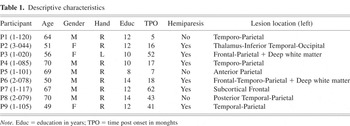
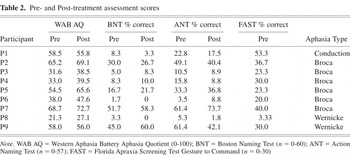
Nine individuals were recruited from a subject pool in a research center studying treatment for aphasia. All provided written informed consent to participate in this study. Participants had aphasia from a left hemisphere stroke that occurred more than four months prior to enrollment, including many who were several years post onset. They had no history of neurological conditions or developmental learning disabilities. In preliminary testing, all participants completed the Western Aphasia Battery (WAB; Kertesz, 1982), the Boston Naming Test (BNT; Kaplan et al., 2001), and the Action Naming Test (ANT; Obler & Albert, 1986). Participants were eligible for this experiment if they demonstrated word retrieval impairments (<75% accuracy) for both nouns and verbs with no more than a moderate accompanying motor speech impairment and intact ability to repeat single words as defined by scores >2.0 on the WAB repetition subtest. Individuals with noun and verb retrieval impairments were assigned randomly to one of two noun/verb treatment experiments. Table 1 reports demographic information and lesion descriptions for all nine participants. Test results displayed in Table 2 indicate that, whereas the participants showed different patterns of aphasia (1 conduc-tion, 2 Wernicke, 6 Broca), all had notable noun and verb retrieval impairments ranging in severity from mild to severe. Impairment was more severe (>10% difference) for nouns than for verbs for four participants, including two with Broca's aphasia (P2, P5), one with conduction aphasia (P1) and one with Wernicke's aphasia (P9). None showed the pattern of verbs worse than nouns as has been reported in other studies for participants with Broca's aphasia (e.g., Damasio & Tranel, 1993). Results of the Florida Apraxia Screening Test-Revised (Rothi et al., 1997), in which participants produced 30 gestures to verbal command with the left hand, indicated that all had mild to moderate limb ideomotor apraxia except P8 who was severely impaired. The fact that P8, a patient with Wernicke's aphasia, was also severely impaired when asked to gesture in response to pictured objects suggests that auditory comprehension difficulties were not the sole cause of his severe impairment on the gesture to command test.
Descriptive characteristics

Pre- and Post-treatment assessment scores

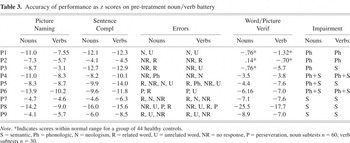
To further characterize word retrieval impairments, participants completed three additional lexical tasks, two word retrieval tasks developed by Zingeser and Berndt (1990), and a third verification task devised in our lab. All tasks incorporated the same 30 verbs and 60 nouns from Zingeser and Berndt (30 nouns matched to the verb base frequency, i.e., run; and 30 nouns matched to the verb cumulative frequency, i.e., run+runs+running). In picture naming, participants retrieved names for black and white line drawings. In sentence completion, the clinician read aloud, as the participant read along, and then the participant was required to retrieve a word to complete the sentence (e.g., The choir began to … sing.). In spoken word/picture yes/no verification, participants were asked to decide whether a given word corresponded to the target picture. In one administration, the word was correct (“yes”), and on another occasion, the word was semantically-related to the target picture (“no”; e.g., picture: singing; “Is this dancing?”). To be scored as correct, the participant had to respond correctly in both “yes” and “no” presentations. Participants were considered impaired on a task if they performed greater than two standard deviations below mean performance in normative data collected from healthy adults aged 40–85 years (Raymer et al., 2004). To facilitate comparisons across tasks that varied in difficulty in the normative sample, z scores were calculated. A semantically based word retrieval impairment was suggested by difficulty across all three tasks, whereas a phonologic retrieval impairment was indicated if there was difficulty on the word retrieval tasks (picture naming and sentence completion) and intact performance on the verification task. A semantic+phonologic impairment was suggested when z scores indicated impairment across tasks with a difference greater than 3.0 in the picture naming and verification tasks, as such differences between tasks represent substantially different portions of the distribution of scores.
Results of the lexical tasks showed an array of impairments across participants (Table 3). Two participants (P1 and P2) had phonologic retrieval impairments for both nouns and verbs. Three participants (P7, P8, P9) had semantically-based retrieval impairments for both nouns and verbs. Two individuals (P4, P6) had mixed semantic+phonologic impairments for nouns and verbs, as they were mildly impaired in the verification task and more severely impaired in the two naming tasks. Finally, mixed patterns of impairment were observed in P3, with phonologic impairment for nouns and semantic impairment for verbs, and P5, with phonologic+semantic impairment for nouns and semantic impairment for verbs.
Accuracy of performance as z scores on pre-treatment noun/verb battery

Treatment Design
The treatment study utilized a single-participant design across behaviors and participants. The gestural+verbal treatment (GVT) protocol consisted of four steps designed to maximize the number of opportunities to correctly produce the spoken words and gestures administered for 20 noun or verb stimuli in each training session: (1) The clinician presented the picture (e.g., verb = peeling; noun = salt shaker) and modeled the target word (e.g., peel, salt) and gesture (e.g., peeling a carrot, shaking the salt); then the participant attempted to produce the target word and gesture three times. (2) The clinician presented the gesture in isolation and the participant imitated the gesture three times. The clinician provided additional hands-on manipulation of the limb to form the correct gesture as necessary. (3) The clinician presented the target word and the participant repeated the word three times. If necessary, the clinician segmented the word for the participant to pronounce the word syllable by syllable. (4) After a five second pause, the clinician prompted the participant to once again show and tell what was happening in the target picture. At that point, the participant was reinforced if correct, or the correct response was modeled if incorrect. Thus, participants attempted each target spoken word and gesture nine times in each training trial.
Participants took part in two 10-session phases of training, one for nouns and one for verbs. Treatment order was randomly assigned across participants. Treatment was provided for nouns in phase 1 and for verbs in phase 2 for P2, P4, P7, and P8. Treatment was provided for verbs in phase 1 and for nouns in phase 2 for P1, P3, P5, P6, and P9. Participants took part in three-to-four 60-minute sessions per week—P2 participated in treatment two days per week. A one-month break took place between treatment phases to reduce influences of phase 1 on phase 2. At one month following completion of treatment phase 2, a maintenance session was completed in five of the nine participants.
A probe task was administered in daily sessions to document training effects. The task required spoken naming and gesture production in response to 80 black and white line drawings representing 40 nouns and 40 verbs that could be associated with a pantomime. These 80 pictures were selected for each individual from an original corpus of 280 pictures representing 150 nouns (e.g., ladle, coffee), and 130 verbs (e.g., sew, drink). Words that the participant was unable to retrieve in at least two of three baseline presentations of the full corpus administered on separate days were selected as stimuli to be included on the daily picture naming and gesture production probe task. The 40 noun and verb picture sets were divided into two sets of 20 items. One set of 20 words was also used in training and the second set was an untrained control set. The word sets were balanced for level of accuracy at baseline, with additional efforts to balance word frequency and syllable length across sets.
The full 80 item probe task (20 trained, 20 untrained nouns and verbs) was administered across 4–9 baseline sessions to assure stable baseline performance. During the treatment phases, each participant completed the picture naming/gesture production probes prior to treatment. Due to slow response times, P3, P5, and P6 completed half (n = 40) of the set per session, such that the full 80 item set was administered every two sessions (5 total administrations in the treatment phase), whereas all other participants completed all 80 items within each session (10 total administrations in the treatment phase). A verbal response that was identifiable as the target word was accepted as correct, allowing for articulatory distortions. Likewise, any gesture that was recognizable as representing the depicted concept, allowing for distortions of limb movements (mild-moderate limb apraxia) was considered a correct response. Participants with right arm paresis gestured with the left arm. Reliability of scoring was assessed with a second examiner who scored videotapes of 10% to 25% of sessions for all participants except P7, for whom reliability data were not available because of logistical problems. Scoring agreement ranged 96.25% to 100% (mean 99.0%) for verbal responses and 94.2% to 100% (mean 97.9%) for gestured responses, indicating a high degree of scoring agreement.
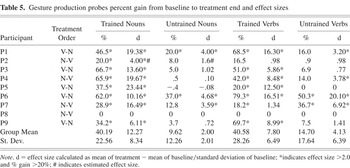
Results of the daily probe task for spoken naming and gesture production were graphed for percent correct in each set of 20 trained and untrained nouns and verbs. To quantify treatment effects, effect sizes (d) were calculated for each treatment phase. Using the method delineated by Busk and Serlin (1992), we compared the mean performance in treatment to the mean performance in baseline divided by the standard deviation of the baseline. In phase 2, data points in phase 1 served as the baseline comparison. Using the guidelines of Busk and Serlin, effect sizes greater than 2.0 were considered large. No variability was present in the gesture baselines for P1, P2, P5, and P8, precluding accurate measurement of an effect size. Therefore effect sizes were estimated for those participants by calculating the standard deviation if the participant had provided one correct response in one baseline session. To balance against effect sizes, which can be inflated when there is little baseline variability, we also evaluated gains associated with training. Gain scores, comparing the mean of the final four treatment sessions (in phase 1 and phase 2, respectively) to the mean of the prior phase (baseline, phase 1, respectively), were calculated. Gains >20%, which is more than two standard deviations greater than the mean of the control sets, was considered clinically meaningful. To summarize, we considered significant only those changes for which both effect size and gain scores surpassed benchmarks. In addition to the daily probes, participants completed standardized aphasia testing (WAB, BNT, ANT) at the completion of training.
RESULTS
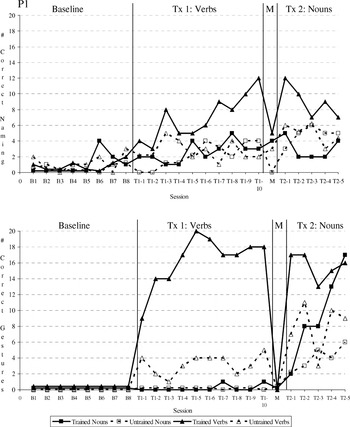
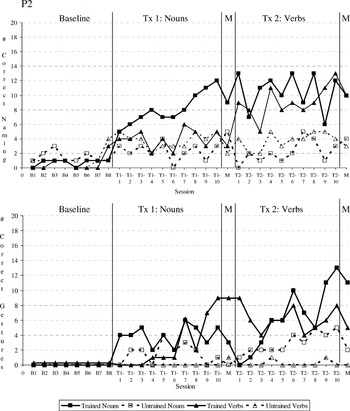
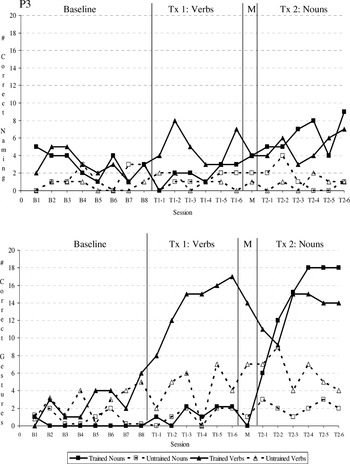
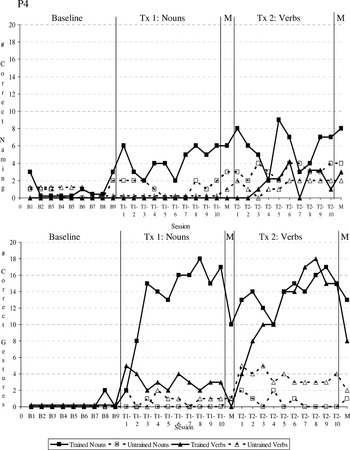
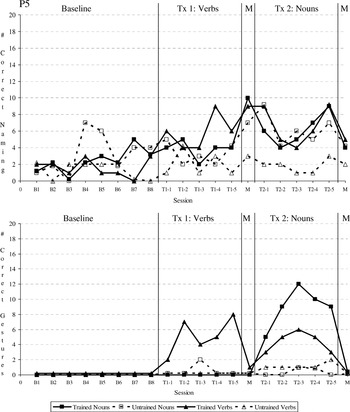
Results of GVT for the daily probe measure of picture naming and gesture production are graphed in Figs. 1, 2, 3, 4, 5, 6, 7, and 8. Because results for P8 indicated no improvements in any measure across the training sessions, his results are not graphed. Effect sizes and gain scores are summarized in Tables 4, and 5. Although order of noun and verb training phases was counterbalanced across participants, influence of order on effect sizes was evaluated. Paired samples t-tests showed no differences evident for effect sizes in training phase 1 versus phase 2 (naming: t = .42, df = 8, p = .68; gesture: t = 1.67, df = 8, p = .13).

P1 number correct spoken picture naming and gesture production.

P2 number correct spoken picture naming and gesture production.

P3 number correct spoken picture naming and gesture production.

P4 number correct spoken picture naming and gesture production.

P5 number correct spoken picture naming and gesture production.

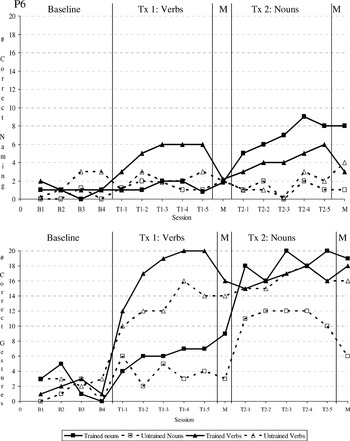
P6 number correct spoken picture naming and gesture production.

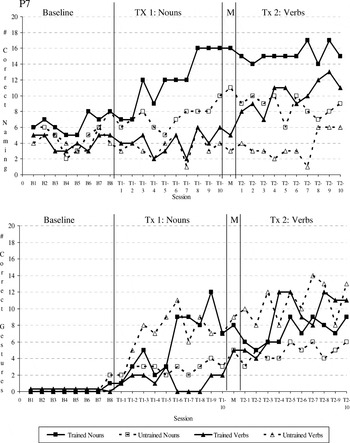
P7 number correct spoken picture naming and gesture production.

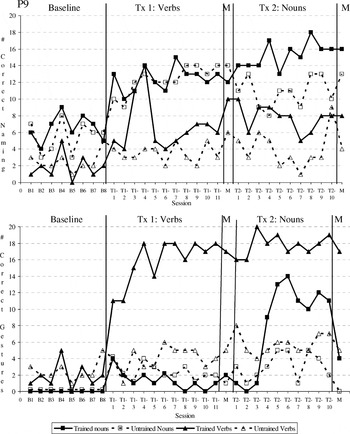
P9 number correct spoken picture naming and gesture production.
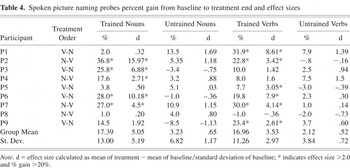
Spoken picture naming probes percent gain from baseline to treatment end and effect sizes

Gesture production probes percent gain from baseline to treatment end and effect sizes

Spoken Naming
Results of spoken picture naming probes are shown in the upper graph of Figs. 1, 2, 3, 4, 5, 6, 7, and 8. As summarized in Table 4, large improvements in spoken picture naming as represented by both gain scores >20% and effect sizes >2.0 were evident for 6/9 participants. Improvements for trained nouns were apparent in 4/9 participants, and for trained verbs in 4/9 participants. Increases were evident for both nouns and verbs in P2 and P7, only for nouns in P3 and P6, and only for verbs in P1 and P9. As a group, the average effect size of 5.05 for nouns and 3.53 for verbs surpassed the 2.0 benchmark for large effect sizes in single participant designs (Busk & Serlin, 1992). A group comparison indicated no significant difference between trained nouns and verbs for gain scores, t = .09, df = 8, p = .93, nor for effect sizes, t = .82, df = 8, p = .44. No participant showed remarkable increases for spoken naming of untrained nouns and verbs during GV training. Finally, at one month following completion of training, naming performance for trained words was maintained above baseline levels in 4/5 individuals tested (P2, P4, P6, P9), with some advantage noted for nouns over verbs.
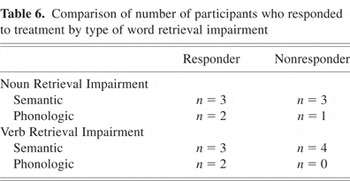
Given results of Rose et al. (2002) suggesting greater effects of GV treatment for phonologic impairments, we examined whether the type of word retrieval impairment was associated with the participant's responsiveness to treatment. For this analysis, we contrasted all who had a phonologic source of impairment to those with a semantic source of impairment (including those with semantic+phonologic, Table 6). Although numbers of participants are small, there was a tendency to have greater success in treatment for those with phonologic impairments (4/5 comparisons) than semantic impairments (6/13 comparisons). For those with semantic impairment, we examined whether severity of impairment, as indicated by scores on the word/picture verification task (Table 3), correlated with treatment effect sizes (Table 4). Correlations were not significant for noun comparisons (n = 6, r = .70, n.s.), nor for verb comparisons (n = 7, r = .27, n.s.).
Comparison of number of participants who responded to treatment by type of word retrieval impairment

Gesture Production
Results of the gesture production probes are shown in the lower graphs of Figs. 1, 2, 3, 4, 5, 6, 7, and 8. Gesture production gain scores and effect sizes are summarized in Table 5. Large improvements in gesture production were evident for 8/9 participants, as only P8 did not increase his gesture use. Improvements for trained nouns were apparent in 8/9 participants, and for trained verbs in 6/9 participants. A group comparison indicated no significant differences between trained nouns and verbs for gain scores, t = .06, df = 8, p = .96, nor effect sizes, t = 1.87, df = 8, p = .10. In contrast to spoken naming, increased use of gestures for untrained words was evident in 3/9 participants. P1 increased gesture use for untrained nouns; P7 increased gesture use for untrained verbs; and P6 increased gesture use for both untrained nouns and verbs. At one month following com-pletion of training, gesture performance was maintained above baseline levels in 4/5 individuals tested (P2, P4, P6, P9), with an advantage noted for nouns over verbs.
Follow-up Testing
Results of post-treatment assessment with the WAB, BNT, and ANT are displayed in Table 2. Significant increases in WAB scores were noted, t = 3.08, df = 8, p = .015, associated with a small effect size, d = .30. The scores of five individuals increased by more than the standard error of variance (4.5), largely because of increases in comprehension scores. No significant increases were noted for the BNT and ANT, however.
Finally, correlations (Spearman's) were calculated to determine whether severity of impairment on any pre-treatment measures was associated with treatment effect sizes, predicting responsiveness to treatment. The only significant correlations were between trained verb naming effect sizes and WAB aphasia quotients (r = .75 p = .02), and trained noun gesture effect sizes and WAB auditory comprehension scores (r = .75 p = .020). Remarkably, there were no significant correlations between gesture to command (limb apraxia) scores and treatment effect sizes for gesture (correlations ranged .08–.36, n.s.), as virtually all participants improved gesture production with training, regardless of apraxia severity.
DISCUSSION
Gestural+verbal training was effective for improving word retrieval in most of the participants with aphasia. All participants but one showed large increases in the spontaneous use of gestures following training, a finding that has been reported less commonly in earlier studies of GV treatment. A consideration of the neural bases of nouns and verbs led us to anticipate differences in response to GV treatment in favor of verbs over nouns (Druks, 2002). This prediction was not supported, however. In the group analysis, GV training was just as effective for improving spoken naming of trained nouns as trained verbs, and large effect sizes resulted for both nouns and verbs. Several possible factors may contribute to these findings. One argument can be generated based on functional neuroimaging studies that suggest that the neural networks subserving nouns and verbs are more complementary than distinct (Soros et al., 2003; Tyler et al., 2001). If the networks are complementary, then both types of words are more likely to respond to training in similar patterns. This observation may account to some extent for the results as a group, but an analysis of the individual patterns of treatment response lead to alternative explanations.
Another factor that may have influenced the noun/verb findings is the heterogeneity of the participants in the study. The study was open to individuals with impairments of noun and verb retrieval, but great variability was seen across participants in the type of aphasia, the source of word retrieval failure (semantic, phonologic), and severity of impairment. Considering source of impairment, if more impairments were semantically-based in one category of words and more phonologically-based in the other category of words, it would be possible for any expected treatment advantages for one class of words to be confounded by type of impairment. This does not seem to be the case, however, as similar numbers of individuals with semantic, phonologic, and mixed impairments are seen for nouns and for verbs (Table 3).
Another consideration is type of aphasia. Previous aphasia studies (Miceli et al., 1984; Zingeser & Berndt, 1990) showed that patients with nonfluent forms of aphasia (e.g., Broca's) had more difficulty retrieving verbs than nouns, whereas those with fluent forms of aphasia (e.g., anomic) had more difficulty retrieving nouns than verbs. Taking that idea one step further, we might predict that during word retrieval treatment, individuals with nonfluent forms of aphasia would respond better for nouns than for verbs, whereas those with fluent forms of aphasia might improve more for verbs than for nouns. Among the six individuals with Broca's aphasia in this study, 5/6 improved for noun retrieval and 3/6 improved for verb retrieval. In the three with fluent forms of aphasia (conduction and Wernicke's), 0/3 improved for nouns and 2/3 improved for verbs. Unfortunately, our numbers are not large, but these observations begin to shed light on the reason that both nouns and verbs improved in this study. Overall, the links that we proposed favoring gestural facilitation of verbs over nouns seem to be modified by type of word retrieval impairments. In general, both classes of words are amenable to GV treatment, however.
The broader influences of GV treatment are revealed in examining results for untrained nouns and verbs, which differed for spoken naming and gesture production. Consistent with much of the word retrieval treatment literature (Nickels, 2001), little increase was evident in spoken naming for untrained words, a finding that is not unexpected in that untrained words served as control words in the experiment and had no systematic semantic or phonologic relationship to trained words. Whereas we might have anticipated that gesture could be used more broadly as a strategy to facilitate word retrieval, even for untrained words, this simply was not the case. The implication of this finding is that naming treatment stimuli must be carefully selected to have any potential to impact a patient's functional verbal communication.
In contrast to spoken naming, increases in gesture production for untrained words were seen in a portion of the study participants, a finding that has been reported in other studies as well (e.g., Rodriguez et al., 2006). It is possible that training increased the awareness of gestures as a potential communication modality such that some participants, though not all, increased their gesture use in general. Unfortunately, our data do not provide any clues as to which participants are more likely to demonstrate generalized increases in gesture use. For example, there was no association between gesture effect sizes and limb apraxia scores. The three individuals with increased gesture use for untrained pictures (P1, P6, P7) had gesture to command scores that ranged from 20% to 53.3% correct, whereas the five who increased gesture use only for trained pictures had scores that ranged from 23.3% to 40% correct. The basis for word retrieval impairment differed across the 3 individuals, 1 semantic, 1 phonologic, and 1 mixed, and the type of aphasia varied as well, with 1 conduction, 1 Broca's, and 1 Wernicke's aphasia. No test measures correlated significantly with effect sizes for untrained noun and verb gestures. Overall, these findings suggest that GV treatment has the potential to increase use of a gestural means of nonverbal communication in some patients with severe anomia.
Types of word retrieval impairments vary across individuals with aphasia, with some arising from a semantic failure, and others from a dysfunction in activating phonological representations of words (Wilshire & Coslett, 2000). Rose and colleagues (Rose & Douglas, 2001; Rose, Douglas, & Matyas, 2002) noted that gestural treatment was more effective in individuals with phonologic impairment than those with semantically-based word retrieval failure. Rodriguez et al. (2006) also noted that one participant who improved verb retrieval following GV treatment had a phonologic anomia. The participants in the current study represented a spectrum of naming impairments. Those with primarily phonologic impairments improved in naming, including two of three with phonologic impairments for noun retrieval and two of two with phonologic impairments for verb retrieval. Several with primarily semantic impairments also improved in noun and verb naming, however. That is, although there is a tendency for more success in word retrieval training for those with phonologic impairments, some with semantic impairments also showed a positive GVT response.
The single participant design of this study allowed us to examine not only the positive effects of GVT but also the patterns in participants for whom the treatment was less effective. P5, with Broca's aphasia and moderate word retrieval deficits, demonstrated little treatment response for spoken naming. Yet he had a dramatic response in gesture production, suggesting some positive benefit of the treatment. In contrast, P8 showed no improvements in either spoken naming or gesture production following GV treatment. P8 had Wernicke's aphasia associated with more severe semantically-based word retrieval impairments and limb apraxia as compared to the other participant with Wernicke's aphasia in the study (P9). Rodriguez et al. (2006) reported that their participant with severe Wernicke's aphasia (P3) and semantically-based word retrieval impairment improved only in gesture production and not in spoken naming following GVT for verbs. Thus, individuals with severe semantically-based word retrieval impairments associated with Wernicke's aphasia may not improve greatly in verbal naming following GVT, although some might improve their ability to use gesture, providing them a potential means to communicate.
A final observation is that GVT led to significant increases on the WAB Aphasia Quotient. This improvement was primarily in auditory comprehension rather than naming scores. Because part of the GVT involved training the participant to repeat, it is possible that this training step might have contributed to improvements in auditory-phonological perception and lexical access, or to improved attention to linguistic stimuli (Helm-Estabrooks et al., 2000).
In conclusion, GVT led to significant improvements in spoken naming and gesture production for trained nouns and verbs in most of our participants, and there were no apparent differences between nouns and verbs. Verbs seem to be amenable to the same types of treatments as nouns despite their different neural representations; any associations between verbs and gesture knowledge did not lead to an advantage of GVT for verbs over nouns. A positive effect of GVT was increased gesture use in several participants with severe word retrieval impairments, providing these individuals a potential alternative nonverbal mode of communication. Whether the verbal or the gestural component of training played the greater role in treatment outcomes cannot be ascertained in this study, although earlier studies suggested that both components together provide a more potent treatment effect (Hoodin & Thompson, 1983), Finally, whether improvements in naming and gesture use translate to conversational language use is a matter that we are investigating in further analyses.
ACKNOWLEDGMENTS
The authors extend their appreciation to the participants who diligently completed this study. This project was supported by NIH (NIDCD) grant P50 DC03888-01A1 to the University of Florida (subcontract to Old Dominion University), and by the Dept. of Veterans Affairs Rehabilitation Research & Development Center of Excellence Grant F2182C to the Brain Rehabilitation Research Center, Gainesville, Florida.