Maja Spener’s Introspection: First-Person Access in Science and Agency is an invaluable contribution to the debate about the nature and reliability of introspection. By sifting it through a novel, illuminating, and very much needed conceptual framework, the book lays the foundation for that debate to substantially move forward. The book’s main aim is to offer a detailed diagnosis of introspection’s epistemological shortcomings, provide the tools for a careful analysis of its limitations and methodological potential, and open up moderately optimistic prospects with respect to its use in science.
At a first approximation, introspection is a distinctively first-personal way of getting information about our conscious minds. Discussions around introspection’s reliability are often polarized between excited optimists, for whom introspection is infallible or at least very reliable, and dark pessimists, who take introspection to be hopelessly faulty and anyway unable to provide any knowledge. Spener sets the stage for a sensible and solidly motivated middle-ground moderately optimistic position, on which introspection’s reliability is not a monolithic, all-or-nothing epistemic property, but rather a variable feature that depends on a set of contextual factors; introspection is reliable in some conditions and unreliable in others. Part of the challenge is to find out what those conditions are. Spener’s fundamental contribution consists in carefully drawing crucial distinctions, neglect of which has caused contemporary debates around introspection – in philosophy, psychology, and neuroscience – to be affected by major confusion, carelessness, and imprecision. Based on those distinctions, Spener takes some substantial steps toward putting order in those debates and overcoming their confusion.
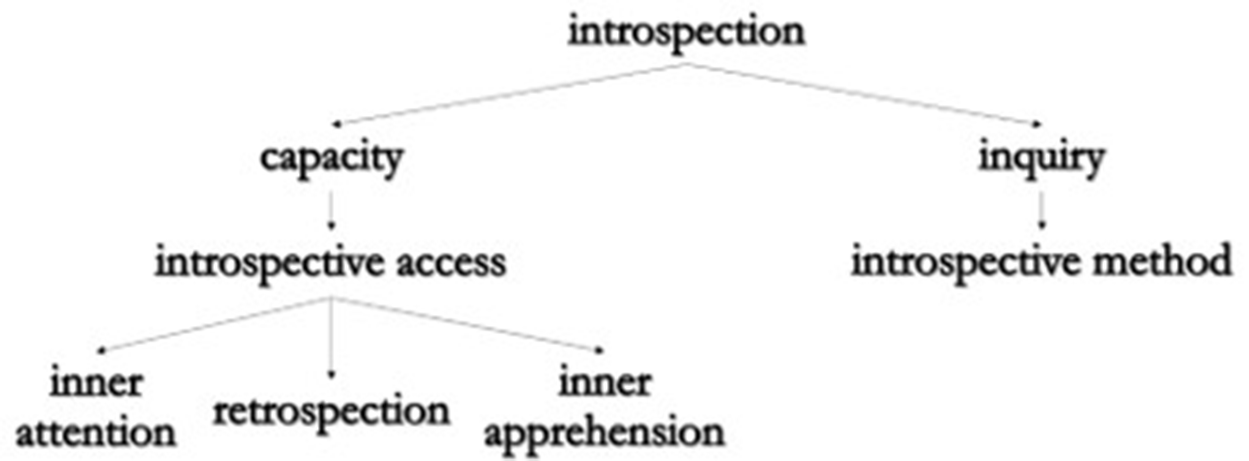
Spener’s proposal is grounded in what she calls the ‘Basic Framework’ (see Figure 1), whose structure and importance are articulated in Chapter 1. This is a battery of conceptual distinctions aimed at dissolving the ambiguities that are responsible for most of the abovementioned carelessness and imprecision. The fundamental distinction is between introspection as a mental capacity and introspection as a form of inquiry. As a mental capacity, introspection is a form of cognitive access – introspective access – to one’s conscious experiences. In this sense introspection is a mental capacity on a par with, say, perception and memory. Spener distinguishes three modes of introspective access: inner attention, inner apprehension, and retrospection. Inner attention is an active and deliberate focus of one’s attention on one’s current experience, whose upshots are judgments about one’s current conscious situation. Inner apprehension is a passive, involuntary, and non-focal (i.e., peripheral and non-attentive) awareness of one’s current experience which comes along with the experience itself. Retrospection is an active and deliberate episodic recall of one’s past experience, whose upshots are judgments about one’s past conscious situation. As inquiry, introspection is a method of scientific investigation that employs some mode of introspective access in an experimental setting and is aimed at collecting data about the human conscious mind. The experimental set-up involves not just a specific mode of introspective access but also the definition of a target of investigation, the preparation of subjects, the presentation of a stimulus, the selection of a type of report and of the way to elicit it, and the experimenter’s interpretation of the collected data.
Spener’s Basic Framework.

This has important consequences on assessing introspection’s reliability and on addressing the so called ‘calibration problem’ for introspection (i.e., the problem of determining the conditions under which introspection is reliable). First of all, the reliability of introspective methods and of introspective access should be assessed separately. For one thing, the evaluative standards are distinct: an introspective method is reliable insofar as the introspective data it generates are useful for the scientific or philosophical study of the mind; a mode of introspective access is reliable insofar as its upshots are epistemically accurate (it delivers information about one’s conscious situation). For another, method (un)reliability and mode-of-access (un)reliability do not necessarily entail each other. On the one hand, if a mode of access is unreliable under certain conditions, controlling for other features of the method in which it is embedded (target, preparation, kind of report, etc.) may compensate for such unreliability. On the other hand, if an introspective method turns out to deliver unreliable data, the unreliability may lie not in the specific mode of access deployed but in some other features of the experimental set-up.
In light of this meticulous and extremely useful battery of distinctions, it becomes clear that the question about introspection’s reliability cannot be addressed at a general level, and its answer is unlikely to be univocal and monolithic. The reliability question breaks down into several specific questions, where answers have to take into account a plurality of factors. Adopting this approach has several advantages. First, it does justice to the complexity of introspection, avoiding oversimplifying generalizations that are likely to produce a misleading picture of the phenomenon. Second, it makes the problem of introspection’s reliability more tractable, for addressing it gets to be factorized into a multiplicity of specific and more manageable tasks. Third, it promises to open up new and brighter prospects for the scientific and philosophical study of consciousness, for it allows for a much more precise and mindful use of introspection in philosophy, psychology, and neuroscience.
Yet, as compellingly argued by Spener throughout the book, participants in contemporary philosophical and scientific debates have mostly overlooked those distinctions, with detrimental effects both on the conceptual understanding of introspection and on the prospects for using it in the science of consciousness. The bulk of the book is devoted to unveiling the confusion affecting those debates and giving the discussion a fresh start on clearer, more solid, and more fecund foundations.
Part I of the book focuses on introspection as inquiry and examines the reliability and epistemological legitimacy of introspective methods. Here Spener analyses in deep detail two central problems that sceptics of introspective methods have wielded against the legitimacy of the use of introspection in science: the problem of self-observation (Chapters 2–3) and the problem of response bias (Chapters 4–6).
The problem of self-observation is quite marginal in current debates, but it was central at the dawn of empirical psychology and dominated the discussion over the legitimacy of introspection throughout the 19th and early 20th century. Roughly, the problem is this: when a subject tries to observe their own experience by focusing their attention on it, the very act of observation alters the overall conscious situation in such a way that the original target may end up being deeply distorted – or even destroyed. In Chapter 2, Spener explains the problem in detail and develops a thorough investigation of how it was addressed by some prominent participants in the debate (with a focus on John Stuart Mill, William James, and Wilhelm Wundt). Chapter 3 examines the specific solutions elaborated by Wundt and Georg Elias Müller. Spener’s discussion here – incredibly detailed and greatly illuminating – has a twofold goal. One is historical: to rectify an incorrect and misguided narrative (yet widespread enough to have become the ‘standard view’), on which the introspective method used by early experimental psychologists was hopelessly naïve, inconclusive, and good only for producing endless and pointless disagreements. The story unveiled by Spener is very different:
It is a story of excellent science and ingenuity, of detailed and sophisticated experimenting by the deployment of introspective access, of great variety in methodological approaches to such deployment, and of keen awareness and forthright discussion of the main problems with such employment. (16)
Spener’s pursuit of this goal is at the same time passionate, invaluably knowledgeable, and lucidly organized: by the end of Chapter 3 the reader can neatly see the truth of the above-quoted sentence. The other goal is to foreground and understand – by using the Basic Framework – the sophisticated and nuanced ways in which early experimental psychologists addressed introspection’s methodological challenges, and present them if not as a model, at least as a source of inspiration for regimenting, advancing, and hopefully improving contemporary debates.
The problem of response bias is a central methodological problem in the contemporary science of consciousness. It concerns the use of so-called ‘subjective measures of consciousness’ in trying to establish the threshold between conscious and unconscious perception. Roughly, the problem is this. Given its essentially subjective nature, any empirical study of consciousness requires relying on first-person reports. Now, first-person reports relevant to the study of conscious vs. unconscious perception partly depend on the subject judging whether a stimulus is consciously perceived, which in turn is based on a subjective threshold – a criterion by which the subject discerns whether they are consciously perceiving something or not. Crucially, subjective thresholds may be influenced by factors that are irrelevant to whether a stimulus is consciously perceived. Hence the problem: the subject’s response to a stimulus may be biased and for this reason it is not a reliable indicator of the presence or absence of conscious perception. Chapter 4 explains the problem of response bias in great detail and contextualizes it in the debate about subjective vs. objective measures of consciousness. Chapter 5 examines the two main types of subjective measure used in empirical research on conscious v. unconscious perception: Confidence Ratings and the Perceptual Awareness Scale. The bulk of the Chapter is devoted to bringing to the surface the confusion and imprecision that permeate both the use of those subjective measures and the polarized discussion over their legitimacy. The fundamental problem, Spener compellingly argues, is that the whole discussion relies on a conception of introspection that is sketchy, ambiguous, and generic – rather than on a worked-out and conceptually regimented notion. Finally, Chapter 6 illustrates how applying the Basic Framework and learning from the methodological virtues of early experimental psychology can help discipline the debate, address the methodological challenges faced by introspection, and pave the way to a middle-ground moderately optimistic stance with respect to introspection’s reliability.
Part II of the book (Chapters 7–8) examines the reliability of introspective access and outlines a broader view of the nature of introspection as a mental capacity. Chapter 7 offers an overview of the three modes of introspective access: inner attention, inner apprehension, and retrospection. For each, Spener outlines its main proprietary features (its structural properties and the kind of upshot it delivers) and draws up its epistemic profile (the kind of knowledge about the mind we can get by deploying it). Chapter 8 inquiries into the psychological reality of modes of introspective access, and into whether they can legitimately be seen as belonging to a unified kind. Spener’s proposal here is a pluralist view, but a realist one, rather than eliminativist: inner attention, inner apprehension, and retrospection are distinct modes of introspective access, each with its own proprietary features and distinctive epistemic profile (this is the ‘pluralism’ bit); however, they are all genuinely introspective in virtue of the role they play in explaining human agency (this is the ‘realist’ bit).
There is so much to learn from Spener’s book. And not just because it is a treasure trove of information about so many issues around introspection, from the history of its use and development in early experimental psychology, to the assumptions and disagreements about its nature and reliability in current debates about subjective measures of consciousness, through the way it is used in contemporary empirical research in psychology and neuroscience. Through the lenses of the Basic Framework, all this rich and detailed information is critically and valuably organized and supports a strong, fresh, ingenious, and promising proposal as to how to constructively restructure the discussion around introspection’s nature, reliability, and use in the scientific practice.
Acknowledgements
This paper benefited from grant PID2023-151949NA-I00, “Know Yourself: The Importance, the Nature, and the Applications of Introspective Self-Knowledge,” financed by Spain’s Ministry of Science, Innovation, and the Universities, and from grant CIPROM/2023/55 “Autonomy as Address,” financed by the Conselleria d’Innovació, Universitats, Ciència i Societat Digital – Generalitat Valenciana.