Introduction
Anxiety and depressive disorders often present together, both as subthreshold syndromes and as threshold disorders. Although it is known that their co-occurrence is relatively common and is frequently associated with increased severity and poorer response to treatment than in people suffering with either condition alone, their co-existence has not been studied extensively in later life. Only a small number of studies have investigated and published in relation to the epidemiology of co-morbid anxiety and depression amongst older adults (Beekman et al. Reference Beekman, de Beurs, van Balkom, Deeg, van Dyck and van Tilburg2000; Lenze et al. Reference Lenze, Mulsant, Shear, Schulberg, Dew, Begley, Pollock and Reynolds2000; Schoevers et al. Reference Schoevers, Beekman, Deeg, Jonker and van Tilburg2003; Kvaal et al. Reference Kvaal, McDougall, Brayne, Matthews and Dewey2008; Byers et al. Reference Byers, Yaffe, Covinsky, Friedman and Bruce2010). The prevalence of co-morbid anxiety and depression found in these studies ranged from 1.8% to 8.4% in community settings and, as expected, was higher (14.8%) in primary-care and psychiatric settings (Lenze et al. Reference Lenze, Mulsant, Shear, Schulberg, Dew, Begley, Pollock and Reynolds2000). This wide range is the result of the different definitions of depression and anxiety and diverse ascertainment methods used, hampering possible comparisons amongst the studies. Furthermore, all these studies were conducted in high-income countries and it is not known whether the same findings could be applicable to different settings and in particular to developing countries – places where the demographic transition (e.g. change in the population pyramids) will occur more rapidly, and where infrastructures to deal with treatable mental disorders are still limited.
Depression has been estimated to be the fourth leading cause of global burden as measured by total disability-adjusted life years (known as DALYs) in 2005, and it is the current leading cause of disability as measured by years lost to disability (World Health Organization, 2004). A number of studies have found an association between common mental disorders and disability. Sullivan et al. (Reference Sullivan, LaCroix, Baum, Grothaus and Katon1997) found that older individuals with anxiety and depression symptoms are more disabled than those without psychiatric syndromes. Similar findings were found by Bijl & Ravelli (Reference Bijl and Ravelli2000), who found greater functional disability amongst depressed and anxious patients. The independent and joint effect of anxiety and depression on disability in later life has never been investigated cross-culturally in developing countries. Aided by a large sample size, the 10/66 study allows for such a type of investigation by using all of the anxiety and depression states, including subthreshold syndromes.
The purpose of this study is to investigate cross-culturally the co-occurrence of anxiety and depression amongst older individuals living in low- and middle-income countries, adding to the shortage of population-based evidence that surrounds this subject. We also aim to analyse the relative contribution and impact that anxiety, depression and their co-occurrence have on disability.
Method
Settings
The protocol and full details of the 10/66 population-based surveys of people aged 65 years and over living in seven low- and middle-income countries (urban sites) are available elsewhere (Prince et al. Reference Prince, Ferri, Acosta, Albanese, Arizaga, Dewey, Gavrilova, Guerra, Huang, Jacob, Krishnamoorthy, McKeigue, Rodriguez, Salas, Sosa, Sousa, Stewart and Uwakwe2007) but they are also summarized here. A total of 11 different catchment areas were identified. In the People's Republic of China, India, Mexico and Peru both rural and urban sites were selected, whereas in Cuba, the Dominican Republic and Venezuela only urban areas were included. The rural areas were selected from areas with a traditional agrarian life-style and with a low-density population. For the urban areas, avoidance of zones with a prevalence of middle- and high-income individuals occurred. Precise bounding and mapping of the catchment areas and identification of all the eligible households (those aged 65 years or over) were carried out. Households were allocated household identification numbers and the age of the participant was confirmed during the interview. Information about sex and gender of the other co-residents was also recorded and stored securely in databases. After verification of eligibility, written consent was obtained from the participants, or from next of kin if the individual did not have the capacity to give consent. Oral consent, which was witnessed in writing by someone literate, was also taken from the illiterate participants.
Protocols and procedures
Each centre had a co-ordinator who supervised the interviewers. There were between four and ten interviewers for each site, usually non-specialist graduates (apart from Cuba and China where medical doctors were used) extensively trained for the interviews and the main diagnostic assessment. Previous experience was also gained during the dementia diagnostic pilot study. Several meetings for the principal investigators were also conducted before the start of the fieldwork, and at regular intervals of 6 months during the project. A standardized operating procedure manual covering all aspects of the interviews and procedures was also available to all interviewers, who were supervised during the fieldwork until the quality of the interview was deemed satisfactory. Random checks were also carried out during the project. Data were collected onto paper and then extracted, cleaned and processed in SPSS (version 15.0; SPSS, Inc., USA), or directly onto laptops (in Cuba) using computerized questionnaires driven by EpiData (version 2.0; EpiData Software, Denmark). Data were finally checked a number of times (three to four) in London after completion of the interviews.
All participants underwent a comprehensive interview, including a structured clinical interview, a physical examination and an informant interview. The interviews were translated into the different languages for each centre: Ibero-American Spanish for Latin America, if necessary with alterations for specific countries, Mandarin for China, and Tamil for India. Only the measures used for this analysis will be described here.
Ethical approval was sought and received by local ethical committees and by the King's College London research ethics committee.
Anxiety
The Geriatric Mental State Examination (GMS) together with its diagnostic algorithm, the Automated Geriatric Examination for Computer Assisted Taxonomy (AGECAT), were used to measure anxiety. This examination has been used successively translated and adapted to different cultures in many international studies, with demonstration of robust reliability and validity (Copeland et al. Reference Copeland, Prince, Wilson, Dewey, Payne and Gurland2002).
There are six levels of diagnostic confidence for anxiety that range from no symptoms (0) to very severely affected (5). Participants who reached level three in the GMS/AGECAT stage I anxiety axis were considered to be cases, as this threshold normally reflects a severity that warrants professional intervention. Those having a score of one or two in the cluster were considered as subthreshold cases.
Depression
In order to categorize depressed participants, International Classification of Diseases 10th revision (ICD-10) criteria (World Health Organization, 1992) were used. These were derived using a computerized algorithm applied to the GMS.
Participants scoring five or more on the EURO-D scale (Prince et al. Reference Prince, Reischies, Beekman, Furher, Jonker, Kivela, Lawlor, Lobo, Magnusson, Fichter, van Oyen, Roelands, Skoog, Turrina and Copeland1999b), which had been validated and extensively used cross-culturally (Prince et al. Reference Prince, Beekman, Deeg, Fuhrer, Kivela, Lawlor, Lobo, Magnusson, Meller, van Oyen, Reischies, Roelands, Skoog, Turrina and Copeland1999a, Reference Prince, Acosta, Chiu, Copeland, Dewey, Scazufca and Varghese2004; Castro-Costa et al. Reference Castro-Costa, Dewey, Stewart, Banerjee, Huppert, Mendonca-Lima, Bula, Reisches, Wancata, Ritchie, Tsolaki, Mateos and Prince2008), were described as ‘EURO-D depression’ cases. By identifying cases of ‘EURO-D depression’ that did not meet ICD-10 depression criteria, we described subthreshold cases of depression. The most appropriate cut-off point for this scale was derived by running receiver-operating characteristic curves, and by applying the Youden Index (J) for each centre, as currently recommended by the 10/66 group. An ideal cut-off point of five was found across all the sites.
Other measures
Other health conditions were self-reported, with the exception of dementia, which was measured by different diagnostic algorithms, including both 10/66 and Diagnostic and Statistical Manual of Mental Disorders, Fourth Edition (DSM-IV) cases (Prince et al. Reference Prince, Acosta, Chiu, Scazufca and Varghese2003). The self-reported measures were stroke and having three or more limiting physical impairments from the following list: arthritis or rheumatism, eyesight problems, hearing difficulty or deafness, persistent cough, breathlessness, difficulty breathing or asthma, high blood pressure, heart trouble or angina, stomach or intestine problems, faints or blackouts, paralysis, weakness or loss of one leg or arm, skin disorders such as pressure sores, leg ulcers or severe burns (Sousa et al. Reference Sousa, Dewey, Acosta, Jotheeswaran, Castro-Costa, Ferri, Guerra, Huang, Jacob, Rodriguez Pichardo, Garcia Ramirez, Llibre Rodriguez, Calvo Rodriguez, Salas, Sosa, Williams and Prince2010).
Disability was measured by using the World Health Organization's Disablement Assessment Scale Version II (WHODAS; Rehm et al. Reference Rehm, Ustun, Sexena, Nelson, Chatterji, Ivis and Adlaf1999) that assesses activity limitation and participation restriction. This scale was developed by the World Health Organization as a cross-cultural and culture-fair assessment tool to use in epidemiological studies. Its psychometric properties have recently been assessed (Sousa et al. Reference Sousa, Dewey, Acosta, Jotheeswaran, Castro-Costa, Ferri, Guerra, Huang, Jacob, Rodriguez Pichardo, Garcia Ramirez, Llibre Rodriguez, Calvo Rodriguez, Salas, Sosa, Williams and Prince2010).
The sociodemographic characteristics and socio-economic circumstances of the participants were also recorded during the interview stage: age was assessed from formal documents, and marital status, education, social support, pension status, household assets and food insecurities were also measured. This latter was measured by the question: ‘do you ever go hungry because there is not enough food to eat?’
Statistical analysis
The sociodemographic characteristics, health status and economic circumstances of the sample in each site were described.
The distribution of anxiety and depressive states was tabulated for each country. Three by three tables reporting the absolute number and frequency of each state were described for anxiety and depression, categorising each disorder in: no or few symptoms, subthreshold syndrome and disorder.
Mutually adjusted prevalence ratios for potential risk factors were modelled in Latin America by using Poisson regression models. Adjustment for each country was also carried out. We chose to investigate these factors only in Latin America, as similar trends were found across the sites, and there were too few cases in China to estimate the parameters. The investigated factors were demographic (sex and gender), socio-economic (education, marital status, number of assets, food insecurity) and health variables (number of physical impairments and having a dementia diagnosis).
Finally, we investigated whether anxiety and depression had an impact on disability by analysing the distribution of mean WHODAS disability scores, reported here with their standard deviations. A zero-inflated negative binomial regression (ZINB), which accounted for excess zeros and over-dispersion in the distribution of disability scores (Greene, Reference Greene1994; Long, Reference Long1997), was applied to model the effect of anxiety and depression on disability scores. This was adjusted for age, gender, level of education, dementia diagnosis and other physical co-morbidities. Vuong (Reference Vuong1989) non-nested tests were also used to decide if the ZINB model was the most appropriate model to use, rather than just a standard negative binomial regression. An interaction term for depression and anxiety was also added to the models to explore whether there was a multiplicative effect on disability scores from their interaction.
Results
Sample characteristics
In total 15 021 interviews were carried out. Women outnumbered men (62% women) in all sites (see Supplementary Table S1, available online), and the proportion of older people was greater in the Latin American sites. Urban areas registered higher levels of completed education in contrast to rural areas where minimal or low education was common. Most participants were married or widowed, and this was constant across centres. Food insecurities were relatively common in India (14.1% in rural and 20.8% in urban India), rural Peru (13.5%) and the Dominican Republic (12.1%). The number of missing values was minimal (Supplementary Table S1).
Distribution of anxiety and depression
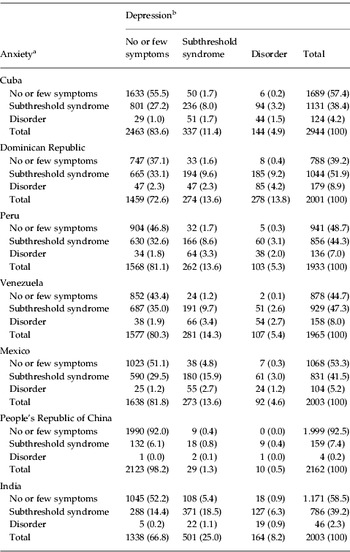
The distribution of anxiety and depressive states by country is reported in Table 1 that includes both the absolute number and the frequency of each state. Similar trends were found across regions, in particular across the Latin American centres. The only exception was China, where minimal levels of anxiety and depression were recorded (92% of individuals were not affected by either syndrome or subsyndrome). The two least common states were pure anxiety or depression, defined by not having any co-morbidity at either subthreshold or disorder level. Subthreshold anxiety with no depressive symptoms was the most prevalent state in almost all centres [mean 25.4 (s.d.=10.9) %], if being free of both disorders is not considered. This state was closely followed by mixed subthreshold depression/subthreshold anxiety that had a prevalence of 10.2 (s.d.=5.7) %. The overall prevalence of co-morbid disorders (depression with subthreshold anxiety, anxiety with subthreshold depression, subthreshold anxiety and depression, and pure anxiety and depression) ranged from 14.4% (Cuba) to 26.8% (India) if China is excluded (only 1.3%). However, the prevalence of co-occurring anxiety and depression (with the exclusion of subthreshold disorders) was much lower and ranged between 0.9% (India) and 4.2% (Dominican Republic). In the whole sample we found that 84% of those with depression (including subthreshold depression) also had anxiety or subthreshold anxiety, and that 54% of those with anxiety suffered with depressive disorder.
Distribution of anxiety and depression by country

GMS, Geriatric Mental State Examination; AGECAT, Automated Geriatric Examination for Computer Assisted Taxonomy; ICD-10, International Classification of Diseases 10th revision.
Data are given as number of participants (percentage).
a Anxiety was categorized at disorder level (GMS/AGECAT score ⩾3) or subthreshold (GMS/AGECAT score of 0<3).
b Depression was measured according to ICD-10 criteria and subthreshold depression consisted of EURO-D cases that did not reach ICD-10 levels.
Factors associated with common mental disorders
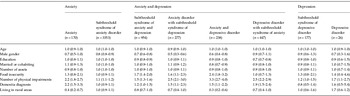
This introductory analysis was followed by an investigation of factors associated with the different anxiety and depressive states. We conducted this analysis only in the Latin American subsamples, as the distribution of the two disorders was similar in the different countries. Table 2 shows the mutually adjusted prevalence ratios obtained from running Poisson models across the range of syndrome categories: subthreshold anxiety; subthreshold anxiety with depression syndrome; anxiety disorder with subthreshold depression; anxiety and depression disorder; depressive syndrome with subthreshold anxiety; pure depressive disorder and subthreshold depression.
Independent effects of age, gender, socio-economic status, dementia diagnosis and number of physical impairments on the different anxiety/depression statesFootnote a

Data are given as mutually adjusted prevalence ratio estimate (95% confidence interval) from a Poisson regression.
a Adjustment for the country was also carried out.
Age and number of assets did not have a significant association with any syndrome category. Female gender, a diagnosis of dementia, and an increasing number of physical impairments were all associated with the different states, both co-morbid and pure. The magnitude of association was higher when co-morbid anxiety and depression were present. Urbanicity and food insecurity were associated with most categories with only a couple of exceptions.
Common mental disorders and disability
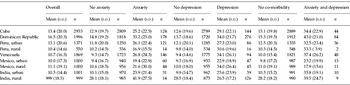
We then investigated the distribution of WHODAS disability scores in those participants with GMS/AGECAT anxiety, ICD-10 depression and co-morbid anxiety/depression (Table 3). Scores in those with anxiety and depression were intermediate, with depressed participants having slightly higher scores. People in either category had much higher scores (twice and occasionally three times as high) than people who were free from neuroses and mood disorders. The scores were higher in people with co-morbid disorders than in those with pure syndromes in all centres with the exception of rural Mexico, where they were lower. As expected, the scores for the participants with both anxiety and depression were higher than in those with no co-morbidities.
Distribution of WHODAS disability scores by anxiety (GMS/AGECAT) and depression (ICD-10) status in the different sites

WHODAS, World Health Organization's Disablement Assessment Scale Version II; GMS, Geriatric Mental State Examination; AGECAT, Automated Geriatric Examination for Computer Assisted Taxonomy; ICD-10, International Classification of Diseases 10th revision; s.d., standard deviation.
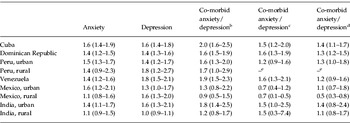
The single and joint effect of anxiety and depression on disability scores was thus investigated, by running zero-inflated negative binomial regression models. For each model we fitted, the Vuong test resulted in a significant p value (p<0.0001), and for this reason using the standard negative binomial regression was rejected in favour of the zero-inflated negative binomial model. We excluded the Chinese centre from the analysis, as there were not sufficient numbers of cases. Table 4 reports the count ratio with 95% confidence intervals for each condition: anxiety, depression and co-morbid anxiety/depression. All the risk ratios were adjusted for age group, gender, education, dementia, and number of physical illnesses. Having an anxiety syndrome was significantly associated with increased disability scores in all centres with the exception of the rural ones (Mexico, Peru and India). Depression had a similar increased risk of disability to anxiety, but significant p values of less than 0.05 were also reached in Mexico and Peru but not in rural India. The reference categories were being free of anxiety and depression, respectively, and the increased risk ranged from 1.3 to 1.9 by using the fully adjusted models. Finally, the co-morbid interaction between anxiety and depression was significant in six out of nine centre-specific regressions. We also repeated the analysis changing the reference category from no co-morbidity to either pure depression or pure anxiety. Having both anxiety and depression had higher ratios than having only one disorder in most centres. Increased disability scores and risk were also associated with subthreshold anxiety in all centres except for rural Peru and rural Mexico (data not shown). There was very little evidence for an anxiety–depression interaction. None of the interactions was statistically significant apart from one in rural Mexico, where an inverse association was found (risk ratio 0.4, 95% confidence interval 0.2–0.8).
Effect of GMS/AGECAT anxiety, ICD-10 depression and co-morbid anxiety/depression on mean WHODAS scoreFootnote a

GMS, Geriatric Mental State Examination; AGECAT, Automated Geriatric Examination for Computer Assisted Taxonomy; ICD-10, International Classification of Diseases 10th revision; WHODAS, World Health Organization's Disablement Assessment Scale Version II.
Data are given as adjusted risk ratio (95% confidence interval) from a zero-inflated negative binomial regression.
a The model was adjusted for age group, gender, education level, dementia diagnosis and number of physical illnesses.
b Reference: free of co-morbidity.
c Reference: anxiety.
d Reference: depression.
e Too few cases to estimate the parameter.
Discussion
This study investigated the co-occurrence of common mental disorders: anxiety and depression. The prevalence of ICD-10 depression was reasonably consistent across Latin America and India (range 4.9–13.8%) but was much lower in the Chinese site. A similar pattern was also found for the distribution of anxiety (range excluding China: 2.3–8.9%).
The prevalence of co-morbid anxiety and depression was high, especially when we consider that 84% of those with depression (including subthreshold depression) suffer also from anxiety or subthreshold anxiety, and that 54% of those with anxiety have a depressive disorder. The risk profiles were not radically diverse across the various co-morbid categories except for differences in the magnitude of the associations. On the whole, the states that included subthreshold syndromes had smaller associations with risk factors, as expected.
These ranges are in agreement with the prevalence of affective and neurotic disorders found in the developed world (Beekman et al. Reference Beekman, de Beurs, van Balkom, Deeg, van Dyck and van Tilburg2000; Lenze et al. Reference Lenze, Mulsant, Shear, Schulberg, Dew, Begley, Pollock and Reynolds2000; Schoevers et al. Reference Schoevers, Beekman, Deeg, Jonker and van Tilburg2003; Kvaal et al. Reference Kvaal, McDougall, Brayne, Matthews and Dewey2008; Byers et al. Reference Byers, Yaffe, Covinsky, Friedman and Bruce2010), with the exception of China. It is difficult to know why we could not measure a higher prevalence of common mental disorders in China, but an increased stigma of mental illnesses (Lee, Reference Lee1999) could partially account for the difference. Urban China also had the lowest response rates amongst all the centres (74%), and although this is still a relatively high figure we are unable to formally exclude that response bias might have had a role.
The mean prevalence of threshold co-morbid disorders in the Latin American site was 2.3%, well within the range found in the literature, and particularly similar to the lower estimates from Schoevers et al. (Reference Schoevers, Beekman, Deeg, Jonker and van Tilburg2003) (1.8%) and the 2.8% of the recent American National Comorbidity Survey Replication study (Byers et al. Reference Byers, Yaffe, Covinsky, Friedman and Bruce2010). Kvaal et al. (Reference Kvaal, McDougall, Brayne, Matthews and Dewey2008) reported the highest prevalence of depression in a sample of British older adults (8.4%) but this is due to the fact that co-morbid subthreshold disorders were included. Their estimate would be far lower if only anxiety and depression were to be considered. In spite of the wide variation in the estimates, what transpires from our findings is that the prevalence of co-morbid anxiety and depression is still relatively high amongst older people.
Various hypotheses have been put forward to explain the high prevalence of co-morbid anxiety and depression found in the literature. It has been suggested that anxiety may lie on a continuum with depression, and that the different classifications of ‘pure’ depression and ‘pure’ anxiety may represent different severity levels of the same disorder or different stages of its manifestation (Kessler et al. Reference Kessler, McGonagle, Zhao, Nelson, Hughes, Eshleman, Wittchen and Kendler1994). Alternatively, the two conditions might represent distinct forms of psychopathology, sharing common genetic factors, but ultimately determined by environmental experiences (Kendler, Reference Kendler1996).
As the co-occurrence of anxiety and depression was particularly common we were able to investigate different risk factors across the various co-morbid states. The literature has conflicting findings on whether anxiety and depression have different risk factors. Beekman et al. (Reference Beekman, de Beurs, van Balkom, Deeg, van Dyck and van Tilburg2000) found more inconsistencies than similarities between the risk factors of these conditions. However, similar risk profiles were described in the Amsterdam Study of the Elderly (Schoevers et al. Reference Schoevers, Beekman, Deeg, Jonker and van Tilburg2003). One of the most recently published studies (Kvaal et al. Reference Kvaal, McDougall, Brayne, Matthews and Dewey2008) also investigated co-morbid subthreshold syndromes in an extensive manner, and found that although risk factors were shared by the different anxiety and depression states, some were different.
In our cohort the risk profiles' shared risk factors could suggest that both disorders may lie on a continuum, re-enforcing the findings of the Medical Research Council Cognitive Function and Ageing Study (MRC CFAS; Kvaal et al. Reference Kvaal, McDougall, Brayne, Matthews and Dewey2008) and the concept that in community studies it might be better to use a ‘common mental disorders’ status rather than a marked subdivision between anxiety and depression (Kendell & Jablensky, Reference Kendell and Jablensky2003; Weich, Reference Weich2005).
The strongest associations were found for co-morbid conditions. This finding could potentially be explained by the overall severity of psychiatric morbidity. This has been reported previously in the literature where much of the co-morbidity was accounted for and explained by overall psychiatric morbidity (Das-Munshi et al. Reference Das-Munshi, Goldberg, Bebbington, Bughra, Brugha, Dewey, Jenkins, Stewart and Prince2008). Unfortunately, the 10/66 dataset does not include a single unitary measure of psychiatric morbidity and we were therefore not able to explore this issue further.
We also showed a strong and significant association between disability and common mental disorders, as was found in other studies (Sullivan et al. Reference Sullivan, LaCroix, Baum, Grothaus and Katon1997; Bijl and Ravelli, Reference Bijl and Ravelli2000), including the MRC CFAS where co-morbid depression and anxiety had a major impact on the Townsend Disability Scale that was used to measure physical functional limitations (Kvaal et al. Reference Kvaal, McDougall, Brayne, Matthews and Dewey2008). Subthreshold disorders were also linked with increased disability, confirming the idea that people with subthreshold syndromes are still affected and impaired. Moreover, co-morbid anxiety and depression were found to have a sizeable impact on disability that resulted in increased risk ratios compared with individual disorders. This suggests that an interaction might be present between the two disorders, although further research is needed to address this issue. The excess disability seen in this sample could be explained by the fact that physical disorders might interact with depression and anxiety in later life to produce this disability (Ormel et al. Reference Ormel, Kempen, Deeg, Brilman, van Sonderen and Relyveld1998) or that disabled elderly are at higher risk for developing common mental disorders (Lenze et al. Reference Lenze, Mulsant, Shear, Alexopoulos, Frank and Reynolds2001). The data cannot corroborate either theory because they are limited by their cross-sectional nature, therefore not allowing distinction between prognostic and aetiological factors.
Moreover, cross-sectional data tend to over-represent the chronic cases with severe disorders and are thus likely to have at the same time other co-morbid conditions, increasing their risk of disability.
Limitations of the study
The cross-sectional nature limits the analysis of risk factors. In particular, it cannot give insight in causality, and direction of association. Over-representation of chronic cases with severe disorders is a common issue in cross-sectional studies that has be to taken into consideration when interpreting the strength of association and that could potentially result in an overestimation of effects.
The way anxiety was measured in the 10/66 study was also potentially limited. Although the GMS/AGECAT diagnostic system has been validated extensively (Copeland et al. Reference Copeland, Prince, Wilson, Dewey, Payne and Gurland2002), especially for mood disorders and dementia, less validation work has been done on the psychometric properties of this anxiety measure in developing countries. Moreover, the GMS did not include the 6-months criterion (i.e. symptoms most days for at least 6 months) usually required to make a diagnosis of generalized anxiety disorder using the DSM-IV classification.
Finally, we used catchment areas during the recruitment phase, a factor that contributed to a higher response rate, but that theoretically could result in loss of generalizability outside these areas and similar districts.
Implications and conclusions
The high prevalence of co-morbid mood and anxiety disorders that we found in Latin America and India warrants the need for more research investigating these disorders in diverse settings, particularly in non-high-income countries and amongst older people. It is also of public health importance to research and implement policies to improve recognition and address the treatment gap of anxiety disorders. This is even more significant in light of the fact that people with co-morbid anxiety and mood disorders have worse treatment outcomes than older people suffering from depression alone (Blazer, Reference Blazer2000).
The high co-morbidity and the shared risk factors across the different anxiety/depression profiles also have direct implications regarding the way we categorize and think about mental disorders. This underlines the complexity of defining a clear distinction between anxiety and depression in older people and it is something that needs to be taken into consideration during the expected revision of the forthcoming DSM-5.
The ageing population across Latin America and India will increase dramatically over the coming decades, increasing the role and burden of common mental disorders. Further research, together with improved mental health services, access to treatment, and campaigns to reduce stigma are needed if we want to globally achieve healthy ageing and mental well-being.
Note
Supplementary material accompanies this paper on the Journal's website (http://journals.cambridge.org/psm).
Acknowledgements
This is a secondary analysis of data collected by the 10/66 Dementia Research Group (DRG) (www.alz.co.uk/1066). The 10/66 DRG is led by M.P. and co-ordinated by C.P.F. from the Institute of Psychiatry, King's College London. The other principal investigators, responsible for research governance in each site are Juan Llibre Rodriguez (Cuba), Daisy Acosta (Dominican Republic), M.G. (Peru), Aquiles Salas (Venezuela), Ana Luisa Sosa (Mexico), K.S. Jacob (Vellore, India), Joseph D. Williams (Chennai, India) and Yueqin Huang (China). The 10/66 DRG's research has been funded by the Wellcome Trust Health Consequences of Population Change Programme (GR066133 – prevalence phase in Cuba and Brazil; GR08002 – incidence phase in Peru, Mexico, Argentina, Cuba, Dominican Republic, Venezuela and China), the World Health Organization (India, Dominican Republic and China), the US Alzheimer's Association (IIRG-04-1286 – Peru, Mexico and Argentina), and FONACIT/CDCH/UCV (Venezuela). The Rockefeller Foundation supported a dissemination meeting at their Bellagio Center. Alzheimer's Disease International has provided support for networking and infrastructure.
Declaration of Interest
The 10/66 DRG works closely with Alzheimer's Disease International (ADI), the non-profit federation of 77 Alzheimer's associations around the world. ADI is committed to strengthening Alzheimer's associations worldwide, raising awareness regarding dementia and Alzheimer's disease and advocating for more and better services for people with dementia and their caregivers. ADI is supported in part by grants from GlaxoSmithKline, Novartis, Lundbeck, Pfizer and Eisai.