One of the most perplexing questions in Prokofiev's biography is why he chose to return to the Soviet Union in the mid-1930s, at the very time that the brutality and persecution of Stalin's totalitarian regime was intensifying and the artistic censorship of socialist realism was becoming apparent. Why would any artist, especially one who had lived in the West since 1918, choose this moment to settle back in the USSR? Simon Morrison, basing his observations on a thorough investigation of archival evidence, suggests that Prokofiev was wooed by the prospect of being a Soviet celebrity, including promises of guaranteed state commissions.Footnote 1 This essay explores the dramatic changes in Prokofiev's compositional style that occurred at the time of his decision. In the time leading up to his return there was a marked change in his music towards a simpler, more lyrical style. With its formal clarity and accessibility, this new style has some similarities with the artistic ideals of socialist realism (forinstance, representational forms understandable to the proletariat). The nature of the relationship between these stylistic changes, which began some years before his return, and hisfinal decision to move back to the Soviet Union is uncertain. An exploration of his new compositional approach, however, can provide a basis for understanding Prokofiev's artistic development at this critical juncture in his life.
Prokofiev believed that his new lyricism would be a source of national pride, as a uniquely modern yet accessible music for the Soviet people. In 1934 he articulated his musical vision for Soviet composers as follows:
The question of what kind of music should be written at the present time is one that interests many Soviet composers today […]. To begin with it must be melodious; moreover the melody must be simple and comprehensible, without being repetitive or trivial. Many composers have difficulty in composing any sort of melody; all the harder is to compose a melody that has a definite function. The same applies to the technique and idiom; it must be clear and simple, but not banal. We must seek a new simplicity.Footnote 2
Although opinions printed under Stalin's regime should be read with scepticism, the above quotation faithfully describes the musical style of Prokofiev's Soviet period. Some of his most popular pieces, including Lieutenant Kijé (1933), Romeo and Juliet (1935–6), and Peter and the Wolf (1936), date from this time. Compared with the more dissonant, astringent idiom of earlier works such as the Scythian Suite (1915), Second Symphony (1925), and The Fiery Angel (1919–27), Prokofiev's ‘new simplicity’ features a self-conscious return to Classical precedents, including eighteenth-century phrase structures, clear cadential goals, and lyrical melodies. These attributes are the ‘simple’ aspects of the style.Footnote 3 These elements, however, do not coalesce into syntactic middleground structures. In other words, allusions to tonality are only skin-deep. The style is distinctive because of its sudden chromatic swerves to distant harmonic areas, disruptive moves that resist integration into cogent tonal progressions.Footnote 4 These transgressive digressions are the ‘new’ in Prokofiev's ‘new simplicity’. By invoking and then thwarting tonal conventions, Prokofiev creates a fractured, modernist musical surface. This essay takes as an exemplar of Prokofiev's ‘new simplicity’ the first movement of his Violin Concerto no. 2 (1935) and, through detailed analysis, explores the compelling tension between Classicism and modernism in his mature compositional style.
A narrative approach
Because the music associated with Prokofiev's ‘new simplicity’ does not fit neatly into either the tonal or the atonal category it resists explanation by way of common analytical methods. It cannot be modelled satisfactorily by Schenkerian methodologies because its surface and middleground levels cannot be related by diminution to any coherent background level. On the other hand, pitch-class set analysis alone cannot capture the tonal allusions that are so important and so prevalent within the style. Most studies of Prokofiev's music involve some sort of integration of tonal and atonal analytical tools, usually emphasizing one over the other. For example, Neil Minturn's seminal book The Music of Sergei Prokofiev emphasizes atonal relationships, while my own previous articles focus more on correlations with tonality.Footnote 5 This study aims for a more balanced approach, combining within a single narrative insights from both tonal and atonal music theory.
I offer a narrative interpretation of the movement as an ironic satire of sonata form.Footnote 6 In a narrative both tonal and atonal associations can participate as interpretative signs, contributing to a listener's understanding of events. In particular, the interaction between tonal and atonal events is especially important to Prokofiev's ‘new simplicity’ because the integration of tradition and innovation is its central theme. In this analysis tonal allusions become recognizable signs that help to create musical expectations and continuity. Chromatic, non-tonal outbursts become notable and disruptive narrative foils.Footnote 7 Because, in the course of this narrative, meaning accrues only as the events unfold, the organization of this essay follows the chronology of the piece. If we read the work as embodying a style intended to be comprehensible to the Soviet people in concert settings, it seems appropriate to centralize the listener's role in the music's interpretation. Consequently this essay attempts to recreate a listener's experience of the piece as it unfolds in time.
The story begins (Exposition: P theme)
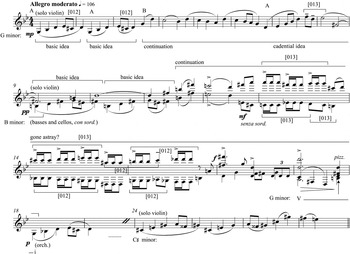
The opening theme of the concerto (the primary or P theme) perfectly exemplifies Prokofiev's aesthetic of ‘new simplicity’ (see Example 1). It begins with the solo violin in its lowest register presenting arpeggiations of the G minor tonic triad with a double neighbour-note figure around scale degree  . In addition the opening phrase adheres closely to conventions of Classical phrase structure. As Example 1 demonstrates, this phrase is a sentence.Footnote 8 The initial arpeggiations and double neighbour-note figure constitute the basic idea (bars 1–2), which is then repeated in a different metrical position (bars 2–3). The descending stepwise motions at the beginning of the continuation offer a motivic contrast to the basic idea, but the ascending arpeggiation and neighbour-note figure of the opening motive return in the cadential portion of the continuation. Matthew BaileyShea calls this design an AABA sentence, which is usually featured in thematic presentations and is ‘particularly notable for its folk-like simplicity’.Footnote 9 Although Prokofiev's continuation is expanded beyond the
expected proportions, it is otherwise very conventional. This allusion to Classical phrase structure is especially apparent because of the theme's lyricism and formal clarity.
Prokofiev, Violin Concerto no. 2 (1935), first movement, opening. © 1937 by Hawkes and Son (London) Ltd. Reproduced by kind permission of Boosey & Hawkes Publishers Ltd. International Copyright Secured. All rights reserved.

Given the conventional melodic design of the phrase, the cadence – or, rather, the lack of a cadence – comes as a surprise. If the diminished seventh interval of bar 8 had resolved as expected to a G minor harmony in bar 9, then the sentence would have concluded with a cadence on the tonic. Instead, Prokofiev retains the F♯ in the solo violin, and the orchestra restates the opening theme, this time in B minor. Because of the strong evocation of the Classical style in bars 1–8, and the strong implications created by the diminished seventh, the B minor harmony of bar 9 is unexpected. This effect is reinforced by the unusual instrumentation. While beginning a concerto with an unaccompanied solo entrance is certainly contrary to Classical norms, introducing the orchestra in so sparse a fashion, with muted double basses and cellos, is equally so, in that it severely downplays the type of textural contrast typically highlighted between soloist and orchestra in a Classical concerto.
The unusual instrumentation and harmony in bar 9 (Fig. 1 in the score) are the first indication of Prokofiev's modern reinterpretation of Classicism. What ensues is an even stronger defiance of Classical expectations. In bar 9 the orchestral B minor version of the theme begins as a transposed version of the opening, with the solo violin adding a countermelody – another B minor arpeggiation beginning in longer note values. Reference to Classical precedents dissolves, however, in the continuation, which features non-functional harmonic successions, chromaticism leading to remote harmonic regions, and extremes of register. It is as if the phrase has gone off track and lost its way.Footnote 10 Tonal momentum stalls as chromatic pitches thwart expectations. For example, the B♮ at the end of bar 13 could be heard as a temporary leading note of C minor. Instead of resolving up to C, however, it descends to B♭ in the following bar, supported by a C♯ in the melody. Similarly, the leap of a diminished fourth in the bass from D♯ to G in bars 14–15 obscures any sense of harmonic progression. Functional harmony returns, however, for the cadence in bars 17–18 (Fig. 2 in the score), with an authentic cadential motion from dominant to tonic in the home key of G minor.
Even at the return of harmonic functionality in bar 17, however, there is a glib reminder of the disruptive orchestral interlude. At the end of the bar the double basses and cellos play a B♮, which is marked with an arrow on the example. This B♮ clashes with the dominant chord presented by the rest of the orchestra, a clash that seems to represent a mischievous reminiscence by the lower strings of their previous B minor escapades. The mischief continues a few bars later in bars 24–7, where the theme is restated in the enigmatic key of C♯ minor. I shall discuss this interesting tonal diversion at the end of the P theme later in the paper.
As Robert Hatten proposes, musical meaning can result from the opposition of or difference between, on the one hand, a marked event and, on the other, an unmarked event (or field of unmarked events) conforming to expected norms.Footnote 11 Throughout the movement B♮ is associated with surprising gestures and thwarted expectations. In other words, it is marked as anomalous in terms of traditional Classical conventions. Consequently I interpret B♮ as a metaphor for disruption and discontinuity. I shall argue that the B minor gestures in Example 1 are not mere surface anomalies, but rather participate in a larger modernist narrative.
The listener is introduced to this modernist thread by the gesture in bars 13–15, which serves not only as a foil to conventions but also as the first sign of an alternative narrative path, one built upon set-class motives. As Example 1 shows, these bars are saturated with [013] and [012] trichords. While there are earlier instances of these set classes in the double neighbour-note figures of the first phrase, these trichords completely permeate the musical surface in the second phrase.Footnote 12 In their initial presentation in the neighbour-note motions of the first phrase the trichords can be understood in a tonal context (for example, the E♭ and C♯ of bar 1 are upper and lower neighbours to scale degree
). The motives of bars 13–15, however, are untethered from a governing tonic. Prokofiev reinterprets the neighbour-note
figure, divorcing it from its functional connotation. The extremes of register, the non-functional successions, and the statement of the complete aggregate within this brief three-bar interjection can all be viewed as modernist gestures. The effect of the passage is accentuated by its extreme disjunction from the music that surrounds it, including distinct contrasts in register, rhythm, and dynamics. These fractures of convention and overtly modernist features are part of the ‘new’ in Prokofiev's ‘new simplicity’.
A sceptical reader may question my interpretation of such chromatic disturbances as a specifically modernist event. After all, Prokofiev is not usually considered a modernist in quite the same sense as Schoenberg or Stravinsky. Furthermore, if surface disjunction were the only qualifying trait, couldn't Beethoven be considered modernist as well? In particular, what might cause Prokofiev's chromatic swerves to be interpreted as expressly modernist gestures? Although the surprising effect of the non-linear surface is an important attribute – the sudden registral shifts, the distant chromatic areas, and the thwarting of phrase expectations – another key feature is the event's lack of integration into a larger framework of harmonic coherence. Unlike Beethoven's, Prokofiev's swerves cannot be subsumed into a middleground tonal progression. Functionality simply lapses. As I have noted elsewhere, this is akin to the stream-of-consciousness writing of literary modernists such as James Joyce or Virginia Woolf.Footnote 13 In stream-of-consciousness writing the grammatical coherence of prose is sacrificed rather as middleground harmonic coherence is sacrificed in Prokofiev's chromatic swerves. Finally, modernist art frequently entails the reinterpretation of a familiar object as something unfamiliar.Footnote 14 In the opening of this movement Prokofiev takes a familiar phrase structure – the Classical sentence – and distorts it. In my article ‘Making it Modern’ I distinguish between mild, moderate, and extreme examples of modernist effects in twentieth-century tonal styles, depending upon the degree of interrelationship between melody, harmony, and formal design. The chromatic disruptions in Prokofiev's Second Violin Concerto tend to be moderate to extreme examples, in which melodic, harmonic, and formal processes all transgress Classical expectations.
Going places (Exposition: Transition)
Typically the transition of the exposition is the point in a sonata movement at which the dialogue between keys begins. Consequently it is an auspicious place to explore the relationships between surface events, tonal rhetoric, and middleground structure. Whereas these three things are usually mutually interdependent in eighteenth-century sonatas, Prokofiev unravels their connection in this transition, which calls into question not only tonal coherence and the meaning of middleground structures, but also the very notion of transition.
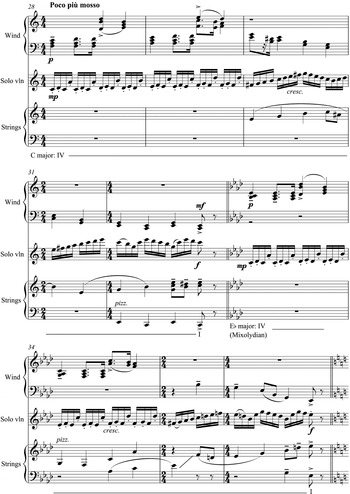
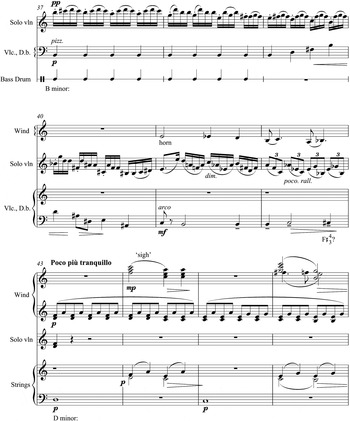
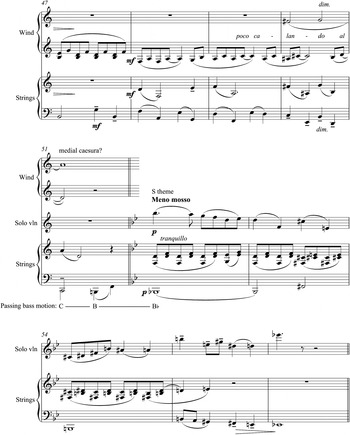
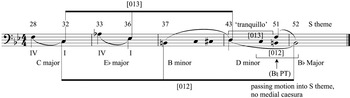
In their explanation of sonata theory, Warren Darcy and James Hepokoski maintain that the primary function of a transition is to gain energy and drive towards what they call a medial caesura, which is the structural cadence that concludes the first section of the exposition and leads into the second theme.Footnote 15 Prokofiev's transition, shown in Example 2, begins with an animated semiquaver rhythmic pattern and an increased rate of harmonic change. In other words, this section begins with very conventional rhetorical signs of a transition. It also begins with a sequential pattern, another typical feature of a transition. The sequential model spans five bars and features a subdominant to tonic progression in C major (bars 28–32; Fig. 3 in the score). Interestingly, there is an E minor quotation of the first theme embedded within this progression. The sequential pattern is repeated in bars 33–6 in E♭ major. This second pattern is shorter than the model by one bar and also features an embedded statement of the first theme idea, this time in A minor. The fragmented thematic motive, the frequent harmonic changes of the sequences, the constant semiquaver motion, and the relatively full instrumentation of winds, strings, and solo violin all work together to create the energized musical surface that is expected of sonata transitions.
Prokofiev, Violin Concerto no. 2, first movement, exposition transition. Reproduced by kind permission of Boosey & Hawkes Publishers Ltd.


Once Prokofiev has invoked the rhetorical conventions of the transition section sufficiently for an audience to recognize them, he then veers off track. At the onset of a B minor harmony in bar 37 (Fig. 4 in the score) conventional signs of a transition dissipate. There are ominous steady beats on the bass drum, which represent the first use of any percussion so far in this movement, and there is a sudden drop in dynamics in the solo violin part from forte to pianissimo. At the same time an odd effect is created by the instrumentation, as the middle register drops out, leaving the sparse and exposed registral extremes of the high solo violin and the low bass drum, double basses, and cellos. Once this new texture has gathered some momentum, there is a reference to the first theme in the lower strings (bar 39) with their ascending crotchet arpeggiation, but the theme gets distorted and there are no neighbour-note figures. This B minor section ends with a poco rall. and an enharmonically spelled and inverted F♯ seventh chord on the last beat of bar 42. The efficacy of this simultaneity as a dominant harmony is severely hampered, however, not only by its diminished seventh (E♭ instead of E♮), but also by the lack of a functional discharge or connection to what follows. In fact, this B minor episode seems not to reach a conclusive end; instead, it dissolves into a D minor ‘tranquil pool’ in bar 43 (Fig. 5 in the score). All of the momentum and ‘energy gain’ (to use Hepokoski and Darcy's term) built up at the beginning of the transition is lost entirely as the harmonic rhythm slows, lower strings move in semibreves, and the upper winds present a legato ‘sigh’.
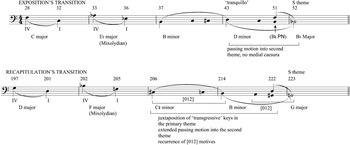
In this transition B minor not only squelches the rhetorical energy gain expected in a transition, but it also disrupts the middleground harmonic progression. Although the first theme of the sonata is in G minor and the second theme begins in B♭ major (the expected mediant of a minor-mode sonata), how exactly does this transition lead us from one to the other? Consider the key successions so far in this transition (see Example 3). The transition moves from C major to E♭ major to B minor to D minor. Obviously these successions do not coalesce into a functional middleground. The only intimation of functional harmony occurs at the very end of the transition (on the last beat of bar 51), where a prominent bass F falls by fifth into the B♭ second theme (as shown in Example 2). It is difficult to hear that F as functional, however, because of several weakening factors. First, the lowest-sounding note of the F major triad in the bar is the C on the downbeat, not the F on the last beat; consequently the chord is in second inversion. Second, the F major harmony competes concurrently with salient B♮s and Ds, which obscure the harmonic function of the bar. Finally, the quasi-F major chord in bar 51 (Fig. 6–1) is not the culmination of a directed progression. There is no clear middleground progression linking that final F harmony with preceding harmonic events. In other words, this transition does not lead to F major in the manner one would have expected in a traditional transition, because it gathers neither harmonic nor rhetorical momentum.Footnote 16
Key successions in exposition transition.

At this important formal juncture (bars 51–2; Fig. 6 in the score), where a traditional transition would provide a rhetorical flourish on a medial caesura, Prokofiev provides instead a contrapuntal slide into the second theme. As can be seen in Example 3, the low B♮ in bar 51 is a passing note connecting the double bass's C on the downbeat with the B♭ that begins the second theme. The stepwise descent began earlier in bar 43, at the onset of the tranquil D minor music. Because there is no rhetorical pause and the connection to the second theme is contrapuntal (not harmonic) the end of this transition seems like the antithesis of a medial caesura.Footnote 17 In summary, B♮ has had three major transgressive effects in this transition: first, the arrival of B minor in bar 37 brought with it a sparse texture, quiet dynamic, and foreboding atmosphere that stifled the ‘energy gain’ that had hitherto characterized the transition; second, B♮ disrupted a middleground harmonic progression by initiating the harmonic swerve to disconnected chordal successions; and, third, it compromised the medial caesura, by substituting for the familiar rhetorical flourish a contrapuntal descent using the B♮ as a passing note.
Once again, at the points where the music veers off traditional trajectories, the modernist narrative comes to the fore. B minor not only foils the transition's expected course, but also participates in a restatement of the chromatic gestures identified earlier as modernist features. Whereas the key successions of the transition do not fit into tonal models, they do reiterate [012] and [013] motives. As Example 3 shows, the [012] C–B–B♭ motive is not only stated at the very end of the transition but also spread across its entire length. This large-scale statement of the motive is shown by the notes connected by the lower beam in the example. A [013] motive is treated similarly in this passage, with a larger-scale unfolding at the beginning of the transition and a smaller-scale one near the end. All the pitch classes involved with these motives are salient as either beginnings or endings of sections, and are rhetorically emphasized by distinct changes of surface design.
A contrasting character (Exposition: S theme)
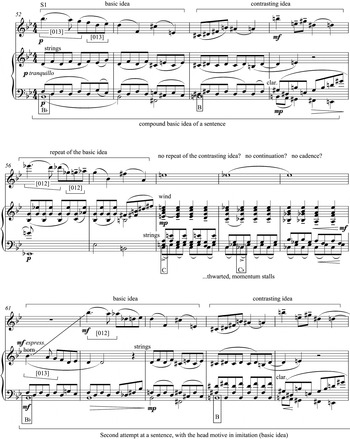
The second theme (or S theme) area also presents an amalgamation of Classical conventions interrupted by modernist outbursts – the characteristic features of Prokofiev's ‘new simplicity’. As Example 4 shows, Prokofiev returns to predictable sonata rhetoric at the beginning of the S theme (bar 52; Fig. 6 in the score) by presenting a quiet, lyrical melody that begins in B♭, the relative major key. In addition this section opens with a loose sentential form, a common phrase structure for an S theme.Footnote 18 It begins with a compound basic idea (cbi) consisting of a basic idea (bi) and a contrasting idea (ci).Footnote 19 Had these four bars ended with a cadence, they could have comprised the antecedent phrase of a period. Without a cadence, however, they retain the harmonic openness typical of a sentential presentation. The melodic structure of these first four bars combined with their placement at the beginning of the S zone creates the expectation of a sixteen-bar sentence: cbi (4 bars) + repeat of cbi (4 bars) + continuation–cadence (8 bars). With the repetition of the basic idea in bars 56–7, these expectations gain further support.
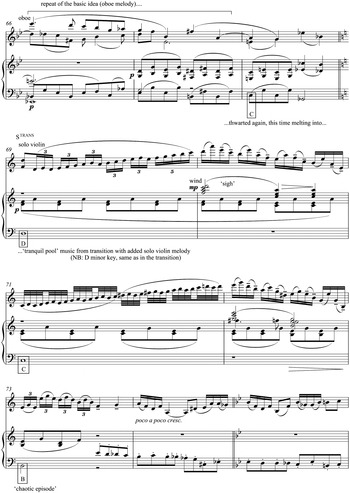
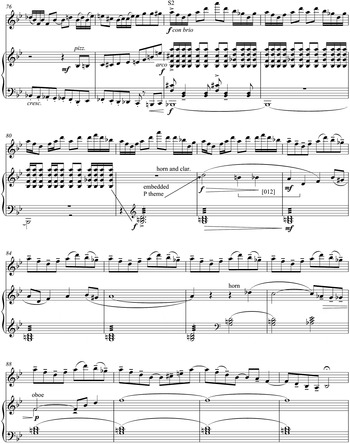
Violin Concerto no. 2, first movement, second (S) theme. Reproduced by kind permission of Boosey & Hawkes Publishers Ltd.


Although the melodic structure of this theme makes clear reference to Classical phrase structure, the harmonic support is not at all traditional. In its most tight-knit form, a grand sentence like this would feature a tonic prolongation throughout the presentation phase of the sentence. It seems far-fetched to consider Prokofiev's harmonic successions as anything remotely akin to the prolongation of a stable tonic. The only relic of harmonic syntax in this theme is the move to the subdominant in bar 56, which signals the return of the basic idea. The harmonies that lead to the subdominant, however, seem driven more by motivic association than by harmonic syntax. As the boxes in the bass line show, the S theme begins by unwinding the stepwise descent of the transition. B♭ (bar 52) yields to B♮ (bar 54), and this line continues in register up to C in bar 58. Notice that this motivic reference is interrupted by the E♭ harmony of bar 56, creating a disjunction between melody and bass. It is as if the return to a comprehensible diatonic harmony in bar 56 is there only to reinforce the melodic phrasing, and once that rhetorical sign is accomplished, the bass line continues its [012] motivic references.
Allusion to Classical melodic phrasing collapses completely in the subsequent bars. The sentence is suddenly broken off, midway through the second statement of the compound basic idea, by a dramatic change of texture and orchestration in bars 58–60. The rest of the sentence is completely omitted; there is no repeat of the contrasting idea (ci), nor any subsequent continuation. Instead, momentum stalls as the solo violin languishes in semibreves and the full orchestra descends in chromatic stepwise motion, with the bass portentously reviewing the C–C♭–B♭ motive. A sentence's continuation would ordinarily provide increased tension, energy, and drive. Prokofiev's version provides just the opposite: a decline in energy, slower rhythms, and a descending contour. In other words, reference to Classical convention lasts long enough to make the listener aware that the second theme has begun, but once that impression has been made Prokofiev again creates an interruption with [012] motives that thwart any harmonic arrival.
As earlier in the piece, a disintegration of tonal expectations ushers in a resurgence of [012] and [013] motives. Not only is the second theme saturated with [012] and [013] set classes, but it also highlights the transformation from one to the other. As Example 4 shows, the first six notes of the melody can be segmented as consecutive [013] set classes. Four bars later this head motive is repeated in E♭ with chromatic alterations, creating two [012] set classes. This progression from a [013] to a [012] was first presented in the P theme and then again in the transition;to my ears it has an intensifying effect as diatonic stepwise motion becomes completely chromatic. Because these motives consistently emerge out of the rubble of tonal dissolution, they take on the disruptive force of modernist elements. In the S theme this association is strengthened by the lack of any harmonic arrival. Instead, the theme drifts back stepwise to B♭ major through a bass-line [012] motive for a second attempt – a repeat of the S1 theme.
In the varied repetition of the theme that immediately follows in bars 61–8 (from Fig. 7 onwards), the different forms of the head motive recur in imitation. The diatonic version is stated first (bar 61), imitated by the chromatic version in the solo violin (bar 62). Thus the diatonic-to-chromatic exchange occurs not only within each eight-bar theme but also between the highest melodies of each thematic statement.
In this variation there is another allusion to a sentence form, along with an ascending bass progression B♭–B–C, which reaches one step further up to D in bar 69 (Fig. 8 in the score). Yet the expectation of a driving continuation is again thwarted, this time in a more dramatic way. Instead of offering a continuation that fragments and liquidates motives, this supposed sentence melts into the ‘tranquil pool’ music from the transition. I call this Strans – in other words, a transition that occurs within the zone of the second theme (the S zone). The reference to the earlier transition is striking because Prokofiev preserves the D minor key and the wind's legato ‘sighs’. This is no fleeting reference, but rather a full repetition of this section of the transition, complete with a bass descent from D (bar 69) to C (bar 71) to B (bar 73). On the arrival of the bass note B, which completes a [013] descent, we veer off into a brief chaotic episode. The lowest register is abandoned, the solo violin spins through the complete aggregate in an unpredictable manner, metric emphases shift with each bar, and the tempo is unstable because of an accelerando. When the bass register returns, B yields to B♭ in bar 78, beginning S2.
Although B♭ is re-attained in the bass register in bar 78 (Fig. 9 in the score), the solo violin presents forte arpeggiations of a D minor chord that conflict with the basses' and bassoons' low B♭. By the end of the S zone (bar 86) the harmonic support has shifted to a G major chord (another instance of B♮ supplanting a B♭), which still conflicts with the soloist's D minor arpeggiations. As a final gesture the P theme returns in the horn and clarinet (bars 82–8). The D minor presentation of the P theme corroborates the solo violin's tonality, but conflicts with the G major chord presented by the rest of the orchestra. At the end of the second theme even the reference to the P theme is tinged with the modernity motive, as the head of the P theme is altered to a chromatic descent, B–B♭–A in bars 82–3, instead of its usual arpeggiation figure. Thus the exposition ends not only with tonal and thematic conflict but also with a repetition of the [012] motives within the P theme.
In summary, what had begun as a surface anomaly in the P theme (the swerve to B minor) has blossomed into an alternative modernist narrative. Within the exposition B♮ is repeatedly associated with transgressive rhetoric, and B♭ fails to assert its prominence as a tonal opposition to the G minor tonic of the movement. While maintaining the rhetoric and gestures of a Classical exposition, with its sentential phrase structures, conventional key areas for thematic ideas, and conventional thematic characters for P and parts of S, Prokofiev calls into question the underlying idea of tonal opposition inherent in the Classical conception of sonata.
Whenever the modernist narrative gains the upper hand in the S zone, one might reasonably question whether sonata theory is still a relevant analytical tool. Given the strong allusions to Classical conventions earlier in the movement, and subsequent ones in the development and recapitulation, I would argue that, whether or not one considers this a sonata movement, Prokofiev is undeniably in dialogue with sonata traditions. In other words, I am not so concerned with what the movement is, but with how the music evolves on a rhetorical level.Footnote 20 How is the story of the errant B♮ and its attendant modernist associations played out in the rest of the movement? In the following discussion of the development and recapitulation I posit that the modernist narrative becomes even more pronounced.
The plot thickens (Development section)
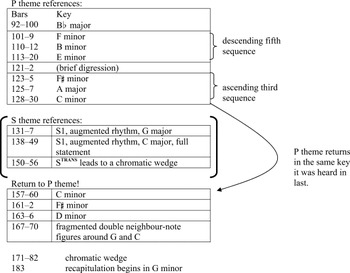
As is the case following most formal boundaries in this sonata, this section begins quite conventionally, such that a listener can become oriented to the Classical aspects of the form. The development starts in bar 92 (Fig. 10 in the score) with an arpeggiation and a neighbour-note figure that recall the P theme, though this time the arpeggiation is inverted to produce a descending contour. This gesture begins in B♭ major, which recalls the convention of starting the development in the key of the second theme. Prokofiev continues with traditional developmental techniques: for instance, the head of the P theme is presented in a stormy sequence of descending fifths.Footnote 21 Table 1 charts the main sections of the development. The sequence begins in F minor with the P theme in its original ascending form and continues through two sequential statements, in B minor and E minor. At the end of the E minor section the sequence breaks off, spinning briefly into a remote harmonic area and ultimately landing in F♯ minor in bar 123 (Fig. 14 in the score). Harmonic succession continues by thirds, as shown in Table 1. This section of the development ends with a C minor version of P material. In all, Prokofiev presents the head of the P theme in six different minor keys, using sequential developmental techniques.
Violin Concerto no. 2, first movement, development section.

The development proceeds with S theme material beginning in bar 131 (Fig. 15 in the score), interrupting the C minor version of P. S theme material offers a contrast to P by virtue of its major mode and its augmented rhythm. Thus this development reiterates the minor-to-major transformation of the P and S themes in the exposition. S material dissipates into a chromatic wedge in bar 155 (Fig. 18–2), leading back to a C minor presentation of the P theme. Interestingly, the S2 theme, the one that had the most intensely modernist associations in the exposition, is not broached in the development. Instead, the P theme returns in the key in which it was last heard (bar 128; Fig. 14+5). It seems significant that this is the first repetition of any key area in the development. Because of the lack of resolution or cadence in the S material, this return to P in C minor (bar 157; Fig. 18) makes the intervening S material seem parenthetical. It is as if S's interruption of the C minor P theme in bar 128 had made no impact, and when S sputtered out, the P theme began again exactly from where it had left off. The tangential nature of the S theme is reinforced by its timbral setting: there is a sudden switch to the woodwind at the onset of S that coincides with an upward shift in register. Lower tessitura and a predominance of strings return when P material is resumed in bar 157.
I interpret this development as an oasis that minimizes the signs of fracture and disjuncture that function elsewhere as modernist elements. Of course this is an ironic position, given the traditional understanding of a development as the nexus of fragmented themes and harmonic agitation. Although Prokofiev uses traditional developmental techniques, they do not have quite the same destabilizing effect that they would have in an eighteenth-century context. In a sonata in which the exposition features sudden and quirky swerves to distant keys, a descending fifth sequence – such as the one in bars 92–120 (Fig. 10 onwards) – seems more like a return to enlightened reason than a sign of volatility. In addition, Prokofiev avoids all allusions to S2, the most chaotic and fractured theme of the exposition. Lastly, the [013] to [012] exchange of S1 is minimized in this development as a parenthetical utterance. This development is a supreme example of Prokofiev's humorous irony, in which the seemingly straightforward adoption of traditional techniques ends up meaning the exact opposite of what it would have meant in its original context – in other words, this is modernist satire.
The return (Recapitulation)
The recapitulation begins with a G minor restatement of the primary theme in the cellos and double basses, though this section is truncated because the B minor and C♯ minor tangents are omitted. Transition material begins in bar 197 (Fig. 22 in the score), transposed up a whole tone from its original presentation in the exposition. Example 5 shows the corresponding key successions. Although there are many exceptions in the common-practice period, one would ordinarily expect a recapitulatory transition, or at least its ending, to be transposed to accommodate its new tonal goal – a medial caesura that ushers in the second theme in the tonic key. In this case, the end of the transition (bars 214 ff; Fig. 24) is transposed down a minor third to accommodate the new key of the second theme, G major. In other words, Prokofiev seems to have made an effort to preserve the contrapuntal connection at the end of the transition, the one that avoided any semblance of a traditional medial caesura. In the exposition's version B♮ was a passing note that obscured any possible caesura effect. In the recapitulation B minor has a different role, as the key that corresponds to what I called the ‘tranquil pool’ in the exposition. Is B minor now the tranquil pool? Significantly, Prokofiev does not reiterate the poco più tranquillo tempo indication that he used in the corresponding place in the exposition. I have a different interpretation of events in this transition, in which this B minor passage continues a modernist narrative.
Key successions in the transitions of the exposition and recapitulation.

Prokofiev's key choices at the beginning of the recapitulation's transition seem not to be motivated by harmonic conventions. What explanation could there be for transposing the beginning up a whole tone in relation to the corresponding bars in the exposition? Because the key choices in the exposition's transition did not coalesce into a cogent middleground structure, it may not come as too much of a surprise that the keys of the recapitulation's transition also derive from sources outside the realm of middleground harmonies. Perhaps there is a rhetorical explanation for these keys. According to Robert Hatten's ideas about musical narratives, meaning can be constructed by a rhetorical opposition between a musical gesture and a listener's expectations.Footnote 22 In this case Prokofiev's transposition levels are different from those that would be motivated by harmonic reconciliation, and so we seek a different rhetorical explanation.
By transposing the first part of the transition up a whole tone and the last part down a minor third Prokofiev juxtaposes the two transgressive keys of the primary theme – C♯ minor and B minor. This juxtaposition is important because it requires an alteration from the exposition's path of material. In bars 37–43 (Fig. 4, shown in Example 3) Prokofiev connects B minor to the tranquil pool of D minor by means of an upward passing motion through C and C♯. In the corresponding bars in the recapitulation (bars 206–14; Fig. 23 onwards) he descends from C♯ minor to B minor via a C♮ chromatic passing note. Not only do the changes in the recapitulation juxtapose the transgressive keys but they also exaggerate the contrapuntal technique that originally thwarted expectations at the end of the exposition's transition. Here the descending passing motion is extended by eight more bars, beginning on C♯ in bar 206 (Fig. 23). This long descent can be divided into two [012] motives, C♯–C–B andA–G♯–G. Notice that the only missing pitch in this chromatic descent is a B♭, an interesting omission. Throughout the movement B♭ has been the ambassador of tradition, while B♮ revelled in modernist escapades. Consequently the absence of B♭ within this expanded modernist motive could symbolize the decline of traditional sonata rhetoric.
The G major return of the second theme in the recapitulation has a double meaning because of its approach from this contrapuntal device, this time originating from C♯ minor and moving through B minor. Although G major could be a redemptive resolution of the tonal conflict of the sonata, I hear this unconventional approach from B minor as a factor that complicates such a simple resolution of its tonal dialectic. Because of the untraditional progression from B minor, the subsequent arrival of the second theme in G major lacks a profound sense of resolution. Although the return of the second theme in the tonic key (and in a redemptive major mode, no less) would traditionally be the nexus of reconciliation of the harmonic drama of a sonata, in this context – namely when G major remains disconnected from any prior prolongational structure – the recapitulatory significance of the second theme's key loses its tonal potency. Once again B minor acts in a transgressive manner, as the agent for disjunction and the disruption of conventions.
G major is not achieved in bar 223 (Fig. 25) through harmonic means: it is not integrated into the harmonic fabric of the sonata and it cannot be related by way of a coherent middleground to the corresponding passages in the exposition. Consequently its meaning as a tonal resolution is attenuated. Its connection to previous material is mostly associative or motivic, not structural. What, in essence, does this G major mean, if it is not tonally motivated? I suggest that this return to a G tonic in the major mode is a rhetorical device, not a structural one. Rhetorically, the G major key of the second theme is a nod to tradition, as the straight man to an ironic twentieth-century twist on sonata form.
The turning point (S theme, Recapitulation)
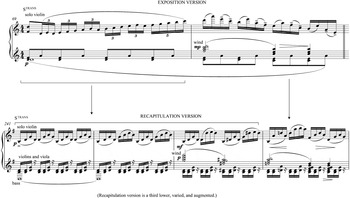
The modernist narrative emerges at its peak in the recapitulation of the second theme. At the beginning, however, conventions are maintained so that the listener can recognize the formal boundary. The S theme returns in bar 223 (Fig. 25), and for seventeen bars (bars 223–39) Prokofiev provides a clear recapitulation of S1 events as they were in the exposition, except this time in the generically expected key of G major. If G major were confirmed by a cadence, then B♮ would be vindicated, at least rhetorically, as part of the tonic resolution of the sonata into the major mode. The first glimpse of the changes that would be necessary to transform the narrative into such a triumph occurs within Strans. As is demonstrated in Example 6, Strans is varied, augmented, and transposed in the recapitulation. The first bar from the exposition version of Strans blooms into three bars in the recapitulation, shown by the brackets on the example. Not by coincidence, Strans now emphasizes the rhetorically charged B♮ as the lowest pitch of the violin solo and by means of agogic accent in the double basses and bassoon. Had Prokofiev provided a conventional transposition of Strans material down a third from its D minor presentation in the exposition, then this passage would have been in B minor. Instead he avoids the key that has been associated with transgressive acts and contextualizes the low B♮ still within G major. Interestingly, once the low B is asserted at the beginning of Strans (bar 241; Fig. 27) by the double basses and bassoons, the bass register is abandoned completely until bar 251 (Fig. 28+2).
Comparison of exposition and recapitulation versions of Strans.

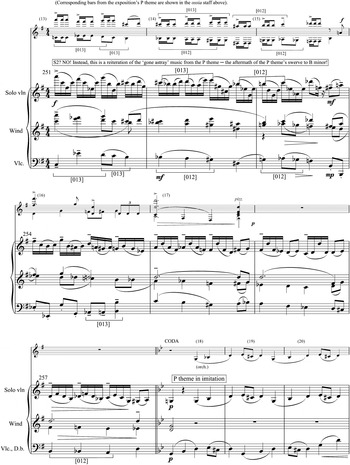
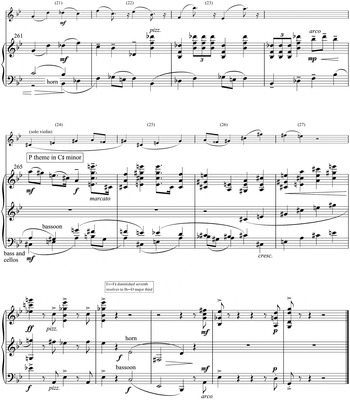
When the bass register returns, something is amiss (see Example 7). This is the point at which we might expect critical changes that would alter the course of the S theme from its expositional path of disintegration into fractured chaos towards a transformative fulfilment of a G tonic. Alas, this fulfilment remains elusive. Not only is there no cadence confirming G major but also the whole of the rest of the S theme is abandoned, never to be recapitulated.Instead, Prokofiev inserts a varied repetition of bars 13–17 of the P theme, which recalls the very first instance in which the movement went ‘astray’ from traditional expectations. Bars 13–17 were the aftermath of the P theme's first swerve to B minor. (See Example 1 for the initial context of bars 13–17.) As Example 7 shows, bars 251–5 correspond to bars 13–17. This material is presented at the same pitch level as in the exposition, demonstrating an immutable nature unresponsive to the events of the development or the transformations of the sonata process. Example 7 shows the recurrence and saturation of [013] and [012] set classes, and the continued progression from the diatonic [013] to the fully chromatic [012]. Whereas key relationships and tonal closure are paramount in a traditional sonata, here Prokofiev eschews those values in favour of presenting a final, dramatic, modernist eruption. With the constant semiquaver motion in the solo violin, the added wind in the middle range, and the cellos presenting what had been the low notes of the solo violin's double stops, the passage has a heightened chaotic effect compared to its first appearance. At the very point at which formal closure would be expected, Prokofiev includes an unexpected review of the very first modernist swerve of the piece, in its original key and with orchestral flourish. Ironically this rounds out the modernist narrative, while leaving the tonal conventions in the lurch.
Violin Concerto no. 2, first movement, end of recapitulation and coda. Reproduced by kind permission of Boosey & Hawkes Publishers Ltd.


Tying up loose ends (Coda)
As the remainder of Example 7 shows, the coda presents the parts of the P theme that had been left out of the recapitulation's abbreviated restatement, including the imitative presentation of the P motive (bars 258–61; Fig. 29) and the surprising swerve to C♯ minor (bars 265–7). In bars 270–71 the horn recalls the descending diminished seventh interval, E♭–F♯, that had led to the first troubling B minor passage of the piece (bars 8–9). As a final feeble attempt at tonal closure, this diminished seventh leads to a B♭–D major third (bar 271) – a wistful attempt to correct B♮'s transgressions in the sonata and a mournful reminiscence of what might have been. Finally, with characteristic impish impunity, Prokofiev ends the movement with a falling-fifth bass motion, D–G, as if we will finally hear an authentic cadence – an event that has been avoided with great skill – but he leaves out the third of the chord. There will be no definitive resolution of the B♭ versus B♮ conflict.
In the title of this article I call this piece a ‘quiet revolution’, not only because the transgressive B♮ often enters pianissimo but also because this neoclassical style is fairly conservative when compared to that of works written up to three years either side of it, such as Schoenberg's Fourth Quartet and his Violin Concerto (both 1936), and Bartók's Fifth Quartet (1934) and his Second Violin Concerto (1938). Berg's Violin Concerto was written in the same year (1935), as was Henry Cowell's Third Quartet, the ‘Mosaic’. In this sonata movement, Prokofiev brilliantly integrates tradition and innovation – themes that run through most modernist pieces of the time – and yet he does so by writing music that retains an essential simplicity. In accordance with his artistic vision, Prokofiev thought that this music would also appeal to the Soviet public.
Unlike other modernist deformations of Classical conventions, Prokofiev's ‘new simplicity’ is tightly tethered to its eighteenth-century muse. It must recreate the semblance of Classical style sufficiently to create strong expectations of continuity, which are then thwarted by distinctly transgressive events. The sentential phrase structures, conventional key areas, and formal clarity represent the ‘simplicity’ in Prokofiev's mature style. This sonata movement is not, however, a product of the Enlightenment: thematic and harmonic differences do not consummate their relationships through dialectical or teleological processes of opposition and resolution. With no grounding in cogent middleground motions, the structural dialectic between keys is severely compromised. Instead, conventional aspects of the themes, key areas, and formal designs serve only as rhetorical signs, not as integrated structural events. In its many guises B♮ upsets the deeper order of Classical coherence that these traditional elements might otherwise have suggested.
I interpret the chaotic outbursts affiliated with B♮ as modernist elements because they disrupt linear continuity, fracture tonal coherence, and exhibit extremes of register, dynamics, and textural contrast. In addition they feature a consistent recurrence of [013] and [012] set classes, often moving from [013] to [012] and thus accumulating a concentration of semitones. In accord with general attributes of modernism, Prokofiev's ‘new simplicity’ takes a familiar object and revises it in an unexpected manner, using surprising juxtapositions and fragmented textures. This is the ‘new’ in Prokofiev's ‘new simplicity’.
This essay provides a detailed account of just one piece, yet the compositional strategies discussed are representative of Prokofiev's mature style, a style that spans twenty years and encompasses his most popular works. One of the essential aspects of the style is its accessibility, which is fostered by its references to tonality and traditional sonata processes. I believe that this accessibility was part of the reason Prokofiev believed that his new style would find favour in Stalin's Soviet Union. Because allusions to convention are strongest at the beginning of each formal section, listeners can orient themselves to the structure of the sonata at every important thematic and formal juncture. In this way Prokofiev's ‘new simplicity’ can be compared to the highly representational nature of socialist realism's manifestations in the visual arts, which emerged in the same years.Footnote 23 Although not explicit, an awareness of this relationship is suggested by Prokofiev in a diary entry in 1933, which I quote below. I conclude with this quotation because it summarizes Prokofiev's sentiments on central issues of this article, including the provocative tensions between accessibility, modernism, and artistic integrity.
Lessons with students and several of their awkward attempts to compose something contemporary, and likewise the unsuccessful attempts of proletarian musicians (attempts at simplicity, which does not come easy without technique) […] gave me the idea that what is needed now is to create for the masses in a manner that allows the music to remain good. My previous, melodic pieces and my search for a ‘new simplicity’ have prepared me well for this task.Footnote 24