Introduction
Subjective memory complaints (SMCs) are common amongst older adults and have been found in some studies (Mol et al., Reference Mol, Carpay, Ramakers, Rozendaal, Verhey and Jolles2007) but not all (McIlvane et al., Reference McIlvane, Popa, Robinson, Houseweart and Haley2008) to be associated with significant distress and anxiety. However, the degree of distress appears unrelated to severity of objective cognitive impairment (Elfgren et al., Reference Elfgren, Gustafson, Vestberg and Passant2010). The reasons why some older adults experience distress associated with their SMCs while others do not remain unclear.
Differential adjustment to both physical and mental health problems has been widely demonstrated to be associated with the beliefs a person holds about their health condition (Hagger and Orbell, Reference Hagger and Orbell2003). The Common Sense Model of Illness Perception (hereafter referred to as “the model”) (Leventhal et al., Reference Leventhal, Nerenz, Steele, Baum and Singer1984) is a theoretical model of how people respond when they experience health problems. Leventhal and colleagues argue that when an individual experiences symptoms of illness he/she will formulate a common sense model of the problem. This model consists of beliefs or perceptions about the symptoms based on information from several sources including past experience, lay knowledge, information from friends and family, the media and the medical profession. Beliefs run along five major themes: the cause of the symptom, the consequences of the symptom, how long the symptom is likely to last, controllability of the symptom, and finally the label applied to the symptom. These beliefs are thought to determine the coping strategies an individual employs to deal with the health condition, which in turn determine psychological adjustment. Specifically, illness perceptions themselves are not thought to impact directly upon adjustment; rather, their effects are argued to be mediated by the coping strategies selected. Illness perceptions, coping and health outcomes have been associated across several health conditions (Hagger and Orbell, Reference Hagger and Orbell2003; Petrie et al., Reference Petrie, Jago and Devcich2007).
Illness representations and coping have recently become a focus of interest in memory disorders; the model has been employed to explore beliefs about dementia (Clare et al., Reference Clare, Goater and Woods2006; Harman and Clare, Reference Harman and Clare2006), mild cognitive impairment (MCI) (McIlvane et al., Reference McIlvane, Popa, Robinson, Houseweart and Haley2008) and help-seeking for memory problems (Hamilton-West et al., Reference Hamilton-West, Milne, Chenery and Tilbrook2010). A preliminary investigation of illness perceptions and coping in early stage dementia found those patients with low control beliefs were more likely to be depressed or anxious (Clare et al., Reference Clare, Goater and Woods2006). Consistent findings have been seen in samples of community-dwelling older adults. Older adults who perceive more control over their memory and report less forgetfulness have less memory-related anxiety and better well-being (Commissaris et al., Reference Commissaris, Ponds and Jolles1998; Verhaeghen et al., Reference Verhaeghen, Geraerts and Marcoen2000). Furthermore, a preliminary study of perceptions of SMCs exploring the model's dimensions of illness perception found beliefs about SMCs to be related to depression (Hurt et al., Reference Hurt, Burns, Brown and Barrowclough2010). Perceiving memory problems to have serious consequences, holding a strong illness identity and perceiving low personal control over memory problems were all related to greater depression.
There has been little exploration of coping in memory disorders although Clare et al. (Reference Clare, Goater and Woods2006) did find that early stage dementia patients who had a limited coping repertoire were more depressed and anxious. The association between coping and well-being is well established in the chronic illness literature (Felton and Revenson, Reference Felton and Revenson1984). Problem-focused forms of coping which involve seeking solutions to problems are often viewed as more adaptive than emotion-focused coping where emotional responses (e.g. anger) or avoidance (e.g. denial or distraction) are employed in an attempt to manage the stress produced by a problem.
Together, the research into coping and illness perceptions suggests that beliefs and coping may underlie differential adjustment to SMCs.
A recent review of non-pharmacological interventions for SMCs concluded that to date most intervention studies have focused on improving memory rather than alleviating depression and anxiety (Metternich et al., Reference Metternich, Kosch, Kriston, Harter and Hull2010). Interventions included standard memory training and/or psychoeducation aimed at changing beliefs and attitudes about memory. Only a limited number of studies measured depression or well-being as an outcome. Those studies that did showed little effect of interventions on reducing depression and anxiety, although psychoeducation showed more promising results than memory training (Metternich et al., Reference Metternich, Kosch, Kriston, Harter and Hull2010).
By better understanding the beliefs and coping strategies that cause older adults with SMCs to become distressed and worried by their condition, psychological therapies such as cognitive restructuring and psychoeducation can be targeted towards altering beliefs particularly associated with distress. Experimental studies in other health conditions have demonstrated that interventions based on altering patient perceptions of illness lead to both changes in perceptions and improved outcomes (Broadbent et al., Reference Broadbent, Ellis, Thomas, Gamble and Petrie2009).
The aim of the present study was to examine the relationships between perceptions of SMCs, coping, and depression and anxiety to determine the strongest predictors of distress. The secondary aim of the study was to test the proposed mediating effect of coping on the relationship between illness perceptions and outcomes as proposed in the model. Based on previous findings it was hypothesized that holding strong identity perceptions (attributing lots of symptoms to SMCs), perceiving serious consequences of SMCs and low perceptions of control over SMCs combined with use of avoidant coping strategies would predict greater depression and anxiety.
Methods
Participants
Ninety-eight participants with SMCs were recruited: 34 males and 64 females (mean age 73.4 years, range = 53–91, SD = 8.8, mean MMSE score 27.4, range = 24–30, SD = 2.6, mean years of education = 10.8, range = 0–20, SD = 2.9, mean pre-morbid intelligence (as measured by the National Adult Reading Test; Nelson and Willison, Reference Nelson and Willison1991) 108.1, range 82–127, SD = 11.4). All participants were aged 50 years or over, did not have serious or unstable medical conditions and scored 24 or above on the Mini-Mental State Examination (MMSE) (Folstein et al., Reference Folstein, Folstein and McHugh1975). All participants reported subjective memory problems with onset in middle/old age. Participants reported a mean duration of memory problems of 4.8 years since first onset (range = 1–26, SD = 4.2).
Procedure
In order to encompass the widest range of perceptions that people with SMCs hold, both help-seekers and non-help-seekers were included. A consecutive series of individuals with SMCs attending the Manchester Memory Clinic were invited to take part in the study. All those approached about the study agreed to participate. In addition, participants with SMCs were recruited from community groups and sheltered housing projects. A short presentation about the research project was given at group meetings. Individuals interested in participating in the project approached the researcher after the meeting. Five participants refused to take part in the study: two due to family problems, one due to ill health, one did not want any visitors and one gave no reason. After obtaining informed consent, all assessments were performed at a single visit to the participant's home by the researcher (Ethics Ref: 03/NM/623).
Measures
The Illness Perception Questionnaire for Memory Problems (IPQ-M) (Hurt et al., Reference Hurt, Burns, Brown and Barrowclough2010) is a version of the Illness Perception Questionnaire – Revised (IPQ-R) (Moss-Morris et al., Reference Moss-Morris, Weinman and Petrie2002) adapted for the use in individuals with SMCs. The measure comprises 11 subscales: identity (the symptoms attributed to SMCs), timeline acute/chronic (ideas of how long the SMCs will last), timeline stability/decline (beliefs about whether the SMCs will remain stable or deteriorate), personal control – blame (extent to which an individual blames themselves for not trying to control their memory), personal control – helplessness (extent to which an individual feels unable to control their memory), consequences (consequences of SMCs for the individual), emotional representation (an individual's emotional reaction to SMCs), illness coherence (the extent to which SMCs make sense to the individual), treatment control (beliefs about the efficacy of treatment), social comparison (perceptions of whether one's memory is worse than one's peers) and cause of SMCs. All subscales are measured on a five-point Likert scale except identity which is a yes/no symptom checklist of common memory complaints. Items specifically related to memory complaints were added to the cause subscale: lack of concentration/not listening properly, loneliness, lack of blood to the brain, loss of brain cells, stroke, not using my brain enough, and trauma e.g. death of a loved one (see Table 2). Standardized subscale scores were computed (the raw score divided by the number of items in the subscale), except for the identity subscale which is a cumulative score. Higher scores indicate greater endorsement of the perception of interest. A full description of the measure and its clinimetric properties can be found elsewhere (Hurt et al., Reference Hurt, Burns, Brown and Barrowclough2010).
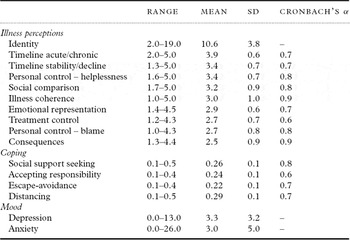
Coping was assessed using the Ways of Coping Questionnaire (WCQ) (Folkman et al., Reference Folkman, Lazarus, Pimley and Novacek1987) (subscales: escape-avoidance, social support seeking, self-control, confrontative, distancing, accepting responsibility, planful problem solving and positive reappraisal). Specific coping strategies were elicited using a standard brief vignette of an illustrative every-day instance of forgetting: ‘Recently you have noticed that you have difficultly remembering things that you need when out shopping and often come home having forgotten important things. How often would you use each of the following ways of coping in relation to this situation?’. The vignette was developed through a brief consensus exercise between a clinical psychologist and old age psychiatrist focusing on common problems for older adults with SMCs. The vignette and WCQ were piloted with four people with SMCs attending a Memory Re-training group for acceptability. The confrontative subscale was removed from the measure as it was not felt to be relevant to memory problems and made the questionnaire difficult to answer. The planful problem solving, self control, and positive reappraisal subscales were found to be unreliable with Cronbach's α below 0.6 (Table 1). Therefore these subscales were dropped from the analysis. Scores were computed as a percentage representing each subscale as a proportion of total coping effort (Vitaliano et al., Reference Vitaliano, Maiuro, Russo and Becker1987).
Descriptive statistics: illness perceptions, coping, depression and anxiety (N = 98)

Depression was assessed using the 15-item self-report Geriatric Depression Scale (GDS; Yesavage et al., Reference Yesavage1983) (mild depression ≥5, severe depression ≥10 severe depression). The Beck Anxiety Inventory (BAI; Beck et al., Reference Beck, Epstein, Brown and Steer1988) was used to assess anxiety (mild anxiety ≥9, moderate anxiety ≥18).
Statistical analysis
All statistical analyses were undertaken using SPSS 15.0. In order to explore relationships between all study variables, Pearson's correlations were performed between demographic and clinical variables, illness perceptions, coping styles, GDS scores and BAI scores. All variables were normally distributed with the exception of BAI scores which were positively skewed and had a platykurtic distribution. Log transformation was used to normalize the distribution. Due to the large number of comparisons made, only correlations significant at the P≤0.01 were taken to be significant and entered into the regression analyses.
A series of hierarchical regression analyses were then performed to identify statistical predictors of depression (GDS scores) and anxiety (BAI scores) and to test the hypothesized mediating effect of coping on the relationship between illness perceptions and outcome. Baron and Kenny (Reference Baron and Kenny1986) suggest a series of steps be taken when testing a mediation model: (1) outcome variables should be regressed onto illness perceptions to establish a relationship; (2) coping should be regressed onto illness perceptions to establish a relationship; (3) outcome should be regressed onto both illness perceptions and coping. In the final models, illness perceptions were entered into the first step and coping into step two. This order of entry allows testing of the mediation hypothesis of the model. If the relationships between illness perceptions and outcome are mediated by coping strategies, illness perceptions should significantly predict outcome in step one but this effect should be reduced with the addition of coping in step two (Baron and Kenny, Reference Baron and Kenny1986). In the following sections, the term “predictor” refers to a statistical predictor rather than a causal predictor, which would require a longitudinal rather than cross-sectional design.
Results
Descriptives: illness perceptions, coping and mood
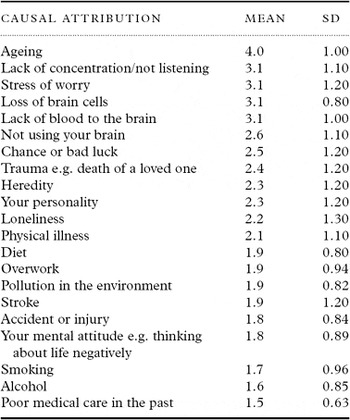
The most strongly endorsed perceptions of SMCs were: chronic timeline (timeline acute/chronic), expectation of future decline (timeline stability/decline) and feelings of helplessness (personal control – helplessness). Least strongly endorsed perceptions were: personal blame (personal control – blame), treatment control and consequences (Table 1). Mean scores for all causal items are shown in Table 2. The following items were endorsed as a possible cause of SMCs (mean score >3): stress or worry, lack of concentration/not listening properly, lack of blood to the brain, loss of brain cells and age. Mental attitude, drinking alcohol and smoking were among the least frequently endorsed casual items.
Mean scores on each IPQ-M cause item

IPQ-M = Illness Perception Questionnaire for Memory Problems
Coping efforts were spread evenly across the coping subscales, with distancing being the most used, and escape-avoidance the least used, strategy. Ten percent of participants scored in the mildly anxious range and 2% in the moderately anxious range on the BAI and 22% in the mildly depressed range and 6% in the moderately depressed range on the GDS; mean scores on both measures were in the not depressed/anxious range (Table 1).
The internal reliabilities of all subscales are shown with the exception of identity as this is a symptom checklist. Reliabilities were reasonable with all α ≥0.6.
Thirty-eight of the participants were recruited from community groups and sheltered housing; the remaining 60 were recruited from a memory clinic. No significant differences were found in MMSE score (t (96) = 0.922, p = 0.359), BAI score (t (96) = 0.925, p = 0.357) or GDS score (t (96) = 1.560, p = 0.122) between samples.
Univariate relationships between illness perceptions, coping, depression and anxiety
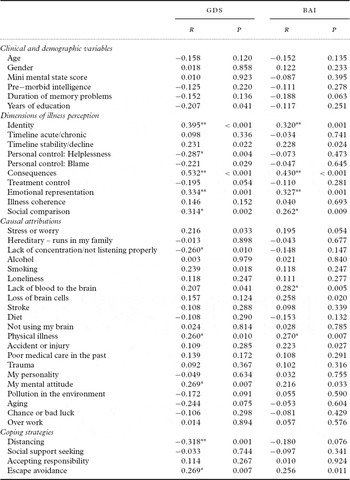
Pearson's correlations were performed between GDS scores and BAI scores and illness perceptions, coping, MMSE scores, duration of memory problems, age, and years of education. Significant correlations are shown in Table 3.
Pearson's correlations between study variables and depression and anxiety

** Correlation is significant at the 0.001 level * Correlation is significant at the 0.01 level
GDS = Geriatric Depression Scale; BAI = Beck Anxiety Inventory
Demographic and clinical variables were not significantly correlated with depression or anxiety. Depression significantly correlated with perceptions of low personal control (helplessness – feeling nothing can be done to control memory problems), strong illness identity (attributing lots of symptoms to SMCs), serious consequences of SMCs, having a negative emotional reaction to SMCs (emotional representation) and perception of memory as worse than peers (social comparison). Attribution of memory problems to physical illness and mental attitude correlated with greater depression scores, while belief in lack of concentration/not listening properly as a cause of SMCs correlated with less depression. Greater use of escape-avoidance and less use of distancing correlated with greater depression.
Fewer significant correlations were found between anxiety and study variables. Strong illness identity, serious consequences, negative emotional reaction (emotional representation) and perception of memory as worse than peers (social comparison) all correlated with greater anxiety. Attribution of memory problems to lack of blood to the brain and physical illness correlated with greater anxiety scores. No coping measures significantly correlated with anxiety.
Multiple regression models of depression and anxiety
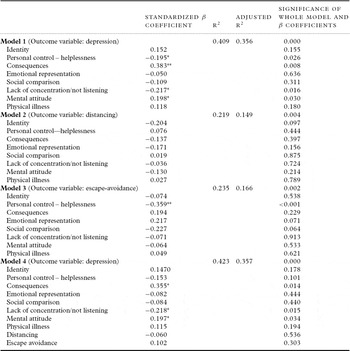
Perceptions of SMCs significantly associated with GDS scores at p ≤ 0.01 were entered into the first regression model. Illness perceptions explained 36% of variance in GDS scores (Table 4). Perceptions of low personal control and serious consequences predicted greater depression along with attribution of SMCs to mental attitude. Attributing SMCs to lack of concentration/not listening predicted less depression.
Regression models testing the model in depression

Following the approach of Baron and Kenny (Reference Baron and Kenny1986) the relationships between illness perceptions and coping were explored in two further regression models. No dimensions of illness perceptions significantly predicted distancing; however, personal control (helplessness) predicted escape-avoidant coping.
When coping strategies and illness perceptions were added to the final regression model, the addition of coping only increased the variance explained very slightly from 0.356 to 0.357. The change in R2 was not significant (F = 1.049, p = 0.355). Coping did not significantly predict depression. In the final model, consequences and causal attributions significantly predicted depression.
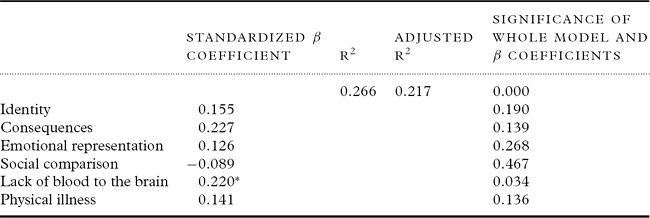
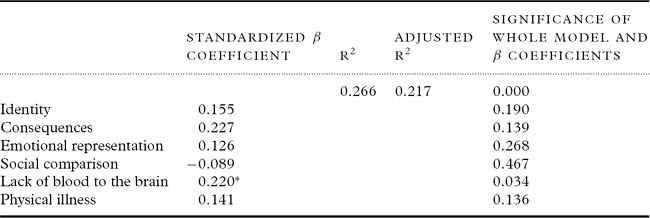
A regression model was performed to examine predictors of anxiety. Coping strategies were not found to correlate significantly with BAI scores in the univariate analysis, therefore only illness perceptions were entered into the model. Illness perceptions explained 22% of variance in BAI scores (Table 5). However, attribution of memory problems to lack of blood to the brain was the only significant predictor of anxiety.
Beta weights and significance levels of predictors of anxiety
Discussion
The aim of the present study was to explore the relationships between illness perceptions, coping and depression and anxiety in older adults with SMCs to identify predictors of distress. As hypothesized, illness perceptions did predict depression and anxiety in older adults with SMCs. In line with previous research (Elfgren et al., Reference Elfgren, Gustafson, Vestberg and Passant2010), level of cognitive impairment and duration of memory problems were not found to be significantly associated with distress, suggesting that distress is not simply a product of illness severity.
Overall, participants did not hold strong negative perceptions of their SMCs, as evidenced by mean IPQ-M scores between 2.5 and 3.9, and did not display clinically significant depression or anxiety in line with a previous study in MCI (McIlvane et al., Reference McIlvane, Popa, Robinson, Houseweart and Haley2008). This is surprising given previous reports of significant distress in SMCs (Mol et al., Reference Mol, Carpay, Ramakers, Rozendaal, Verhey and Jolles2007). Also consistent with McIlavne et al. (2008) was the greater reported use of problem-focused coping strategies than maladaptive strategies such as escape-avoidance.
Participants most frequently attributed their memory problems to psychological factors such as not listening properly and stress or worry. They were least likely to attribute their memory problems to causes which indicated some level of personal blame, e.g. thinking negatively, drinking alcohol and smoking. This is an interesting finding: the lack of perceived guilt and blame over SMCs may be associated with the relatively low levels of distress in the present sample.
All but four of the eleven dimensions of illness perception measured were associated with distress; negative perceptions were associated with greater distress. Timeline acute/chronic, timeline stability/decline, treatment control and illness coherence were not associated with distress. Cognitive function is commonly believed to deteriorate with age and is not necessarily a negative or maladaptive perception. Likewise, perceptions of low treatment control of SMCs may reflect the lack of knowledge of interventions available for memory problems such as memory retraining and cognitive restructuring (Metternich et al., Reference Metternich, Kosch, Kriston, Harter and Hull2010) rather than a negative belief about the efficacy of treatments. Furthermore it may be an accurate reflection of the current lack of interventions available for this patient group. In both cases we would not expect these perceptions to be associated with distress.
Contrary to the model, coping did not mediate the effects of illness perceptions on outcome. Coping was not found to correlate with anxiety at p ≤ 0.01 so no further testing of the mediating effect of illness perceptions upon anxiety could be conducted. While distancing and escape-avoidance were correlated with depression, when entered into a regression analysis with illness perceptions they did not significantly predict depression ruling out a mediating effect. This lack of mediation is in line with previous studies which have also failed to find a mediating effect of coping (Scharloo et al., Reference Scharloo, Kaptein, Weinman, Bergman, Vermeer and Rooijmans2000; Fortune et al., Reference Fortune, Richards, Griffiths and Main2002; Groarke et al., Reference Groarke, Curtis, Coughlan and Gsel2004; Lobban et al., Reference Lobban, Barrowclough and Jones2004).
Implications
The findings of the present study are preliminary but suggest that illness perceptions, rather than coping strategies, should be the primary target of interventions designed to relieve distress in patients with SMCs. The present findings suggest that changing an individual's perception of the consequences of SMCs may help to relieve depression – for example, through challenging patient interpretations of memory failures to be less catastrophic. Furthermore, targeting causal attributions may help to improve well-being. Attribution of memory problems to lack of blood to the brain was associated with greater anxiety. Attribution to a biological cause such as this may lead to feelings of helplessness regarding memory problems. Educating patients about psychological factors which may influence memory and which may be controllable by the patient may help to reduce feelings of helplessness and improve well-being. This idea is supported by the finding that attribution of memory problems to lack of concentration/not listening properly was associated with less depression. Interventions based around patient perception of SMCs, in addition to work based around coping methods, may improve the efficacy of more generic psychoeducation interventions in alleviating depression and anxiety.
The findings of the study also have implications for the model itself. According to the model, the relationships between illness perceptions and outcome are mediated by coping, rather than perceptions having a direct effect upon outcome. However, the findings add to a growing body of literature suggesting that illness perceptions have direct effects upon outcome which are not mediated by coping strategies. In the light of these findings some revision of the model may be necessary.
Limitations
The model proposes causal relationships between illness perceptions, coping and outcomes; patients formulate beliefs about their illness which influence the choice of coping strategy they employ. The outcome of this act of coping is then appraised which determines psychological adjustment. The present study was cross-sectional, which prevented testing of the direction of these relationships, and therefore no conclusions can be drawn regarding causality. A longitudinal or experimental design is required to test the direction of causal relationships.
Questionnaire measures of coping have been criticized in illness perception studies for failing to capture the complexity of coping and for measuring generic forms of coping which may differ depending on the situation (Parker et al., Reference Parker, Endler and Bagby1993). In the present study attempts were made to overcome some of the problems associated with coping checklists by providing a vignette of forgetting on which participants could base their answers. The development of an illness-specific coping measure may further clarify the relationships between illness perceptions, coping styles and outcomes in people with SMCs.
Limitations of the sample should be considered. The sample was relatively small (N = 98); had a larger sample been available greater effects of coping may have been demonstrated. Furthermore, the sample was recruited from two sources: community and memory clinic. It is possible that significant differences may exist between these groups. However, no group differences were observed in measures of cognition or distress. Finally, overall levels of depression, and anxiety in particular, were low in the present sample. This low level of anxiety may account for the lack of associations between anxiety, coping and illness perceptions.
Three participants were excluded from the study: one due to severe physical health problems and two due to learning difficulties. Informed consent was not taken from the participants; therefore, no data is available to compare with the final sample to identify any differences. However, as only three participants were excluded from the study it is unlikely that systematic differences existed between these participants and the final sample.
Conclusions
The beliefs that older adults with SMCs hold about their memory problems are associated with depression and anxiety. Beliefs were found to be stronger determinants of distress than choice of coping strategy and clinical and demographic factors. A longitudinal study of illness perceptions, depression and anxiety is warranted to explore the direction of causal relationships and further inform interventions to reduce distress in patients with SMCs.
Conflict of interest
None.
Description of authors' roles
C. Hurt assisted with design of the study, collected and analyzed the data and wrote the paper. A. Burns assisted with design of the study, supervised the data collection and analysis and assisted with writing. C. Barrowclough assisted with design of the study, supervised the data collection and analysis, and assisted with writing.
Acknowledgments
The authors acknowledge the support of the Medical Research Council.