1 Introduction
Studying the relationships between syntactic and semantic processing during language comprehension is a major issue in psycho- and neurolinguistic research that has largely benefited from the use of the Event-Related brain Potential (ERP) method. The excellent temporal resolution of the ERPs is particularly well suited to examine the fine-grained temporal aspects of language processing. In the past thirty years, numerous experiments have been designed to investigate different aspects of both semantic and syntactic processing (Friederici, Reference Friederici2002; Hagoort, Reference Hagoort2008; Kutas & Federmeier, Reference Kutas and Federmeier2011). Interestingly, the first studies conducted in the 1980s and 1990s highlighted a clear-cut dichotomy between ERP components related to semantic processing (i.e., the N400 component discovered by Kutas and Hillyard, Reference Kutas and Hillyard1980) and to syntactic processing (the P600 component (Osterhout & Holcomb, Reference Osterhout and Holcomb1992), or Syntactic Positive Shift (Hagoort, Brown, & Groothusen, Reference Hagoort, Brown and Groothusen1993; Rösler, Pütz, Friederici, & Hahne, 1993), and the Left Anterior Negativity, LAN, or early LAN, ELAN (Friederici, Pfeifer, & Hahne, Reference Friederici, Pfeifer and Hahne1993)). The finding of distinct semantic and syntactic ERP components was taken as evidence that the dissociation between semantics and syntax is implemented in the brain. This result was also taken to support hierarchical and serial models of sentence comprehension (e.g., Friederici, Reference Friederici2002). However, results at the beginning of the new millennium revealed that the difference between the ERP components related to semantic and syntactic processing was not as clear-cut as initially thought (Bornkessel-Schlesewsky & Schlesewsky, 2008; Kuperberg, Kreher, Sitnikova, Caplan, & Holcomb, Reference Kuperberg, Kreher, Sitnikova, Caplan and Holcomb2007) and that semantic and syntactic processing may not be independently processed (Martín-Loeches, Nigbur, Casado, Hohlfeld, & Sommer, Reference Martín-Loeches, Nigbur, Casado, Hohlfeld and Sommer2006). We will first summarize these findings before considering their implications for current theoretical models of sentence comprehension. We will then present the aims and design of the present experiments.
Kuperberg, Sitnikova, Caplan, and Holcomb (Reference Kuperberg, Sitnikova, Caplan and Holcomb2003) unexpectedly found that violations of the semantic−thematic relationship between the subject and the verb in English elicited a P600 component, rather the expected N400 component. Thus, for instance, the verb eat in the semantically incongruous but syntactically congruous sentence *Every morning at breakfast, the eggs would eat elicited a larger P600 than in the semantically and syntactically congruous sentence Every morning at breakfast, the boys would eat. Similar semantic P600 effects (that is, the difference between semantically incongruous and congruous words in otherwise syntactically well-formed sentences) were simultaneously reported by Kolk, Chwilla, van Herten, and Oor (Reference Kolk, Chwilla, van Herten and Oor2003) in Dutch sentences (e.g., *De vos die op de stropers joeg sloop door het bos *‘The fox that hunted the poachers’ vs. De stropers die op de vos joegen slopen door het bos ‘The poachers who hunted the fox’) and later by Hoeks, Stowe, and Doedens (Reference Hoeks, Stowe and Doedens2004) also in Dutch sentences (*De speer heeft de atleten geworpen *‘The javelin has thrown the athletes’ vs. De speer werd door de atleten geworpen ‘The javelin was thrown by the athletes’) and Kim and Osterhout (Reference Kim and Osterhout2005) in English (*The hearty meal was devouring vs. The hearty meal was devoured). In extensive reviews of these findings, Bornkessel-Schlesewsky and Schlesewsky (2008) and Kuperberg (2007) concluded that task requirementsFootnote 1 as well as different semantic factors, such as the plausibility of the verb−argument combination (Geyer, Holcomb, Kuperberg, & Perlmutter, Reference Geyer, Holcomb, Kuperberg and Perlmutter2006), the semantic association/attraction/fit between the verb and its argument (Kim & Osterhout, Reference Kim and Osterhout2005; Kuperberg, Caplan, Sitnikova, Eddy, & Holcomb, Reference Kuperberg, Caplan, Sitnikova, Eddy and Holcomb2006) and the overall discourse context (Nieuwland & van Berkum, Reference Nieuwland and van Berkum2005) influenced the occurrence and amplitude of the semantic P600 component. While ongoing research will help to determine the specific role of each factor and the extent to which syntactic manipulations conversely influence the occurrence and amplitude of the N400 component (Brown & Hagoort, Reference Brown, Hagoort, Brown and Hagoort1999; Deutsch & Bentin, Reference Deutsch and Bentin2001; Kutas, Federmeier, Coulson, King, & Münte, Reference Kutas, Federmeier, Coulson, King, Münte, Cacioppo, Tassinary and Berntson2000; Ye, Zhan, & Zhou, Reference Ye, Zhan and Zhou2007), these results clearly challenged the view of the P600 as a purely syntactic component. From a theoretical perspective, they called into question a simple and clear dichotomy between semantics and syntax, as well as the view that syntax dominates online sentence comprehension, as advocated in influential linguistic theories such as the original model of Generative Grammar (Chomsky, Reference Chomsky1965) and in hierarchically organized models of sentence comprehension (e.g., Frazier & Clifton, Reference Frazier and Clifton1996; Friederici, Reference Friederici2002).
Other experiments have directly tested the independence of semantic and syntactic processing by combining syntactic and semantic violations within the same experimental design. However, based on an extensive review of eleven studies using a factorial (2 × 2) design (complete congruity, simple semantic or syntactic incongruity, and combined semantic−syntactic incongruities), Martín-Loeches et al. (Reference Martín-Loeches, Nigbur, Casado, Hohlfeld and Sommer2006) pointed to the heterogeneity of the results that in some cases argued in favor of independent processing of semantic and syntax and in other cases in favor of interactive processing. Importantly, these authors were able to isolate several factors that may account for this variability: the language under study (mainly English, German, and Dutch, with fewer studies in Mandarin Chinese, Italian, Japanese, and Spanish), the absolute position (intermediate or final) of the violation within the sentence or the distance and, consequently, the quantity of information, between the violation and the previous sentence constituents that is known to influence integration and working memory processes. Maybe most importantly, the type of syntactic violation (morphosyntactic, syntactic phrase structure, word category) was also shown to directly influence the results. For example, Wicha, Moreno, and Kutas (Reference Wicha, Moreno and Kutas2004) used violations of gender agreement between the article and the noun in Spanish (e.g., *‘The prince … would finally be able to wear the [masc] crown [fem] for the rest of his life.’) and semantic violations (e.g., *‘The prince … would finally be able to wear the [fem] suitcase [fem] for the rest of his life.’). They reported an interactive processing of semantics and gender agreement for combined violations (e.g., *‘The prince … would finally be able to wear the [masc] suitcase [fem] for the rest of his life.’) in both the N400 and P600 latency bands. Palolahti, Leino, Jokela, Kopra, and Paavilainen (Reference Palolahti, Leino, Jokela, Kopra and Paavilainen2005) also reported an interaction between semantic and morphosyntactic processes in Finnish when using semantic violations (e.g., *‘A big bumblebee rusts among the flowers.’), morphosyntactic subject–verb number agreement violations (e.g., *‘A big bumblebee buzz among the flowers.’), and combined violations (e.g., *‘A big bumblebee rust among the flowers.’). However, this interaction was significant in the N400 (LAN) latency band, not in the P600 latency band (see also Hagoort, Reference Hagoort2003). Similarly, by using phrase structure violations in Mandarin Chinese (*‘To make new dresses, the stylist cut.’), Ye, Luo, Friederici, and Zhou (Reference Ye, Luo, Friederici and Zhou2006) also found an interaction between semantic and syntactic processes for the combined violation condition (*‘Exploiting the forest the timberjack cut.’) in the N400 latency band. By contrast, Gunter, Friederici, and Schriefers (Reference Gunter, Friederici and Schriefers2000) reported an interaction between semantic (high vs. low contextually constrained German sentences) and noun gender processing in the P600 latency band but not on the N400 component.
Overall, these results favored an interactive rather than independent view of semantic and morphosyntactic processing. However, they also clearly illustrate the large variability of the timecourse of the interaction between semantic and morphosyntactic processes (i.e., in the N400 and/or P600 latency bands). In this respect, they stand in contrast with previous results by Osterhout and Nicol (Reference Osterhout and Nicol1999) showing that the sum of the ERPs to the single semantic and morphosyntactic violations was not significantly different from the ERPs recorded in the combined violation condition, thereby supporting an independent view of morphosyntactic and semantic processing. Similar conclusions were also reached by Hahne and Friederici (Reference Hahne and Friederici2002) and Friederici, Gunter, Hahne, and Mauth (Reference Friederici, Gunter, Hahne and Mauth2004) based upon results showing no significant differences between the purely syntactic condition (phrase structure violations due to the omission of the noun phrase: *Das Eis wurde im gegessen. *‘The ice cream was in-the eaten.’) and the combined semantic−syntactic violation condition (*Das Türschloß wurde im gegessen. *‘The door lock was in-the eaten.’).
In light of the continuing debates on the independence/interaction between semantics and syntax, on the one hand, and of the occurrence of semantic P600 related to violations of verb−argument combination on the other hand, we conducted an experiment to further examine the respective contribution of syntax and semantics in sentence processing by manipulating verb argument structure, using transitive constructions. Transitivity opens interesting avenues to study the syntax−semantic interface because most linguists agree that it involves both syntactic and semantic dimensionsFootnote 2 (Bresnan, Reference Bresnan2001; Comrie, Reference Comrie, Jacobs, von Stechow, Sternefeld and Venneman1993; Hopper & Thompson, Reference Hopper and Thompson1980; Raettig, Frisch, Friederici, & Kotz, 2010). Most recent works insist on the gradient (De Swart, Reference De Swart2007) or scalar (Kittilä, Reference Kittilä and Song2011) and multifactorial (Hopper & Thompson, Reference Hopper and Thompson1980; Malchukov, Reference Malchukov, Kulikov, Malchukov and de Swart2006) aspects of (semantic) transitivity and point out that the syntactic roles involved in a transitive clause can cover various semantic roles depending on the language’s configuration (Mithun & Chafe, Reference Mithun and Chafe1999). Nevertheless, a prototypical transitive clause can be defined both as a Subject−Verb−(direct) Object syntactic template defining grammatical roles (SVO; e.g., The child [S] broke [V] the cup [O]) and as a semantic pattern defining semantic (or thematic) roles associated with the verb argument structure and assigned to sentence constituents. Prototypically, a process triggered by a volitional agent (A) is applied to an affected patient (P) or theme (The child [A] broke [V] the cup [P]). Consequently, in the transitive clause, there is a mapping (or linking) between semantic and syntactic information: the agent is the sentence subject and the patient is the sentence direct object (Givón, Reference Givón2001).
In one of the first experiments aimed at specifying the relative contribution of the syntactic and semantic information related to the verb, Hagoort et al. (Reference Hagoort, Brown and Groothusen1993) manipulated three types of syntactic violation: agreement, phrase structure, and subcategorization (verb argument structure violation consisting of intransitive verbs followed by direct objects). Compared to the congruous condition, critical incongruous words were associated with increased positivities (P600) in the first two cases but no P600 effect was generated by verb subcategorization violations. This lack of P600 effect was interpreted as resulting from an overlap between an N400 generated in response to the violation of the verb’s semantic specifications (e.g., *The son of the rich industrialist boasts the car of his father) and a P600 generated in response to the violation of the syntactic pattern required by the verb argument structure (i.e., intransitive verbs do not take a direct object), that cancelled each other out. Friederici and Frisch (Reference Friederici and Frisch2000) and Frisch, Hahne, and Friederici (Reference Frisch, Hahne and Friederici2004) also reported biphasic N400−P600 effects in response to verb argument structure violations in German generated either by the presence of an object following an intransitive verb (e.g., *Heute, trödelte (V) der Cousin (NOM) den Geiger (ACC) am Aufzug. *‘Today, dawdled (V) the cousin (NOM) the violinist (ACC) at the lift.’) or by an intransitive verb following a passive auxiliary (e.g., *Der Garten wurde oft gearbeitet und … *‘The garden was often worked and …’). The presence of an N400 was interpreted as reflecting “the semantic/thematic problems which arise when a noun phrase (NP) argument cannot be assigned a thematic role by the verb” (Frisch et al., Reference Frisch, Hahne and Friederici2004, p. 212). The P600 was taken to reflect the reanalysis necessary when the transitive syntactic structure of the sentence computed in the first place cannot be maintained in light of the intransitive characteristics of the verb.
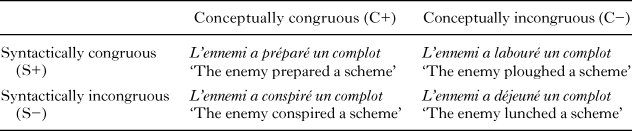
Based on these previous results (e.g., Friederici & Frisch, Reference Friederici and Frisch2000; Frisch et al., Reference Frisch, Hahne and Friederici2004; Hagoort, Brown, & Groothusen, Reference Hagoort, Brown and Groothusen1993; van Herten, Chwilla, & Kolk, Reference van Herten, Chwilla and Kolk2006; Kolk, Chwilla, van Herten, & Oor, Reference Kolk, Chwilla, van Herten and Oor2003; Kuperberg et al., Reference Kuperberg, Sitnikova, Caplan and Holcomb2003), the aim of the present experiments was to investigate the processing of verb argument structure violations in transitive clauses by using a 2 × 2 factorial design. We manipulated both the syntactic and semantic components in transitive constructions, and not only the semantic aspects of argument structure (e.g., Kuperberg et al., Reference Kuperberg, Sitnikova, Caplan and Holcomb2003). Sentences were presented in French (a language with no case marking), which, to our knowledge, has not yet been used to address the semantic−syntax issue. As proposed by Friederici and Frisch (Reference Friederici and Frisch2000) and Frisch et al. (Reference Frisch, Hahne and Friederici2004), sentences with verb argument structure violations may be difficult to interpret because an object argument is not expected after an intransitive verb: the syntactic pattern of the sentence does not match with the verb argument structure. However, such sentences may also be difficult to process because the overall semantic context of the sentence does not allow the listener to easily integrate the semantic information carried by the NP argument. To test this hypothesis, we used transitive coercion. We define transitive coercion as a clause-level operation by which a transitive construction is applied to an intransitive verb. Depending on the semantic context, this operation can be successful or not: a successful coercion occurs when sentence context is used online to override the syntactic problem caused by the verb subcategorization violation. Thus, we compared conditions in which the object argument is not expected after an intransitive (INTR) verb (transitive coercion), but the semantic context either allows (successful coercion) or does not allow the listener to easily integrate the additional argument (NP object). To achieve this aim, we manipulated orthogonally both syntactic (S) and semantic (C, conceptualFootnote 3) factors to create four experimental conditions using SVO sentences: (i) C+S+: semantically and syntactically congruous; (ii) C+S−: semantically congruous and syntactically incongruous; (iii) C−S+: semantically incongruous and syntactically congruous; (iv) C−S−: both semantically and syntactically incongruous (see examples in Table 1). Note that verb transitivity may vary across languages (e.g., Dixon & Aikhenvald, Reference Dixon, Aikhenvald, Dixon and Aikhenvald2000; Goldberg, Reference Goldberg2006, Hopper & Thompson, Reference Hopper and Thompson1980, Kittilä, Reference Kittilä2002; Næss, Reference Næss2007); therefore, English translation may be occasionally misleading for understanding the violations in French. For the syntactic violations of this experiment (transitive coercion), we used only strictly intransitive French verbs and ruled out bivalent ones (ambitransitive or labile). The transitive vs. intransitive character of the verbs was controlled in four different reference books and in a grammaticality test (see Section 2.1.3).
Examples of sentences used in the four experimental conditions

Importantly, in the first experiment reported below, sentence constituents (subjects, transitive verbs, and direct objects) were strongly semantically related in the C+S+ condition (e.g., L’ennemi a préparé (TR) un complot. ‘The enemy prepared a scheme.’) and direct objects are highly expected in this type of transitive construction. Thus, direct objects were expected to elicit no (or small amplitude) N400 and P600 components. By contrast, the semantic relationship between sentence constituents was weaker in the C−S− condition (e.g., *L’ennemi a déjeuné (INTR) un complot. *‘The enemy lunched a scheme.’) because ‘lunch’ and ‘scheme’ are not part of the same semantic field. Moreover, direct objects are also unexpected in this type of intransitive construction. Thus, they were expected to elicit large N400 and P600 components. Of most interest are the predictions for the C−S+ and C+S− conditions. Based on the classical views described above, large N400 components should be elicited in the C−S+ condition because the direct object is semantically unexpected (e.g., *L’ennemi a labouré un complot. *‘The enemy ploughed a scheme.’) but no (or small) P600 components should be elicited because direct objects are syntactically expected following transitive verbs. However, based on results showing a semantic P600 to semantic−thematic relationship violations between the subject and the verb (Hoeks et al., Reference Hoeks, Stowe and Doedens2004; Kim & Osterhout, Reference Kim and Osterhout2005; Kolk et al., Reference Kolk, Chwilla, van Herten and Oor2003; Kuperberg et al., Reference Kuperberg, Sitnikova, Caplan and Holcomb2003), one may also expect a semantic P600 to verb−object semantic violations. Finally, we hypothesized that if semantic information is used on-line during sentence comprehension and interacts with syntax to help solve the problem raised by the syntactic violation, results should be similar in the C+S− and in the control condition C+S+. In other words, because the semantic relationship between the verb and direct object is strong in *L’ennemi a conspiré un complot. *‘The enemy conspired a scheme.’, it may override the problem posed by the syntactic incongruity so that no (or small) N400 and P600 components are elicited. However, if semantic and syntactic information are processed independently, the verb argument structure violation should elicit a P600 component.
2 Experiment 1
2.1 methods
2.1.1 Participants
Twenty-five participants (14 females) between nineteen and thirty-five years old (mean = 25) were paid to participate in the experiment, which lasted for about two hours. All were right-handed native speakers of French and had normal or corrected-to-normal vision. Three participants were excluded from further analyses due to a large number of electrophysiological artifacts.
2.1.2 Stimuli
A total of 112 experimental sentences were built that shared the same syntactic (SVO) and syllabic (10 syllables) structures (see ‘Appendix A’ for a complete list of sentences). The sentence-final word was always a noun (e.g., complot ‘scheme’) and was always preceded by a verb in the past tense (e.g., a conspiré ‘conspired’). Experimental sentences were built by adding (i) semantically congruous direct objects to transitive verbs: semantically and syntactically congruous control sentences (C+S+); (ii) semantically congruous direct objects to intransitive verbs: syntactically incongruous sentences (C+S−); (iii) semantically incongruous direct objects to transitive verbs: semantically incongruous sentences (C−S+); or (iv) semantically incongruous direct objects to intransitive verbs: double violation condition (C−S−). Twenty-eight series of four sentences each were built for the experiment. To increase the homogeneity of the experimental materials and to be able to compare items between experimental conditions, the subject and direct object were always the same in the four experimental conditions, while only the verb differed. Thus, each of the four experimental conditions comprised twenty-eight different sentences. Finally, in order to prevent participants from anticipating the experimental sentences, 112 filler sentences were built using different syntactic and syllabic structures than those found in the experimental sentences (see ‘Appendix B’). Moreover, because 75% of the experimental sentences required a No response (C+S−; C−S+, and C−S− conditions), 75% of the filler sentences required a Yes response to equal the overall proportion of Yes and No responses. Subject−verb agreement violations were used in 25% of the filler sentences that required a No response (e.g., *Dans son article, le journaliste racontent son histoire. *‘In his paper, the journalist share his story.’).
2.1.3 Grammaticality test
The transitive vs. intransitive character of the verbs was controlled for in the lists of French verbs established by Boons, Guillet, and Leclerc (Reference Boons, Guillet and Leclerc1976) and in three well-known handbooks for French verb conjugations (Conjugaison, 2005, Le Petit Larousse Illustré, 1996, Bescherelle, 1990). Verbs that can be used in both transitive and intransitive constructions (e.g. vivre ‘to live’ vs. vivre sa vie ‘to live his/her life’ (to lead one’s own life)) were discarded. Only the verbs categorized as strictly intransitive were used in the simple syntactic violation (C+S−) and double violation (C−S−) conditions. Most importantly, in order to ensure that participants were able to correctly categorize intransitive verbs, they were asked to perform a grammaticality test at the end of the experiment. The same intransitive verbs as in the C+S− and C−S− conditions were used in different sentences with prepositional phrases and presented in three conditions: (i) syntactically correct intransitive constructions (e.g., Le maire a plaisanté (INTR) pendant toute la reception. ‘The mayor joked during the whole reception.’); (ii) syntactically incorrect constructions but semantically congruous, as in the experimental condition C+S− (e.g., *Le maire a plaisanté (INTR) des histoires à la fin du banquet. *‘The mayor joked stories at the end of the banquet.’); and (iii) syntactically incorrect constructions because the verb was followed by an incorrect preposition (e.g., *Le maire a plaisanté (INTR) à même les impôts. *‘The mayor joked under the tax.’). Participants were asked to judge the grammaticality of the sentences on a five-point scale (1 = unacceptable, 5 = completely acceptable). Results, summarized in Table 2, clearly showed that correct intransitive constructions were judged as more acceptable than the other two conditions that did not differ from each other (F(1,21) = 587.83, p < .0001). Thus, participants involved in the main experiment were able to correctly judge the grammaticality of the sentences in the grammaticality test. Consequently, the constructions a priori considered to be syntactically incongruous in the experiment (C+S−) were indeed judged as such by the participants.
Grammaticality test

note: Mean ranking on a five-point scale (1 = unacceptable, 5 = completely acceptable) of the sentences presented in the three conditions: (i) correct intransitive constructions; (ii) incorrect transitive constructions; semantically congruous; (iii) incorrect prepositions for intransitive verbs. Results are presented by subjects and by items. The Standard Deviation (SD) is presented in parentheses.
2.1.4 Procedure
During the experiment, participants were asked to decide, as quickly and as accurately as possible, whether the sentence was grammatically and semantically acceptable or not, so that the task was the same across violations. They responded by pressing one of two buttons (Yes or No) and the hand of response was counterbalanced across participants. Participants were seated on a comfortable chair in an electrically shielded room, facing a computer screen. A total of 224 sentences were presented visually with 112 experimental sentences and 112 filler sentences. In order to avoid spurious effects linked to the order of presentation, sentences were presented in pseudo-random order, with the constraint that no more than three sentences from the same experimental condition were presented successively. The order of presentation varied from one participant to the other. Each session began with a practice session to familiarize participants with the task and to train them to blink during the Inter-Stimuli Interval (ISI). Each group of words matched with a syntactic phrase (e.g., L’ennemi / a préparé / un complot. ‘The enemy / prepared / a scheme’) was presented for 300 ms, followed by a blank screen for 200 ms. A fixation cross was presented 1800 ms after the offset of the final group of words for 2000 ms to give participants time to blink. The use of a phrasal presentation allowed for the mode of presentation to be closer to the tested linguistic structure and from natural reading conditions. However, for simplicity purposes, words rather than groups of words or phrases are used here to refer to the subject, verb, and object of the experimental sentences.
2.1.5 ERP recording
EEG was recorded from twenty-eight scalp electrodes, mounted on an elastic cap, and located at standard left and right hemisphere positions over frontal, central, parietal, occipital, and temporal areas (International 10/20 system sites: Fz, Cz, Pz, Oz, Fp1, Fp2, F3, F4, C3, C4, P3, P4, O1, O2, F7, F8, T3, T4, T5, T6, Fc1, Fc2, Fc5, Fc6, Cp1, Cp2, Cp5, Cp6). These recording sites, plus an electrode placed on the right mastoid, were referenced to the left mastoid electrode. The data were then re-referenced off-line to the averaged activity over the left and right mastoids. Impedances of the electrodes never exceeded 3 kΩ. In order to detect horizontal eye-movements and blinks, the horizontal electro-oculogram (EOG) was recorded from electrodes placed 1 cm to the left and right of the external canthi, and the vertical EOG was recorded from an electrode beneath the right eye, referenced to the left mastoid. The EEG and EOG were amplified by an SA Instrumentation amplifier with a bandpass of .01−30 Hz, and were digitized at 250 Hz by a PC-compatible microcomputer (Compaq Prosignia 486). ERPs to correct responses were computed separately for each participant and each condition, starting 200 ms before (i.e., baseline) and lasting 2100 ms after the onset of the final word of the sentence. Trials containing ocular artifacts, movement artifacts, or amplifier saturation were excluded from the averaged ERP waveforms (less than 10% of the trials). Data were filtered off-line with a 20Hz low-pass filter for figure display only.
2.1.6 Data analysis
Reaction Times (RTs) and error rates were analyzed using two-way analyses of variance (ANOVAs) with Semantics (congruous vs. incongruous) and Syntax (congruous vs. incongruous) as within-subject factors.
Mean amplitude ERPs to the critical words were computed in selected latency windows based upon visual inspection of the waveforms (50−150 ms, 150−300 ms, 300−500 ms, 600−900 ms, and 900−1300 ms). ANOVAs were used to analyze the mean amplitude ERPs and were computed for midline electrodes with Semantics (congruous vs. incongruous), Syntax (congruous vs. incongruous), and Electrode (Fz, Cz, Pz, and Oz) as factors. To test for the scalp distribution of the effects, ANOVAs were also computed for lateral electrodes, using six regions of interest: left and right fronto-central (F3, Fc1, Fc5 and F4, Fc2, Fc6), left and right centro-temporal (C3, T3, Cp5 and C4, T4, Cp6), and left and right parietal (Cp1, P3, T5 and Cp2, P4, T6). ANOVAs for lateral electrodes included Semantics (congruous vs. incongruous), Syntax (congruous vs. incongruous), Hemisphere (left vs. right), and Region (fronto-central vs. centro-temporal vs. parietal) as factors. All reported p-values were adjusted with the Greenhouse−Geisser epsilon correction for non-sphericity. Reported are the uncorrected degrees of freedom and the probability level after correction.
2.2 results
2.2.1 Behavioral data
Reaction Times and error rates in each experimental condition are shown in Table 3. Results of a two-way ANOVA on the RTs revealed significant main effects of Semantics (F(1,21) = 14.69, p < .01) and Syntax (F(1,21) = 10.79, p < .003), as well as a significant Syntax by Semantics interaction (F(1,21) = 27.61, p < .001): the simple syntactic violation condition (C+S−) was associated with longer RTs than the other three conditions (all ps < .001).
Mean error rates (in percentage) and mean RTs (in milliseconds) in the four experimental conditions

note: C+ = conceptually congruous; C− = conceptually incongruous; S+ = syntactically congruous; S− = syntactically incongruous. The Standard Deviation (SD) is presented in parentheses.
Results of a two-way ANOVA on error rates also showed main effects of Semantics (F(1,21) = 226.41 p < .001) and Syntax (F(1,21) = 27.91, p < .001), as well as a significant Semantics by Syntax interaction (F(1,21) = 14.36, p < .001): the simple syntactic violation condition (C+S−) was associated with higher error rates than the other three conditions (all ps < .001). Control sentences (C+S+) were also associated with a significantly higher error rate than simple conceptual violations and double conceptual and syntactic violations (all ps < .001). In contrast, the last two conditions (C−S+ and C−S−) did not differ.
2.2.2 ERP data
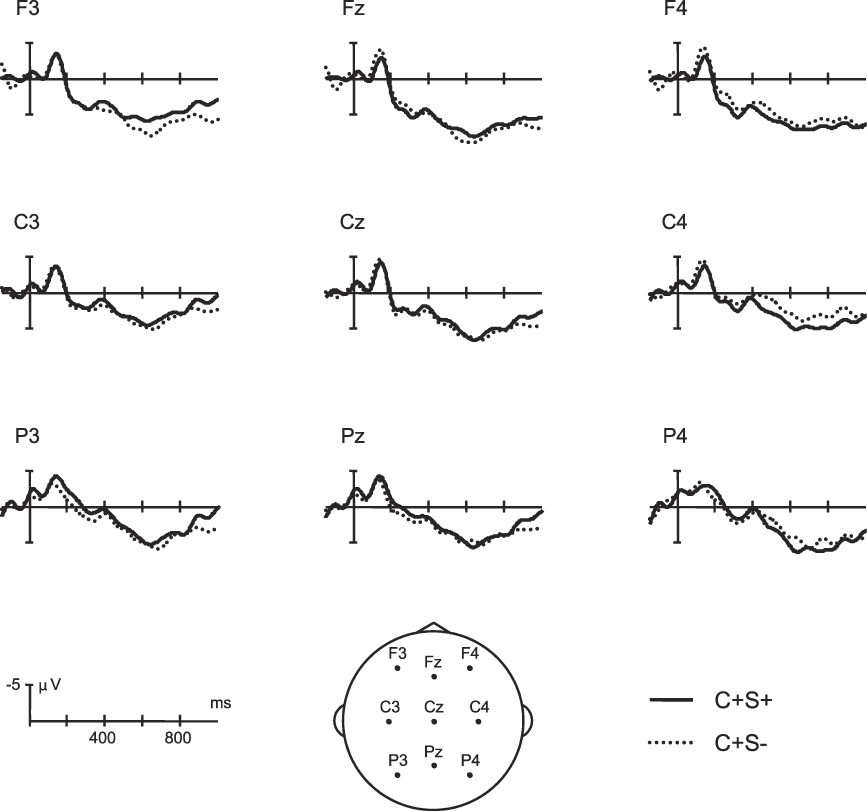
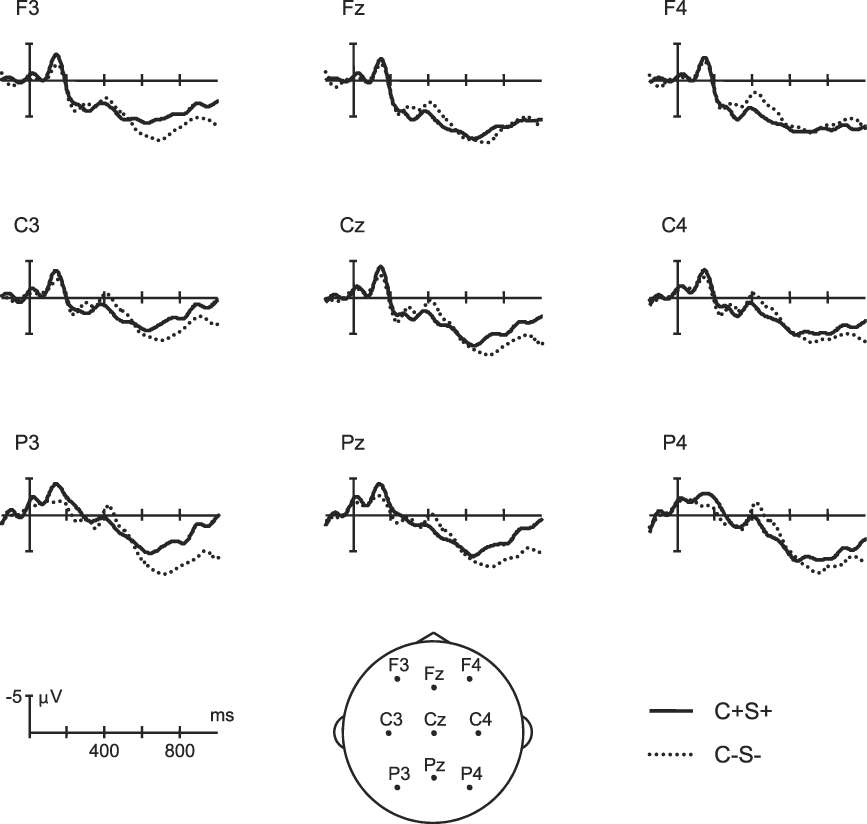
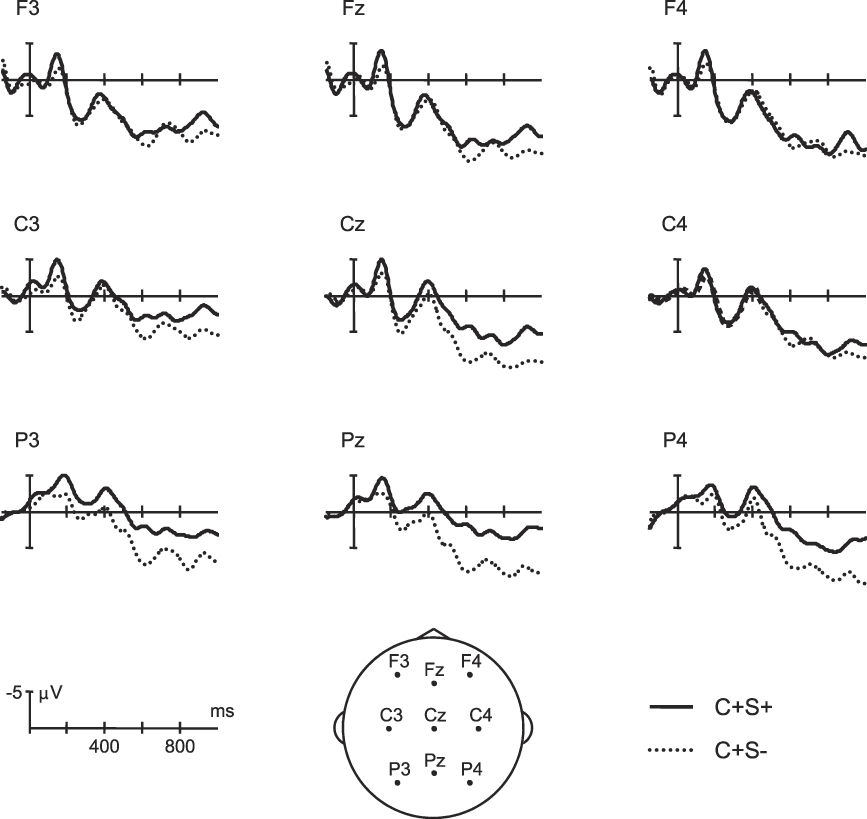
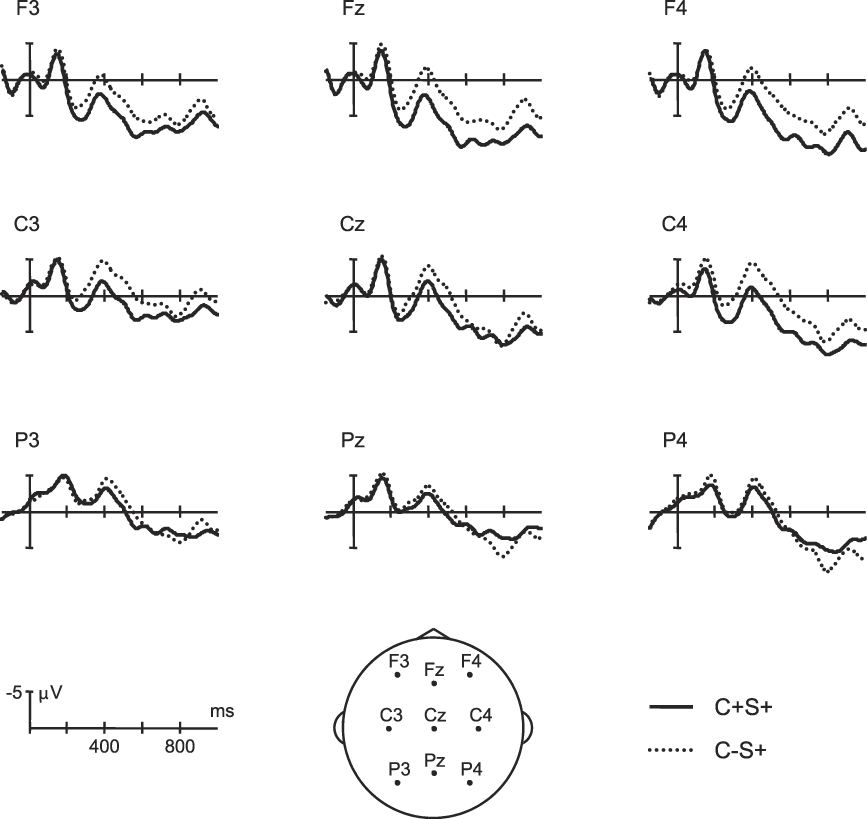
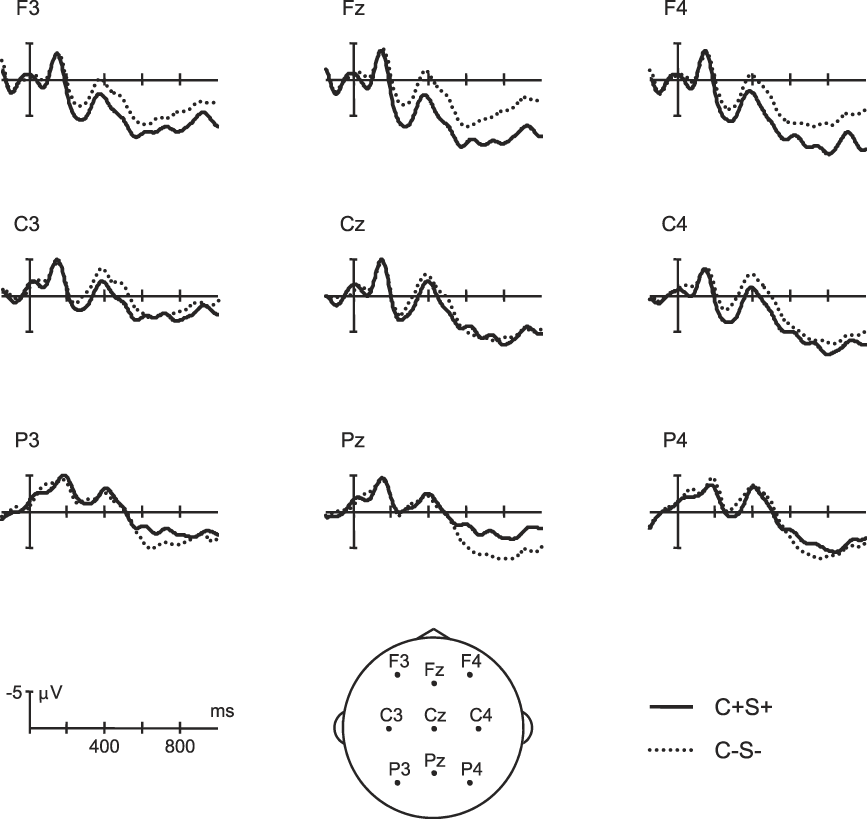
The ERPs to the simple syntactic violations (C+S−) were not different from the ERPs in the control condition (C+S+), neither in the N400 nor in the P600 latency bands (see Figure 1). Moreover, and as expected, the N400 component was larger in the simple conceptual violation (C−S+) and double violation (C−S−) conditions than in the control condition (C+S+). The P600 component was also larger in the simple conceptual violation and double violation conditions than in the control condition (see Figures 2 and 3). These observations were confirmed by the results of the ANOVAs.
Grand-average ERPs synchronized to the presentation of the final words in the control condition (C+S+, ‘The enemy prepared a scheme’, solid line) and simple syntactic violation condition (C+S−, ‘The enemy conspired a scheme’, dotted line) in Experiment 1. In this figure, as in the following ones, the amplitude (in microvolts) is plotted on the ordinate (negative up) and the time (in milliseconds) is on the abscissa. Selected traces from nine electrodes are presented.
Grand-average ERPs synchronized to the presentation of the final words in the control condition (C+S+, ‘The enemy prepared a scheme’, solid line) and simple semantic violation condition (C−S+, ‘The enemy ploughed a scheme’, dotted line) in Experiment 1.
Grand-average ERPs synchronized to the presentation of the final words in the control condition (C+S+, ‘The enemy prepared a scheme’, solid line) and the double violation condition (C−S−, ‘The enemy lunched a scheme’, dotted line) in Experiment 1.

In the 50−150 ms and 150−300 ms ranges, there was no main effect of Syntax or Semantics, nor significant interaction between the effects of Syntax, Semantics, Hemisphere, and Region (all ps > .05).
In the 300−500 ms range, the main effect of Semantics was significant at both midline (F(1,21) = 10.07, p = .004) and lateral electrodes (F(1,21) = 6.81, p = .016), with larger N400 components for semantically incongruous words (conditions C−S+ and C−S−) than for semantically congruous words (conditions C+S+ and C+S−). By contrast, there was no main effect of Syntax, or significant interaction between Syntax and the other factors.
In the 600−900 ms range, there was a significant main effect of Semantics at both midline (F(1,21) = 7.40, p = .012) and lateral electrodes (F(1,21) = 6.23, p = .021), and a significant Semantics by Region interaction (F(2,42) = 4.36, p = .038): post-hoc analyses showed that semantically incongruous words elicited larger positive components than semantically congruous words over the centro-temporal region (F(1,21) = 8.19, p = .009) and the parietal region (F(1,21) = 7.11, p = .014) of the scalp. No main effect of Syntax or significant interactions between Syntax and the other factors were found.
In the 900−1300 ms range, there was a main effect of Semantics at both midline (F(1,21) = 6.07, p = .022) and lateral electrodes (F(1,21) = 4.36, p = .049), and a Semantics by Region interaction (F(2,42) = 6.21, p = .006): semantically incongruous words continue to elicit larger positivity than semantically congruous words over the centro-temporal (F(1,21) = 8.14, p = .009) and parietal regions (F(1,21) = 7.11, p = .014). By contrast, there was no significant main effect of Syntax, or significant interaction between Syntax and the other factors.
2.3 discussion
The main result of the first experiment is that sentences with a simple semantic violation (C−S+) or a double violation (C−S−) were associated with larger N400 and P600 components than in the control condition (C+S+). In contrast, the ERPs in the simple syntactic violation condition (C+S−) were very similar to the ERPs in the control condition (C+S+), and no significant differences were found on the P600 in the two conditions. It could be argued that participants did not know the French rules of verb subcategorization and did not notice the syntactic violations. Such an interpretation is not likely for at least two reasons. First, results of the grammaticality test performed by the participants at the end of the experiment showed that sentences built on the same model as sentences in the simple syntactic violation (C+S−) condition, and using the same intransitive verbs, were judged as grammatically incorrect by the participants. Therefore, the participants knew that these verbs were intransitive. Second, analysis of the behavioral data showed that RTs were longer and error rates higher in the simple syntactic violation (C+S−) than in the other conditions. Clearly, sentences in this condition were more difficult to process than sentences in the other conditions. It is likely that such sentences did generate a conflict between the grammaticality of the construction (leading to a No response) and the semantics of the sentence (leading to a Yes response). Such an interference effect again points to the fact that participants knew the rules of transitivity. Interference effects were also found for congruous (C+S+) sentences (i.e., higher error rate than for C−S+ and C−S− sentences), which may reflect the difficulty in discriminating correct (C+S+) from incorrect (C+S−) transitive constructions when both were meaningful.
Since the sentences were repeated in each of the four experimental conditions, it could be argued that repetition effects influenced the present results. However, as all sentences were presented an equal number of times, it is unlikely that repetition effects can account for the differential effects observed across conditions. Moreover, it is also unlikely that syntactic and/or lexical priming accounts for the observed effects because sentence presentation was pseudo-random. Consequently, participants could not anticipate whether the direct object was to be semantically and/or syntactically incongruous based upon the reading of the sentences’ subjects and verbs. Finally, it is also unlikely that participants expected/predicted that direct objects would follow intransitive verbs because the overall probability of the C+S− sentences was 12.5% (28 out of 224 sentences).
In line with our hypothesis, we interpret these results as showing that when the different sentence constituents are semantically congruous relative to each other, the sentence context is used on-line to override the syntactic problem caused by the verb subcategorization violation, resulting in a successful coercion. Coercion can then be linked to ERP effects in the following way: a successful coercion elicits no differences from control, while an unsuccessful coercion elicits P600 effects. If this interpretation is correct, it should be possible to increase the amplitude of the P600 by using the same syntactic violations in semantically less related sentence contexts.
3 Experiment 2
The results of Experiment 1 were in line with our hypothesis in showing that the effects of verb transitivity violations were smaller when the conceptual context was congruous (C+S−) than when it was incongruous (C−S−). To maximize the congruence of the sentence context in Experiment 1, strong semantic associations were present not only between the verb and the object (an internal object, in linguistics), but also between the subject and the verb (a prototypical subject). To further examine the influence of the sentence context and the respective contribution of the subject−verb and verb−object relationships, we reduced the overall strength of sentence context in Experiment 2 by reducing the subject−verb semantic associations. To this end, the prototypical subject of the sentences was replaced by a semantically neutral proper name (e.g., Thomas), while keeping the same semantic association between the verb and the object. If, as proposed in constraint-based models (MacWhinney, Reference MacWhinney and MacWhinney1987; McCLelland, St John, & Taraban, 1989), we are correct in assuming that all available semantic information is used on-line during sentence comprehension to solve the problem raised by the syntactic violation (see also the immediacy principle in Hagoort, Reference Hagoort2008), larger P600 components should be elicited when the subject−verb relationship provides less information to solve the integration problem posed by the object violating the verb argument structure. In other words, the amplitude of the P600 should be larger in the C+S− than in the C+S+ control condition in Experiment 2.
3.1 methods
3.1.1 Participants
Fifteen participants (8 females) between twenty-two and twenty-nine years old (mean = 27) were paid to participate in the experiment, which lasted for about two hours. One participant was discarded from further analyses because of too many artifacts. All the remaining participants were right-handed native speakers of French and had normal or corrected-to-normal vision.
3.1.2 Stimuli and procedure
The same 112 experimental sentences were used as in Experiment 1, except that the subject of the sentence was always a first name (e.g., ‘Thomas prepared a scheme’). To this end, the 112 most common French first names (as reported by the French National Institute of Statistics and Economic Studies) were used. Moreover, the same 112 filler sentences were also presented and the procedure and task were the same as in Experiment 1: participants were asked to decide, as quickly and as accurately as possible, whether the sentence was grammatically and semantically acceptable or not.
3.1.3 ERP recording and analysis
EEG was recorded and analyzed following the same constraints as in Experiment 1.
3.2 results
3.2.1 Behavioral data
RTs and error rates in each experimental condition are shown in Table 4. Results of a two-way ANOVA on the RTs and error rates only revealed a significant main effect of Semantics (RTs: F(1,13) = 51.76, p < .001; Error rates: F(1,13) = 71.68, p < .001): semantically congruous words (conditions C+S+ and C+S−) were associated with longer RTs and higher error rates than semantically incongruous words (conditions C−S+ and C−S−). The main effect of Syntax and the Semantics by Syntax interaction were not significant.
Mean error rates (in percentage) and mean RTs (in milliseconds) in the four experimental conditions

note: C+ = conceptually congruous; C− = conceptually incongruous; S+ = syntactically congruous; S− = syntactically incongruous. The Standard Deviation (SD) is presented in parentheses.
3.2.2 ERP data
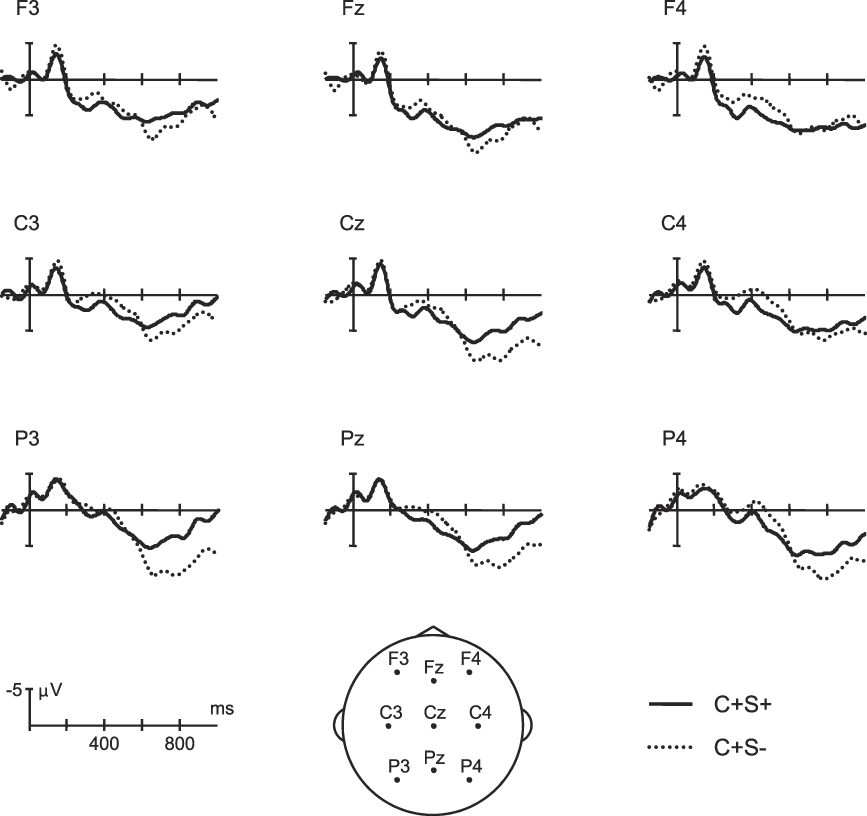
As can be seen in Figure 4, and in contrast with the results of Experiment 1, the simple syntactic violation (C+S−) elicited more positivity than the control condition (C+S+). Moreover, a larger N400 component was elicited in the simple conceptual violation condition (C−S+) than in the control condition (C+S+; see Figure 5). Finally, both the N400 and P600 components were larger in the double incongruity (C−S−) than in the control condition (see Figure 6). To test for the reliability of these differences, ANOVAs were conducted in the same latency bands as in Experiment 1.
Grand-average ERPs synchronized to the presentation of the final words in the control condition (C+S+, ‘Thomas prepared a scheme’, solid line) and simple syntactic violation condition (C+S−, ‘Thomas conspired a scheme’, dotted line) in Experiment 2.
Grand-average ERPs synchronized to the presentation of the final words in the control condition (C+S+, ‘Thomas prepared a scheme’, solid line) and simple semantic violation condition (C−S+, ‘Thomas ploughed a scheme’, dotted line) in Experiment 2.
Grand-average ERPs synchronized to the presentation of the final words in the control condition (C+S+, ‘Thomas prepared a scheme’, solid line) and the double violation condition (C−S−, ‘Thomas lunched a scheme’, dotted line) in Experiment 2.
In the 50−150 ms and 150−300 ms ranges, there was no main effect of Syntax or Semantics. In addition, there was no significant interaction between any of these factors and the factors Hemisphere and Region (all ps > .05).
In the 300−500 ms range, there was a significant main effect of Semantics at both midline (F(1,13) = 13.09, p = .003) and lateral electrodes (F(1,13) = 12.00, p = .004): semantically incongruous words (conditions C−S+ and C−S−) elicited a larger N400 than semantically congruous words (conditions C+S+ and C+S−). There were also a significant main effect of Syntax at both midline (F(1,13) = 6.98, p = .020) and lateral electrodes (F(1,13) = 6.96, p = .020) and a significant Syntax by Region interaction (F(2,26) = 4.93, p = .019): syntactically incongruous words (conditions C+S− and C−S−) elicited a larger positivity than syntactically congruous words (conditions C+S+ and C−S+) over the parietal region (F(2,26) = 13.78, p = .002).
In the 600−900 ms range, there was a main effect of Syntax at both midline electrodes (F(1,13) = 10.75, p = .006) and lateral electrodes (F(1,13) = 6.60, p = .023), as well as significant Syntax by Region interaction (F(2,26) = 4.84, p = .020) and Syntax by Semantics by Region interaction (F(2,26) = 5.89, p = .007): the C+S− condition elicited a larger positivity than in the C+S+ condition over the parietal (F(1,13) = 26.49, p < .001) and centro-temporal regions (F(1,13) = 14.46, p = .022). Moreover, the C−S− condition also elicited a larger positivity than in the C+S+ condition over the parietal region (F(1,13) = 15.98, p = .001). By contrast, no significant difference was found between the C−S+ and C−S− conditions.
In the 900−1300 ms range, the main effect of Syntax was significant at midline electrodes (F(1,13) = 6.97, p = .020): syntactically incongruous words continue to elicit a larger positivity than syntactically congruous words. There was no main effect of Semantics, or significant interaction.
3.3 discussion
Sentences ending with semantically incongruous words (conditions C−S+ and C−S−) produced an increased N400 effect as in Experiment 1. In contrast to Experiment 1, however, syntactically incongruous words (C+S− and C−S−) were associated with larger P600 components than syntactically congruous words (C+S+ and C−S+). This finding is in line with our hypothesis that reducing the strength of the sentence context (by replacing the prototypical subject of the verb by a neutral subject) increases the difficulty of integrating the verb argument violation on the object so that the effect of syntactic incongruity becomes significant. This interpretation is also supported by the decrease in error rate and RTs in the simple syntactic violation condition (C+S−) condition in Experiment 2 as compared to Experiment 1, which may reflect reduced interference effects when the strength of the semantic context is decreased. Results of the two experiments are considered together in the ‘General Discussion’.
4 General discussion
4.1 influence of semantic context on the processing of verb argument violation
The main comparison of interest is between the simple syntactic violation (C+S−) and the control condition (C+S+). While the difference between these two conditions was not significant in Experiment 1, it was significant in Experiment 2, starting around 300 ms. As mentioned above, semantic congruency was increased in Experiment 1 by building sentences in which the verbs were associated with both prototypical subjects and internal objects (*L’ennemi a conspiré (INTR) un complot. ‘The enemy conspired a scheme.’).
These results are important from a theoretical perspective. Certain linguistic features are known to favor transitive constructions (Hopper & Thompson, Reference Hopper and Thompson1980) such as the mode, the telic, the punctual, kinesic, and volitional aspects of the verb, the agentivity of the subject, and the individuation and affectedness of the object. However, these properties are not sufficient to account for our results because they were similar for all intransitive verbs in our experiment (C+S− and C−S− conditions). Those sentences always contained (kinetic, non-punctual, and volitional) action verbs in the past tense; furthermore, subjects were referring to agents and objects were indefinite nouns (similarly individuated). Among the properties that favor transitivity, the only one distinguishing the successful intransitive verbs (C+S−) from the unsuccessful ones (C−S−) in our experiments is the affectedness of the object (i.e., the extent to which the object is affected by the process expressed in the verb). Affectedness of the patient, producing a salient result of the action, is actually considered by Kittilä (Reference Kittilä2002, Reference Kittilä and Song2011) as a central feature of transitive events.
Interestingly, a fine-grained account of the successful transitive coercion in our experiment (i.e., the simple syntactic violation condition in which a meaning could be attributed to the sentence, overriding the mismatch between the verb argument structure and the syntactic structure of the clause) can be inferred from the theoretical framework developed in Cognitive Construction Grammar theory (Goldberg, Reference Goldberg1995, Reference Goldberg, Verspoor and Sweetser1997, Reference Goldberg, Östman and Fried2005, Reference Goldberg2006; Michaelis, Reference Michaelis2004). For space reasons, we limit the presentation of this refined framework to two relevant points for our explanation. First, in line with Fillmore’s (Reference Fillmore1982) Frame Semantics, in Construction Grammar, the verb is considered to have a rich semantic structure (or frame) in which some components are brought to the foreground and specified as obligatorily expressed; namely, the participant roles corresponding to the semantic/thematic roles of other linguistic models (Fillmore, Lee-Goldman, & Rhodes, Reference Fillmore, Lee-Goldman, Rhodes, Sag and Boas2012). Second, the semantic component of a sentence is not restricted to the lexicon: syntactic constructions also have their own meanings, independent from the lexical meanings of their constituents (for an ERP study supporting this view, see Ye et al., Reference Ye, Zhan and Zhou2007). For instance, the ditransitive construction (e.g., She baked him a cake) indicates that the agent argument acts to cause transfer of an object to a recipient (independently of the meaning of the verb to bake). During the building of the sentence, the participant roles of the verb fuse with the argument roles of the syntactic construction according to the semantic pattern of the construction. Based on this theory, one can consider that the function of transitive constructions is to define an object as the patient affected by the activity expressed in the verb and instigated by the agentive subject. In sentences with intransitive verbs, there is typically no patient to fuse with the argument role of object. Nevertheless, a patient can be present in the background of the verb’s semantic frame without being lexically profiled as such by the verb argument structure. This was the case for all the intransitive verbs used in the present experiment in the simple syntactic violation (C+S−) condition which were built up with internal objects. For instance, in the sentence *L’ennemi a conspiré (INTR) un complot *‘The enemy conspired a scheme’, a scheme is the prototypical result of the activity of conspiring. So, the successful transitive interpretation, as shown by the smaller P600 amplitude in the simple syntactic violation (C+S−) than double violation (C−S−) conditions, is taken to reflect the movement to the foreground (by the transitive construction) of an object (complot ‘scheme’) that was present in the (rich) semantic structure/frame of the verb, but only as a background element. Thus, in line with the override principle claimed in Cognitive Grammars (Michaelis, Reference Michaelis, Cuykens, Dirven and Taylor2003Footnote 4), our results show that the semantic coherence of the sentence seems to override the syntactic incongruity. By contrast, in *L’ennemi a déjeuné un complot *‘The enemy lunched a scheme’, a scheme cannot be the result (object) of lunching and no transitive interpretation is available. Consequently, the syntactic construction is perceived as incongruous. To summarize, the ERP results reported in the present experiment can be accounted for by the linguistic theories that take into consideration both the specific characteristics of transitive constructions and the rich semantic frame of the verb (Fillmore, Reference Fillmore1982). Furthermore, they validate a constructionist approach to coercion. In a modularist approach to coercion, such as the one developed by Piñango, Zurif, and Jackendoff (Reference Piñango, Zurif and Jackendoff1999) for aspectual coercion, the coerced tokens are syntax−semantics mismatches requiring enriched semantic composition to achieve semantic compatibility between the sentence constituents; they are thus predicted to require additional processing cost. This additional processing effort should be detectable in the ERPs; no indicators of additional processing effort were detected in our experiment. By contrast, in a Construction Grammar account (e.g., Goldberg, Reference Goldberg1995; Michaelis, Reference Michaelis, Cuykens, Dirven and Taylor2003), we distinguish between unsuccessful and successful coercions tokens. Successful coercion is then analyzed as involving a match between the frames evoked by the predication and the construction, which does not require additional processing and therefore results in no differences in ERPs, as was the case.
If this interpretation is correct, reducing the overall strength of the sentence context in Experiment 2 by using semantically neutral relationships between the subjects and the verbs (*Thomas a conspiré (INTR) un complot. *‘Thomas conspired a scheme.’), while maintaining strong relationships between verbs and internal objects, should not allow semantic information to override the problem posed by the syntactic incongruity. Results were in line with this prediction: in contrast to Experiment 1, the amplitude of the P600 was larger in the C+S− than in the C+S+ condition.
Interestingly, previous results can also be reinterpreted in the framework proposed above. In Hagoort et al. (Reference Hagoort, Brown and Groothusen1993), no P600 effect was generated by verb subcategorization violations (e.g., *The son of the rich industrialist boasts the car of his father), possibly because, as in the present study, there is a strong semantic association between the different sentence constituents: the subject and the verb (a son of a rich industrialist is prototypically a boasting person), the subject and the object (he prototypically has an expensive car), and the verb and the syntactically unexpected object (a car can be the topic of boasting). By contrast, in Friederici and Frisch’s (Reference Friederici and Frisch2000) experiment, a P600 was generated in response to violations of verb argument structure. However, the overall meaning of the sentence was more difficult to access and the semantic context did not help override the syntactic incongruity. For instance, in the sentence (translated from German) *‘Today, the cousin dawdled the violinist at the lift’, the semantic association between all constituents is low and, in particular, a ‘violinist’ cannot be the result of the action of ‘dawdling’ as the semantics of the transitive construction would imply. Finally, while Friederici and Frisch (Reference Friederici and Frisch2000) also reported an N400 component to verb argument structure violation, no N400 was generated in our Experiment 2. This may be explained by the presence of a relatively strong verb−object semantic relationship (e.g., ‘… conspired a scheme’) compared to Friederici and Frisch’s (Reference Friederici and Frisch2000) ‘… dawdled the violinist’.
Taken together, the results of these experiments highlight two interesting features. First, semantic information seems to contribute to the processing of syntactic structure. This interpretation is in line with several results showing an interaction between semantic and syntactic processing (Friederici, Reference Friederici2002; Gunter, Stowe, & Mulder, Reference Gunter, Stowe and Mulder1997, Experiment 2, 2000; Hahne & Friederici, Reference Hahne and Friederici1999, Experiment 1). Going one step further, Ye et al. (Reference Ye, Zhan and Zhou2007) recently demonstrated that the semantic properties of syntactic structures influence the processing of transitive constructions in Chinese, thereby supporting the Construction Grammar approach to language. Second, and maybe more surprisingly, the semantic relationship between the subject and the verb in the current study clearly influenced the processing of the verb−object relationship, not only in terms of animacy or distinctness of the subject vis-à-vis the object as classically reported about transitivity (Naess, Reference Næss2007), but also in terms of general semantic information inducing (or not) prototypical scenarios and expectations favoring the recoverability of the sentence global meaning. This finding is in line with the constraint-based models (MacWhinney, Reference MacWhinney and MacWhinney1987; McClelland et al., Reference McClelland, St John and Taraban1989) and with the idea that all linguistic cues are integrated into a meaningful global representation that is constantly updated and that generates expectations for upcoming linguistic elements (Robert, Reference Robert, Fuchs and Robert1999, Reference Robert and Vanhove2008; Victorri, Reference Victorri1997).
4.2 functional significance of the P600 component
Interestingly, in Experiment 1, a P600 component was elicited in the simple semantic violation condition (C−S+) and it was not different from the P600 generated in the double violation condition (C−SN). This result is line with the semantic P600 described by several authors (Bornkessel-Schleveswky & Schleveswky, Reference Bornkessel-Schlesewsky and Schlesewsky2008; Kuperberg, 2007). However, the functional significance of the P600 component is still a matter of debate. Regardless of the question of its language specificity (Coulson, King, & Kutas, Reference Coulson, King and Kutas1998; Osterhout & Hagoort, Reference Osterhout and Hagoort1999; Patel, Gibson, Ratner, Besson, & Holcomb, Reference Patel, Gibson, Ratner, Besson and Holcomb1998), the P600 component may reflect a processing initiated by various violations, such as semantic, morphosyntactic, and orthographic (Münte, Heinze, Matzke, Wieringa, & Johannes, Reference Münte, Heinze, Matzke, Wieringa and Johannes1998). Moreover, other authors have argued that the P600 is triggered by the integration of both semantic and syntactic information rather than syntactic anomaly per se (Brouwer, Fitz, & Hoeks, Reference Brouwer, Fitz and Hoeks2012), the reanalysis process that sets in whenever the syntactic and semantic/conceptual representations cannot be mapped onto one another (Bornkessel, Schlesewsky, & Friederici, Reference Bornkessel, Schlesewsky and Friederici2002; Friederici, Reference Friederici2002), the reanalysis of possible language errors in language monitoring (Kolk et al., Reference Kolk, Chwilla, van Herten and Oor2003; van de Meerendonk, Kolk, Vissers, & Chwilla, Reference van de Meerendonk, Kolk, Vissers and Chwilla2010; Vissers, Chwilla, & Kolk, 2006, 2007), the reprocessing focused on the lexico-syntactic analysis (Kim & Sikos, Reference Kim and Sikos2011), the integration of prosodic and syntactic information (Eckstein & Friederici, Reference Eckstein and Friederici2005), the integration of metric and semantic information (Magne, Astésano, Aramaki, Ystad, Kronland-Martinet, & Besson, Reference Magne, Astésano, Aramaki, Ystad, Kronland-Martinet and Besson2007), or the difficulty of integration processes in general (Kaan, Harris, Gibson, & Holcomb, Reference Kaan, Harris, Gibson and Holcomb2000).
Interestingly, in Experiment 2, similar semantic incongruities did not elicit an increased P600. One possible explanation is the difference in the strength of the semantic context between the two experiments. In Experiment 1, though the object was not semantically related to the verb (e.g., ‘lunch’ and ‘scheme’), it was strongly related to the subject (e.g., ‘enemy’ and ‘scheme’). As a result, the observed P600 may reflect a reanalysis arising from the conflicting information between the weak verb−object relationship and the strong subject−object relationship. In contrast, in Experiment 2, the semantic relationship between the subject and the object was neutral (e.g., ‘Thomas’ and ‘scheme’). Thus, the absence of P600 may reflect that no reanalysis was required since both the subject−object and verb−object associations were weak. These interpretations are very close to the proposal by Kim and Sikos (2011, p. 18) that when there is a conflict between semantic and syntactic cues, “syntactic cues can vary in their ability to resist vs. ‘surrender’ to challenge from semantics” and from Kos, Vosse, Van den Brink, and Hagoort’s (2010, p. 1) proposal that “The relative strength of the cues of the processing streams determines which level is affected most strongly by the conflict”. Overall, our results, by showing that P600-like components were elicited by both syntactic and semantic incongruities, coincide with the interpretation that P600 components are elicited whenever the reader has difficulty processing both structural and conceptual linguistic information (Eckstein & Friederici, Reference Eckstein and Friederici2005; Friederici, Reference Friederici2002; Kaan et al., Reference Kaan, Harris, Gibson and Holcomb2000; Kuperberg et al., Reference Kuperberg, Caplan, Sitnikova, Eddy and Holcomb2006; Münte et al., Reference Münte, Heinze, Matzke, Wieringa and Johannes1998).
4.3 the N400 component
In both Experiments 1 and 2, sentences ending with semantically unexpected words (conditions C−S+ and C−S−) elicited larger N400 components than sentences in the control condition (C+S+). These results are in line with previous results showing that N400 amplitude varies as a function of word expectancy: the less expected a word within a sentence context, the larger the N400 amplitude (Kutas & Hillyard, Reference Kutas and Hillyard1984). The reported N400 effect may result both from the local incongruity linked to the presentation of a direct object semantically unrelated to the preceding verb, and from a general integration difficulty of building a coherent and meaningful representation of the sentence with the available linguistic information (Brown, Hagoort, & Kutas, Reference Brown, Hagoort, Kutas and Gazzaniga2000; Hagoort, Reference Hagoort2008). These interpretations are compatible with the scenario mapping theory (Sanford & Garrod, Reference Sanford and Garrod1998) following which the N400 effect reflects the goodness-of-fit of a word with global world knowledge, and with recent results showing no N400 to locally ambiguous words that can be easily integrated within the global sentence context (Sanford, Leuthold, Bohan, & Sanford, Reference Sanford, Leuthold, Bohan and Sanford2011).
4.4 conclusion
The present study investigated the relationship between syntax and semantics in French, by orthogonally manipulating the syntactic and conceptual/semantic aspects of verb subcategorization. Our results showed that the same syntactic incongruity was processed differently as a function of the semantic context in which it was presented. These results, therefore, favor the view that at least some aspects of syntactic and semantic information are processed in interaction. Moreover, when contrasted with the results of Experiment 1, the results of Experiment 2 highlight the importance of the subject−verb semantic relationship in building coherent sentence representations. They also demonstrate that the S-V relationship exerts a strong influence on the processing of the V-O relationship. Finally, the finding that the amplitude of the P600 component was modulated by semantic congruency, even without syntactic violations, favors the functional interpretation that the P600 component reflects a general integration process, in which both syntactic and conceptual representations are taken into account. In accordance with linguistic cognitive−functional theories (e.g., Barlow & Kemmer, Reference Barlow and Kemmer2000; Fillmore, Reference Fillmore1982; Goldberg, Reference Goldberg1995, Reference Goldberg, Östman and Fried2005; Tomasello, Reference Tomasello1998), dynamical models of sentence comprehension (e.g., MacWhinney & Bates Reference MacWhinney and Bates1989), the processing competition account (Kos et al., Reference Kos, Vosse, Van den Brink and Hagoort2010), and recent views advocated by Kim and Sikos (Reference Kim and Sikos2011), these results suggest that the semantics−syntax distinction is not as clear-cut as previously thought, that syntactic and semantic processing are highly interactive, and that syntactic processing is strongly context-dependent.
appendix a: experimental sentences
Conditions: a = C+S+, b = C+S−, c = C−S+, d = C−S−
1 a La concierge, a colporté, un ragot.
2 b La concierge, a bavardé, un ragot.
3 c La concierge, a torturé, un ragot.
4 d La concierge, a végété, un ragot.
5 a L’ennemi, a préparé, un complot.
6 b L’ennemi, a conspiré, un complot.
7 c L’ennemi, a labouré, un complot.
8 d L’ennemi, a déjeuné, un complot.
9 a L’écolier, a recopié, un devoir.
10 b L’écolier, a paressé, un devoir.
11 c L’écolier, a débouché, un devoir.
12 d L’écolier, a crépité, un devoir.
13 a L’élève, a présenté, une excuse.
14 b L’élève, a ronchonné, une excuse.
15 c L’élève, a replanté, une excuse.
16 d L’élève, a pédalé, une excuse.
17 a L’espion, a suggéré, une manœuvre.
18 b L’espion, a intrigué, une manœuvre.
19 c L’espion, a raboté, une manœuvre.
20 d L’espion, a séjourné, une manœuvre.
21 a Le bébé, a esquissé, une mimique.
22 b Le bébé, a grimacé, une mimique.
23 c Le bébé, a gouverné, une mimique.
24 d Le bébé, a galopé, une mimique.
25 a Le soldat, a effectué, une corvée.
26 b Le soldat, a flemmardé, une corvée.
27 c Le soldat, a étranglé, une corvée.
28 d Le soldat, a plafonné, une corvée.
29 a Le malade, a ressenti, un frisson.
30 b Le malade, a grelotté, un frisson.
31 c Le malade, a installé, un frisson.
32 d Le malade, a fureté, un frisson.
33 a Le marin, a repéré, un trajet.
34 b Le marin, a navigué, un trajet.
35 c Le marin, a réveillé, un trajet.
36 d Le marin, a éclaté, un trajet.
37 a Le notaire, a proposé, un accord.
38 b Le notaire, a transigé, un accord.
39 c Le notaire, a sulfaté, un accord.
40 d Le notaire, a gambadé, un accord.
41 a Le client, a proféré, une insulte.
42 b Le client, a tempêté, une insulte.
43 c Le client, a accroché, une insulte.
44 d Le client, a boitillé, une insulte.
45 a Le voyou, a murmuré, une injure.
46 b Le voyou, a ricané, une injure.
47 c Le voyou, a dérangé, une injure.
48 d Le voyou, a résidé, une injure.
49 a Le comique, a improvisé, une astuce.
50 b Le comique, a plaisanté, une astuce.
51 c Le comique, a arrosé, une astuce.
52 d Le comique, a sautillé, une astuce.
53 a Le pilote, a réalisé, une cascade.
54 b Le pilote, a voltigé, une cascade.
55 c Le pilote, a caressé, une cascade.
56 d Le pilote, a grisonné, une cascade.
57 a Le gamin, a étouffé, un sanglot.
58 b Le gamin, a pleurniché, un sanglot.
59 c Le gamin, a allumé, un sanglot.
60 d Le gamin, a prospéré, un sanglot.
61 a L’adjudant, a formulé, un reproche.
62 b L’adjudant, a sourcillé, un reproche.
63 c L’adjudant, a enfermé, un reproche.
64 d L’adjudant, a serpenté, un reproche.
65 a Le clochard, a déclamé, une tirade.
66 b Le clochard, a déliré, une tirade.
67 c Le clochard, a encerclé, une tirade.
68 d Le clochard, a rayonné, une tirade.
69 a Le voleur, a retenu, un sursaut.
70 b Le voleur, a tressailli, un sursaut.
71 c Le voleur, a déposé, un sursaut.
72 d Le voleur, a évolué, un sursaut.
73 a Le champion, a accompli, un exploit.
74 b Le champion, a jubilé, un exploit.
75 c Le champion, a licencié, un exploit.
76 d Le champion, a ruisselé, un exploit.
77 a Le vieillard, a raconté, une histoire.
78 b Le vieillard, a radoté, une histoire.
79 c Le vieillard, a remorqué, une histoire.
80 d Le vieillard, a clopiné, une histoire.
81 a La voisine, a annoncé, une nouvelle.
82 b La voisine, a papoté, une nouvelle.
83 c La voisine, a vidangé, une nouvelle.
84 d La voisine, a fonctionné, une nouvelle.
85 a Le gardien, a prolongé, une sieste.
86 b Le gardien, a somnolé, une sieste.
87 c Le gardien, a financé, une sieste.
88 d Le gardien, a éternué, une sieste.
89 a Le ministre, a établi, une alliance.
90 b Le ministre, a magouillé, une alliance.
91 c Le ministre, a voyagé, une alliance.
92 d Le ministre, a immigré, une alliance.
93 a L’étudiant, a rédigé, une réponse.
94 b L’étudiant, a disserté, une réponse.
95 c L’étudiant, a colmaté, une réponse.
96 d L’étudiant, a vacillé, une réponse.
97 a L’acrobate, a réussi, une pirouette.
98 b L’acrobate, a tournoyé, une pirouette.
99 c L’acrobate, a chatouillé, une pirouette.
100 d L’acrobate, a resurgi, une pirouette.
101 a Le grand-père, a débité, une sornette.
102 b Le grand-père, a divagué, une sornette.
103 c Le grand-père, a vacciné, une sornette.
104 d Le grand-père, a demeuré, une sornette.
105 a La fillette, a ébauché, un sourire.
106 b La fillette, a minaudé, un sourire.
107 c La fillette, a replié, un sourire.
108 d La fillette, a pataugé, un sourire.
109 a L’accusé, a inventé, un mensonge.
110 b L’accusé, a fabulé, un mensonge.
111 c L’accusé, a fusillé, un mensonge.
112 d L’accusé, a canoté, un mensonge.
appendix b: filler sentences
Conditions : a = mophologically incongruous, b, c, and d = morphologically congruous
1 a Dans l’article, le chroniqueur, colportèrent, la nouvelle.
2 b Dans l’autobus, l’écolier, bavarda, constamment.
3 c Son mari, fut torturé, pendant, la guerre.
4 d Malgré ses efforts, Paul, végète, dans sa carrière.
5 a Dans l’atelier, le sculpteur, préparèrent, ses outils.
6 b Dans son bureau, le général, conspira, sans scrupule.
7 c Le champ, a été labouré, en entier.
8 d La voisine, déjeunera, avec nous, demain.
9 a Dans son carnet, l’architecte, recopièrent, les mesures.
10 b Dans sa cabine, le gardien, paressa, sans se gêner.
11 c Le serveur, a débouché, une bouteille.
12 d Le feu, crépite, dans la cheminée.
13 a Dans le défilé, le mannequin, présentèrent, le modèle.
14 b Dans son atelier, le garagiste, ronchonnait, en permanence.
15 c L’éleveur, a replanté, du maïs, pour ses cochons.
16 d Le facteur, pédalait, en sifflant, une chanson, d’autrefois.
17 a Dans son rapport, le savant, suggérèrent, une formule.
18 b Dans sa rancune, le vicomte, intrigua, sournoisement.
19 c Le menuisier, a raboté, le bas, de la porte.
20 d L’actrice, séjournait, souvent à Paris.
21 a Dans sa surprise, le ministre, esquissèrent, un refus.
22 b Dans sa douleur, le blessé, grimaça, soudainement.
23 c Le président, gouvernait, avec fermeté.
24 d La jument, galopait, dans la campagne.
25 a Dans sa misère, le pionnier, effectuèrent, des miracles.
26 b Dans le café, le garçon, flemmardait, derrière le bar.
27 c La victime, n’a pas été, étranglée, mais étouffée.
28 d Le candidat, plafonne, dans les sondages.
29 a Dans la flatterie, la vedette, ressentirent, l’ironie.
30 b Dans son taudis, le mendiant, grelotta, tout l’hiver.
31 c Les comédiens, avaient installé, des tréteaux, sur la place, du village.
32 d Il m’énerve, à fureter, constamment, dans mes affaires.
33 a Dans la forêt, le marcheur, repérèrent, une clairière.
34 b Dans la tempête, l’amiral, navigua, au jugé.
35 c Le coq, a réveillé, tout le village.
36 d La bombe, a éclaté, en plein match.
37 a Dans sa lettre, l’envoyé, proposèrent, une alliance.
38 b Dans son courrier, le vendeur, transigea, sur les prix.
39 c Ma sœur, n’aime pas, sulfater, les raisins.
40 d Les enfants, gambadent, près de, la rivière.
41 a Dans son discours, le gréviste, proférèrent, une menace.
42 b Dans la cuisine, la servante, tempêta, de colère.
43 c Le boucher, a accroché, des saucisses, dans sa devanture.
44 d Le chien, boitille, car il s’est tordu, la patte.
45 a Dans son angoisse, l’accusé, murmurèrent, une prière.
46 b Dans la chambrée, le sergent, ricana, nerveusement.
47 c Michel, a dérangé, la réunion, à cause, de son retard.
48 d Depuis dix ans, Paul, a résidé, dans plusieurs pays.
49 a Dans l’euphorie, le convive, improvisèrent, un couplet.
50 b Dans la boutique, la jeune fille, plaisanta, gentiment.
51 c L’été, il faut arroser, régulièrement, les rosiers.
52 d Des moineaux, sautillaient, autour, d’une flaque, dans le jardin.
53 a Dans sa folie, le tyran, réalisèrent, ses désirs.
54 b Dans l’opéra, la danseuse, voltigea, dangereusement.
55 c La grand-mère, caresse, le chat, sur ses genoux.
56 d Le directeur, a les tempes, qui grisonnent, peu à peu.
57 a Dans les bureaux, le patron, étouffèrent, le scandale.
58 b Dans l’alcôve, la mariée, pleurnicha, cinq minutes.
59 c Raymond, allume, la radio, dès qu’il rentre, chez lui.
60 d Depuis qu’il est marié, ses affaires, prospèrent.
61 a Dans sa missive, l’employé, formulèrent, une requête.
62 b Dans son silence, l’avocat, sourcilla, légèrement.
63 c Au Moyen Age, des murailles, enfermaient, toutes les villes.
64 d La rivière, serpentait, entre, les collines boisées.
65 a Dans sa roulotte, le tzigane, déclamèrent, une poésie.
66 b Dans la chambre, l’alcoolique, délira, de longues heures.
67 c Les troupes, encerclèrent, la ville, au petit jour.
68 d Le visage, de Sophie, rayonnait, de joie.
69 a Dans son assaut, l’assaillant, retinrent, les archers.
70 b Dans son sommeil, le patient, tressaillit, brusquement.
71 c Les chauffeurs, de taxi, n’aiment pas, déposer, leurs passagers, le long des, grandes avenues.
72 d Les chiffres, du chômage, évoluent, dans, le bon sens.
73 a Dans la descente, le champion, accomplirent, une prouesse
74 b Dans l’opérette, le ténor, jubila, de bonheur.
75 c Le contremaître, a licencié, un manœuvre.
76 d La pluie, ruisselait, dans la cave, par, un soupirail.
77 a Dans la soirée, l’invité, racontèrent, une légende.
78 b Dans le bateau, le grand-père, radota, tant et plus.
79 c Le camion, remorquait, une voiture, en panne.
80 d Pierre, a clopiné, longtemps, après, son accident.
81 a Dans son courrier, le soldat, annoncèrent, son départ.
82 b Dans l’ascenseur, le facteur, papota, longuement.
83 c Le plombier, a vidangé, le circuit d’eau.
84 d La machine, à laver, ne fonctionne plus.
85 a Dans sa bonté, le jury, prolongèrent, le sursis.
86 b Dans son fauteuil, le garçon, somnola, un quart d’heure.
87 c La compagnie, a financé, l’expédition.
88 d Le curé, éternua, bruyamment, au cours, de la messe.
89 a Dans son office, l’avocat, établirent, un contrat.
90 b Dans son travail, ce diplomate, magouilla, sans cesse.
91 c Rémy, a voyagé, aux quatre coins, du monde.
92 d Beaucoup, de scientifiques, étrangers, ont immigré, aux Etats-Unis.
93 a Dans le bureau, le comptable, rédigèrent, une facture.
94 b Dans son discours, l’orateur, disserta, brillamment.
95 c Le maçon, a colmaté, les brèches, sur la façade, de la maison.
96 d La flamme, de la bougie, vacille, dans la nuit.
97 a Dans la foulée, le joueur, réussirent, un coup-double.
98 b Dans la soirée, le valseur, tournoya, sans répit.
99 c Les herbes sèches, lui chatouillaient, l’oreille.
100 d Le disparu, a resurgi, un beau jour.
101 a Dans sa boutique, le boucher, débitèrent, un gigot.
102 b Dans sa peine, le vieil homme, divagua, quelque peu.
103 c L’infirmière, a vacciné, toute la famille.
104 d Pierre, demeure, toujours, à Londres.
105 a Dans son coma, le mourant, ébauchèrent, un mouvement.
106 b Dans le miroir, la coquette, minauda, gracieusement.
107 c N’oublie pas, de replier, la nappe.
108 d Les canards, pataugent, dans la mare.
109 a Dans l’embarras, le fautif, inventèrent, une excuse.
110 b Dans le procès, le témoin, fabula, sans vergogne.
111 c On a fusillé, de nombreux, résistants, pendant, la guerre.
112 d Les amoureux, vont canoter, sur le lac.