Introduction
Red clover (Trifolium pratense L.) is a perennial legume crop which is cultivated as a major cool season forage legume in various regions of the world (Bowley et al., Reference Bowley, Taylor and Dougherty1984). It is a diploid (2n = 2x = 14) with outcrossing behaviour. Red clover is potentially an important forage legume of Indian Himalayan ecosystem and is predominantly grown in orchard land in the states Himachal Pradesh and Uttarakhand. However, there is no systematic and concerted research effort aimed at red clover improvement in India. Red clover is suitable to grow in a wide range of pH, soil types and environmental conditions and generally grown for hay, silage, soil conditioning (Smith et al., Reference Smith, Taylor, Bowley and Taylor1985; Greene et al., Reference Greene, Gritsenko and Vandemark2004). However, some of its undesired attributes such as less seed production, medium winter hardiness and low levels of disease and pest resistance, pose the problems in fulfilling the adequate and high quality forage needs. Thus, breeders are required to develop improved varieties having superior nutritional contents and high herbage yield. But improvement programmes also need prior diversity information of the available germplasm, which is not sufficient in this crop and few studies were conducted to assess the level of genetic diversity and to identify diverse genotypes suitable for breeding programmes (Rosso and Pagano, Reference Rosso and Pagano2005; Dias et al., Reference Dias, Julier, Sampoux, Barre and Agnol2008a, Reference Dias, Pretz, Agnol, Schifino-Wittmann and Zuanazzib; Asci, Reference Asci2011). Therefore, more such studies are required to create a background for breeders and to accelerate the breeding programmes in red clover. Hence, we conducted present study to evaluate the genetic diversity in a core set of worldwide collection of red clover developed by Kouamé and Quesenberry (Reference Kouamé and Quesenberry1993) and procured from United States Department of Agriculture, Agricultural Research Service Plant Introduction Station in Washington.
Experimental
Accessions (Supplementary Table S1) of red clover were procured from National Temperate Forage Legume Germplasm Unit, Prosser, WA, USA and grown in polyhouse at Agricultural University Palampur. DNA from leaves of each accession was isolated according to cetyl trimethyl ammonium bromide (CTAB) method (Doyle and Doyle, Reference Doyle and Doyle1990). The quality and concentration of DNA was checked on 0.8% agarose gel by comparing λ DNA. Simple sequence repeat (SSR) genotyping was done as per Sharma et al. (Reference Sharma, Bhardwaj, Kumar, Sharma, Sood and Ahuja2009) using selected 36 SSR primers (Sato et al., Reference Sato, Isobe, Asamizu, Ohmido, Kataoka, Nakamura, Kaneko, Sakurai, Okumura, Klimenko, Sasamoto, Wada, Watanabe, Kohara, Fujishiro and Tabata2005). Polymerase chain reactions (PCRs) were performed in a Thermal-cycler PCR system (Applied Biosystem, USA). The PCR conditions were: 1 cycle of 5 min at 94°C, 35 cycles of 1 min at 94°C, 1 min at respective annealing temperature for each primer, 2 min at 72°C and final extension for 7 min at 72°C. Amplification products were resolved in 3% agarose gel, sized using 100 bp plus DNA ladder and visualized using ethidium bromide under Gel Documentation System. Amplified fragments were scored and converted into binary data. The polymorphism information content (PIC) of each marker was calculated according to Botstein et al. (Reference Botstein, White, Skolnick and Davis1980). Other diversity estimates were drawn using POPGENE version 1.32 (Yeh and Boyle, Reference Yeh and Boyle1997). Dendrogram construction and Bayesian clustering was done using DARwin (Perrier and Jacquemoud-Collet, Reference Perrier and Jacquemoud-Collet2006) and STRUCTURE (Pritchard et al., Reference Pritchard, Stephens and Donnelly2000) software, respectively. STRUCTURE parameters were kept same as in Sharma et al. (Reference Sharma, Sharma, Rana and Chahota2015) except the value of K, which was set from 1 to 7. Further, STRUCTURE HARVESTER (Earl and vonHoldt, Reference Earl and vonHoldt2011) was used to get the best fit value of K for the data. Admixture analysis was also performed. PCA and analysis of molecular variance (AMOVA) was performed using the Genalex 6.4 program (Peakall and Smouse, Reference Peakall and Smouse2006).
Discussion
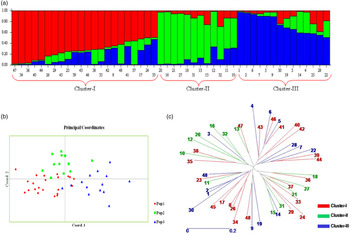
A high level of polymorphism was detected within studied accessions. Average number of alleles and PIC value was 3.18 and 0.60, respectively (Supplementary Table S2). The results showing high diversity were in agreement with earlier studies using different attributes and markers in regional germplasms (Sato et al., Reference Sato, Isobe, Asamizu, Ohmido, Kataoka, Nakamura, Kaneko, Sakurai, Okumura, Klimenko, Sasamoto, Wada, Watanabe, Kohara, Fujishiro and Tabata2005; Rosso and Pagano, Reference Rosso and Pagano2005; Paplauskienė and Dabkevičienė, Reference Paplauskienė and Dabkevičienė2008; Nikolic et al., Reference Nikolic, Vasiljevic, Karagic, Vujakovic, Jovicic, Katic and Momirovic2010). Using morphological and molecular diversity in a set of 57 accessions of this National Plant Germplasm System-United States Department of Agriculture (NPGS-USDA) core collection, Dias et al. (Reference Dias, Julier, Sampoux, Barre and Agnol2008a) also reported high genetic diversity and also pointed out the high within population diversity. In a separate study, high diversity was revealed by isozyme and Random Amplified Polymorphic DNA (RAPD) markers in a set of 79 accessions of this core set (Dias et al., Reference Dias, Pretz, Agnol, Schifino-Wittmann and Zuanazzi2008b). Mosjidis and Klingler (Reference Mosjidis and Klingler2006) also observed that genetic diversity at the species level was high and there was nearly twice as much variability among the wild populations as among the cultivars or landraces included in the red clover core subset. In contrast, few studies reported low level of genetic diversity in red clover cultivars (Kongkiatngam et al., Reference Kongkiatngam, Waterway, Fortin and Coulman1995; Kölliker et al., Reference Kölliker, Herrmann, Boller and Widmer2003). Two accessions, namely, PI205313 and PI171870 from Turkey were most distant with lowest similarity of 0.15, while highest similarity of 0.78 was found between a Danish line PI196424 and Hungarian line PI23294, thus, both these observations ruled out any correlation between geographic distance and genetic diversity. The diverse nature of Turkish lines indicated the presence of highly variable germplasm within Turkey, which was in agreement with an earlier study by Asci (Reference Asci2011). Linkage group (LG) 5 generated maximum (16) polymorphic alleles and LG 6 generated minimum (13) polymorphic alleles using 5 primer pairs from each of these LG, showing LG 5 more prone to mutational events. LG 6 showed conserved genomic region for the used SSR loci, while LG 3 was the most diverse with highest heterozygosity (Supplementary Table S3). STRUCTURE assigned three genetic clusters to all accessions indicating three gene pools in red clover (Fig. 1). It was observed that even two accessions belonging to the same country (PI418889 and PI315522 from Italy, PI318888 and PI232941 from Hungary) were placed in different clusters and vice versa. Showing no correlation in groupings of accessions, this was in correspondence to previous studies in red clover (Dias et al., Reference Dias, Julier, Sampoux, Barre and Agnol2008a, Reference Dias, Pretz, Agnol, Schifino-Wittmann and Zuanazzib). Admixture analysis showed that percentage of accessions with admixture was higher than the genotypes with pure ancestry in all clusters. High level of admixed ancestry can be attributed to pollination behaviour, breeding system/allogamy in red clover (Frame et al., Reference Frame, Charlton and Laidlaw1998; Grlju et al., Reference Grlju, Bolari, Popovi, Upi, Tucak and Kozumplik2008). Further, it was noted that each cluster was equally diverse as expected in a core set and each of these clusters were having accessions with unique alleles. Dendrogram also supported STRUCTURE analysis and showed no correlation between genetic and geographic distance (Fig. 1). This type of grouping pattern in dendrogram may be attributed to high level of variation present within groups or populations of individuals studied as also shown by admixture proportion in structure. Principal component analysis showed that the first three principal axes accounted for 57.81% variation in aggregate and were able to distinguish three populations as inferred by structure. Partition of genetic variation by AMOVA showed that greater part of genetic diversity (91%) resided within populations, while 9% genetic variation was residing among populations (Supplementary Table S5, Supplementary Fig. S1).
(a) Assignment of 48 individuals into three genetic clusters inferred by Structure. (b) Principal Coordinate Analysis of 48 Red clover genotypes based on the first two principal axes accounting for 41.6% of the total genetic variation (first axis = 22.18% and the second = 19.38% of the total genetic variation). Populations were defined on the basis of Structure analysis. (c) Neighbour-joining tree constructed for the red clover germplasm core collection. Branches are coloured according to the Structure cluster given at K = 3.

In conclusion, the results of our study showed that a high level of genetic diversity was present in this red clover core collection, which can prove beneficial for future clover improvement programmes.
Supplementary material
To view supplementary material for this article, please visit http://dx.doi.org/10.1017/S1479262116000034
Acknowledgements
The authors thank Department of Biotechnology, Ministry of Science and Technology, Government of India for providing financial support under the Grant No. BT/PR8158/AGR/02/382/2006. T. R. S. also thanks Dr Stephanie L. Greene, USDA-ARS, Pullman, WA for supply of red clover core set.