Introduction
Nasal obstruction and deformity are among the commonest conditions otorhinolaryngologists treat.Reference Jones, Smith, Carney and Davis 1 , Reference Montnémery, Svensson, Adelroth, Löfdahl, Andersson and Greiff 2 Surgery for these conditions does not improve patient survival, but is undertaken to improve symptoms and quality of life.Reference Huang and Cheng 3 , Reference Udaka, Suzuki, Fujimura, Hiraki, Ohkubo and Shiomori 4 Furthermore, there is overlap between treating nasal obstruction, congenital or post-traumatic nasal deformity, and aesthetic rhinoplasty. As such and in common with other similar treatments, nasal surgery has increasingly come under commissioning scrutiny to ensure that it is effective in relieving nasal obstruction and is not being undertaken for mainly cosmetic reasons.
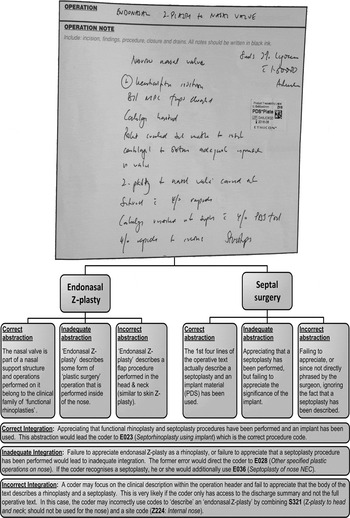
The administrative dataset, which in the UK is also known as the Hospital Episode Statistics, provides a coded summary of admitted patient care as well as out-patients and emergency department attendances in England. 5 Its clinical data forms the basis of the payment-by-results system from which hospital income is derived. It is also the principal data tool by which hospital activity is scrutinised and benchmarked, and supports increasingly complex decisions around care commissioning and resource allocation.Reference Nouraei, Hudovsky, Virk, Chatrath and Sandhu 6 , Reference Nouraei, Virk, Hudovsky, Wathen, Darzi and Parsons 7 Studies have consistently shown that Hospital Episode Statistics data has over 80 per cent accuracy for primary diagnosis and procedures, but it is less clear how well data vocabulary in nasal surgery can capture the clinical nuances of treatment and how well clinical coders who generate this data can translate subtle differences among diagnoses or procedures into codes (Figure 1).Reference Nouraei, Hudovsky, Virk, Chatrath and Sandhu 6 , Reference Nouraei, Virk, Hudovsky, Wathen, Darzi and Parsons 7
Diagram showing an example of nasal surgery coding which demonstrates the complexities of abstraction, which are strongly affected by the clarity and legibility of the primary documentation. PDS = polydioxanone

This study aimed to develop a multidisciplinary coded dataset standard (‘MCDS’) for nasal surgery, use it to guide abstraction of nasal surgery activity into codes and assess the impact of introducing the nasal surgery multidisciplinary coded dataset standard on the accuracy of nasal surgery coding.
Materials and methods
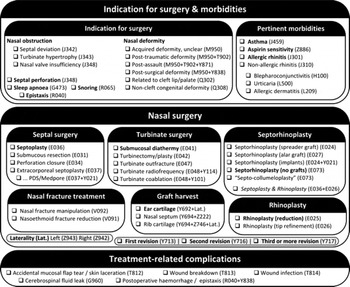
A clinical coding audit of a sample of patients undergoing septal and/or inferior turbinate surgery, rhinoplasty, or septorhinoplasty and nasal fracture treatment was undertaken between 2010 and 2013. Patients who underwent concomitant endoscopic sinus surgery (Office of Population Censuses and Surveys (‘OPCS’) codes E12–E17) were excluded. A multidisciplinary coded dataset standard (‘MCDS’) document was developed through consultation between senior ENT surgeons and clinical coders (Figure 2). A senior ENT surgeon and a clinical coding auditor who had access to the case notes and original coding used the multidisciplinary coded dataset standard as part of a multidisciplinary coding audit review (the details of which have been previously published) as a guide to assess the accuracy of nasal surgery coding.Reference Nouraei, O'Hanlon, Butler, Hadovsky, Donald and Benjamin 8 The document acted as a coding guide and checklist to systematically review whether key clinical features had been captured during the initial coding. Coding accuracy was assessed by comparing the codes generated by the clinician–auditor multidisciplinary team against the original coding. Different codes and code combinations were aggregated to identify different clinical variables. Odds ratios and their p values were used to quantify the accuracy of the original coded dataset by comparing it against the ‘gold standard’ multidisciplinary coded dataset standard audited dataset. The original coded data and multidisciplinary coded dataset standard audited data were processed using Health Resource Grouping software, and differences in tariffs were calculated and compared. Statistical comparisons were made using MedCalc statistical software version 4.0 (Mariakerke, Belgium); a p value of less than 0.05 was considered statistically significant.
Diagram showing the minimum coded dataset standard for nasal surgery.

Results
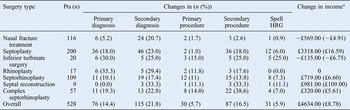
The audited dataset comprised patient data on 200 septoplasties, 109 septorhinoplasties and 57 complex septorhinoplasties (i.e. septorhinoplasty with graft or implant placement; n = 528). Overall, there were 76 (14.4 per cent) changes to the primary diagnosis, with the commonest being from J348 (other specified diseases of nose and sinuses) to a more precise diagnosis such as J342 (deviated nasal septum) or J343 (inferior turbinate hypertrophy). Septoplasty coding was changed in only 2 cases, but septorhinoplasty coding was changed in over 10 per cent of cases, with almost all of these being between different septorhinoplasty subtypes. The overall audit-related income change for nasal surgery was £8.78 per patient. Table I provides details of the impact of the multidisciplinary coded dataset standard (‘MCDS’) supported clinical coding audit on coding accuracy and income variance.
Audit using a nasal surgery minimum coded dataset standard: impact on coding accuracy and income

*Total (per patient). Pts = patients; HRG = Health Resource Grouping
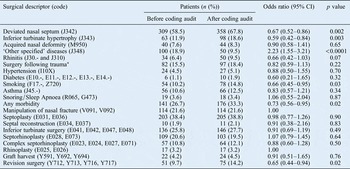
Comparisons of clinical variables between the multidisciplinary coded dataset standard audited dataset and the original coded dataset revealed under-coding of many nasal diagnoses. In addition, 50 patients (9.4 per cent) who could have been given a precise nasal diagnosis had instead been given a J348 diagnosis (other specified nasal and sinus conditions). There was also significant under-coding of morbidities. Procedure coding was more precise: most procedure-related clinical variables had odds ratios higher than 0.8. The only exception was in the capture of codes denoting revision surgery, where there was significant under-coding. Table II provides details of the coding accuracy of clinical variables.
Development of a minimum coded dataset standard: impact on the accuracy of nasal surgery coding

*International Classification of Diseases (10th Revision) codes used to identify the sequelae of trauma within the index spell: Y850, Y859, Y86X, Y870, Y871, Y872, Y880, Y881, Y882, Y883, Y890, Y891, Y899, T900, T901, T902, T903, T904, T905, T908 and T909. CI = confidence interval
Discussion
This study reports the effect of using a method for standardising nasal surgery coding on the accuracy of data used for remuneration and benchmarking of clinical activity. 9 Use of the multidisciplinary coded dataset standard (‘MCDS’) document in conjunction with a clinician–auditor multidisciplinary audit significantly improved the capture of key clinical variables into codes, enabling the administrative dataset to be used as a more clinically-aligned data source. The multidisciplinary coded dataset standard process resulted in a significant reduction in the use of the ‘unspecified’ and ‘other specified’ diagnostic codes and enabled more precise codes such as deviated nasal septum (J342), inferior turbinate hypertrophy (J343) and acquired nasal deformity (M950) to be assigned. It is important to realise that the use of less specific diagnostic codes does not necessarily denote an omission or coding error, but rather that when there is more than one way of coding an activity, use of the minimum coded dataset standard allows a clinically-guided abstraction and coding path to be taken (Figure 1). This results in more clinically relevant and accurate large datasets, which allow a more precise outcome assessment along with health policies and planning.
Only two changes (1 per cent) to the coding of septoplasty procedures were indicated, but inferior turbinate surgery was under-coded, particularly when involving an outfracture that was described without detail or inclusion in procedure heading (e.g. inferior turbinate outfracture). Likewise, in a few cases, complex septorhinoplasty was obscured by imprecise description and the use of abbreviations to denote graft placement. Two important prognostic variables, smoking and revision surgery, were significantly under-coded. For example, revision surgery was not described in the surgical record but was identified from the general practitioner's letter or by reference to previous correspondence or surgical notes in the patient's notes. Likewise, smoking was not documented in the surgical record but was identified from either the general practitioner's letter or the anaesthesia record. Failure to document pertinent morbidities in patients undergoing short-stay surgery is a common problem.
Improved coding of nasal surgery activity did not lead to significant Health Resource Grouping drift and income variance, but it did lead to significant changes in the assignment of primary and secondary diagnoses and, to a lesser extent, procedures. These findings make the dataset a better tool for benchmarking and the data it contains more clinically useful.
It is therefore proposed that the coded dataset should be constructed according to certain conventions, which are embodied in the multidisciplinary coded dataset standard document. The commonest primary diagnoses were deviated nasal septum (J342), inferior turbinate hypertrophy (J343) and acquired nasal deformity (M950). It is proposed that the indication for surgery, for example whether to treat nasal obstruction (J342 or J343) or nasal deformity (M950), should be identified through assigning it to the primary diagnosis. Other diagnoses such as rhinitis can be coded in the secondary position. Most procedure codes are readily identifiable, but the use of grafts or implants in septorhinoplasty should be clearly documented. A further consideration is septorhinoplasty vs septoplasty plus rhinoplasty (Figure 2). For rhinoplasty performed to aid access to the septum to correct a complex deviation or place functional implants, the septorhinoplasty code would be most appropriate. However, for rhinoplasty performed to correct a separate nasal deformity (such as endonasal dorsum reduction and concomitant septoplasty), it may be more precise to assign separate codes for each of the septoplasty and rhinoplasty components. This would distinguish truly functional septorhinoplasty from rhinoplasty appended to septoplasty to treat a separate condition. The post-traumatic nature of nasal surgery can and should be further clarified through using specific secondary diagnoses that denote the sequelae of events (the most common are shown in Figure 2).
There are three possibilities for implementation. Firstly, the multidisciplinary coded dataset standard can be completed by the clinician as an adjunct to the operation notes. Secondly, it should be provided to clinical coding teams (along with training and discussion) and form part of a coding department's policies and procedures documents to ensure that its continued use is not affected by clinical coder rotations among different specialties. It is also possible to audit the accuracy of data coding (as in the present study), but this study has shown that such an audit would not be cost–effective.
-
• Hospital Episode Statistics forms the basis of activity and outcome data, benchmarking, payment-by-results, resource allocation, hospital policies and planning
-
• Otolaryngology diagnoses and procedures are susceptible to clinical coding subjectivity, variability, and error
-
• A multidisciplinary coded dataset standard for nasal surgery improved coded data precision and reduced non-specific code use
-
• Standardised datasets provide for more reliable outcome assessments and benchmarking
A drawback of this study is the inherent limitation of the administrative vocabulary to capture the most subtle nuances of treatment. It can currently capture almost all septal and turbinate procedures and can differentiate between septorhinoplasty with and without the use of grafts and implants. However, although there is a specific code for the use of cartilage to reconstruct the alar cartilage (E027), the coded language cannot currently distinguish between other types of septorhinoplasty grafts. This problem may be resolved as the coding language is constantly evolving to create new codes denoting new diagnoses and procedures.
Conclusion
This study has shown that the multidisciplinary coded dataset standard (‘MCDS’) approach can be used successfully to bridge the communication gap between clinicians and clinical coders. It can form the basis of an education programme for both clinicians and coders to improve the efficiency of information transfer. The approach developed to create a nasal surgery multidisciplinary coded dataset standard can be readily adapted to other areas of ENT surgery and beyond. It may also provide a more clinically-directed shared language, which would in turn help bring the use of administrative big data for clinical outcome improvement a step closer. 9 , 10