Introduction
Health is among the many factors that can enable or constrain people's ability to form, cultivate and maintain social relationships. Poor health, for instance, can be a simple deficit of the bodily resources necessary for engaging with others. In many cases, moreover, health problems also signal ‘abnormality’, raising symbolic interpersonal barriers and relegating people to the margins of social life (Haas, Schaefer and Kornienko Reference Haas, Schaefer and Kornienko2010; Schaefer, Kornienko and Fox Reference Schaefer, Kornienko and Fox2011). A wealth of research among middle- and older-age adults supports the empirical association between health and networks, with scholars giving clear priority to understanding how social relationships shape health and wellbeing (Smith and Christakis Reference Smith and Christakis2008; Thoits Reference Thoits2011). Socially integrated adults, for instance, live longer and in better mental health than their socially isolated counterparts (Berkman et al. Reference Berkman, Glass, Brissette and Seeman2000), and the support provided by social ties is useful for utilising medical care (DiMatteo Reference DiMatteo2004), maintaining healthy lifestyles (Umberson Reference Umberson1987) and even reducing physiological inflammation (Uchino Reference Uchino2006). A small, but growing number of social scientists have pursued this issue from the opposite perspective and asked how adults' health limitations shape their networks (Cornwell Reference Cornwell2009a; Perry Reference Perry2012). Such is the focus of the current article.
The disruptions induced by poor health can appear quite salient at early stages of the lifecourse where health limitations are generally unusual and unexpected. Several recent studies using network data from the Add Health study in the United States of America, for instance, find that youths in poor health are unable to participate in activities typical among their classmates, and that they are less frequently nominated as friends by their peers (Ali, Amialchuk and Rizzo Reference Ali, Amialchuk and Rizzo2012; Haas, Schaefer and Kornienko Reference Haas, Schaefer and Kornienko2010). The current article builds on these important contributions and considers how the social dynamics associated with good and bad health play out among older adults. Health declines are often assumed to be part of ‘normal’ ageing (Rowe and Kahn Reference Rowe and Kahn1987), and so mobility problems, flagging energy levels or chronic disease may not be seen as unnatural or as problematic for seniors as they are among younger people. On the other hand, because health confers autonomy and helps preserve many aspects of people's identity in later life (Dittmann-Kohli Reference Dittmann-Kohli1990), seniors in good health likely enjoy a distinct form of social status relative to their less healthy peers.
Bounded social contexts marked by health heterogeneity are a location in which these status dynamics likely rise to the fore. Self-contained senior communities – the type of setting featured in the current study – are spaces in which wellbeing is a conspicuous and differentiating trait and, as such, provide a special window into how health can shape the social ecology of a defined population. My analysis is grounded in a particular continuing care retirement community (CCRC) in which independent-living residents do most of their socialising and conduct most of their day-to-day affairs. Records from this full set of actors allow us to peer into a uniquely bounded community and to understand social dynamics at multiple levels of analysis: individual-level reports of social interaction, dyadic patterns of affiliation and higher-order processes in the population.
Drawing from the concept of social fields as developed in Bourdieu's (Reference Bourdieu1977) theory of practice, as well as several other bodies of recent research, I anticipate that good health is a distinctively valued resource that should produce certain advantages among the healthiest older adults and that should be related to social segregation. The analyses will employ recently developed techniques for studying full social networks (exponential random graph models), examining the very straightforward issue of who reports interacting with whom, and what health has to do with it. Below, I begin by situating the analysis in the context of older-age congregative living. I then briefly outline the applicability of a field perspective, advance the hypotheses and move to the empirical analysis.
Health as status?
The retirement community context
The ageing population of the USA has prompted policy makers, health-care professionals and entrepreneurs to develop and promote a diverse array of older-age living opportunities (Howe, Jones and Tilse Reference Howe, Jones and Tilse2013). CCRCs are one such option for senior living and represent the attempt to meld non-institutionalised community life, moderate nursing assistance and long-term health care into one seamless package (American Association of Homes and Services for the Aging 2007). The basic idea is that high-functioning older adults move into their own apartment and live independently until they require more care. At that point, residents move within the same community to an assisted-living unit, where they are helped with the activities of daily life. Residents requiring more advanced care transition to full-on nursing units where they are monitored around the clock and tended to by health-care workers.
Housing contexts such as CCRCs are social spaces wedged between two disparate circumstances: conventional community life and medicalised long-term care. Residents often enter under the assumption that they will be active and enjoy the many social opportunities afforded by their new community (Shippee Reference Shippee2008), but the prospect of imminent decline looms large (Ayalon and Green Reference Ayalon and Green2012). Indeed, several recent qualitative studies document residents' fear of impending disability, the stigma of poor health and the social marginalisation of the ill, and the great lengths that residents go to to conceal their physical problems within these types of communities (Gamliel and Hazan Reference Gamliel and Hazan2006; Shippee Reference Shippee2009, Reference Shippee2012). In many ways, independent living in a CCRC context is a point of liminality enabled, in part, by elongated lifespans and uncertainty about the future of care necessity (e.g. how much care will be needed and when?). By its very design, the CCRC is a way-station between the widely desired goal of ‘ageing in place’ in one's own neighbourhood and the inevitability of eventual institutionalised care.
Social fields perspective
As such a point of liminality in the lifecourse, the CCRC context ought to shed light on how health can emerge as a uniquely valued personal trait and the corresponding implications for how residents of this space report interacting with one another. Bourdieu's (Reference Bourdieu1977) theory of practice offers one framework for understanding how these processes unfold.
In brief, the theory of practice develops an interrelationship of three core constructs: habitus, capital and field. Fields are competitive systems of social relations that operate by their own internal logic (Bourdieu Reference Bourdieu1984). Having internalised the ‘rules of the game’, people act within a field according to the assumptions, preferences and inclinations of others who have internalised its logic and participate in the social space. While fields can be analysed at the macro level, such as within a country or a profession, they can also be understood at the meso level of concrete institutions, such as older-age residential facilities (Mortensen et al. Reference Mortensen, Oliffe, Miller and Backman2012). Capital represents the sum of a person's material and symbolic resources that can be transformed into forms of power within a given field. Physical ability, for instance, can function as a form of capital within older-age residential settings if they enable people to obtain what they want or need (Mortensen et al. Reference Mortensen, Oliffe, Miller and Backman2012). Finally, habitus refers to the enduring patterns of automatic, pre-reflexive dispositions that are rooted in a person's social position by virtue of the resources available in that position. The habitus helps reproduce social structures. Practice ultimately emerges from the interrelation of these core constructs; it is ‘the result of various habitual schemas and dispositions (habitus), combined with resources (capital), being activated by certain structured social conditions (field) which they, in turn, belong to and variously reproduce and modify’ (Crossley Reference Crossley2001: 96).
The internal logic of the CCRC draws out the central value of good health in the contemporary USA. Health is a basic form of bodily and symbolic capital, and CCRC residents should act in ways – many of them subtle and pre-reflexive – to reinforce the social importance of health. Participation within varied overlapping social fields over the lifecourse underscores tacit understandings about the importance of bodily health for autonomy and self-expression; from exposure to family life, athletics, education and other arenas of social activity, people accumulate the predisposition to value wellness and disparage the illness associated with ageing. In this way, fields and habitus work in concert to develop a ‘sense of one's place’ but also a ‘sense of the place of others’ relative to oneself across the lifecourse in a variety of contexts (Bourdieu Reference Bourdieu1989: 19). The field perspective suggests that health is especially critical in older adult residential communities where it is less taken-for-granted than in other settings – and perhaps eclipses the other embodied characteristics that were more central for shaping social status at earlier points in the lifecourse (e.g. beauty or physical attractiveness; Jaeger Reference Jaeger2011). The specially privileged position of health within senior community fields is due to its relative scarcity and its importance for forestalling impending events (i.e. a move to more advanced care).Footnote 1
Implications for network patterns
Though Bourdieu's framework ‘distinguishes a field, as a theoretical space of “objective relations”, from a social network comprising actual, concrete relationships’Footnote 2 (Bottero and Crossley Reference Bottero and Crossley2011: 100), insights from the field perspective can shed light on why particular relationships are evident in a social space. Indeed, as Bottero and Crossley (Reference Bottero and Crossley2011) maintain, the field perspective provides strong motivation for moving towards a network model of explicit social interaction. If the social world of old-age congregative living is a social field in which health is a scarce and valued resource, then several individual- and dyad-level patterns should be evident when observing the social network of its residents.
At a basic level, health is an important resource that can be leveraged to build or maintain social ties with other people (Cornwell Reference Cornwell2009a). Talking, expressing interest in others and remembering interpersonal details that facilitate conversation all require some basic level of energy and physical wellness. Consistent with this idea, many studies find a positive association between health and various indicators of social engagement among older adults such as volunteering, church attendance and informal social activities (e.g. Ainlay, Singleton and Swigert Reference Ainlay, Singleton and Swigert1992; Cornwell, Schumm and Laumann Reference Cornwell, Schumm and Laumann2008; Lennartsson Reference Lennartsson1999). It is difficult to determine, however, whether healthy people have more social inclination, whether factors beyond the individual's preferences underlie this apparent association or whether a reverse causal process is really at work such that greater sociability engenders a healthier lifestyle. Some findings even suggest that those in better health may actually spend less time interacting with their close friends, adding some complication to the interpretation of differential sociality effects (Cornwell, Schumm and Laumann Reference Cornwell, Schumm and Laumann2008). That is, healthier people could need less of their associates' time (if time spent implies a care-taking relation), or people in worse health may over-estimate their time spent with others.
Information about multiple actors in a social setting helps bring some clarity to this complex scenario. In studies of social networks, it is customary to distinguish between social ties that people report sending towards other people, and those that they receive from their peers. The term preferential selection reflects the latter issue and applies in situations where relationships are potentially asymmetric (Goodreau, Kitts and Morris Reference Goodreau, Kitts and Morris2009).Footnote 3 In brief, the choices and habits of social interaction are governed not only by an individual him- or herself (e.g. whom someone reports knowing or spending time with), but also by the choices of others in their network. Certain characteristics of a focal person (ego) may make him or her more or less noticeable or appealing to their peers. Individuals in prominent, visible social roles or those who embody socially valued traits may reap a disproportionate share of social regard and attention, which can result in a disproportionate share of social tie nominations received net of those sent (cf. Feld and Carter Reference Feld and Carter2002).
As far as health is concerned, several factors suggest that good health is a predictor of preferential selection. Health protects the sense of personal autonomy, counteracting the fear that many older people have of being dependent and burdening to their loved ones (Silverstein and Abramson Reference Silverstein, Abramson, Kohlbacher and Herstatt2008). Healthiness also keeps at bay reminders of death and attendant psychological discomfort (Cicirelli Reference Cicirelli2002). Supporting the argument that good health is valued and poor health is stigmatising, Haas, Schaefer and Kornienko (Reference Haas, Schaefer and Kornienko2010) report that youth in poor health are more likely to be isolated by their peers and less likely to be nominated as friends. Empirical evidence for this effect among older adults, however, is surprisingly scant. In light of past research, I propose the following hypothesis:
• Hypothesis 1: Holding constant their levels of participation in the community, healthier people should receive the most nominations of interaction and be the least likely to nominate others.
The focus on social networks in an old-age congregative living context also leads us to expect several patterns at the level of dyads in the community. Dyadic processes refer to phenomena that transpire between two actors, including the question of which combination of actors tend to be connected in the network. Homophily, or the tendency for actors to associate with those that are like themselves, is one of the most commonly observed patterns in social network research and represents a central mechanism explaining the ‘creation, persistence, and dissolution of social relationships’ (Rivera, Soderstrom and Uzzi Reference Rivera, Soderstrom and Uzzi2010: 94). Recent theory and empirical evidence suggests, moreover, that the homophily concept provides key insights for how highly valued traits shape patterns of tie formation in a network.
Schaefer and his colleagues (Schaefer Reference Schaefer2012; Schaefer, Kornienko and Fox Reference Schaefer, Kornienko and Fox2011) argue that people aspire to interact with those in the highest status (consistent with the preferential selection hypothesis above), but that people do not ‘aim too high’ up the hierarchy, lest their social gestures go unreciprocated (see also Gould Reference Gould2002). This implies, first, that those with highly valued, status-endowing characteristics will tend to be tied with others who share their valued characteristics because it accords with their interactional preferences. This produces homophily among a certain subset of high-status actors. The theory also suggests, moreover, that homophily will be found at the lower end of the status distribution, though not because low-status actors necessarily prefer to associate with others on the bottom of the hierarchy. Rather, what manifests as homophily will result from ‘leftover’, lower-status people ‘accepting relationships with similarly valued partners’ (Schaefer Reference Schaefer2012: 1273). For our purposes here, I will refer to this phenomenon as status-oriented homophily (SOH).
Several prior studies have shown evidence for SOH as it relates to health. Hogue and Steinberg (Reference Hogue and Steinberg1995), for instance, show that depressed adolescents face avoidance from their peers and have few options for friendship apart from other young people with mental health problems. Schaefer, Kornienko and Fox (Reference Schaefer, Kornienko and Fox2011) report a similar finding, arguing that depressed adolescents withdraw from the hubs of social activity and tend to find other depressed peers at the margins of the network. Other authors have speculated that these types of processes may operate among obese adolescents (Crosnoe, Franks and Mueller Reference Crosnoe, Frank and Mueller2008). Unfortunately, however, I am unaware of any studies that have explored how health homophily may operate among older adults.
A simple, undifferentiated homophily hypothesis could anticipate that people will tend to interact with others who are similar to themselves in health. A hypothesis of differential homophily, however, takes a somewhat more nuanced form:
• Hypothesis 2: Those with the highest levels of health will tend to interact with those at the highest levels of health; those at the lowest levels of health will tend to interact with those at the lowest levels of health.
This latter hypothesis – informed by Schaefer's theory of status-oriented homophily – predicts a curvilinear pattern whereby homophily is found at the top and bottom – but not in the middle – of the health distribution.
Higher-order network considerations
The patterns of who gives and receives social ties in a population may not be governed only by people's individual associational preferences or by dyadic patterns of similarity. Tie formation is also generated by endogenous, structural mechanisms involving larger aggregates of people. That is, properties of the network itself may predispose additional ties to form between the actors. The analysis, using an exponential random graph model approach, will account for several of these key factors, including triadic closure and popularity processes.
Triadic closure refers to the ubiquitous pattern of ‘completed triangles’ in naturally occurring networks. In essence, ties tend to form between person X and person Y when both are already connected to a third person Z. This has the effect of ‘closing’ a triangle of people. As an endogenous mechanism, triadic closure implies that the likelihood of a tie between X and Z is increased by the original presence of X with Y and Y with Z (see Figure 1a). Whereas triadic closure is the presumed process responsible for tie-generation between X and Y, transitivity or clustering are the terms typically used to characterise this pattern as an outcome in an observed network (Goodreau, Kitts and Morris Reference Goodreau, Kitts and Morris2009).
Higher-order structural processes: (a) triadic closure; (b) popularity.

Popularity processes occur when actors report ties with those who are already prominent by virtue of receiving many ties from other actors. As an endogenous network mechanism, this is akin to a cumulative advantage process whereby the likelihood of a tie from one actor to another is increased by many pre-existing ties to X from other actors in the social system (see Figure 1b).
Do higher-order, endogenous network factors help generate health-based inequalities in social interaction? Our field-based approach to health, status and social network patterns in a CCRC context implies that the hypothesised preferential selection and homophily effects may be explained, in part or in whole, by the broader structural processes. That is, if the actions of multiple social actors in the community are aligned by the internal logic of the field, then triadic closure and popularity mechanisms may have the overall effect of making healthier older persons disproportionately receptive of tie nominations and the most and least healthy to interact with one another. Analyses will therefore account for these endogenous forces in the interest of understanding the complex operations of a social field.
Method
Study population
The observed network in this study comes from a CCRC in the Midwestern USA, hereafter called RC (retirement community). This community is naturally bounded; residents eat their meals in the same dining room, serve on committees that set the community policies, and participate in the same set of social, physical, educational and religious activities. Focusing on a meaningful and unambiguous community sidesteps the problem of arbitrarily defining the boundaries of a social network (Wasserman and Faust Reference Wasserman and Faust1994: 30–4). Communal populations often have a very distinctive demographic portfolioFootnote 4 but they provide an opportunity to observe basic social processes on a scale far more tractable than in a more general population.
To be eligible for the study population, individuals had to be independent-living, cognitively intact apartment dwellers. Facility requirements for living independently included (a) being physically and cognitively capable of managing all of one's own affairs or (b) living with a spouse or partner who assumed the care-giver role. Six persons occupying an apartment were cognitively incapacitated but lived with a spouse; these persons were not considered as part of the valid study population. Of the remaining 152 persons at the start of data collection, seven persons died and one moved away during the course of interviews.
In addition to the independent living apartments, RC was comprised of an assisted living unit and an area for more intensive, skilled nursing supervision. These areas of RC were separated geographically from the independent living apartments, though the units were accessible via an enclosed hallway. Nine persons transitioned from an independent-living apartment to another setting within the facility during the data collection time-frame and were thus ineligible for interview inclusion. After these restrictions, 91 per cent of the eligible population participated in the study (N=123).
Network data
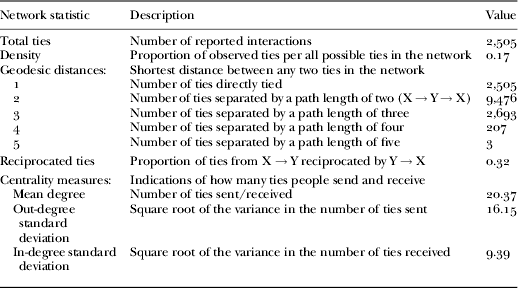
Relations connecting the older adults in this population were reports of whether they spent time interacting in a ‘typical week’ with their co-residents of the facility. Reports of these interactions were recorded during a private interview conducted with each community resident. Interviews occurred in a small office or in residents' apartments and most lasted approximately 40–60 minutes. During the course of the interview, participants were shown diagrams of each floor in the building depicting the apartments with the name of each tenant beside it. They were then asked, ‘In a typical week, would you say you spend any time interacting or socialising with [name], besides just passing by or saying “hello”?’ When the interviewee responded in the affirmative, they were asked: ‘How much time would you say you spend interacting with [name]?’ Thirty minutes per week was designated as a cut-off, creating a binary indicator of the tie.Footnote 5 There were 2,505 ties observed in these data. Basic aspects of the network are reported and described in Table 1.
Network statistics for the retirement community population
Relational ties between these older residents were directed (i.e. person X could report a tie with Y, though Y was not obliged to reciprocate). Though time spent interacting could be considered an objective fact, the interpretive evaluation was deemed more important than any ‘actual tie’ that could exist between two residents. This decision coincides with what Butts (Reference Butts2003) calls the divide between criterion/error and cognitivist networks. Whereas the former approach takes the position that there is a ‘real’ network and self-reported data only undermines its accuracy, the latter approach sees the perceptions of actor as intrinsically meaningful. As Butts suggests, some social dynamics are better (or only) suited to criterion treatment, such as diffusion of a disease through sexual partners. Other issues, such as social influence, are ideal substance for cognitivist networks. In some ways, room for interpretation taps an important axiom of interpersonal status dynamics: ‘Someone who pays less attention to you than you pay to her implicitly asserts that she is superior to you in status’ (Gould Reference Gould2002: 1151). That is, differences in how two people define the situation – interacting versus not – are in their own right a core social process underlying the emergence of status hierarchies. This subjective element will be important for assessing whether health generates divisions and inequality between older individuals in the observed community.
Health data
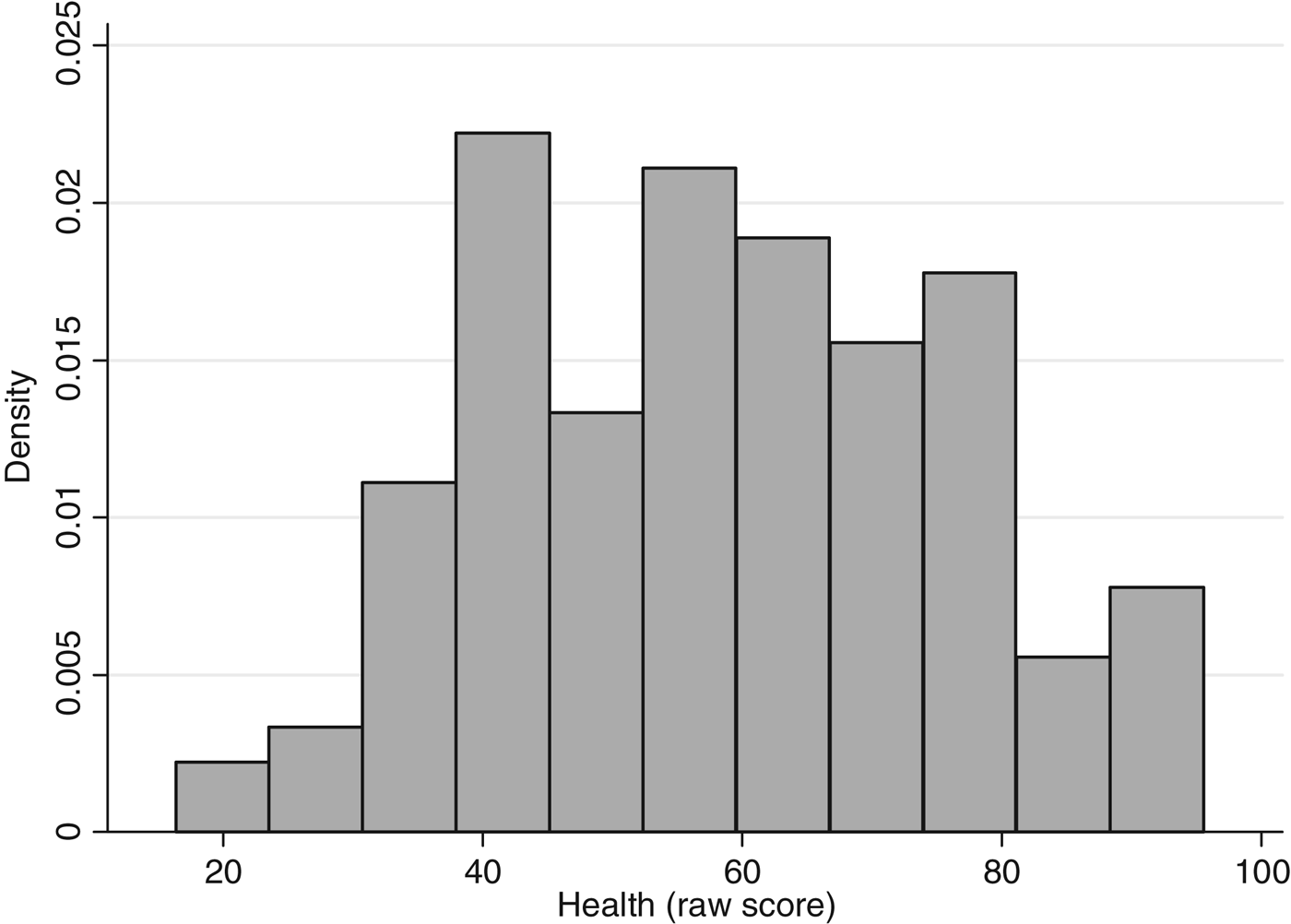
As a multi-dimensional construct, there are many ways to operationalise health status. Several previous studies on this topic utilise a single self-rated health item to capture the broad meaning of health (Cornwell, Schumm and Laumann Reference Cornwell, Schumm and Laumann2008; Haas, Schaefer and Kornienko Reference Haas, Schaefer and Kornienko2010). The current study utilises the RAND Medical Outcomes Short-Form 36 (SF 36). This measure includes 36 items related to physical functioning, disturbance of normal roles due to physical reasons, disturbance of normal roles due to emotional problems, energy/fatigue levels, emotional wellbeing, social functioning and disruption of social activities, bodily pain, and overall health evaluations. Scoring was completed following technical instructions from the investigative team (Hays, Sherbourne and Mazel Reference Hays, Sherbourne and Mazel1993), but after removing two items related to ‘social activities’.Footnote 6 The overall health score ranges from 0 to 100 and was standardised as a z-score. Figure 2 shows the raw distribution of the health variable.
Histogram of health variable.
Additional variables used in the analysis
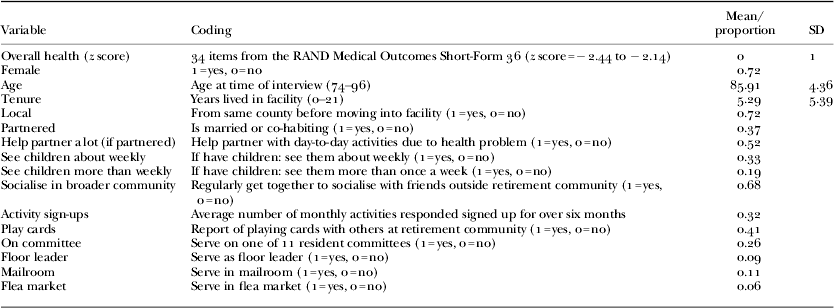
A number of additional variables were included in the analysis to account for additional factors that may influence patterns of social interaction. The basis and rationale for many of these factors was developed through participant observation in the study community (summary description available upon request). Specific coding decisions for each of the variables used in the analysis – along with their means and standard deviations (in the case of continuous variables) – can be found in Table 2.
Descriptive statistics of study sample
Notes: N=123. SD: standard deviation.
The majority of the covariates characterise individual-level traits, but many can also be reasonably conceptualised as dyad-level factors. Several of these individual traits were obtained from RC's institutional records: gender, being a local prior to entering RC, partnership status, sign-ups for formal community social activities, committee membership, floor leader status and service in the community mailroom. Several of the traits were obtained from the interviews with residents: tenure (years lived in the facility), whether they regularly helped a partner with health problems, whether they frequently see adult children, whether they regularly socialise with friends outside RC, whether they regularly play cards in the community and whether they serve in the community flea market. Most of these individual-level factors demarcate opportunities to interact with others and/or factors increasing social visibility in the community (e.g. playing cards, serving as floor leader).Footnote 7 Factors such as frequent assistance to a spouse or frequent interaction with adult children, on the other hand, could be activities which take away from time to interact with others in the community.
Several dyad-level variables were also constructed. Difference in age and in RC tenure account for the possibility that dissimilarities in life experience decrease the probability of social interaction. Most of the dyadic variables are binary indicators of similarity (1=both people have same value on the variable; 0=otherwise); these include sharing the same floor, the same gender, locality status, partnership status, card-playing status, both being on a community committee, both working in the mailroom and both serving in the flea market. Including these factors in the analysis takes into account the likelihood that people prefer others who share their traits (e.g. gender, partnership status), that residents who share common activities will have a greater likelihood of interacting, and that people living close to one another (i.e. sharing a floor) will have more opportunities for contact (Rivera, Soderstrom and Uzzi Reference Rivera, Soderstrom and Uzzi2010).
Incorporating this set of individual- and dyad-level covariates will not only aid the model in more realistically reproducing network structure, it can also help address whether health shapes patterns of social interaction through various aspects of involvement or visibility in the community. If health enables more social activity, then people in the best health may receive more tie nominations and tend to interact with one another. Preliminary analyses explored this very issue, but revealed that there were no significant differences in any of the covariate scores across quartiles of the health variable.
Exponential random graph model (ERGM) analysis
In order to investigate the two hypotheses given above, we must fit a statistical model to the network of retirement community residents. Objectives tied to this goal entail (a) recognising the stochastic nature of the network while trying to undercover empirical regularities; (b) attempting to disentangle the multiple, potentially competing micro-mechanisms which give rise to the network's global structure; and (c) comparing structural elements of the network relative to chance (Robins et al. Reference Robins, Snijders, Wang, Handcock and Pattison2007). Network models imply the processes by which ties are generated (Robins et al. Reference Robins, Snijders, Wang, Handcock and Pattison2007), and so although this analysis uses cross-sectional data, interpretation will focus on inferring the mechanisms that produce the network's structure.
Modelling the network involves a function of statistics characterising endogenous aspects of the network as well as exogenous attributes of the actors. A common modelling framework for predicting the probability of occurrence for graph y (network) from data matrix X is the ERGM:
 $$P({ Y} = y\; |n{\rm \ actors}) = \; \displaystyle{{\exp \left( {\mathop \sum \nolimits_{k = 1}^K \theta _k z_k (y)} \right)} \over c}$$
In the ERGM formulation, z k(y) represents model covariates, the set of K network statistics calculated on y and proposed to affect the formation of network Y, θ are unknown parameters that determine the influence of model covariates and the denominator c represents the quantity from the numerator summed over all possible networks with n persons. This general equation can be thought of as a conditional logit regression model predicting tie/no tie between all possible pairs of actors. The equation thus takes the form:
 $${\rm logit}\left( {P(Y_{ij} = 1\; |\; n \ {\rm actors},\; Y_{ij}^c )} \right) = \; \mathop \sum \limits_{k = 1}^K \theta _k \delta z_k (y)$$
where Y ijc represents all dyads other than Y ij and δz k(y) represents the amount that z k(y) changes when Y ij is toggled from 0 to 1. Given a logit formulation, the θ is interpretable as a logit coefficient; the log odds of a tie increase by θ k for each increase in z k. This represents a probability distribution on a fixed set of actors, where the typical graph is constituted by local configurations. In essence, the ERGM allows us to examine simultaneously explanatory variables at multiple levels of analysis – individual, dyadic and higher-order terms each predict the conditional log odds of a tie being observed in the network.
One of the long-standing problems of exponential random graph modelling has been the issue of degeneracy – a failure of the model to converge properly, or a situation where the simulations erroneously produce ties between every actor in the network. As a solution, scholars have emphasised the need to better capture endogenous processes in the network and have proposed a family of special model terms to more realistically simulate observed networks (Hunter Reference Hunter2007). Clustering and popularity, as mentioned above, are also important substantive concerns for the current article. To parameterise transitivity, I use two statistics: a geometrically weighted edge-wise shared partner (GWESP) distribution statistic, which captures a transitive (i.e. ‘closed’) triad, and a geometrically weighted dyad-wise shared partners (GWDSP) statistic which captures an ‘unclosed triangle’ pattern (X → Y and Y → Z, but no tie X → Z). A positive coefficient for GWESP and a negative coefficient for GWDSP is evidence for transitivity within the network (Papachristos, Hureau and Braga Reference Papachristos, Hureau and Braga2013). Finally, I include a term to capture popularity as a structural process, geometrically weighted in-degree (GWIDEGREE) and a parallel term to capture inequality in the distribution of ties sent in the network (GWODEGREE). These four geometrically weighted terms are standard for ERGM in the network literature (for more details, see Hunter Reference Hunter2007; for a recent empirical example, see Papachristos, Hureau and Braga Reference Papachristos, Hureau and Braga2013).
ERGM were estimated with Markov chain Monte Carlo maximum likelihood. This simulation-based estimation strategy was necessary because the standard maximum likelihood approach of logistic regression cannot handle the problem of dyadic dependence (e.g. individual- and dyad-level terms are not independent from other processes in the model). As for statistical inference, I examine the t-ratios associated with each model term (log odds coefficient divided by standard error) to assess the likelihood that a given network characteristic would have arisen by chance if it was not involved in generating the empirical pattern of social relations.
Presentation of ERGM results will proceed in three steps. First, I will estimate a pair of models focusing on individual-level explanatory factors which include terms for the focal actor's (ego's) health as a predictor for incoming and outgoing ties. The initial model is semi-reduced (Model 1), while the second of the pair (Model 2) adds four higher-order network terms (GWESP, GWDSP, GWIDEGREE, GWODGREE) to account for endogenous processes.
The second pair of models (Models 3 and 4) adds dyadic variables to the analysis. Health homophily is assessed in this pair of models, but in its simple (uniform) version. That is, the dyadic variable for health similarity merely captures the log odds of a tie between two actors who have similar health scores. In order to parsimoniously capture various segments of the health distribution, I use a four-category dyadic variable. The coefficient for this term, then, represents the log odds of a tie between two people who share the same quartile of the health distribution, net of other dyadic covariates and individual-level predictors. As with the first pair, Model 3 does not include the four higher-order structural terms, but they are added in Model 4 for sake of comparison.
Finally, the last two models (Models 5 and 6) relax the assumption of uniform homophily and allow the homophily term to differ across the quartiles of the health distribution. This set of models is used to test the differential homophily hypothesis, but is otherwise identical to Models 3 and 4. That is, it includes the full set of individual and dyadic covariates used in that pair of models, and it proceeds from a semi-reduced form to a full model which adds the four higher-order structural terms.
All six models also adjust for the baseline log odds of observing a tie, reciprocity (the tendency for a tie X → Y to be matched by a corresponding tie Y → X), and a term representing the difference (in days) between each pair of persons' interviews for the study. Although the data are technically cross-sectional, there is an inherent temporal dynamic in which a longer time between two people's sociometric reports could itself reduce the probability of one reporting interaction with the other. The time difference term attempts to adjust the ERGM estimates for this natural type of perturbation in a network setting. All ERGM analyses were completed with R using the Statnet package (Handcock et al. Reference Handcock, Hunter, Butts, Goodreau and Morris2003). Model diagnostic routines were used to assess model fit and to ensure adequate model convergence.
Results of ERGM analysis
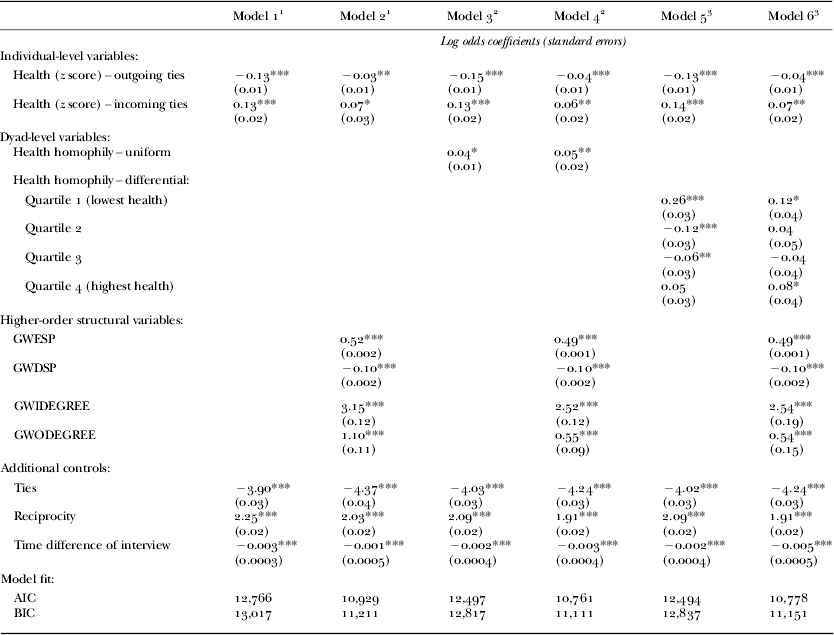
Before relating the ERGM results, it is worth noting that the plurality of coefficients included in the sequence of models complicates the typical goal of balancing parsimony with comprehensiveness. Model 1 alone contains 32 terms corresponding to individual-level predictors, 16 corresponding to ties being sent by the focal actor (ego) and the other half assessing factors which predict ties received by ego (from other actors, i.e., alters). Subsequent models include even more covariates (i.e. dyadic predictors), and so for the sake of space, Table 3 and the in-text discussion will focus on the health-related variables. I will make brief mention of the other variables included in the various models. A full table with coefficients shown for all variables used in the analysis is available upon request.
Exponential random graph model results
Notes: With 123 actors in the network, the number of observations is for all possible directed ties (N=123×122=15,006). Exponential random graph model estimation used 60,000 draws from simulated networks with a burn-in (number of toggles used in the Markov chain mixing) of 600,000. 1. Models adjust for additional individual-level covariates, including those denoting female, local, partnered, helping a partner regularly, seeing children weekly, seeing children more than weekly, socialising in broader community, activity sign-ups, playing cards, on committee, floor leader, mailroom and flea market (see Table 2). 2. Models adjust for the same covariates as Models 1 and 2, plus additional dyad-level covariates, including age difference, retirement community tenure difference, same gender, same partnership status, same locality status, same apartment floor for residence, both playing cards, both serving on committee, both working in flea market, both working in mailroom. 3. Models adjust for all covariates in Models 1–5. GWESP: geometrically weighted edge-wise shared partner. GWDSP: geometrically weighted dyad-wise shared partner. GWIDEGREE: geometrically weighted in-degree. GWODEGREE: geometrically weighted out-degree. AIC: Akaike information criterion. BIC: Bayesian information criterion.
Significance levels: * p<0.05, ** p<0.01, *** p<0.001.
Individual-level characteristics are the focus of Model 1. As indicated in the first two rows of Table 3, adults with higher levels of health demonstrate lower log odds of sending ties to peers but higher log odds of receiving ties from their co-residents. This finding is consistent with my first hypothesis, and includes adjustment for a number of other factors that increase or decrease the likelihood of ties in the network. Additional individual-level covariates that predict the increased log odds of sending a tie include being older; being partnered; living locally prior to RC entrance; and serving in the community flea market, on a community committee or as a floor leader. Individual-level covariates associated with increased log odds of receiving a tie include being partnered; being female; serving in the flea market, mailroom, on a committee or as a floor leader; playing cards regularly; and seeing one's adult children less than on a weekly basis. A table with this full set of covariates included is available upon request.
Moving down the rows of Model 1, the ‘ties’ term is negative, as is typical in statistical network models. This network statistic can be interpreted as an indication that the probability of a tie to or from an actor characterised by all zero-valued dummy reference groups is quite unlikely. As the overall density of the network is 0.17 (observed ties per total number of possible ties in the network; 2,505/15,006=0.17), a negative value for this probability could be anticipated (as 1/6 is less than a 50/50 probability). Also to be expected is the strong positive, significant value of the reciprocity term. This indicates that a reciprocated tie from ego to alter increases the probability of reproducing the empirical network more so than an unreciprocated tie would. The final adjustment made to the model was to relax the unrealistic assumption that all people's reports of social interactions came from the same moment in time. The ‘time difference’ term is statistically significant, albeit quite small (−0.003). This suggests that a greater difference (in days) between the reports of ego and alter reduces the likelihood of alter nominating ego for a social tie. For instance, for a given X–Y dyad separated by a month, X would be about 9 per cent less likely to nominate Y, net of the other factors in the model. This term accounts for the unmeasured changing circumstances in the network that could be produced by the passage of time.
Model 2 includes the full set of predictors found in Model 1, but adds several higher-order network structure variables. These variables capture endogenous processes that exist beyond the actions of single actors or dyads. The two terms representing transitivity – GWESP and GWDSP – are both statistically significant. The positive coefficient for GWESP indicates that triads are more likely to be ‘closed’ than would be expected by chance alone (i.e. X → Y and Y → Z implies a tie X → Z), while the negative coefficient for GWDSP indicates that ‘unclosed’ triadic formations are relatively unlikely. Together, these terms indicate clustering in the network. The GWIDEGREE term is also statistically significant, suggesting that there are some highly nominated people in the community that receive additional ties by virtue of their central position in the network. This term indicates that endogenous popularity processes are at work in the population. Adding higher-order structure terms improves the model considerably, lowering summary model fit statistics Akaike information criterion (AIC) and Bayesian information criterion (BIC) from the values yielded in Model 1 (smaller values of AIC and BIC indicate better fit).
Coefficients for health change somewhat when the four higher-order structure variables are included in the analysis: both terms reduce in size. In all, the individual-level patterns of ties sent and received diminish when larger structural patterns are accounted for. Several individual-level predictors besides health are reduced to non-significance, such as the tie advantage of those previously living in the local area and those who regularly play cards in groups. The high amount of clustering within this network appears to explain why these individuals are disproportionately likely to receive tie nominations.
Dyadic variables are added to Model 3. As noted above, I divide health into quartiles and assess whether sharing a similar level of health increases the conditional log odds of a tie between two people.Footnote 8 The coefficient for uniform health homophily is small and positive, though statistically significant. Estimates for health homophily are net of the individual-level health predictors, which are approximately equal in size to Model 1, which did not adjust for the dyadic covariates. Additional dyadic covariates included in Model 3 are indicators for whether person X and Y share partnership status; live on the same apartment floor in the community; serve together in the flea market, mailroom or on a committee; or both play cards. As could be expected, sharing these various characteristics and activities in common was associated with a higher log odds of a tie (full results available upon request). I also capture difference in age and residential tenure to allow dissimilarity in such characteristics to decrease the log odds of a tie, and dissimilarities in these conditions produced the expected results.
Model 4 replicates Model 3, but adds the four higher-order structure terms to the model. This follows the same sequence as Model 1 → Model 2. As before, the inclusion of the structural terms improves model fit considerably (as indicated by lower AIC/BIC values in Model 4). The coefficient for health homophily changes very little from Model 3 (goes from 0.04 to 0.05). In summary, when considering only uniform health homophily, it could appear that RC residents simply tend to associate with others that are similar to themselves in health, though the association is very modest.
The analysis concludes with Models 5 and 6. According to our second (differential homophily) hypothesis, health homophily should be driven by the increased likelihood of people at either end of the health distribution interacting with one another. To assess differential homophily, I allow dyadic health similarity to vary across the four quartiles of the distribution. This produces four terms for health, each one indicating homophily at a given 25th percentile of the health score. All other model terms are identical to those found in Model 3. Results from Model 5 indicate that sharing the lowest health quartile predicts a 0.26 log odds increase in the presence of a tie (p<0.001), while sharing the uppermost health quartile is also associated with the increased log odds of a tie, though the coefficient fails to reach conventional levels of statistical significance (0.05, p<0.10). These findings are partially consistent with hypothesis 2, but suggest that health homophily is especially driven by those at the low end of the health distribution. Health homophily is not at all evident among adults sharing the middle 50th percentile of the health distribution – in fact, the coefficients are negative. This suggests that, accounting for health as an individual-level predictor of ties sent and received, people in the middle of the health distribution are less likely than chance to identify one another as interaction partners.
Actual patterns of homophily may be obscured in Model 5, however, because we have not yet accounted for several important endogenous network processes. As with Models 1 and 2 and Models 3 and 4, accounting for the additional higher-order network terms in Model 6 provides considerable improvement to model fit (as the difference in AIC and BIC between Models 5 and 6 illustrates). The coefficients for Quartile 2 and Quartile 3 become non-significant when higher-order structural terms are included in Model 6. Coefficients for health homophily within Quartiles 1 and 4, on the other hand, are both positive and statistically significant, which supports hypothesis 2. The homophily estimate for those in the lowest health quartile is somewhat reduced in size (the log odds coefficient for Quartile 1 drops from 0.26 to 0.12), but the findings suggest that in the preferred ERGM, people at both the highest and the lowest levels of health tend to associate with others who are similar in health status.
Discussion
Using data from an entire network of retirement community residents, this study sought to explore how a local social structure can take shape on the basis of its actors' health. Analyses contribute to the large literature on health and social relations by inverting the typical causal directionality of the relationship (see Smith and Christakis Reference Smith and Christakis2008; Thoits Reference Thoits2011) and asking how relationships are distinctively patterned by health. Importantly, I account for multiple social processes that operate concurrently in a network. The overriding expectation was that health, as a valued trait in relatively scarce supply, would operate as a signal of high social status in this setting. I proposed that this should result in two noticeable patterns within the social ecology: (a) the healthiest adults should receive the most ties from their peers while themselves sending the fewest; and (b) residents should demonstrate health-based segregation at the highest and lowest segments of the health distribution. Using an ERGM approach, I examined the simultaneous influence of personal characteristics, conditions common to a pair of actors and higher-order structural factors in a network such as the tendency for relations to be clustered in triangle configurations (Robins et al. Reference Robins, Snijders, Wang, Handcock and Pattison2007).
As anticipated, healthier men and women received more social tie nominations from their peers. Much of the effect, in turn, was due to higher-order processes that represent the co-ordinated action of a social field. Taken together, these findings attest to the significance of health as a status characteristic in contexts where it is a scarce attribute, as well as to the often-overlooked reality that social ties are a function of both choice and constraint. Indeed, the social participation of an actor is not entirely of their own choosing, but is shaped in large part by the preferences and tendencies of others in a social ecology. Much of the research on social networks, health and ageing tends to emphasize the agency of a focal actor. Certainly, focal individuals can organise their network (Perry and Pescosolido Reference Perry and Pescosolido2012: 136), demonstrate an underlying preference for social ties of one sort or another (Cornwell Reference Cornwell2009b: 131) or otherwise initiate activity in their social contexts. But by adopting a data design which allows asymmetry in the reporting of social ties, we have a unique viewpoint on how network alters convey different perspectives about interpersonal interaction depending on each person's health status. To the extent, then, that social ties are generally health-protective (Thoits Reference Thoits2011), it is worth emphasising that such relationships are not merely of an individual's own choosing. The data suggest, in fact, that the very people in the community most in need of social support and companionship – those most health-vulnerable – are most at risk of being overlooked by their peers. The net effect is that older adults in this community seem to disproportionately seek the attention and company of their healthiest peers.
Findings also provided some support for status-oriented homophily – a tendency for those both high and low in a valued trait to report interacting with one another. While the results provide very modest support for a simplistic and uniform form of health homophily, there is stronger evidence for a more subtle, differential type of homophily. The expectation for these patterns was premised upon recent theory and experimental research which has outlined the ‘unintended consequences of actors seeking to build relationships that provide them with valued rewards’ (Schaefer Reference Schaefer2012: 1272). The relationships assessed in the present study were not explicitly those of social exchange within a defined game over a period of time (the conditions in which Schaefer conducted his study); the relationships I studied were asymmetric social ties in which people indicated their interaction partners in a ‘typical week’ – and in which the members of each dyad could implicitly disagree in their appraisal. As such, these relationships provided an opportunity to examine patterned non-reciprocity according to the valued trait of health. In the end, the observed pattern of status-oriented homophily corresponds to Schaefer's results from a social exchange paradigm in a laboratory setting. This extends the idea of status-oriented homophily, upholding the expectation that health can operate as an indicator of status in dyadic network patterns. We could expect to see such configurations take shape in other social fields where health is especially crucial capital.
In closing, congregate housing for older adults – including the CCRC model showcased in this study – purports to meet a variety of late lifecourse needs. Though these types of communal living often bill themselves as a place to maintain autonomy and social connectivity, residents will inevitably decline in health, often creating anxiety, frustration and marginalisation among residents (Shippee Reference Shippee2008). Understanding the effects of unequal health on the social fabric of such communities is an important task. This study employed a useful analytic technique to help disentangle the concurrent processes that shape patterns of interaction, but it represents a limited first step in helping to address the practical implications of health as a basis of interactional inequality and segregation. A significant limitation is that all data come from a single period of collection. From a policy standpoint, it would be important to observe how people's friendship networks respond to an acute health crisis or to more gradual declines.
Cross-sectional data also constrain the ability to make causal conclusions on the basis of this study. A vast literature suggests that social relationships can foster good health through a variety of mechanisms – including social support, healthful social influence, enhanced social engagement and access to health-enabling resources (Berkman et al. Reference Berkman, Glass, Brissette and Seeman2000) – and so it is likely that the true association between health and social interaction is one characterised by multiple feedback loops. For instance, some people with low levels of social engagement may feel emotionally dejected, consequently withdrawing further from social activity and continuing the cycle of inactivity and health decline (see also Haas, Schaefer and Kornienko Reference Haas, Schaefer and Kornienko2010, 434).
In addition, the setting of this study represents one CCRC in a particular region of the USA with its own idiographic set of historical developments, informal norms and customs, and mix of idiosyncratic characters. To cite just one example of the site's distinctiveness, residents had disproportionately high levels of education and former occupational prestige relative to the broader population.Footnote 9 It remains to be seen, therefore, whether the unique patterns of ties sent and received, homophily, triadic closure and popularity take similar forms in other types of space and place (see Andrews, Evans and Wiles Reference Andrews, Evans and Wiles2013). Provisional as the findings of this article may be, hopefully they will provide concepts to be examined among older adults in similar contexts. More broadly, I hope that these findings will help spur further research in other bounded settings and social fields where health has practical importance and symbolic meaning. An individual's health shapes not only his or her own capacity for social interaction; it also evokes or suppresses the behaviour of multiple other actors comprising a social structure.
Acknowledgements
This work was supported by the National Science Foundation (Dissertation Improvement Grant, 1003772), the Purdue Research Foundation, and the Center on Aging and the Life Course at Purdue University. Ethical approval for all data collection and analysis was granted by the author's institution. I thank the Ageing & Society Editor and reviewers for their helpful remarks, as well as Scott Feld, Ken Ferraro, Karen Fingerman and Jill Suitor for their guidance on an earlier stage of this research. Kirk Fatool, Ann Howell and Sarah Poorman provided excellent assistance with data collection and preparation. There are no conflicts of interest to report.