Clinical Implications
-
1. There are valid and reliable tools to assess psychopathy. The therapeutic nihilism for psychopathy is mainly based on an outdated body of literature, despite some recent advances. Offenders with psychopathy should not be excluded from treatment on the basis that they are either untreatable or that treatment can do harm; both assumptions are not supported by reliable empirical evidence.
-
2. The antisociality and dysfunctional lifestyle (PCL-R F2), and not the affective and interpersonal core personality features of psychopathy (PCL-R F1), predict violence and recidivism. Consider using interventions to reduce risk of violence by directing such intervention at ameliorating the former and managing the latter, which often manifest as treatment-interfering behaviors. A 2-component model can be used to guide the design and delivery of such treatment.
-
3. MDOs with schizophrenia can be classified into 3 types (Type I, II, III); Type I, in contrast to the other 2, is characterized by an early onset and persistence of conduct problems, culminating in a history of criminal behaviors. We hypothesize that the prevalence of psychopathy, in particular F2 features, is higher among Type I offenders than the other 2 types. Consider assessing Type I for the presence of features of psychopathy.
-
4. The predictors of aggression and violence among Type I offenders are more likely due to be criminological rather than clinical factors. Consider assessing both dynamic criminogenic factors in addition to clinical factors among Type I offenders for use as treatment target. Risk reduction treatment should focus on the causes of antisociality and violence as indicated in the second bullet above.
Introduction
Therapeutic nihilism on treating psychopathy is widespread, so much so that treatment is sometimes withheld predicated on the belief that nothing works or that treatment can cause harm. For example, a recent paper on the treatability of psychopathy stated that “... psychopathic disorders … are widely assumed to be untreatable conditions” and that “the absence of evidence based treatment efficacy for psychopathic disorders is a logical reason for not subjecting individuals with only a psychopathic disorder to involuntary hospitalization” (p. 400).Reference Felthous 1 The article was based on an award-wining lecture delivered at the annual meeting of the American Psychiatric Association. Despite such pessimism, recent advances in assessing psychopathy as well as offender risk assessment and rehabilitation have generated renewed optimism to re-conceptualize risk reduction–focused treatment for psychopathic offenders. Early treatment evaluation results are encouraging. A review and possible extension of this work to the treatment of mentally disordered offenders (MDOs) with schizophrenia, violence, and psychopathy are presented.
Psychopathy Assessment and Treatment: A Brief Overview
Psychopathy is a psychological construct generally characterized by a constellation of personality traits characterized by callous and remorseless manipulation of others, insincerity, and lying, as well as antisociality and criminal offending.Reference Cleckley 2 , Reference Hare 3 We use the term psychopath(y) to describe persons with a significant number of such characteristics. The present discussion on the treatment of psychopathy refers primarily to treatment to reduce the individual’s risk of violence and antisocial behaviors rather than to ameliorate the psychopathic personality traits and related psychopathologies.
The Psychopathy Checklist–Revised (PCL-R),Reference Hare 3 a 20-item construct rating scale, is a widely used assessment tool designed to assess some of the Clecklian features of psychopathy. The assessment and conceptualization of the construct of psychopathy using the PCL-R are not without its critics and controversies (see a review by Skeem et al),Reference Skeem, Polaschek, Patrick and Lilienfeld 4 and other tools such as the Comprehensive Assessment of Psychopathic PersonalityReference Cooke, Hart, Logan and Michie 5 have been developed to assess psychopathy. The PCL-R was used as the operational definition of psychopathy in the present discussion because it has a broad empirical evidence base and it is also the most widely used. As such, we do know quite a lot “about the psychopathic offender as defined by the PCL-R” (p. 383).Reference MacDonald and Iacono 6 The PCL-R consists of 2 oblique factors: Factor 1 (F1), which measures the interpersonal and affective traits of psychopathy, and Factor 2 (F2), which measures the chronic antisocial behaviors and unstable lifestyle. F1 can be further subdivided into the Interpersonal (eg, superficiality, grandiosity) and affective (eg, callousness, lack of remorse) facets, while F2 can be subdivided into the lifestyle (eg, irresponsibility, impulsivity) and antisocial (eg, criminal versatility, early behavior problems) facets.
Despite the widespread therapeutic nihilism on treating psychopathy, there are, in fact, very few well designed studies attesting to its treatment efficacy; that the literature is “short on quality and long on lore” is not an inappropriate characterization.Reference Simourd and Hoge 7 In a review of 74 studies of psychopathy treatment,Reference Wong 8 only 2 studies using the same sample and operating a now completely discredited programReference Rice, Harris and Cormier 9 , Reference Rice, Harris and Cormier 10 (also see next section) satisfied very basic criteria of an acceptable study design; a subsequent systematic review also pointed out the very poor state of the literature.Reference D’Silva, Duggan and McCarthy 11 However, in a meta-analysis of 42 psychopathy treatment studies, the author identified some positive outcomes after making a number of methodological adjustments to compensate for the many methodologically flawed studies.Reference Salekin 12 A subsequent updated meta-analysisReference Salekin, Worley and Grimes 13 identified recent additions to the literature with better designed studies with encouraging results.Reference Bernstein, Nijman, Karos, Keulen-de Vos, de Vogel and Lucker 14 , Reference Wong, Gordon, Gu, Lewis and Olver 15 There are still too few well designed studies to draw firm conclusions on the efficacy of treating psychopaths. However, the absence of positive evidence does not mean that no treatment will work.
In an oft quoted study,Reference Rice, Harris and Cormier 9 PCL-R–assessed psychopaths treated in a therapeutic community–type program in the 1950s recidivated violently more than a matched control group. This finding alone led to a widely held view that treatment could make psychopaths worse. The paradoxical finding is likely due to the use of totally inappropriate treatment regimes by the treatment providers. The regime was described as “… both idiosyncratic and extreme”Reference D’Silva, Duggan and McCarthy 11 and “… would be considered to be unacceptable today” (p. 169), as it consisted of “… extreme measures such as nude marathon encounter sessions for 2 weeks, together with the use of drugs such as methedrine, LSD, scopolamine, and alcohol” (p. 168). Some program participants were allowed to operate the program and “prescribe” controlled medications to co-patients! Even the authors of the article concurred that the treatment regime “… is the wrong type of program for serious psychopathic offenders.”Reference Rice, Harris and Cormier 10 Rather than asserting that treatment made psychopaths worse, a more appropriate conclusion to draw from the study is that the wrong treatment made psychopaths worse.
A Model for Risk Reduction Treatment of Psychopathy
Treatment progress can be facilitated by using an evidence-based or rationally derived conceptual framework together with appropriate safeguards to ensure treatment integrity; these basic notions were lacking in earlier treatment studies. A 2-component (2-C) model has been proposed based on recent advances in the psychopathy assessment, offender risk assessment, and offender rehabilitation literatures (see Refs.Reference Wong, Gordon, Gu, Lewis and Olver 16 – Reference Wong and Hare 18 ). The 2 components are the interpersonal component (C1), corresponding to the PCL-R F1 affective and interpersonal traits, and the criminogenic component (C2), corresponding to the PCL-R F2 dysfunctional lifestyle and antisociality, respectively. The model’s main treatment objective is to reduce the risk of institutional and community violence and criminality.
Component 1
A growing body of research shows, perhaps counterintuitively, that the core PCL-R F1 affective and interpersonal personality traits, which underpin C1, are not predictive of violence or criminality. Dysfunctional lifestyle and antisociality features, or F2, which underpin C2, are significantly linked to violence and criminality. Two meta-analyses, one on violent nonsexual offendersReference Wong, Gordon, Gu, Lewis and Olver 19 and one on sexual offenders,Reference McGuire 20 showed that F2, but not F1, predicted violent and sexually violent recidivism, respectively. Very similar findings were obtained in a number of studies of the predictive efficacy of F1 and F2 using different offender groups. These studies include a group of male Canadian aboriginal and non-aboriginal offenders,Reference Wong and Hare 21 a group of male Canadian offenders followed up prospectively for 24 years,Reference Olver and Wong 22 a group of male learning-disabled offenders from Belgium,Reference Pouls and Jeandarme 23 and a group of male and female forensic treatment patients and offenders (about 66%/34% respectively) from Sweden assessed with the PCL-Screening Version.Reference Douglas, Strand, Belfrage, Fransson and Levander 24 Further statistical analyses to determine the relative contributions of the 4 facets to predicting recidivism using 8 international samples of male and female adults showed that “… the antisocial facet is the most trustworthy and powerful predictor of future recidivism on the PCL–R and PCL:SV” and “… to maximize the predictive power … we need the antisocial facet … supported perhaps by the lifestyle facet and supplemented, on occasion, by the interpersonal and affective facets” (p. 556).Reference Walters, Wilson and Glover 25 A separate meta-analysis showed no interaction effects of F1 and F2.Reference Kennealy, Skeem, Walters and Camp 26 As F1 does not appear to predict violent reoffending, treatment aimed at changing F1, the core personality feature of psychopathy, is not expected to significantly impact future violence. However, F1 characteristics are closely linked to treatment interfering behaviors, such as poor treatment compliance and lack of motivation and engagement, as well as generally highly disruptive and manipulative behaviors during treatment.Reference Barbaree 27 – Reference Hughes, Hogue, Hollin and Champion 29 Research has also reported high treatment drop-out rates for psychopaths.Reference Olver and Wong 15 , Reference Ogloff, Wong and Greenwood 30 – Reference Olver and Wong 32 Thus, behavioral manifestations of F1 traits in treatment must be closely and carefully managed to maintain motivation and engagement, to reduce drop-out, and to ensure program integrity. Violence reduction treatment should be directed at changing F2, rather than F1 characteristics; this is a key point, as it would seem intuitively obvious that to reduce one of the central concerns of the disorder—violence and antisocial behaviors, the psychopathic personality traits, essentially F1—should be the focus of treatment.
Component 2
Many of the PCL-R F2 dysfunctional lifestyle and antisociality features that underpin C2 are static and unchangeable (eg, juvenile delinquency); a dynamic risk assessment tool can be used to identify equivalent dynamic or modifiable violence risk predictors to serve as the offender’s treatment targets. Cognitive-behavioral treatment can then be used to modify affects, cognitions, and behaviors that cause or are closely associated with the offender’s violence and criminality to reduce the offender’s risk of violence. A risk assessment tool such as the Violence Risk Scale (VRS),Reference Wong and Gordon 33 with 20 dynamic risk factors, can be used to make such assessments. The VRS dynamic factors correlate strongly with F2 (r=.80) and can be used as a proxy measure of F2.Reference Lewis, Olver and Wong 34
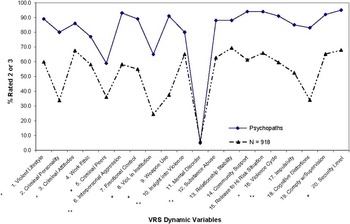
Figure 1 features the titles of the 20 VRS dynamic factors/predictors (selected based on the extant literature on offender risk assessment) and the prevalence (%) of offenders in the sample with high (3) or moderately high (2) ratings on each of the factors, which then are the identified treatment targets. VRS dynamic factors are rated with a 4-point rating scale of 0, 1, 2, and 3; factors rated 2 or 3 indicate a moderate to substantial link to violence. One sample consists of 918 Canadian federal offenders, the majority with histories of violence, and the other consists of 65 PCL-R–rated (PCL-R≥30) psychopathic offenders (adapted from Wong and GordonReference Wong and Gordon 33 ). As expected, compared to the violent offender sample, the psychopathic sample has a much higher prevalence of all of the treatment targets except the mental disorder factor. The results suggested that psychopaths and violent offenders in general have qualitatively similar treatment targets, though the former showed a higher prevalence of almost all of them. The very low endorsement of the mental disorder factor results from both samples consisting of offenders whose violence is not attributable to diagnosed mental disorders; the converse should be the case for MDOs with violence associated with the disorder.
Risk profile assessed using 20 VRS dynamic factors. The sample of 918 is a male adult offender normative sample for the VRS (see Wong and GordonReference Wong and Gordon 33 ). The psychopathic sample was identified from an offender sample using PCL=R cutoff of 30. This figure was adapted from Wong and Gordon.Reference Wong and Gordon 33

Recent research has shown that changes of the VRS dynamic factors assessed within a treatment program were associated with a subsequent reduction in violent reoffending post-release in the community among male high risk PCL-R–assessed psychopathic offenders with no active psychotic symptoms.Reference Lewis, Olver and Wong 34 , Reference Olver, Lewis and Wong 35 Analogous results were obtained for psychopathic sexual offenders assessed using the Violence Risk Scale–Sexual Offender version (VRS-SO)Reference Wong, Olver, Nicholaichuk and Gordon 36 designed for sexual offenders.Reference Olver and Wong 15 , Reference Olver, Wong, Nicholaichuk and Gordon 37 The results suggest that the dynamic factors of the VRS and VRS-SO are modifiable and satisfy the criteria for causative dynamic factors.Reference Kraemer, Kazdin, Offord, Kessler, Jensen and Kupfer 38 . Once the treatment targets are identified, risk reduction treatment can proceed.
The 2-C model is consistent with the generic and specific factors set forth by LivesleyReference Livesley 39 – Reference Livesley 41 for the treatment of personality disorders. The generic factor entails establishing therapeutic and supportive engagements between therapists and clients, vis-à-vis, the interpersonal C1 component, whereas the specific factor includes interventions that target the individual’s specific problem areas, vis-à-vis, the criminogenic C2 component. The risk/need/responsivity (RNR) principles are widely accepted as important principles to guide risk reduction treatment of offenders.Reference Andrews and Bonta 42 , Reference Andrews and Bonta 43 Higher risk offenders should receive more intensive treatment (the Risk principle); treatment should be directed toward the person’s criminogenic needs, that is, the causes or closely link attributes of the criminal behaviors (the Need principle), and, treatment delivery should be tailored to the person’s learning and response style such as the level of motivation, engagement, and intellectual abilities (Responsivity principle). Risk and Need closely map onto C2, whereas Responsivity maps onto C1.
The 2-C model is also consistent with the National Institute of Health and Clinical Excellence (NICE, UK) guidelines for the treatment of antisocial personality disorder including psychopathy. 44 The Guidelines assert that persons with antisocial personality (including psychopathy) should not be excluded from any health or social care service because of their disorder or offending behaviors (p. 7). For reducing reoffending, the guidelines recommend the following: (1) using CBT group-based approaches, (2) adapting treatment to suit the individual, (3) monitoring treatment progress, and 4) providing appropriate staff training and support (pp. 16–18). Pharmacological interventions, however, should not be routinely used for the treatment of antisocial personality disorder or associated behaviors of aggression, anger, and impulsivity (p. 16).
Treatment programs with design and delivery similar to the 2-C model have produced positive outcome results. The Violence Reduction ProgrammeReference Wong and Gordon 45 and the Clearwater Sex Offender ProgrammeReference Nicholaichuk, Gordon, Gu and Wong 46 – Reference Olver and Wong 48 are 2 examples. During such treatment, offenders’ criminogenic needs linked to sexual and nonsexual violence (F2), such as criminal attitudes and beliefs, sexually deviant interests, interpersonal aggression/hostility, substance use, etc, are assessed and identified as possible treatment targets using the VRS/VRS-SO and clinical evaluations. Cognitive-behavioral group and/or individual interventions are used, if appropriate, in a structured but flexible manner to modify antisocial thoughts, feelings, and behaviors. Practice and generalization of socially appropriate behaviors to day-to-day living are very much encouraged and supported with ongoing close monitoring guided by what we referred to as Offence Analogue and Offence Reduction Behaviors (OAB and ORB, respectively) protocols.Reference Gordon and Wong 49 OABs are the proxies of offending behaviors that manifest within an institutional context, and ORBs are the prosocial counterparts to replace the OABs in day-to-day functioning. Each VRS-identified treatment target should have corresponding OABs and ORBs. The here-and-now OABs are behaviors that treatment staff can focus on, and, using appropriate interventions, can assist offenders to learn to replace them with ORBs. To address F1-related issues, motivational and engagement work are emphasized throughout the program using, for example, motivational interviewing principles.Reference Miller and Rollnick 50 Intensive staff training to manage treatment-interfering behaviors and appropriate staff supervision and support are also important program components. The programs, about 8–9 months in duration, are suitable for both offenders with a significant history of nonsexual and sexual violence as well as for psychopathic offenders. The close integration of risk assessment and risk reduction treatment is essential in the program’s implementation.Reference Wong, Gordon and Gu 51
For MDOs with histories of violence, the 2-C model also can be used to guide risk reduction treatment once acute psychiatric symptoms are well managed, controlled, and carefully monitored and the person has regained a sufficient level of daily functioning to attend to risk reduction treatment requirements (see the next section).
Summary
The 2-C model is developed based on integrating the psychopathy assessment, risk assessment, and offender rehabilitation literatures to guide violence reduction treatment of high-risk and/or psychopathic offenders. Treatment should target the person’s modifiable criminogenic features, analogous to F2 characteristics, which are identified using an appropriate dynamic risk assessment tool. Offenders can then learn, practice, and generalize offense-reducing thoughts, feelings, and behaviors to replace offense-producing behaviors in day-to-day functioning. Staff must closely monitor and manage treatment-interfering behaviors (linked to F1 features) to maintain treatment engagement and integrity. Treatment targeting F1 features, though intuitively appealing as they appear to target the most salient and obvious psychopathic personality traits, will unlikely reduce violence recidivism even if changes were successfully made, as these traits are not linked to future violence. Outcome evaluations of programs similar to the 2-C model have shown some positive results.Reference Olver and Wong 15 , Reference Wong, Gordon, Gu, Lewis and Olver 16 , Reference Olver, Lewis and Wong 35
Psychopathy, Mental Disorder, and Violence
The majority of mentally ill persons are not violent. Among major mental disorders, psychosis has the closest link to violence. In a meta-analysis using 166 independent data sets, psychosis was associated with a 49%–68% increase in the odds of violence.Reference Douglas, Guy and Hart 52 Again, most persons with psychosis are not violent. A recent systematic review and meta-analysis based on 110 eligible studies by Witt et al Reference Witt, van dorn and Fazel 53 investigated static and dynamic predictors for aggression and violence among MDOs formally diagnosed with psychosis, the majority with schizophrenia (total n=45,533 adults; 87.8% schizophrenia, 0.4% bipolar disorder, and 11.8% other psychoses). The sample base rate of violence was 18.5%. The strongest predictor for all aggression or serious violence was criminal history—a static predictor. The dynamic predictors were hostile behaviors, poor impulsive control, recent drug/alcohol misuse, lack of insight, and noncompliance with psychological therapies and medication; the predictors were essentially the same for aggression vs severe violence as well as for inpatient vs community or mixed settings, although the strengths of association varied. In Figure 1, the dynamic predictors identified for the MDOs with psychosis are marked with a double asterisk (**). The static criminal history predictors should have a number of likely underlying dynamic counterparts, such as violent (criminal) lifestyle, criminal attitude, criminal peers, violence (criminal) cycle, and so forth that are a part of the VRS dynamic factors marked in Figure 1 with a single asterisk (*). (For a more detailed discussion of this point, see Wong and Gordon.Reference Wong and Gordon 33 ) The overlaps of dynamic violence predictors for the 3 groups are considerable (Figure 1), although the data were collected using very different methodologies. These findings are consistent with 2 meta-analyses, both showing criminological, rather than clinical, variables to be better predictors for violent and general recidivism for MDOs.Reference Bonta, Law and Hanson 54 , Reference Bonta, Blais and Wilson 55 A recent study with MDOs and non-MDOs on parole also obtained very similar results.Reference Skeem, Winter, Kennealy, Louden and Tatar 56 Given the similarities in the risk factors for the 3 groups, it is possible that they share similar etiological pathways.
Developmental Trajectory of Schizophrenia
In the last 2 decades, the extant literature, including large longitudinal cohort studies, has identified 3 different types of MDOs with schizophrenia (MDO-S) with different developmental trajectories (types I, II, and III; see HodginsReference Hodgins 57 for a review). Type I or MDO-S early starters are those whose conduct problems start before their illnesses, with an onset around late adolescence or early adulthood. Their significant childhood conduct problems persist into adolescence and adulthood, often resulting in a record of quite diverse criminal behaviors. These Type I MDO-S’s share many similarities with life-course persistent antisocial offenders without mental illness.Reference Moffitt and Caspi 58 The Type II MDO-S presents with no history of antisocial or aggressive behavior prior to illness onset (late onset), after which they repeatedly engage in many externalizing aggressive behaviors. Given their late onset, they generally accumulate fewer criminal convictions compared to the Type I. Of importance, a larger proportion of the Type II MDOs had been convicted of homicide than the Type I.Reference Tengström, Hodgins, Grann, Långström and Kullgren 59 Type III MDOs with schizophrenia are likely men in their late 30s with no history of antisocial or aggressive behaviors who kill or try to kill someone who is likely their care provider. Many of the MDO-S cases in Witt et al’sReference Witt, van dorn and Fazel 53 study also had a significant criminal history, substance abuse problems, hostility, and impulsivity that were predictive of future violence—characteristics similar to the Type I MDO-S cases.
A separate study in Sweden investigated all men who underwent pretrial psychiatric assessments and were later convicted of violent offenses in a 6-year period; 202 men were diagnosed with schizophrenia (the MDO-S cases), and 78 met PCL-R criteria for psychopathy without mental disorder.Reference Tengström, Hodgins, Grann, Långström and Kullgren 59 Twenty-nine percent of the MDO-S obtained high scores on the PCL-R and they appear to be similar to non-mentally ill men with psychopathy. The high ratings of psychopathy are associated with earlier ages of first conviction for a criminal offense and more convictions among the men with schizophrenia, just as among men with no mental illness.Reference Tengström, Hodgins, Grann, Långström and Kullgren 59 It is not unexpected that both MDO-S and non-MDOs who met PCL-R criteria would share similar criminological features, since high PCL-R ratings as well as the presence of antisocial personality disorder 60 would signal an early-onset and persistence of conduct problems, substance abuse, juvenile delinquency, criminal versatility, and so forth, essentially PCL-R F2 features.
Among MDOs with schizophrenia, those with higher PCL-R scores are more likely to be found among Type I early starters than Type II or Type III. We hypothesize that among MDO-S, the presence of high PCL-R scores is probably a proxy indication of life-course persistent antisocial behaviors, that is, a preponderance of PCL-R F2 features more so than F1 core psychopathic personality traits. In fact, it was noted that in the non-offender population, few MDOs with schizophrenia have PCL-R ratings that satisfy the criteria for psychopathy, and characteristics such as glibness, superficial charm, promiscuity, and many short-term relationships (PCL-R items) are rarely observed among them.Reference Hodgins, Côté and Toupin 61 It is also possible that the ratings of some PCL-R F1 items, such as shallow affect, lack of guilt or remorse, callous/lack of empathy, could be confounded by the presence of negative symptoms of schizophrenia, thus artificially inflating PCL-R scores. It remains to be seen what PCL-R composite and factor scores Type I MDOs would obtain should the ratings be made based only on their personality characteristics assessed prior to the onset of their illnesses.
If our hypothesis was correct and the relatively high ratings on the PCL-R among Type 1 are mainly due to the preponderance of F2 rather than F1 features, it would follow that risk reduction treatment of these MDOs should address their violence risk predictors (proxy of F2 features), not unlike the treatment of non–mentally ill offenders with psychopathy. A comprehensive risk assessment using an appropriate dynamic risk assessment tool should inform what risk factors are present that can be used as treatment targets; treatment delivery can be similarly guided by the proposed 2-C model. Assessing the possible presence and extent of F1 features would inform us of how best to manage the person to reduce the impact of treatment-interfering behaviors such as disruption of treatment group, staff splitting, etc.
Conclusion
Recent advances in the assessment of psychopathy, risk assessment, and offender rehabilitation have enabled the integration of these literatures to inform risk reduction treatment of psychopathy as illustrated by the recently developed 2-component (2-C) treatment model for violence-prone psychopathic offenders. Parallel advances in the study of MDOs, in particular those with schizophrenia, have also shed light on their characteristics and possible etiology. This article reviewed the literature and extends the 2-C treatment model to mentally disordered offenders with schizophrenia, violence, and psychopathy with supporting evidence.
Disclosures
The authors do not have anything to disclose.