Elected in 1975, Principal Chief Ross Swimmer fought for the ratification of a new Cherokee (ᏣᎳᎩ) Constitution, to officially signal the rebirth of Cherokee self-governance after seventy years of direct U.S. oversight.Footnote 1 The new constitution was meant to bring unity to a people who had endured years of termination policies designed to eliminate Indian self-governance. Reactions to the document were, however, far from unified. From the perspective of then future Chief Wilma Mankiller, the Cherokee were especially divided over the provisions made for citizenship in the nation.Footnote 2 “Many people thought a requirement of one-quarter blood quantum should have been instituted,” while others alternately “objected to the inclusion of the Delawares and Shawnees” or the “exclusion of the Cherokee freedmen and intermarried whites.”Footnote 3 Division over who counts as Cherokee was not new in the 1970s. Such turmoil developed during years of struggle against the United States over Cherokee citizenship.
This struggle continues today and is exacerbated by an American misunderstanding of indigenous politics.Footnote 4 As theorist Kennan Ferguson argues, “indigenous patterns of thought overtly oppose many of the values that [the] United States presumes.”Footnote 5 This ideological incongruence over issues of land ownership, community, and citizenship (among other things), has resulted in a long-standing tension between American and Cherokee political thought, as evidenced in the case of Sen. Elizabeth Warren (D-MA), who endured backlash from the Cherokee community over her claims of blood ancestry.Footnote 6 This tension has prevented many Americans from understanding the nature of Cherokee citizenship, its importance, and the lessons its development has for scholars who study citizenship.
Previous research has explored the character of indigenous self-government, the quest for American citizenship, and the internal struggle to define tribal belonging, but has not articulated Cherokee political thought (CPT) for use as an analytical tool.Footnote 7 Historical accounts have touched upon internal Cherokee politics and citizenship laws, yet these too have not focused on CPT as a cohesive and practicable political ideology.Footnote 8 This absence means that CPT has not been used to analyze the development of citizenship laws within the Cherokee Nation. I contribute to the ongoing discussion of indigenous politics and political development by creating a new theoretical framework for interpreting and analyzing the idea of Cherokee citizenship.
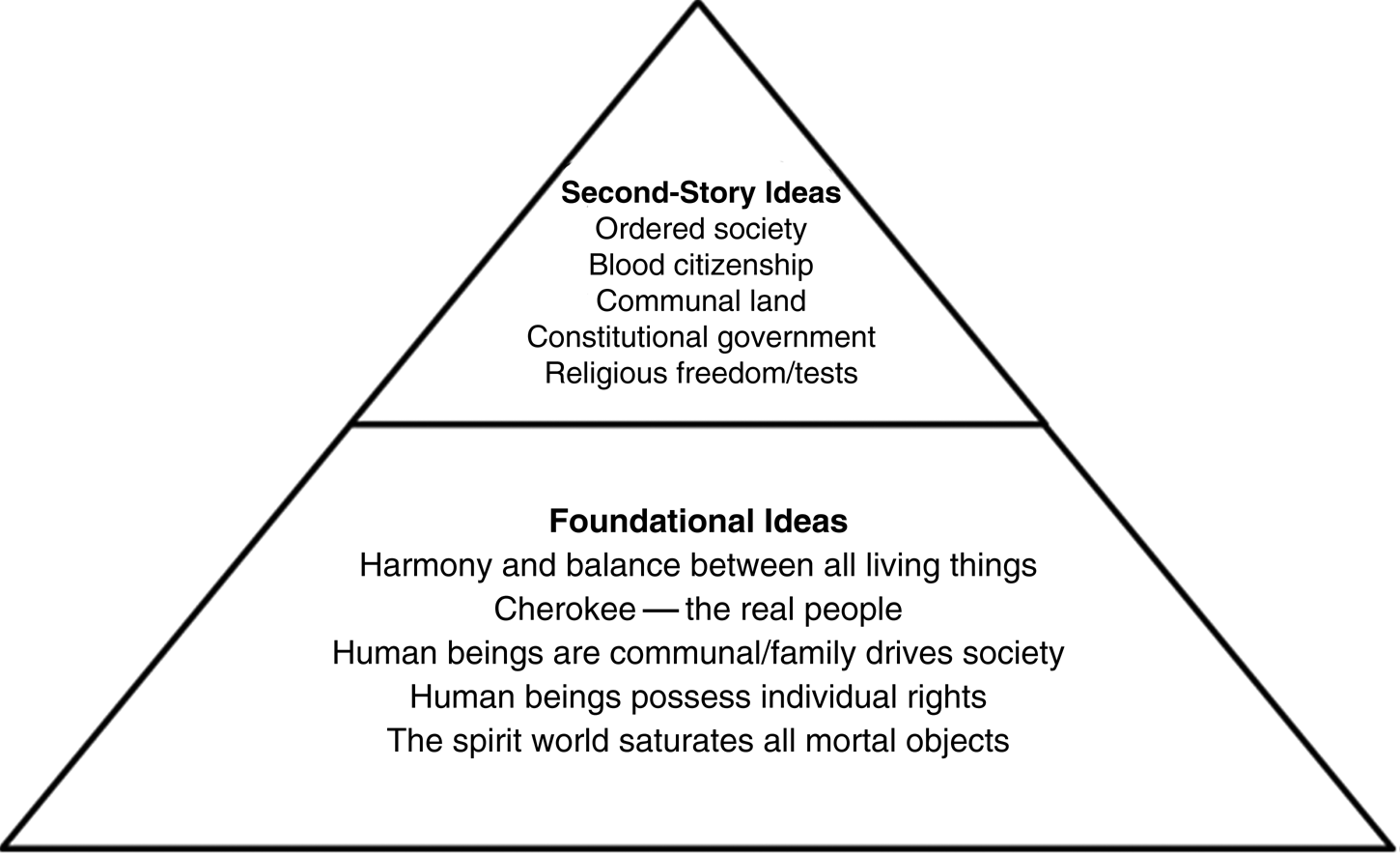
The goal of this study is to create a new framework from which to discuss CPT and then utilize that framework to identify, analyze, and interpret durable shifts in the evolution of Cherokee citizenship. I present this framework as a pyramid construction of CPT that includes two sections: a bottom section featuring foundational ideas and a top section containing second-story ideas.Footnote 9 Foundational ideas, as core ideational commitments, are in some sense immutable and thus do not often change. Changes in second-story ideas are much more frequent, made to realize and retain foundational principles. Foundational ideas answer why second-story ideas are implemented, and second-story ideas answer how foundational ideas are practiced in the real world. I then use this CPT framework to identify durable shifts in Cherokee citizenship laws across four key moments of change. Second-story ideas (what citizenship laws looked like) changed so that foundational ideas (the principle of restricting citizenship) could stay the same. Change thus becomes a means of preserving core facets of CPT, particularly ideals of citizenship.
David Wilkins, who has done much to carve out a distinct place for indigenous peoples in American political development (APD), writes that the “diversity in native governing structures” and their value systems suggests that “native peoples were more than willing to embrace new legal traditions and institutions” to conform to new political realities.Footnote 10 At the same time, many in those communities pushed “to maintain precontact sociocultural norms, institutions, and ceremonial traditions” to distinguish themselves from outsiders.Footnote 11 In its novel arrangement of political ideas and practical political evolution, this study explores that duality articulated by Wilkins. Understanding why certain laws exist, like those written in the 1975 Cherokee Constitution, and where they came from is crucial for cultivating political engagement, engaging in productive discourse, and creating humanitarian policies.
CHEROKEE POLITICAL DEVELOPMENT
Ideas have consequences; yet there are different types of ideas. Some ideas may be classified as “foundational concepts.”Footnote 12 These ideas are manifested in political discourse as justification for political positions or policies. Second-story ideas, conversely, “are encountered as tangible political phenomena in the practical political world.”Footnote 13 This strategy of categorizing ideas as either foundational or second-story aids the analyst in organizing ideas into defined packages that may then change over time. I apply this strategy to the study of CPT, focusing on the evolution of citizenship laws.
Other scholars have argued that the primary interest of APD is in “grasping processes of change conceptually” and “considering their broader implications for the polity as a whole.”Footnote 14 A political development is “a durable shift in governing authority,” where “authority” means the exercise of control over persons by the state, and “shift” means a change in the “locus of direction of that control.”Footnote 15 Here, the “analyst jumps in and investigates major ideas” as they appear in time and forms their political-analytical inquiry from that starting point.Footnote 16 Yet even in this context, adaptive decision making, which leads to durable shifts in governing authority, takes place within an environment shaped by certain political ideas. I use this strategy—the search for durable shifts—grounded in the pyramid of ideas underpinning CPT, to analyze the development of the idea of Cherokee citizenship and demonstrate both why and how it has changed.
The differences between Cherokee thought and Western liberalism have, of course, been explored before, frequently through the lens of colonization and subsequent decolonization efforts.Footnote 17 As some scholars argue, American political thought (APT) often mischaracterizes or misunderstands indigenous politics—one result of American colonial practices.Footnote 18 APT smooths over U.S. policies of removal, assimilation, and termination by focusing instead on the “progressive extension of civil rights.”Footnote 19 The dominant focus in APT has become, according to David Temin, making amends for not allowing everyone to be American and not rectifying colonial practices that suppress indigenous identity and sovereignty.Footnote 20 For some scholars, APT cannot therefore by itself offer a satisfactory solution for the problems created by the “building of an American empire,” since Western political traditions carry biases against nonliberal ideologies.Footnote 21
One of the most prominent biases APT has harbored against Cherokee thought is against the latter's conception of the citizen. While issues of blood and DNA have captured popular and scholarly attention over what it means to be Indian, less attention has been paid to tracking, from one era to the next, how and why indigenous citizenship laws have changed over time.Footnote 22 The law, as Joanne Barker points out, is a discourse that operates in historically contingent ways that engages in both internal and external conversations.Footnote 23 Cherokee citizenship law is therefore an ongoing discourse, conducted internally with CPT and externally with APT. That Cherokee citizenship has always been exclusive, often hereditary, has brought it into direct conflict with APT, which rejects in theory, if not always in practice, hereditary and exclusive citizenship.
Defining any political thought is like trying to hit a moving target. Neither CPT nor APT exist in a vacuum but are instead part of a dynamic reality. Certain generalizations, such as choosing a starting point, are necessary. That being said, defining CPT and interpreting it as an analytical tool moves the conversation from the colonial practices of the United States to the political innovations of the Cherokee, which are unique for reasons explained in the next section. Cherokee citizenship law underwent many changes before 1827 and will likely undergo many more. The crux of the present theory is that Cherokee citizenship law has changed over time due to the Cherokee desire to preserve and maintain certain foundational ideas of exclusive citizenship and tribal belonging by continually adapting to new political circumstances.
CONSTRUCTING A PYRAMID OF CHEROKEE POLITICAL THOUGHT
I begin my analysis of CPT with the 1827 Constitution, which Grant Foreman argues “inaugurated a new era of Cherokee history.”Footnote 24 While there is a rich history of Cherokee citizenship law before 1827, Cherokee constitutional citizenship—in its current legal form—began in 1827.Footnote 25 That constitution reveals both second-story and foundational Cherokee ideas. The second-story ideas, which tell how foundational ideas translate into political reality, are reflected in the laws and the design of the constitution itself. The foundational ideas implicit in the constitution require deeper analysis. To “get our knowledge of simple things from composite things,” I begin by analyzing the 1827 Constitution to gather what sort of second-story ideas are immediately present.Footnote 26
Cherokee politics in the 1820s was especially tumultuous. In addition to the ever-increasing pressure from Georgia and United States officials to relocate westward, internal divisions steadily arose between full-blood Cherokee and the growing number of mixed-bloods.Footnote 27 To add to the internal strife, “Cherokee leaders increasingly came from an elite group of wealthy men who promoted acculturation.”Footnote 28 Men like John Ross, John Ridge, and Elias Boudinot quickly rose to prominence, in part due to their comparatively advanced education. While these and other leaders tended to be more well-off than the average Cherokee, they “were no more representative of the Cherokees than the U.S. founding fathers were of Americans” and, like the founders, often fought each other.Footnote 29 Given the aristocratic tendencies of the Cherokee leaders and their precarious situation as a nation in the 1820s, the 1827 Constitution is even more remarkable. Whatever they lacked in representativeness, the drafters of the Cherokee Constitution made up for in patriotism, as they sought for the survival of the Cherokee people and to cement some form of CPT into constitutional law.
On the surface, the 1827 Constitution resembles the U.S. Constitution. The educated mixed-blooded elite among the Cherokee found much to praise in the form of the U.S. Constitution and adapted it to suit their own purposes.Footnote 30 A closer reading, however, reveals distinct differences from the United States in how the Cherokee intended their government to function. First, and perhaps most importantly, the Cherokee sought to secure their lands from hostile takeover.Footnote 31 Article I of the 1827 Constitution explicitly states that Cherokee lands are theirs, to “remain the common property of the Nation,” in perpetuity.Footnote 32 The lands they referred to in 1827 were those in modern-day Tennessee, North Carolina, Alabama, and Georgia—lands from which they would soon be violently removed. The commitment to communal land ownership, however, remained and appeared just as prominently in the 1839 Constitution, formed after removal.
Citizenship in this 1827 Constitution was also defined differently from the legal definition in the United States. Article III, Section 4 states that “the descendants of Cherokee men by all free women, except the African race … as well as the posterity of Cherokee women by all free men … shall be entitled to all the rights and privileges” of the Cherokee Nation.Footnote 33 Section 7 further qualified that voting rights were extended to “all free male citizens … who shall have attained to the age of eighteen years.”Footnote 34 Women, children, and blacks were not given the franchise, much like the legal practice in the United States at the time.Footnote 35 Citizenship then was restricted to blood Cherokee.
Cherokee citizens were afforded similar legal rights to those listed in the U.S. Constitution. Article V, Sections 14 and 15 state that citizens shall have a right to a fair trial and the right to be “secure in their persons, houses, papers, and possessions from unreasonable searches and seizures.”Footnote 36 Enumerated rights differed in the relationship between church and state. Article VI, Section 2 prescribes a religious test to hold office, stating that “no person who denies the being of a God, or a future state of rewards & punishments shall hold any office in the civil department of this Nation.”Footnote 37 Article VI, Section 10 reinforces this religious test to hold office by proclaiming that “religion, morality, and knowledge” are essential to good government, the “preservation of liberty, and the happiness of mankind.”Footnote 38 These lines were controversial. John Ridge wrote that, upon learning Christianity, his “heart received the rays of civilization and [his] intellect expanded.”Footnote 39 Yet many more traditional Cherokees lacked Ridge's enthusiasm. These lines in the constitution were a compromise so that multiple belief systems, namely Moravian Christianity, could thrive within Cherokee culture.
Notably, the Cherokee did not list a right to free speech or freedom of the press. The first Cherokee written newspaper, The Cherokee Phoenix, initially under the direction of Elias Boudinot, was a government publication, designed to help unify the Cherokee people, not divide them, as American newspapers had often done by offering conflicting or partisan arguments.Footnote 40 According to John Ross, “the public press” must be supported by the people and kept from containing “scurrilous productions” and “sectarian principles on religious subjects.”Footnote 41 “As the Phoenix is a national newspaper,” wrote Boudinot, “we shall feel ourselves bound to devote it to national purposes,” which largely included presenting the Cherokee as politically unified to hostile neighboring whites.Footnote 42
Another striking distinction between the first Cherokee Constitution and the U.S. Constitution is the amount of power given to the government, especially the General Council. The Cherokee Supreme Court was to have three justices who were appointed by the National Council to finite terms. The General Council was their bicameral legislature—representatives were selected from multimember districts for brief terms, one to two years depending on the upper or lower house. The General Council was responsible for electing the principal chief, according to Article IV, Section 1. The 1827 Cherokee Constitution set up a government that relied heavily on the General Council, the members of which selected officials in the other two branches.
The 1827 Constitution reveals several second-story ideas—ideas about how the Cherokee thought that their government should function. Land should be held in common. Citizenship should be reserved for those who were Cherokee by blood. Free blacks should be excluded from citizenship. Individual rights should be protected by the government. Religious belief should be promoted and protected by the state. The General Council should hold most of the power in government. Representatives, some directly elected but many appointed, should make critical decisions for the public good. Each of these composite ideas reflects the influence of some foundational idea. Next, I analyze these second-story ideas to arrive at foundational ideas that form the basis of CPT.
FOUNDATIONAL IDEAS IN CHEROKEE POLITICAL THOUGHT
The second-story ideas presented in the 1827 Cherokee Constitution reflect concepts drawn from both the ancestral and liberal political traditions. According to Theda Perdue, “despite major changes in the structure of Cherokee government since the days of town councils … political ethics remained relatively unchanged.”Footnote 43 This meant that Cherokees carried old political traditions into the 1820s and beyond, believing, among other things, “that leaders should represent a consensus” and cherishing “a passionate attachment to the earth.”Footnote 44 Yet there were major changes as well, like the gradual shift away from the “gendered division of labor that empowered women and men as autonomous producers” of the diverse resources needed to survive, toward a patriarchal society.Footnote 45 Thus a mixture of attachment to traditional political norms and attempts to “introduce white peoples’ habits” among the Cherokee underpinned the political environment of the 1820s.Footnote 46
According to Cherokee tradition, the Earth exists in a precarious balance: Right actions keep life orderly, whereas wrong actions upset mortal harmony.Footnote 47 The way the Cherokee formerly lived, in loosely organized towns, dependent upon communal action and familial relationships for survival, was intended to keep life balanced. Kinship associations and clan affiliation largely determined the role that each individual would play in the community; having a Cherokee mother was key to Cherokee identity.Footnote 48 Cherokee towns were loosely organized, structured to facilitate natural spiritual flourishing by allowing the Cherokee to freely interact with one another and the land.
The Cherokee people were profoundly spiritual. They “led a life full of ritual, ceremony, myth, and symbol.… life was hedged with spiritual significance in every respect. All dreams were important omens.”Footnote 49 Blood was a “central metaphor for life.”Footnote 50 One of the most sacred stories in Cherokee mythology, the story of Selu and Kanati, presents a “cautionary tale about the power of blood.”Footnote 51 Selu is cruel because she wastes blood by discarding living matter—the moral of the story was to “shed blood with care” because blood is life.Footnote 52 When Selu is later killed by her children, her blood brings forth corn from the Earth.Footnote 53 Her blood became a metaphorical source of Cherokee life. Those red human beings—the first men and women—came to be called Aniyunwiya, the real people.Footnote 54
Cherokee culture was grounded in the land and nature in a way unintelligible to individuals versed solely in the American liberal lexicon. The Cherokee had “a nuanced, layered understanding of the word ‘home,’ and they defined it in a collective sense,” one that indicated a permanent place of settlement, “collectively owned land.”Footnote 55 Cherokee beliefs “imposed a rigid personal morality and an intense communal ethic” that integrated their lives in a meaningful, clear, cohesive order.Footnote 56 Personal duties toward nature included performing regular festivals and rites linked to the agricultural seasons and ritualistic daily prayer.Footnote 57 Human beings, the land, nature, and the spirit world were all closely intertwined. The purpose of living communally was to produce harmony—the Cherokee, the real people, achieved this goal by respecting the sanctity of everyday life, community, the Earth, and themselves.Footnote 58
The legal commitment to communally held lands in the 1827 Constitution stemmed directly from the belief in the sacredness of nature and the role the Cherokee played communing with the spirit world. The foundational ideas underpinning the notion that land should be held in common are the principles of harmony and balance. These critical principles formed the Cherokee belief in the relationship between man and nature. Land could not be owned by an individual. The community was responsible for performing the sacred rituals that kept the Earth balanced and the people alive. From a young age, Cherokee children were taught that “self-interest should give way to the will of the community.”Footnote 59 The Cherokee placed great emphasis on group consensus and “not on individual competition.”Footnote 60 The decision to hold lands in common is therefore rationally derived from the principles of harmony and balance.
In a similar vein, the Cherokee idea of blood citizenship was derived from their tradition of identifying themselves through clan membership. The seven matrilineal Cherokee clans were thought of as kinship units “identical with the mother's blood.”Footnote 61 The Cherokee were members of a Cherokee clan, “and thus were Cherokee, because they had a Cherokee mother.”Footnote 62 This commitment to identifying with a Cherokee clan and maternal lineage continued even after white colonizers introduced patriarchal norms.Footnote 63 Their community was so important to the Cherokee—family, clan, and town were essential to Cherokee spirituality—that they took the exclusion of non-Cherokees from tribal membership for granted.Footnote 64 Blood membership, a practice that had existed for centuries, therefore became constitutional law in 1827.
The Cherokee spirituality explains the inclusion of religious tests for office, the dedication to promote religious belief and morality, and the right to religious practice in the 1827 Constitution. Since the Cherokee belief system permeated all corners of Cherokee life, the framers of the 1827 Constitution naturally wrote that governing document with an eye to the cultivation and protection of spiritual belief. The 1827 Constitution, however, while adamant about the importance of religious belief, is vague on the type of belief. William McLoughlin argues that the infusion of Christianity into the Cherokee Nation—most of the 1827 Constitution's framers were mixed-blooded, educated Christians—resulted in Cherokee political leaders scaling back a number of traditional Cherokee practices to appease Christian morality.Footnote 65 Boudinot saw this transformation of Cherokee culture as the nation “rising from the ashes of her degradation, wearing her purified and beautiful garments,” dedicating itself to civilization.Footnote 66
“Well-to-do, English speaking [and English educated] mixed-bloods,” like John Ross, had gained control of the Cherokee government and were largely responsible for drafting the Constitution.Footnote 67 These Cherokee political leaders saw the value in appropriating American political values so that the Cherokee might meet American government officials on an equal footing—what John Ridge referred to as “intellectual warfare.”Footnote 68 The foundational idea that human beings possess individual rights, therefore, stemmed from the experiences of Cherokee elites, who used such language to legally justify Cherokee interests in a way that white civilization could understand.
Finally, the idea of a constitutional government emanated from a combination of different foundational ideas (e.g., human beings are communal and possess individual rights, principles of harmony and balance govern all human and spiritual activity, etc.). The Cherokee in the 1820s were faced with a daunting choice between modernizing their government structure to interact with the United States more effectively or perishing at the hands of white settlers and dismissive American officials. Political necessity demanded a unified government. Political prudence recommended that the Cherokee follow the United States’ example in crafting that unified government. Through the new Constitution, the Cherokee displayed a commitment to the rule of law, by which, they thought, they could protect their rights as human beings to live, worship, labor, and thrive as they saw fit. The summation of these concepts, foundational and second-story ideas, are shown in Figure 1.
Pyramid of Cherokee Political Thought, 1827

Figure 1 displays a pyramid of ideas comprising CPT. Second-story ideas are shown on the second level and answer “how” foundational ideas are practiced in the real world. How is the communal nature of human beings, with respect to the harmony and balance that exist between man and nature, manifested as political reality? The answer to that question is “communally held lands.” Foundational ideas rest on the bottom. These ideas help answer the question why. For example, why did the Cherokee restrict legal citizenship to those with only Cherokee blood? The answer to this question is because the Cherokee, Aniyunwiya, believed that they had a special role to play in keeping the Earth balanced—and they also believed that they derived strength from familial ties. Again, the purpose of this theoretical framework is to help outline my inquiry into the nature of Cherokee citizenship, how and why it has changed, and how and why it has remained the same over time.
The pyramid of CPT, taken in totality, suggests that the Cherokee desired an ethnic-republican form of government. By ethnic, I mean that the Cherokee sought a government dedicated to the specific protection of the Cherokee people. By republican, I mean that the Cherokee desired a government dedicated to pursuing the public good—harmony and balance in the world—that could only be achieved by the Cherokee adhering to certain traditional principles. These principles were merged with individual rights language adopted from legal experiences with white civilization. The Cherokee used the United States’ liberal constitutional framework to protect nonliberal Cherokee interests. An integral component of CPT was the requirement that all citizens be related to the tribe by blood. Next, I analyze the development of Cherokee citizenship, searching for durable shifts in that governing authority.
DURABLE SHIFTS IN THE DEVELOPMENT OF CHEROKEE CITIZENSHIP
In the previous section, I created a new theoretical framework, an idea pyramid simplifying the package of ideas termed CPT. In this section, I focus on how and why Cherokee citizenship has evolved over time. Cherokee citizenship, as articulated in 1827, rested upon a few foundational ideas, such as the primacy of the family and the Cherokee communal lifestyle. The second-story idea—how those precepts were put into practice—at the time was the law of blood citizenship. Changes to Cherokee citizenship over time, therefore, should involve challenges to foundational precepts and subsequent alterations to second-story ideas. Given the Cherokee commitment to their political tradition, I expect that durable shifts in citizenship law will manifest as changes made to second-story ideas calculated to preserve exclusive tribal membership, a foundational idea.
After implementing their first constitution in 1827, the Cherokee faced a series of trials that enlarged the societal divisions already present within the nation. The tyranny of Georgia and U.S. officials over removal left Cherokee leaders a choice between leaving voluntarily or by force. Some, like Ridge and Boudinot, chose to migrate willingly. These and likeminded Cherokee, a decided minority called the Treaty Party, ultimately signed the 1835 Treaty of New Echota without the participation of the Cherokee Council or Chief John Ross.Footnote 69 U.S. officials used this unrepresentative treaty to justify and enforce westward removal. The signers, Major Ridge—father of John Ridge—and Boudinot among them, wrote Ross and the council that they were motivated by the “misery of our people accumulating every day” and sought amelioration while Ross was in Washington.Footnote 70 This treaty furthered the growing rift among Cherokee leadership.
While the Treaty Party headed west, Ross and the vast majority of the Cherokee remained until they were violently removed in the late 1830s. By the time the Ross Party relocated in Indian Territory, there already existed a council and settled laws. Ross called for unity—and to implement Cherokee constitutionalism out West—to which western Cherokee replied in June 1839 that if “your original laws, created beyond the Mississippi, [were] to be brought here, brought to life, and have full force,” it would be “entirely repugnant to the government and laws of the Cherokee Nation” and would “thereby create great dissatisfaction.”Footnote 71 A few days later, Treaty Party leaders Major Ridge, John Ridge, and Elias Boudinot were murdered. A successful constitutional convention held in the wake of these deaths gave the Cherokee a renewed sense of legal unity in their new home.
The 1839 Constitution defined citizenship as belonging to the descendants of Cherokee men or women by all other free persons except those of African descent, similar to the provisions made in 1827. They instituted new policies for marrying into the Cherokee Nation that permitted any white male citizen of the United States to obtain citizenship through marriage. Otherwise, citizenship flowed through the Cherokee bloodline, excluding blacks. An official statement released by the convention reaffirmed the Cherokee as a “separate and distinct nation” while defending “each individual in the enjoyment of all his rights,” held since time immemorial, and publicly announced their unity.Footnote 72 The 1839 official expression of citizenship kept continuity with 1827, despite the horrors of removal and social violence.
During the next few decades, the Cherokee settled into their new lands and again contended with factionalism and continued acculturation. The tension between mixed-bloods and full-blooded Cherokee that had existed for years came to a head by the time Confederates asked the Cherokee to join the southern cause. Full-blooded Cherokee generally did not own slaves and were largely turned off to this white men's practice. Mixed-blooded Cherokee, on the other hand, collectively owned more slaves than any other Indian Nation. While Ross advocated neutrality, these factions paved the way for the eventual Cherokee-Confederacy alliance in 1861.Footnote 73 Social violence and the Confederacy's insistence, coupled with the fact that the other tribes in Indian Territory had joined, caused Ross to relent. The Cherokee, however, did not go wholeheartedly into the fray.
In December 1861, Union troops moved through Cherokee territory, causing many Cherokee to defect to the Union side—Chief Ross himself followed suit, eventually fleeing to Philadelphia.Footnote 74 By the war's end, the majority of the Cherokee had joined the Union cause. The war, however, had been disastrous for them, both in terms of physical damage and social division. The southern Cherokee, under the charge of Stand Watie, brother of Elias Boudinot, were dispersed and decimated by the war. When at last Watie surrendered his Confederate command in 1865, the rush began between the Ross and Watie factions to carve out for themselves a beneficial peace treaty with the United States. The Treaty of 1866 largely conformed to the wishes of the Ross Party—that the Cherokee Nation remain one united community—but also made significant changes to Cherokee citizenship law.Footnote 75
The new treaty defined citizenship in the Cherokee Nation as belonging to all native-born Cherokee, all Indians and whites legally adopted, all freedmen liberated by acts of masters, and all free blacks residing therein.Footnote 76 The terms of the treaty, and the new legal definition of Cherokee citizenship, affected those who could be declared residents of Cherokee territory within six months of the signing. In the words of Elias Cornelius Boudinot, nephew of Stand Watie, “We have been beaten; this is to say we have not been successful in securing an absolute separation … the Ross party [has] no jurisdiction over us … they shoulder all the responsibility of the negro matter. We get none of the money.”Footnote 77
THE FIRST SHIFT IN CHEROKEE CITIZENSHIP: THE TREATY OF 1866
The Treaty of 1866 significantly changed the legal articulation of Cherokee citizenship. Instead of only belonging to Cherokee by blood, the new law stipulated that formerly enslaved peoples, many with no blood relation, had to be included as legal citizens. The second-story idea shifted, yet the foundational idea—that citizenship should be kept exclusive—endured. While U.S. officials saw the treaty as a means to finalize the end of slavery and simultaneously deal with the issue of newly freed slaves in Indian Territory, the Cherokee actively resisted the redefinition of their tribal citizenship.Footnote 78
The treaty was a victory for those who would see the Cherokee unified, like John Ross—who died of natural causes shortly after the signing. While the southern faction was upset over the outcome, they were able to join their fellow Cherokee and elect a compromise candidate for principal chief in the wake of Ross's death. By 1870, the new chief, Lewis Downing, had to contend with not only internal factionalism and newly freed slaves, but also Congress threatening to establish a “territorial form of government over them,” jeopardizing Cherokee sovereignty.Footnote 79 Alarmed at U.S. attempts to dictate who could be considered Cherokee, the Cherokee Council opted for a strict interpretation of the six-month provision in the Treaty of 1866 that acknowledged citizenship only for those who returned to the nation within six months of the signing. Six months, however, was not enough time for those displaced by the war to return to Cherokee territory. For years after the treaty, hundreds of freedmen and their families migrated back. The council routinely denied them citizenship.Footnote 80
In 1869, the Cherokee Council empowered the Cherokee Supreme Court to sit as commissioners to pass judgment on citizenship claims. Yet while the Cherokee asserted their authority to define their own citizenship, they quickly found that they could not handle the chaos of hundreds of people pouring into Cherokee territory, all claiming previous residence.Footnote 81 Lacking the infrastructure to handle these claims, the Cherokee either hastily denied many freedmen or kept them in limbo. The Cherokee referred those rejected claimants to the Commissioner of Indian Affairs along with a request for their removal—a provision present in long-standing treaties. The new status quo, however, proved untenable. As early as 1871, inundated with pleas from freedmen and their families, the Office of Indian Affairs ordered Union Agents in Indian Territory not to remove freedmen whom the Cherokee classified as intruders.Footnote 82 The Union Agency instructed freedmen and others struggling with the Cherokee for citizenship to come directly to U.S. officials instead, further undermining Cherokee authority.Footnote 83
Despite the efforts of the Cherokee to resist, the altered citizenship law—that non-blood-related freedmen were citizens—prevailed, and it helped create a new political reality for the Cherokee people in the post–Civil War era. This new reality forced Cherokee politics to wrestle with an influx of new citizens, along with now-old struggles against American land grabs and divisive acculturation. Yet, as evidenced by repeated efforts to suppress the number of new citizens, the Cherokee remained politically committed to the foundational idea that their membership ought to be exclusive. The second-story idea—the actual citizenship law—changed, but although the United States forced the Cherokee into that position, the council and other leaders took agency where they could and restricted citizenship as much as possible.
The Cherokee amended their constitution in November 1866 to reflect the new definition of citizenship, as required by treaty. The new law stated that:
All native born Cherokees, all Indians, and whites legally members of the Nation by adoption, and all freedmen who have been liberated … as well as free colored persons who were in the country at the commencement of the rebellion, and are now residents therein, or who may return within six months from the 19th day of July, 1866, and their descendants … shall be taken, and deemed to be, citizens of the Cherokee Nation.Footnote 84
Some scholars, like Circe Sturm, argue that the Cherokee resistance to incorporating the freedmen was “motivated largely by economic factors,” and certainly many Cherokee loathed the idea of sharing federal money and land.Footnote 85 The analysis of CPT presented here, and the commitment to foundational ideas, however, suggests that the Cherokee had deep-seated cultural and ideological reasons for excluding the freedmen, and everyone else, from citizenship as well.
In 1883, Chief Dennis Bushyhead addressed the federal government's continued attempts to dictate policy and practice to the Cherokee over their citizenship laws. The Cherokee government, claimed Bushyhead, “considering itself in the light of a parent to a family … had the right to count and claim its own children for itself and to be let alone while doing so.”Footnote 86 This included the right to exclude the “unentitled” and “pretenders” who were not part of the Cherokee family.Footnote 87 Part of Bushyhead's exasperation came from the U.S. insistence on dealing with claimants as individuals, pretending “that the Treaty [of 1866] had been made with individual members, and not with the Nation as a whole.”Footnote 88 Bushyhead articulated in his speech what many U.S. agents either could not or refused to understand: that the Cherokee viewed politics and the family as inseparable. This foundational idea endured despite changes to the law.
THE SECOND SHIFT IN CHEROKEE CITIZENSHIP: THE DAWES ACT AND TERMINATION
Without the appropriate infrastructure or help from the federal government, the Cherokee were unable to keep up with the pressure of new claimants to citizenship, especially when the time came to receive payments for Cherokee lands sold to the United States. In 1883, the Cherokee passed an act declaring that the money, some $300,000, could only be distributed among blood Cherokee.Footnote 89 The decision excluded freedmen from receiving any of the bounty. Desiring a share in the payment, many freedmen appealed to the Office of Indian Affairs, as they had done in the past. The Office of Indian Affairs, refusing to acknowledge Cherokee authority, used the situation to begin settling the issue of native sovereignty in the eyes of the federal government.Footnote 90
Freedmen and white settlers attempted to gain access to Cherokee citizenship for decades, culminating in the Dawes and Curtis Acts of 1887 and 1898, respectively. The Dawes Act began the process of converting communally held lands in Indian Territory into lots of individual ownership, to both further Americanize Indian nations and make room for white settlements.Footnote 91 The Dawes Act also created the Dawes Commission, responsible for compiling a roll of residents living in Indian Territory. The Cherokee were greatly opposed to these measures and actively resisted efforts to count them.Footnote 92
Chief Joel Mayes cautioned the Cherokee in 1889 against U.S. officials’ attempts to count them, stating that he “refused to appoint any one to act” with agents in charge of compiling the rolls.Footnote 93 While Chief Mayes was certain that “there [would be] no trouble in determining the citizenship of the Shawnees and Delawares,” who had been incorporated in the 1860s, he was adamant that “bona fide colored citizens should be definitively known,” to rule out illegitimate claimants.Footnote 94 Mayes did not anticipate a fair counting, especially when it came to the contentious issue of the freedmen and those pretending to belong to the Cherokee Nation.
Congress passed the Curtis Act when it became clear that many in Indian Territory would not cooperate. The act gave the Dawes Commission authority to act without tribal consent, extended federal court jurisdiction over tribal lands, and allowed the United States to assume the tax payments of whites living in the Cherokee Nation.Footnote 95 The Dawes Rolls broke down those residing on Cherokee land into three categories: Cherokee, whites, and freedmen. All told, the counted inhabitants of the Cherokee Nation numbered 41,798, including 4,924 freedmen.Footnote 96 There were over 1,000 freedmen who had previously been citizens, however, that the Dawes Commission excluded from its rolls—due to a mixture of clerical error, inability to produce proof of citizenship, and racial profiling. The final rolls closed in 1902, and in 1907 the Cherokee Nation ceased to exist as Oklahoma joined the Union.
The Dawes Act—that “mighty pulverizing engine to break up the tribal mass,” as Theodore Roosevelt called it—began eliminating the Cherokee policy of holding land in common and allowed the federal government to physically count and name Cherokee citizens.Footnote 97 The Cherokee lost their ability to hold lands in common, their ability to determine tribal citizenship, and, in 1907, the entirety of their tribal governing authority. The Dawes Rolls determined who could be legally Cherokee from that point forward. Further complicating matters—factoring in the lack of cooperation from the Cherokee, the racial profiling of the census takers, and the inability to correctly place some people—the Dawes Rolls were a wholly flawed list.Footnote 98 Not only did the United States assume control over Cherokee citizenship, but it also miscounted the existing citizens.
The federal policies of allotment and termination resulted in the second shift in Cherokee citizenship law. Of course, with these acts, Congress dealt major blows to indigenous sovereignty across the board—what happened to the Cherokee was part of a larger narrative to eliminate all tribal governments and claim more land. U.S. officials hoped through allotment that Indians would more fully Americanize.Footnote 99 Up until 1907, the Cherokee faced social and political problems they lacked the infrastructure to handle. Powerless to stop the inflow of settlers and business that followed the railroads, the Cherokee stood firm when it came to citizenship. By dissolving the nation completely, the United States erased many of the second-story ideas in the pyramid of CPT.
THE THIRD SHIFT IN CHEROKEE CITIZENSHIP: SELF-DETERMINATION
The federal policies of allotment, termination, and assimilation continued into the 1930s. In 1924, Congress passed the Indian Citizenship Act, which “conferred US citizenship on noncitizen Indians.”Footnote 100 During the debates in the House of Representatives over the Indian Citizenship Act, Rep. William Hastings (D-OK) spoke of the end of Indian affairs, stating that “during the present session of Congress everything has been done that has been possible to wind up the affairs of the Five Civilized Tribes.”Footnote 101 Government officials during this period hoped to resolve Indian affairs and fully assimilate Indians into American culture. However, the persistence of tribal organizations, culture, and practice—combined with the continued problem of policing and governance after the failure of allotment to improve economic conditions among indigenous peoples—eventually forced a reappraisal of the situation.Footnote 102
In what indigenous activist-intellectual Vine Deloria Jr. called “perhaps the only bright spot in all of Indian-Congressional relations,” the Indian Reorganization Act of 1934 declared Congress's intentions to end allotment period policies and permit tribes to organize for political and economic reasons.Footnote 103 During the 1920s, there was a growing sense among reform groups that Indian life needed to be drastically improved.Footnote 104 Reform movements culminated in the Reorganization Act, which sought to “revive traditional tribal institutions and integrate them with a program” for economic rehabilitation.Footnote 105 Yet while Congress was willing to grant more autonomy to tribes, lawmakers were doubtful that Indians were ready for self-government—the allotment and termination periods had sunk many into extreme destitution, and the lack of strong internal government had bred corruption.Footnote 106 The momentum of this policy era changed, however, after WWII ended and bureaucrats believed that tribal governments were outdated in the new world order.Footnote 107
Termination and relocation policies constituted a new plan to end the “government's trust relationship over Indian lands” and relocate native residents to new homes in urban centers.Footnote 108 Wilma Mankiller, who was relocated under the Urban Relocation Program as a little girl, explained that the “government wanted to break up tribal communities and ‘mainstream’ Indians,” so they moved them to where they might become more American.Footnote 109 House Concurrent Resolution 108 in 1953 “announced Congress’ purpose to end tribal wardship” and “sever federal obligations to tribes” to further facilitate assimilation.Footnote 110 Yet the “combined effects of termination and relocation,” coupled with the civil unrest of the 1960s, eventually gave rise to the Indian self-determination movement, which had important ramifications for Cherokee citizenship law.Footnote 111
While there were many changes in federal Indian policy between 1907 and 1970, neither these changes nor the effects they had on the Cherokee produced any substantial shift in Cherokee citizenship law. It was not until the restoration of tribal sovereignty in the 1970s, with the passage of the Five Civilized Tribes and the Principal Chiefs Acts, that the Cherokee were able to reassert their sovereign right to declare who was a citizen of the Cherokee Nation.Footnote 112 In 1975, the Cherokee drafted a new governing constitution—one vastly different from the versions that preceded it in the nineteenth century. It was similar, however, in its commitment to exclusive citizenship, yet different in its means of securing it.
In 2006, former Chief Ross Swimmer, reflecting back on that 1975 Constitution, wrote that:
In 1975 we established, through the constitution, that one had to be either on—or a lineal descendant of—someone who was on the 1906 Dawes Commission Roll. And on the Dawes Commission roll there were approximately 41,000 Cherokees enrolled. So in order to be a member of the tribe one has to prove his ancestry back to a person on that roll.… That's somewhat arbitrary.… One of the reasons why we oppose blood quantum for membership is that there really is no way of determining what blood quantum is … we treated membership as citizenship in a nation, not blood quantum.Footnote 113
The treatment of citizenship in the 1975 Constitution reflects the same commitment to the foundational idea that citizenship should be exclusive—in this case, as exclusive as possible. The long history of U.S. interference in Cherokee governance forced a permanent shift away from nineteenth-century citizenship laws. The second-story idea of citizenship in the 1970s, therefore, had to be different from what came before. By using the Dawes Rolls as the standard by which to determine Cherokee citizenship, Cherokee leaders hoped to appease the United States—since the Dawes Rolls were a U.S. project—while remaining dedicated to the principle of exclusive citizenship.
In many ways, the Cherokee Nation established a government from the ground up in the 1970s. While guided by the lessons of history and CPT, the Cherokee people, as Swimmer put it, had to relearn how to self-govern.Footnote 114 The 1975 Constitution reflected a corporate model of government, where officials acted as a board of directors overseeing tribal affairs. Swimmer viewed the Cherokee Nation “not necessarily as a government but as an organization,” akin to a nonprofit with a budget of $10,000.Footnote 115 The unicameral National Council was more responsible for organizing the distribution of services than governing. At the time, with the Cherokee people scattered and unorganized, this constitution fulfilled the need for reform and served as a rallying point for the reinvigorated Cherokee Nation, then some 40,000 strong.Footnote 116
The Cherokee Nation continued to grow and prosper under the Swimmer and subsequent Mankiller administrations. The corporate model of government, however, did not provide the infrastructure to handle a surge in population, services, and governing responsibilities. The situation evolved into a crisis in the late 1990s, when the government split in two shortly after the bitterly-contested election of Chief Joe Byrd in 1995, a political novice, whose inauguration Wilma Mankiller refused to attend. In the 1990s, the stakes were higher for Cherokee governance than they had been in the 70s. The number of citizens had increased from 40,000 to 200,000 and the nation's budget from $10,000 to $192 million.Footnote 117 Byrd's political opponents had Cherokee marshals and the FBI open investigations against him over Byrd's alleged misuse of federal funds. Byrd responded by removing most of the Cherokee officials with legal authority to challenge him, including all three court justices and the editor of the nation's newspaper.Footnote 118 Half of the tribal council in turn boycotted council meetings, preventing quorum, halting government operations for nearly a year.
The situation in the Cherokee Nation turned violent when fired Cherokee marshals and impeached justices attempted to physically retake the nation's courthouse from the private security force Byrd had hired to protect him.Footnote 119 The resulting brawl, and the increasing threat of congressional intervention, convinced both sides to eventually come together and establish an independent Constitution Convention Commission in 1998, which included representatives from each branch of government.Footnote 120 In 1999, a group of seventy-nine Cherokee citizens assembled for nine days and drafted a new constitution, one more suited to organizing a larger Cherokee Nation responsible for a more diverse constituency. The 1999 Constitution was ratified in 2003 and eventually became law in 2006.
In the 1999 Constitution, the Cherokee displayed a citizenship law consistent with their foundational idea of citizenship—in fact, Article IV of the 1999 Constitution is the most explicit description of Cherokee citizenship of all four governing documents. It states:
Citizenship of the Cherokee Nation shall be limited to those originally enrolled on, or descendants of those enrolled on, the Final Rolls of the Cherokee Nation, commonly referred to as the Dawes Rolls, for those listed as Cherokees by blood, Delaware Cherokees… and the Shawnee Cherokees.
While the reliance on the Dawes Rolls remained, the 1999 Constitution placed more emphasis on the sovereign right of the Cherokee to self-govern and self-determine. Elected in 1999, Chief Smith's administration—which saw an overall increase in policies reaffirming Cherokee culture, traditional practices, and sovereignty—continued fighting for more governing autonomy. The renewed push for sovereignty culminated in a 2003 vote to abolish the 1976 Constitution's requirement of U.S. federal approval for all Cherokee constitutional amendments. The amendment passed with 65 percent of the vote.Footnote 121 The 1999 Constitution was ratified shortly thereafter.
One of the side-effects of this amendment was that the Cherokee government gained more control over citizenship and voting. Practically, this 2003 amendment also led to the exclusion from citizenship of many descendants of freedmen and those who could not prove blood ancestry by relation to someone on the Dawes Rolls.Footnote 122 The Bureau of Indian Affairs, which had delayed the ratification of the 1999 Constitution for years, again challenged the results of the 2003 vote. In 2007, the Bureau of Indian Affairs denied the validity of the amendment, stating that the Cherokee were in violation of the Treaty of 1866 and could not deny citizenship rights to sections of their population.Footnote 123 Later that same year, Rep. Diane Watson (D-CA) introduced a bill designed to sever U.S. ties with the Cherokee Nation unless they granted full citizenship to the descendants of freedmen.Footnote 124 Challenges to the amendment were seemingly put to rest by the Cherokee Supreme Court in 2011. Chief Justice Matlock argued that “it stands to reason that if the Cherokee had the right to define citizenship” in 1866, then they would have the “sovereign right” to change it.Footnote 125
Finally, in August 2017, U.S. District Judge Thomas Hogan remarked that while Native Americans had been marginalized and unjustly removed from their lands, nothing in this history gave the Cherokee the authority to deny previously established citizenship to descendants of their freedmen.Footnote 126 As the results of Hogan's ruling indicate, Cherokee citizenship is legally defined as including all Cherokee, all whites and others adopted, and all freedmen and their descendants. Legally, the United States’ redefinition of Cherokee citizenship prevailed. While the Cherokee still retain some measure of self-determination, the United States has had the final say on who counts as a Cherokee citizen.
The congressional policy of Native American self-determination that led to the rebirth of Cherokee constitutionalism created the third durable shift in Cherokee citizenship. Whereas, prior to 1975, Cherokee citizenship carried little political weight beyond Cherokee communities, after the Cherokee ratified their new constitution, tribal membership received new political vigor. The Cherokee moved quickly to assert their national sovereignty by again formally restricting citizenship to descendants of those listed on the Dawes Rolls. Freedmen and others who could not prove relation to anyone listed—even though they had been physically residing in Cherokee communities their entire lives—were excluded. The freedmen and others pushed back. Legal battles continued for years until 2017, when a U.S. district court ruled that Cherokee citizenship must include those listed on the original 1906 Freedmen Rolls as well.
CHEROKEE CITIZENSHIP, 1827–2020
The search for durable shifts in Cherokee citizenship policies from 1975 to 2017 finds two more watershed moments. The first shift came in the 1970s, when Congress released control of the Cherokee tribal government. Immediately, the Cherokee reaffirmed their commitment to exclusive hereditary citizenship. By 1992, the Cherokee had codified paths to citizenship; while expanded to include adoptions and other nontraditional familial attachments, citizenship remained driven by the Dawes Rolls.Footnote 127 The 1999 Constitution and 2003 amendment show the Cherokee attempting to expand their governing authority. The effort to restrict citizenship to only those on the Cherokee Rolls as of 2017 has failed. Federal officials have upheld the definition of Cherokee citizenship that includes individuals listed on both Cherokee and Freedmen Rolls. Moreover, the United States has asserted that the Cherokee do not have the sovereign right to change their definition of citizenship to exclude currently included peoples.
An analysis of how Cherokee citizenship developed reveals at least three significant, durable shifts in policy. It remains to be seen whether the Cherokee will challenge the 2017 court ruling. Table 1 displays the progression of Cherokee citizenship polices over time. The dominant policy prior to 1866 was a strict, racially based vision of citizenship as explicitly derived from the Cherokee bloodline. The racial component reflected the same prejudices of white society against blacks, which the Cherokee codified into law in their 1827 and 1839 Constitutions.
Shifts in Cherokee Legal Citizenship, 1866–2018

The Treaty of 1866 changed this policy. The Cherokee, to return into the good graces of the government they had rebelled against, were forced to submit to the inclusion of freedmen as citizens of the Cherokee Nation. The treaty was ratified, however, with a six-month provision that gave the Cherokee authority to refuse entry to those appealing for citizenship more than six months after the signing. The policy for the next thirty years was a strict interpretation of the treaty and a routine refusal to admit those who came late into Cherokee territory.
Between 1887 and 1907, the United States used the freedmen situation as leverage to chip away at Cherokee sovereignty to claim both land and dominion. The dissolution of the Cherokee Nation when Oklahoma became a state in 1907 made Cherokee resistance to the legal incorporation of their formerly enslaved peoples obsolete. The Cherokee government thereafter possessed only token authority to decide on many matters of governance. This era of direct federal oversight continued for over sixty years until a buildup of civil rights legislation in Congress and President Nixon's efforts to reestablish Indian control over their own internal affairs gained traction.
The 1975 Constitution reaffirmed the idea of ancestry as essential to Cherokee politics. The new policy quickly became a strict adherence to those families and names listed on the Dawes Rolls. This policy again shifted thirty years later, after decades of struggling against the United States to increase Cherokee governmental capacity. In the legal battles between the descendants of freedmen and the Cherokee over citizenship, the United States repeatedly sided with the freedmen, who had been disenfranchised before and especially after 2003. As of 2017, the prevailing citizenship policy in the Cherokee Nation includes all those who can prove relation to someone listed on the Dawes Rolls and those who have previously held citizen status, regardless of Cherokee blood. The Cherokee, however, continue to demarcate their citizenship by excluding all others.
THE IMPORTANCE OF AN IDEA
The pattern this analysis reveals is one of change to ensure the continuity of a foundational idea: Belonging to the Cherokee Nation is special, familial, and should be exclusive. We observe in this development not only the importance of understanding historical events but also how ideas may persist and manifest themselves in practical ways. The citizenship policies covered here are attempts to translate the commitment to exclusive citizenship into law. While these laws have changed, they share similarity in how they articulate the desire to restrict citizenship in the midst of changing political circumstances—both internal and external—caused largely by developing alongside the United States.
Tribal governments, according to Eric Lemont, are engaged in a continual struggle to “balance entrenched Western institutions with often competing traditional, cultural, and political values.”Footnote 128 The United States, as David Temin points out, has trouble wrestling with indigenous political ideas because these are often at odds with the established liberal lexicon.Footnote 129 Yet in a large, diverse nation like the United States, communities grounded in nonliberal political traditions, the Cherokee among them, continue to thrive, forcing scholars to consider new ways of understanding how indigenous politics challenges established liberal orthodoxies.Footnote 130
One of those many challenges that indigenous peoples bring to APT is their diverse conceptions of citizen. It is a challenge, as this study points out, that cannot be fully analyzed by techniques that “assume the primacy of the nation-state, the legitimacy of American constitutionalism, and the normative justice of colonialism.”Footnote 131 The use of indigenous political thought as an analytical tool permits an understanding of political development from the view point of indigenous politics itself, rather than from the “ideological assumptions and agendas” of established American politics.Footnote 132 Through this lens, we see more clearly the role that underlying foundational political ideas play in shaping Cherokee citizenship policy. Of course, the study presented here is but a snapshot of CPT and the development of a single issue. The breadth and scope of indigenous political thought is vast, and despite the renewed interest in Native American political development studies in the mid-2010s, there is much work to be done.Footnote 133
The Cherokee Nation today deals with a large number of citizenship claims—a situation often muddled by non-Indian Americans claiming Indian heritage.Footnote 134 That the Cherokee have maintained their commitment to exclusive citizenship is a testament to the political resilience of certain foundational ideas, despite repeated U.S. efforts to replace them with liberal principles. Ideas matter. Understanding how the Cherokee and other indigenous groups view citizenship, and why, is essential for cultivating civic discourse dedicated to exploring the diverse canon that is American politics, which includes CPT as one of the many ideological packages governing life in the United States.