Introduction
Biological invasions have been widely recognized as one of the most important threats to native biodiversity of isolated islands (Frenot et al. Reference Frenot, Chown, Whinam, Selkirk, Convey, Skotnicki and Bergstrom2005). Sub-Antarctic islands of both the cold-temperate and the warm-temperate zones (following the terminology of Stonehouse Reference Stonehouse1982) are among the more isolated islands. These islands have depauperate native floras and faunas reflecting isolation and severe climatic conditions (Chown et al. Reference Chown, Gremmen and Gaston1998). The terrestrial ecosystems of these islands depend mainly on the surrounding oceanic waters. Nutrients inputs are mostly marine in origin, due to the presence of numerous seabirds and seals coming ashore to moult and reproduce. Food webs are simplified, with a relatively high number of decomposers and very few herbivores or predators (Vernon et al. Reference Vernon, Vannier and Trehen1998). Many niches remained unfilled and many groups of plants and animals are absent (Whinam et al. Reference Whinam, Chilcott and Bergstrom2004).
Due to their less diversified communities and simplified ecosystem functions, these islands are highly vulnerable to invasive species (Smith & Smith Reference Smith and Smith1987, Convey et al. Reference Convey, Frenot, Gremmen and Bergstrom2006). Except for a few known natural introductions due to long distance migration (Greenslade et al. Reference Greenslade, Farrow and Smith1999), the main source of introduction is passive transport by driftwood or by other organisms such as migrant bird and human voyagers. A strong correlation between the establishment of alien species and human occupancy and activities has been clearly demonstrated (Chown et al. Reference Chown, Gremmen and Gaston1998, Reference Chown, Hull and Gaston2005, Frenot et al. Reference Frenot, Gloaguen, Massé and Lebouvier2001) both for deliberate introductions such as mammals and fishes but also for unintentional introductions of plants or invertebrates. On Iles Crozet and Kerguelen, the number of recorded plant species has been multiplied nearly by four and for invertebrates by three due to the establishment of non-native species since the end of the nineteenth century (Frenot et al. Reference Frenot, Gloaguen, Massé and Lebouvier2001, Reference Frenot, Convey, Lebouvier, Chown, Whinam, Selkirk, Skotnicki and Bergstrom2008, Lebouvier & Frenot Reference Lebouvier and Frenot2007). The risk of alien species establishment is likely to increase with ameliorating climate (Bergstrom & Chown Reference Bergstrom and Chown1999).
Among recently introduced insects, aphids (Hemiptera, Aphididae) are now present on most of isolated Indian Ocean islands (Hullé et al. Reference Hullé, Maurice, Courmont, Chaillon, Chaillon, Saccone, Hebert, Gracia, Buffin, Simon and Frenot2003b) and the Aphididae Rhopalosiphum padi L., is the most widely distributed alien insect along with Psychoda parthenogenetica (Diptera, Psychodidae) (Frenot et al. Reference Frenot, Chown, Whinam, Selkirk, Convey, Skotnicki and Bergstrom2005). Except on the Falkland Islands where two endemic aphid species have been recorded (Brown Reference Brown1987), all aphid species present in the sub-Antarctic islands are cosmopolitan and have a large range of host plants. These insects feed on plant sap, an ecological niche which remained nearly empty before their introduction to these islands. Aphids are important pests in the temperate regions they originate from (Tatchell Reference Tatchell1989). When introduced on sub-Antarctic islands, they feed on both introduced and native plants (Hullé et al. Reference Hullé, Pannetier, Simon, Vernon and Frenot2003a, Reference Hullé, Maurice, Courmont, Chaillon, Chaillon, Saccone, Hebert, Gracia, Buffin, Simon and Frenot2003b) and they are likely to damage both kinds of plants.
In their areas of origin, aphid populations are controlled by natural enemies such as entomopathogenic fungi, insect predators and parasitoids. Aphids attacked by Entomophthorales (Zygomicota) have been already observed on Kerguelen (Hullé & Dedryver, personal observation). One parasitoid species has been described from Marion Island, Aphidius matricariae (Hymenoptera, Braconidae) (Lee et al. Reference Lee, Slabber, Jansen van Vuuren, van Noort and Chown2007) and one from Gough Island, A. colemani which seems to have been introduced recently, between 2001 and 2003, by the vessel which supplies Marion Island from South Africa (Gaston et al. Reference Gaston, Jones, Hänel and Chown2003). Apart from these few observations, the relationships between aphids and their natural enemies’ in sub-Antarctic islands are poorly documented and with even less known of the possible role of natural enemies in aphid control.
This paper aims to complete the current knowledge of alien invertebrate fauna of the Southern Ocean islands by studying the aphid and associated natural enemies of two very isolated islands, Ile Amsterdam and Ile Saint-Paul, and discusses the possible impact of these insects on the native ecosystems of these islands.
Material and methods
Location and characteristics
Ile Amsterdam (37°50′S, 77°30′N) and Ile Saint-Paul (38°43′S, 77°31′E) are very isolated islands of the warm-temperate zone of the southern Indian Ocean (Stonehouse Reference Stonehouse1982). They are situated halfway between South Africa and Australia, around 3000 km from the nearest continent. Ile Amsterdam is about 55 km2 in land area, entirely volcanic and forms a cone reaching a height of 881 m (Mont de la Dives). The coastline is surrounded by steep cliffs, commonly 30–60 m, rising up to 700 m in the western part (Entrecasteaux Cliffs). Ile Saint-Paul is 80 km south of Ile Amsterdam. It is a small crescent-shaped collapsed crater of 7 km2 and 265 m high. A small scientific and meteorological station, Martin-de-Viviès, was established on Ile Amsterdam in 1949 and has been permanently occupied while Ile Saint-Paul has been unoccupied since 1931 (the end of crayfish cannery) and now has limited access.
Due to their location north of the subtropical convergence, the climate of these islands is oceanic and mild. The mean air temperature is 14.0°C (11.2°C in August, 17.4°C in February) and strong westerly winds are frequent (Lebouvier & Frenot Reference Lebouvier and Frenot2007).
The flora of Ile Amsterdam and Ile Saint-Paul includes 17 and 13 native vascular plants species and 71 and 14 introduced species respectively (Frenot et al. Reference Frenot, Gloaguen, Massé and Lebouvier2001, Lebouvier unpublished). On Ile Amsterdam there is one species of native tree, Phylica arborea Thouars, also present on Tristan da Cunha which belongs to the same warm-temperate zone in the southern Atlantic Ocean. The introduced plant species have become dominant except in some sites (Frenot et al. Reference Frenot, Gloaguen, Massé and Lebouvier2001). A description of the ecological systems of Ile Amsterdam was given by Tréhen et al (Reference Tréhen, Frenot, Lebouvier and Vernon1990) and Frenot & Valleix (Reference Frenot and Valleix1990).
Insect study
Insect data came from a multi year monitoring programme on Ile Amsterdam (1990–2001) and a summer campaign on both Ile Amsterdam and Ile Saint-Paul (2007–08) funded by the French Polar Institute (IPEV, Institute Paul Emile Victor, Program Ecobio). Data from 1997, 2000 and 2001 with a complete and regular sampling all year round were selected from Ile Amsterdam monitoring programme to study the phenology of aphids and their natural enemies’. During these three years, five Barber traps (i.e. a catch unit) were placed twice a month for three days in three different sites, one inside the station (site 1) and two at 500 m (site 2) and 1000 m (site 3) southward. All insects collected were then stored in 70% alcohol. The total catches of the different species were compared between sites and years using Chi-square tests.
From winter (July) to the mid-summer (December), the number of aphids per catch unit (total of aphid individuals found in the five Barber traps per site and per date) was analysed by a Generalized Linear Model with a quasipoisson error distribution (i.e. overdispersed data) using the temperature, the number of aphid parasitoids, the sampling year and the sampling site as independent variables. Each interaction between these variables was also considered. Models were then simplified to the minimal adequate model by stepwise removal of non-significant interactions followed by independent variables that were not included in any significant interaction. Data were analysed using the R software 2.10.0.
During the summer campaign (three days on Ile Saint-Paul and four weeks on Ile Amsterdam), aphid colonies were collected directly on plants in order to establish the host plant range of the different species. Mummies of parasitized aphids were also collected in the field and kept until hatching of parasitoid or hyperparasite imagoes.
Results
Species diversity and distribution
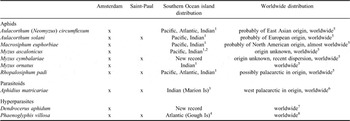
Seven aphid species were recorded on Ile Amsterdam (Table I). Five species (Aulacorthum solani (Kaltenbach), Macrosiphum euphorbiae (Thomas), Myzus ascalonicus Doncaster, M. cymbalariae Stroyan, and Rhopalosiphum padi) were present on the station and in its surroundings. A. solani and M. euphorbiae were especially abundant in the gardens which have been installed in lava open top tunnels and scarce everywhere else. Myzus ascalonicus was found only on the station. Six species, i.e. all except M. ascalonicus, were recorded on the slopes of the volcano, but only two were abundant there, Myzus ornatus Laing and R. padi. Aulacorthum (Neomyzus) circumflexum (Buckton) was found mainly on Phylica arborea trees and on the plants below. The number of aphid species decreased with the distance from the base and only two species (M. ornatus and R. padi) were found at Del Cano (9 km away) and only one (R. padi) at the bottom of Entrecasteaux Cliffs (8 km away). In these remote locations aphids were never abundant. Lastly, four species were recorded at high altitude in the vicinity of the caldera (750 m a.s.l., 6 km away): Myzus ornatus and A. circumflexum were the most frequent, whereas R. padi was moderately abundant and A. solani very rare.
Aphid and parasite species recorded on Ile Amsterdam and Ile Saint Paul, Southern Indian Ocean.

1review in Hullé et al. Reference Hullé, Maurice, Courmont, Chaillon, Chaillon, Saccone, Hebert, Gracia, Buffin, Simon and Frenot2003b, 2Greenslade Reference Greenslade2006, 3Lee et al. Reference Lee, Slabber, Jansen van Vuuren, van Noort and Chown2007, 4Gaston et al. Reference Gaston, Jones, Hänel and Chown2003, 5Blackman & Eastop Reference Blackman and Eastop2000, 6Starý Reference Starý1974, 7Fergusson Reference Fergusson1980, 8Pujade-Villar et al. Reference Pujade-Villar, Paretas-Martinez, Selfa, Seco-Fernadez, Fülöp and Melika2007
Three aphid species (A. solani, M. cymbalariae and R. padi) were recorded on Ile Saint-Paul (Table I). They were all found close to the old cannery site within the crater. Only R. padi was also found outside the crater on the volcano slopes but only a few individuals at one site.
One aphid parasitoid, Aphidius matricariae Haliday (Braconidae, Aphidiinae), and two hyperparasites, the ectoparasite Dendrocerus aphidum (Rondani) (Megaspilidae) and the endoparasite Phaenoglyphis villosa (Hartig) (Figitidae), were recorded on both islands. On Ile Amsterdam, emergences of both hyperparasites were observed from mummies of R. padi and M. ornatus.
Aphids’ host plants
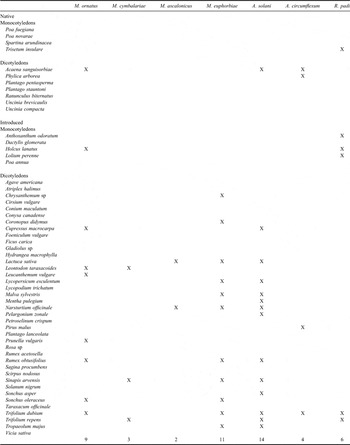
Eleven native plants (out of 17) and 39 introduced plants (out of 56) were examined during the 2007 summer campaign on Ile Amsterdam in order to find breeding aphids. Four native plants and 29 introduced ones hosted aphids (Table II).
Aphid host plant range recorded during the 2007 summer campaign on Ile Amsterdam: plants with no marks were found to host no aphids.

Myzus ascalonicus, M. cymbalariae and M. euphorbiae colonized only introduced plants. The scarce species M. ascalonicus was found mainly on Lactuca sativa in gardens. Myzus cymbalariae was common on three plants belonging to three different families (Asteraceae, Brassicaceae, Fabaceae), and principally on the very common Trifolium repens. Macrosiphum euphorbiae was found on eleven plant species and was very abundant on Sonchus oleraceus, on garden flowers such as Chrysanthemum sp., and on vegetables such as Lactuca sativa or Nasturtium officinale. Myzus ornatus colonized one native species, the austral Rosaceae, Acaena sanguisorbiae, and eight introduced plants. This species was particularly abundant on the Polygonaceae Rumex obtusifolius. Aulacorthum solani also colonized A. sanguisorbiae but was less abundant than M. ornatus on this plant. Aulacorthum solani was abundant on the Asteraceae (Lactuca sativa, Leontodon taraxacoides and Sonchus asper) and on the Malvaceae Malva sativa. Rhopalosiphum padi was found mainly on the very common introduced Poaceae Holcus lanatus. Aulacorthum circumflexum was very common and abundant on the native tree P. arborea, and to a smaller extent on the native Rosaceae A. sanguisorbiae and the introduced Fabaceae Trifolium dubium. This was the only species really abundant on a native plant.
On Ile Saint-Paul, M. cymbalariae was found on the Apiaceae Apium sp. (possibly A. graveolens, unpublished data), R. padi on the endemic Poa novarae and the introduced grass H. lanatus and A. solani on the introduced Asteraceae S. oleraceus.
Phenology of aphids and their natural enemies
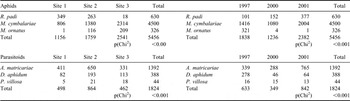
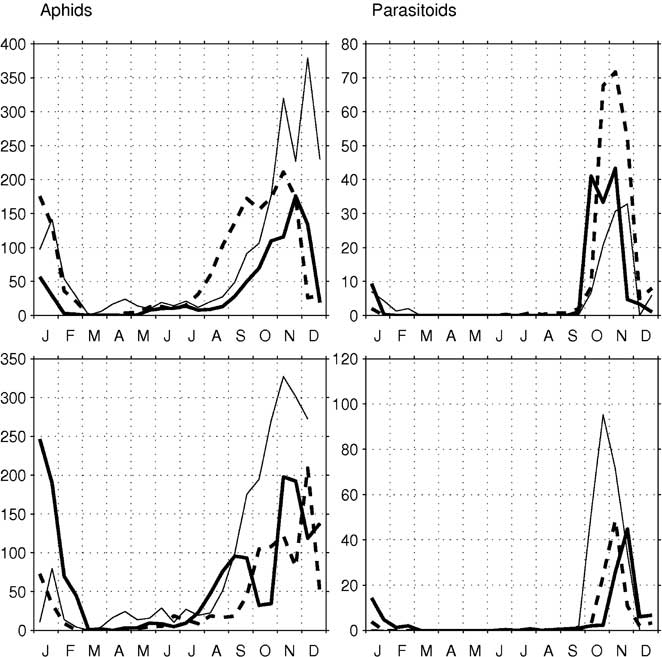
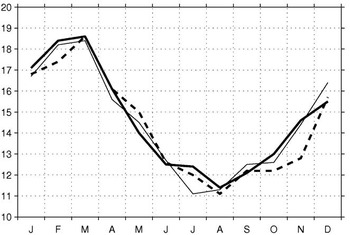
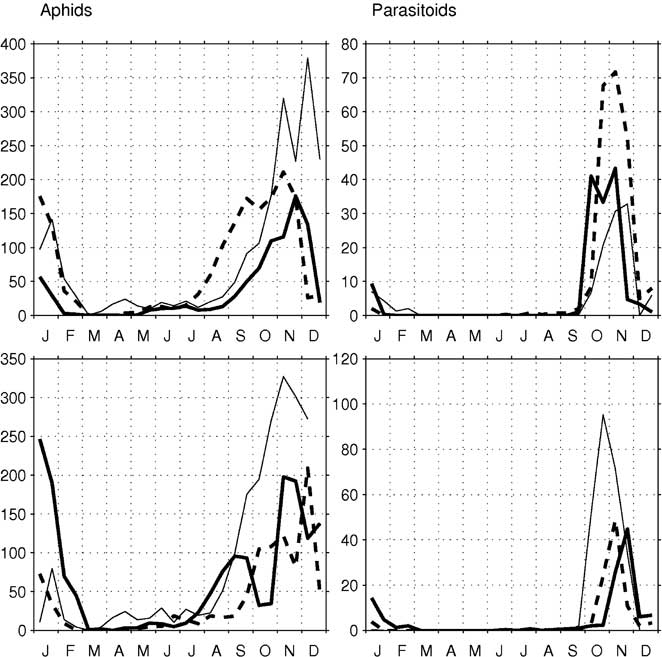
A total of 5456 aphids and 1824 Hymenoptera parasites were identified during the three years of operation. Three aphid species out of the seven were caught in barber traps: Myzus cymbalariae (82%), Rhopalosiphum padi (12%) and Myzus ornatus (6%). Aphid species’ composition was different between sites and between years (Table III and Fig. 1). M. ornatus, the less abundant species, was trapped essentially in 1997 and was absent on site 1. M. cymbalariae was very abundant in 2001 on site 3. Rhopalosiphum padi was the most abundant in 2001 and site 1. Aphids were active all year round but principally from July when temperatures were above 12°C (Fig. 2) to February with a peak in November (Fig. 1). All aphids were parthenogenetic viviparous females.
Test of independence between the numbers of insects and the sites or the years.

Mean aphid and parasitoid catches on Ile Amsterdam per site (top section: thick line = site 1, dotted thick line = site 2, thin line = site 3) and per year (bottom section: thick line = 1997, dotted line = 2000, thin line = 2001).
Monthly mean air temperatures at the base of Ile Amsterdam during the years of operation (data Météo France) (thick line = 1997, dotted line = 2000, thin line = 2001).

The three Hymenoptera were caught: the parasitoid Aphidius matricariae (79%) and the two hyperparasites Dendrocerus aphidum (19%) and Phaenoglyphis villosa (2%). Hymenoptera species’ composition was different between sites and years mainly with a lack of hyperparasites in 2001 and site 1 (Table III and Fig. 1). Winter catches started in October, six weeks after aphids, and ended in December earlier than aphids.
From the winter (July) to midsummer (December), the number of aphids per catch unit increased with time. The temperature explained this rise of aphid density (χ2 = 2670, d.f. = 1, P < 0.001). Both spatial and temporal variations in the number of aphids were also found (site effect: χ2 = 995, d.f. = 2, P < 0.001; year effect: χ2 = 913, d.f. = 2, P < 0.001) and the spatial variation depended on the sampling year (interaction term: χ2 = 945, d.f. = 1, P < 0.001). Finally, the number of aphids was found to be positively linked to the number of parasitoids (χ2 = 2430, d.f. = 1, P < 0.001), suggesting synchronous temporal dynamics during this year period.
Discussion
The seven species found on Ile Amsterdam have a worldwide or almost worldwide distribution (Table I) which is the case for many alien species present in the Antarctic (Frenot et al. Reference Frenot, Convey, Lebouvier, Chown, Whinam, Selkirk, Skotnicki and Bergstrom2008). Six of them have been already recorded from other isolated sub-Antarctic islands (Hullé et al. Reference Hullé, Maurice, Courmont, Chaillon, Chaillon, Saccone, Hebert, Gracia, Buffin, Simon and Frenot2003b) and one, M. cymbalariae was recorded for the first time. They were possibly introduced with their host plants via human occupancy. The number of introduced insects can be explained by environmental characteristics of each island such as temperature, available energy, total area, number of vascular plant species or by human occupancy and activities (Chown et al. Reference Chown, Gremmen and Gaston1998, Reference Chown, Hull and Gaston2005, Frenot et al. Reference Frenot, Gloaguen, Massé and Lebouvier2001, Reference Frenot, Chown, Whinam, Selkirk, Convey, Skotnicki and Bergstrom2005). The number of aphid species found on Ile Amsterdam is comparable to that on Auckland Island (Palmer Reference Palmer1974), Campbell Island (Gressitt 1964, Palmer Reference Palmer1974) in the New Zealand Province, and Gough Island (Gaston et al. Reference Gaston, Jones, Hänel and Chown2003) in the South Atlantic Province. Campbell and Auckland islands are colder than Ile Amsterdam and should be less colonized (Hullé et al. Reference Hullé, Maurice, Courmont, Chaillon, Chaillon, Saccone, Hebert, Gracia, Buffin, Simon and Frenot2003b) but they are much longer (113 km2 and 626 km2 respectively) than Ile Amsterdam (55 km2) and have a greater number of plant species which could compensate (Chown et al. Reference Chown, Gremmen and Gaston1998). Gough Island hosts eight aphid species (Gaston et al. Reference Gaston, Jones, Hänel and Chown2003). The significant characteristics explaining the colonization of Gough Island by alien insects such as total area (57 km2), mean annual sea surface temperature (12.3°C) and number of occupants (38 per year) are comparable to those of Ile Amsterdam (Chown et al. Reference Chown, Gremmen and Gaston1998). Even if the numbers of plant species given by Chown et al. (Reference Chown, Gremmen and Gaston1998) are not updated, the main differences between both islands lies in the species richness of introduced vascular plants which is more higher on Ile Amsterdam (81) than on Gough Island (24) and in the number of indigenous plants (57 vs 26 on Gough Island and Ile Amsterdam respectively) which should favour a higher number of introduced insects on Ile Amsterdam. Ile Amsterdam appears therefore to be less colonized than other islands compare to its biological, physical and anthropogenic characteristics.
Ile Saint-Paul was colonized by three aphid species which were all also present on Ile Amsterdam. Furthermore, both islands host Myzus cymbalariae which has not been reported from any other Southern Ocean island. This confers a distinctive characteristic to the Ile Amsterdam and Ile Saint-Paul group which is consistent with the prediction of colonization by highly dispersal taxa from nearby islands implying spatial autocorrelations in species richness (Selmi & Boulinier Reference Selmi and Boulinier2001).
In their reviews, Frenot et al. (Reference Frenot, Chown, Whinam, Selkirk, Convey, Skotnicki and Bergstrom2005, Reference Frenot, Convey, Lebouvier, Chown, Whinam, Selkirk, Skotnicki and Bergstrom2008) underlined that most alien established invertebrates belong to a limited number of higher taxonomic groups in particular Diptera, Hemiptera and Coleoptera, and many of them share the biological trait of parthenogenetic reproduction. For example, 28% of established insects on Gough Island are parthenogenetic (Jones et al. 2003 in Gaston et al. Reference Gaston, Jones, Hänel and Chown2003). With seven species of aphids, one Delphacidae and one Reduviidae, the Hemiptera is one of the major insect groups of Ile Amsterdam. Sexual forms of aphids were found neither in trap samples over a 10-year period nor during the summer campaign investigation. This suggests that all aphid species which have colonized both Ile Amsterdam and Ile Saint-Paul have only an asexual mode of reproduction. Moreover, the seven species found on these islands are all described as being either strictly parthenogenetic or possibly entirely parthenogenetic when the climate is mild enough (Blackman & Eastop Reference Blackman and Eastop2000) which is the case with Ile Amsterdam and Ile Saint-Paul. This unique asexual mode of reproduction of aphid species has already been reported from other islands such as Kerguelen, Crozet (Hullé et al. Reference Hullé, Pannetier, Simon, Vernon and Frenot2003a) and Macquarie (Greenslade Reference Greenslade2006). This mode of reproduction obviously reduces the barrier to establishment as, in theory, the arrival of a single female is sufficient to found colonies. Furthermore, all aphid species established on Ile Amsterdam and Ile Saint-Paul are polyphagous, a biological trait which enhances the chance of a successful establishment.
The complex of aphids’ natural enemies on these two islands comprised three Hymenoptera species, one parasitoid Aphidius matricariae and two hyperparasites Dendrocerus aphidum and Phaenoglyphis villosa. All these parasites have a worldwide distribution (Table I). This is the first record of D. aphidum on a sub-Antarctic island. Aphidius matricariae was already known from Marion Island (Lee et al. Reference Lee, Slabber, Jansen van Vuuren, van Noort and Chown2007). Another Aphidius species, A. colemani and one hyperparasite, P. villosa were recorded on Gough Island (Gaston et al. Reference Gaston, Jones, Hänel and Chown2003). Dendrocerus is the most economically important genus of the Ceraphronoidea as it contains most of the aphid hyperparasites known from this super family (Fergusson Reference Fergusson1980). Aphidius matricariae is a generalist and common aphid parasitoid. Among the seven potential aphid hosts present on Ile Amsterdam and Ile Saint-Paul, R. padi, M. cymbalariae, M. ornatus and A. solani are already known as hosts (Mackauer & Starý Reference Mackauer and Starý1967, Kavallieratos et al. Reference Kavallieratos, Tomanovic, Starý, Athanassiou, Sarlis, Petrovic, Niketic and Veroniki2004, Lee et al. Reference Lee, Slabber, Jansen van Vuuren, van Noort and Chown2007). In this study, we found mummies of R. padi and M. ornatus. Other species are likely to be parasitized. Aphids and their parasitoids presented synchronous temporal dynamics: the density of their populations increased from July to November with temperatures and then declined from November to February when temperatures were still going up. Parasitoids are suggested to exert a significant control of aphid populations (Dixon Reference Dixon1987) but present data did not allow this assumption to be clearly demonstrated. To determine the real impact of parasitoids on the populations of their aphid hosts, a continuous measure of the parasitism rate (i.e. the rate of the aphid populations containing parasitoid immatures) during the summer would be necessary. The observed decline on aphids from November to February may be due to abiotic factors such as elevated temperatures.
The impact of alien invertebrates on native fauna is well documented (Frenot et al. Reference Frenot, Chown, Whinam, Selkirk, Convey, Skotnicki and Bergstrom2005) but their impact on native flora is poorly known. On Ile Amsterdam, with the exception of A. circumflexum which have notably colonized the native tree Phylica arborea, aphids breed mainly on introduced plants. Furthermore, aphids were rare in the less disturbed ecosystems of the island, such as Entrecasteaux Cliffs or the Caldera, and some species were present principally or exclusively on or around the station, especially in the gardens. This limits the possible impact of these introduced damaging insects on native plants of Ile Amsterdam. The distribution of introduced insects restricted to the vicinity of settlements and without expanding has already been described in sub-Antarctic islands (Gaston et al. Reference Gaston, Jones, Hänel and Chown2003, Hullé et al. Reference Hullé, Pannetier, Simon, Vernon and Frenot2003a). On Ile Amsterdam, the question of whether the gardens could act as reservoir or source of introduced species which could later expand their distribution has to be considered. The fact that aphids have been found everywhere on Ile Amsterdam leave this question opened. However, our results did not clearly demonstrate this assumption, as species abundant in these gardens were scarce outside and anyway aphid populations could be easily controlled in these very limited locations.
Acknowledgements
This would not have been possible without the scientific volunteers (F. Troubadours, L. Derouard, F. Kerleau, D. Salomon, C. Baur and F. Gallais) who collected samples and J. Hullé who assisted in identifying insects in samples, B. van de Vijver who helped to identify plants on the field. We are grateful to two referees for their useful comments and suggestions on an earlier draft of the manuscript. This work was financially and logistically supported by the French Polar Institute (IPEV through Programme 136 ECOBIO), the CNRS (Zone Atelier Recherches sur l’Environnement Antarctique et Subantarctique) et l’ANR (programme EVINCE).