Introduction
Childbearing postponement has formed the central issue of a large number of studies (e.g. Kohler et al., Reference Kohler, Billari and Ortega2002; Billari & Kohler, Reference Billari and Kohler2004; Billingsley, Reference Billingsley2010; Sobotka, Reference Sobotka2017). Indeed, over the past few decades the transition towards childbearing at later ages has constituted one of the most characteristic features of fertility trends in Europe. Women have reduced their level of fertility in their mid- and late-twenties and are compensating for some or most of this reduction in their thirties or even forties. The formation of a late childbearing pattern, according to which women prefer to realize their reproductive plans after the age of 30 (Beets et al., Reference Beets, Schippers and te Velde2011), represents a key outcome of the postponement transition. The commencement of the postponement transition is relatively easy to determine since it is characterized by an increase in the age of the mother at first childbirth and, consequently, by a decline in the total fertility rate (TFR).
However, determining the end of the postponement transition is open to debate. It can be expected to occur once the increase in the age of mothers at first childbirth decelerates or stops altogether, thus significantly weakening the effect of the shifting of the age at first childbirth on period fertility which, in turn, can be expected to be reflected in an increase in the TFR (Goldstein et al., Reference Goldstein, Sobotka and Jasilioniene2009; Sobotka, Reference Sobotka2011; Frejka, Reference Frejka2011; Sobotka, Reference Sobotka2017). Thus, the TFR depends on the extent to which the low fertility level of younger women is compensated for by an increase in that of older women. Nevertheless, the formation of the late childbearing pattern does not necessarily have to be accompanied by an increase in the TFR towards the re-establishment of the pre-transition level. The most cited example in this respect concerns German-speaking countries, where the postponement transition was accompanied by a continuous decline in cohort fertility, reaching its lowest level of 1.5 in Germany for the late-1960s cohorts (Zeman et al., Reference Zeman, Beaujouan, Brzozowska and Sobotka2018). Low fertility has been explained by the erosion of the two-child norm (Lutz et al., Reference Lutz, Skirbekk and Testa2006), with young women in German-speaking countries recording a decline in the average ideal family size to 1.7 children in 2001 (Goldstein et al., Reference Goldstein, Lutz and Testa2003). Thus, their fertility preferences and intentions appear to have changed during the postponement transition period. Nevertheless, the two-child family ideal continues to dominate in other countries (Sobotka & Beaujouan, Reference Sobotka and Beaujouan2014), where it can be supposed that the end of the postponement transition depends not only on the formation of the late childbearing pattern, but also on the capacity of women to realize their fertility intentions should they commence the childbearing process later in their lives.
This study employed a new approach in order to determine the completion of the postponement transition based on an assessment of the realization of the fertility intentions of women at later childbearing ages. Such an approach presupposes the availability of survey data. A method developed by Castro (Reference Castro2015) was applied to differentiate between the transitional and post-transitional cohorts. A post-transition population is defined as a population within which a late childbearing pattern has formed and in which women who postpone childbearing are able to fulfil their reproductive plans. The investigation was based on a comparison of the postponement transitions of two different populations, i.e. the Czech and French populations. The postponement transition in Czechia commenced two decades later than in France (Sobotka et al., Reference Sobotka, Šťastná, Zeman, Hamplová and Kantorová2008; Toulemon et al., Reference Toulemon, Pailhé and Rossier2008). While both populations have recently begun to exhibit a similar mean age of mothers at first childbirth of 28 years, Czechia continues to register a TFR of almost 0.5 lower than in France (Sobotka et al., Reference Sobotka, Zeman, Potančoková, Eder, Brzozowska, Beaujouan and Matysiak2015). Thus, while it appears that the demographic data indicate a similarity in the pattern of fertility timing in France and Czechia, due to significant differences in the fertility level the two populations appear to be in different phases of postponement transition.
The aim of this study was to determine, via the use of survey data, to what extent the late-fertility pattern was formed in the countries under study and whether it is possible to differentiate between the Czech and French populations in terms of their being transitional or post-transitional. In greater detail, firstly the effect of the shifting of the age at first childbirth on the TFR using a tempo-adjusted TFR (Bongaarts & Feeney, Reference Bongaarts and Feeney1998) was analysed in order to explain the differences between the fertility levels in the two countries. Secondly, the trends in age-specific fertility schedules were assessed in order to identify a late-fertility pattern. Then attention was concentrated on the period between 2005 and 2008, for which the postponement transition was compared between both countries. Firstly, survey data from the Generation and Gender Surveys (GGS) of 2005 and 2008, available for Czechia and France, were used to differentiate ‘transition’ and ‘post-transition’ cohorts in the two countries on the basis of changes in fertility rates conditional on age at first child (Castro, Reference Castro2015). Secondly, the realization of childbearing intentions between 2005 and 2008 based on the regression modelling of the panel data was compared. The realization of the fertility intentions of women aged 30 years and over was linked with the completion of the postponement transition. The institutional context based on family policy developments was taken into account. The aim was to demonstrate that the complementary use of demographic and survey data is able to contribute towards both forming a better understanding of transition as a complete process and depicting differences in terms of the formation of the late-fertility pattern across Europe.
Background
The commencement of childbearing postponement in Europe has occurred at different times in different regions (Sobotka, Reference Sobotka2017). The trend commenced in northern and western European countries in the 1970s and in post-communist countries in the 1990s. While northern and western European countries experienced a long-term, gradual transition towards the delayed fertility pattern accompanied by a fertility decline slightly below the replacement level, fertility decreased significantly in southern and eastern regions, particularly in post-communist countries, to an unprecedented level; moreover, the transition proceeded at a much more rapid pace than in northern and western European countries (Frejka, Reference Frejka2011). Therefore, Czechia and France were selected as representatives of two different, i.e. post-communist and western, European regions.
Fertility postponement accompanied by a decrease in fertility has been conceptualized in the form of the theory of the second demographic transition, which underlines value changes (Lesthaeghe, Reference Lesthaeghe2010). However, since this theory has been found to not adequately explain the underlying mechanism behind the start of fertility transition in post-communist countries in the 1990s, a further theoretical explanation involving the notion of ‘postponement transition’ was suggested by Kohler et al. (Reference Kohler, Billari and Ortega2002), who suggested that the causal mechanism behind the postponement of childbearing in post-communist countries consisted of economic uncertainty rather than value changes. In addition, the impact of social and economic crises on childbearing has been stressed frequently by other authors (Billingsley, Reference Billingsley2010; Spéder & Kapitány, Reference Spéder and Kapitány2014; Kocourková et al., Reference Kocourková, Šťastná and Černíková2019), who have argued that, due to unfavourable conditions, people not only delay childbearing but may also choose to have fewer children.
Fertility recovery can be expected when fertility recuperation begins. Fertility recuperation can be defined as the action of compensating for fewer reproductive years with higher fertility once motherhood has commenced, thus resulting in an increase in the TFR (Sobotka et al., Reference Sobotka, Zeman, Lesthaeghe and Frejka2011; Castro, Reference Castro2015). More specifically, if recent cohorts of women decide to postpone their fertility with the intention of having children later in the life course, then the rates of entry into motherhood and progression to subsequent birth orders at older ages should be in these cohorts than in previous cohorts (Frejka, Reference Frejka2011). Thus, if the age at motherhood has shifted to older ages, a necessary precondition for fertility recuperation consists of the supposition that women who have their first child later in life will also eventually achieve a higher completed fertility level than previous cohorts of women who had their first birth at the same age (Castro, Reference Castro2015; Berrington et al., Reference Berrington, Stone and Beaujouan2015). It can be expected that in such cases the formation of late-childbearing pattern is followed by the completion of the postponement transition. However, women who postpone entry into motherhood are usually less able to fulfil their intentions than are younger women (Ní Bhrolcháin et al., Reference Ní Bhrolcháin, Beaujouan and Berrington2010). Thus, despite the formation of the late-fertility pattern, the postponement transition cannot be fully completed until the unrealized fertility intentions of older women reduce the fertility level.
It has been found that the extent of fertility recuperation differs significantly by country; in northern and western European countries (including France) most delayed births had been recuperated by the time women reached their late-twenties and thirties (Frejka et al., Reference Frejka, Sobotka, Hoem and Toulemon2008), whereas in most post-communist countries the recuperation in delayed births remains weak, especially for second- and higher-order births (Kapitány & Spéder, Reference Kapitány and Spéder2012; Šťastná et al., Reference Šťastná, Slabá and Kocourková2019b). Šprocha (Reference Šprocha2014) documented the low recuperation rate in Czechia with respect to second order births for those cohorts that initiated childbearing postponement.
Family policy makes up one element of a range of institutional factors that may contribute towards the creation of favourable conditions for childbearing at later ages (Luci-Greulich & Thévenon, Reference Luci-Greulich and Thévenon2013). Policies aimed at reducing the opportunity costs of childbearing for working women are particularly relevant at later stages in the life cycle (Lesthaeghe, Reference Lesthaeghe2010). These policies appear to be linked to a higher rate of fertility recuperation and, consequently, to higher levels of period fertility (Luci-Greulich & Thévenon, Reference Luci-Greulich and Thévenon2013).
Czechia and France differ significantly with regard to family policy developments. France has a long tradition of family policy that is pro-natalist, in that it supports two- and three-child families while adapting favourably to the participation of women in the labour force (Toulemon et al., Reference Toulemon, Pailhé and Rossier2008). New family policy tools introduced since the 1990s encompassed a wide range of measures such as a parental leave system and childcare facilities, which have contributed to the harmonization of work and family. In contrast, in Czechia the financial support allotted to families has been significantly reduced and oriented predominantly towards those most in need since the 1990s (Kocourková, Reference Kocourková2002; Sobotka et al., Reference Sobotka, Šťastná, Zeman, Hamplová and Kantorová2008; Frejka & Basten, Reference Frejka and Basten2016). The general tendency of post-communist family policy in the 1990s was re-familization, in that it encouraged women to leave the labour market. Parental leave was extended up to the child’s fourth birthday, while childcare facilities for children under three years of age was almost abolished. This resulted in a deepening of the conflict between work and family (Hašková & Dudová, Reference Hašková and Dudová2017). The situation changed in 2000, at which time the Czech economy commenced a period of continuous growth, with the rate of GDP growth reaching as high as 6% in 2005. Concurrently, new policy measures were introduced, particularly between 2001 and 2007; however, while the main aim was to increase financial assistance for families, it maintained the preference for care for children under the age of three within the family (Kocourková, Reference Kocourková2009). Moreover, from 2008 a trend was apparent towards reducing family benefits due to the need to reduce state spending (Blum et al., Reference Blum, Formánková and Dobrotić2014). While the 2008 reform of the parental leave system, which increased the level of flexibility, represented an improvement, it was not accompanied by the adequate expansion of childcare facilities for children under three years of age (Šťastná et al., Reference Šťastná, Kocourková and Šprocha2019a). Thus, Czech family policy has not developed systematically so as to provide a complex and effective system of family support over the long term, which may well strengthen the level of uncertainty in the childbearing decision-making process.
Based on previous findings it was hypothesized that compared with the French population the Czech population constitutes a transitional population in which the postponement transition has not yet been completed. The hypothesis was tested for the period of 2005–2008 as panel data from surveys in 2005 and 2008 were available. It was considered that the cohorts of Czech women who initiated childbearing postponement did not increase realization of their fertility intentions in later age. Furthermore, it was supposed that despite some improvements, the Czech family policy was not immediately supportive to the realization of delayed fertility plans for these cohorts.
Methods
Data
Two data sources were used for the analysis. Firstly, data from the Human Fertility Database (HFD) were employed in order to illustrate period and fertility trends in Czechia and France (Figs 1 and 2). Second, data from the Generations and Gender Survey (GGS) conducted in Czechia and France in 2005 and 2008 as part of the Generation and Gender Programme (http://www.ggp-i.org) were also used. The GGS consists of panel surveys of nationally representative samples of 18- to 79-year-olds. In both countries, random sampling was employed for data collection purposes in the first wave using the face-to-face interview technique.
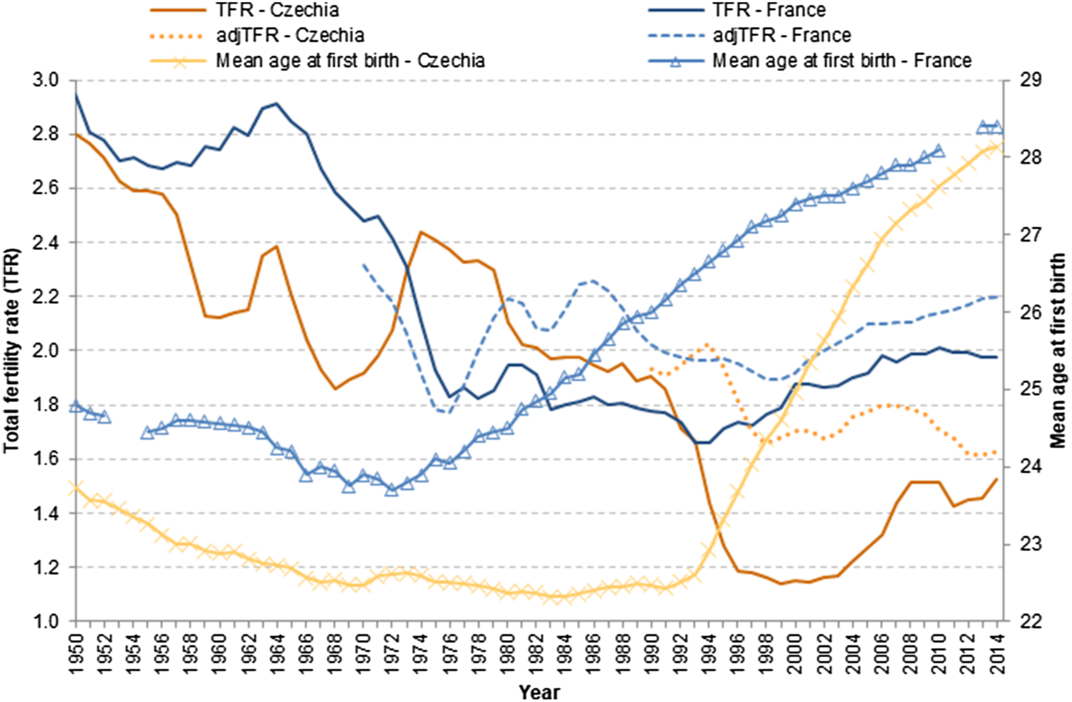
Total fertility rate (TFR), adjusted total fertility rate (adjTFR) and mean age at first birth in Czechia and France, 1950–2014. Sources: HFD (n.d.), CZSO (n.d.), INED (n.d.), VID & IIASA (2016), Sobotka et al. (Reference Sobotka, Zeman, Potančoková, Eder, Brzozowska, Beaujouan and Matysiak2015) and Toulemon et al. (Reference Toulemon, Pailhé and Rossier2008).

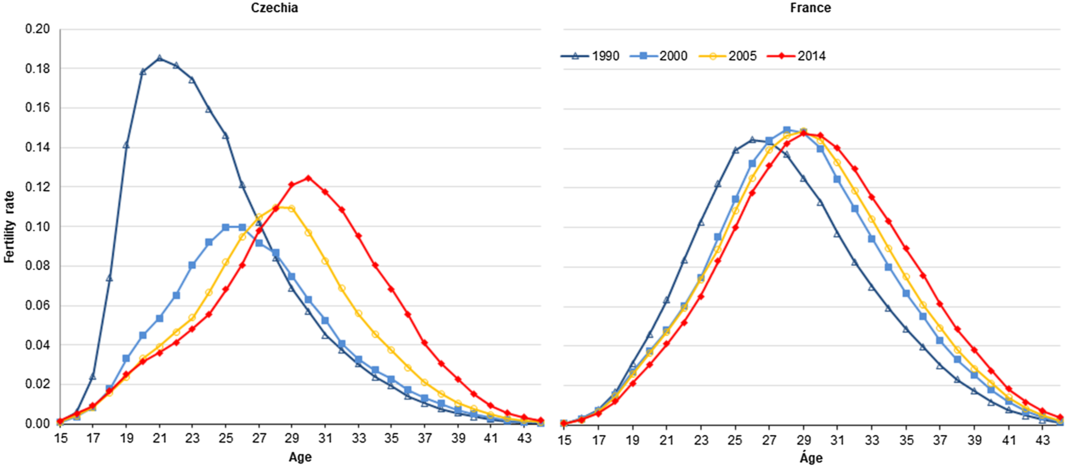
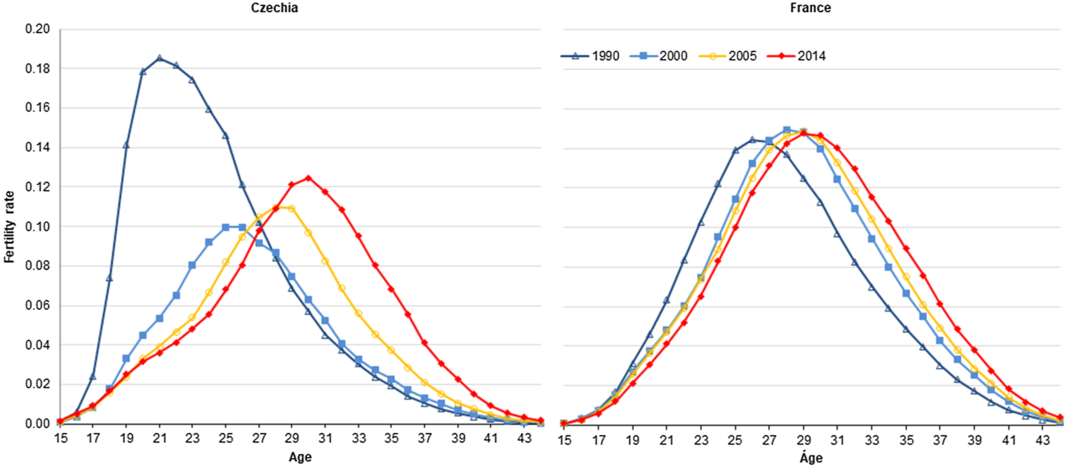
Age-specific fertility patterns in Czechia and France, 1990, 2000, 2005 and 2014. Source: HFD (n.d.).
Several GGS data samples were analysed. First, Czech GGS 2008 and French GGS 2005 data were used to analyse the effect of later entry into motherhood on completed fertility (Fig. 3); the samples consisted of 2106 Czech women born in the period 1946–1975 and 1588 French women born in the period 1936–1960. Secondly, panel data for both countries were used to analyse fertility and the realization of fertility intentions between 2005 and 2008 (Tables 1 and 2). Data from the two waves of the survey provided a unique opportunity to compare original reproductive plans with their realization. In 2005 both women and men were asked about their future childbearing plans within the next three years or later; thus, following the second wave in 2008 it was possible to assess whether those expectations had been met and whether and to what extent short-term plans were reflected in actual reproductive behaviour. The Czech first-wave survey sample consisted of 10,006 individuals, i.e. 4798 men (48%) and 5208 women (52%) from cohorts born during the period 1926–1987. Of the initial sample of 5199 men and women aged 18–45, i.e. born between 1960 and 1987, a total of 1506 people were interviewed in the two waves of the survey. The panel attrition rate in this age group between the two waves was 71%, which was mainly due to the refusal of respondents to participate in the second wave. Therefore, control analysis according to interest variables was conducted to avoid bias in the results.
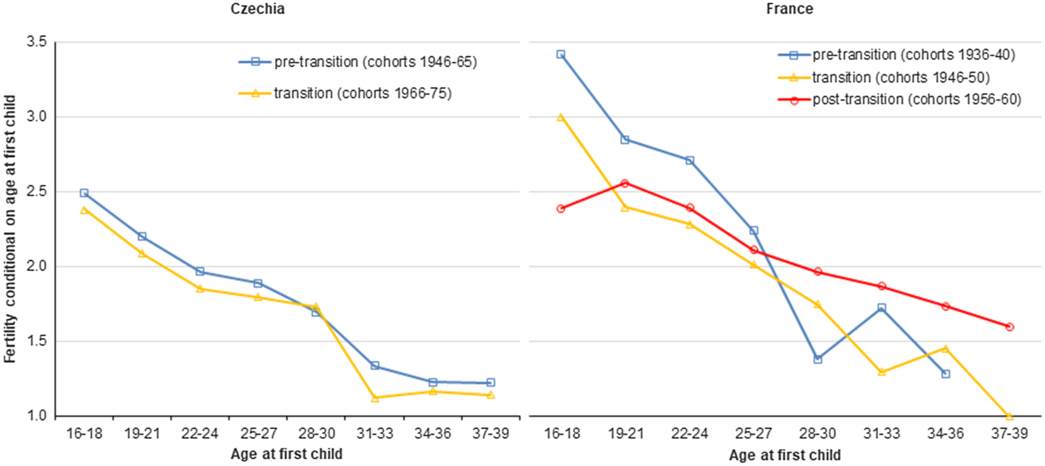
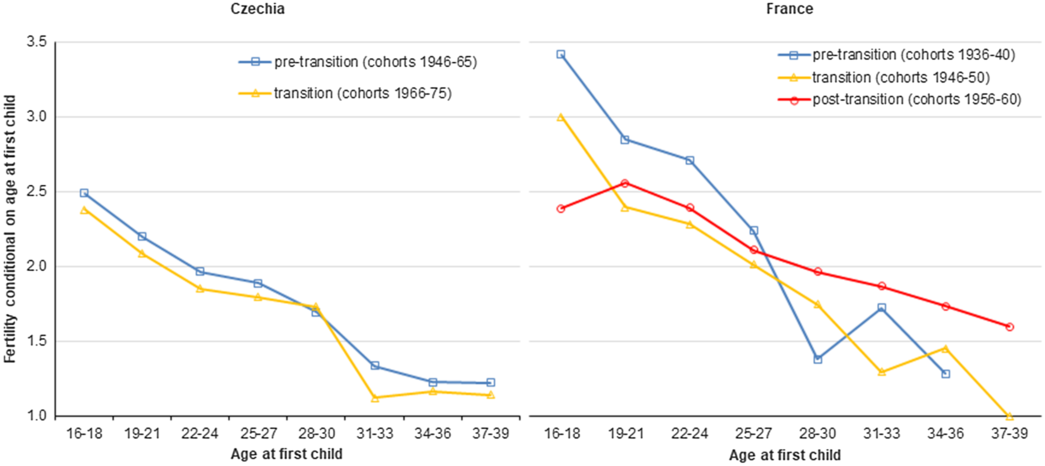
Completed fertility rates conditional on age at first child by cohort in Czechia and France. Sources: French GGS 2005 and Czech GGS 2008.
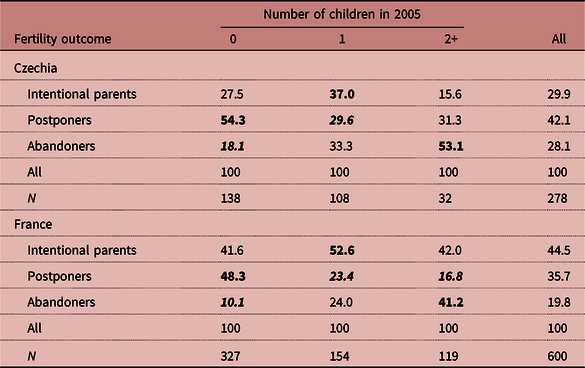
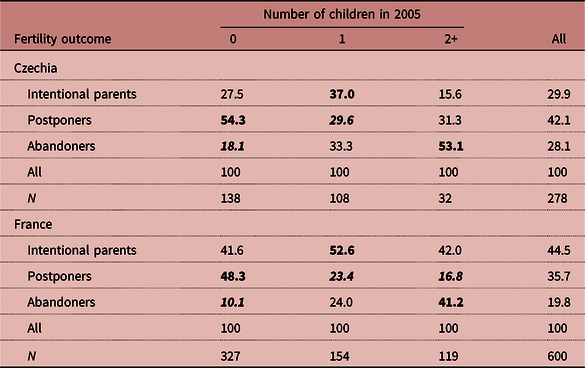
Fertility outcomes (%) of initial childbearing intentions to have a child in the next three years by number of children in 2005, Czechia and France
Source: Generation and Gender Surveys 2005 and 2008.
Intentional parents: intended to have a child within the next three years and realized this intention; Postponers: intended to have a child within the next three years but failed and maintained their intention to have a child in the second wave; Abandoners: intended to have a child within the next three years but failed and abandoned their intention (Spéder & Kapitány, Reference Spéder and Kapitány2009).
Bold numbers are significantly higher percentages; bold italic numbers are significantly lower percentages. Differences were tested within a given country.
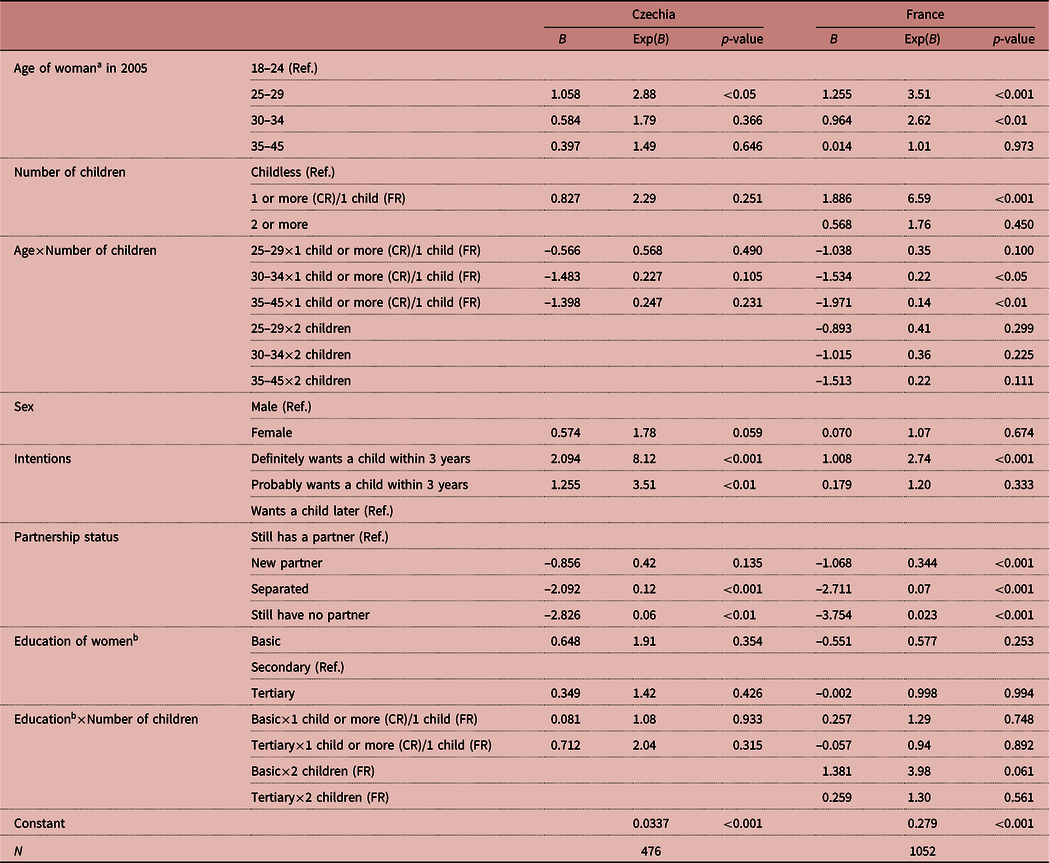
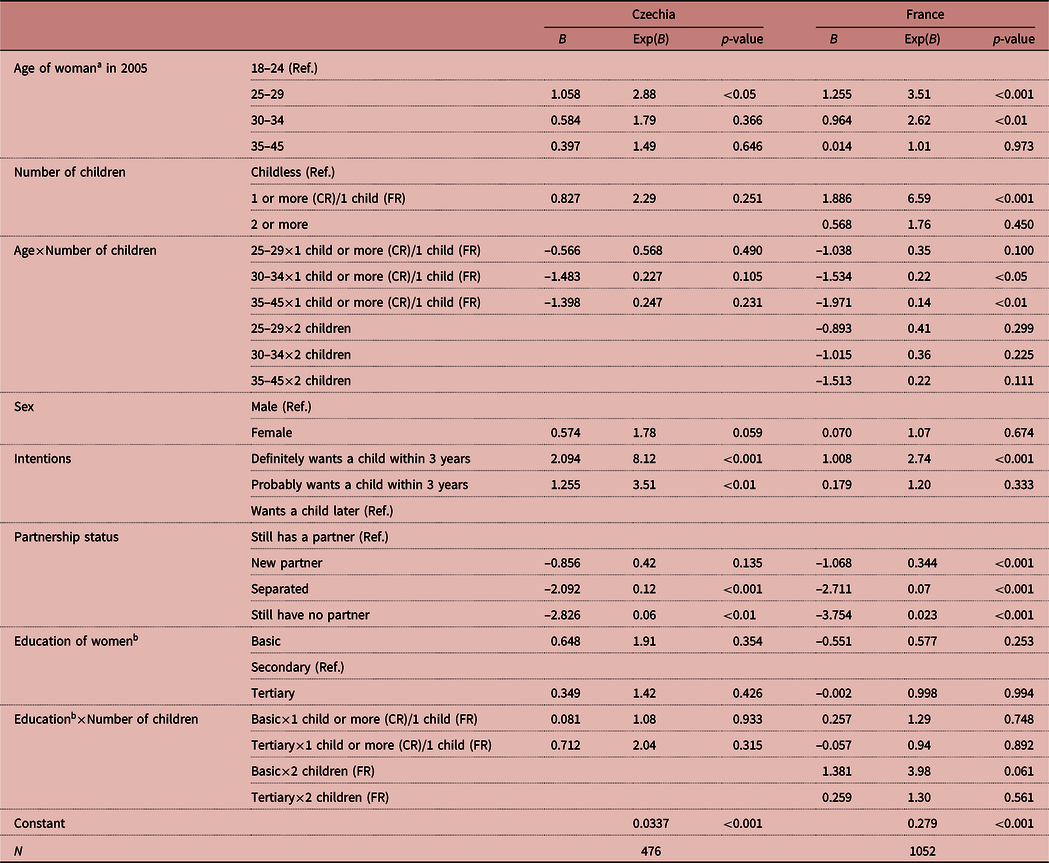
Realization of intentions to have a child: odds ratios (binary logistic regression model) predicting having a child between 2005 and 2008, Czechia and France
Source: Generation and Gender Surveys 2005 and 2008.
For women aged 25–29 in France, the chance of having a second child was given by the Odds Ratio computed from B coefficients as follows: Exp(1.255 + 1.886 – 1.038) = Exp(2.103) = 8.18.
For women aged 30–34 in France, the chance of having a second child was given by the Odds Ratio computed from B coefficients as follows: Exp(0.964 + 1.886 – 1.534) = Exp(1.316) = 3.73.
a For men age group of their partner; for men who did not report the age of their partner: the man’s age group (1% in Czechia, 0% in France).
b For men: education of their partner; for men who did not report the education of their partner: the man’s education (2% in Czechia, 1% in France).
The French first-wave survey sample consisted of 10,079 subjects, i.e. 4371 men (43%) and 5708 women (57%) from cohorts born during the period 1926–1987. Of the initial sample of 4843 men and women aged 18–45, i.e. born between 1960 and 1987, a total of 3175 people were interviewed in the two waves of the survey. The panel attrition rate in this age group between the two waves was 34%.
Only female respondents and male respondents with a partner who planned to have a child in 2005 were included in the analysis. Two sub-samples of the panel data were employed: a) to analyse the fulfilment of short-term reproduction plans, the data were narrowed down to include only those respondents who in 2005 declared that they wanted a child within three years (data available for the analysis consisted of 278 Czech and 600 French respondents who planned to have a child within the next three years; Table 1) and b) respondents who declared in 2005 that they wanted a/another child in the future were included in the analysis of the chances of a birth between 2005 and 2008. These sub-samples consisted of 476 Czech and 1052 French respondents (Table 2).
Analysis
Firstly, the aim was to assess the effect of the shifting of the age at first childbirth (timing) on the TFR during the postponement transition using HFD data. Since the period TFR reflects the interplay of two components – the tempo (timing) and quantum (level) of fertility – a tempo-adjusted TFR (adjTFR) was employed in order to measure the level of fertility that is free from the tempo effect and thus better indicates the average number of children per woman in a given year than the period TFR (Bongaarts & Feeney, Reference Bongaarts and Feeney1998). The application of the Bongaarts–Feeney formula requires the TFR and the mean age at childbearing to be specified by birth order. These data were available only for Czechia. For France, the adjusted TFR was estimated from data on the overall TFR and the mean age at childbearing for all birth orders combined (see VID, 2010, for more details). In addition, three-year moving averages were employed in order to ‘smooth out’ the time series of the tempo-adjusted TFR since this indicator displayed significant year-to-year fluctuations (Jasilioneiene et al., Reference Jasilioneiene2015).
Secondly, trends in age-specific fertility rates were compared to identify a late childbearing pattern in the countries.
Thirdly, using survey data completed fertility rates conditional on age at first child (F AFC) were calculated for both countries according to Castro (Reference Castro2015). The F AFC for France was calculated as the average for three types of cohorts; ‘pre-transition’ cohorts (1936–40), ‘transition’ cohorts (1946–50) and ‘post-transition’ cohorts (1956–60). For Czechia, two types of cohorts were distinguished according to Šprocha (Reference Šprocha2014): ‘pre-transition’ cohorts (1946–65) and ‘transition cohorts’ (1966–75).
Finally, binary logistic regression model was used in order to study the realization of childbearing intentions between 2005 and 2008 using GGS survey data. The following two questions were asked in the 2005 survey in order to measure intentions: ‘Do you intend to have a/another child during the next three years?’ Possible answers were: ‘definitely yes’; ‘probably yes’; ‘probably not’; and ‘definitely not’. The additional question ‘Supposing you do not have a/another child during the next three years, do you intend to have any (more) children at all?’ was included so as to distinguish between short-term and long-term intentions according to declared certainty. By combining the two questions, a new variable was constructed and coded into the following four categories: ‘definitely yes within 3 years’, ‘probably yes within 3 years’, ‘yes, but later’ and ‘no’. Only those respondents who declared positive short-term (definitely or probably yes within 3 years) or long-term (yes, but later) childbearing intentions and who participated in both waves of the panel survey were included in the binary logistic model.
The dependent variable was the realization of childbearing intentions, and this was equal to 1 when a child was born during the inter-survey period or a pregnancy was reported at second interview. It was possible via the model to explore associations rather than causal effects. Two key explanatory variables are relevant to the postponement issue: a woman’s age and the number of children recorded at the time of the first wave; these characteristics were employed as covariates in the model. Age as the first explanatory covariate (18–24, 25–29, 30–34, 35–45) was operationalized according to Kapitány and Spéder (Reference Kapitány and Spéder2012): the age for women corresponds to the respondent’s age in the first wave, while for men it refers to their partner’s age. In cases where the age of a female partner was not available, the age of the man was included (1% of the Czech sub-sample). The second explanatory covariate ‘number of children’ (childless, with one child, with two and more children) included only biological children. Due to the insufficient number of cases in certain categories, the ‘number of children’ variable was simplified into two categories (childless versus having at least one child) in the Czech model.
The control variables were gender, intentions and partnership status. Partnership status was defined as a dynamic variable reflecting not only the status in 2005, but also the stability of, or change in, the partnership between the two waves. This variable had four categories: having a partner in both waves (reference category), not having a partner in 2005 but having a new partner in 2008, being separated from a previous partner in 2008, and having no partner in both waves. Education referred to the highest level of completed study in 2005 and was coded as basic (corresponding to the international classification of education levels 0, 1 and 2), secondary (corresponding to ISCED levels 3A, 3B, 3C and 4 and set as the reference category) and tertiary (corresponding to ISCED levels 5A, 5B and 6). Education represents the education of female respondents in the first wave, while for men it refers to their partner’s level of education.
Since the number of children has been found to be significantly associated with the realization of fertility intentions in the low-fertility pattern (Billari et al., Reference Billari, Philipov and Testa2009) it was deemed relevant to assess whether the age variable or education had different effects on childless respondents, respondents with one child and respondents with two children or more. Therefore, the interaction of a woman’s age with the number of children and interaction of the number of children with education were also investigated so as to improve the model.
The binary logistic regression models were acquired by means of the Enter method and were run separately for Czechia and France. The coefficients (Bs) and odds ratios (ORs) are presented. Appropriate diagnostic statistics and Hosmer–Lemeshow goodness-of-fit tests were used to assess the model fit. All the analysis was performed using SPSS Version 20.
Results
Figure 1 shows a comparison of the trends in the TFR and mean age at first birth for Czechia and France. The extent of childbearing postponement was more considerable in Czechia than in France. In Czechia the mean age at first birth started to increase rapidly in 1991 from 22.5 to 25 years in 1999 and resulted in a sharp drop in the TFR from 1.86 to 1.13 children per woman. This significant period fertility trough was induced by the overlapping of the rapidly declining fertility of young women born in the late 1960s and in the early 1970s with the low fertility of older women born in the 1950s and early 1960s (due to their having had most of their children at a younger age). As a result, rapid changes in the age–fertility pattern, i.e. retreating from the early childbearing pattern (Kocourková et al., Reference Kocourková, Konečná, Burcin and Kučera2015), occurred in the 1990s (Fig. 2). The increase in the TFR in Czechia commenced only after 2000 and accelerated between 2005 and 2008. Since 2008 the TFR has oscillated around the level 1.5 children per woman, while the increase in the mean has significantly slowed down. Nevertheless, the late-childbearing pattern had not yet formed in the period under study as significant shifts in the curve towards later age occurred by 2014 (Fig. 2).
In France, as opposed to Czechia, the timing of fertility began to change as early as in 1973, i.e. two decades earlier (Fig. 1). The mean age of the mother at first birth increased slowly but continuously and did not result in a significant decrease in the TFR. The late-childbearing pattern seemed to be formed as early as at the beginning of the 1990s and only a slight shift in the peak fertility rate was evident from 1990 onwards (Fig. 2).
Figure 1 also displays the adjTFR, which measures the level of fertility independent of the tempo effect, thus without the effect of a postponement in childbearing. Compared with the sharp decline in TFR towards 1.1 in Czechia, the adjTFR reached considerably higher levels and centred around 1.7 for the whole period of the lowest TFR levels in the second half of the 1990s. This suggests that the low fertility level observed in Czechia in the second half of the 1990s and the first half of the 2000s was driven by the marked postponement of first births. The adjTFR reached as high as 1.8 in 2006–2008, since which time it has been decreasing towards the TFR level, which would appear to reflect the weakening of the tempo effect and the strengthening of the quantum effect on the fertility level. Thus, in Czechia the stagnation of the TFR at around 1.5 by 2014 was due principally to a lack of fertility recuperation among women who commenced the childbearing process later in their lives.
Trends in the French adjTFR suggest that the TFR was influenced to some extent by the tempo effect between the mid-1970s and the mid-1990s. Nevertheless, this influence was not as strong as in Czechia since the increase in the mean age of mothers at first birth was more gradual than that in Czechia.
To sum up, the standard demographic approach confirms the similarity between the French and Czech fertility timing patterns at the end of the period under study. However, the late childbearing pattern was formed in France much earlier than in Czechia. Furthermore, the change in the adjTFR trajectory in Czechia from 2008 onwards confirms that in more recent years the difference in the TFRs of the two countries can be explained as being more due to the quantum effect. Thus, it indicates low fertility recuperation at older ages.
The next step aimed to verify whether it could be determined that the French population is post-transitional and, conversely, whether the Czech population is transitional. Survey data were employed in order to study the link between shifting age at first child and completed fertility (Castro, Reference Castro2015). Figure 3 shows completed cohort fertility rates conditional on age at first child (F AFC) as an outcome of the distribution of women by age at first child (AFC) and fertility rates conditional on the AFC. Accordingly, change in the F AFC could be employed as a measure of recuperation in order to enable the better understanding of differences between Czechia and France as regards the total dynamics of the fertility postponement and recuperation process. Three types of cohorts were distinguished in order to assess whether the recuperation of fertility in Czechia and France took place through changes in the fertility ages of women of late AFC. Indeed, in France clear signs of recuperation were documented for the 1956–60 cohorts in the form of higher F AFC values for women who entered motherhood at a relatively late age (over the age of 30), who might be labelled ‘post-transition’ cohorts (Castro, Reference Castro2015). In contrast, such signs of recuperation were lacking in Czechia for the later 1966–1975 cohorts under study. Higher F AFC values were determined only for those women who had entered motherhood by the age of 29. Czech women who had their first child later in life (over the age of 30) did not evince a significant increase in fertility, i.e. did not achieve a higher completed fertility rate than previous cohorts of women who had their first birth at the same later age; therefore, the 1966–1975 cohorts were identified as ‘transition’.
In line with the hypothesis, the relationship between fertility intentions and their subsequent realization was investigated. The analysis was restricted to those respondents who declared in 2005 that they intended to have a child in the future. When analysing the realization of intentions among those who wished to have a child within three years, it was found that the realization of these short-term childbearing intentions differed greatly between the Czech and French populations. Table 1 reveals that a considerable proportion of respondents who initially declared the intention of having a child in the next three years did not do so between 2005 and 2008. In Czechia a higher rate of failure to realize fertility intentions was confirmed regardless of the respondent’s age and number of children. Although ‘postponers’ accounted for the highest proportion of childless respondents in both countries, postponement was found to be more extensive in Czechia. In general, only 30% of Czech respondents who definitely or probably planned to have a child within three years succeeded in so doing compared with 45% of French respondents. Realization rates were significantly higher in France, particularly with regard to those with one or more children: 37% of intentions to have a second child were realized in Czechia in contrast to 53% in France, and only 16% of intentions to have a third or more children against 42% respectively. Despite lower fertility intentions among French respondents with one child, realization rates were higher. The two-child family seems to represent the most successful childbearing plan, particularly in France. With regard to French respondents with two children, higher fertility intentions, as well as higher realization rates, were confirmed.
The final part of the analysis focused on those respondents who in 2005 stated that they wanted to have a child in the future. Table 2 provides odds ratios for having a child between 2005 and 2008 in Czechia and France as estimated by means of binary logistic regression models. For the control variables, only two of them appeared to be statistically significant in both countries. Firstly, in both countries, partnership status was found to be an important prerequisite for the realization of fertility intentions since those who remained single or who dissolved their partnership were found to have only a small chance of having a child. Secondly, although in both countries childbearing intentions were found to be statistically significant, it appears that they played a more dominant role in Czechia since the chance of having a child for those who definitely wanted a child within three years was found to be 8 times higher than for those who declared merely long-term positive childbearing plans.
The effects of the other two explanatory variables differed significantly between the two countries. As far as Czechia is concerned, a significantly higher chance of having a child was identified solely for women aged 25–29 years. In France, however, the effect of age also appeared to be significant with concern to women aged 30–34 years; the chance of having a child between 2005 and 2008 for women aged 25–29 years was found to be 3.5 times higher than for the youngest age group (18–24), and for women aged 30–34 years 2.6 times higher than for women aged 18–24. As for the number of children in Czechia, having at least one child did not significantly increase the chance of having another child in a given period of time. Conversely, as far as France is concerned, the number of children plays a significant role and the chance of having a child for respondents with one child was more than 6.5 times higher than that for childless respondents. Accordingly, in the case of France the transition to a two-child family is highly probable once it is planned.
In order to enhance the understanding of the interrelated impacts of age and number of children on the realization of childbearing intentions, a variable consisting of the interaction between the age of women and the number of children they had was included; no significant impact was identified for Czechia. Conversely, in France the interaction effect was found to be statistically significant in the case of respondents with one child, despite the fact that the chance of realizing plans to have a second child declined with age. The chance of having a second child for women aged 25–29 and 30–34 years with one child was 8.2 times (Table 2) and 3.7 times (Table 2) higher than for young and childless women. Moreover, since the effect of the number of children was found to be statistically significant in France, the interaction between the number of children and the level of education of women was also studied. However, no significant differences were discovered in either country in terms of the chance of having a first or second child between women with a basic or tertiary education and those with a secondary education.
Discussion
The aim of this study was to enhance the understanding of the childbearing postponement mechanism and the formation of the late-fertility pattern using data from two European countries. By comparing the Czech and French populations the aim was to provide a contribution to the explanation as to why the Czech population has maintained a markedly lower fertility level than that of France, despite the rapprochement in fertility timing to that of the French population.
The study demonstrated that the recent difference between the TFRs of the two countries can be explained as being due principally to the quantum effect. It is argued that in contrast to France, the postponement transition in Czechia had not been completed by the time this study was conducted. Although the shaping of a late childbearing pattern was in progress, the realization of the intention to have a child at a later age was not found to be significant. The premise was based on the comparison of the realization of short-term childbearing intentions between 2005 and 2008 in the two countries. It was found that the realization of childbearing intentions in Czechia was lower than that in France. Using a new approach based on completed fertility rates conditional on age at first childbirth, it was showed that the unrealized intentions of older Czech women who postponed fertility may have contributed significantly to the reduction in the quantum of childbearing.
It was deduced that Czech women born in the period 1966–75, i.e. those who first began to postpone entry into motherhood and who had reached the age of 30–39 by 2005, were unable to catch up on their fertility intentions, as illustrated by the fact that they did not indicate a significantly higher chance of having a child between 2005 and 2008. These cohorts did not contribute to the completion of the postponement transition despite their having begun to form the late-fertility pattern, as evidenced, in turn, by their not exhibiting a significant increase in completed fertility at later ages; thus, they were identified as ‘transition’. They exhibited similar characteristics to the French ‘transition’ cohorts of 1946–50, who initiated the postponement transition in the early 1970s (Castro, Reference Castro2015).
The cohorts that had the best chances of realizing their fertility intentions between 2005 and 2008 were identified. While in France women aged 25–29 years and 30–34 years had a higher chance of having a child, in Czechia, this group consisted only of women aged 25–29 years, at which time they had attained the optimal biological age for childbirth (Beets et al., Reference Beets, Schippers and te Velde2011; Te Velde et al., Reference Te Velde, Leridon and Eijkemans2012). This finding corresponds to the persisting norm concerning the ideal age for entering motherhood in Czechia (Šamanová, Reference Šamanová2010) and suggests that no new norm consisting of later childbearing had formed in Czechia during the period under study. Moreover, the results correspond with findings that younger women are more likely to achieve their childbearing plans than are older women (Ní Bhrolcháin et al., Reference Ní Bhrolcháin, Beaujouan and Berrington2010; Harknett & Hartnett, Reference Harknett and Hartnett2014). It was deduced that women aged 25–29 years were the most responsive to improved economic and institutional conditions during the early 2000s in Czechia. In contrast, women aged 30–34 were found not to exhibit significantly higher chances of childbirth. Thus, despite better conditions for childbearing between 2005 and 2008, the chance of realizing childbearing intentions for women aged 30 and over, i.e. those who started to postpone childbearing in the 1990s, was not found to be significant. It is probable that improvements in the childbearing environment occurred too late for these cohorts and therefore did not contribute towards a significant recovery in the postponed fertility of this group.
Hence, the main precondition for the formation of the late-fertility pattern – an increase in the realization of fertility intentions for women aged 30–34 years – has not been fulfilled in Czechia. It appears likely that the unrealized intentions of Czech women aged 30 and over has depressed the quantum of childbearing, as it has done in other European countries (Harknett & Hartnett, Reference Harknett and Hartnett2014; Kurkin et al., Reference Kurkin, Šprocha, Šídlo and Kocourková2018).
The results agree with those of previous research in that those with one child are more likely to realize their fertility intentions than those who are childless (Testa & Toulemon, Reference Testa and Toulemon2006; Kapitány & Spéder, Reference Kapitány and Spéder2012). Accordingly, it is highly probably that women with one child will attempt to have a second child. The ideal of a two-child family prevails in both the countries under study, although more French parents expect to have three children than do their Czech counterparts (see also Sobotka & Beaujouan, Reference Sobotka and Beaujouan2014). However, Czech women with one child were found to be more likely to postpone or abandon having a second child than were their French counterparts.
The fact that women fail to meet their short-term childbearing intentions may indicate an unfavourable childbearing environment (Harknett & Hartnett, Reference Harknett and Hartnett2014). Lower chances of the realization of childbearing intentions have also been shown in two other post-communist countries, Hungary and Bulgaria, (Kapitány & Spéder, Reference Kapitány and Spéder2012). Accordingly, it might be expected that these low-fertility countries have not yet reached the post-transitional phase. Family policy appears to have contributed to the level of instability in the childbearing environment as a result of the high frequency of changes in the system of state support for families (Spéder & Kapitány, Reference Spéder and Kapitány2014). On the contrary, recent studies in France suggest that a well-designed family policy may have the potential to eliminate the factors that hamper the realization of fertility intentions, in particular barriers to the balancing of work and family responsibilities (Régnier-Loilier et al., Reference Régnier-Loilier, Vignoli and Dutreuilh2011).
In line with the hypotheses, it is argued that, despite improvements between 2005 and 2008, the Czech family policy has not been immediately supportive of the realization of delayed childbearing plans. Czech family policy has continued to suffer from incompleteness and a short-term nature. The family policy measures adopted in Czechia up to 2008 were incomplete in that they did not reflect the need to enable choice via the development of both maternal/parental leave policies and childcare services for children under the age of three years (Šťastná et al., Reference Šťastná, Kocourková and Šprocha2019a). The development of childcare services has had a greater impact on fertility trends in developed countries than policies that extend the entitlement to maternal/parental leave (Luci-Greulich & Thévenon, Reference Luci-Greulich and Thévenon2013). Moreover, state support for families aimed at reconciling work and family is particularly relevant during a period of economic development. The impact of economic growth on fertility in Czechia between 2003 and 2008 could be seen as ambiguous since it was not accompanied by improved opportunities for women to combine work with family. Despite continuous improvements to the leave system in Czechia, the long-term shortage of childcare facilities for children under the age of three years has led to limited work and family compatibility (Hašková & Dudová, Reference Hašková and Dudová2017).
Family policy can contribute towards an increase in the recuperation of second births provided that favourable childbearing conditions are sustained (Gauthier & Philipov, Reference Gauthier and Philipov2008). However, this requires time and the long-term commitment of the government to broadly conceived policies that go far beyond core family policies alone. Since 2008 there has been a reduction rather than an increase in family support in Czechia and, together with the negative impact of the global economic recession, this may have contributed to the exacerbation of unstable childbearing conditions. Thus, the less-supportive institutional context may have contributed to the delay in the completion of the postponement transition in Czechia.
The study has a number of limitations. Caution is required in forming general conclusions due to the small sample size. Furthermore, the rate of attrition at follow-up was high and differences were evident between the attrition rates of the two countries. Finally, the realization of fertility intentions was only studied among those who declared a desire to have a/another child.
In conclusion, in spite having a similar pattern of fertility timing, the gap in the fertility level between Czechia and France reflects the fact that the populations underwent differing phases of childbearing postponement transition. The study demonstrates that in France the late childbearing pattern was based on the relatively high rate of realization of the reproductive plans of those women who began to have children later in their lives. However, in Czechia only the ‘transition’ cohorts had completed their fertility during the period under study. Since findings from other European countries have demonstrated that ‘transition’ cohorts register lower fertility levels than ‘post-transition’ cohorts (Castro, Reference Castro2015; Burkimsher, Reference Burkimsher2015), a fertility increase, possibly followed by fertility stabilisation close to the replacement level, can be expected in Czechia once the ‘post-transition’ cohorts complete their fertility. Nevertheless, this is not easily achievable without adequate developments in family policy aimed at reducing the opportunity costs of childbearing for working women.
Funding
This research was supported by the Czech Science Foundation (Project 18-08013S: Transition towards the late childbearing pattern: individual prospects versus societal costs) and Charles University Research Centre program (UNCE/HUM/018).
Conflicts of Interest
The authors have no conflicts of interest to declare.
Ethical Approval
The authors assert that all procedures contributing to this work comply with the ethical standards of the relevant national and institutional committees on human experimentation and with the Helsinki Declaration of 1975, as revised in 2008.