Cassida Linnaeus (Chrysomelidae: Cassidinae: Cassidini) is a primarily Old World genus of tortoise beetles including over 400 species associated with a wide range of host plants in the families Acanthaceae, Amaranthaceae, Asteraceae, Caryophyllaceae, Chenopodiaceae, Convolvulaceae, Cucurbitaceae, Lamiaceae, Meliaceae, Ranunculaceae, Rosaceae, Rubiaceae, and Solanaceae (Borowiec and Więtojańska Reference Borowiec and Więtojańska2014). Only five Cassida species were previously known from North America, of which the only endemic North American species, C. relicta Spaeth, is an uncommon species that feeds on Gaillardia Fougeroux de Bondaroy (Asteraceae) (Clark et al. Reference Clark, LeDoux, Seeno, Riley, Gilbert and Sullivan2004). The remaining four species are Cassida nebulosa Linnaeus (host Chenopodiaceae and Amaranthaceae), C. azurea Fabricius (host Caryophyllaceae), C. flaveola Thunberg (host Caryophyllaceae), and C. rubiginosa Müller (host Asteraceae). These are generally considered to be accidentally or deliberately introduced from Europe to North America, although Majka and Lesage (Reference Majka and Lesage2008) suggest that C. flaveola might be a naturally Holarctic species, and C. nebulosa (recorded from California and New York, United States of America) might not be established in North America. North American tortoise beetles can be identified using keys in Riley (Reference Riley1986) and Riley et al. (Reference Riley, Clark, Flowers and Gilbert2002), and the few recorded North American species in the genus Cassida are easily distinguished on the basis of body colour. One of the most common Cassida species across Canada and much of the United States of America is the thistle tortoise beetle (C. rubiginosa), first accidentally introduced around 1900 and subsequently deliberately released for control of pest thistles (Majka and Lesage Reference Majka and Lesage2008). The thistle tortoise beetle is bright green, unlike other recorded North American Cassida species, and occurs only on some Asteraceae, including thistles, burdock, and knapweed (Borowiec and Więtojańska Reference Borowiec and Więtojańska2014).
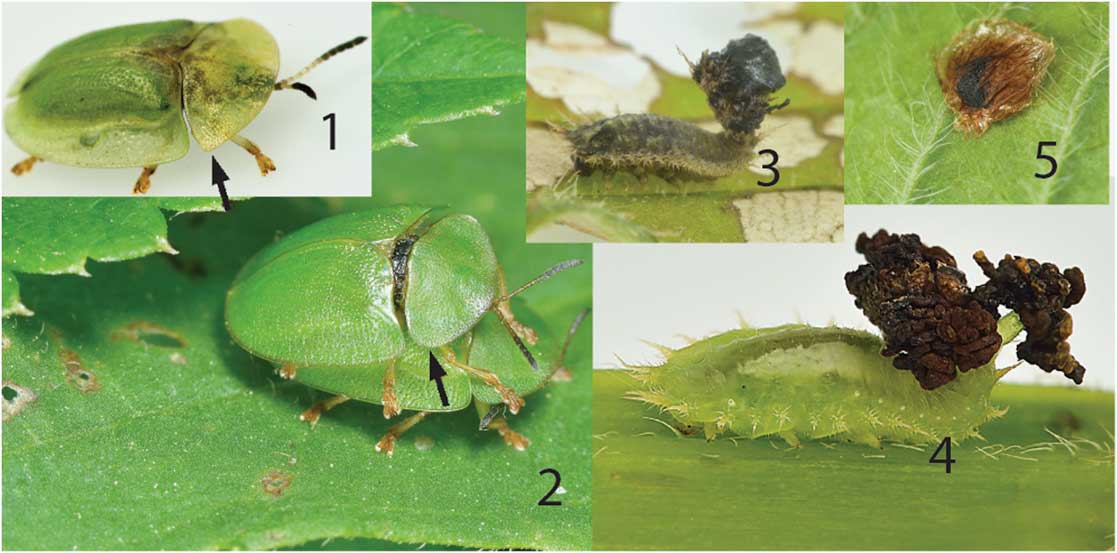
Since C. rubiginosa, the only bright green Cassida species known from North America, develops only on Asteraceae, we were surprised to find a bright green Cassida species feeding on Monarda Linnaeus (Lamiaceae) in a garden in Fergus, Ontario, Canada. Specimens of these Monarda-feeding beetles were subsequently identified as the European C. viridis Linnaeus using Borowiec and Więtojańska (Reference Borowiec and Więtojańska2014). Cassida viridis is known to feed on a variety of Lamiaceae, including Galeopsis Linnaeus, Lycopus Linnaeus, Melissa Linnaeus, Mentha Linnaeus, Salvia Linnaeus, and Stachys Linnaeus (Borowiec and Więtojańska Reference Borowiec and Więtojańska2014) and Monarda Linnaeus (Mabbott and Salisbury Reference Mabbott and Salisbury2005). Cassida viridis is easily distinguished from C. rubiginosa by its relatively broad posterolateral pronotal angle (Figs. 1, 2) and large, appendiculate tarsal claws (the claws of C. rubiginosa are simple). The larvae of C. viridis are bright green (Fig. 4), while those of C. rubiginosa are darker (Fig. 3). Eggs of both species are packaged in a brown, papery sheaf (Fig. 5 shows the eggs of C. viridis).
1, Cassida rubiginosa adult, Windsor, Ontario, 6.vii.2014 (arrow points to posterolateral pronotal angle). 2, Cassida viridis, Fergus, Ontario, 1.vi.2014 (arrow points to posterolateral pronotal angle). 3, Cassida rubiginosa larva. Orwell, Ontario 13.vi.2013. 4, Cassida viridis larva, Fergus, 26.vi.2013. 5, Cassida viridis eggs, Fergus, Ontario, 8.vi.2013. All photographs by S.A.M.

Although there are no published records of C. viridis from North America, the discovery of thriving populations of this species in an Ontario garden does not mean that the species has been newly introduced to the continent. Specimen records in the University of Guelph Insect Collection (Guelph, Ontario, Canada) (see below for details) show that it has been present in Ontario at least since 1974, but it has been overlooked because of its similarity to C. rubiginosa, from which it can be distinguished by the characters given above. The only other North American tortoise beetle with which it could be confused is the pale green Gratiana pallidula (Boheman), which differs from Cassida species in having coarse elytral punctation arranged in rows, and in having larvae that lack the fecal shield carried by C. viridis and relatives. North American Gratiana Spaeth species occur only on Solanum Linnaeus, but no North American Cassida species occurs on host plants in the family Solanaceae, and C. viridis is found only on host plants in the family Lamiaceae. One other tortoise beetle, Physonota unipuncata (Say), has been recorded from Monarda in northeastern North America but this species is pale brown and is unlikely to be confused with C. viridis. Physonota unipuncata is the only tortoise beetle listed by Borowiec and Więtojańska (Reference Borowiec and Więtojańska2014) as feeding on Monarda.
Specimen data (standardised) for Cassida viridis in the University of Guelph Insect Collection: ONTARIO: Wellington Co.: Guelph, 11 May 1988, pan trap, I.P. Smith (1 specimen); Guelph, 3 June 1974, D.J. McComb; Guelph, 7–8 May 2005, O. Lonsdale (1 specimen); Nichol Township, 26 July 1975, S. Allan (2 specimens); Guelph, Township Road 3, 1 June 1970, R.D. Fairbairn (1 specimen); Fergus, 26 April 1998, S.A. Marshall (1 specimen); Fergus, 13 June 2005, S.A. Marshall (1 specimen); Fergus, Marshall property, on Monarda, June 2014, S.A. Marshall (1 specimen); Halton Reg.: Milton, 7 July 1976, E.A. Innes (1 specimen).